Archive for the ‘Israeli military’ category

‘Tunnel war’ heralds Hamas-IDF next clash

May 6, 2016

‘Tunnel war’ heralds Hamas-IDF next clash, DEBKAfile, May 6, 2016

NahalOz_Tunnel_480_Kotert

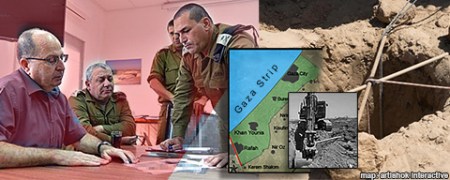
The IDF and Hamas are engaged in another round of warfare both above and below ground. The two sides are exchanging fire in the Gaza border area while the IDF continues its operations to locate the terror tunnels of the Hamas military wing. The IDF did the correct thing on Thursday by declaring areas near Gaza with suspected  tunnels as “closed military zones”, amid concern that Hamas has already infiltrated into Israeli territory, even as training exercises. It is also important that the IDF is maintaining secrecy on the technological tools being used to locate the tunnels.

The exchanges of fire between the IDF and Hamas in the Gaza border area during the last few days have rattled the terrorist organization, making it fire mortar shells, rockets and light weapons at IDF forces in the area. The firing that intensifies each time that the troops approach a tunnel is helping the IDF locate the openings of the tunnels.

More than a year after the end of “Operation Protective Edge” in 2014, which was supposed to eliminate the threat of tunnels to southern Israel and restore calm among citizens, the Israeli government finally ordered the Defense Ministry and the IDF to listen to the complaints of Gaza border area residents, and to what was happening beneath the ground.

The noises from underground that were recorded over the last few months by frightened residents in the area’s communities and the shaking of the ground at night left no doubt that the digging was taking place nearby. In order to eradicate in  order to end the tunnel threat. IDF experts tested hundreds of devices, ideas, methods and means from various fields of research, including some that could be defined as bizarre.  Many new tunnels were been discovered with the help of hitherto untested technologies.

This with the human sources of intelligence like Mohammad Atauna, a commander in the Hamas tunnel network whose capture by Israeli intelligence was published on Thursday, could lead to the elimination of the tunnels in the coming days and weeks. All of these developments have made it clear to the heads of the military wing of Hamas, the Izzudin al-Qassam brigades, among whom only some follow the orders of the Hamas leadership and its political wing, that their biggest strategic asset, the tunnels, may disappear in the very near future. Whether the process takes a month or six months, it should now be very obvious to them that in the very near future the majority of the underground Hamas infrastructure will be destroyed, whether by explosives or flooding.

Since the heads of the Hamas military wing invested most of their budget and efforts in the digging, fortification and reinforcement of the tunnels that they planned to use to invade and attack Israel, the destruction of the underground network may have three main results:

1. In the coming days, the Hamas military wing may lash out in a desperate attempt to land a major blow against Israel. It is expected to be significantly weakened by the IDF operations in the near future but regain strength in the long term.

2. The military wing of Hamas will suffer a major defeat in the battle for popular support. The dire economic situation in Gaza that is partially due to the diversion of resources to the tunnels and other military means will weaken support among the public.

3. These developments will bring about a change in the balance of forces in Gaza that will benefit the political wing and weaken the military wing.

Under these circumstances, the desire by the head of the Izzuddin al-Qassam brigades, Mohammed Deif, who was seriously injured but is still alive and kicking, to get revenge against Israel has not been forgotten in IDF command in Tel Aviv and at the Prime Minister’s Office in Jerusalem. The assessment in Israel’s intelligence community is that in the coming days he will use all the means at his disposal, with or without the permission of the political wing, and just before his last tunnels are discovered, in an attempt to launch a strike to deal a powerful and painful blow to Israel.

In the meantime, on Thursday, the IDF continued its preparations to bombard Hamas from the ground and the air as the terrorist organization’s mortar shelling increases.

Column One: Our estranged generals

April 21, 2016

Column One: Our estranged generals, Jerusalem Post, Caroline B. Glick, April 21, 2016

(But, but if Israel accepts that weakness is strength and strength is weakness, as Obama and Europe have agreed, they will support Israel and a lasting peace will break out. Not. — DM)

IDF generalsIDF chief of staff Gadi Eisenkot (R), Defense Minister Moshe Ya’alon, and Prime Minister Benjamin Netanyahu. (photo credit:GPO)

It’s been a long time coming, but it finally happened.

The IDF General Staff has lost the public trust.

This is terrible for the General Staff. But it is more terrible for the country, because the public is right not to trust our military leaders. They have earned our distrust fair and square.

The final straw came in less than optimal circumstances.

But such is life. Things are never cut and dry. On Purim, Sgt. Elor Azaria killed a terrorist in Hebron as he lay on the ground, shot, following his attempted murder of one of Azaria’s comrades.

Still today, we don’t know whether Azaria acted properly or improperly. He claims that he believed the terrorist had a bomb beneath the heavy jacket he was wearing in the middle of a heat wave.

Azaria claims that he shot him because he feared that the terrorist – who was moving – was trying to detonate the bomb. This view was shared by emergency personnel at the scene caring for the wounded soldier.

But even before he had a chance to tell his story, IDF Chief of Staff Lt.-Gen. Gadi Eisenkot and Defense Minister Moshe Ya’alon had already declared Azaria guilty of murder. Based on an initial field investigation and a snuff film produced by the European-funded anti-Israel group B’Tselem, Eisenkot and Ya’alon excoriated Azaria and pronounced the soldier, who was decorated for his service just last year, a rotten apple.

Prime Minister Benjamin Netanyahu initially joined them in their condemnations. But when he realized that the public wasn’t buying it and that the evidence was far from cut and dry, to his credit, Netanyahu walked back his remarks.

Ya’alon and Eisenkot, in contrast, have refused to let the uncertainty of the situation affect them.

Their continued assaults on the soldier have compounded the damage. Their stubborn refusal to give Azaria the benefit of the doubt and admit that he may well have comported himself properly indicates that they have no idea how their statements are being viewed by the public, or worse, they may not care. They may simply be playing for another audience.

And here lies the beginning of the real problem.

For the public – including the five thousand citizens who came to the support rally for Azaria at Rabin Square on Tuesday – the critical moment was when the film of Azaria being led away from the scene in handcuffs was broadcast on the evening news. That image, of a combat soldier who killed a terrorist being treated like a criminal, was the breaking point for the public. Whether he was guilty or innocent was beside the point. The point was that his commanders – beginning with the defense minister and the chief of General Staff – were treating him like a criminal instead of a combat soldier on the front lines defending our country from an enemy that seeks our destruction.

This image, combined with Ya’alon’s and Eisenkot’s increasingly shrill and caustic condemnations of Azaria, was a breach of the social contract between the IDF and the public. That social contract says that we serve in the IDF. We send our children to serve in the IDF. And the IDF values us and values our sons and daughters as its own.

The sense that our generals are not on the same page as the rest of us has been gnawing at us since at least April 2002, in the aftermath of the battle in Jenin, during the course of Operation Defensive Shield.

Back then, fearing CNN and the UN, IDF commanders sent a reserve battalion into Jenin refugee camp, the epicenter of the Palestinian murder machine, without air cover and without armored vehicles. Thirteen reservists were killed in one day. Twenty-three soldiers were killed in the three-day battle.

The sense of alienation continued through the war in Lebanon four years later when the IDF conducted one of the most inept campaigns in its history. Soldiers were sent willy-nilly into battles with no strategic purpose because the General Staff wanted to “stage a picture of victory.”

This sense has been maintained in successive inconclusive campaigns in Gaza.

Now, with the General Staff’s decision to turn Azaria into a scapegoat at a time when it is failing to defeat the Palestinian terrorist wave in Judea and Samaria, that gnawing sense that something is amiss has become a certainty.

Our generals are not on the same page as the rest of us. In fact, they aren’t even reading the same book.

Our generals are motivated by three impulses and strategic assumptions that are not shared by the majority of Israelis.

The first of those is their willingness to sacrifice soldiers in battles, and, in the case of Azaria, in show trials, in the hopes of winning the support of the Europeans and other Western elites. This impulse is not simply problematic. It is insane, because for more than a decade, it has been continuously proven futile.

At least since the battle in Jenin, it has been abundantly obvious that the Europeans will never support us. The Europeans, along with the UN and the Western media, ignored completely the lengths Israel went to prevent Palestinian civilian casualties in Jenin. They accused us of committing a Nazi-style massacre despite the fact that not only wasn’t there a shred of evidence to back their wild allegations. There were mountains of evidence proving the opposite. The Palestinians were massacring Israelis and would have continued to do so, had the IDF not retaken their population centers and so ended their ability to strike us at will.

And yet, despite the trail of UN blood libels from Jenin to the Goldstone Report and beyond, despite the faked media images of purported IDF bombings of civilians in Lebanon and Gaza, despite the hostility of EU diplomats and politicians and the open anti-Semitism of the European media and public, our generals still care what these people think about us.

Eisenkot and his generals still believe that by giving soldiers sometimes life-threateningly limited rules of engagement, by forcing every battalion commander to have a legal adviser approve his targeting decisions, the Europeans will be convinced that they should stop supporting our enemies.

The second impulse separating our generals from us is that almost to a man, members of the General Staff want a Palestinian state to be established in Judea, Samaria and Jerusalem and they want that state to be joined in some way with Gaza.

After 15 years of Palestinian terrorism and political warfare, our security brass still believe that the PLO is Israel’s partner. It doesn’t matter to them that the PLO is driving the current wave of terrorism just as it drove all the previous ones.

This is the reason that Eisenkot and his ideologically driven generals insist that we leave the Palestinian population centers after we spent so much blood and treasure fighting our way into them 14 years ago.

This is the reason that while Eisenkot and his generals insist that the PA security services are helping us fight terrorism even though no help would be necessary if the PA wasn’t inciting terrorism.

The generals’ stubborn faith in the notion that Palestinian terrorists who seek the destruction of our country will magically be transformed into allies the minute we turn the keys to our security over to them, sets them apart from the vast majority of Israelis.

Most Israelis support a theoretical Palestinian state that is at peace with us. Most Israelis would be willing to give up substantial amounts of territory if doing so would bring peace with the Palestinians.

But most Israelis also recognize that the Palestinians are not interested in peace with us and as a consequence, it makes no sense to give them any land. Most Israelis recognize that you can’t trust the good intentions of leaders who tell their school-age children to stab our school-age children.

The third impulse separating our generals from the public is their embrace and glorification of weakness. On every front, for more than 20 years, members of the General Staff have embraced the notion that there is no military solution to any of the security threats facing the country.

Until the Syrian civil war, the generals believed that if we left northern Israel vulnerable to attack and invasion by giving the Assad dynasty the Golan Heights, then the Assads would be magically convinced to ditch their Iranian sponsors and make common cause with an Israel that could no longer defend itself.

They have opposed attacking Iran’s nuclear facilities, insisting that we can trust the US, even though it has been obvious for years that the US would take no action to prevent Iran from acquiring nuclear weapons.

As for the US, the IDF embraces strategic dependency on the US. They insist that we can trust the Americans even though the Obama administration sided with Hamas in Operation Protective Edge. They continue to argue that we can depend on American even though the Obama administration is actively enabling Iran to acquire nuclear weapons. Utterly foreign to them is the notion that Israel would strengthen its alliance with the US by acting independently against Iran’s nuclear facilities, because doing so would prove that Israel is not a strategic basket case but a regional power that commands respect.

They oppose destroying Hamas’s military capabilities.

As a consequence, they have conducted four campaigns in Gaza since the 2005 withdrawal that all lacked a concept of victory. And by the way, the General Staff enthusiastically supported the strategically irrational withdrawal from Gaza.

When the public gets angry at our generals for not striving to defeat Hamas, for instance, they look at us like we fell off of Mars. Why would they want to defeat Hamas? Their job is to contain Hamas. And they are doing their job so well that Hamas managed to dig a tunnel right under their feet.

What explains our generals’ embrace of positions that most Israelis reject? Why are they willing to sacrifice soldiers and embrace Orwellian notions that weakness rather than strength is the key to peace? It is hard to say. Perhaps it’s groupthink. Perhaps it’s the selection process. Perhaps it’s overexposure to Europeans or Americans. Perhaps they are radicals in uniforms. Perhaps it is none of those things.

But whatever the cause of their behavior, the fact is that behavior has alienated them from Israeli society. In treating Palestinian terrorists with more respect than it accords its own soldiers, the IDF General Staff is earning the public’s fury. And in their contemptuous dismissal of the public’s loss of trust, our generals – including Ya’alon – are demonstrating that they have become strangers to their own society. This of course is a calamity.

The IDF lost the public’s trust at Purim. Let us hope that at Passover, our generals will leave their bubble and begin repairing the damage they caused. They are not in Europe. They are here.

And they need to be with us.
New Iron Dome version can destroy tunnels

March 11, 2016

New Iron Dome version can destroy tunnels, DEBKAfile, March 11, 2016

Anti_tunnel_missile_NEWIran keeps its ballistic missiles in underground bunkers

Israel has started testing a secret new weapon for defeating the tunnel systems which the Palestinian Hamas and Hizballah are busy digging for surprise attacks against Israel. Western sources reported Friday, March 11, that the new weapon, dubbed the “Underground Iron Dome,” can detect a tunnel, then send in a moving missile to blow it up.

US intelligence sources disclosed only that new weapon is equipped with seismic sensors to detect underground vibrations and map their location before destroying them.

Western experts have been talking for years about a secret Israeli weapon capable of destroying Iran’s Fordo nuclear facility, which is buried deep inside a mountain not far from the Shiite shrine city of Qom. They suggested that this hypothetical weapon could be slipped through the Fordo facility’s vents, thread its way through the underground chambers and take down the illicit enrichment facility.

It was discussed again three years ago, when the Israeli Air Force on Aug. 23 2013 blew up the Popular Palestinian Front-General Command underground facility at Al-Naama on the South Lebanese coast, 15 km south of Beirut.

The PPF-GC leader Ahmed Jibril was then taking his orders from Iran’s Revolutionary Guards Corps.

How this operation turned out was never revealed. But Western military sources saw it as a strong Israeli message to Tehran that its underground nuclear facilities were now vulnerable to attack. The secret JIbril command center was constructed in the 1970s by East German military engineers as one of most heavily fortified military sites in the Middle East.

As for the new weapon, the Pentagon spokesman Christopher Sherwood said that the US had allocated $40 million for completing in 2016 the establishment of “anti-tunnel capabilities to detect, map and neutralize underground tunnels that threaten the US or Israel.”

According to the spokesman, the main part of the development work (on the secret weapon) would be conducted in Israel in 2016. The US would receive prototypes and access to the test sites and hold the rights to any intellectual property.

The Israeli firms working on the anti-tunnel weapon are Elbit Systems and Rafael Advanced Defense Systems, which developed the Iron Dome.

Sherwood denied claims from Israeli defense quarters that the US had earmarked $120 for developing the system, or that another $80 million would be available – half in 2017 and half in 2018.

DEBKAfile’s military sources emphasize that the timeline implicit in those estimates doesn’t necessarily represent the tempo of he Underground Iron Dome’s development.

According to past experience, unfinished Israeli weapons have more than once been rushed to the battlefield to meet an emergency war situation. The Iron Dome is one example. This has the advantage of testing innovative systems in real operational conditions, with the result that improvements and adjustments can be introduced much faster than planned.

Our sources add: Both Palestinian Hamas and the pro-Iranian Hizballah are working overtime on tunnels for sneaking terrorists and commando fighters into Israel to attack IDF posts and civilian locations. During Israel’s last counter-terror operation in the Gaza Strip, Hamas staged a deadly tunnel attack on the Israel side of the border and is planning repeats. Hizballah is training commando units for underground surprise incursions to capture parts of Galilee in northern Israel.

The Israeli government has spent more than $250 million since 2004 on efforts to thwart tunnel construction under the Gaza border.

IDF Chief of Staff Gen. Gadi Eisenkot hinted at these efforts in February. “We are doing a lot, but many of [the things we do] are hidden from the public,” he told a conference at Herzliya’s Interdisciplinary Center. “We have dozens, if not a hundred, engineering vehicles on the Gaza border.”

Special Israeli emissary to Moscow over Russian Syria air strikes near border

February 17, 2016

Special Israeli emissary to Moscow over Russian Syria air strikes near border, DEBKAfile, February 17, 2016

Israel_near_border_16.2.16

In view of the crisis building up on the southern Syrian-Israeli border, Prime Minister Binyamin Netanyahu decided immediately on his return home from Berlin early Wednesday, Feb. 17, to send a special  emissary to Moscow to ask for clarifications. Tuesday, Intensified Russian air strikes came to within 6 km of the Israeli border, sparking a growing exodus of Syrian refugees heading towards the Qoneitra border crossing to Israel.

DEBKAfile’s sources reveal that the envoy is Dr. Dore Gold, director-general of the Foreign Ministry and one of the prime minister’s few trusted confidantes.

It was still not clear whom Gold will meet in the Russian capital, but it is assumed that it will be one of Moscow’s senior decision-makers in the loop on its military operation in Syria.

The fact that Netanyahu decided to dispatch a top diplomat rather than a senior military or intelligence officer is a sign that the prime minister is not of one mind with the IDF’s intelligence assessments of the situation on the ground.

Netanyahu’s concerns grew after after the Russian air force on Tuesday widened its massive bombing of southern Syria from the city of Daraa to the Golan town of Quneitra, in order to help the Syria army’s 7th armored division push the rebels east, so they will not attempt to cross the border and seek shelter in Israel.

DEBKAfile’s military sources report that that 12 of the 15 targets bombed by the Russian air force across from the Israeli border were new rebel positions that had not been attacked before, even by the Syrian army. Military sources monitoring the war said Tuesday night that there is no doubt that the Russians are in the process of wiping out the rebel positions along the Israeli border by means of an offensive comparable to their operations in the northern Aleppo sector.

Our sources report that Israel’s concerns grew when, as the Russians bombing raids neared the Israeli border, Syrian officials threatened Jordan with serious consequences if Amman gave the Saudi air force a base for attacking eastern or southern Syria.

The threats began Tuesday, after Jordanian forces took over the Syrian-Jordanian border crossings formerly held by Syrian rebels, as a measure to stem the volume of Syrian refugees in search of sanctuary in the Hashemite Kingdom. But this step was interpreted by the Syrians and their Russian ally as clearing the way for Saudi intervention in the Syrian conflict using Jordan as a jumping-off base.

Meanwhile, Western military sources reported a sub substantial presence Tuesday of both Russian and Israeli warplanes in the skies over and around southern Syria.

Did Hizballah dig a special tunnel to get bomb into Israel?

January 6, 2016

Did Hizballah dig a special tunnel to get bomb into Israel?, DEBKAfile, January 6, 2016

Israeli Minister of Defense Moshe 'Boogie' Ya'alon (2R) seen during a visit in the Golan Heights, Northern Israel, on January 5, 2016. Photo by Ariel Hermoni/Ministry of Defense *** Local Caption *** ?? ?????? ??? ????? ???? ??? ????? ??? ?????
Israel’s military chiefs on Golan

The mystery of how Hizballah managed to plant the bomb, which blew up against an IDF patrol, without causing casualties, Tuesday, Jan. 5, in the Shebaa Farms district of Mt Hermon – on the Israeli side of the ceasefire line – is perplexing Israel’s military chiefs. It brought Defense Minister Moshe Yaalon, Deputy Chief of Staff Maj. Gen. Yair Golan (former OC Northern Command) and his successor Maj. Gen. Aviv Kochavi to the Golan the next day for a close inspection of the Syrian and Lebanese border defenses.

They found no fault with the meticulous preparations and counter-measures the contingents on the spot had made for an attack, which Hizballah leader Hassan Nasrallah had said was “inevitable” after the assassination of Samir Quntar in Damascus on Dec. 20.

But, in addition, to the lookout posts scattered along the border, was a countermeasure that had been rated impermeable: an “electronic sterile area” abutting the electronic border fence, which has been strewn with hi-tech sensors and other devices designed to act as tripwires for the smallest intrusion.

The fact that Hizballah was able to plant a bomb on the Israeli side of the border proved that this elaborate system did not work.

The Shiite terrorist group, Iran’s Lebanese proxy, has long been known to maintain a commando unit known as the “Redwan Force,” especially trained for eventual incursions into Israel on missions of assault and the capture of Israeli locales with hostages.

But its ability to outsmart an electronically sterile barrier was quite another matter. It is of the utmost urgency for IDF tacticians to seriously rethink the defensive measures in place on the northern borders with Syria and Lebanon, before Hizballah strikes again.

But first of all, they must find out how it happened. Some Lebanese sources are throwing out hints of a secret tunnel dug by Hizballah, through which the “Quntar Brigade” was able to sneak the bomb onto the IDF patrol route, although it failed to cause casualties. No trace of a tunnel has so far been reported.

At the time of the incident, Israeli public and media attention was wholly taken up with the Dizengoff gunman, who murdered three Israelis on Jan. 1 and is still at large six days later.

Since Hizballah’s Shebaa Farms attack was swiftly countered by massive IDF artillery fire, it was soon over and the episode relegated to back pages. However, the defense minister and IDF chiefs cannot afford to treat it lightly. They are convinced that Hizballah has not concluded its campaign of “revenge” and may reuse the same method for further attacks. No stone is therefore being left unturned to discover how Hizballah smuggled a bomb onto Israeli terrain – over or under the border – and the preparations for an attack remain high.

At the end of his Golan inspection visit, the defense minister said: “The IDF is alert and fully prepared for every eventuality, just as it was for the Mt Dov (part of Mt. Hemon) attack. The forces are ready to respond whenever and however necessary and, if need be, their response will be powerful indeed.”

Hizballah blows up “Mossad” patrol, sparks border clash with Israel

January 4, 2016

Hizballah blows up “Mossad” patrol, sparks border clash with Israel, DEBKAfile, January 4, 2016

Shortly after DEBKAfile’s forecast of a Hizballah revenge strike for the Samir Quntar assassination, a Hizballah roadside bomb blew up against an IDF patrol at the Shebaa Farms on the Hermon slopes Monday afternoon, Jan. 4.  No casualties were caused. The Israeli force responded with tank artillery fire on the southern Lebanese town of Al-Wazzani and was answered by rocket fire from Lebanon

Hizballah announced that it had targeted an Israeli patrol with a bomb on the ceasefire line at the Shebaa Farms targeting a civilian car carrying a “senior Mossad officer”.

The next Hizballah communiqué said: The Martyr al-Quntar Unit blew up a bomb against an Israeli patrol in the Shebaa Farms, destroying a military vehicle and causing casualties.

In a third communiqué, Hizballah said the car attacked carried a “senior Israeli army officer” – amending its previous claim of a Mossad officer.

The Israeli army has closed all northern roads to civilian traffic in case the Hizballah attack spreads into a major clash.

DEBKAfile reported earlier Monday that the rising tension between Tehran and Riyadh may serve Iran and its Lebanese proxy as an oportunity to attack Israel. The leader of that proxy, Hizballah’s Hassan Nasrallah, had repeatedly threatened to punish Israeli for the assassination of its high profile terrorist planner Samir Quntar in Damascus on Dec, 20. Quntar was freed by Israel as part of a prisoner swap in 2008, three decades after he was convicted of killing four Israelis. In September, the United States placed Quntar on its terror blacklist, saying he had “played an operational role, with the assistance of Iran and Syria, in building up Hizballah’s terrorist infrastructure in the Golan Heights.”

IDF, Russian, Iranian forces on war alert for Hizballah attack on Israel – and backlash

December 31, 2015

IDF, Russian, Iranian forces on war alert for Hizballah attack on Israel – and backlash, DEBKAfile, December 31, 2015

Gerhard-Conrad

The IDF and all of the armies involved in the Syrian civil war, namely those of Russia, Syria and Iran, went on their highest war alert on Thursday, Dec. 31 when all their intelligence organizations reported that Hassan Nasrallah could not be stopped from attacking Israel, in revenge for the assassination of Samir Quntar in Damascus on December 20.

More than one intermediary visited Beirut to avert the Hizballah attack and its deadly fallout, including a former senior officer of the German BND foreign intelligence service. According to DEBKAfile’s intelligence sources, Gerhard Conrad, late of the BND and incumbent director of the European Union’s Intelligence and Situation Center, was given this urgent mission by Chancellor Angela Merkel.

He came away from a meeting with Nasrallah on Dec. 29, with the news that the Hizballah chief was not open to persuasion and the attack was already underway.

Conrad has excellent connections in the Arab world, especially in Syria and Lebanon. Seven years ago, he acted as intermediary between Israel and Hizballah for negotiating the recovery of the bodies of two fallen IDF soldiers, Eldad Regev and Ehud Goldwasser, in exchange for the handover of that same Hizballah high-up Samir Quntar and other jailed and convicted Arab terrorists.

The German spy-diplomat then established personal connections with a shadowy figure, Wafik Safa, who is in charge of Hizballah’s intelligence and security network and a close crony of Nasrallah.

Conrad used those connections again in 2011 to broker the release of Gilead Shalit from Hamas captivity.

It was Safa he arranged for him to meet Nasrallah in Beirut Tuesday. He found the Hizballah chief unshakeable in his determination to make Israel pay for Quntar’s death, even at the cost of a painful backlash against the Shiite group’s terrorists in Syria and Lebanon.

He was unmoved by the warning issued by Israel’s chief of staff, Lieut. Gen. Gady Eisenkott, on Monday, just hours before the Conrad mission.  Eisenkott said, “Just as we have proven in the past, we know how to strike anyone who wishes to harm us. Our enemies know they will suffer grave consequences if they try to undermine our security.”

Upon receipt of the German emissary’s report on the meeting, Eisenkott, his deputy, Maj. Gen. Yair Golan, and OC Northern Command, Maj. Gen. Aviv Kochavi, inspected the preparedness of the IDF’s northern border defenses for all contingencies.

They took into account a scenario, whereby Nasrallah would take advantage of the stormy weather forecast for the weekend in Syria, Lebanon and Israel, to strike Israel, in the knowledge that the heavy rain and snow would impede Israeli air force activity and give the Hizballah operation a tactical edge.

Russian military and Iranian Revolutionary Guard forces in Syria have taken into account that a Hizballah attack will not go unanswered by Israel and that the IDF would most likely hit back at Hizballah on Syrian soil, thus ushering in the New Year with a new whirlwind.