Archive for the ‘Israel’ category

Hamas Declares Palestinian Unity Government Dead

December 1, 2014

Hamas Declares Palestinian Unity Government Dead, Washington Free Beacon, December 1, 2014

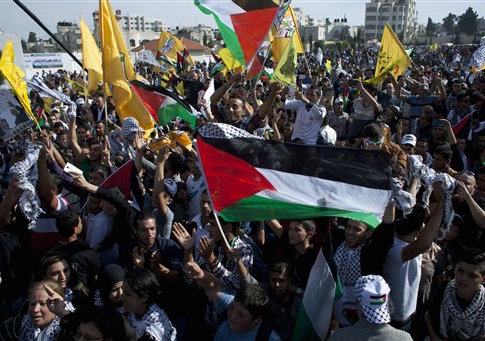
Mideast Israel PalestiniansPalestinian supporters fly Palestinian and Fatah party flags, chant slogans and dance during a ceremony marking the 10th anniversary of the late Palestinian leader Yasser Arafat’s death, at the Palestinian Authority headquarters, in the West Bank city of Ramallah / AP

Fatah claims otherwise.

***************

Leaders of the Palestinian terror group Hamas announced on Sunday that a national unity government formed earlier this year with the Fatah party had officially expired, leaving the status of the fragile political framework up in the air, according to regional reports.

The end of a tenuous six-month unity deal reached between Hamas and Fatah means that leaders from both Palestinian factions will have to meet in the coming weeks to decide whether or not to renew the governing coalition, which had united the ruling parties in the Gaza Strip and West Bank.

The expiration of the deal was announced on Sunday by Hamas Spokesman Sami Abu Zuhri during a news conference in Gaza, according to the Palestinian Ma’an News Agency. Conflicting reports about the status of the unity government emerged just hours later when a Fatah official claimed that an expiration date had never been set on the deal.

The uncertainty surrounding the unity government comes as tension in Jerusalem remains high amid a spate of violent protests by the Palestinians that have been endorsed by Fatah leaders in several cases.

Hamas Spokesman Zuhri said that the group “isn’t interested in incitement, but rather seeks to maintain national unity,” according to Ma’an.

Hamas “does not control the Gaza Strip at all,” according to Zuhri, who added, “If the national consensus government doesn’t want to take responsibility for Gaza, this doesn’t mean the government is exempted from this responsibility.”

Hamas also expressed anger at a recent crackdown on its supporters undertaken by Palestinian Authority security forces.

At least 80 Hamas-backers have been arrested in the West Bank, according to Ma’an.

“Hamas denounces the escalating violations and criminal acts by the PA security services against supporters of Hamas and the Palestinian resistance,” Zuhri was quoted as saying.

Meanwhile, Fatah leaders are claiming that the unity government was not supposed to expire.

The unity government was tasked with holding elections within a six-month time frame, but was not supposed to be dissolved if this was not completed.

“If the Hamas movement has retracted the reconciliation agreement and the termination of rivalry, that is a different case,” Fatah official Faisal Abu Shahla was quoted as telling Ma’an after Hamas’s announcement.

Shahla further stated that “reconciliation discussions were pending a response from Hamas regarding the attacks with explosives against Fatah leaders’ property in Gaza and the cancellation of a ceremony commemorating the late Palestinian leader Yasser Arafat in Gaza City in early November,” according to Ma’an.

Erdogan slams US on Syria again, days after Biden visit

December 1, 2014

Erdogan slams US on Syria again, days after Biden visit, Al-Monitor, Week in Review, November 30, 2014

U.S. VP Biden meets with Turkey's President Erdogan in IstanbulUS Vice President Joe Biden (L) meets with Turkey’s President Recep Tayyip Erdogan at Beylerbeyi Palace in Istanbul, Nov. 22, 2014. (photo by REUTERS/Murad Sezer)

Turkish President Recep Tayyip Erdogan calls US “impertinent” on Syria, says West likes seeing Muslim children die; Israel considers extension of Iran nuclear talks as better than a bad deal.

*********************

Turkish President Recep Tayyip Erdogan said on Nov. 26 that he is “against impertinence, recklessness and endless demands” coming from “12,000 kilometers away” (7,456 miles), his latest not-so-veiled rebuke of US policy toward Syria.

Erdogan’s outburst came four days after US Vice President Joe Biden departed Turkey. Biden, the latest in a seemingly endless stream of senior US official visitors to Ankara, spoke of the “depth” of the US-Turkish relationship and how the United States “needs” Turkey. The US vice president praised Turkey’s turnaround, for now, in its ties with Iraq, as reported this week by Semih Idiz, and Turkey’s handling of close to 1.6 million Syrian refugees (the UN High Commissioner for Refugees puts the number at approximately 1.1 million).

Despite the predictable deadening public platitudes, Biden’s visit, like those of other senior US officials, was a flop for the anti-Islamic State (IS) coalition. Erdogan prefers to hold his support against IS as ransom for a US-backed buffer or no-fly zone inside Syria. Not that the Turkish president, or others hawking such a plan, present any “day after” strategies for Syria; explain how a buffer zone or “doubling down” on the Syrian opposition would do anything more than prolong the war and wreck what remains of the Syrian state; lay out how the United States can avoid another Libya or another Iraq (that is, a failed state or a prolonged occupation) if it pursues regime change in Syria; identify where a post-transition stabilization force may come from given the limitations of Syrian rebel forces; or explain why the jihadists would not gain the upper hand in a divided post-Assad Syria with such a weak and fragmented opposition.

Turkey’s unwillingness to combat IS and other terrorist groups stands in contrast with US allies Saudi Arabia, United Arab Emirates, Jordan and Bahrain, as well as Iran, all of whom have concerns about US policy but are nonetheless engaged in combat operations against terrorists in Syria and Iraq.

Bruce Riedel explains how Saudi Arabia, which uncovered an IS-linked cell operating in the kingdom this week, is struggling with managing the threat from IS and its regional rivalry with Iran, but is nonetheless playing a leading role in the anti-IS coalition. Hossein Mousavian points out that among the “ground forces” combating IS, besides US-supported Syrian rebel forces, are the Iraqi and Syrian armies and Hezbollah, which are all backed by Iran. According to Mousavian, Tehran could be ready to do more if a nuclear deal is reached. Ali Hashem reports this week on Hezbollah’s role in Iraq, and Ali Mamouri chronicles the higher profile role that Iran Quds Force leader Qasem Soleimani is playing with Iraqi forces battling IS. Iraqi Kurdistan Region President Massoud Barzani, whose forces are also on the frontlines of the battle against IS, praised Iran’s role, saying in August that “Iran was the first country to provide us with weapons and ammunition” to confront the IS advance toward Erbil. Syrian government warplanes bombed Raqqa, an IS stronghold, on Nov. 25, although the United States accused Syria of killing many civilians in the process. US-led coalition forces also conducted airstrikes against IS forces in Raqqa this week.

Erdogan appears to be the odd man out in the coalition, compared with the actions of the other regional powers, and his policies and statements should raise broader questions about the direction of Turkish foreign policy, including what it means for Turkey’s membership bid in the EU and its role in NATO. Idiz writes that Erdogan appears to be turning his back on Turkey’s EU membership bid. On Nov. 28, the eve of Pope Francis’ visit to Turkey, Erdogan offered the following about Western countries: “Believe me, they don’t like us,” AFP reported him as saying. “They look like friends, but they want us dead — they like seeing our children die. How long will we stand that fact?”

The United States might soon tire of the all-pain, no-gain appeals to Turkey and simply ask Erdogan to pick a side in the US war against terrorists, making clear, as US President Barack Obama recently said, that the United States is not planning to remove Syrian President Bashar al-Assad at this time. Turkey is a critical US ally that must play a constructive role in Syria and the region, but the trends are becoming alarming. The United States, for its part, does not “need” Turkish bases to train anti-IS or anti-Assad rebels, does not “need” Turkish troops in Syria, and certainly does not “need” a buffer or no-fly zone, unless Washington is longing for a quagmire. What the coalition “needs” is for Turkey to crack down, hard, on the terrorist transit, trade and financial networks operating through Turkey into Syria, which have contributed to the rise of these groups over the past three years. Turkey’s intensified efforts at border security and counterterrorism cooperation would be a major contribution to the coalition. It does not seem to be an unreasonable ask, even if Ankara disagrees with the US approach to Assad.

As this column wrote on Nov. 16, it is the prospect of a nuclear deal with Iran, and the potential for regional cooperation with Iran, that is the key to a settlement of many of the region’s problems, including a political settlement in Syria and whether Assad stays or goes: “US interests in both defeating IS and securing a political settlement to end the Syria war depend on Iran’s good offices in Damascus. The United States cannot deal with Assad, but Iran can. Iran, like Washington’s regional allies, has a high tolerance for the spilling of Syrian blood. If the United States wants to deal Iran out in Syria, especially in the context of a bid to oust Assad, then Iran’s card will be to make the awful situation in Syria go from bad to worse. Iran is not necessarily immovable on Assad’s survival. Iran’s four-point plan for Syria includes a decentralization of power away from the Syrian presidency. Iranian officials privately signal that Assad may not be untouchable, under the right conditions, but such conversations — if they are to bear fruit — can only occur with Iran in a spirit of collaboration, not confrontation. Otherwise, Iran will simply hunker down, and the war will go on.”

Israel OK with extension of Iran nuclear talks

The seven-month extension of the P5+1 nuclear talks with Iran has sparked reactions across the region. Laura Rozen reports from Vienna that progress was made as the Nov. 24 deadline approached but observers are still divided on whether this can be turned into a finished deal in the upcoming months.

Ben Caspit writes of the furious diplomatic effort by Israel to fend off what it would consider a bad deal: “Israel has invested enormous amounts of energy in this. Over the past few months, and especially in the last few weeks, Minister of Intelligence Yuval Steinitz, who has coordinated these efforts, has become a ‘frequent flyer,’ plowing through the relevant capitals right and left. And Steinitz wasn’t alone in this. Senior Israeli intelligence officials also made frequent trips abroad to present their colleagues in different relevant capitals with intelligence documents, intelligence per se, and plenty of new information obtained by the Mossad and other Israeli intelligence agencies about the dangers inherent in that ‘bad agreement.’

“As the deadline approached this week, Steinitz intensified his activities, making two more quick visits, to London and to Paris, and meeting with German Foreign Minister Frank-Walter Steinmeier. Steinitz’s message, backed as always with intelligence reports, expert assessments and various analyses: ‘The agreement under discussion is a terrible agreement. It leaves room for huge potential breaches, which means that it is propped up on weak foundations. If those gaps are not sealed, it would be preferable to avoid reaching any agreement whatsoever than to sign the current one.’”

Retired Israel Defense Forces Gen. Michael Herzog writes that Israel views the extension of the talks as the least of all possible evils, “The truth is that Israel’s ability to influence the relationship between Iran and the West has reduced considerably. The credibility of its military option (which still exists) has decreased in the eyes of the United States and Iran, and its tense relationship with US President Barack Obama’s administration makes it difficult to engage in open dialogue between the two country’s top leaders. At this stage, as long as Iran is not hurtling toward the critical nuclear threshold, all that is left for Israel to do is to maintain the hope that Iran will continue to be intransigent, and that the US Congress will continue to play tough.”


The UN’s theater of the absurd

November 30, 2014

The UN’s theater of the absurd, Israel Hayom, Ron Prosor, November 30, 2014

(Please see also Ambassador Proser’s recent address to the U.N. General assembly. — DM)

In 1975, after repeated attempts to kick Israel out of the U.N., the General Assembly succumbed to the pressure exerted by the Arab countries and determined that Zionism is racism. The decision was the cornerstone of the institutionalized factory of discrimination against Israel at the United Nations. The U.N. waited 16 long years before retracting its “Zionism is racism” decision. The protocols have been updated, but even with no official reminder, the stain remains on the walls of the general assembly hall and the stench is still in the U.N.’s corridors today.

Of the 193 states that belong to the U.N., only 87 are democracies — less than half. The countries that are taking advantage of the democratic process at the United Nations are the same ones that suppress any spark of democracy within their borders. Although the U.N. uses a parliamentary mechanism, many of the hands raised to vote are the hands of brutal dictators.

*****************

On Nov. 29, 1947, a Saturday night, the entire Yishuv (the Jewish community of pre-state Israel) held its breath. The tiny voice of Brazilian U.N. General Assembly President Osvaldo Aranha blared from the radios in every home. The agenda for the day: Resolution 181 on the end of the British Mandate and the partition plan of Palestine. Holocaust survivors, Jews who were kicked out of Arab lands, the many waves of immigrants to Israel, the pioneers and those who immigrated illegally all cast their lot with the promising institution that would be a magnificent monument to the triumph of good over evil in World War II.

Sixty-seven years after that historical vote — the U.N.’s shattered dream lies before us. Over the years, it has gone from a monument of victory to a memorial, a remnant of the hope that has vanished. Although it was designed to prevent the reoccurrence of Nazi crimes, the U.N. has become an international arena for Arab criminal bullying. The Arab world attacked the Yishuv only hours after rejecting the outcome of the vote, and it did not stop even after the thunder of the Napoleon cannons subsided at the end of the War of Independence. The unification of Arab and Muslim countries at the U.N. has created the foundation for a 120-state-strong anti-Israel diplomatic cartel.

In 1975, after repeated attempts to kick Israel out of the U.N., the General Assembly succumbed to the pressure exerted by the Arab countries and determined that Zionism is racism. The decision was the cornerstone of the institutionalized factory of discrimination against Israel at the United Nations. The U.N. waited 16 long years before retracting its “Zionism is racism” decision. The protocols have been updated, but even with no official reminder, the stain remains on the walls of the general assembly hall and the stench is still in the U.N.’s corridors today.

Of the 193 states that belong to the U.N., only 87 are democracies — less than half. The countries that are taking advantage of the democratic process at the United Nations are the same ones that suppress any spark of democracy within their borders. Although the U.N. uses a parliamentary mechanism, many of the hands raised to vote are the hands of brutal dictators.

The U.N. has gone from being a stage for courageous statecraft to a theater of the absurd: The General Assembly allows wild Palestinian incitement, the Security Council has Venezuela and Malaysia managing peacekeeping forces, and then there is the Human Rights Council, in which the guardians of humanity are regimes without a shred of humanity, regimes that invent blood libels against Israel while in Syria, a tyrant slaughters hundreds of thousands of his own people.

Franklin Roosevelt and Winston Churchill had a vision of cross-border cooperation. It’s doubtful that this is the United Nations they envisioned: Nations united by their hatred of Israel. Right now, the U.N. is being asked to decide on its place in the annals of history, will it be remembered as an obstacle to the free world or as a magnet to the nations that aspire to join it?

“Our future does not depend on what the Gentiles will say, but on what the Jews will do,” David Ben-Gurion once said. Israel is not waiting for the U.N. to reform itself — our response to its injustices is in our actions. Our response to the demonization of Israel in the Human Rights Council is the uncompromising defense of the rights of all sectors of society, including women, members of the proud community and the disabled. Our response to delegitimization in the Security Council is the contribution of knowledge and professional experience to the U.N. peacekeeping forces. Our response to incitement in the General Assembly is a series of initiatives that aspire to create a better world, including agricultural technology in the Third World, entrepreneurship in developing countries and taking steps toward religious tolerance, like making Yom Kippur the first Jewish holiday officially recognized by the United Nations.

On the fifth day of the Hebrew month of Iyyar in 1948, the Declaration of Independence was signed. Its text mentions the United Nations no less than seven times. The founders of the state committed with their signatures to stay true to the principles of its charter. Even though the U.N. has lost its way, Israel is keeping its promise. Israeli eye doctors are spreading light in East Africa, Israeli officers offer help during every disaster, and the sharing of blue-and-white knowledge and resources brings water and solar energy to areas in need — we will continue to light the way for the international community until we will again gather in our homes in Israel, looking toward the United Nations filled with hope, not disappointment, appreciation and not contempt.

Ron Prosor is the Israeli ambassador to the United Nations.

Clearing my spindle, Iran edition

November 30, 2014

Clearing my spindle, Iran edition, Power LineScott Johnson, November 29, 2014

(A very good summary of the Iranian mullahs vs. those who don’t want them to have nukes. — DM)

I take it that the mullahs who run the show in Iran have been pursuing nuclear warheads to hitch to ballistic missiles for about as long as the regime as been in business. They have sacrificed much in pursuit of their goals and they are within shouting distance of success, mostly minus whatever sacrifice imposed by the sanctions crafted by Congress against the will of the Obama administration.

Watching the absurd negotiations taking place with the Iranian regime in Vienna, with the United States and the rest of the crew steadily bidding against themselves, I wonder what is to be done by the likes of us. We understand what is happening, but are powerless to do a blessed thing about it.

As the negotiations drag on past their appointed hour, I want to round up some of the recent news and commentary that sheds some light on where we are and whither we are tending. Beyond the links I have little in the way of commentary other than to say that they provide an aid to understanding the consequential events taking place behind closed doors.

Rebecca Shimoni Stoil, Times of Israel, “Former envoy: Iran showed no flexibility in nuke talks.” What do you make of that? Probably more than the Obama administration does.

Bret Stephens, Wall Street Journal, “Iran cheats, Obama whitewashes” (subscribers only, accessible via Google here). Stephens makes a powerful case that the Obama administration has gone into public relations on behalf of the Islamic Republic of Iran:

Why the spin and dishonesty? Partly it’s the old Platonic conceit of the Noble Lie—public bamboozlement in the service of the greater good—that propels so much contemporary liberal policy-making (cf. Gruber, Jonathan: transparency, lack of). So long as the higher goal is a health-care bill, or arms control with Russia, or a nuclear deal with Iran, why should the low truth of facts and figures interfere with the high truth of hopes and ideals?

But this lets the administration off too easily. The real problem is cowardice. As a matter of politics it cannot acknowledge what, privately, it believes: that a nuclear Iran is undesirable but probably inevitable and hardly catastrophic. As a matter of strategy, it refuses to commit to the only realistic course of action that could accomplish the goal it professes to seek: The elimination of Iran’s nuclear capabilities by a combination of genuinely crippling sanctions and targeted military strikes.

And so—because the administration lacks the political courage of its real convictions or the martial courage of its fake ones—we are wedded to this sham process of negotiation. “They pretend to pay us; we pretend to work,” went the old joke about labor in the Soviet Union. Just so with these talks. Iranians pretend not to cheat; we pretend not to notice. All that’s left to do is stand back and wait for something to happen.

Caroline Glick, Jerusalem Post, “Iran’s no China.” Glick draws the inevitable contrast, not to our benefit:

Not only will Obama’s Iran opening not redound to the US’s benefit in the short term. Its inevitable result will be a decade or more of major and minor regional wars and chronic instability, with the nuclear-armed Iran threatening the survival of all of America’s regional allies. It will also lead to shocks in the global economy and massively expand Iran’s direct coercive power over the world as a whole.

Not only is Obama no Nixon, compared to him, Neville Chamberlain looks like a minor, almost insignificant failure.

Ron Ben-Yishai, YnetNews, “Despite nuclear talks’ extension, Iran still on the verge of a bomb.” Not sure about “despite,” but you get the idea.

Michael Herzog, Al Monitor, “Israel views extension of Iran talks as lesser of two evils.” Keep hope alive!

Andrew McCarthy, PJ Media, “Iran celebrates victory over Great Satan because American have clearly surrendered.” As I have observed previously, the public pronouncements of the powers-that-be in Iran have proved far better guides to the course of events than have those of their opposite numbers in the P5+1. Why would that be?

Amos Yadlin, INSS, “Kicking the can down the road.” Keep hope alive!

Aaron David Miller & Jason Brodsky, Wilson Center, “4 big reasons the Iran nuclear deal didn’t happen.” Miller and Brodsky usefully summarize the conventional wisdom while overlooking the glaringly obvious. By contrast, Michael Ledeen extracts the 1 big reason in“The fantasy of the deal.”

Eds., New York Daily News, “Obama bombs in Iran again.” The editors of the Daily News pay attention to what the mullahs have to say:

The supreme religious leader of Iran has confirmed what many Americans already knew: The seven-month extension of talks on Iran’s nuclear program is a victory for the fanatics in Tehran and a serious setback for the world.

Ayatollah Ali Khamenei crowed that, in blowing through the deadline set for Iran to agree to curbs on its uranium enrichment, the West had failed to cow a resurgent Islamic Republic.

“In the nuclear issue,” he told fellow mullahs, “America and colonial European countries got together and did their best to bring the Islamic Republic to its knees — but they could not do so — and they will not be able to do so.”

As I say, the public pronouncements of the mullahs on this matter of the utmost seriousness have a higher truth quotient than those of the Obama administration. The least we can do is attend to them.

Reuel Marc Gerecht, Weekly Standard, “Extending extensions.” In the department of what is to be done?, Gerecht offers this: “Increase the pressure. Don’t be scared of Ali Khamenei. We still hold the high ground. Use it—or lose it. Iranian research and development continue to advance.”

George Will, Washington Post, “Better a contained Iran than an all out war.” Will seems to me the lamest commenter on this subject. He holds to the views expressed in this December 2013 column, but he has yet to explain what he means by “containment.”

Will assumes that the same theory of deterrence applies to Iran’s ongoing war against the United States as applied to the Soviet Union’s against what we used to call the free world. For these purposes Will does not differentiate between a theologically driven regime such as Iran’s and a militantly atheist regime such as the Soviet Union’s. Will has thus opted for discretion as the better part of valor in ignoring the case made by Norman Podhoretz in the Wall Street Journal column “Strike Iran now to avert disaster later” (accessible via Google here).

The world’s illogical rush to unilaterally recognize a Palestinian State

November 28, 2014

The world’s illogical rush to unilaterally recognize a Palestinian State | Anne’s Opinions, 27th November 2014


Dry Bones’ excellent political insight into the Two State Solution

Following the brouhaha over Israel’s declaration of the country as “the Jewish State“, and the international and domestic opposition to such a law, despite the Prime Minister’s vow to uphold democracy and minority rights, you would think that there would be similar opposition to unilateral recognition of a Palestinian State, especially one that has specifically stated will not allow a single Israeli to reside there. But you would be wrong.

Last month Sweden became the first country to officially recognize the State of Palestine. The UK has already voted last month to “recommend recognizing the State of Palestine” – albeit solely a “recommendation” rather than actual recognition; last week Spain voted – symbolically – to recognize Palestine – davka on the day of the Jerusalem synagogue massacre; and a similar vote is going to take place in France, though there are doubts it will pass, and in Denmark. And while the Germans, of all nations, object to the recognition of the Palestinian State, the EU have been debating the issue today.

Prime Minister Binyamin Netanyahu commented on Israeli opposition to unilateral recognition of Palestine after the Spanish vote:

Speaking Sunday with Germany’s foreign minister, Prime Minister Benjamin Netanyahu called similar resolutions that passed the British and Irish parliaments this fall counterproductive, saying the “the calls… to unilaterally recognize a Palestinian state pushed peace backwards.”

“They don’t tell the Palestinians that they have to make their peace with a nation-state for the Jewish people,” he said. They just give the Palestinians a nation-state.”

Today’s debate at the EU was a bitter one:

New EU foreign affairs chief Federica Mogherini called on Israel and the Palestinians Wednesday to resume direct peace talks, as the European Parliament debated whether to recognize a Palestinian state.

“The sense of urgency is getting higher and higher in the absence of a political context,” Mogherini told lawmakers at the start of what she said was a “timely” debate. “There has to be a direct dialogue.”

I have yet to hear a reasoned explanation for the sense of urgency in recognizing what will be in essence a terrorist state. I also eagerly await an explanation of how such recognition will enable negotiations. Surely recognition of a Palestinian state will bring a full stop to any negotiations, for after all, what will be left to negotiate?

In Wednesday’s debate, European Parliament members appeared sharply divided on what policy to endorse. One lawmaker branded Israel “a state of child killers and land robbers,” while another likened a Palestinian state to the Islamic State terrorist group.

If the Europeans can’t agree amongst themselves how to define Israel and the Palestinians (and what antisemitic terms they use to describe Israel!), how can they possibly expect Israel and the Palestinians to be able to negotiate existential questions?

But the sort of good news:

A vote, originally expected Thursday, was put off until December.

A month is a long time in politics.

As for Germany’s objections to unilateral recognition, thank goodness for Angela Merkel’s steady hand at the wheel:

Germany, Israel’s closest European ally and the EU’s most powerful member, is a leading opponent of recognizing Palestinian statehood before Israel does. To do so, German officials say, would do more harm than good.

Chancellor Angela Merkel said Friday it was better to focus on getting Israel-Palestinian talks going again, although “that appears very difficult in the current conditions.” She added that “we also believe that unilateral recognition of the Palestinian state won’t move us forward.”

A partial answer to my questions above about the urgency of unilateral recognition comes here:

There has been international alarm over a spate of deadly terror attacks carried out by Palestinians inside Israel along with rioting in East Jerusalem and the deadlock over peace talks that are fueling fear of another flareup after the Israel-Hamas war earlier this year.

But that still does not make sense. Does anyone really think that granting, or recognizing, Palestinian statehood will make them more peaceful? On the contrary. From past experience, any time the Palestinians achieve a political goal without effort, they take that as a reward for their violent behaviour and only increase their terrorist activities. As Israeli ambassador to the UN Ron Prosor said in his reproof of the Europeans’ behaviour:

European parliaments voting to recognize Palestine are “giving the Palestinians exactly what they want — statehood without peace,” Prosor told the UN General Assembly.

“By handing them a state on a silver platter, you are rewarding unilateral actions and taking away any incentive for the Palestinians to negotiate or compromise or renounce violence,” he added.

Regarding the upcoming French vote, not everyone in France is for recognizing a Palestinian State. Former President Nicholas Sarkozy voiced his objections:

Sarkozy was quoted as asking fellow UMP party members on Tuesday to vote against the resolution.

“I will fight for the Palestinians to have their state. But unilateral recognition a few days after a deadly attack and when there is no peace process? No!” he said, in reference to last week’s terrorist attack at a synagogue in the capital’s Har Nof neighborhood that killed five Israelis.

The renowned French philosopher Bernard-Henri Levy also heartily opposes such unilateral recognition, as he writes, “He who would act the angel acts the brute“:

One does not recognize, even symbolically, a state in which half of the government denies another state’s right to exist.One does not recognize, especially not symbolically, a government in which half of the ministers dream of annihilating that state.

…One day, perhaps, a majority of Israelis may come to believe that the least bad form of protection against this situation is a clean break. But that will be their decision, not the decision of a Spanish, English, Swedish, or, now, French parliament improvising a hasty, ill-founded, and, above all, inconsequential resolution.

One cannot be horrified at the decapitations in Iraq and then dismiss murders with knives and hatchets in Israel.

…No honest observer can ignore the fact that both sides have a long way to go.

But that is precisely what the proponents of unilateral recognition deny.

It is very precisely what they forget when they go around saying “we can’t take anymore of this” and “it is urgent that things move forward,” or that a “strong gesture” is needed in order to “apply pressure” and “unblock the situation,” and that no better “strong gesture” can be found than to impose on Netanyahu a non-negotiated Palestinian state.

And that points to the last critique to be laid against them: Their reasoning presupposes that there is only one blockage (the Israeli one) and only one party that needs to be pressured (Israel), and that nothing needs to come from the Palestinian camp—literally nothing: Stay put; take no initiative; whatever you do, do not demand the revocation of a Hamas charter that drips with hate for Jews and contempt for international law—because, hey, now you have your state.

Whilst I take issue with Levy’s implicit equating Israel’s settlements policy with Palestinian violence, I heartily agree with all the rest.

I would refer you back to an earlier post of mine (from 2 years ago) where I linked to an Algemeiner article explaining “Why I don’t want a Palestinian State” It states clearly and politically incorrectly why a Palestinian State would be a terrible idea, and only strengthens my puzzlement at the world’s eagerness to do so.

And it is interesting to note the timing of these votes, and also the original date of the Palestinians vote at the UN – 29th November, known in Israel as “Kaf-Tet beNovember”. On this date 67 years ago, 29th November 1947, the UN General Assembly passed Resolution 181, “the Partition Plan”, partitioning Palestine into two entities: a state for the Jews and one for the Arabs. Yes, in those days Palestinians were the Jews. The “Palestinians” of today were simply “Arabs”.

The Arabs rejected Resolution 181 unanimously, and they have been trying ever since to overturn their stupid rejectionism. And in the typical Palestinian fashion of co-opting, aka stealing, Jewish history, they choose to hold these votes on the day that Israel was granted de-facto recognition in the Partition Plan. See my posts from 2011 and 2012 for examples of their attempts on 29th November.

And here they are again today, 67 years later, still trying to undo the results, with the eager connivance of the UN and the Europeans. The Palestinians have asked the Security Council to demand that Israel pull out of Judea and Samaria within two years. Since world attention has been distracted by the on-again off-again nuclear talks with Iran, the Palestinians decided to delay the vote. They always were attention-seekers, like 3 year old children. But now “chief negotiator” Saeb Erekat, denies the deferral. The more likely cause for the deferral of the vote, if it is indeed is deferred, is that despite their bombastic claims, the Palestinians have not been able to guarantee 9 Security Council votes. (h/t Israel Matzav).

Only the Palestinians are ever allowed to turn back the clock of history and get a do-over of the wars they started, each time hoping for a different result.

Iran’s win-win

November 25, 2014

Iran’s win-win, Power Line, Paul Mirengoff, November 24, 2014

(The $700 million per month that Iran will receive is, presumably, in addition to its continuing lucrative relief from business sanctions. While the money continues to roll in and the negotiations continue to plod along, there is no realistic expectation that any final deal will prevent Iran from getting (or keeping) nuclear weaponry. — DM)

Iran will receive about $700 million per month in frozen assets. In exchange, it makes no concessions. Instead, the status quo is maintained with regard to Iran’s nuclear program.

Obama envisages some sort of mega-deal with Iran, pursuant to which the mullah regime helps bring stability to the region. Iran’s posture in the nuclear negotiations would persuade anyone but a fool or a blind ideologue that a meaningful “grand bargain” is not to be had.

*****************

The deadline for reaching a deal with Iran over its nuclear program expires today without the parties having reached a negotiated agreement. The negotiating period will be extended until July 1 of next year.

This development is being reported as “no deal,” but there actually is a deal of sorts here. According to the British foreign secretary, Iran will receive about $700 million per month in frozen assets. In exchange, it makes no concessions. Instead, the status quo is maintained with regard to Iran’s nuclear program.

In all likelihood, then, Iran’s economy will continue to expand. No longer will it experience the severe bite that caused it to come to the negotiating table. Thus, Iran will have even less incentive to make concessions than it has had in the run-up to the current stalemate.

Meanwhile, Obama will feel pressure to make additional concessions. Clearly, he wants a deal; otherwise he would have walked away in the face of Iran’s intransigence.

Obama wants a deal for his legacy. Two of the three major components of that legacy — Obamacare and Obamnesty — are subject to possible reversal. The third component — pulling out of Iraq — has exploded in his face.

Obama also wants a deal to reduce the likelihood of Israel attacking Iran. Short of a deal, Obama needs the negotiating process to continue for this purpose.

Finally, Obama envisages some sort of mega-deal with Iran, pursuant to which the mullah regime helps bring stability to the region. Iran’s posture in the nuclear negotiations would persuade anyone but a fool or a blind ideologue that a meaningful “grand bargain” is not to be had.

I’ll leave it to the reader to say which of these descriptons fit Obama.

Obama’s desperation has already driven him to make a series of concessions. Lee Smithcatalogues them.

Among the concessions are these:

1. Obama has offered Iran a 10-year sunset period. After 10 years, any deal would be void.

2. Obama has given up on its demands that Iran enrich no uranium at all.

3. Obama has abandoned the demand that Iran must dismantle its centrifuges.

According to Smith, there are also reports that Obama may have given up on demanding that Iran fully disclose its past activities, including possible military dimensions of the nuclear program.

No wonder Iran wants to keep Obama at the negotiating table. The mullahs are in a win-win position. Either the status quo continues and Iran prospers or Obama eventually gives away the store.

The mullahs lose only if Israel attacks. Neither side wants that, so negotiations, such as they are, will persist.

The Many Iranian Obstacles in the Way of a Strong Nuclear Deal

November 23, 2014

The Many Iranian Obstacles in the Way of a Strong Nuclear Deal, The Atlantic, November 23, 2014

(Assuming an eventual bad nuke deal, will the U.S. Congress be able to kill it? In a reasonably bipartisan fashion?– DM)

I just want this much‘I just want this much enriched uranium’ (Reuters)

It will be near-impossible, especially after the immigration debate, to sell the Republican-controlled Congress on whatever Iran deal Obama negotiates. But the Democrats won’t be an easy sell, either.

***********

The other day I fell into conversation with a very smart congressman named Ted Deutch, a Democrat from Florida, about his minimum requirements for an Iran nuclear deal. Deutch, who sits on the House Foreign Affairs Committee, is—like a large number of Democrats—fairly-to-very dubious about the possibility of a true breakthrough with Iran, and fairly-to-very worried about the consequences of a bad deal. (It seems likely, at this moment at least, that the Iran talks will be extended for several more months.)

Democrats such as Deutch will need to be convinced by the Obama administration that it hasn’t been outplayed by Iran. If an accord is eventually reached, and if Obama cannot convince the Democrats that he has delivered to them the toughest possible deal, then Congress will do everything in its power to undo the agreement. The Republicans, of course, are itching to subvert an Obama-negotiated deal, and Democratic support will be important to them as they make their case.

As I’ve written previously, I support a diplomatic solution to the challenge posed by the Iranian nuclear program because such a solution could theoretically achieve, without bloodshed, what a military strike might not achieve with bloodshed. But as I outline in this column, I don’t believe that either the diplomatic solution, or a solution that requires crushing sanctions and the credible threat of force, are overly likely to neutralize this threat. (And yes, it is a threat. An Iran with nuclear weapons would pose an acute challenge to pro-American moderates across the Middle East, and to the cause of nuclear non-proliferation, in particular in the world’s most volatile region. And it would pose a genocidal threat to Israel; please see, in case you haven’t read it yet, John Kerry’s condemnation of Iranian Supreme Leader Ayatollah Khamenei’s recently tweeted nine-point plan for Israel’s destruction.)

(One more parenthetical: Of course the Iranian regime wants a nuclear capability. Iran is surrounded by enemies—imagined, in some cases, but real, in others—and it is completely rational for Iran’s leaders to want to deter these enemies with nuclear weapons. Its leaders see what happened to Saddam Hussein and Muammar Qaddafi, who didn’t have nuclear weapons. And these leaders also have pretensions of empire, by the way.)

The goal of a deal is to make it as hard as possible for Iran to reach the nuclear threshold. Deutch’s analysis focuses on three potential weaknesses. The first is the notion that any agreement to curtail Iranian uranium-enrichment activities would one day expire. “I worry about a time-limited deal, one which remains in place for a 10- or 15-year term,” he said. “What happens after that period? Does Iran then have a free path to a bomb?”

The answer is, yes, Iran would have a free path to the bomb. Ten or 15 or even 20 years might seem like a long time in the U.S., but the people of the Middle East are patient. Any agreement that contains an expiration date is an inadequate agreement, because it will, in essence, grant Iran time-delayed permission to build nuclear weapons.

Deutch’s second concern relates to sanctions relief: “I don’t want to see the Iranian economy prematurely bolstered.” A legitimate fear on the part of skeptics is that the U.S. will agree to lift the most biting sanctions now in place before guaranteeing real progress in the deconstruction of Iran’s nuclear program. “The third issue,” Deutch went on to say, “concerns our ability to access any enrichment, research, or military sites.” He makes the point that the Iranian regime had kept hidden from the world at least two uranium-enrichment facilities, at Natanz and Fordow. “We need access to sites like Parchin which have military dimensions and which the Iranians prohibited us from seeing. If we can’t become comfortable in our knowledge about what they’re doing in nuclear-weapons development, then I’m not comfortable with a deal.”

It seems unlikely that the Iranians will share with the West the true scope of their nuclear-weapons development work. And unfortunately, it seems as if the West is willing to let Iran slide on this important issue. From Reuters:

World powers are pressing Iran to stop stonewalling a U.N. atomic bomb investigation as part of a wider nuclear accord, but look likely to stop short of demanding full disclosure of any secret weapon work by Tehran to avoid killing an historic deal.

Officially, the United States and its Western allies say it is vital that Iran fully cooperate with a U.N. nuclear agency investigation if it wants a diplomatic settlement that would end the sanctions severely hurting its oil-based economy. …

A senior U.S. official stressed that the powers had not changed their position on Iran’s past activities during this week’s talks: “We’ve always said that any agreement must resolve the issue to our satisfaction. That has not changed.”

Privately, however, some officials acknowledge that Iran may never be prepared to admit to what they believe it was guilty of: covertly working in the past to develop the ability to build a nuclear-armed missile—something it has always denied.

Deutch’s position on the matter of Iranian concealment is not particularly hawkish for his party. He is fairly representative of a broad swath of Democratic thinking and, in fact, on important issues he scans less hawkish than the (putatively) most important Democrat, Hillary Clinton. Given what Clinton told me in an interview over the summer, I can’t imagine that she’s overjoyed by reports coming out of the nuclear talks this week. “I’ve always been in the camp that held that they did not have a right to enrichment,” she said. “Contrary to their claim, there is no such thing as a right to enrich. This is absolutely unfounded. There is no such right. I am well aware that I am not at the negotiating table anymore, but I think it’s important to send a signal to everybody who is there that there cannot be a deal unless there is a clear set of restrictions on Iran. The preference would be no enrichment. The potential fallback position would be such little enrichment that they could not break out. So, little or no enrichment has always been my position.”

It will be near-impossible, especially after the immigration debate, to sell the Republican-controlled Congress on whatever Iran deal Obama negotiates. But the Democrats won’t be an easy sell, either.

Exclusive: Cornered but unbound by nuclear pact, Israel reconsiders military action against Iran

November 22, 2014

Exclusive: Cornered but unbound by nuclear pact, Israel reconsiders military action against Iran, Jerusalem Post,  Michael Wilner, November 22, 2014

( “By framing the deal as fundamentally flawed, regardless of its enforcement, Israel is telling the world that it will not wait to see whether inspectors do their jobs as ordered.” )

Israeli official cites “sunset clause” in proposed comprehensive deal, which guarantees Iran a path into the nuclear club and may corner Israel into war.

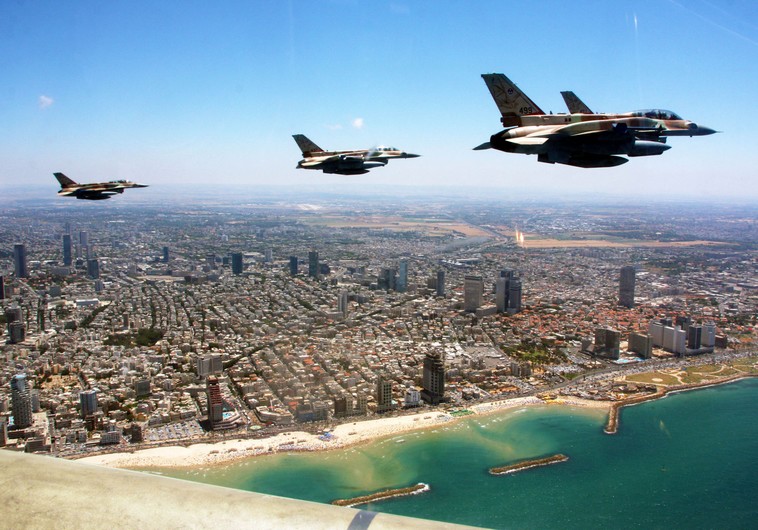
IAF pix Israel Air Force planes fly over Tel Aviv. . (photo credit:IDF SPOKESPERSON’S UNIT)

[M]ore than any single enforcement standard or cap included in the deal, Israel believes the Achilles’ heel of the proposed agreement is its definitive end date – the sunset clause.

“You’ve not dismantled the infrastructure, you’ve basically tried to put limits that you think are going to be monitored by inspectors and intelligence,” said the official, “and then after this period of time, Iran is basically free to do whatever it wants.”

***************

WASHINGTON —  Historic negotiations with Iran will reach an inflection point on Monday, as world powers seek to clinch a comprehensive deal that will, to their satisfaction, end concerns over the nature of its vast, decade-old nuclear program.

But sharing details of the deal under discussion with The Jerusalem Post on the eve of the deadline, Israel has issued a stark, public warning to its allies with a clear argument: Current proposals guarantee the perpetuation of a crisis, backing Israel into a corner from which military force against Iran provides the only logical exit.

The deal on the table

World powers have presented Iran with an accord that would restrict its nuclear program for ten years and cap its ability to produce fissile material for a weapon during that time to a minimum nine-month period.

Should Tehran agree, the deal may rely on Russia to convert Iran’s current uranium stockpile into fuel rods for peaceful use. The proposal would also include an inspection regime that would attempt to follow the program’s entire supply chain, from the mining of raw material to the syphoning of that material to various nuclear facilities across Iran.

Israel’s leaders believe the best of a worst-case scenario, should that deal be reached, is for inspections to go perfectly and for Iran to choose to abide by the deal for the entire decade-long period.

But “our intelligence agencies are not perfect,” an Israeli official said. “We did not know for years about Natanz and Qom. And inspection regimes are certainly not perfect. They weren’t in the case in North Korea, and it isn’t the case now – Iran’s been giving the IAEA the run around for years about its past activities.”

“What’s going to happen with that?” the official continued. “Are they going to sweep that under the rug if there’s a deal?”

On Saturday afternoon, reports from Vienna suggested the P5+1 – the US, United Kingdom, France, Russia, China and Germany – are willing to stop short of demanding full disclosure of any secret weapon work by Tehran.

Speaking to the Post, a senior US official rejected concern over limited surveillance capabilities, during or after a deal.

“If we can conclude a comprehensive agreement, we will have significantly more ability to detect covert facilities – even after its duration is over – than we do today,” the senior US official said. “After the duration of the agreement, the most intrusive inspections will continue: the Additional Protocol – which encompasses very intrusive transparency, and which Iran has already said it will implement – will continue.”

But compounding Israel’s fears, the proposal Jerusalem has seen shows that mass dismantlement of Iran’s nuclear infrastructure – including the destruction, and not the mere warehousing, of its parts – is no longer on the table in Vienna.

“Iran’s not being asked to dismantle the nuclear infrastructure,” the Israeli official said, having seen the proposal before the weekend. “Right now what they’re talking about is something very different. They’re talking about Ayatollah Khamenei allowing the P5+1 to save face.”

Officials in the Netanyahu government are satisfied that their ideas and concerns have been given a fair hearing by their American counterparts. They praise the US for granting Israel unprecedented visibility into the process.

But while those discussions may have affected the talks at the margins, large gaps – on whether to grant Iran the right to enrich uranium, or allow it to keep much of its infrastructure – have remained largely unaddressed.

“It’s like the chemical weapons deal in Syria,” the official said. “They didn’t just say: Here, let’s get rid of the stockpile and the weapons, but we will leave all the plants and assembly lines.”

‘Sunset clause’

Yet, more than any single enforcement standard or cap included in the deal, Israel believes the Achilles’ heel of the proposed agreement is its definitive end date – the sunset clause.

“You’ve not dismantled the infrastructure, you’ve basically tried to put limits that you think are going to be monitored by inspectors and intelligence,” said the official, “and then after this period of time, Iran is basically free to do whatever it wants.”

The Obama administration also rejects this claim. By e-mail, the senior US administration official said that, “‘following successful implementation of the final step of the comprehensive solution for its duration, the Iranian nuclear program will be treated in the same manner as that of any non-nuclear weapon state party to the NPT – with an emphasis on non-nuclear weapon.”

“That has in no way changed,” the American official continued, quoting the interim Joint Plan of Action reached last year.

But the treatment of Iran as any other signatory of the Nuclear Non-Proliferation Treaty –189 countries are members, including Iran – would allow Tehran to ultimately acquire “an industrial-sized capability,” the Israelis say. “The breakout times [to a nuclear weapon] will be effectively zero.”

Israel and world powers seek to maximize the amount of time they would have to identify non-compliance from a nuclear deal, should Iran choose to defy its tenets and build a bomb.

But in the deal under discussion in Vienna, Iran would be able to comply with international standards for a decade and, from Israel’s perspective, then walk, not sneak, into the nuclear club.

“You’ve not only created a deal that leaves Iran as a threshold nuclear power today, because they have the capability to break out quickly if they wanted to,” the Israeli official contended. “But you’ve also legitimized Iran as a military nuclear power in the future.”

From the moment this deal is clinched, Israel fears it will guarantee Iran as a military nuclear power. There will be no off ramp, because Iran’s reentry into the international community will be fixed, a fait accompli, by the very powers trying to contain it.

“The statement that says we’ve prevented them from having a nuclear weapon is not a true statement,” the Israeli official continued. “What you’ve said is, you’re going to put restrictions on Iran for a given number of years, after which there will be no restrictions and no sanctions. That’s the deal that’s on the table.”

Revisiting the use of force

Without an exit ramp, Israel insists its hands will not be tied by an agreement reached this week, this month or next, should it contain a clause that ultimately normalizes Iran’s home-grown enrichment program.

On the surface, its leadership dismisses fears that Israel will be punished or delegitimized if it disrupts an historic, international deal on the nuclear program with unilateral military action against its infrastructure.

By framing the deal as fundamentally flawed, regardless of its enforcement, Israel is telling the world that it will not wait to see whether inspectors do their jobs as ordered.

“Ten, fifteen years in the life of a politician is a long time,” the Israeli said, in a vague swipe against the political directors now scrambling in Vienna. “In the life of a nation, it’s nothing.”

Prime Minister Benjamin Netanyahu has threatened the use of force against Iran several times since 2009, even seeking authorization from his cabinet in 2011. Iran’s program has since grown in size and scope.

According to his aides, the prime minister’s preference is not war, but the continuation of a tight sanctions regime on Iran’s economy coupled with a credible threat of military force. Netanyahu believes more time under duress would have led to an acceptable deal. But that opportunity, in his mind, may now be lost.

Whether Israel still has the ability to strike Iran, without American assistance, is an open question. Quoted last month in the Atlanticmagazine, US officials suggested that window for Netanyahu closed over two years ago.

But responding to claims by that same official, quoted by Jeffrey Goldberg, over Netanyahu’s courage and will, the Israeli official responded sternly: “The prime minister is a very serious man who knows the serious responsibility that rests on his shoulders. He wouldn’t say the statements that he made if he didn’t mean them.”

“People have underestimated Israel many, many times in the past,” he continued, “and they underestimate it now.”

Column One: Responding to the slaughter

November 21, 2014

Column One: Responding to the slaughter, Jerusalem Post, Caroline Glick, November 20, 2014

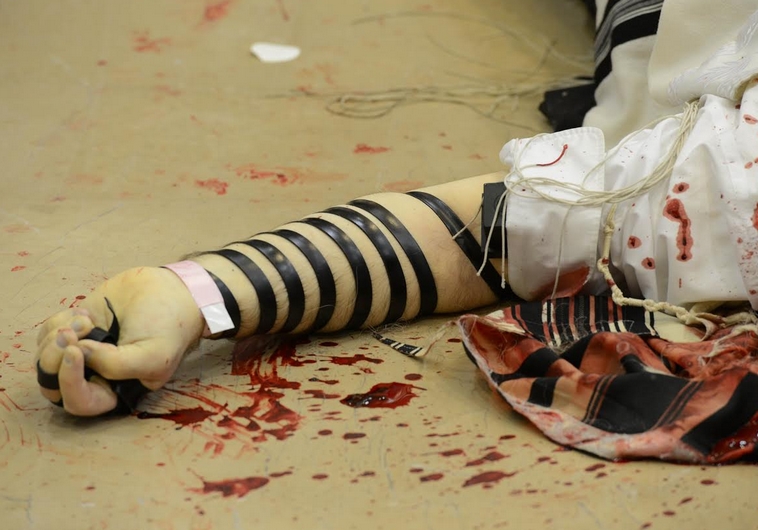
Jerusalem terror attackTerror attack scene in Jerusalem . (photo credit:KOBI GIDEON/GPO)

The horrible truth is that all of the anti-Jewish slaughters perpetrated by our Arab neighbors have been motivated to greater or lesser degrees by Islamic Jew-hatred.Today Israel is powerless to influence the hearts of our Arab neighbors. But we can influence their minds. We can deter them from attacking us.

The actions set forth above: asset seizure, revenue seizure and citizenship/residency abrogation for terrorists and their dependents are steps that Israel can take today, despite the hostile international climate.

If the government and Knesset adopt these measures, they will rectify some of the damage Israel has inflicted on itself by showing the Palestinians over two decades that they will be rewarded for their aggression.

********************
What we are seeing in Jerusalem today is not simply Palestinian terrorism. It is Islamic jihad. No one likes to admit it. The television reporters insist that this is the worst possible scenario because there is no way to placate it.

There is no way to reason with it.

So what else is new? The horrible truth is that all of the anti-Jewish slaughters perpetrated by our Arab neighbors have been motivated to greater or lesser degrees by Islamic Jew-hatred. The only difference between the past hundred years and now is that today our appeasement-oriented elite is finding it harder to pretend away the obvious fact that we cannot placate our enemies.

No “provocation” by Jews drove two Jerusalem Arabs to pick up meat cleavers and a rifle and slaughter rabbis in worship like sheep and then mutilate their bodies.

No “frustration” with a “lack of progress” in the “peace process,” can motivate people to run over Jewish babies or attempt to assassinate a Jewish civil rights activist.

The reason that these terrorists have decided to kill Jews is that they take offense at the fact that in Israel, Jews are free. They take offense because all their lives they have been taught that Jews should live at their mercy, or die by their sword.

They do so because they believe, as former Jordanian MP Ya’qub Qarash said on Palestinian television last week, that Christians and Muslims should work together to forbid the presence of Jews in “Palestine” and guarantee that “not a single Jew will remain in Jerusalem.”

Our neighbors are taught that Muhammad, the founder of Islam, signed the treaty of Hudaybiyah in 628 as a ploy to buy time during which he would change the balance of power between his army and the Jews of Kuraish. And 10 years later, once his army gained the upper hand, he annihilated the Jews.

Throughout the 130-year history of modern Zionism, Islamic Jew-hatred has been restrained by two forces: the desire of many Arabs to live at peace with their Jewish neighbors; and the ability of Israeli authorities and before them, British authorities, to deter the local Arab Muslims from attacking.

The monopoly on Arab Muslim leadership has always belonged to the intolerant bigots. Support for coexistence has always been the choice of individuals.

Haj Amin el-Husseini’s first act as the founder of the Palestinian Arab identity was to translate The Protocols of the Elders of Zion, and serialize them in the local press.

During the Arab jihad of 1936-1939, Husseini’s gangs of murderers killed more Arabs than the British did. He targeted those who sought peaceful coexistence with the Jews.

His successor Yasser Arafat followed his example.

During the 1988-1991 Palestinian uprising, the PLO killed more Palestinians than the IDF did. Like Husseini, Arafat targeted Palestinians who worked with Israel.

Since Israel imprudently embraced Arafat and the PLO in 1993 and permitted them to govern the Palestinians in Judea, Samaria and Gaza, and exert direct influence and coercive power over the Arabs of Jerusalem, the Palestinian Authority’s governing institutions have used all the tools at their disposal to silence those who support peaceful coexistence with Israel, and indoctrinate the general public in Islamic and racial Jew-hatred.

Much has been made of the recent spike in incitement of violence by Palestinian leaders led by Arafat’s successor Mahmoud Abbas. But the flames Abbas and his comrades are throwing would not cause such conflagrations if they hadn’t already indoctrinated their audience to desire the destruction of the Jews.

You cannot solicit murder among those who haven’t been taught that committing murder is an act of heroism.

Today Israel must take swift, effective action to stop the slaughter. The damage that has been done to the psyches of the Arabs of Jerusalem and their brethren in Judea, Samaria and Gaza, cannot be repaired in a timeline relevant to the task of preventing the next massacre.

This means that for the time being, on the tactical level, Israel’s only play is strengthening its deterrence.

Israel faces two major constraints in meeting this challenge.

First, the European Union and the Obama administration, as well as the US foreign policy elite, are obsessively committed to a policy of empowering the Palestinians against Israel.

The Spanish parliament’s decision to go ahead with its planned vote to recognize the “State of Palestine,” just hours after the massacre at the Bnei Torah Kehillat Yaakov synagogue in Jerusalem’s Har Nof neighborhood shows that the EU’s dedication to strengthening the Palestinians against Israel is entirely unrelated to events on the ground.

They don’t care who the Palestinians are or what they do. For their own reasons they have made supporting the Palestinians at Israel’s expense their top foreign policy priority.

Similarly, US President Barack Obama couldn’t contain his compulsion to pressure Israel even in his statement condemning the massacre. Even there, Obama called on Israelis and Palestinians equally to restrain themselves.

Obama’s unabated hostility toward Israel was brought to bear on Tuesday afternoon when the State Department restated its rejection of Jewish property rights in Jerusalem and its desire to see the homes of terrorist murderers left intact for the welfare of their terror-supporting families.

On Tuesday, Israel’s social media outlets were filled with angry rebukes of Western media outlets from CNN to MSNBC to CBS, to the BBC. All these networks, and many others, did everything in their power to explain away the synagogue slaughter as just another instance of a cycle of violence. That is, they all sought to frame the discussion in a way that would lead their viewers to the conclusion that the slaughter of praying rabbis was justified.

While appalling, the coverage was not the least surprising. The Western elite media’s devotion to their false narrative of Israeli culpability for all the problems in the region is absolute. Networks would rather wreck their professional reputations than tell the truth.

Together with the EU, the American policy elite and the Obama administration, the media place Israel’s leaders in a bind. Every step they take to defend the country and protect the rights of Jews meets with automatic and libelous condemnation.

The other impediment Israel faces in deterring anti-Jewish violence against its citizenry is its own weakness. Since the inception of the phony peace process, Israel has continuously rewarded the Palestinians for their murderous violence against its citizenry.

From Israel’s transfer of control over all the Palestinian population centers in Judea and Samaria, to its forcible expulsion of its own people from Gaza, to its repeated releases of terrorists from prison, to its continued transfer of hundreds of millions of shekels in tax revenues to the PA, Israel has showed the Palestinians at every turn that far from being punished for murdering Jews, they will be rewarded for doing so.

Given the US and European support for the Palestinians, Israeli declarations that there will be no future releases of terrorists have no credibility. If terrorists aren’t killed on the spot, they can assume that they will eventually be released; if not in exchange for an Israeli hostage, Israel will release them in an attempt to placate the White House.

But even with these constraints on its actions, Israel can take steps to deter its hate-filled enemies from attacking.

Since the current campaign of murder is being carried out by terrorists largely acting on their own accord, the measures Israel adopts to stop the attacks should be directed primarily against individual terrorists. As for action against the PA, it needs to be credible, consistent and directed to where it will hurt Palestinian leaders the most: their wallets.

With regard to the individual terrorists, the government has made much of its intention to destroy the homes of terrorists. While it sounds good, there is limited evidence of the effectiveness of this punitive measure, which is a relic of the British Mandate.

Rather than destroy their homes, Israel should adopt the US anti-narcotics policy of asset seizure.

All assets directly or indirectly tied to terrorists, including their homes and any other structure where they planned their crimes, and all remittances to them, should be seized and transferred to their victims, to do with what they will.

If Israel hands over the homes of the synagogue butchers to the 24 orphans of Rabbi Moshe Twersky, Rabbi Kalman Levine, Rabbi Aryeh Kupinsky and Rabbi Avraham Goldberg, not only will justice be served. The children’s inheritance of the homes of their fathers’ killers will send a clear and demoralizing message to other would-be killers.

Not only will their atrocities fail to remove the Jews from Israel. Every terrorist will contribute to the Zionist project by donating his home to the Jewish settlement enterprise.

Just as Israel has repeatedly buckled under US pressure to release terrorists from jail, so it has bowed to US pressure to continue to fund the PA by transferring the tax revenues it collects on goods imported to the PA.

Assuming that the government is too weak to stand up to the Americans, at a minimum it can see that the money is properly used.

To that end, the Knesset should pass a law permitting Israeli terror victims to sue the PA for actual and punitive damages in Israel courts. The sums awarded to the victims should be taken from the tax revenues Israel collects for the PA. The law should apply retroactively to all victims of Palestinian terror carried out since the establishment of the PA in May 1994.

Not only should the law permit Israeli terror victims to sue the PA. It should dictate actions the Justice Ministry must take to assist them in bringing suit.

Israel should also revoke citizenship and residency rights not only from terrorists themselves, but from those who enjoy citizenship and residency rights by dint of their relationship with the terrorists.

Wives who received Israeli residency or citizenship rights though marriage to terrorists should have their rights revoked, as should the children of the terrorists.

Since Tuesday’s massacre, aside from Abbas’s phony condemnation, the Palestinian leadership and public from Fatah to Hamas have been unanimous in their praise for the atrocity.

Today Israel is powerless to influence the hearts of our Arab neighbors. But we can influence their minds. We can deter them from attacking us.

The actions set forth above: asset seizure, revenue seizure and citizenship/residency abrogation for terrorists and their dependents are steps that Israel can take today, despite the hostile international climate.

If the government and Knesset adopt these measures, they will rectify some of the damage Israel has inflicted on itself by showing the Palestinians over two decades that they will be rewarded for their aggression.

If our leaders fail to take these or similar actions, and suffice with complaining about incitement, their condemnations of the murder of Jews will ring as hollow as those sounded by the BBC, Obama and Abbas.
Obama on Ferguson and Jerusalem

November 20, 2014

Obama on Ferguson and Jerusalem, American Spectator, November 20, 2014

p110414ps-0347

On the one hand, in Ferguson, with an entire population on edge, the president and his attorney general are plainly siding with the lynch mob. On the other hand, when it comes to the Israelis and Palestinians in response to the killing of rabbis in a synagogue, the response is moral equivalence.

********************

Moral equivalence on parade.

Ferguson, Missouri, where the facts of the police shooting that killed Michael Brown have yet to be presented by the grand jury, an entire community braces for violence if the “wrong” decision is announced. While waiting, the Obama administration huddled with those who have a history of inciting racial violence and are heading to Ferguson.

In Jerusalem, where the bloody trail of Jihad streams from a synagogue, the response of the Obama administration is to play the moral equivalency card between Palestinians and Israel.

The contrast could not be more stark — or more telling.

First Ferguson: As headlined at The Gateway Pundit reports:

President Obama met with Ferguson protest leaders on November 5th, the day after the midterm elections. The meeting was not on his daily schedule. He was concerned that the protesters “stay on course.”

There was no Oval Office meeting or similar words of encouragement for those supporting either officer Darren Wilson or the simple concept of letting a grand jury work its will without intimidation.

Meanwhile, about Jerusalem, the New York Times tells the story this way:

The Orthodox Jewish men were facing east, to honor the Old City site where the ancient temples once stood, when two Palestinians armed with a gun, knives and axes burst into their synagogue Tuesday morning, shouting “God is great!” in Arabic. Within moments, three rabbis and a fourth pious man lay dead, blood pooling on their prayer shawls and holy books.

The assailants, cousins from East Jerusalem, were killed at the scene in a gun battle with the police that wounded two officers; one died of his injuries Tuesday night. Politicians and others around the world condemned the attack and the rising religious dimension of the spate of violence, which has been attributed mainly to a struggle over the very site the victims were praying toward.

And what was the president’s response? Mr. Obama read a statement in which he said that “too many Palestinians have died,” and “I think it’s important for both Palestinians and Israelis to try to work together to lower tensions and reject violence….We have to remind ourselves that the majority of Palestinians and Israelis overwhelmingly want peace.” There was no summoning of the Israeli ambassador no suggestion for Israel to “stay the course.”

What are we seeing here? It’s very clear and utterly unsurprising. On the one hand, in Ferguson, with an entire population on edge, the president and his attorney general are plainly siding with the lynch mob. On the other hand, when it comes to the Israelis and Palestinians in response to the killing of rabbis in a synagogue, the response is moral equivalence. Moral equivalence uttered while — quite literally, as seen here — Palestinians take to the streets to wave hatchets, and hand out food to gleefully celebrate the murders. Just as, it should not need to be reminded, Palestinians were in the streets celebrating on 9/11 when the twin towers fell and some 3,000 Americans were murdered.

This follows six years worth of the Obama administration absolutely trashing Israeli Prime Minister Benjamin Netanyahu and Israel itself — whether rudelyleaving Netanyahu waiting around the West Wing while the president went off to dinner, or having an anonymous minion snarking to the Atlantic that Israel’s prime minister is a “chickens–t.” Recall the moment that played out in front of cameras at the 2012 Democratic Convention when it was discovered that somehow, mysteriously, the Democratic platform refused to recognize Jerusalem as the capital of Israel — and it had to be undone while delegates booed? As seen here it wasn’t pretty, the cameras picking up a delegate loudly shouting “no” while displaying an “Arab American Democrats” sign. Not to be forgotten is Obama’s personal history with the Reverend Jeremiah Wright and Columbia professor Rashid Khalidi, both of whom have frequently been labeled as anti-Semites.

Thus the vivid illustration of the core of the modern left. A president stands with the lawbreakers in Ferguson as the town braces for riots. At the same time, confronted with the murder of rabbis in a Jerusalem synagogue — another chapter in the war of Islamic fascism against the Jews — he responds with moral equivalence. The Palestinians this…but on the other hand the Israelis that. And so on.

From Ferguson to Jerusalem, this is the mindset of the modern left that is on display. That mindset isn’t just ugly — it’s dangerous.