Archive for the ‘Israel, Palestinians’ category

Gaza War Rages On as Hamas Claims Israel Tried to Kill Military Chief

August 20, 2014

Gaza War Rages On as Hamas Claims Israel Tried to Kill Military Chief

Gaza house destroyed
People gather as a Palestinian man reacts next to the rubble of his house, which witnesses said was destroyed in an Israeli air strike, in Rafah in the southern Gaza Strip August 20, 2014. Ibraheem Abu Mustafa/Reuters

Israeli air strikes killed 11 Palestinians in Gaza, including the wife and infant son of Hamas’s military leader, Mohammed Deif, in what the group said on Wednesday was an attempt to assassinate him after a ceasefire collapsed.

Accusing Israel of opening a “gateway to hell”, Hamas fired rockets at Tel Aviv and Jerusalem. The attacks caused no casualties but demonstrated the Islamist movement could still bring the Gaza war to Israel’s heartland despite heavy Israeli bombardments in the five-week-old conflict.

Israel’s military said it had carried out 60 air strikes on the Gaza Strip since hostilities resumed on Tuesday, and that Palestinians launched more than 80 rocket salvoes, some intercepted by the Israeli anti-missile Iron Dome system.

The violence shattered a 10-day period of calm, the longest break from fighting since Israel launched its Gaza offensive on July 8 with the declared aim of ending Palestinian rocket fire into its territory.

The Palestinian Health Ministry says 2,029 people, most of them civilians, have been killed in the Gaza Strip. Israel says it has killed hundreds of Palestinian militants in fighting that the United Nations says has displaced about 425,000 people in the territory of 1.8 million.

Sixty-four Israeli soldiers and three civilians in Israel have also been killed in the most deadly and destructive war Hamas and Israel have fought since Israel withdrew unilaterally from Gaza in 2005, before Hamas seized the territory in 2007.

Hamas said an Israeli bombing of a house in Gaza City late on Tuesday was an attempt to assassinate Deif, widely believed to be masterminding the Islamist group’s military campaign from underground bunkers.

There was no official confirmation from Israel, which has targeted Deif in air strikes at least four times since the mid-1990s, holding him responsible for the deaths of dozens of its citizens in suicide bombings.

“I am convinced that if there was intelligence that Mohammed Deif was not inside the home, then we would not have bombed it,” Yaakov Perry, Israel’s science minister and former security chief, told Army Radio. A Hamas official said that Deif does not use the house.

Three bodies were pulled from the rubble. Hospital officials identified them as Deif’s wife, his seven-month-old son and a 20-year-old man.

TALKS END

Accusing Hamas of breaking the truce with rocket fire eight hours before it was to have expired, Israel recalled its negotiators from truce talks in Cairo on Tuesday, leaving the fate of the Egyptian-brokered efforts hanging in the balance.

Palestinian negotiators walked out of the talks later, blaming Israel for their failure. “Israel thwarted the contacts that could have brought peace,” chief Palestinian negotiator Azzam al-Ahmed said.

Rejecting the charge, Mark Regev, a spokesman for Prime Minister Benjamin Netanyahu, said Gaza rocket fire “made continuation of talks impossible”.

“The Cairo process was built on a total and complete cessation of all hostilities and so when rockets were fired from Gaza, not only was it a clear violation of the ceasefire but it also destroyed the premise upon which the talks were based,” Regev told Reuters.

Israel instructed its civilians to open bomb shelters as far as 80 km (50 miles) from Gaza, or beyond the Tel Aviv area, and the military called up 2,000 reservists.

United Nations Secretary General Ban Ki-moon condemned the breach of the ceasefire, saying in a statement he was “gravely disappointed by the return to hostilities” and urging the sides not to allow matters to escalate.

Egyptian mediators have been struggling to end the Gaza conflict and seal a deal that would open the way for reconstruction aid to flow into the territory of 1.8 million people, where thousands of homes have been destroyed.

The Palestinians want Egypt and Israel to lift their blockades of the economically crippled Gaza Strip that predated the Israeli offensive.

Israel, like Egypt, views Hamas as a security threat and wants guarantees that any removal of border restrictions will not result in militant groups obtaining weapons.

A senior Palestinian official in Gaza said sticking points to an agreement have been Hamas’s demands to build a seaport and an airport, which Israel wants to discuss only at a later stage.

Israel has called for the disarming of militant groups in the enclave. Hamas has said that laying down its weapons is not an option, saying it will pursue its armed struggle until Israel’s occupation of Palestinian lands ends.

Israel captured the West Bank, Gaza and East Jerusalem in 1967. It unilaterally withdrew from Gaza in 2005. The Palestinians want Gaza and the West Bank for an independent state with its capital in East Jerusalem.

VOA: Retired US defense official and diplomat, Ambassador Chas Freeman (does not have a clue about the Middle East of today)

August 19, 2014

Published on Aug 19, 2014

Host Carol Castiel talks with retired US defense official and diplomat, Ambassador Chas Freeman, who served in numerous senior positions from US Ambassador to Saudi Arabia to Director of Chinese Affairs at the State Department to Assistant Secretary of Defense for International Security Affairs, about a range of national security issues from the crises in Iraq and Syria, tensions between the United States and Russia over Ukraine, differences between the U.S. and China over territorial disputes in the South and East China Seas as well as about the challenges to American influence and power in the post-Cold War and post-9-11 era.
For updates on Press Conference USA, and other VOA’s programs, follow host Carol Castiel on Facebook at: Facebook.com/CarolCastielVOA & Twitter: @CarolCastielVOA

Hamas manipulated and intimidated the media in Gaza. Why was that kept from us?

August 18, 2014

We should normally say if our reports are censored or monitored or if we withhold information, and explain, wherever possible, the rules under which we are operating.-          Section 11.4.1 of the BBC Editorial Guidelines on accuracy and impartiality in times of War, Terror and Emergencies

The Foreign Press Association (FPA) issued an astonishing protest yesterday about “blatant, incessant, forceful and unorthodox” intimidation of journalists in the Gaza Strip by Hamas. “In several cases,” they complained, “foreign reporters working in Gaza have been harassed, threatened or questioned over stories.” The FPA said this amounted to “denying readers and viewers an objective picture from the ground,” adding  “we are also aware that Hamas is trying to put in place a ‘vetting’ procedure that would, in effect, allow for the blacklisting of specific journalists. Such a procedure is vehemently opposed by the FPA.The statement raises a lot of questions. Here is one: why have British broadcasters not mentioned any of this to their viewers?

Let’s review what we know.

Indian television station NDTV broadcast and posted on its internet site on 5 August a report by Sreenivasan Jain showing rockets fired from a tent next to his hotel. In the accompanying text on NDTV’s website, Jain wrote that it was published “after our team left the Gaza Strip – Hamas has not taken very kindly to any reporting of its rockets being fired. But just as we reported the devastating consequences of Israel’s offensive on Gaza’s civilians, it is equally important to report on how Hamas places those very civilians at risk by firing rockets deep from the heart of civilian zones.” In an article published subsequently, Jain wrote of “the fear which hobbles the reporting such material: fear of reprisals from Hamas against us”, asking “how long do we self-censor because of the fear of personal safety in return for not telling a story that exposes how those launching rockets are putting so many more lives at risk, while the rocket-makers themselves are at a safe distance?”

More and more examples of intimidation of journalists by Hamas are seeping out of Gaza:

  • Israeli filmmaker Michael Grynszpan described on Facebook an exchange he had had with a Spanish journalist who had just left Gaza. “We talked about the situation there. He was very friendly. I asked him how come we never see on television channels reporting from Gaza any Hamas people, no gunmen, no rocket launcher, no policemen. We only see civilians on these reports, mostly women and children. He answered me frankly: ‘It’s very simple, we did see Hamas people there launching rockets, they were close to our hotel, but if ever we dare pointing our camera on them they would simply shoot at us and kill us.'”
  • An op-ed in The Australian and other sources including The Jerusalem Post noted that after Nine Network reporter Peter Stefanovic tweeted that he had seen rockets fired into Israel from near his hotel, he was threatened by pro-Hamas tweeters and warned: “in WWII spies got shot”.
  • The Wall Street Journal’s Nick Casey posted a photo of a Hamas spokesman being interviewed from a room in the hospital along with this tweet: “You have to wonder (with) the shelling how patients at Shifa hospital feel as Hamas uses it as a safe place to see media.” After “a flood of online threats”, the tweet was deleted.
  • John Reed of The Financial Times was reportedly threatened after he tweeted about rockets being fired from the same hospital.
  • Following his departure from Gaza, Italian journalist Gabriele Barbati tweeted on 29 July. “Out of #Gaza far from #Hamas retaliation: misfired rocket killed children yday in Shati. Witness: militants rushed and cleared debris.”
  • French-Palestinian journalist Radjaa Abou Dagga wrote an article for French newspaper Libération, on July 23, detailing how he was “detained and interrogated by members of Hamas’s al-Qassam Brigade at a room in Shifa hospital next to the emergency room” and was forced to leave Gaza immediately without his papers. The day after publication, Mr Dagga asked Libération to remove his article from their website.
  • RT correspondent Harry Fear was told to leave Gaza after he tweeted that Hamas fired rockets into Israel from near his hotel.

Hamas manipulation of the media is not always so crude.

  • As reported in Times of Israel on 11 July, the Hamas Ministry of Interior in Gaza published a video in Arabic advising on “cautious and effective” social media engagement on Facebook and Twitter during Operation Protective Edge. It contained such directives as “Anyone killed or martyred is to be called a civilian from Gaza or Palestine, before we talk about his status in jihad or his military rank … Don’t forget to always add ‘innocent civilian’ or ‘innocent citizen’ in your description of those killed in Israeli attacks on Gaza.”
  • Hamas has also actively interfered with bomb sites in order to gain PR advantage. The Washington Post’s Sudarsan Raghavan detailed how Hamas staged events and scenes to evoke sympathy. By way of illustration, he was taken to photograph a mosque that had been bombed, and discovered that someone had “prepared” the scene and placed a prayer mat and burnt Quran pages. “The symbolism was obvious, almost too perfect. It was clear that someone had placed them there to attract sympathy for the Palestinian cause. A television crew spotted the pile and filmed it. Mission accomplished.”
  • Hamas ensure reporters are exposed to casualties by insisting that spokesmen could only be interviewed in the courtyard of the Al-Shifa hospital, as described by Ynet News.

The long Hamas record of shutting down news bureaus, arresting reporters and cameramen, confiscating equipment and beating journalists has already been documented by the Committee to Protect Journalists. In the latest conflict Hamas wanted to reduce the reports coming out of Gaza to what Reinhold Niebuhr once called “emotionally potent over-simplifications”. Journalists from India, America, Norway, Italy, Spain, Australia, Canada and elsewhere are complaining. Will we now hear from the Brits?

Occupation hypocrisy: Gaza vs. Cyprus

August 18, 2014

Occupation hypocrisy: Gaza vs. Cyprus

One provokes outrage; the other earns a yawn

Illustration on the ongoing Turkish occupation of Cyprus by Alexander Hunter/The Washington Times
Illustration on the ongoing Turkish occupation of Cyprus by Alexander Hunter/The Washington Times more >
– – Wednesday, August 13, 2014

LIMASSOL, Cyprus | Cyprus is a beautiful island, but it has never recovered from the Turkish invasion of 1974. Turkish troops still control nearly 40 percent of the island — the most fertile and formerly the richest portion.

Some 200,000 Greek refugees never returned home after being expelled from their homes and farms in Northern Cyprus.

The capital of Nicosia remains divided. A 112-mile demilitarized “green line” runs right through the city across the entire island.

Thousands of settlers from Anatolia were shipped in by the Turkish government to occupy former Greek villages and to change Cypriot demography — in the same manner the occupying Ottoman Empire once did in the 16th century. Not a single nation recognizes the legitimacy of the Turkish Cypriot state. In contrast, Greek Cyprus is a member of the European Union.

Why, then, is the world not outraged at an occupied Cyprus the way it is at, say, Israel?

Nicosia is certainly more divided than is Jerusalem. Thousands of Greek refugees lost their homes more recently, in 1974, than did the Palestinians in 1947.

Turkey has far more troops in Northern Cyprus than Israel has in the West Bank. Greek Cypriots, unlike Palestinians, vastly outnumbered their adversaries. Indeed, a minority making up about a quarter of the island’s population controls close to 40 percent of the landmass. Whereas Israel is a member of the United Nations, Turkish Cyprus is an unrecognized outlaw nation.

Any Greek Cypriot attempt to reunify the island would be crushed by the formidable Turkish army, in the brutal manner of the brief war of 1974. Turkish generals would most likely not phone Greek homeowners warning them to evacuate their homes ahead of incoming Turkish artillery shells.

The island remains conquered not because the Greeks have given up, but because their resistance is futile against a NATO power of some 70 million people. Greeks know that Turkey worries little about what the world thinks of its occupation.

Greeks in Cyprus and mainland Greece together number less than 13 million people. That is far less than the roughly 300 million Arabic speakers, many from homelands that export oil, who support the Palestinians.

No European journalist fears that Greek terrorists will track him down should he write something critical of the Greek Cypriot cause. Greek Cypriots would not bully a journalist in their midst for broadcasting a critical report the way Hamas surely would to any candid reporter in Gaza.

In other words, there is not much practical advantage or interest in promoting the Greek Cypriot cause.

Unlike Israel, Turkey is in NATO — and is currently becoming more Islamic and anti-Western under Prime Minister Recep Tayyip Erdogan. If it is easy for the United States to jawbone tiny Israel, it is geostrategically unwise to do so to Turkey over the island of Cyprus.

Turkey is also less emblematic of the West than is Israel. In the racist habit of assuming low expectations for non-Westerners, European elites do not hold Turkey to the same standards that they do Israel.

We see such hypocrisy when the West stays silent while Muslims butcher each other by the thousands in Afghanistan, Iraq, Lebanon, Libya and Syria. Only when a Westernized country like Israel inflicts far less injury to Muslims does the West become irate. The same paradox seems to hold true for victims. Apparently, Western Christian Greeks are not the romantic victims that Palestinian Muslims are.

In the 40 years since they lost their land, Greek Cypriots have turned the once impoverished south into a far more prosperous land than the once-affluent but now stagnant Turkish-occupied north — unlike the Palestinians, who have not used their know-how to turn Gaza or Ramallah into a city like Limassol.

Resurgent anti-Semitism both in the Middle East and in Europe translates into inordinate criticism of Israel. Few connect Turkey’s occupation of Cyprus with some larger racist commentary about the supposed brutal past of the Turks.

The next time anti-Israeli demonstrators shout about divided cities, refugees, walls, settlers and occupied land, let us understand that those are not necessarily the issues in the Middle East. If they were, the Cyprus tragedy would also be center stage. Likewise, crowds would be condemning China for occupying Tibet, or still sympathizing with millions of Germans who fled a now-nonexistent Prussia, or deploring religious castes in India, or harboring anger over the tough Russian responses to Georgia, Crimea and Ukraine, or deploring beheadings in northern Iraq.

Instead, accept that the Middle East is not just about a dispute over land. Israel is inordinately condemned for what it supposedly does because its friends are few, its population is tiny, and its adversaries beyond Gaza numerous, dangerous and often powerful.

And, of course, because it is Jewish.

Victor Davis Hanson is a classicist and historian with the Hoover Institution at Stanford University.

BBC: Rocket fired from Gaza hits Israel

August 13, 2014

Rocket fired from Gaza hits Israel

Israeli bomb disposal expert collects remains of rocket fired by Gaza militants 29/07/2014Thousands of rockets have been fired at Israel by Gaza militants in the past five weeks – file photo
A rocket fired from Gaza has hit southern Israel just hours before a three-day ceasefire was due to expire, police say.

The rocket came down in an open area near Ashkelon, but caused no casualties or damage, a spokeswoman said.

Hamas militants denied they had fired any rockets, Reuters reported.

Israeli and Palestinian negotiators have been involved in indirect talks in Egypt aimed at finding a long-term solution to the Gaza conflict.

About 2,000 people have died since the fighting in Gaza began on 8 July.

Those killed include more than 1,900 Palestinians, mostly civilians, according to the United Nations.

Sixty-four Israeli soldiers have been killed in the violence and three civilians in Israel have also died.

The rocket, which landed in Israel late on Wednesday, was the first to be fired since the current ceasefire began on Monday.

Map showing potential range of rocket attacks from Gaza

Jordan is Palestine

August 12, 2014

Jordan is Palestine

Which is Palestinian
and which is Jordanian?

On the same day Dutch politician, Geert Wilders, delivered a speech in Tel Aviv where he declared that Jordan is indeed the state of the Palestinians, the Argentinean government also made a declaration, it said it recognized a Palestinian state in pre-1967 borders of Judea, Samaria and Gaza. Both statements caused a stir in many places around the world.

PVV Dutch MP, Geert Wilders:
“Jordan is Palestine and Palestine is Jordan.”

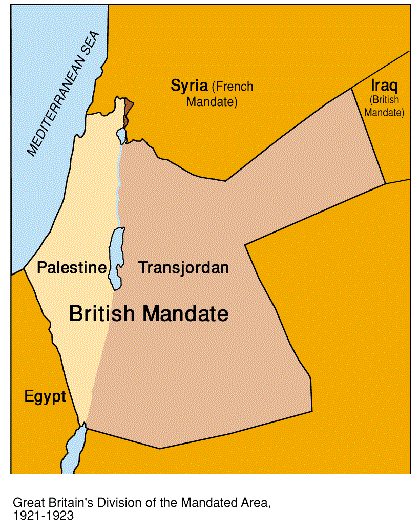
In light of the far reaching ramifications of both statements, they should be then scrutinized for their veracity and historical factuality. First of all, is Jordan a Palestinian state? When looking at the map of the British mandate for what was known then as “Palestine”, it becomes quite clear what area was originally earmarked for the Jewish homeland.

At the end of the First World War, the division of responsibilities for the administering of the Middle East areas fell to the various Western powers victorious over the Ottoman Turks, as mandates, under the auspices of the League of Nations, it was during that time that the famous Balfour Declaration was made:

November 2nd, 1917

Dear Lord Rothschild,

I have much pleasure in conveying to you, on behalf of His Majesty’s Government, the following declaration of sympathy with Jewish Zionist aspirations which has been submitted to, and approved by, the Cabinet.

“His Majesty’s Government view with favour the establishment in Palestine of a national home for the Jewish people, and will use their best endeavours to facilitate the achievement of this object, it being clearly understood that nothing shall be done which may prejudice the civil and religious rights of existing non-Jewish communities in Palestine, or the rights and political status enjoyed by Jews in any other country.”

I should be grateful if you would bring this declaration to the knowledge of the Zionist Federation.

Yours sincerely,

Arthur James Balfour

The Balfour Declaration was accepted by the British Mandate in 1917, which then became subject to a White Paper that many believe reneged on it’s earlier promise, that being a commitment to allowing Jews a homeland. But the paper did insist however that:

“the Jewish community should know that it is in Palestine as of right and not on the sufferance. That is the reason why it is necessary that the existence of a Jewish National Home in Palestine should be internationally guaranteed, and that it should be formally recognized to rest upon ancient historic connection.”

Palestine Facts states that: “The area of the Mandate was originally 118,000 square kilometers (about 45,000 square miles). In 1921, Britain took the 91,000 square kilometers of the Palestine Mandate east of the Jordan River, and created Trans-Jordan (later the Arab country of Jordan) as a new Arabprotectorate. Jews were barred by law from living or owning property east of the Jordan river, even though that land was over three-fourths of the original Mandate.”

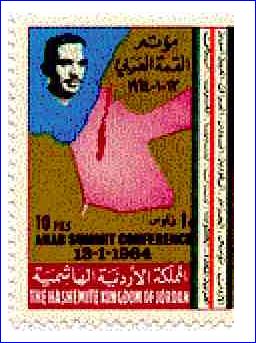
A Jordanian State stamp dating from 1964, bearing the likeness of King Hussein and pictures Mandated Palestine as an undivided territory

The Arab official line before a “two state solution” became stated policy of Israel and the West, was that the people in Trans-Jordan cum Jordan were indivisible from those Arabs inside Israel proper, Judea and Samaria. In fact there are statements by leading Arabs buttressing the notion that indeed: Jordan is Palestine and Palestine is Jordan.

This is the royal decree and sentiments of two of the kings of Jordan.

“Palestine and Jordan are one…” said King Abdullah in 1948.

“The truth is that Jordan is Palestine and Palestine is Jordan,” said King Hussein of Jordan, in 1981.

“Palestine is Jordan and Jordan is Palestine; there is only one land, with one history and one and the same fate,” Prince Hassan of the Jordanian National Assembly was quoted as saying on February 2, 1970.

Abdul Hamid Sharif, Prime Minister of Jordan declared, in 1980, “The Palestinians and Jordanians do not belong to different nationalities. They hold the same Jordanian passports, are Arabs and have the same Jordanian culture.”

What are we to conclude from this other than the historical perspective at the time, that being, they (the Arabs) saw themselves as being part of Palestine/Palestinian. Around 70%of the Jordanian population today, still see themselves as Palestinians. Even Yasser Arafat and his PLO thugs looked to Jordan as being a part of their homeland.

Abu Toameh:

When the PLO tried to establish a state-within-a-state in the kingdom in the late 60′s and early 70′s, Jordan’s King Hussein ordered the army to launch a massive assault on the refugee camps in the kingdom, massacring thousands of Palestinians in what has since become to be known as Black September.

The Palestinians who were expelled from Jordan to Lebanon later played a major role in the Lebanese civil war. Over 100,000 people are believed to have been killed in that war, which lasted for more than a decade.

Lets face facts, the three state solution has become an intractable mess, there is no room for budging on the Israeli side, every square centimeter given to these Arabs as a permanent part of a second Palestinian state, spells trouble for the Jewish state as it’s used as a launching pad for further aggression against it.

The Palestinians (which used to mean Jews in Palestine before Israel became a state) are not able to form a state for themselves, because they refuse to accept the responsibility for actually running it. They have proven themselves to be more comfortable in accepting massive amounts of foreign aid, while they continually try to chip away at Israeli legitimacy on the world stage.

Time to end the pretending that these Arabs are really serious about wanting a state of their own, and accept the fact that it’s the massive amounts of foreign aid that really interests them most, as well as the hope of one day getting rid of the highly successful  Jewish one. KGS

Israel Palestine Conflict: Female Soldiers Shell Gaza Every 2 Minutes

August 11, 2014

Israeli Ambassador Hits Back at UN ‘War Crimes’ Accusation

August 11, 2014

Israel and Palestinians accept cease-fire

August 10, 2014

Rocket Attack Forces Closure of Israel-Gaza Border Crossing today

August 10, 2014

Israel closes Kerem Shalom crossing due to rocket fire

By JPOST.COM STAFF
LAST UPDATED: 08/10/2014 17:20

Israel announced Sunday that it would be closing the Kerem Shalom crossing which it uses to transfer goods into Gaza in response to deliberate rocket fire at the crossing  from Gaza.”After continuous and intentional rocket fire at the Kerem Shalom Crossing this morning and this afternoon, during which trucks carrying flammable materials to the Gaza Strip were almost hit, we took the exceptional decision to close the crossing in order to protect the lives of workers and traders,” the Defense Ministry Land Crossings Authority said in a statement.”The crossing was open throughout Operation Protective Edge despite constant firing in its vicinity and is the sole artery for the passage of vital humanitarian goods and equipment to the residents of the Gaza Strip,” the statement added.