FILE – In this Monday, Sept. 29, 2014 file photo, Israel’s Prime Minister Benjamin Netanyahu addresses the 69th session of the United Nations General Assembly at U.N. headquarters.
He tells it like it is, and the president should listen this time.
President Obama must absorb this. He came to office thinking there is little moral difference between Israel and Hamas and its Palestinian cohort. He seems to identify more with the Palestinians, observing that Israeli intransigence, not the distortion of Islam, is the infection festering in the Middle East.
***********************
Israeli Prime Minister Benjamin Netanyahu is a courageous leader and a glutton for punishment. He never hesitates to stand up to those who despise him and his country, and indeed despise the West and the civilization it brought to the world. Some of his critics dream of beheading him if they could. He rebuts their lies, stares them down and corrects the record. He understands that what they seek is not peace, but an opportunity to destroy Israel and the Western civilization it represents.
He stared them down again this week at the United Nations General Assembly, and he’ll be in Washington on Wednesday to visit an American president who clearly doesn’t like him and delights in humiliating him. He gave the assembled diplomats the tutorial they needed, whether they wanted it or not, on life in the real world. We hope the president was listening.
The prime minister applauded the president for recognizing the threat of the Islamic State, or ISIS, but reminded the delegates that there’s still more to recognize. “ISIS and Hamas are branches of the same poisonous tree,” he said. “ISIS and Hamas share a fanatical creed, which they seek to impose well beyond the territory under their control.” Islamic terrorism is a cancer, he said, and “to protect the peace and security of the world we must remove this cancer before it is too late.”
President Obama must absorb this. He came to office thinking there is little moral difference between Israel and Hamas and its Palestinian cohort. He seems to identify more with the Palestinians, observing that Israeli intransigence, not the distortion of Islam, is the infection festering in the Middle East.
He said early on that he wanted a settlement with the Palestinians that would require Israel to retreat to its 1967 borders, before its Islamic neighbors ganged up to go to war and, instead of destroying the Jewish state, got a good country licking themselves. Mr. Netanyahu’s warning of the true aims of Hamas, the Muslim Brotherhood and Iran were ignored. On an afternoon in 2010, the president invited the Israeli prime minister to the White House, presented him with a list of 13 demands, and when Mr. Netanyahu wouldn’t agree to them, rudely told him that he was off to supper with his family and his absence would give Mr. Netanyahu time to reconsider his answer.
The prime minister spent the next hour cooling his heels in the Roosevelt Room and was then summarily dismissed, in a remarkable display of bad manners and diplomatic discourtesy, and told that he hadn’t given sufficient thought to buying the Obama solutions. The president snubbed him on several additional occasions. He once instructed Vice President Joe Biden to tell a group of U.S. senators, assembled to listen to a briefing on Iran’s nuclear program, to “ignore” anything Mr. Netanyahu might say about Iran and its pursuit of the nuclear bomb.
Subsequent meetings of the two heads of state were cool, some more correct than others, but all with lectures from the president, who imagines that he knows more about the region than Mr. Netanyahu or others who actually live and work there.
The occasion on Wednesday is less auspicious than occasions in the past. Mr. Obama has climbed into a coalition of strange allies with his strategy to blunt a fanatic Muslim surge through the region. The president is getting a late education in the reality of that region. We can only hope he’s listening this time to those who, like Mr. Netanyahu, an ally with insights, actually knows what’s going on there.
52 European lawmakers propose Alaa Abdel Fattah, who also called for the assassination of Egyptians, for the Sakharov Prize.
Egyptian activist Alaa Abdel Fattah upon his release from Tora prison in Cairo, September 15, 2014 (photo credit: AP/Amr Nabil)
Debating the Palestinian issue, Abdel Fattah wrote on November 15, 2012, that “there is a critical number of Israelis that we need to kill and then the problem is solved.”
The following day, he wrote: “there should be no equal relations with Israel or any other relations. Israel must come to an end.”
***********************
A group of over 50 European parliament members has nominated a controversial Egyptian activist for the prestigious Sakharov Prize for Freedom of Thought, despite his having advocated the assassination of Israelis and political leaders in Egypt and calling for an end to the State of Israel.
Alaa Abdel Fattah, 32, an Egyptian blogger and political activist, was arrested numerous times by Egyptian authorities since the eruption of a popular revolution in the country in early 2011. Abdel Fattah, who boasts 626,000 followers on Twitter and 156,000 on Facebook, was released on bail September 15 after being charged with organizing an illegal protest in Cairo and sentenced to 15 years in prison.
Abdel Fattah was nominated for the Sakharov Prize on September 23 along with rappers Mouad Belghouate (Morocco) and Ala Yaacoubi (Tunisia) by the European United Left/Nordic Green Left (GUE/NGL) Parliamentary Group, a left-wing group of 52 European parliament members representing 14 EU countries. The winner of the prize will be announced on October 16.
Named after Soviet dissident Andrei Sakharov, the €50,000 ($63,000) prize is awarded to “exceptional individuals who combat intolerance, fanaticism and oppression.” Previous laureates included South African president Nelson Mandela, UN secretary general Kofi Annan, and teenage Pakistani campaigner Malala Yousafzai.
While Abdel Fattah’s credentials as a political dissident are unimpeachable, a number of past comments published by him on Twitter raise doubts about his suitability for a prize rewarding “respect for international law, development of democracy and implementation of the rule of law.”
“Will no one form an armed organization and randomly assassinate Interior Ministry officers and be rid of them?” he tweeted on July 6, 2011, as the country seethed in violent protests against Egypt’s military rulers. “We all know that they’re all criminals.”
On September 6, 2012, Abdel Fattah wrote that the 1981 assassination of then-Egyptian president Anwar Sadat was “a service to the nation,” since Sadat was a traitor to his people.
“A president isn’t just anyone. It is our right to kill the president if there is no other way to get rid of him. Was the killing of [former Libyan leader Muammar] Gaddafi a crime?” he wrote. Abdel Fattah added that he would consider the killing of former Egyptian general Mohammed Hussein Tantawi, who served as de facto ruler of Egypt in 2012 as chairman of the Supreme Council of the Armed Forces (SCAF), “a patriotic act.”
“We could limit killing to presidents of the republic only,” he tweeted.
During an exchange on generalizations in the Egyptian political context, Abdel Fattah wrote: “All Zionists are criminals, all racists are stupid, all humans have rights. These are examples of acceptable generalizations.”
Debating the Palestinian issue, Abdel Fattah wrote on November 15, 2012, that “there is a critical number of Israelis that we need to kill and then the problem is solved.”
The following day, he wrote: “there should be no equal relations with Israel or any other relations. Israel must come to an end.”
“While Egypt should be leading a comprehensive boycott movement against the [Zionist] entity and anyone who cooperates with it, we have the QIZ [Qualifying Industrial Zone; a free trade area uniting Israel and Egypt], normalization, an [Israeli] embassy and tourism,” he added.
Neither Abdel Fattah nor the European parliamentary group GUE/NGL responded to a Times of Israel request for clarification.
If Israel did not exist it would have to be invented.– DM)
Many Europeans who would laugh at the idea of negotiating with ISIS or al-Qaeda say that Israel should negotiate with Hamas.
Almost nobody sees that the invention of the “Palestinian people” has transformed millions of Arabs into a genocidal weapon to be used against the Israelis, and even, as in Europe recently, the Jews. Transforming people into a genocidal weapon is a barbaric act.
Israel was urged to find ways to coexist peacefully with people who did not want to co-exist with it. Terrorism against Israel fast became acceptable: a “good” terrorism.
Hamas’s stated aim is the destruction of Israel. Its stated way to achieve this aim is terror attacks, called “armed struggle” by Hamas leaders. To this day the Palestinian Authority has not ceased praising and promoting terrorism.
If hatred of Israel is increasing in the U.S., it is largely confined to academics and other extreme radical circles, many of which are funding or receiving funding from Soviet-style agitprop organizations. Journalists are recruited to disseminate descriptions of “facts” as if they were real facts. Pseudo-historians rewrote the history of the Middle East. The falsified version of history replaced history.
Understanding radical Islam requires going back to its roots.
The Christian idea of rendering “unto Caesar that which is Caesar’s and unto God that which is God’s” never existed in Islam. Its absence has had consequences, including, possibly, the decline of the Muslim civilization and the feeling of humiliation that resulted.
During the late eighteenth and early nineteenth centuries, when Muslim clerics observed that that the Islamic world was not keeping pace with the West and was on the verge of collapse, they may have decided they needed answers.
Some of these clerics turned to the West, where they chose to study Western political ideas. They spoke of necessary reforms, and created secret societies and nationalist organizations.
Other clerics chose dogmatic, strict readings of the Quran. They found inspiration in the writings of Muhammad ibn Abd-al-Wahhab and in the established fundamentalist movements.
Several secret societies gained strength and came to power: the Young Ottomans staged a coup d’état in 1876; the Young Turks ruled the Ottoman Empire from 1908 to 1918.[1]
Nationalist revolts took place: Colonel Ahmed Urabi led a mutiny in Egypt in 1879. A secret society, calling Arabs to recover their “lost vitality,” was created in Beirut by Ibrahim al-Yaziji in the late 1870s.[2]
The House of Saud, led by Wahhabis, mounted military campaigns against other tribal rulers and the Ottomans in order to seize the Arabian Peninsula. From 1855-56 until his death in 1897, Sayyid Jamāl ad-Dīn al-Afghānī traveled throughout the Muslim world to call desperately for a return to the “original principles” of Islam.
But the decline did not stop and the collapse occurred. The First World War led to the dismantling of the Ottoman Empire, the emergence of modern Turkey, and the creation of kingdoms and Mandates in the Arab World.
In 1923, the Ankara-based Turkish regime, founded by Mustafa Kemal Pasha [Atatürk], became the officially secular Republic of Turkey. Arab nationalists, whom Britain had used as a weapon against the Ottoman Empire, felt betrayed when Britain and France settled on the division of Arab territories and did not satisfy Arab demands. The leader of the Arab revolt, Emir Faisal ibn Hussein, for example, asked during the 1919 Paris Peace Conference in Versailles that, “the Arabic-speaking peoples of Asia” be recognized as “independent sovereign peoples,” and that “no steps be taken inconsistent with the prospect of an eventual union” of Arab “areas under one sovereign government.”
As Arab nationalists grew bitter, pan-Arab nationalism emerged throughout the Arab world.
The House of Saud united the kingdoms of the Hejaz and Nejd, and created the Kingdom of Saudi Arabia in 1932.
Around the same time, radical Islam arose. The Muslim Brotherhood (al-Ikhwān al-Muslimūn), established in 1928, quickly became the main radical movement.[3]
Radical Islam soon took on a different color. Although it is sometimes described as a by-product of fundamentalism, it is really fundamentalism influenced by Western totalitarian dogmas: Marxism, Leninism, fascism, National-Socialism.
The borders between radical Islam, Islamic fundamentalism, and Arab Nationalism have always been porous. Fundamentalist Islam “must have power in this world. It is the true religion—the religion of God—and its truth is manifest in its power…. [I]f Muslims now return to the original Islam, they can preserve and even restore their power.”[4]
In the late 1950s, the political landscape of the Muslim world was relatively easy to describe. Saudi Arabia was fundamentalist. Some moderate kingdoms existed: Jordan, Morocco, Iran. Turkey was a secular republic. Lebanon was a “unitary confessionalist” Republic: a Republic resting on a power-sharing mechanism based on religious communities.[5] Arab nationalists had taken power in Egypt, Syria, Iraq, Tunisia, and were about to take power in Algeria.
The major Muslim countries in Asia — Pakistan and Indonesia — were not especially present in the news. Pakistan declared Islam as its state religion in 1949: most Pakistani Muslims belonged at the time to the Barelvi movement, much influenced by Sufism.[6] The Deobandi movement, inspired by Wahhabism, was not politically influential. And in Indonesia, the main Muslim groups — Nahdlatul Ulama and Muhammadiyah — advocated religious moderation.[7]
Meanwhile, radical Islam was growing in the shadows.
In the 1960s, Arab nationalism was still gaining ground: Libya and Algeria were added to the list of countries ruled by people calling themselves Nationalists.
In the 1970s, a civil war erupted in Lebanon. Palestinian militias were expelled from Jordan. They settled in South Lebanon and began fighting Christian militias. As central government authority quickly disintegrated, Shi’a militias that were beginning to form joined in the fighting.[8]
The great change occurred on April 1st 1979: Iran, with its version of radical Shi’a Islam, became an Islamic Republic.[9] From then on, radical Islam spread rapidly. In 1985, various violent Lebanese Shi’a extremist groups founded Hezbollah, apparently in the hope of establishing an Islamic State in Lebanon. Two years later, in 1987, Hamas, an offshoot of the Egyptian Muslim Brotherhood, was founded in Gaza City. Al-Qaeda, a radical Wahhabi movement calling for global jihad, was created in 1988-1989 by Osama bin Laden and Abdullah Yusuf Azzam. In Algeria, the Islamic Salvation Front started its bloody activities in 1989. Afghanistan became an Islamic State in 1992. The Taliban established the Islamic Emirate of Afghanistan in 1996. Countless more violent and deadly developments have taken place since.
Radical Islam is now present on every continent. It has many names, various appearances, and is now a global threat.
***
In the meantime, as nationalism was on the rise all over the world and the idea of national liberation filled the atmosphere, Zionism emerged as the national liberation movement of the Jewish people, urging Jews scattered all over the earth to come back to “the Land of Israel.”
The movement began during the collapse of the Muslim world. The First Aliyah [lit. “going up”] to Israel took place in 1881; the First Congress of the World Zionist organization took place in Basel, in 1897, and the Second Aliyah began in 1904.[10]
In the 1920s, as the Ottoman Empire was dismantled, and the secret societies, nationalist organizations and fundamentalist movements rose in the Muslim world, Zionism also gained strength.
In 1917, the Jewish Legion, a group of Zionist volunteers, assisted the British Army in Palestine (the name given to the land by Roman Emperor Hadrian in 135 A.D., to try to rid it of its Jewish roots). The same year, the Balfour Declaration confirmed support from the British government for “the establishment in Palestine of a national home for the Jewish people.” In 1922, the League of Nations granted Britain a mandate over Palestine to establish the “national home for the Jewish people.” The official document explicitly states that “a recognition has been given to the historical connection of the Jewish people with Palestine.”[11]
Zionism was compatible. It could coexist with moderate kingdoms, such as Morocco, with secular republics such as modern Turkey, and with republics such as Lebanon before its civil war.
Islamic fundamentalism and Arab Nationalism, however, are not compatible with Zionism. In the eyes of Islamic fundamentalists, Jews are ahl al-ḏimmah, people of the dimmah: inferiors who are allowed to survive in an Islamic-conquered land only if they accept being subjugated and deprived of any legal or human rights.
Further, in fundamentalist Islam, the entire world is divided into either the Dar al-Islam [The House of Islam] or the Dar al-Harb [The House of War], where Islam does not yet dominate. In the eyes of Islamic fundamentalists, therefore, every territory — whether Israel or Spain’s al-Andalus — that has ever been under the rule of Islam must remain irreversibly under the rule of Islam — a waqf, or religious endowment, held in trust for Allah as part of his dar al-Islam [the House of Islam].
Originally, Arab nationalists wanted to end the Ottoman domination of Arab lands; then, after the Ottoman Empire was dissolved in 1918, they wanted the end of all Western presence in the Arab world.
The Zionist project was first viewed as a continuation of this Western presence. Then the influence of Marxism and Leninism, fascism and National-Socialism led them to start describing Zionism as “imperialist” and “colonialist,” or as part of some alleged “world Jewish conspiracy” — still how they see it today.
Radical Islam is also not compatible with Zionism. Radical Muslims are outspoken about wanting to destroy all that is not radical Islam and kill all those who do not submit to it, as can be seen now in the “Islamic State” in Iraq and Syria, in the Hamas Charter and in groups such as Boko Haram.
In such conditions, Zionism would seem to have no chance of succeeding.
But succeed it did — despite unbelievable adversity and despite the cowardice and the opportunism of Western leaders. Although Britain was granted a Mandate over Palestine in 1922 with the clear objective of supporting the Jews, the British never respected the spirit and the letter of the Mandate. They gradually closed the doors to Jewish immigrants who were trying to flee Hitler’s Europe before, during and after World War II. The British government did not even try to save Jews at the time when the extermination was taking place in Auschwitz; and no member of the League of Nations issued any objection to the British behavior.[12]
In parallel, the British kept the doors wide open to Arab immigration. In 1939, the British government issued a policy paper (“White Paper of 1939“) providing for the creation of an “independent Palestine” to be governed by “Palestinian Arabs and Jews” in “proportion to their numbers in the population.” The result of the British immigration policy was that Jews were made a minority, and “Palestine” would be an Arab Muslim State.
Despite British complicity with Amin al Husseini, an Islamic nationalist, violent anti-Semite and friend of Adolf Hitler, Zionism succeeded. Husseini, thanks to the approval of the British authorities, was appointed Mufti of Jerusalem in 1921. But in order to be able to appoint him, the British High Commissioner, Sir Herbert Samuel, first had to pardon Husseini for having incited riots. The British also chose Husseini despite his having received, in the election for Mufti, the least number of votes.[13]
British authorities received the results that could be expected: Arab riots and a pogrom in Hebron in 1929; the 1936-1939 Arab revolt; hundreds of Jews killed, and a widespread atmosphere of anti-Semitic hatred in the Arab population. Ironically, in 1921 Herbert Samuel was regarded as a British Zionist leader.
Then came the abandonment of the European Jews by every Western country at the Evian conference in July 1938. Before the conference, Hitler had said that if other countries would agree to take the Jews, he would help them leave. But when the United States and Britain refused to accept Jewish refugees, other countries at the conference followed suit, and any mention of the British Mandate of “Palestine” as a possible destination for Jewish refugees was excluded from the agenda. The decision-making process which led to the “final solution to the Jewish problem” began immediately after the conference and was a direct result of it.
Despite the Holocaust, the murder of six million Jews trapped in Europe, and the complicity of Western powers with the enemies of Israel to destroy Israel the day it was established, November 29, 1947 — just a few months after the adoption of the United Nations Partition Plan for Palestine — Zionism succeeded. Although most Western countries had voted in favor of the Partition Plan, no Western country helped the newborn state. Only one country, and not a powerful one, provided weapons: Czechoslovakia.
The Arab armies that attacked Israel on the day of its birth were equipped and supplied by the British and the French. Most Western leaders did not think Israel would last long. All of them were sure that Arab armies would win and wipe out both Israel and its population.
In the 1950s, Israel had almost no allies. The British and the French temporarily signed alliances and cooperation agreements with Israel — for opportunistic reasons: as nationalists in the Arab world were choosing the side of the Soviet Union, the British and the French could only choose the other side: the United States. But the United States, apparently wanting to have good relations with Turkey and fundamentalist Saudi Arabia, were prone to appeasement. Eisenhower did not support the action of France, Britain and Israel against the nationalization of the Suez Canal in 1956; instead, he granted victory to Egypt’s President, Gamal Abdel Nasser.[14]
During the 1960s, the French — after the Algerian War of Independence from French colonization, which ended in March 1962 — switched sides again. That period was the beginning of the so called “Arab policy of France,” which later became the Arab and Muslim policy of Europe.
The British also switched sides again, strengthening their ties with Jordan and the Gulf countries. “Eurabia,” as the Egyptian writer, Bat Ye’or, has called it, took shape: “a geo-political reality envisaged in 1973 through a system of informal alliances between, on the one hand, the nine countries of the European Community (EC) which, enlarged, became the European Union (EU) in 1992, and on the other hand, the Mediterranean Arab countries.”[15]
All members of the European Community started to distance themselves from Israel and instead to align their interests with those of the Arab world.
At the same time, the United States saw that Israel could be a strategic asset in the Middle East. America started to help Israel seriously in 1967, and during the next decades, its help increased.
The alliance between Israel and the United States, however, often fluctuated; frequently Israel found itself under American pressure too heavy to resist.
When Egypt’s President, Anwar al-Sadat, for instance, decided to cut Egypt’s ties with the Soviet Union and align his country with the United States, the Carter Administration encouraged Israel in the direction of a peace treaty that could be acceptable to Sadat. In 1978, therefore, Israel’s Prime Minister, Menachem Begin, signed a text acknowledging the “legitimate rights of the Palestinian people.” Peace with Egypt is a strategic asset for Israel, but the recognition by Israel of the “legitimate rights of the Palestinian people” has had complicated consequences.
When George H.W. Bush (“Bush 41”) thought that he could establish a “new world order,” he tried to force the Israeli government to sign a peace agreement allowing the fulfillment of “Palestinian rights.” The result was the Madrid conference of 1991 from which, two years later, the Oslo Accords followed, under the presidency of William Jefferson Clinton.
The Oslo Accords, supposed to bring peace, brought anything but peace. Instead, they led to countless attacks on Israelis by Palestinians, and hundreds of injuries and deaths.
A separate peace treaty was signed with Jordan in 1994, but the price Israel had to pay was the de facto recognition of the PLO’s demand to create and take administrative control over an independent “Palestinian state” in Judea and Samaria, on the “West Bank” of the Jordan River. The Palestinian Authority [PA] was formed the same year, 1994 — the PLO acquired a “self-governing body” — but, in total contravention of the Oslo Accords, it did not renounce violence. Terrorist attacks from territories ruled by the PA stopped only a decade later when the Israelis finally built a security barrier to make it more difficult to blow up buses, hotels, cafés, and discotheques. To this day, the PA has not ceased praising and promoting terrorism.
President Clinton, although a friend of Israel, witnessed more Israelis killed by terrorist attacks under his watch than all U.S. presidents from Harry Truman to George H.W. Bush combined.
Ronald Reagan, also a friend of Israel, had as his main concern the danger posed by the Soviet Union. Even though he treated Israel as a reliable ally and fought to free Jews from the Soviet Union, in 1981 he decided temporarily to suspend the delivery of F-16 jet fighters to Israel, after an Israeli raid on a nuclear reactor in Osirak, Iraq, purchased from France by Saddam Hussein.
In 1982, Reagan announced a two-stage plan: to pull Israeli troops out of Lebanon, and to force Israel into withdrawing from the West Bank and Gaza. Israel eventually completed a full withdrawal from south Lebanon in 2000, but the second stage of the plan was killed by resistance from the Israeli government.
Under the presidency of George W. Bush (“Bush 43”), also a friend of Israel, the “peace process” that was to have emerged from the Oslo Accords had ground to a total halt.
After the attack on the World Trade Center and Pentagon on September 11, 2001, Bush understood that radical Islam was a global threat, that the mix of ideas roaming the Muslim world was dangerous, and that Arab nationalism, as well as Islamic fundamentalism and radical Islam, did not seem to be producing world peace. He tried to reshape the Middle East to prepare it for democracy and to break the backbone of radical Islam, but he was not successful.
Under his presidency, a majority of European leaders acted according to the unwritten rules of Eurabia. They placed themselves on the side of the most extreme form of Arab nationalism, such as the hellish dictatorship of Saddam Hussein, and did all they could to appease radical Islam. When they could see that Arab nationalism and Israel were not compatible, they chose Arab nationalism. When they could also see that radical Islam and Israel were not compatible, they chose radical Islam. When they could see the aims of George W. Bush, they chose to defeat him.
President Barack Obama, from the beginning of his term, adopted policies toward Israel and Islam that most Europeans were ready to love. As he seems to be basically “anti-imperialist,” he shares the fundamentals of Arab nationalism. As, according to his two books, he identifies with the history of “African Americans,” he seems to think he understands radical Islam’s vision of the world as an expression of a Muslim rage coming from the abuses committed by “American imperialism.”[16]
Obama appears to think that if the alleged abuses were corrected, and if radical Islam gained power, the world would be a more fair and friendly place. He may not have approved of Osama Bin Laden, but he very much approved of the Muslim Brotherhood in both Turkey and Egypt, and as it has infiltrated the U.S., according to U.S. “official sources.”
Obama apparently held up, as a “role model” of Muslim leadership, Turkey’s Islamist Prime Minister, Recep Tayyip Erdogan, who said, “Democracy is like a streetcar. You ride it until you arrive at your destination and then you step off,” and, quoting a poem, “Mosques are our barracks, the domes our helmets, the minarets our bayonets, the faithful our soldiers.”
In 2010, Obama issued a “Presidential Study Directive 11,” ordering an assessment of the Muslim Brotherhood and other “political Islamist” organizations; he concluded that the U.S. should shift from its policy of supporting stability in the Middle East to a policy of backing Islamic political movements. He encouraged the overthrow of Egypt’s President Hosni Mubarak in 2011 and, despite massive protests, supported President Mohamed Morsi and his government until the last moment. Obama also did his best to not support Morsi’s successor, President Abdel Fattah al-Sisi.
Obama also seems to think he understands the grievances of the Islamist regime in Tehran. If he regards Israel as an ally of “American imperialism”, he possibly considers it yet another reason for America to be embarrassed.
On June 4, 2009, in the address to the Muslim world Obama delivered in Cairo, he analogized Palestinian “daily humiliations that come with occupation” to the “humiliation of segregation” of black people in America. He has said several times that he supports a “solution” based on the Arab Peace Initiative promulgated at the 2002 Beirut Summit of the Arab League, and has called many times for Israel’s return to indefensible pre-1967 borders. He seems not to be a friend of Israel.
Meanwhile, despite the supine pro-Arab and Muslim policy of Europe; despite fluctuations in the alliance between Israel and the United States, despite Israel’s sometimes making costly concessions to yield to pressure, despite the circumstance that some American presidents were not friends of Israel, and despite the present U.S. president’s not being a friend of Israel, Zionism has continued to succeed.
It has persisted despite the pretext that Europeans have used to justify their anti-Israeli policies, and despite the so-called “Palestinian cause” which stands behind the pressure exerted by several U.S. administrations, the 1979 Camp David Accords, the Madrid Conference in 1991, the Oslo Accords in 1992, and all that followed the Oslo Accords until today.
In 1948-49, in 1967, and in 1973, the Arabs states used conventional armies to try to destroy Israel. They attacked Israel, mostly in the name of Arab nationalism, partly in the name of Islamic fundamentalism. In 1948-49, they had the implicit support of Western powers. In 1967 and in 1973, the U.S. was on the side of Israel. European powers were not, but could not come right out and say they supported the eventual destruction of Israel. In 1948-49, the “Palestinian cause” did not exist; and in 1967 and 1973, it was embryonic.
The Fatah movement, founded in 1959, remained marginal and unimportant until the creation of the Palestine Liberation Organization [PLO] in 1964 by a decision of Arab nationalist leaders in Egypt and Syria, in coordination with the Soviet Union. Its aim was to create a “national liberation struggle” and a “people” fighting for its liberation. It was only then that the “Palestinian people” and the “Palestinian cause” started their existence, but it took time for them to reach center stage.
The PLO, structured according to the codes of Arab nationalism, used the vocabulary of Arab nationalism with touches of the Soviet propaganda apparatus. Israel began to be described as a by-product of “colonialism,” and as a bridgehead of “American imperialism” in the region. A Middle Eastern, romanticized Che Guevara-type of terrorist was created: the leader of the Fatah movement, Yasser Arafat. The aim was apparently to seduce as many people as possible in the West, and many in the West were seduced.
Suddenly forgotten was that Israel had been born from a genuine national liberation movement of the Jewish people. It was now buried under the new “national liberation struggle,” presented as “more authentic”, emanating as it did from Arab Muslims, the ultimate victims of European “imperialism” and “colonialism.”
Little by little, Israel was no longer perceived as a small country threatened by 22 powerful and bloodthirsty armies, but as a “strong” power trying to “cruelly crush” a “small people” who “only” aspired to be free. European leaders found in this tale a good excuse to distance themselves from Israel and to accuse Israel of all types of crimes, whether it was guilty of them or not, such as in the non-stop accusations against Israel in the United Nations, as opposed to nations who are daily committing real violations of human rights.
Israel was pushed to sign peace treaties with leaders who were molded to make war, not to sign peace.
Israel was urged to find ways to coexist peacefully with people who did not want to coexist with it. The people Israel was asked to coexist with had been invented, literally, in order to be a weapon of war against Israel. Their entire reason for being was as a weapon of war against Israel.
Terrorism against Israel fast became acceptable: a “good” terrorism, a “resistance,” a sign of “despair.” Even attacks against children in a toy store or a restaurant were considered “comprehensible”. Every time Israel accepted a compromise and the “Palestinian leaders” said it was not enough, Israel was treated as the guilty party. The huge number of Israelis killed under Clinton’s presidency was treated as a detail.
When fewer Israelis were killed under the presidency of George W. Bush than in earlier years, he was accused of being “indifferent” to the “suffering” of the “Palestinians”.
The global rise of radical Islam in the 1980s saw the creation of Hamas. Hamas is not a nationalist Arab movement: it is an integral part of radical Islam.[17]
Hamas’s stated aim is the genocidal destruction of Israel. Its stated way to achieve this aim is terror attacks, called “armed struggle” by Hamas leaders.
For many years, European countries did not define Hamas as a terrorist organization. As Hamas was fighting for the “Palestinians,” it was considered by European leaders a “resistance movement.” Hamas only started to beconsidered a terrorist organization by the European Union in 2005. Many European leaders who would laugh at the idea of negotiating with ISIS or al-Qaeda, say that Israel should negotiate with Hamas. In other words, they are saying that Israel should negotiate with an organization dedicated to its genocidal destruction.
***
Although Zionism succeeded despite the “Palestinian cause” and its consequences, it did not lead to peaceful coexistence between Israel and the rest of the Middle East, or even the Western world. Each time Israel was attacked by Arab conventional armies, Western media generally spoke of the wars in a neutral tone. Some commentators had sympathy for Israel, but not many.
In 1948-49 and in 1967, those who had no sympathy for Israel did not explicitly say what they thought.
In 1973, those who did not like Israel and the Jews hoped that Israel would be defeated; when Israel won, most of them did not openly express their disappointment.
Then, Israel was seen as the underdog, a tiny state set upon by 22 Arab and Muslim countries trying to obliterate it. But in 1973, that perception began to change — the start of a process that has not stopped.
The first “Palestinian” terrorist attacks[18] against Israel occurred in 1968, four years after the creation of the PLO, and one year after the unexpected victory of Israel in the Six Day War.
Even though the Western media talked of “Palestinian terrorism,” the phrase did not last. From the moment that “Palestinian” terrorism was associated with the “Palestinian cause,” Palestinian terrorist acts were described as noble and brave. Terrorists were portrayed as “militants” or “activists.” Killing Israeli Jews came to be considered by more and more journalists as logical, making sense.
Terror attacks went hand in hand with diplomatic attacks and attacks of disinformation. Arab diplomats worked closely with “Palestinian” organizations. European diplomats who wished to establish economic strategic links with the Arab world worked with Arab diplomats, and warmly received leaders of “Palestinian” organizations. They adopted the Arab vision of the Middle East and the “Palestinian” vision of Israel. Most American diplomats followed suit.
Since the early 1970s, some U.S. administrations have been supportive of Israel, others not as much. All of them have said they support the rights of the “Palestinian people”.
The Soviet propaganda apparatus produced all the elements of disinformation necessary[19]: “Pro-Palestinian” movements were created, existing “pacifist” movements were mobilized and protests were organized. Journalists were recruited to disseminate elements of language and descriptions of “facts” that other journalists used as if they were real facts. Pseudo-historians rewrote the history of the Middle East. The falsified version of history replaced history.
After a few years, all Western media were using the elements of language and the descriptions of “facts” that had been disseminated, and no Western media outlet was free of bias.
Not all of them became fully hostile to Israel. But most did.
As a result, Western opinion on Israel, especially in Europe, evolved in a negative direction.
The Soviet propaganda apparatus disappeared when the Soviet Union collapsed, but what had been sown remains, and continues its momentum.
Today, Israel is wrongly described almost everywhere in the West as an “aggressor,” an “occupier,” a “colonizer” or as a country that treats its minorities badly. Few bother to compare how Israel treats Palestinians to how their own “brothers” in Arab and Muslim countries treat them. The “Palestinian people,” who officially organized in 1964, are presented as a people as old as the Jewish people, as if a country called “Palestine” had ever existed in the past and as if “Palestine” had been illegitimately and arbitrarily displaced by Israel seven decades ago. The Gaza Strip, Judea and Samaria are defined as “occupied Palestinian territories”, even though much of Judea and Samaria are ruled by the Palestinian Authority and Fatah, and every Jew was forcibly removed from the Gaza Strip by the Israelis themselves in 2005. The very existence of a Jewish people is questioned by bestselling authors[20] and the ties of the Jewish people to their historic homeland are challenged.
“Palestinian” terrorism is still almost never described as terrorism. Violence against Israel is almost never condemned. Israel’s responses in self-defense are almost always defined as “disproportionate,” “barbaric,” “criminal.”
“Zionism” has become a dirty word. Being an “anti-Zionist” and fighting to erase Israel off the map — and the Israeli Jews off the earth — has become a widely-accepted attitude. “Anti-Zionists” again spread old anti-Semitic stereotypes, in new clothes.
In every Western country today, except the United States, a majority of the people regards Israel as one of the most despicable countries in the world and has a positive view of the “Palestinians”.
In every Western country, even in the United States, almost nobody sees that the raw invention of the “Palestinian people” transformed millions of Arabs into a genocidal weapon to be used against Israelis and even, in Europe this year, the Jews. Almost nobody sees that transforming people into a genocidal weapon is essentially a barbaric act.
Terror attacks have not stopped and will not stop so long as Arab nationalism and radical Islam exist. Israel will continue to exist at the price of eternal and strict vigilance.
Diplomatic attacks have not stopped and will not stop so long as Western countries do not break with the Arab vision of the Middle East and the “Palestinian” vision of Israel.
Disinformation attacks also have not stopped and will almost certainly increase. They could stop if, and only if, Western media admitted they had lied or been lied to — not a high probability.
There is no sign that European countries will change course. No sign indicates that European media will change discourse. The Arab and Muslim policies of Europe exist.
Multiple economic ties connect European countries to Arab Muslim countries and to the Muslim world in general. The Islamic influence on Europe is growing, despite the horrors of Syria, Libya and especially the “Islamic State.” Hostility toward Jews has never really disappeared in Europe; it just adapted to new circumstances. The Jewish State now plays the role of the “collective Jew,” with European Jews treated as its “henchmen.”
There is no sign even that most American leaders, diplomats and journalists will change course and stop talking about the rights of the “Palestinian people”.
Some American leaders and journalists speak the truth: a majority of the American people do not see Israel as a despicable country, and have a deeply skeptical view of the “Palestinian cause”.
One hopes that the United States will remain an exception. Although the Soviet propaganda machine has infiltrated academia and is increasingly inciting Americans to become “anti-Zionist”, most Americans are still impressed by what Israel has accomplished despite the diplomatic, political and economic pressures on it, despite the Soviet-style propaganda cooked up against it and despite the wars inflicted on it.
The Obama Administration is the most hostile administration to Israel in history — the dismaying result of the old Soviet-style propaganda to demonize America and the values of economic freedom, decentralized government and the individual liberties it promotes.
The decline of the Muslim world started at least one century before Zionism emerged. Fundamentalism, Arab nationalism, and radical Islam were born decades before the birth of Israel. Historical and cultural trends show that a Middle East without Zionism and Israel would not have evolved very differently.
The Arab world has used — and is still using — Israel as a decoy to hide its multiple failures and to channel the frustration of Muslim populations. But these failures and frustrations are not the result of the existence of Israel. The success of Israel so nearby only highlighted the sense of failure and frustrations of authoritarian governance in the Middle East. It did not create those failures or the authoritarian governance.
Israel has no responsibility for what happened to the Muslim world or for what the Muslims have done to their own societies. Israel could not have done more to be tolerated and accepted by the Muslim world, apart from ceasing to exist altogether. Israel could not bring democracy and liberty to countries with no experience of, or appetite for, either. Israel could have created links and partnerships that allow for evolution in the Muslim world towards more democracy and liberty only if the Muslim world were not what it is. But the Muslim world is what it is.
Israel also has no responsibility for the choices that led to the policies of Europe toward Arabs and Muslim. The choices made in Europe are the result of the cynical and short-sighted political calculations of European leaders.
Israel had no oil to offer to Europe in the 1970s. Israel did not threaten to plant bombs in European cities. And as Jews are a tiny minority in every European country, their votes do not matter.
Israel also has no responsibility for the choices made by the administrations in the United States. America is a superpower and can dictate terms to smaller countries. The ability of small countries to resist has limits.
The Camp David Accords brought a peace with Egypt that is now strengthening. The Madrid Conference and the Oslo Accords were disasters that have led to many deaths, and are causing painful consequences to this day. Many Israeli politicians were naïve and enthusiastic when the agreements were signed. Others, who could see what a “Trojan Horse” Oslo was, were shouted down.
Israel has no responsibility for the emergence and the global spread of the “Palestinian cause;” the disinformation campaigns either against Israel or in support of the “Palestinians;” the demonization of Israel, or the return of anti-Semitism in Europe.
Maybe Israel could have done more to counter the disinformation campaigns or have found better ways to sound the alarm about the return of anti-Semitism in Europe. But there are limits to what a small country, beset by terrorism, constant rocketing and wars every few years can do against propaganda, especially when it is financed by petrodollars.
The main achievement is that Israel not only exists but is flourishing, open, free and independent — despite setbacks that might have crushed any of the comfortable nations now criticizing and pecking at it. Despite all the dangers, attacks, hatred, enemies and threats, Israel and the Jewish people are better than ever.
It is better than in 1921, when the Jewish Agency for Palestine was created. It is better than in 1948 when the Arab armies attacked the tiny, newborn State of Israel.
It is better than in 1956, 1967 or 1973, when Arab armies attacked Israel, and better than in the time of endless waves of suicide bombings, before the security barrier was built.
Hamas and Islamic Jihad have been trying create a small terrorist state in Gaza and use it as a base for launching missiles into Israeli territory, but Israel’s military can defend it without asking anyone from abroad to risk his life for it.
In the late eighteenth and early nineteenth centuries, the Muslim world feared collapse. Muslim clerics and scholars looked for answers. But the collapse occurred almost a century ago; we are still in the aftershocks.
Fundamentalism survives in Saudi Arabia, in Yemen, in the Gulf Emirates. Fundamentalists with their petrodollars try to buy themselves a future with investments in the West. Many of the fundamentalists help radical Islamists. But that still does not create development or growth.
Arab nationalism is dying; it survives only in countries where economies are crumbling. It has no future. Leaders such Egypt’s President al-Sisi seem to understand the immense scale of the problem.
Lebanon sits unofficially under the dictatorship of Hezbollah. The secular Republic of Turkey under Erdogan has been increasingly sliding toward radical Islamism. Moderate monarchies survive in Jordan and Morocco, but Jordan and Morocco are — and will remain — underdeveloped for years to come.
Radical Islam destroys and threatens. It is the most destructive force of the twenty first century. It brings only chaos and sterility; it is dangerous and has no future.
The only country in the Middle East that has a future is Israel. Militarily, economically, legally and technologically, Israel is strong. Even as birth-rates throughout the Muslim world, including the so called “Palestinian territories,” are going down, in Israel, they are going up.
If hatred of Israel is growing in Europe, then Israel never had any real friends in Europe to begin with. Ties connecting European countries to Arab and Muslim countries, and to the Muslim world in general, are ties connecting European countries to losing countries. Islam’s growing influence in Europe is not exactly improving the continent. Europe continues to deteriorate.
As more and more Jews leave Europe, they take with them their cultural and intellectual capital. Israeli technological innovations have been essential to the economic survival of Europe. European countries cannot cut their ties with Israel without committing suicide, but it is not sure if they will or not, either out of short-term political comfort, or even out of spite.
If hatred of Israel is increasing in the United States, it is largely confined to academics and other extreme radical circles, many of which are funding, or receiving funds from, agitprop organizations trying to increase this hatred. Israel still has many friends among Americans. Ties to Arab and Muslim countries exist but have much less of an influence on America’s economy, politics and culture than they have in Europe.
If Jews leave the United States, it is because they choose to, not because they are tormented there.
Many American companies work together with Israeli companies and have branches in Israel. Many Israeli start-ups are bought or financed by American companies. Virtually all American leaders know that Israeli technology is essential to the U.S. economy. Even in the Obama Administration, there are limits to what he can do: Congress will never pass any law that could threaten the economic and strategic ties between the U.S. and Israel. A new president will be elected in November 2016 and a new administration will be formed. It almost certainly will not choose to harm U.S.-Israel relations.
Although U.S. President Barack Obama is not one of them, Israel still has many friends among Americans. Virtually all American leaders know that Israeli technology is essential to the U.S. economy. (Image source: The White House)
Other leaders of major countries in the world — Russia, China, Brazil, India, Japan — see the economic, technological and military importance of Israel, and respect what it has brought to the world.
To too many countries, the rarity that is Israel — a democracy that constantly brings fruitful inventions to the world — is not recognized. Perhaps they are envious.
Millions of people dream of destroying Israel and killing the Jews. What Jews brought to the world — one of the earliest codes of humanitarian law, social justice and respect for education — is not acknowledged. Yet Israel is respected by most leaders of the world and feared by its enemies. Even leaders who despise Israel respect it.
As long as these views hold, and as long as Jews who are persecuted elsewhere can find refuge and be able to build full lives in Israel, those who created Israel will have achieved its goal.
[1] M. Sükrü Hanioglu, A Brief History of the Late Ottoman Empire, Princeton University Press, 2010.
[2] Kamal Salibi, A House of Many Mansions: The History of Lebanon Reconsidered, University of California Press, 1990.
[3] Cf. Carrie Rosefsky Wickham, The Muslim Brotherhood, Evolution of an Islamist Movement, Princeton University Press, 2013.
[4] Martin Kramer, “Fundamentalist Islam at Large: The Drive for Power”, Middle East Quarterly, June 1996. Also, on radical Islam, cf. Daniel Pipes, “The Western Mind of Radical Islam“, First Things, December 1995.
[6] Gregory C. Kozlowski, “Devotional Islam and Politics in British India: Ahmad Raza Khan Barelwi and His Movement”, Journal of the American Oriental Society, Oct-Dec 1999.
[7] Cf. M. C. Ricklefs, A History of Modern Indonesia, Indiana University Press, 1981.
[8] Itamar Rabinovitch, The War for Lebanon, 1970-1985, Cornell University Press, 1985.
[9] Amir Taheri, The Spirit of Allah: Khomeini and the Islamic Revolution, Adler & Adler, 1986.
[10] Cf. Walter Laqueur, A History of Zionism: From the French Revolution to the Establishment of the State of Israel, Fine Communications, 1997.
[11] Isaiah Friedman, The Question of Palestine: British-Jewish-Arab Relations 1914-1918, Transaction Publishers, 1991.
U.S. President Barack Obama addresses the 69th session of the United Nations General Assembly at the U.N. headquarters, Wednesday, Sept. 24, 2014.
[W]e have reaffirmed that the United States is not and never will be at war with Islam. Islam teaches peace.” He added, “The only language understood by killers like this is the language of force.”
In advance of next week’s meeting at the White House with Israeli Prime Minister Benjamin Netanyahu, Mr. Obama said the situation in the Middle East looks “bleak” and laid down a marker for negotiations between Israel and the Palestinians.
“Let’s be clear: the status quo in the West Bank and Gaza is not sustainable,” Mr. Obama said. “We cannot afford to turn away from this effort — not when rockets are fired at innocent Israelis, or the lives of so many Palestinian children are taken from us in Gaza. So long as I am president, we will stand up for the principle that Israelis, Palestinians, the region, and the world will be more just with two states living side by side, in peace and security.”
**********************
Exactly one year after proclaiming that the world was “more stable,” President Obama urged the United Nations Wednesday to confront rising emergencies around the globe, from terrorists rampaging in Syria and Iraq to Russia’s invasion of Ukraine to the deadly Ebola epidemic in West Africa.
“We come together at a crossroads between war and peace, between disorder and integration, between fear and hope,” Mr. Obama told the United Nations general assembly. “Each of these problems demands urgent attention.”
Mr. Obama said pledged the U.S. will spend more on the emergencies, and blamed the international community for allowing the problems to fester.
“We collectively have not invested adequately in the public health system of developing countries,” he said. “We have not confronted forcefully enough the intolerance, sectarianism and hopelessness that feeds violent extremism in too many parts of the globe.”
He again criticized Russia’s “aggression” in Ukraine and said the world would lift sanctions against Moscow if Russia de-escalates the war.
Despite renewing America’s war against terrorists in the Middle East, Mr. Obama said his administration is not engaged in a “class of cultures.”
“I have made it clear that America will not base our entire foreign policy on reacting to terrorism,” he said. “Rather, we have waged a focused campaign against al Qaeda and its associated forces — taking out their leaders, and denying them the safe-havens they rely upon.
“At the same time, we have reaffirmed that the United States is not and never will be at war with Islam. Islam teaches peace.”He added, “The only language understood by killers like this is the language of force.”
Later Wednesday, Mr. Obama is expected to urge the U.N. Security Council to pass a broad new resolution that would impose global travel bans on fighters intent on enlisting in overseas wars, a measure aimed at the Islamic State. Administration officials have said they believe the resolution has enough support to be approved.
In his speech to the U.N. last year, Mr. Obama said “the world is more stable than it was five years ago.” He said “new circumstances” would allow the U.S. to shift away from a “perpetual war footing.”
Two days after expanding airstrikes into Syria against the militant group, Mr. Obama asked the world “to join in this effort.”
“Those who have joined [the Islamic State] should leave the battlefield while they can,” the president said. “Those who continue to fight for a hateful cause will find they are increasingly alone.”
He also urged nations and Muslim communities to reject sectarian strife, calling for “a new compact among the civilized peoples of this world to eradicate war at its most fundamental source: the corruption of young minds by violent ideology.”
“That means cutting off the funding that fuels this hate,” he said. “It’s time to end the hypocrisy of those who accumulate wealth through the global economy, and then siphon funds to those who teach children to tear it down.”
Mr. Obama said it’s “true” that the U.S. “has plenty of problems within our own borders,” and pointed as an example to the civil unrest spawned by a white police officer shooting black teenager Michael Brown in Ferguson, Mo., in August.
“In a summer marked by instability in the Middle East and Eastern Europe, I know the world also took notice of the small American city of Ferguson, Missouri — where a young man was killed, and a community was divided,” Mr. Obama said. “So yes, we have our own racial and ethnic tensions. And like every country, we continually wrestle with how to reconcile the vast changes wrought by globalization and greater diversity with the traditions that we hold dear.”
But Mr. Obama said Americans “welcome the scrutiny of the world, because what you see in America is a country that has steadily worked to address our problems and make our union more perfect.”
“America is not the same as it was 100 years ago, 50 years ago, or even a decade ago,” he said. “Because we fight for our ideals, and are willing to criticize ourselves when we fall short.”
In advance of next week’s meeting at the White House with Israeli Prime Minister Benjamin Netanyahu, Mr. Obama said the situation in the Middle East looks “bleak” and laid down a marker for negotiations between Israel and the Palestinians.
“Let’s be clear: the status quo in the West Bank and Gaza is not sustainable,” Mr. Obama said. “We cannot afford to turn away from this effort — not when rockets are fired at innocent Israelis, or the lives of so many Palestinian children are taken from us in Gaza. So long as I am president, we will stand up for the principle that Israelis, Palestinians, the region, and the world will be more just with two states living side by side, in peace and security.”
Perfect timing for Rosh Hashana, settling the “account” just as the Jewish year ends and a New Year begins.– AP)
Marwan Kawasmeh and Amer Abu Eisha of Hevron located and killed in exchange of gunfire.
Murdered (L to R): Eyal Yifrah, Gilad Sha’ar, Naftali Frenkel courtesy of the families
Marwan Kawasmeh and Amer Abu Eisha of Hevron, who abducted and murdered three yeshiva boys Eyal Yifrah, Gilad Sha’ar, Naftali Frenkel in June, were located and killed in exchange of gunfire early Tuesday morning.
The operation was carried out by the Yamam, a special unit of the Border Police, and the IDF, in Hevron. An attempt was made to arrest the suspects but an exchange of fire developed in which they were killed.
The operation was made possible by the Shin Bet (Israel Security Agency), which located the murderers’ hideout. In the last few days, several Hamas suspects were arrested and questioned on the assumption that they were assisting the fugitives.
“We have been pursuing these two since the abduction,” said Judea and Samaria Division Commander Brig. Gen. Tamir Yadai. “Last night the investigation ripened as regards their location and we have been surrounding the place where they were hiding since 1:00 a.m. We killed them and there are arrests of several other collaborators.”
“We began areesting suspects and at the same time we applied [IDF] ‘pressure cooker’ protocol on the house. It is a big house and they hid out in a secret arms store on the basement floor. The floor is not visible from the outside. At one stage they went outside and opened fire. One was shot and the other fell inside, into a hole.”
“There was use of weapons, like hand grenades and the deployment of explosives that were prepared ahead of time,” he added. “We know that they have been staying in this location quite a lot in the last few days. We know for certain that they were not here the whole time. They had weapons like M-16s, a Kalachnikov and handguns, too.”
Kawasmeh’s close relative Hussam was arrested in Jerusalem in August for planning the attack, which was carried out physically by Marwan, along with Amer Abu-Eisha.
The abduction and murder reportedly was planned by a third Kawasmeh, Mahmoud, along with Hussam, under the support of Hamas’s military branch, the Al-Qassam Brigades, through their branches both in Gaza and abroad.
The Brigades transferred funds via Mahmoud to purchase a car with an Israeli license plate, weapons and hideouts which were arranged in advance,according to security sources. They added that the three Israeli teens were buried on land purchased by the Kawasmeh family long before the attack. Hussam admitted in investigation to having shaven his beard off and obtained a forged passport in an attempt to flee the country to Jordan.
Marwan Kawasmeh (L) and Amar Abu-Eisha Israel Security Agency
After going missing on June 12, Eyal Yifrah, 19, and 16-year-old classmates Gilad Sha’ar and Naftali Frenkel, were declared kidnapped the next day.
Suspicion immediately fell on Hamas after intelligence pointed towards the involvement of Kawasmeh and Abu-Eisha, whose names were publicized two weeks later.
An 18-day search for the three teenagers ensued, accompanied by a crackdown on Hamas in Judea and Samaria, but the search ended in tragedy after their bodies were found in field close to the Arab village of Halhul near Hevron. They were buried side-by-sidein the city of Modi’in.
The three boys are believed to have been murdered very shortly after being kidnapped; one source close to the murder investigation said a recording of a call made by one of the boys as he was being kidnaps provides crucial evidence that the murder had been pre-planned from the very start.
The source claimed the kidnappers used a silenced weapon, indicating their attempt to actually use the gun, and dressed up as religious Jews to lure the victims into their car.
What Hamas and Iran are saying is that if and when Israel pulls back to the pre-1967 lines, they, together with other Palestinians, would bring weapons into the West Bank to achieve their goal of eliminating the “Zionist entity.”
Abbas’s initiative also ignores that Hamas could easily seize control of the West Bank through force or through the promised free and democratic elections, which recent polls show Hamas is assured of winning. Abbas is demanding something that would bring about his own demise.
If the West Bank had one quarter of the weapons that the Gaza Strip has, Israel would be eliminated in one day. This is what Hamas leader Mahmoud Zahar told worshippers during a sermon he delivered on September 5.
Zahar, who, during Israel’s Operation Protective Edge, spent his time in hiding, was speaking during Friday prayers at Martyr Abdullah Azzam Mosque in Gaza City.
Abdullah Azzam, by the way, was a Palestinian “scholar,” teacher and mentor of Osama bin Laden, the slain leader of Al-Qaeda. Azzam was killed in Pakistan in 1989.
Back to Zahar, who delivered his first sermon since the Egypt-brokered cease-fire between Hamas and Israel was announced in late August: he chose to remind Palestinians and the rest of the world of his movement’s dream to destroy Israel.
“If only the West Bank had one quarter of what Gaza has of resistance tools, the Israeli entity would end in one day,” Zahar declared, reiterating the claim that Hamas had scored a “big victory” in the war.
The Hamas leader went on to criticize those who still have doubts as to whether Israel could be destroyed.
“Those who were skeptical as to whether Palestine could be liberated are no longer doubtful after the enemy was hit from the Gaza Strip,” Zahar said. “Can you imagine what would happen if the enemy is targeted from the West Bank, which makes up 20% of the size of Palestine?”
Zahar’s wish to see the West Bank flooded with rockets and mortars and other “tools of resistance” was echoed by other Hamas and Islamic Jihad leaders and spokesmen after the recent war in the Gaza Strip.
Zahar himself was quoted recently as saying that Hamas’s goal now was to “move the Gaza example of resistance” to the West Bank.
Even the Iranians seem to think that the time has come to turn the West Bank into a launching pad for attacks on Israel.
During the war in the Gaza Strip, a senior Iranian commander of the Revolutionary Guard Corps, Mohamed Reza Naqdi, announced that Tehran had plans to “arm Palestinians in the West Bank” in order to destroy Israel.
Naqdi boasted that the weapons used by Hamas and other Palestinian groups during the recent war had been manufactured and supplied by Iran.
The threats by Hamas and Iran regarding the West Bank show why it is critically important for Israel (and the Palestinian Authority) to insist on the demilitarization of the Gaza Strip as part of any long-term cease-fire agreement.
Even more significantly, these threats underline the need to keep the West Bank a demilitarized area in any future peace agreement, especially one that would see the establishment of an independent and sovereign Palestinian state.
Moreover, these threats support Israel’s insistence on maintaining permanent security control over the border with Jordan. Without such a presence, Iranian-made weapons would easily find their way into the West Bank.
What Hamas and Iran are saying is that if and when Israel pulls back to the pre-1967 lines, they, together with other Palestinians, would bring weapons into the West Bank to achieve their goal of eliminating the “Zionist entity.”
Zahar does not even believe that there is a need for large amounts of weapons – just one fourth of what Hamas and Islamic Jihad already have in the Gaza Strip are sufficient, in his eyes, to destroy Israel in one day.
In the aftermath of Operation Protective Edge, it is not difficult to understand why flooding the West Bank with weapons poses an existential threat to Israel.
But this is also something that would wreak havoc on Palestinians in the West Bank.
Fortunately, Mahmoud Abbas and his Palestinian Authority are fully aware of attempts by Iran and Hamas to turn the West Bank into a base for terrorism and jihadis.
Thanks to Israel, they are also aware of Hamas’s effort to topple the Palestinian Authority and replace it with an Islamist government.
Last month, Israel announced the arrest of more than 90 West Bank Hamas members who planned to stage a coup against Abbas and renew terror attacks against Israelis. Were it not for Israel’s effort, Abbas and his top officials would have been either killed or imprisoned by Hamas.
That episode explains why Abbas has now ordered a massive crackdown on Hamas members and supporters in the West Bank. During the Gaza war, Abbas refrained from such measures against his Hamas rivals out of fear of being accused of “collaboration” with Israel.
Mahmoud Abbas (r) meets with the Hamas political bureau chief Khaled Mashaal in Qatar, July 20, 2014. (Image source: Handout from the Palestinian Authority President’s Office/Thaer Ghanem)
Since the cease-fire went into effect, Abbas’s security forces in the West Bank have detained more than 80 Hamas men. They have also stopped Hamas-affiliated preachers from delivering sermons during Friday prayers.
Abbas will be able to rein in Hamas in the West Bank only if he pursues security coordination with Israel.
However, it would be unrealistic to expect Abbas or any Palestinian government to disarm Hamas and its allies in the Gaza Strip.
Abbas and the Palestinian Authority would not be able to survive for one day in the West Bank without the presence of the IDF, especially given Hamas’s rising popularity among Palestinians in the aftermath of the war.
Last week, Abbas sent two senior officials, Saeb Erekat and Majed Faraj, to Washington to present his “new peace initiative” to Secretary of State John Kerry.
Abbas’s initiative envisages the establishment of a Palestinian state within three years either through negotiations or by having the UN Security Council impose a solution on Israel.
Abbas’s initiative, however, ignores the threat from Hamas and Iran to use the West Bank as a launching pad for destroying Israel. It also ignores that Hamas could easily seize control over a future Palestinian state by force or through the promised free and democratic elections, as assured by a recent public opinion poll published by the Ramallah-based Palestinian Center for Policy and Survey Research.
Abbas is demanding a full Israeli withdrawal to the pre-1967 lines (including the border with Jordan). But he cannot offer any assurances that Hamas and Iran would not use this border to smuggle weapons into the West Bank.
In fact, Abbas is demanding from the Israelis and Americans something that would bring about his own demise. His only option for now is to hold onto power in the West Bank and continue to work with Israel against the common enemy – Hamas. The day Hamas agrees to lay down its weapons and abandon its dream of destroying Israel, he will then be able to go to the U.S. and Security Council and ask for an independent state next to Israel.
Egypt’s President General Abdel Fattah al-Sisi has come up with a new and surprising solution to resolving the Israeli-Palestinian conflict: Establish a Palestinian state in the Sinai.
Egyptian President Gen. Abdel Fattah al-Sisi has reportedly proposed to Palestinian Authority (PA) head Mahmoud Abbas to extend the Gaza Strip into the Sinai area and establish a Palestinian state there.
According to the plan, Egypt would provide a 1,600-square-kilometer area in the Sinai Peninsula near the Gaza Strip, making the Strip five times its size, where a Palestinian state would be established under full control of the PA. The Palestinian refugees would go to that state, which would be demilitarized.
In addition to the new state south of Gaza there would be full Palestinian autonomy in PA-administered cities Judea and Samaria. In return, Abbas would relinquish the Palestinian demand for a return to the ’67 borders.
According to IDF Radio, al-Sisi told Abbas that if he does not take this offer, those who succeed him will take it, but Abbas was not convinced and rejected the proposal. IDF Radio further reports that the Americans are also in the picture and have given a green light to the plan.
Prime Minister Benjamin Netanyahu was reportedly advised of the program, but according to a preliminary investigtion by the radio station, he has not updated his staff on the proposed solution.
The radio journalist pointed out that a similar program had been suggested by Israeli academics in the past as well as by former National Security Council head Giora Eiland. Eiland claimed at the time that the area of Gaza is too small to support more than a million residents and therefore must be increased at the expense of the Sinai. However, when this idea was presented a few years ago, Egypt rejected it outright.
Serious Responses to the Egyptian Proposal
Responding to the offer on IDF Radio, Member of Knesset Yaakov Perry said that al-Sisi’s generosity was surprising but that there were many issues outstanding. “Questions must be asked, and we do not yet have enough details, regarding the status of Judea and Samaria and Jerusalem. We should address the offer seriously, even if Abu Mazen (Abbas) has turned it down,” Perry, who is a former head of the Shabak (Israel’s Security Agency), said.
Minister of Transportation Yisrael Katz welcomed al-Sisi’s proposal, which he praised as “the Egyption President’s amazing offer.”
“This is the End of Days. The Americans are in support [of the proposal]. All that is left is to convince Abu Mazen, who is in pursuit of the Palestinian right of return to Israel, and the Israeli Left, who are eager to relinquish land.”
Egypt and the PA Deny the Report
Egypt’s Foreign Ministry denies that al-Sisi ever made such an offer to the Palestinian Authority, i24 News reports.
Abbas’ office likewise denies the report. PA Secretary-General Al-Tayyib Abd Al-Rahim told the Palestinian Ma’an news agency that the report was “fabricated.” He added that Abbas would not accept any alternative to a Palestinian state on the 1949 Armistice lines with eastern Jerusalem as its capital. Abbas’s representative further claimed that Egypt shares the PA’s position on this issue.
Author: Aryeh Savir Staff Writer, United with Israel
Interim Report: 46 Percent of Gaza War Dead Were Terrorists(Intelligence and Terrorism Information Center)
The Intelligence and Terrorism Information Center examined a third group of 150 Palestinians killed in the Gaza fighting to examine the ratio between terrorists and non-involved citizens.
Of the 448 dead who could be identified based on the three lists, 46% were terrorist operatives, while 54% were non-involved civilians. ITIC is continuing to examine the names of those killed.
Hamas’ Illegal Use of Civilian Infrastructure during the Gaza War (Israel Defense Forces)
A new report released by the IDF utilizes intelligence maps, photographs and videos to mount a serious case against Hamas’ illegal use of public infrastructure during the Gaza war.
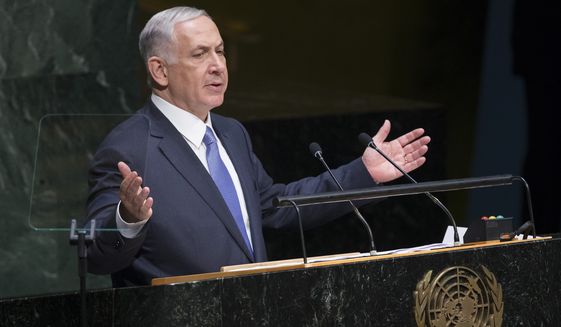 FILE – In this Monday, Sept. 29, 2014 file photo, Israel’s Prime Minister Benjamin Netanyahu addresses the 69th session of the United Nations General Assembly at U.N. headquarters.



 Mahmoud Abbas (r) meets with the Hamas political bureau chief Khaled Mashaal in Qatar, July 20, 2014. (Image source: Handout from the Palestinian Authority President’s Office/Thaer Ghanem)





 anneinpt
 artaxes
 danmillerinpanama
 davidking1530
 Peter Hofman
 Joseph Wouk
 Peter
Peter Louisiana Steve
 WarSclerotic
Recent Comments