Archive for the ‘Israel borders’ category

Sean Hannity Full One-on-One Interview with Donald Trump (2/18/2016)

February 19, 2016

Sean Hannity Full One-on-One Interview with Donald Trump (2/18/2016), Fox News via You Tube, February 18, 2016

(Trump discusses the Israel – “Palestine” situation and the mess Obama has made beginning at 11:05 during the interview. The rest is very good too. — DM)

https://www.youtube.com/watch?v=4rcALd00L5k

Special Israeli emissary to Moscow over Russian Syria air strikes near border

February 17, 2016

Special Israeli emissary to Moscow over Russian Syria air strikes near border, DEBKAfile, February 17, 2016

Israel_near_border_16.2.16

In view of the crisis building up on the southern Syrian-Israeli border, Prime Minister Binyamin Netanyahu decided immediately on his return home from Berlin early Wednesday, Feb. 17, to send a special  emissary to Moscow to ask for clarifications. Tuesday, Intensified Russian air strikes came to within 6 km of the Israeli border, sparking a growing exodus of Syrian refugees heading towards the Qoneitra border crossing to Israel.

DEBKAfile’s sources reveal that the envoy is Dr. Dore Gold, director-general of the Foreign Ministry and one of the prime minister’s few trusted confidantes.

It was still not clear whom Gold will meet in the Russian capital, but it is assumed that it will be one of Moscow’s senior decision-makers in the loop on its military operation in Syria.

The fact that Netanyahu decided to dispatch a top diplomat rather than a senior military or intelligence officer is a sign that the prime minister is not of one mind with the IDF’s intelligence assessments of the situation on the ground.

Netanyahu’s concerns grew after after the Russian air force on Tuesday widened its massive bombing of southern Syria from the city of Daraa to the Golan town of Quneitra, in order to help the Syria army’s 7th armored division push the rebels east, so they will not attempt to cross the border and seek shelter in Israel.

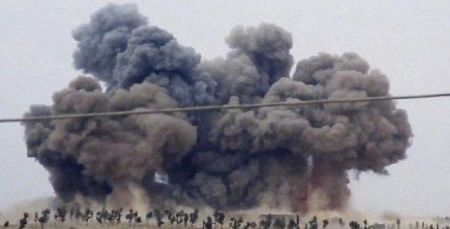
DEBKAfile’s military sources report that that 12 of the 15 targets bombed by the Russian air force across from the Israeli border were new rebel positions that had not been attacked before, even by the Syrian army. Military sources monitoring the war said Tuesday night that there is no doubt that the Russians are in the process of wiping out the rebel positions along the Israeli border by means of an offensive comparable to their operations in the northern Aleppo sector.

Our sources report that Israel’s concerns grew when, as the Russians bombing raids neared the Israeli border, Syrian officials threatened Jordan with serious consequences if Amman gave the Saudi air force a base for attacking eastern or southern Syria.

The threats began Tuesday, after Jordanian forces took over the Syrian-Jordanian border crossings formerly held by Syrian rebels, as a measure to stem the volume of Syrian refugees in search of sanctuary in the Hashemite Kingdom. But this step was interpreted by the Syrians and their Russian ally as clearing the way for Saudi intervention in the Syrian conflict using Jordan as a jumping-off base.

Meanwhile, Western military sources reported a sub substantial presence Tuesday of both Russian and Israeli warplanes in the skies over and around southern Syria.

Report: Hizballah Has Russian Technology Capable of Downing Israeli Jets

February 16, 2016

Report: Hizballah Has Russian Technology Capable of Downing Israeli Jets, Investigative Project on Terrorism, February 16, 2016

Hizballah is using advanced radar technology to “lock on” to Israeli aircraft flying reconnaissance missions over Lebanon, according to Israel’s Walla news service and reported by i24 News.

The new technology enables Hizballah to identify Israeli jets and fire missiles at them, Israeli security sources said.

“The connection between Hizballah, Russia and Syria have greatly changed the rules of the game in the region…Hizballah is indicating to Israel that it is ready for the next stage,” said an Israeli security official, quoted in Walla.

Israeli fighter jets are capable of detecting radar that threatens them, allowing pilots to alter their course. Nevertheless, the reports signal a troubling development that could hinder Israel’s freedom of movement in airspace across the northern border and its ability to effectively monitor Hizballah.

Following the 2006 war between Israel and Hizballah, the terrorist organization began acquiring sophisticated anti-aircraft systems and other advanced weapons from Syria and Iran. A recent report suggests that Hizballah is using Iranian anti-tank missiles in Syria that could be used against Israel in a future confrontation.

In light of these developments, Israel has allegedly targeted Hizballah weapons convoys on several occasions coming into Lebanon from Syria over the past few years. Nevertheless, the terrorist organization continues to build up its weapons arsenal and consolidate a base of operations on the Syrian Golan in order to attack the Jewish state.

Last month, Hizballah field commanders with operatives fighting in Syria told the Daily Beast that Russia is providing the terrorist organization with advanced weaponry amid enhanced coordination among both actors. The report outlines that Hizballah is acquiring long-range tactical missiles, anti-tank systems, and laser guided rockets from the Russians.

In new Syrian exodus, some 50,000 refugees head to Jordanian, Israeli borders

February 10, 2016

In new Syrian exodus, some 50,000 refugees head to Jordanian, Israeli borders, DEBKAfile, February 10, 2016

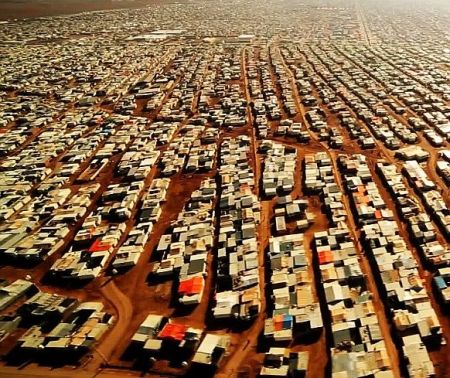
An aerial view shows the Zaatari refugee camp near the Jordanian city of Mafraq, some 8 kilometers from the Jordanian-Syrian border. 03/02/2016. BBC News

An aerial view shows the Zaatari refugee camp near the Jordanian city of Mafraq, some 8 kilometers from the Jordanian-Syrian border. 03/02/2016. BBC News

Syria’s refugee crisis in the north is now repeating itself in the south, with tens of thousands of destitute women, children and elderly people fleeing their homes – not this time from beleaguered Aleppo to the Turkish border, but from the southern region of Daraa towards the Jordanian and Israeli borders.

Unlike the broad coverage of the refugee crisis on the Syrian-Turkish border, the refugee exodus from the south has received scant media attention – even from Israeli correspondents.

With the intensification of attacks in southern Syria, about 50,000 refugees are now streaming toward Jordan and another 20,000 making tracks from Israel’s Golan border at Quneitra.

DEBKAfile’s military sources report that, since the weather has cleared and Russian air strikes resumed against the rebels holding the northern part of Daraa, tens of thousands of civilians are on the move from the South. About 15,000 to 20,000 have reached the Jordanian border, and more than 30,000 are believed heading that way; while another 20,000 refugees may be making for the Golan town of Quneitra on the Israeli border.

Jordan has taken in 650,000 Syrian refugees in previous exoduses from the five-year old war.

A desperate SOS appeared on social media Wednesday, Feb. 10, in which the rebel-controlled Daraa Provincial Council warned that tens of thousands of civilians were in flight from Russian air strikes and the barrel bombs dropped by the Syrian warplanes and helicopters.

There was no way to bring water, food or medicines to the fleeing refugees.

Military sources monitoring the situation report that the exodus was first touched off by the fall of Alaman, 3 km north of Daraa in the last few days to Syrian and Hizballah forces. They next cut off parts of Highway 5 from Daraa to Damascus. The rebels were left with only one remaining escape route, the road to the Jordanian border, but that too is under heavy fire, forcing the refugees to go round through rough country.

As in Aleppo, the Darnah district is held by hundreds of assorted rebel militias, ranging from the US-backed Free Syrian Army to groups which have sworn allegiance to ISIS. According to our intelligence sources, it is often hard to determine which groups are taking orders from whom.

Jordan has followed the Turkish policy towards the tens of thousands of refugees massing on its border  A single crossing is operating at Ramtha, but refugees are not allowed to pass through.

The Israeli government has not yet issued any statements of policy with regard to the Syrian refugees heading for the Golan.

Hizballah Using Advanced, Iranian Anti-Tank Missiles in Syria

February 2, 2016

Hizballah Using Advanced, Iranian Anti-Tank Missiles in Syria, Investigative Project on Terrorism, February 2, 2016

Israel frequently has voiced concerns over Hizballah acquiring sophisticated weaponry – including new Iranian anti-tank missiles – that could end up being utilized against in a future battle between Israel and the Shi’ite terrorist organization.

*****************

Hizballah terrorists are using Iranian-made anti-tank missiles in Syria that could be used against Israel in a future confrontation, the Investigative Project on Terrorism (IPT) has learned.

On Sunday, Iranian news agency ABNA reported that Hizballah is using Toophan anti-tank missiles manufactured by Iran’s Aerospace Industries Organization.

The Toophan is a reverse-engineered version of the American military BGM-71 TOW missile, with a payload of 3.6 kg warhead that is capable of penetrating up to 550mm of steel armor. The missile can reach a top speed of 310 m/s, with a range of 3,850m.

Israel frequently has voiced concerns over Hizballah acquiring sophisticated weaponry – including new Iranian anti-tank missiles – that could end up being utilized against in a future battle between Israel and the Shi’ite terrorist organization.

This development comes amid growing Iranian expansion in Syria and throughout the region. Since the launch of Iran’s October ground operation in northern Syria, more than 135 Iranian Revolutionary Guard Corps (IRGC) troops have been killed, according to a report written by Raz Zimmt – an expert on Iran’s political and social networks.

Click here for the full analysis published by the Meir Amit Intelligence and Terrorism Information Center.

The commander of IRGC’s Qods Force – Qassem Soleimani – was also seen in public Jan. 21, his first appearance since he was reported injured in Syria. Soleimani spoke at a memorial service for an IRGC brigadier general killed in an alleged Israeli airstrike in January 2015 near Quneitra in the southern Golan Heights. That airstrike also killed six Hizballah terrorists, including Jihad Mugniyeh, son of arch-terrorist Imad Mugniyeh.

Iran is working with Hizballah and other terrorist organizations, including the Palestinian Islamic Jihad, to set up a base of operations along the Syrian border to target the Jewish state.

Iran has also increased its interventions in Iraq and Yemen in recent months, as the Islamic Republic seeks to expand its presence throughout the Middle East in an effort to achieve regional hegemony.


IDF Preparing for Arrival of ISIS on Syrian Border

January 30, 2016

IDF Preparing for Arrival of ISIS on Syrian Border, Investigative Project on Terrorism, Yaakov Lappin, January 29, 2016
934

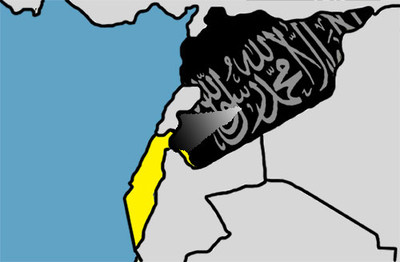
As conflict and mayhem continue to rage across Syria, the Israel Defense Forces (IDF) is preparing to encounter the threat of ISIS and al-Qaida forces right on its borders, and could encounter such threats in the coming months.

The preparations come as the Syrian civil war shows no sign of letting up. This is a conflict that has led to the violent deaths of 300,000 Syrians, and the displacement of more than 10 million others, 4.5 million of whom have fled the country.

Today, the IDF’s Military Intelligence Directorate views Syria as a former state that has broken apart into multiple ‘Syrias.’ The Assad regime controls barely 30 percent of Syria and is fully reliant on the foreign assistance of Russia, Hizballah, and Iran. Sunnis and Shi’ites wage daily war on one another.

It is worth examining the wider recent events in the multifaceted Syrian conflict, and place the IDF’s preparations in their broader regional perspective.

In Syria’s murderous kill-or-be-killed environment, Salafi-jihadist doctrines flourish, in the form of ISIS, which views Shi’ites (including the Assad regime and Hizballah) as infidels who must be destroyed.

ISIS cells have operated recently in Lebanon too, targeting Shi’ite Hizballah’s home turf of Dahiya in southern Beirut with two large bombings in November that claimed over 40 lives, while ISIS in Iraq continues to target Shi’ites.

Today, ISIS has between 30,000-50,000 members who are dedicated to expanding their caliphate and killing all those who disagree with their doctrine, including even fellow Sunni jihadi members of al-Qaida’s branch in Syria, the Al-Nusra Front, which has 8,000-12,000 members.

ISIS continues to use its territory in Syria and Iraq to plot major, mass-casualty terrorist attacks in Western cities. At the same time, its budgetary future looks uncertain, as oil funds have decreased significantly following allied air strikes on oil facilities. In the past year, 45 percent of ISIS’s $1.3 billion budget came from oil, far less than the oil revenue in 2014.

Unlike ISIS, al-Qaida believes in following a phased, slower plan in setting up a caliphate, and the two jihadist organizations have been at war with each other for more than two years in Syria.

Shi’ites led by Iran are fighting to stop the Salafi-jihadis’ spread. Under the command of Iranian Revolutionary Guard Corps (IRGC)-Quds Force unit commander, Qassem Suleimani, Iranian fighting forces and advisers moved into Syria. Iran has sustained more than 300 casualties there thus far.

Hizballah, too, is heavily involved in Syria’s battles, losing an estimated 1,300 fighters and sustaining 10,000 injuries – meaning more than half of its conscripted fighting force has been killed or wounded. Iran and its proxies are using the mayhem to try to spread their own influence in Syria.

Near Israel’s border with Syria, the Al-Yarmouk Martyrs Battalions, which is affiliated with ISIS, has set up many posts.

An estimated 600 members of the group control a population of around 40,000 Syrians. Al-Yarmouk is at war with al-Qaida’s Jabhat Al-Nusra, which maintains a few thousand members in the Syrian Golan near Israel.

Jabhat Al-Nusra’s membership is mostly derived of local Syrians, who tend to be more hesitant to start a war with Israel that would result in their areas, and relatives, being badly affected. Yet 10 to 15 percent of its membership comes from abroad, and have no commitment to the area. These foreign fighters have no qualms about precipitating attacks on Israel. At the moment, however, Jabhat Al-Nusra is bogged down by its fight with Al-Yarmouk.

ISIS has officially put Israel in its sights, and its leader, Abu Bakr Al-Baghdadi, declared his intention at the end of December to attack Israel.

The IDF is taking the threat seriously and is preparing for a range of possible attacks, including strategic terror attacks, cross-border raids, the sending of bomb-laden armored vehicles into Israel, and rocket, missile, small-arms, and mortar fire on the Israeli Golan Heights.

One possibility is that the heavily armed Al-Yarmouk group, which is facing the southern Golan Heights, might follow an Islamic State directive to attack Israel.

In 2014, Al-Yarmouk became an ISIS representative, swearing allegiance to it, though it is not fully subordinate to it.

Al-Yarmouk’s late leader, known as Al Khal (“the uncle”), was killed in November in an attack by Jabhat Al-Nusra. Before his violent end, Al Khal only partially committed himself to ISIS, and turned down ISIS requests to send fighters to Iraq.

Al-Yarmouk’s response to Jabhat Al-Nusra’s attacks came in December, when it assassinated a Jabhat Al-Nusra commander in his armored vehicle, just 400 meters from the Israeli border.

Al-Yarmouk subscribes to the Salafi jihadist ideology and has shoulder-held missiles, tanks, and other weapons looted during raids on the Assad regime military bases.

But Israel is also preparing for the possibility of encountering ISIS itself, not just an affiliate group.

ISIS proper is currently situated 40 kilometers from the Israeli border in southern Syria. One possibility is that Russian airstrikes will cause ISIS forces to ricochet southwards, towards Israel.

The IDF is gathering intelligence on all armed groups near its border, exhausting many resources to assess their capabilities, and intentions.

Israel watched as Shi’ite Hizballah came from Lebanon to block Sunni jihadist advances towards Lebanon in recent months, and as Russian airstrikes blocked the advance of the rebels northwards, to Damascus.

The IDF remains in a heightened state of alert along the Syrian border, though it is also working to avoid the creation of easy targets for the array of predatory forces on the other side.

As part of its preparations, the IDF’s Northern Command has given more autonomy to regional field commanders to enable faster responses to surprise attacks by reducing the initial chain of command during emergencies.

Inter-branch cooperation between intelligence, ground forces, and the air force has also been tightened.

Additionally, the IDF has fortified its border fence with Syria, adding electronic sensors to better be able to detect and respond to a potential attack in time.

The underlying assumption within military circles is that, sooner or later, ISIS will turn its guns on Israel, and the IDF does not intend to be caught off guard when that happens.
The Inside Track From Israel’s Gaza Border Defenders

January 21, 2016

The Inside Track From Israel’s Gaza Border Defenders, Investigative Project on Terrorism, Paul Alster, January 21, 2016

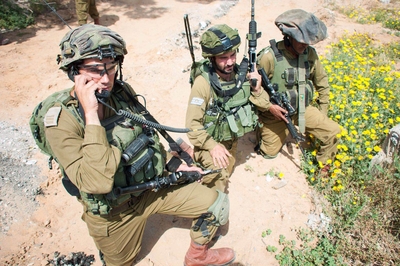
1339Photos courtesy of IDF Spokesperson.

Like it or not, the Iran nuclear deal is done. In much of the Middle East, defense officials in many states believe that a sizeable proportion of the soon-to-be released $100 billion Iranian windfall will be directed toward funding proxy armies of the Islamic Republic, for whom the Jewish state remains the prime target. Israel’s focus is now, more than ever, on defense and surveillance.

In the north, Hizballah, Iran’s proxy Lebanese army, remains a massive threat to regional stability, siding with Syria’s disgraced President Bashar Assad and his saviors from Russia. In Gaza, it is no secret that a previous rift between Iran and Hamas has been smoothed over to further mutual objectives and that another, and possibly more brutal round of hostilities between Israel and Hamas may not be far away.

“The sanctions relief and the nuclear deal with Iran represent a strategic shift that the IDF will have to tackle over the next decade,” Israel Defense Forces (IDF) Chief of Staff Gadi Eizenkot said Monday in a speech at the INSS conference in Tel Aviv. “We also see [Iran’s] attempt to influence Arab Israelis and those in the Gaza Strip, and the estimation is that as Iran’s economic situation improves, over the next one-to-two years, it will divert considerably more resources into opposing Israel, via the Iranian military industry.”

Last week, the Investigative Project on Terrorism (IPT) saw first-hand the situation on Israel’s south-western border, meeting with a senior IDF source who cannot be identified for security reasons. Close to the Kerem Shalom border crossing, where Israel oversees the transfer of many hundreds of tons of goods and supplies every day into Gaza,  we scrambled up a sizeable sand dune that offered a panoramic view of the situation on the ground toward the closed Rafah crossing from Egypt into Gaza.

“We hear the explosions and the fighting [against the Islamists] on the Egyptian side. The Egyptian army is taking it seriously,” the senior IDF source explained as we looked across the triangular border junction and heard distant noises, apparently explosions. “We hear this every day. Terrorists continue to try to cross from Egypt into Gaza.”

Minutes later, a text message announced that the Keren Shalom crossing suddenly had been closed. It turned out that the Egyptian army reportedly engaged and killed 13 jihadists  just a couple of miles away. Two days earlier, an attempt to breach the Israel-Gaza border fence and plant an IED resulted in an Israeli airstrike reportedly eliminating a member of the Al Aqsa Martyrs Brigade.

Meanwhile, Hamas continues to test fire rockets into the sea, and in recent months other Islamic militants in Gaza sporadically lob rockets toward Israel. On the other side of the border triangle, Egypt is doing its best to keep a lid on ISIS and other Islamist forces in the Sinai Peninsula.

It’s clear that relations between the Israeli and Egyptian militaries are good, a dangerous common enemy helping to focus minds. Under President Abdel Fattah el-Sisi, Egypt (despite a lack of support from the United States), has taken the fight to the terror organizations, often at a significant cost in Egyptian military lives. The horrific October downing of the Russian passenger jet out of Sharm el-Sheikh brought the scale of the task facing Egypt into focus. Israel remains alert for the jihadists turning their attention and firepower from Sinai, but for now believes that Gazan-based terror poses its most immediate threat.

“It’s been quite quiet with Hamas [since the 2014 Protective Edge war], but they don’t keep quiet for long,” the IDF source said. “We’re not looking for a fight – we have an interest that there will be quiet here – but if we have to deal with Hamas, this time we’ll deal with them properly.”

Many Israelis were dismayed when Israel unilaterally pulled out of Gaza in 2014 without a ceasefire, some criticism coming notably from members of the left-wing opposition and media for allowing Hamas off the hook when many believed it was in utter disarray. Now, despite ongoing attempts to stem the flow of weapons, reports suggest Hamas is rebuilding fast and may have some surprises in store for Israel if there’s another round of fighting.

“Look, we’re quite certain they are still building tunnels,” the official said, planting his heel in the sand and showing how easy it is to dig. “And yes, I’m sure they have new weapons – anti-tank, anti-aircraft etc. Like us, they will want to be better next time, but we understand more. The reality is different. We’re learning all the time what is going in Gaza. The army is always preparing for the war to come and [Hamas] won’t meet the same thing as in [Protective Edge].”

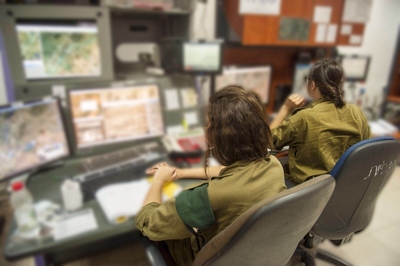
While Israeli soldiers and advanced technology such as its Guardium unmanned patrol vehicles are the first line of defense – the IDF indicated last year that the development of underground tunnel detection systems is also a priority project – the eyes of the military are actually in special units of female soldiers, known as the tazpitanyot. They monitor all movements, looking for suspicious activity, known terror operatives, and attempts to breach the border.

1340 (2)

They work in a series of non-descript trailers and shipping containers belying the fact that inside are massed banks of video screens and radar images, and the ability to combine pictures filmed from aerial blimps with other cameras – both day and night vision. This arrangement allows operatives to zoom in and see Gazans as far as a mile from the border fence.

When anything, or anyone suspicious pops up, there are pictures of ‘Wanted’ terror suspects close to the screens.  They instruct the on-the-ground forces to investigate. Never averting their gaze from the screen during a four-hour shift, each soldier has been trained to identify every landmark, tree, or rock within her specific area of surveillance. “If there’s even a single branch missing from a tree, they’ll spot it” the women’s commanding officer said. They also have remote control of the machine guns sited on border watch towers.

No security system is 100 percent foolproof, and during the first two weeks of the last round of fighting, four terror tunnels emerged on the Israeli side, only being detected at the last moment.  In two cases, the IDF fought gun-battles leaving  at least 10 terrorists and six Israeli soldiers dead. Hamas had hoped to kill civilians before luring Israeli soldiers back through the tunnels then kidnapping them or causing mass casualties.

Methods and practices of surveillance are being continually reviewed, but no-one in the Israeli military doubts the tatzpitanyot’s crucial front-line role in its border security, both north and south.

Jibril Rajoub to Israelis: You Sons of Bitches, We Will Accept Nothing Less than a Palestinian State

January 11, 2016

Jibril Rajoub to Israelis: You Sons of Bitches, We Will Accept Nothing Less than a Palestinian State, MEMRI-TV via You Tube, January 11, 2016


https://www.youtube.com/watch?v=FLw3V9qXzEk


According to the blurb following the video,

At a ceremony marking the 51st anniversary of the establishment of Fatah, the movement’s Central Committee member Jibril Rajoub, former head of the Preventive Security force, addressed the Israelis, saying: “You sons of bitches, we will accept nothing less than a Palestinian state. We own this place, we are its people, while you are alien here.” Rajoub, who serves as the head of the Palestinian football association and the head of the Palestine Olympic committee, further said: “To this day, resistance has remained a genetic code among all Fatah members.” The ceremony, held at Burqin, near Jenin, was broadcast on the Palestinian Awdeh TV channel on January 6, 2016.

Did Hizballah dig a special tunnel to get bomb into Israel?

January 6, 2016

Did Hizballah dig a special tunnel to get bomb into Israel?, DEBKAfile, January 6, 2016

Israeli Minister of Defense Moshe 'Boogie' Ya'alon (2R) seen during a visit in the Golan Heights, Northern Israel, on January 5, 2016. Photo by Ariel Hermoni/Ministry of Defense *** Local Caption *** ?? ?????? ??? ????? ???? ??? ????? ??? ?????
Israel’s military chiefs on Golan

The mystery of how Hizballah managed to plant the bomb, which blew up against an IDF patrol, without causing casualties, Tuesday, Jan. 5, in the Shebaa Farms district of Mt Hermon – on the Israeli side of the ceasefire line – is perplexing Israel’s military chiefs. It brought Defense Minister Moshe Yaalon, Deputy Chief of Staff Maj. Gen. Yair Golan (former OC Northern Command) and his successor Maj. Gen. Aviv Kochavi to the Golan the next day for a close inspection of the Syrian and Lebanese border defenses.

They found no fault with the meticulous preparations and counter-measures the contingents on the spot had made for an attack, which Hizballah leader Hassan Nasrallah had said was “inevitable” after the assassination of Samir Quntar in Damascus on Dec. 20.

But, in addition, to the lookout posts scattered along the border, was a countermeasure that had been rated impermeable: an “electronic sterile area” abutting the electronic border fence, which has been strewn with hi-tech sensors and other devices designed to act as tripwires for the smallest intrusion.

The fact that Hizballah was able to plant a bomb on the Israeli side of the border proved that this elaborate system did not work.

The Shiite terrorist group, Iran’s Lebanese proxy, has long been known to maintain a commando unit known as the “Redwan Force,” especially trained for eventual incursions into Israel on missions of assault and the capture of Israeli locales with hostages.

But its ability to outsmart an electronically sterile barrier was quite another matter. It is of the utmost urgency for IDF tacticians to seriously rethink the defensive measures in place on the northern borders with Syria and Lebanon, before Hizballah strikes again.

But first of all, they must find out how it happened. Some Lebanese sources are throwing out hints of a secret tunnel dug by Hizballah, through which the “Quntar Brigade” was able to sneak the bomb onto the IDF patrol route, although it failed to cause casualties. No trace of a tunnel has so far been reported.

At the time of the incident, Israeli public and media attention was wholly taken up with the Dizengoff gunman, who murdered three Israelis on Jan. 1 and is still at large six days later.

Since Hizballah’s Shebaa Farms attack was swiftly countered by massive IDF artillery fire, it was soon over and the episode relegated to back pages. However, the defense minister and IDF chiefs cannot afford to treat it lightly. They are convinced that Hizballah has not concluded its campaign of “revenge” and may reuse the same method for further attacks. No stone is therefore being left unturned to discover how Hizballah smuggled a bomb onto Israeli terrain – over or under the border – and the preparations for an attack remain high.

At the end of his Golan inspection visit, the defense minister said: “The IDF is alert and fully prepared for every eventuality, just as it was for the Mt Dov (part of Mt. Hemon) attack. The forces are ready to respond whenever and however necessary and, if need be, their response will be powerful indeed.”

As the Mideast Descends into Chaos, Israel Must Have Defensible Borders

January 3, 2016

As the Mideast Descends into Chaos, Israel Must Have Defensible BordersThe Jerusalem Center via You Tube, January 3, 2015

(Would the “two state solution” be a “final solution” for Israel? — DM