Archive for the ‘Israel and Syria’ category

Making Sense of the Mess in Syria

December 6, 2016

Making Sense of the Mess in Syria, Front Page MagazineAri Lieberman, December 6, 2016

syriamess

The vacillating and pusillanimous policies pursued by the Obama administration have enabled the Russians and Iranians to fill the void. Meanwhile, as Syria’s death toll nears 500,000 and its migrants – some with radical Islamic connections – continue to stream into Europe, it is clear that the nation state of Syria, Balkanized after five years of brutal conflict, is no more.
***********************

On July 30, 1970 a squadron of Israeli air force F-4E Phantoms and Mirages laden with bombs and missiles took off from their airbase in Sinai and flew westward toward Egypt. Their target was an Egyptian radar station.

The action occurred during the height of the War of Attrition between Israel and Egypt. The Egyptians were faring badly and their armed forces had suffered a series of public humiliations at the hands of the Israel Defense Forces. As a consequence, the Soviets stepped into the fray to save their client state and deployed 10,000 military personal and technical experts to the theater. The Soviets also assumed full control of Egypt’s air defenses. Surface-to-air missile batteries were manned by Soviet personnel and Soviet piloted MiG 21Js – the Soviet Union’s latest MiG-21 variant – patrolled Egyptian airspace. A direct clash between the Soviet Union and Israel was inevitable.

As the Israeli fighters zeroed in on their target, 16 Soviet MiGs moved in to intercept. In the melee that followed, five MiGs were shot down for no Israeli losses. The remaining 11 MiGs beat a hasty retreat. The Soviets were simply no match for the seasoned Israeli pilots.

The clash brought regional tensions – already heightened after one year of near constant border clashes – to a boiling point but neither side wanted an escalation. A ceasefire was eventually brokered by the superpowers and tensions deescalated.

Russia’s present military deployment in Syria is not dissimilar to its deployment in Egypt 46 years ago but the chances of an Israeli-Russian aerial clash today is virtually nil. There are some salient differences between the two circumstances. Israel and Russia are no longer bitter enemies and currently maintain cordial relations. Lines of communications between the two nations are good. Potential misunderstandings – to the extent that any exist – are channeled through liaisons to prevent accidental confrontations.

But war can best be summed up as organized chaos and given the clutter over the skies of Syria, with Russian, Israeli, Turkish and Coalition aircraft all operating within the confines of a limited space, mishaps are certainly possible. The Russians maintain formidable air defenses in Syria and Israel views them warily.

Underscoring this, last week IAF fighter jets launched two strikes in Syria, one targeting ISIS, in which four ISIS terrorists were killed and the second, targeting a Hezbollah weapons convoy and a Syrian military compound just outside Damascus. Though the Israelis have understandably remained moot on the specifics of the latter attack, according to published sources, Israeli fighters launched a number of Israeli made Popeye air-to-surface missiles from Lebanese airspace at a facility housing elements of Syria’s 4th Armored Division as well as a Hezbollah-bound weapons convoy traveling along the Beirut-Damascus highway.

Israel cognizant of Russia’s S-400 and S-300 air defense platforms in Syria opted to circumvent the possibility of an accidental confrontation by launching its attack from Lebanese airspace. It should be noted that the S-400s were deployed by the Russians last year following the downing of a Russian Su-24 by a Turkish F-16. The move was meant to serve as a deterrent to Turkey and no hostile intent was directed at Israel. Additionally, the term “Lebanese airspace” is a rather generous term that implies that Lebanon is a fully sovereign nation. In reality, Lebanon is sovereign in name only, having been swallowed whole by Hezbollah, Iran’s genocidal Shia proxy.

Israel’s interest in Syria is limited to ensuring that game-changing weapons of strategic import don’t fall into the hands of Hezbollah. Thus, on several occasions, Israeli fighter jets have launched successful interdicting operations aimed at destroying sophisticated weaponry – including SA-22 anti-aircraft missiles, Scud D ballistic missiles and Yakhont cruise missiles – clandestinely shipped from Iran via Syria.

A secondary goal is to ensure that border areas remain free of Hezbollah, Iranian and ISIS influence. In January 2015, an Israeli airstrike liquidated 12 senior Hezbollah and Iranian Revolutionary Guard Corps operatives, including an IRGC general, who were reconnoitering the border near Israel’s Golan Heights for future operations against the Jewish State.

Russia, which has a much broader interest in Syria, understands Israel’s concerns and has no interest in needlessly antagonizing the Israelis. Syria has been under Soviet and now Russia’s sphere of influence since the early 1950s and Russia is intent on maintaining its air and naval bases in Syria. To that end, it is keen on maintaining Assad’s hold on power, or for that matter, any Assad replacement that commits to friendly relations with Moscow and continued Russian military presence.

Russia is also looking to project military power and reassert its role as a superpower. The high profile deployment of a sizable Russian fleet in the Eastern Mediterranean, which includes the Russian aircraft carrier and Cold War relic, Admiral Kuznetsov, represents part of this strategy. However, it appears that the Kuznetsov has been a bit of an embarrassment for Putin.

On November 14, a carrier-based MiG-29K crashed while attempting a failed landing on the Kuznetsov. The carrier was encountering problems with its arrestor cables and the MiG crashed while circling and waiting for repairs. Just three weeks later, a Russian Navy Su-33 encountered a similar fate while attempting a landing on the Kuznetsov. Recent Satellite imagery taken of the Russian air base at Khmeimim, near Latakia, shows rows of Su-33 and MiG-29K carrier-based aircraft parked alongside Russian land-based fighter jets indicating that the Russians have given up on the notion of launching strikes from the Kuznetsov.

While the Israelis and Russians maintain clear strategies and objectives for Syria, under Obama, the U.S. strategy in Syria can best be described as befuddled and lacking any clear direction. The U.S. had initially called for Assad’s unconditional departure but seems to have backed away from that position and now calls for an orderly transition of power, seemingly giving Assad some wiggle room.

Obama had threatened to use military force if Assad employed poison gas against his own people but back peddled on that position as well. In late 2015 it was revealed that the Obama administration spent an astonishing $500 million to train four or five Free Syrian Army rebels, clearly demonstrating that Obama’s policy on Syria represents nothing short of a farcical tragic comedy.

The Obama administration had initially ignored the ISIS menace and its current pinprick military campaign against the terror group is utilizing but a fraction of America’s military strength. Finally, while the Obama administration has publicly sought to end Syria’s civil war peacefully, its transfer of billions in cash to the Islamic Republic has only served to fuel the fire. There is no doubt that this cash has been utilized to pay the salaries of Iran’s mercenary forces in Syria, Lebanon, Yemen and Iraq.

The vacillating and pusillanimous policies pursued by the Obama administration have enabled the Russians and Iranians to fill the void. Meanwhile, as Syria’s death toll nears 500,000 and its migrants – some with radical Islamic connections – continue to stream into Europe, it is clear that the nation state of Syria, Balkanized after five years of brutal conflict, is no more.
“Syrian 5th Corps” is new Shiite foreign legion

December 4, 2016

“Syrian 5th Corps” is new Shiite foreign legion, DEBKAfile, December 4, 2016

fifth_corps

The new Shiite foreign legion or international brigade presents a major headache for Syria’s neighbors, Turkey, Lebanon, Jordan and Israel. It provides a cover for Iran and Hizballah to sneak troops right up to their borders. Whenever this happened in the past, Israel and Jordan pushed back hard. But this will be more difficult once the Fifth Corps is set up as an integral part of the Syrian army.

***************************

Syria and its allies came closer than ever to taking Aleppo on Friday, Dec. 2, when they captured the Tariq al-Bab district to gain control of 60 percent of the rebel-held eastern part of the city.

Drawing on the lessons of this success, the winning forces have begun building a military outfit modeled on the format of the victorious coalition. It is designated the “Fifth Corps” of the Syrian army, but DEBKAfile’s military and intelligence sources can identity the new unit as the framework for an international Shiite brigade or foreign legion.

It is the brainchild of the Iranian Revolutionary Guards’ Gen. Qassem Soleimani, commander of Iranian Mid East operations, who is in Iraq at present, supervising the Shiite militias on the Mosul front. However, his officers are overseeing its construction of the new military legion. It is composed of the remnants of the Syrian army’s First and Second Corps, which took a bad beating in the five years of conflict, the Hizballah expeditionary force in Syria and the Shiite militias which Tehran imported from Iraq, Afghanistan and Pakistan to fight for Bashar Assad.

The new framework aims to field 50,000 to 70,000 fighting men.

Its command structure is already taking shape in a form that is new for the Syrian army and indeed any other fighting force in the region. Syrian, Hizballah and foreign Shiite officers will make up this command, but not direct their own forces, only mixed units composed of Iranian, Syrian, Shiite and Hizballah servicemen.

It will be the first Shiite army or foreign legion ever seen in the Middle East.

An oblique reference to the novel force came from a Hizballah source this week who said: “The Fifth Corps is an important turning-point for the ties between allied forces within the same axis – Syria, Iran, Russia and Hizballah.”

Russia? DEBKAfile’s sources have heard no hint of the Russians joining the new Shiite legion. But Hizballah has been spreading reports in the past fortnight about its deepening ties with Russian officers, mainly on the Aleppo front, and their supposed appreciation of the Lebanese Shiites’ fighting prowess.

The Syrian high command has meanwhile moved forward on the new scheme with a decision this week to send the entire next class of military recruits to the new Fifth Corps.

The new Shiite foreign legion or international brigade presents a major headache for Syria’s neighbors, Turkey, Lebanon, Jordan and Israel. It provides a cover for Iran and Hizballah to sneak troops right up to their borders. Whenever this happened in the past, Israel and Jordan pushed back hard. But this will be more difficult once the Fifth Corps is set up as an integral part of the Syrian army.

Western and Arab observers following the Syrian war believe that, as soon as they finish off the rebels in Aleppo, the new foreign legion’s forces will turn south to repeat the exercise there with Russian support.

The Russian bombardment of rebel concentrations outside the southern towns of Jasim and Daraa Sunday, Nov. 27, was seen a message from Moscow to Jerusalem and Amman that southern Syria is now in line for the next battle.

Israel jets mark go-it-alone policy on Syria

November 30, 2016

Israel jets mark go-it-alone policy on Syria, DEBKAfile, November 30, 2016

raidfire480Arab media show damage caused by air strikes to Syrian army compound in Damascus

Although Erdogan is notorious for his wildly unpredictable decision-making, it is more than likely that before going public on his radical change of heart on Assad, he was in touch with the new national security team taking shape in Washington. If that was the case, then Donald Trump was using Erdogan to notify Putin that the entire architecture of their understandings on Syria was now at risk.

If the Arab media reporting on Israeli air attacks on Syrian military and Hizballah targets in Damascus from Lebanese air space are confirmed, Jerusalem will be shown to have followed Ankara in backing away from those short-lived, understandings, opting instead for an independent policy in its own security interests with regard to Syria.

*****************************

Arab media carried conflicting reports wich described Israeli warplanes striking in and around Damascus overnight Tuesday, Nov. 29, with “four long-range Popeye” missiles fired from Lebanese air space on the government-held town of Al-Saboorah, a western suburb of Damascus, near the highway to Beirut.

A Lebanese newspaper reported that a Syrian army ammunition depot was destroyed in one of the raids, while other strikes hit and damaged a Hizballah arms convoy bound for Lebanon on the Damascus-Beirut Highway. There was also speculation, later denied, that one of the air strikes aimed at assassinating a senior Hizballah figure.

None of these reports were confirmed by Israel or any other official source.

Even so, Israel’s reported military action against enemy targets in Syria is bound to have repercussions in the next 24 hours, since, whatever took place, broke out of the secret overarching understandings on Syria reached provisionally this month between US President elect Donald Trump, Russian President Vladimir Putin and Turkey’s Recep Tayyip Erdogan.

Those understandings hinged strongly on joint US-Russian cooperation in the war on the Islamic State in Syria, supported by the coalition fighting for the Assad regime, namely, the Syrian army and its allies, the Lebanese Hizballah and foreign Shiite militias under the command of the Iranian Revolutionary Guards.

As the sub-text of the “big power” understandings, an outline was drafted between the next US administration, Moscow, Jerusalem, Amman and the UAE on arrangements for stabilizing Syria’s southern borders with Israel and Jordan.

Talks on these arrangements were first disclosed in an exclusive DEBKAfile report on Nov. 21, after they had already produced the unheralded return of the UN observers to the Golan demilitarized zone outside Quneitra.

But then, Sunday, Nov. 27, Russian warplanes staged a sudden series of airstrikes against Syrian rebel concentrations in the very region under discussion, southern Syria. After a three-month pause in these attacks, Moscow appeared to have waited for major Syrian government progress in Aleppo, to go against those understandings and send Russian jets into action over Jasim and Daraa in order to wipe out the rebel forces holding out in the South. Heavy casualties were sustained by those forces.

The Russian action was seen by the incoming Trump administration and Jerusalem as presaging the next danger-fraught step: To round out the raids, the Syrian army would come flooding into the South, along with Hizballah and other Shiite militias fighting under Iranian Revolutionary Guards command.

Tuesday saw two further ruptures in the trilateral understandings on Syria.

Assad announced he was gearing up for a decisive victory in Aleppo, notwithstanding a request from Trump’s advisers to Putin to hold back from the final step and refrain from retaking every last eastern district from rebel hands..

This was followed by an unforeseen statement by Erdogan: “The Turkish military launched its operations in Syria to end the rule of President Bashar al-Assad.”

This sentiment pivoted sharply away from the secret Trump-Putin understandings endorsed by the Turkish leader that was contingent on Assad remaining in power.

Although Erdogan is notorious for his wildly unpredictable decision-making, it is more than likely that before going public on his radical change of heart on Assad, he was in touch with the new national security team taking shape in Washington. If that was the case, then Donald Trump was using Erdogan to notify Putin that the entire architecture of their understandings on Syria was now at risk.

If the Arab media reporting on Israeli air attacks on Syrian military and Hizballah targets in Damascus from Lebanese air space are confirmed, Jerusalem will be shown to have followed Ankara in backing away from those short-lived, understandings, opting instead for an independent policy in its own security interests with regard to Syria.

Russia: Dissolve US-Arab-Israeli Syria war room

September 12, 2016

Russia: Dissolve US-Arab-Israeli Syria war room, DEBKAfile, September 12, 2016

jordan_mifkada480

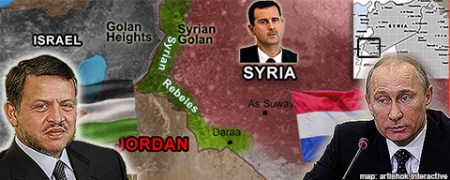
In another move to grab control of the Syrian arena, the Kremlin marked the start of the US-Russian brokered ceasefire in Syria on Sept 12 with a push for the United States to dissolve the war room that has been running anti-Assad operations from a venue north of the Jordanian capital Amman. DEBKAfile’s military and intelligence sources report that the demand was handed down from the Russian presidential office and Defense Minister Sergei Shoigu.

The US Central Command Forward Command in Jordan has for three years run the command and communications functions of select rebel ground operations against Bashar Assad, especially insofar as US special operations units and air force were involved.

Jordanian, Saudi, Israeli, Qatari and United Arab Emirates officers serve alongside American commanders.

This forward command has evolved, according to our sources, into the nerve center of the military campaigns waged by this coalition against the Syrian army and its allies in southern Syria and also against the Islamic State in southeastern Syria and parts of western Iraq.

In January 2016, President Vladimir Putin had the Saudis talk King Abdullah into establishing a Russian-Jordanian forward command outside Amman alongside the American war room. His pretext was the necessity to avert accidental collisions between the Russian and Jordanian warplanes operating in Syrian air space.

But over the past months, the Russian-led command center has gradually nudged the US war room into an inferior role in the control of ongoing operations.

Last week, in the course of the marathon talks on a Syrian truce held by US Secretary of State John Kelly and Russian Foreign Minister Sergei Lavrov in Geneva, the American delegation was suddenly confronted with a demand to shut down the Centcom forward command in Jordan and reassign the US officers staffing it to the Russian-Jordanian command center.

Although taken aback, the US delegation in Geneva did not immediately reject the demand, but agreed to give it due consideration provided that the 10-day truce in Syria holds up and can be extended.

If President Barack Obama submits to Moscow’s demand, our sources point out, it would mean curtains for Israeli, Saudi, Qatar and Emirate officers participation in the Amman command. They would be sent home and their governments would find themselves out in the cold in relation to coordinated Russia-US and Jordanian operations in Syria.

According to DEBKAfile’s intelligence sources, Israel and Gulf Arab military chiefs have concluded that Moscow’s move has the opposite goal of a ceasefire, and is in fact designed to clear the way for a major Russian-Syrian operation to seize Daraa, the main town of southern Syria, and drive all anti–Assad forces out of this region.

Since most of the rebel groups in control of the South are backed by Saudi Arabia, Israel and the Emirates, their expulsion would eliminate those nations’ influence and involvement in that part of Syria and sever their operational links with the United States.

This theory gained substance from the Syria ruler’s declaration Monday at the Daraya mosque:

“The Syrian state is determined to recover every area from the terrorists,” Assad said in an interview broadcast by state media. He made no mention of the ceasefire agreement going into effect that day, but said the army would continue its work “without hesitation, regardless of any internal or external circumstances”.