Archive for the ‘Israel and Syria’ category

Powerful pro-Iran Badr Brigades to enter Syria

May 31, 2017

Powerful pro-Iran Badr Brigades to enter Syria, DEBKAfile, May 31, 2017

Their entry into Syria could raise the total of pro-Iranian Shiite forces fighting in Syria to 80,000 to 100,000 troops.

For Israel, Hizballah’s hostile penetration of Syrian borders abutting its territory is child’s play compared with a major military force capable of transforming Syria into a huge staging area for Iranian aggression against the Jewish state.

****************************

Hadi al-Amiri, commander of the strongest Iraqi Shiite militia, the Badr Brigades, said Wednesday, May 31, that his forces are preparing to enter Syria. The advanced capabilities of this powerful Iranian-led militia, would tilt the Syrian war strongly in Iran’s favor, with alarming ramifications for the US, Israel and Jordan.

Al-Amri, in making this announcement, cited Iran’s new slogan: “Iraq’s security will be maintained only if Syria’s security is preserved.” In other words, the Syrian conflict would end only when pro-Iranian Shiite militias, including Hizballah, control Syria like they control Iraq.

DEBKAfile’s military and intelligence sources report that the Badr Brigades’ path into Syria was secured this week when an Iraqi Shiite conglomerate breached the Iraqi-Syrian border in the north, on the orders of Al Qods chief Gen. Qassem Soleimani. This opened Iran’s coveted overland corridor through Iraq to Syria.

The combat capabilities of the Badr Brigades, estimated at between 30,000 and 50,000 strong, are impressive. One of the most professional and well-trained military forces in Iraq, its recruits receive instruction at special camps operated by Revolutionary Guard Corps on Iranian soil. The militia consists of special forces, tank, mechanized infantry, artillery and antiaircraft units. The high quality of their munitions may be seen in the photo at the top of the story.

Their entry into Syria could raise the total of pro-Iranian Shiite forces fighting in Syria to 80,000 to 100,000 troops.

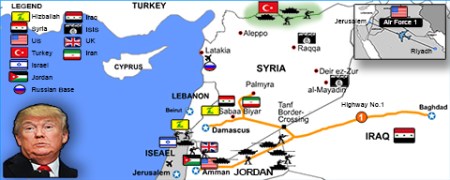
Intelligence sources expect the Badr Brigades to first head south towards the Deir ez-Zor area to link up with the Syrian Arab Army and Hizballah forces, which are threatening the US special forces and allied hold on a key crossing that commands the triangle where the Jordanian, Syrian and Iraqi borders meet.

They would need to cover 230km from Palmyra to Deir ez-Zor, the while fighting small, scattered ISIS concentrations. Wednesday, May 31, Russia came down on the side of Tehran, with a cruise missile strike on ISIS targets around Palmyra. They were fired from the missile frigate Admiral Essen and the submarine Krasnodar for the purpose of softening jihadi resistance to the Badr Brigades’ southward advance.

The consequences of this massive pro-Iranian intervention in the Syrian war are dire for the US, Israel and Jordan. For Washington, it lays the ground for Tehran’s domination of Syria – in the face of President Donald Trump’s solemn vows to prevent this happening.

For Israel, Hizballah’s hostile penetration of Syrian borders abutting its territory is child’s play compared with a major military force capable of transforming Syria into a huge staging area for Iranian aggression against the Jewish state.

Jordan’s foreboding comes from its judgment that pro-Iranian Shiite militias sitting on its borders are a greater threat even that ISIS.

Read more about this pivotal development in the coming issue of DEBKA Weekly. If you are not yet a subscriber, click here to sign on.

Syria & allies push back at US-held border post

May 20, 2017

Syria & allies push back at US-held border post, DEBKAfile, May 20, 2017

The US bombardment of that force Thursday underlined for Saudi Arabia and the dozens of Arab and Muslim rulers, gathered in Riyadh to meet the US president, his administration’s determination to prevent Iran and its Lebanese surrogate, Hizballah, from gaining control of Syria. American troops were accordingly engaged proactively in securing the border crossings between Syria and Iraq.

This clash of arms is likely to expand into an outright US showdown with the US and Syria, Iran and Hizballah in the next 24-48 hours ahead of President Trump’s visit to Israel, the second stop of his four-national trip.

*********************

The Syrian-pro-Iranian-Hizballah force in southern Syria renewed its advance on the Iraqi border on Saturday, May 20, two days after sustaining heavy casualties from a US air strike on its convoys and in spite of US Defense Secretary James’ Mattis warning, “We will defend our troops.”

Syrian military sources reported the capture Saturday of the Suweida region and another 60 square kilometers. This offensive brought the Syrian army and its allies closer to the strategic Al-Tanf crossing at the Syrian border intersection with Iraq and Jordan, which is held by US and other special operations units.

The US-led coalition force is also made up of elite units from Britain, Holland, Germany and the Czech Republic, as well as Jordan and a large contingent of the rebel Free Syria Army trained and armed by American instructors in Jordan.

The latest arrival to boost this force, DEBKAfile’s military sources report, was a unit of Norwegian special forces, which entered Syria from Iraq through the Al-Waleed border crossing in western Anbar. They arrived along with American reinforcements and linked up with the US and British forces deployed at Al Tanf.

However, the Syrian force and its allies to the US air strike moved fast enough Saturday to threaten the FSA troops fighting there with being trapped by a siege. They have pushed their offensive forward against the US-led force, despite their losses from an American air raid, as a show of defiance that was timed for President Donald Trump’s arrival in Saudi Arabia.

Another US air strike appears to be unavoidable for pushing them back. The danger is also rising of a major clash on the ground between US-led coalition special forces troops and the combined Syrian-Iranian-Hizballah force.

The US bombardment of that force Thursday underlined for Saudi Arabia and the dozens of Arab and Muslim rulers, gathered in Riyadh to meet the US president, his administration’s determination to prevent Iran and its Lebanese surrogate, Hizballah, from gaining control of Syria. American troops were accordingly engaged proactively in securing the border crossings between Syria and Iraq.

However, Tehran, Damascus and Hizballah are evidently not about to shirk a direct confrontation with Washington and the Trump administration, apparently with the support of Moscow.

This clash of arms is likely to expand into an outright US showdown with the US and Syria, Iran and Hizballah in the next 24-48 hours ahead of President Trump’s visit to Israel, the second stop of his four-national trip

US, UK, Jordanian forces enter S. Syria

May 15, 2017

US, UK, Jordanian forces enter S. Syria, DEBKAfile, May 15, 2017

DEBKAfile’s military sources explain that Damascus and Tehran acted to pre-empt the US-Jordanian-Israeli military operations along the Israeli and Jordanian borders with Syria, lest they lead to the carving out of US-controlled security zones in southern Syria.

Iran continued to pour additional troops into Damascus through the Baghdad-Damascus highway, on the one hand, while, on the other, Iraqi Prime Minister Haidar al-Abadi offered Washington two of his army’s divisions, which would be sent into Syria to support US military operations in the southeast.

*****************************

US special forces, together with British and Jordanian elite troops, moved into southern Syria late Sunday, May 14. They were acting to counter the Syrian-Iranian scheme to nullify the American plan for posting Jordanian forces in southeastern Syria, which timed for the days before US President Donald Trump’s trip to the Middle East.

The US-led armored force with British and Jordanian units crossed from northern Jordan through the Tanf Border-Crossing between the Hashemite Kingdom, Iraq and Syria, and took up positions capable of consolidating their control of the main road between Palmyra and Baghdad. Some of their moves were coordinated with Israel.
(See map).

This push aimed at countering the drive in the last few days by hundreds of Syrian troops, Iranian-backed Shiite militias and Hizballah’s Radwan special forces, with tanks and heavy equipment, to take over the town of Sabaa Biyar. Located in sparsely desert territory, this town lies 110km west of the Syrian-Iraqi border, 95km north of the Syrian-Jordanian border and 128km east of Damascus.

Its high strategic importance for Tehran, Damascus and Hizballah lies in its command of the border between Syria, Iraq and Jordan and of Highway No. 1 which links the Jordanian capital of Amman with Baghdad.

DEBKAfile’s military sources explain that Damascus and Tehran acted to pre-empt the US-Jordanian-Israeli military operations along the Israeli and Jordanian borders with Syria, lest they lead to the carving out of US-controlled security zones in southern Syria.

Our military sources add that Moscow too eyes the new US-led military movements with mistrust, in view of its potential impact on the Russian plan for four ceasefire zones in Syria, in cooperation with Iranian and Turkish forces. The Russians are accordingly feeding Tehran and Damascus intelligence on the US-led movements.

On Sunday, too, the Israeli Defense Forces launched a large-scale military exercise in the Galilee and Golan regions close to its borders with Syria and Lebanon. The war game may well run over its final date in order to keep a substantial military force poised on along Israel’s northern borders, in case of attempts to disrupt the Trump visits to Saudi Arabia and Israel from May 22 to May 24.

Other military movements in the region this week were taken by the Iraqi army and Iraqi Shiite militias under the command of Iranian Revolutionary Guards officers. Iran continued to pour additional troops into Damascus through the Baghdad-Damascus highway, on the one hand, while, on the other, Iraqi Prime Minister Haidar al-Abadi offered Washington two of his army’s divisions, which would be sent into Syria to support US military operations in the southeast.

For the time being, the Trump administration’s plans for an offensive against the Islamic State appear to have been put on a back burner.

Russian monitors for Syrian Golan – not Iranians

May 11, 2017

Russian monitors for Syrian Golan – not Iranians, DEBKAfile, May 11, 2017

The issue came up during Russian Foreign Minister Sergey Lavrov’s talks with US President Donald Trump and Secretary of State Rex Tillerson in Washington on May 11, and a day earlier, in a telephone conversation between Russian President Vladimir Putin and Israeli Prime Minister Binyamin Netanyahu.

****************************

Moscow this week responded to Israel’s concerns about posting Iranian and Turkish officers on its borders to monitor the potential “de-escalation” zones Russia is proposing for Syria. In respect of those concerns, DEBKAfile’s military and intelligence sources reveal that Russia agreed in high-level contacts in the last few days to replace them with Russian military officers in the Mt. Hermon region and the areas where Israeli, Lebanese and Syrian borders meet. The proposal also calls for the expansion of the UN Disengagement Observer Force (UNDOF), which supervises the cease-fire between Israel and Syria on the Golan.

(DEBKAfile was the first publication to reveal Israel’s concerns on May 3 and May 5.)

The Russian military are preparing to establish four ceasefire safe zones in Syria. The southernmost would be located along Syria’s borders with Israel and Jordan. The issue came up during Russian Foreign Minister Sergey Lavrov’s talks with US President Donald Trump and Secretary of State Rex Tillerson in Washington on May 11, and a day earlier, in a telephone conversation between Russian President Vladimir Putin and Israeli Prime Minister Binyamin Netanyahu.

The chairman of the US Joint Chiefs of Staff, Gen. Joseph Dunford, was also involved in the exchanges on the ceasefire zones between Washington, Moscow and Jerusalem during his visit to Israel this week as the guest of the Israeli chief of staff, Lieut. Gen. Gady Eisenkott. On Tuesday, May 9, Dunford said that “Israel is concerned about the possibility of having Iranian or Iranian-backed forces, such as Hizballah, so close to its border.” Both Putin and Lavrov promised that neither Iranian, pro-Iranian, nor Turkish officers would be placed in areas close to the Israeli border.

Our military sources report that during talks between Washington, Moscow and Jerusalem on Thursday, May 11, the three sides agreed to continue to discuss the Russian proposal.

Another issue raised among them was who will deal with the ISIS forces in the Yarmouk area near the Israel-Jordan and Israel-Syria borders, including the bases established by the Khaled bin al-Walid army, which has sworn allegiance to ISIS.

The coming DEBKA Weekly out Friday, May 12, also reveals positive US-Russian dialogue on more Syrian issues.  If you are not already a subscriber, click here.

KLEIN – Iran Is the Wild Card Following U.S. Air Strikes In Syria

April 7, 2017

KLEIN – Iran Is the Wild Card Following U.S. Air Strikes In Syria, BreitbartAaron Klein, April 7, 2017

U.S. Navy/via AP

President Vladimir Putin cannot risk a military confrontation with Trump and Russia is already signaling willingness to abandon Assad to come to a larger regional accommodation.

Still, there is the possibility that Russia may quietly support action by others, especially agents of a very nervous Iranian regime that has been preparing proxies for years who can heat up Israel’s northern border and beyond.  Both Moscow and Tehran have reason for wanting Trump to pay a price for acting in their Syrian playground.  The question is whether they will dare to respond, even tacitly.

The next few days and weeks will be critical in determining Iran and Russia’s resolve in the face of an awakened America that has returned from its eight-year slumber.

******************************

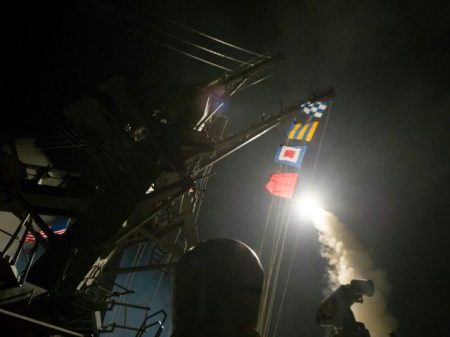
TEL AVIV – Following the U.S. launch of Tomahawk missiles targeting a strategic Syrian airfield on Thursday night, Iran must be monitored carefully for the possibility that it may use its proxies for retaliation, especially against Israel’s northern border.

Following eight years of inaction on Syria under the Obama administration, President Donald Trump demonstrated last night that he is willing to hold Syrian President Bashar al-Assad to account, this time by striking the Shayrat Airfield near the Syrian city of Homs that was believed to have been utilized to carry out a chemical weapons attack that killed scores of civilians.

The U.S. airstrikes signaled to Assad and his Russian and Iranian backers that Trump will act in Syria and the administration strongly supports the removal of the Syrian president – an important strategic ally of Moscow and Tehran. The U.S. military move demonstrates to Israel and the Sunni Arab bloc cast aside by Obama’s nuclear deal with the mullahs that American leadership has officially returned to the region.

Assad himself is unlikely to retaliate since the last thing he wants amidst a years-long insurgency attempting to topple his regime is to go to war with Trump or expand the battlefield to U.S. ally Israel.

Trump’s bold authority in Syria directly threatens Russian interests since it was Moscow that largely filled the security vacuum in that country when Obama repeatedly failed to take any meaningful action against Assad. However, Russia’s direct response will most likely be confined to vocal protestation, such as Kremlin spokesman Dmitry Peskov calling the U.S. strikes “aggression against a sovereign nation” carried out on a “made-up pretext.”

President Vladimir Putin cannot risk a military confrontation with Trump and Russia is already signaling willingness to abandon Assad to come to a larger regional accommodation.

Still, there is the possibility that Russia may quietly support action by others, especially agents of a very nervous Iranian regime that has been preparing proxies for years who can heat up Israel’s northern border and beyond.  Both Moscow and Tehran have reason for wanting Trump to pay a price for acting in their Syrian playground.  The question is whether they will dare to respond, even tacitly.

And that brings us to Iran.  Trump’s embrace of America’s traditional Sunni Arab partners at the expense of Tehran and his strong positions against the disastrous international nuclear agreement have been deeply concerning to the expansionist, terrorist-supporting Twelvers in Tehran.  And while the removal of Assad from power would be a blow to Russia, depending on the ultimate outcome such a move could be disastrous for Iran’s position in Syria.  Iranian Revolutionary Guard units have been fighting the anti-Assad insurgents alongside the Syrian military and the Iran-backed Hezbollah militia.  Syria represents a key pawn in Iran’s geopolitical chessboard that stretches across the vital region.

In recent weeks, there have been strong indications that Iran has been seeking to arm its Hezbollah proxy with even more advanced weapons that can target the Jewish state. Last month, Israel took the unusual step of striking a Hezbollah weapons convoy near the city of Palmyra that Prime Minister Benjamin Netanyahu said was transporting advanced weapons to the Iran-backed militia.

Israeli leaders and Hezbollah terrorists have in recent weeks ratcheted up war rhetoric, with Israeli officials warning that Hezbollah, which can only act at the direction of Iran, has been preparing for conflict.

Last Sunday, IDF Chief of Staff Lt. Gen. Gadi Eisenkot warned the IDF would not hold back from striking Lebanese state institutions in a future conflict with Hezbollah. “The recent declarations from Beirut make it clear that in a future war, the targets will be clear: Lebanon and the organizations operating under its authority and its approval,” Eisenkot stated.

Hezbollah is not Iran’s only option. Breitbart Jerusalem has been reporting on the formation of a “Golan Liberation Brigade,” which was announced last month by the secretary-general of the Iraqi Harakat al Nujaba Shiite militia and is reportedly being trained by the Iranian Revolutionary Guard Corps.  The so-called militia is another Iranian front that could be used to target Israel’s Golan Heights at the behest of Tehran.

The next few days and weeks will be critical in determining Iran and Russia’s resolve in the face of an awakened America that has returned from its eight-year slumber.

Hizballah’s trust in Russia – strategic dilemma for Israel

March 19, 2017

Hizballah’s trust in Russia – strategic dilemma for Israel, DEBKAfile, March 18, 2017

Israel is not planning action against Russian forces in Syria, but if the Russian army, whether deliberately or unintentionally, grants Iran and Hizballaha military protection, as they counted on having at T4, Israel would not hesitate to disabuse them.

************************

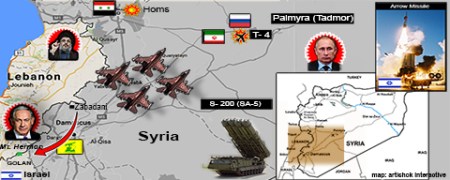
Israel finally took a hand in the swiftly moving events looming from Syria over its northern borders by launching multiple air raids against the key northern Syrian air base known as T4 near Palmyra early Friday night March 17.

Those events are spearheaded by the pro-Iranian Hizballlah’s drive to capture the Golan in line with its war of “resistance” on the Jewish state.  This fixation came into sharp focus the day after the air strike in a rare admission by Hizballah of the loss of a commander. He was named Badee Hamiyeh and was described as having been killed “in the southern Syrian region of Quneitra near the Israeli-held Golan Heights.”  This was the first anyone had heard of any recent battle on the Golan.

A week earlier, Prime Minister Binyamin Netanyahu and IDF Intelligence Director Maj. Gen. Hertzl Halevi showed President Vladimir Putin in the Kremlin maps depicting the various military movements ongoing in Syria, with the accent on an armored convoy of several hundred Hizballah troops driving out of their Syrian stronghold of Zabadani towards Mt. Hermon. The convoy was clearing a path by overrunning some 30 Syrian rebel villages on the Hermon slopes, which command the Syrian Golan town of Quneitra and the Israeli border.

This evidence demonstrated that Hizballah had developed a single military stratagem for threatening Israel-held Hermon, ruling central Golan and gearing up for battle to restore the entire Golan area to Syrian sovereignty under Hizballah control.

Netanyahu had hoped that Putin would agree to stop the Hizballah convoy and keep his promise not to let Iran and Hizballah deploy on the Israeli border. However, the Russian leader was unresponsive. Not only were Russian commanders in Syria not instructed to restrain Hizballah, they acted to persuade Syrian rebels on the Hermon and the Golan to surrender to he Lebanese Shiite invaders.

And indeed, as the Hizballah advance continued. Its leader Hassan Nasrallah contrived an equation to justify his assault on the Golan. “They brought ISIS to the Beqaa [Hizballah’s Lebanese stronghold] and so the ‘resistance’ [Hizballah] went to Syria. They wanted this group to reach Beirut, and so, today, we are in Golan.”

Seeing Hizballah on the move unchecked and gearing up for an expeced showdown with Israel, Netanyahu and the IDF decided to take matters in their own hands. They ordered several air force strikes Friday on the relatively remote strategic T4 air base near Palmyra in northeastern Syria and hit several birds with one stone.

DEBKAfile’s military sources describe T4 as the main terminal for Iranian planes to land day by day and unload  war materials for their own forces as well as the Syrian army and Hizballah.This air base also houses Russian attack helicopters and special operations troops, whose presence there was trusted by Tehran and Nasrallah to be an effective shield against Israeli attack.

The IAF air strike Friday proved them wrong.

These developments were the subtext of the video statement by Netanyahu that was broadcast Friday night by Israeli media: “I can assure you that our resolve is firm, as attested to by our actions,” he said. “This is something that everyone should take into account, everyone!.” When he said, “everyone,” he was not just addressing Tehran and Beirut, but Moscow as well.

Israel is not planning action against Russian forces in Syria, but if the Russian army, whether deliberately or unintentionally, grants Iran and Hizballaha military protection, as they counted on having at T4, Israel would not hesitate to disabuse them.

The Kremlin got the message and, a few hours after the Israeli air strikes, Israeli Ambassador Cary Koren was summoned to the Russian Foreign Ministry. There was no official protest, but Deputy Foreign Minister Mikhail Bogdanov firmly informed the ambassador that Moscow would not tolerate any further Israeli attacks on Syrian bases where Russian forces were present.

In the course of the raid, Israel’s advanced anti-missile Arrow system made its first operational appearance. IDF chiefs feared that the Syrian anti-air missiles fired against the Israeli jets might fall on a populated location inside Israel and so decided it was necessary to intercept any incoming projectiles.

Israel’s military experts got into an argument, which will no doubt go on for years, over whether Arrow’s first appearance in this situation was a good or a bad move. However, the deafening bang that the IDF wonder weapon inflicted on millions of Israeli ears, within a radius of more than a 150 kilometers from the Jordan Valley to the Mediterranean, offered an inkling of how much worse it will be in a full-scale conflict.

IRGC-controlled Iraqi militia forms ‘Golan Liberation Brigade’

March 13, 2017

IRGC-controlled Iraqi militia forms ‘Golan Liberation Brigade’, Long War Journal, , March 12, 2017

(Please see also, Iran’s Islamic Revolutionary Guards now opposite Israeli troops on 1967 ceasefire line in Golan Heights — DM)

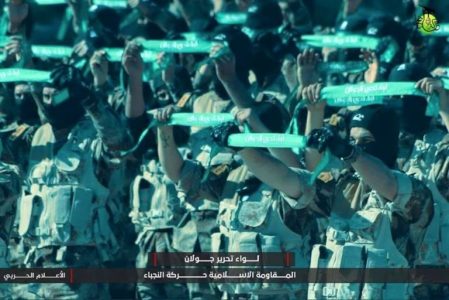
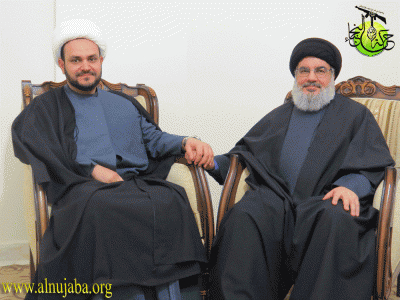
Photo 1: Harakat al Nujaba Golan Liberation Brigade, as portrayed in propaganda video.

The IRGC’s goals in southern Syria are to crush Syrian opposition forces, and build the capability to open another front against Israel. The IRGC hopes a viable Golan foothold would serve as deterrence against Israel and US, and that it could activate in a future conflict, such as another Israel-Hezbollah war. For now, the IDF’s fortified posture in the Golan remains a difficult, if not futile, target for the Guard and its allies. The IRGC nevertheless intends to project steadfast commitment to ideological principles and defiance of adversaries.

*****************************

The Iranian-controlled Iraqi militia Harakat al Nujaba this week announced the formation of its “Golan Liberation Brigade.” While it is not uncommon for entities to name themselves after areas they aim to “liberate,” the militia’s spokesman has said that the unit could assist the Syrian regime in taking the Golan Heights, a region in the Levant that has been controlled by Israel since the 1967 Six-Day War.

If true, the unit would likely participate in a future offensive to capture territory from Syrian opposition in the part of the Golan Heights still controlled by Syria, before moving on to the much taller order of dislodging the Israelis across the border. This week’s announcement reflects Tehran’s priorities in southern Syria since finally taking the fiercely contested city of Aleppo late last year: crush Syrian opposition, and pose military threat to Israel from the Golan Heights. While the Islamic Republic is incapable of credibly challenging the Jewish state’s fortress in the Golan, reaffirming ideological commitment to fighting Israel signals defiance to a global audience amid a reportedly converging American-Arab-Israeli military alliance against Tehran.

Harakat al Nujaba, or Movement of the Noble, has sustained operations in the Syrian and Iraqi combat zones. An offshoot of the Iranian-backed militias Asaib Ahl al Haq and the Hezbollah Brigades, Harakat al Nujaba was formed in 2013 to fight in the Syrian Civil War as part of Iranian-led Iraqi expeditionary forces. The militia joined the Popular Mobilization Forces, the umbrella organization of Iraqi militia, the following year, after the Islamic State incursion into Iraq. Operating as one of the largest Iraqi-Shiite militia contingents in Syria, the militia has claimed to field 10,000 forces. Harakat al Nujaba played an important role in assisting Iran’s Islamic Revolutionary Guard Corps (IRGC) and pro-Syrian regime forces conquer Aleppo late last year.

The Iraqi militia functions as an extension of the Islamic Republic. Having sworn full allegiance to Iran’s Supreme Leader, Ayatollah Ali Khamenei, the militia promotes velayat-e faqih (guardianship of jurisprudence), the Islamic Republic’s founding ideology. Harakat al Nujaba takes direct orders from Major General Qassem Soleimani, the chief of the IRGC extraterritorial branch the Qods Force. Last year, the Iraqi militia, which is also known as Harakat Hezbollah al Nujaba, proclaimed that it and Lebanese Hezbollah, Iran’s most powerful foreign militia, were “the twins of resistance.”

The militia leader Akram al Kabi is close to the top Iranian leadership, including the supreme leader. A co-founder of the Asaib Ahl al Haq – itself an offshoot of the Mahdi Army – Kabi was designated in September 2008 by the US Treasury as a terrorist for aiding Iraqi insurgents. In 2015, he openly said he would depose the Iraqi government if Khamenei issued the order. Last year, top Iranian officials close to Khamenei gave Kabi a highly publicized reception in Tehran, unprecedented in scope and scale for a militia leader. This past December, Harakat al Nujaba publicized Kabi’s meeting with Khamenei on the sidelines of a conference in Tehran.

Harakat al Nujaba has divulged some details about the Golan Liberation Brigade. The commander of the militia’s forces in Syria released a statement declaring the unit to be a synthesis of combat experiences gained in Lebanon, Syria and Iraq. The militia’s official spokesman confirmed the event as a press conference March 8 in Tehran at the IRGC-affiliated Tasnim News Agency, saying the unit was formed following “recent victories” (an implicit reference to Aleppo). He claimed the Golan unit is comprised of “special” forces.

“Should the Syrian government make the request, we are ready to participate in the liberation of occupied Golan with our allies,” the spokesman said. “We will not permit the soil of Arab countries to remain in the grasps of occupiers.”

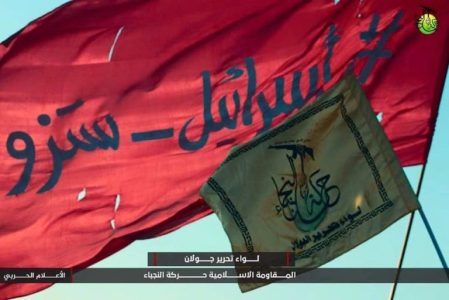
Harakat al Nujaba also released a video promoting the Golan unit that showed fighters marching in columns and carrying a banner reading, “Israel will be destroyed.”

(The video is at the link. — DM)

Tehran’s goal of establishing a foothold in the Golan Heights is not a secret. Last year, the head of the Israeli foreign and defense legislative committee revealed without divulging details that Israel had repelled several Iran-directed attempts to move forces into Syrian Golan Heights.

Senior Iranian military commanders are known to operate in Syrian Golan. Last July, the then-commander of the IRGC Basij paramilitary publicized an inspection of Quneitra by the Israel border. In January 2015, an Israeli strike in the area killed several high-value targets including IRGC Brigadier General Mohammad Ali Allah-Dadi and multiple Hezbollah operatives.

A chasm remains between the capabilities and ambitions of Harakat al Nujaba and the IRGC to retake the Golan from Israel. The combined forces of the Syrian regime and IRGC-led militias are no match for the Israel Defense Forces (IDF), and this disparity is expected to hold for the foreseeable future. Israel could also adopt a more proactive approach in Syria to foil IRGC encroachment by the Golan, for example coordinating with Syrian rebels positioned in the area. Syrian Golan’s flat geography furthermore denies the IRGC suitable terrain to replicate the southern Lebanon model of concealing rocket launch sites dispersed across a widespread area, making it easier for the IDF to search and destroy weapons systems. For years, the IDF has been fortifying positions in the rocky plateau of Golan to face greater capabilities than the IRGC and its allies can muster.

Yet the claim to retake Israeli Golan underscores Harakat al Nujaba’s ideological commitment to the IRGC’s and Khamenei’s declared goal of destroying Israel. Khamenei and his top Guard generals have frequently spoken that that the divine hand would aid the faithful who take steps towards “divine-inspired” ideological principles.

Brandishing the formation of the Golan unit also challenges Arab countries on the Palestinian issue, as the Tehran has accused them of abandoning the cause in service of Israel. The Islamic Republic has slammed reported Arab-Israeli rapprochement and talks to form a US-brokered military coalition with the goal of countering Tehran, as covered in The Wall Street Journal. Last month, top Iranian government officials hosted another round of the Support of Palestinian Intifada Conference in a show of unity and defiance. This past week, Tehran’s interim Friday prayer leader this week excoriated “some leaders in Islamic countries who are with Zionists,” calling them “not human.” Suffering from loss of legitimacy over support of Syrian President Bashar al Assad against a Sunni-Arab uprising and nervous over a converging Israeli-Arab alliance, the Islamic Republic is projecting to the globe and “sell-out”Arab leaders a defiant commitment to fighting Israel.

The Iraqi militia’s Golan unit and IRGC-led expeditionary forces could help pro-Syrian regime forces take opposition-held areas in the south. In February 2015, IRGC-led forces launched a failed campaign in the Daraa and Quneitra in the south. Since conquering Aleppo last year, the IRGC-led expeditionary forces and other pro-Syrian regime forces have been able to redirect their dwindling assets to several fronts in north, central, and south Syria. Pro-regime forces backed by Russian air power have been pounding Daraa in the south for more than a month to slow an opposition offensive, and have recently launched a new bid to capture it. An IRGC colonel was also killed last month in the area. A pro-Syrian regime propaganda outlet late last month reaffirmed the government’s intention to retake all of Daraa and open a major border crossing with Jordan. Meanwhile, pro-regime forces have made progress in the northern pocket of Quneitra Governorate, located in the Syrian-controlled part of the Golan.

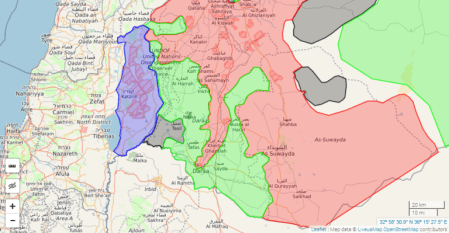
Map 1: southern Syria front, March 2017. Red: pro-Syrian regime forces. Green: rebel forces including Free Syrian Army and al Qaeda-affiliate Jabhat Fath al Sham. Black: Islamic State affiliates. Credit: Liveuamap.

The IRGC’s goals in southern Syria are to crush Syrian opposition forces, and build the capability to open another front against Israel. The IRGC hopes a viable Golan foothold would serve as deterrence against Israel and US, and that it could activate in a future conflict, such as another Israel-Hezbollah war. For now, the IDF’s fortified posture in the Golan remains a difficult, if not futile, target for the Guard and its allies. The IRGC nevertheless intends to  project steadfast commitment to ideological principles and defiance of adversaries.

Photo 2.
Photo 3: Harakat al Nujaba Golan Liberation Brigade flag at front, and “Israel will burn” banner in the back.

Amir Toumaj is a Research Analyst at Foundation for Defense of Democracies.

Trump-Putin deal on Syria bears on Israel security

January 28, 2017

Trump-Putin deal on Syria bears on Israel security, DEBKAfile, January 28, 2017

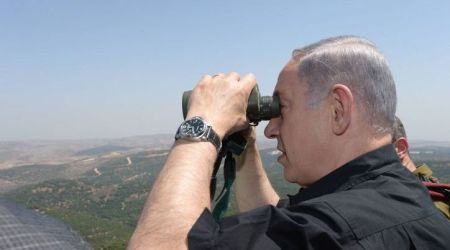
Israeli Prime Minister Benjamin Netanyahu looks through binoculars during his visit in the Northern district border of Israel on August 18, 2015. Photo by Amos Ben Gershom/GPO *** Local Caption *** ???? ??? ?????? ?????? ?????? ?????? ????? ????? ???? ????

Israeli Prime Minister Benjamin Netanyahu looks through binoculars during his visit in the Northern district border of Israel on August 18, 2015. Photo by Amos Ben Gershom/GPO

1. Will Washington and Moscow go through with the expulsion from Syria of Iranian forces and their proxies, including Hizballah – and take it all the way until it is accomplished?

2. After they are gone, who will take over the areas they evacuate?

3. Will Bashar Assad stay on as president, or has his successor been nominated?

4. The most burning question of all is the level of Hizballah’s armament. Not only must Hizballah forces be pushed out of Syria, but it is essential to strip them of their sophisticated new weaponry, including missiles. Israel’s military and security chiefs assess Hizballah’s arsenal as having been upgraded in recent weeks to a level that directly impinges on Israel’s security.

**************************

It would be a mistake to take it for granted that Prime Minister Binyamin Netanyahu’s talks with President Donald Trump in Washington early next month will be plain sailing or produce an automatic shower of benefits for the Jewish state. It is understood in Jerusalem that a new order is unfolding close to Israel’s borders, which is not yet fully in the sights of its government, military and intelligence leaders. This process is going forward at dizzying speed in Syria, currently the central Middle East arena, where Presidents Donald Trump, Vladimir Putin and Tayyip Erdogan have agreed to cooperate.

The British Prime Minister Theresa May picked up fast on the new power equation. After standing before the media with the US President Friday, Jan. 27, and declaring hopefully, “Britain and the US can once again lead the world together,” she decided to fly straight from Washington to Ankara Saturday, before returning home.

The outcome of her first meeting with President Erdogan was one of the fastest defense collaboration pacts ever negotiated for trade and the war on terror. The British leader lost no time in getting down to brass tacks on how British military and intelligence can be integrated in the joint US-Russian-Turkish military steps for Syria. Erdogan did not exactly receive her with open arms. He did not afford his visitor the courtesy of placing a British flag in the reception room in his palace.

Israel is in much the same position. Israel stayed out of military involvement in the Syrian civil war, according to a policy led by Netanyahu, former Defense Minister Moshe Ya’alon and OC Northern Command Maj. Gen. Avivi Kochavi (then Direct of Military Intelligence). This policy has left Israel out of today’s decision-making loop on Syria’s future.

Towards the end of 2015, shortly after Russia embarked on its massive military intervention in the Syrian conflict, Netanyahu took steps for safeguarding Israel’s security interests by setting up a direct line with the Russian president. It was translated into a military coordination mechanism between the Russian air force command in Syria and the Israeli air force, with Gen. Valery Gerasimov, Russia’s Chief of General Staff, and Maj. Gen. Yair Golan, Israel’s Deputy Chief of Staff, in charge of this direct military link.

Any problems that could not be solved at the military level were promptly turned over to be addressed at meetings or in phone calls between Netanyahu and Putin.

In one example, the prime minister obtained an undertaking from the Russian president to keep Iranian forces and Iran’s Shiite surrogates, including the Lebanese Hizballah, away from the Syrian-Israeli border, or allow them to use borderlands to send terrorists into Israel.

Shortly after Trump’s election victory (Nov. 8, 2016), the spadework on his collaboration with Putin was quietly begun by their national security advisers, Michael Flynn, in New York and Nikiolai Platonovich Patrushev in Moscow.

Jerusalem knew what was going on, but was taken aback by the speed at which those close understandings ripened into US-Russian deals on the ground. Before Trump had finished his first week in the White House, US warplanes had escorted a Russian air strike against ISIS in Syria.

This rush of events injects further urgency into Netanyahu forthcoming talks with the US president.  Whereas in the second term of the Obama presidency, the Israeli leader was wont to travel to Moscow or Sochi to sort out security problems relating to Syria, henceforth he must directly engage Donald Trump as the lead player.

So when the Israeli premier travels to the White House next month, he will have to address four pressing concerns, all relating to the fast-moving Syrian scene:

1. Will Washington and Moscow go through with the expulsion from Syria of Iranian forces and their proxies, including Hizballah – and take it all the way until it is accomplished?

2. After they are gone, who will take over the areas they evacuate?

3. Will Bashar Assad stay on as president, or has his successor been nominated?

4. The most burning question of all is the level of Hizballah’s armament. Not only must Hizballah forces be pushed out of Syria, but it is essential to strip them of their sophisticated new weaponry, including missiles. Israel’s military and security chiefs assess Hizballah’s arsenal as having been upgraded in recent weeks to a level that directly impinges on Israel’s security.

Mystery blasts in Damascus: Syria accuses Israel

January 13, 2017

Mystery blasts in Damascus: Syria accuses Israel, DEBKAfile, January 13, 2017

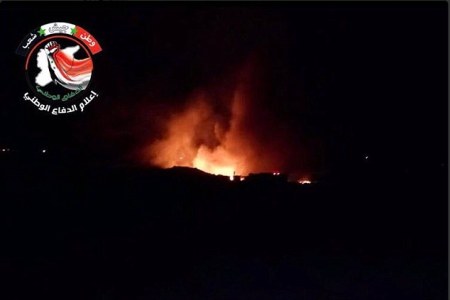
syrian_iaf_attack_13-1-17

Some unknown hand struck into the heart of that regime in the space of a few hours – not once, but twice.The Assad regime used its standard scapegoat, Israel, for covering up embarrassing and inexplicable occurrences.

However, DEBKAfile’s military and intelligence sources disclose that the regime has reached an awkward crossroads. The Russians have taken charge of the Syrian war and no longer bother to consult with the Syrian president or Iran on its conduct. They are deeply immersed in preparing the Syrian peace conference they are sponsoring which is scheduled to open at Astana, Kazakhstan on Jan. 23.

If Moscow coordinates its Syrian strategy with anyone, it is Turkish President Tayyip Erdogan, but even then only to a limited extent.

***************************

There were two unclaimed explosions in Damascus overnight Thursday and early Friday (Jan.12-13) – one at an officers club in Damascus and the second at Mezzeh airport, which Syria alleged was the work of the new Israeli S-35 stealth aircraft firing across the border from a point over the Sea of Galilee.

There was no claim to either of the attacks.

The standard Israeli policy of striking any Iranian arms shipments for Hizballah in Lebanon when they cross through Syria would not longer be applicable to any such air strike, if indeed one was launched..

The Lebanese Shiite Hizballah deploys 9,000 elite fighters in Syria to fight for Bashar Assad. Its Iranian arms supplies no longer need to risk being trucked through Syria to Lebanon; they can be delivered directly to Hizballah bases in Syria without exposure to Israel air strikes.

Indeed, should the pro-Iranian Hizballah decide to go back to shooting missiles at Israel – or using Iranian-supplied unconventional weapon – it has new launching pads readily available in Syria from those very bases. They are located in the Qalamoun mountains in western Syria and at Zabadani, a Syrian ghost town near the Damascus-Beirut highway, which the Lebanese terror group has made its military center.

Both would be obvious targets for Israel to attack rather than Damascus’ Mezzeh airport.

Tehran, having grasped from bitter experience that Mezzeh is under close surveillance by Israeli intelligence, no longer uses its facilities. Instead Iran flies arms shipments for Hizballah to Beirut by commercial aircraft, which Israel prefers not to attack, or overland through Iraq to northwestern Syria, where the consignments are picked up and transferred to Lebanon by sea.

So if an Israeli F-35 air strike on the Damascus airport should be confirmed, its target would not have been Iranian and Hizballah military supplies. Mezzeh is the site of a sterile zone set aside for the exclusive use of President Bashar Assad, his family and his top military and intelligence chiefs. It also houses laboratories for developing and manufacturing unconventional weapons, as well serving as the main command center for the 4th Division, whose Republican Guard unit protects the president, his family and members of the ruling caste.

In the first attack, a suicide bomber blew himself up Thursday night at the officers’ club in the heavily policed Kafra Sousa district of Damascus. At least ten people were killed and dozens injured. Located there are the homes of many Assad loyalists in the security and military establishments, as well as top secret facilities.

The ability of a suicide bomber to penetrate one of the most heavily secured locations in Damascus and blow up at an exclusive regime watering hole raises questions about the inner workings of the Assad regime.

Some unknown hand struck into the heart of that regime in the space of a few hours – not once, but twice.The Assad regime used its standard scapegoat, Israel, for covering up embarrassing and inexplicable occurrences.

However, DEBKAfile’s military and intelligence sources disclose that the regime has reached an awkward crossroads. The Russians have taken charge of the Syrian war and no longer bother to consult with the Syrian president or Iran on its conduct. They are deeply immersed in preparing the Syrian peace conference they are sponsoring which is scheduled to open at Astana, Kazakhstan on Jan. 23.

If Moscow coordinates its Syrian strategy with anyone, it is Turkish President Tayyip Erdogan, but even then only to a limited extent.

The Syrian ruler and Iran, after being sidelined by the Russians, are following their example. Both have taken to holding their cards close to their vests and operating under in close secrecy.

In an attempt to pierce the resulting aura of mistrust spreading over the staunch Iranian-Syrian alliance, Ali Shamkhani, Secretary of the Supreme National Security Council of Iran and one of supreme leader Ayatollah Ali Khamenei’s closest confidants, was sent to Damascus Sunday, Jan 8, to find out what is going on there

The mystery deepened further Friday morning, when Syrian state media ran photos of a big blaze – which may or may not be authentic – to illustrate the alleged Israeli attack on Mezzeh airport.

Aleppo’s Fall Signals Rise of Emboldened Radical Shi’ite Axis

December 16, 2016

Aleppo’s Fall Signals Rise of Emboldened Radical Shi’ite Axis, Investigative Project on Terrorism, Yaakov Lappin, December 16, 2016

1918-1

Recent sweeping gains by the pro-Assad alliance in Aleppo signal the rise of an emboldened Iranian-led radical Shi’ite axis. The more this axis gains strength, territory, weapons, and influence, the more likely it is to threaten regional and global security.

Ideologues in Iran have formulated a Shi’ite jihadist vision which holds that the Iranian Islamic revolution must take control of the entire Muslim world. Losing the Assad regime to Sunni rebels, many of them backed by Tehran’s Gulf Arab state archenemies, would have represented a major setback to Iran’s agenda.

This same ideological agenda also calls for the eventual annihilation of Israel, the toppling of Sunni governments, and intimidating the West into complying with Iran’s schemes.

Supreme Leader Ayatollah Khamenei and Tehran’s military elites, in the form of the Islamic Republican Guards Corps (IRGC), use the current regional chaos to promote these goals.

In Syria, Iran has mobilized tens of thousands of Shi’ite militia fighters from all over the Middle East, as well as those from Hizballah in Lebanon, and sent them to do battle with Sunni rebel organizations to help save the Assad regime.

As the Shi’ite axis wages a sectarian war against Sunnis moderate groups and jihadists, it mobilizes and arms its proxies, and moves military assets into Syria, gaining a growing influence that can be used for bellicose purposes in the not too distant future.

The conquest of east Aleppo is a victory for the wider, transnational Iranian-led alliance, of which the Damascus regime is but one component. The Assad regime is composed and led by Syria’s minority Alawite population, which makes up just 11 percent of Syrians (Alawites are seen as an offshoot of Shia Islam).

A look at the order of battle assembled in Aleppo reveals that the war in Syria is not a civil conflict by any measure. In addition to Assad regime forces sent to fight Sunni rebels, such as the Fourth Division, Syrian army special forces, and paramilitary units, there is also the Iranian-backed Hizballah, which has transformed itself into a regional Shi’ite ground army, deployed across Syria and Lebanon.

These are joined by Shi’ite Iraqi Kataib Hizballah militia, Afghan Shi’ite militia groups, and Iranian military personnel on the ground in Syria, all of whom receive the assistance of massive Russian air power.

The large scale, indiscriminate airstrikes and shelling in places like Aleppo resulted in mass slaughter and ethnic cleansing of many Sunni civilians, producing the largest humanitarian catastrophe and refugee crisis in the 21st century. Such extreme war crimes will be sure to produce a new generation of radical recruits for ISIS and al-Qaida.

The IRGC’s Quds Force, under the command of Qassem Suleimani, orchestrates the entire ground war effort. Suleimani is very close to the Iranian supreme leader.

The Quds Force uses Syria as a transit zone to traffic advanced weapons from Iranian and Syrian arms factories to the Hizballah storehouses that pepper neighboring Lebanon.

Hizballah has amassed one of the largest surface to surface rocket and missile arsenal in the world, composed of over 100,000 projectiles, all of which are pointed at Israeli cities.

According to international media reports, Israel recently launched two strikes in the one week, targeting attempts to smuggle game-changing weapons to Lebanon.

Syrian dictator Basher Assad owes his survival to Iran and Hizballah, and their military presence in Syria should continue and expand further.

Assad regime and Hizballah representatives boast of this fact in recent statements highlighted by the Middle East Media Research Institute (MEMRI).

“The power-balances will change not only in Syria but in the entire region,” said Hizballah Executive Council Chairman Hashem Safi Al-Din.

“Syria’s steadfastness, and the support from its allies, have shifted the regional and international balance [of power], said Assad political adviser Bouthaina Sha’aban. “The recent developments in the international arena are bringing the countries of the region face to face with a new world.

If it takes western Syria with Russian air support, the Shi’ite axis victors will likely turn their sights on seizing southern Syria, near the Israeli border. To accomplish that, they will need to do battle with an array of Sunni rebels that now control that area (groups that include ISIS-affiliates). If successful, the axis could be tempted to build bases of attack throughout Syria against Israel, a development that would certainly trigger Israeli defensive action, as has reportedly occurred in the past.

The same pattern repeats itself in Iraq, where Iran-backed militias are moving in on Mosul, and could later be used to threaten Iraq’s Sunnis, and in Yemen, where Iranian-armed Houthi rebels control large swaths of the country, and are currently at war with a Saudi-led military coalition. The Houthis also threaten international oil shipping lanes and have fired on the U.S. Navy using Iranian-smuggled missiles.

In this way, the fundamentalist Iranian coalition gains a growing foothold.

Iran’s ballistic missile program, which is developing long-range strike capabilities that could place Europe in range, and its temporarily dormant nuclear program, represents investments that would make the Shi’ite axis more powerful than any Sunni Islamist camp.

Defense officials in Israel and in pragmatic Sunni states will watch for the danger that Iran will use its presence, proxies, and bases in Syria and Iraq to wage a Shi’ite jihad that extends well beyond the battlegrounds there.

The Iranian coalition can also lure armed Sunni groups into its orbit as well, as it has done in the past with the Palestinian Hamas terrorist regime in Gaza.

While the Israeli defense establishment has no desire to be dragged into Syria’s conflict, Jerusalem has indicated that it would act to remove any Iranian-Hizballah base it detects in Syria that is designed to launch attacks on Israel, and would not tolerate the trafficking of advanced weapons to Hizballah.

Few events illustrate more clearly how an ascendant Shi’ite jihadist axis is redrawing the map of the region than a recent military parade held by Hizballah in the western Syrian town of Al-Qusayr, which it conquered from the rebels in 2013.

According to an assessment by the Tel Aviv-based Meir Amit Intelligence and Terrorism Information Center, that parade featured Soviet-made tanks, American armored personnel carriers, artillery guns, anti-aircraft guns, and powerful truck-mounted rocket launchers with an estimated range of between 90 to 180 kilometers. “It is clear that state-owned capabilities, some of them advanced, were delivered to Hizballah, which is a terrorist organization,” the Intelligence and Terrorism Information Center said in its report.

Hizballah, like the Assad regime and armed groups in Iraq and Yemen, is a component of an international axis whose battles against ISIS have managed to dupe some decision makers into believing that they are stabilizing forces. In actuality, the Shi’ite jihadists are as radical as their Sunni jihadist counterparts – albeit more tactically prudent – and are far better armed and better organized.