Archive for the ‘Islamic State’ category

Iran’s Tel Afar op is in sync with Russia in Syria

October 30, 2016

Iran’s Tel Afar op is in sync with Russia in Syria, DEBKAfile, October 30, 2016

hezbollah_brigades_convoy_mosul_b_30-10-16-png

The irony of this arrangement is that, the US armed the Iraqi army, and indirectly the Shiite militias, for this offensive with top-notch Abrams M1 tanks, M1-198 Howitzers and M88 Recovery vehicles for tanks. All this s valuable hardware looks like ending up away another battlefield away from Mosul in Syria, and under a different command, Russia.

****************************

The pro-Iranian Iraqi Shiite drive to capture Tel Afar, 55 km from Mosul in western Iraq, was designed less to complete the encirclement of the Islamists in Mosul – in support of the US-led coalition – and more to forge a link in the land bridge Tehran aspires to build to give its Revolutionary Guards free passage to Hizballah and the Shiite groups fighting for Bashar Assad in Syria. This is reported by DEBKAfile’s military and intelligence sources.

The Iraqi Shiite battle for Afar is led by Iran’s Al Qods chief, Gen. Qassem Soliemani from the front lines.

US and Iraqi commanders of Operation Inherent for expelling ISIS from Mosul welcomed the Iran-led Iraqi Shiites’ initiative to take Tal Afar in order to sever ISIS’ supply lines from Syria to Mosul.

But Iran’s overriding motive in initiating this operation was laid bare by Ahmad al-Asadi, spokesman of the pro-Iranian Iraqi Hashid Shaabi Shiite groups, when he spoke to reporters Saturday, Oct. 29 in Baghdad.

After “clearing” these “terrorist gangs,” from 14,000 sq. km of Iraq including Tal Afar and the regions bordering on Syria, he said, “We are fully ready to cross the border into Syria and fight alongside President Bashar al-Assad.

According to our sources, this plan was not coordinated directly with the US-Iraqi command of the Mosul operation, but with the Russian military command center in the Syrian province of Latakia.

It is important enough for the Russian command to have just established a new center for military and intelligence interchanges. It is staffed by Russian, Turkish, Syrian, Iraqi Shiite and Iranian officers. This mechanism has been put in charge of coordinating Shiite military operations both in Syria and Iraq.

It was decided that when US military assistance or air support is deemed necessary, requests will be piped through the bureau of Iraq’s Shiite Prime Minister Haider al-Abadi and passed on to the US-Iraqi command of Operation Inherent.

Russian, Iranian and Turkish officers have thus effectively hitched on to the decision-making process for the Mosul offensive alongside American officers.

The irony of this arrangement is that, the US armed the Iraqi army, and indirectly the Shiite militias, for this offensive with top-notch Abrams M1 tanks, M1-198 Howitzers and M88 Recovery vehicles for tanks. All this s valuable hardware looks like ending up away another battlefield away from Mosul in Syria, and under a different command, Russia..

ISIS’ Kirkuk raid spreads. US air force in action

October 22, 2016

ISIS’ Kirkuk raid spreads. US air force in action, DEBKAfile, October 22, 2016

kurdish_gen-_mariwan_mohammed_21-10-16Kurdish General. Mariwan Mohammed

The raid of Iraq’s northern oil city of Kirkuk launched by the Islamic State Friday began to spread Saturday, Oct. 22 to surrounding towns. DEBKAfile’s military sources report that ISIS fighters headed south from Kirkuk in two heads. One tried to enter Laylan, a town 21 km south of the oil city, which was defended by Kurdish Peshmerga and Turkman paramilitary forces; the second seized the crossroads of Rtes 2, 3 and 24 to sever Kirkuk from Baghdad.

When Kirkuk first came under attack, the Kurdish defenders still left there appealed for US air support against the Islamist invaders. The US air force went into action late Friday. They first targeted ISIS sniper positions on the town’s highest rooftops. Then, the next day US aircraft struck twin targets: the jihadist fighters storming Laylan and the fighters heading down the roads to the south of Kirkuk.

Nonetheless, up until Saturday pm, ISIS was still in control of at least five of the oil city’s neighborhoods as well as buildings in the town center, including government offices.

Meanwhile, the Kurdish Peshmerga, according to our military sources, dispatched to Kirkuk their special counterterrorism unit to dislodge the raiders. Kurdish sources also warned that this city was only the first of a row of Iraqi towns still in ISIS sights. They added that they would not be surprised to find the Islamists heading out to strike European towns as well.

Iraqi and Kurdish sources have since Friday been throwing out high ISIS casualty figures and reporting that many were put to flight. They were attempting to play down the scale of the raid on Kirkuk.

In fact, our sources report that the Islamists found extra numbers and ammunition caches waiting for them in two places – sleeper cells in Kirkuk and local Sunni sympathizers.

The numbers of civilian casualties and refugees mounting since the onset of the Mosul operation are mounting, causing grave concern to the UN and international aid agencies.

DEBKAfile first reported on the ISIS raid of Kirkuk Friday.

No one doubted that the US-Iraqi-Kurdish offensive to liberate Mosul would be drawn out and fraught with unforeseen setbacks before the Islamic State was finally thrown out of its Iraqi capital. But on Oct. 21, five days into the Mosul operation, the ISIS terrorists landed their most severe blow, when Islamist fighters and suicide bombers suddenly hurled themselves on the Iraqi oil city of Kirkuk in a coordinated attack.

DEBKAfile’s military sources report that taking advantage of a chance to catch the US, Iraqi and Kurdish generals leading the attack on Mosul unawares, the Islamist fighters were able to open a second front to the rear of the main battle arena against ISIS.

Kirkuk is some 175km southeast of Mosul and 230km from Baghdad. By hitting this important oil city, the terrorists came close to enough to menace the autonomous Kurdish Regional Government region and its capital, Irbil, and expose the Kurdish Peshmerga troops fighting for Mosul.

Our military sources note that a large Peshmerga force of some 11,000 troops had been posted to secure the town and its oil fields, under the command of Gen. Mariwan Mohammed.

But then, on Wednesday, Oct. 19, the US-Iraqi-Kurdish joint command of the Mosul offensive decided that Kurdish reinforcements were necessary to provide the operation with greater impetus. The extra Peshmerga troops were accordingly ordered to set out from Khazar, 40 km east of Mosul, and join the coalition offensive.

However, what they missed, despite the mainly American spy satellites, drones and reconnaissance planes collecting intelligence, was an ISIS concentration clandestinely building up at Hawja, 57km east of Kirkuk. According to our military sources, some of the jihadists reported by the Western media to have turned tail on the run from Mosul had been gathering to the southeast, some 57km from Kirkuk. They stood ready to attack that town.

Their opportunity came when the large Kurdish group exited Kirkuk and headed out to Mosul. Kirkuk was left exposed without defenders.

Friday morning, the Islamic State launched its surprise attack on the defenseless oil city. Its fighters and suicide bombers slammed into four police stations, Kurdish security offices, residential neighborhoods and a power station to the north. Clashes continued during the day with unknown casualty figures on both sides.

At some point, the governor claimed control of the city was regained but residents reported the clashes continued.

ISIS said in a statement it had seized “half the city” and had also attacked the Dubiz power plant, killing all the security forces inside, but the claims were not possible to verify.

ISIS hits Kirkuk, opens a 2nd front behind Mosul

October 21, 2016

ISIS hits Kirkuk, opens a 2nd front behind Mosul, DEBKAfile, October 21, 2016

kurdgenKurdish General. Mariwan Mohammed

No one doubted that the US-Iraqi-Kurdish offensive to liberate Mosul would be drawn out and fraught with unforeseen setbacks before the Islamic State was finally thrown out of its Iraqi capital. But on Oct. 21, five days into the Mosul operation, the ISIS terrorists landed their most severe blow, when Islamist fighters and suicide bombers suddenly hurled themselves on the Iraqi oil city of Kirkuk in a coordinated attack.

DEBKAfile’s military sources report that taking advantage of a chance to catch the US, Iraqi and Kurdish generals leading the attack on Mosul unawares, the Islamist fighters were able to open a second front to the rear of the main battle arena against ISIS.

Kirkuk is some 175km southeast of Mosul and 230km from Baghdad. By hitting this important oil city, the terrorists came close to enough to menace the autonomous Kurdish Regional Government region and its capital, Irbil, and expose the Kurdish Peshmerga troops fighting for Mosul.

Our military sources note that a large Peshmerga force of some 11,000 troops had been posted to secure the town and its oil fields, under the command of Gen. Mariwan Mohammed.

But then, on Wednesday, Oct. 19, the US-Iraqi-Kurdish joint command of the Mosul offensive decided that Kurdish reinforcements were necessary to provide the operation with greater impetus. The extra Peshmerga troops were accordingly ordered to set out from Khazar, 40 km east of Mosul, and join the coalition offensive.

However, what they missed, despite the mainly American spy satellites, drones and reconnaissance planes collecting intelligence, was an ISIS concentration clandestinely building up at Hawja, 57km east of Kirkuk. According to our military sources, some of the jihadists reported by the Western media to have turned tail on the run from Mosul had been gathering to the southeast, some 57km from Kirkuk. They stood ready to attack that town.

Their opportunity came when the large Kurdish group exited Kirkuk and headed out to Mosul. Kirkuk was left exposed without defenders.

Friday morning, the Islamic State launched its surprise attack on the defenseless oil city. Its fighters and suicide bombers slammed into four police stations, Kurdish security offices, residential neighborhoods and a power station to the north. Clashes continued during the day with unknown casualty figures on both sides.

At some point, the governor claimed control of the city was regained but residents reported the clashes continued.

ISIS said in a statement it had seized “half the city” and had also attacked the Dubiz power plant, killing all the security forces inside, but the claims were not possible to verify.

Obama vs Baghdad on Sunni cleansing of Mosul

October 20, 2016

Obama vs Baghdad on Sunni cleansing of Mosul, DEBKAfile, October 20, 2016

baaj_road_19-10-16

A major dispute on combat tactics which has sprung up between Washington and Baghdad hangs over the coalition’s Mosul offensive after three days of combat. Thursday, Oct. 20, President Barack Obama and US commanders challenged Iraq’s Shiite Prime Minister Haydar al-Abadi and is generals over a 500km long route, the Ba’aj Road, which does not appear on maps, but is pivotal for the offensive’s continuation, DEBKAfile’s exclusive military and intelligence sources report.

This route is a kind of “Burma road” developed by the Islamic State as a private corridor between Mosul in Iraq and Raqqa, the terrorist group’s Syrian capital, during the terrorist group’s two years of control. It runs through the Iraqi town of Tal Afar before crossing into Syria and passing south of areas controlled by Syrian Kurdish militias, among which US special operations forces are embedded.

The argument flared over a demand by President Obama and US commanders that Iraqi government forces turn to the Syrian border and block the Ba’aja Road, and so cut off the ISIS fighters’ escape route from Mosul to Syria. The Americans can’t bomb the corridor because it is also packed with a stream of refugees in flight from the fighting in Mosul.

So long as it is open, ISIS is free to move thousands of fighters and masses of weapons, ammunition and other supplies between its two strongholds. This freedom of action, Obama warned Al-Abadi, would prolong the Mosul operation beyond the Dec. 20 deadline set by the coalition for its termination.

However, according to our sources, the Iraqi prime minister countered this demand with a proviso unacceptable to Washington. He was prepared to order Iraqi forces to block the Ba’aja Road provided Mosul’s entire population of 750,000 Sunni Muslims was expelled from the city. He argued that ISIS could not be defeated until then because the Sunnis were supporting and collaborating with the Islamist terrorists.

Obama fiercely opposes the mass Sunni expulsion, seeing it as an attempt by the Shiite Iraqi prime minister to cleanse Iraq’s second city of its Sunni inhabitants and using the Mosul offensive against ISIS as a pretext for such action.

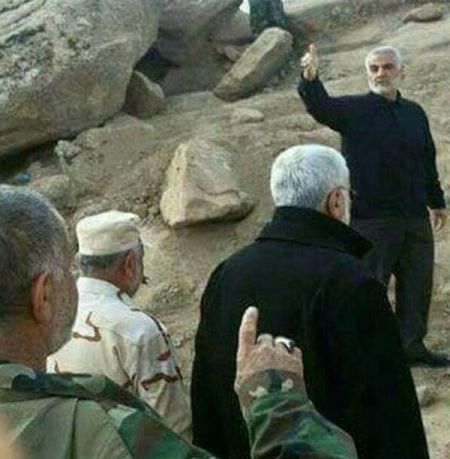
mosul_soulemeni_19-10-16EXCLUSIVE: Iranian Gen. Qassem Soleimani greets Shiite fighters outside Mosul.

DEBKAfile’s sources add that Al-Abadi has found support for his side of the argument with the arrival of the Iranian Al Qods chief Gen. Qassem Soleimani at the command posts of the pro-Iranian Iraqi Shiite militias, who have not yet been thrown into the Mosul battle.

The Mosul offensive came up in the third US presidential debate in Las Vegas early Thursday. The Republican candidate Donald Trump, who appeared to have been updated on the state of play there, commented that the big winner from that offensive would be Iran.

Our military sources report that three days of combat have not brought any major coalition forces advances against ISIS. On some sectors Iraqi forces are moving forward slowly, backed by US air strikes and rocket artillery fire; on others, they are stalled by Islamist resistance.

The big Mosul offensive is stuck, halted by ISIS

October 19, 2016

The big Mosul offensive is stuck, halted by ISIS, DebkaFile, October 19, 2016

mosul_offensive_declaration_16-10-16-1

Less than a day after its launch, the big Mosul offensive prepared for more than a year by the US, the Iraqi army, Kurdish forces and others, ground to a halt Tuesday Oct. 17, DEBKAfile’s military sources report – although none of the parties admitted as much.  Iraqi Prime Minister Haidar Al-Abadi said his troops were busy opening up corridors for some million civilians to escape, while US sources suggested that the Islamic State would use primitive chemical weapons against the advancing Iraqi and Kurdish forces.

Both had the ring of cover stories to account for the spearhead forces, the Iraq army’s 9th Armored Division and the Federal Police special anti-terror units, being thrown back Tuesday on their way to Mosul from the east and the south, while still 10-15km short of the city. They sustained heavy losses in lives and hardware.

The 9th Division and its newly-supplied heavy US Abrahams tanks were stopped at al-Hamdaniyah outside Mosul and retreated, recalling a previous defeat at ISIS hands in June 2014, when troops of the same division fled under Islamist attack, leaving their tanks behind.

The Iraqi anti-terror force withdrew from the village of al-Houd outside Mosul, a move which left the Kurdish Peshmerga no option but to stop its sweep of the villages around the city or expose their flanks to ISIS suicide and car bomb assaults.

Tuesday night, both Iraqi and Kurdish commanders announced a pause in their advance and said they would meet Wednesday to decide how to proceed.

The Kurdish Peshmerga’s role in the battle of Mosul has run into a further major impediment, which likewise has not been publicly aired. It turned out Tuesday that at least 3,000 of the 12,000 Kurdish fighters taking part in the offensive came from the banned Turkish underground PKK (Kurdish Workers Party) which is fighting the Turkish government. They came down from their northern Iraqi strongholds in the Sinjar and Qandil mountains. Ankara thereupon warned Washington and Baghdad in a strong ultimatum that unless those fighters were pulled off the field, Turkish troops would step in to attack them.

A second front within a front would effectively torpedo the entire Mosul liberation campaign against ISIS before it gets underway.

The first bricks of the military Tower of Babel predicted by DEBKAfile in the background report below were set in place sooner than expected.

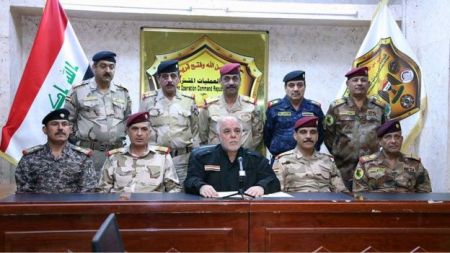
Sunday night, Oct. 16, Iraqi Prime Minister Haidar al-Abadi, supported by a bevy of generals, announced that the military operation to recapture Mosul from its two-year occupation by the Islamic State had begun.

Three formally approved participants are taking part in the operation, DEBKAfile’s military sources report:

1. American special operations, artillery and engineering units – equipped with floating bridges for crossing the Tigris River – plus the US air force for massive bombardment to crush enemy resistance.

2. Iraqi army armored divisions, special ops forces, regular troops and anti-terror police units.

3. The Iraqi Kurds’ Peshmerga.

The Iraqi prime minister pledged formally that only Iraqi fighters would enter Mosul, i.e. no Americans, Kurds or other non-Iraqi forces.

It was a pledge that neither the Iraqi Sunni and Shiite combatants nor the Kurdish and Turkmen fighters trusted him to uphold, after similar promises went by the wayside in the US-led coalition battles fought in the past two years to retake the Iraqi towns of Ramadi, Tikirit, Baiji and Fallujah from ISIS.

The first forces to enter those cities were by and large pro-Iranian Iraqi Shiite militias, especially the Bader Brigades and the Popular Mobilization Units, under Iran’s supreme Middle East commander Gen. Qassem Soleimani. Nonetheless, despite the ravages they wrought in those Sunni cities, US air support was forthcoming for their advance, while in Washington US officials pretended they were helping Iraqi government army units.

With regard to the Mosul campaign, Obama administration officials and military officers, like the Iraqi prime minister, insist there will be no repetition of the Iranian-backed Shiite invasion and conquest of yet another Sunni city, where a million inhabitants still remain.

mosul_offensive_17-10-16-1

They don’t explain how this will be prevented when those same pro-Iranian Iraqi Shiite forces are already massing northeast of Mosul, near the Iraqi-Syria border, and standing by for the order to advance into the city.

Tehran quite obviously has no intention of being left out of the epic capture of Mosul.

Neither is another uninvited party, Turkish President Tayyip Erdogan. He too has positioned a Turkish military concentration in Iraq, in defiance of strong objections from Washington and Baghdad. Turkish troops stand ready to move forward to do Erdogan’s will and achieve three strategic goals:

a) To actively frustrate Kurdish Peshmerga entry to Mosul, although its 15,000 fighters out of the 25,000 invasion force are a vital element of the spearhead thrust into the city. Ankara has warned that if Kurds set foot in Mosul, Turkish troops will follow.

b)  To block the path of Syrian Kurdish YPG militiamen from entering Iraq and linking up with their Iraqi brothers-in-arms.

c) To provide backing, including Turkish air support, for the Iraqi Turkmen militias still present in the Turkmen quarter of Mosul.

DEBKAfile’s military sources count six assorted military groupings taking part in the liberation of Mosul. They have nothing in common aside from their determination to drive the Islamic State out.

They are utterly divided on the two main aspects of the offensive: How to achieve their common goal and what happens to Mosul after the Islamist invaders are gone.

The underlying US rationale for embarking on this high-wire operation is President Barack Obama’s aspiration to achieve Mosul’s liberation before his departure from the White House in January, in the hope that this landmark success will provide a major distraction from his administration’s failed policies in Syria.

The Islamic State might have been expected to take advantage of the prior warning of the offensive for a stand in defense of the Iraqi capital of Abu Bakr Al-Baghdadi’s caliphate and so exploit the conflicting interests of the invading force.

But ISIS leaders decided against waiting for the combined offensive. Indeed, according to DEBKAfile’s sources, thousands of jihadis made tracks out of the city two or three months ago, relocating the bulk of their combat strength and institutions in two new locations: in the western Iraqi desert province of Anbar at a site between the Jordanian and Saudi borders and eastern Syria. Several hundred fighters were left behind in Mosul to harass the US-Iraq-Kurdish armies as they advance into the city and exploit the invaders’ discord to retain a foothold in Mosul.
A ‘lasting defeat’ of the Islamic State will be elusive

October 18, 2016

A ‘lasting defeat’ of the Islamic State will be elusive, Long War Journal, October 18, 2016

islamic-state-convoy-anbar-e1440694626820-1023x312

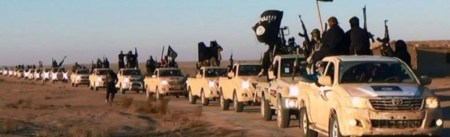
As the Iraqi government and Coalition forces launched the offensive to retake Mosul, the US military has optimistically said that the campaign will deal a “lasting defeat” to the Islamic State. But, if the recent history of the fight against jihadist groups in the Middle East, Africa, and South Asia is any indicator, a lasting defeat of the Islamic State will remain elusive.

On Oct. 16, the US military made the claim that the Mosul operation will “deliver ISIL [Islamic State] a lasting defeat” [emphasis mine]:

Tonight Iraqi Prime Minister Haider al-Abadi announced the start of Iraqi operations to liberate Mosul from ISIL. This is a decisive moment in the campaign to deliver ISIL a lasting defeat. The United States and the rest of the international coalition stand ready to support Iraqi Security Forces, Peshmerga fighters and the people of Iraq in the difficult fight ahead. We are confident our Iraqi partners will prevail against our common enemy and free Mosul and the rest of Iraq from ISIL’s hatred and brutality.

Keep in mind that many analysts were quick to pronounce the Islamic State’s predecessor, al Qaeda’s Islamic State of Iraq, as defeated after the US surge that began in 2007 rooted out the jihadists from its sanctuaries across Iraq. By 2010, Iraqi and US forces killed the Islamic State of Iraq’s emir, Abu Omar al Baghdadi, and War Minister Abu Ayyub al Masri a.k.a. Abu Hamza al Muhajir, and the group was driven underground. But these setbacks did not deter the Islamic State of Iraq. Its new leader, Abu Bakr al Baghdadi rallied the Islamic State of Iraq’s remaining forces and reconstituted the organization. In Syria, the Islamic State of Iraq took advantage of the Syrian civil war to rebuild its strength. By 2012, it created the Al Nusrah Front, its branch in Syria, and was launching large scale raids inside Iraq, such as the one in Haditha in March 2012, that presaged the events of 2014, which saw Iraqi forces defeated in Anbar, Salahaddin, Ninewa, and Diyala.

The Islamic State is not alone in its phoenix-like rebirth after losing ground to local forces backed by the US. Al Qaeda branches in Somalia, Yemen, and Mali, have experienced major setbacks and lost ground it held, only to regroup and retake territory. The same is true with Boko Haram in Nigeria and Taliban branches in Afghanistan and Pakistan. Each of these countries have been in a state of perpetual war for well over a decade due to jihadist insurgencies.

In Iraq, the political and security situation is ripe for an eventual Islamic State (or whatever jihadist entity may follow it) comeback. There are large rural areas in Iraq still under Islamic State control today, and it is highly unlikely that Iraqi forces will root out the Islamic State from all of these areas. Syria remains a security nightmare, and even with recent Islamic State losses, it still controls large areas. Iraq remains a fractured state divided between the Shia-led government, which is under pressure from Iran, the marginalized Sunnis that make up the recruiting base for the Islamic State, and the Kurds, who seek independence. The Islamic State has deftly taken advantage of Iraq’s political and sectarian fault lines to stoke the fires of conflict. Iran’s machinations in Iraq and its Shia militias provide the Islamic State all of the recruiting fodder it needs to convince Sunnis to join the fight.

The fight in Iraq, as in other jihadist theaters, ebbs and flows. For the Islamic State, it is currently retreating from many of the cities and towns in Iraq and Syria that it once held. But do not expect a lasting defeat of the Islamic State. The Islamic State has survived the full might of the US surge, and was able to regroup, wage a terrorist insurgency, and build an army that overran large areas of Iraq and Syria, all over the course of four years.

Sweden: Returning Islamic State jihadis to get free housing, driver’s license, tax benefits

October 18, 2016

Sweden: Returning Islamic State jihadis to get free housing, driver’s license, tax benefits, Jihad Watch,

Some people’s balloon never lands. These besotted multiculturalists live in a fantasy world of their own making. Probably even as they are being beheaded by a returning jihadi, they will be congratulating themselves in their final moments for being “welcoming” and “non-judgmental.”

islamic-state-eradicate-judaism-video-1

“Breaking: IS terrorists to get free license and housing in Sweden,” translated from “Nu klart: IS-terrorister får gratis körkort och bostad i Sverige,” Fria Tider, October 18, 2016 (thanks to Fjordman):

Muslims who return to Sweden after joining the terrorist organization Islamic state, IS, in the Middle East can be offered tax benefits which include drivers education, free housing and even debt restructuring.

Radio Sweden spoke to Christoffer Carlsson, author of a report for the national coordinator against violent extremism, which gathers examples of how the terrorists are to be “reintegrated” into Swedish society with the help of state funds.

“It’s directly through social, economic and material means. You need to be able to reintegrate into the job market, you may need to have a driver’s license, debt settlement and shelter. When people leave, they want to leave for something else, but they do not have the resources to do so, so it is difficult for them to realize their plans,” says Christoffer Carlsson.

Without these kinds of benefits at the Swedish taxpayers’ expense, there is a risk that terrorists “do not succeed” in leaving the Muslim extremist environment, stresses Carlsson.

Anna Sjöstrand, municipal coordinator against violent extremism in Lund, also participated in Radio Sweden’s report. She points out that one cannot deny the terrorists tax benefits just because they made a “wrong choice.”

“We cannot say that because you made a wrong choice, you have no right to come back and live in our society, said Anna Sjöstrand to SR.

Why not, exactly? The Islamic State is at war with Sweden. What evidence does Anna Sjöstrand have that the returning jihadis will not continue to pursue this war?

“Municipalities prepare for defection from violent extremism,” translated from “Kommuner förbereder för avhopp från våldsbejakande extremism,” Radio Sweden, October 18, 2016 (thanks to Fjordman):

Around 140 Swedes have so far returned after having joined the violent groups in Syria and Iraq. Now several municipalities are preparing to work with those who want to defect. This could include offering practical support to defectors.

One of the few known cases where someone defected after having joined the IS is in Lund. Although violent extremism existed in Lund before that, this case raised the issue of what to do when Swedes began to travel to Syria and Iraq to fight with extremist groups.

“When the subject first came up, we thought ‘Oh God, how should we handle this,’ but pretty quickly we realized that we should deal with this in the same way. This is a concern like any other concern whatsoever,” says Anna Sjöstrand, who is the municipal coordinator against violent extremism.

Lund’s conclusion is that defectors from violent extremist groups should be handled like defectors from other environments, such as organized crime. After an investigation of the person’s needs, the municipality can help with housing, employment or livelihood.

This approach is supported by a report by the national coordinator against violent extremism. The report’s author, Christoffer Carlsson, says that a person who wants to leave extremist environments often needs support to be able to do it.

“It’s directly through social, economic and material means. You need to be able to reintegrate into the job market, you may need to have a driver’s license, debt settlement and shelter. When people leave, they want to leave for something else, but they do not have the resources to it, so it is difficult for them to realize their plans,” says Christoffer Carlsson.

“If they do not receive support, the risk is great that they will be unable to leave the extremist environment, but instead fall back into it,” says Christoffer Carlsson.

“Then they might make an attempt and fail because they do not have anything holding out another chance to them, so instead there is always something to go back to, namely the group they left,” says Christoffer Carlsson.

Malmö, Borlänge and Örebro also have similar views on how to support defectors. Last year, the Municipality of Örebro received some criticism for offering an internship to a young man who returned after having been in Syria.

Anna Sjöstrand, municipal coordinator against violent extremism in Lund, does not agree with the criticism. It is wrong to assume that people have to serve any punishment; they should all have the same support, she says.

“There may be such criticism, but for me it is difficult to think along those lines. They get the same help as others who seek help from us. We cannot say that because you made a wrong choice, you have no right to come back and live in our society,” says Anna Sjöstrand.

Ireland: Athletic club drops cross from logo after ISIS attack on website

October 18, 2016

Ireland: Athletic club drops cross from logo after ISIS attack on website, Creeping Sharia, October 18, 2016

crusaders

Source: Athletic club drops cross from its crest over Isil fears weeks before Dublin Marathon – Independent.ie

An athletic club has decided to temporarily remove a cross emblem from its crest on new sportswear after its website was attacked by someone claiming to represent so-called Islamic State.

The Crusaders Athletic Club wrote to members last week telling them that a decision had been taken to remove the cross from new singlets to be worn by some runners competing in the Dublin City Marathon in two weeks.

The decision to remove the cross from the crest caused major disquiet among members of the Dublin club, with some threatening to leave if the logo is changed.

In an email sent to members, which has been seen by the Sunday Independent, the club said a final decision had not been taken to change the crest but it would be discussed at the annual general meeting.

“As some of you may or may not have heard, our website was hacked (twice) by persons unknown purporting to be from Islamic State and threatening messages sent to us,” it said.

“The second attack pretty much wiped the site out. The committee has a responsibility to discuss and take measures to protect the club and a lot of time and energy was spent trying to figure out how best to deal with this.”

The email said the cyber attack led to a “wider debate” about the club’s identity and there was also a discussion by the organisation’s committee about changing its name due to the religious and historic association with the Christian crusades of the middle ages.

“Threats have to be taken seriously and although any real danger is unlikely, it was decided that as an interim measure and as a compromise to some views in the committee to temporarily suspend the use of the cross logo until the proposal could be put to the members at the AGM,” it added.

The club is the latest in a line of sporting organisations to discuss changing their names due to historic associations.

The Washington Redskins have been under pressure for years to change their name as it is seen as offensive to native Americans.

The Exeter Chiefs rugby union club in the UK faced similar calls to change their name and logo due to offence it causes.

In 2009, the Middlesex Crusaders cricket club changed their name to the Middlesex Panthers after complaints from Jewish and Muslim communities about the link to the crusades.

Jihadi terror group Isil regularly brands US-led military action against its strongholds in Iraq and Syria as attacks by “western crusaders” against Muslim communities.

The Crusaders Athletic Club, which is Dublin’s biggest running club, is a non-religious organisation and members stress that its name has no direct association with the crusades in the Middle East.

It is understood that the majority of the runners in the club are in favour of retaining the club logo and name.

Organisers expect almost the entire team that it has entered in the Dublin City Marathon to wear older singlets which include the cross crest rather than the new ones ordered following the alleged attack on its website by Isis.

A Crusaders spokesman said there has been many versions of the club’s singlet since the organisation’s formation.

“Some have displayed the club’s emblem and some have not,” he said.

“This year we will have over 50 runners competing in the Dublin Marathon, each wearing a singlet of their choosing. Many will display the official club crest.”

The club has recently modernised its website to include new features and mobile optimisation. It said this was a scheduled and planned upgrade.

“Crusaders AC has no religious affiliations and is proud to have one of the largest memberships in Ireland,” the spokesman added.

“Our history is one of inclusivity and openness and we celebrate the diversity that comes with being a modern athletic club.”


The Crusaders AC may have no religious affiliation but if it weren’t for the various Crusades, Islam may have overtaken Europe a long time ago.

https://www.youtube.com/watch?v=cMjUFBYEzqQ

Dhimmitude in the US too:

Denver: Christian school dropping ‘Crusaders’ mascot to appease Muslims

Wisconsin: Christian College Drops ‘Crusaders’ Nickname Because…of Islam

Mosul assault – a military Tower of Babel

October 17, 2016

Mosul assault – a military Tower of Babel, DEBKAfile, October 17, 2016

mosul_offensive_declaration_16-10-16

The underlying US rationale for embarking on this high-wire operation is President Barack Obama’s aspiration to achieve Mosul’s liberation before his departure from the White House in January, in the hope that this landmark success will provide a major distraction from his administration’s failed policies in Syria.

****************************

Sunday night, Oct. 16, Iraqi Prime Minister Haidar al-Abadi, supported by a bevy of generals, announced that the military operation to recapture Mosul from its two-year occupation by the Islamic State had begun.

Three formally approved participants are taking part in the operation, DEBKAfile’s military sources report:

1. American special operations, artillery and engineering units – equipped with floating bridges for crossing the Tigris River – plus the US air force for massive bombardment to crush enemy resistance.

2. Iraqi army armored divisions, special ops forces, regular troops and anti-terror police units.

3. The Iraqi Kurds’ Peshmerga.

The Iraqi prime minister pledged formally that only Iraqi fighters would enter Mosul, i.e. no Americans, Kurds or other non-Iraqi forces.

It was a pledge that neither the Iraqi Sunni and Shiite combatants nor the Kurdish and Turkmen fighters trusted him to uphold, after similar promises went by the wayside in the US-led coalition battles fought in the past two years to retake the Iraqi towns of Ramadi, Tikirit, Baiji and Fallujah from ISIS.

The first forces to enter those cities were by and large pro-Iranian Iraqi Shiite militias, especially the Bader Brigades and the Popular Mobilization Units, under Iran’s supreme Middle East commander Gen. Qassem Soleimani. Nonetheless, despite the ravages they wrought in those Sunni cities, US air support was forthcoming for their advance, while in Washington US officials pretended they were helping Iraqi government army units.

With regard to the Mosul campaign, Obama administration officials and military officers, like the Iraqi prime minister, insist there will be no repetition of the Iranian-backed Shiite invasion and conquest of yet another Sunni city, where a million inhabitants still remain.

mosul_offensive_17-10-16

They don’t explain how this will be prevented when those same pro-Iranian Iraqi Shiite forces are already massing northeast of Mosul, near the Iraqi-Syria border, and standing by for the order to advance into the city.

Tehran quite obviously has no intention of being left out of the epic capture of Mosul.

Neither is another uninvited party, Turkish President Tayyip Erdogan. He too has positioned a Turkish military concentration in Iraq, in defiance of strong objections from Washington and Baghdad. Turkish troops stand ready to move forward to do Erdogan’s will and achieve three strategic goals:

a) To actively frustrate Kurdish Peshmerga entry to Mosul, although its 15,000 fighters out of the 25,000 invasion force are a vital element of the spearhead thrust into the city. Ankara has warned that if Kurds set foot in Mosul, Turkish troops will follow.

b)  To block the path of Syrian Kurdish YPG militiamen from entering Iraq and linking up with their Iraqi brothers-in-arms.

c) To provide backing, including Turkish air support, for the Iraqi Turkmen militias still present in the Turkmen quarter of Mosul.

DEBKAfile’s military sources count six assorted military groupings taking part in the liberation of Mosul. They have nothing in common aside from their determination to drive the Islamic State out.

They are utterly divided on the two main aspects of the offensive: How to achieve their common goal and what happens to Mosul after the Islamist invaders are gone.

The underlying US rationale for embarking on this high-wire operation is President Barack Obama’s aspiration to achieve Mosul’s liberation before his departure from the White House in January, in the hope that this landmark success will provide a major distraction from his administration’s failed policies in Syria.

The Islamic State might have been expected to take advantage of the prior warning of the offensive for a stand in defense of the Iraqi capital of Abu Bakr Al-Baghdadi’s caliphate and so exploit the conflicting interests of the invading force.

But ISIS leaders decided against waiting for the combined offensive. Indeed, according to DEBKAfile’s sources, thousands of jihadis made tracks out of the city two or three months ago, relocating the bulk of their combat strength and institutions in two new locations: in the western Iraqi desert province of Anbar at a site between the Jordanian and Saudi borders and eastern Syria. Several hundred fighters were left behind in Mosul to harass the US-Iraq-Kurdish armies as they advance into the city and exploit the invaders’ discord to retain a foothold in Mosul.
Kerry: To Avoid ‘Islamic’ or ‘State,’ Call ISIS ‘World’s Most Evil Terrorist Group’

October 12, 2016

Kerry: To Avoid ‘Islamic’ or ‘State,’ Call ISIS ‘World’s Most Evil Terrorist Group, PJ Media, Bridget Johnson, October 11, 2016

isislibyafire-sized-770x415xc

“But it’s just — you kind of resort to the use of those letters because it refers to a state — it’s the Islamic State — and it’s not a state. There’s nothing legitimate about it. There’s nothing Islamic about it. It’s a complete misnomer. It’s their title and we shouldn’t use it and I feel that very strongly,”

*****************

Secretary of State John Kerry suggested referring to ISIS as “the world’s most evil terrorist group” so as to not use the acronym references to “Islamic” or “State.”

Kerry noted at the Virtuous Circle Conference on Monday in Silicon Valley that he “rarely” uses the terms “ISIS” or “ISIL” at all.

“I’ve been on a lot of campaigns to get everybody to say “Daesh” because it’s a pejorative in Arabic — the initials — and I haven’t won that campaign at all,” he added.

“But it’s just — you kind of resort to the use of those letters because it refers to a state — it’s the Islamic State — and it’s not a state. There’s nothing legitimate about it. There’s nothing Islamic about it. It’s a complete misnomer. It’s their title and we shouldn’t use it and I feel that very strongly,” Kerry continued. “But it has gained — it’s the recognized term and if you want people to know what you’re talking about, unfortunately, sometimes you are forced to.”

He stressed that “it would be great if we could get away from that, and the key is the media to begin really to call it something else.”

“The terrorist group Daesh — that would be the best moniker, I think,” he said. “Or the most evil — the world’s most evil terrorist group.”

Daesh also incorporates Islamic State, just in Arabic. It stands for al-Dawla al-Islamiya al-Iraq al-Sham. It’s one letter away from the word “daes,” which means to crush or trample. ISIS hates the Daesh term and has threatened violence against people who use it.

“Anyway, it’s hard,” Kerry added. “Today’s media is so — it’s so labelized and it reduces everything into these simplistic things. It’s very, very hard to break out once something has stuck.”

Kerry also talked at the technology confab about the State Department’s Global Engagement Center “mostly focused on countering violent extremism.”

“And we have 131 employees authorized, I think we’re currently at about 68. Why are we not at full force? Because it’s pretty competitive out here and tough to get people… it’s hard to find the talent and fill the slots, number one. It’s just been a slower growth process than we would have liked,” he said of the department meant to counter terrorist propaganda online.

“We’re messaging and changing the narrative of ISIL, of Daesh. And countering that narrative very forcefully. We use a lot of defectors, a lot of survivors of Daesh’s brutality. And they are the people who are messaging. They are the communicators. They’re the people who are debunking the extraordinary lies of a fairly sophisticated Daesh operation, I might add. It’s quite amazing how effective they’ve been for a while in proselytizing propaganda and so forth,” Kerry said.

“Their narrative is caliphate, we’ve taken territory, we’re the future of true Islam, and on you go. And you have to find a way to counter that that’s effective and I think we’ve gotten pretty good at it. We know we have reduced recruits. We know we have cut financing. And I am absolutely convinced, not any exaggeration, that we are going to destroy ISIL as we know it now, in the sense that there’s still a few al-Qaeda folks around, but there’s not the day-to-day threat that existed. We’re moving on Mosul, we’re moving on Raqqa, we’re shrinking their space significantly. They haven’t taken one piece of territory and held it since May of last year and their leadership is being decimated person by person.”

Al-Qaeda has been growing in the past few years, from the opening of its al-Qaeda in the Indian Subcontinent chapter to numerous attacks by al-Qaeda in the Islamic Maghreb. The Treasury Department recently sanctioned “part of a new generation of al-Qaeda operatives” being sheltered by Iran.

House Intelligence Committee Chairman Devin Nunes (R-Calif.) told CBS on Sept. 11 that al-Qaeda “continues to metastasize” and “is very, very good at seeding people in and waiting. They’re very patient… they’re spreading globally very, very slowly.”

Kerry added that “the problem is there have been thousands of fighters over the course of five years, some of whom have gone back to other countries, where through the Internet they’ve been able to build subgroups of the group, or create affiliations with Boko Haram, with al-Shabaab in Somalia.”

“And so we’re going after them too, and that’s why Somali is one of the languages we’re working in now, and French for Boko Haram,” he said. “And we’re getting pretty good at this.”