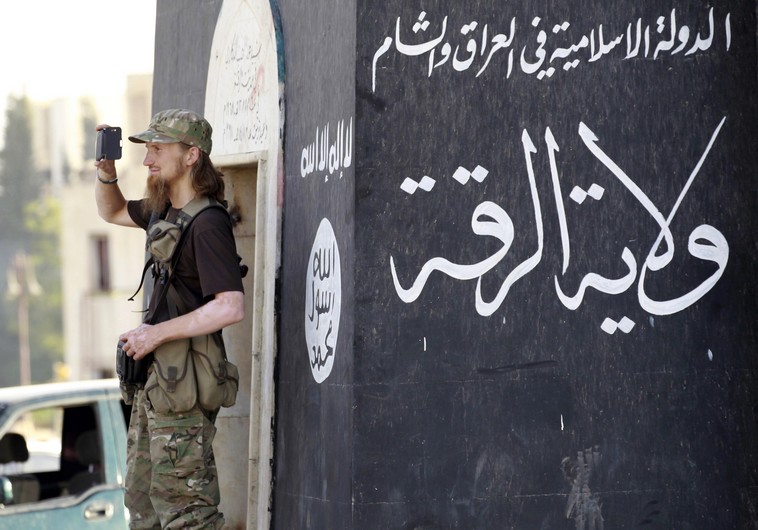
Archive for the ‘Islamic State’ category

Inside The ISIS-Al Qaeda Merger Talks

November 11, 2014

Inside The ISIS-Al Qaeda Merger Talks, Daily BeastJamie Dettmer, November 11, 2014

(If Abu Bakr al-Baghdadi — the Islamic State leader whose disagreements with al Qaeda led to a split — is dead or otherwise out of the game, will that help to facilitate an Islamic State –  Jabhat al Nusra union? — DM)

The merger, if it comes off, would have major ramifications for the West. It would reshape an already complex battlefield in Syria, shift forces further against Western interests, and worsen the prospects for survival of the dwindling and squabbling bands of moderate rebels the U.S. is backing and is planning to train.

******************

U.S. airstrikes have helped drive ISIS and al Nusra together, and the Khorasan group is trying to cement the deal. The big losers: Everybody else—except Assad.

ISTANBUL—Jihadi veterans known collectively as the Khorasan group, which have been targeted in two waves of airstrikes by U.S. warplanes, are trying to broker an alarming merger between militant archrivals the Islamic State and Jabhat al Nusra, the official Syrian branch of al Qaeda.

The merger, if it comes off, would have major ramifications for the West. It would reshape an already complex battlefield in Syria, shift forces further against Western interests, and worsen the prospects for survival of the dwindling and squabbling bands of moderate rebels the U.S. is backing and is planning to train.

“Khorasan sees its role now as securing an end to the internal conflict between Islamic State and al Nusra,” says a senior rebel source. The first results are already being seen on the ground in northern Syria with a coordinated attack on two rebel militias favored by Washington.

All three of the groups involved in the merger talks—Khorasan, Islamic State (widely known as ISIS or ISIL), and al Nusra—originally were part of al Qaeda. Khorasan reportedly was dispatched to Syria originally to recruit Westerners from among the thousands of jihadi volunteers who could take their terror war back to Europe and the United States. But among ferocious ideologues, similar roots are no guarantee of mutual sympathy when schisms occur.

Current and former U.S. officials say they are unaware of any cooperation between ISIS and al Nusra, and they doubt that a merger or long-term association could be pulled off. “I find it hard to believe that al Nusra and Islamic State could sink their differences,” says a former senior administration official. “The rift between them is very deep,” he adds.

But senior Syrian opposition sources say efforts at a merger are very much under way and they blame Washington for creating the circumstances that make it possible. Moderate rebels accuse the Obama administration of fostering jihadi rapprochement by launching ill-conceived airstrikes on al Nusra while at the same time adamantly refusing to target the forces of Syrian President Bashar al-Assad in the U.S. military intervention in the region.

This, they say, has created the opening for a possible understanding between the jihadists and is creating sympathy for al Nusra. Other Islamist rebels and the wider population in insurgent-held areas in northern Syria question American motives and designs and remain furious at the U.S. decision not to help topple Assad.

“Al Nusra knows more airstrikes are coming, so why wait,” says an opposition source. If the Americans are going to lump them together with ISIS, maybe best to join forces. “What made the possibility of their coming together are the airstrikes.”

The opposition sources, who agreed to interviews on the condition they not be identified, warn that mounting cooperation between the two jihadist groups already is evident in specific operations.

Earlier this month, ISIS sent more than a hundred fighters in a 22-vehicle column to assist its onetime competitor, al Nusra, in the final assault on a moderate Islamist rebel alliance, the Syrian Revolutionaries Front, commanded by Jamal Maarouf in Idlib province.

The jihadis also targeted a secular brigade of insurgents, Harakat al-Hazm, which the U.S. has supplied with advanced anti-tank weaponry, because it tried to intervene and separate the SRF and al Nusra.

“Da’esh fighters weren’t really needed,” says one of the sources, “Al Nusra had sufficient numbers but the support given is highly symbolic.” (Da’esh is the Arabic acronym for ISIS.)

The coordination being claimed between the two groups would be the first time ISIS militants have cooperated with al Nusra since the winter ,when al Qaeda’s overall leader Ayman al-Zawahiri issued what seemed a definitive statement: “Al Qaeda announces that it does not link itself with [ISIS] … It is not a branch of the al Qaeda group, does not have an organizational relationship with it.”

The al Qaeda old guard and the ambitious ISIS leader Abu Bakr al-Baghdadi, who bristled at orders from Zawahiri, fell out over strategy and the attacks that his mainly foreign fighters were mounting against Syrian rebels. But the rift was, not least, a matter of personalities and egos. Al-Baghdadi has since attempted to declare himself the true leader of all true Muslims (by his lights) as the Caliph of the Islamic State. Zawahiri is not about to sign on to that.

Thus reports that al-Baghdadi may have been badly wounded or even killed in a U.S.-led coalition airstrike mounted last week near Mosul, while they may sound like good news for the coalition, could be even better news for the jihadis. Syrian rebel sources say al-Baghdadi’s elimination might well assist an agreement being struck between ISI and al Nusra.

The senior opposition sources say the coordination in the fight with the Syrian Revolutionaries Front was agreed on at a meeting held just west of Aleppo between representatives of the two jihadi groups and overseen by members of the Khorasan group.

U.S. intelligence agencies accuse the Khorasan veterans of plotting attacks against commercial airliners in the West. The U.S. targeted them with a wave of sea-launched cruise missiles on Sept. 23 and last week hit again with wide-ranging airstrikes on al Nusra positions as well, partly in a bid to hit the veterans. Several members of the group have been killed, but top leaders are still thought to have escaped the targeting and U.S. officials say they can’t confirm who has survived and who hasn’t.

There were representatives at the meeting from other hardline groups as well, such as Jund al-Aqsa, a jihadi offshoot, and Ahrar al-Sham, a group al Qaeda was instrumental in forming.

At the meeting a few nights before the final jihadi push against the SRF, which was attended by al Nusra leader Abu Mohammad al-Golani, the participants agreed, say opposition sources, that the Syrian Revolutionaries Front should be eliminated as an effective fighting force.

The assault on the weekend of Nov. 1 sealed weeks of battles between al Nusra and the SRF. The jihadis have now captured a series of towns and villages in Idlib province—Maarshorin, Maasaran, Dadikh, Kafr Battikh, Kafr Ruma, Khan al-Subul, and Deir Sunbul, Maarouf’s hometown. And al Nusra fighters have in recent days moved further north, coming within three miles of the important crossing on the Turkish border at Bab al-Hawa. The SRF has been left with virtually no territory.

Meanwhile, the secular Hazm movement was forced by al Nusra fighters to withdraw from its strongholds in Idlib, including Khan al-Subul, where it stored about 10 percent of its equipment. Hazm denies reports that jihad fighters managed to seize U.S.-supplied TOW anti-tank missiles, but concedes that al Nusra was able to secure 20 tanks, five of which were fully functional, six new armored personnel carriers recently supplied from overseas, and dozens of the group’s walkie-talkies, with the result that Hazm fighters elsewhere had to ditch their sets lest ISIS listen in.

(Some Hazm members bought the walkie-talkies themselves from Best Buy during a visit to the U.S.—suggesting that aside from TOW missiles the Obama administration has not been that generous in supplying the brigade.)
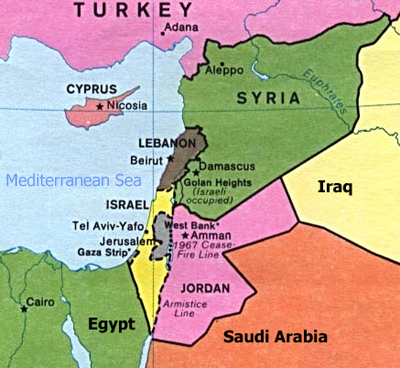
 

The Islamic State and Hezbollah Fight For Lebanon

November 8, 2014

The Islamic State and Hezbollah Fight For Lebanon, Vice News via You Tube, November 6, 2014


israel_lebanon_map

How to understand Obama’s Iran diplomacy

November 8, 2014

How to understand Obama’s Iran diplomacy, Power LineScott Johnson, November 7, 2014

I think the easiest way to understand Obama’s diplomacy is this. Assume that Obama believes Iran should have nuclear weapons and would like to facilitate the mullahs’ nuclear weapons program. This assumption is the Occam’s Razor that clarifies what might otherwise be obscure. The assumption may not be correct, but it should prove a handy guide to coming attractions.

Obama bids against himself chasing after the mullahs. You can say that he doesn’t know how to negotiate, and it’s a plausible hypothesis. As Michael Rubin explains, “Desperation is not a good negotiating position” (unless you want to give it away).

But how explain Obama’s vehement opposition in the past to the imposition of sanctions against Iran by Congress, or the threat of such sanctions in the future in the case no final deal were to be reached?

How explain his concession up front (in the P5+1 interim agreement with Iran) to Iran’s nuclear enrichment?

How explain the offer to agree to an ever increasing number of centrifuges for enrichment?

How explain the apparent acceptance of a prospective deal without proof that Iran’s nuclear program is peaceful in nature, which is in itself an absurd and unbelievable proposition?

And so on, and so on.

When Obama makes the famously false promise that he is from the government and he is here to help, he means it in the case of the mullahs.

Today’s page-one story in the Wall Street Journal reveals Obama’s fourth secret letter to the mullahs in search of a deal. He is pleading with them. He will not take no for an answer. See Michael Rubin, “White House ignores Khameni response to letters.”

Obama’s most recent letter is already yesterday’s news. Today’s news comes via the IAEA. Omri Ceren summarizes it as follows in an email message this morning:

The new IAEA report went online about two hours ago. No changes from last time: not only are the Iranians continuing to block the Agency’s work, but they’re refusing to offer new ways of moving forward. Zero progress during the reporting period, and no sign that the next one will be any better.

The report is here The key lines are:

“The Agency is not in a position to provide credible assurances about the absence of undeclared nuclear material and activities in Iran, and therefore to conclude that all nuclear material in Iran is in peaceful activities”

“Iran has not provided any explanations that enable the Agency to clarify the outstanding practical measures, nor has it proposed any new practical measures in the next step of the Framework for cooperation”

The Iranians seem to be betting that the West will eventually drop the demand that Tehran come clean about the possible military dimensions (PMDs) of its nuclear program. Negotiations will come down to the wire, all of the other issues will have been massaged, and Iranian negotiators will look up and say the equivalent of ‘you’re not really going to blow up this whole deal over something we did in the past, are you?’ Under that scenario the message will be echoed by a few advocates in the nonproliferation world, the P5+1 will latch on to the reasoning, and that’ll be that.

The problem is that the PMD issue has very little to do with the past and everything to do with future verification. Unless the Iranians disclose what they’ve been doing on the nuclear front – including whatever the military is doing to surreptitiously enrich and store uranium – there’s no way to verify that they’ve stopped doing those things.

Remember how we got here. The P5+1 was supposed to be working with Iran on uranium, plutonium, and ballitsic missiles. Underneath all of those issues, the IAEA was supposed to be working on getting Iran to come clean on the full scope of its program: both the civilian and the military aspects (i.e. the PMDs).

People often talk and write about the PMD issue as if it’s just about weapons work – suspected Iranian experiments with detonators, warheads, etc. Those things matter but the issue is much broader. The IAEA wants access to all the places where the Iranian military had its hand in any atomic work – uranium mining, centrifuge construction, enrichment, and so on. The goal is to get a full picture of everything the Iranians are doing, so that the IAEA can confirm that they’ve stopped.

When the Iranians jam the IAEA up on PMDs, it’s not just another fourth core issue that can be negotiated alongside uranium, plutonium, and ballistic missiles. Transparency is the prerequisite to creating any robust verification scheme on those other three issues. It’s not possible for Western negotiators to say something like: ‘ok, we’ll give you a little on PMDs, but you have to give us something back on centrifuges.’ Without disclosure, there’s no way to verify that the Iranians are actually living up to their half of the trade.

Isn’t this obviously true? That’s where my Occam’s Razor cuts through the fog to help us understand what is happening now and what will in all likelihood be happening soon.

In related news, see Adam Kredo, “Report: Iran nuclear program more advanced than previously believed” and “Pentagon: Iran giving ‘lethal aid to the Taliban’ to fight US.”

UPDATE: Omri Ceren writes to update his message with news of today’s State Department briefing:

The issue came up in today’s State Department press briefing between the AP’s Matt Lee and State spox Jen Psaki. It actually came up twice, with [AP State Department reporter] Matt [Lee] circling back to it….The [short] version is that Jen left open the possibility that the US will take a deal with Iran even if the Iranians continue to obstruct the IAEA, i.e. even if they refuse to come clean on their past nuclear activity including military atomic work. If that happens it would mark another erosion in the US position, alongside reported walkbacks in the other three core areas: uranium, plutonium, and ballistic missiles. More problematically, letting Iran slide on IAEA inspections now risks gutting any verification regime set up later.

It is “problematic,” however, only if your (our) goal is to prevent Iran from obtaining nuclear weapons.

Obama deploys 1,500 more U.S. troops to Iraq

November 8, 2014

Obama deploys 1,500 more U.S. troops to Iraq, Washington TimesDave Boyer and Maggie Ybarra, November 7, 2014

(Will they be permitted to wear combat boots? — DM)

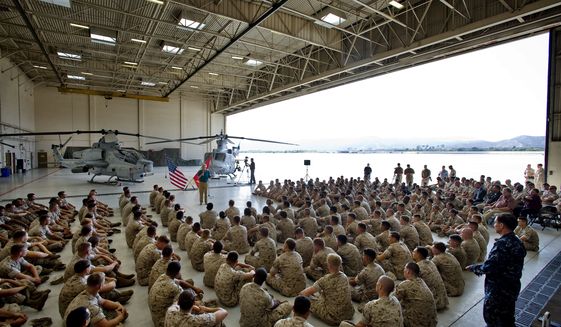
united-states-iraq-advisersjpeg-05ad1_c0-176-4256-2656_s561x327A group of selected Marines representing Camp Pendleton listen as Secretary of Defense Chuck Hagel answers their questions during his short visit to the base Tuesday Aug. 12, 2014. Hagel announced the deployment of another 130 U.S. troops to Iraq in remarks to Marines at this Southern California base on the final stop of a weeklong, around-the-world trip that also took him to India, Germany and Australia. (AP Photo/The Orange County Register, Paul Rodriguez)

“The president also authorized U.S. personnel to conduct these integral missions at Iraqi military facilities located outside Baghdad and Erbil,” the statement said. “U.S. troops will not be in combat, but they will be better positioned to support Iraqi Security Forces as they take the fight to ISIL.”

***********

President Obama is sending up to 1,500 more U.S. military personnel to Iraq to serve as non-combat advisers in the fight against Islamic State terrorists, the White House said Friday.

The troops will “train, advise, and assist Iraqi Security Forces, including Kurdish forces,” the White House said.

“The president also authorized U.S. personnel to conduct these integral missions at Iraqi military facilities located outside Baghdad and Erbil,” the statement said. “U.S. troops will not be in combat, but they will be better positioned to support Iraqi Security Forces as they take the fight to ISIL.”

It’s the latest escalation of U.S. military personnel in Mr. Obama’s fight to rescue the besieged government in Baghdad, where the president withdrew all U.S. forces in 2011. Since August, the U.S. has been conducting hundreds of airstrikes against the Islamic State in Iraq, and more recently in Syria.

The surge in military advisers will more than double the number of U.S. personnel in Iraq, which currently totals about 1,400.

U.S. troops will be asked to train nine Iraqi brigades and three Kurdish fighter brigades, said Pentagon spokesman Rear Adm. John Kirby.

“These sites will be located in northern, western, and southern Iraq,” Adm. Kirby said. “Coalition partners will join U.S. personnel at these locations to help build Iraqi capacity and capability. The training will be funded through the request for an Iraq train-and-equip fund that the administration will submit to Congress as well as from the government of Iraq.”

The White House said the Iraqi government requested the additional forces, and Defense Secretary Chuck Hagel agreed.

White House press secretary Josh Earnest said the Islamic State “has suffered a series of defeats in Iraq against the Iraqi Security Forces and Peshmerga, with the support of U.S. and coalition airstrikes and Intelligence, Surveillance and Reconnaissance, and as well as U.S. military advice.”

“The United States and its coalition partners will continue to confront the threat of [the Islamic State] with strength and resolve as we seek to degrade and ultimately defeat” the terrorist group,” he said.

Shaun Donovan, director of the White House Office of Management and Budget, said the administration is sending a request to Congress for $5.6 billion to pay for the military operations.

The request includes $1.6 billion to establish the Iraq train-and-equip fund to develop and support Iraqi security forces, including Kurdish forces.

“This funding will help reconstitute the Iraqi army and strengthen the capability and capacity of our Iraqi partners to go on the offensive against” the Islamic State, Mr. Donovan said.


Iran Nuclear Talks and North Korean Flashbacks

November 7, 2014

Iran Nuclear Talks and North Korean Flashbacks, ForbesClaudia Rosett, November 7, 2014

(During Clinton’s efforts to achieve detente with North Korea, Wendy Sherman found hope for change — for the better —  in every hostile utterance from NK leaders. Now she is Obama’s boot on the ground in the P5+1 negotiations with Iran. What can possibly go right wrong? — DM)

Now, in the Obama administration’s increasingly desperate quest for an Iran deal, comes news that President Obama is proposing to Iran’s Khamenei, ruler of the world’s leading terror-sponsoring state, that Iran and the U.S. cooperate to fight the terrorists of ISIS. This has a familiar ring. Back in 2000, the visit of North Korea’s Vice Marshal Jo to the White House was preceded, shortly beforehand, by a “Joint U.S.-D.P.R.K. Statement on International Terrorism,” in which both the U.S. and North Korea agreed that “international terrorism poses an unacceptable threat to global peace and security.” Apparently this was all part of the negotiating process of finding common ground. What could go wrong? Not that anyone should pin all this on Wendy Sherman, who is just one particularly active cog in the Washington negotiating machine. But there’s a familiar script playing out here. It does not end well.

*****************

With the Iran nuclear talks nearing a Nov. 24 deadline for a deal, U.S. chief negotiator Wendy Sherman is under pressure to bring almost a year of bargaining to fruition. While U.S. policy rests ultimately with President Obama, and the most prominent American face in these talks is now that of Secretary of State John Kerry, the hands-on haggling has been the domain of Sherman. On the ground, she has been chief choreographer of the U.S. negotiating team. The President has been pleased enough with her performance to promote her last week from Under Secretary to Acting Deputy Secretary of State.

The talks themselves have been doing far less well, marked by Iranian demands and U.S. concessions. This summer the U.S. and its negotiating partners agreed to extend the original July deadline until November. Tehran’s regime, while enjoying substantial relief from sanctions, is refusing to give up its ballistic missile program and insisting on what Tehran’s officials have called their country’s “inalienable right” to enrich uranium.

The Obama administration badly wants a deal. This week The Wall Street Journal reported that last month Obama wrote a secret letter to Iran’s Supreme Leader Ali Khamenei, which “appeared aimed both at buttressing the campaign against Islamic State and nudging Iran’s religious leader closer to a nuclear deal.” Speaking to reporters in Paris this week about the Iran nuclear negotiations, Kerry said “We believe it is imperative for a lot of different reasons to get this done.”

So, now that crunch time has arrived, what might we expect? If precedent is any guide, it’s worth revisiting Sherman’s record from her previous bout as a lead negotiator, toward the end of the second term of the Clinton administration. Back then, Sherman was trying to clinch an anti-proliferation missile deal with another rogue despotism, North Korea.

That attempt failed, but only after then-Secretary of State Madeleine Albright, together with Sherman, had dignified North Korean tyrant Kim Jong Il with a visit to Pyongyang in late October, 2000. These American top diplomats brought Kim the gift of a basketball signed by one of his favorite players, Michael Jordan. Kim entertained them with a stadium display in which tens of thousands of North Koreans used flip cards to depict the launch of a long-range missile.

Less well remembered was the encounter shortly before Albright’s trip to Pyongyang, in which the State Department hosted a visit to Washington, Oct. 9-12 of 2000, by one of the highest ranking military officials in North Korea, Vice Marshal Jo Myong Rok. The centerpiece of Jo’s trip was a 45-minute face-to-face meeting at the White House, in the Oval Office, with President Clinton. It was historic, it was the first time an American president had met with an official of North Korea’s totalitarian state.

And it was a deft piece of extortion by North Korea, which had parlayed its missile program — including its missile trafficking to the Middle East, and its 1998 test-launch of a missile over Japan — into this lofty encounter in which the U.S. superpower was pulling out all the stops in hope of cutting a deal before Clinton’s second term expired in Jan., 2001. By 2000 (or, by some accounts, earlier) the Clinton administration was also seeing signs that North Korea was cheating on a 1994 denuclearization arrangement known as the Agreed Framework. Eight months before Jo arrived in Washington, Clinton had been unable to confirm to Congress that North Korea had abandoned its pursuit of a nuclear weapons program. Nonetheless, Jo’s visit rolled ahead, with Sherman enthusing in advance to the press that “Chairman Kim Jong Il has clearly made a decision — personally — to send a special Envoy to the United States to improve relations with us.”

Officially, Jo was hosted in Washington by Albright. But it was Sherman, then the Special Advisor to the President and Secretary of State for North Korea Policy, who orchestrated the events, squired Jo around Washington and briefed the press. It was Sherman who had helped prepare the way while accompanying her predecessor, the previous North Korea policy coordinator and former defense secretary, William Perry, on a trip to North Korea in 1999.

Jo arrived in Washington on Oct. 9, staying at the venerable Mayflower Hotel, where Sherman went to greet him. The next morning Jo and his delegation began their rounds with a courtesy call on Albright at the State Department. Then, before heading to the White House, Jo engaged in a symbolically freighted act. According to an account published some years later in the Washington Post by the senior State Department Korean language interpreter, Tong Kim, who was present for the occasion: “The marshal arrived in Washington in a well-tailored suit, but before going to the White House, he asked for a room at the State Department, where he changed into his mustard-colored military uniform, with lines of heavy medals hanging on the jacket, and donned an impressive military hat with a thick gold band.” Perhaps it did not occur to anyone at the State Department that North Korea was still a hostile power, a brutal rogue state fielding one of the world’s largest standing armies, and that this donning of the uniform on State premises was not just a convenience, but an implied threat. Or perhaps the zealous hospitality of the occasion just over-rode any thought at all. In any event, it was in his uniform that Jo went from the State Department to the White House.

Following those meetings, Sherman briefed the press. She made a point of mentioning that Jo had worn a business suit to the State Department. but changed into full military uniform for his meeting with the President of the United States. Sherman chose to interpret Jo’s wardrobe change as happy evidence of North Korean diversity under Dear Leader Kim: “We think this is very important for American citizens to know that all segments of North Korea society, obviously led by Chairman Kim Chong-Il in sending this Special Envoy, are working to improve the relationship between the United States and North Korea and this is obviously an important message to the citizens of North Korea as well.”

Actually, there were substantial segments of North Korean society whose chief preoccupation was finding enough food to stay alive, toward the end of a 1990s famine in which an estimated one million or so had died — forbidden by Kim’s totalitarian state to enjoy even a hint of the freedom that had by then allowed their brethren in South Korea to join the developed world. This was known at the time, but did not figure in Sherman’s public remarks.

On the second evening of Jo’s Washington visit, Albright hosted a banquet for him and his delegation at the State Department. She welcomed the “distinguished group” to the “historic meeting,” and invited everyone to relax and get better acquainted. There was laughter and applause. Jo made a toast — a disturbing toast — in which he said there could be “friendship and cooperation and goodwill, if and when the Democratic People’s Republic of Korea and our leadership is assured, is given the strong and concrete security assurances from the United States for the state sovereignty and the territorial integrity of the Democratic People’s Republic of Korea.”

If the State Department’s chief North Korea policy coordinator, Wendy Sherman, noticed a problem with that toast, and its mention of territorial integrity, it seems she did nothing to alert the assembled American dignitaries. The crowd clapped and raised a toast to North Korea’s envoy. It was left to outside observers, such as American Enterprise Institute scholar and North Korea expert Nicholas Eberstadt, to point out, as Eberstadt stressed at an AEI forum in 2008, that North Korea lays claim to the entire Korean peninsula, including South Korea. “Take a look at the maps; take a look at the preamble to the Workers’ Party charter,” said Eberstadt; the real message is, “We can be friends with North Korea if we are willing to subsidize North Korean government behavior and throw South Korea into the bargain too, but that is a pretty high opening bid.”

Jo’s visit ended with a U.S.-D.P.R.K Joint Communique, full of talk about peace, security, transparency and access. There was no missile deal. Kim Jong Il wanted Clinton, leader of the free world, to come parley over missiles in totalitarian, nuclear-cheating Pyongyang. Clinton demurred. In late October, Albright and Sherman went instead. As the clock ticked down on the final weeks of the Clinton administration, Sherman reportedly traveled to Africa with a bag of cold-weather clothes, to be ready in the event of a last-minute summons to North Korea.

In 2001, President Bush was inaugurated. Sherman left the State Department, and soon afterward she wrote an Op-ed for The New York Times, headlined “Talking to the North Koreans.” Sherman noted that “Some are understandably concerned that a summit with President Bush would only legitimize the North Korean leader” — nonetheless, she urged Bush to try it. Bush tried confrontation in 2002 over North Korea’s nuclear cheating, followed by years of Sherman-style Six-Party Talks, including two agreements, in 2005 and 2007, which North Korea punctuated in 2006 with its first nuclear test, and has followed during Obama’s presidency with two more nuclear tests, in 2009 and 2013.

Vice-Marshal Jo died in 2010. Kim Jong Il died in 2011, and was succeeded by his son, current North Korean tyrant Kim Jong Un, whose regime carried out the 2013 nuclear test, and threatened earlier this year to conduct another. Wendy Sherman rejoined the State Department under Obama, and has moved on from wooing North Korea to the bigger and potentially far deadlier project of negotiating a nuclear deal with Iran. Considerable secrecy has surrounded many specifics of these talks, while Americans have been asked to trust that this is all for their own good. In a talk last month at Washington’s Center for Strategic and International Studies, Sherman said: “As Madeleine Albright once observed — a wonderful Secretary of State, a dear friend, and a business partner to boot at one point in my life — negotiations are like mushrooms, and often they do best in the dark.”

Now, in the Obama administration’s increasingly desperate quest for an Iran deal, comes news that President Obama is proposing to Iran’s Khamenei, ruler of the world’s leading terror-sponsoring state, that Iran and the U.S. cooperate to fight the terrorists of ISIS. This has a familiar ring. Back in 2000, the visit of North Korea’s Vice Marshal Jo to the White House was preceded, shortly beforehand, by a “Joint U.S.-D.P.R.K. Statement on International Terrorism,” in which both the U.S. and North Korea agreed that “international terrorism poses an unacceptable threat to global peace and security.” Apparently this was all part of the negotiating process of finding common ground. What could go wrong? Not that anyone should pin all this on Wendy Sherman, who is just one particularly active cog in the Washington negotiating machine. But there’s a familiar script playing out here. It does not end well.

Our enemies are on the ballot today as well and remember, they have a vote.

November 4, 2014

Our enemies are on the ballot today as well and remember, they have a vote. LTC Allen B. West (U.S. Army, ret.), November 4, 2014

(Not even the force of Obama’s character, honed during his time as a community organizer, is degrading or destroying the Islamic State. Is he is the one for whom IS had been waiting?– DM)

isis_flag-300x180

[T[his is what happens when you have a cast of amateurs masquerading as national security experts or advisors — such as Susan Rice, Dan Pfeiffer or Ben Rhoades. This is what happens when you have a truly inept Secretary of Defense in Chuck Hagel, and a lack of trust and belief in the combined experience of the senior U.S. military generals. And all comes back to the desk of Valerie Jarrett.

*********************

Today is the critical 2014 midterm Election Day and I won’t beleaguer you with many posts today, but here’s something about which we need be aware.

As President Obama touted, his policies are on the ballot today – but I haven’t heard any candidates or incumbents discussing his foreign policies at length.

Obama’s solution to the ISIS crisis was to arm the Free Syrian Army — we have written often about how that is a flawed strategy. As former Commandant of the Marine Corps General James T. Conway stated, it didn’t have a snowball’s chance in hell of succeeding — and it only took three months, from August 8th, for that prediction to come to fruition.

As reported by the UK Guardian, “The U.S. plan to rally proxy ground forces to complement its air strikes against ISIS militants in Syria is in tatters after jihadis ousted Washington’s main ally from its stronghold in the north over the weekend. The attack on the Syrian Revolutionary Front (SRF) by the al-Qaida-aligned Jabhat al-Nusra came after weeks of clashes between the two groups around the city of Idlib, which has remained one of the last bastions of regime control in northern Syria throughout the civil war. Militants overran the command center of the SRF’s leader, Jamal Maarouf, in Deir Sonbol in a humiliating rout that came as U.S. and Arab air forces continued to attack ISIS in the Kurdish town of Kobani, 300 miles east, in an effort to prevent the town from falling.”

This represents the utter failure of strategy based on rhetoric, rather than the implementation of a sound strategy. Barack Hussein Obama truly believed that talk is the best means to evade a crisis — not realizing that the enemy has a vote.

We have never launched a full-scale air campaign against ISIS aimed to degrade and destroy the Islamic terrorist enemy. We continue to witness ISIS operating on multiple fronts conducting offensive operations — something we discussed here – and their main effort versus supporting efforts.

The Guardian says, “the defeat of Maarouf is a serious blow to the U.S. strategy of building a proxy coalition against Isis. It comes amid a groundswell of anger at the U.S. strikes across the opposition-held north, which have done nothing to slow the intensity of attacks from Bashar al-Assad’s air force, especially in Aleppo. “We thought the Americans were going to help us,” said an SRF spokesman. “But not only have they abandoned us, they have been helping the tyrant Bashar instead. We will move past this betrayal and get back to Jebel al-Zawiya [the group’s heartland], but it is going to take some time.”

So much for that faux alliance and promise from Obama.

According to the Guardian, “a survivor from one of the Syrian bombed refugee camps, Haithem Ahmed, who fled with his family to Turkey, said the Syrian regime had been emboldened by the U.S. attacks on a common enemy and was acting with increasing impunity. “It is obvious that the U.S. is supporting Assad,” he said. “Don’t bother trying to argue with me or anyone else about it. They are aiding the war against us. Their leaders are weak and they are liars.”

In addition, we failed to realize that the forces of Jabhat al-Nusra and ISIS have bonded in an alliance — something we also reported on here. The al-Nusra front, which was supposed to be fighting against the Assad regime, decided to turn against the Free Syria Army forces, the SRF, to take away any ground options of Obama.

So Obama’s intent of outsourcing to the FSA is truly a non-viable option – as a matter of fact, it’s the option that has been degraded and destroyed. Obama’s decision not to attack ISIS but rather just support the free Syrian elements to defend their territories has been a disaster.

Confusion abounds in the Obama administration, as the Guardian reports “the U.S. defense secretary, Chuck Hagel, is reported to have warned national security adviser Susan Rice of a blowback among opposition communities in northern Syria because U.S. strategy against Assad has not been clearly defined.”

Ladies and gents, this is what happens when you have a cast of amateurs masquerading as national security experts or advisors — such as Susan Rice, Dan Pfeiffer or Ben Rhoades. This is what happens when you have a truly inept Secretary of Defense in Chuck Hagel, and a lack of trust and belief in the combined experience of the senior U.S. military generals. And all comes back to the desk of Valerie Jarrett.

But if the events in Syria are disturbing, “In Iraq, Isis has reportedly killed over 230 members of a tribe in western Anbar province in the last ten days, including dozens of women and children. The killings were some of the worst bloodshed in the country since the militants swept through northern Iraq in June.”

In this midterm election we need to realize we have no national security strategy whatsoever — not in the Middle East, not towards Iran, not towards Russia, and certainly not towards China. ISIS and Islamo-fascists are just handing the Obama administration its collective arse and embarrassing it at every turn.

The sad result is that more men, women and children are being slaughtered and sold off into slavery — yes, in the 21st century. Perhaps someone out in Colorado could tell Senator Mark Udall there’s a real “War on Women” going on — not that made up political stuff. But hopefully after tonight, it will be a moot point as far as he’s concerned.

There is much at stake in the Middle East and a lack of a determined strategic vision and resolute commitment is evident to both “allies” and foes. ISIS and the Islamists have a vision, a strategy, and developing alliances and growing recruiting numbers. This is a war of ideologies, but we have a president who refuses to acknowledge that premise — perhaps because he supports the Islamist ideology.

The Guardian says, “Kobani has become a defining struggle between ISIS and the U.S., as much as it is between the jihadis and the Kurds who, with U.S. help, beat back an advance on Irbil in August. If ISIS was able to take Kobani it could boast a significant victory. A victory over the secular Kurds would help advance its hardline interpretation of Islam, which has seen it rule areas it controls along strict medieval precepts that are rooted in an uncompromising understanding of Islamic teachings.”

The ideology must be defeated foremost. The enemy must then be destroyed in detail. The failed policy of doing neither is on the ballot today.

It is a time for choosing.

Who is the Real Chickenshit?

November 4, 2014

Who is the Real Chickenshit? Gatestone InstituteBassam Tawil, November 4, 2014

(Are attempts to spawn a new Islamic Caliphate more grounded in fantasy than Obama-Kerry perceptions of the Islamic State, grounded in their ill-formed perceptions of fact and ideology? Or less? — DM)

Judging by their actions, most Arab leaders do not want to create yet another terrorist Islamist state, dedicated to the Muslim Brotherhood’s ideology and to toppling their regimes. We do want a Palestinian state, but please, only one that will provide responsible governance.

According to the “Arab street,” it is the Americans and Europeans who are cowards, afraid to take significant steps against Iran, and terrified of the Islamic ghettoes in their cities, which have been exporting terrorists to fight for the Islamic State, and providing housing to the seasoned fighters who return.

To Arabs, the ultimate irony is that America is paying Qatar to have its airbase there, while Qatar is paying terrorists to kill Americans.

When John Kerry claimed it was the unresolved Palestinian issue that caused a ripple effect that crated ISIS, he simply inspired the Palestinians to use Al-Aqsa mosque as a religious trigger for future bloodshed.

There is a civil war currently under way between radical Islam — motivated by imperialist fantasies of restoring the Islamic Caliphate — and the more moderate secular Muslim regimes that are seeking the path to modernization and progress.

At the same time, Sunni Islam is in the midst of an increasingly violent crisis in its dealings with Shi’ite Iran, which looks as if it is about to be granted nuclear weapons capability, and which for decades quietly has been eyeing neighboring Arab oil fields.

Into the middle of this explosive disarray, U.S. Secretary of State John Kerry and his supporters have thrown the accusation that it was actually Israel’s so-called refusal to reach a peace agreement that was responsible for the ripple effect that led to the creation of ISIS. This incorrect diagnosis of the situation merely postpones the West’s efforts to find a real, workable solution for the Palestinian issue.

774Does Kerry really blame Israel for ISIS? Above, U.S. Secretary of State John Kerry meets with Israeli Prime Minister Benjamin Netanyahu in Tel Aviv, Israel, on July 23, 2014. (Image source: U.S. State Department)

It is easy for the leaders of the Arab world to latch onto Kerry’s accusation and use it justify their weakness and unwillingness to enter into a direct battle against terrorism; to let America do the dirty work, and conveniently to relieve the Arab world of having to recognize Israel and establish a Palestinian state.

They would also be able to avoid dealing with Israel’s demand for the Palestinian territories to be disarmed and the Palestinians’ demands for concessions from Israel.

Judging by their actions, most Arab leaders have no desire to see the Palestinian issue resolved. They seem to prefer preserving the status quo. They blame Israel for refusing to make concessions to the Palestinians and hope that this refusal will weaken Israel, even though Israel is their strategic defense against Iran.

Most Arab leaders do not want to create what is bound soon to become yet another terrorist Islamist state, dedicated to the Muslim Brotherhood’s ideology and to toppling their regimes. The Arab leaders already have to contend with ISIS, Al-Qaeda and the Al-Nusra Front in Syria, Iraq, Libya and Yemen, which are enough for them, to say nothing of Africa from Nigeria to Somalia and everything in between.

But if Israel can be blamed for another of world’s ills, with Kerry’s blessing, why waste the opportunity?

When Jordan’s King Abdullah called the current Islamic civil war a cry of distress, he was not speaking randomly. There is a genuine problem.

No examples are better than Turkey, Qatar and Iran. Turkey, led by its president, Recep Tayyip Erdogan, hosts Hamas’s overseas command center; is supported by Qatar and would apparently like to take control of more Sunni territory by subverting the Sunni Arab monarchies. Such a move would enable Erdogan to realize his outspoken dream of recreating an Ottoman Empire and Caliphate.

Turkey and Qatar, its partner in plotting the return of the Caliphate, have left their fingerprints on most of the terrorist attacks and catastrophes currently visited upon the Middle East, especially in the fields of subversion, incitement to terrorism, and the arming and training of terrorists.

The Middle Eastern Sunni Islamist terrorist organizations, meanwhile, are being incited and indoctrinated by Al-Jazeera TV, a Muslim Brotherhood megaphone that belongs to Qatar’s ruling al-Thani family. It was Al Jazeera’s Arabic channel that created the “Arab Spring” by taking the story of a fruit-seller who merely wanted a permit, and whipping it up, non-stop, until it grew into a revolution that brought down Tunisia’s government.

The Middle East’s terrorist gangs are now armed and trained with funding from Qatar. Recently, in yet another savored irony, Turkey agreed to help train Syrian rebels and allow the U.S. to use its military bases — but for Turkey, the plan is probably to bring down Syria’s non-Sunni President, Bashar Al-Assad, and not, as the U.S. might imagine, to bring down ISIS.

In the past, Persian Gulf states such as Saudi Arabia joined in training Islamic terrorist cadres, but currently, as the Arab proverb goes, “The magic spell boomeranged,” and Saudi Arabia and its Gulf allies have to defend themselves from the very groups they helped create.

Terrorist organizations are now generously funded by Qatar and NATO-member Turkey, which inspire them to attack the regimes of Egypt, Syria, Iraq and Jordan, and various regimes in the Persian Gulf and Africa. Of course, they are all also inspired to attack Israel, as Hamas has done.

Turkey and Qatar are also exploiting the naiveté of the Western world, encouraging ISIS operatives to make preparations to attack Europe and the United States. Preachers of “political Islam” incite susceptible Islamic youths in the West and prepare them for a terrorist campaign. They use the West’s political correctness, free speech and support for “pluralism,” all the while insisting they are not preaching terrorism.

Turkey and Qatar, along with Iran — which does its utmost to export the Ayatollah Khomeini’s Islamic Revolution throughout both North and South America, as well as Syria, Lebanon, Iraq and Yemen — are aided by a mechanism known as the da’wah, or “outreach,” Da’wah, technically the preaching of Islam, is used by political Islam for indoctrinating, enlisting and handling Islamist terrorists worldwide. Perfected for terrorist purposes by the Muslim Brotherhood, its mouthpiece is Sheikh Yusuf al-Qaradawi, who, like Hamas’s leader, Khaled Mashaal, is based in Qatar.

While Iran’s rivals, the Sunni states, conduct their civil wars, Iran only becomes stronger. Not only is it turning itself into a nuclear power, it is also strengthening all its outposts in the Middle East and around the world. It supports the Shi’ite regime in Iraq against ISIS; it arms and funds the Houthis in Yemen and the Hezbollah in Lebanon; and it supports the Syrian Alawite regime against its Sunni opponents.

When it comes to terrorism, Iran does not draw partisan lines. It also supports the Sunni groups Hamas and Palestinian Islamic Jihad, both of which seek to destroy Israel and attack the Egyptians in the Sinai Peninsula.

In response to the colossal threat of radical Islam, the whimpering voice of the West can barely be heard. The U.S. administration targeted Israel for condemnation. A “senior official,” most likely the current White House Chief of Staff Denis McDonough, called Israel’s Prime Minister Benjamin Netanyahu a “chickenshit,” for being afraid to make peace with the Palestinians.

According to the “Arab street,” including the Palestinian street, it is the Americans and Europeans who are cowards, afraid to take significant steps against Iran, and terrified of the Islamic ghettoes in their cities, which have been exporting terrorists to fight for the Islamic State, and providing housing to the seasoned fighters who return.

The Sunni states under Shi’ite threat cannot even reach an agreement among themselves about what is to be done; and the Palestinians, in their folly, have chosen the worst possible moment to ignite violence in Jerusalem and the Al-Aqsa mosque. The Palestinians seem not to understand that the Arab regimes that might support them are currently busy fighting for their own survival, and have no desire to fall prey to Palestinian provocations about what they realize all too well are fictional threats to Jerusalem.

Given the current situation, Turkey’s regional political actions are dangerous, underhanded and hypocritical. To achieve their ends, Turkey’s leaders seem to have no qualms about sacrificing their minorities, such as Christians and the Kurds (most of whom are Sunni). Turkey’s leaders were the first to cry “humanitarian crisis” when Israel imposed a closure on the Gaza Strip to prevent Iran from sending Hamas arms. Turkey sent the Mavi Marmara flotilla to protect the Gazans, who were never in any danger in the first place. Turkey’s leaders then weakened Palestinian Authority President Mahmoud Abbas, who, at least at that time, showed himself willing to reach a peace agreement with the Israelis. But when Syria’s Kurds are being killed in Kobani on a daily basis, the Turks are silent, perhaps secretly comfortable seeing a group that wants a state of its own apart from Turkey, being attacked.

Thus, when John Kerry claimed that it was the unresolved Palestinian issue that caused a ripple effect that created ISIS, he simply inspired the Palestinians to use Al-Aqsa mosque as a religious trigger for future bloodshed. The idea is not new; it was used in 1929 by the Grand Mufti of Jerusalem and led to anti-Jewish riots and the massacre of the Jews in Hebron. It was used again by PLO Chairman Yasser Arafat in 2000, to incite the Palestinians to the second intifada, which killed untold numbers of Jews and Arabs. Today, Mahmoud Abbas and Hamas’s Khaled Mashaal are doing the same thing to incite a jihad that this time will truly be religious and not based on real estate.

The more Kerry accuses Israel of having had a hand in creating ISIS, the more the Palestinians will use Al-Aqsa mosque to stir the fire burning under the bubbling cauldron of the Middle East.

The Palestinians’ religious incitement campaign is currently being waged primarily by Mahmoud Abbas, the man who stood in front of the UN and accused Israel of fomenting a religious war. This is the same Mahmoud Abbas who calls on Palestinians to use every means available to fight Israel, while at the same time denying that he is doing so.

Meanwhile, Qatar lurks in the background, instructing Al-Jazeera TV to incite the Palestinians against Israel, Egypt and Jordan, and encouraging terrorist attacks that lead only to justified Israeli reprisals.

Qatar’s royal family hides behind the security of having a major U.S. airbase on its soil, while supporting Hamas, the Islamic Movement in Israel and the terrorist organizations in the Sinai Peninsula. To Arabs, the ultimate irony is that Americans are paying Qatar to have an airbase there, while Qatar is paying terrorists to kill Americans.

Qatar also still finds time nonsensically to accuse the wakf in Jordan, responsible for Al-Aqsa mosque, of collaborating with Israel to eradicate all signs of Muslim presence on the Temple Mount. Qatar’s only plan with that at the moment, however, is to cause riots in Jordan to oust Jordan’s king.

Inspired by Western accusations against Israel and the West’s enthusiastic recognition of a Palestinian state — without requiring the direct negotiations with Israel, as obligated by international treaties — the Palestinian leadership has become more radicalized.

Mahmoud Abbas has gone so far as to abandon his pretense of moderation: if the Israelis can be accused of creating the ISIS with no mention made of the culpability of Hamas, whose ideology is the same as ISIS’s, Mahmoud Abbas has been freed of any commitment to peace and can actively pursue the unilateral declaration of a Palestinian state.

In addition, witnessing Russia’s abrogation of its 1994 Budapest Memorandum with the Ukraine, with virtually no adverse consequences, must have seemed a precedent too tempting to ignore. Thus, the Palestinian Authority and Hamas do truly speak with one voice, but it is the voice of Hamas.

Khaled Mashaal, head of Hamas’s political bureau, called on all the Palestinians to take up arms to defend Al-Aqsa mosque in Jerusalem. The mosque, he said, justifies jihad and the sacrificing of shaheeds [martyrs] to liberate it, and, as in the Hamas charter, that “resistance” is the only solution for the problems of the Palestinian people.

Mashaal was echoed by Mahmoud Abbas at the 14th Fatah conference. Abbas said that under no condition were Jews to be allowed into Al-Aqsa mosque or the Church of the Holy Sepulcher, because any Jewish presence would defile them. On whose authority did he take possession of the Christian holy sites? A short time earlier, Abbas had even claimed that he had no intention of inciting a third intifada against Israel.

Somehow, John Kerry has managed to link to Israel the Shi’ite-Sunni civil wars, radical Islam’s Muslim Brotherhood-inspired global plot and the creation of ISIS. Then he linked the failure of the Palestinian issue to have been resolved to Israel’s Prime Minister Benjamin Netanyahu.

The unpopular and inconvenient truth is: if there is to be peace, Hamas has to be disarmed, the Palestinian Authority and the Gaza Strip have to be demilitarized, Mahmoud Abbas has to recognize the State of Israel as the homeland of the Jews, and Netanyahu has to recognize the Palestinians state. Israel will then compensate the Palestinians with land in return for the land on which the three large blocks of settlements stand, as has already been agreed.

It is not Israel but the Palestinians who are trying to avoid negotiating a final agreement. They see themselves, with the backing of the UN and Secretary Kerry — and in a final breakdown of any trust in future international agreements — as able to achieve their desired result without having to make any concessions.

People who repeat infamies, as Kerry has done, not only encourage radicalism, they are just delaying the establishment of a Palestinian state. We do want a Palestinian state, but please only one that will provide responsible governance.

Islam, murder and hate speech

November 4, 2014

Islam, murder and hate speech, Dan Miller’s Blog, November 3, 2014

(Wilders is, of course, an Islamophobic hater of peace. As Obama and Kerry are pleased to inform us, Israeli settlements and prayers are the greatest sources of hate, the greatest threats to peace and hence to civilization. — DM)

November 2nd was the tenth anniversary of the Islamic assassination of Theo Van Gogh in Amsterdam. Islam is the religion of death and slaughter. Those who understand and therefore oppose it are targets of Islam. Often, in formerly free western nations, they are prosecuted for “hate speech.” Obama, Kerry and other “leaders” of the international community call Islam the “religion of peace” which is not to be disparaged.

Mr. Wilders’ address is in English. For those who would prefer to read it, the text is available at New English Review. Here’s a short excerpt:

Van Gogh warned us in  strong language, as clear as the colors that his great-granduncle Vincent used when painting his landscapes.

He was a brave man. When he realized the danger of Islam, he did not run like a coward.

He would have hated to see how our freedom of speech has been restricted in the ten years since his death.

Ladies and gentlemen, dear friends, the more Islam we get, the less free our societies become. Not only because of the islamization but also because of the weak appeasers who call themselves politicians. [Emphasis added.]

We are no longer allowed to crack jokes or draw cartoons if Islam feels insulted by it.

If you do so, your life is in danger, as Kurt Westergaard and Lars Vilks can testify. You might even get arrested, as happened a few years ago with the Dutch cartoonist Gregorius Nekschot.

. . . .

Last Summer, my home town, The Hague, witnessed scenes which brought back memories of the darkest period in our history, the Nazi era.

Sympathizers of the Islamic State paraded in our streets. They carried swastikas, they carried the black flags of ISIS. They shouted “Death to the Jews.”

Instead of rounding up these hatemongers, the authorities did nothing. [Emphasis added.]

When we warn against Islam, the authorities call it hate speech and bring us to court. But when the grim forces of hatred march down our streets, the police look on and do not interfere. It is a disgrace. It is a scandal. It is intolerable. [Emphasis added.]

Islam is waging a war against the free West.

Indeed, we are at war. Only fools can deny it. Islam has declared war on us.

America and its allies are currently bombing the Islamic State in Syria and Iraq.

Excellent.

My party supports this offensive. I am glad that Dutch and Danish F16s participate in it and that our two nations stand shoulder to shoulder in this endeavor. We should liquidate Abu Bakr Al-Bagdadi and the other criminals who are leading the Islamic State.

But we have to do more than that.

Far more important than fighting Islamic State abroad, is the fight to preserve our own security in our own countries, in the Netherlands, in Denmark, in all the other European and Western countries. It is our homes that we must defend. [Emphasis added.]

It is just to bomb the Islamic State in the Middle East. But our first priority must be to protect our own nations, our own freedoms, our own people, our own children, here, at home. [Emphasis added.]

. . . .

[T]he future of human civilization depends on us. Now is a time when everyone in the West must do their duty. We are writing history here.

So, let us do our duty.

Let us stand with a happy heart and a strong spirit.

Let us go forth with courage and save freedom!

The Obama Nation and its allies are fighting — sporadically, with no viable strategy and with little effect, against the Islamic State and its cohorts, which they tell us are “non-Islamic.” The Islamic State, et al, are pure Islam and gain more supporters and fighters daily because they are. Until our “leaders” recognize and acknowledge this, Islam will continue to advance and we will continue to retreat at our grave peril. As Mr. Wilders said,

[O]ur leaders still refuse to defend our freedoms because they are either cowards or appeasers. This is why the task of defending freedom has now fallen on us. On you, on me, on ordinary citizens.

Are we cowards and appeasers as well? Or will we eliminate the curse of Islam in our own countries?

Behind the lines: The Jihadi connection between Sinai, Gaza and Islamic State

November 2, 2014

Behind the lines: The Jihadi connection between Sinai, Gaza and Islamic State, Jerusalem PostJonathan Spyer, November 1, 2014

Islamist fighterA militant Islamist fighter films his fellow fighters taking part in a military parade to celebrate their declaration of an Islamic caliphate. (photo credit:REUTERS)

Islamists in the Sinai Peninsula have formed ties with ISIS and, closer to home, with Hamas and salfist groups in the Gaza Strip.

********************

What kind of relations do the jihadists of northern Sinai and Gaza have with Islamic State, and with Hamas? Egyptian President Abdel Fattah al-Sisi declared a three-month national emergency this week, following the killing of over 31 Egyptian soldiers in a suicide car bombing carried out by jihadists in northern Sinai.

No organization has issued an authoritative claim of responsibility for the bombing, but it comes amid a state of open insurgency in northern Sinai, as Egyptian security forces battle a number of jihadist organizations. Most prominent among these groups are Ansar Bayt al-Maqdis and Majlis Shura al-Mujahideen; the attack on the Sinai military base came a few days after an Egyptian court sentenced seven members of Ansar Beit al-Maqdis to death for carrying out previous attacks on the army.

In subsequent days, Egyptian officials pointed an accusing finger at the Hamas rulers of Gaza, asserting there is “no doubt that elements belonging to Palestinian factions were directly involved in the attack.” Cairo is now set to build a new barrier separating the Strip from northern Sinai.

In a number of Arabic media outlets, unnamed Egyptian government sources openly accused Hamas members of aiding the assault, assisting with planning, funding and weapons supply.

Are the Egyptian claims credible? Are there links between Hamas or smaller jihadist movements in the Gaza Strip and the insurgents in northern Sinai? And no less importantly, is the armed campaign in northern Sinai linked to Islamic State? First, it is important to understand that jihadist activity in northern Sinai is not a new development. Long before the military coup of July 3, 2013, and indeed before the downfall of president Hosni Mubarak in February 2011, this area had become a lawless zone in which jihadists and Beduin smugglers of people and goods carried out their activities.

Ansar Bayt al-Maqdis emerged from this already existing jihadist milieu in the period following Mubarak’s ouster.

At this time, Egyptian security measures in the area sharply declined.

Ansar Bayt al-Maqdis has not confined its activities to the Sinai area; rather, it has directly engaged in attacks on Israeli targets. Recently, the group beheaded four Sinai locals who it accused of being “spies for the Mossad,” also carrying out two rocket attacks on Eilat this past January.

The claim of links between Hamas and Ansar Bayt al-Maqdis has been raised in the past. In September, Egyptian security forces claimed to have found uniforms and weaponry identifiable as belonging to Hamas’s Izzadin Kassam brigades.

It is worth remembering that the current Egyptian government has, since its inception, sought to link salafi jihadist terrorism with the Muslim Brotherhood in Egypt, as part of its strategy of marginalizing and criminalizing the Brotherhood.

The current statements seeking to link Hamas directly to Ansar Bayt al-Maqdis may form part of this larger strategy.

For its part, Hamas indignantly denies any link to this week’s bombing.

But what can be said with greater confidence is there is, without doubt, a burgeoning and violent salafi jihadist subculture which encompasses northern Sinai and southern Gaza – with various organizations possessing members and infrastructure on both sides of the border.

Ansar Bayt al-Maqdis itself and Majlis Shura al-Mujahideen both have members in Sinai and Gaza. Working tunnels smuggling goods and weapons exist between Gaza and northern Sinai, despite Egyptian attempts to destroy them.

It is also a fact that Hamas is aware of these tunnels and makes no attempt to act against them, benefiting economically from their presence.

From this standpoint, Hamas authorities in Gaza are guilty by omission of failing to act against the infrastructure supplying and supporting salafi guerrillas in northern Sinai, whether or not the less verifiable claims of direct Hamas links with them have a basis.

Given this reality, it is also not hard to understand the Egyptian determination to build an effective physical barrier between the Strip and Egyptian territory.

What of the issue of support for Islamic State? Should these jihadist groups be seen as a southern manifestation of the Sunni jihadist wave now sweeping across Iraq, Syria and increasingly, Lebanon? From an ideological point of view, certainly yes.

From an organizational point of view, the situation is more complex.

According to Aymenn Jawad al-Tamimi, an expert on jihadist groups currently based at the Interdisciplinary Center Herzliya and the Middle East Forum, neither Ansar Bayt al-Maqdis nor Majlis Shura al-Mujahideen have formally pledged their allegiance to the caliphate established by Islamic State in parts of Iraq and Syria.

Nevertheless, Tamimi confirmed, both organizations have expressed “support” for Islamic State and its objectives, while not subordinating themselves to it through a pledge of allegiance.

Ansar Bayt al-Maqdis is known to maintain contacts with Islamic State, which has advised it on the mechanics of carrying out operations. Islamic State, meanwhile, has publicly declared its support for the jihadists in northern Sinai, without singling out any specific group for public support.

Tamimi further notes the existence of two smaller and more obscure groups in Gaza with more direct links to Islamic State.

These are Jamaat Ansar al-Dawla al-Islamiya fi Bayt al-Maqdis (The Group of Helpers/ Supporters of the Islamic State in Bayt al-Maqdis), which carries out propaganda activities from Gaza and helps funnel volunteers to Syria and Iraq, and the Sheikh Abu al-Nur al-Maqdisi Battalion, a Gazan contingent fighting with Islamic State in these countries.

So, a number of conclusions can be drawn: Firstly, Hamas, in its tolerance of and engagement with smuggling tunnels between Gaza and Sinai, at least indirectly permits the jihadists networks operating these tunnels to wage their insurgency against Egypt – even if the claims of a direct Hamas link to violent activities in Sinai have not yet been conclusively proven.

Secondly, the most important organizations engaged in this insurgency support Islamic State, and are supported by them, though the former have not yet pledged allegiance and become directly subordinate to the latter.

Islamic State is not yet in northern Sinai, but its close allies are. Their activities are tolerated by the Hamas rulers of the Gaza Strip – as long as they are directed outward, against Egypt and Israel.

Islamic State threat prompts new security warnings across U.S. military

October 31, 2014

Islamic State threat prompts new security warnings across U.S. military, Military TimesAndrew deGrandpreLance M. BaconJeff Schogol, October 30, 2014

bildeMilitary commands and individual service members are tightening up on security amid the growing threat posed by the Islamic State. (Tech. Sgt. Sandra Niedzwiecki / Air Force)

Perhaps the most chilling statement came from the Pentagon, where late last week officials with the building’s internal security force sent employees a memo calling service members and law enforcement officers “legitimate targets.” Such attacks, according to the memo, could involve knives, guns or bombs — and most likely would be perpetrated without warning. The memo cites unspecified sources within the intelligence and law enforcement communities.

****************

Military facilities around the U.S. are on alert, urging troops and their families to take precautions amid continued threats of violence from the Islamic State group.

The responses to that threat are being driven not just by the need to ensure protective measures are taken, but also to address increasing concerns being voiced by troops and family members who are worried about safety for their loved ones and themselves. It marks a shifting mindset, from one of full confidence that the military community was safe on its home turf to an unsettling sense that that is where they are newly vulnerable.

The Defense Department refuses to discuss the protective measures it has taken on behalf of the country’s 2.1 million service members, and to date Washington has not issued universal guidance. But many senior leaders and installation commanders are taking matters into their own hands, issuing clear warnings of the potential for “lone-wolf” style attacks like those carried out in mid-October on military personnel in Canada.

On Wednesday, for instance, the Marine Corps distributed a servicewide announcement instructing personnel to report “even the most minor suspicious activity” and to watch what they share on social media. Doing so, the message says, will help reduce the likelihood of an attack.

At MacDill Air Force Base in Tampa, Florida, officials with the 6th Air Mobility Wing took the Marine Corps’ warning a significant step further. Troops assigned to the base, home to the headquarters of U.S. Central Command and U.S. Special Operations Command, should downplay their military affiliation while in public. Uniforms, even military T-shirts and car bumper stickers, could put people at risk, it says.

‘Legitimate targets’

Perhaps the most chilling statement came from the Pentagon, where late last week officials with the building’s internal security force sent employees a memo calling service members and law enforcement officers “legitimate targets.” Such attacks, according to the memo, could involve knives, guns or bombs — and most likely would be perpetrated without warning. The memo cites unspecified sources within the intelligence and law enforcement communities.

“We disseminated this advisory, not because of a specific threat, but as a reminder for Pentagon employees to be vigilant at home, at work, during travel and in their communities, by using individual protective measures,” said Christopher Layman, a spokesman for the Pentagon Force Protection Agency.

At installations across the country, troops and their families are increasingly on edge, sources tell Military Times. “At least a third to half of my friends in the military spouse community have changed their last names on their Facebook profiles,” said Kristine, the wife of an active-duty Marine who, like other military spouses interviewed for this report, asked that her last name not be published.

“I have chosen to leave mine as it is, but I did change my profile picture to one which doesn’t show any military association,” she said.

Bonny, spouse of an Air Force crew chief, acknowledged feeling “scared to death” by recent communication from her husband’s command at Langley Air Force Base along the Virginia coast. They have since attended a commander’s call and a meeting with leaders in the Key Spouses program. Officials told the families gathered that they could not give details on the severity of the threat but recommended they shut down social media accounts.

While it was an initial consideration, “we came to the decision that we are not going to live our lives in fear over this,” Bonny said. She and her family opted instead to max out privacy settings, remove military and location references and teach their kids to be especially careful on social media, which the parents closely monitor.

A bigger problem for her is soothing the fears of other loved ones. “Our families and friends are worried more than us, probably because we are accustomed to threats, and extremely upset that they have to lose social media ties,” Bonny said. “For military families that’s huge because of distance.”

Distance of a different kind is an issue for Brandon, a sailor whose wife also serves on active duty.

“I am not scared for myself. I’ve got the man upstairs, along with 2,000 rounds and six weapons fighting on my side,” he said. “I am only scared for those times I am on duty and my wife and daughter are alone.”

Brandon said he takes seriously the threat posed by the Islamic State. He taught his wife how to shoot weapons and they both carry sidearms wherever they go. They deleted social media accounts, as well.

“It made me realize how ridiculously accessible we are through Facebook,” he said. “Little stuff like shutting that off gets you off the map. This terrorist group is organized and they are not dumb. I would not second-guess them at all.”

Ramping up precautions

Select Navy commands also issued warnings as airstrikes against Islamic State targets in Iraq and Syria, many carried out by Navy warplanes flying from aircraft carriers in the Persian Gulf, ramped up in October. Officials in Jacksonville, Florida, and Norfolk, Virginia, have encouraged sailors and their families to guard against common operational security mistakes like posting personnel rosters or scheduled ship movements.

And while the response varies from base to base and service to service, online safety is a consistent theme. Spokespersons for three Army posts — Fort Hood, Texas, Fort Bragg, North Carolina, and Fort Belvoir, Virginia — each said their installations had adopted no additional security measures. Yet a recent directive published by the Army Threat Integration Center calls on troops to disable mobile apps that track their whereabouts and to avoid posting anything on social media that reveals where their kids attend school or would otherwise allow someone to know ahead of time where they’ll be.

Kristine, who runs a family support site called USMC Life, has a substantial digital presence. Her site’s Facebook community alone has more than 200,000 followers. In recent days she rechecked her privacy settings to ensure her personal profile is locked down, and she’s purged from her website the last names of her staff members.

Even so, Kristine downplayed the risk associated with one’s digital footprint, saying it would take considerable effort to target someone electronically. Military officials are using these threats as an opportunity to compel people to behave more responsibly online, she said.

“There’s a larger chance of the Islamic State targeting us through random acts of violence around local military installations, or by following people’s cars by tracking DoD stickers, or additional military decals on their vehicles,” she said. “For me, this is just one more reason to move to 100-percent ID scan at the gate and ditch the military decals on our cars.”

The growing sense of troops and family members as individual targets owes not just to domestic concerns but also to recent incidents overseas, such as a bold Islamic State kidnapping plot in Turkey that raised questions about safety for the thousands of troops and family members stationed in that country.

Earlier in October, U.S. military officials in Europe told local-level commanders they should consider instructing troops not nor wear their uniforms off base.

And inside a week in the same month, two Canadian soldiers were killed in separate attacks by individuals believed to be terrorist sympathizers.