Archive for the ‘Islamic State’ category

U.S. Accused of Training Iranian-Tied Forces in Iraq

December 16, 2016

U.S. Accused of Training Iranian-Tied Forces in Iraq, Washington Free Beacon, December 26, 2016

(It all depends on what “Iranian-tied” means. — DM)
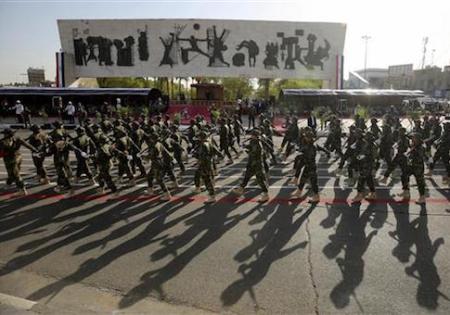
pmfIraqi government-backed Popular Mobilization forces take part in a joint military parade with Iraqi security forces in Baghdad / AP

“There are militiamen, Sunni, Shias, and Christians who are not part of the Iranian-backed network in Iraq and are not necessarily amenable to Tehran’s influence,” he said. “However, these are dwarfed, out-financed, and out-gunned by the IRGC-backed militias, who promote the brand of Islamic identity as espoused by the IRGC, and openly display ideological loyalty to the velayat-e faghih (the Islamic Republic’s founding ideology) and Iran’s supreme leader.”

*****************************

The United States military is facing accusations that it has been training Iraqi militia fighters who are tied to Iran, a charge that military officials who spoke to the Washington Free Beacon denied this week while insisting that the United States and Iran share common goals in the war-torn country, as both sides fight to eradicate the threat of Islamic State terrorists.

The latest charge that the United States may be directly involved in the training of Iranian-backed militia fighters has reignited concerns that America is becoming too cozy with Iranian interests operating in Iraq, an issue that highlights the difficultly facing U.S forces as they seek to counter the influence of ISIS.

Video recently emerged of U.S. military advisers training Iraqi militia fighters in Makhmur. Some foreign policy observers assessed that these militia fighters may have ties to Iran, which controls an increasing number of Iraqi militia fighters taking on ISIS.

The charge was picked up this week in a lengthy Los Angeles Times exposé claiming, “The U.S. is helping train Iraqi militias historically tied to Iran.”

Senior military sources who spoke to the Free Beacon denied the United States is directly working with Iranian forces, but acknowledged the United States and Iran do share similar goals in Iraq when it comes to combatting the threat of ISIS.

“In Iraq, with regards to ISIL, our interests and Iranian interests have some convergence,” said one senior military official who spoke to the Free Beacon on background, using another acronym for the Islamic State.

Iranian influence over militias in Iraq continues to be a challenge for the United States, which is barred by law from working with any such group. Foreign policy insiders who spoke to the Free Beacon about the issue warned that U.S. intervention against ISIS in Iraq is serving to bolster and legitimize Iran’s regional influence.

During last spring’s campaign in Fallujah, the U.S. provided air cover to Iraqi fighters, some of whom came from militias tied to Iran. Iranian media reported that some of the fighters belonged to Iran’s state-controlled militia.

“The forces that the LA Times observed in that story are not affiliated with Iran,” Col. John Dorrian, a spokesman for the U.S. Joint Task Force operating in Iraq, told the Free Beacon. “They are approved as hold forces ‎for terrain that has been liberated by the Iraqi Security Forces. They are being trained by coalition forces. They are local forces, and they represent diverse ethnic and sectarian backgrounds. The local tie is a key element in their acceptance by the population they are going to keep secure.”

Dorrian added that the headline on the LA Times article discussing the training of these militias “is very misleading.”

“There’s a lot of good information ‎in the article but the Iranian tie is nonexistent,” Dorrian said. “The Government of Iraq has enrolled these forces as Popular mobilization forces. I think LAT conflated that fact with Iran. Despite my telling them there’s no tie, they went with that headline.”

Multiple other military officials, Obama administration sources, and outside experts familiar with the matter told the Free Beacon that the militia fighters depicted in recent videos have no ties to Iran.

However, they said the United States and Iran share common goals in Iraq, where the threat of ISIS has sparked sectarian battles and endangered the Western-backed government.

A State Department official authorized only to speak on background told the Free Beacon that the United States does not train any Iranian-tied fighters, even if they are officially backed by the Iraqi government.

“The U.S. provides support to the Iraqi Security Forces, and those aligned with the Iraqi government,” the official said. “The U.S. does not, and will not, provide direct support to any group proscribed by American law, or which does not operate under the aegis of the Iraqi government.”

Much of Iraq’s Popular Mobilization Forces, or PMFs, are comprised of Shia Muslim fighters, many of whom are ideologically aligned with Iran’s hardline regime.

Maj. Adrian J.T. Rankine-Galloway, a Defense Department official, confirmed to the Free Beacon that some Iraqi units have been barred from receiving U.S. training due to their inability to pass background checks.

“Some Iraqi units have been restricted from receiving assistance because their commander didn’t pass vetting,” Rankine-Galloway said. “Because that quarterly report is classified, we cannot release which units were disqualified from receiving ITEF assistance.”

Rankine-Galloway further maintained that the United States has not changed its policy with regards to training in Iraq.

“U.S. government support to the counter-ISIL campaign remains by, with, and through the central Government of Iraq—and only to forces under the command and control of the Iraqi Security Forces,” Rankine-Galloway said. “Department of Defense policies on the provision of military assistance to foreign military forces have not changed. Iraqi Security Forces units who receive Iraq Train and Equip Fund assistance are strictly vetted” for ties to terror groups and the government of Iran.

Critics of the Obama administration’s policy in Iraq charge that even if the forces are not directly under the Iranian government’s orders, they are influenced by its senior military leaders.

“For proof the Obama administration treats our enemies like friends, look no further than their efforts to train armed militias loyal to Qassem Soleimani, commander of the IRGC-Qods Forces, in Makhmur,” said one senior congressional aide who works on the matter. “Incoming national security adviser Michael Flynn knows intimately what Iran is capable of, so it’s hoped that he and the Trump administration will reverse this disgrace.”

Amir Toumaj, an Iran analyst at the Foundation for Defense of Democracies, said that militia fighters tied to Iran far outnumber other fighters in Iraq.

“There are militiamen, Sunni, Shias, and Christians who are not part of the Iranian-backed network in Iraq and are not necessarily amenable to Tehran’s influence,” he said. “However, these are dwarfed, out-financed, and out-gunned by the IRGC-backed militias, who promote the brand of Islamic identity as espoused by the IRGC, and openly display ideological loyalty to the velayat-e faghih (the Islamic Republic’s founding ideology) and Iran’s supreme leader.”

“Key leaders” in the PMF “are beholden to Qassem Soleimani,” a top Iranian military leader, Toumaj said. “For example, the PMF operations commander is Abu Mahdi al Muhandis, Iran’s number one man in Iraq who has been designated as a terrorist by the U.S. Treasury and has overseen lethal attacks against U.S. soldiers during the occupation of Iraq. Iraqi militia and party leaders openly travel to Iran, and have received royal treatment, such as Akram al Kabi, head of Harakat al Nujaba, or the Movement of the Noble. The group under his command has committed war crimes and summary executions of women and children in east Aleppo this past week, according to the U.N.”

“The law legalizing the PMF has been welcomed in Iran. When Supreme Leader Ali Khamenei this past week received Ammar Hakim, head of the National Alliance Shia party that helped passed that bill, he called the PMF a ‘great wealth’ for Iraq that should be ‘supported and consolidated.’”

“The current U.S. policy of defeating the Islamic State above all else is empowering the IRGC-backed network, which has worked to infiltrate the Iraqi government and cement itself into a part of the state and establish an Iraqi version of the IRGC, crystallized in the PMF,” Toumaj said.

Jihadi Children Return to Europe: ‘Purer’ Than Adult Fighters

December 11, 2016

Jihadi Children Return to Europe: ‘Purer’ Than Adult Fighters, Clarion Project, Leslie Shaw, December 11, 2016

isis-kids-640-320_0Photo: Islamic State propaganda video)

The problem is that there is no plan on how to deal with these children whose indoctrination began at birth with inculcation of Islamic doctrine and memorization of passages from the Koran. They are seen as purer than adult fighters because they have never been exposed to secular values and therefore have a superior understanding of Islam.

*********************

The projected defeat of Islamic State (ISIS/ISIL) in Syria may prove to be a Pyrrhic victory for Europe given that it will result in the return of combatants trained to carry out attacks on the home front.

An ancillary issue is the repatriation of children who either travelled to Syria alone or with their parents, or who were born there. They are a key component in Islamic State’s strategy to develop the next generation of jihadists.

In May 2016, Patrick Calvar, head of French national security, revealed that around 400 French minors were present in the combat zone. Two-thirds of these had travelled there with their parents and one-third were born there and are now under the age of four. One five-year-old girl was abandoned in Syria following the death of her father, Eddy Leroux, who had left France with his wife and four children in August 2014 to wage jihad in Syria.

He was killed a year later and his wife returned to France with three of their children, leaving the youngest in the hands of Islamic State. The mother was jailed in France for abandoning and endangering the child.

Islamic State propaganda videos show these children wearing balaclavas engaged in military training: hand-to-hand combat, body-building, shooting with assault weapons, hostage-taking and suicide bombing. They are slapped and beaten with sticks by adults to desensitize them to violence.  In some cases they carry out executions of prisoners by shooting, beheading and detonation of explosives.

For the children who return to France, reintegration will not be easy. What should be done with a child who has carried out an execution?

Calvar says these offspring of jihad have been raised to hate Western values and are potential time-bombs. “They have been trained and instrumentalized by Islamic State.“

The problem is that there is no plan on how to deal with these children whose indoctrination began at birth with inculcation of Islamic doctrine and memorization of passages from the Koran. They are seen as purer than adult fighters because they have never been exposed to secular values and therefore have a superior understanding of Islam.

Intelligence and psychology experts reckon that it will take a generation to bring them back to normality.

Making Sense of the Mess in Syria

December 6, 2016

Making Sense of the Mess in Syria, Front Page MagazineAri Lieberman, December 6, 2016

syriamess

The vacillating and pusillanimous policies pursued by the Obama administration have enabled the Russians and Iranians to fill the void. Meanwhile, as Syria’s death toll nears 500,000 and its migrants – some with radical Islamic connections – continue to stream into Europe, it is clear that the nation state of Syria, Balkanized after five years of brutal conflict, is no more.

***********************

On July 30, 1970 a squadron of Israeli air force F-4E Phantoms and Mirages laden with bombs and missiles took off from their airbase in Sinai and flew westward toward Egypt. Their target was an Egyptian radar station.

The action occurred during the height of the War of Attrition between Israel and Egypt. The Egyptians were faring badly and their armed forces had suffered a series of public humiliations at the hands of the Israel Defense Forces. As a consequence, the Soviets stepped into the fray to save their client state and deployed 10,000 military personal and technical experts to the theater. The Soviets also assumed full control of Egypt’s air defenses. Surface-to-air missile batteries were manned by Soviet personnel and Soviet piloted MiG 21Js – the Soviet Union’s latest MiG-21 variant – patrolled Egyptian airspace. A direct clash between the Soviet Union and Israel was inevitable.

As the Israeli fighters zeroed in on their target, 16 Soviet MiGs moved in to intercept. In the melee that followed, five MiGs were shot down for no Israeli losses. The remaining 11 MiGs beat a hasty retreat. The Soviets were simply no match for the seasoned Israeli pilots.

The clash brought regional tensions – already heightened after one year of near constant border clashes – to a boiling point but neither side wanted an escalation. A ceasefire was eventually brokered by the superpowers and tensions deescalated.

Russia’s present military deployment in Syria is not dissimilar to its deployment in Egypt 46 years ago but the chances of an Israeli-Russian aerial clash today is virtually nil. There are some salient differences between the two circumstances. Israel and Russia are no longer bitter enemies and currently maintain cordial relations. Lines of communications between the two nations are good. Potential misunderstandings – to the extent that any exist – are channeled through liaisons to prevent accidental confrontations.

But war can best be summed up as organized chaos and given the clutter over the skies of Syria, with Russian, Israeli, Turkish and Coalition aircraft all operating within the confines of a limited space, mishaps are certainly possible. The Russians maintain formidable air defenses in Syria and Israel views them warily.

Underscoring this, last week IAF fighter jets launched two strikes in Syria, one targeting ISIS, in which four ISIS terrorists were killed and the second, targeting a Hezbollah weapons convoy and a Syrian military compound just outside Damascus. Though the Israelis have understandably remained moot on the specifics of the latter attack, according to published sources, Israeli fighters launched a number of Israeli made Popeye air-to-surface missiles from Lebanese airspace at a facility housing elements of Syria’s 4th Armored Division as well as a Hezbollah-bound weapons convoy traveling along the Beirut-Damascus highway.

Israel cognizant of Russia’s S-400 and S-300 air defense platforms in Syria opted to circumvent the possibility of an accidental confrontation by launching its attack from Lebanese airspace. It should be noted that the S-400s were deployed by the Russians last year following the downing of a Russian Su-24 by a Turkish F-16. The move was meant to serve as a deterrent to Turkey and no hostile intent was directed at Israel. Additionally, the term “Lebanese airspace” is a rather generous term that implies that Lebanon is a fully sovereign nation. In reality, Lebanon is sovereign in name only, having been swallowed whole by Hezbollah, Iran’s genocidal Shia proxy.

Israel’s interest in Syria is limited to ensuring that game-changing weapons of strategic import don’t fall into the hands of Hezbollah. Thus, on several occasions, Israeli fighter jets have launched successful interdicting operations aimed at destroying sophisticated weaponry – including SA-22 anti-aircraft missiles, Scud D ballistic missiles and Yakhont cruise missiles – clandestinely shipped from Iran via Syria.

A secondary goal is to ensure that border areas remain free of Hezbollah, Iranian and ISIS influence. In January 2015, an Israeli airstrike liquidated 12 senior Hezbollah and Iranian Revolutionary Guard Corps operatives, including an IRGC general, who were reconnoitering the border near Israel’s Golan Heights for future operations against the Jewish State.

Russia, which has a much broader interest in Syria, understands Israel’s concerns and has no interest in needlessly antagonizing the Israelis. Syria has been under Soviet and now Russia’s sphere of influence since the early 1950s and Russia is intent on maintaining its air and naval bases in Syria. To that end, it is keen on maintaining Assad’s hold on power, or for that matter, any Assad replacement that commits to friendly relations with Moscow and continued Russian military presence.

Russia is also looking to project military power and reassert its role as a superpower. The high profile deployment of a sizable Russian fleet in the Eastern Mediterranean, which includes the Russian aircraft carrier and Cold War relic, Admiral Kuznetsov, represents part of this strategy. However, it appears that the Kuznetsov has been a bit of an embarrassment for Putin.

On November 14, a carrier-based MiG-29K crashed while attempting a failed landing on the Kuznetsov. The carrier was encountering problems with its arrestor cables and the MiG crashed while circling and waiting for repairs. Just three weeks later, a Russian Navy Su-33 encountered a similar fate while attempting a landing on the Kuznetsov. Recent Satellite imagery taken of the Russian air base at Khmeimim, near Latakia, shows rows of Su-33 and MiG-29K carrier-based aircraft parked alongside Russian land-based fighter jets indicating that the Russians have given up on the notion of launching strikes from the Kuznetsov.

While the Israelis and Russians maintain clear strategies and objectives for Syria, under Obama, the U.S. strategy in Syria can best be described as befuddled and lacking any clear direction. The U.S. had initially called for Assad’s unconditional departure but seems to have backed away from that position and now calls for an orderly transition of power, seemingly giving Assad some wiggle room.

Obama had threatened to use military force if Assad employed poison gas against his own people but back peddled on that position as well. In late 2015 it was revealed that the Obama administration spent an astonishing $500 million to train four or five Free Syrian Army rebels, clearly demonstrating that Obama’s policy on Syria represents nothing short of a farcical tragic comedy.

The Obama administration had initially ignored the ISIS menace and its current pinprick military campaign against the terror group is utilizing but a fraction of America’s military strength. Finally, while the Obama administration has publicly sought to end Syria’s civil war peacefully, its transfer of billions in cash to the Islamic Republic has only served to fuel the fire. There is no doubt that this cash has been utilized to pay the salaries of Iran’s mercenary forces in Syria, Lebanon, Yemen and Iraq.

The vacillating and pusillanimous policies pursued by the Obama administration have enabled the Russians and Iranians to fill the void. Meanwhile, as Syria’s death toll nears 500,000 and its migrants – some with radical Islamic connections – continue to stream into Europe, it is clear that the nation state of Syria, Balkanized after five years of brutal conflict, is no more.

Mosul offensive folds, waiting now for Trump

December 5, 2016

Mosul offensive folds, waiting now for Trump, DEBKAfile, December 5, 2016

qayyarah_iraqi_forces_12-16

Altogether 54,000 Iraqi troops and 5,000 US servicemen – supported by 90 warplanes and 150 heavy artillery pieces – were invested in the Mosul campaign when it was launched in October. They proved unable to beat 9,000 jihadists.

Aware of the crisis on the Mosul front, the Pentagon has drawn up plans for sending out US reinforcements in the hope of turning the tide of the stalled battle. Those plans repose in their pending trays to await the decisions of the incoming US President Donald Trump and the new Defense Secretary Gen. James Mattis.

********************

The failure of the US-backed Iraqi army offensive to liberate Mosul – nine weeks after it began – could no longer be denied when a delegation of ISIS chiefs arrived there Sunday, Dec. 4, traveling unhindered from Raqqa, Syria.

DEBKAfile’s military and intelligence sources report that they arrived to discuss how to synchronize the operations of the two jihadist strongholds, after the Islamist leaders occupying Mosul changed course about leaving the city and decided to stay put.

This decision followed their assessment that the Iraqi army and its American backers were incapable of bringing their offensive to a successful conclusion. It was also evident in Washington that the US commanders in the field would not be able to meet Barack Obama’s presidential directive to capture Mosul by the end of December, so that he could exit the White House next month with a successful Mosul campaign behind hm.

Altogether 54,000 Iraqi troops and 5,000 US servicemen – supported by 90 warplanes and 150 heavy artillery pieces – were invested in the Mosul campaign when it was launched in October. They proved unable to beat 9,000 jihadists.

Iraqi forces have gained no more than one-tenth of the territory assigned them. This lack of progress has damped their initial impetus and sapped their morale. While Baghdad keeps on pumping out reports of good progress and new fronts opening up, the Iraqi army has come to a virtual standstill and does nothing more than exchange fire with ISIS fighters.

The first sign that ISIS had reversed its tactics and decided to hold out against the Iraqi assault came in the form of a slickly-produced video released by the jihadists on Dec. 27 to display their defenses inside Mosul. It showed commando units in battle formation, sniper positions in place, bomb cars parked at key points and well-barricaded streets. In the terrain from which they pulled back, they had strewn shells and rockets loaded with poisonous chemicals as a warning message to Iraqi troops that they would storm the city at their peril.

Our sources report meanwhile that some of the ISIS fighters who quit Mosul in the early stage of the Iraqi offensive are turning back, along with some of the administration officials.

The Kurdish Peshmerga, which three weeks ago turned their backs on the campaign, now realize they will have to live with ISIS as a dangerous next-door neighbor, after all. They are bending their energies to establishing a strong line of defense against Mosul, to secure their capital Irbil and other towns of the semiautonomous Kurdish Republic of Iraq.

Aware of the crisis on the Mosul front, the Pentagon has drawn up plans for sending out US reinforcements in the hope of turning the tide of the stalled battle. Those plans repose in their pending trays to await the decisions of the incoming US President Donald Trump and the new Defense Secretary Gen. James Mattis.

Green Berets in Islamic State fight frustrated with top brass micromanagement

December 5, 2016

Green Berets in Islamic State fight frustrated with top brass micromanagement, Washington Times

(Perhaps the new Secretary of Defense will do something useful. — DM)

124_2016_berets8201_c0-0-3488-2033_s885x516Colonel Kevin C. Leahy is receptive to the complaints of his soldiers about the command structure’s micromanagement, but said he allows his forces to figure out how to do the job. (U.S. Army)

The secretive teams of Green Berets guiding rebels in northeast Syria have expressed frustration with the amount of micromanagement they receive from a top-heavy headquarters in Iraq and the United States.

Special Forces sources tell of support staff watching the free-spirited Green Berets on reconnaissance aircraft and then criticizing their performance as they conduct the mission officially described as “train, advise and assist” the multi-ethnic Syrian Democratic Forces. The Americans and SDF are fighting their way toward Raqqa, the Islamic State terrorist army’s home base in Syria. Some of the “assisting” has drawn the Americans into firefights.

One officer chalked up the complaints to the sensitive political situation of U.S. troops on the ground in a chaotic country amid competing groups of Arab, Kurdish and Turkish forces, all converging with different objectives. The Green Berets, known officially as Army Special Forces, must act under strict combat rules after President Obama approved their insertion one year ago.

“Based on the very high-level approval required to conduct operations, it can be extremely frustrating for the teams,” the officer told The Washington Times. “We just don’t have the latitude we had during our years in Iraq, and that can be frustrating for the teams. The progress over the last year has been slow. Each team may not see it during their rotation, but cumulatively we’ve made significant progress against Daesh while maintaining relationships with Turkey and Jordan. In my many years in Special Forces, I’ve never been involved with a more complex mission.”

The Islamic State is also called Daesh, ISIL and ISIS.

The officer said that any foreign assistance operation governed by Section 1209 of the annual National Defense Authorization Act, as is Syria, “comes with lots of rules and scrutiny from Congress and the Defense Department, so we had to be very deliberate on how we execute this program.”

A second Special Forces source told of Green Berets in Syria being criticized for not immediately answering a phone call from overseers in Iraq. Others get critiqued back at their forward operating base in Syria after supervisors watched their actions on surveillance drones.

Said the source: “They sometimes take risk and do stuff, and when they get back to camp, they get a phone call. ‘What the [expletive] were you doing?’”

Pentagon press officials have provided scant information on operations by Green Berets in Syria.

The second Special Forces source told The Times of a recent incident: A group of Green Berets and their partner rebels were taking sporadic long-range fire. Tired of waiting for permission to return fire, they killed the sniper. That, in turn, brought more fire from Islamic State fighters. The Americans found themselves in a firefight and then evaded the enemy.

“Why even have the guys out there?” the second Special Forces source said. “It’s literally that they are watching you and watching you, and they’ll call you, and if you don’t answer — it’s kind of like having parents. As an organization, we have become incredibly risk-averse.”

The second source said the number of watchers versus the number of Green Berets in Syria is 50-50.

“For every guy you’ve got on the ground there, there’s some staff guy that hasn’t ever deployed,” the source said. “Or some colonel who wants to be involved, and he’s the assist to the assistant to the assistant.”

The first Green Berets to go into Syria were from the 5th Special Forces Group, based at Fort Campbell, Kentucky. The 5th Group is the go-to Green Beret unit for fighting radical Islam in the Middle East and North Africa. They were the first to enter Afghanistan, and rode horseback over rocky terrain with allied Afghans.

This source said that many Special Forces soldiers believe the entire cadre has become more careerist as the war on terror continues in its second decade. “Too many officers worried about promotions,” the source said.

‘Careerism and compromise’

The Washington Times asked Col. Kevin C. Leahy, 5th Group commander, about his soldiers’ complaints.

“No one knows how to work with rebels better than our Green Berets,” Col. Leahy said in an email. “We provide lots of latitude on how guys work with various groups. Of course to accomplish goals we have to tell them what we want done, but we let them figure out how to do it. I can only discuss Syria, but can firmly say I and my subordinate leaders do not micromanage.”

He added: “They are right on top-heavy. There is a sizable amount of people required to provide intel, fires, logistics and vetting of rebels/groups, liaison with host nation partners, U.S. country teams, etc. The teams really are the tip of an inverse triangle of support/Hq needed to enable the mission. Unfortunately, whether you have one team or ten in the field, you still need all of the support.”

Rep. Ryan K. Zinke, Montana Republican, is Congress’ lone former Navy SEAL. The retired commander says part of the problem with the Syrian troop mission is that commandos do not have sufficient firepower support if they get pinned down.

“I can tell you with zero doubt about the level of frustration from our forward deployed troops because they feel like they are micromanaged,” he said. “They feel like they don’t have the appropriate decision authority to make decisions and, even in contact, if you have a supporting asset, that supporting asset doesn’t have the authority to target opposition forces without going through a series of assessments by an armchair quarterback.”

A belief by some Green Berets that careerism has overtaken the officer corps was bolstered by a Special Forces soldier fighting in Kunduz, Afghanistan, on the night an AC-130 gunship mistakenly pummeled a Doctors Without Borders trauma center.

This soldier’s Operation Detachment Alpha (ODA) was assigned the task of fighting with Afghan security forces to repel a flash Taliban invasion.

In his sworn statement to investigators, the Special Forces veteran said: “There is a fine line between not conducting operations to keep people out of harm’s way and not conducting operations in such a fashion that it actually increases overall risk to force and risk to mission.”

He said the special operations commanders back in Kabul abandoned the “A-Team.”

“When an ODA’s mission runs headlong into national strategy, and the detachment asks for guidance on the level of commitment and receives nothing back over a 96-hour period, that’s an abject failure of leadership,” the Green Beret said.

When the team asked Kabul for guidance, the response was, “How far do you want to go?”

Said the Green Beret in his statement: “It’s not a strategy, and in fact it’s a recipe for disaster in that kinetic of an environment. How have we, as a force, as a group of officers, become so lost from the good lessons that our mentors taught us? I will tell you how. It is a decrepit state that grows out of the expansion of moral cowardice, careerism and compromise devoid of principle, exchanged for cheap personal gain.”

Top Muslim University Rejects Reform, Stands by ‘Terrorist Curriculum

December 1, 2016

Top Muslim University Rejects Reform, Stands by ‘Terrorist Curriculum, Front Page MagazineRaymond Ibrahim, December 1, 2016

(Don’t they understand that Islam is the “religion of peace and tolerance?” Perhaps President Obama and Pope Francis, both prominent theologians, should point our their errors. — DM)

rd-1

Much of the curriculum of Al Azhar—the Islamic world’s most prestigious university, located in Cairo—is based on Islamic books written in the medieval era or earlier.  These books—histories, biographies of Muhammad, hadith (words and deeds of the latter), tafsirs (Koran exegeses), etc.—are often criticized by more reform-minded Muslims for being too backwards,, teaching things such as unrelenting jihad and hatred for non-Muslims.

During a recent televised interview, Sheikh Ahmed al-Tayeb, Egypt’s highest authority on Islam and Grand Imam of Al Azhar, was asked about his university’s reliance on these books.  His responses left many reformers disappointed.

Tayeb insisted that all books used by Al Azhar are fine: “Our heritage books are innocent and being abused by those ignorant or indecent among us—and that’s all they can be: either ignorant or indecent.”

Settling the question in such black and white terms completely overlooks the fact that many of these books are indeed loaded with problematic teachings.  It is from these books—in this case, one of the histories of the prophet—that ISIS justifies burning people alive.

He continued his apologia: “Some say, do away with the other, ancillary books of Al Azhar.  Okay, but then how can I understand the Koran and Sunna?”  He explained that if Al Azhar got rid of the other books, every Muslim would be free to interpret the Koran any which way they want—claiming that that’s what ISIS does.  Tayeb even attacked using one’s brain, or reason, to understand the Koran, claiming again that that is what ISIS does.

This was another strange assertion: it is ISIS that most criticizes the free use of the brain, and insists on slavishly following the teachings of those ancillary books—which teach anything from eating the flesh of infidel captives to selling women and children on slave markets.

But the most telling portion of the interview came when Al Azhar’s Grand Imam said:

When they [reformers] say that Al Azhar must change the religious discourse, change the religious discourse, this too is, I mean, I don’t know—a new windmill that just appeared, this “change religious discourse”—what change religious discourse?  Al Azhar doesn’t change religious discourse—Al Azhar proclaims the true religious discourse, which we learned from our elders.

As all Egyptians know, the one man that made the phrase “change religious discourse” famous is President Sisi.  He too has publicly called on Al Azhar to reconsider its usage of ancillary books—most notably on New Year’s Day, 2015—in an effort to change the international image of Islam, from one of war and enmity, to something more tolerant.

Now the highest Muslim authority in Egypt has made clear that Al Azhar never had any intention of changing anything, that the “religious discourse” articulated in the Medieval era—one of hostility and violence for the other, in a word, jihad—is the only “discourse” Muslims can accept.

Anything else is apparently quixotic—“tilting at windmills.”

The Houris: Islam’s ‘Sexual Superwomen’

November 25, 2016

The Houris: Islam’s ‘Sexual Superwomen’, Front Page MagazineRaymond Ibrahim,November 24, 2016

houthis

Western secular minds would do well to stop projecting their own materialistic paradigms onto jihadis—such as when the Obama administration said that people join ISIS for “a lack of opportunity for jobs”— and start understanding Islam’s motivations on its own terms.

**************************

Last month, when the battle for Mosul began, Islamic State “caliph” Abu Bakr al-Baghdadi reportedly promised four extra Houris (supernatural, celestial women designed for sexual purposes)—atop the other 72 promised by prophet Muhammad—to all jihadis who die (are “martyred”) fighting the infidel forces, according to Arabic media accounts.

Al-Baghdadi did this during an extra “fiery sermon” wherein he recounted 15 hadiths and three stories dealing with the Houris in the context of the original Muslim conquest of Mosul, circa. 637, at the hands of Muhammad’s companions (the sahahba).  After promising his followers that “blood will run like rivers in the battle,” al-Baghdadi added: “All, without exception, will enter paradise as martyrs.  Moreover, you will enter paradise with four more Houris than other martyrs.  For just as you stand by me now, so will they stand by you, or under you, or above you, so that you might forget what will happen to you by way of violence, death, and degradation in this war.”

While it is easy to dismiss this report as a hoax (among other things, it doesn’t explain why al-Baghdadi thinks they will get four more heavenly concubines), the problem is that Islam—from its history and doctrines, to the exhortation of its leaders, from Muhammad to al-Baghdadi—is full of stories and enticements concerning the Houris.

Here, for instance, is an authentic hadith—a statement attributed to Muhammad that mainstream Islam acknowledges as true—which all jihadi organizations (including ISIS) regularly invoke:

The martyr is special to Allah. He is forgiven from the first drop of blood [that he sheds]. He sees his throne in paradise…. He will wed the Houris [[a.k.a. “voluptuous women”] and will not know the torments of the grave and safeguards against the greater horror [hell]. Fixed atop his head will be a crown of honor, a ruby that is greater than the world and all it contains. And he will copulate with seventy-two Houris.   (Source: The Al Qaeda Reader, p.143).

The histories of the conquest of Mesopotamia and Syria are in fact full of anecdotes of Muslims throwing themselves into the fray and rushing to death because they believed doing so would rush them to the warm embraces of the divine sex slaves.  Here are some anecdotes from al-Waqidi’s account of the battle of Yarmuk in Syria (636), which took place right around the same time as the conquest for Mosul, and which also pitted smaller Muslim forces against much greater infidel (in this case, Christian Byzantine) forces:

As one Muslim captain searched for his nephew, Suwayed, in a field of Muslim corpses, he found him dying on the ground.   When the man came into the vision of the fallen youth, Suwayed began to cry.  He explained that, after being speared by a Byzantine, “something amazing began to happen to me: the Houris are standing beside me, awaiting my soul’s departure.”  Another Muslim reported that he came upon a fallen comrade in a strange posture: “I saw him smitten on the ground, and I watched as he lifted his fingers to the sky. I understood he was rejoicing, for he saw the Houris.”   While waving his standard, another Muslim battalion leader told his men that a furious rush against the “Christian dogs” is synonymous with a “rush to the embraces of the Houris.”

As usual, obsession over Houris is not limited to arcane Islamic texts or ISIS (“which has nothing to do with Islam”).  Over the years I have watched numerous videos of Muslim men—mostly jihadis—discussing their excitement at the prospect of dying in the jihad and being rushed to the embraces of the supernatural celestial women.  For an idea of how pervasive the Houri is in Islam, consider its impact on Muslim women, as demonstrated in a video of a Muslim cleric taking and answering questions via phone calls.  A woman called in expressing outrage at the Houris, saying that she would be driven “mad with jealousy” seeing her husband copulating with these supernaturally beautiful women all day.

The cleric responded telling her that “when you enter paradise, Allah will remove the jealousy from your heart.   And have no fear, for you will lord over the Houris and be their queen.”  Still apprehensive, the Muslim wife asked, “But must he have the Houris?”  Laughing, the cleric reassured her:  “Look, when you enter paradise, you will be more beautiful than the Houris—you will be their mistress.  Okay?  And, when you enter paradise Allah will remove any jealousy or concerns from your heart.”

All this is a reminder that the Muslim mindset and the motivations behind the jihad are many and multifaceted—and even include those that disbelieve in Allah and the afterlife altogether.  As such, Western secular minds would do well to stop projecting their own materialistic paradigms onto jihadis—such as when the Obama administration said that people join ISIS for “a lack of opportunity for jobs”—and start understanding Islam’s motivations on its own terms.

Brooklyn: Uber-driving Muslim Immigrant Plotted Times Square Truck Rampage

November 22, 2016

Brooklyn: Uber-driving Muslim Immigrant Plotted Times Square Truck Rampage, Creeping Sharia, November 22, 2016

mohammed_rafik_naji_1121

Source: ISIS-Inspired Brooklyn Resident Discussed Times Square Attack « CBS New York

A 37-year-old Brooklyn resident is facing terror charges after he allegedly expressed support for a truck attack in Times Square similar to one ISIS claimed responsibility for in Nice, France.

As CBS2’s Dick Brennan reported, the federal criminal complaint was issued Monday against Mohamed Rafik Naji, 37 – a citizen of Yemen, but a permanent legal resident of the U.S.

Naji was awoken and arrested at 3 a.m. Monday at his home in Brooklyn, authorities said. Cellphone video showed federal agents leading Naji from his apartment on Clarendon Road in Flatbush.

A witness who recorded his arrest reported that dozens of officers from at least five agents came to arrest Naji.

“He was arrested at 3 this morning and charged with material support of a terrorist organization, which you know, that’s what we do in New York now,” said Naji defense attorney Susan Kellman.

Naji appeared in U.S. District Court in Downtown Brooklyn for an initial hearing Tuesday afternoon.

READ THE FULL COMPLAINT

The Justice Department said Naji has been supporting ISIS or ISIL since 2014. Naji traveled to Turkey and Yemen between March 2015 and September 2015, according to the criminal complaint.

Kellman said her client had innocent and legitimate reasons to be in Yemen.

“According to the complaint, he traveled overseas to Yemen, which you know, is immediately suspect in the view of our government,” Kellman said. “Of course, the fact that he has family over there and three children didn’t seem to affect the government one way or the other, but he certainly had legitimate reasons to be over there.”

But when Naji returned, prosecutors said he expressed support for carrying out attacks in Times Square, similar to the one on Bastille Day in July in Nice, France that killed 86 people.

The complaint states Naji emailed his girlfriend, who allegedly wired him money on several occasions, about his efforts to join the terror group in Yemen. In one email Naji allegedly wrote (cq), “It’s very hard to get in I’m on my 5 try its difficult mad po po military and ppl here very scared inshallah I make it m keep trying if not m have to go from somewhere else.”

The complaint further spelled out a recorded conversation Naji had with a confidential informant in which he allegedly said: If there is a truck, I mean a garbage truck and one drives it there to Times-Square and crushes them shshshshshsh… Times-Square Day….They want an operation in Times-Square.”

Naji allegedly told the informant further: “They want an operation in Times-Square, reconnaissance group already put out a scene, the Islamic State already put up scenes of Times-Square.”

But in a later email, Naji said, “we can’t get in,” the complaint read.

Gov. Andrew Cuomo said the arrest is “a sharp reminder of the evolving threat of global terrorism.”

“New York must remain vigilant in the face of hate and intolerance, and continue to advance the core values of democracy that this state and nation were founded upon,” Cuomo said, adding there is no specific threat at this time.

Just last week, an online ISIS magazine described the upcoming Macy’s Thanksgiving Day Parade as “an excellent target” for a similar track attack. The NYPD is already planning a large security detail.

“It is a very large detail,” said NYPD Commissioner James O’Neill. “I think this year, you’re going to see a lot more block cars and sand trucks on the cross-streets.”

Authorities said Naji works as an Uber driver in Brooklyn.

Naji is also accused of trying to join ISIS in Yemen. On Monday night, neighbors in his apartment building say while they didn’t know Naji, they are still fearful.

“I think it’s crazy, honestly. It’s just crazy,” one woman said from behind her closed door. “I don’t what to say.”

Naji is charged with providing material support to a terror group. His attorney said they are trying to put together a bail package.


Clapper: US collects and analyzes more intelligence on jihadi groups now than ever

November 19, 2016

Clapper: US collects and analyzes more intelligence on jihadi groups now than ever, Long War Journal, November 17, 2016

(Collecting lots of intelligence is good; how it is analyzed, what is looked for and what’s done with the information are at least as important. Please see also, Clueless Clapper Calls It Quits – DM)

Director of National Intelligence (DNI) James Clapper announced his retirement during a hearing held by the House Permanent Select Committee on Intelligence (HPSCI) earlier today. In his written testimony, Clapper offered this assessment (emphasis added):

Violent extremism, which has been on an upward trajectory since the late 1970s, has generated more IC collection and analysis against groups, members, and safe havens than at any other point in history. These include: the Islamic State of Iraq and the Levant; al-Qa’ida with its nodes in Syria, Pakistan, Afghanistan, and Yemen; al-Shabaab, al-Qa’ida’s affiliate in East Africa; and Iran, the foremost state sponsor of terrorism, which continues to exert its influence in regional crises in the Middle East through the Islamic Revolutionary Guard Corps – Qods Force, its terrorist partner Lebanese Hizbollah, and proxy groups.

It is clear from his description that what Clapper describes as “violent extremism” is what we call jihadism. The Islamic State and al Qaeda are on the Sunni side of the jihadi coin, while the Shiite side is led by the Iranian regime.

What specifically stands out is Clapper’s testimony regarding al Qaeda’s “nodes.” Al Qaeda maintains a cohesive international network more than fifteen years after the Sept. 11, 2001 terrorist attacks.

In Syria and Yemen, these “nodes” are known as Jabhat Fath al Sham (formerly Al Nusrah Front) and Al Qaeda in the Arabian Peninsula (AQAP), both of which are regional al Qaeda branches devoted to waging insurgencies against the local governments and their allies. Likewise, Shabaab is headquartered in Somalia and is al Qaeda’s regional arm throughout East Africa. Al Qaeda in the Indian Subcontinent (AQIS) is the newest branch of the group, operating in Afghanistan, Pakistan and neighboring countries as well. To this list we can also add Al Qaeda in the Islamic Maghreb (AQIM), which maintains a footprint in North and West Africa. There are multiple other al Qaeda-linked groups as well.

In each case, the emir of the regional al Qaeda arm has been openly loyal to Ayman al Zawahiri. The only wrinkle is in the case of Jabhat Fath al Sham (JFS), which is led by Abu Muhammad al Julani.

In late July, Julani claimed that his group would no longer be affiliated with any “external” or “foreign” entity. His language was deliberately ambiguous, but many ran with the idea that JFS was no longer really part of the al Qaeda network. The Long War Journal offered an extensive rebuttal to that interpretation of Julani’s statement. Indeed, al Qaeda’s senior leadership never wanted to formally acknowledge the group’s presence in Syria, so Julani’s message was a return, of sorts, to al Qaeda’s original strategy for the war against Bashar al Assad’s regime. Julani did not renounce his bay’ah (oath of allegiance) to Zawahiri and Julani heaped praise on Zawahiri and Osama bin Laden even as he supposedly distanced his organization from them. Moreover, one of Zawahiri’s top deputies gave his blessing for Julani’s statement beforehand. Some break. [See FDD’s Long War Journal report, Analysis: Al Nusrah Front rebrands itself as Jabhat Fath Al Sham.]

Although the Islamic State generates most of the headlines these days, al Qaeda remains an international organization, albeit one that is not keen to advertise its presence in the same manner as Abu Bakr al Baghdadi’s enterprise.

Al Qaeda’s senior leadership is not confined to South Asia. It is well documented that the group sent cadres to Syria, Yemen and elsewhere to lead the charge. The Obama administration’s drone campaign has repeatedly targeted veteran al Qaeda figures throughout 2015 and 2016.

The al Qaeda threat to the West and the US homeland is not confined to South Asia either. In October, the Pentagon announced that the US carried out airstrikes targeting jihadists serving al Qaeda’s “external operations” arm in Afghanistan, Syria and Yemen. Testifying before the Senate Armed Services Committee in February, Clapper warned that the threat emanates from multiple countries. Clapper testified that al Qaeda “nodes in Syria, Pakistan, Afghanistan, and Turkey” are “dedicating resources to planning attacks.”

There is no question that the Islamic State expanded rapidly beginning in 2013 and 2014, thereby cutting into al Qaeda’s share of the jihadi market around the globe. But as Clapper reminded Congress today, al Qaeda is far from out of the game.

The HPSCI hearing was devoted to the US intelligence community’s role supporting the Defense Department. Clapper explained that the war in Afghanistan continues to demand resources.

“In addition, we must continue to provide intelligence to assist in the transition of our mission in Afghanistan by supporting the Kabul government against persistent hurdles to political stability including eroding political cohesion, assertions of authority by local powerbroker, recurring financial shortfalls, and countrywide, sustained attacks by the Taliban,” Clapper’s written testimony reads.

That transition is not going smoothly, to put it mildly. Al Qaeda remains closely allied with the Taliban and the Haqqani Network. Siraj Haqqani is now one of the Taliban’s top deputies. Zawahiri has announced his allegiance to Taliban emir Mullah Haibatullah Akhundzada. The US military and its partners are forced to hunt al Qaeda throughout much of Afghanistan, while also attempting to turn back the Taliban’s rising insurgency, which threatens several provincial capitals at once.

It is easy to see why the intelligence community is forced to collect and analyze more intelligence on jihadi groups now “than at any other point in history,” as Clapper testified. Sunni and Shiite jihadis are operating in more countries now than ever.

Unsolicited Advice for the Trump Transition Team on National Security Intelligence

November 10, 2016

Unsolicited Advice for the Trump Transition Team on National Security Intelligence, PJ Media, Andrew C. McCarthy, November 10, 2016

isis

It was encouraging Wednesday to hear that President Obama intends to emulate President Bush, who generously provided Obama with a highly informative and smooth transition process.

Running the Executive Branch is a daunting task, so there is no aspect of the transition to a new administration that is unimportant. But obviously, the most crucial focus for New Jersey Governor Chris Christie, who is heading up President-elect Donald Trump’s transition team, must be national security.

That transition is going to be more complicated than it should be, but there are things Gov. Christie can do – better to say, people he ought to consult — to make sure his team is getting accurate information.

The Bush National Security Council was very good about putting together briefing books so their successors could hit the ground running. The problem now, however, is the trustworthiness of what is in those books.

As PJ Media has reported, a highly disturbing report by a congressional task force this summer found that the Obama administration had politicized its intelligence product.

Rep. Mike Pompeo (R-KS), who has been stellar on national security issues and was among the leaders of the task force (comprised of the Intelligence, Armed Services, and Appropriations Committees), put it this way when the report was issued:

After months of investigation, this much is very clear: from the middle of 2014 to the middle of 2015, the United States Central Command’s most senior intelligence leaders manipulated the command’s intelligence products to downplay the threat from ISIS in Iraq.The result: consumers of those intelligence products were provided a consistently “rosy” view of U.S. operational success against ISIS. That may well have resulted in putting American troops at risk as policymakers relied on this intelligence when formulating policy and allocating resources for the fight.

The intelligence manipulation became a controversy in 2015, when 50 intelligence-community whistleblowers complained that their reports on the Islamic State and al-Qaeda terror networks were being altered.

The manipulation, driven by Obama’s Office of the Director of National Intelligence (ODNI) and carried out in the Defense Department by senior Central Command (CENTCOM) officers, aimed to downplay the jihadist threat.

This is a reckless practice I have written about several times over the last eight years (see, e.g., here). The Obama administration has made a concerted effort to miniaturize the terrorist threat in order to project a mirage of policy success.

Intelligence has routinely been distorted — portraying the networks as atomized, largely detached cells that are not unified by any overarching ideology — in an attempt to make them appear smaller and less threatening. Basically, a nuisance to be managed rather than an enemy to be defeated.

Even when the terrorists are on the march, the administration claims they are in retreat. Indeed, less than 24 hours after four Americans, including our ambassador to Libya, were killed by al-Qaeda-affiliated jihadists in the 2012 siege of Benghazi, President Obama stated this in a political fundraising speech:

A day after 9/11, we are reminded that a new tower rises above the New York skyline, but al-Qaeda is on the path to defeat and bin Laden is dead.

Intel manipulation ran rampant after Obama fired Marine General James Mattis, CENTCOM’s commander, in 2013. General Mattis had the irksome habits of demanding clear-eyed assessments of America’s enemies and forcing administration policymakers to confront the potential consequences of their ludicrously optimistic assumptions, particularly regarding Iran’s behavior. Obama officials replaced him with Army General Lloyd Austin.

Meanwhile, it was made clear to the Pentagon that because the president made campaign commitments to end the U.S. mission in Iraq, he did not want to hear information contradictory to his narrative that withdrawing our forces was the right thing to do. After retiring, Army General Anthony Tata confirmed that an ODNI official instructed the Defense Department not to put in writing assessments that portrayed al-Qaeda and ISIS as fortified and threatening.

The result, of course, was that the president was told what wanted to hear.

This eventually led to Obama’s infamous assertion that ISIS was merely a “JV” terrorist team. Naturally, when the JV team rampaging through Iraq and Syria rendered that judgment embarrassing, the White House shifted the blame to General Austin, pushing him out the CENTCOM door.

The administration has done more to sculpt the narrative than quell the enemy. So Gov. Christie and his team will need to regard with skepticism any briefing books Obama’s transition coordinators supply.

Of course, Team Trump already has a tremendous resource to rely on: retired Army General Michael Flynn, the former head of the Defense Intelligence Agency (and the author, along with PJ Media columnist Michael Ledeen, of The Field of Fight, which pleads for a desperately needed strategy for fighting the global war against jihadists and their allies). Like General Mattis, General Flynn (in 2014) was pushed out of his job because he rejected the politicization of our intelligence product for purposes of low-balling the terrorist threat. He knows his stuff, knows what we are up against, and will be a major asset not only to the transition, but to the Trump administration.

I would also respectfully suggest that Gov. Christie consult with General Mattis and General Jack Keane: smart, experienced former commanders who have given a great deal of thought to, and sound advice to Congress regarding, the current administration’s strategic and intelligence voids.

In understanding global jihadist networks — who the players are, how the organizations collude and compete — Tom Joscelyn, editor of The Long War Journal, is the best expert in the United States, bar none. While his value would be limitless, Tom is especially knowledgeable about the jihadists released from Guantanamo Bay, many of whom have gone back to the jihad.

Yet again, this is a context in which briefings from the Obama administration would be suspect. The president adheres to another narrative driven by foolish campaign promises, namely: the cost of Gitmo as a “recruiting tool” for the enemy outweighs the benefit of detaining committed, capable, anti-American jihadists. To justify both this absurd premise and the release of the terrorists, the administration watered down intelligence that supported holding the terrorists as enemy combatants who posed continuing danger to the United States.

The new administration needs accurate information for purposes of grasping the threat and formulating sound detention policy.

Finally, it is vital to understand “Countering Violent Extremism,” the Obama administration’s strategic guidance — their playbook for military, intelligence, and law-enforcement officials on how to approach and respond to terrorism. CVE is where the dereliction that I have labeled “willful blindness” has devolved into compulsory blindness.

Under CVE guidelines, the fact that Islamic-supremacist ideology spurs the jihadist threat and knits together terrorists and their sponsors is no longer just consciously avoided; taking notice of it is verboten.

The most thoroughgoing critique of this lunacy is Catastrophic Failure: Blindfolding America in the Face of Jihad. Its author is Stephen Coughlin, a trained military intelligence officer and an attorney who has made a point of learning how Islamic law principles inform the goals and tactics of our enemies. Steve is extraordinarily informed about the administration’s wayward assumptions. If the Trump transition team wants to check the premises on which their work is based, he’s the guy.

Let’s welcome President Obama’s assurances of a seamless transition to the Trump administration. But my best unsolicited advice to Gov. Christie: When it comes to briefing books, don’t believe everything you read.