Archive for the ‘Islamic State’ category

Iran’s advances create alarm in Saudi Arabia and the Gulf

March 14, 2015

Iran’s advances create alarm in Saudi Arabia and the Gulf, the Guardian,  March 13, 2015

Arabs believe Baghdad, Damascus, Beirut and Sana’a are in effect under Iranian control – and power may shift further if US sanctions are eased.

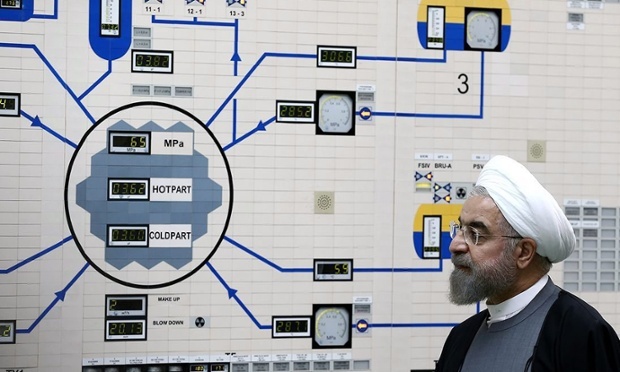
c0ac3569-93da-4ae8-8b51-29dc6991ee13-620x372 Hassan Rouhani, the Iranian president, visiting Bushehr nuclear power plant in southern Iran this year. Photograph: Presidential official handout/EPA

Iran’s great advantage, suggests Emile Hokayem, an analyst, is its commitment and competence, in Syria and beyond. “The expertise, experience and strategic patience it deployed in support of the Syrian regime to a great extent facilitated Assad’s recovery from serious setbacks in 2012. In contrast, the war in Syria has exposed not only the political and operational limitations of the Gulf states, but also the rivalries among them.”

*********************

The commanders of Iran’s Islamic Revolutionary Guard Corps (IRGC) have been working overtime recently, flaunting their achievements across the Middle East and flexing muscles as international negotiations over the country’s nuclear programme enter their critical and perhaps final phase.

On Wednesday it was the turn of Major-General Mohammad Ali Jafari, the IRGC’s most senior officer. “The Islamic revolution is advancing with good speed, its example being the ever-increasing export of the revolution,” he declared. “Not only Palestine and Lebanon acknowledge the influential role of the Islamic Republic but so do the people of Iraq and Syria. They appreciate the nation of Iran.”

Last month a similarly boastful message was delivered by General Qassem Suleimani, who leads the IRGC’s elite Quds force — and who is regularly photographed leading the fightback of Iraqi Shia miltias against the Sunni jihadis of the Islamic State (Isis) as well as against western and Arab-backed rebels fighting Bashar al-Assad in southern Syria. “Imperialists and Zionists have admitted defeat at the hands of the Islamic Republic and the resistance movement,” Suleimani said.

Iran’s advances are fuelling alarm in Saudi Arabia and the Gulf, where Tehran has been a strategic rival since the days of the Shah, and which now, it is said with dismay, in effect controls four Arab capitals – Baghdad, Damascus and Beirut and in the last month Sana’a in Yemen – which is uncomfortably close to home.

Iran’s regional position has certainly improved. Its high-profile role fighting Isis in Iraq, Assad’s retention of control in Syria with the help of its Lebanese ally Hezbollah, and the Houthi rebel takeover in Yemen have all been deeply discomfiting for the Saudis. Anti-government protests in Shia-majority Bahrain are also often blamed on Tehran — though that ignores the domestic roots of the unrest.

In Riyadh King Salman has dropped his preoccupation with the Muslim Brotherhood in favour of building a united Sunni Arab front to confront the Iranians, diplomats say, though translating that strategy into action is another matter. The message from Saudi Arabia and the United Arab Emirates is that whatever the outcome of the nuclear talks, Iran is bent on expanding its power and influence. “The Iranians have scored major victories but only where there are Shia minorities,” a senior Gulf official told the Guardian. “Our concern is that the nuclear issue will become a tool of their foreign policy.”

Arab alarm is shared by Israel. Binyamin Netanyahu used identical arguments in his recent speech to the US Congress, timed to influence next week’s nuclear endgame in Geneva. “The Saudis will be incredibly worried that we are getting close to a point where the Iranians will be players because of the nuclear issue and the way the Americans have effectively ended up on the same side as the Iranians in Iraq,” said one veteran Saudi-watcher. “But the noise they are making is in inverse proportion to their ability to do anything about it.”

Arab governments are not reassured by the promises of John Kerry, the US secretary of state, that Washington is not seeking a “grand bargain” with Tehran that will allow it to “destabilise” the Middle East, bolstered by the easing of economic sanctions. Saud Al Faisal, the Saudi foreign minister, warned of Tehran’s “hegemonic” ambitions as the IRGC supported the military operation to retake the Iraqi town of Tikrit from Isis. In Gulf capitals Hassan Rouhani, the emollient Iranian president, is seen as less important than the hardline supreme leader, Ayatollah Ali Khamenei.

It is hard to disentangle propaganda from reality. But independent analysts argue that Iran is inflating its gains for both foreign and domestic consumption. “If you listen to Suleimani there is a degree of exaggeration,” argues Ali Ansari of St Andrews University. “It’s rhetorical reassurance. He is saying to Iranians: ‘We are powerful and and everyone is worried about this’ – partly to make the point that they are not really under pressure. People outside can see what Iran’s strengths and weaknesses are. But there is this belief that you need to negotiate from a position of strength and that if you are weak you will be trampled on.”

Iran-watcher Hossein Rassam also detects a domestic calculation in the IRGC statements. “Critics of Rouhani’s policy of rapprochement with the international community inside Iran can turn to the supreme leader and say there wasn’t really much need for that softer tone because now we have more bargaining chips in our hands. Iran is the only power in the region which can actually fight Isis and the west needs us for that.”

Meir Litvak, an Israeli expert on Iran, sees both genuine belief and posturing in Tehran’s stance. “The Iranians believe they have been able to save the Assad regime from total collapse and there is at least stalemate in Syria,” he said. “That means they have been able to maintain the link with Hezbollah and maybe open a second front by proxy against Israel on the Golan Heights. The Houthi rebellion in Yemen was initially a genuinely domestic affair but the Iranian regime saw it as an opportunity. And it has become a bonus for it – even if they are not that active inYemen. But if the Saudis are scared that’s a plus for the Iranians.”

Arab diplomatic sources say they expect to see an IRGC and Hezbollah presence in Yemen, helped by a new agreement on regular flights between Tehran and Sana’a.

Iran’s role in Bahrain, where the Shia majority remains locked in confrontation with the Saudi-backed Sunni monarchy, is more about scoring propaganda points than material support – despite claims in Manama about Iran’s sinister role.

Still, in the heartlands of Iranian influence, Iraq and Syria, there have been significant costs as well as benefits, including the deaths of two senior IRGC commanders. Continuing sanctions and low oil prices – seen in Tehran as a deliberate strategy by the Saudis – have also made it harder to shell out billions of dollars to subsidise the Assad regime.

Iran’s great advantage, suggests Emile Hokayem, an analyst, is its commitment and competence, in Syria and beyond. “The expertise, experience and strategic patience it deployed in support of the Syrian regime to a great extent facilitated Assad’s recovery from serious setbacks in 2012. In contrast, the war in Syria has exposed not only the political and operational limitations of the Gulf states, but also the rivalries among them.”

IDF braces for Islamic State attack on Israel-Egypt border

March 13, 2015

IDF braces for Islamic State attack on Israel-Egypt border, Israel Hayom, Lilach Shoval and Daniel Siryoti, March 13, 2015

(Please see also IDF on alert for coordinated ISIS assault on Eilat or vicinity. — DM)
142623927595729064a_bSouthern Border Brigade Deputy Commander Col. Arik Hen | Photo credit: Yehuda Ben Itach

Ansar Bayt al-Maqdis released a video Thursday in which its operatives claim to have fired three rockets at the Eilat port last week. The group claimed it plans to fire up to 150 rockets daily at Egyptian security forces in Sinai and the Eilat port.

*********************

The Israel Defense Forces is said to be preparing for the possibility that one of the Sinai-based terrorist organizations affiliated with the Islamic State group will carry out a massive attack on the Israel-Egypt border.

It is believed that Ansar Bayt al-Maqdis, the largest Islamic State-affiliated jihadi group in Sinai, will attempt to target Egyptian security forces along Israel’s southern border using what has become its signature modus operandi — surprise attacks by dozens of terrorists on several targets simultaneously.

The military believes these terrorists will attempt to disguise themselves as smugglers, or perhaps even as Egyptian security forces, so they would be able to approach Israeli troops in the sector.

Earlier this week, Southern Border Brigade Deputy Commander Col. Arik Hen said the threat was a priority for the IDF, and that “it affects military readiness for various scenarios that may develop” near or on the border.

Meanwhile, the military is said to be outlining its defense of the Timna Airport, the new international airport currently under construction in southern Israel, which is expected to become operational in 2017.

As part of the planned defenses, a 30-kilometer fence is being designed to encompass the airport and adjacent area.

Ansar Bayt al-Maqdis released a video Thursday in which its operatives claim to have fired three rockets at the Eilat port last week. The group claimed it plans to fire up to 150 rockets daily at Egyptian security forces in Sinai and the Eilat port.

IDF on alert for coordinated ISIS assault on Eilat or vicinity

March 12, 2015

IDF on alert for coordinated ISIS assault on Eilat or vicinity

DEBKAfile March 12, 2015, 5:55 PM (IDT)


(Stay safe JW. – LS)

The commander of the IDF’s 80th Division, Col. Arik Hen, announced Thursday that the army is deployed ready to fend off a large-scale coordinated attack on Israel’s southernmost town of Eilat, which the Islamic State is believed to be planning with speedboats and aquatic motor bikes combined with an overland incursion and rocket bombardment from Egyptian Sinai. Israeli troops are also ranged on Route 12 north of Eilat and the civilian locales along the highway in case they too come under jihadi attack.

Col. Hen reported that hundreds of ISIS terrorists have gathered in Sinai, but there is not enough intelligence to keep track of all their plans and movements. DEBKAfile adds: The IDF has released this nformation as a warning because the Islamist terrorists may intend to strike during the eight-day Feast of Passover, when Eilat and southern Israel teem annually with holidaymakers and trippers.

It’s Not Just Islam, It’s the Tribal Mentality

March 12, 2015

It’s Not Just Islam, It’s the Tribal Mentality, Front Page Magazine, March 12, 2015

fft-450x253

Islam in part is the “theologizing” of the tribal mentality. Islam’s important innovation was to redefine the “tribe” as the whole umma of believers, creating in effect a “super tribe” that transcends mere blood as the bonding agent. But the tribal warrior ethos persists–– in the doctrine of jihad, tribal atrocities in contemporary terror and its gruesome videos, the privileging of men in polygamy, honor killings, and social restrictions on women, the disdain for the infidel “other” in the Koranic belief that Muslims are the “best of nations,” the betrayal of alliances in the religious sanction of lying to infidels (taqiyya), and the obsession with “honor” that today we find in violent Muslim reactions to “blasphemy” against Mohammed or the Koran.

Ignoring the tribal mentality is as dangerous for our foreign policy as downplaying Islamic doctrine.

The Obama administration’s serial appeasement of Iran––currently the “strongest tribe” spreading its influence throughout the region–– has damaged our prestige among allies like Jordan, Saudi Arabia, and Egypt, who are already shopping around for a more reliable and forceful partner. If we want to destroy the jihadists, check Iran’s nuclear ambitions, and protect our interests, we must again become the “strongest tribe.”

********************

The “nothing to do with Islam” mantra took a hit recently in one of the premier organs of liberal received wisdom, The Atlantic. Many have greeted as a revelation Graeme Wood’s article on the Islamic doctrines behind ISIS’s atrocities. Regular readers of FrontPage and Jihad Watch will not be as impressed. For years they have understood the link between jihadism and Islam. In 1994 Andy McCarthy made this connection when he prosecuted the perpetrators of the first World Trade Center bombing the previous year, a connection that the FBI ignored or discounted at the time––a failure, by the way, that has become a pernicious tradition for those charged with protecting our nation’s security and interests. For everyone else who has been paying attention to the rise of modern jihadism, Wood’s article is a dog bites man story.

One can hope that perhaps now, with the truth revealed by one of the Acela corridor’s oracles, the jihad deniers will wise up, though I wouldn’t bet on it. Unexamined opinions comprise the bulk of the progressive mind, and are notoriously resistant to empirical evidence and sound argument. But the current mess in the Middle East results from more than just Islam and its traditional belligerence, supremacist pretensions, and illiberal religious laws and doctrines. These characteristics reflect variations on the mentality of the tribe, one antithetical to modernity and the principles of liberal democracy, and still powerful in the Middle East, the region once described as “tribes with flags.”

For all the differences among tribal peoples, the components of this mentality are consistent, from the ancient Gauls and Germans Caesar conquered and the Vikings terrorizing much of Europe, to the American Indians the U.S. Cavalry fought and the jihadist gangs rampaging in the Middle East.

First, there is little notion of a common humanity that transcends ethnicity or culture. Universal principles are scarce, and personal identity is found solely in the collective customs and traditions of the tribe. Outsiders are to be distrusted, plundered, or conquered when possible. Loyalty is not to principle, but to blood. Most tribal peoples consider their tribe the acme of humanity, the only genuine humans. Hence their word for “human” is usually identical to the name of their tribe. They are literally ethnocentric.

Second, violence, particularly against outsiders, is an acceptable instrument for resolving conflict and asserting tribal superiority. Not just the violence of war, but also the cruel torture and slaughter of outsiders, including women and children, are legitimate for serving the interests of the tribe. Indeed, what we call terrorism was a tactic of tribal warfare to prevent a full-scale war by so terrorizing enemies that they would give up without a fight, a phenomenon common in the various Indian wars of American history. Hence the scary face-paint, tattoos, war cries, bizarre hairstyles, tortures like scalping, mutilation of enemies, or slaughter of their women and children, all of which are meant to frighten and demoralize the enemy. The same intent explains the blustering threats, braggadocio, and insults typical of tribal warfare and diplomacy. These practices can be documented in tribal societies from the Iroquois to the ancient Gauls.

Next, loyalty in tribal societies counts only for those within the tribe. Alliances with other tribes or peoples are ad hoc and contingent on the immediate interests of the tribe. They can be abandoned or betrayed if circumstances or perceptions change. Moreover, respect for others beyond the tribe is based solely on their capacity to inflict violence on their enemies. The “strongest tribe,” a status based on its effectiveness and success in conflict, will attract allies, who will abandon the hegemon once it loses that perception of its strength. Thus during Caesar’s wars in Gaul various Gallic and Germanic tribes would ally with the Romans when they appeared dominant, and betray them in an instant if they thought them weak. Likewise during the U.S. Cavalry’s wars against the Plains Indians, many tribes victimized by the Sioux or Apache or Cheyenne would ally with the Americans if they seemed to be winning, then switch sides the moment they seemed weak.

Finally, tribal societies are centered on the male warrior and his honor. Forget the Women’s Studies fantasies of matriarchal tribal societies. Tribal cultures privilege males, for men fight, and the survival and honor of the tribe depends on martial valor. Women bear children and work, as the skeletons of pre-contact American Indian remains demonstrate. Female bones show much more damage from hard physical labor than do male. This doesn’t mean that women had no status within the tribe, or did not enjoy somewhat more equality than women in more sophisticated civilizations. But warrior males still dominated, and culture in the main centered on men and their prowess in war, which earned honor, what we call prestige, for the whole tribe.

Sound familiar? It should, for Islam in part is the “theologizing” of the tribal mentality. Islam’s important innovation was to redefine the “tribe” as the whole umma of believers, creating in effect a “super tribe” that transcends mere blood as the bonding agent. But the tribal warrior ethos persists–– in the doctrine of jihad, tribal atrocities in contemporary terror and its gruesome videos, the privileging of men in polygamy, honor killings, and social restrictions on women, the disdain for the infidel “other” in the Koranic belief that Muslims are the “best of nations,” the betrayal of alliances in the religious sanction of lying to infidels (taqiyya), and the obsession with “honor” that today we find in violent Muslim reactions to “blasphemy” against Mohammed or the Koran.

Ignoring the tribal mentality is as dangerous for our foreign policy as downplaying Islamic doctrine. The chronic disorder in northern Iraq today is not just about the Sunni-Shi’a divide, or ISIS’s dream of a caliphate. It also reflects the bewildering number of tribes and clans in the region, whose complex alliances and enmities continually shift depending on circumstances and the perceptions of which tribe is the stronger. Our ally today can instantly become our enemy tomorrow. Factions that appear “moderate” today can become jihadist terrorists tomorrow. Our “friends” will tell us what we want to hear today, and then betray their words tomorrow. Most important, anything we do that creates the perception of weakness––especially concessions, or failure to inflict revenge, or acts of mercy––will also damage our prestige as the “strongest tribe” and invite tribes to abandon us.

These tribal practices defined most peoples, including Europeans, before the advent of modernity. They have survived among Middle Eastern Muslims because they were encoded in religious doctrines that promise global power for the tribe of the faithful in this life, and paradise in the next, especially for jihadist warriors. This amalgamation in part explains the spectacular success of Muslim warriors for a 1000 years, a record of martial achievement the memory of which today fuels the resentment and anger of those Muslims who wish to restore that lost honor. It also contributes to the difficulty of many Muslim societies to reconcile with modernity, particularly liberal democracy and its cargo of human rights, confessional tolerance, and equality for women and those of other faiths.

Of course, worldwide millions of Muslims have managed to transcend tribalism and adjust their faith to modernity. But millions more haven’t, and it is they who are fomenting most of the mayhem and murder on every continent except Antarctica. Our tactics and strategies in confronting this threat must indeed be based on a correct understanding of the spiritual imperatives that motivate the jihadists. But they also must take into account the tribal mentalities that respect force and honor the strong.

The Obama administration’s serial appeasement of Iran––currently the “strongest tribe” spreading its influence throughout the region–– has damaged our prestige among allies like Jordan, Saudi Arabia, and Egypt, who are already shopping around for a more reliable and forceful partner. If we want to destroy the jihadists, check Iran’s nuclear ambitions, and protect our interests, we must again become the “strongest tribe.”

Obama Gives Sisi the Netanyahu Treatment

March 12, 2015

Obama Gives Sisi the Netanyahu Treatment, Commentary Magazine, March 11, 2015

[O]ne of the major changes that took place on President Obama’s watch was a conscious decision to downgrade relations with Cairo, a nation that his predecessors of both parties had recognized as a lynchpin of U.S. interests in the region. The current weapons supply squeeze is not only a blow to the efforts of a nation that is actually willing to fight ISIS and other Islamist terrorists; it’s a statement about what it means to be an American ally in the age of Obama.

******************************

In a Middle East where Islamist terror groups and the Iranian regime and its allies have been on the offensive in recent years, the one bright spot for the West in the region (other, that is, than Israel) is the way Egypt has returned to its old role as a bulwark of moderation and opposition to extremism. The current government led by former general Abdel Fattah el-Sisi has clamped down on Hamas terrorists and has been willing to deploy its armed forces to fight ISIS in Libya while also clamping down on a Muslim Brotherhood movement that seeks to transform Egypt into another Islamist state. Yet despite this, the Obama administration is unhappy with Egypt. Much to Cairo’s consternation, the United States is squeezing its government on the military aid it needs to fight ISIS in Libya and Sinai terrorists. As the Israeli government has already learned to its sorrow, the Egyptians now understand that being an ally of the United States is a lot less comfortable position than to be a foe like Iran.

The ostensible reason for the holdup in aid is that the Egyptian government is a human-rights violator. Those concerns are accurate. Sisi’s government has been ruthless in cracking down on the same Muslim Brotherhood faction that was running the country until a popular coup brought it down in the summer of 2013. But contrary to the illusions of an Obama administration that hastened the fall of Hosni Mubarak and then foolishly embraced his Muslim Brotherhood successors, democracy was never one of the available options in Egypt.

The choice in Egypt remains stark. It’s either going to be run by Islamists bent on taking the most populous Arab country down the dark road of extremism or by a military regime that will keep that from happening. The obvious Western choice must be the latter, and Sisi has turned out to be an even better ally than Washington could have dreamed of, as he ensured that the Brotherhood would not return to power, took on Hamas in Gaza, and even made public calls for Muslims to turn against religious extremists.

But rather than that endearing him to the administration, this outstanding record has earned Sisi the Netanyahu treatment. Indeed, like other moderate Arab leaders in the Middle East, Sisi understands that President Obama has no great love for his country’s allies. Besotted as he is by the idea of bringing Iran in from the cold, the American government has allied itself with Tehran in the conflicts in both Iraq and Syria. He also understands that both of those ongoing wars were made far worse by the president’s dithering for years, a stance that may well have been motivated by a desire to avoid antagonizing Iran by seeking to topple their Syrian ally.

But those issues notwithstanding, one of the major changes that took place on President Obama’s watch was a conscious decision to downgrade relations with Cairo, a nation that his predecessors of both parties had recognized as a lynchpin of U.S. interests in the region. The current weapons supply squeeze is not only a blow to the efforts of a nation that is actually willing to fight ISIS and other Islamist terrorists; it’s a statement about what it means to be an American ally in the age of Obama.

As the Times of Israel reported:

On Monday Sisi was asked what he and the other Arab allies thought of U.S. leadership in the region. It is hard to put his response in words, mainly due to his prolonged silence.

“Difficult question,” he said after some moments, while his body language expressed contempt and disgust. “The suspending of US equipment and arms was an indicator for the public that the United States is not standing by the Egyptians.”

It turns out that although the American administration recently agreed to provide the Egyptian Air Force with Apache attack helicopters; it has been making it increasingly difficult for Cairo to make additional military purchases.

For example, the U.S. is delaying the shipment of tanks, spare parts and other weapons that the army desperately needs in its war against Islamic State.

This development raises serious questions not only about U.S.-Egyptian relations but the administration’s vision for the region.

This is, after all, a time when the administration is going all out to make common cause with Iran, an open enemy that is currently the leading state sponsor of terrorism in the world. President Obama is pursuing a diplomatic arrangement that will strengthen the Iranian regime and guarantee the survival of a nuclear program that moderate Arabs see as being as much of a threat to them as it is to Israel or the West.

The Egyptians understand that Washington isn’t interested in their friendship. Nor is the administration particularly supportive of Cairo’s efforts to rein in Hamas or to fight ISIS. Indeed, the Egyptians are now experiencing the same sort of treatment that has heretofore been reserved for the Israelis. That’s especially true in light of the arms resupply cutoff against Israel Obama ordered during last summer’s war in Gaza.

Despite flirting with Russia, Egypt may, like Israel, have no real alternative to the United States as an ally. Perhaps that’s why Obama takes it for granted. But if the U.S. is serious about fighting ISIS as opposed to just talking about it, Washington will have to start treating Egypt and its military as a priority rather than an embarrassment.

Analysis: Iran is no partner in the fight against the Islamic State

March 11, 2015

Analysis: Iran is no partner in the fight against the Islamic State, Long War Journal and , March 11, 2015

B_vsofcXEAAtDRvQassem Soleimani (center) with his bodyguards near the frontlines of Tikrit.

Iran benefits from the threat of an Islamic State, and if the US continues its courtship of Tehran, it may find the Islamic State replaced by an Islamic Republic.

****************

Testifying on Capitol Hill on March 3, Joint Chiefs Chairman General Martin Dempsey characterized the joint attempts of the Iraqi military, Iraqi Shia militias, and Iran’s Islamic Revolutionary Guards Corps (IRGC) at taking back control of Tikrit, Saddam Hussein’s hometown, from the Islamic State, as “a positive thing.” “Frankly,” General Dempsey said, “it will only be a problem if it results in sectarianism.”

General Dempsey’s caveat is an interesting one, since there is every reason to believe that Shia control of Tikrit will result in further sectarianism. While the US administration says in its most recent National Security Strategy that it desires to “degrade and ultimately defeat ISIL [Islamic State]” in an attempt to “support Iraq … free itself from sectarian conflict and the scourge of extremists,” Tehran is actively perpetuating the sectarian crisis in Iraq.

The threat of the Islamic State, coupled with American “strategic patience,” not only makes the Iraqi Shia more dependent on Tehran and legitimizes Iran’s military presence in Iraq, it also provides the regime in Tehran with another bargaining chip in nuclear negotiations with the P5+1 Group.

In the past, the Iraqi Shia have demonstrated little interest in reducing themselves to puppets of Tehran. During the war with Iraq from 1980-1988, Iraqi nationalism trumped sectarian identity: the Shia constituted the rank and file of the Iraqi military, and Shia leaders in Iraq kept their distance from the regime in Tehran. After the collapse of Saddam Hussein’s regime in 2003, Iraq became a sanctuary to Iranian clerics critical of the regime in Tehran, including Hossein Khomeini, grandson of the founder of the Islamic Republic.

But Iraq did not remain a refuge for long. The civil war in Iraq, followed by the rise of Islamic State, forced moderate Iraqi Shia, who otherwise would have pursued a line independent of Iran, to become dependencies of Tehran. After being rebuffed by the US following the Islamic State’s takeover of Mosul in 2014, General Qassem Atta, head of the Iraqi National Intelligence Service, asked Tehran for help and received assistance within 48 hours. Iraqi Prime Minister Haider al Abadi continues to press Washington for more support in his fight against the Islamic State and uses US hesitancy to justify reliance on Iran, which according to Vice President Iyad Allawi,only increases Iran’s influence in Iraq and could lead to dismantlement of the Iraqi state.

The Obama administration may desire to help secure the survival of the Iraqi state, but the small contingent of US advisers in Iraq is relying on a heavily Iranian-influenced Iraqi sectarian intelligence and security apparatus. The Iraqi security forces are predominantly Shia, and in addition, Shia militias and “advisers” from the IRGC Quds Force are now fighting as legitimate Iraqi forces. 

This creates an environment in which targeting operations developed by Iranian forces and the militias have primacy over those developed by the US, leading to the possibility that  Washington could be portrayed by Islamic State as complicit in the indiscriminate targeting of Sunnis. Such operations will be perceived the same way by the very Sunnis we need to fight Islamic State, thus undermining the US strategy to “support Iraq … free itself from sectarian conflict and the scourge of extremists.”

Any US reliance on Iranian support in the fight against the Islamic State is also likely to strengthen Tehran’s bargaining position in the nuclear negotiations.

Although both US and Iranian negotiators maintain that nothing but the nuclear issue is being discussed, this of course is fiction. On Sept. 22, Fars News, quoting an anonymous American source, reported that Secretary of State John Kerry and Mohammad Javad Zarif, Iran’s foreign minister, discussed the nuclear issue as well as the fight against the Islamic State. And Admiral Ali Shamkhani, Iran’s Supreme National Security Council Secretary, has also connected both issues. Clearly, Tehran’s cooperation with Washington in the fight against the Islamic State comes at a price, which Washington must pay at the negotiating table in Geneva.

Iran has Washington where it wants it. Iran wants a favorable deal, and the Obama administration is signaling that such a deal is forthcoming. US “strategic patience” is allowing Iran to increase its influence and presence in Iraq and Syria. Assad is waiting out the Americans and the international community, and Shia militias are now viewed as legitimate forces in Iraq, Syria, and Yemen. But most importantly, US “strategic patience” signals to Iran an unwillingness to jeopardize the talks by linking them to Iran’s role in Iraq, Syria, and Yemen. 

Iran benefits from the threat of an Islamic State, and if the US continues its courtship of Tehran, it may find the Islamic State replaced by an Islamic Republic.

Abdel Fattah el-Sisi Fox News. Egypt’s president discusses America’s role in fighting terror

March 10, 2015

Abdel Fattah el-Sisi Fox News. Egypt’s president discusses America’s role in fighting terror, March 9, 2015


Iranian Al Qods chief on landmark visit to Amman as guest of Jordan’s national intelligence director

March 9, 2015

Iranian Al Qods chief on landmark visit to Amman as guest of Jordan’s national intelligence director, DEBKAfile, March 9, 2015

Qassem_Suleimani_Jordan_5.3.15Al Qods chief Gen. Soleimani welcomed in Amman

[T]he Jordanian king lately shows a different face in private conversations to his public aspect as steadfast friend of the Obama administration. In private, Abdullah is highly critical of current US policies in the region.

*************************

DEBKAfile’s military and intelligence sources reveal exclusively that Gen. Qassem Soleiman, commander of the Revolutionary Guards elite Al Qods Brigades, paid a groundbreaking visit last Thursday, March 5, to the Hashemite Kingdom of Jordan as guest of Gen. Faisal Al-Shoulbaki, director of General Intelligence and a close adviser to King Abdullah II.

The visit, encouraged by Obama administration policy, showed one of America’s oldest Sunni Arab allies, recognizing the direction of the trending regional reality to jump the lines over to Tehran. Iran’s grab for Middle East influence is now reaching from four capitals, Baghdad, Damascus, Sanaa, Beirut to a fifth, Amman.

Our sources report that Royal Jordanian Air Force fighter jets escorted the Iranian general’s armored motorcade as it drove from Baghdad to Amman through the main highway connecting the two Arab capitals.

It is not known whether the king gave Soleimani an audience, but the possibility is not ruled out.

His talks with Jordan’s intelligence and military heads ranged widely over the battles in Iraq and Syria against the Islamic State in Iraq and the Levant-ISIS. This suggests that Jordan has shown willingness to take the first step towards coordinating its policies and military operations with Tehran – not just with Washington as hitherto.

Some 12,000 American soldiers are posted to Jordan, most of them members of elite US combat units. Their primary task is to safeguard the throne against threats from Syria and Al Qaeda and its affiliates.

Interestingly, Soleimani’s landmark trip to Amman was carefully timed to take place just a day before Gen. Martin Dempsey, Chairman of the Joint US Chiefs of Staff, arrived in Baghdad, so that by the time he landed, the Iranian general, who commands his coutry’s expanding military input in the war on ISIS, had returned to the  Iraqi capital from his visit to Amman.

Our sources also report that the Jordanian king lately shows a different face in private conversations to his public aspect as steadfast friend of the Obama administration. In private, Abdullah is highly critical of current US policies in the region. In meetings with US lawmakers on visits to Amman, Abdullah has voiced bitter disappointment in President Barack Obama’s tepid response to the  burning alive by ISIS of the Jordanian pilot Lt. Moath al-Kasasbeh.

He was on a visit to the White House when the horrific video was released on Feb. 3.

The Jordanian king has been heard to remark that Obama’s military partnership with Iran, which has the effect of providing the Assad regime with an extra shield, cannot survive long, because the Sunni Arab world finds it intolerable and won’t accept it.

Sisi’s religious revolution gets underway

March 8, 2015

Sisi’s religious revolution gets underway, American ThinkerMichele Antaki, March 8, 2015

In light of the apocalyptic convulsions shaking our world, never had the reform of the Islamic religious discourse been of more consequence and urgency than now. Sisi warned this would take time. One can see why, but he is to be applauded for keeping the pressure on in order to remove resistance to his initiative. The reform, which had known several false starts in the past, is now firmly underway.

*******************

Last week, the news spread across the web that Egypt’s President Al-Sisi had “cancelled Islamic education” in all of Egypt. Was it in fulfillment of his New Year call for a religious revolution?  Was that dramatic announcement for real or a just a wild rumor?

Bonjour Egypte, a French-language online publication, announced on February 20th that Al-Sisi’s Ministry of Education had “published a manual of values and ethics, for all levels of education, after canceling the program of Islamic education.” It added: “The decision is explained by the lack of moral values in the Egyptian street. Sissi, a champion of secularism and an enemy of the Muslim Brotherhood, has canceled the teaching of Islam in the schools of Egypt.”

The same word-for-word announcement had already been made by a different publication on 26 June 2014, only to be denied as a fake in an online forum one day later.

On February 22, in the Saudi holy city of Mecca where a counter-terrorism conference was held in the aftermath of the slaughter of 21 Copts by the Islamic State, Grand Imam Ahmed Tayyeb called for a radical reform of religious education to prevent the misinterpretation of the Quran by extremists. “The only hope for Muslim nations to restore their unity is to deal with this Takfiri trend [accusing other Muslims of being unbelievers] in our schools and universities.” He offered no indication whether this reform had been effected in Egypt and to what extent.

When Sisi called for a religious revolution on January 1st, 2015 before an assembly of ulema and clerics at prestigious Al-Azhar University, the world caught its breath. Could it be that the leader of a great Muslim nation, seat of the foremost Sunni Islamic learning center, was truly intent on carrying out such a historic and unprecedented reform?

Sisi knew that in requesting the revisiting of the “corpus of texts and ideas” that had been “sacralized over the years” and were “antagonizing the entire world,” he was taking enormous risks and not endearing himself to the radical fringes of his people. And indeed, voices calling out for his death were quickly heard on programs broadcast by Turkey-based Muslim Brotherhood channels: “Anyone who kills Egyptian President Abdel Al-Fattah Al-Sisi and the journalists who support him would be doing a good deed,” said Salama Abdel Al-Qawi on Rabea TV.  On Misr Alaan TV, Wagdi Ghoneim clamored that “whoever can bring us the head of one of these dogs and Hell-dwellers” would be “rewarded by Allah.”

In calling for a ‘religious revolution,’ Sisi also knew that he was up against tremendous odds, owing to Al-Azhar’s educational curricula that had been promoting a radical Salafist and Wahhabist brand of Islam for quite some time.

On Jan 4, the popular satellite TV host Ibrahim Issa showed, with book in hand, that what Al-Azhar taught in its curricula was exactly what Daesh [ISIS] practiced. To wit, that “all adult, free and able men” were to “kill infidels,” and do so “without so much as a prior notice or even an invitation to embrace Islam.” Issa, in his characteristically refreshing and funny style, chided his audience for being so deeply in denial. “So you find Daesh horrible, don’t you? Oh dear, oh dear! But why, when Daesh does exactly what Al-Azhar teaches?” He added that there was “no hope that Al-Azhar would ever lead the “religious revolution’” requested by Sisi, unless Al-Azhar was first willing to “reform itself.”  For how could an entity that was “part of the problem be also part of the solution?”

As Sisi had done, Issa made the distinction between religion/doctrine/belief (deen/ akida) on the one hand, and the thinking/ideology (fikr) on the other. He further explained that what was meant by the latter was the body of interpretative and non-core texts — such as Bukhari’s Hadith, for example, which narrated violent episodes taken from the lives of the Prophet’s companions. Those were amenable to re-interpretation in terms of contextual relevance.

In an earlier, Dec.14 program, Al-Azhar refused to consider the Islamic State as an apostate. On Dec.11, Al-Azhar had called the Islamic State criminal while insisting that “No believer can be declared an apostate, regardless of his sins.”  Nonsense, opined Issa. Apostasy had been declared many times against believers. The real reason for the reluctance was simply that ISIS’s practices were based on Al-Azhar’s teachings,[i] which had been allowed to stand for decades with the regrettable connivance and complicity of the State. Consequently, if ISIS was now declared an apostate, so should Al-Azhar.

Issa’s views echoed those of Sheikh Mohammed Abdallah Nasr, a former Al-Azhar student and a leading figure of the “Azhariyyun” Civil State Front, which is opposed to political Islam. “Although many consider Al-Azhar a representative of moderate Islam, its curricula incite hatred, discrimination and intolerance, and are a doctrinal reference for the Islamic State,” he said to MCN direct.

It is to be remembered that soon after his New Year’s bombshell, Sisi had created another commotion on Jan.7, by becoming the first Egyptian leader ever to visit the Coptic Orthodox Cathedral during mass, to wish his Christian compatriots a Merry Christmas. His overtures towards the Copts were a bold gesture that went against conventional wisdom. As stated by Ibrahim Issa, religious radicalism and supremacism were “deeply embedded in the minds of some Egyptians contaminated by pollutants inherent in the Brotherhood’s ideology.” The contamination “endured despite Egypt’s massive rejection of the MB rule in 2013,” he believed. Those people would not take kindly to Sisi’s move.

And sure enough, a leading Takfiri Salafist by the name of Yahia Rifai Suroor launched into inflammatory rhetoric that spread across Facebook and was also reported by Copts Today. Suroor posted that unless Christians clearly renounced “the war waged by the Church on Islam,” shedding their blood would be “a religious duty.” As for Muslims who were “Sisi’s supporters,” they were automatically “renegades” and their blood was also fair game.

A few days later at Davos, however, Sisi appeared to have taken a step back in his carefully worded address where he described Islamic terrorism as the action of a “minority” that “distorted religion,” instead of his previous strong language on the need for a “religious revolution.”

But his speech was delivered in the aftermath of the Paris terror attacks and subsequent violent protests that had swept the Muslim world; the timing was probably not right for him to come down too hard on Islam.

On Jan. 31, he was back on track when a wave of deadly attacks rocked the Egyptian Sinai Peninsula. Responsibility was claimed by a group of extremists previously called “Beit al-Maqdis,” who had pledged allegiance to the Islamic State and morphed into the “Province of Sinai.” The new terror acts presented Sisi with an opportunity to forecefullyrenew his commitment to fighting terrorism and to also tackle its root cause, religious extremism. He reiterated his undertaking on Feb.1st before a huge gathering of leaders of the Armed Forces, Islamic and Coptic clerics, and government members.  He said he was aware of how sensitive the subject of religion was, yet he had to confront it head on because he would be “accountable before God” for his stewardship of the country. In a dramatic tone, he added that he was ready to “lay down his life” for the completion of his mission — perhaps a veiled allusion to the fate of late assasinated President Sadat. He reminded the assembly that Egyptians had mandated him to lead their fight against the enemy [the Muslim Brotherhood, which he never named other than by “them”], adding that “they” had declared armed jihad on Egypt on their official website as of that very day. Therefore, it was war and Egyptians needed to brace themselves for it. This said, he emphasized he would not lead them against their will because he had to respect their freedom of choice.

This freedom, he said, extended to the religious sphere, for freedom was God-given gift to the human species. There were three aspects to religious freedom, which he enumerated. “First, the freedom to embrace a religion or none at all. Second, the freedom to choose which religion. Third, the freedom to do the right thing based on the teachings of that religion or to stray away from the path of righteousness.” Fourteen minutes into his address, Sisi called moderate Sheikh  Ali al-Jifri in the assembly, and pleaded with him half-jokingly: “Sheikh Ali al-Jifri, the world is so tired of us…Can we please, please have some tolerance and moderation?” Turning next to Grand Imam Ahmed al-Tayyeb, he assured him that he would not interfere with the technical aspect of the reform process entrusted to him, adding that the the religious problem as a whole was indeed a shared concern for all Egyptians. Both statements drew a round of applause.

On 3 Feb, Egypt’s Imams came out in a massive show of support for the President, chanting pro-Sisi and anti-Muslim Brothers slogans.

The Feb.15 massacre of 21 Egyptian Copts that took place in Libya at the hands of ISIS was a further test of Sisi’s resolve. At Christmas mass on Jan.7, he had told the Coptic Christian congregation that all of them were “Egyptians, without distinction.” And he proved true to his word by immediately launching punitive strikes against ISIS’s positions in the wake of the mass slaughter, in coordination with the Libyan government.

Sisi returned to the Coptic cathedral to present his condolences in person to the congregation and decreed 7 days of national mourning for the victims. This went far beyond what governments of Christian-majority Western countries ever did to honor their own nationals targeted by terrorist attacks. He also acknowledged to all 21 Copts the status of “martyrs,” an unprecedented move in a country that previously denied its victimized Copts such recognition — deemed incompatible with the uncertainty on whether they would end up in hell or paradise, owing to their condition of  “kufar.”  He finally granted a generous financial compensation to the victims’ families — bereaved and deprived of their breadwinner — both as one-time cash payments and yearly income.

In doing so, Sisi did not fear arousing again the ire of the “Ikhwan” [Muslim Brotherhood].  And sure enough, ex-Muslim Brother Wagdy Ghoneim started his ranting against Copts from his exile in Turkey. He justified their killing by arguing that they behaved as though they owned the country. On his public Facebook page, he also lashed out at those who had expressed condemnation for the beheadings, including the Church.

In a statement uploaded to his personal YouTube channel on February 19, he accused the Coptic Pope of having “staged a coup” for the removal of former MB President Morsi in 2013, saying that “treachery run in the blood of Copts.”

Ibrahim Issa held another episode of his 25/30 TV program on that same day, where he blamed the religious education infused with a Wahhabi and Salafist ideology — taught in schools and at Al-Azhar University — for the radicalization that boomeranged now against Egypt. He said that Egypt was only reaping what it had sewn for  30/40 years by allowing its students to be poisoned by notions of religious supremacy and hatred of non-Muslims.  It was sheer hypocrisy to feign being scandalized by the slaughter of these 21 Christians, knowing that ISIS’s legal and religious justifications for their killings found their origins in the teachings of Al-Azhar.

On a more positive note, the Copts’ massacre was perhaps the catalyst that allowed Grand Imam Ahmed Tayyeb to be persuaded to modify his stance on religious education. Previously, his position had been that the teachings dispensed at Al-Azhar reflected the true and immutable word of God — as he stated in his closing remarks at the Al-Azhar meeting of Jan.1st, 2015.

Ibrahim Issa had analyzed them as meaning that Sisi’s initiative of a “religious revolution” was doomed to be indefinitely shelved. In Issa’s opinion, those remarks by the Grand Imam effectively closed the door on exegesis or ijtihad [also called intellectual jihad].

Yet, in a dramatic turnabout after the Copts’ massacre, it was the same Grand Imam who called for a radical reform of religious education while speaking at a Mecca conference on “Islam and counter-terrorism.”

Just as one was wondering where Egypt stood exactly with this on-again, off-again reform of the religious discourse and education, the “cancelation of religious education” reported by Bonjour Egypte appeared to have been misstated. On Feb. 23, Dar al-Akhbar reported not a cancelation, but a revision, was stillo worked on. The media representative of the Education Ministry, Omar Turk, said that efforts, focused on “generating a spirit of tolerance,” were part of “a 3-year strategy for intellectual security established in response to Sisi’s repeated calls for a religious revolution.”

Some people on social media expressed doubts the revision would ever take place. But as the project seemed pushed back to a distant future — if not downright taken off the table — an article suddenly appeared last Monday in the Egyptian publication Youm7 showing the first amendments made to Al-Azhar’s educational manuals. It was immediately shared and profusely commented upon on Facebook’s public pages. Jihad was not abrogated — because it could “merge with the protection of the homeland” — but postponed to the last 3 years of high school (ages 15-18 years); the crime of “terrorism” replaced that of “spreading [moral] corruption on earth,” perhaps to prevent the latter expression from covering atheism or “polytheism” [Christianity].  And the distribution of war booty among the victors was suppressed as being incompatible with modern warfare.

Last but not least, a former license to cannibalise enemies was also removed as being incompatible with modern mentalities. Comments under the Facebook post revealed readers’ genuine outrage and disbelief at discovering what had been taught for all these years under their nose — with the exception of a minority who attempted to find excuses.

A special Nov. 26, 2014 Youm7 investigative report predating the start of the reform analyzed the main contents of Al-Azhar’s educational books in some detail.  It revealed that late Grand Imam Mohammed Tantawi was very much aware of how “catastrophic” the Al-Azhar curricula were, and that is why he had removed certain texts deemed ill-adapted to our day and age. But his successor, current Grand Imam Ahmed al-Tayyeb, yielding to pressure by some groups, had reinstated them.

The report added that Al-Azhar had always professed to promote an “Islam for all times and places,” truly “in the service of mankind,” as was “the purpose of all revealed religions.”

Al-Azhar, touted as a “bastion of moderation in the Muslim world,” had clearly not walked the talk, said the report. In deciding to sponsor archaic texts, revolting for modern minds, it had instead produced a generation of  “extremists” who also suffered from “psychological and behavioral troubles, and a sense of alienation from others,” as confirmed by the interviewed psychologists and sociologists.

These texts “could have been studied as part of a ‘history of religion’ curriculum without any problem, but not as a source of 21st century doctrine,” the report went on to say, least of all in an embattled country “fighting for its prosperity, and against terrorism and extremism.”  It was important, concluded the report, to make proposals “in a dispassionate spirit,” for “the substitution of all articles inciting violence and hatred against non-Muslims and against women, for others reflecting true Islam.”

Recent examples of horrific acts probably inspired by Al-Azhar’s anachronistic teachings come to mind. Such as the video of an FSA fighter, showing him eating the heart of an Assad loyalist back in 2013. Or this week’s repulsive story of a mother fed the flesh of her kidnapped son when she came to enquire about him with ISIS members.

In light of the apocalyptic convulsions shaking our world, never had the reform of the Islamic religious discourse been of more consequence and urgency than now. Sisi warned this would take time. One can see why, but he is to be applauded for keeping the pressure on in order to remove resistance to his initiative. The reform, which had known several false starts in the past, is now firmly underway.

Michele Antaki was raised in Egypt and France. LLM of Law – France. PG Diploma of Conference Interpretation – UK. She was a UN interpreter in NY for 27 years in 4 languages – Arabic, English, French, Spanish.


[i] “All infidels inside the country and everywhere else are killed without exception or excuse, to get them to convert. If they refuse, both to convert and to pay the jizya (protection money conferring the status of dhimmi – protected, second-class citizen), death is their fate, “including by immolation.” Infidels slated to be killed have “their weapons, clothes and horses confiscated, their lands burned. If the Imam entered a town by force, he could decide to distribute the booty among the looters [his men]. He could also decide to kill or enslave prisoners.  Those allowed to pay the jizya, have first to be subdued and humiliated.”


Dr. Zuhdi Jasser: How to Win the New Cold War Against Muslim Theocracy

March 8, 2015

Dr. Zuhdi Jasser: How to Win the New Cold War Against Muslim Theocracy via You Tube, March 8, 2015

(Please see also Dr. Jasser gives reaction to Israeli Prime Minister Netanyahu’s speech. — DM)