Archive for the ‘Islamic State’ category

Seeking to Spark Sectarian War, ISIS Bombs Saudi Arabia

May 26, 2015

Seeking to Spark Sectarian War, ISIS Bombs Saudi Arabia, The Clarion Project, Ryan Mauro, May 25, 2015

Saudi-Arabia-ISIS-Mosque-Bombing-IPA family member of a slain victim mourns after arriving at the shiite Imam Ali mosque, the site of a suicide bomb attack, in the village of al-Qadeeh in the eastern province of Gatif, Saudi Arabia where an ISIS suicide bomber blew himself during Friday prayers. Twenty people were killed and more than 50 were wounded.

The Islamic State (ISIS) suicide bombing in Saudi Arabia on May 23 is significant in that it’s the group’s first claimed suicide bombing in the country, but it’s also a strategic move to spark sectarian upheaval in the Shiite-majority province that holds 90% of royal family’s oil reserves.

The Islamic State is trying to spark a cycle of sectarian violence that will destabilize Saudi Arabia and heighten the Royal Family’s tension with Iran. The terror group thrives in environments where Shiitesfeel they need Iranian protection and where Sunnis feel threatened by real or imagined Iranian influence. The Saudi Eastern Province has the added benefit of endangering the Royal Family’s most critical resource.

The bombing’s objective is to spur Islamic State supporters in Saudi Arabia into action against the Shiites and the royal family. AnOctober 2014 poll found that 5% of the Saudi population of 29 million has a positive opinion of the Islamic State (2% very positive and 3% somewhat positive).

The Saudi population includes about 8.5 million foreign residents, and it is unclear if they are included in the poll. This means that the Islamic State has a pool of somewhere between 1 million and 1.45 million supporters in Saudi Arabia that could be inspired to act.

The prospects for the Islamic State are much brighter if an atmosphere of sectarian warfare is instigated; a scenario that can be easily envisioned.

The sensitivity of the Saudi royal family to the bombing’s impact on sectarianism was evident in the immediate booking of the grand mufti on state television to condemn the attack on “sons of the homeland.” The language was deliberately chosen to assure the Shiite minority that the Saudi government cares about their well-being and to distance itself from any Salafists who may cheer the bombing.

The New York Times reported on how Saudis were declining to donate blood in the wake of the Islamic State bombing, deriding them as infidels and one saying that a Shiite “does not deserve even my spit.” Although there are Saudi Sunnis who stand up for Shiites —like one prominent human rights activist who is a leader in the Shammar tribe — their rarity is apparent in the very fact that their activism makes news headlines.

The Saudi government may deploy Salafist-dominated security forces to the Eastern Province to prevent attacks and to stop the Shiites from holding large demonstrations of grief that could easily turn political and demand better treatment.

The Eastern Province is known for its protests against the Saudi government and subsequent arrests of activists and clerics demanding an end to discrimination and democratic reform. The leader of the Municipal Council in Qatif, where the bombing took place, has already blamed the Saudi government for promoting anti-Shiite sentiment.

Through the bombing, the Islamic State has created a catch-22: Any move by the Saudi government to enhance security in the province risks inflaming the passions of the Shiites, resulting in clashes and oppression that further the cycle.

The popularity of Sunni terrorist groups known for oppressing Shiites is a strong indication of how quickly sectarian fervor could sweep across Saudi Arabia, particularly if there are mass Shiite protests and Iran rallies to their side.

The aforementioned poll found that 52% of Saudis support Hamas and 33% support the Muslim Brotherhood. A November 2014 poll by Zogby showed that Saudi Arabia is the only Middle Eastern besides Turkey where a majority (53%) feel that the Muslim Brotherhood played a positive role in Egypt and Tunisia.

A frightening 15% of Saudis most favor Al-Qaeda’s branch in Syria, Jabhat al-Nusra, among all the forces fighting the Syrian regime. About 9% support the Islamic Front, a Saudi-backed Salafist group and 3% preferred the Islamic State.

The Iranian regime and its radical Shiite proxies like Hezbollah and the Houthis are looking for an opportunity to strike back at the Saudis for their military intervention in Yemen and ongoing support for Syrian rebels. There is no better opportunity than upheaval in the Eastern Province, especially at this time when Iran’s economy is suffering from low oil prices.

The objective of the bombing in Qatif is to make Saudi Arabia an extension of the Shiite-Sunni battlefield seen in Iraq, Syria and Yemen. And the Islamic State isn’t crazy for thinking it could happen.

Cartoon of the Day

May 26, 2015

H/t Freedom is just another word.

degrade

Muslim world reacts to Obama’s latest speech

May 26, 2015

Muslim world reacts to Obama’s latest speech – IPhoneConservative, MEMRI TV via IPhoneConservative via You Tube, May 20, 2015

(Another update: Now the video is up at Front Page Magazine, with a caveat about Poe’s law.

Poe’s law is an internet adage which states that, without a clear indicator of the author’s intent, parodies of extremism are indistinguishable from sincere expressions of extremism.[1][2] Poe’s Law implies that parody will often be mistaken for sincere belief, and sincere beliefs for parody.[3]

– DM)

(UPDATE, May 27th: the subtitles were edited by IPhoneConservative. In a comment beneath the video, posted on May 26th, it was stated:

I must admit I find it fascinating that so many people commenting here are voicing their outrage at my editing of the subtitles in this clip from MEMRI. For those that don’t know who they are………..they are an invaluable site that documents and translates much of what goes on in Middle East media. This clip was from their site. Every day they post videos with leading Islamic figures and personalities making hideous statements about Jews and Christians. About killing gays and beating women. I wonder how many of those outraged by my use of the clip in this way are equally outraged by the real sentiments expressed on these program’s? Not enough I would guess.

– DM)

***********************

(Offensive? Yes. Well worth watching? Yes.– DM)

No army in Mid East is challenging ISIS. Iran regroups to defend S. Iraqi Shiites, Assad to save Damascus

May 25, 2015

No army in Mid East is challenging ISIS. Iran regroups to defend S. Iraqi Shiites, Assad to save Damascus, DEBKAfile, May 25, 2015

Baiji_22.5.15Iranian troops in fight to evict ISIS from Baiji refinery

Hassan Nasrallah Saturday, May 23, called his Lebanese Shiite Hizballah movement to the flag, because “we are faced with an existential crisis” from the rising belligerence of the Islamist State of Iraq and the Levant. His deputy, Sheik Naim Qssem, sounded even more desperate: “The Middle East is at the risk of partition” in a war with no end in sight, he said. “Solutions for Syria are suspended. We must now see what happens in Iraq.”

The price Iran’s Lebanese proxy has paid for fighting alongside Bashar Assad’s army for four years is cruel: some 1,000 dead and many times that number of wounded. Its leaders now understood that their sacrifice was in vain. ISIS has brought the Syrian civil war to a new dead end.

This week, a 15-year old boy was eulogized by Hizballah’s leaders for performing his “jihadist duty” in Syria.

Clearly, for their last throw in Syria, the group, having run out of adult combatants, is calling up young boys to reinforce the 7,000 fighting there.

The Syrian president Bashar Assad is in no better shape. He too has run dangerously short of fresh fighting manpower. Even his own Alawite community has let him down. Scarcely one-tenth of the 1.8 million Alawites have remained in Syria. Their birthrate is low, and those who stayed behind are hiding their young sons to keep them from being sent to the front lines.

Assad also failed to enlist the Syrian Druze minority to fight for his regime, just as Hizballah’s Nasrallah was rebuffed when he sought to mobilize the Lebanese army to their cause. This has left Hizballah and the Syrian ruler alone in the battlefield with dwindling strength against two rival foes:  ISIS and the radical Syrian opposition coalition calling itself Jaish al-Fatah – the Army of Conquest – which is spearheaded by Al Qaeda’s Nusra Front and backed to topple Assad by Saudi Arabia, Qatar and Turkey.

Nasrallah tried to paint a brave picture of full mobilization to expand the war to all parts of Syria. However, Sunday, May 24, a key adviser to Assad admitted that his regime and its allies were being forced to regroup.

Their forces were withdrawing from the effort to shift the Islamists from the land they have conquered – about three-quarters of Syrian territory – and concentrating on defending the cities, Damascus, Homs and Latakia, home to the bulk of the population, as well as the strategic Damascus highway to the coast and Beirut. Hizballah needed to build up the Lebanese border againest hostile access.

But Syrian cities, the Lebanese border and the highway are still under threat – from Syrian rebel forces.

The Iraqi army, for its part, has been virtually wiped out, along with the many billions of dollars the US spent on training and weapons. There is no longer any military force in Iraq, whether Sunni or Shiite, able to take on ISIS and loosen its grip on the central and western regions.

The Kurdish peshmerga army, to whom President Barack refused to provide armaments for combating the Islamists, has run out of steam. An new offensive would expose the two main towns of the semi-autonomous Kurdish Republic – the capital Irbil and the oil city of Kirkuk – to the depredations of the Islamist belligerents.

A quick scan of Shiite resources reveals that in the space between the Jordan River and the Euphrates and Tigris, Iran commands the only force still intact in Iraq – namely, the Iraqi, Afghan and Pakistani Shiite militias, who are trained and armed by the Revolutionary Guards.

This last remaining fighting force faces its acid test in the battle ongoing to recover Baiji, Iraq’s main oil refinery town. For the first time, Iranian troops are fighting in Iraq, not just their surrogates, but in the Baiji campaign they have made little headway in three weeks of combat. All they have managed to do is break through to the 100 Iraqi troops stranded in the town, but ISIS fighting strength is still not dislodged from the refinery.

The Obama administration can no longer pretend that the pro-Iranian Shiite militias are the panacea for the ISIS peril. Like Assad, Tehran too is being forced to regroup. It is abandoning the effort to uproot the Islamists from central and western Iraq and mustering all its Shiite military assets, such as the Badr Brigade, to defend the Shiite south – the shrine towns of Najef and Karbala, Babil (ancient Babylon) and Qadisiya – as well as planting an obstacle in the path of the Islamists to Iraq’s biggest oil fields and only port of Basra.

The Shiite militias flown in by Tehran from Pakistan and Afghanistan have demonstrated in Syria and Iraq alike that they are neither capable nor willing to jump into any battlefields.

The upshot of this cursory scan is that not a single competent army capable of launching all-out war on ISIS is to be found in the Middle East heartland – in the space between the 1,000km long Jordan and the Euphrates and Tigris to the east, or between Ramadi and the Saudi capital of Riyadh to the south.

By Sunday, May 24, this perception had seeped through to the West. US Defense Secretary Ashton Carter, remarked: “What apparently happened was that the Iraqi forces just showed no will to fight.” The former British army chief Lord Dannatt was more down to earth. Since the coalition air force campaign had failed to stop ISIS’s advance, he said “it was time to think the previously unthinkable” and send 5,000 ground troops to fight the Islamists in Syria and Iraq.

The next day, Monday, Tehran pointed the finger of blame for the latest debacles in Iraq at Washington. Al Qods Brigades chief Gen. Qassem Soleimani was quoted by the English language Revolutionary Guards mouthpiece Javan as commenting: “The US didn’t do a damn thing to stop the extremists’ advance on Ramadi.”

Cartoon of the day

May 25, 2015

(Tip of the hat to joopklepzeiker.– DM)

Historic sites

Exclusive: ISIS columns heading from Syria toward Jordan, first targeting the border crossing

May 24, 2015

Exclusive: ISIS columns heading from Syria toward Jordan, first targeting the border crossing, DEBKAfile, May 24, 2015

ISIS-Jordan_24.5.15ISIS on the march to Jordan

The Islamic State in Iraq and the Levant – ISIS – was on the move Sunday, May 24, from central Syria to the Jordanian border, DEBKAfile’s exclusive military sources report. They were advancing from the central town of Palmyra, which they seized last week, in columns of US-made tanks and armored cars taken booty in Iraq. No Syrian military force was there to block their advance on the border.

Our sources report that the initial ISIS mission is to take control of the eastern section of the border, including the meeting point between the Syrian, Jordanian and Iraqi frontiers. They are estimated to cover the 250 km from Palmyra to the Jordanian border byTuesday, May 26, passing through Deir el-Zour in the east, which they already occupy.

After the border crossing, ISIS is expected to seize villages and towns in northeastern Jordan, especially Ar Ruwayshid, where 800,000 Syrian refugees shelter.

The Jordanian army, our sources report, had the foresight earlier this month to reinforce its western frontier against a potential ISIS assault on the frontier from point where it links with the Israeli and Syrian borders and up to the Tanaf border crossing, However, the Islamists are heading for the eastern sections whic the Jordanian army did not fortify with extra troops.

It is important to note that the United States maintains in the Kingdom of Jordan 7,000 special operations troops and an air force unit to guard its northwestern border with Syria. Most are stationed at Jordanian military bases in Mafraq, opposite the central sector of the border with Syria.

By reaching Jordan’s doorstep, the Islamic State is posing a challenge to President Barack Obama and forcing him to reach a decision, avoided thus far, about sending US troops to confront the terrorists.

The ISIS approach may stir into action the clandestine cells the group maintains in the towns of central Jordan with strong local support. ISIS is popular in the kingdom, especially in the southern regions abutting on Israel and Saudi Arabia. Ma’an is seen as an Islamic State stronghold in southern Jordan.

Ash Carter: Iraqis Need to Be The Ones Fighting Islamic State But Don’t Have The Will to Do So

May 24, 2015

Ash Carter: Iraqis Need to Be The Ones Fighting Islamic State But Don’t Have The Will to Do So, Washington Free Beacon via You Tube, May 24, 2015

(We can give them equipment and training. But how can we give them time — and training requires time as well as motivation on the part of the trainees — when the Islamic State gives them neither? — DM)

ISIS advances on Baghdad, faces little resistance

May 24, 2015

ISIS advances on Baghdad, faces little resistance, DEBKAfile, May 24, 2015

The Islamic State continued its push toward Baghdad and on other fronts. Saturday, the group took the Iraq-Syrian town of Husaybah on the Tigris, rounding off its control of the border and the river and gaining an easy and rapid route for transferring reinforcements between the two countries.

The Islamists closed the distance to the big Iraqi base of Habbaniyah, taking Khalidiya on the way.DEBKAfile: Claims in Baghdad that Iraqi forces are preparing to recapture Ramadi have no substance in fact. The only place the ISIS is facing resistance is at the eastern exit of Khalidiya, where pro-Iranian Shiite militias are attempting to bar their progress towards Habbaniyah whic would bring them to within 12 km from Baghdad.


Why Obama has come to regret underestimating the Islamic State

May 24, 2015

Why Obama has come to regret underestimating the Islamic State, The Telegraph, May 23, 2015


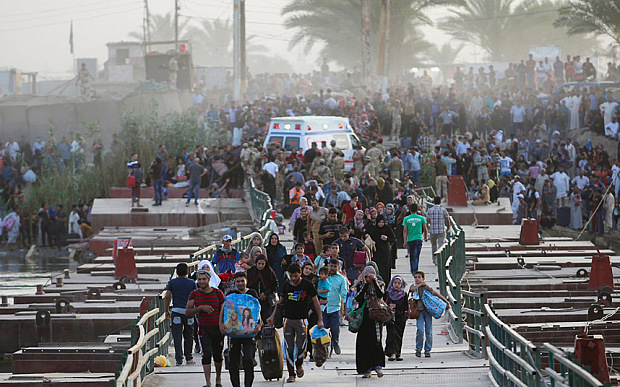
Displaced Sunni people, who fled the violence in the city of Ramadi, arrive at the outskirts of Baghdad Photo: STRINGER/IRAQ

Its strategy is essentially Maoist – the comparison has not been enough made, but now that Isil has declared itself an agent of Cultural Revolution, with its destruction of history, perhaps it will be more. Like Mao’s revolutionaries, it conquers the countryside before storming the towns.

Even now, the fact that much of its territory is rural or even desert is seen as a weakness. But it is beginning to “pick off” major towns and cities with impunity. In fact, where society is fractured, like Syria and Iraq, the “sea of revolution” panics the citizenry, making it feel “surrounded” by unseen and incomprehensible agents of doom.

********************

Have any words come back to haunt President Obama so much as his description of Islamic State of Iraq and the Levant last team as a “JV” – junior varsity – team of terrorists?

This wasn’t al-Qaeda in its 9/11 pomp, he said; just because a university second team wore Manchester United jerseys didn’t make them David Beckham.

How times change. As of this weekend, the JV team is doing a lot better than Manchester United. With its capture of Palmyra, it controls half of Syria.

Its defeat in Kobane – a town of which few non-Kurds had heard – was cheered by the world; its victory in Ramadi last Sunday gives it control of virtually all of Iraq’s largest province, one which reaches to the edge of Baghdad.

Calling itself a state, one analyst wrote, no longer looks like an exaggeration.

Senior US officials seem to agree. “Isil as an organization is better in every respect than its predecessor of Al-Qaeda in Iraq. It’s better manned, it’s better resourced, they have better fighters, they’re more experienced,” one said at a briefing to explain the loss of Ramadi. “We’ve never seen something like this.”

How did Isil manage to inflict such a humiliation on the world’s most powerful country? As with many great shock-and-awe military advances over the years, it is easier to explain in hindsight than it apparently was to prevent.

Ever since Isil emerged in its current form in 2013, military and and political analysts have been saying that its success is due to its grasp of both tactics and strategy.

Its strategy is essentially Maoist – the comparison has not been enough made, but now that Isil has declared itself an agent of Cultural Revolution, with its destruction of history, perhaps it will be more. Like Mao’s revolutionaries, it conquers the countryside before storming the towns.

Even now, the fact that much of its territory is rural or even desert is seen as a weakness. But it is beginning to “pick off” major towns and cities with impunity. In fact, where society is fractured, like Syria and Iraq, the “sea of revolution” panics the citizenry, making it feel “surrounded” by unseen and incomprehensible agents of doom.

Like Mao, Isil uses propaganda – its famed dominance of social media – to terrorise its targets mentally. Senior Iraqi policemen have recounted being sent images via their mobile phones of their decapitated fellow officers. This has a chastening effect on the fight-or-flight reflex.

It then uses actual terror to further instil chaos. Isil’s main targets have been ground down by years of car bombs and “random” attacks. It seems extraordinary, but one of the reasons given by Mosul residents for preferring Isil rule is that there are no longer so many terrorist attacks: not surprising, since the “terrorists” are in control.

Only once your enemy is weak, divided, and demoralised, do you strike.

You then do so with an awesome show of force – one which can mislead as to the actual numbers involved.

The final assault on central Ramadi, which had been fought over for almost 18 months, began with an estimated 30 car bombs. Ten were said to be individually of an equivalent size to the 1995 Oklahoma bombing, which killed 168 people.

There is nothing new in saying that both Syrian and Iraqi governments have contributed greatly to the rise of Isil by failing to offer the Sunni populations of their countries a reason to support them.

Some say that focusing on the failings and injustices of these regimes ignores the fact that militant Islamism, like Maoism, is a superficially attractive, even romantic idea to many, whether oppressed or not, and that its notions must be fought and defeated intellectually and emotionally.

That is true. But relying on Islamic extremism to burn itself out, or for its followers to be eventually persuaded of the errors of their ways, is no answer. Like financial markets, the world can stay irrational for longer than the rest of us can stay politically and militarily solvent.

Rather, the West and those it supports have to show they can exert force against force, and then create a better world, one which all Iraqis and Syrians, especially Sunnis, are prepared to fight for.

In March, an uneasy coalition of Shia militias, Iraqi soldiers, and US jets took back the town of Tikrit from Isil. It remains a wasteland, whose inhabitants have yet to return, ruled over by gunmen rather than by the rule of law.

That is not an attractive symbol, for Iraqi Sunnis, of what victory against Isil looks like. If the war against Isil is to be won, the first step is to make clear to Iraqis and Syrians alike what victory looks like, and why it will be better for them.

Relying on the U.S. for security is a mistake

May 21, 2015

Relying on the U.S. for security is a mistake, Al Arabiya News, Khalaf Ahmad Al Habtoor, May 21, 2015

(Al Arabiya is based in the United Arab Emirates and is majority-owned by Saudi broadcaster Middle East Broadcasting Center.– DM)

Obama says Iran’s newfound wealth will be used to improve lives rather than end up in the treasure chests of Hezbollah, the Shiite Yemeni Houthis, or other troublemakers under the Iranian wing. Sorry, but to me that smacks of naivety at best, snake oil at worst.

According to a Daily Telegraph investigation, Iran’s Supreme Leader controls “a financial empire” estimated to be worth $95 billion, more than even the grandiose Shah had managed to accumulate. That alone should tell Mr Obama that Iran has no intention of prioritising the needs of its people over its regional mischief makers.

****************

At a passing glance, President Barack Obama’s meetings with the leaders of the Arab Gulf States have borne fruit in terms of furthering mutual respect and as a building block to closer cooperation. But when one digs beneath the flimflam and the verbal pledges – with the exception of a joint missile defense system and a promise that deliveries of U.S. weapons would be fast-tracked – the recent Camp David Summit delivered few tangible benefits.

Indeed, more than a few commentators have described the meeting as a U.S.-hosted arms bazaar, one that will fill the coffers of American weapons manufacturers with billions of dollars. Plus the P5+1 – Iranian nuclear deal is set to enrich and empower Tehran once economic sanctions are lifted.

Obama says Iran’s newfound wealth will be used to improve lives rather than end up in the treasure chests of Hezbollah, the Shiite Yemeni Houthis, or other troublemakers under the Iranian wing. Sorry, but to me that smacks of naivety at best, snake oil at worst.

According to a Daily Telegraph investigation, Iran’s Supreme Leader controls “a financial empire” estimated to be worth $95 billion, more than even the grandiose Shah had managed to accumulate. That alone should tell Mr Obama that Iran has no intention of prioritising the needs of its people over its regional mischief makers.

Eradicating terrorism

The question is whether the leaders of the GCC countries should rightly feel secure from Iranian aggression now that the U.S. President has promised to come to their defense, militarily if deemed necessary. Naturally, that assessment would be made by the White House, not by the threatened states.

Without a signed and sealed security pact and in light of Obama’s track record of hesitancy in ending regional conflicts or eradicating terrorism, I don’t think so. Are we seriously to believe that the U.S. would declare war on Iran were we to be menaced?

Obama’s rhetoric speaks otherwise when he told the New York Times that internal threats to Gulf States are “bigger than Iran” and, at Camp David, he warned his guests not to “marginalise” Tehran. And even if Obama’s undertaking was rock solid, his term expires in just over 18 months. What happens then?

In any case, while there is nothing wrong with cementing better relations with the U.S., we must not on any account rely on its protection or that of any other world power. Yemen proves that we are able and willing to protect ourselves and our allies and when the proposed Joint Arab Force comes into play, our capabilities will be strengthened. We have no need of guardians or bosses in foreign capitals. We have strong, well equipped armies and air forces. We are not helpless, underage youths pleading to be defended, as characterised by sectors of the media.

Merely a public relations exercise

I would urge GCC heads of state to put Camp David under a microscope to ascertain whether it was a genuine attempt on Obama’s behalf to induce closer ties or merely a public relations exercise to bring Gulf States on board a bad deal rewarding Iran for its hostility, regional interference and its backing of terrorists.

In my opinion, trusting the Obama administration to rein in Iran would be a huge mistake. U.S. engagement with Iran was exactly the legacy Obama was after even before he moved into the Oval Office. And to that end he surrounded himself with pro-Iranian officials, such as Vice President Joe Biden, Secretary of State John Kerry and Deputy Secretary-of-State Bill Burns, who have all been championing détente with Iran for many years.

Obama’s personal adviser and family friend, Valerie Jarrett grew up in Iran, speaks Farsi, and was a main player along with Bill Burns in U.S.-Iranian secret talks to pave the way for official negotiations. The President’s National Security Council Director for Iran, Sahar Nowrouzzadeh is a former employee of the National-Iranian American Council, a pro-Iranian lobbying organisation.

The President’s own behaviour with regards to America’s long-time sworn enemy was suspect since the beginning. He has been sending the Iranians video Nawrus (New Year) messages and letters to Iran’s Supreme Leader. This year, Obama actually celebrated the Persian New Year at home with his wife and daughters.

Just as strange was Obama’s silence concerning Iran’s crackdown on street protests following elections. And if he condemns Tehran for its human rights abuses and lack of civil liberties, he must be whispering. Because all we hear from him is condemnation of predominately Sunni Arab states on those issues.

“The greatest supporter and plotter of terrorism”

Stranger still, while Obama comes across as the ayatollahs’ new best friend, just days ago, the Ayatollah Khamenei attacked the U.S. as “the greatest supporter and plotter of terrorism” and accuses Washington of pursuing its own interests making the region insecure, while branding America as the enemy of both Shiite and Sunni Muslims. Far from committing to stay out of Arab affairs, Khamenei stressed that his country would continue supporting “the oppressed people of Yemen, Bahrain and Palestine in every way possible.”

Are we really going to place our trust in America’s Commander-in-Chief when he claims backing the Free Syrian Army against the Syrian regime partnered with Iran and Hezbollah, even as his Air Force provides air cover to Iran’s Quds Force and pro-Iranian Shiite militias in Iraq’s Anbar province? This rabble with blood-stained hands – officially known as Popular Mobilisation Forces (Al-Shaabi) – has been deployed by Prime Minister Haider Al-Abadi and is directed by the commander of Iran’s Quds Force Qassem Soleimani. What is worse is that Iran is poised to send in ground troops as soon as it receives the go ahead from the government.

And what does Mr Obama say about the shocking news revealed by the Times and other papers to the effect that the government in Baghdad is turning away tens of thousands of desperate Sunni refugees fleeing the city of Ramadi, recaptured by ISIS? Nothing much as far as I can tell! Iraq families with nowhere to go are being treated worse than foreign foes, barred entrance into their own capital city unless they happen to have a local “guarantor.” This is a plan to reduce the Sunni population by sending them into the fray to die; there is no other explanation.

In reality, Saudi Arabia’s towns bordering northern Yemen are under direct threat from Houthis, while Iran, close to being literally under the Iranian boot, constitutes a grave threat to Gulf States. Does the Obama administration plan to wait until the horse has bolted before acting? The Iranian plot to dominate the region is taking shape before our eyes. We are being surrounded. Yet the U.S. president asks us to play nice with the plotters.

Qualitative military edge

The bottom line is we did not get what we asked for. Obama’s commitment to intervene in Syria to stop the regime’s killing spree was off the table along with a joint defense pact on the lines of those the U.S. has with Israel, Japan and South Korea. Moreover, he has turned down the Saudi request to purchase state-of-the-art F-35 Joint Strike Fighters to maintain Israel’s qualitative military edge over its neighbors.

And we certainly did not get what we need. Most importantly, any final agreement with Iran should be negotiated with the participation of Gulf states and co-signed by our leaders. Such agreement should not be limited to nuclear issues, but should be conditional upon Tehran’s commitment to quit meddling in the affairs of Arab countries, notably Syria, Lebanon, Iraq, Yemen and Bahrain whether directly (in the case of Iraq and Syria) or via its armed proxies (Lebanon and Yemen).

We should not trust any other countries but our own. We must not await instructions from the White House on how to pursue our own interests, as it is well-known that U.S. friendship is not proffered without strings. We must proceed with our mission to free Yemen of Houthi rabble, continue with our efforts to destroy ISIS and lend every support to that sector of the Syrian opposition fighting for a democratic, inclusive state – as opposed to terrorist groups that seek to drag Syria back to the Middle Ages.

Lastly, we should insist upon the stringent terms outlined above. And if those terms are not put in writing, the GCC should work to weaken the Iranian regime once and for all, beginning with material support for the oppressed Ahwazi Arab citizens of Iranian-occupied Arabistan – a region Iran now calls Khuzestan, which supplies the country with most of its oil and gas.

I fear that Camp David was a well-timed bluff and its weapons bounty no more than candies to sweeten the pill. I trust and believe that our leaders understand the score and will maintain independent strategies to counteract threats to our very existence. We cannot gamble with tomorrow on the words of one man, even if that man is the U.S. president.

Our region has been burned many times before. If the past is a good predictor of the future, we should recognise that ultimately we must become the masters of our own destiny, which is far too precious to be handed to the safekeeping of fair-weather friends.