Archive for the ‘Islam’ category

Megyn Kelly Grills State Dept’s Marie Harf After Obama Invokes Anti-American Islamic Cleric

September 26, 2014

Megyn Kelly Grills State Dept’s Marie Harf After Obama Invokes Anti-American Islamic Cleric, You Tube, September 26, 2014

(How difficult must it be to find a prominent Islamic scholar who has not issued a fatwa encouraging the killing of Americans?  The one chosen for Obama’s remarks at the UN, Bin Bayyah who issued such a fatwa, appears to have become rather an embarrassment. — DM)


CURL: Obama’s breathtaking naivete at the United Nations

September 25, 2014

CURL: Obama’s breathtaking naivete at the United Nations, Washington TimesJoe Curl, September 24, 2014

Obama's ToastPhoto by: Pablo Martinez Monsivais. President Barack Obama raises his glass to toast during a luncheon hosted by UN Secretary General Ban Ki-moon, Wednesday, Sept. 24, 2014, at the United Nations headquarters. (AP Photo/Pablo Martinez Monsivais)

Simply believing something doesn’t make it so. The president’s desire for a world in which nations talk openly about their true feelings, perhaps share a good cry together, and sing kumbaya around the campfire, is the height of naivete.

So is this passage of his speech: “… the United States is not and never will be at war with Islam. Islam teaches peace. Muslims the world over aspire to live with dignity and a sense of justice. And when it comes to America and Islam, there is no us and them, there is only us.”

******************

ANALYSIS/OPINION:

President Obama on Wednesday delivered a speech at the United Nations filled with his usual soaring rhetoric of global collectivism and the importance of “international norms.” But the president also displayed a shocking naivete about global affairs, religion, Islam — a Pollyannaish interpretation on the state of the world and America’s role in it.

Although Mr. Obama won a Nobel Peace Prize just eight months into office, the president made his annual trip to the ineffectual world council to deliver a call to war. “Ladies and gentlemen, we come together at a crossroads between war and peace, between disorder and integration, between fear and hope.”

Of course he waxed poetic about “climate change” and the promise of “the children,” but the president was forced to devote the bulk of his speech to what he called the “heart of darkness” and the “cancer of violent extremism.”

He said upon opening his remarks that “the shadow of world war that existed at the founding of this institution has been lifted.” He couldn’t be more wrong. A true man of peace worthy of the Nobel Prize, Pope Francis, said just the opposite this month in remarkably astute comments to commemorate the anniversary of World War I.

“Even today, after the second failure of another world war, perhaps one can speak of a third war, one fought piecemeal, with crimes, massacres, destruction,” the pope said, summing up the conflicts in Ukraine, Iraq, Syria, Israel, Gaza and much of northern Africa, including Libya and Tunisia, not to mention Somalia.

To Mr. Obama, there’s no global conflict of ideology, just “pervasive unease in our world.” To him, the strife is merely the “failure of our international system to keep pace with an interconnected world.” And to him, “it is one of the tasks of all great religions to accommodate devout faith with a modern, multicultural world.”

He asked delegates from nations across the world to mull this “central question of our global age: Whether we will solve our problems together, in a spirit of mutual interest and mutual respect, or whether we descend into the destructive rivalries of the past.”

His answer? “It’s time for a broader negotiation in the region in which major powers address their differences directly, honestly, and peacefully across the table from one another, rather than through gun-wielding proxies.”

Simply believing something doesn’t make it so. The president’s desire for a world in which nations talk openly about their true feelings, perhaps share a good cry together, and sing kumbaya around the campfire, is the height of naivete.

So is this passage of his speech: ” … the United States is not and never will be at war with Islam. Islam teaches peace. Muslims the world over aspire to live with dignity and a sense of justice. And when it comes to America and Islam, there is no us and them, there is only us.”

But Islam and the holy Koran on which Muslim militant groups like al Qaeda and the Islamic State base their actions do call for the extermination of all who do not follow Islam, do demand that followers kill anyone who leaves the religion, do subjugate women. For the record, the Koran contains more than 100 verses that call Muslims to war with nonbelievers.

Mr. Obama said in his speech that “all people of faith have a responsibility to lift up the value at the heart of all great religions: Do unto thy neighbor as you would do — you would have done unto yourself.” But that is not a cornerstone of Islam. Militant Muslims have a very different belief: “Fight in the name of your religion with those who disagree with you.” And that edict comes straight from their holiest book.

To the president, that ideology “will wilt and die if it is consistently exposed and confronted and refuted in the light of day.” Again, the callowness is astounding. While he urged the world, “especially Muslim communities,” to reject the ideology that underlies al Qaeda and the Islamic State, nothing will change the fact that cold-blooded killers are determined to destroy the West, wipe all infidels from the face of the earth and build a new caliphate based on strict adherence to Shariah law (which leans heavily toward beheadings, lashings, stonings).

The president let loose some passing platitudes — “right makes might,” “the only language understood by killers like this is the language of force” — but in the end Mr. Obama still labors under the delusion that the Islamic State group and its ilk have “perverted one of the world’s great religions.” He still rejects “any suggestion of a clash of civilizations” — despite al Qaeda’s and Islamic State’s express declaration of war against western civilization (and anyone who is not Muslim).

In the end, Mr. Obama said: “No external power can bring about a transformation of hearts and minds,” which means America is powerless. The only solution in this multicultural world is sharing our true feelings honestly with those who not only fundamentally disagree with us, but vow to do us harm.

Exactly a year ago, Mr. Obama said this at the U.N.: “Together, we’ve also worked to end a decade of war.” But the worldwide war on terrorism does not end when the U.S. president decides it is so, it ends when the enemy is defeated.

While he says “peace is not merely the absence of war, but the presence of a better life,” he really should say only this: “We didn’t start this war, but we will end it.”

Obama Praises Muslim Cleric Who Backed Fatwa on Killing of U.S. Soldiers

September 24, 2014

Obama Praises Muslim Cleric Who Backed Fatwa on Killing of U.S. Soldiers, Washington Free Beacon, September 14, 2014

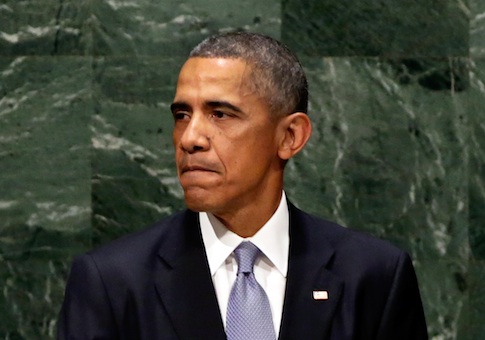
Barack ObamaPresident Barack Obama addresses the United Nations General Assembly / AP

Patrick Poole, a reporter and terrorism analyst who has long tracked Bin Bayyah, expressed shock that the Obama administration would endorse the cleric on the world stage.

“It is simply amazing that just a few months ago the State Department had to publicly apologize for tweeting out it’s support for Bin Bayyah, only to have Barack Obama go before the leaders of the entire world and publicly endorse Bin Bayyah’s efforts,” Poole said.

“It seems that nothing can stop this administration’s determination to rehabilitate Bin Bayyah’s image, transforming him from the Islamic cleric who issued the fatwa to kill Americans in Iraq and calling for the death of Jews to the de facto White House Islamic mufti,” he said.

This type of mentality has contributed to the administration’s foreign policy failures in the region,” Poole said.

********************

President Barack Obama favorably quoted and praised on Wednesday in his speech before the United Nations a controversial Muslim cleric whose organization has reportedly endorsed the terror group Hamas and supported a fatwa condoning the murder of U.S. soldiers in Iraq.

Obama in his remarks offered praise to controversial cleric Sheikh Abdallah Bin Bayyah and referred to him as a moderate Muslim leader who can help combat the Islamic State of Iraq and the Levant’s (ISIL or ISIS) radical ideology.

However, Bin Bayyah himself has long been engulfed in controversy for many of his views, including the reported backing of a 2004 fatwa that advocated violent resistance against Americans fighting in Iraq.

This is not the first time that the Obama administration has extoled Bin Bayyah, who also has served as the vice president of a Muslim scholars group founded by a radical Muslim Brotherhood leader who has called “for the death of Jews and Americans,” according to Fox News and other reports.

The State Department’s Counterterrorism Bureau (CT) was forced to issue multiple apologies earlier this year after the Washington Free Beacon reported on its promotion of Bin Bayyah on Twitter.

“This should not have been tweeted and has since been deleted,” the CT Bureau tweeted at the time after many expressed anger over the original endorsement of Bin Bayyah.

However, it appears that Obama and the White House are still supportive of Bin Bayyah, who, despite his past statements, is still hailed by some as a moderate alternative to ISIL and al Qaeda.

“The ideology of ISIL or al Qaeda or Boko Haram will wilt and die if it is consistently exposed, confronted, and refuted in the light of day,” Obama said before the U.N., according to a White House transcript of his remarks.

“Look at the new Forum for Promoting Peace in Muslim Societies—Sheikh bin Bayyah described its purpose: ‘We must declare war on war, so the outcome will be peace upon peace,’” Obama said, quoting the controversial cleric.

Concern over the administration’s relationship with Bin Bayyah started as early as 2013, when outrage ensued after he was reported to have met with Obama’s National Security Council staff at the White House.

While Bin Bayyah has condemned the actions of groups such as Boko Haram and ISIL, he also has taken controversial positions against Israel.

He issued in 2009 a fatwa “barring ‘all forms of normalization’ with Israel,” according to a Fox report on the White House meeting.

Additionally, the notorious 2004 fatwa permitting armed resistance against U.S. military personnel in Iraq reportedly stated that “resisting occupation troops” is a “duty” for all Muslims, according to reports about the edict.

Patrick Poole, a reporter and terrorism analyst who has long tracked Bin Bayyah, expressed shock that the Obama administration would endorse the cleric on the world stage.

“It is simply amazing that just a few months ago the State Department had to publicly apologize for tweeting out it’s support for Bin Bayyah, only to have Barack Obama go before the leaders of the entire world and publicly endorse Bin Bayyah’s efforts,” Poole said.

“It seems that nothing can stop this administration’s determination to rehabilitate Bin Bayyah’s image, transforming him from the Islamic cleric who issued the fatwa to kill Americans in Iraq and calling for the death of Jews to the de facto White House Islamic mufti,” he said.

This type of mentality has contributed to the administration’s foreign policy failures in the region,” Poole said.

“This is a snapshot of why this administration’s foreign policy in the Middle East is a complete catastrophe,” he said. “The keystone of their policy has been that so-called ‘moderate Islamists’ were going to be the great counter to al Qaeda. But if you take less than 30 seconds to do a Google search on any of these ‘moderate Islamists,’ you immediately find they are just a degree or two from the most hardcore jihadis and have little to no difference when it comes to condoning violence.”

A White House official said that the president’s remarks speak for themselves and declined to add anything further.

The “Khorasan Group”, New Name, Old Threat

September 24, 2014

The “Khorasan Group”, New Name, Old Threat, Center for Security PolicyKyle Shideler, September 24, 2014

There has been an attempt to try to separate out elements of Al Qaeda, into Core, and affiliates, and in the case of the Khorasan group, small units within affiliates. Or for that matter to disassociate ISIS from Al Qaeda, as ISIS being “too brutal”, when the reality is that ISIS hasn’t engaged in any tactic that Al Qaeda didn’t institute first.

This is a misguided attempt to convince people that what we face is a series of minor groups, and that the enemy who attacked us on 9/11 is broken, and/or on the run. The reality is we face an overarching enemy, a Global Islamic Movement – which is how they identify themselves – operating in accordance with a knowable strategic doctrine that we are not addressing.

That doctrine is Shariah law. It is the same law that ISIS is instituting in its territory, and the same one that Jabhat al Nusra and several of the other Syrian groups would institute in Syria if they prove successful in defeating Assad.

Until we are prepared to discuss the conflict in ideological terms, we will forever be playing “whack-a-mole” with a never ending series of “new” threats.

*****************

Recent media coverage has been bombarded by revelations of a “new terror threat“, “more dangerous than ISIS”, the Khorasan Group.

Khorasan refers to the historical area under the Islamic Caliphate that corresponds to Iran/Afghanistan/Pakistan and the subcontinent, and the Khorasan Group, according to intelligence officials speaking to the media, consists of a relatively small (between fifty and a hundred) group of veteran Al Qaeda fighters from the Afghanistan/Pakistan region. These fighters are said to include a number of highly skilled bomb makers and other operatives, led by Muhsin al-Fadhli, a native Kuwaiti, and long time Al Qaeda insider, who specializes in financing and facilitation. Jihadist social media is hinting that Al-Fadhli may have been killed in the first round of U.S. bombing.

Khorasan Group’s mission, supposedly, has been to find jihadists with western passports who have travelled to Syria, train them, and reinsert them into the West to conduct spectacular attacks of the kind that Al Qaeda is famous for.

Khorasan Group operates in and among Al Qaeda’s Syrian affiliate Jabhat al-Nusra, and there’s been lively debate in the counterterrorism community over whether its really worthwhile distinguishing between Jabhat al-Nusra and Khorasan group at all. This is significant because Jabhat al-Nusra, despite being Al Qaeda, is deeply intertwined with the Syrian rebels at-large, and they are widely supported by these rebels, including those that the Obama strategy calls for arming and training to fight ISIS. For their part, Jabhat al Nusra hasn’t made the distinction, claiming they were the recipient of U.S. bombings.

It’s entirely plausible that intelligence suggested that this Khorasan group was preparing an imminent attack, and even if they weren’t, they are definitely enemies of America and a legitimate target.

But the extra hype about this specific group, and separating them out as somehow different or more threatening than Jabhat al Nusra, and Al Qaeda proper, has more to do with attempting to limit the negative reaction from rebels within Syria, and to distract Americans from the reality that in Syria there really are few good guys, with a possible exception of the Kurdish forces, who aren’t really receiving support. That strategy has already failed, with multiple Syrian rebel groups complaining about the strikes against Jabhat al Nusra, includingone group expected to be the core of the force the U.S. intends to train to send against ISIS.

There has been an attempt to try to separate out elements of Al Qaeda, into Core, and affiliates, and in the case of the Khorasan group, small units within affiliates. Or for that matter to disassociate ISIS from Al Qaeda, as ISIS being “too brutal”, when the reality is that ISIS hasn’t engaged in any tactic that Al Qaeda didn’t institute first.

This is a misguided attempt to convince people that what we face is a series of minor groups, and that the enemy who attacked us on 9/11 is broken, and/or on the run. The reality is we face an overarching enemy, a Global Islamic Movement – which is how they identify themselves – operating in accordance with a knowable strategic doctrine that we are not addressing.

That doctrine is Shariah law. It is the same law that ISIS is instituting in its territory, and the same one that Jabhat al Nusra and several of the other Syrian groups would institute in Syria if they prove successful in defeating Assad.

Our enemy knows that you can not defeat an opponent you do not name. They do not say that their war is with the U.S. Army,  the 75th Ranger Regiment, or the 5th Special Forces Group. They say plainly and openly, that their war is with America, and the allies of America, and more importantly, that it is an ideological war, based on a conflict between belief systems which are irreconcilable.

Until we are prepared to discuss the conflict in ideological terms, we will forever be playing “whack-a-mole” with a never ending series of “new” threats.

Nobel Peace Prize-winning president urges U.N. to destroy Islamic State

September 24, 2014

Nobel Peace Prize-winning president urges U.N. to destroy Islamic State, Washington Times

The One at the UNU.S. President Barack Obama addresses the 69th session of the United Nations General Assembly at the U.N. headquarters, Wednesday, Sept. 24, 2014.

[W]e have reaffirmed that the United States is not and never will be at war with Islam. Islam teaches peace.” He added, “The only language understood by killers like this is the language of force.”

In advance of next week’s meeting at the White House with Israeli Prime Minister Benjamin Netanyahu, Mr. Obama said the situation in the Middle East looks “bleak” and laid down a marker for negotiations between Israel and the Palestinians.

“Let’s be clear: the status quo in the West Bank and Gaza is not sustainable,” Mr. Obama said. “We cannot afford to turn away from this effort — not when rockets are fired at innocent Israelis, or the lives of so many Palestinian children are taken from us in Gaza. So long as I am president, we will stand up for the principle that Israelis, Palestinians, the region, and the world will be more just with two states living side by side, in peace and security.”

**********************

Exactly one year after proclaiming that the world was “more stable,” President Obama urged the United Nations Wednesday to confront rising emergencies around the globe, from terrorists rampaging in Syria and Iraq to Russia’s invasion of Ukraine to the deadly Ebola epidemic in West Africa.

“We come together at a crossroads between war and peace, between disorder and integration, between fear and hope,” Mr. Obama told the United Nations general assembly. “Each of these problems demands urgent attention.”

Mr. Obama said pledged the U.S. will spend more on the emergencies, and blamed the international community for allowing the problems to fester.

“We collectively have not invested adequately in the public health system of developing countries,” he said. “We have not confronted forcefully enough the intolerance, sectarianism and hopelessness that feeds violent extremism in too many parts of the globe.”

He again criticized Russia’s “aggression” in Ukraine and said the world would lift sanctions against Moscow if Russia de-escalates the war.

Despite renewing America’s war against terrorists in the Middle East, Mr. Obama said his administration is not engaged in a “class of cultures.”

“I have made it clear that America will not base our entire foreign policy on reacting to terrorism,” he said. “Rather, we have waged a focused campaign against al Qaeda and its associated forces — taking out their leaders, and denying them the safe-havens they rely upon.

“At the same time, we have reaffirmed that the United States is not and never will be at war with Islam. Islam teaches peace.”He added, “The only language understood by killers like this is the language of force.”

Later Wednesday, Mr. Obama is expected to urge the U.N. Security Council to pass a broad new resolution that would impose global travel bans on fighters intent on enlisting in overseas wars, a measure aimed at the Islamic State. Administration officials have said they believe the resolution has enough support to be approved.

In his speech to the U.N. last year, Mr. Obama said “the world is more stable than it was five years ago.” He said “new circumstances” would allow the U.S. to shift away from a “perpetual war footing.”

Two days after expanding airstrikes into Syria against the militant group, Mr. Obama asked the world “to join in this effort.”

“Those who have joined [the Islamic State] should leave the battlefield while they can,” the president said. “Those who continue to fight for a hateful cause will find they are increasingly alone.”

He also urged nations and Muslim communities to reject sectarian strife, calling for “a new compact among the civilized peoples of this world to eradicate war at its most fundamental source: the corruption of young minds by violent ideology.”

“That means cutting off the funding that fuels this hate,” he said. “It’s time to end the hypocrisy of those who accumulate wealth through the global economy, and then siphon funds to those who teach children to tear it down.”

Mr. Obama said it’s “true” that the U.S. “has plenty of problems within our own borders,” and pointed as an example to the civil unrest spawned by a white police officer shooting black teenager Michael Brown in Ferguson, Mo., in August.

“In a summer marked by instability in the Middle East and Eastern Europe, I know the world also took notice of the small American city of Ferguson, Missouri — where a young man was killed, and a community was divided,” Mr. Obama said. “So yes, we have our own racial and ethnic tensions. And like every country, we continually wrestle with how to reconcile the vast changes wrought by globalization and greater diversity with the traditions that we hold dear.”

But Mr. Obama said Americans “welcome the scrutiny of the world, because what you see in America is a country that has steadily worked to address our problems and make our union more perfect.”

“America is not the same as it was 100 years ago, 50 years ago, or even a decade ago,” he said. “Because we fight for our ideals, and are willing to criticize ourselves when we fall short.”

In advance of next week’s meeting at the White House with Israeli Prime Minister Benjamin Netanyahu, Mr. Obama said the situation in the Middle East looks “bleak” and laid down a marker for negotiations between Israel and the Palestinians.

“Let’s be clear: the status quo in the West Bank and Gaza is not sustainable,” Mr. Obama said. “We cannot afford to turn away from this effort — not when rockets are fired at innocent Israelis, or the lives of so many Palestinian children are taken from us in Gaza. So long as I am president, we will stand up for the principle that Israelis, Palestinians, the region, and the world will be more just with two states living side by side, in peace and security.”

Manufacturing Excuses So Iran Can Get Nukes

September 24, 2014

Manufacturing Excuses So Iran Can Get Nukes, Gatestone InstitutePeter Huessy, September 24, 2014

(Islam is the religion of peace death and a nuclear armed Iran will act accordingly. — DM)

We assume Iran’s leaders will abide by the very international rules they are dedicated to destroying.

When we refer to Iranian missiles as a legitimate form of “deterrence,” we just fool ourselves into imagining that Iranian missiles, which support aggression, are no different from American and allied missiles, which prevent and deter aggression.

The U.S. has said it would not address Iran’s 30-plus years of sponsorship of terror nor is extensive ballistic missile program, even though the U.S. officially designates Iran as the leading state-sponsor of terror in the world.

While security threats have been increasingly serious, the United States and its allies have not been willing honestly to face the challenges of our time — especially from the coalition of oil-rich, rogue state sponsors of terror and their jihadist affiliates.

Instead they have been content to push for declining defense budgets and jettisoning their security obligations. This has — and is — making it increasingly difficult to find the leadership necessary to lead a coalition of nations to defeat the threats we face.

The United States is making three critical mistakes.

First, much of the deterrent effect of U.S. military power is being squandered. Not only have the U.S. and its NATO allies neglected their defense needs and cut defense budgets by a collective $2 trillion from the base budgets of 2009[1], but many leaders have adopted the view that military power is the problem, not part of the solution.

In the United States, critics of wars in both Afghanistan and Iraq have claimed that U.S. military power was the cause of much of the terrorism and aggression we see around the world. They see less military presence — even a complete withdrawal from parts of the world — as the key to a more peaceful world.[2]

This “blame America first” view was wrong in 1984 — as Ambassador Jeanne Kirkpatrick explained then — and it is wrong now. “They [San Francisco Democrats] said that saving Grenada from terror and totalitarianism was the wrong thing to do,” Kirkpatrick said then. “They didn’t blame Cuba or the communists for threatening American students and murdering Grenadians — they blamed the United States instead. But then, somehow, they always blame America first.”[3]

The second mistake the U.S. is making is not taking the threats we face seriously. Oddly, this seems true even when we admit that the threats are real and warrant action.

In June 2000, for instance, the top administration counter-terrorism expert, Richard Clarke, told a private Congressional briefing that, “we [the U.S.] could not prioritize the terrorist threats we faced because there were too many.” He concluded that therefore the administration could not “prioritize how to spend counter-terrorism funds.”[4]

The third mistake, also one of long standing, is that we have relied on false assumptions. One is that our adversaries adhere to international law, support “stability,” hold similar humanitarian concerns and are afraid of “being isolated.”

The other is we can persuade our adversaries to change by threatening them with paying an economic price for aggressive behavior. We hope that our adversaries will fear that “tough” economic sanctions levied on them will be painful enough to compel them to stop acting aggressively.

Then we hope that our adversaries will conclude that there is no long-term benefit even to starting aggression in the first place, and that therefore a series of peaceful deals are possible — theoretically as the only “reasonable alternative” our adversaries have.

From this rosy, wishful view we often see our adversaries’ intransigence only as a reaction to our “unfair” negotiating position, or to our supposedly threatening behavior — and not due to our determination to prevent them from carrying out their aggressive designs.

The late Senator Arlen Specter, for instance, traveled to Iraq in June 1990 and concluded that Saddam Hussein was “sincere” and had no territorial designs on his neighbors. On his return to Washington, he led a successful effort to block the imposition of sanctions against Iraq by the Bush Sr. administration, arguing Saddam Hussein had no territorial ambitions against Kuwait. Two months later Saddam invaded Kuwait.[5]

Taken together, dismantling a credible military capability, minimizing dangers to our security and failing to understand the intentions of our enemies markedly increases the danger to our Republic and our allies especially at a time when strong U.S. leadership is increasingly uncertain.

Probably the most serious of these mistakes is undermining the respect once given America’s combined military and diplomatic power. The United Arab Emirates and Egypt bombed Libya this past month without consulting the U.S. — this a time when Washington believes there is an effective central government in Tripoli, a conclusion clearly not shared by the UAE or Egypt.

Adam Garfinkle of the Foreign Policy Research Institute explains with understated disbelief: “According to [US] Administration fantasists, a competent and democratically elected Libyan central government exists and is in basic control of the country—excepting maybe a little militia kerfuffle, you know—so outsiders should not be dropping ordnance on warring groups so that the United Nations can work its diplomatic magic.”

In addition, Mahmoud Abbas of the Palestinian Authority is going to unveil a new initiative to resolve (he claims) the Palestinian-Israeli conflict but has announced the plan will not be shared beforehand with the United States.

When the red line on Syria’s use of chemical weapons disappeared during the first political sandstorm, it was clear the U.S. was contributing to this enfeebled state of affairs.

Meanwhile, even as U.S. intelligence sources for the past year have warned both Congress and administration officials of the expansion and growing danger to both Syria and Iraq from the armed Islamic State of Iraq and Syria ISIS], it was dismissed by the administration as a “JV” [junior varsity] affiliate of the more “serious” threat of Al Qaeda.

A Congressional Reference Service had reported to Congress in June 2014: “Senior U.S. officials have [over the past year] stated that ISIL poses a serious threat to the United States and maintains training camps in Iraq and Syria”.

After three videotaped beheadings of American journalists and British aid worker, even the American people, who have no stomach for more war, are said by at least one recent poll — by an overwhelming margin approaching 90% — to want a strong U.S. response to the threat from ISIS.[6]

Withdrawing precipitously from the international arena — avoiding “war” — does not buy peace. Avoiding war buys only more bad actors who march in wherever a vacuum has been created — creating, ironically, even greater threats.

American leaders have failed to lead the country toward what needs to be done simply because what needs to be done looked unpopular.

As former Secretary of State Henry Kissinger warned: “A free standing diplomacy is an ancient American illusion. History offers few examples of it. The attempt to separate diplomacy and power results in power lacking direction and diplomacy being deprived of incentives.”

When confronted with similar isolationist public perceptions, Prime Minister Margaret Thatcher and President Ronald Reagan, because of their extraordinary “complete cultural self-belief” succeeded. “[T]he world shifted toward them” as they led the U.S. and Great Britain with a policy of “peace through strength,” not “peace through retreat.”

The lawyer and constitutional scholar, John W. Howard, summed matters up:

“America has squandered 60 years of assiduous diplomacy and expanding American influence in the Middle East… Successive presidents, Republican and Democrat alike, carefully navigated the esoteric alleyways of shifting Middle Eastern politics to American advantage. American primacy was solidified by the decline and collapse of the Soviet Union, leaving a uni-polar sphere of influence. If there is one principle underlying Middle Eastern political culture, it is an acute sense of the importance and consequences of power and alliances.”

In confronting even those threats we admit must be faced, consider the deployment of missile defenses in Europe. They are a good thing, especially if you happen to be a state near Russia.

Many in the media, Hollywood, politics and academia, however, have charged that U.S. missile defense deployments in Europe “might upset the Russians” or “fuel an arms race.”

Their criticism started with the first proposed defense deployments early in the George W. Bush administration and continued long after the Polish and Czech governments had agreed to install the missiles and their associated radars.

The Bush-era pledge of a missile defense shield was scrapped, however, in 2009 by the current U.S. administration. Today, as Russia violates the Budapest memorandum of 1994 by invading Ukraine, we are still — again! — told that the new deployments of missile defense elements will “inflame tensions.”[7]

The missile defense components in Europe, specifically those now in Spain and England, but also those planned for Poland and Romania, were initiated primarily in response to missiles deployed by Iran, not the other way around.

Today, it is both Russian and Iranian missiles that are creating tensions. Both countries are carrying out terrorist acts or acts of aggression, safe in the belief that they are secure from being challenged because there is no threat from the West or its missiles.

This lack of seriousness extends to our allies as well. We are about to deploy a limited number of new THAAD [Terminal High Altitude Air Defenses] batteries in South Korea. These missile defenses are also a good thing, especially if you happen to be a state near North Korea, Russia or China.

But a spokesman for the South Korean government felt compelled to reassure Russia and China that the missile defenses are “only to protect American troops” and not part of any emerging South Korean “missile defense cooperative effort” with the United States.[8]

Conversely, Russia threatens to deploy Iskander nuclear-tipped missiles in the Crimea along with other nuclear-armed cruise missiles with the range to threaten all of Western Europe. Missiles of between 500-5500 kilometers are currently forbidden by the 1987 U.S.-Russia INF treaty — an agreement the US has formerly charged Russia with violating. If such missiles were deployed in the Crimea, their range could cover all of Europe.

Opponents of U.S. and NATO missile defense deployments admit Russia has already deployed such threatening missiles even absent any US missile defense. However, they are already charging that should the U.S. accelerate its plans for missile defenses in Europe to defend against these Russian missiles, “it would do nothing to reduce the Russian threat and would likely give Moscow reason to move Iskander short-range missiles closer to NATO.”[9]

In the face of recent Russian aggression against Ukraine, the U.S. initially put into place only relatively weak and limited sanctions against certain Moscow entities.

One part of those sanctions would prohibit prominent Russians from banking in New York City, but Russians have long since moved their money out of Russia, and would certainly not give up their pretensions to reconstituting their empire; they will continue to try to “shoot” Ukraine back into being the subsidiary of a new Russian state.

Since then, U.S. sanctions have been measurably strengthened, but the first action was what was noticed, and it was lacking in seriousness. Even today, as it is still not clear what further sanctions the U.S. is prepared to put into place, the sheer lack of resolve is associated with a lack of seriousness.

Another example of the U.S. lack of seriousness regarding national security threats is what former Army War College Russian expert Steve Blank calls the “cottage industry” of manufacturing excuses for Russian aggression.

One essay published by The Nation proclaimed that Putin’s invasion of Ukraine was really not an invasion because, after all, Ukraine was not a real country. The essay went on to excuse Russian aggression even further with the explanation that the “non-invasion” had simply taken place out of concern for “corruption” in the Kiev government — corruption being long known as a key concern of the Russian government![10]

Then, in addition to making excuses for our enemies, we go out of our way to announce to our adversaries that the U.S. military power will be used only in a very limited way. Airstrikes are to be only “pin pricks.” Military campaigns are advertised as “unbelievably small.” There will be “no boots on the ground,” or only “for limited objectives” or “only to protect American personnel.”

Years ago, President Eisenhower is reported to have warned his successor: “Never tell your enemies what you willnot do.”[11] Minimalist tactics, while perhaps popular, denote a lack of seriousness, which our adversaries see as incentives for continuing their aggression, while our friends further doubt our resolve and strength.

We appear to pick only those tools of war designed not to upset our political supporters rather than the tools needed to get the job done.

Then we assume that our enemies actually share some of our common objectives — such as “stability”, not being “isolated” and wanting “approval” from the “international community.”

The U.S. also deliberately handicaps itself by apparently believing that some kind of UN-sponsored “deal” — which no one will implement, that is if they even try — purporting to uphold international law, is the only workable solution to the threats we face.

After 9/11, Admiral James Loy, the Commander of the Coast Guard, explained to the author how helpful the United Nations International Maritime Organization [IMO] was in working to guard against attacks on our ports. The IMO effort was successful, he explained, because members of most host countries, and associated private commercial interests, all had an extremely strong economic interest in maintaining free trade and international commerce.[12]

Other U.N. institutions, however, are far less serious in the extreme. Not only has the UN’s Human Rights Council, for example, been chaired by Iran, but its current members include such “champions” of human rights such as Venezuela, Cuba, China, Pakistan, Russia, and Saudi Arabia. Further, over 70% of all the council’s past decade of inquiries have been about the supposed crimes or human rights violations of the only open, transparent, democratic human-rights adherent in the region: Israel.

The newest U.N.-approved inquiry about Gaza is being directed by London professor William Schabas, a Canadian citizen who reportedly refuses to describe Hamas as a terrorist outfit. That the U.S. continues to fund nearly a quarter of the budget of such a fraud once again shows the degree of contempt in which the U.S. holds its taxpayers.

Nowhere is this disingenuousness more evident than in the more than three decades of U.S. relations with the Islamic Republic of Iran. During this period, the U.S. has engaged in a variety of charades with Tehran, always with the Americans assuming that they would end with a deal in which the U.S. would no longer be the “Great Satan” and the mullahs would no longer seek nuclear weapons.[13]

In the current discussions with Iran over its nuclear program, however, the U.S. has said it would not address Iran’s 30-plus years of sponsorship of terror nor its major ballistic missile production programs — even though the U.S. officially designates Tehran as the leading state-sponsor of terror in the world and has repeatedly assessed its missile programs as dangerous.

The U.S. also seems not to understand that Iran calls America the “great arrogance” for a reason — because America was the major country putting together the “rules of the road” internationally after World War II.

Naturally, it is precisely these rules or “norms” — such as those governing international trade, the right to have nuclear weapons, which currencies are convertible, and, most critically, the rules against the use of force, assassinations and terrorism in conducting international relations — that Tehran seems to want to drop into the next ash-heap of what it considers historically bad ideas.

There is a message there, but we are not listening. We assume Iran’s leaders will abide by the very international rules they are dedicated to destroying.[14]

The U.S. administration also seems to be trying to downplay the extent to which Tehran’s extraordinarily robust missile production program, costing tens of billions of dollars, is now a threat now to the U.S., or will be into the future.

When asked whether a third East Coast missile-defense site would be beneficial to protect America from Iranian missiles, the administration reassures the American people that the mullah’s missiles cannot reach New York. (Yet.)

Spencer Ackerman of the Washington Post, in a February 24, 2012 essay, quotes intelligence officials: “Calm down, Iran’s missiles can’t (and won’t) hit the East Coast.” Former CIA Mideast analyst Paul Pillar assures us that, “the intelligence community does not believe the Iranians are anywhere close to having an ICBM”.

Even when the U.S. acknowledges that Iranian missiles can hit targets throughout the Middle East and much of Europe, especially U.S. allies and key security facilities, some intelligence analysts find a way to make such missiles seem less threatening.
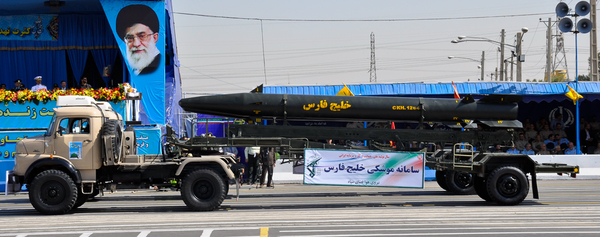
709An Iranian “Khalij Fars” mobile ballistic missile on parade in Iran. (Image source: Wikimedia Commons)

U.S. intelligence reports to Congress, for example, proclaim in all seriousness that Iran’s missiles, and even its nuclear programs, exist merely to ensure regime survival.

The Arms Control Association, for instance, approvingly quotes an administration report that, “Since the revolution, Iran’s first priority has consistently remained the survival of the regime” and that is why they are building and deploying ballistic missiles.

Iran’s missiles, we are told, are a “deterrent.” The deterrent, it is implied — is to protect Iran from the US and its allies.

Well, who can argue with that? Without their missiles and their nuclear weapons program (which, we are repeatedly assured they do not have — yet), they would be wide open to a U.S. invasion, don’t you see? And if the United States or Israel has nuclear weapons, why cannot Iran? So, the thinking seems to go, if we just leave Iran alone, then Iran’s missiles and bombs might very well go away.

This viewpoint is more widespread than many might believe. The former Director General of the United Nations International Atomic Energy Administration [IAEA], Mohamed Mustafa ElBaradei, admonished the United States and the Bush administration: “You can’t bomb your way through countries” to stop nuclear proliferation. He was implying that the U.S wanted to end nuclear proliferation in Iran, Iraq and Libya to give the U.S. a free hand to commit serial aggression against them.

During his entire time as head of the IAEA, ElBaradei also repeatedly downplayed or ignored the nuclear weapons threats from North Korea, Iran and Iraq. He said it was unfair for some countries such as the U.S. to have nuclear weapons while denying them to others, such as Iran.

He was also opposed to the liberation of Iraq, and claimed that the use of military force made terrorist problems worse. He ridiculed the U.S. and British elimination of the Libyan nuclear program largely because his agency, the IAEA, had “mysteriously” missed its very existence although it was their responsibility to monitor exactly such activities.[15]

One Times of India story put it this way: “Disarmament is for wimps. Go get your nukes if you can”.

The Washington Post ran an essay on December 2, 2013, in which nuclear-abolitionist Joe Cirincione of the Ploughshares Fund was quoted complaining, “Why is the U.S. okay with Israel having nuclear weapons but not Iran?” — again implying that U.S. concern over Iran’s potential nuclear proliferation was “unfair.”

A Christian Science Monitor essay concluded about the troubling lesson of Libya’s President Muammar Qaddafi giving up his nuclear weapons: that if he hadn’t, the U.S. and NATO would not have bombed him out of power.[16]

This sounds logical, but it is wrong. The U.S. government worked with the Libyan government to get rid of its nuclear program — which had not produced nuclear weapons fuel, let alone nuclear warheads. The two governments discussed normalizing relations after the elimination of Qaddafi’s nuclear program.

The bombing of Libya in 2011-12 took place in reaction to the terrorist threat emerging in Benghazi and the potential for mass killings in Libya. The bombing may have been misguided, but it was not triggered by Libya giving up its nuclear program in 2007.

Thus, by alleging that the US concern with Iranian or Libyan nuclear weapons programs is less than genuine, arms controllers and others in the U.S. then claim that Iran’s reluctance to abide by the rules of the Nuclear Non-Proliferation Treaty — which prohibits all but the permanent five members of the UN Security Council from having nuclear weapons — is understandable.

This view then leads to calls for even greater U.S. concessions to Iran — in order to “get a deal.” After all, it is claimed, Iran obviously has a legitimate reluctance to give ups its nuclear program with the knowledge that once Libya gave up its nuclear centrifuges in 2007, the U.S. then bombed Libya and helped overthrow the Qaddafi government four years later in 2011.

That supposed lesson is also being applied to Ukraine. In the 1994 Budapest Memorandum, Ukraine transferred its nuclear arsenal back to Russia with the assurance that Russia would guarantee Ukraine’s borders.

Today, some lawmakers in Kiev and critics of the 1994 deal have concluded that if Ukraine still possessed nuclear weapons, Russia would not have invaded either Crimea or Donetsk.

Yet at the time, Ukraine’s new leaders had no desire to become a new nuclear power and so they happily worked with the U.S. government to remove the Soviet-era nuclear weapons from their soil.

Glenn Greenwald, writing in the Guardian, echoes the idea that U.S. adversaries such as Iran have to keep whatever nuclear program they have because such weapons — once acquired — would allow Iran to “deter U.S. attacks.”[17]

The implication is that, as the U.S is such an out-of-control threat, Iran has every good reason to seek and build nuclear weapons.

The entire premise, however, that rogue states should resist having their nuclear programs dismantled because they are then more likely “to be invaded,” is wrong.

There are roughly 190 countries in the world with no nuclear weapons. Although they all lack nuclear weapons, the U.S., and its NATO and East Asian allies, have not invaded any of them and have no intention of invading them.

Afghanistan and the Taliban were removed from power because, with Osama bin Laden, they were partners in the 9-11 attacks.

Iraq was liberated from the murderous regime of Saddam Hussein because, since 1991, the Baghdad government had done everything not to comply with 17 UN resolutions; it had undermined and violated sanctions; it had armed and gave sanctuary to terrorists, and it remained committed to securing WMDs.[18]

When we refer to Iranian missiles as a legitimate form of “deterrence,” we just fool ourselves into imaging that Iranian missiles, which support aggression, are no different from American and allied missile defenses, whichprevent and deter aggression.

We have come to see Iran as a mirror image of ourselves. We assume Iran’s nuclear weapons and ballistic missiles are solely for deterrence and regime survival because, after all, that is why we in the US have both nuclear weapons and ballistic missiles — to protect our security.

But Iran’s ballistic missiles and potential nuclear weapons are to protect Tehran’s projection of power and terrorist activities, which are critical to its goals of dominating the Middle East, uniting all Muslims under its version of Islamic Shariah law, and gain the prize of having control over nearly 70% of the world’s conventional oil and gas resources — a hardly benign objective.

Judging from recent failures to counter Syria, Libya, Russia and ISIS, the U.S.’s squandering of its military might, taking a casual view of threats, and misunderstanding its enemies has led it to becoming an object of ridicule, instead of an object of fear, trust or respect.

Those can only be gained through the serious waging of war — economic, political, diplomatic and militarily — until our adversaries and enemies are defeated. Only then will they cease to fight.


[1] America in Retreat: The New Isolationism and the Coming Global Disorder by Bret Stephens (forthcoming Nov 18, 2014)

[2] See Sandy Davis, Progressive Democrats of America, “We Need To End the Disastrous Failure Of The War On Terror by Sandy Davis, February 4, 2014; or ABC News Blog: “Ron Paul Recruits Anonymous to Attack Rudy’s Foreign Policy,” May 22, 2007; and Jack A. Smith, “Terrorism–Cause and Effect”, May 29, 2010, anti-War.com; and Glen Greenwald on Salon: “A Rumsfeld-era reminder about what causes Terrorism”, October 20, 2009.

[3] Jeanne Kirkpatrick “They Always Blame America” from Jim Geraghty, The Campaign Spot, National Review, April 24th, 2013.

[4] This was explained in a detailed June 2000 letter from Congressman Chris Shays to Richard Clarke following the latter’s appearance before Shays Subcommittee on National Security, Emerging Threats and International Relations of the Committee on Government Reform.

[5] This is but one example of many cited by Michael Rubin of the American Enterprise Institute in his new book “Dancing with the Devil: The Perils of Engaging Rogue Regimes“, 2014, p. 209. Rubin notes that Senator Specter later acknowledged he had been “played by Saddam”.

[6] CNN poll as reported in FDD, 8 Sept 2014, “Majority of Americans Alarmed by ISIS”

[7] MDA Digest, September 4, 2014

[8] MDA Digest, September 4, 2014

[9] MDA Digest, August 29, 2014; and Tom Collina, “Nukes are Not the Answer to Containing Russia,” in Breaking Defense, April 11, 2014

[10] Stephen Cohen cited in the Daily Kos, February 20, 2014, “Stephen Cohen accuses Obama Administration of Coup Attempt in Ukraine” by Mark Lippman

[11] This quote was referenced by General Jack Keane, (US Army-Ret) on Fox News, Monday September 8, 2014.

[12] Admiral John Loy told me this about the IMU in a 2006 conversation we had at one of my NDUF Congressional breakfast seminars where he was the featured speaker. For an excellent review of the distortions of the UN see “UN Perversion of Human Rights“, J. Puder, Frontpage, September 8, 2014.

[13] Michael Ledeen in his “Accomplice to Evil: Iran and the War Against the West”, 2009; and Michael Ledeen, “How to Protect Against a Bad Deal With Iran“, The Hill, July 9, 2014.

[14] In a January 2014 Carnegie Europe report titled “Tehran Calling: Understanding a New Iranian Leadership”, Cornelius Adebahr says the norms Iran has had difficulty adhering to are “prohibitions against using assassinations and terrorism as legitimate tools of diplomacy” although he says the use of such tools by Iran is only “alleged” although he does admit “Iran does not accept all norms governing today’s international system”.

[15] Match Blog, October 26, 2004 and Ben Smith in Politico, January 31, 2011, quoting Malcolm Hoenlein, of the Conference of Presidents of Major American Jewish Organizations.

[16] See Reza Sanati, in the Christian Science Monitor, August 30, 2011, “A troubling lesson from Libya: Don’t give up nukes”. And NewsMax, “Ukraine Pays Price for US Advice to Give Up Nuclear Weapons” March 20, 2014; Ukrainian legislator Pavlo Rizanenko sums up the Crimea crisis: “If you have nuclear weapons, people don’t invade you.” See also “Ukraine’s Broken Nuclear Promises”, by Owen Matthews, March 19, 2014, Newsweek.

[17] Critics of US policy toward North Korea and Iran often assert both rogue states have or seek nuclear weapons to deter the United States from attacking — a variation on the “Always Blame America First Theme”. Here are two such essays: “DPRK Briefing Book: Confronting Ambiguity: How to Handle North Korea’s Nuclear Program”, by Phillip Saunders, Arms Control Association, March 3, 2003; and Glenn Greenwald, “The true reason US fears Iranian nukes: they can deter US attacks” in theguardian.com, Tuesday 2 October 2012. Greenwald also asserts “GOP Senator Lindsey Graham echoes a long line of US policymakers: Iran must not be allowed to deter US aggression”.

[18] On March 17, 2014, former Congressman Ron Paul wrote an essay in USA Today in which he said we have no interest in a fight “many thousands of miles from the US” about a country and people of “which we know almost nothing.” In the 2008 book “Munich: The 1938 Appeasement Crisis” by David Faber, British Prime Minister Neville Chamberlain is quoted saying this on September 27, 1938, just before traveling to Munich to sign a peace agreement with Chancellor Adolph Hitler:

“How horrible, fantastic, incredible it is that we should be digging trenches and trying on gas-masks here because of a quarrel in a far-away country between people of whom we know nothing. It seems still more impossible that a quarrel that has already been settled in principle should be the subject of war.

In light of the lack of seriousness with which we are treating the threats we face, it is instructive to refer to an exchange that reportedly took place between then Prime Minister Chamberlain and Winston Churchill. In this story Churchill told Prime Minister Chamberlain when the latter complained that preparing to defend England against Nazi aggression “might upset trade with Germany”: “Well, yes, Mr. Prime Minister”, said the representative from Epping/Woodford, “That would be the idea.”

Britain’s Female Jihadists

September 22, 2014

Britain’s Female Jihadists, Gatestone InstituteSoeren Kern, September 21, 2014

(The gentler sex and the religion of peace submission and death. — DM)

“My son and I love life with the beheaders.” — British jihadist Sally Jones.

Mujahidah Bint Usama published pictures of herself on Twitter holding a severed head while wearing a white doctor’s jacket; alongside it, the message: “Dream job, a terrorist doc.”

British female jihadists are now in charge of guarding as many as 3,000 non-Muslim Iraqi women and girls held captive as sex slaves.

“The British women are some of the most zealous in imposing the IS laws in the region. I believe that’s why at least four of them have been chosen to join the women police force.” — British terrorism analyst Melanie Smith.

Mahmood also called on Muslims to conduct jihad operations on British streets. In a recent tweet, she counselled: “If you cannot make it to the battlefield, then bring the battlefield to yourself.” Great Britain is now the leading European source of female jihadists in Syria and Iraq.

********************

As many as 60 Muslim women between the ages of 18 and 24 are believed to have left Britain to join the jihadist group Islamic State [IS] during the past twelve months alone, according to British terrorism analysts.

Dozens more have inquired about joining IS since the beheading of American journalist James Foley in Syria in August 2014 set off a frenzy of enthusiasm within jihadist circles.

Many of the women seem to be motivated by the hope of finding a jihadist husband, analysts say, apparently because they covet the cultural and religious “prestige” conferred upon Muslim widows whose husbands have died as “martyrs” for Allah.

Until recently, most of the British women affiliated with IS have been restricted to performing domestic chores such as cleaning and cooking. Lately, however, some women have become restive and have demanded a greater role in the IS enterprise.

Several British women are now engaged in IS recruiting efforts, using social media platforms such as Facebook and Twitter to encourage a new wave of British jihadists to travel to Syria and Iraq.

A half-dozen other women have been incorporated into a female-only militia called the Al-Khansaa brigade, based in the Syrian city of Raqqa, where the IS has set up its headquarters.

Al-Khansaa—named after a seventh-century female Arab poet who was a contemporary of the Muslim Prophet Mohammed—was established in February 2014 with the purpose of exposing male enemy jihadists who try to disguise themselves by wearing women’s clothing in order to avoid detection and detention at IS checkpoints.

The brigade was also established to detain civilian women in Raqqa who do not follow the Islamic State’s strict interpretation of Islamic Sharia law, including the requirement that all women be fully covered in public and that they be accompanied by a male chaperone.

In an interview with the blog “Syria Deeply,” Abu Ahmad, an IS official in Raqqa, explained the rationale behind Al-Khansaa. He said:

“We have established the brigade to raise awareness of our religion among women, and to punish women who do not abide by the law. There are only women in this brigade, and we have given them their own facilities to prevent the mixture of men and women.”

British terrorism analyst Melanie Smith told the Daily Telegraph that Al-Khansaa is a Sharia law police brigade whose social media accounts are run by British women and written in English.

“The British women are some of the most zealous in imposing the IS laws in the region,” Smith said. “I believe that’s why at least four of them have been chosen to join the women police force.”

The Al-Khansaa brigade has now expanded its remit to operating brothels for the use of IS fighters. The result is that British female jihadists are now in charge of guarding as many as 3,000 non-Muslim Iraqi women and girls who are being held captive as sex slaves, according to British media.

“It is the British women who have risen to the top of the Islamic State’s Sharia police and now they are in charge of this operation,” another analyst told the Daily Mirror. “It is as bizarre as it is perverse.”

A key figure in the Al-Khansaa brigade is said to be Aqsa Mahmood, a 20-year-old woman from Glasgow, Scotland who left for Syria in November 2013. Mahmood attended private schools and had wanted to become a doctor, but she dropped out of university without warning and vanished overnight in order to become a jihadist and marry an IS fighter.

Using the jihadist name of Umm Layth (Arabic for “Mother of the Lion”) on Twitter (account now suspended), Mahmood has encouraged other British Muslim women to leave their families behind in order to join the jihad in Syria. She wrote:

“Biggest tip to sisters: don’t take detours, take the quickest route, don’t play around with your Hijrah [religious pilgrimage] by staying longer than 1 day for safety and get in touch with your contacts as soon as you reach your destination.”

Mahmood, who says she is dedicated to the “pursuit of Allah’s pleasure,” added: “Once you arrive in the land of jihad, [IS] is your family.”

In two tweets Mahmood described the kinship she felt with fellow Muslims in the Islamic State. Before referring to the place as “paradise,” she concluded:

“Wallahi [I swear] I will never be able to do justice with words as to how this place makes me feel or what Ansaar of Shaam [helpers of Syria] have done for me and Allah only knows how much I love and appreciate these people for His sake…”

In another post, Mahmood called on Muslims to imitate those who murdered British soldier Lee Rigby outside the Woolwich Barracks in London in May 2013. “Follow the examples of your brothers from Woolwich, Texas and Boston,” she wrote, referring also to the shooting in Fort Hood, Texas in November 2009 and the Boston Marathon bombings in April 2013.

Mahmood also called on Muslims to conduct jihad operations on British streets. In a recent tweet, she counselled: “If you cannot make it to the battlefield, then bring the battlefield to yourself.”

She also wrote about martyrdom: “Allahu Akbar, there’s no way to describe the feeling of sitting with the Akhawat [sisters] waiting on news of whose Husband has attained Shahadah [martyrdom].”

British media have published photographs of a burqa-clad Mahmood holding a shotgun, and of a child holding an AK-47 machine gun.

Mahmood’s parents have said they cannot understand why their daughter ran away from home to become a jihadist:

“Our daughter was brought up with love and affection in a happy home, attended Craigholme private school, went to university and was always taught to show respect for mankind and was well integrated into this society. She may believe that the jihadists of ISIS are her new family but they are not and are simply using her.

“If our daughter, who had all the chances and freedom in life, could become a bedroom radical, then it is possible for this to happen to any family.”

Another British jihadist linked to the Al-Khansaa brigade, a 21-year-old medical student who goes by the name Mujahidah Bint Usama, published pictures of herself on Twitter holding a severed head while wearing a white doctor’s jacket. The gruesome image appears alongside the message “Dream job, a terrorist doc,” followed by images of smiley faces and love hearts.

Usama’s Twitter account has now been suspended, but in her description of herself she wrote: “Running away from jihad will not save you from death. You can die as a coward or you can die as a martyr.”

Yet another British jihadist, a 22-year-old convert to Islam named Khadijah Dare, has vowed to become the first female jihadist to execute a British or American captive.

Writing under the Twitter name Muhajirah fi Sham (Arabic for “immigrant in Syria”), Dare asked for links to video footage of the beheading of James Foley. In a slang-filled tweet she wrote:

“Any links 4 da execution of da journalist plz. Allahu Akbar. UK must b shaking up ha ha. I wna b da 1st UK woman 2 kill a UK or US terorrist!(sic)”.

In another tweet, Dare wrote:

“All da people back in Dar ul kufr [land of disbelievers] what are you waiting for … hurry up and join da caravan to where the laws of Allah is implemented.

“No one from Lewisham [a borough in southeast London] has come here apart from an 18-year-old sister shame on all those people who afford fancy meals and clothes and do not make hijra [Mohamed’s flight from Mecca to Medina in 622]. Shame on you.”

Dare was born in London and converted to Islam at age 18, when she began worshipping at the Lewisham Islamic Center, a mosque linked to the radical cleric Abu Hamza and the two killers of Lee Rigby.

Dare moved to Syria in 2012 to marry a Swedish jihadist named Abu Bakr. The marriage was arranged through his mother on Facebook and she did not meet him until the day of their wedding. Dare recently published pictures of her son holding an AK-47 rifle.

In a Channel 4 documentary that aired in July 2013, Dare, who at that time went by the name Maryam, said:

“I couldn’t find anyone in the UK who was willing to sacrifice their life in this world for the life in the hereafter… I prayed, and Allah ruled that I came here to marry Abu Bakr.”

She also called on other British Muslims to join the jihad:

“You need to wake up and stop being scared of death…we know that there’s heaven and hell. At the end of the day, Allah’s going to question you. Instead of sitting down and focusing on your families or your study, you just need to wake up….”

702Khadijah “Maryam” Dare, a young London woman who converted to Islam and moved to Syria to marry a Swedish jihadist, is shown here in Aleppo setting off to go shopping with a friend and their small children. They bring along their AK-47 assault rifles “just in case”. (Image source: Channel 4 video screenshot)

On August 31, the Daily Mirror reported that Dare’s jihadist rants have turned her into a “celebrity jihadi” who has become an “immense threat” due to her popularity. The newspaper reported that British security services have now made finding her a “top priority” over fears that radical Muslims are answering her calls to leave the UK to join IS in the Middle East.

In a four-minute video entitled, “Answering the Call–Foreign Fighters (Mujahedeen) in Syria,” a burka-clad Dare appears firing an AK-47 rifle and pleading with fellow Brits to fight by her side in Syria. Speaking in a London accent, she said:

“These are your brothers and sisters as well and they need your help. So instead of sitting down and focusing on your families or focusing on your studies, you need to stop being selfish because time is ticking.”

Not all British female jihadists are in their teens and twenties. A 45-year-old British convert to Islam named Sally Jones recently issued threats via Twitter to behead Christians. Jones, who changed her name to Umm Hussain al-Britani, wrote: “You Christians all need beheading with a nice blunt knife and stuck on the railings at Raqqa. Come here I’ll do it for you!”

Police say Jones, who also goes by the name Sakinah Hussain, travelled to Syria in late 2013 after converting to Islam and developing an online romance with a 20-year-old British jihadist from Birmingham named Junaid Hussain.

Hussain, who uses the alias Abu Hussain al-Britani, was jailed in 2012 for running a computer hacking group known as Team Poison. He escaped to Syria in 2013 while on bail, and has been posting extremist messages on social media pledging to conquer the world and kill infidels.

Police fear Hussain is masterminding plan to teach jihadists how to empty the bank accounts of rich and famous Britons to fund terror attacks.

According to British media, Jones, originally from Kent in southeast England, was once an aspiring musician with an all-girl punk rock band but ended up spending a lifetime on social welfare benefits. She is now raising her 10-year-old son from a previous marriage as a Muslim under the Islamic State.

In an interview with The Sunday Times, Jones reflected on her new circumstances: “My son and I love life with the beheaders.”


Al Nusrah Front threatens to execute 2nd Lebanese hostage

September 21, 2014

Al Nusrah Front threatens to execute 2nd Lebanese hostage, Long War Journal, Thomas Joscelyn, September 21, 2014

Screen Shot 2014-09-21 at 2.16.39 PM-thumb-560x292-3761

The Al Nusrah Front, al Qaeda’s official branch in Syria, is threatening to kill a second Lebanese hostage held in its custody. The man has been identified as Ali al Bazzal.

The threat was posted in tweets on one of the group’s official Twitter feeds. A banner containing the threat can be seen above.

In addition, a video posted online appears to show the group executing another Lebanese hostage, Mohammad Hamiyeh. In a tweet on Sept. 19, Al Nusrah said that Hamiyeh “is the first casualty of the stubbornness of the Lebanese military that has become a puppet in the hands of the Iranian party.”

The “Iranian party” is Hezbollah, which is fighting alongside Bashar al Assad’s forces against Al Nusrah and other rebel forces.

Lebanese officials subsequently confirmed that Hamiyeh has been killed. The al Qaeda group had repeatedly promised to kill Hamiyeh if its demands were not met.

The video shows a man shooting Hamiyeh in the head, with Bazzal sitting to his right. Bazzal then pleads for his life, saying that Hezbollah, the “party of the devil,” must alter its operations.

“If you don’t stop attacking and inciting against our Sunni brethren then I will follow my fellow soldier who was killed right there,” Bazzal says, according to The Daily Star, a publication based in Lebanon.

The video does not appear to have been posted on Al Nusrah’s official Twitter feeds, but instead surfaced online separately. For instance, the banner shown above was posted on Al Nusrah’s Twitter feed for the Qalamoun region of Syria. The video was not posted on the same feed.

The version of the video viewed by The Long War Journal also does not contain Al Nusrah’s official media logo.

Still, the image of the man identified as Bazzal in the video matches the picture in banner republished above, which was released by Al Nusrah.

The banner contains the question, “Who will pay the price?” Al Nusrah used that same question in the first video it released showing its Lebanese hostages, who were captured in August, as well as in subsequent statements and online banners.

The al Qaeda group says that Hamiyeh was the first to pay the price, because the Lebanese army and Hezbollah have not met their demands. Al Nusrah has said previously that it wants Hezbollah to remove its fighters from Syria, and a number of other conditions met. As in Al Nusrah’s past hostage operations, the government of Qatar is attempting to broker the negotiations.

Al Nusrah has shied away from killing its captives in recent weeks, releasing hostages on several occasions. The organization has not produced graphic beheading videos like its counterparts in the Islamic State, a jihadist group that has captured large swaths of territory in Iraq and Syria since earlier this year. The Islamic State and Al Nusrah are fierce rivals.

While it has not produced gory execution videos like its rivals in the Islamic State, Al Nusrah has now executed a Lebanese soldier and threatened to kill another hostage.

The muddled strategy of Jubilation T. Obama

September 21, 2014

The muddled strategy of Jubilation T. Obama, Dan Miller’s Blog, September 20, 2014
Obama continues to insist on leading from behind; that’s the most He can do. Who in his right mind would follow Him were He to try to lead from the front?

“Moderate” Islamists

Commander in Chief Juilation T. Cornpone Obama, Nobel Peace Prize recipient and Hero of the Obama Nation, has His own ideas about the “non-Islamic” Islamic State (IS) with which He is or isn’t at war (or going to war) with the help of “moderate” Islamists.

It is not out of ignorance that President Obama and Secretary Kerry are denying the Islamic roots of the Islamic State jihadists. As I argued in a column here last week, we should stop scoffing as if this were a blunder and understand the destructive strategy behind it. The Obama administration is quite intentionally promoting the progressive illusion that “moderate Islamists” are the solution to the woes of the Middle East, and thus that working cooperatively with “moderate Islamists” is the solution to America’s security challenges. [Emphasis added.]

. . . .

[T]he term “moderate Islamist” is an oxymoron. An Islamist is a Muslim who wants repressive sharia imposed. There is nothing moderate about sharia even if the Muslim in question does not advocate imposing it by violence.

Most people do not know what the term “Islamist” means, so the contradiction is not apparent to them. If they think about it at all, they figure “moderate Islamist” must be just another way of saying “moderate Muslim,” and since everyone acknowledges that there are millions of moderate Muslims, it seems logical enough. Yet, all Muslims are not Islamists. In particular, all Muslims who support the Western principles of liberty and reason are not Islamists.

If you want to say that some Islamists are not violent, that is certainly true. But that does not make them moderate. There is, moreover, less to their nonviolence than meets the eye. Many Islamists who do not personally participate in jihadist aggression support violent jihadists financially and morally – often while feigning objection to their methods or playing semantic games (e.g., “I oppose terrorism but I support resistance,” or “I oppose the killing of  innocent people . . . but don’t press me on who is an innocent). [Emphasis added.]

Perhaps Obama doesn’t know or doesn’t care what He wants to fight, beyond sagging poll numbers.

Coalition of the unwilling

His coalition of the unwilling is a diverse bunch, but how can He lead them, even from behind, when He can’t convince himself or them of much of anything?

Despite being the greatest orator of the last thousand years, he’s a complete bust at selling anything but himself, as comprehensively demonstrated in his first couple of years: see his rhetorical efforts on behalf of ObamaCare, or Massachusetts Senate candidate Martha Coakley, or Chicago’s Olympics bid. When it comes to war, he suffers from an additional burden: before he can persuade anybody else, he first has to persuade himself. And he can’t do it. So he gave the usual listless performance of a surly actor who resents the part he’s been given. It’s not just the accumulation of equivocations and qualifications – the “Islamic State” is not Islamic, our war with them is not a war, there’ll be no boots on the ground except the exotic footwear of a vast unspecified coalition – but something more basic: What he mainly communicates is that he doesn’t mean it. [Emphasis added.]

Coalition Islamists want to retain their own regional powers but have few quarrels with Islam (Egypt under President Sisi may be an exception as to Islam). Saudi Arabia?

Islamic State terrorists have infamously decapitated three of their prisoners in recent weeks. That is five fewer than the Saudi government decapitated in August alone. Indeed, it is three fewer beheadings than were carried out in September by the Free Syrian Army — the “moderate Islamists” that congressional Republicans have now joined Obama Democrats in supporting with arms and training underwritten by American taxpayer dollars.

The Obama administration regards the Saudi government as America’s key partner in the fight against Islamic State jihadists. The increasingly delusional Secretary of State John Kerry reasons that this is because the fight is more ideological than military. Get it? The world’s leading propagators of the ideology that breeds violent jihad are our best asset in an ideological struggle against violent jihadists. [Emphasis added.]

. . . .

Saudi Arabia is the cradle of Islam: the birthplace of Mohammed, the site of the Hijra by which Islam marks time — the migration from Mecca to Medina under siege by Mohammed and his followers. The Saudi king is formally known as the “Keeper of the Two Holy Mosques” (in Mecca and Medina); he is the guardian host of the Haj pilgrimage that Islam makes mandatory for able-bodied believers. The despotic Saudi kingdom is governed by Islamic law — sharia. No other law is deemed necessary and no contrary law is permissible.

Boots on the ground

The Obama Nation will have no “boots on the ground.” Obama, a specialist in all specialities and wiser in all matters than anyone else, apparently believes that He knows better about military matters than do His past and current military advisers.

Retired Marine Gen. James Mattis, who served under Obama until last year, became the latest high-profile skeptic on Thursday, telling the House Intelligence Committee that a blanket prohibition on ground combat was tying the military’s hands. “Half-hearted or tentative efforts, or airstrikes alone, can backfire on us and actually strengthen our foes’ credibility,” he said. “We may not wish to reassure our enemies in advance that they will not see American boots on the ground.”  [Emphasis added.]

Mattis’s comments came two days after Army Gen. Martin Dempsey, the chairman of the Joint Chiefs of Staff, took the rare step of publicly suggesting that a policy already set by the commander in chief could be reconsidered.

Despite Obama’s promise that he would not deploy ground combat forces, Dempsey made clear that he didn’t want to rule out the possibility, if only to deploy small teams in limited circumstances. He also acknowledged that Army Gen. Lloyd Austin, the commander for the Middle East, had already recommended doing so in the case of at least one battle in Iraq but was overruled. [Emphasis added.]

Perhaps a few of Obama’s Islamist allies will supply a few boots on the ground.

The “moderate” Islamists Obama wants to train and equip, now with Congressional approval, are little if any better.

Air strikes

Air power, provided by the Obama Nation and apparently now also by France, could be useful in degrading and destroying enemy leaders and their military equipment. However, Obama says that He will micromanage the process in Syria.

A man who’s a better speechwriter than his speechwriters, a better political director than his political directors, and who knows more about policy than his policy advisors must surely also be a better general than his generals, no?

The U.S. military campaign against Islamist militants in Syria is being designed to allow President Barack Obama to exert a high degree of personal control, going so far as to require that the military obtain presidential signoff for strikes in Syrian territory, officials said.

The requirements for strikes in Syria against the extremist group Islamic State will be far more stringent than those targeting it in Iraq, at least at first. U.S. officials say it is an attempt to limit the threat the U.S. could be dragged more deeply into the Syrian civil war… [Emphasis added.]

Throughout President Obama’s time in office, the White House has kept close control of counterterrorism targeting, reserving the right to sign off on strikes against al Qaeda and other militant targets in Yemen, Pakistan and elsewhere.

Defense officials said that the strikes in Syria are more likely to look like a targeted counterterrorism campaign than a classic military campaign, in which a combatant commander picks targets within the parameters set by the commander in chief.

President Johnson micromanaged airstrikes during the Vietnam war and joked (?) that no outhouse could be attacked without his approval. Obama, if He is awake and preoccupied with neither of the heavy burdens of office He bravely shoulders — golfing and fund raising — may perhaps manage it almost as well as did Johnson. Oh well. He may get a few IS leaders lurking in outhouses. Unfortunately, the IS is a many headed hydra: lop off one head and two replace it. Destroyed military equipment? Newly armed “moderate” Islamic jihad groups will provide more, willingly or otherwise.

The Commander in Chief, Jubilation T. Obama

The Confederacy had no General Cornpone. The Obama Nation now has its own, as the Commander in Chief. He is the leader who can best implement His “strategies,” if and when He decides what they are and how to do it. Please pay attention to the lyrics. How many analogies are there to our current Commander in Chief?

The country’s now in the very best of hands, at least since 2009.

But be of good cheer: help is on the way. Here are some better ideas than Obama has offered thus far:

Finally, the really good news

There is still one shimmering example of efficiency and wisdom in the Obama Administration, the Department of Homeland Security, which protects us from Tea Party and other far right terrorists, foreign and domestic. It’s right at home where it should be, in a (former) insane asylum. Here is a picture of DHS personnel hard at work doing their best for we the people:

Lunatic Asylum

Jubilation T. Obama is the demented gentleman to the far left rear of the photo, leading the DHS from His customary position.

UPDATE:

Rick Moran posted an article titled Defense Secretary Hagel to Review Pentagon-NFL Ties at PJ Tatler. His onerous new duties might keep the Secretary of Defense out of trouble by limiting any bothersome ruminations on insignificant military concerns such as those affecting the “non-Islamic” Islamic State, et al.

FURTHER UPDATE:


Where Is Obama’s ‘Broad Coalition’?

September 21, 2014

Where Is Obama’s ‘Broad Coalition’? National Review Online, Victor Davis Hanson, September 18, 2014

The OnePresident Obama addresses servicemembers at MacDill Air Force Base. (Joe Raedle/Getty Images)

The so-called Islamic State has left destruction everywhere that it has gained ground. But as in the case of the tribal Scythians, Vandals, Huns, or Mongols of the past, sowing chaos in its wake does not mean that the Islamic State won’t continue to seek new targets for its devastation.

If unchecked, the Islamic State will turn what is left of the nations of the Middle East into a huge Mogadishu-like tribal wasteland, from the Syrian Mediterranean to the Persian Gulf. And they will happily call the resulting mess a caliphate.

It is critical for United States to put together some sort of alliance of friendly Middle East governments and European states to stop the Islamic State before it becomes a permanent base for terrorist operations against the U.S. and its allies. Unfortunately, it appears unlikely that the U.S. will line up a muscular alliance — at least until the Islamic State reaches the gates of Baghdad or plows on through to Saudi Arabia and forces millions of Arabs either to fight or submit.

Why the reluctance for allies to join the U.S.?

Most in the Middle East and Europe do not believe the Obama administration knows much about the Islamic State, much less what to do about it. The president has dismissed it in the past as a jayvee team that could be managed, contradicting the more dire assessments of his own secretary of defense and the Joint Chiefs of Staff.

When Obama finally promised to destroy the Islamic State, Secretary of State John Kerry almost immediately backtracked that idea of a full-blown war. Current CIA director John Brennan once dismissed as absurd any idea of Islamic terrorists seeking a modern caliphate. It may be absurd, but it is now also all too real.

Such confusion sadly is not new. The president hinges our hopes on the ground on the Free Syrian Army — which he chose not to help when it once may have been viable. And not long ago he dismissed it as an inexperienced group of doctors and farmers whose utility was mostly a “fantasy.”

No ally is quite sure of what Obama wants to do about Syrian President Bashar Assad, whom he once threatened to bomb for using chemical weapons before backing off.

Potential allies also feel that the Obama administration will get them involved in an operation only to either lose interest or leave them hanging. When Obama entered office in 2009, Iraq was mostly quiet. Both the president and Vice President Joe Biden soon announced it was secure and stable. Then they simply pulled out all U.S. troops, bragged during their re-election campaign that they had ended the war, and let our Iraqi and Kurdish allies fend for themselves against suddenly emboldened Islamic terrorists.

In Libya, the administration followed the British and French lead in bombing the Moammar Gadhafi regime out of power — but then failed to help dissidents fight opportunistic Islamists. The result was the Benghazi disaster, a caricature of a strategy dubbed “leading from behind,” and an Afghanistan-like failed state facing Europe across the Mediterranean.

Now, the president claims authorization to bomb the Islamic State based on a 13-year-old joint resolution — a Bush administration-sponsored effort that Obama himself had often criticized. If the president cannot make a new case to Congress and the American people for bombing the Islamic State, then allies will assume that he cannot build an effective coalition either.

Finally, potential allies doubt that the United States wants to be engaged abroad. They are watching China flex its muscles in the South China Sea. They have not yet seen a viable strategy to stop the serial aggression of Russian president Vladimir Putin. Iran seems to consider U.S. deadlines to stop nuclear enrichment in the same manner that Assad scoffed at administration red lines. With Egypt, the administration seemed confused about whether to support the tottering Hosni Mubarak government, the radical Muslim Brotherhood, or the junta of General Abdel Fattah el-Sisi — only at times to oppose all three.

Obama himself seems disengaged, if not bored, with foreign affairs. After publicly deploring the beheading of American journalist James Foley, Obama hit the golf course. When the media reported the disconnect, he scoffed that it was just bad “optics.”

There is a legitimate debate about the degree to which the United States should conduct a preemptive war to stop the Islamic State before it gobbles up any more nations. But so far the president has not entered that debate, much less won it.

No wonder, then, that potential allies do not quite know what the U.S. is doing, how long America will fight, and what will happen to U.S. allies when we likely get tired, quit, and leave.

For now, most allies are sitting tight and waiting for preemptive, unilateral U.S. action. If we begin defeating the Islamic State, they may eventually join in on the kill; if not, they won’t.

That is a terrible way to wage coalition warfare, but we are reaping what we have sown.