Archive for the ‘Islam’ category

Obama’s Vietnam

October 13, 2014

Obama’s Vietnam, American ThinkerBruce Walker, October 13, 2014

(The Korean mess was similar, particularly after China entered the conflict in mid – late 1950. Political attempts to end the conflict (1951 – 1953) by putting things back where they had been before the Russian sponsored June 25, 1950 invasion of South Korea resemble current negotiations with Iran over its nukes.

In Korea and Vietnam, we were not fighting for our homes and mothers; they were not at risk. In Korea, after China joined the conflict against us, we were fighting to maintain our status quo as a world power against alien cultures (mainly China) and to bring as many of our “boots on the ground” back home alive as possible. After initial successes and attempts to win, we no longer sought victory. Victory was not politically useful and had ceased to be an objective.

Have we learned much since then? It does not appear that we, or our “leaders,” have. Here we go again, this time with (as Obama has often pledged) no boots on the ground against the “not Islamic” Islamic State although it may in time threaten our homes and mothers, and with little interest in keeping Iran from getting (or keeping) nukes. — DM)


The “grand strategy” of Obama in the Middle East is an indecent flux of poll numbers and sound bites.  It is to react to crises that affect American public opinion until the media and the voters are lulled into thinking that he has done something.  The purpose of American national security policy is to make Barry look good.

The price for such selfishness is that innocent blood is spilt for ignoble vanities.  Today it is Kurdish blood, but because ISIS is the sort of existential threat to Western values that in time will demand either its defeat or our surrender, inevitably it will be the blood of our best and bravest that will wash away the venality of Obama and his Vietnam.

***************

Vietnam has long been recognized as a failure caused by political meddling in military operations, coupled with lying by Democrat presidents anxious to protect their image and popularity.  Although many Americans – count me in that group – believed that the cause of freedom demanded that communist aggression in Southeast Asia be stopped, implementing this policy demanded presidential leadership.  The man in the White House had to tell us why spending treasure and blood to win a war was in our nation’s interest, and he had to explain, at least in broad terms, how we were going to win.

Vietnam was a winnable war.  The idea that American military power could not stop a communist attack from the north and a guerrilla war from within South Vietnam was absurd.  As Goldwater accurately explained during his 1964 presidential campaign, our command of the air meant that if we let military leaders decide the targeting in North Vietnam, we could “bomb them back to the Stone Age.”  (This phrase was twisted by leftists to imply that he wanted to use nuclear weapons.)

Our four Iowa-class battleships – each with nine sixteen-inch guns, which could hit targets in 90% of North Vietnam with perfect precision – if all four were brought out of mothballs, had a combined rate of fire of one sixteen-inch shell every two seconds.  Every factory, every bridge, every railway, every anti-aircraft battery, every North Vietnamese Army post, every power generation plant – everything of any military, political, or economic value – could have been utterly destroyed in a few months.

Our minelayers, our bombers, and our submarines had the capacity to completely blockade Haiphong Harbor, where nearly all the munitions, weapons, and supplies the North Vietnamese came through, with an airtight quarantine.  The Ho Chi Minh Trail, if hit at irregular intervals by different types of attacks, could have been stopped cold.  The very preventable Holocaust that Cambodia and Vietnam endured happened because of gutless American presidents and in spite of the courage and honor of our fighting men.

Whatever the faults of George H. Bush, he fully grasped the reasons we failed in Vietnam, and he scrupulously avoided those in Desert Storm, a war against a much more powerful Iraq (we tend to forget that the battle-tested Iraqi army had outfought, in a decade-long war, an Iranian army three times as big.)  We had a specific goal, and we used every weapon we had to achieve that goal.  Leftists at the time predicted that this would be “another Vietnam,” but they were utterly and pathetically wrong.

Obama, now, is demonstrating that it is possible to repeat all the mistakes of Vietnam.  He is following what fifty years ago was called “escalation,” or the incremental response with American military power to communist aggression with the vague intention of raising the costs high enough so that the rational actors who were leading enemy forces would decide that peace was in their best interest.  ISIS leaders, like communists and like similar radical Islamists, are madmen obsessed with the destruction of those they cannot conquer.  These are the folks who successfully recruit suicide bombers.

Obama also fails to tell us what victory will look like.  Will we establish and support a free Kurdistan?  Is our goal to both defeat ISIS and the Assad regime and create a functioning democracy in Syria?  Are we trying to prevent a general conflagration in West Asia?  Obama doesn’t say, and, scary as this sounds, his dull-witted advisers – truly embarrassingly dumb folks – don’t know any more than he does what we are trying to do.

The “grand strategy” of Obama in the Middle East is an indecent flux of poll numbers and sound bites.  It is to react to crises that affect American public opinion until the media and the voters are lulled into thinking that he has done something.  The purpose of American national security policy is to make Barry look good.

The price for such selfishness is that innocent blood is spilt for ignoble vanities.  Today it is Kurdish blood, but because ISIS is the sort of existential threat to Western values that in time will demand either its defeat or our surrender, inevitably it will be the blood of our best and bravest that will wash away the venality of Obama and his Vietnam.

Nuke negotiations with Iran are worse than the 1951-53 peace process with North Korea

October 12, 2014

Nuke negotiations with Iran are worse than the 1951-53 peace process with North Korea, Dan Miller’s Blog, October 12, 2014

Parallels between the current negotiations with Iran over nukes and those with North Korea and China over the end of the U.S. – U.N. “police action” in Korea should be considered in evaluating the former. That is the purpose of this article.

Among the conclusions to be drawn is that Obama’s America and the rest of the “international community” are heading down a foolishly misguided path in nuke negotiations with Iran. The path is likely to lead to results more inconclusive and substantially worse than did negotiations to end the Korean Conflict. 

Korea negotiations

Negotiations looking to the end of the Korean conflict began on July 10, 1951 at Kaesong, a town occupied by North Korea. On November 25th, negotiations moved to neutral territory in Panmunjom, where they continued until July 19, 1953, just over two years after they had begun.

During the Korea negotiations — which South Korea opposed and at which North Korea and China, but not South Korea were represented — fighting continued with many casualties on all sides. The push for “peace” and political strategies to achieve it — mainly on the part of the United Nations, America and her allies —  overwhelmed military considerations. Those factors pushed the casualty rate higher than it would likely have been during more normal combat operations had there been no “peace process.” (Note: much of the information provided here on the Kaesong – Panmunjom peace process and the continuing combat which accompanied it is from T. R. Fehrenbach’s excellent book titled This Kind of War, first published in 1963. During the conflict, Mr. Fehrenbach served in Korea as a U.S. Army officer.)

The resulting agreement put the geographical situation back where it had been when North Korean troops – supplied, trained and led by Stalin’s Russia — invaded the South on June 25, 1950.

Still a horridly repressive country, North Korea still remains aggressive against South Korea and now has nuclear weaponry. In contrast Japan — which we nuked to end the war in the Pacific with fewer casualties than would otherwise likely have occurred had the war continued — has become one of few reasonably free, democratic and prosperous nations in Asia. Another is South Korea, far past the days of the Japanese occupation followed by the increasingly dictatorial reign of U.S. supported Syngman Rhee.

Iran nuke negotiations 

IranBombCartoon

Feelers for a nuke deal with Iran began as early as 2006, with multiple U.N. resolutions. A round of talks among the P5+1 representatives (United States, Russia, China, United Kingdom, and France, plus Germany) and Iran was held on February 26 – 27, 2013 in the Kazakh city of Almaty. Germany

is the key trading partner of Iran.[4] Iran’s nuclear program depends mainly upon German products and services. For example, the thousands of centrifuges used to enrich the uranium are controlled by Siemens “Simatic WinCC Step7” software.[5][6] Around 50 German firms have their own branch offices in Iran and more than 12,000 firms have their own trade representatives in Iran. Several well-known German companies are involved in major Iranian infrastructure projects, especially in the petrochemical sector, like Linde, BASF, Lurgi, Krupp, Siemens, ZF Friedrichshafen, Mercedes, Volkswagen and MAN (2008). (Emphasis added.]

Iran’s relationships with Russia and China are similar. Negotiations have continued at various venues since February of 2013 with little if any progress and have been extended through November 24, 2014. They seem likely to be extended further. By November 24th, they will have lasted one year and nine months. An extension could well prolong them beyond the two years consumed by negotiations over the Korean conflict.

Iran has benefited substantially from the amelioration of sanctions which pressed it into negotiations and which seem highly unlikely to be restored in any effective manner no matter what happens during the negotiations. Iran has very likely continued its efforts to obtain (or keep) and militarize nukes. P5 + 1 negotiators, with “guidance” from Obama, have yielded to many if not most Iranian demands pointing to that result.

Iran continues to refuse the U.N. “watchdog,” the International Atomic Energy Agency (IAEI), access to sites such as Parchin, where it is thought that Iran continues its nuclear weapons research but which the IAEI has not been permitted to inspect since 2005. According to the IAEI, it has

collected about 1,000 pages of information that point to attempts to develop such weapons.

Several meetings have resulted in little progress since Iran and the IAEA agreed late last year on a new effort to try and clear up the allegations.

The agency said Thursday that Iran presented no new proposals at the latest talks with IAEA experts. An IAEA statement gave no date for a new meeting.

The explosions at Parchin may have been workplace violence a workplace accident, sabotage or, perhaps more likely, an effort by Iran to hide its nuke developments because pressure to allow inspection by IAEI has increased significantly.

The timing of the blast is notable. On Monday night, a delegation from the IAEA landed in Tehran for a new round of talks scheduled for that Tuesday. The UN’s demand to inspect Parchin was set to be one of the top agenda items at the talks. [Emphasis added.]

Given the timing, it is certainly possible that the Iranians carried out the explosion themselves as a means of preventing the IAEA from demanding access.

The explosions at Parchin strongly suggest that Iran continues its nuclear weapons development while Obama and many others continue to live in a world of fantasy, hoping that Iran does not have, may not get and in any event will not use nukes.  Obama has not declared the Islamic Republic of Iran “non-Islamic,” so evidently He fantasizes that it (unlike the “non-Islamic” Islamic State) is benign and trustworthy.

Here is an Iranian video simulation of a nuclear attack on Israel:

According to the summary posted at You Tube,

A short animated film being aired across Iran, shows the nuclear destruction of Israel and opens with the word ‘Holocaust’ appearing on the screen, underneath which a Star of David is shown, Israel’s Channel 2 reported on Tuesday.

Israel may well be the first to suffer an Iranian nuclear attack if when Iran decides to use its nukes. Why would Iran — which continues to proclaim to the West its innocence of any past, present or future desire for nuclear weapons — try to convince its denizens otherwise? Just as South Korea had the most to lose, opposed and was not represented at the Korean peace process negotiations, Israel is not represented in the P5+1 peace process. She can do little more than sit on the sidelines and urge an international community that rejects her contentions to deny Iran nukes.

As was the case during the Panmunjom peace process, the human rights abuses by Iran appear to be deemed irrelevant. Despite Iranian President Rouhani’s pre-election promises to improve Iranian human rightsits human rights record remains little if any better than that of North Korea. Indeed, far from improving, the situation under “moderate” Iranian President Rouhani has worsened.

The Iranian regime executed more people per capita than any other country, executing as many as 687 people in 2013—an increase of 165 over the prior year.  In March 2014, Reuters quoted Dr. Ahmed Shaheed, the U.N. special rapporteur for human rights in Iran, as saying:  “I am still at a loss to understand how a reformist president should be in office and see such a sharp rise in executions.  The government hasn’t given an explanation, which I would like to hear.”

  • The United Nations cited an increase in the rate of executions in Iran under Rouhani’s presidency in the second half of 2013.  As the Office of the United Nations High Commissioner for Human Rights (OHCHR) noted in an April 2014 report:  “An escalation in executions, including of political prisoners and individuals belonging to ethnic minority groups such as Baloch, Ahwazi Arabs and Kurds, was notable in the second half of 2013.  At least 500 persons are known to have been executed in 2013, including 57 in public.  According to some sources, the figure may be as high as 625.”

  • Under Rouhani, Iranian authorities have executed more than two people per day in 2014.  As Iran Human Rights reported in June 2014:  “at least 320 prisoners have been executed in 2014 in Iran. Iranian official sources have announced at least 147 executions in the period between 1. January and 1. June 2014.  In addition, more than 180 executions have been reported by human rights groups and not announced by the official sources.  Based on these numbers, the Iranian authorities have executed in average, more than 2 people every day in the first five months of 2014.  This is despite the fact that there has been a 3 week’s halt in the executions around the Iranian New Year in March.” [All emphasis is in the original.]

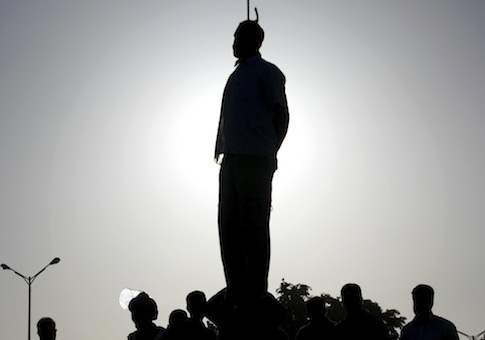
Iran hangings by crane

It also appears to be deemed inconsequential that Iran is among the world’s foremost state sponsors of Islamic terrorism, perhaps because Obama and His minions refuse to recognize the nature of Islamic terrorism. Indeed, the State Department recently

issued a tweet endorsing a manual that promotes sharia and admonishes investigators not to use terms like “jihad,” which it describes as “a noble concept” in Islam.

. . . .

Upon reading the book, Toronto Star columnist Anthony Furey observes that it frowns on “liberal values,” forbidding such things as the intermingling of the sexes in civil society and the marriage of a Muslim woman to a non-Muslim, while promoting the treatment of adultery and premarital sex as crimes for which “punishments are harsh.”  [Emphasis added.]

Even if Iran does not itself use nukes against its enemies (e.g., Israel) how likely is it that it will provide nukes to its Islamic terrorist clients? It has been supplying them with conventional weapons for years.

Iranian negotiators, like the negotiators for North Korea and China, are skillful, well led and devious. They know what they want and will not accept less. “Our” negotiators? Not so much. Indefinite continuation of the Iran Scam negotiations helps rather than hurts Iran. Please see The Iran Scam continues for a summary of the problems as of January of this year. The situation has not got better and instead continues to worsen.

Summany

Obama's excellent foreign policy

The Korean “police action” was a deadly mess and its results were inconclusive. Ditto the 1951 – 1953 peace process and the attenuation of military strategy and tactics for the political purpose of achieving “success” at Panmunjom. In view of Obama’s likely willingness to continue negotiations with Iran for however long it may take to get a deal – any deal that He can claim will bring peace in His time – the results are likely to be far worse than merely inconclusive.

Iran even without nukes — assuming that it does not already have them — has been and continues to be a major problem. With nukes, it will become an even greater threat to world security, including that of the United States.

While North Korea has nukes, it has not yet used them. Since North Korea (unlike the Islamic Republic of Iran) is “not Islamic,” perhaps it may eventually do so. However, North Korea has more than enough problems for now. It continues to deteriorate economically and it is not now even known for sure whether Kim Jong-un remains in power, if he ever was.  As I noted here in January of 2013,

I disagree that Young Kim leads the direction in which North Korea travels and contended even prior to the death of Kim Jong-il, his father, that a regency would be needed to “guide” his steps. Kim Jong-un is only twenty-eight or so. He is simply too young, too unworldly, too untrained, and by himself too weak, to govern a nation — particularly one such as North Korea, where age is revered and poverty worse than we can imagine based on our own experiences is endemic. For those reasons, and because continuation of the Kim Dynasty was and remains necessary to prevent unfortunate events — among them the death or worse of those in Kim Jong-il’s inner circle — a regency was and remains necessary. There have been changes in the Kim Jong-un regency as central leaders have gained power and those at the periphery have lost it or been ousted. But there is still a regency and Kim Jong-un still seems to dance in step with the music it plays and directs.

Iran — with which North Korea has collaborated in nuke development — is very different. Supreme Leader Khamenei is its most powerful leader; “moderate” President Rouhani has comparatively little power. With the amelioration of sanctions, and despite Iran’s abysmal record of human rights abuses and continuing sponsorship of terrorism, Iran has grown economically as it continues to pursue nuclear weapons; its government seems more than merely stable because it has and uses forceful means to keep it so.

Conclusions

P5 +1 negotiations with the Persian rug merchants of Iran should terminate on November 24th and Iran should be told, clearly and emphatically, that any further attempt to augment its nuclear arsenal will be met with such force as may be needed to eliminate it. That of course assumes something quite unlikely, that such attempts will come to our attention. It also assumes with little basis that the “international community” will care enough to do anything substantial.

However, any Iranian attempt to use its nuclear weapons is more likely to be obvious, and the U.S., what’s left of Israel and others should respond forcefully. It can probably be done effectively even without boots on the ground.

It would be criminally insane to leave the matter up to the “international community” and the U.N. The U.N. in June of 1950, immediately following the North Korean invasion of South Korea, took several of its rare useful steps to respond to aggression. Then, however, Russia was boycotting the U.N. in its efforts to have Communist China admitted as a member. At the request of the U.N. as then very temporarily configured, members of what was then an international community of sorts sent troops and supplies to fight along with the American and South Korean troops. Had Russia been present in the Security Council, the U.N. could not and would not have taken those steps. The Russian boycott stopped soon after the initial U.N. actions and, by 1951, the U.N. and the “international community” were clamoring for an end of military conflict regardless of the outcome and its consequences. America now has far fewer friends there and the U.N. is now far worse than in June of 1950.

Hopefully, Obama will be out of office by the time that Iran uses its nuclear weapons and there may be someone in the Oval Office with sufficient courage, testicular fortitude, belief in freedom and democracy to collaborate with Israel in eliminating those weapons. That remains to be seen, but the prospects do not seem very encouraging.

Doggie heaven

Obama? That’s rather different.

ISIS: Can the West Win Without a Ground Game?

October 10, 2014

ISIS: Can the West Win Without a Ground Game? Middle East Forum, Jonathan Spyer, October 2014

(It should be (but appears not to be) obvious to our “leaders” that before we have a chance of “winning” the fight against the Islamic State, et al, we need to define “win” and to decide who are our allies and who are our enemies. That has not yet happened. As to ground troops, how many will we need to do what and where? Those questions need to be answered as well, based largely on answers to the first set of questions. — DM)

[A] lack of strategic understanding of the nature of the conflict being waged is preventing the development of a coherent response to the specific problem of the Islamic State, along with the parallel problems of Shia terror groups such as Hezbollah, and the ambitions of the Islamic Republic of Iran. At root is the failure to grasp the implacable nature of political Islam in both its Sunni and Shia variants at the present time.

From this original error, all further errors, and as we can see there are many, inevitably follow.

**********************

The United States and its allies have launched a military campaign whose stated goal is, in the words of President Barack Obama, to “degrade and ultimately destroy” the Islamic State (I.S., also known as ISIS or ISIL) established by Sunni jihadis in a contiguous land area stretching from western Iraq to the Syrian-Turkish border.

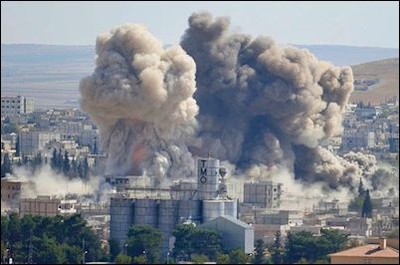
686Smoke rises from a U.S. air strike on Islamic State positions in Kobani.

As the aerial campaign begins in earnest, many observers are wondering what exactly its tactical and strategic objectives are, and how they will be achieved. A number of issues immediately arise.

Any state—even a provisional, slapdash, and fragile one like the jihadi entity now spreading across Iraq and Syria—cannot be “destroyed” from the air. At a certain point, forces on the ground will have to enter and replace the I.S. power. It is not yet clear who is to play this role—especially in the Islamic State’s heartland of Raqqa province in Syria.

In Iraq, the national military and the Kurdish Pesh Merga are now having some successes at chipping away at the Islamic State’s outer holdings. The role of U.S. air support is crucial here. But the center of the Islamic State is not Iraq, and both the Iraqi forces and the Pesh Merga have made clear that they will not cross the border into Syria. This leaves a major question as to who is to perform this task, if the objectives outlined by President Obama are to be achieved.

The answer we have heard most often of late is that elements among the Syrian rebels will be vetted by the U.S., trained in cooperation with the Saudis, and then deployed as the force to destroy the IS on the ground.

If this is indeed the plan, it is deeply problematic.

The Syrian rebels are characterized by extreme disunity, questionable effectiveness, and the presence of hardline Sunni Islamist elements among their most committed units. There are certainly forces of an anti-jihadist ideology among them—the most well-known being the Syrian Revolutionaries Front, headed by Jamal Ma’arouf from the Jebel Zawiya area in northern Syria, and the smaller Harakat Hazm. Both movements have benefitted from Western aid in recent months.

The problem, however, is that these organizations are quite prepared to work with salafi groupings whose worldview is essentially identical to that of the I.S., even if their methods are somewhat different. Thus, if we observe the recent fighting between Assad’s forces and rebels in the Quneitra area along the border with the Israeli Golan Heights, it is clear that the main contribution to rebel achievements came from the Jabhat al-Nusra group, which constitutes the “official franchise” of the core al-Qaeda group in Syria.

Reliable sources confirm that Nusra cooperates with other rebel groups in southern Syria and has even been prepared to minimize its own role, so as to allow other groups to present achievements as their own to Western and Arab patrons and thus secure a continued flow of arms, benefiting all factions.

What this means is that by championing these rebel elements as the ground force which will seek to enter and destroy a weakened I.S. in Raqqa province, the U.S. would be putting itself in the position of supporting one group of Sunni jihadis against another.

In Iraq, while the Kurdish Pesh Merga cooperates de facto with Iran, their alliance is pragmatic and tactical, one that the Kurds would gladly break given the possibility of clear Western sponsorship.

But the fierce condemnations in recent days (even by supposedly “pro-Western” rebel groups such as Hazm) of the U.S. bombing raids into Syria indicate that there is a deeper problem here. The alliance between these Sunni rebel groups and the salafis has a common anti-Western component to it.

It is, in any case, not clear if these Sunni rebels will prove able to defeat the I.S., but even if they were to do so, the presence of radical anti-Western elements among them attests to the danger of a policy of support and sponsorship of them.

Of course, the Sunni jihadis are not the only dangerous players on the ground. Another possible, no less troubling, outcome of the air campaign against the Islamic State could be the return of Bashar al-Assad’s forces to eastern Syria, from which they have been largely expelled over the last year. It is not at all hard to imagine a scenario in which once the I.S. has been weakened by Western air attacks, the Syrian military and its Iranian-backed allies will be able to make gains.

Indeed, the Iranian Revolutionary Guard Corps (IRGC) are already present in northern Iraq (and, of course, in Syria as well) and IRGC personnel have taken part in the fighting in Iraq in recent weeks. Qods force teams are reportedly located at Samarra, Baghdad, Karbala, and the former al-Sahra Air Base near Tikrit. Iran has deployed seven SU-25 ground attack aircraft which have played a role in offering air support to the Kurds and Iraqi special forces.

Following intensive Western bombing, the possibility of the Islamic State eventually being sandwiched between pro-Iranian forces on either side before being destroyed would be a real one. This would achieve the desired goal of destroying the jihadi entity, but it could end up handing a major victory to the Assad regime and its Iranian backers—enemies of the West of significantly greater potency and seriousness than the Islamic State itself.

Such a result would be somewhat reminiscent of the Iraq invasion of 2003, in which the destruction of the Sunni regime of Saddam Hussein ended up largely helping Iran.

How does the West get out of this mess? The discussion about which ground force should be used to replace the Islamic State is itself confused by a much larger misunderstanding regarding the nature of the war now taking place in Iraq and in Syria (and periodically spilling over into Lebanon).

The I.S. has now been depicted as the main problematic factor emerging from this conflict. But the Islamic State is in fact merely a particularly extreme and brutal manifestation of a broader process taking place in this area, in which political Islam of a Sunni variety is at war with the Shia political Islam of Iran and its proxies (especially Hezbollah and the Assad regime).

The I.S. may promote a particularly lurid and repulsive version of Sunni political Islam, but in its beliefs and in its practices it does not represent some unique presence in the Syrian and Iraqi context. Rather, it is little more than a particularly virulent manifestation of a strain of politics and ideology which is the primary cause of the conflict taking place across the region.

In the two scenarios discussed above, both quite plausible outcomes of a Western air campaign, the I.S. would be defeated and replaced by another version of Islamism—either that of its fellow Sunnis, or that of the rival Shi’ites.

A third possibility, however, is that the White House does not actually intend to pursue a policy intended to physically destroy the Islamic State in its heartland in northern Syria. Certainly, more recent statements emerging from the Administration appear to be preparing to “walk back” the President’s comments.

White House Chief of Staff Denis McDonough said in mid-September that success for U.S. policy vis-à-vis the I.S. would come when the group “no longer threatens our friends in the region, no longer threatens the United States.” This sounds like the introduction to a more modest policy of degrading I.S. capabilities, rather than seeking to “destroy” the Islamic State.

Of course, such a modified objective would end the dilemma over which ground forces to ally with. On the other hand, it would also have the effect of a tacit admission that the U.S. did not intend to promote its policy as originally stated by the President in the aftermath of the horrific murder of two U.S. citizens by the Islamic State.

But whether or not the goal of destroying the Islamic State is pursued with vigor, the current failure to see accurately what is happening in the Levant and Mesopotamia looks set to remain. This, in turn, looks set to prevent the emergence of a coherent policy and a coherent allocation of resources.

What is taking place across Syria and Iraq, and across their borders into Lebanon, Turkey, and Iran, is a sectarian war, made possible because of the decline of the police states which for half a century kept the lid on sectarian differences. The regional ambitions of Iran, which has clients and proxies in all three countries, exacerbate this dynamic. The attempts by Saudi Arabia to block Iran’s advance toward the Mediterranean, and by Qatar and Turkey to sponsor various Sunni jihadi elements, have produced a far more confused, and far less effective, Sunni side in this struggle.

The struggle itself, in turn, can be traced back to the failure by these states to develop coherent notions of citizenship or stable national identities in the post-Ottoman period. In other words, this war has been a long time coming, but now it is here.

Because the nature of this struggle is not widely grasped in the West, policy appears somewhat rudderless. This is reflected in the current discussion regarding the response to the Islamic State.

First, Assad was the enemy. This was made clear enough not only by his support for Hezbollah and attempts to nuclearize, but also by his unspeakable brutality and use of chemical weapons against his own citizens.

Then, when the brutality of some of the rebels became apparent, Western public interest in supporting the rebels receded. Soon the I.S. emerged as the new bogeyman. Declarations for its destruction became de rigueur, though it is far from clear how this is going to be carried out—and a de facto alliance with Iran and its clients, at least in Iraq, has emerged. This was seen in the expulsion of the I.S. from the town of Amerli, a pivotal moment in the major setbacks faced by the organization in recent days. In that town, Shi’ite militias were backed by American air power—to telling effect against the Sunni jihadis.

But is it really coherent policy to be backing murderous Shi’ite sectarians against murderous Sunni ones? It is not. Of course, when the West backs the Sunni rebels in Syria, the precise opposite is happening. Weaponry donated to “moderate” rebels then inevitably turns up in the hands of Sunni jihadis, who do most of the fighting associated with the Syrian “rebellion.” The result is that in Iraq the U.S. is helping one side of the Sunni-Shia war, and in Syria it’s helping the other side.

Only when it is understood that the West cannot partner with either version of political Islam does it become possible to formulate a coherent policy toward the Sunni jihadi forces, on the one hand, and toward the Iran-led bloc, on the other.

Such a policy must rest on the identification and strengthening of non-Islamist forces willing to band together and partner with the West. Not all of them are perfect characters, but they all understand the threat that political Islam poses.

Most obviously, there is a line of pro-American states along the southern side of the arena of the war. These are Israel, Jordan, and in a far more partial and problematic way, Saudi Arabia. Both Israel and Jordan have demonstrated that they are able to successfully contain the spread of the chaos coming out of the north. Both are well-organized states with powerful militaries and intelligence structures. Jordan has clearly benefitted from the deployment of U.S. special forces to prevent incursions by the I.S. Israel has also made clear that its resources will be available to assist the Jordanians should this be required. (Egypt, too, while not in the immediate vicinity of the conflict, can be a silent partner as well—as its campaign against the Muslim Brotherhood and tough line against Hamas have shown, it is nothing if not a virulent opponent to political Islam.)

This is what the proper coordination of allied states is supposed to look like. And it works in containing the conflict. To the east of the war’s arena is of course Iran. To its west is the Mediterranean Sea. To its north is a long, contiguous line of Kurdish control, shared between the Kurdish Regional Government of President Massoud Barzani in northern Iraq, as well as the three enclaves created by the PKK-linked Democratic Union Party (PYD) in northern Syria. The YPG militia, which is the military force in these enclaves, has fought the I.S. almost since its inception, and has largely prevailed in keeping the jihadis out of the Kurdish areas.

As part of a strategy of containment, the West should increase support for and recognition of both the Kurdish enclaves in the north of Syria and the Kurdish Regional Government itself. Both are elements capable of containing the spread of the jihadis from the north. It has become clear in recent days that the Pesh Merga, despite early setbacks, is a useful instrument in preventing the further advance westward of the Islamic State, and in so doing protecting the investment of international oil companies in the oil-rich parts of Iraq. The YPG militia, though poorly equipped, has also avoided major losses.

Such a principle of alliance will also encourage the West to reconsider the involvement of Turkey. As events of the last few years have shown, Turkey cannot be a reliable ally in the struggle against political Islam, because its ruling party, AKP, is itself an Islamist party. This is not a theoretical formulation. Turkey’s support for Islamist militias in northern Syria and its opening of its border for them has been a major contributing factor in the proliferation of these elements. There is also considerable evidence that Turkey at the very least turned a blind idea to the activities of the I.S. in the border area in 2013, and may well have offered some help to the jihadis in their fight with the YPG.

In order to grasp the rationale for a policy of dual containment, the nature of the war between rival sectarian forces must be grasped. There is also a need for the clear understanding that the effort to preserve at all costs the territorial integrity of “Iraq” and “Syria” is mistaken. Rather, what should take place is support for those forces committed to order, as listed above, and non-support for the forces of political Islam.

In other words: If political Islam (rather than one specific jihadi group, to quickly be replaced by another) is the real problem, then the real solution is to ally, forcefully and over the long haul, with those forces most committed to stopping it: Israel, Jordan, the Saudis, and the Kurds.

So it may be seen that a lack of strategic understanding of the nature of the conflict being waged is preventing the development of a coherent response to the specific problem of the Islamic State, along with the parallel problems of Shia terror groups such as Hezbollah, and the ambitions of the Islamic Republic of Iran. At root is the failure to grasp the implacable nature of political Islam in both its Sunni and Shia variants at the present time.

From this original error, all further errors, and as we can see there are many, inevitably follow.

Islamic State, Al-Qaeda, Islam and Iran

October 10, 2014

(Please listen to this twenty-two minute interview with Clare M. Lopez. She highlights Iran’s central involvement and the benefits it receives. — DM)


U.S. Denies Visa to Victim of Boko Haram, Muslim Persecution of Christians, May 2014

October 8, 2014

U.S. Denies Visa to Victim of Boko Haram, Muslim Persecution of Christians, May 2014, Gatestone InstituteRaymond Ibrahim, October 8, 2014

(Gee, couldn’t Obama at least have explained, gently, in a friendly way but persuasively to King Abdullah that Islam is the Religion of Peace and why torturing and executing people on account of their religious beliefs is not Islamic? Just think of the difference he might have made (none whatever).– DM)

U.S. President Barack Obama did not “publicly broach the subject of religious freedom” during talks with Saudi King Abdullah, despite a letter from 70 members of Congress urging him to “address specific human rights reforms” both in public and in direct meetings with King Abdullah. It was “remarkable that the resident could stay completely silent about religious freedom…. as well as other human rights concerns, with King Abdullah.” — International Christian Concern advocacy group.

Al-Shabaab Islamists publicly beheaded a mother of two girls and her cousin after discovering they were Christians. The two daughters of one of the women, ages 8 and 15, “were witnesses to the slaughter,” sources said, with the younger girl screaming for someone to save her mother.

“You will regret why you left the prophet’s religion.” — Threatening phone message, Kenya.

The deplorable state of religious freedom in the Islamic world really came to the fore in May with the arrest, imprisonment, and death sentencing of a pregnant Christian wife and mother on the accusation that she had left Islam for Christianity. On May 15, Meriam Ibrahim of Sudan, after repeatedly refusing to convert to Islam, was sentenced to being flogged with 100 lashes, followed by being hanged for apostasy.

During her 6-month imprisonment, with her one-year-old son by her side, she gave birth to another child. The girl was born with disabilities due to the harsh conditions of the prison cell in which she was delivered, and the chains with which her “apostate” mother was still shackled as she gave birth.

Because Meriam Ibrahim’s plight made it to the mainstream media, however, Sudan released Ibrahim and her children in June.

Before her release, Islamic clerics were often sent to her cell where they repeatedly pressured, and threatened her with death, to convert to Islam. In a recent interview with Megyn Kelly on Fox News, Ibrahim said: “My faith was the only weapon that I had in these confrontations with imams and Muslim scholars because that’s what I believe. Faith means life. If you don’t have faith, you’re not alive.”

When Kelly asked her why she didn’t simply do what the clerics wanted and convert to Islam in the interest of freedom, Ibrahim replied:

If I did, that would mean I gave up. It’s not possible because it’s not true. It’s my right to follow the religion of my choice. I’m not the only one suffering from this problem. There are many Meriams in Sudan and throughout the world. It’s not just me; I’m not the only one…. With regard to the situation of Christians, this is a well-known fact that they live under difficult circumstances and they are persecuted and treated harshly. They are afraid to say they are Christian out of fear of persecution. Sometimes imprisoned Christians with financial difficulties are told that the government will pay off their debts if they convert to Islam…. If you are a Christian and you convert to Islam it will become hard to leave Islam because if you do so you will be subjected to the death penalty.

As Ibrahim’s son, imprisoned with her, is an American citizen from his father’s side, many Americans wondered why the Obama administration was not saying or doing much. Speaking of Ibrahim’s ordeal, Sen. Ted Cruz said, “There is urgency, a dire need for U.S. leadership. President Obama should speak out publicly and call upon the government of Sudan to free Meriam Ibrahim. Secretary of State John Kerry should speak out loudly and forcibly and call up on.” [sic]

Members of Congress are increasingly urging Obama to speak up on behalf of persecuted minorities throughout the Islamic world.

A few weeks earlier, human rights activists criticized the U.S. president for not addressing the plight of Christians and other minorities during his talks with leaders in Saudi Arabia, where Christianity is banned.

Many Christians, far from being released, are killed for being Christian and refusing Islam.

Around the same time the world was hearing about Ibrahim’s plight, a prominent underground church Christian leader was killed by Muslims from the al-Shabaab group in Somalia. “Sadness and grief has befallen our community when our dear brother Abdishakur Yusuf was mercilessly murdered in Mogadishu by unknown gunmen,” said a local source: “He was found outside his house lying in a pool of blood… He was shot in the head multiple times, so that his face is barely recognizable.” Yusuf leaves a widow and three children, ages 11, 8 and 5. Weeks before this murder, al-Shabaab Islamists publicly beheaded a mother of two girls and her cousin after discovering they were Christians. According to local sources, the Islamists “called residents to the town center to witness the executions of the 41-year-old mother, Sadia Ali Omar, and her 35-year-old cousin, Osman Mohamoud Moge.” Before slaughtering the two women, an al-Shabaab member announced, “We know these two people are Christians who recently came back from Kenya—we want to wipe out any underground Christian living inside ofmujahidin [jihadi] area.” The two daughters of one of the women, ages 8 and 15, “were witness to the slaughter,” sources said, with the younger girl screaming for someone to save her mother.

According to the Washington-based International Christian Concern advocacy group, Obama did not “publicly broach the subject of religious freedom” during talks on March 28 with Saudi King Abdullah, despite a letter from 70 members of Congress urging him to “address specific human rights reforms” both in public and in direct meetings with Abdullah and other officials.

“This visit was an excellent opportunity for the president to speak up on an issue that affects millions of Saudi citizens and millions more foreign workers living in Saudi Arabia,” said Todd Daniels, ICC’s Middle East regional manager. He added that it was “remarkable that the president could stay completely silent about religious freedom” despite pressure from Congress “to publicly address the issue, as well as other human rights concerns, with King Abdullah…”

Another report appearing in May further highlighted the U.S. government’s indifference. Deborah Peters, a Christian teenage from Nigeria girl told of how Boko Haram came to her household and slaughtered her father and brother because they refused to convert to Islam. After abusing her, they tied her up and left her in a state of shock between the two corpses. Emmanuel Ogebe, the human rights attorney who helped Peters come to the United States after the murders, said that visa requests filed on Peters’ behalf were denied “multiple times” in 2011, with the State Department citing no family ties in the U.S. as the reason. The incident became public only this May.

Similarly, a month earlier, the United States Institute for Peace brought together the governors of Nigeria’s mostly Muslim northern states for a conference in the U.S., but the State Department blocked the visa of the region’s only Christian governor, an ordained minister, citing “administrative” problems.

The rest of May’s roundup of Muslim persecution of Christians around the world includes (but is not limited to) the following accounts, listed by theme and country alphabetical order, not necessarily according to severity.

Muslim Attacks on Christian Churches

Iran: Plainclothes security authorities raided an Easter service in a house-church in southern Tehran. They arrested and hauled off all those in attendance. Neighbors said that security authorities were “very disrespectful to those in the house-church as well as to the neighbors.”

Malaysia: Two Catholic nuns in the Muslim-majority nation “were viciously attacked on the grounds of the Church of Visitation in Seremban in what is believed to be a robbery attempt early this morning,” reported the Malaysian Insider. Sister Juliana Lim was hospitalized in critical condition and on a respirator, while Sister Mary-Rose received treatment for various injuries. “Both nuns from the Infant Jesus Convent, were left bruised, bleeding and in shock following the attack, said Fr Chan in his Facebook posting, adding: ‘As I anointed them [two nuns], tears streamed down my face. I couldn’t help it. How wicked it is to do this to our nuns, who have given their whole life to God.'” In response, the Council of Churches of Malaysia said: “The voices of antagonism and hatred have been on the increase in the country and it would be no surprise if the attack on the nuns were not conspired by those out to cause inter-religious conflict in the country.”

Nigeria: Seven churches were attacked and 29 Christians slaughtered. On Sunday, May 25, during a worship service, Islamic terrorists from Boko Haram killed 21 Christians of the Church of Christ in Nations congregation in town of Gwoza. The next day, Boko Haram Islamists burned down six churches and slaughtered eight more Christians in the area.

Palestinian Authority: St. George’s Orthodox Church in Bethlehem was attacked by Muslims during its annual St. George’s Day services on May 6, leaving one Christian stabbed, several injured, and the building damaged. According to Leila Gilbert, “Some local Muslims either tried to park a car too close [to] the church and/or tried to enter the church during a service honoring St. George—the initial instigation isn’t clear. But when the intruders were asked to leave, one of them stabbed a Christian man who was outside the church serving as a guard. He was hospitalized. Several then started throwing stones at the church. 7 or 8 Christians were injured and some physical damage was done—broken windows etc. The police didn’t show up for an hour.”

Tanzania: Two churches were attacked. As Christians were gathered for overnight prayers in the Assemblies of God church, around 80 Muslim men armed with arrows and knives attacked the church building while shouting “death to apostates.” They set fire to the church, leaving its interior in ruins, and then went looking for its pastor, a Muslim convert to Christianity, presumably to slaughter him. Separately, a homemade explosive device in a plastic bag left inside the Evangelical Lutheran Church of Tanzania exploded in the face of a female employee who found it, causing serious injuries to her face and legs and leaving her in critical condition.

Turkey: At least one Turkish church’s website was labeled “pornographic” and blocked from computers at the Grand National Assembly of Turkey, prompting one legislator to demand an investigation. When asked, the speaker for the ruling Islamist Justice and Development Party (AKP) said it was likely a technical glitch, but Aykan Erdemir, the legislator who discovered it, said “I wouldn’t be surprised if there was some malicious intent.” Umut Ṣahin, general secretary for Turkey’s Association of Protestant Churches, said the ban was “horrible… It’s a shame. It really pains us at having this kind of accusation when we have a high moral standard.”

Muslim Attacks on Christian Freedom: Apostasy, Blasphemy, Proselytization

Egypt: A Coptic Christian teacher, Bishoy Camille, was sentenced to four years in prison and fined 10,000 Egyptian pounds [$1,400 USD]. He was found guilty of sharing cartoons of the Islamic prophet Muhammad on Facebook, prompting Muslim riots against the Copts.

Iran: A May report by Morning Star News said that “Iran’s secret police and Revolutionary Guard are subjecting Christians to a continuing wave of arrests, and increased torture and brutal beatings, in an effort to crush the house-church movement, activists said. Human rights activists confirmed that there has been a noticeable increase this month in the number of reported assaults against Christians imprisoned in Iran. The assaults, which are taking place against converts who lead house churches, are meant to send a message to Christians in the country, said a Middle East Concern [MEC] researcher who focuses on Iran.” On May 5, for instance, internal security agents arrested Silas Rabbani, a leader with the Church of Iran in Karaj. Rabbani, a former Muslim, has been “informally charged” with apostasy and was accordingly beaten while in custody. “He was then transferred to Gohardasht Prison, also known as Rajai Shahr, where the torture has continued.”

Kenya: Three weeks after converting to Christianity, Hassan Hussein Mohammed, a 26-year-old former Muslim, was severely beaten in a mosque. Although he was training to become a Muslim leader, he met some Christians, discussed religion, and eventually converted. According to Morning Star News, “Mohammed later went to the mosque only to collect his identification papers, but leaders ordered him to stay and conduct evening prayers. After some hesitation, he agreed. A voice within, he later told church leaders, told him not to lead the prayers, and when he tried to say them his mind blanked. He then admitted that he had accepted ‘Isa,’ Jesus. Those in the mosque beat him with a blunt object, kicked him and struck him until he was unconscious, he told church leaders. When he regained consciousness a few minutes later, he said, ‘I am ready to die for Isa, and I forgive you for what you have done to me.'” He managed to escape, but after news of his conversion spread, Mohammed began receiving threatening phone messages and texts. One said: “You will regret why you left the prophet’s religion.”

Pakistan: When a Muslim religious leader discovered that four Christians, a married couple, and two women, were handing out Christian pamphlets, he immediately informed police who arrested the Christians, taking them away from a growing crowd of angry Muslims. According to Fr. Arshad John of the Archdiocese of Karachi, who is engaged in the protection of minority rights: “The claims that the religious minorities are free to practice and preach their religion, is clearly evident from this act. Although the act of distributing the religious material and preaching in such areas is not very wise, in the past such cases have produced unfortunate results. We pray for the group and hope they will be released soon.” Separately, the Pakistan Christian Post reported that Dr. Nazir S. Bhatti, President of Pakistan Christian Congress, was concerned about a recent example of double standards concerning the implementation of blasphemy laws. He said that when any Muslim commits blasphemy on electronic media watched by millions, he or she is pardoned after a simple apology note, but when a Christian or Ahmadiyyia community member is accused of blasphemy by one Muslim wittiness, then he faces death sentence even if he swears that he did not insult the name of prophet Muhammad: “All Christian victims of blasphemy laws after arrests have publically denied committing blasphemy but not any court or complainant have pardoned them but when a Muslim cleric or any Muslim very openly defiles name of Prophet Mohammad then uproar of Islamic decrees appear to Pardon these Muslims.”

Sudan: In the town of al-Gadarif on Sudan’s eastern border with Ethiopia, another Christian woman, like Meriam Ibrahim, was incarcerated on the accusation that she had apostatized from Islam. Immigration authorities arrested Faiza Abdalla, 37, when she responded to officers’ questions about her religion that she was Christian. They immediately arrested her based on her Muslim name. (Her family had converted to Christianity before she was born but kept their former name.) As with Meriam Ibrahim and others, a court went on to annul Faiza’s marriage to her husband, a lifelong Catholic from South Sudan, on grounds that she had committed “adultery” by allegedly having left Islam and married a Christian.

Dhimmitude: Generic Hostility, Abuse, and Discrimination

Egypt: Lawyers for a Muslim man who attacked Christian properties and persons—stabbing one Coptic woman to death—maintain that he is innocent by reason of insanity, even though psychiatric evaluations found him sane and fit to stand trial. Last February, Mahmoud Mohamed Ali went on a violent rampage, attacking three Christians with a knife. When his intended victim, a male Coptic pharmacy clerk, fought him off, Ali fled. Next, Ali stabbed Demian, a Coptic shopkeeper in another Christian-owned pharmacy; he severed an artery in her neck. She fell to the floor and bled to death. Soon after, Ali stabbed a female Coptic high school student, who barely managed to escape with her life. But according to Morning Star News: “Confirming fears of human rights activists who said attorneys for Mahmoud Mohamed Ali would use a tactic that has freed other Muslims from punishment for premeditated, religiously motivated murder, the lawyers are challenging results of the evaluation.”

Some Islamic teachings state that the life and worth of a Muslim is greater than that of an “infidel” and so they should not be punished, or should receive the minimum punishment when they kill non-Muslims. Egyptian human rights activist Osama Wagdy said the “insanity” plea is a tactic commonly used in Egypt by those who have violently targeted Christians: “They are pretending, because that is how they get out of cases… Nobody thinks he is mentally ill. He went from one place to another knowing what he was doing and told one of the victims, ‘You deserve it.'” Separately, five “unidentified persons” kidnapped a Coptic Christian pharmacy owner at gunpoint in Sohag, Upper Egypt. Shortly after Friday mosque prayers, a car pulled up in front of the pharmacy and opened fire on it before the assailants raided it and drove off with the kidnapped owner, Mr. Marcos, a 52-year-old Copt, at gunpoint.

Eritrea: Five Christians of the Evangelical Lutheran Church were arrested after their church announced that they were set to be ordained for pastoral ministry. “The arrests clearly show how even government recognized churches, namely the Catholic, [Eritrean] Orthodox [Church] and Evangelical Lutheran churches, are not free from government control,” said a source from the Open Doors organization on condition of anonymity. “The arrest of these pastoral candidates reminds us of one of the greatest challenges churches in Eritrea face…. Due to the constant turnover of pastors due to arrest or threats, continuous and biblically consistent pastoral care for Christians is hampered.” Further, “1,500 Christians are languishing in prison for their faith.” In 2010, an estimated 3,000 Christians were incarcerated for their faith; most were held in shipping containers in desert camps and others in underground cells; some were tortured to death while others perished in the desert trying to escape.

Germany: A Turkish man being treated in a hospital attacked his nurse because there were too many crosses on the wall. According to Mainpost, a German publication (as translated by Nicolai Sennels for Jihad Watch), “A 34-year-old went to St. Joseph Hospital early on Saturday morning due to a ‘gastro-intestinal flu.’ Suddenly he refused to be treated, because he thought there were too many Christian crosses on the wall. Because of the crosses, the man started insulting the nurse, calling her a bitch, fascist, and the like. Then the man, according to police report, also started becoming physically aggressive. The hospital called the police. The officers seized the man in front of the hospital and checked him.”

Pakistan: Five Christian families that, according to Agenzia Fides, were “kidnapped and enslaved by their Muslim employers” in the Punjab were released after nearly three decades of slavery. After their release, one of the families told of their suffering: they were victims of forced labor and were treated as slaves for over 25 years. One of the women, Safia Bibi, began working at the brick kiln along with her husband, Anwar Masih, right after her wedding. When their nine children were old enough, they also started to work in the same place. They lived in the factory complex with no toilets and often did not receive compensation. If they tried to leave their job, they were beaten and tortured, left days without food. In 2013, Safia’s husband died due to illness and weakness; no doctor was called. Her children could not attend his funeral—or go to prayer meetings or celebrate Christmas—because they were forced to work.

Nasir Saeed, a human rights activist, said: “It is sad to see that even in the 21st century slavery continues to exist in Pakistan. The owners of furnaces are often wealthy and influential and are rarely prosecuted. The workers, often Christian, work a life in slave-like conditions to pay their debts, that last generations. Sometimes they are sold from one furnace to another. The government is aware of the situation, but has never taken serious measures.”

Turkey: According to ANSamed, “Prime Minister Recep Tayyip Erdogan’s government plans to turn Istanbul’s Hagia Sofia Basilica into a mosque in the afternoon and evening and a museum in the morning. The historical monument, which draws millions of tourists every year, will have the Byzantine [Christian] frescoes covering its walls cast into shadow by ‘dark light’ so as to avoid offending Islam. The government would thus like to turn what is today seen as a symbol of Christianity back into a place of worship for Muslims, as it was after the Ottoman conquest of Constantinople in 1453.” A campaign to turn the Hagia Sofia back into a mosque has been brewing for quite some time now, raising alarm among Christian communities in the east. Patriarch of Constantinople, Bartholomew I, said that, “We and all other Christians will oppose it.” And Athens called it [sic] an “insult to the religious sensibilities of millions of Christians.” Even so, the Islamist party submitted a formal motion in parliament to transform Hagia Sofia into a mosque.
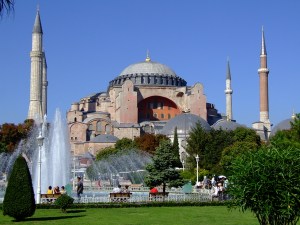
Hagia SophiaThe Turkish government plans to convert Istanbul’s Hagia Sofia Basilica, currently used as a museum, into a mosque. (Image source: Wikimedia Commons/Jerzy Kociatkiewicz )

While not all, or even most, Muslims are involved, persecution of Christians is expanding. “Muslim Persecution of Christians” was developed to collate some—by no means all—of the instances of persecution that surface each month.

It documents what the mainstream media often fails to report.

It posits that such persecution is not random but systematic, and takes place in all languages ethnicities and locations.

Obama’s Peace Process for Iraq, Syria and the Islamic State begins [Caution: includes satire]

October 2, 2014

Obama’s Peace Process for Iraq, Syria and the Islamic State begins [Caution: includes satire], Dan Miller’s Blog, October 2, 2015

Obama was heard to remark during a recent presidential golf game,

“Israel is a terrorist war criminal. It won’t even yield to my reasonable demands for a two state solution with my beloved Palestinians, whose children and other innocent civilians it relishes murdering. However, Iraq, Syria, ISIL, etc. are humanitarians and will recognize that I am like them, as I lead them to peace through the Light of My true wisdom and greatness.”

FINALLY, He has a plan!

His best plan yet!

Obama functions at His very best with no intelligence. Intelligence would imperil His domestic and foreign priorities and perhaps even His brilliant world view.

I don’t think the problem is Obama’s inattentiveness. It’s not the demands of his golf game. It’s not his incessant fundraising. It’s his worldview. [Not satire.]

(The video is not satire)

The first Peace Process phase

In Iraq and now in Syria, Obama is trying to appear less humanitarian. It’s the initial focus of His Peace Process (PP), through which He plans to arrange a three state solution among the Non-Islamic Islamic State, its cohorts, friends and associates, Iraq and Syria. During His initial PP phase, He intends to gain credibility with and empathy from the Islamic State, et al. Accordingly, He has lifted His rules of engagement, previously intended to minimize civilian casualties, when striking forces of the Islamic State, et al.

The White House revealed on Tuesday that its usually strict rules of engagement, intended to prevent civilian casualties of US airstrikes, have been relaxed in the current offensive against the Islamic State and other radical Islamist groups. [Emphasis added.]

National Security Council spokeswoman Caitlin Hayden told Yahoo News in an email that a much-publicized statement last year by President Barack Obama that US drone strikes would only be carried out if there is a “near certainty” of no civilian injuries would not apply to the US campaign against jihadi forces in Syria and Iraq.

Hayden wrote that the “near certainty” rule was intended “only when we take direct action ‘outside areas of active hostilities,’ as we noted at the time.

“That description — outside areas of active hostilities — simply does not fit what we are seeing on the ground in Iraq and Syria right now,” she continued, but added that the strikes, “like all US military operations, are being conducted consistently with the laws of armed conflict, proportionality and distinction.”

The statement came after reports that a dozen civilians, including women and children, were killed on September 23 after an errant Tomahawk cruise missile hit a house in the village of Kafr Daryan, in Syria’s Idlib province, believed to be a stronghold of al-Qaeda-linked militants. [Emphasis added.]

In a briefing to the House Foreign Affairs Committee last week, Syrian rebel commanders described scenes of devastation as the bodies of women and children were pulled from the beneath the rubble of the destroyed building, which was apparently being used as a shelter for displaced civilians. [Emphasis added.] [Not satire.]

It’s His most clever strategy yet, and only Obama could devise it: by showing the Islamic State, et al, that He agrees with their strategy of maximizing casualties, both combatant and civilian, Obama will easily convince them of the benefits of the true peace and security His PP will provide.

When asked whether, during the next Gazan conflagration, Israel should adopt His modified rules of engagement, Obama was heard to mumble at the 15th hole, “That’s entirely different. Hamas does not threaten My popularity in My country.” State Department spokesperson Jen Psaki hinted at much the same in August:

US State Department Spokesperson Jen Psaki delivered an unusually strong condemnation of an Israeli strike near a Gaza school being used as a shelter in Rafah, saying that the US was “appalled” by the “disgraceful shelling outside an UNRWA school. [Emphasis added.]

The shelling, which left 10 people dead according to Palestinian reports, drew harsh condemnations worldwide, including from the United Nations, London and elsewhere, amid growing international criticism of the 27-day-long operation. [Emphasis added.]

The IDF issued a statement saying that forces had targeted three Palestinian Islamic Jihad terrorists on board a motorcycle in vicinity of an UNRWA school in Rafah, and added that “the IDF is reviewing the consequences of this strike.”

However, the US said that the presence of combatants did not justify targeting areas near the school. [Emphasis added.]

. . . .

Before the reports of the latest strike came in, senior White House adviser and Obama confidant Valerie Jarrett addressed the ongoing violence on CBS’s Face the Nation Sunday morning.

Describing the conflict as “a devastating situation,” Jarrett asserted that “Israel absolutely has the right to defend itself, and we are Israel’s staunchest ally.”

At the same time, she added that “you also can’t condone the killing of all of these innocent children,” referring to the hundreds of civilian casualties reported in Gaza over the course of the past three weeks. [Emphasis added.] [Not satire.]

Neither Psaki nor Jarrett mentioned Obama’s popularity at home expressly. However, increasing civilian (mainly Muslim) casualties in Iraq and Syria, and demanding that Israel do even more to engage in strictly proportionate kinetic actions against Hamas Islamists, are both calculated to increase Obama’s popularity at home. This twofer is consistent with an address prepared for Him by my confidential White House informant, The Really Honorable I.M. Totus:

Israel’s actions have been disgracefully disproportionate and must stop. If they do not cease before I leave for my much needed family vacation at Martha’s Vineyard on August 9th, my red line will have been crossed and upon my return I may issue an Angry Executive Decree chastising Israel. Here is what Israel has done and what it must stop doing:

Israel has used WMDs (Weapons Minimizing Death and Destruction) including “Iron Dome,” warning sirens and shelters to thwart missile attacks. The Palestinians in Gaza have no even remotely comparable WMDs: They have no Iron Domes, their tunnels — clearly dug as air-raid shelters — have been destroyed maliciously and their air-raid sirens often can not be used due to Israel’s inhumane refusal to furnish electricity. They are therefore forced to use civilians, including small children, to guard their missile sites. They do so in the forlorn hope that Israel will take pity on them and refrain from attacking. Merciless Israel continues to attack, wantonly and intentionally wasting the precious lives of many innocent Palestinians. [Emphasis added.] [Satire.]

Second PP phase

Unlike the Obama Nation and its splendid coalition of the unwilling, the Islamic State, et al, have no aircraft. Nor have they any WMDs comparable to the Iron Dome used by wickedly ferocious Israel. Despite that, airstrikes have done little to diminish their effectiveness.

As of Tuesday, the U.S. and its coalition partners had conducted nearly 310 air attacks on Islamic terrorist targets, more than 230 in Iraq and 76 in Syria, a Pentagon spokesman said.

And while the air campaign has forced the terrorists to change their tactics, “We still believe ISIL remains a very potent force,” Admiral John Kirby told reporters on Tuesday. [Emphasis added.]

“Yes, they’ve changed some of their tactics, there’s absolutely no question about that, in response to the pressure that we put them under, but that doesn’t make them less dangerous or less potent over time,” Kirby said. [Emphasis added.] [Not satire.]

Accordingly, during the second phase of His PP strategy, Obama will cease all air strikes. He will also require Iraqi, coalition and any U.S. boots on the ground to use only stolen or abandoned weapons, ammunition and vehicles. As the photo provided below clearly shows, Islamic State, et al, forces have little more than rocks for weapons and that is not fair. Neither is forcing them to steal the few they do have, vigorously punished under Sharia law.

islamic-state-stoning-from-dabiq-magazine-ip_0 (1)

Additionally, all lethal weapons heretofore provided to those fighting disproportionately will now be provided only to the Islamic State, et al. Obama will make it perfectly clear that, in return, non-Islamic freedom fighters must read their rights under Sharia law (to be drafted by Attorney General Holder) to all whom they intend to execute. If convenient, the notification must be read in languages they are believed able to understand.

These steps will level the playing field and help the non-Islamic Islamic State, et al, to understand that Obama is the Messiah of true Peace, Virtue and Understanding based on true Islamic values under Sharia law, as recently articulated in a letter signed by one hundred and twenty-six moderate Islamists (not satire). They may even accept Him as the Mahdi, an honor greater even than His highly regarded and equally well deserved Nobel Peace Prize.

Third PP phase

With the realistic understanding of His life, His universe and everything which Obama will thus give to them, they will follow Him anywhere He may lead, particularly from well behind. They will jump, shout with joy and fire our their rifles into the air when He receives His second Nobel PP prize.

Conclusions

According to Reuters, Obama met with Israeli Prime Minister Netanyahu at the White House on October 1st — the same day that His new rules of engagement increasing civilian casualties in Iraq and Syria were announced.

Even as Netanyahu pressed Obama over Iran in White House talks, the president urged the Israeli leader to help find ways to prevent Palestinian civilian casualties like those inflicted in the recent Gaza war between Israel and Hamas militants.

. . . .

While Netanyahu put the emphasis on Iran, Obama was quick to focus on the bloody 55-day Gaza conflict, which ended in August with no clear victor. This followed the collapse of U.S.-sponsored peace talks between Israel and Palestinians in April. [Not satire]

“Iran? Nukes? What’s wrong with that,” Obama didn’t ask. He probably knows that a nuke deal allowing the Islamic Republic of Iran to get (or to keep) nukes will enhance His popularity ratings if Iran doesn’t actually use them until He leaves office in January of 2017, in accordance with His informal understanding with the Islamic Republic. And to Him, that’s what matters. When He leaves office, anything bad that happens will be somebody else’s fault, as He will be quick to point out.

Anne in PT, my favorite Israeli blogger, wrote a serious article about Obama’s hypocrisy titled Hypocrisy as demonstrated by the White House. She began,

In this post I want to highlight the brazen double standards and utter screaming hypocrisy demonstrated by that ill-mannered hostile man who stands at the head of Israel’s ostensible best friend, America. [Not satire.]

She then does so, clearly and well. I had considered writing a similar article but didn’t have the stomach for it. Therefore, I tried to write this bit of satire instead.

Iranian Doctor Hung for ‘Heresy’ After Eight Years in Prison

October 1, 2014

Iranian Doctor Hung for ‘Heresy’ After Eight Years in Prison, Washington Free Beacon, , October 1, 2014

Executed for making claim that Jonah did not emerge from whale’s belly

Mideast Iran Execution

Iran officially executed 373 people in 2013. But according to Cornell University’s Deathpenaltyworldwide.org database, there were between 624 and 727 last year, up from an estimated 314 to 580 in 2012.

The U.S.-based Iran Human Rights Documentation Centre puts the total number of executions at 531 for this year.

***********************

(Reuters) – A former psychologist has been executed for heresy in Iran after eight years in detention, human rights groups said, in the latest example of what activists say is a worrying rise in the use of death penalty by the Islamic Republic.

Mohsen Amir Aslani was hanged in a prison near the city of Karaj west of Tehran on Sept. 24, according to the Human Rights Activists News Agency (HRANA), which is based outside Iran, for “corruption on earth and heresy in religion”.

Iranian opposition news websites have said Aslani, 37, had given religious classes where he propagated a new interpretation of the Koran. He was also accused by the authorities of insulting the Prophet Jonah.

The Iran Wire website reported that in one of his classes he told his audience that Jonah could not have emerged from the whale’s belly, and it was this statement that led to his charge of insulting the Prophet Jonah.

U.N. Secretary-General Ban Ki-moon has expressed alarm at a reported increase in executions in Iran. Iran has one of the highest levels of executions in the world, second to China, according to Amnesty.

Some human rights activists and others fear that hardliners who oppose pragmatic President Hassan Rouhani and his negotiations with Western powers over the country’s nuclear program are pushing the executions to weaken him.

Iran officially executed 373 people in 2013. But according to Cornell University’s Deathpenaltyworldwide.org database, there were between 624 and 727 last year, up from an estimated 314 to 580 in 2012.

The U.S.-based Iran Human Rights Documentation Centre puts the total number of executions at 531 for this year.

On Thursday, in an open letter to Iran’s Supreme Leader, Ali Khamenei, 18 physics Nobel laureates called for the “immediate and unconditional” release of Iranian physicist and prisoner of conscience, Omid Kokabee, according to a statement by the International Campaign for Human Rights in Iran.

He is suffering serious health problems, according to the campaign.

Kokabee, who was arrested while on a visit to Iran from the United States in 2011 where he was studying, was charged with “communicating with a hostile government,” and receiving “illegitimate funds.”

In an open letter from Evin prison, in April 2013, Kokabee wrote that his imprisonment was the result of his refusal to heed pressure by Iranian intelligence agents to collaborate on a military research project.

Muslim Leaders Sign Letter Against ISIS, But Endorse Sharia

October 1, 2014

Muslim Leaders Sign Letter Against ISIS, But Endorse Sharia, Clarion ProjectRyan Mauro, October 1, 2014

(Abdullah Bin Bayyah is among the “moderate” Islamists signing the letter. He was noted favorably in Obama’s September 24, 2014 address to the UN General Assembly. — DM)

Islamic-State-Stoning-From-Dabiq-Magazine-IP_0A picture of a the sharia punishment of stoning from the Islamic State’s Dabiq magazine (Issue #2)

A published letter to the Islamic State (ISIS)  signed by 126 international Muslim leaders and scholars, including top American leaders, is getting major press for rebutting the theological arguments behind the actions of Islamic State. Unfortunately, the same letter endorsed the goal of the Islamic State of rebuilding the caliphate and sharia governance, including its brutal hudud punishments.

Point 16 of the letter states, “Hudud punishments are fixed in the Qu’ran and Hadith and are unquestionably obligatory in Islamic Law.” The criticism of the Islamic State by the scholars is that the terrorist group is not “following the correct procedures that ensure justice and mercy.”

The Muslim “moderates” who signed the letter not only endorsed the combination of mosque and state; they endorsed the most brutal features of sharia governance as seen in Iran, Saudi Arabia and elsewhere.

An example of a hudud punishment is the death penalty for apostates (Muslims who leave Islam). The letter does not dispute or oppose that. It says that labeling Muslims as apostates is only permissible when an individual “openly declares disbelief.”

The signatories are not condemning the execution of apostates, only how the Islamic State is deciding who qualifies as an apostate.

Point 7 states that Islam forbids the killing of diplomats, journalists and aid workers, but it comes with a very important exception.

“Journalists—if they are honest and of course are not spies—are emissaries of truth, because their job is to expose the truth to people in general,” it reads.

This is actually an endorsement of targeting journalists that Muslims feel are unfair. Islamists, including Islamic State supporters, often claim that the journalists they kill are propagandists and/or spies, meeting the letter’s standards.

Point 22 of the letter states, “There is agreement (ittifaq) among scholars that a caliphate is an obligation upon the Ummah. TheUmmah has lacked a caliphate since 1924 CE. However, a new caliphate requires consensus from Muslims and not just from those in a small corner of the world.”

A caliphate is a pan-Islamic government based on sharia; virtually all Islamic scholars agree that this objective requires the elimination of Israel. It is also fundamentally (and by definition) expansionist.

Again, the “moderate” signatories endorse the principles of the Islamic State and other jihadists but criticize their implementation.

Point 5 states, “What is meant by ‘practical jurisprudence’ is the process of applying Shari’ah rulings and dealing with them according to the realities and circumstances that people are living under.”

It continues, “Practical jurisprudence [fiqh al-waq’i] considers the texts that are applicable to peoples realities at a particular time, and the obligations that can be postponed until they are able to be met or delayed based on their capabilities.”

This is an endorsement of the Islamist doctrine of “gradualism.” This is an incremental strategy for establishing sharia governance, supporting jihad and advancing the Islamist cause.

The Islamic Circle of North America (ICNA), whose leader is a signatory of the letter, preaches this concept in its own publications. An ICNA teaching guide published by the Clarion Project preaches gradualism as its strategy for implementing sharia governance and resurrecting the caliphate.

ICNA’s manual directs Muslims to use deception and infiltrate the government. The gradualist strategy is part of a jihad that includes war with the ultimate goal of conquering the world.

A weakness in the letter is the vague terminology that gives room for terrorist groups like Hamas to justify their violence.

For example, point 8 states that “Jihad in Islam is defensive war. It is not permissible without the right cause, the right purpose and without the right rules of conduct.”

The letter goes into detail about these qualifications in order to condemn the tactics of the Islamic State, but the terms of a “defensive war” are not spelled out. All Islamist terrorists consider their attacks “defensive.”

Muslim-American activist Michael Ghouse pointed out the need for clarification in a conversation with me about the letter. He said:

“Define the right cause. Is fighting against India in Kashmir a jihad? Was the war between Iraq and Iran two decades ago a jihad? This group needs to continue to update these situations to let the common Muslim know what is right and what is wrong, lest he commits himself to the jihad.

Islamists regularly redefine words like “clear disbelief,” “democracy,” “justice,” “peace” and “terrorism” on their own terms. The use of subjective language like “innocents,” “mistreat,” “defensive” and “rights” leave much room for interpretation.

This is what enabled a terrorism-supporting cleric named Sheikh Abdullah Bin Bayyah to sign the letter. He is linked to the Muslim Brotherhood, has called for attacks on U.S. soldiers in Iraq, supports Hamas and seeks the destruction of Israel.

The Islamist leaders behind the anti-Islamic State letter are still endorsing Islamic sharia law, which is oppressive and incompatible with Western values. The implementation of sharia is what drives all Islamic extremism.

The letter also utilizes Islamist thinkers that formed the intellectual foundation for today’s extremism. For example, it cites Ibn Taymiyyah. Terrorism expert Atto Barkindo writes, “Some scholars suggest there is probably no other Islamic theologian, medieval or otherwise, who has had as much influence on radical political ideology of Islam as Ibn Taymiyya.” This includes the leaders of Al Qaeda.

Ghouse told the Clarion Project that sharia as encoded by such scholars, needs revising. “Classical texts that are referred to in the list are part of the problems,” Ghouse said. “We need to make a commitment to question and revise the exegeses of the Ulemas [scholars] like Ibn-Kathir, Ibn Taymiyyah, Maududi, Hassna al-Banna and others. We cannot equate them to Quran and Hadith.”

The letter does make a much-needed rebuttal to the murdering of diplomats, noncombatants, labeling of Yazidis as apostates, attacks on Christians, forced conversions and torture. It states that Arab Christians are exceptions to the “rulings of jihad” because of “ancient agreements that are around 1400 years old.”

The letter also does tries to persuade Muslims to reject the Islamic State because of its tactics and procedures; however, it reinforces the Islamist basis of those actions.

Far from proving that the Muslim-American signatories are “moderate,” the letter actually exposes them as Islamist extremists because of their endorsements of sharia governance, its brutal hudud punishments and the resurrection of the caliphate.

These 18 leaders include:

Kurdish Female Fighters against ISIS – FEMALE STATE (extended un-aired footage)

September 30, 2014

Kurdish Female Fighters against ISIS – FEMALE STATE (extended un-aired footage), September 29, 2014

(Why are “we” not providing more support to the Kurdish fighters? Might it offend some members of our “coalition of the willing” that the Kurdish fighters — women among them — probably would not require remedial training of the type “we” apparently need to provide to Iraqi troops and others? WTF — “Win the Future,” or something. Who is leading this clusterdunk and from where? Please see also Obama betrays the Kurds.— DM)

“Goodbye, Dear Mum”: Iran Executes Rayhaneh Jabbari — UPDATED

September 30, 2014

“Goodbye, Dear Mum”: Iran Executes Rayhaneh Jabbari, Jonathan Turley, September 30, 2014

(Update: According to Fox News, her execution has again been postponed — DM)

[E]arly Tuesday, Shole Paravan said she had learned the execution had been postponed. That word came after Paravan and other supporters of Jabbari went to Rajaiy Shahr Prison to protest the pending execution, and after Jabbari’s farewell.

(Please see also Iran’s “Hanging Machine” to Execute Reyhaneh Jabbari. But what the heck; it’s not as though the Islamic Republic of Iran were Islamic or even evil. Just give them (or let them keep) nukes to play with. — DM)

Iran execution

It is another notch in the belt of Iran’s Sharia courts and medieval prison system.

*********************

Over international protests, Iran has reportedly executed Rayhaneh Jabbari, 26. Jabbari claimed that a former Iranian Intelligence Ministry employee tried to rape her and that she stabbed in him the shoulder to escape. Despite the fact that a drink given to her was found to contain a date rape drug, the Iranian officials still wanted her hanged and they have now carried out their intent. As she was being led away to be hanged, a guard showed mercy and gave her his phone to type a final message to her mother. Her reported message below is poignant and tragic as a final goodbye to her mother.

Jabbari wrote:

“I am currently handcuffed and there is a car waiting outside to take me for the execution of the sentence. Goodbye, dear Mum. All of my pains will finish early tomorrow morning. I’m sorry I cannot lessen your pain. Be patient. We believe in life after death. I’ll see you in the next world and I will never leave you again because being separated from you is the most difficult thing to do in the world.”

When her mother called the prison to ask what she could do, they told her to pick up the body of her daughter.

Jabbari was a decorator who said that she was contacted Morteza Abdolali Sarbandi, who arranged a meeting. She said that Sarbandi drugged her and tried to rape her after the two met at a café and she agreed to go to his office to discuss a business deal. She said that Sarbandi took her to a remote building and offered her a fruit drink which was later found to contain the date-rape drug. Her family noted that the wounds from a small pocket knife to the shoulder would not have caused death.

After her arrest, her family said that she was tortured to confess.

It is another notch in the belt of Iran’s Sharia courts and medieval prison system.