Archive for the ‘Irqui military’ category

Despite reports, Syria’s Palmyra and Iraq’s Mosul not on verge of liberation

March 24, 2016

Despite reports, Syria’s Palmyra and Iraq’s Mosul not on verge of liberation, DEBKAfile, March 24, 2016

In complete contrast with media reports issued on Thursday morning, the Iraqi army is not preparing to liberate Mosul, the country’s second largest city, and the Syrian army is not on the verge of capturing Palmyra.

DEBKAfile‘s intelligence and military sources report that the Syrian army is not capable of taking over the historic city without support from the Russian air force. On President Vladimir Putin’s orders, the Russian military has recently reduced its support of the Syrian army to a minimum until Damascus agrees to negotiate with the opposition regarding the country’s future.

The sources add that the Iraqi army does not intend to attack ISIS-held Mosul at any time in the near future, and has even reduced its forces near the city by sending a number of battalions to Baghdad to protect the capital from attacks by the terrorist organization.

US-Iranian-Russian-Iraqi offensive launched to recover Ramadi from ISIS

December 22, 2015

US-Iranian-Russian-Iraqi offensive launched to recover Ramadi from ISIS, DEBKAfile, December 22, 2015

Ramadi_Map

Ramadi, the capital of the vast Anbar Province, was the second major Iraqi city to fall to the Islamic State after the devastating loss of Mosul. The importance of the offensive launched Tuesday, Dec. 22 for its recapture from ISIS lies chiefly in the makeup of the assault force, which is unique in contemporary Syrian and Iraqi conflicts.

DEBKAfile’s military sources name its partners as US and Russian army and air force elements, two varieties of Iraqi militia – Shiites under Iranian command and Sunnis, as well as the regular Iraqi army.

The Iraqi army is depicted as leading the assault. But this is only a sop to its lost honor for letting this Sunni city fall in the first place. The real command is in the hands of US Special Operations officers alongside Iraqi troops, and the Russian officers posted at the operational command center they established last month in Baghdad.

This Russian war room is in communication with US military headquarters in the Iraqi capital. It is from the Russian war room that the top commanders of the pro-Iranian militias send their orders. The most prominent is Abu Mahadi al-Muhandis, who heads the largest Iraqi Shiite militia known as the Popular Mobilization Committee.

Noting another first, our military sources disclose that Iranian officers liaise between the Americans and Russians on the front against ISIS. If this combination works for Ramadi, it will not doubt be transposed to the Syrian front and eventually, perhaps next summer, serve as the format for the general offensive the Americans are planning for wresting Mosul from the Islamic State.

When US Defense Secretary Ashton Carter was in Baghdad last week to review the final preparations for the Ramadi operation, US officials were still insisting that the Iraqi army was fit for the heavy lifting after being trained by American instructors.

By Tuesday, US sources were admitting that pro-Iranian militias were also part of the operation.

DEBKAfile’s military sources report on the division of tasks as follows:

Iraqi army forces are attacking the Ramadi city center from the north; Shiite militias from the south. The US air force is pounding ISIS targets inside the town in order to cripple its ability to fight off the oncoming forces. The Russian air force is standing by, ready to destroy any ISIS reinforcements attempting to cross in from Syria to aid their comrades in beleaguered Ramadi.

Experts keeping track of the offensive have no doubt that it will end in success. The jihadists holding Ramadi are few in number – 400-500 fighters at most. However, cleansing the town after victory will presents a daunting difficulty. In Tikrit and the refinery town of Baiji, ISIS split its defense structure into two levels – one on the surface and the second hidden underground.

The top level was thinly manned by fighting strength, but crawling with mines, booby-trapped trucks and IEDs detonated by remote control.

The lower level, consisting of deeply-dug interconnected tunnel systems, was where ISIS fighters hid out and jump out at night for attacks. According to the experience gained in other Iraqi battle arenas against ISIS, neither the Iraqi army nor local Shiite militias have been able to plumb and destroy these tunnel systems. And so they could never really purge the Islamic State from “liberated” towns.

Ramadi will face the same quandary.

The Islamic State Is Here to Stay

June 5, 2015

The Islamic State Is Here to Stay, VICE NewsAhmed S. Hashim, June 6, 2015

(Please see also, The Kurd-Shia War Behind the War on ISIS. — DM)

The victories against IS in early 2015 have proven ephemeral — or have been nullified by IS gains elsewhere. On Sunday, CIA director John Brennan said on Face the Nation, “I don’t see this being resolved anytime soon.” Assad’s vaunted offensives of February 2015 have fallen short as the regime faced stiff resistance from a wide variety of opposition fighters, including elements from IS. The failure was alarming in part because the campaign was designed and aided by both Hezbollah and the Iranians, two seemingly ascendant Shia powers.

************************

Just a few months ago, analysts and policy-makers were certain that the defeat of Islamic State (IS) forces was simply a matter of time.

Coalition airstrikes would degrade the group’s capabilities and eventually allow Iraqi forces and Kurdish Peshmerga — though discredited by their poor military showing in mid-2014 — to push back the extremists. And indeed, IS fighters were ejected from Tikrit in March 2015 by the Iraqi army and thousands of motivated fighters from Shia militias. In Kobani in northern Syria, IS fighters were defeated by Syrian Kurdish fighters. Elsewhere in the country, the regime of Bashar al-Assad was going on the offensive with help from Hezbollah and advisers from the Iranian Revolutionary Guard.

The Islamic State, however, rose like a phoenix from the ashes of every setback. And today, the situation is not so rosy.

The victories against IS in early 2015 have proven ephemeral — or have been nullified by IS gains elsewhere. On Sunday, CIA director John Brennan said on Face the Nation, “I don’t see this being resolved anytime soon.” Assad’s vaunted offensives of February 2015 have fallen short as the regime faced stiff resistance from a wide variety of opposition fighters, including elements from IS. The failure was alarming in part because the campaign was designed and aided by both Hezbollah and the Iranians, two seemingly ascendant Shia powers.

The situation in Iraq is just as complicated, something that the Obama administration appears either oblivious to or reluctant to acknowledge. Much of the US strategy continues to hinge on what is increasingly a mirage: a unified, albeit federal, Iraq under the control of Baghdad. Meanwhile, the resilience of IS is greatly enhanced by the ability of its military forces to innovate and adapt faster on the ground than its lackluster opponents.

In light of the constant aerial strikes by the US and its allies, IS has dispersed and made its forces more mobile, no longer presenting dense concentrations of fighting men as it did when it seized Mosul in mid-2014. Instead, when IS seized Ramadi in May 2015, it made use of inclement weather and sent several small units from different directions simultaneously into the city aided by suicide bombers. Moreover, the fact that the group faced ill-equipped and poorly motivated Sunni fighters in and around Ramadi did not do anything for Baghdad’s standing with the country’s already alienated Sunni community, which had pleaded for arms while caught between the unfathomable brutality of IS and revengeful Shia militias.

Many Sunnis are now angling for their own “super-region,” one that would have considerable independence from Baghdad. The problem? In order to have it, the Sunnis would need to first defeat IS. Currently, they’re unable to do so because they lack the resources; despite all the talk from Baghdad and Washington about arming Sunni tribes, Baghdad is not actually keen to do so.

And besides, the Sunnis seem relatively ambivalent about defeating IS. They took an unequivocal stance between late 2006 and 2009, when they joined with the Americans and the Iraqi government to deal the Islamist militants what was then seen as a decisive blow. Now, however, despite Sunnis’ resentment and fear of IS, the Islamists’ existence is seen as a kind of insurance policy against Shia revanchism should Baghdad succeed in retaking the three Sunni provinces of Anbar, Salahuddin, and Ninevah.

(Please see video at the link. — DM

The “victory” of the Iraqi government in Tikrit was more propaganda than reality; a few hundred IS fighters managed to inflict considerable damage on the Shia militias that had been mobilized to fight alongside the Iraqi army, then withdrew because they were outnumbered and wished to avoid being surrounded. The IS forces in Tikrit simply felt that they had done enough damage; there was no need to waste further assets in an untenable situation.

Militarily, the Iraqi Shia militias are better motivated and more dedicated than the regular army. Anecdotal information out of Baghdad suggests that Iraqi Shias are wondering whether the government should invest more effort building these forces into an effective and more organized parallel army. Even that parallel army, however, might be reluctant to commit to any significant long-term offensive to reclaim provinces full of “ungrateful” Sunnis.

But the Shia are willing to die to defend what they have, and there is increased sentiment among the Shia in central Iraq and Baghdad, along with the southern part of the country, that they would be better off without the Sunnis. There also exists the belief that the Kurds have more or less opted out of the Iraqi state despite the fact that they maintain a presence within the government in Baghdad. The Shia would seemingly not be sorry to see them exit the government in a deal that would settle as best as possible divisions of resources and territory. However, whether the Kurds would take the plunge and opt for de jure rather than de facto independence is a question that is subject to regional realities — How would Ankara and Tehran react? — rather than merely a matter of a deal between Baghdad and Erbil.

The Islamic State will continue to be a profound geopolitical problem for the region and the international community, and a long battle lies ahead. Syria and Iraq are more or less shattered states; it is unlikely that they will be put back together in their previous shapes. If Assad survives 2015, it will be as head of a rump state of Alawites and other minorities protected by Hezbollah, Iran, and Alawite militias. Shia Iraq will survive, and will possibly dissociate itself from the nettlesome Sunni regions. The Kurds will go their own way step by step. The international community is currently at a loss for how to stem the flow of foreign fighters to the IS battlefields — and even more serious is the growing sympathy and admiration for the group in various parts of the world among disgruntled and alienated youth.

If the US is serious about defeating IS, it needs to take on a larger share of the fight on the ground. This means more troops embedded with regular Iraqi forces in order to bring about better command, control, and coordination. It also means advisors who can continue to train these forces so that they improve over time. If this is not done, the regular Iraqi military will continue to be nothing more than an auxiliary to the more motivated — and pro-Iranian — Shia militias. Currently, militia commanders are giving orders to the regular military; that cannot be good for morale.

This month, the Islamic State celebrates the first anniversary of its self-declared caliphate. The group has little reason to fear it will be the last.

The Kurd-Shia War Behind the War on ISIS

June 5, 2015

The Kurd-Shia War Behind the War on ISIS, The Daily BeastMat Wolf, June 5, 2015

1433495718557.cachedAhmed Jadallah/Reuters

“We could see outright civil war,” Farhan Siddiqi, a research fellow on international politics and national security at the Middle East Research Institute (MERI), tells The Daily Beast. Siddiqi says he believes the Kurds and the Shia central government would face domestic and international pressure to avoid such a conflict, but if cooler heads failed a hypothetical conflict could escalate into something even worst than the current ISIS war.

********************

In a dusty town near the Iranian border, the terror group was defeated, but the victors are at each other’s throats.

JALAWLA, Iraq — Behind Iraq’s front lines against the so-called Islamic State, Kurdish and Shia factions already are drawing a blueprint for what could be the region’s next major conflict.

In the city of Jalawla in Iraq’s Diyala province, near the Iranian border approximately 80 miles east of Baghdad, Kurdish forces have given the boot to the Shia militia they previously allied with to take the city from ISIS in a bloody November battle. Last month, the commanding Kurdish Peshmerga general in Jalawla threatened to start shooting if the Shia refused to leave the city immediately.

“This area is ours now, and that’s not changing,” Brig. Gen. Mahmoud Sangawi told The Daily Beast. He added that Jalawla, an abandoned city that previously had 83,000 people and was 80 percent Sunni Arab in 2003, would soon have a Kurdish mayor. Sangawi bragged that henceforth the city would also be called by its new Kurdish moniker, “Golala.”

Not so fast, say the Shia militias. They were recruited in the name of a fatwa from Iraqi Grand Ayatollah Ali al-Sistani in June 2014, following the Iraqi army’s humiliating loss of Mosul, Iraq’s second largest city, virtually without a fight. Many are trained and advised by Iranians, and they have been the spearhead of Baghdad’s efforts to recover lost territory in the name of the national government.

The Kurds, meanwhile, have fought hard to protect, consolidate and indeed expand areas they consider “their” territory.

“They [the Kurds] need to recognize this region is Iraq,” says Ali Khorasani, the commander of the Hashd al-Shaabi militias that Sangawi’s Peshmerga expelled from Jalawla. Hashd al-Shaabi is the Arabic term for Popular Mobilization Units, the name preferred by the volunteer Shia militias.

Khorasani said the Kurds “are strong, and they’re very organized, and our relationship was good, but now our relationship has problems.” And that appears to be an understatement. When asked if Kurdish moves in the region might lead to another war, Khorasani replied tersely: “Maybe.”

For now, Khorasani’s unit has been dispersed to the south of Jalawla around a town called Sadiya. It’s only a five-minute drive from Jalawla, but Kurdish forces are limiting access to Sadiya and prevented us from going there. Khorasani spoke to The Daily Beast by phone.

The ISIS blitz of northern and central Iraq one year ago sent the on-paper highly trained and well-equipped Iraqi army scrambling, and led to the sacking of controversial Shia Prime Minister Nouri al-Maliki. He was widely criticized for his sectarian policies that alienated the country’s Sunni Arabs, who are now the main support base for ISIS.

The Iraqi army’s retreat also opened the door for Kurdish forces to seize large swaths of territory abandoned by government forces.

Now, the central government’s inability to deal decisively with ISIS in Anbar province and its loss of the Anbar provincial capital Ramadi has seen the Kurds acting even more brazenly in anticipation of an independence push. Iraqi Kurdistan President Masoud Barzani has promised a long-awaited Kurdish independence referendum.

“Certainly an independent Kurdistan is coming,” Barzani said on a visit to Washington D.C. on May 6. “It will take place when the security situation is better and when the fight against ISIS is over.”

“We could see outright civil war,” Farhan Siddiqi, a research fellow on international politics and national security at the Middle East Research Institute (MERI), tells The Daily Beast. Siddiqi says he believes the Kurds and the Shia central government would face domestic and international pressure to avoid such a conflict, but if cooler heads failed a hypothetical conflict could escalate into something even worst than the current ISIS war.

Since the summer of 2014, the Kurds have increased their territory by 40 percent, most notably around the oil-rich city of Kirkuk, often called the “Kurdish Jerusalem.” Today Kirkuk has a Kurdish population of around 50 percent combined with large groups of Arabs and Turkmens. The city and its outlying territories were frequent targets of “Arabization” by the Saddam Hussein regime, a policy meant to shift the ethnic balance of power there as he waged a genocidal war against the rebellious Kurds. Now they want the city back, but Arab families who have lived there for decades have no place to go.

Areas like Jalawla are a different matter. It is closer to Baghdad than to the Iraqi Kurdish capital Erbil. It, too, was the target of waves of Arabization, but it has been a majority Arab city for decades. By Sangawi’s own admission the population was less than 10 percent Kurdish in 2003.

“The Baath regime had a process of oppressing the Kurdish people. They had to change their names to Arab names or leave the city,” Sangawi says. “When filling out forms they had to register as Arab. In 1970, 32 percent of this city was Kurdish. The city was only 8 percent Kurdish at the time of the American invasion in 2003. The Arabs tried to rob the Kurds of their land.”

Today, Jalawla has been completely abandoned by its civilian inhabitants, many of whom supported ISIS, according to Sangawi. Feral dogs dart in front of Peshmerga convoys and Kurdish graffiti proclaims the city part of Kurdistan. The immediate surrounding area of the town—dusty flat fields speckled with palm groves—clashes with the green, mountainous terrain often associated with Kurdistan, and syncs up more with stereotypically Arab lands.

Parts of Jalawla, especially the former ISIS command center on high ground overlooking the city, have been reduced to rubble. However, a spring bloom of un-manicured pink desert roses has overrun the walls and sidewalks, offsetting the many bullet holes and craters that otherwise dot the settlement.

“One-hundred and ten Peshmerga died in the fighting. When ISIS came in here they left many IEDs and explosives on the roads,” says Sangawi.

But the November fighting wasn’t the area’s first battle, and likely not its last. The Kurdish-Arab rift in the city goes back over a millennium.

Golala, Jalawla’s Kurdish name, means the “land of flowers.” Its Arabic title’s etymology is more grisly. In 637 AD, Arab Muslim forces during the early Islamic conquest of the Middle East won a decisive battle here against a Zoroastrian Persian force. A popular tale in the region holds the Arabs named the location Jalawla from an Arabic verb meaning to cover or to fill, as so many Zoroastrian corpses filled the landscape.

Sangawi knows this tale, and says he considers the Zoroastrians the Kurds’ forebears before Arabs took their territory—a perfect and historically convenient parable for Kurdish claims on the region.

Dark haired with a round face, thick droopy mustache and rosy cheeks, the 63-year-old Sangawi at first comes across as a friendly grandfatherly type, albeit one who travels with an entourage equipped with RPGs and machine guns. And most grandfathers don’t blithely threaten former heads of state.

“We’ve killed lots of people, a lot of them like Maliki,” he says of the former Iraqi prime minister, who said in a TV interview last month that anyone wishing to break up Iraq would create a “river of blood.”

“Maliki can eat shit,” Sangawi chuckles.

Sangawi’s been with the Peshmerga since the 1970s and has jumped around the Kurds’ various political parties, at one point even becoming a Marxist before joining up with the Patriotic Union of Kurdistan (PUK), the party of former Iraqi President Jalal Talabani.

Compared to Sangawi’s stance of bold antagonism, Khorasani is more conciliatory. The 45-year-old says he was in the legal profession before volunteering for the militia, and he makes a point of saying how the liberation of Jalawla was a joint effort. Even before then, he adds, the Kurds and Shia Arabs could find common cause.

“This is Iraq. We used to be united. They opposed the former regime and so did we,” he laments. “We were one.”

But Sangawi counters: “We were both against Saddam Hussein. We fought together. However, when the Shias came to power they treated us the same as Saddam Hussein, that’s why we don’t have a good relationship now.”

Siddiqi, at the Middle East Research Institute, says that the new Baghdad government under Prime Minister Haider al-Abadi has shown a willingness to negotiate and be more accommodating to Iraq’s minorities, but the country’s age-old tensions still run deep.

“Saddam Hussein is gone, but his authoritarianism still survives along all levels of Iraqi society,” Siddiqi says. “It remains to be seen if the government becoming more accommodating will reduce calls for independence.”

If a conflict were to occur, he adds, the Hashd al-Shaabi would be at the forefront of any government pushback against the Kurds. “The central government could easily call on the Shia militias it’s currently using against ISIS, using religious pretexts and slogans to drive them forward,” he says.

The central Iraqi government has already come under fire for its use of the militias, whose religious zealotry exacerbates sectarian tensions in Iraq. The government’s operation to retake the Sunni-majority Ramadi was originally named “At Your Service, Hussein,” in honor of a major Shia historical and religious figure. Human Rights Watch has also raised concerns that the Hashd al-Shaabi have committed serious human rights abuses while ostensibly fighting ISIS.

Siddiqi says the international community, including the central government’s main ally, Iran, would be wary of seeing another war in the region. “Iran wants peace, it does not want Iraq to become another Syria or another Yemen,” he says, adding that although opposed on many issues, the U.S. and Iran have tacit tactical cooperation in Iraq these days, and neither would support a Shia-Kurd conflict.

If a fight did occur, Siddiqi says he believes world powers would do their best to take a “hands-off” approach to avoid further escalation. If Kurdish independence were to succeed, he continues, it would only be accomplished via an agreement with Baghdad, not another war.

But far from Tehran and the beltway, on the dusty plains of disputed Jalawla, Sangawi says he’s ready for that war, drawing little distinction between Shia Hashd al-Shaabi and Sunni ISIS, and viewing them both as his people’s ancient enemies.

“The Shia militias believe if they kill ISIS they’re going to heaven, and ISIS believes if they kill the Shia people they are going to go to heaven,” Sangawi declares. “They fight over religion, not for land.”

“For me, if they attack me I will attack them, because this is my land. If they come to this land, of course I will fight them.”

Iraq’s divisions will delay counter-offensive on Islamic State

November 30, 2014

Iraq’s divisions will delay counter-offensive on Islamic State, Reuters, Dominic Evans, November 30, 2014

(Surely, fighters of the (non-Islamic) Islamic State will sit around quietly, patiently awaiting the counter-offensive. — DM)

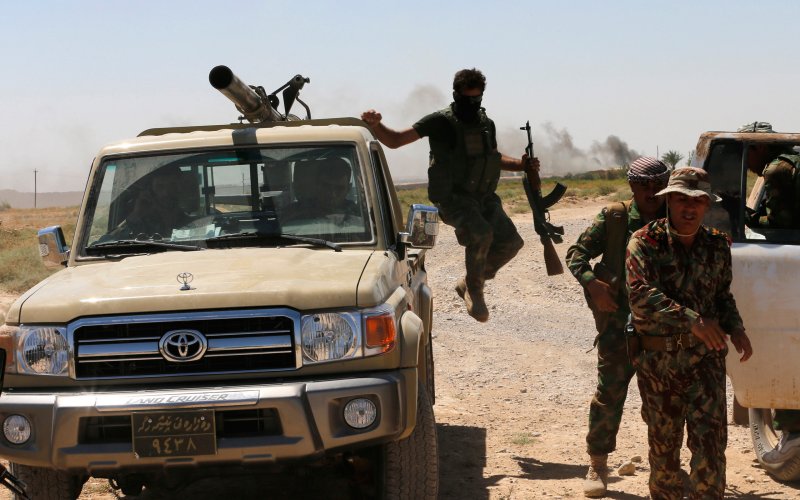
Iraqi divisionosMembers of the Iraqi security forces and Shi’ite fighters take part during an intensive security deployment in the town of Qara Tappa in Iraq’s Diyala province November 26, 2014. REUTERS/Stringer

BAGHDAD (Reuters) – U.S. air support and pledges of weapons and training for Iraq’s army have raised expectations of a counter-offensive soon against Islamic State, but sectarian rifts will hamper efforts to forge a military strategy and may delay a full-scale assault.

The Sunni Islamists stormed through northern Iraq in a 48-hour offensive in June, charging virtually unopposed toward the outskirts of Baghdad, humiliating a U.S.-trained Iraqi army which surrendered both land and weapons as it retreated.

By contrast, even a successful effort by the Shi’ite-led government to dislodge Islamic State, also known as ISIS, from Sunni territory where it rules over millions of Iraqis would be fiercely fought and could stretch well beyond next year.

The Baghdad government relies on Shi’ite militias and Kurdish peshmerga to contain Islamic State – a dependence which underlines and may even exacerbate the sectarian rivalry which opened the door for the summer offensive.

U.S. newspapers have cited officials in Washington saying the Americans’ training mission aims to prepare Iraqi troops for a spring offensive to retake territory, including Mosul, northern Iraq’s largest city and Islamic State’s powerbase.

Hemin Hawrami, an official close to Kurdish leader Masoud Barzani, told Reuters that Iraqi forces would not be ready to take the fight to Mosul, in Iraq, until late 2015.

“There will be no spring or summer (offensive),” he said, adding that progress depended on government willingness “to reorganize the army, how quickly they can solve political issues with us and the Sunnis, (and) how quick the coalition will be in providing heavy arms to peshmerga and the Iraqi army.”

“CERTAIN VICTORY”

The army, Shi’ite militias and Kurdish fighters have made some gains against Islamic State, pushing back an advance toward Kurdish territory in August and last week recapturing towns in Diyala province, on the road from Baghdad to Iran.

The leader of the pro-Iranian Shi’ite Badr Organisation, whose fighters battled alongside peshmerga and soldiers in Diyala, said they would turn next to the Sunni provinces of Salahuddin and Anbar – north and west of Baghdad – before moving further north to Nineveh province, where Mosul lies.

“We are counting on the support of the Sunni tribal fighters. With them joining the fight, our victory is certain,” Hadi al-Amiri told Reuters by telephone from Diyala province.

Amiri said he expected to get weapons not just from the Iraqi government, which may allocate a quarter of next year’s $100 billion budget to the military, but also from the $1.6 billion of arms and training which Washington plans to deliver.

Both Amiri’s assumptions look optimistic, as Washington and the Sunni tribes are deeply wary of Shi’ite militia forces.

Iraqi authorities aim to overcome the deep rifts between Shi’ites, Sunni Arabs, Kurds and other groups by absorbing local fighters into a state-funded National Guard, but the role of that force remains undecided.

LONG WAR

Government adviser Zuhair al-Chalabi told Reuters the army was in no shape to surge north and Mosul’s mainly Sunni residents would resist a campaign by Shi’ite militias alone.

Instead, a combined force of army soldiers, Sunni tribes, Kurdish peshmerga and Shi’ite fighters must be assembled – and the open border with Islamic State territory in Syria sealed.

“There is a plan, but it can’t be implemented that quickly,” said Chalabi, who is from Mosul.

Finance Minister Hoshyar Zebari said Islamic State was still a formidable force but was losing the ability to conduct major ground combat because that exposed it to air strikes.

Zebari, a Kurd, declined to give details of the military strategies of either the Baghdad government or the semi-autonomous Kurdish authorities, but said “planning and coordination are already under way” for the battle for Mosul.

“I am really not aware of spring offensives. The offensive is on – spring, summer, winter. We countered them in autumn. This is an ongoing battle with them.”

The United States is setting up four training camps for Iraq’s 80,000-strong armed forces – two around Baghdad, one in the Kurdish city of Arbil and the fourth in Anbar.

Washington has also set out plans to provide body armor and guns to 45,000 soldiers, 15,000 Kurdish peshmerga and 5,000 Sunni tribal forces.

A senior Western diplomat in Baghdad said the training might take six months, with the first round complete in late spring.

While he argued that the tide had turned against Islamic State in northern Iraq and was moving against it elsewhere, fighting was likely to stretch into 2016.

And without control over the border, Islamic State fighters could slip away and regroup in Syria. “It’s the balloon theory. You squeeze one part and it pops up elsewhere,” he said.

Hawrami, the Kurdish official, foresaw a protracted and potentially inconclusive battle.

“In order to guarantee their defeat in Mosul we have to defeat them in Syria as well,” he said. “ISIS cannot be vanquished. ISIS can be degraded and weakened, but this process of degrading and weakening needs years.”

Obama deploys 1,500 more U.S. troops to Iraq

November 8, 2014

Obama deploys 1,500 more U.S. troops to Iraq, Washington TimesDave Boyer and Maggie Ybarra, November 7, 2014

(Will they be permitted to wear combat boots? — DM)

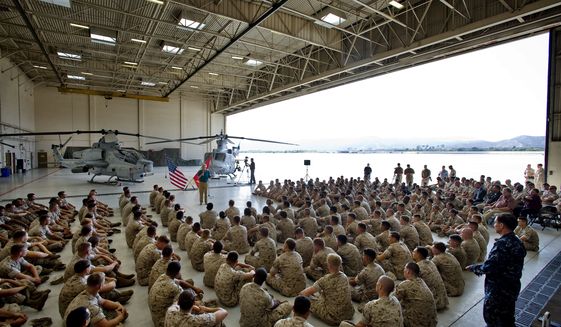
united-states-iraq-advisersjpeg-05ad1_c0-176-4256-2656_s561x327A group of selected Marines representing Camp Pendleton listen as Secretary of Defense Chuck Hagel answers their questions during his short visit to the base Tuesday Aug. 12, 2014. Hagel announced the deployment of another 130 U.S. troops to Iraq in remarks to Marines at this Southern California base on the final stop of a weeklong, around-the-world trip that also took him to India, Germany and Australia. (AP Photo/The Orange County Register, Paul Rodriguez)

“The president also authorized U.S. personnel to conduct these integral missions at Iraqi military facilities located outside Baghdad and Erbil,” the statement said. “U.S. troops will not be in combat, but they will be better positioned to support Iraqi Security Forces as they take the fight to ISIL.”

***********

President Obama is sending up to 1,500 more U.S. military personnel to Iraq to serve as non-combat advisers in the fight against Islamic State terrorists, the White House said Friday.

The troops will “train, advise, and assist Iraqi Security Forces, including Kurdish forces,” the White House said.

“The president also authorized U.S. personnel to conduct these integral missions at Iraqi military facilities located outside Baghdad and Erbil,” the statement said. “U.S. troops will not be in combat, but they will be better positioned to support Iraqi Security Forces as they take the fight to ISIL.”

It’s the latest escalation of U.S. military personnel in Mr. Obama’s fight to rescue the besieged government in Baghdad, where the president withdrew all U.S. forces in 2011. Since August, the U.S. has been conducting hundreds of airstrikes against the Islamic State in Iraq, and more recently in Syria.

The surge in military advisers will more than double the number of U.S. personnel in Iraq, which currently totals about 1,400.

U.S. troops will be asked to train nine Iraqi brigades and three Kurdish fighter brigades, said Pentagon spokesman Rear Adm. John Kirby.

“These sites will be located in northern, western, and southern Iraq,” Adm. Kirby said. “Coalition partners will join U.S. personnel at these locations to help build Iraqi capacity and capability. The training will be funded through the request for an Iraq train-and-equip fund that the administration will submit to Congress as well as from the government of Iraq.”

The White House said the Iraqi government requested the additional forces, and Defense Secretary Chuck Hagel agreed.

White House press secretary Josh Earnest said the Islamic State “has suffered a series of defeats in Iraq against the Iraqi Security Forces and Peshmerga, with the support of U.S. and coalition airstrikes and Intelligence, Surveillance and Reconnaissance, and as well as U.S. military advice.”

“The United States and its coalition partners will continue to confront the threat of [the Islamic State] with strength and resolve as we seek to degrade and ultimately defeat” the terrorist group,” he said.

Shaun Donovan, director of the White House Office of Management and Budget, said the administration is sending a request to Congress for $5.6 billion to pay for the military operations.

The request includes $1.6 billion to establish the Iraq train-and-equip fund to develop and support Iraqi security forces, including Kurdish forces.

“This funding will help reconstitute the Iraqi army and strengthen the capability and capacity of our Iraqi partners to go on the offensive against” the Islamic State, Mr. Donovan said.