Archive for the ‘Iraqi military’ category

Mosul Campaign Hampered by Fear of Iraq’s Shia Army

April 7, 2016

Mosul Campaign Hampered by Fear of Iraq’s Shia Army, Washington Free Beacon, April 7, 2016

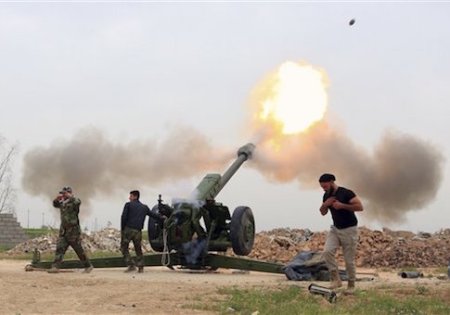
FILE - In this Saturday, March 26, 2016 photo, Iraqi security forces fire at Islamic State militants positions from villages south of the Islamic State group-held city of Mosul, Iraq. The Iraqi military backed by U.S.-led coalition aircraft on Thursday launched a long-awaited operation to recapture the northern city of Mosul from Islamic State militants, a military spokesman said. (AP Photo, File)

FILE – In this Saturday, March 26, 2016 photo, Iraqi security forces fire at Islamic State militants positions from villages south of the Islamic State group-held city of Mosul, Iraq. The Iraqi military backed by U.S.-led coalition aircraft on Thursday launched a long-awaited operation to recapture the northern city of Mosul from Islamic State militants, a military spokesman said. (AP Photo, File)

The grinding village-to-village war against ISIS in Northern Iraq has been weighed down by public complaints from Kurdish officials and military commanders who fear that the Shia-dominated Iraqi army will provoke stiffer resistance from ISIS defenders in Mosul.

Sunni, Shia, and Kurd units all want the political capital that goes with liberating a city of a million people and the capital of Sunni Iraq from ISIS, according to military observers.

A see-saw battle between elements of the predominantly Shia 15th Iraqi Army Division and ISIS fighters over control of abandoned villages on the Makhmour Front 40 miles southwest of Mosul took a turn for the worse on Monday, April 4, according to sources near the front. Last week the Iraqi Army, supported by Kurdish Peshmerga forces, captured four villages, including Al Nasr, but an ISIS counterattack recovered the village and left 20 soldiers dead, Rudaw reported.

Of these casualties, six were Peshmerga soldiers killed by a suicide vehicle that passed through the front line, said Ali Awni, a Kurdish Democratic Party leader in the Shekhan District north of Mosul.

The Shia soldiers reportedly abandoned their posts in the recent combat, according to Awni. “They left behind many guns, ammunition, and equipment for ISIS,” Awni said.

The campaign to retake the Iraq’s northern province of Nineweh started on March 24, according to the Iraqi Defense Ministry. That day, Iraqi Security forces backed by the Peshmerga and anti-ISIS Sunni tribal fighters recaptured four villages west of Makhmour.

Iraqi military spokesmen hailed the operations as “heroic,” but military observers say there is no sign of the final offensive to retake the city. The Iraqi defense minister has promised that the campaign to capture Mosul will start no later than May.

The array of armed forces ready and eager to retake the city of Mosul includes the Shia brigades of the Iraqi Security Forces, the Peshmerga army of the Kurdish Regional Government, the Iranian-backed Popular Mobilization Units, and Sunni-tribal fighters from Nineweh itself.

Until now, however, the Iranian-backed forces have not been allowed to join the campaign to recapture Mosul due to the high aversion to them by Sunni citizens in the north of Iraq.

The Iraqi Army has approximately 4,500 soldiers in the current campaign, not nearly an adequate force to secure the city, according to Michael Pregent, a career Army intelligence officer and former adviser to the Peshmerga in Mosul during 2005-06, who now serves as an adjunct scholar at the Hudson Institute in Washington.

“The force to retake Mosul has not been built yet. It must be a majority-Sunni unit to be accepted by the population,” Pregent said, adding that the defending force of ISIS fighters has been weakened and could be defeated by a patient, intelligence-heavy counter-insurgency campaign.

“There are more than 4,000 reluctant ISIS fighters in Mosul who don’t want to be there, who as soon as an operation begins may dwindle down to 1,500 or 2,000 as they melt into the population to wait the offensive out,” Pregent told a closed briefing at the Westminster Institute in Mclean, VA recently.

Awni, the Kurdish official, says the residents of Mosul despise the Popular Mobilization Units and will fight hard to resist them. “The people of Mosul believe the PMU will destroy the city with artillery and air strikes the way they did Ramadi a few months ago and Tikrit last year. When they entered Tikrit the looted houses and killed many people,” Awni says, adding: “the Mosul residents say if Shia militia are joining the fight, they will fight with ISIS, but if not, they will support the Coalition forces.”

Col. Tariq Ahmed Jaff, deputy commander of the 9th Combat Brigade of Peshmerga based in Kirkuk said in an email, “After ISIS we may have to fight the PMU. These guys pretend to be heroes but they intimidate elderly men, women, and children.” Sectarian war is a pervasive threat throughout Iraq’s territory south of Kurdistan’s borders. Hundreds of thousands of Iraqis have died in sectarian fighting that worsened after the U.S. invasion of 2003.

“Wherever there is PMU, there is Baghdad, and where there is Baghdad there is Tehran,” observed Ernie Audino, a retired U.S. Army brigadier general and a Senior Military Fellow at the London Center for Policy Research.

“All three are Shia, all three are allies to some degree, and all three vigorously support the concept of a unified Iraq, by force if necessary,” said Audino, who spent a year as an embed with the Pershmerga.  “Consequently, Shia militias cadred by Iranian Quds Forces, and Shia-dominated Iraqi Army units have pressed into Kurdish areas in and around Jalawla and Tuz Khurmatu to directly challenge Peshmerga control. Their continuing presence is seen by Kurds as a hammer waiting to fall.”

ISIS Threatens Obama With ‘New Lesson’ in Beheading Video

October 31, 2015

ISIS Threatens Obama With ‘New Lesson’ in Beheading Video, Newsmax, Sandy Fitzgerald, October 31, 2015

(Video at the link. Has Obama recently decided that the Islamic State is a greater threat than climate change?– DM)

A horrifying new 15-minute video appears to show Islamic State (ISIS) terrorists beheading four captured Kurdish Peshmerga fighters — and delivering a bold warning to President Barack Obama.

The video claims to be the ISIS response to a Delta Force-Kurdish raid in northern Iraq last week that cost American Master Sgt. Joshua Wheeler his life.

“Obama, you have learned a new lesson,” a masked terrorist warns Obama in what sounds like an American accent. “Six of the soldiers of the caliphate faced 400 of your children; they killed and injured them by Allah’s grace.”

The warning was delivered before the man executes one of the prisoners, reports CNN, and the other three prisoners are also beheaded by the video’s end. Arabic text also appears onscreen, translating as “Peshmerga soldiers that Americans came to rescue.”

The video was released online Friday, and earlier in the clip, ISIS claims to show the aftermath of the raid, in which Kurdish, U.S., and Iraqi forces rescue 70 hostages from an ISIS prison in Hawija, located in Kirkuk, a province located in northern Iraq.

CNN reports that those who were set free included 20 of the Iraqi Security Forces, local residents and several ISIS fighters accused of spying. None of the hostages were Kurds.

As of Saturday morning, there had not been an official response issued from the White House on the video or the threat. But in Kurdistan, regional government spokesman Dindar Zebari told CNN that “ISIS respects no form of human rights. Our message to them is that we will finish them.”

But Kurdistan will not kill ISIS prisoners in response, Zebari said.

“We hold 215 ISIS prisoners and we treat them according to international human rights laws,” he said. “We have also freed 85 prisoners who had been suspected of association with ISIS. We do not kill our prisoners.”

The Kurdistan regional government said that more than 20 ISIS fighters were killed in last week’s raid, and six more were captured.

The Kurdish Peshmerga, which protects an autonomous region in northern Iraq, has been fighting against ISIS and its push to take Iraq and Syria and create a caliphate.

ISIS earlier this week said the Delta Force-Kurdish raid, called for by the Kurds to rescue Peshmerga fighters, was a failure.

The man who issued the threat does not appear to be the infamous “Jihadi John,” the English-speaking jihadist who has appeared in several other ISIS beheading videos.

The terrorist, whose real name is believed to be Mohammed Emwazi, is considered to be a priority target after killing American, Western, and Japanese hostages.

Meanwhile, two Syrian activists have also been killed in recent days in the Turkish town of Urfa, and their deaths are being blamed on ISIS.

According to the groups Raqqa is Being Slaughtered Silently and Eye on Homeland, activists Ibrahim Abdul Qadir and Faris Humadi the men who were shot and beheaded. ISIS has not yet claimed responsibility for their deaths.

Qadir and Humadi worked for Eye on Homeland, a Syrian media group that reports on the civil war, and Qadar also was a founding member of the Raqqa group, which posts photos, video, and other information online from the Raqqa province in Syria.

Chinese warplanes to join Russian air strikes in Syria. Russia gains Iraqi air base

October 2, 2015

Chinese warplanes to join Russian air strikes in Syria. Russia gains Iraqi air base, DEBKAfile, October 2, 2015

Russia_China_480

Russia’s military intervention in Syria has expanded radically in two directions.DEBKAfile’s military and intelligence sources report that China sent word to Moscow Friday, Oct. 2, that J-15 fighter bombers would shortly join the Russian air campaign that was launched Wednesday, Sept. 30. Baghdad has moreover offered Moscow an air base for targeting the Islamic State now occupying large swathes of Iraqi territory

Russia’s military intervention in Syria has five additional participants: China, Iran, Iraq, Syria and Hizballah.

The J-15 warplanes will take off from the Chinese Liaoning-CV-16 aircraft carrier, which reached Syrian shores on Sept. 26 (as DEBKAfile exclusively reported at the time). This will be a landmark event for Beijing: its first military operation in the Middle East as well the carrier’s first taste of action in conditions of real combat.

Thursday night, China’s foreign minister Wang Yi, made this comment on the Syrian crisis at a UN Security Council session in New York: “The world cannot afford to stand by and look on with folded arms, but must also not arbitrarily interfere (in the crisis).”

A no less significant development occurred at about the same time when Iraqi Prime Minister Haider al-Abadi, speaking to the US PBS NewsHour, said he would welcome a deployment of Russian troops to Iraq to fight ISIS forces in his country too. As an added incentive, he noted that this would also give Moscow the chance to deal with the 2,500 Chechen Muslims whom, he said, are fighting with ISIS in Iraq.

DEBKAfile’s military sources add that Al-Abadi’s words came against the backdrop of two events closely related to Russia’s expanding role in the war arena:

1.  A joint Russian-Iranian-Syrian-Iraqi war room has been working since last week out of the Iraqi Defense Ministry and military staff headquarters in Baghdad to coordinate the passage of Russian and Iranian airlifts to Syria and also Russian air raids. This command center is also organizing the transfer of Iranian and pro-Iranian Shiite forces into Syria.

2.  Baghdad and Moscow have just concluded a deal for the Russian air force to start using the Al Taqaddum Air Base at Habbaniyah, 74 km west of Baghdad, both as a way station for the Russian air corridor to Syria and as a launching-pad for bombing missions against ISIS forces and infrastructure in northern Iraq and northern Syria.

Russia has thus gained a military enclave in Iraq, just as it has in Syria, where it has taken over a base outside Latakia on the western coast of Syria. At the same time, the Habbaniyah air base also serves US forces operating in Iraq, which number an estimated 5,000.

Dispatch from Iraq: the Stealth Iranian Takeover Becomes Clear

August 1, 2015

Dispatch from Iraq: the Stealth Iranian Takeover Becomes Clear, PJ Media via Middle East Forum, Jonathan Spyer, July 31, 2015

1484A Shi’a militia billboard in Baghdad

Close observation of the militias, their activities, and their links to Tehran is invaluable in understanding what is likely to happen in the Middle East following the conclusion of the nuclear agreement between the P5 + 1 powers and Tehran.

The genius of the Iranian method is that it is not possible to locate a precise point where the Iranian influence ends and the “government” begins. Everything is entwined. This pro-Iranian military and political activity depends at ground level on the successful employment and manipulation of religious fervor. This is what makes the Hashed fighters able to stand against the rival jihadis of ISIS.

The deal itself proves that Iran can continue to push down this road while paying only a minor price, so why change? Expect further manifestations of the Tehran formula in the Middle East in the period ahead.

****************

In late June, I traveled to Iraq with the purpose of investigating the role being played by the Iranian-supported Shia militias in that country.

Close observation of the militias, their activities, and their links to Tehran is invaluable in understanding what is likely to happen in the Middle East following the conclusion of the nuclear agreement between the P5 + 1 powers and Tehran.

An Iranian stealth takeover of Iraq is currently under way. Tehran’s actions in Iraq lay bare the nature of Iranian regional strategy. They show that Iran has no peers at present in the promotion of a very 21st century way of war, which combines the recruitment and manipulation of sectarian loyalties; the establishment and patient sponsoring of political and paramilitary front groups; and the engagement of these groups in irregular and clandestine warfare, all in tune with an Iran-led agenda.

With the conclusion of the nuclear deal, and thanks to the cash about to flow into Iranian coffers, the stage is now set for an exponential increase in the scale and effect of these activities across the region.

So what is going on in Iraq, and what may be learned from it?

Power in Baghdad today is effectively held by a gathering of Shia militias known as the Hashed al-Shaabi (Popular Mobilization). This initiative brings together tens of armed groups, including some very small and newly formed ones. However, its main components ought to be familiar to Americans who remember the Iraqi Shia insurgency against the U.S. in the middle of the last decade. They are: the Badr Organization, the Asaib Ahl al-Haq, the Kataeb Hizballah, and the Sarayat al-Salam (which is the new name for the Mahdi Army of Muqtada al-Sadr).

All of these are militias of long-standing. All of them are openly pro-Iranian in nature. All of them have their own well-documented links to the Iranian government and to the Revolutionary Guards Corps.

1559Shia militiamen are becoming a fixture of daily life in the Iraqi capital.

The Hashed al-Shaabi was founded on June 15, 2014, following a fatwa by venerated Iraqi Shia cleric Ali al-Sistani a day earlier. Sistani called for a limited jihad at a time when the forces of ISIS were juggernauting toward Baghdad. The militias came together, under the auspices of Quds Force kingpin Qassem Suleimani and his Iraqi right-hand man Abu Mahdi al-Muhandis.

Because of the parlous performance of the Iraqi Army, the Shia militias have become in effect the sole force standing between ISIS and the Iraqi capital.

Therein lies the source of their strength. Political power grows, as another master strategist of irregular warfare taught, from the barrel of a gun. In the case of Iraq, no instrument exists in the hands of the elected government to oppose the will of the militias. The militias, meanwhile, in their political iteration, are also part of the government.

In the course of my visit, I travelled deep into Anbar Province with fighters of the Kataeb Hizballah, reaching just eight miles from Ramadi City. I also went to Baiji, the key front to the capital’s north, accompanying fighters from the Badr Corps.

1469Asaib Ahl al-Haq fighters operating in Baiji in June

In all areas, I observed close cooperation between the militias, the army, and the federal police. The latter are essentially under the control of the militias. Mohammed Ghabban, of Badr, is the interior minister. The Interior Ministry controls the police. Badr’s leader, Hadi al-Ameri, serves as the transport minister.

In theory, the Hashd al-Shaabi committee answers to Iraqi Prime Minister Haider al Abadi. In practice, no one views the committee as playing anything other than a liaison role. The real decision-making structure for the militias’ alliance goes through Abu Mahdi al Muhandis and Hadi al-Ameri, to Qassem Suleimani, and directly on to Supreme Leader Ali Khamenei.

No one in Iraq imagines that any of these men are taking orders from Abadi, who has no armed force of his own, whose political party (Dawa) remains dominated by former Prime Minister Nouri al-Maliki and his associates, and whose government is dependent on the military protection of the Shia militias and their political support. When I interviewed al-Muhandis in Baiji, he was quite open regarding the source of the militias’ strength: “We rely on capacity and capabilities provided by the Islamic Republic of Iran.”

1482Iraqi militia leader Abu Mahdi al-Muhandis (right) with Iranian Quds Force commander Qassem Suleimani

The genius of the Iranian method is that it is not possible to locate a precise point where the Iranian influence ends and the “government” begins. Everything is entwined. This pro-Iranian military and political activity depends at ground level on the successful employment and manipulation of religious fervor. This is what makes the Hashed fighters able to stand against the rival jihadis of ISIS. Says Major General Juma’a Enad, operational commander in Salah al-Din Province: “The Hashed strong point is the spiritual side, the jihad fatwa. Like ISIS.”

So this is Tehran’s formula. The possession of a powerful state body (the IRGC’s Quds Force) whose sole raison d’etre is the creation and sponsorship of local political-military organizations to serve the Iranian interest. The existence of a population in a given country available for indoctrination and mobilization. The creation of proxy bodies and the subsequent shepherding of them to both political and military influence, with each element complementing the other. And finally, the reaping of the benefit of all this in terms of power and influence.

This formula has at the present time brought Iran domination of Lebanon and large parts of Syria, Iraq, and Yemen. Current events in Iraq form a perfect study of the application of this method, and the results it can bring. Is Iran likely to change this winning formula as a result of the sudden provision of increased monies resulting from the nuclear deal? This is certainly the hope of the authors of the agreement. It is hard to see on what it is based.

The deal itself proves that Iran can continue to push down this road while paying only a minor price, so why change? Expect further manifestations of the Tehran formula in the Middle East in the period ahead.

Is Obama Supporting a Shiite ISIS?

June 12, 2015

Is Obama Supporting a Shiite ISIS?, Front Page Magazine, Daniel Greenfield, June 12, 2015

Asaib-ahl-alhaq_logo-450x300Asaib Ahl al-Haq logo.

Obama had campaigned vocally against the Kyl-Lieberman Amendment which designated Iran’s Revolutionary Guard, the hidden force behind Asaib Ahl al-Haq and much of the Shiite terrorist infrastructure, a terrorist organization. He had accused its sponsors of “foolish saber rattling.”

While we focused on ISIS, its Shiite counterparts were building their own Islamic State by burrowing from within to hollow out the Iraqi institutions that we had put into place. ISIS is a tool that Iran is using to force international approval of its takeover of Iraq and its own nuclear program.

Like ISIS, its Shiite counterparts envision an apocalyptic struggle in which the other branch of Islam will be destroyed, along with all non-Muslims, leading to regional and global supremacy. Iraq is only one of the battlefields on which this war is being fought and Obama’s inept mix of appeasement and regime change, abandoning allied governments while aiding enemy terrorists has helped make it possible.

*********************

Staff Sgt. Ahmed Altaie was the last American soldier to come home from Iraq. His body was turned over by Asaib Ahl al-Haq or The League of the Righteous; a Shiite terrorist group funded and trained by Iran.

Altaie had been kidnapped, held for ransom and then killed.

It was not Asaib Ahl al-Haq’s only kidnapping and murder of an American soldier. A year after Altaie’s kidnapping, its terrorists disguised themselves as Americans and abducted five of our soldiers in Karbala. The soldiers were murdered by their Shiite captors after sustained pursuit by American forces made them realize that they wouldn’t be able to escape with their hostages.

Asaib Ahl al-Haq’s obsession with American hostages was a typically Iranian fixation. Iran’s leaders see the roots of their international influence in the Iran hostage crisis. Its terrorist groups in Lebanon had abducted and horrifically tortured Colonel William R. Higgins and William Francis Buckley.

Higgins had been skinned alive.

Most Americans have never heard of Asaib Ahl al-Haq, sometimes referred to as the Khazali Network after its leader, even though it has claimed credit for over 6,000 attacks on Americans. Its deadliest attacks came when the Democrats and their media allies were desperately scrambling to stop Bush from taking out Iran’s nuclear program. Asaib Ahl al-Haq’s ties to Iran were so blatant that the media could not allow it to receive the kind of coverage that Al Qaeda did for fear that it might hurt Iran.

Obama had campaigned vocally against the Kyl-Lieberman Amendment which designated Iran’s Revolutionary Guard, the hidden force behind Asaib Ahl al-Haq and much of the Shiite terrorist infrastructure, a terrorist organization. He had accused its sponsors of “foolish saber rattling”.

Nancy Pelosi joined the Democratic Party’s pro-Iranian turn, rejected a vote on the amendment and sneered that if the kidnapping and murder of American soldiers was “a problem to us and our troops in Iraq, they should deal with it in Iraq.” Earlier that year, she had visited Syria’s Assad to stand with him against President Bush even while Assad was aiding the terrorists massacring American soldiers.

Once Obama took power, coverage of the war was scaled down so that Americans wouldn’t realize that the rising power of ISIS and Asaib Ahl al-Haq were already making a mockery of his withdrawal plans.

But Asaib Ahl al-Haq was not merely an anti-American terrorist group; it was an arm of the Shiite theocracy. As a Shiite counterpart to what would become ISIS, it had most of the same Islamic goals.

While Obama was patting himself on the back for the end of the Iraq War and gay rights, Asaib Ahl al-Haq was throwing those men and women it suspected of being gay from the tops of buildings.

When buildings weren’t available, it beat them to death with concrete blocks or beheaded them.

Its other targets included shelters for battered women, which the Islamist group deemed brothels, men who had long hair or dressed in dark clothing. And even while its Brigades of Wrath were perpetrating these atrocities, Obama and the Shiite Iraqi government embraced the murderous terrorist group.

Qais al-Khazali, the leader of Asaib Ahl al-Haq, and his brother Laith al-Khazali along with a hundred other members of the terror group were freed during Obama’s first year in office. (But to provide equal aid and comfort to the other side, Obama also freed the future Caliph of ISIS in that same year.)

“We let a very dangerous man go, a man whose hands are stained with US and Iraqi blood. We are going to pay for this in the future,” an unnamed American officer was quoted as saying. “This was a deal signed and sealed in British and American blood.”

“We freed all of their leaders and operatives; they executed their hostages and sent them back in body bags.”

The releases were part of Obama’s grand strategy of reconciliation for Iraq. The miserable reality behind the upbeat language was that Obama was handing over Iraq to ISIS, Iran and its Shiite militias.

Last year, Maliki had made Asaib Ahl al-Haq and other Shiite terror groups into the Sons of Iraq that were to protect and defend Baghdad. Asaib Ahl al-Haq and its leader were now the Iraqi security forces. The Shiite death squads were in charge even while they continued carrying out ISIS-style massacres.

Obama belatedly decided to respond to ISIS, but his war strategy depends on Asaib Ahl al-Haq.

Officially his strategy is to provide training and air support for the Iraqi military. But the Iraqi military’s Shiite officers conduct panicked retreats in the face of ISIS attacks while abandoning cities and equipment. The goal of these retreats is to make Asaib Ahl al-Haq and other Shiite militias into the only alternative to ISIS for the United States. Even though he pays lip service to Sunni and Kurdish resistance to ISIS, Obama shows that he has accepted Iran’s terms by refusing to arm and support them.

While we focused on ISIS, its Shiite counterparts were building their own Islamic State by burrowing from within to hollow out the Iraqi institutions that we had put into place. ISIS is a tool that Iran is using to force international approval of its takeover of Iraq and its own nuclear program.

An Iraqi official last year was quoted as saying that Asaib Ahl al-Haq’s men give orders to the police and military. “Before they were just around, now they are high-ranking officers in the military.”

Some defense experts wonder if the Iraqi military even exists. The bulk of the forces in Tikrit were Shiite Jihadists and they are armed with American weapons that they receive from the Iraqi government. Asaib Ahl al-Haq boss Qais al-Khazali claims that soldiers and Shiite militia members both wear Iraqi military uniforms.

The capture of Tikrit became an opportunity for the Shiite terrorist groups and Qasem Soleimani, their Iranian terror boss, to boast about their victory and loot and terrorize the local Sunni residents.

Obama’s official plan to arm and train the Iraqi military and security forces is a dead end because like the mythical moderate Syrian rebels, they are fronts for moving money and weapons to Jihadists. We are arming ghost armies and funding fake political institutions and the money and weapons end up going to bands of Islamic terrorists, militias and guerrillas that are actually calling the shots.

By aiding Shiite militias in Iraq and Sunni militias in Syria, we’re backing both sides of an Islamic civil war.

Obama turned over Iraq to the Shiites and then backed the Muslim Brotherhood’s efforts to force the Shiites out of power in Syria. The Sunni-Shiite civil wars tearing the region apart were caused by those two decisions. His solution to the wars is to continue backing the same forces responsible for them.

Despite assorted denials, Obama’s real ISIS strategy is to have Iran do the fighting for him in Iraq.

But Obama is backing one ISIS against another ISIS. Why is a Shiite Islamic state that kidnaps and kills Americans, throws gays off buildings and massacres women better than a Sunni Islamic state that does the same things? Not only is the Obama strategy morally dubious, but it’s also proven to be ineffective.

The rise of ISIS has helped Iran tighten its hold on Shiite areas in Iraq and Syria. Iran does not need to beat ISIS. Its interests are best served by maintaining a stalemate in which ISIS consolidates Sunni areas while Iran consolidates Shiite areas. The more Obama aids Iran and its terrorist forces as a counterweight to ISIS, the more Iran sees keeping ISIS around as being vital to its larger strategy.

By aiding Iran, Obama is really aiding ISIS.

Despite depending on our air support, Asaib Ahl al-Haq and its leaders are threatening to attack American planes and soldiers making it clear that they view the fight against ISIS and for Assad as part of a larger struggle for achieving Iran’s apocalyptic Shiite ambitions for the region and the world.

Iran’s Supreme Leader, Ayatollah Ali Khamenei recently gave a speech in which he warned that, “We must prepare the country’s conditions, the region’s conditions, and, Allah willing, the world’s conditions for the reappearance [of Imam Mahdi] will spread justice.”

Like ISIS, its Shiite counterparts envision an apocalyptic struggle in which the other branch of Islam will be destroyed, along with all non-Muslims, leading to regional and global supremacy. Iraq is only one of the battlefields on which this war is being fought and Obama’s inept mix of appeasement and regime change, abandoning allied governments while aiding enemy terrorists has helped make it possible.

Soup Sandwich: Obama and His National Security Team Has no Plan to Combat ISIS

June 9, 2015

Soup Sandwich: Obama and His National Security Team Has no Plan to Combat ISIS, ISIS Study Group, June 9, 2015

(This appeared in an e-mail this morning from Foreign Policy Strategy Report:

Wait, where is everybody? Several hundred U.S. soldiers and Marines at al Asad air base in Iraq are standing by, ready to train some Iraq soldiers. But those Iraqi troops have stopped showing up, leaving the Americans all alone at the sprawling base. FP’s John Hudson, Lara Jakes and Paul McLeary report that across Iraq, there seem to be more U.S. trainers than recruits, with only 2,600 Iraqi soldiers currently receiving training from about 3,000 U.S. military personnel.

While the training has dried up, at the G-7 summit in Germany, President Barack Obama maintained that the United States and its allies must speed up the training of the Iraqi security forces….even, presumably, if they aren’t showing up.

— DM)

President Obama did some talking about the Islamic State (IS) after the G-7. Of note is that he admitted to not having an actual strategy in combatting IS and the threat it poses to the free world. In typical fashion he fails to hold himself accountable for his actions and points the finger at everybody but himself. He’s known about the threat of IS for since 2010 when Baghdadi’s guys initiated the “Breaking the Walls Campaign” in Iraq (which the Long War Journal did a great job of covering btw). This quote from our illustrious President was quite telling:

“I don’t want to put the cart before the horse. We don’t have a strategy yet,”

Obama: No ‘complete strategy’ yet on training Iraqis
http://www.cnn.com/2015/06/08/politics/obama-abadi-iraq-germany-g7/

And here’s President Obama’s press conference after the G-7 (we recommend fast-forwarding to the 18:00 mark to get to the good stuff):


The President comes off as well-versed in “saying the right things” when it comes to things like Greece, healthcare or raising minimum wage. However, he starts stumbling the minute someone asks about IS. At around the 19:00 mark of the aforementioned video he said that we’re making “progress” in pushing IS back, but then goes on to say that as we “secure” an area they move into other areas the Iraq Security Forces/Popular Mobilization Committee (ISF/PMC) left. This is the President’s definition of “winning” the fight against IS. We’re sorry if this offends his supporters (not really), but what’s happening on the ground in Syria, Iraq, Lebanon and Yemen isn’t the US “winning” this fight against IS, Iran or al-Qaida (AQ).

His “solution” to the problem being an acceleration of training up the ISF is smoke and mirrors, really. You can train the ISF up all you want and it won’t make any difference because at its core both the IA and Iraqi Police (IP) have been purged of their most capable commanders and replaced by incompetent officers. The fact that the IA is now 80% Shia further alienates itself from the Sunni Arab and Kurd communities. Even Secretary of Defense Ash Carter stated all the training in the world can’t help the IA due to the cowardice that’s endemic throughout the force. As much as the Iranian regime denied this and pushed back against Carter’s assessment, IRGC-Qods Force commander GEN Suleimani shares many his beliefs in the poor state of the IA – and that’s a big reason why Suleimani has been influencing the establishment of the Iraqi National Guard by working to ensure that the ranks are filled with Shia militia personnel. Oh, and btw, a lot of those “fresh troops” the President was referring to are already being put through the meat grinder in places like Bayji and Ramadi – and the results aren’t pretty.

Iranian Regime, GOI Take Issue With US SECDEF’s Assessment that IA are Cowards
http://isisstudygroup.com/?p=6707

ash-carter-300x169

SECDEF Ash Carter is the only guy in the Obama administration who seems to “get it” – too bad the powers that be forced him to walk back his accurate assessment on the cowardice seen throughout the IA
Source: Wall Street Journal

Again, none of this is surprising to our readers who’ve been with us since the beginning of our site. President Obama had a quasi-strategy of sorts that we covered in last summer’s “Obama’s ISIS Strategy: Failed Before it Started” that was followed up by “Another Reason Obama’s ISIS Strategy Has Already Failed.” To the uninitiated, the Obama strategy called for trainers and the arming of so-called “moderates” in Syria while supporting an Iraqi Army (IA) that has taken on sectarian characteristics. He’s banking on doing the bare minimum to basically run out the clock so that he can say he “didn’t deploy combat troops to Iraq.” In other words, he has a plan alrighHe’s been very untruthful because he’s dramatically increased the US military footprint in Iraq since last summer. Their situation is also much more dangerous now than it ever was during the OIF-era thanks to the restrictive ROE he slapped our brethren with prior to authorizing their deployment. Additionally, his term “no boots on the ground” is misleading because those “advisors/trainers” we’ve deployed are all ground troops – many of which are located in bases currently under siege such as al-Asad Airbase or Habbaniyah. If these aren’t American “combat troops,” then what are they, aid workers? Bystanders? The Obama administration may give the “trainer” label on our guys being deployed to Iraq, but the inconvenient truth of the matter is that they all have either “US ARMY” or “US MARINES” tags on their uniforms.

Obama’s ISIS Strategy: Failed Before it Started
http://isisstudygroup.com/?p=1730

Another Reason Obama’s ISIS Strategy Has Already Failed
http://isisstudygroup.com/?p=1757

US-Backed Syrian Group Disbands – But Were They Ever Truly “Moderate” to Begin With?
http://isisstudygroup.com/?p=5286

It was painful to watch President Obama – the alleged “leader” of the free world – have a hard time answering some pretty easy questions asked about US policy to combat IS. President Obama and his national security team had more than a few years to develop a strategy – but didn’t. Why is that? Its because President Obama doesn’t want his domestic agenda to get sidetracked by things like the foreign-policy arena. He just points the finger at everybody else saying “its their fault” while not formulating any real solution. He’s on his 7th year in office and still blames his predecessor for everything. Coming from military backgrounds ourselves, we were taught that a leader doesn’t make excuses. He makes things happen. A leader doesn’t keep rolling with a plan if it clearly isn’t working. A leader will adjust accordingly and inspire his subordinates to press on. That’s what a leader does. We’re not seeing that from this President. As we’ve stated earlier in this article, he’s just trying to “run out the clock” of his second term so that this will become the “next guy’s problem.” Unfortunately for him, it doesn’t work that way. His inaction and arrogance has directly led to the rise of IS, and his current policies have allowed the terror organization to expand into other locales such as Yemen, Libya, Egypt, Tunisia, Iraq, Afghanistan, Pakistan and the North Caucasus region. History won’t look so kindly on him as the current American media. The public will see this manifest itself in the next administration, when our country gets attacked on our home soil – again. Of course there’s the hope that the American people will finally realize this is what a “hope and change” foreign policy is all about before its too late. But we doubt it.

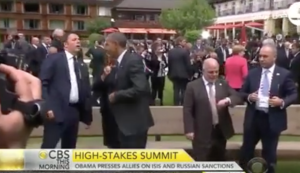
Screen-Shot-2015-06-08-at-2.21.59-PM-300x173

Oh yeah, President Obama knew PM Abadi was next to him and acted as if he wasn’t there – kinda like his approach to foreign policy
Source: CBS News

If you want additional details on the lead up to the rise of IS, then check out the history lesson we put together for President Obama’s counterpart Rand Paul, who is just as naive on foreign policy as he is:

Rand Paul Needs a History Lesson..
http://isisstudygroup.com/?p=6782

Links to Other Related Articles:

Defeating The Islamic State
http://isisstudygroup.com/?p=1708

Egypt Atmospherics
http://isisstudygroup.com/?p=614

Iraq Lost 2,300 Humvees in Mosul, Prime Minister Says

May 31, 2015

Iraq Lost 2,300 Humvees in Mosul, Prime Minister Says, Defense News, May 31, 2015

HumveesMembers of Iraqi security forces gather around a military vehicle on March 28 outside the western entrance of Tikrit during a military operation to retake the northern Iraqi city from Islamic State group jihadists. (Photo: Ahmad Al-Rubaye/AFP)

The militants gained ample arms, ammunition and other equipment when multiple Iraqi divisions fell apart in the country’s north, abandoning gear and shedding uniforms in their haste to flee.

IS has used captured Humvees, which were provided to Iraq by the United States, in subsequent fighting, rigging some with explosives for suicide bombings.

*********************

BAGHDAD — Iraqi security forces lost 2,300 Humvee armored vehicles when the Islamic State jihadist group overran the northern city of Mosul, Prime Minister Haider al-Abadi said on Sunday.

“In the collapse of Mosul, we lost a lot of weapons,” Abadi said in an interview with Iraqiya state TV. “We lost 2,300 Humvees in Mosul alone.”

While the exact price of the vehicles varies depending on how they are armored and equipped, it is clearly a hugely expensive loss that has boosted IS’ capabilities.

Last year, the State Department approved a possible sale to Iraq of 1,000 Humvees with increased armor, machine guns, grenade launchers, other gear and support that was estimated to cost $579 million.

Clashes began in Mosul, Iraq’s second city, late on June 9, 2014, and Iraqi forces lost it the following day to IS, which spearheaded an offensive that overran much of the country’s Sunni Arab heartland.

The militants gained ample arms, ammunition and other equipment when multiple Iraqi divisions fell apart in the country’s north, abandoning gear and shedding uniforms in their haste to flee.

IS has used captured Humvees, which were provided to Iraq by the United States, in subsequent fighting, rigging some with explosives for suicide bombings.

Iraqi security forces backed by Shiite militias have regained significant ground from IS in Diyala and Salaheddin provinces north of Baghdad.

But that momentum was slashed in mid-May when IS overran Ramadi, the capital of Anbar province, west of Baghdad, where Iraqi forces had held out against militants for more than a year.

ISIS Wins No Matter What Happens Next

May 28, 2015

ISIS Wins No Matter What Happens Next, The Daily BeastMichael Weiss, May 28, 2015

1432804506635.cachedAhmad Al-Rubaye/AFP/Getty

Usama al-Nujaifi, one of Iraq’s vice presidents and the former parliamentary speaker, pointed out that recent missteps by the militias has squandered incipient good will for Sunni reconciliation. Yesterday, during a parliamentary session, the Sunni governor of Diyala province was fired—and replaced with a Shia. “This is a real threat and a very negative message to Iraqis. This is considered a break to the rules and it contradicts what has been agreed,” Nujaifi said. “The majority in Diyala are Sunnis.”

**********************

The latest planned attack on the terror army could be playing right into their hands.

The Obama administration is being slammed from all sides for its failing strategy against ISIS—and rightly so. But amid all the scorn, one question has yet to be asked about the resiliency of the terror army, which, actually goes to the heart of its decade-old war doctrine. Namely: does ISIS actually win even when it loses?

This isn’t an academic issue. America’s allies in the ISIS war are gearing up for a major counteroffensive against the extremist group. That assault that could very well play right into ISIS’ hands.

Having superimposed its self-styled “caliphate” over a good third of Iraq’s territory, in control of two provincial capitals, ISIS is today in strongest position it has ever been for fomenting the kind of sectarian conflagration its founding father, Abu Musab al-Zarqawi, envisioned as far back as 2004.

Zarqawi’s end-game was simple: by waging merciless atrocities against Iraq’s Shia majority population (and any Sunnis seen to be conspiring with it), Zarqawi’s jihadists would have only to stand back and watch as radicalized Shia militias, many of whose members also served in various Iraqi government and security roles, conducted their own retaliatory campaigns against the country’s Sunni minority. Internecine conflict would have the knock-on effect of driving Sunnis desperately into the jihadist fold, whether or not they sympathized with the ideology of al-Qaeda in Iraq, Zarqawi’s franchise and the earliest incarnation of what we now call the Islamic State.

Indeed, in the mid-2000s, the Jordanian jihadist nearly got what he wished for by waging spectacular terror attacks against Shia civilians and holy sites, such as the Golden Mosque in Samarra, a strategy which quickened devolved Iraq’s violence from a primarily anti-American insurgency into all-out civil war. The only stopgap for a truly apocalyptic or nation-destroying result was the presence of nearly 200,000 U.S. and coalition troops. Today, however, absent such a foreign and independent military presence, the main actors left in Iraq are the same extremists —Shia militias and ISIS.

This fact was only driven home last week after thousands of U.S.-trained Iraqi Security Force personnel, including the elite counterterrorist Golden Division, fled from Ramadi, allowing the city fall to a numerically modest contingent of ISIS jihadists. Having been initially instructed by Iraq’s Prime Minister Haider al-Abadi to refrain from defending the city (no doubt at the prompting of Washington) the Hashd al-Shaabi, the umbrella organization for these Shia militias, now say they are prepping a massive counteroffensive to retake Ramadi. It promises to be a drawn-out and highly fraught counteroffensive, pitting paramilitaries—which have been accused of war crimes and atrocities by Human Rights Watch, Amnesty International and United Nations Human Rights Commission—against genocidal ISIS militants.

Many Iraqis fear, with good reason, that this counteroffensive will also extend to Sunni civilians who will now be branded “collaborators” of ISIS, as they have in previous Hashd-led operations. The result: torture, extrajudicial killing, and ethnic cleansing. Nothing would better serve the ISIS narrative or legitimate its claim to be the last custodian and safeguard of Sunni Muslims in the Middle East. Such an outcome might even precede the eventual disintegration of the modern state of Iraq into warring ethno-religious enclaves. That this was ISIS’s plan all along adds yet another grim paragraph to the obituary of American-hatched adventurism in the Middle East.

True, Hashd al-Shaabi has routed ISIS elsewhere before, namely in Amerli and Jurf al-Sakhar and Tikrit. In the aftermath, the militia was accused of committing human rights abuses, but those accusations didn’t tear the country apart.

The difference with Ramadi, however, is one of both scale and symbolism. This city of close to 200,000 is dead center in the Sunni heartland of Iraq, where ISIS has the home advantage. Ramadi was also, not coincidentally, the cynosure of the so-called “Anbar Awakening,” which saw hundreds of thousands of Sunni tribesmen rise up against ISIS’s predecessor, al-Qaeda in Iraq, in a cautious but fruitful partnership with American soldiers in the mid-2000s, a grassroots counterinsurgency whose gains were then solidified by the “surge” orchestrated by U.S. commander General David Petraeus. This time, absent any American combat forces, there are Shia Islamists who have never before tread into Ramadi. Many Iraqis dread the consequences.

“Iraq is not unified,” Iraq’s former Deputy Prime Minister Rafe Essawi, a senior Sunni political leader originally from Anbar, told The Daily Beast. “50 percent of the country belongs either to Kurds or ISIS, and 50 percent belongs to the Shia militias backed by Iran. We said too many times to our friends the Americans that we do not need to see the militias in Ramadi because this will lead to sectarian conflict.”

Yet the Americans have little on offer by way of an alternative. U.S. training efforts are still months off from fielding military units able to join the fight. With Iraq’s future resting on them, Hashd is seen as the only ready bulwark against further ISIS encroachments, though its conduct in Anbar may paradoxically purge the province of ISIS’s hard power while underwriting its soft version.

The Ramadi offensive hardly got off to a promising start. On Tuesday, Hashd spokesmen announced that the name for their Anbar offensive was, “Labeyk Ya Hussein,” a slogan roughly translated as “At your service, Hussein,” in tribute to a venerated Shia religious figure. The connotations were therefore of holy war — not exactly the multi-sectarian, pan-Iraqi message Baghdad has preferred to telegraph to international audiences.

On Wednesday, in response to criticism from U.S. officials and some Iraqi leaders—including demagogic Shiite cleric Muqtada al-Sadr (who has fallen out with Iran and has since platformed himself as a nationalist politician)—the operation’s name was changed to to more universal: “Labeyk Ya Iraq.” But the public relations rethink has not addressed underling concerns about the Hashd’s intentions, nor allayed Sunni anxieties.

“I think the careful examiner of the facts on the ground will see de facto borders are being drawn whether by design or by circumstance,” said one former Iraqi official who spoke to The Daily Beast on the condition of anonymity. “The militias have effectively cleared the Baghdad belts to the south of Sunnis, and with the Ramadi operation I expect the same will happen westward but it will entail a lot more fighting and possibly much more instability.”

This is because the war for the future Iraq isn’t being waged first and foremost by Iraqis but by their self-interested next-door neighbor, Iran, led by its elite Revolutionary Guards Corps-Quds Force, a U.S.-designated terrorist entity in its own right.

Iraq’s sectarian division, whereby Sunnis have been forced out of Shia-controlled areas under the auspices of fighting ISIS, reflects the fact that the Hashd operates more according to Tehran’s geo-strategic and ideological interests, the former official said. “I feel that Iran and some of its erstwhile allies have reached a realization that they have lost a significant ally in Syria and therefore need to buffer the ‘Shia’ zones in Iraq to protect them while paying lip service to the notion of a unified state.”

It certainly does not help matters that America’s unacknowledged ally in the anti-ISIS coalition is the IRGC-QF, whose commander, Major General Qassem Suleimani, not only blamed U.S. incompetence for the fall of Ramadi this week but labeled the United States an “accomplice” of the jihadists—a conspiratorial view of ISIS’s secret patronage widely shared amongst the Hashd rank-and-file.

The scenario described by Essawi and the ex-official is more common among the Sunni political class that either Washington or Baghdad care to acknowledge. Whether it is credible will depend on how the Hashd conducts itself on hostile terrain and whether it can break with precedence of collective punishment. If the militias act as a nationalist reserve army, under the command and control of Haider al-Abadi—something the White House has insisted as a precondition of U.S. air support—then they may be able to recruit Sunnis to their efforts, or at least earn their respect and admiration.

Essawi argues that Hashd has so far relied on coercion rather than a savvy hearts-and-minds approach for winning over Sunnis. “The Sunni tribes used to be against ISIS after [their] crimes,” he said. “Definitely there are some local supporters of ISIS, but the tribes generally speaking —almost all of them — are committed to fight. It is the government that refuses to strengthen them. So some very weak tribes have been coerced into accepting this bad choice: it’s either Hashd al-Shaabi or ISIS.”

Saleh al-Mutlaq, a Sunni deputy prime minister under Abadi, disagreed.

He emphasized that the Hashd should henceforth operate under the Iraqi flag rather than the host of competing standards their constituent militias currently brandish (including those bearing the images of Iranian ayatollahs Khomeini and Khamenei). But Mutlaq is hopeful of greater Sunni support for the Hashd. He pointed out that there are currently volunteer camps established near Ramadi to incorporate Sunnis volunteers and Iraqi policemen who fled the city into the broader counteroffensive.

“The government will give them training and weapons,” a statement issued by Mutlaq’s office read, without offering specifics. As for Shia sloganeering deemed alienating the Anbari support base, he doesn’t think this has had too dire an impact. “The Sunnis were conflicted about the intervention from the Hashd al-Shaabi because they were worried about reprisal attacks. But the Hashd is less harmful than ISIS. At least, these people are Iraqis and we can deal with them later on, but we can’t with ISIS.”

Nevertheless, Mutlaq wonders just what form a pro-government success may take and what happens the day after ISIS is routed from Ramadi. “His concern is whether Ramadi will undergo demographic changes,” his office said. “Will Sunnis be forced to relocate to others areas and will there will be any revenge attacks and conflicts between the Hashd and the tribes?”

Usama al-Nujaifi, one of Iraq’s vice presidents and the former parliamentary speaker, pointed out that recent missteps by the militias has squandered incipient good will for Sunni reconciliation. Yesterday, during a parliamentary session, the Sunni governor of Diyala province was fired—and replaced with a Shia. “This is a real threat and a very negative message to Iraqis. This is considered a break to the rules and it contradicts what has been agreed,” Nujaifi said. “The majority in Diyala are Sunnis.”

ISIS is counting on such political heavy-handedness to indemnify its own savagery. “It is that enemy, composed of Shiites joined by Sunni agents, who are the real danger with which we are confronted, for it is our fellow citizens, who know us better than anyone,” Zarqawi wrote in a 2004 letter, correctly foreseeing that the U.S. military occupation would be fleeting and incidental to the future of Iraq.

In other words, he wanted the Shia militias, principally the Badr Corps — now first among equals in the Hashd— to commit anti-Sunni atrocities as payback for Zarqawi’s own scorched-earth war against the Shia. “If we manage to draw them onto the terrain of partisan war, it will be possible to tear the Sunnis away from their heedlessness, for they will feel the weight of the imminence of danger and the devastating threat of death wielded by these Sabeans.”

If Iraq does fall apart, it will have been because Zarqawi’s apocalyptic plan got realized a decade after his death.

WH Admits Need To ‘Adapt Our Strategy’ Against IS, Contradicts Previous Admin Statements

May 27, 2015

WH Admits Need To ‘Adapt Our Strategy’ Against IS, Contradicts Previous Admin Statements, Washington Free Beacon via You Tube, May 27, 2015

(“It’s more complicated than that.” Wash, rinse and repeat– DM)


Obama’s Islamic State strategy sparks doubt, resentment among Pentagon officials

May 27, 2015

Obama’s Islamic State strategy sparks doubt, resentment among Pentagon officials, Washington TimesRowan Scarborough, May 26, 2015

Beneath the glowing battle reports about Iraq from U.S. military spokesmen in recent months, there remains a strong undercurrent of dissatisfaction among the Pentagon rank and file with the Obama administration’s Islamic State strategy.

“What strategy?” asked a Pentagon official involved in counterterrorism analysis. “We are now floating along, reacting to ISIS,” using a common acronym for the Islamic State.

This source said the military has a plan for introducing ground troops and defeating the Islamist group, but the belief is that President Obama will never activate it.

Whether this unhappiness has reached the inner sanctum of the Joint Chiefs of Staff is unclear. In public, the military leadership says it is squarely behind the strategy of limited U.S.-led airstrikes coinciding with the rebuilding of the Iraq army for all the ground fighting.

But a Washington Times spot check of department officials and people who interact with the Pentagon reveals deep-seated doubts.

5_262015_iraq8201_s220x143Photo by: © STRINGER Iraq / Reuters  Iraq’s Shiite paramilitaries claimed to have taken charge of driving the Islamic State out from the western province of Anbar. However, Pentagon officials decry what they see as an unfocused White House plan to rout the terror group. (Reuters)

The Islamic State’s rout of Ramadi on May 18 exposed more than the Iraqi army’s lack of will to fight, as Defense Secretary Ashton Carter bluntly put it over the weekend.

After months of U.S. and coalition airstrikes on hundreds of Islamic State targets, after U.S. surveillance and intelligence collection, and with senior American officers advising Iraqis at a joint command center, the battlefield outcome still was no better than the rout of Mosul 11 months ago.

A former official who is frequently in the Pentagon said, “The building is very guarded about what they say, but clearly the White House is running the campaign, which has them furious.”

This source said combat pilots can loiter over a target for hours before approval comes to strike it. Sometimes approval never comes.

“The targeting requires immaculate rules of engagement, which means they cannot drop if there is a possibility of collateral damage [civilian deaths],” the former official said.

U.S. Central Command’s list of airstrikes around Ramadi showed a smattering of tactical strikes, not concentrated air power.

On May 18, the day Ramadi fell, Central Command listed three targets as being struck around Ramadi — two tactical units and an Islamic State staging area. Destroyed there were an armored vehicle, an excavator and a resupply vehicle.

On the previous day, as Islamic State fighters were taking control of Ramadi, eight airstrikes hit targets near the city. They were three tactical units, eight buildings, two armored vehicles, two mortars, an ammunition storage area and a command center.

“This is worse than pathetic,” the former official said.

Another annoying development, the source said, is the lack of American arms making their way from the Shiite-led national government in Baghdad to Iraqi Kurdish forces in the north. They have proven to be one of the few Iraqi units willing to take on the Islamic State.

The former official said a commitment of U.S. special operations forces and some infantry “could defeat the Islamic State in weeks.”

“But then what?” the source asked, noting that the Shiite-dominated government has badly mismanaged the post-U.S. environment.

“I have never seen such disgruntlement before,” the source said of the mood in the Pentagon.

Another official said a constant theme inside the Pentagon is that the White House does not seem committed to winning. The frequent public relations spin is that this will be a long process to take down the Islamic State when, in fact, officers say, it does not have to be.

“They question whether the U.S. has any interests at stake in Iraq,” this official said. “If we do, they expect Obama to make the case.”

The Iraqi government announced Monday that it has launched a new counteroffensive aimed at retaking Ramadi, the capital of the Sunni-dominated Anbar province. U.S. Marines in the mid-2000s, in an alliance with Sunni tribal leaders, fought a protracted counterinsurgency to rid the western region of al Qaeda terrorists.

So far, the Sunni role in trying to expel the Islamic State, a Sunni extremist army, does not seem as robust. That is why Prime Minister Haider al-Abadi is now relying on Iran-directed Shiite militias to fight in Anbar, as he did in the assault on the Sunni-majority city of Tikrit.

The former defense official said that if one wants to get a sense of the unhappiness inside the Pentagon, they should listen to the few retired senior generals who are speaking out.

One is retired Army Lt. Gen. Michael T. Flynn, the former director of the Defense Intelligence Agency under Mr. Obama. Mr. Flynn is urging a much more aggressive approach to the Islamic State and jihadis worldwide.

“Unless the United States takes dramatically more action than we have done so far in Iraq, the fractious, largely Shiite-composed units that make up the Iraqi army are not likely to be able, by themselves, to overwhelm a Sunni stronghold like Mosul, even though they outnumber the enemy by ten to one,” he wrote in Politico. “The United States must be prepared to provide far more combat capabilities and enablers such as command and control, intelligence, logistics and fire support, to name just a few things.”

Globally, he said, “We must engage the violent Islamists wherever they are, drive them from their safe havens and kill them. There can be no quarter and no accommodation.”

Another is retired Marine Corps Gen. James Mattis, who was Mr. Obama’s Central Command chief until May 2013, a time when the Islamic State had not yet established itself in Iraqi territory.

“The bottom line is we do not have a global strategy,” Mr. Mattis said May 13 at the Heritage Foundation. “Right now we have an America that is starting to reduce its role in the world. That’s not good.”

He noted that Mr. Obama last August said “we don’t have a strategy yet” for defeating the Islamic State. Mr. Mattis said that statement still holds true today. “We don’t really have a good strategy right now,” he said.

He added, “This is what would be called a poor grade at the National War College, to say the least. They would have flunked you.”

Robert Gates, Mr. Obama’s first defense secretary, told MSNBC, referring to the U.S. in Middle East, “We’re basically sort of playing this day to day.”

Mr. Carter took a big step over the weekend in beginning to bluntly blame the Iraqis for failing to hold Ramadi.

“What apparently happened was that the Iraqi forces just showed no will to fight,” the defense secretary told CNN. “They were not outnumbered. In fact, they vastly outnumbered the opposing force, and yet they failed to fight.”

The White House immediately launched damage control so as not to offend Mr. Abadi’s government.

“The recent universal statement by the [secretary of defense] that the Iraqis don’t have the will to fight is unhelpful,” said retired Army Lt. Gen. James Dubik, who led the training of Iraqi troops during the war. “‘Will to fight’ is a complex phenomenon. Why do they fight like hell in some circumstances and not others? That is the real issue.”

Mr. Dubik has been playing close attention to starts and stops of the campaign against the Islamic State as an analyst at the Institute for the Study of War in Washington.

“The fall of Ramadi is a blow to the Iraqi counteroffensive, and it complicates resupply and reinforcements to Al Asad [air base],” he said. “It shows how resilient ISIS is, and how difficult the counteroffensive to re-establish the Iraq-Syria border and re-establish Iraq’s political sovereignty will be. There is no guarantee that Iraq will be successful. And if they’re not, U.S. security interests in the region, and beyond, will suffer.”

U.S. Central Command remains upbeat. On Tuesday, Marine Brig. Gen. Thomas Weidley, the war command’s chief of staff, issued a statement referring to recent setbacks as temporary.

“Positive steps and effects are occurring throughout the battle space, which, in combination, are encouraging signs of the operational-level progress to date within the campaign,” he said.