Archive for the ‘Iraq’ category

Gulf states, abandoned against Iran

March 26, 2015

Gulf states, abandoned against Iran, Israel Hayom, Dr. Reuven Berko, March 26, 2015

(At least the Gulf States are awakening. That’s a good start. — DM)

The West’s weakness and apathy toward Iran and the perilous predicament it has created in Yemen again prove the flimsy nature of those security and defense treaties. This lesson justifies Israel’s approach, which is based on the ability to defend itself on its own. In the meantime, following the Houthi takeover, Saudi Arabia has decided to deploy a massive military force along the border with Yemen. The first shot is in the chamber and the finger is already on the trigger.

**********************

Shiite Iran’s increasing involvement in Iraq, Syria and Lebanon, while exploiting the Shiite elements of the population in those target countries, is causing a great deal of concern among leaders of Arab Gulf states. The trauma of Iran’s attempt to topple the regime in Bahrain, where most of the population is Shiite, under the claim that Bahrain is Iran’s 14th province, is still fresh in their minds. The Iranian goal of using Bahrain as a bridgehead from which to spread across the Arabian Peninsula is still in play, despite Iran’s first effort being blocked in March 2011, when some 1,000 Saudi troops and 500 policemen from the United Arab Emirates entered Bahrain to save its regime.

Ever since Saddam Hussein’s sudden invasion of Kuwait, the Gulf states — Saudi Arabia, Oman, Kuwait, Qatar, Bahrain and the UAE — realized the need for a type of “Al Jazeera defense force” to pose a strategic deterrent against Iranian machinations on the peninsula. Their effort has not been a success. Through its latest intervention, via the mobilization of Shiite Houthi tribesmen to capture key targets in Yemen, including the primary port cities and airports in the south of the country leading to control of the Gulf of Aden, Iran is clearly reiterating its ambition of acquiring the straits of Hormuz and Bab el-Mandeb, which will allow Iran to paralyze the Red Sea and Persian Gulf waterways.

Arab stagnation combined with the West turning a blind eye to this Iranian aggression, alongside the willingness of Western powers to sign a deal allowing Iran to acquire a nuclear bomb, is causing sleepless nights among those Arab leaders who are again pushing the need to upgrade the capabilities of the “Al Jazeera defense force.”

Considering the lack of trust in the West and Yemen’s expected fall to the Houthis, the leaders of the Arab Gulf states are again working, feverishly, to build the military capability to curb Iran. As early as December 2009, with the goal of protecting the integrity of Arab territories situated in the Arabian Peninsula, the Arab League decided to establish a massive, unified, heavily funded, rapid-reaction military force comprising hundreds of thousands of troops and naval capabilities, capable of posing a deterrent and striking a decisive blow on the battlefield. Morocco and Jordan were also added to this coalition, as strategic depth, but the initiative ultimately failed to gain traction.

The recent gathering of these partner states in Riyadh gave birth to a multitude of agreements, including support and aid to Egypt, which is considered the strongest true military force in the Sunni Arab Middle East. Additionally, Saudi Arabia has lobbied for Pakistani support in the aftermath of Yemen’s inevitable fall, or worse, when Iran completes its nuclearization with American consent.

As the West falls victim to the fraud peddled by Mohammad Javad Zarif, Iran’s foreign minister, the Arabs (and Israel) have no illusions about Iran’s true intentions. Even as the Bahrain crisis was unfolding, the threats issued by many of Iran’s highest-ranking defense establishment officials — whether in the regime, the military or the Shura (parliament) — reflected the hostile nature of Iran’s foreign policy, and removed any doubt in the minds of neighboring Arab leaders.

Many of the Gulf states with signed security and defense pacts with the West, namely the United States, are currently feeling abandoned. Ever since the events in Bahrain, and to a greater degree following the recent developments in Yemen, the realization is growing in the Gulf that Iran’s aggressive goals and ambitions regarding the Arabian Peninsula have not changed and that they must take care of themselves.

The Arabs have recently come to the realization that not only will they not receive aid from the West in their hour of need, but that the West is forging a deal with Iran at their expense — a deal that will pose the greatest threat to their security. The situation that has been created provides an opportunity for Israel, even if clandestinely, to play a part in the geostrategic plans being formulated by states in the region, and which could help lead to an agreeable deal on the Palestinian issue — which is rather secondary in the current pan-Arab context.

The West’s weakness and apathy toward Iran and the perilous predicament it has created in Yemen again prove the flimsy nature of those security and defense treaties. This lesson justifies Israel’s approach, which is based on the ability to defend itself on its own. In the meantime, following the Houthi takeover, Saudi Arabia has decided to deploy a massive military force along the border with Yemen. The first shot is in the chamber and the finger is already on the trigger.

The Kobani Precedent

March 25, 2015

The Kobani Precedent, [Bary] Rubin Center, March 25, 2015

(Whose side are “we” on in Iraq? Not the Kurds. Why not? Do “we” prefer an Iranian theocracy with nukes?– DM)

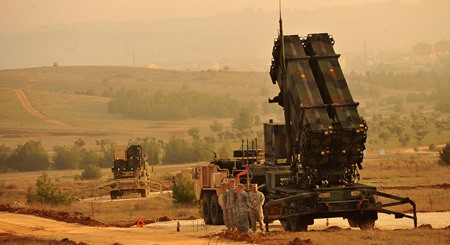
???????????????????U.S. Service members stand by a Patriot missile battery in Gaziantep, Turkey, Feb. 4, 2013, during a visit from U.S. Deputy Secretary of Defense Ashton B. Carter, not shown. U.S. and NATO Patriot missile batteries and personnel deployed to Turkey in support of NATO’s commitment to defending Turkey’s security during a period of regional instability. (DoD photo by Glenn Fawcett)

Unlike in Syria . . . in Iraq the US relates to the official government, mistakenly, as an ally.  This is leading to a potentially disastrous situation  whereby US air power is currently partnering with Iran-supported Shia militias against the Islamic State.

The most powerful of these militias have a presence in the government of Iraq. But they do not act under the orders of the elected Baghdad government, but rather in coordination with their sponsors in the Qods Force of the Iranian Revolutionary Guards Corps.

The Kurds, because of the existence among them of a secular, pro-western nationalist politics with real popular appeal, have unsurprisingly emerged as the only reliable partner.    On both the Shia and the Sunni sides, the strongest and prevailing forces are anti-western.

This reality is denied both by advocates for rapprochement with Iran, and by wishful-thinking supporters of the Syrian rebellion.  But it remains so.

*****************

Recently,  I attempted to undertake a reporting trip into the Kurdish Kobani enclave in northern Syria.  It would not have been my first visit, neither to Syria nor to Kobani.  For the first time, however, I found myself unable to enter.  Instead, I spent a frustrating but, as it turns out, instructive four days waiting in the border town of Suruc in south-east Turkey before running out of time and going home.

The episode was instructive because of what it indicated regarding the extent to which Kurdish control in the enclaves established in mid 2012 is now a fact acknowledged by all neighboring players, including the enemies of the Kurds.  This in itself has larger lessons regarding US and western policy in Syria and Iraq.

But I am getting ahead of myself.  First, let me complete the account of the episode on the border.    My intention had been to enter Kobani ‘illegally’ with the help of the Kurdish YPG and local smugglers.  This sounds more exciting than it is.    I have entered Syria in a similar way half a dozen times over the last two years, to the extent that it has become a not very pleasant but mundane procedure. This time, however, something was different.  I was placed in a local center with a number of other westerners waiting to make the trip. Then, it seemed, we were forgotten.

The westerners themselves were  an interesting bunch, whose varied presence was an indication of the curious pattern by which the Syrian Kurdish cause has entered public awareness in the west.

There was a group of European radical leftists, mainly Italians, who had come after being inspired by stories of the ‘Rojava revolution.’  A little noted element of the control by the Syrian franchise of the PKK of de facto sovereign areas of Syria has been the interest that this has generated in the circles of the western radical left.  These circles are ever on the lookout for something which allows their politics to encounter reality, in a way that does not bring immediate and obvious disaster.  As of now, ‘Rojava,’ given the leftist credentials of the PKK, is playing this role.  So the Europeans in question  wanted to ‘contribute’ to what they called the ‘revolution.’

Unfortunately, their preferred mode of support was leading to a situation of complete mutual bewilderment between themselves and the local Kurds.   Offered military training by their hosts, the radical leftists demurred.  They would not hold a gun for Rojava before they had seen it and been persuaded that it did indeed represent the peoples’ revolution that they hoped for.

Instead, they had a plan for the rebuilding of Kobani along sustainable and environmentally friendly lines, using natural materials  In addition, the health crisis and shortage of medicines in the devastated enclave led the radicals to believe that this might offer an appropriate context for popularizing various items of alternative and naturopathic medicine about which they themselves were enthusiastic.  (I’m not making any of this up).

All this had elicited the predictable reaction from the Kurds, who were trying to manage a humanitarian disaster and a determined attempt by murderous jihadis to destroy  them.  ‘Perhaps you could do the military training first and then we could talk about the other stuff?’ suggested Fawzia, the nice and helpful representative of the PYD who was responsible for us.  This led to further impassioned and theatrical responses from the Italians.

Apart from this crowd, there was a seasoned Chilean war reporter who looked on the leftists with impatience.  He was looking to get down to the frontlines south of Kobani, where the YPG was trying to cut the road from Raqqa to Aleppo at an important point close to the Euphrates.

Also, there was a polite and friendly lone American, a Baptist Christian, who had come to volunteer his services to the YPG.  That was us.

But as the days passed, it became clear that none of us appeared to be getting anywhere near Kobani any time soon.

The reasons given for the delay were plentiful, and unconvincing.  ‘It is the weather,’ Fawzia would say vaguely, ‘too much mud.’  But the presence of mud on the border in February was hardly a new development, so this couldn’t be the reason.

Finally, frustrated at the lack of information, I called a PKK friend based in Europe and asked for his help in finding out why we weren’t  moving.  He got back to me a little later.  ‘It seems the Turkish army is all over the border, more than usual. That’s the reason,’ he told me.

This was more plausible, if disappointing.  After four days on the border, I was out of time and set off back for Gaziantep and then home.  The Italians went to Diyarbakir to take part in a demonstration.  The Chilean and the American volunteer stayed and waited.

When I got back to Jerusalem, all rapidly became clear.  News reports were coming in about a large operation conducted by the Turkish army through Kobani and into Syria.  The operation involved the evacuation of the Turkish garrison at the tomb of Suleiman Shah, south of the enclave.  The American volunteer sent me a picture of the Turkish tanks on tank transporters driving though Suruc at the conclusion of the operation.

This operation was astonishing on a number of levels.

Despite stern Turkish denials, it could only have been carried out on the basis of full cooperation between the Turkish armed forces and the Kurdish fighters of the YPG in Kobani.  Obviously, any unauthorized entry of Turkish troops into the Kurdish canton would have meant an armed battle.

During the fight for Kobani last year, the Turkish government was very clearly quite content for the enclave to fall.  The Turkish army waited on the border, as the prospect of a generalized slaughter of the Kurds in Kobani came close to realization.

But of course, the slaughter didn’t happen.  In the end, the partnering of US air power with the competent and determined forces of the YPG on the ground delivered the first real defeat to the forces of the Islamic State in Syria.

This effective partnering has continued, and has now become the main military element in northern Syria in the battle against IS.

The combination of the YPG and the USAF is now nudging up to a second strategic achievement against the jihadis – namely, the cutting of the road from Tel Hamis to the town of al-Houl on the Iraqi border.   This road forms one of the main transport arteries linking the Islamic State’s conquests in Iraq to its heartland in the Syrian province of Raqqa.  If the links are cut, the prospect opens for the splitting of the Islamic State into a series of dis-connected enclaves.

The YPG-US partnership is particularly noteworthy, given that the YPG is neither more nor less than the Syrian representative of the PKK.  The latter, meanwhile, is a veteran presence on the US and EU lists of terror organizations.  Despite a faltering peace process, the PKK remains in conflict with Turkey, a member of NATO.

But the reality of the Kurdish-US alliance in northern Syria has clearly now been accepted by the Turks as an unarguable fait accompli, to the extent that they are now evidently willing to work together with the armed Syrian Kurds, where their interests require it.

It is an astonishing turnabout in the fortunes of the Kurds of Syria, who before 2011 constituted one of the region’s most brutally oppressed, and most forgotten minority populations.

This raises the question as to why this reversal of fortune has taken place.

Why is the YPG the chosen partner of the Americans in northern Syria, just as the Kurdish Pesh Merga further east is one of the preferred partners on the ground in Iraq?

The answer to this is clear, but not encouraging.  It is because in both countries, the only reliable, pro-western and militarily effective element on the ground is that of the Kurds.

Consider:  in northern Syria, other than the forces of the Islamic State, there are three other elements of real military and political import.  These are the forces of the Assad regime, the al-Qaeda affiliated Jabhat al-Nusra and the YPG.

In addition, there are a bewildering variety of disparate rebel battalions, with loyalties ranging from Salafi Islamism to Muslim Brotherhood style Islamism, to non-political opposition to the Assad regime.  Some of these groups operate independently.  Others are gathered in local alliances such as the Aleppo based Jabhat al-Shamiya (Levant Front), or the Syria-wide Islamic Front, which unites Salafi factions.

Despite the reported existence of a US staffed military operations room in Turkey, the latter two movements are either too weak, or too politically suspect (because of their Islamist nature), to form a potential partner for the US in northern Syria.

Nusra is for obvious reasons not a potential partner for the US in the fight against the Islamic State.  And the US continues to hold to its stated  goal that Bashar Assad should step down.  So the prospect of an overt alliance between the regime and the US against the Islamic State is not on the cards (despite the de facto American alliance with Assad’s  Iran-supported Shia Islamist allies in Iraq).

This leaves the Kurds, and only the Kurds, to work with.  And the un-stated alliance is sufficiently tight for it to begin to have effects also on Turkish-Kurdish relations in Syria, as seen in the Suleiman Shah operation.

But what are the broader implications of this absence of any other coherent partner on the ground?

The stark clarity of the northern Syria situation is replicated in all essentials in Iraq, though a more determined attempt by the US to deny this reality is under way in that country.

In Iraq, there is a clear and stated enemy of the US (the Islamic State), a clear and stated Kurdish ally of the west (the Kurdish Regional Government and its Pesh Merga) and an Iran-supported government which controls the capital and part of the territory of the country.

Unlike in Syria, however, in Iraq the US relates to the official government, mistakenly, as an ally.  This is leading to a potentially disastrous situation  whereby US air power is currently partnering with Iran-supported Shia militias against the Islamic State.

The most powerful of these militias have a presence in the government of Iraq. But they do not act under the orders of the elected Baghdad government, but rather in coordination with their sponsors in the Qods Force of the Iranian Revolutionary Guards Corps.

It is possible that the current partnering with Shia Islamist forces in Iraq is the result of a general US attempt now under way to achieve a historic rapprochement with Iran, as suggested by Michael Doran in a recent essay.  Or it may be that this reality has emerged as a result of poor analysis of the realities of the Levant and Iraq, resulting in a confused and flailing policy.  But either way, the result is an astonishing mess.

In northern Syria, the obvious absence of any partners other than the Kurds has produced a momentary tactical clarity.  But as the larger example of Iraq shows, this clarity is buried in a much larger strategic confusion.

This confusion, at root, derives from a failure to grasp what is taking place in Syria and in Iraq.

In both countries, the removal or weakening of powerful dictatorships has resulted in the emergence of conflict based on older, sub-state ethnic and sectarian identities.  The strength and persistence of these identities is testimony to the profound failure of the states of Syria and Iraq to develop anything resembling a sustainable national identity.  In both Syria and Iraq, the resultant conflict is essentially three-sided.  Sunni Arabs, Shia/Alawi Arabs and Kurds are fighting over the ruins of the state.

Because of the lamentable nature of Arab politics at the present time, the form that both Arab sides are taking is that of political Islam.   On the Shia side, the powerful Iranian structures dedicated to the creation and sponsorship of proxy movements are closely engaged with the clients in both countries (and in neighboring Lebanon.)

On the Sunni Arab side, a bewildering tangle of support from different regional and western states to various militias has emerged.  But two main formations may be discerned. These are the Islamic State, which has no overt state sponsor, and Jabhat al-Nusra, which has close links to Qatar.

In southern Syria, a western attempt to maintain armed forces linked to conservative and western-aligned Arab states (Jordan, Saudi Arabia) has proved somewhat more successful because of the close physical proximity of Jordan and the differing tribal and clan structures in this area when compared with the north.  Even here, however, Nusra is a powerful presence, and Islamic State itself recently appeared in the south Damascus area.

The Kurds, because of the existence among them of a secular, pro-western nationalist politics with real popular appeal, have unsurprisingly emerged as the only reliable partner.    On both the Shia and the Sunni sides, the strongest and prevailing forces are anti-western.

This reality is denied  both by advocates for rapprochement with Iran, and by wishful-thinking supporters of the Syrian rebellion.  But it remains so.  What are its implications for western policy?

Firstly, if the goal is to degrade the Islamic State, reduce it, split it, impoverish it, this can probably be achieved through the alliance of US air power and Kurdish ground forces.  But if the desire, genuinely, is to destroy the Islamic State, this can only be achieved through the employment of western boots on the ground.  This is the choice which is presented by reality.

Secondly, the desire to avoid this choice is leading to the disastrous partnering with Iraqi Shia forces loyal to Iran.  The winner from all this will be, unsurprisingly,  Iran. Neither Teheran nor its Shia militias are the moral superiors to Islamic State. The partnering with them is absurd both from a political and an ethical point of view.

Thirdly, the determination to maintain the territorial integrity of ‘Syria’ and ‘Iraq’ is one of the midwives of the current confusion.  Were it to be acknowledged that Humpty cannot be put back together again, it would then be possible to accurately ascertain which local players the west can partner with, and which it can not.

As of now, the determination to consider these areas as coherent states is leading to absurdities including the failure by the US to directly arm the pro-US Pesh Merga because the pro-Iranians in Baghdad object to this, the failure to revive relations with and directly supply Iraqi Sunni tribal elements in IS controlled areas for the same reason,  and the insistence on relating to all forces ostensibly acting on behalf of Baghdad as legitimate.

Ultimately, the mess in the former Syria and Iraq derives from a very western form of wishful thinking that is common to various sides of the debate in the west.  This is the refusal to accept that political Islam, of both Shia and Sunni varieties, has an unparalleled power of political mobilization among Arab populations in the Middle East at the present time, and that political Islam is a genuinely anti-western force, with genuinely murderous intentions.

For as long as that stark reality is denied, western policy will resemble our Italian leftist friends on the border, baffled and bewildered as they go about proposing ideas and notions utterly alien to and irrelevant to the local situation.

The reality of this situation means that the available partners for the west are minority nationalist projects  such as that of the Kurds (or the Jews,) and traditional, non-ideological conservative elites – such as the Egyptian military, the Hashemite monarchs, and in a more partial and problematic way, the Gulf monarchs.  Attempts to move beyond this limited but considerable array of potential allies will result in the strengthening of destructive, anti-western Islamist forces in the region, of either Sunni or Shia coloration.

As for the Syrian Kurds, they deserve their partnership with US air power, and the greater security it is bringing them.

The American Baptist volunteer, to conclude the story, made it across the border and is now training with the YPG.  He, at least, has a clear sense of who is who in the Middle East.  Hopefully, this sense will eventually percolate up to the policymaking community too.
Iran gathers power in Iraq as US further sidelined

March 18, 2015

Iran gathers power in Iraq as US further sidelined, Al-MonitorMohammed A. Salih, March 17, 2015

(The Iraqi – Iranian effort to retake Tikrit has been “stalled” for several days. — DM)

SULAIMANIYAH, Iraq — While the United States has invested trillions of dollars and thousands of lives since 2003 to bring Iraq into its orbit, today it is Iran that appears to have achieved that goal, albeit with far less costs in terms of money and lives, observers and analysts of Iraqi affairs agree.

There appears to be no better demonstration of Iran’s success in having firmly established its hegemony across Iraq than in the current operation to retake the Sunni-dominated province of Salahuddin in central Iraq. The operation to push out Islamic State (IS) militants from Tikrit and its surrounding areas in Salahuddin is being carried out by a ragtag force of Shiite Popular Mobilization Units (PMUs), the Iraqi army and some local Sunni tribes.

The largest military campaign so far against IS, the Salahuddin operation has been noted for the heavy involvement of Iranian military advisers and the conspicuous absence of the US military. While the United States has in the past aided similar operations by the Iraqi military and PMUs in areas such as Amerli and Baiji, no US warplanes are now dropping bombs in Salahuddin.

“The Iranians have checkmated the Americans, and I think the Americans now understand this,” Hayder al-Khoei, an Iraq expert at the London-based Chatham House, told Al-Monitor. “What’s interesting about the Salahuddin operation is that the Iraqis and the Iranians are proving to Americans: We don’t need your airstrikes.”

When IS swept large parts of northern and central Iraq in June, the jihadist group appeared unstoppable. During a forum last week in Sulaimaniyah, a city in Iraqi Kurdistan, Brett McGurk, US deputy assistant secretary of state for Iraq and Iran, admitted that a few days after IS’ onslaught in mid-June, his government’s assessment was that Baghdad might fall within 72 hours.

“Iran proved, despite its difficult economic conditions, that it is prepared … and stood by us in any way it could to defend our country and our Islam and common beliefs, and by that I don’t mean the Shiite sect but the genuine human values that govern in this region,” said Hussein al-Shahristani, Iraq’s minister of higher education and a powerful Shiite politician, during the forum. “Iraqis will not forget this favor.”

Iraqi leaders say Iran has provided around $10 billion worth of weaponry to their forces. Iranian military advisers have also not been shy to advertise their role in the battle to retake the key city of Tikrit, the hometown of their former No. 1 enemy, former leader Saddam Hussein.

Gen. Qasem Soleimani, head of the Iran’s Islamic Revolutionary Guard Corps’s (IRGC) elite Quds Force, has made no secret of his pivotal role on the front lines of Salahuddin. He is said to have been deeply involved in planning and executing the current battle.

Many of the major Shiite armed groups such as the Badr Brigades, Asaib Ahl al-Haq and Kataib Hezbollah are known to have been founded, trained and funded by the IRGC. It’s these forces that play the critical role in pushing back IS jihadists, according to media reports.

US military officials have expressed their concerns over Iran’s strong role in Salahuddin, fearing this could further alienate Sunni Arabs and Washington’s efforts to get them onboard to fight against IS. Amid all this, many observers are asking whether the United States was even invited to join the Salahuddin campaign.

“The Iranians and their Iraqi proxies wanted to demonstrate their power and that they can fight in any battlefield, whether it is in the … mixed sectarian areas or in Sunni-only areas such as the Tigris River Valley [in Salahuddin],” Michael Knights, a fellow at the Washington Institute for Near East Policy specialized in the military affairs of Iraq and Iran, told Al-Monitor.

The US absence in the Salahuddin theater comes despite Washington’s attempts to coordinate the “liberation” of Sunni areas from IS. A date was even announced by Pentagon officials for an operation to retake Mosul from IS. But by conducting the Salahuddin operation, Shiite paramilitary groups and their Iranian backers sent a message of their own.

“[Iran and Shiite forces] are the most significant partners to the Iraqi state. They planned this operation to ensure they would get [to Tikrit] first, before the Americans,” Knights added. “It’s a big propaganda victory for the PMUs.”

Knights said that the operation was initially planned without Iraqi Prime Minister Haider al-Abadi’s involvement. Official Iraqi army units were added only later, when Abadi got wind of the planning for the operation. Around 20,000 Shiite forces and 3,000 Iraqi soldiers are taking part in the Salahuddin assault, according to top US Gen. Martin Dempsey.

If the operation succeeds, most of the credit will go to PMU leaders such as Hadi al-Ameri and Abu Mahdi al-Muhandis and Quds Force Cmdr. Soleimani, Knights said.

The emergence of IS appears to have further consolidated Iranian clout in Iraq, as Iran’s generals and sponsored militias have taken the lead in fighting off IS in areas the jihadist group seized from the Iraqi army last summer.

Even though many believe much of the US arms assistance for Iraq ends up in the hands of the pro-Iranian Shiite paramilitary groups, these forces make little secret of their disdain for the United States, often peddling conspiracies that the United States and other countries deliver military aid to IS.

While Iran has jockeyed for influence in Iraq since 2003, the withdrawal of US troops from Iraq in late 2011 paved the way for a stronger Iranian role in Iraq. The Syrian crisis next door brought Tehran and Baghdad even closer together as both sides shared an interest in saving President Bashar al-Assad’s regime and preventing the rise of a Sunni-dominated order there.

Now, as Iraq continues to slide even further into Iran’s hemisphere of influence, many in Washington are questioning US arms deliveries to Baghdad. Concerns about military aid to Iraq have been amplified due to gross human rights violations committed by Shiite PMUs and Iraqi troops.

Kenneth Pollack, an expert on Middle East politics and military affairs with the Washington-based Brookings Institution, believes the United States should continue a strong relationship with Baghdad.

“I think the Americans drawing back will be the worst thing to do. That will drive the government in Baghdad even more deeply into the arms of the Iranians,” Pollack told Al-Monitor. “If Iraq is going to move to a place where Iran has less influence, it’s going to take a long time.”


Grand Gas Project Signifies Futility of Anti-Iran Sanctions: President

March 17, 2015

Grand Gas Project Signifies Futility of Anti-Iran Sanctions: President, Tasnim News Agency (Iranian), March 17, 2015

(Iran claims to have done quite well with sanctions, or what sanctions remained after November of 2013, despite all the money it has been spending in Iraq and Syria, not to mention terrorism elsewhere. Why, then, the demand that all sanctions be removed instanter? Will Kerry ask? Not likely.– DM)

139312261516169584940403

TEHRAN (Tasnim) – Iranian President Hassan Rouhani described the inauguration of the 12th development phase of the massive offshore South Pars gas field as a testimony to the ineffectiveness of the Western sanctions against Iran.

“The inauguration of the 12th phase illustrates that sanctions, pressures, and illegal and inhumane measures cannot push the (Iranian) nation back,” President Rouhani said in a Tuesday ceremony in the southern province of Bushehr for the official coming into service of the giant gas field’s 12th phase.The president explained that Iran’s gas production now exceeds 100 million cubic meters, stressing that such a great job has been accomplished while the country has been slapped with the cruel sanctions.Iran has also experienced economic growth and inflation reduction with the sanctions being in place, Rouhani added.

According to Oil Minister Bijan Namdar Zanganeh, the 12th phase, which has been totally designed and developed by the local experts, has cost more than $7.5 billion.

The 12th phase can produce 80 million cubic meters of gas and 120,000 barrels of gas condensates on a daily basis, bringing the country $17.5 million in revenue every day.

Zanganeh has also hailed the new phase as a helpful source of revenue while Iran is hit by “cruel economic sanctions” and the global oil price decline has diminished the country’s financial resources.

The 12th phase extends over an area of approximately 205 square kilometers along Iran-Qatar joint border. Located at a distance of 105 kilometers from the coast, the 12th phase alone contains about 5 percent of the whole gas reserves in the South Pars filed.

South Pars is part of a wider gas field that is shared with Qatar. The larger field covers an area of 9,700 square kilometers, 3,700 square kilometers of which are in Iran’s territorial waters (South Pars) in the Persian Gulf.

Book review: The Islamic War

March 16, 2015

The Islamic War: Book review, Dan Miller’s Blog, March 16, 2015

(The views expressed in this article are mine and do not necessarily reflect those of Warsclerotic or its other editors. — DM)

The Islamic War, Martin Archer, 2014

The novel begins with a terror attack on a residential area in Israel, resulting in multiple causalities. It may, or may not, have involved members of the Iranian Revolutionary Guard. Menachem Begin is the Israeli Prime Minister and Ariel Sharon is the Defense Minister. The story begins immediately after the (postponed?) end of the Iran – Iraq war in 1988.

A massive armor, infantry, artillery and air attack on Israeli positions in the Golan follows the terrorist attack. The Israelis are outnumbered and suffer many thousands of casualties.

Israel had anticipated a simultaneous attack via Jordan, so most Israeli tank, infantry and air resources are deployed there, rather than in the Golan, to conceal themselves and await the arrival of Iranian, Iraqi and Syrian forces. They come and are defeated, most killed or fleeing. The Israeli forces then move into Syria and have similar successes there as well.

As the story evolves, it becomes evident that Israel must have known that the Iran – Iraq war had been allowed to fester to permit Iran, Iraq and Syria to develop a well coordinated plan to dispose of Israel, in hopes that a surprise attack could be made as soon as the Iran – Iraq war ended. Other events also suggest that Israel had prior notice:

Nuclear facilities of several hostile nations explode mysteriously.

The Israeli Navy had managed to infiltrate Iranian oil ports — apparently before the attack on the Golan — without being noticed. Then, at a propitious moment near the end of the fighting elsewhere, they destroyed all oil tankers in, entering or leaving port, along with all Iranian oil storage facilities.

The Israel Navy, which had suffered no losses, then moved to Saudi Arabia to protect her oil ports and ships coming to buy her oil and leaving.

As these events unfold, Israel, Egypt, Jordan, Saudi Arabia and Turkey* are negotiating a united front against Iran, Iraq and Syria, much to the displeasure of the U.S. Secretary of State, who wants a cease fire and return to the status quo ante. Fortunately, the U.S. President favors Israel and her coalition and generally ignores his SecState.

I won’t spoil the story by relating what happens at the end, but it’s very good for Israel, Egypt, Jordan, Saudi Arabia, Turkey and the Kurds, and very bad for Iran, Iraq and Syria. The novel is well worth reading, perhaps twice.

_____________

*Historical note: Turkey in 1988 was reasonably secular and also in other ways quite different from now. Egypt under President Al-Sisi is, in some but not all respects, similar to Egypt in 1988 under President Mubarak. Beyond a good relationship with Israel, Al-Sisi is working to modernize and reform Islam by turning it away from the violent jihad which drives both the Islamic State (Sunni) and the Islamic Republic of Iran (Shiite). Egypt remains under fire from the Obama administration due to the “coup” which ousted President Morsi, who had made Egypt essentially an arm of the Muslim Brotherhood. Egypt now helps to protect Israel with her military presence in the Sinai to oppose Hamas and Muslim Brotherhood activities there. Saudi Arabia and Jordan, like most countries in the Middle East, look out for the interests of their rulers first and are quite concerned about both the Islamic State and Iran.

Iran’s advances create alarm in Saudi Arabia and the Gulf

March 14, 2015

Iran’s advances create alarm in Saudi Arabia and the Gulf, the Guardian,  March 13, 2015

Arabs believe Baghdad, Damascus, Beirut and Sana’a are in effect under Iranian control – and power may shift further if US sanctions are eased.

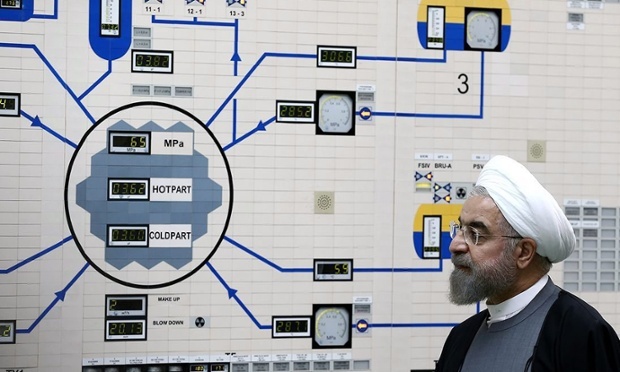
c0ac3569-93da-4ae8-8b51-29dc6991ee13-620x372 Hassan Rouhani, the Iranian president, visiting Bushehr nuclear power plant in southern Iran this year. Photograph: Presidential official handout/EPA

Iran’s great advantage, suggests Emile Hokayem, an analyst, is its commitment and competence, in Syria and beyond. “The expertise, experience and strategic patience it deployed in support of the Syrian regime to a great extent facilitated Assad’s recovery from serious setbacks in 2012. In contrast, the war in Syria has exposed not only the political and operational limitations of the Gulf states, but also the rivalries among them.”

*********************

The commanders of Iran’s Islamic Revolutionary Guard Corps (IRGC) have been working overtime recently, flaunting their achievements across the Middle East and flexing muscles as international negotiations over the country’s nuclear programme enter their critical and perhaps final phase.

On Wednesday it was the turn of Major-General Mohammad Ali Jafari, the IRGC’s most senior officer. “The Islamic revolution is advancing with good speed, its example being the ever-increasing export of the revolution,” he declared. “Not only Palestine and Lebanon acknowledge the influential role of the Islamic Republic but so do the people of Iraq and Syria. They appreciate the nation of Iran.”

Last month a similarly boastful message was delivered by General Qassem Suleimani, who leads the IRGC’s elite Quds force — and who is regularly photographed leading the fightback of Iraqi Shia miltias against the Sunni jihadis of the Islamic State (Isis) as well as against western and Arab-backed rebels fighting Bashar al-Assad in southern Syria. “Imperialists and Zionists have admitted defeat at the hands of the Islamic Republic and the resistance movement,” Suleimani said.

Iran’s advances are fuelling alarm in Saudi Arabia and the Gulf, where Tehran has been a strategic rival since the days of the Shah, and which now, it is said with dismay, in effect controls four Arab capitals – Baghdad, Damascus and Beirut and in the last month Sana’a in Yemen – which is uncomfortably close to home.

Iran’s regional position has certainly improved. Its high-profile role fighting Isis in Iraq, Assad’s retention of control in Syria with the help of its Lebanese ally Hezbollah, and the Houthi rebel takeover in Yemen have all been deeply discomfiting for the Saudis. Anti-government protests in Shia-majority Bahrain are also often blamed on Tehran — though that ignores the domestic roots of the unrest.

In Riyadh King Salman has dropped his preoccupation with the Muslim Brotherhood in favour of building a united Sunni Arab front to confront the Iranians, diplomats say, though translating that strategy into action is another matter. The message from Saudi Arabia and the United Arab Emirates is that whatever the outcome of the nuclear talks, Iran is bent on expanding its power and influence. “The Iranians have scored major victories but only where there are Shia minorities,” a senior Gulf official told the Guardian. “Our concern is that the nuclear issue will become a tool of their foreign policy.”

Arab alarm is shared by Israel. Binyamin Netanyahu used identical arguments in his recent speech to the US Congress, timed to influence next week’s nuclear endgame in Geneva. “The Saudis will be incredibly worried that we are getting close to a point where the Iranians will be players because of the nuclear issue and the way the Americans have effectively ended up on the same side as the Iranians in Iraq,” said one veteran Saudi-watcher. “But the noise they are making is in inverse proportion to their ability to do anything about it.”

Arab governments are not reassured by the promises of John Kerry, the US secretary of state, that Washington is not seeking a “grand bargain” with Tehran that will allow it to “destabilise” the Middle East, bolstered by the easing of economic sanctions. Saud Al Faisal, the Saudi foreign minister, warned of Tehran’s “hegemonic” ambitions as the IRGC supported the military operation to retake the Iraqi town of Tikrit from Isis. In Gulf capitals Hassan Rouhani, the emollient Iranian president, is seen as less important than the hardline supreme leader, Ayatollah Ali Khamenei.

It is hard to disentangle propaganda from reality. But independent analysts argue that Iran is inflating its gains for both foreign and domestic consumption. “If you listen to Suleimani there is a degree of exaggeration,” argues Ali Ansari of St Andrews University. “It’s rhetorical reassurance. He is saying to Iranians: ‘We are powerful and and everyone is worried about this’ – partly to make the point that they are not really under pressure. People outside can see what Iran’s strengths and weaknesses are. But there is this belief that you need to negotiate from a position of strength and that if you are weak you will be trampled on.”

Iran-watcher Hossein Rassam also detects a domestic calculation in the IRGC statements. “Critics of Rouhani’s policy of rapprochement with the international community inside Iran can turn to the supreme leader and say there wasn’t really much need for that softer tone because now we have more bargaining chips in our hands. Iran is the only power in the region which can actually fight Isis and the west needs us for that.”

Meir Litvak, an Israeli expert on Iran, sees both genuine belief and posturing in Tehran’s stance. “The Iranians believe they have been able to save the Assad regime from total collapse and there is at least stalemate in Syria,” he said. “That means they have been able to maintain the link with Hezbollah and maybe open a second front by proxy against Israel on the Golan Heights. The Houthi rebellion in Yemen was initially a genuinely domestic affair but the Iranian regime saw it as an opportunity. And it has become a bonus for it – even if they are not that active inYemen. But if the Saudis are scared that’s a plus for the Iranians.”

Arab diplomatic sources say they expect to see an IRGC and Hezbollah presence in Yemen, helped by a new agreement on regular flights between Tehran and Sana’a.

Iran’s role in Bahrain, where the Shia majority remains locked in confrontation with the Saudi-backed Sunni monarchy, is more about scoring propaganda points than material support – despite claims in Manama about Iran’s sinister role.

Still, in the heartlands of Iranian influence, Iraq and Syria, there have been significant costs as well as benefits, including the deaths of two senior IRGC commanders. Continuing sanctions and low oil prices – seen in Tehran as a deliberate strategy by the Saudis – have also made it harder to shell out billions of dollars to subsidise the Assad regime.

Iran’s great advantage, suggests Emile Hokayem, an analyst, is its commitment and competence, in Syria and beyond. “The expertise, experience and strategic patience it deployed in support of the Syrian regime to a great extent facilitated Assad’s recovery from serious setbacks in 2012. In contrast, the war in Syria has exposed not only the political and operational limitations of the Gulf states, but also the rivalries among them.”

Analysis: Iran is no partner in the fight against the Islamic State

March 11, 2015

Analysis: Iran is no partner in the fight against the Islamic State, Long War Journal and , March 11, 2015

B_vsofcXEAAtDRvQassem Soleimani (center) with his bodyguards near the frontlines of Tikrit.

Iran benefits from the threat of an Islamic State, and if the US continues its courtship of Tehran, it may find the Islamic State replaced by an Islamic Republic.

****************

Testifying on Capitol Hill on March 3, Joint Chiefs Chairman General Martin Dempsey characterized the joint attempts of the Iraqi military, Iraqi Shia militias, and Iran’s Islamic Revolutionary Guards Corps (IRGC) at taking back control of Tikrit, Saddam Hussein’s hometown, from the Islamic State, as “a positive thing.” “Frankly,” General Dempsey said, “it will only be a problem if it results in sectarianism.”

General Dempsey’s caveat is an interesting one, since there is every reason to believe that Shia control of Tikrit will result in further sectarianism. While the US administration says in its most recent National Security Strategy that it desires to “degrade and ultimately defeat ISIL [Islamic State]” in an attempt to “support Iraq … free itself from sectarian conflict and the scourge of extremists,” Tehran is actively perpetuating the sectarian crisis in Iraq.

The threat of the Islamic State, coupled with American “strategic patience,” not only makes the Iraqi Shia more dependent on Tehran and legitimizes Iran’s military presence in Iraq, it also provides the regime in Tehran with another bargaining chip in nuclear negotiations with the P5+1 Group.

In the past, the Iraqi Shia have demonstrated little interest in reducing themselves to puppets of Tehran. During the war with Iraq from 1980-1988, Iraqi nationalism trumped sectarian identity: the Shia constituted the rank and file of the Iraqi military, and Shia leaders in Iraq kept their distance from the regime in Tehran. After the collapse of Saddam Hussein’s regime in 2003, Iraq became a sanctuary to Iranian clerics critical of the regime in Tehran, including Hossein Khomeini, grandson of the founder of the Islamic Republic.

But Iraq did not remain a refuge for long. The civil war in Iraq, followed by the rise of Islamic State, forced moderate Iraqi Shia, who otherwise would have pursued a line independent of Iran, to become dependencies of Tehran. After being rebuffed by the US following the Islamic State’s takeover of Mosul in 2014, General Qassem Atta, head of the Iraqi National Intelligence Service, asked Tehran for help and received assistance within 48 hours. Iraqi Prime Minister Haider al Abadi continues to press Washington for more support in his fight against the Islamic State and uses US hesitancy to justify reliance on Iran, which according to Vice President Iyad Allawi,only increases Iran’s influence in Iraq and could lead to dismantlement of the Iraqi state.

The Obama administration may desire to help secure the survival of the Iraqi state, but the small contingent of US advisers in Iraq is relying on a heavily Iranian-influenced Iraqi sectarian intelligence and security apparatus. The Iraqi security forces are predominantly Shia, and in addition, Shia militias and “advisers” from the IRGC Quds Force are now fighting as legitimate Iraqi forces. 

This creates an environment in which targeting operations developed by Iranian forces and the militias have primacy over those developed by the US, leading to the possibility that  Washington could be portrayed by Islamic State as complicit in the indiscriminate targeting of Sunnis. Such operations will be perceived the same way by the very Sunnis we need to fight Islamic State, thus undermining the US strategy to “support Iraq … free itself from sectarian conflict and the scourge of extremists.”

Any US reliance on Iranian support in the fight against the Islamic State is also likely to strengthen Tehran’s bargaining position in the nuclear negotiations.

Although both US and Iranian negotiators maintain that nothing but the nuclear issue is being discussed, this of course is fiction. On Sept. 22, Fars News, quoting an anonymous American source, reported that Secretary of State John Kerry and Mohammad Javad Zarif, Iran’s foreign minister, discussed the nuclear issue as well as the fight against the Islamic State. And Admiral Ali Shamkhani, Iran’s Supreme National Security Council Secretary, has also connected both issues. Clearly, Tehran’s cooperation with Washington in the fight against the Islamic State comes at a price, which Washington must pay at the negotiating table in Geneva.

Iran has Washington where it wants it. Iran wants a favorable deal, and the Obama administration is signaling that such a deal is forthcoming. US “strategic patience” is allowing Iran to increase its influence and presence in Iraq and Syria. Assad is waiting out the Americans and the international community, and Shia militias are now viewed as legitimate forces in Iraq, Syria, and Yemen. But most importantly, US “strategic patience” signals to Iran an unwillingness to jeopardize the talks by linking them to Iran’s role in Iraq, Syria, and Yemen. 

Iran benefits from the threat of an Islamic State, and if the US continues its courtship of Tehran, it may find the Islamic State replaced by an Islamic Republic.

Rouhani adviser denies he called for Iran’s return to empire

March 11, 2015

Rouhani adviser denies he called for Iran’s return to empire, Al-MonitorArash Karami, March 10, 2015

(An modest attempt at a partial walk-back. Please see also, Advisor To Iranian President Rohani: Iran Is An Empire, Iraq Is Our Capital . . . — DM)

Iran's former Intelligence Minister Younesi, chief nuclear negotiator Larijani and former chief nuclear negotiator Rohani attend conference in TehranIran’s former Intelligence Minister Ali Younesi (L), chief nuclear negotiator Ali Larijani and former chief nuclear negotiator and current President Hassan Rouhani (R) attend a conference on Iran’s nuclear policies and prospects in Tehran April 25, 2006. (photo by REUTERS/Raheb Homavandi)

Ali Younesi, President Hassan Rouhani’s adviser on Ethnic and Religious Minorities affairs, has issued a clarification about his comments suggesting a union between regional countries. His words had sparked criticism from the Arab-language media, which construed them as reviving Iran’s ancient empire. A former Iranian vice president who was at the conference also spoke out against Younesi’s comments.

Younesi accused Iran’s enemies of creating propaganda by misconstruing his comments at a March 8 conference on Iranian history and culture, saying that he was simply talking about a “historical and cultural unity” between certain countries in the region, including Iran, Tajikistan, Afghanistan and Iraq. He said that his proposal was for a “union” and “does not mean an empire should be reborn,” but rather that the neighbors should cooperate to confront mutual threats. He added that Iran’s official position is that “it respects the national boundaries and territorial integrity of other countries.”

Younesi was specifically criticized for saying, “Currently, Iraq is not only part of our civilizational influence, but it is our identity, culture, center and capital, and this issue is for today and the past. Because Iran and Iraq’s geography and culture are inseparable, either we fight one another or we become one.” He went on, “My meaning is not that we should remove our borders, but that all the countries of the Iranian plateau should become close because our interests and safety are intertwined.”

Younesi’s call for a “natural union” between these countries was not welcomed by Iran’s regional rivals, especially given the sensitivities of Arab countries in the Persian Gulf to Iran’s assistance to Iraqi forces currently battling the Islamic State in former Iraqi President Saddam Hussein’s hometown of Tikrit.

Saudi Arabian-funded Al-Arabiya incorrectly reported that Younesi had said, “Iran today has become an empire like it used to be through history, and its capital is now Baghdad. That is the center of our civilization and our culture and our identity today, as it has been in the past.” CNN Arabic wrote in their headline that Younesi said, “Iran is an empire and its capital is Iraq. We protect the region from Wahhabis, neo-Ottomans and atheists.” Though the first sentence in the CNN Arabic is incorrectly translated, Younessi did say in the March 8 conference that Iran was helping to protect the region from Wahhabi, takfiri, Zionist and Western domination. The Al-Arabiya article was tweeted over 3,000 times and shared on Facebook by over 4,000 people.

Former Iranian Vice President Mohammad Ali Abtahi also criticized Younesi, posting on Facebook immediately after attending the conference, “Now that the Arab countries in the region have reached a relative unity with Israel on fears about Iran, these comments will be construed as the same threatening talk of Ahmadinejad.” He added, “Irrespective of their governments, people have a sensitivity to their land, and this talk provokes people’s sensitivities.”

As Rouhani’s Ethnic and Religious Minorities adviser, Younesi has become known for reaching out to Iran’s Jewish population by laying wreaths at the graves of Jewish Iranians killed in the Iran-Iraq war, taking criticism from conservatives for suggesting Iran revert to its pre-revolution flag bearing the lion and sun and criticizing those who commit human rights violations in Iran. Though he was once minister of intelligence under President Mohammad Khatami, today his position carries no executive weight. But given the tensions between Iran and Arab countries in the Persian Gulf, it’s understandable that these comments would spark a backlash.

Advisor To Iranian President Rohani: Iran Is An Empire, Iraq Is Our Capital . . .

March 10, 2015

Advisor To Iranian President Rohani: Iran Is An Empire, Iraq Is Our Capital ; We Will Defend All The Peoples Of The Region; Iranian Islam Is Pure Islam – Devoid Of Arabism, Racism, Nationalism, MERI, March 9, 2015

On March 8, 2015, Ali Younesi, advisor to Iranian President Hassan Rohani and previously intelligence minister (2000-2005) in the government of president Khatami, spoke at the “Iran, Nationalism, History, and Culture” conference in Iran; his statements were published by the Iranian ISNA news agency the same day.

According to Younesi, Iran is once again an empire, as it was in the past, and its capital, Iraq, is “the center of Iranian heritage, culture, and identity.” Delineating the borders of the Persian Empire, or, in his words, “greater Iran,” he included countries from China, the Indian subcontinent, the north and south Caucasus, and the Persian Gulf. He added that since the very dawn of its history, Iran had been an empire and a melting pot of different cultures, languages, and peoples.

Younesi stressed that despite the current obstacles to the unification of the countries in the region under Iranian leadership, Iran cannot disregard its regional influence if it wishes to preserve its national interests. Iran, he said, has been operating in this region, particularly in Iraq, with the aim of ensuring the security of the peoples there, whose connection to Iran is obvious because of history and culture. Saudi Arabia has nothing to fear from Iran’s actions, he added, because the Saudis themselves are incapable of defending the peoples of the region. He also assured the peoples of the region that Iran is operating there against Islamic extremism as embodied by ISIS, as well as against the Saudi Wahhabis, Turkey, secularists, Western rule, and Zionism.

Further emphasizing that anything that enters Iran is improved by becoming Iranian, especially Islam itself, he added that Islam in its Iranian-Shi’ite form is the pure Islam, since it has shed all traces of Arabism, racism, and any other element that divides the various Islamic groups.

Following are excerpts from Younesi’s statements:

“Every Cultural Or Ethnic Group That Arrived From Other Places To The Iranian Plateau Has In Time Become Iranian”

“The central, western, and eastern parts of the Iranian Plateau have always protected and nurtured Iranian ethnic groups, and all the people living in this expanse are ethnic Iranians. Every cultural or ethnic group that arrived from other places to the Iranian Plateau has in time become Iranian, as have their language and culture – even a language originating from somewhere else takes on a distinct Iranian flavor once it reaches the Iranian Plateau.

“The Azeris are one of the oldest tribes of the Iranian empire, and some of them spoke a Turkic language. But when this language reached the Iranian Plateau, it became Iranian and totally different from Turkic languages in other countries. The Azeris in Iran have always defended [Iran’s] national literature, language, and culture.

“A large section of the Iranian Plateau stretches in the east to the peaks of the Pamir [mountains in Tajikistan, Kyrgyzstan, Afghanistan, and Pakistan] and to the great River Sindh; in the north to the River Amu [Darya]; in the west to the peaks of the Caucasus; and in the central part to the peaks of Alborz and Zagros, overlooking the Caspian Sea, the Persian Gulf, and Oman…

“Today Iran is restricted to [only] the central plateau. Several countries have emerged from the eastern and western plateaus. The name and culture of greater Iran have always had a good reputation in the region… We cannot preserve our interests, national security, and historic identity without attention to Iran’s regional influence and borders…”

“If We Disregard The Region That Lies Within Our Sphere Of Influence, We Will Be Unable To Protect Our Interests And Security… Since Its Inception, Iran Has [Always] Had A Global [Dimension]; It Was Born An Empire”

“In essence, the greater Iran and Iranian culture, civilization, religion, and spirit are present in this expanse, and constitute a natural union in this region. While differences prevent such a union, in truth the Iranian Plateau includes countries from the borders of China and the Indian subcontinent to the north and south Caucasus and the Persian Gulf – all of which are part of this union…

“There is no dismantling our borders. Our borders have been recognized throughout history, like our territory and our culture. This region is impacted greatly by cultural and historical partnerships. If we disregard the region that lies within our sphere of influence, we will be unable to protect our interests and security.

“Since its inception, Iran has [always] had a global [dimension]; it was born an empire. Iran’s leaders, officials, and administrators have always thought in the global [dimension]…

“Of course, I do not mean that we want to take over the world again, but we need to know what our status is and must arrive at historic self-awareness – that is, thinking globally but acting as Iranians. [Israeli Prime Minister Benjamin] Netanyahu acknowledged with certainty Iran’s might and influence; he said that Iran has taken over four countries in the region. But Iran was only trying to help these [countries].”

“Iraq Is Not Merely A Sphere Of Cultural Influence For Us; It Is Also… Our Capital”

“In the current situation, Iraq is not merely a sphere of cultural influence for us; it is also our identity, our culture, our center, and our capital. This issue [of Iraq as our capital] exists today as it did in the past, because just as there is no way to divide the territory of Iran and Iraq, there is no way to divide our culture either. We must either fight each other or unite. The purpose of such a union would not be the elimination of borders; rather, that all the countries in the Iranian expanse would become closer, since their interests and security are interconnected.”

“We Are Protecting The Interests Of [All] The People In The Region –Because They Are All Iran’s People”

“Now, when Iran is defending Iraq from the extremists, our historic rivals are displeased, and in order to annoy us they are helping their own enemiesthus destabilizing the region. Today, the [Saudi] Wahhabis are angry that Iran is supporting Iraq, but their fear is misplaced, since they themselves are incapable of fighting the fossilized Islamic thought in the region [i.e. ISIS]. We [on the other hand] are protecting the interests of [all] the people in the region, because they are all Iran’s people. We will support all the people living in Iranian Plateau, and we will defend them from fossilized Islamic thought, takfirism, and atheism, from the new Ottoman regime [Turkey], from the Wahhabi regime [Saudi Arabia], from the Western regime, and from Zionism.”

“When Islam Reached Iran, It Shed Arabism, Racism, And Nationalism”

“Everything that comes into Iran is improved. When Islam reached Iran, it shed Arabism, racism, and nationalism, and Iran eventually received pure Islam. Even during the time when the Iranians were Sunnis, their Islam was mystical, as opposed to Wahhabi; now, when [Iranian] Islam is Shi’ite, it belongs to Ahl Al-Beit – the Islam of unity and friendship.

“We must try to once again spread the banner of Islamic-Iranian unity and peace in the region. Iran must bear this responsibility, as it did in the past.”

Obama’s Iranian-nuclear strategy brings dividend: Rev Guards lead military assault on Tikrit

March 4, 2015

Obama’s Iranian-nuclear strategy brings dividend: Rev Guards lead military assault on Tikrit, DEBKAfile, March 4, 2015

(Please see also The World Bows to Iranian Regional Hegemony and Should We Give Up on the Iraqi Army? — DM)

General_Qassam_Suleimani_IRAQ_1.15Iranian Gen. Qassem Soleimani on Tikrit battlefront

US President Barack Obama’s plans for Iran, which were spectacularly challenged by Binyamin Netanyahu in his Congress speech Tuesday, March 3, were manifested 10,000 kilometers from Washington in the firestorm over Tikrit, the important Sunni town north of Baghdad. There, Iranian-led Iraqi troops are on the offensive against the Islamic State in the biggest ground battle fought in Iraq since the Iraqi army fell apart and scattered last June against the conquering Islamist march through western and central Iraq.

For four reasons, this battle is loaded with ramifications for Obama’s Iran policy and the Islamic Republic’s drive for recognition as the leading Middle East power:

1.   For Tehran it is a high-stake gamble for prestige, Its top military strategist, Al Qods Brigades chief Gen. Qassem Soleimani, was thrown into the Tikrit operation, to become the first high-ranking general Iran has ever placed publicly up front in direct command of a key battle as a guarantee of its success.

2.  However, three days after the offensive was launched on Sunday, March 1, the 25,000 Iranian and Iraqi troops, backed by Iraqi Shiite militias, were still fighting outside its gates, upsetting the high hopes of a swift victory and breakthrough into the city.

Islamist forces slowed their advance by strewing hundreds of mines and roadside bombs on all the roads leading to Tikrit, while teams of suicide bombers jumped out and blew themselves up amidst the invading army – a tactic seen before in the battle for the Syrian Kurdish town of Kobani.
ISIS boasted that one of the suicide bombers was an American citizen whom they dubbed “Abu Dawoud al-Amriki.”

3.  The United States has no military input in the battle – neither US advisers on the ground nor aerial bombardment. On Tuesday, March 3, while Netanyahu was advising Congress in reference to the relative merits of radical Iran and ISIS that “the enemy of your enemy is the enemy,” Gen. Martin Dempsey, Chairman of the US Joint Chiefs of Staff, revealed some of the Obama administration’s thinking on the subject.

He said Iran and its allies (Iraqi Shiite militias) had taken part in the Iraq war ever since 2004. “But the Tikrit campaign signals a new level of involvement,” he said. “This is the most overt conduct of Iranian support in the form of artillery and other things” and “…could turn out to be a positive thing.”

These comments corroborated DEBKAfile’s disclosures on the US-led war on ISIS, which defined America as confining itself to air strikes over Iraq and Syria and assigning the brunt of the ground war to Iran’s Revolutionary Guards forces – a division of labor, which Israeli military chiefs watch with increasing concern as it brings the Iranian peril closer than ever to Israel, DEBKAfile’s military sources report.

The Iraq format is replicated in southern Syria, where the same Gen. Soleimani, joined by a group of fellow Iranian generals, is leading an operation to seize that part of the country from Syrian rebel hands, including the Golan town of Quneitra .

4. The role Obama has assigned Iran in the two embattled Middle East countries bears directly on the scope of his concessions in the bargaining for a comprehensive nuclear deal.