Archive for the ‘Iraq’ category

Saudi Government Daily: U.S. Secretly Cooperating With Iran At Arabs’ Expense

December 15, 2014

Saudi Government Daily: U.S. Secretly Cooperating With Iran At Arabs’ Expense, MEMRI, December 14, 2014

(Fact, fiction or a mix of both? — DM)

Yousuf Al-Kuwailit, who writes the editorials of the Saudi government daily Al-Rai, opined in a December 7, 2014 editorial that, despite the tension that has ostensibly prevailed between the U.S. and Iran ever since the Islamic Revolution, in practice there is secret cooperation between them. As part of this cooperation, he said, Iraq has become nothing but an arena for assuring the interests of these two countries, and Iran has been granted freedom of action in Syria and Lebanon.

Referring to the U.S.-Iran nuclear talks, he said they were a farce that would end in contracts and deals, and perhaps even an alliance, between the two countries. He therefore called on the Arabs not to regard the U.S. as a reliable ally, and warned that the U.S. may force the Gulf states to reconcile with Iran, to the detriment of their interests.

The following are excerpts from the article: [1]
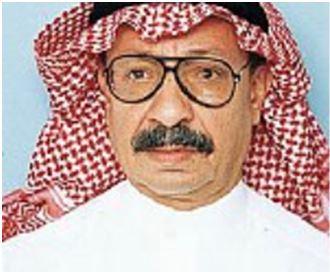
21428Yousuf Al-Kuwailit

“The U.S. appointed the Shah as policeman of the Arab Gulf, turned Iran into a base for conflict with the USSR, and provided Iran with up-to-date weaponry and a nuclear reactor. [Iran, for its part] attempted to take advantage of this situation, as it saw itself as a superpower. [Only] the strength of the USSR… prevented Iran from undertaking military adventures outside its own borders. With [the rise to power of Ayatollah Ruhollah] Khomeini, despite everything that happened at the U.S. Embassy [in Tehran in 1980], when dozens of its staffers were taken hostage and [then-U.S. president Jimmy] Carter carried out a reckless and unsuccessful operation [in attempt to free them]… [despite all this] nothing spoiled the U.S.’s relationship with this country, which it considers one of its strategic and economic outposts by virtue of its location and its history. So the farce… about Iran’s nuclear reactors and non-conventional weapons has taken a clear and final direction, in the form of several deals [between the two countries]…

“Cyrus [the Great],[2] who attacked and destroyed the Arabs, is the spiritual father of the Nazi trend that has characterized Iran’s governments, whether secular or religious. Racial supremacism vis-à-vis the Arabs is a popular [Iranian] obsession. It exists and it is eternal, and even if the mullahs don black turbans [indicating that they are] descendants of the Prophet and have Arab roots, they do not really recognize these roots, but do this only in order to market their national policy to us, prior to marketing their religious school of thought [i.e. the Shi’a]. Anyone who thinks that diplomatic arrangements are aimed at anchoring coexistence between the Arabs and the Iranian ‘Aryans’ is disregarding the nature of the historical reasons [for the tension between the two sides] and its deep roots in the [Iranian] public mentality.

“In order to better understand the unfolding of events, [we need to realize that]  the U.S. and its allies set out the initial plan to divide the Arab [regions] a long time ago, and that the Sikes-Picot agreement is only the first outcome [of that plan]. [We must also realize] that handing over Iraq [to Iran], and annexing Syria and later Lebanon to it, and the [silent] agreement [between the two countries] that Iran would have a free hand in these countries – all these  are only a prelude to  more dangerous activity.

“[Accordingly], relying on the U.S. or thinking it a reliable ally without properly understanding the strategic changes and aims, place us in a situation [of self-delusion], because all the historic elements of power see how positions and policies change but interests remain. This principle will be ultimately applied to all the countries that have a relationship with the U.S., whether economic or strategic, because the Arabs are part of a geographic area whose borders are changing, including through the disappearance of the centrally[-ruled] state in favor of states [based on] sect or nationality.

“One simple event in recent days is the Iranian Air Force’s incursion into Iraq to attack ISIS positions, which the U.S. confirmed but Iran denied. At the same time, the U.S. also ignores the incursion of [Iranian] ground troops under the command of [IRGC Qods Forces commander] Qassem Soleymani into Iraq, [which has been taking place] ever since the U.S. first started managing [Iraq’s] affairs… [In fact,] U.S. Secretary of State John Kerry stated that any Iranian military attack on ISIS was positive. This exposes the significant coordination between the two countries, and belies the statements of U.S. military circles denying any cooperation or coordination [with Iran] in the war on ISIS…

“In the era of [former Iraqi prime minister Nouri] Al-Maliki, Iraq become nothing but an arena for assuring the interests of two players: Iran and the U.S. This came about as part of an agreement that began with [head of the occupational authority of Iraq after the 2003 invasion Paul] Bremer, and no Iraqi government will put an end to it, unless the Iraqis [dare to] oppose their homeland’s dependence on another country – something that is difficult and complicated to do.

“Ultimately, even if the talk about the American-Iranian hostility is true, everything points towards new contracts between the two which are likely to turn into alliance. We could possibly see catastrophic days if the U.S. forces the Gulf states to reconcile with Iran, which will end in a way that will not serve our interests. This is an outcome that should not surprise us, if the reality of [U.S.-Gulf] friendship evolves into [U.S.] dictates [to the Gulf states].”


Endnotes:

[1] Al-Riyadh  (Saudi Arabia), December 7, 2014.

[2] Cyrus the Great founded the Achaemenid Empire, circa 600 BCE.

ISIS’s Stay-at-Home Radicals

December 9, 2014

ISIS’s Stay-at-Home Radicals, Abigail R. Esman, December 9, 2014

(Could there be some in Israel? In the United States?– DM)

1101

[A]n analysis by Italian academics of more than 2 million Arabic-language posts online found that “support for Islamic State among Arabic-speaking social media users in Belgium, Britain, France and the US is greater than in the militant group’s heartlands of Syria and Iraq.”

****************

Across Europe and America, governments and intelligence officials are struggling to address the problem of Western Muslims who join the jihad in Syria – and then come back home again. But in the process, they may be missing the bigger threat: the ones who never left.

Counterterrorism experts agree that the danger posed by returning jihadists is significant: already radicalized before they joined groups like the Al Nusra Front and the Islamic State (IS or ISIS), they are now well-trained in the practice of terrorist warfare. Unlike most Westerners, they have overcome any discomfort they may have previously felt about killing or confronting death. Chances are, they’ve already done it.

And their numbers are increasing: already an estimated 3,000 westerners have made the move to join the Islamic State and similar terrorist groups. Hence many countries, including the Netherlands and England, have determined to revoke the passports of any Syrian fighter known to carry dual nationality (many second-generation Turkish and Moroccan immigrants carry passports from their family’s land of origin. Similar bills have also been proposed in the U.S., such as one put forward by U.S. Rep. Frank Wolf, R-Va. The UK has also considered confiscating the passports of all British citizens who join the jihad, but such measures have been rejected on the basis of concerns about leaving individuals stateless.

But now some experts – and returning jihadists – say ISIS “sleeper cells” are already embedded in the West. So-called “Jihadi Hunter” Dimitri Bontinck told the UK’s Mail Online last month that “influential sources” had informed him of such cells, and warned that they were “preparing to unleash their war on Europe.” And an ISIS defector reportedly told a Scandinavian broadcaster of similar sleeper cells in Sweden which were, he said, “awaiting orders.”

The presence of these cells should not come as much of a surprise. More surprising is that Europe’s intelligence agencies hadn’t spotted them earlier. In part, this could be blamed on the intense focus on dealing with returnees, a problem that has left some intelligence and law enforcement agencies stretched thin: in June, for instance, Dutch intelligence agency AIVD admitted it “could no longer keep up” with the jihadists in the Netherlands. By October they were forced to bring in police teams to assist, especially in following the 40 or so jihadists who had returned. (An estimated 130 Dutch, including both returnees and those killed, have joined the Syrian fight.)

But if the AIVD and other intelligence agencies can barely follow the ones they know, this leaves countless other radicalized Muslims in Europe easy prey for Islamic State recruiters, who have already turned Europe’s efforts to block returnees to their advantage. With videos online and with extraordinary social media prowess, IS agents are increasingly encouraging Western supporters to work from home: spread the word, motivate others to make the trip (known as “making Hijrah”), or prepare to attack the infidel on Western soil.

And attack they have, as in the beheading of Fusilier Lee Rigby on a London street in 2013, the killing of a Canadian soldier, Cpl. Nathan Cirillo, in Ottawa on Oct. 22, and the hatchet attack on NYPD officers in Queens, N.Y. only two days later. Other assaults have been thwarted, such as the alleged plot by three British men who, prosecutors say, were inspired by ISIS calls for attacks on unbelievers. The men were arrested Nov. 6 in London on charges of planning to behead civilians.

But ISIS’s propaganda has been successful in other ways. Recruiting for jihad is on the rise in the Netherlands, according to a recent AIVD report, which further notes that “the number of Dutch jihadists traveling to Syria to join the conflict there has increased substantially since late 2012.” And overall support for the terrorist group is growing even faster – as thousands made clear during pro-ISIS demonstrations last summer. “Several thousand” people in the Netherlands alone support IS, the AIVD claims, while another recent Dutch report concluded that nearly 90 percent of Dutch Turkish youth considered IS members “heroes.” (That latter report has since come under fire, but its researchers stand by their findings.)

In Germany, ISIS support has grown so threatening that in September, the government passed a law to ban it outright. That legislation includes “a ban on activities that support the Islamic State in Iraq and Syria, including any displays of its black flag, as part of an effort to suppress the extremist group’s propaganda and recruitment work among Germans,” the New York Times reported. On Dec. 5, officials used the law to close a Bremen mosque; sermons there allegedly encouraged young Muslims to make Hijrah – to migrate – and join in the jihad.

In France, where an estimated 700 people have made Hijrah – the highest number in Europe – an ICM poll conducted last summer for Russian news agency Rosslya Segodnya found that one in six people support ISIS. Among those aged 18-24 – the age of most of the country’s Muslim population –27 percent indicated a “positive opinion” of the terrorist group.

These are not just mathematical figures. They represent people: tens of thousands of young men and women. In fact, the Guardian observes, an analysis by Italian academics of more than 2 million Arabic-language posts online found that “support for Islamic State among Arabic-speaking social media users in Belgium, Britain, France and the US is greater than in the militant group’s heartlands of Syria and Iraq.”

Why?

This is exactly the question Rotterdam Mayor Ahmed Aboutaleb –a Muslim of Moroccan origin – is asking. Despite his own hard stance against Islamic radicalization, the number of youths in Rotterdam suspected of radicalizing has increased by 50 percent over the past year. While attending the trial of one suspected jihadist, Dutch daily AD reports, Aboutaleb wondered aloud “why such youths, well-educated and full of promise commit themselves to the jihad.”

“The question is,” he is quoted as saying, “who are the people who go? Why do they make this step? Because they feel discriminated? Because they’re unemployed? Rejected by society? I don’t get that. Doubtless, that would maybe push someone over the edge, but there have to be other arguments that play a role.”

Ultimately, these are the questions everyone should be asking – intelligence and law enforcement agencies most of all. Because as the number of Western jihadists rises, and the support for ISIS grows, one thing is becoming clear: that until we have the answers to the basic queries, nothing else we do will matter.

Obama’s Christmas Gift to ISIS and Al Qaeda

December 9, 2014

Obama’s Christmas Gift to ISIS and Al Qaeda, Front Page Magazine, Daniel Greenfield, December 9, 2014

(According to an NBC News article,

Outgoing Uruguayan President José Mujica has made clear that Uruguay would not hold or restrict the six Guantanamo detainees who were recently resettled in his country.

“The first day that they want to leave, they can leave,” said Mujica in a Spanish-language interview with state television TNU.

— DM)

obama-1-419x350

Everyone likes presents; even murderous Muslim terrorists.

That must be why Obama decided to give ISIS, Hamas and Al Qaeda an early Christmas present by freeing their followers from Guantanamo Bay and dispatching them to Uruguay.

Why Uruguay? It’s one of several South American countries run by Marxist terrorists.

Uruguayan President Jose Mujica, a former Marxist terrorist, already offered to take in Syrian refugees and a number of the freed Gitmo Jihadists are Syrians who trained under the future leader of what would become ISIS. If they stay on in Uruguay, they can try to finish the job of killing the Syrian refugees resettled there. If they don’t, they can just join ISIS and kill Christian and Yazidi refugees back in Syria.

It’s a win-win situation for ISIS and Marxist terrorists; less so for their victims.

Most of the Guantanamo detainees freed by Obama were rated as presenting a high risk to America and our allies. They include a bomb maker, a trained suicide bomber, a document forger and a terrorist who had received training in everything up to RPGs and mortars.

The only thing Obama left out was the partridge in the pear tree. It probably wasn’t Halal.

These terrorists aren’t about to settle down in a country best known for its agricultural sector. There is no major demand for bomb makers to herd sheep or suicide bombers to milk cows.

Obama’s Christmas gift to Islamic terrorists includes Mohammed Tahanmatan, a Hamas terrorist who told American personnel at Gitmo that he “hates all enemies of Islam, including Americans, Jews, Christians and Muslims who do not think as he does.”

Uruguay is filled with these enemies of Islam, but so is the rest of the world. There’s no telling where Mohammed Tahanmatan will take his Jihad against Americans, Christians and Jews; he might go back to Israel or head over to Syria. Or he might just go back to Afghanistan and Pakistan to kill the American soldiers still left there.

Either way the blood of his victims will be on Obama’s hands.

And yet Mohammed Tahanmatan is the least dangerous of the terrorists freed by Barack Obama.

Ahmed Adnan Ahjam, Abd al Hadi Omar Mahmoud Faraj, Ali Husain Shaabaan and Jihad Ahmed Diyab were members of the Syrian Group which left an Assad crackdown to join Al Qaeda in Afghanistan. The Syrian Group was headed by Abu Musab al-Suri, a key ideological figure in international Jihadist circles, who was linked to multiple bombings in Europe, including one that wounded American soldiers.

The Damascus Cell of the Syrian Group was run by the uncle of Al Qaeda in Iraq leader Abu Musab Al-Zarqawi who also sat on AQIQ’s advisory council. Al Qaeda in Iraq is known today as ISIS.

Even while Obama bombs ISIS in Syria and Iraq, he releases experienced ISIS recruits from Gitmo.

Ahmed Adnan Ahjam was listed as receiving advanced training from Al Qaeda in the use of a wide range of battlefield weapons up to artillery. He will be invaluable to ISIS in its campaign in Kobani.

Obama’s present of Ahjam to ISIS will aid in genocide against the Kurds of Kobani. Ahjam was rated a “high risk” and should never have been released.

Abd al Hadi Omar Mahmoud Faraj received training at a camp run by Zarqawi providing him with an even more direct link to ISIS. He is a trained suicide bomber. ISIS will make use of him to train suicide bombers including its growing army of brainwashed and abused child soldiers.

Faraj was rated “high risk”. He should never have been released.

Ali Husain Shaabaan also trained at a Zarqawi camp. He was listed as “high risk”. Like Farj and Ahjam, there is little doubt that he will be in Syria before too long.

Jihad Ahmed Diyab is a document forger who provided documents to the Jihadist network of Abu Zubaydah linked to the bombing plot against Los Angeles International Airport, he worked with Zarqawi and associated with 9/11 terrorist recruiter Mohammed Zammar.

Jihad Diyab was not only listed as being “high risk”, but also as being of high intelligence value. He has connections to multiple Islamic terrorist groups around the world. That makes Jihad potentially the most valuable member of the Syrian Group to be released by Obama in his Christmas gift to ISIS.

ISIS will find Jihad Diyab useful for providing forged documents to smuggle its fighters into Syria and also to potentially move terrorists into Europe and America.

And yet giving this gift of Jihad to ISIS may pale next to Abdul Bin Mohammed Abis Ourgy, the final Gitmo Jihadist, who not only has many links to Muslim terrorist groups, but is a bomb maker who also trained terrorists in his explosive arts. The United States suspected that he may have even known beforehand about 9/11.

Ourgy is likely to head for North Africa and his ability to move money around will help strengthen the operations of Al Qaeda and Al Qaeda linked groups in the area. His bomb making skills will be used to train the next generation of terrorists. The blood of those they kill will be on Obama’s hands.

It goes without saying that Ourgy was listed as “high risk” and that releasing a bomb maker who will train other terrorists to build bombs is about as irresponsible as it gets.

Obama didn’t just free six more Gitmo detainees. He dumped “high risk” Jihadists with skills that make them extremely useful to ISIS and extremely dangerous to us into a country run by a former terrorist.

These terrorists are not just Al Qaeda, but the majority of them have personal links to Syria and to the network of what has become ISIS.

“We’ve offered our hospitality for human beings who have suffered a terrible kidnapping in Guantanamo,” President Jose Mujica has said, making it clear once again where his sympathies lie.

The former Marxist terrorist predictably sympathizes with the terrorists, not the terrorized. Obama might as well have given the new ISIS recruits a plane ticket directly to Istanbul. The only difference between doing that and doing what he did is plausible deniability.

As soon as the money gets wired to them from Saudi Arabia or Qatar, they’ll be at Carrasco International Airport. After a plane trip from there to Buenos Aires to Istanbul, the rest will be a jaunt across the border with a wink and a nod from friendly Turkish border guards happy that ISIS is committing the genocide that their prospective position in the European Union won’t allow them to openly carry out.

Of the terrorists released from Gitmo, 100 were confirmed as having returned to terrorism. Thanks to Obama’s Christmas present to Hamas, Al Qaeda and ISIS, that number is about to go up.

In Iraq, Regionalism Another Casualty of Islamic State

December 6, 2014

In Iraq, Regionalism Another Casualty of Islamic State, World Politics Review, December 5, 2014

l_iraq_basra_12052014Residents chant slogans supporting the creation of Basra region, in front of the Basra provincial headquarters, Basra, Iraq, Sept. 27, 2014 (AP photo by Nabil al-Jurani)

As for regional governments, there will be no more of them. Iraqi Kurdistan will become independent at some point; it is a matter of when rather than if. The Sunni autonomy effort is dead, and the Shiite establishment will use all means fair and foul to ensure Basra is never autonomous. Right now the Sumer movement is mostly an Internet phenomenon without a mass street following, but were it to take off, it would destroy the state, not create an autonomous region.

*****************

The Iraqi government agreed Tuesday to a long-term oil wealth sharing deal with the Kurdistan Regional Government (KRG). In an email interview, Kirk Sowell, a political risk analyst who is the publisher of the biweekly newsletter Inside Iraqi Politics, discussed regionalism in Iraq.

WPR: What are the main non-Kurdish regional movements (i.e., potential autonomous regions) in Iraq, and what grievances are driving their regional aspirations?

Kirk Sowell: There are three. The first, chronologically speaking, is what might be called the “southernist tendency,” which has existed in two variants. One focused on Basra province, and another on combining Basra with the other southern oil producers, Maysan and Dhi Qar provinces. These were driven by a feeling of material deprivation, despite the wealth these provinces produce. The second is the Sunni Arab autonomy movement, driven by the abuses of former Prime Minister Nouri al-Maliki’s government, in particular illegal arrests. It started in Salah al-Din and Diyala provinces in late 2011 and made a second push through the Sunni protest movement of 2013. The third, newer tendency might be called “Sumerism,” and is essentially a Shiite effort to break the south and the center away from the Sunni Arabs and just have a state from the city of Samarra southward.

WPR: How have these movements been affected by the rise of the Islamic State, the post-Maliki political shifts in Baghdad and the oil revenue-sharing deal with the KRG?

Sowell: The southernist tendency has never really gotten off the ground. Referenda efforts have failed. The main party pushing it, the Islamist Fadhila, has lost seats, and its main secular proponent, Wael Abd al-Latif, failed to win a seat in Basra in the last election. The Sunni autonomy movement has essentially been destroyed by the jihadists’ dominance of more nationalist Sunni movements, and their leaders are now just trying to get more decentralized local control without full autonomy. The “Sumer” movement, on the other hand, was basically created by the jihadists’ unexpected success; its backers have lost patience with Sunni uprisings of any kind.

As for the potential Baghdad-Irbil oil deal, which is rather vague at points and will not be final until and unless it is passed into law, it is just a holdover deal until the Kurds are ready to declare independence. If it succeeds, the Kurds will have less need to rush that process, but it will not last forever.

WPR: What role can provincial and regional governments play in addressing Iraq’s challenges, including sectarianism, security and governance in general?

Sowell: Provincial governments could potentially play a role in improving governance, but their lack of independent revenue sources makes them dependent on Baghdad’s willingness to let them take control of service functions. So far a mixture of deliberate suppression and bureaucratic paralysis has frozen efforts at localization. Even where enshrined in statute, such as governors’ control over local security, Baghdad has held a firm grip, and it is unclear whether Prime Minister Hayder al-Abadi’s rhetorical support for a stronger provincial role will mean anything.

As for regional governments, there will be no more of them. Iraqi Kurdistan will become independent at some point; it is a matter of when rather than if. The Sunni autonomy effort is dead, and the Shiite establishment will use all means fair and foul to ensure Basra is never autonomous. Right now the Sumer movement is mostly an Internet phenomenon without a mass street following, but were it to take off, it would destroy the state, not create an autonomous region.

The new Ottoman emperor

December 3, 2014

The new Ottoman emperor, Israel Hayom, Clifford D. May, December 3, 2014

[T]here is mounting evidence that weapons and fighters are crossing from Turkey into Syria, where they are delivered to Islamic State fighters. Turkish officials are turning a blind eye, or maybe even facilitating the traffic. Stolen oil is moving in the other direction, sold to raise cash for Islamic State. Inside Turkey, as well, Schanzer and Tahiroglu write, Islamic State has “established cells for recruiting militants and other logistical operations.” Last weekend, Turkey’s main Kurdish party accused the Erdogan government of allowing Islamic State fighters to attack the Syrian Kurdish town of Kobani from within Turkey.

******************

Turkey should have been part of the solution. Instead it has become part of the problem. The problem, of course, is the spread of jihadism throughout the Middle East, North Africa and beyond.

Turkish policies have been aiding and abetting the Nusra Front, an al-Qaida affiliate; the Islamic State group, which has turned large swaths of Syria and Iraq into killing fields; the Islamic Republic of Iran, still ranked by the U.S. government as the world’s leading sponsor of terrorism and well on its way to becoming nuclear-armed; and the Muslim Brotherhood, including Hamas, the group’s Palestinian branch.

Troubling, too, is the rhetoric we’ve been hearing from Turkish leaders. Turkish Science, Industry and Technology Minister Fikri Isık claimed last week that it was Muslim scientists who first discovered that the earth is round. Two weeks earlier, Turkish President Recep Tayyip Erdogan insisted that Muslim sailors reached the Americas 300 years before Columbus — only to find that well-established Muslims in Cuba had built a beautiful mosque.

Such myth-making might be dismissed as nothing more than attempts to play to Islamic pride. Less easy to excuse is Erdogan’s increasing xenophobia. “Foreigners,” he recently observed, “love oil, gold, diamonds, and the cheap labor force of the Islamic world. They like the conflicts, fights and quarrels of the Middle East.” He added that Westerners “look like friends, but they want us dead, they like seeing our children die. How long will we stand that fact?”

If Turkey were just another tin-pot dictatorship, none of this would much matter. But Turkey is a Muslim-majority (98 percent) republic with a dynamic economy (not dependent on the extraction of petroleum), a member of NATO (making it, officially, an American ally), and a candidate for membership in the European Union (though that possibility now appears remote).

Just three years ago, U.S. President Barack Obama listed Erdogan as one of five world leaders with whom he had especially close personal ties. He regarded the Turkish leader as a moderate, his interpreter of — and bridge to — the tumultuous and confusing Islamic world.

Today, as detailed in a new report by Jonathan Schanzer and Merve Tahiroglu, my colleagues at the Foundation for Defense of Democracies, Erdogan is refusing to allow the American-led coalition formed in August to launch strikes against Islamic State from Turkish soil.

Worse, there is mounting evidence that weapons and fighters are crossing from Turkey into Syria, where they are delivered to Islamic State fighters. Turkish officials are turning a blind eye, or maybe even facilitating the traffic. Stolen oil is moving in the other direction, sold to raise cash for Islamic State. Inside Turkey, as well, Schanzer and Tahiroglu write, Islamic State has “established cells for recruiting militants and other logistical operations.” Last weekend, Turkey’s main Kurdish party accused the Erdogan government of allowing Islamic State fighters to attack the Syrian Kurdish town of Kobani from within Turkey.

The FDD report cites numerous sources alleging that Turkey also has given assistance to the Nusra Front. To be fair: The Turkish government, like the Obama administration, seeks the fall of Syrian dictator Bashar Assad, satrap of the Islamic Republic of Iran. A Turkish official is quoted as saying that Nusra fighters are essential to that effort, adding: “After Assad is gone, we know how to deal with these extremist groups.”

Do they? Hamas is an extremist group and one of its top leaders, Saleh al-Arouri, has been permitted to set up his headquarters in Turkey. In August, Israel’s Shin Bet security agency said it had thwarted a Hamas-led plot to topple Palestinian Authority President Mahmoud Abbas — and that Arouri was behind it. Arouri also claimed responsibility — in the presence of Turkey’s deputy prime minister — for the kidnapping and murder of three Israeli boys in the West Bank early last summer, an act of terrorism that led to the 50-day war between Israel and Hamas in Gaza.

There’s more: credible allegations that Turkey has helped Iran’s rulers evade sanctions; the fact that Turkey imprisons more journalists than any other country; Erdogan’s comparison of Israelis to Nazis (guess which he regards as more “barbaric”); and his pledge to “wipe out Twitter. I don’t care what the international community says. They will see the Turkish republic’s strength.”

To understand what Turkey has become, it helps to know a little about what Turkey used to be. Istanbul was once Constantinople, a Christian capital of the ancient world. In 1453, it fell to the fierce armies of the Ottoman Empire and the Islamic caliphate. Islam’s political and religious leaders soon established the Sublime Porte, the central government of their growing imperial realm.

Almost 500 years later, in the aftermath of World War I, the empire collapsed and the caliphate was dissolved. Modern Turkey arose from the ashes thanks to the leadership of Mustafa Kamal Ataturk, a visionary general who believed that progress and prosperity could be achieved only by separating mosque and state. His goal was to make Turkey a nation, one as modern and powerful as any in Europe.

A century later, the world looks rather different. There are good reasons to believe Europe is in decline and America in retreat (these are disparate phenomena). While it may be delusional to believe that Columbus encountered Muslims in the Caribbean, it is not crazy to believe that, over the decades ahead, fierce Muslim warriors will profoundly alter the world order once more.

Viewed in this light, Erdogan looks like a neo-Ottoman, one who dreams of commanding Muslims — and those who have submitted to them — in many lands. If that’s accurate, the rift between Turkey and the West can only widen.

Iraq’s divisions will delay counter-offensive on Islamic State

November 30, 2014

Iraq’s divisions will delay counter-offensive on Islamic State, Reuters, Dominic Evans, November 30, 2014

(Surely, fighters of the (non-Islamic) Islamic State will sit around quietly, patiently awaiting the counter-offensive. — DM)

Iraqi divisionosMembers of the Iraqi security forces and Shi’ite fighters take part during an intensive security deployment in the town of Qara Tappa in Iraq’s Diyala province November 26, 2014. REUTERS/Stringer

BAGHDAD (Reuters) – U.S. air support and pledges of weapons and training for Iraq’s army have raised expectations of a counter-offensive soon against Islamic State, but sectarian rifts will hamper efforts to forge a military strategy and may delay a full-scale assault.

The Sunni Islamists stormed through northern Iraq in a 48-hour offensive in June, charging virtually unopposed toward the outskirts of Baghdad, humiliating a U.S.-trained Iraqi army which surrendered both land and weapons as it retreated.

By contrast, even a successful effort by the Shi’ite-led government to dislodge Islamic State, also known as ISIS, from Sunni territory where it rules over millions of Iraqis would be fiercely fought and could stretch well beyond next year.

The Baghdad government relies on Shi’ite militias and Kurdish peshmerga to contain Islamic State – a dependence which underlines and may even exacerbate the sectarian rivalry which opened the door for the summer offensive.

U.S. newspapers have cited officials in Washington saying the Americans’ training mission aims to prepare Iraqi troops for a spring offensive to retake territory, including Mosul, northern Iraq’s largest city and Islamic State’s powerbase.

Hemin Hawrami, an official close to Kurdish leader Masoud Barzani, told Reuters that Iraqi forces would not be ready to take the fight to Mosul, in Iraq, until late 2015.

“There will be no spring or summer (offensive),” he said, adding that progress depended on government willingness “to reorganize the army, how quickly they can solve political issues with us and the Sunnis, (and) how quick the coalition will be in providing heavy arms to peshmerga and the Iraqi army.”

“CERTAIN VICTORY”

The army, Shi’ite militias and Kurdish fighters have made some gains against Islamic State, pushing back an advance toward Kurdish territory in August and last week recapturing towns in Diyala province, on the road from Baghdad to Iran.

The leader of the pro-Iranian Shi’ite Badr Organisation, whose fighters battled alongside peshmerga and soldiers in Diyala, said they would turn next to the Sunni provinces of Salahuddin and Anbar – north and west of Baghdad – before moving further north to Nineveh province, where Mosul lies.

“We are counting on the support of the Sunni tribal fighters. With them joining the fight, our victory is certain,” Hadi al-Amiri told Reuters by telephone from Diyala province.

Amiri said he expected to get weapons not just from the Iraqi government, which may allocate a quarter of next year’s $100 billion budget to the military, but also from the $1.6 billion of arms and training which Washington plans to deliver.

Both Amiri’s assumptions look optimistic, as Washington and the Sunni tribes are deeply wary of Shi’ite militia forces.

Iraqi authorities aim to overcome the deep rifts between Shi’ites, Sunni Arabs, Kurds and other groups by absorbing local fighters into a state-funded National Guard, but the role of that force remains undecided.

LONG WAR

Government adviser Zuhair al-Chalabi told Reuters the army was in no shape to surge north and Mosul’s mainly Sunni residents would resist a campaign by Shi’ite militias alone.

Instead, a combined force of army soldiers, Sunni tribes, Kurdish peshmerga and Shi’ite fighters must be assembled – and the open border with Islamic State territory in Syria sealed.

“There is a plan, but it can’t be implemented that quickly,” said Chalabi, who is from Mosul.

Finance Minister Hoshyar Zebari said Islamic State was still a formidable force but was losing the ability to conduct major ground combat because that exposed it to air strikes.

Zebari, a Kurd, declined to give details of the military strategies of either the Baghdad government or the semi-autonomous Kurdish authorities, but said “planning and coordination are already under way” for the battle for Mosul.

“I am really not aware of spring offensives. The offensive is on – spring, summer, winter. We countered them in autumn. This is an ongoing battle with them.”

The United States is setting up four training camps for Iraq’s 80,000-strong armed forces – two around Baghdad, one in the Kurdish city of Arbil and the fourth in Anbar.

Washington has also set out plans to provide body armor and guns to 45,000 soldiers, 15,000 Kurdish peshmerga and 5,000 Sunni tribal forces.

A senior Western diplomat in Baghdad said the training might take six months, with the first round complete in late spring.

While he argued that the tide had turned against Islamic State in northern Iraq and was moving against it elsewhere, fighting was likely to stretch into 2016.

And without control over the border, Islamic State fighters could slip away and regroup in Syria. “It’s the balloon theory. You squeeze one part and it pops up elsewhere,” he said.

Hawrami, the Kurdish official, foresaw a protracted and potentially inconclusive battle.

“In order to guarantee their defeat in Mosul we have to defeat them in Syria as well,” he said. “ISIS cannot be vanquished. ISIS can be degraded and weakened, but this process of degrading and weakening needs years.”

Islamic State leader claims ‘caliphate’ has expanded in new audio message

November 13, 2014

Islamic State leader claims ‘caliphate’ has expanded in new audio message, Long War Journal, Thomas Jjoscelyn, November 13, 2014

The Islamic State, an al Qaeda offshoot that currently controls large portions of Iraq and Syria, has released a new audio message from its leader, Abu Bakr al Baghdadi. The Islamic State’s emir is defiant in the recording, saying his group will continue its fight against all of its enemies.

Baghdadi was rumored to have been killed in airstrikes that took place sometime on Nov. 7 and Nov. 8. Some Iraqi officials claimed Baghdadi had been mortally wounded. But no firm evidence emerged to back up those claims. And Baghdadi references events that took place since those airstrikes, thereby demonstrating that he is alive.

On Nov. 10, jihadists in Algeria, Egypt, Libya, Saudi Arabia, and Yemen swore allegiance to Baghdadi and the Islamic State’s caliphate. In the newly-released audio recording, Baghdadi accepts their oaths of allegiance and praises the jihadists who made them.

Baghdadi gives glad tidings and announces “the expansion of the Islamic State to new lands, to the lands of al Haramain [meaning Saudi Arabia] and [to] Yemen, and to Egypt, Libya and Algeria.”

Baghdadi accepts “the bayat (oath of allegiance) from those who gave us bayat in those lands,” pronounces “the nullification of the groups therein,” and announces the creation of “new wilayah [provinces] for the Islamic State, and the appointment of wali [provincial leaders] for them.”

The Islamic State’s emir calls on “every” Muslim to “join the closest wilayah to him, and to hear and obey the wali appointed by us for it.”

Baghdadi’s statement is deliberately provocative as he is saying that all other jihadist groups, especially those that have not pledged allegiance to the Islamic State, are nullified. The Islamic State’s ideologues have argued that, with the reestablishment of an Islamic caliphate, all other jihadist groups owe their allegiance to Baghdadi as the caliphate expands into their lands.

The Islamic State made this argument in late June, when its leaders announced that the group was now a caliphate. “The legality of all emirates, groups, states, and organizations, becomes null by the expansion of the [caliphate’s] authority and arrival of its troops to their areas,” the Islamic State’s founding statement reads.

The swearing of bayat from jihadists in several countries on Nov. 10 was, therefore, intended to legitimize the Islamic State’s right to rule over the jihadists’ affairs within those nations. Long established jihadist groups operating in those countries, including al Qaeda’s official branches, obviously do not agree, as they have not sworn allegiance to Baghdadi.

Indeed, in three of the five cases (Libya, Saudi Arabia, and Yemen), the announcements of allegiance to Baghdadi came from unidentified jihadists who do not represent any well-known jihadist groups. In Algeria, the announcement came from a group of al Qaeda in the Islamic Maghreb (AQIM) veterans who have broken away from their parent organization and are now known as Jund al Khilafa. The Algerian-based jihadists had already sworn allegiance to Baghdadi earlier this year.

The announcement from Egypt was made by an anonymous jihadist representing a faction of Ansar Bayt al Maqdis (ABM), or Ansar Jerusalem, in the Sinai.

Baghdadi praises the jihadists in the Sinai specifically, offering them his congratulations because they “have carried out the obligation of jihad” and “terrified the Jews.”

It appears that ABM is already marketing itself as the Islamic State’s “wilayah,” or province, in the Sinai, as that is how the group refers to itself on its official Twitter feed. ABM’s Twitter page has been taken down repeatedly over the past several months. The latest iteration was posted online in the past few days.

The Islamic State leader rails against the “Crusaders” and the “Jews,” whom he blames for conspiring to launch the airstrikes against the jihadists.

Baghdadi also references President Obama’s decision to send 1,500 additional military advisors to Iraq, claiming that this demonstrates the coalition has been unable to stall the Islamic State’s advances with airstrikes alone. The Obama administration announced the president’s decision to deploy additional forces on Nov. 7, shortly before Baghdadi was supposedly hit in an airstrike.

Baghdadi concludes by calling on the soldiers of the Islamic State to cause “volcanoes” of jihad to “erupt” everywhere.


Encircling Baghdad: The Country that Became a City-State

November 11, 2014

Encircling Baghdad: The Country that Became a City-State, Gatestone InstituteLawrence A. Franklin, November 11, 2014

(Please see also ISIS Expected to Take Aim at the ‘Baghdad Belt’ and Analysis: ISIS, allies reviving ‘Baghdad belts’ battle plan. — DM)

The goal of the Islamic State might be to create enough chaos in the capital city of Baghdad to cause a mass exodus of its Shia population southward, thus ceding Baghdad to the Sunnis by default.

Is it still possible to salvage if not Iraq, at least Baghdad? Sunni Muslim troops, led by ISIS (now the so-called Islamic State, or IS) and fighting against the Iraqi government, have virtually surrounded Baghdad. Iraq’s largest province, al-Anbar, is almost totally occupied by anti-regime forces. Only a portion of Fallujah remains outside of occupation by the IS-led forces. After the IS took over the city of Hit, regular Iraqi units fell back into a defensive posture at al-Asad, the largest military facility in Anbar. Several key population centers to the north and northeast have also fallen, and there is still heavy fighting around the oil refineries of the northern city of Baiji.

IS’s gains north of Baghdad last month prompted U.S. aircraft bombing sorties. Since June, the central government also has lost ground east of the capital; Diyala Province barely remains under Shia control. After the collapse of government forces in Hillah, south of the capital, and IS’s mid-June seizures of Iskandariyah and Mahmoudiyah, barely six miles south of the Baghdad, routes to Iraq’s Shia heartland have also now been jeopardized.

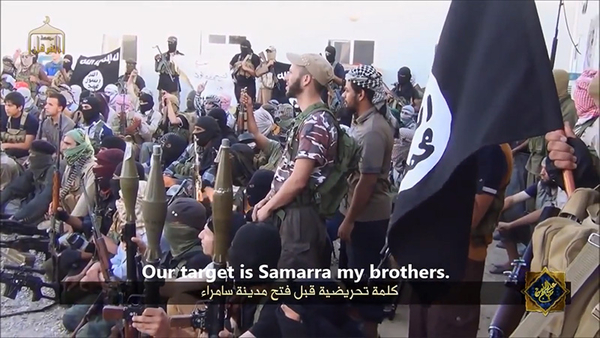
786Islamic State fighters receive a pre-battle briefing and sermon before their attack on Samarra, 125km north of Baghdad.

While the fall of the capital is certainly not imminent, IS’s strategy appears clear. Opposition forces will likely continue to tighten the noose around Baghdad in an attempt to create a sense of isolation. IS will avoid, for now, any large-scale assault on Baghdad for three reasons: it does not have the manpower; Shia militias outnumber enemy forces and will fight zealously to keep the Shia in control of the capital; and a major attack might cause remaining U.S. ground forces to become actively involved in the conflict.

One indicator that American forces might join the fight in a more serious way, if Baghdad appeared truly threatened, was the Pentagon decision on October 12 to employ Apache Attack helicopters against IS forces when they approached Baghdad International Airport. This week, on November 8, U.S. President Barack Obama also approved sending up to 1,500 more U.S. troops to Iraq, although stressing that that “would not be in combat.” The increase would raise the number of U.S. troops in Iraq to just under 3,000, or about eight times fewer than likely needed to re-salvage Iraq.

Meanwhile, fighting has come within two miles of the capital, with IS taking Abu Ghraib.

At present, the IS-led Sunni coalition appears determined to inculcate a feeling of despair among the capital’s Shia citizenry. The daily suicide bombing attacks in Shia neighborhoods must be taking a psychological toll. The suicide bombers are foreign fighters, mostly from North Africa. In the past few months alone, they have killed hundreds of Shia citizens. The operational planners of these assaults apparently know the layout of the capital, a familiarity that suggests they may have been former Baath Party military officers under the reign of Saddam Hussein.

The daily roadside bombs and car bombs are adding to the concern that the security situation in the capital is spiraling out of control. Moreover, there can be little doubt that some within the Sunni neighborhoods are giving logistical and intelligence support to the encircling IS. That intelligence certainly appears to have been available in the October 14 targeted killing of Baghdad’s pro-Iranian commander of the Badr Brigade, Ahmad al-Khafaji. Additional pro-Sunni elements probably have established a network of safe houses to support enemy infiltrators.

The day that the fate of Iraq as a united state irrevocably turned toward disintegration occurred in December 2013, when the largely Shia security forces stormed the Sunni protest camp in Anbar Province’s capital of Ramadi. Not even those tribal sheikhs who may have hoped for reconciliation with the Shia-led regime could reverse the process of permanent alienation. After former Iraqi Vice President Nouri al-Maliki’s fall from power on August 14, newly installed Prime Minister Haider al-Abadi has fared no better. Moreover, he seemingly has even less influence within the governing Shia coalition than al-Maliki originally possessed. He has moved too slowly, it seems, to reach out to Sunnis. Furthermore, with IS at the gates of Baghdad, the new administration did not name a new Minister of Defense and Interior until October 17.

The goal of IS’s siege strategy may be to create enough chaos in Baghdad to cause a mass exodus of its Shia population southward to the Shia provinces of Najaf and Karbala, thus ceding Baghdad to the Sunnis by default.

Inside The ISIS-Al Qaeda Merger Talks

November 11, 2014

Inside The ISIS-Al Qaeda Merger Talks, Daily BeastJamie Dettmer, November 11, 2014

(If Abu Bakr al-Baghdadi — the Islamic State leader whose disagreements with al Qaeda led to a split — is dead or otherwise out of the game, will that help to facilitate an Islamic State –  Jabhat al Nusra union? — DM)

The merger, if it comes off, would have major ramifications for the West. It would reshape an already complex battlefield in Syria, shift forces further against Western interests, and worsen the prospects for survival of the dwindling and squabbling bands of moderate rebels the U.S. is backing and is planning to train.

******************

U.S. airstrikes have helped drive ISIS and al Nusra together, and the Khorasan group is trying to cement the deal. The big losers: Everybody else—except Assad.

ISTANBUL—Jihadi veterans known collectively as the Khorasan group, which have been targeted in two waves of airstrikes by U.S. warplanes, are trying to broker an alarming merger between militant archrivals the Islamic State and Jabhat al Nusra, the official Syrian branch of al Qaeda.

The merger, if it comes off, would have major ramifications for the West. It would reshape an already complex battlefield in Syria, shift forces further against Western interests, and worsen the prospects for survival of the dwindling and squabbling bands of moderate rebels the U.S. is backing and is planning to train.

“Khorasan sees its role now as securing an end to the internal conflict between Islamic State and al Nusra,” says a senior rebel source. The first results are already being seen on the ground in northern Syria with a coordinated attack on two rebel militias favored by Washington.

All three of the groups involved in the merger talks—Khorasan, Islamic State (widely known as ISIS or ISIL), and al Nusra—originally were part of al Qaeda. Khorasan reportedly was dispatched to Syria originally to recruit Westerners from among the thousands of jihadi volunteers who could take their terror war back to Europe and the United States. But among ferocious ideologues, similar roots are no guarantee of mutual sympathy when schisms occur.

Current and former U.S. officials say they are unaware of any cooperation between ISIS and al Nusra, and they doubt that a merger or long-term association could be pulled off. “I find it hard to believe that al Nusra and Islamic State could sink their differences,” says a former senior administration official. “The rift between them is very deep,” he adds.

But senior Syrian opposition sources say efforts at a merger are very much under way and they blame Washington for creating the circumstances that make it possible. Moderate rebels accuse the Obama administration of fostering jihadi rapprochement by launching ill-conceived airstrikes on al Nusra while at the same time adamantly refusing to target the forces of Syrian President Bashar al-Assad in the U.S. military intervention in the region.

This, they say, has created the opening for a possible understanding between the jihadists and is creating sympathy for al Nusra. Other Islamist rebels and the wider population in insurgent-held areas in northern Syria question American motives and designs and remain furious at the U.S. decision not to help topple Assad.

“Al Nusra knows more airstrikes are coming, so why wait,” says an opposition source. If the Americans are going to lump them together with ISIS, maybe best to join forces. “What made the possibility of their coming together are the airstrikes.”

The opposition sources, who agreed to interviews on the condition they not be identified, warn that mounting cooperation between the two jihadist groups already is evident in specific operations.

Earlier this month, ISIS sent more than a hundred fighters in a 22-vehicle column to assist its onetime competitor, al Nusra, in the final assault on a moderate Islamist rebel alliance, the Syrian Revolutionaries Front, commanded by Jamal Maarouf in Idlib province.

The jihadis also targeted a secular brigade of insurgents, Harakat al-Hazm, which the U.S. has supplied with advanced anti-tank weaponry, because it tried to intervene and separate the SRF and al Nusra.

“Da’esh fighters weren’t really needed,” says one of the sources, “Al Nusra had sufficient numbers but the support given is highly symbolic.” (Da’esh is the Arabic acronym for ISIS.)

The coordination being claimed between the two groups would be the first time ISIS militants have cooperated with al Nusra since the winter ,when al Qaeda’s overall leader Ayman al-Zawahiri issued what seemed a definitive statement: “Al Qaeda announces that it does not link itself with [ISIS] … It is not a branch of the al Qaeda group, does not have an organizational relationship with it.”

The al Qaeda old guard and the ambitious ISIS leader Abu Bakr al-Baghdadi, who bristled at orders from Zawahiri, fell out over strategy and the attacks that his mainly foreign fighters were mounting against Syrian rebels. But the rift was, not least, a matter of personalities and egos. Al-Baghdadi has since attempted to declare himself the true leader of all true Muslims (by his lights) as the Caliph of the Islamic State. Zawahiri is not about to sign on to that.

Thus reports that al-Baghdadi may have been badly wounded or even killed in a U.S.-led coalition airstrike mounted last week near Mosul, while they may sound like good news for the coalition, could be even better news for the jihadis. Syrian rebel sources say al-Baghdadi’s elimination might well assist an agreement being struck between ISI and al Nusra.

The senior opposition sources say the coordination in the fight with the Syrian Revolutionaries Front was agreed on at a meeting held just west of Aleppo between representatives of the two jihadi groups and overseen by members of the Khorasan group.

U.S. intelligence agencies accuse the Khorasan veterans of plotting attacks against commercial airliners in the West. The U.S. targeted them with a wave of sea-launched cruise missiles on Sept. 23 and last week hit again with wide-ranging airstrikes on al Nusra positions as well, partly in a bid to hit the veterans. Several members of the group have been killed, but top leaders are still thought to have escaped the targeting and U.S. officials say they can’t confirm who has survived and who hasn’t.

There were representatives at the meeting from other hardline groups as well, such as Jund al-Aqsa, a jihadi offshoot, and Ahrar al-Sham, a group al Qaeda was instrumental in forming.

At the meeting a few nights before the final jihadi push against the SRF, which was attended by al Nusra leader Abu Mohammad al-Golani, the participants agreed, say opposition sources, that the Syrian Revolutionaries Front should be eliminated as an effective fighting force.

The assault on the weekend of Nov. 1 sealed weeks of battles between al Nusra and the SRF. The jihadis have now captured a series of towns and villages in Idlib province—Maarshorin, Maasaran, Dadikh, Kafr Battikh, Kafr Ruma, Khan al-Subul, and Deir Sunbul, Maarouf’s hometown. And al Nusra fighters have in recent days moved further north, coming within three miles of the important crossing on the Turkish border at Bab al-Hawa. The SRF has been left with virtually no territory.

Meanwhile, the secular Hazm movement was forced by al Nusra fighters to withdraw from its strongholds in Idlib, including Khan al-Subul, where it stored about 10 percent of its equipment. Hazm denies reports that jihad fighters managed to seize U.S.-supplied TOW anti-tank missiles, but concedes that al Nusra was able to secure 20 tanks, five of which were fully functional, six new armored personnel carriers recently supplied from overseas, and dozens of the group’s walkie-talkies, with the result that Hazm fighters elsewhere had to ditch their sets lest ISIS listen in.

(Some Hazm members bought the walkie-talkies themselves from Best Buy during a visit to the U.S.—suggesting that aside from TOW missiles the Obama administration has not been that generous in supplying the brigade.)


Obama deploys 1,500 more U.S. troops to Iraq

November 8, 2014

Obama deploys 1,500 more U.S. troops to Iraq, Washington TimesDave Boyer and Maggie Ybarra, November 7, 2014

(Will they be permitted to wear combat boots? — DM)

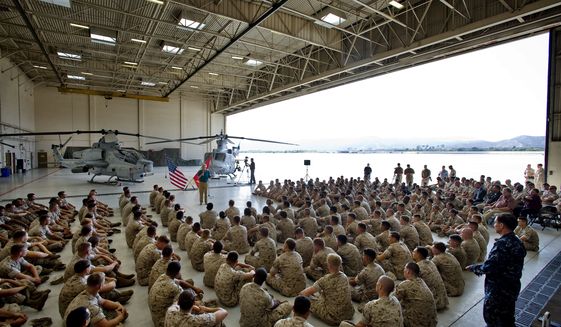
united-states-iraq-advisersjpeg-05ad1_c0-176-4256-2656_s561x327A group of selected Marines representing Camp Pendleton listen as Secretary of Defense Chuck Hagel answers their questions during his short visit to the base Tuesday Aug. 12, 2014. Hagel announced the deployment of another 130 U.S. troops to Iraq in remarks to Marines at this Southern California base on the final stop of a weeklong, around-the-world trip that also took him to India, Germany and Australia. (AP Photo/The Orange County Register, Paul Rodriguez)

“The president also authorized U.S. personnel to conduct these integral missions at Iraqi military facilities located outside Baghdad and Erbil,” the statement said. “U.S. troops will not be in combat, but they will be better positioned to support Iraqi Security Forces as they take the fight to ISIL.”

***********

President Obama is sending up to 1,500 more U.S. military personnel to Iraq to serve as non-combat advisers in the fight against Islamic State terrorists, the White House said Friday.

The troops will “train, advise, and assist Iraqi Security Forces, including Kurdish forces,” the White House said.

“The president also authorized U.S. personnel to conduct these integral missions at Iraqi military facilities located outside Baghdad and Erbil,” the statement said. “U.S. troops will not be in combat, but they will be better positioned to support Iraqi Security Forces as they take the fight to ISIL.”

It’s the latest escalation of U.S. military personnel in Mr. Obama’s fight to rescue the besieged government in Baghdad, where the president withdrew all U.S. forces in 2011. Since August, the U.S. has been conducting hundreds of airstrikes against the Islamic State in Iraq, and more recently in Syria.

The surge in military advisers will more than double the number of U.S. personnel in Iraq, which currently totals about 1,400.

U.S. troops will be asked to train nine Iraqi brigades and three Kurdish fighter brigades, said Pentagon spokesman Rear Adm. John Kirby.

“These sites will be located in northern, western, and southern Iraq,” Adm. Kirby said. “Coalition partners will join U.S. personnel at these locations to help build Iraqi capacity and capability. The training will be funded through the request for an Iraq train-and-equip fund that the administration will submit to Congress as well as from the government of Iraq.”

The White House said the Iraqi government requested the additional forces, and Defense Secretary Chuck Hagel agreed.

White House press secretary Josh Earnest said the Islamic State “has suffered a series of defeats in Iraq against the Iraqi Security Forces and Peshmerga, with the support of U.S. and coalition airstrikes and Intelligence, Surveillance and Reconnaissance, and as well as U.S. military advice.”

“The United States and its coalition partners will continue to confront the threat of [the Islamic State] with strength and resolve as we seek to degrade and ultimately defeat” the terrorist group,” he said.

Shaun Donovan, director of the White House Office of Management and Budget, said the administration is sending a request to Congress for $5.6 billion to pay for the military operations.

The request includes $1.6 billion to establish the Iraq train-and-equip fund to develop and support Iraqi security forces, including Kurdish forces.

“This funding will help reconstitute the Iraqi army and strengthen the capability and capacity of our Iraqi partners to go on the offensive against” the Islamic State, Mr. Donovan said.