Archive for the ‘Iraq war’ category

The Paradox of The “Advisor”

September 30, 2014

The Paradox of The “Advisor” Blackfive, Debow, September 29, 2014

(Please watch the video. Is this what our “advisers” and “trainers” are doing now in Iraq? If so, in a fleeting moment of honesty might it be acknowledged by our “leaders?” — DM)

President Obama: Well, there’s a difference between them advising and assisting Iraqis who are fighting versus a situation in which we got our Marines and our soldiers out there taking shots and shooting back.

****************

So now, we don’t have “boots on the ground” fighting in Iraq.  Instead, we have “advisors” being deployed to Iraq in order to be “embedded” with Iraqi units.

So, when Steve Kroft from CBS actually finds a hardball in the bucket of questions he is lobbing at Barack the Teleprompter Reader, it is interesting to see how he qualifies and hedges his statement regarding exactly what their mission is.

Steve Kroft: You know, you’ve said no American boots on the ground. No combat troops on the ground. We’ve got 1,600 troops there.

President Obama: We do.

Steve Kroft: Some of them are going to be out, embedded with Iraqi units.

President Obama: Well, they’re in harm’s way in the sense that any time they’re in war, it’s dangerous. So I don’t want to downplay the fact that they’re in a war environment and there are hostile forces on the other side. But…

Steve Kroft: And they participated in combat operations.

President Obama: Well, there’s a difference between them advising and assisting Iraqis who are fighting versus a situation in which we got our Marines and our soldiers out there taking shots and shooting back.

As someone who has done this job, let me clear up any misconceptions that the President, or any of his camp followers have regarding what my role as an embedded trainer was; there is just as much or more combat as there is advising.

In fact, the entire deployment I was on in 06/07 was spent in the field with an Afghan unit, “advising” (fighting).  The Taliban and the Haqqani Network were eager for battle with Afghan units, because they knew that attacking American units was a bad day.
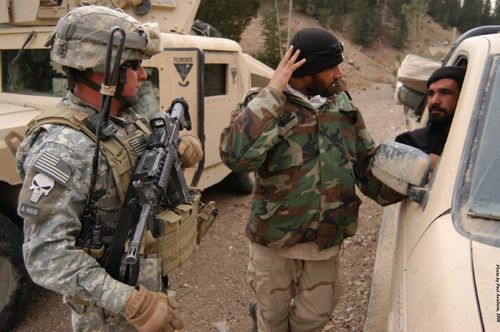
Advisers1

This is what those “embedded trainers” are doing right now in Iraq, so with the Pak border over my right shoulder, here I am “advising” the company commander with my terp on what our next move is, which for him was to get out of his truck and do his damn job instead of hanging out like a spectator.  About an hour before this we had found a rocket launcher that was hidden in the trees and had been firing on FOB Bermel.  It turned out our next move after this little confab (sarcasm doesn’t translate well into Pashto BTW–ed) was to get in a firefight about 5 minutes after this picture was taken with an LP/OP that had been watching us.
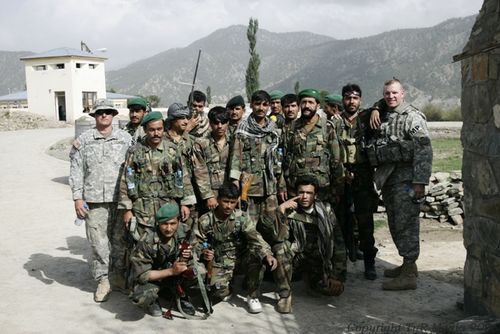
advisers2

This is the Weapons Company (yep, that is all of them) in Zerok, where we put a COP in 2006.  It was also where we saw our heaviest fighting in our sector.  In 2009 on July 4th, this attack took place there.


There are quite a few of us who know exactly what the job of “advisor” entails and when the PINO says “Well, there’s a difference between them advising and assisting Iraqis who are fighting versus a situation in which we got our Marines and our soldiers out there taking shots and shooting back.” I promise you, there isn’t a difference from where they are standing, because if they are doing their job, they are standing next to those Iraqis helping to advise them on how to get the job done.

These are the types of words games that we play with our moms and wives and girlfriends in order to convince them that it isn’t what it looks like on the news and despite all that, they lay awake at night wondering and contemplating the “ifs” that no one wants to contemplate.  These aren’t the words of a leader by any measure.

So when the PINO tries to hedge and minimize and play words games about what the US Military Units forward deployed are doing in Iraq, he is only doing so in order to somehow make Code Pink and Media Matters happy with his statements of his non-Bush war stance during his “extended counter-terrorism operation” that may last “years.”

For those of us who have lived it, it is exactly what it is…
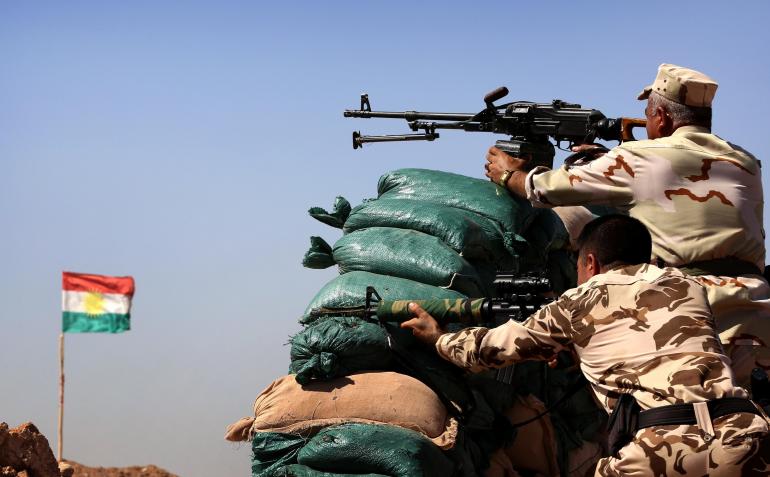
ISIS Baghdad March: Islamic State 1 Mile Away From Iraqi Capital

September 29, 2014

ISIS Baghdad March: Islamic State 1 Mile Away From Iraqi Capital, International Business Times, September 29, 2014

(If the Islamic State takes Baghdad, use of airstrikes by the “coalition of the willing” without “boots on the ground” will bring multiple civilian casualties and be problematical, at best. Iraqi boots? They might help, but only after a year or more of training. — DM)

image-456313666Peshmerga fighters hold a position behind sandbags at a post in the strategic Jalawla area, in Diyala province, which is a gateway to Baghdad, as battles with Islamic State (IS) jihadists continue on September 27, 2014. The United States, which leads the coalition, initially launched strikes in Iraq on August 8 and widened its campaign on September 23, 2014 to include Syria, where IS has its headquarters. SAFIN HAMED/AFP/Getty Images

The Islamic State group is allegedly closing in on Baghdad, according to a report from a vicar at Iraq’s only Anglican church that claims the jihadists formerly known as ISIS are roughly one mile away from the Iraqi capital. Airstrikes against ISIS targets were supposed to stop the group from taking Baghdad.

“The Islamic State are now less than 2km (1.2 miles) away from entering Baghdad. They said it could never happen and now it almost has,” Canon Andrew White of the Foundation for Relief and Reconciliation in the Middle East, a British-based charity that supports Iraq’s only Anglican church in Baghdad, said on his Facebook page early Monday morning. “Obama says he overestimated what the Iraqi Army could do. Well, you only need to be here a very short while to know they can do very, very little.”

The Christian aid group was referring to the U.S. president’s interview Sunday night on “60 Minutes,” the CBS news magazine show, where Obama conceded that his administration underestimated the ascendancy of ISIS. More than 1,000 Iraqi troops were reportedly killed Sunday in clashes with ISIS about 10 miles outside of Baghdad.

The advance by ISIS toward Baghdad shows that the group isn’t weakening despite U.S.-led airstrikes in Iraq. ISIS executed 300 Iraqi soldiers last week during their march toward the Iraqi capital and attempted to break into a prison in northern Baghdad.

“This attack is very significant. It is the first infantry-like, complex, and penetrating attack in Baghdad city by ISIS since the fall of Mosul in June of this year,” the Washington-based nonprofit Institute for the Study of War wrote on its website, referring to Iraq’s second-largest city, which is in the Islamic State’s hands. “ISIS likely carried out the attack to release some of the pressure it is facing as a result of the recent U.S. air campaign targeting its positions. The attack also signifies that, despite the heightened defenses of Baghdad in the aftermath of the fall of Mosul, ISIS is still able to carry out attacks in an area where it is unlikely to have active sleeper cells.”

U.S.-led airstrikes against ISIS in Iraq and Syria have come under criticism over their effectiveness. U.S. Secretary of State John Kerry defended the military action last week in a CNN interview. Kerry claimed“Baghdad could have fallen” if it weren’t for the airstrikes, which have predominantly been launched in the northern part of Iraq.

Al Qaeda official warns against Islamic State in new speech

September 27, 2014

Al Qaeda official warns against Islamic State in new speech, Long War Journal, Thomas Joscelyn, September 27, 2014

“We call to restore the rightly-guided Caliphate on the prophetic method, and not on the method of deviation, lying, breaking promises, and abrogating allegiances – a caliphate that stands with justice, consultation, and coming together, and not with oppression, infidel-branding the Muslims, killing the monotheists, and dispersing the rank of the mujahideen,” al Basha says, according to SITE’s translation.

Although al Basha does not mention the Islamic State by name, his description of al Qaeda’s proposed caliphate is intended to undermine al Baghdadi’s claim to power. Al Basha’s reference to “abrogating allegiances” is probably a reference to the oath of allegiance (bayat) that Abu Bakr al Baghdadi swore to Ayman al Zawahiri and then broke.

**********************

A senior al Qaeda official, Muhammad bin Mahmoud Rabie al Bahtiyti, also known as Abu Dujana al Basha, has released a new audio message seeking to undermine the Islamic State, which was disowned by al Qaeda’s general command in February.

Al Basha’s speech was released by al Qaeda’s official propaganda arm, As Sahab, on Sept. 26. It was first obtained and translated by the SITE Intelligence Group.

Al Qaeda’s senior leaders have not directly addressed the Islamic State’s claim to rule over a caliphate stretching across large portions of Iraq and Syria. Instead, they have sought to undermine the Islamic State’s ideological legitimacy in a variety of more subtle ways. (Other parts of al Qaeda’s international network have specifically rejected the Islamic State’s caliphate claim.)

Al Basha does not name the Islamic State, but his speech is clearly aimed at the group and its supporters.

Al Basha sets forth al Qaeda’s goals, saying the group is dedicated “to the oneness of Allah … as we call to disbelieve the tyrant and disavow polytheism and its people.” Al Basha says al Qaeda seeks “to establish the absent Shariah and empower this religion.”

It is often claimed, wrongly, that al Qaeda is interested only in attacking the West, or carrying out mass casualty attacks. But the organization has repeatedly stated that its jihadists seek to create societies based on their radical version of sharia law. Al Qaeda wants to build Islamic emirates, or states, based on this sharia. It is for this reason that most of al Qaeda’s resources since its founding have been devoted to waging insurgencies against governments in the Muslim-majority world that it deems to be corrupt.

Imposing sharia and creating Islamic emirates are steps to al Qaeda’s ultimate stated goal, which al Basha explains.

“We call to restore the rightly-guided Caliphate on the prophetic method, and not on the method of deviation, lying, breaking promises, and abrogating allegiances – a caliphate that stands with justice, consultation, and coming together, and not with oppression, infidel-branding the Muslims, killing the monotheists, and dispersing the rank of the mujahideen,” al Basha says, according to SITE’s translation.

Although al Basha does not mention the Islamic State by name, his description of al Qaeda’s proposed caliphate is intended to undermine al Baghdadi’s claim to power. Al Basha’s reference to “abrogating allegiances” is probably a reference to the oath of allegiance (bayat) that Abu Bakr al Baghdadi swore to Ayman al Zawahiri and then broke.

Al Qaeda-allied jihadists have argued against the Islamic State’s caliphate claim, saying it was imposed on Muslims and even jihadists without consultation. And this is a theme in a Basha’s speech.

In al Qaeda’s ideological schema, the caliphate can be resurrected only after respected jihadists give it their seal of approval. Al Baghdadi’s organization has tried to impose its caliphate throughout much of Iraq and Syria, frequently fighting with other jihadist organizations, including the Al Nusrah Front, al Qaeda’s official branch in Syria. Leading jihadist ideologues have criticized Baghdadi’s caliphate on this basis, as well as for other reasons.

Al Basha warns against “extremism,” which, ironically enough, is one of al Qaeda’s key charges against the Islamic State. In Syria and elsewhere, al Qaeda has been attempting to portray itself as a more reasonable jihadist organization. Because the Islamic State refuses to consult with other Muslims and jihadist groups, not just in creating a caliphate, but also in other matters, al Qaeda accuses the group of pursuing an extremist path. Of course, al Qaeda is extremist by any reasonable standard, and has spilled more Muslim than non-Muslim blood throughout its existence. Still, because of the Islamic State’s excessive violence, particularly in Syria, al Qaeda has been marketing itself as a more mainstream jihadist organization.

Al Basha addresses the jihadists’ rank and file, urging them to avoid joining the Islamic State and subtly encouraging Baghdadi’s fighters to defect from his army. Al Basha openly worries that the jihad in Syria has been squandered because of the infighting between the groups opposed to Bashar al Assad’s regime. Al Qaeda blames the infighting on the Islamic State.

“I address my speech and my advice to my brothers on the frontlines in Sham [Syria] among those who have been deceived by slogans and titles, to use your heads and have insight, and to weigh the matters fairly,” al Basha says. “Rescue the ship of jihad, and reach it before it deviates from its course and settles on the path of the people of desires. Strive to turn off the sedition and restore cohesion among the mujahideen.”

At the end of his audio speech, al Basha addresses those jihadists who disapprove of al Qaeda’s understated response to the Islamic State’s caliphate claim. Al Basha says that he and others wanted to defend al Qaeda emir Ayman al Zawahiri’s reputation against the Islamic State’s slanders, but Zawahiri ordered them not to.

“The Sheikh [Zawahiri] ordered his brothers to be silent and not protect his honor,” al Basha says. “He considered that out of concern for the benefit of this Ummah [Muslim community], and a hope that Allah will fix the condition, and that the sedition will be suppressed.”

Al Qaeda’s leaders and branches have repeatedly urged the jihadists in Syria to reconcile. However, their efforts have been fruitless.

Veteran al Qaeda leader

Al Basha has taken on a more prominent and public role for al Qaeda in recent years. In December 2013, he argued that jihad is necessary to implement sharia law in Egypt. In late August he issued a statement urging followers to strike American and Israeli interests in support of Muslims in Gaza.

Although al Basha was not initially a public persona for al Qaeda, he was well-known to US counterterrorism officials for years. In January 2009, the US Treasury Department designated al Basha as an al Qaeda terrorist, noting that he was Zawahiri’s son-in-law. Al Basha was located in Iran at the time.

Treasury found that he “served on an al Qaeda military committee and provided military training that included urban warfare tactics for al Qaeda members.” Among other duties, al Basha “drafted training manuals for al Qaeda as well as a book on security that was used as a template for al Qaeda’s surveillance operations.”

Al Basha is a longtime member of Egyptian Islamic Jihad as well as al Qaeda, and was reportedly involved in al Qaeda’s 1995 bombing of the Egyptian Embassy in Islamabad, Pakistan.

Zawahiri tasked al Basha with moving members of Zawahiri’s family to Iran after the Sept. 11, 2001 terrorist attacks.


We Don’t Need to Ally with Terrorists to Defeat ISIS

September 26, 2014

We Don’t Need to Ally with Terrorists to Defeat ISIS, Front Page Magazine, Daniel Greenfield, September 26, 2014

(OK, but assuming that the defeat of the Islamic State is our goal, how is that to happen? Clearly, we will not go to war with Islam. Yet. — DM)

isis-431x350

Allying with terrorists to defeat terrorists is counterproductive. The Muslim world will always have its Jihadists, at least until we make a serious effort to break them which we won’t be doing any time soon. But we can at least stop making the problem worse by arming and training our own enemies.

******************

The big foreign policy debate now is whether we should ally with Sunni or Shiite Jihadists to defeat ISIS.

The pro-Iranian camp wants us to coordinate with Iran and Assad. The pro-Saudi camp wants us to arm the Free Syrian Army and its assorted Jihadists to overthrow Assad.

Both sides are not only wrong, they are traitors.

Iran and the Sunni Gulfies are leading sponsors of international terrorism that has killed Americans. Picking either side means siding with the terrorists.

It makes no sense to join with Islamic terrorists to defeat Islamic terrorists. Both Sunni and Shiite Jihadists are our enemies. And this is not even a “the enemy of my enemy” scenario because despite their mutual hatred for each other, they hate us even more.

The 1998 indictment of bin Laden accused him of allying with Iran. (Not to mention Iraq, long before such claims could be blamed on Dick Cheney.) The 9/11 Commission documented that Al Qaeda terrorists, including the 9/11 hijackers, freely moved through Iran. Testimony by one of bin Laden’s lieutenants showed that he had met with a top Hezbollah terrorist. Court findings concluded that Iran was liable for Al Qaeda’s bombing of US embassies. Al Qaeda terrorists were trained by Hezbollah.

While Shiite and Sunni Jihadists may be deadly enemies to each other, they have more in common with each other than they do with us. Our relationship to them is not that of “the enemy of my enemy is my friend.” That’s their relationship to each other when it comes to us. In these scenarios we are the enemy.

The pro-Saudi and pro-Iranian factions in our foreign policy complex agree that we have to help one side win in Syria. They’re wrong. We have no interest in helping either side win because whether the Sunnis or Shiites win, Syria will remain a state sponsor of terror.

It’s only a question of whether it will be Shiite or Sunni terror.

Our interest is in not allowing Al Qaeda, or any of its subgroups, to control Syria or Iraq because it has a history of carrying out devastating attacks against the United States. We don’t, however, need to ally with either side to accomplish that. We can back the Kurds and the Iraqi government (despite its own problematic ties) in their push against ISIS in Iraq and use strategic strikes to hit ISIS concentrations in Syria. We should not, however, ally, arm or coordinate strikes with either side in the Syrian Civil War.

Both the pro-Saudi and pro-Iranian sides insist that ISIS can’t be defeated without stabilizing Syria. But it doesn’t appear that Syria can be stabilized without either genocide or partition. Its conflict is not based on resistance to a dictator as the Arab Springers have falsely claimed, but on religious differences.

Helping one side commit genocide against the other is an ugly project, but that would be the outcome of allying with either side.

Stabilizing Syria is a myth. The advocates of the FSA claimed that helping the Libyan Jihadists win would stabilize Libya. Instead the country is on fire as Jihadists continue to fight it out in its major cities.

Even if the FSA existed as an actual fighting force, which it doesn’t, even if it could win, which it can’t, there is every reason to believe that Syria would be worse than Libya and an even bigger playground for ISIS. The FSA enthusiasts were wrong in Egypt and Libya and everywhere else. They have no credibility.

The pro-Iranians claim that helping the Syrian government will subdue ISIS, but Assad hasn’t been able to defeat the Sunni Jihadists even with Russian help. The Syrian army and its Hezbollah allies are still struggling despite having an air force, heavy artillery and WMDs. Not only shouldn’t we be allying with Shiite terrorists who have killed plenty of Americans over the years, but it would be extremely stupid to ally with incompetent terrorists. Allying with the FSA or Assad makes as much sense as allying with ISIS.

The difference is that ISIS at least seems to be able to win battles.

Some pro-Iranian wonks claim that if we don’t get Assad’s approval for air strikes, he will shoot down Americans planes. That’s about as likely as Saddam Hussein returning from the dead to audition for American Idol. Assad didn’t even dare shoot down Israeli planes who were buzzing his palace. The odds of him picking a fight with the United States Air Force are somewhere between zero, nil and zilch.

We don’t need Assad’s permission to hit ISIS targets in Syria and, in one of the few things that this administration is doing right, we aren’t asking for it. Unless Assad experiences a bout of severe mental illness, he isn’t going to fight us for the privilege of losing to ISIS. Not even Saddam was that crazy.

The big potential problem in this war is mission creep. That’s why we should avoid committing to any overarching objectives such as stabilizing Syria. Unfortunately that is exactly what Obama has done.

It’s not our job to stabilize Syria and short of dividing it into a couple of majority states in which the Sunni and Shiite Arabs, the Kurds, the Christians and maybe even the Turkmen get their own countries, it’s not a feasible project. We have the equipment and power to pound ISIS into the dirt when its forces concentrate in any area. We can send drones to target their leaders. If Assad or the FSA want to provide us with intel, we can use it as long as we don’t begin working to help them fulfill their own objectives.

We need to remember that we are not there for the Syrians or Iraqis; we’re there for ourselves.

After September 11 we learned the hard way the costs of letting enemy terrorists set up enclaves and bases. But we also learned the hard way the costs of trying to stabilize unstable Muslim countries.

Al Qaeda, in its various forms, will always find sanctuaries and conflicts because the Muslim world is unstable and widely supportive of terrorism. For now this is a low intensity conflict that denies the next bin Laden the territory, time and manpower to stage the next September 11. We can do this cheaply and with few casualties if we keep this goal in mind.

This isn’t nation building. It’s not the fight for democracy. All we’re doing is terrorizing the terrorists by using our superior reach and firepower to smash their sandcastle emirates anywhere they pop up.

Allying with terrorists to defeat terrorists is counterproductive. The Muslim world will always have its Jihadists, at least until we make a serious effort to break them which we won’t be doing any time soon. But we can at least stop making the problem worse by arming and training our own enemies.

ISIS Baghdad March: Is Islamic State Targeting The Iraqi Capital?

September 26, 2014

ISIS Baghdad March: Is Islamic State Targeting The Iraqi Capital? International Business Times, September 26, 2014

(How difficult might it be for the IS, et al, to move more troops into already occupied places near Baghdad, consolidate them there, and then send them to take Baghdad? The Iraqi armed forces have functioned poorly in the past and might well not put up a successful defense.

Were the IS to take Baghdad, what might the “coalition of the willing” do about it? Air strikes on a city of more than 7,216,040, many of them civilians, seem unlikely. In any event, civilian deaths would not likely concern the IS more than they concerned Hamas, and would provide gruesome photos welcomed for propaganda purposes.– DM)

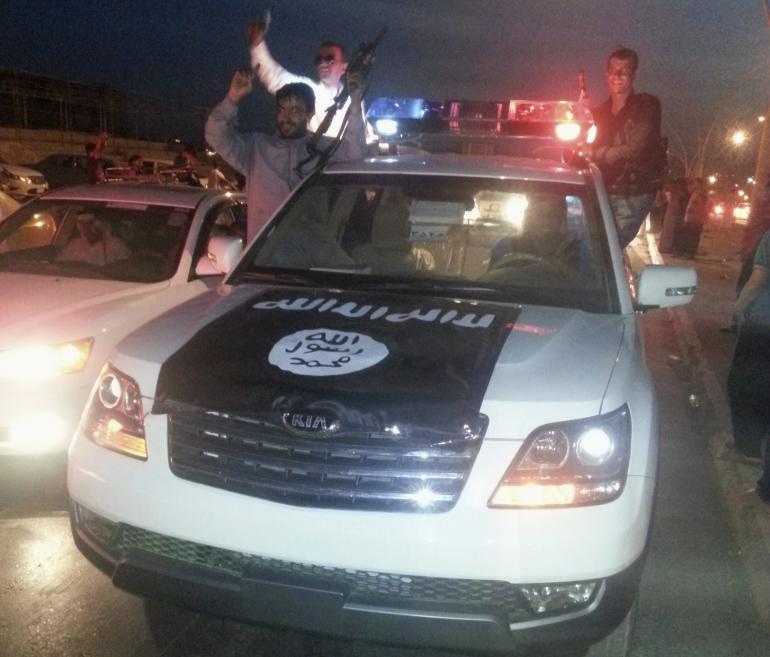
cop car in MosulFighters of the Islamic State group, also known as ISIS or ISIL, celebrate on a police vehicle along a street in the city of Mosul, June 23, 2014. Reuters

ISIS has been circling Baghdad for years. The Islamic State carried out 641 operations in Baghdad last year, up from 371 operations in 2012, including car bombs, armed assaults and assassinations, according to the Institute for the Study of War.

The multi-nation campaign against ISIS might have prodded the militants to refocus their efforts in Iraq, where the Islamic State has many strategic territories near Baghdad . . .

*****************

The Islamic State may be refocusing its sights on Baghdad after the extremist group overran an Iraqi military base and executed 300 soldiers Sunday amid ongoing U.S. airstrikes aimed at weakening the militants’ infrastructure and resources, according to military analysts. Other targeted attacks in recent weeks also suggest the militants are plotting against the Iraqi capital more than three months after international leaders first warned of the group’s aspirations to take Baghdad.

The base attack came days after the militant group also know as ISIS launched 14 mortar rounds during a foiled attempt to break into the Adala Prison in northern Baghdad. ISIS also launched an attack earlier this month in Baghdad’s Iskan neighborhood that likely targeted the offices of the political group and militia, the Badr Organization, according to the Institute for the Study of War in Washington, D.C.

“This attack is very significant. It is the first infantry-like, complex, and penetrating attack in Baghdad city by ISIS since the fall of Mosul in June of this year,” the think-tank wrote on its website. “ISIS likely carried out the attack to release some of the pressure it is facing as a result of the recent U.S. air campaign targeting its positions. The attack also signifies that, despite the heightened defenses of Baghdad in the aftermath of the fall of Mosul, ISIS is still able to carry out attacks in an area where it is unlikely to have active sleeper cells.”

It’s unclear if the U.S. airstrikes in Iraq have accomplished the Obama administration’s stated mission to “degrade and destroy” ISIS. Some military analysts and U.S. critics have said the Obama administration needs to send ground troops to Iraq to wipe out ISIS, while others have said the airstrikes have successfully managed to slow down the militant group’s advances.

“The U.S. has made it pretty much impossible to undertake the large-scale mobile operations that ISIS was doing earlier in the summer,” Michael Knights, who specializes in military and security affairs in Iraq for the Washington Institute for Near East Policy, said. “It has changed the nature of the beast.”

But ISIS’ goal of taking most of western and central Iraq hasn’t changed since the airstrikes, said Bill Roggio, a senior fellow with the Foundation for Defense of Democracies in Washington who specializes in Iraq. While Baghdad might be out of their reach, other territories remain vulnerable, Roggio said.

“They are just continuing their operations,” he said in a telephone interview. “The airstrikes haven’t stopped them for continuing to do what they have been doing all along, which is take control of territory.”

ISIS has been circling Baghdad for years. The Islamic State carried out 641 operations in Baghdad last year, up from 371 operations in 2012, including car bombs, armed assaults and assassinations, according to the Institute for the Study of War.

ISIS gained international prominence in June when it seized northern cities such as Tikrit, Saddam Hussein’s hometown, and Mosul, Iraq’s second largest city, and began holding mass executions of Iraqi soldiers. At the time, military analysts predicted the Sunni militants had their sights on Baghdad. Obama responded by sending 300 military advisers to Iraq to share intelligence with Iraqi soldiers. More recently, the Obama administration began offensive airstrikes against ISIS territories near Baghdad last week in its latest effort to pushback the militant group. At the same time, the U.S. began airstrikes against the Islamic State and other militant groups in Syria.

The multi-nation campaign against ISIS might have prodded the militants to refocus their efforts in Iraq, where the Islamic State has many strategic territories near Baghdad, Knight said.

“Most of the people who watch Iraq say if ISIS is going to punch, it’s going to be in the Baghdad area,” he said in a telephone interview. “I have been surprised that it hasn’t happened … They are well positioned for that.”

Megyn Kelly Grills State Dept’s Marie Harf After Obama Invokes Anti-American Islamic Cleric

September 26, 2014

Megyn Kelly Grills State Dept’s Marie Harf After Obama Invokes Anti-American Islamic Cleric, You Tube, September 26, 2014

(How difficult must it be to find a prominent Islamic scholar who has not issued a fatwa encouraging the killing of Americans?  The one chosen for Obama’s remarks at the UN, Bin Bayyah who issued such a fatwa, appears to have become rather an embarrassment. — DM)


Rouhani ties Iran cooperation on Mideast violence to nuke deal

September 25, 2014

Rouhani ties Iran cooperation on Mideast violence to nuke deal, Fox News, September 25, 2014

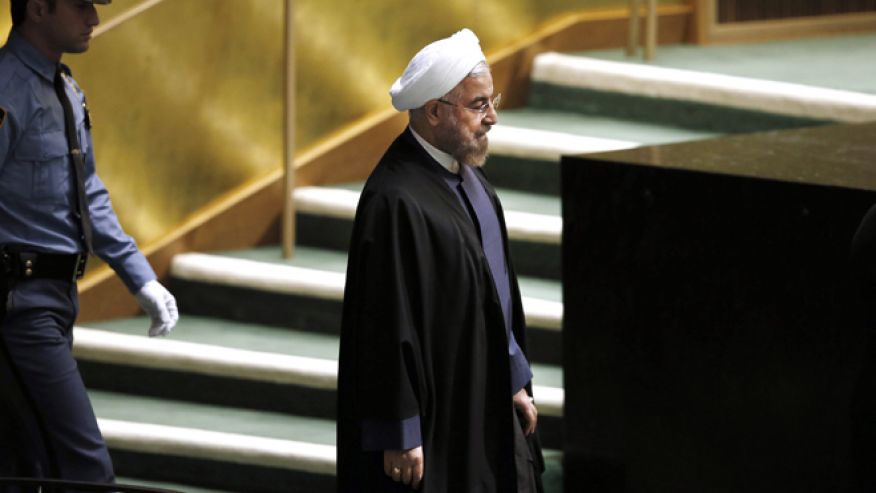
UN General Assembly_Rouhani_AP_660In this Thursday, Sept. 25, 2014 photo, President Hassan Rouhani of Iran walks in before addressing the 69th session of the United Nations General Assembly at U.N. headquarters. (AP)

Iranian President Hassan Rouhani on Thursday sought to leverage the crisis in the Middle East to ease sanctions on his country as part of nuclear talks, suggesting during a United Nations address that security cooperation between Iran and other nations could only occur if they struck a favorable nuclear deal.

The Iranian president, meanwhile, sought to lay the blame for raging violence in the Middle East at the feet of western nations. He strongly condemned terrorism and described it as a serious threat, but also said the West’s “blunders” in the region have created a “haven for terrorists and extremists.” He alleged that attempts to “export” democracy have created “weak and vulnerable governments.”

While focusing in large part on violent extremists in the region, Rouhani made clear Iran’s cooperation in addressing these threats hinges on the outcome of ongoing nuclear talks – as he once again urged other nations to drop what he described as “excessive demands.”

Rouhani said a deal could mark the “beginning of multilateral cooperation” and allow for “greater focus on some very important regional issues such as combating violence and extremism.”

But, he said: “The people of Iran who have been subjected to pressures … as a result of continued sanctions cannot place trust in any security cooperation between their governments with those who have imposed sanctions.”

Whether Iran’s cooperation in addressing Middle East unrest will serve as an effective bargaining chip remains to be seen.

The U.S. publicly has said it will not cooperate militarily or share intelligence with Iran to address the Islamic State threat.

Yet Secretary of State John Kerry said this week he was “open to have a conversation at some point in time if there’s a way to find something constructive.” And the U.S. reportedly notified Iran in advance of plans to strike inside Syria.

In his address to world leaders late Wednesday, British Prime Minister David Cameron also said Iran could help in defeating the terror group’s threat. Cameron spoke hours after meeting in person with Rouhani, the first meeting between the British and Iranian leaders since the Iranian revolution in 1979.

The world leaders spoke as the U.S., Iran and other nations resume nuclear talks after a two-month hiatus.

They are running up against a Nov. 24 deadline to reach a comprehensive agreement to curb Iran’s nuclear activities in exchange for easing sanctions.

Tehran, though, is resisting U.S. calls that it gut a nuclear program that enriches uranium, a process that can make both reactor fuel and the fissile core of a nuclear warhead. GOP lawmakers have also warned that the Obama administration may be willing to give too much ground to Iran in pursuit of an agreement.

Failure to seal a deal could see a return to confrontation, including U.S. and Israeli threats of military means as a last resort to slow Iran’s nuclear program.

“My message to Iran’s leaders and people is simple: Do not let this opportunity pass,” President Obama said Wednesday in his own address to world leaders.

The disagreement has complicated efforts to regarding the Islamic State menace.

In comments on the eve of his own General Assembly speech, Rouhani suggested his country was ready to join Washington and others in opposing the Islamic State. But he said the U.S. needed to move beyond “insignificant” fears that his country seeks nuclear arms.

At the same time, he was critical of the U.S. bombing campaign of Islamic State group strongholds and the growing coalition of countries seeking to stop the extremists by military means. “Bombing and airstrikes are not the appropriate way,” Rouhani said, warning that “extraterritorial interference … in fact only feeds and strengthens terrorism.”

There are other issues. American officials are furious with Iran for detaining Jason Rezarian, a Washington Post journalist who has both American and Iranian citizenship, as well as his wife.

Iranian officials have not specifically said why the couple is being held, and Rouhani has dodged questions about their fate. Asked again Wednesday about Rezarian, he said he would be freed if he is innocent of any crime.

CURL: Obama’s breathtaking naivete at the United Nations

September 25, 2014

CURL: Obama’s breathtaking naivete at the United Nations, Washington TimesJoe Curl, September 24, 2014

Obama's ToastPhoto by: Pablo Martinez Monsivais. President Barack Obama raises his glass to toast during a luncheon hosted by UN Secretary General Ban Ki-moon, Wednesday, Sept. 24, 2014, at the United Nations headquarters. (AP Photo/Pablo Martinez Monsivais)

Simply believing something doesn’t make it so. The president’s desire for a world in which nations talk openly about their true feelings, perhaps share a good cry together, and sing kumbaya around the campfire, is the height of naivete.

So is this passage of his speech: “… the United States is not and never will be at war with Islam. Islam teaches peace. Muslims the world over aspire to live with dignity and a sense of justice. And when it comes to America and Islam, there is no us and them, there is only us.”

******************

ANALYSIS/OPINION:

President Obama on Wednesday delivered a speech at the United Nations filled with his usual soaring rhetoric of global collectivism and the importance of “international norms.” But the president also displayed a shocking naivete about global affairs, religion, Islam — a Pollyannaish interpretation on the state of the world and America’s role in it.

Although Mr. Obama won a Nobel Peace Prize just eight months into office, the president made his annual trip to the ineffectual world council to deliver a call to war. “Ladies and gentlemen, we come together at a crossroads between war and peace, between disorder and integration, between fear and hope.”

Of course he waxed poetic about “climate change” and the promise of “the children,” but the president was forced to devote the bulk of his speech to what he called the “heart of darkness” and the “cancer of violent extremism.”

He said upon opening his remarks that “the shadow of world war that existed at the founding of this institution has been lifted.” He couldn’t be more wrong. A true man of peace worthy of the Nobel Prize, Pope Francis, said just the opposite this month in remarkably astute comments to commemorate the anniversary of World War I.

“Even today, after the second failure of another world war, perhaps one can speak of a third war, one fought piecemeal, with crimes, massacres, destruction,” the pope said, summing up the conflicts in Ukraine, Iraq, Syria, Israel, Gaza and much of northern Africa, including Libya and Tunisia, not to mention Somalia.

To Mr. Obama, there’s no global conflict of ideology, just “pervasive unease in our world.” To him, the strife is merely the “failure of our international system to keep pace with an interconnected world.” And to him, “it is one of the tasks of all great religions to accommodate devout faith with a modern, multicultural world.”

He asked delegates from nations across the world to mull this “central question of our global age: Whether we will solve our problems together, in a spirit of mutual interest and mutual respect, or whether we descend into the destructive rivalries of the past.”

His answer? “It’s time for a broader negotiation in the region in which major powers address their differences directly, honestly, and peacefully across the table from one another, rather than through gun-wielding proxies.”

Simply believing something doesn’t make it so. The president’s desire for a world in which nations talk openly about their true feelings, perhaps share a good cry together, and sing kumbaya around the campfire, is the height of naivete.

So is this passage of his speech: ” … the United States is not and never will be at war with Islam. Islam teaches peace. Muslims the world over aspire to live with dignity and a sense of justice. And when it comes to America and Islam, there is no us and them, there is only us.”

But Islam and the holy Koran on which Muslim militant groups like al Qaeda and the Islamic State base their actions do call for the extermination of all who do not follow Islam, do demand that followers kill anyone who leaves the religion, do subjugate women. For the record, the Koran contains more than 100 verses that call Muslims to war with nonbelievers.

Mr. Obama said in his speech that “all people of faith have a responsibility to lift up the value at the heart of all great religions: Do unto thy neighbor as you would do — you would have done unto yourself.” But that is not a cornerstone of Islam. Militant Muslims have a very different belief: “Fight in the name of your religion with those who disagree with you.” And that edict comes straight from their holiest book.

To the president, that ideology “will wilt and die if it is consistently exposed and confronted and refuted in the light of day.” Again, the callowness is astounding. While he urged the world, “especially Muslim communities,” to reject the ideology that underlies al Qaeda and the Islamic State, nothing will change the fact that cold-blooded killers are determined to destroy the West, wipe all infidels from the face of the earth and build a new caliphate based on strict adherence to Shariah law (which leans heavily toward beheadings, lashings, stonings).

The president let loose some passing platitudes — “right makes might,” “the only language understood by killers like this is the language of force” — but in the end Mr. Obama still labors under the delusion that the Islamic State group and its ilk have “perverted one of the world’s great religions.” He still rejects “any suggestion of a clash of civilizations” — despite al Qaeda’s and Islamic State’s express declaration of war against western civilization (and anyone who is not Muslim).

In the end, Mr. Obama said: “No external power can bring about a transformation of hearts and minds,” which means America is powerless. The only solution in this multicultural world is sharing our true feelings honestly with those who not only fundamentally disagree with us, but vow to do us harm.

Exactly a year ago, Mr. Obama said this at the U.N.: “Together, we’ve also worked to end a decade of war.” But the worldwide war on terrorism does not end when the U.S. president decides it is so, it ends when the enemy is defeated.

While he says “peace is not merely the absence of war, but the presence of a better life,” he really should say only this: “We didn’t start this war, but we will end it.”

Obama Praises Muslim Cleric Who Backed Fatwa on Killing of U.S. Soldiers

September 24, 2014

Obama Praises Muslim Cleric Who Backed Fatwa on Killing of U.S. Soldiers, Washington Free Beacon, September 14, 2014

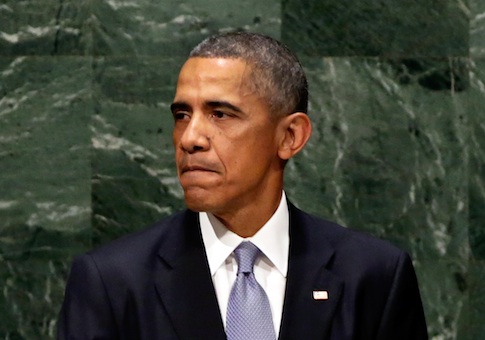
Barack ObamaPresident Barack Obama addresses the United Nations General Assembly / AP

Patrick Poole, a reporter and terrorism analyst who has long tracked Bin Bayyah, expressed shock that the Obama administration would endorse the cleric on the world stage.

“It is simply amazing that just a few months ago the State Department had to publicly apologize for tweeting out it’s support for Bin Bayyah, only to have Barack Obama go before the leaders of the entire world and publicly endorse Bin Bayyah’s efforts,” Poole said.

“It seems that nothing can stop this administration’s determination to rehabilitate Bin Bayyah’s image, transforming him from the Islamic cleric who issued the fatwa to kill Americans in Iraq and calling for the death of Jews to the de facto White House Islamic mufti,” he said.

This type of mentality has contributed to the administration’s foreign policy failures in the region,” Poole said.

********************

President Barack Obama favorably quoted and praised on Wednesday in his speech before the United Nations a controversial Muslim cleric whose organization has reportedly endorsed the terror group Hamas and supported a fatwa condoning the murder of U.S. soldiers in Iraq.

Obama in his remarks offered praise to controversial cleric Sheikh Abdallah Bin Bayyah and referred to him as a moderate Muslim leader who can help combat the Islamic State of Iraq and the Levant’s (ISIL or ISIS) radical ideology.

However, Bin Bayyah himself has long been engulfed in controversy for many of his views, including the reported backing of a 2004 fatwa that advocated violent resistance against Americans fighting in Iraq.

This is not the first time that the Obama administration has extoled Bin Bayyah, who also has served as the vice president of a Muslim scholars group founded by a radical Muslim Brotherhood leader who has called “for the death of Jews and Americans,” according to Fox News and other reports.

The State Department’s Counterterrorism Bureau (CT) was forced to issue multiple apologies earlier this year after the Washington Free Beacon reported on its promotion of Bin Bayyah on Twitter.

“This should not have been tweeted and has since been deleted,” the CT Bureau tweeted at the time after many expressed anger over the original endorsement of Bin Bayyah.

However, it appears that Obama and the White House are still supportive of Bin Bayyah, who, despite his past statements, is still hailed by some as a moderate alternative to ISIL and al Qaeda.

“The ideology of ISIL or al Qaeda or Boko Haram will wilt and die if it is consistently exposed, confronted, and refuted in the light of day,” Obama said before the U.N., according to a White House transcript of his remarks.

“Look at the new Forum for Promoting Peace in Muslim Societies—Sheikh bin Bayyah described its purpose: ‘We must declare war on war, so the outcome will be peace upon peace,’” Obama said, quoting the controversial cleric.

Concern over the administration’s relationship with Bin Bayyah started as early as 2013, when outrage ensued after he was reported to have met with Obama’s National Security Council staff at the White House.

While Bin Bayyah has condemned the actions of groups such as Boko Haram and ISIL, he also has taken controversial positions against Israel.

He issued in 2009 a fatwa “barring ‘all forms of normalization’ with Israel,” according to a Fox report on the White House meeting.

Additionally, the notorious 2004 fatwa permitting armed resistance against U.S. military personnel in Iraq reportedly stated that “resisting occupation troops” is a “duty” for all Muslims, according to reports about the edict.

Patrick Poole, a reporter and terrorism analyst who has long tracked Bin Bayyah, expressed shock that the Obama administration would endorse the cleric on the world stage.

“It is simply amazing that just a few months ago the State Department had to publicly apologize for tweeting out it’s support for Bin Bayyah, only to have Barack Obama go before the leaders of the entire world and publicly endorse Bin Bayyah’s efforts,” Poole said.

“It seems that nothing can stop this administration’s determination to rehabilitate Bin Bayyah’s image, transforming him from the Islamic cleric who issued the fatwa to kill Americans in Iraq and calling for the death of Jews to the de facto White House Islamic mufti,” he said.

This type of mentality has contributed to the administration’s foreign policy failures in the region,” Poole said.

“This is a snapshot of why this administration’s foreign policy in the Middle East is a complete catastrophe,” he said. “The keystone of their policy has been that so-called ‘moderate Islamists’ were going to be the great counter to al Qaeda. But if you take less than 30 seconds to do a Google search on any of these ‘moderate Islamists,’ you immediately find they are just a degree or two from the most hardcore jihadis and have little to no difference when it comes to condoning violence.”

A White House official said that the president’s remarks speak for themselves and declined to add anything further.

The “Khorasan Group”, New Name, Old Threat

September 24, 2014

The “Khorasan Group”, New Name, Old Threat, Center for Security PolicyKyle Shideler, September 24, 2014

There has been an attempt to try to separate out elements of Al Qaeda, into Core, and affiliates, and in the case of the Khorasan group, small units within affiliates. Or for that matter to disassociate ISIS from Al Qaeda, as ISIS being “too brutal”, when the reality is that ISIS hasn’t engaged in any tactic that Al Qaeda didn’t institute first.

This is a misguided attempt to convince people that what we face is a series of minor groups, and that the enemy who attacked us on 9/11 is broken, and/or on the run. The reality is we face an overarching enemy, a Global Islamic Movement – which is how they identify themselves – operating in accordance with a knowable strategic doctrine that we are not addressing.

That doctrine is Shariah law. It is the same law that ISIS is instituting in its territory, and the same one that Jabhat al Nusra and several of the other Syrian groups would institute in Syria if they prove successful in defeating Assad.

Until we are prepared to discuss the conflict in ideological terms, we will forever be playing “whack-a-mole” with a never ending series of “new” threats.

*****************

Recent media coverage has been bombarded by revelations of a “new terror threat“, “more dangerous than ISIS”, the Khorasan Group.

Khorasan refers to the historical area under the Islamic Caliphate that corresponds to Iran/Afghanistan/Pakistan and the subcontinent, and the Khorasan Group, according to intelligence officials speaking to the media, consists of a relatively small (between fifty and a hundred) group of veteran Al Qaeda fighters from the Afghanistan/Pakistan region. These fighters are said to include a number of highly skilled bomb makers and other operatives, led by Muhsin al-Fadhli, a native Kuwaiti, and long time Al Qaeda insider, who specializes in financing and facilitation. Jihadist social media is hinting that Al-Fadhli may have been killed in the first round of U.S. bombing.

Khorasan Group’s mission, supposedly, has been to find jihadists with western passports who have travelled to Syria, train them, and reinsert them into the West to conduct spectacular attacks of the kind that Al Qaeda is famous for.

Khorasan Group operates in and among Al Qaeda’s Syrian affiliate Jabhat al-Nusra, and there’s been lively debate in the counterterrorism community over whether its really worthwhile distinguishing between Jabhat al-Nusra and Khorasan group at all. This is significant because Jabhat al-Nusra, despite being Al Qaeda, is deeply intertwined with the Syrian rebels at-large, and they are widely supported by these rebels, including those that the Obama strategy calls for arming and training to fight ISIS. For their part, Jabhat al Nusra hasn’t made the distinction, claiming they were the recipient of U.S. bombings.

It’s entirely plausible that intelligence suggested that this Khorasan group was preparing an imminent attack, and even if they weren’t, they are definitely enemies of America and a legitimate target.

But the extra hype about this specific group, and separating them out as somehow different or more threatening than Jabhat al Nusra, and Al Qaeda proper, has more to do with attempting to limit the negative reaction from rebels within Syria, and to distract Americans from the reality that in Syria there really are few good guys, with a possible exception of the Kurdish forces, who aren’t really receiving support. That strategy has already failed, with multiple Syrian rebel groups complaining about the strikes against Jabhat al Nusra, includingone group expected to be the core of the force the U.S. intends to train to send against ISIS.

There has been an attempt to try to separate out elements of Al Qaeda, into Core, and affiliates, and in the case of the Khorasan group, small units within affiliates. Or for that matter to disassociate ISIS from Al Qaeda, as ISIS being “too brutal”, when the reality is that ISIS hasn’t engaged in any tactic that Al Qaeda didn’t institute first.

This is a misguided attempt to convince people that what we face is a series of minor groups, and that the enemy who attacked us on 9/11 is broken, and/or on the run. The reality is we face an overarching enemy, a Global Islamic Movement – which is how they identify themselves – operating in accordance with a knowable strategic doctrine that we are not addressing.

That doctrine is Shariah law. It is the same law that ISIS is instituting in its territory, and the same one that Jabhat al Nusra and several of the other Syrian groups would institute in Syria if they prove successful in defeating Assad.

Our enemy knows that you can not defeat an opponent you do not name. They do not say that their war is with the U.S. Army,  the 75th Ranger Regiment, or the 5th Special Forces Group. They say plainly and openly, that their war is with America, and the allies of America, and more importantly, that it is an ideological war, based on a conflict between belief systems which are irreconcilable.

Until we are prepared to discuss the conflict in ideological terms, we will forever be playing “whack-a-mole” with a never ending series of “new” threats.