Archive for the ‘Iranian satellites’ category

Intel Report: Iran Refining Nuke Delivery System in Flagrant Violation of Ban

May 12, 2017

Intel Report: Iran Refining Nuke Delivery System in Flagrant Violation of Ban, Washington Free Beacon, May 12, 2017

(Please see also, Iran to Launch Two New Satellites, Likely Cover for Illicit ICBM Program. — DM)

WASHINGTON, DC – MAY 11: U.S. Director of National Intelligence Daniel Coats testifies before the Senate Intelligence Committee with his fellow heads of the United States intelligence agencies in the Hart Senate Office Building on Capitol Hill May 11, 2017 in Washington, DC. (Photo by Alex Wong/Getty Images)

Iran continues to make critical technological strides in its efforts to perfect an intercontinental ballistic missile capable of delivering nuclear weapons over great distances, efforts that violate international prohibitions, according to the director of national intelligence, who informed Congress this week that the Islamic Republic “would choose ballistic missiles as its preferred method of delivering nuclear weapons.”

The disclosure comes just days after Iranian leaders announced the upcoming launch of two new domestically produced satellites. Iran has long used its space program as cover for illicit missile work, as the know-how needed to launch such equipment can be applied to long-range ballistic missile technology.

Daniel Coats, America’s top spymaster, informed Congress this week in an intelligence briefing that Iran’s ballistic missile work continues unimpeded and could be used by the Islamic Republic to launch a nuclear weapon, according to unclassified testimony.

Iran’s ballistic missile work, particularly its focus on ICBMs, runs counter to United Nations resolutions barring such activity, though it remains unclear if the Trump administration plans to pursue new sanctions on Iran.

Iran continues to perform key research and development on nuclear missile capabilities despite the landmark nuclear agreement with Western powers, according to the last U.S. intelligence assessments.

“Iran is pursuing capabilities to meet its nuclear energy and technology goals and to give it the capability to build missile-deliverable nuclear weapons, if it chooses to do so” Coats wrote in his written testimony to the Senate intelligence committee.

U.S. officials are unsure if Iran will build nuclear weapons, but it is likely this intention would dictate Tehran’s future adherence to the nuclear deal, which the administration of former President Barack Obama framed in such a way as to leave out the issue of ballistic missiles.

The United States assesses that Iran remains about a year away from a functional nuclear missile if it decides to build one in violation of the nuclear deal.

Iranian military leaders claim their missile work is unrelated to the nuclear agreement and permissible under it. The country’s refusal to abandon this work has caused concern on Capitol Hill, as well as among U.S. national security insiders who view the work as related to Iran’s aspirations for regional dominance.

The U.S. intelligence community maintains that Iran—which has the largest inventory of ballistic missiles in the Middle East—likely would use this technology to launch a nuclear weapon.

“We judge that Tehran would choose ballistic missiles as its preferred method of delivering nuclear weapons, if it builds them,” according to Coats. “Iran’s ballistic missiles are inherently capable of delivering WMD, and Tehran already has the largest inventory of ballistic missiles in the Middle East.”

“Tehran’s desire to deter the United States might drive it to field an intercontinental ballistic missile (ICBM),” Coats wrote, referring to Iran’s covert missile work. “Progress on Iran’s space program could shorten a pathway to an ICBM because space launch vehicles use similar technologies.”

Iran “continues to leverage cyber espionage, propaganda, and attacks to support its security priorities, influence events and foreign perceptions, and counter threats—including against U.S. allies in the region,” Coats testified.

This includes cyber attacks “directly against the United States,” such as in 2013, when an Iranian hacker penetrated the computer systems of a U.S. dam.

Iran also is pursuing a massive buildup of its military, which observers have described as unprecedented.

The U.S. intelligence community has confirmed that Iran is developing “a range of new military capabilities to monitor and target U.S. and allied military assets in the region, including armed UAVs [drones], ballistic missiles, advanced naval mines, unmanned explosive boats, submarines and advanced torpedoes, and anti-ship and land-attack cruise missiles,” according to Coats.

Iran to Launch Two New Satellites, Likely Cover for Illicit ICBM Program

May 9, 2017

Iran to Launch Two New Satellites, Likely Cover for Illicit ICBM Program, Washington Free Beacon, , May 9, 2017

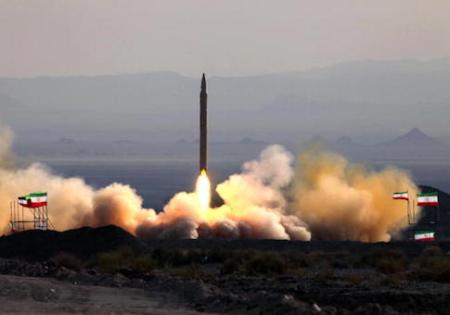
A picture taken on August 20, 2010 shows the test firing at an undisclosed location in Iran of a surface-to-surface Qiam missile, entirely designed and built domestically and powered by liquid fuel according to Defence Minister Ahmad Vahidi, a day before the Islamic republic was due to launch its Russian-built first nuclear power plant. AFP PHOTO/VAHID REZA ALAEI (Photo credit should read VAHID REZA ALAEI/AFP/Getty Images)

Iran is preparing to launch two new domestic satellites into space, according to a new announcement by Iranian military leaders that is stirring discussion among U.S. national security insiders who say the move is likely cover for the test firing of advanced intercontinental ballistic missile technology that could be used as part of Iran’s nuclear program.

The latest test comes as the Trump administration continues to engage in a comprehensive review of the Iran nuclear agreement that U.S. officials tell the Washington Free Beacon will result in a full-scale plan to “meet the challenges Iran poses with clarity and conviction.”

Iran continues to boost its military might and move forward with the testing of controversial ballistic missile technology. The expertise needed to launch satellites into space is similar to that needed to properly launch intercontinental ballistic missiles, which could potentially reach U.S. soil.

U.S. officials and national security experts have been paying close attention to Iran’s missile progress as North Korea ups its provocative moves. Tehran and Pyongyang have long traded illicit missile technology on the black market and Iran’s nuclear progress closely mirrors that of its partner.

The Iranian satellite launches also come as Iran engages in an unprecedented effort to reorganize and boost its military so it can serve as an offensive fighting force, a move that has drawn concern among U.S. national security insiders.

One State Department official, speaking only on background, told the Free Beacon that the Trump administration is moving closer to formulating a plan aimed at confronting Iran’s increasingly provocative behavior.

“As Secretary [Rex] Tillerson said, the Trump administration is currently conducting a comprehensive review of our Iran policy,” the official said. “Once we have finalized our conclusions, we will meet the challenges Iran poses with clarity and conviction.”

Iranian military leaders announced this week that they are preparing for the launch of two new domestically produced satellites.

“Now, we have two ready-to-launch satellites; one of them is Amir Kabir sensing satellite and another one is Nahid telecommunication satellite and over 97 percent of preparation works have been carried out on them,” Iranian Communications and Information Technology Minister Mahmoud Vaezi was quoted as saying Monday in the country’s state-controlled press.

Iran has a history of using space launches as cover to test and refine its ICBM technology, which remains part of its larger nuclear weapons program.

Michael Rubin, a former Pentagon adviser and expert on rogue regimes, told the Free Beacon that launches of this nature have only increased since the landmark nuclear agreement relaxed international restrictions on Iran’s military behavior.

“That Iran uses its satellite program as cover for ballistic missile development is no secret although, quite realistically, since John Kerry loosened restrictions on Iran’s ballistic missile program, they don’t need to hide quite so much,” Rubin said. “The key thing to recognize is that we’re no longer talking about just Iran’s capability.”

Rubin said that U.S. leaders should be paying close attention to the illicit Iranian-North Korean arms trade.

“When it comes to nuclear technology, Iran and North Korea are like sorority sisters swapping clothes or an old married couple sharing a toothbrush,” Rubin said. “What happens in Tehran doesn’t stay in Tehran.”

Saeed Ghasseminejad, a research fellow and Iranian regime expert at the Foundation for Defense of Democracies, called on the Trump administration to impose new sanctions on Iran as a way to roll back its provocative behavior.

The Obama administration moved in its final days in office to lift a number of sanctions on Iran that have enabled it to reap billions in cash windfalls, a portion of which has gone to fund the Islamic Republic’s military buildup.

“The best way to stop Iran’s ballistic missile program is to impose sanctions on the industries involved in the program,” Ghasseminejad said. “This includes the petrochemical, mining and metallurgy, telecommunications, automotive, oil and gas, and electronics industries. The U.S. used the industry-based sanctions to curb Iran’s nuclear program and they were very effective.”

