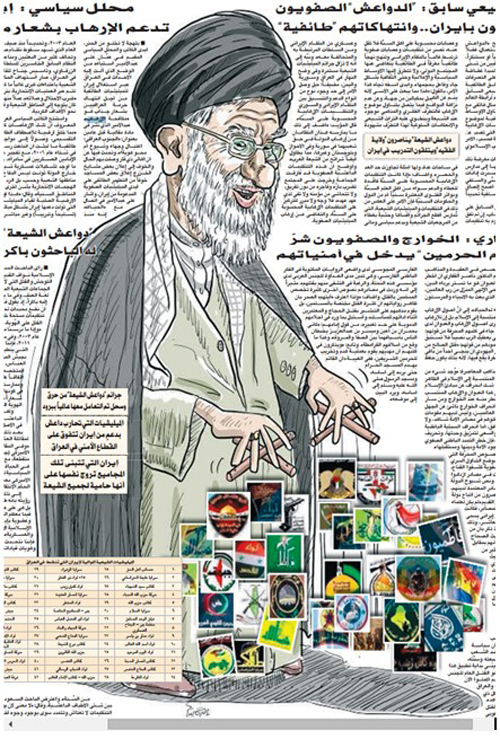
Archive for the ‘Iranian proxies’ category

Terror will not be defeated with reports

June 22, 2015

Terror will not be defeated with reports, Israel Hayom, Dr. Gabi Avital, June 22, 2015

(Please see also, US: Iran’s Support for Terror Undiminished. — DM)

Iran is led by rational and calculated religious clerics, whose goals are openly declared and well-defined. The rationality one should expect to find in the State Department has dissipated in a haze of illusions, which are exacting a heavy toll. Meanwhile, only the Islamic State stands to outflank Iran, and that is only under the assumption that these two terrorist entities are on completely divergent paths. To be sure, that is quite the baseless assumption.

Yet those who with one hand sound the alarm over an increase in terror, while with the other help the perpetrators of said terror rule the roost by giving it nuclear weapons, must provide convincing explanations. The United States, with its utter foreign policy failures — from Iraq to Yemen to Syria to Egypt and Iran — is not forthcoming with such explanations.

Where is Michael Moore when you need him? The State Department can see what is happening, but Kerry is on his way to a nuclear deal with the world’s leading sponsor of terrorism. Not much could be worse.
********************

Understanding history is a tricky proposition. Its lessons are sometimes hidden to us for long periods; often only subsequent generations can achieve the proper historical perspective, after a series of fateful events has unfolded. Even so, within less than 40 years we have witnessed global events that many political scientists correctly predicted.

The time is the late 1970s. All signs point to an oncoming revolution in Iran. However, U.S. President Jimmy Carter (whom some call the worst president ever), is instead consumed with the wording for a peace deal that undermines pre-existing agreements and international accords. Egypt wins the entire pot in a peace deal with Israel. Iran rises in prominence; the Soviet Union bolsters its standing across the globe, until the arrival of Ronald Reagan, who in an effort to defeat the Soviet Union in the ongoing Cold War, announces his Star Wars program.

We know the ending. Almost every single international relations expert points to that declaration as the beginning of the fall of the Soviet Union. In 1989, Reagan concludes two terms in office, and the Soviet Union falls apart.

Terrorism spreads across the globe. The leading sponsors are Saudi Arabia, Syria and Iran. An extensive report, examining the dangers of mass terrorist attacks on U.S. soil, is being compiled. The conservative-democratic pendulum in the U.S. swings toward the Democratic candidate, Bill Clinton. The egregious disregard of the report, now collecting dust, brings terrorism to its horrific pinnacle on Sept. 11, 2001. All fingerprints lead back to Saudi Arabia. Everything had already been laid out in the dust-covered Pentagon report. What the democratic Pentagon and State Department cooked up, the Republican George W. Bush was forced to eat.

The State Department has now published its annual report on terrorism. The seeds of this report were planted in the Carter era, when peace at all costs was championed without any understanding of the world in general and the Middle East in particular. Iran is led by rational and calculated religious clerics, whose goals are openly declared and well-defined. The rationality one should expect to find in the State Department has dissipated in a haze of illusions, which are exacting a heavy toll. Meanwhile, only the Islamic State stands to outflank Iran, and that is only under the assumption that these two terrorist entities are on completely divergent paths. To be sure, that is quite the baseless assumption.

So what does the report say? There will be a dramatic 35% rise in global terrorist acts. Iran supports terrorist organizations all over the world and in the Middle East especially; it backs the Shiite fighters in Iraq, Hezbollah in Lebanon and in Syria, with arms, training, money and intelligence. And we haven’t even mentioned Syria yet, or Hamas and Islamic Jihad.

Yet those who with one hand sound the alarm over an increase in terror, while with the other help the perpetrators of said terror rule the roost by giving it nuclear weapons, must provide convincing explanations. The United States, with its utter foreign policy failures — from Iraq to Yemen to Syria to Egypt and Iran — is not forthcoming with such explanations. Russia is back on the Cold War track; the Islamic State group is emboldened by the conduct of the U.S. president and his team at the State Department; Iran is envisioning a nuclear bomb in its arsenal; and Saudi Arabia is looking on nervously as the carpet of reciprocity is being pulled out from under it and its oil fields.

Only a week before Secretary of State John Kerry, one of the pillars of this dangerous U.S. foreign policy, takes off to pursue the deal with Iran, Tina Kaidanow, the State Department’s coordinator for counterterrorism, tells us: “We continue to be very, very concerned about [the Islamic Revolutionary Guard Corps] activity as well as proxies that act on behalf of Iran.”

What then, is Kerry really unaware of the findings in the 388-page report? And does he not understand that the deal with Iran, the seeds for which were planted in the Carter era and now being cultivated by Obama, is terrorism itself, and that there is no need for any report to merely sit and collect dust again in the State Department cellar?

Where is Michael Moore when you need him? The State Department can see what is happening, but Kerry is on his way to a nuclear deal with the world’s leading sponsor of terrorism. Not much could be worse.
US: Iran’s Support for Terror Undiminished

June 22, 2015

US: Iran’s Support for Terror Undiminished, The Clarion Project, June 21, 2015

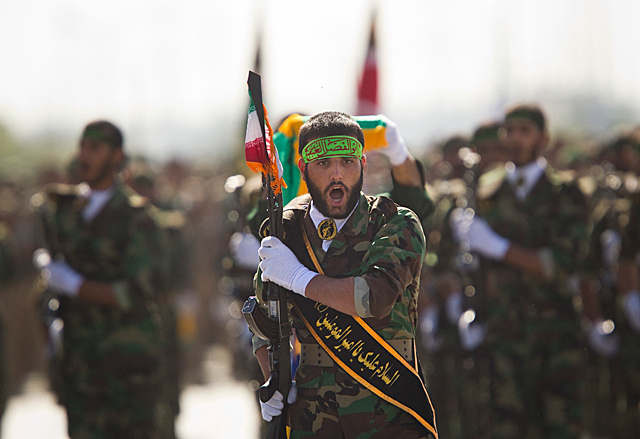
Iran-Basij-March-IP_1The Iranian volunteer Basij militia (Photo: © Reuters)

In an interview with The Atlantic, U.S. President Barack Obamas admitted that some of the money freed up the deal’s proposed sanction relief may up going towards terrorism, although he argued that Iranian government would have to make good on their commitments to improve the country’s economy.

******************

Despite the fact that Iran’s global terror activities were “undiminished” between 2013 and 2014, the U.S. State Department is still entirely committed to pursuing a nuclear deal with Iran.

“We think it’s essential that we pursue those negotiations,” said Tina Kaidanow, the State Department’s coordinator for counterterrorism, as quoted in The Wall Street Journal. “None of that implies that we would be, again, in any way taking our eye off the ball with respect to what Iran is doing as a supporter of terrorism.”

Iran’s support for terror was documented in the State Dept.’s annual report on global terrorism, which was released Friday. The report says “Iran’s state sponsorship of terrorism worldwide remained undiminished,” which makes the State Dept. “very, very concerned,” according to Kaidanow.

While the June 30 deadline for the deal is now fewer than 10 days away, the release of the report shows, “Iran continued to sponsor terrorist groups around the world,” according to Kaidanow.

The report specifically mentions Iran’s continued support for the Shiite terror organization Hezbollah in Lebanon as well as those fighting with embattled Syrian President Bashaar al-Assad.

The Clarion Project reported last week that Iran is supporting more than 100 terrorist organizations in Syria and Iraq alone.

In an interview with The Atlantic, U.S. President Barack Obamas admitted that some of the money freed up the deal’s proposed sanction relief may up going towards terrorism, although he argued that Iranian government would have to make good on their commitments to improve the country’s economy.

“I don’t think …anybody in this administration said that no money will go to the military as a consequence of sanctions relief,” Obama said. “The question is, if Iran has $150 billion parked outside the country, does the IRGC automatically get $150 billion? Does that $150 billion then translate by orders of magnitude into their capacity to project power throughout the region? And that is what we contest …”

The report also showed that between 2013 and 2014, there was a significant rise in global terror attacks, causing an increase in over 80 percent of violent deaths from the previous year (which itself had seen a 43 percent increase from the year before). In addition, the report showed:

  • There was an average of 1,122 attacks per month
  • Kidnappings increased by one-third, with more than with 9,400 people taken hostage
  • The number of global attacks rose by 35 percent
  • 32,727 people were killed worldwide (versus 17,800 in 2013)
  • 34,700 people were injured in attacks in close to 95 countries
  • In Iraq alone,  10,000 people died in 3,360 attacks representing close to a third of all people killed in terror attacks worldwide.

Shaking Hands with Iran

June 19, 2015

Shaking Hands with Iran, The Gatestone InstituteDaniel Mael, June 19, 2015

  • According to the organization Iran Human Rights, the Iranian regime has executed a prisoner every two hours this month.
  • “So far in 2015, more than 560 have been executed, and we are just in the first half of the year… What we are witnessing today is not so much different from what ISIS is doing. The difference is that the Iranian authorities do it in a more controlled manner, and represent a country which is a full member of the international community with good diplomatic relations with the West.” — Mahmood Amiry-Moghaddam, spokesman for Iran Human Rights.
  • Now the West, with the possibility of a nuclear deal, stands to increase Iran’s diplomatic standing.

As negotiations between the P5+1 countries and Iran continue, human rights concerns under the Iranian regime remain on the periphery.

The Obama Administration, over the objections of countless human rights organizations, has made clear that the United States is not seeking to alter the nature of the Iranian regime. Rather, the aim of the direct negotiations is solely to reach an agreeable compromise over the Iran’s continued nuclear enrichment. The current nominal deadline for negotiations is June 30.

The Islamic Republic of Iran is notoriously the world’s largest state sponsor of terrorism. Proxy organizations include Hezbollah in Lebanon, Hamas in the Gaza Strip and Houthi rebels in Yemen. The regime’s support of barbarism is reflected within Iran as well, as Iranian leaders support unspeakable human rights abuses on a daily basis.

With the deadline for negotiations only days away, June 2015 has been no exception.

According to a June 17 press release from the organization Iran Human Rights, which “supports the Iranian people’s struggle for human rights and amplifies their voices on the international stage,” the Iranian regime has executed a prisoner every two hours this month:

“According to reports collected by IHR so far in June at least 206 people have been executed in different Iranian cities. 60 of the executions have been announced by the official sources while IHR has managed to confirm 146 other executions which have not been announced by the authorities.”

“So far in 2015 more than 560 people have been executed in the country and we are just in the first half of the year,” Mahmood Amiry-Moghaddam, the spokesman of IHR, said in an interview. “This is unprecedented in the last 25 years! Unfortunately, people in Iran feel that the international community has closed its eyes on what they are going through.”

The executions are just the tip of the crane. As IHR reported Wednesday morning, Mohammed Moghimi, a defense lawyer for civil activist Atena Faraghadani, was scheduled to be released from prison on June 16, after three days in prison. What, exactly, was his crime?

“Mohammad Moghimi was charged with ‘non-adultery illegitimate relations’ for shaking hands with his female client,” writes IHR. “He had gone to Evin Prison to meet Ms. Faraghadani and to prepare an appeal request for her 12-year prison sentence.” According to IHR sources, the forbidden handshake “happened in the presence of two agents in the room. Atena apologized for this right there… but the agents didn’t let it go and took her back to her prison ward and arrested Mr. Moghimi right there.”

Moghimi release was released on condition that he meet a bail of roughly $60,000.

And why is Faraghadani in prison? For Facebook posts. A Revolutionary Court in Tehran sentenced her to 12 years and 9 months in prison for posts against the government, which constituted “assembly and collusion against national security,” “propaganda against the state,” and “insulting the Supreme Leader, the President, Members of the Parliament, and the IRGC [Revolutionary Guards] Ward 2-A agents, ” according to IHR.

“What we are witnessing in Iran today is not much different from what ISIS is doing,” argues Amiry-Moghaddam. “The difference is that the Iranian authorities do it in a more controlled manner, and represent a country which is a full member of the international community with good diplomatic relations with the West.”

Now the West, with the possibility of a nuclear deal, stands to increase Iran’s diplomatic standing — and with not even a minimal regard for human rights.

While U.S. negotiators shake hands with Iranian diplomats during the next round of talks in Geneva, Iranian citizens cannot shake hands among themselves without fear of years of imprisonment. While officials, both from the West and from Iran, share updates on social media, Iranians at home face jail time for staking out the wrong position in Facebook posts.

1118Does Iran’s foreign minister risk going to jail? Iranian FM Javad Zarif (right) is apparently touching the arm of EU Foreign Affairs representative Federica Mogherini (second from right). Back in Tehran, the lawyer Mohammad Moghimi (inset top) was arrested and charged with “non-adultery illegitimate relations,” for shaking hands with his female client, Atena Faraghadani (inset bottom). Faraghadani was sentenced to 12 years and 9 months in prison, for Facebook posts critical of the regime

If the Iranian regime cannot trust its own citizens’ handshakes, how can the West trust the Iranian regime with uranium centrifuges?

‘Iran Supporting More than 100 Shiite Terror Groups’

June 17, 2015

‘Iran Supporting More than 100 Shiite Terror Groups,’ The Clarion Project, June 17, 2015

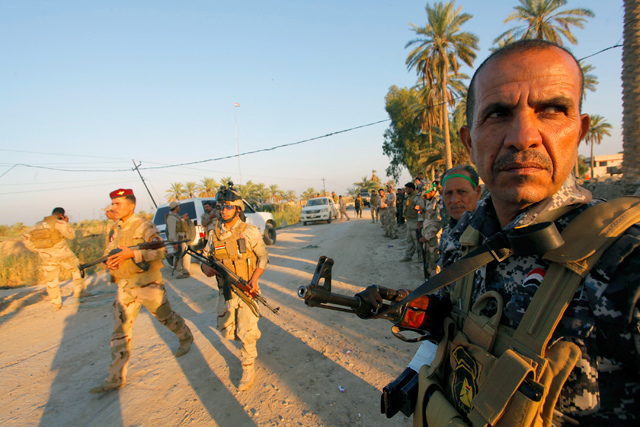
Iraq-Shiite-Militia-Iraqi-Army-IP_0A Shiite militia in Iraq (Photo: © Reuters)

A recent report in Al Hayat, one of the largest and most-respected pan-Arab dailies, charges that Iran is supporting more than 100 Shiite extremist organizations and militias in Syria and Iraq.

The newspaper, which is published in London and funded by Saudi Arabia, says the crimes of these groups are no less horrific than those of the Islamic State.

In Iraq, the Iranian-funded armed militias comprised of Persians have capabilities far beyond those of the Iraqi security forces. The paper quotes academics who commented that the purpose of these militias is to target the Arabs in Iraq, both Sunni and Shiite.

In the Arab world, there is anger that the international media is ignoring the atrocities being committed by these militias. Hussein Al Muayid, an Iraqi religious scholar and advisor to the general secretary of the Muslim World League, pointedly questioned why the media as well as political figures focus only on the activities of the terror activities of Sunni organizations.

Muayid claims such selective reporting serves to makes an implicit statement that the Sunni world is responsible for all the terror in the world.

100-groups

In addition, while governments, experts and clerics issuing fatwasare refusing to give any aid to these Sunni terror organizations, Muayid says Shiite militias, which perpetrate the most horrific acts, enjoy the support of the Iranian ayatollahs, the highest religious authorities in Iran, and the financial and military support of the Islamic republic.

Western researchers and Arab analysts believe that Iran is supporting more than 50 militias in Iraq and another 50 in Syria whose atrocities are not less than those of the Islamic State.

The following is a list of most of the Shiite militias that are loyal to Iran and are active in Iraq:

1.       Gangs of the People of the Truth

2.       Companies of the Churasani Pioneer

3.       Battalions of the Lord of the Martyrs

4.       Noble Movement of Hezbollah

5.       Hezbollah Battalions

6.       Companies of Peace

7.       Corps of the Loyal Promise

8.       Bader Organization – Military Wing

9.       Brigade of Omar ibn Yasser

10.   Brigade of Assad Allah el Raleb

11.   Brigade of the Promised Day

12.   Battalions of the Supporters of Elhaja

13.   Battalions of the Sacred Defense

14.   Brigade of Elkariya

15.   Companies of Alzahra

16.   Brigade of Zu Elfakar

17.   Brigade of the Guarantors of Zainab

18.   Companies of the Supporters of the Belief

19.   Brigade  Al Muntazir

20.   Badar Special Groups

21.   Brigade of Abu Elfader Elabbas

22.   Movement of Al Jihad and al Bina

23.   Companies of the Public Defense

24.   Battalions of the Shiite Brigade

25.   Hezbollah the Rebels

26.   Battalions of the Anger

27.   Brigade of the Youths With Missions

28.   Hezbollah Battalions of the Missing Imam

29.   Battalions With the Direction of the Message

30.   Ashura Companies

31.   Battalions of Malek Elashtar

32.   Elabdar Movement

33.   Battalions of the Imam Ali

34.   Army of the Muktar

35.   Public Draft

36.   Elhamad Brigade

37.   Brigade of the Existing Imam

38.   Eladiat Brigade – Special Guard

39.   Movement of the Loyal Supporters of Allah

40.   Brigade of the 5th Special Guard

41.   Army of Elkarar

42.   Combat Division of Abba

Is there anything the Iranians could do that would upset President Obama?

June 16, 2015

Is there anything the Iranians could do that would upset President Obama? Jerusalem PostEric R. Mandel, June 16, 2015

(Not likely. — DM)

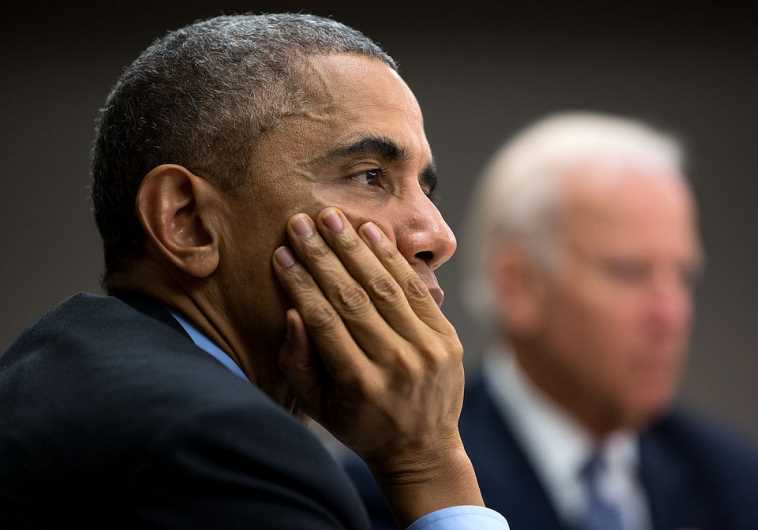
Biden and ObamaUS President Barack Obama (L) and Vice President Joe Biden. (photo credit:OFFICIAL WHITE HOUSE PHOTO BY PETE SOUZA)

The administration’s fear of provoking actions while the nuclear negotiations are ongoing is interpreted by Iran not as pragmatism, but as an invitation to cheat on any future deal.

This schizophrenic foreign policy is not fooling anyone. At best, it is naïve; at worst, it threatens longterm American national security and foreign interests, to say nothing of Israel’s existence.

*****************

It is probably time of us who have strenuously opposed acquiescing in Iran’s development of nuclear weapons to throw in the towel… Mr. Obama’s definition of a satisfactory outcome has evolved… from the complete abandonment… of the Iranian nuclear program to an honor-system reliance on the Iranians.” – Conrad Black, National Review.

What stands out in the following bullets?

• Iran is increasing its financial and military support for the genocidal Syrian ophthalmologist President Bashir Assad.

• The Iranian proxy Hezbollah is helping to prop up the Assad government with its armed forces in Syrian territory.

• US President Barack Obama has stopped supporting Hayya Bina, a “civil society program in Lebanon that seeks to develop alternative Shi’ite political voices to Hezbollah” (The Wall Street Journal).

Reminiscent of the president’s abandonment of the Iranian people during the 2009 Green Revolution, when he sided with the radical mullahs over Iranians seeking a democratic government, the US has decided to leave Lebanese Shi’ites with little choice but the repressive fundamentalist Hezbollah government.

But shouldn’t it be in America’s foreign policy interests to help Iranian and Lebanese Shi’ites break free from the repressive shackles of these anti-Western terrorists and help create the conditions for a peaceful and non-threatening Islam? Anyone paying attention to Iran’s behavior since the Revolution knows that the ayatollah does not reciprocate appeasement. You would have thought after six years of a failed Middle East policy that the president would have learned that unilateral concessions are pocketed, and only encourage more demands and intransigent behavior.

The administration’s fear of provoking actions while the nuclear negotiations are ongoing is interpreted by Iran not as pragmatism, but as an invitation to cheat on any future deal.

The Iranians have been testing the Obama administration with transgressions of the Joint Plan of Action, and their escalating support of the Yemini Houthis, Hezbollah, Hamas, Syria and the Iraqi Shi’ite government. Iran has learned that this American administration would rather bury its head in the sand than act upon almost any transgression.

Iran can be confident that the Obama administration will be the loudest public defender of the deal, knowing it is the president’s foreign policy legacy. Future transgressions will be swept under the table to avoid anything that might unsettle the Iranian regime. Just this week, Iran tested advanced satellite missile launchers, which could be used to deliver nuclear warheads.

Although they contradict current UN Security Council (UNSC) Resolutions, the Obama administration has remained silent, claiming the Iranians are complying with their commitments because the Joint Plan of Action does not address missile systems. The administration conveniently fails to acknowledge is that the JPA does not abrogate the UNSC sanctions.

The president’s outreach to the Iranian-backed Shi’ite Houthis in Yemin, while simultaneously defending the Iranian narrative that it does not support the Shi’ite fighters, fuels the fire that the White House will defend the Iranian narrative after the deal is concluded. Nothing must get in the way of threatening the “success” of the deal.

Even more egregious is the White House’s silence on the blatant violation of a UNSC blacklist. Qassem Suleimani, the head of Iran’s Revolutionary Guard’s elite Quds Force, is barred from traveling to UN member states like Lebanon, Iraq and Syria, yet he travels freely to these nations. For the past eight years, the American government has listed the Quds Force of the Iranian Revolutionary Guard Corps as a terrorist-supporting entity. The Quds Force reports directly to the supreme leader.

The history of the Quds Force’s terrorist activity is well known.

Ahmad Vahidi, who directed the Quds Force at the time, allegedly planned the infamous bombing of the Jewish Center in Buenos Aires in 1994. According to the Obama administration, in 2011 it attempted to assassinate the Saudi ambassador to the US in Washington. No wonder America’s Gulf allies are less than enthusiastic about the US cozying up to the mullahs.

Israel and the Sunni Arab world see the president’s desire to align with Iran as both incomprehensible and inevitable. With little chance of the Senate having the votes to override the president’s almost certain veto this summer, the president is a step closer to his grand plan, in place since his first day in office – to distance America from Israel and the Gulf States, and create a new relationship with the world’s capital for terrorism, Tehran.

The head of the Joint Chiefs of Staff, General Martin Dempsey, went to Israel last week and bluntly told the Israelis that the US expects sanctions relief to increase Iranian support of its proxies, including State Department-designated terrorists Hezbollah and Hamas. The Quds Force can expect a virtual windfall for its overseas terrorist activities. Iran is expected to receive at least $150 billion in sanctions relief, and Dempsey said it would not all be staying in Iran to help its people and economy. Is this administration acting as an indirect supporter of terrorist entities by facilitating their financing? You be the judge.

To deflect charges that the White House is in bed with the Iranians, the administration has allowed the Treasury Department to continue to place some sanctions on Hezbollah members. Like the blacklisting of Quds leader Qassem Suleimani, however, sanctions or blacklisting are one thing, enforcement is another.

This schizophrenic foreign policy is not fooling anyone. At best, it is naïve; at worst, it threatens longterm American national security and foreign interests, to say nothing of Israel’s existence.

Nuclear weapons in the hands of a terrorist state in a decade’s time. That’s a perplexing goal for the leader of the free world.

Iran Backs Taliban With Cash and Arms

June 12, 2015

Iran Backs Taliban With Cash and Arms, Wall Street Journal, Margherita Stancati, June 11, 2015

The White House-supported international nuclear talks with Iran that are scheduled to finish this month face world-wide criticism for potentially setting up a new regional dynamic in which Tehran, unfettered by punitive economic sanctions and flush with new resources, would be able to pursue an activist agenda through its proxies in and around the Middle East. Tehran’s growing ties to the Taliban is another sign of that, these critics say.

U.S. officials declined to comment specifically about closer Iran-Taliban ties, but have said that its diplomacy with Iran doesn’t alter its concerns about Iran’s destabilizing influence in the region. Director of National Intelligence James Clapper said in a recent letter to lawmakers that Iran was the “foremost state sponsor of terrorism.”

**************************

“Iran supplies us with whatever we need,” he said.

Afghan and Western officials say Tehran has quietly increased its supply of weapons, ammunition and funding to the Taliban, and is now recruiting and training their fighters, posing a new threat to Afghanistan’s fragile security.

Iran’s strategy in backing the Taliban is twofold, these officials say: countering U.S. influence in the region and providing a counterweight to Islamic State’s move into the Taliban’s territory in Afghanistan.

The Taliban’s aggressive military push and the new momentum toward peace negotiations between them and Kabul also raises the possibility that some of their members could eventually return to power.

“Iran is betting on the re-emergence of the Taliban,” said a Western diplomat. “They are uncertain about where Afghanistan is heading right now, so they are hedging their bets.”

Iranian officials didn’t respond to requests for comment, but Tehran has repeatedly denied providing financial or military aid to the Taliban in conversations with Afghan and Western officials. “Whenever we discussed it, they would deny it,” a former senior Afghan official said.

The developing Iran-Taliban alliance represents a new complication in Mr. Obama’s plans for both the Middle East and the future of Afghanistan, where the U.S. has been working to curb the Taliban’s role ahead of a planned withdrawal of all but 1,000 U.S. troops at the end of his presidency in 2016. At its peak in 2011 there were 100,000 U.S. troops.

The White House-supported international nuclear talks with Iran that are scheduled to finish this month face world-wide criticism for potentially setting up a new regional dynamic in which Tehran, unfettered by punitive economic sanctions and flush with new resources, would be able to pursue an activist agenda through its proxies in and around the Middle East. Tehran’s growing ties to the Taliban is another sign of that, these critics say.

Rep. Ed Royce (R., Calif.), chairman of the House Foreign Affairs Committee, said Iran’s support to the Taliban could increase if a nuclear deal is signed and Iran wins sanction relief.

“Across the region, Iran is stepping up its support for militants and rebel groups,” Mr. Royce said. “With billions in sanctions relief coming, that support goes into overdrive.”

Sen. John McCain (R., Ariz), chairman of the Armed Services Committee, said Iran’s increased support to the Taliban is a continuation of its aggressive behavior in Yemen, Syria, Iraq and Lebanon. “This is further evidence of the administration’s continued willful disregard for the facts on the ground in light of Iranian aggression in the region,” he said.

U.S. officials declined to comment specifically about closer Iran-Taliban ties, but have said that its diplomacy with Iran doesn’t alter its concerns about Iran’s destabilizing influence in the region. Director of National Intelligence James Clapper said in a recent letter to lawmakers that Iran was the “foremost state sponsor of terrorism.”

The Taliban have long used Pakistani territory as their main recruiting base and headquarters. But Afghan and Western officials say Iran, through its elite Revolutionary Guard Corps, has emerged as an important ally for the Taliban.

What’s more, they say, Tehran is turning to Afghan immigrants within its borders—a tactic it has also used to find new recruits to fight in support of President Bashar al-Assad’s regime in Syria.

Mr. Abdullah is one of those Iranian-backed Taliban fighters. After being detained for working as an illegal laborer in the Iranian port city of Bandar Abbas, Mr. Abdullah said he was approached by an Iranian intelligence officer.

“He asked me how much money I made, and that he would double my salary if I went to work for them in Afghanistan,” he said.

Mr. Abdullah said smugglers hired by Iran ferry supplies across the lawless borderlands where Iran, Afghanistan and Pakistan meet and deliver them to Taliban units in Afghan territory. He said his fighters receive weapons that include 82mm mortars, light machine guns, AK-47 rifles, rocket-propelled grenades and materials for making roadside bombs.

Military and intelligence officials see Iran’s support to the Taliban as an alliance of convenience. Historically, relations between Iran, a Shiite theocracy, and the hard-line Sunni Taliban have been fraught. Iran nearly went to war against the Taliban regime in 1998 after 10 of its diplomats were killed when their consulate in the northern Afghan city of Mazar-e Sharif was overrun.

Iran didn’t oppose the overthrow of the Taliban in 2001, and it has since maintained friendly relations with the Western-backed government in Kabul.

But Iran has long been uneasy with the U.S. military presence on its doorstep, and the Revolutionary Guard Corps have been delivering weapons to the Taliban since at least 2007, according to an October 2014 report by the U.S. Department of Defense.

Iran’s alliance with the Taliban took a new turn in June 2013 when Tehran formally invited a Taliban delegation to participate in a conference on Islam and to meet senior Iranian officials.

By the fall of that year, Afghan security officials said they had clear evidence that Iran was training Taliban fighters within its borders. Tehran now operates at least four Taliban training camps, according to Afghan officials and Mr. Abdullah, the Taliban commander. They are in the Iranian cities of Tehran, Mashhad and Zahedan and in the province of Kerman.

“At the beginning Iran was supporting Taliban financially,” said a senior Afghan official. “But now they are training and equipping them, too.”

The drawdown of U.S. and allied troops has made it easier for Taliban fighters and smugglers to cross the porous border undetected. “In the past, the U.S. had significant surveillance capabilities,” said Sayed Wahid Qattali, an influential politician from the western city Herat, where Iran has long had influence. “But now that the Americans have left, Iran is a lot freer.”

Iran formalized its alliance with the Taliban by allowing the group to open an office in Mashhad, maintaining a presence there since at least the beginning of 2014, a foreign official said. The office has gained so much clout that some foreign officials are now referring to it as the “Mashhad Shura,” a term used to describe the Taliban’s leadership councils.

One of the main points of contact between Tehran and the insurgency is head of the Taliban’s Qatar-based political office, Tayeb Agha, Afghan and foreign officials said. His most recent trip to Iran was in mid-May, the insurgent group said. The Taliban deny they receive support from Iran or any other foreign country, but say they want good relations with Afghanistan’s neighbors.

Iran’s backing of the Taliban has a strategic rationale. Tehran is already battling Islamic State, also known as Daesh, in Syria and Iraq, and it is wary of a new front line emerging close to its eastern border, Afghan officials say.

“Iran seeks to counter Daesh with the Taliban,” said an Afghan security official.

For the Taliban, Islamic State militants represent a threat of a different kind: they are competitors. Since an offshoot of Islamic State announced plans to expand in Afghanistan and Pakistan earlier this year, the new group has been actively recruiting fighters, many of whom are disaffected Taliban, say residents and Afghan officials.

This has pitted the two rival jihadist groups against each other, with clashes erupting between them in provinces including Helmand in the south, Nangarhar in the east and specifically involving Iran-backed Taliban in Farah, near Iran’s border, Afghan officials say.

Iranian funding gives more options to the militant group, support that is beginning to have an impact on the battlefield.

“If it wasn’t for Iran, I don’t think they would’ve been able to push an offensive like they are doing now,” said Antonio Giustozzi, a Taliban expert who has tracked Iran’s involvement in Afghanistan.

In recent months, security in Afghanistan’s west and north deteriorated sharply compared to last year, as Taliban fighters amassed in large numbers, testing the ability of Afghan troops to hold their ground.

It’s unclear, however, how far Iran will go to promote the Taliban.

“They wouldn’t want the Taliban to become too strong,” said a second foreign official. “They just want to make sure that they have some levers in their hands, because if the Taliban would win, God forbid, then they would lose all their leverage.”

Is Obama Supporting a Shiite ISIS?

June 12, 2015

Is Obama Supporting a Shiite ISIS?, Front Page Magazine, Daniel Greenfield, June 12, 2015

Asaib-ahl-alhaq_logo-450x300Asaib Ahl al-Haq logo.

Obama had campaigned vocally against the Kyl-Lieberman Amendment which designated Iran’s Revolutionary Guard, the hidden force behind Asaib Ahl al-Haq and much of the Shiite terrorist infrastructure, a terrorist organization. He had accused its sponsors of “foolish saber rattling.”

While we focused on ISIS, its Shiite counterparts were building their own Islamic State by burrowing from within to hollow out the Iraqi institutions that we had put into place. ISIS is a tool that Iran is using to force international approval of its takeover of Iraq and its own nuclear program.

Like ISIS, its Shiite counterparts envision an apocalyptic struggle in which the other branch of Islam will be destroyed, along with all non-Muslims, leading to regional and global supremacy. Iraq is only one of the battlefields on which this war is being fought and Obama’s inept mix of appeasement and regime change, abandoning allied governments while aiding enemy terrorists has helped make it possible.

*********************

Staff Sgt. Ahmed Altaie was the last American soldier to come home from Iraq. His body was turned over by Asaib Ahl al-Haq or The League of the Righteous; a Shiite terrorist group funded and trained by Iran.

Altaie had been kidnapped, held for ransom and then killed.

It was not Asaib Ahl al-Haq’s only kidnapping and murder of an American soldier. A year after Altaie’s kidnapping, its terrorists disguised themselves as Americans and abducted five of our soldiers in Karbala. The soldiers were murdered by their Shiite captors after sustained pursuit by American forces made them realize that they wouldn’t be able to escape with their hostages.

Asaib Ahl al-Haq’s obsession with American hostages was a typically Iranian fixation. Iran’s leaders see the roots of their international influence in the Iran hostage crisis. Its terrorist groups in Lebanon had abducted and horrifically tortured Colonel William R. Higgins and William Francis Buckley.

Higgins had been skinned alive.

Most Americans have never heard of Asaib Ahl al-Haq, sometimes referred to as the Khazali Network after its leader, even though it has claimed credit for over 6,000 attacks on Americans. Its deadliest attacks came when the Democrats and their media allies were desperately scrambling to stop Bush from taking out Iran’s nuclear program. Asaib Ahl al-Haq’s ties to Iran were so blatant that the media could not allow it to receive the kind of coverage that Al Qaeda did for fear that it might hurt Iran.

Obama had campaigned vocally against the Kyl-Lieberman Amendment which designated Iran’s Revolutionary Guard, the hidden force behind Asaib Ahl al-Haq and much of the Shiite terrorist infrastructure, a terrorist organization. He had accused its sponsors of “foolish saber rattling”.

Nancy Pelosi joined the Democratic Party’s pro-Iranian turn, rejected a vote on the amendment and sneered that if the kidnapping and murder of American soldiers was “a problem to us and our troops in Iraq, they should deal with it in Iraq.” Earlier that year, she had visited Syria’s Assad to stand with him against President Bush even while Assad was aiding the terrorists massacring American soldiers.

Once Obama took power, coverage of the war was scaled down so that Americans wouldn’t realize that the rising power of ISIS and Asaib Ahl al-Haq were already making a mockery of his withdrawal plans.

But Asaib Ahl al-Haq was not merely an anti-American terrorist group; it was an arm of the Shiite theocracy. As a Shiite counterpart to what would become ISIS, it had most of the same Islamic goals.

While Obama was patting himself on the back for the end of the Iraq War and gay rights, Asaib Ahl al-Haq was throwing those men and women it suspected of being gay from the tops of buildings.

When buildings weren’t available, it beat them to death with concrete blocks or beheaded them.

Its other targets included shelters for battered women, which the Islamist group deemed brothels, men who had long hair or dressed in dark clothing. And even while its Brigades of Wrath were perpetrating these atrocities, Obama and the Shiite Iraqi government embraced the murderous terrorist group.

Qais al-Khazali, the leader of Asaib Ahl al-Haq, and his brother Laith al-Khazali along with a hundred other members of the terror group were freed during Obama’s first year in office. (But to provide equal aid and comfort to the other side, Obama also freed the future Caliph of ISIS in that same year.)

“We let a very dangerous man go, a man whose hands are stained with US and Iraqi blood. We are going to pay for this in the future,” an unnamed American officer was quoted as saying. “This was a deal signed and sealed in British and American blood.”

“We freed all of their leaders and operatives; they executed their hostages and sent them back in body bags.”

The releases were part of Obama’s grand strategy of reconciliation for Iraq. The miserable reality behind the upbeat language was that Obama was handing over Iraq to ISIS, Iran and its Shiite militias.

Last year, Maliki had made Asaib Ahl al-Haq and other Shiite terror groups into the Sons of Iraq that were to protect and defend Baghdad. Asaib Ahl al-Haq and its leader were now the Iraqi security forces. The Shiite death squads were in charge even while they continued carrying out ISIS-style massacres.

Obama belatedly decided to respond to ISIS, but his war strategy depends on Asaib Ahl al-Haq.

Officially his strategy is to provide training and air support for the Iraqi military. But the Iraqi military’s Shiite officers conduct panicked retreats in the face of ISIS attacks while abandoning cities and equipment. The goal of these retreats is to make Asaib Ahl al-Haq and other Shiite militias into the only alternative to ISIS for the United States. Even though he pays lip service to Sunni and Kurdish resistance to ISIS, Obama shows that he has accepted Iran’s terms by refusing to arm and support them.

While we focused on ISIS, its Shiite counterparts were building their own Islamic State by burrowing from within to hollow out the Iraqi institutions that we had put into place. ISIS is a tool that Iran is using to force international approval of its takeover of Iraq and its own nuclear program.

An Iraqi official last year was quoted as saying that Asaib Ahl al-Haq’s men give orders to the police and military. “Before they were just around, now they are high-ranking officers in the military.”

Some defense experts wonder if the Iraqi military even exists. The bulk of the forces in Tikrit were Shiite Jihadists and they are armed with American weapons that they receive from the Iraqi government. Asaib Ahl al-Haq boss Qais al-Khazali claims that soldiers and Shiite militia members both wear Iraqi military uniforms.

The capture of Tikrit became an opportunity for the Shiite terrorist groups and Qasem Soleimani, their Iranian terror boss, to boast about their victory and loot and terrorize the local Sunni residents.

Obama’s official plan to arm and train the Iraqi military and security forces is a dead end because like the mythical moderate Syrian rebels, they are fronts for moving money and weapons to Jihadists. We are arming ghost armies and funding fake political institutions and the money and weapons end up going to bands of Islamic terrorists, militias and guerrillas that are actually calling the shots.

By aiding Shiite militias in Iraq and Sunni militias in Syria, we’re backing both sides of an Islamic civil war.

Obama turned over Iraq to the Shiites and then backed the Muslim Brotherhood’s efforts to force the Shiites out of power in Syria. The Sunni-Shiite civil wars tearing the region apart were caused by those two decisions. His solution to the wars is to continue backing the same forces responsible for them.

Despite assorted denials, Obama’s real ISIS strategy is to have Iran do the fighting for him in Iraq.

But Obama is backing one ISIS against another ISIS. Why is a Shiite Islamic state that kidnaps and kills Americans, throws gays off buildings and massacres women better than a Sunni Islamic state that does the same things? Not only is the Obama strategy morally dubious, but it’s also proven to be ineffective.

The rise of ISIS has helped Iran tighten its hold on Shiite areas in Iraq and Syria. Iran does not need to beat ISIS. Its interests are best served by maintaining a stalemate in which ISIS consolidates Sunni areas while Iran consolidates Shiite areas. The more Obama aids Iran and its terrorist forces as a counterweight to ISIS, the more Iran sees keeping ISIS around as being vital to its larger strategy.

By aiding Iran, Obama is really aiding ISIS.

Despite depending on our air support, Asaib Ahl al-Haq and its leaders are threatening to attack American planes and soldiers making it clear that they view the fight against ISIS and for Assad as part of a larger struggle for achieving Iran’s apocalyptic Shiite ambitions for the region and the world.

Iran’s Supreme Leader, Ayatollah Ali Khamenei recently gave a speech in which he warned that, “We must prepare the country’s conditions, the region’s conditions, and, Allah willing, the world’s conditions for the reappearance [of Imam Mahdi] will spread justice.”

Like ISIS, its Shiite counterparts envision an apocalyptic struggle in which the other branch of Islam will be destroyed, along with all non-Muslims, leading to regional and global supremacy. Iraq is only one of the battlefields on which this war is being fought and Obama’s inept mix of appeasement and regime change, abandoning allied governments while aiding enemy terrorists has helped make it possible.

Today in appeasement

June 11, 2015

Today in appeasement, Power LineScott Johnson, June 11, 2015

So on one side the US is strengthening Lebanese institutions that insulate Hezbollah from the consequences of its Syria warfighting. On the other side – this is the WSJ scoop – the US is kneecapping organizations inside Lebanon that are trying to wrest control of those very institutions away from Hezbollah. The combination can’t help but feed regional fears that Washington is realigning with Tehran, and that the US’s traditional Arab allies have to go it alone.

********************

Omri Ceren writes to draw attention to Jay Solomon’s Wall Street Journal article “U.S. Strategy in Lebanon Stirs Fears.” Omri writes:

Hayya Bina is a Beirut-based civil society NGO that – among other things – works to craft and promote an alternative Shiite identity in in opposition to Hezbollah. The WSJ reported yesterday that the State Department has just cut some of its funding. Not all of its funding, which would make sense if the organization was inefficient or corrupt.

The administration only cut the funding for programs – and this is a direct quote from a State Department letter viewed by the WSJ – “intended [to] foster an independent moderate Shiite voice.” Regional actors and folks in town are drawing the straightforward conclusion:

[T]he U.S. move feeds into an increasingly alarmed narrative held by many Arab leaders who say that U.S. and Iranian interests appear increasingly aligned—at their expense. Both Washington and Tehran are fighting Islamic State forces in Iraq and Syria, with U.S. conducting airstrikes against the militants, but notably not against Mr. Assad’s Iran-backed regime… Some pro-democracy activists in Washington also voiced concern that cutting Hayya Bina’s funding will send a message that the U.S. is tacitly accepting Hezbollah in an effort to appease Iran. “At best, the decision shows poor political judgment,” said Firas Maksad, director of Global Policy Advisors, a Washington-based consulting firm focused on the Middle East. “Coming on the heels of an expected deal with Iran, it is bound to generate much speculation about possible ulterior motives.”… the Obama administration has also cooperated with Lebanese institutions—including the armed forces and an intelligence agency—that are considered close to Hezbollah and combating Islamic State and Nusra Front, an al Qaeda-affiliated militia in Syria.

That last part of the excerpt – about the Obama administration’s cooperation with Lebanese institutions controlled by Hezbollah – has separately been getting a lot of play lately. Last week the Pentagon quietly posted a news release announcing “the State Department has made a determination approving a possible Foreign Military Sale to Lebanon for AGM-114 Hellfire II missiles” (I haven’t seen this one reported out, incidentally [1]). Yesterday State Department Press Office Director Jeff Rathke confirmed that the US will be delivering TOW missiles to the Lebanese Armed Forces (LAF) and is contemplating the delivery of six A29 aircraft [2].

That’s just since June began. The problem is that the LAF’s operations are objectively oriented toward shoring up Hezbollah’s position in Lebanon, more or less serving as a rear guard while Hezbollah fights in Syria. Hezbollah and the LAF have been fighting alongside one another on the Lebanese-Syrian border for months [3]. Inside Lebanon top politicians have long accused Hezbollah of using Lebanese security institutions to prevent blowback from Syria [4].

Tony Badran from the Foundation for Defense of Democracies already published a kind of canonical piece on how the LAF has become a domestic tool for Hezbollah last year in English-language Lebanese media [5]. The punchline on the new A29 delivery is that the administration says it’s aimed in part at helping the LAF “enforce United Nation’s security council resolutions 1559 and 1701″ [6]. Those resolutions call on the LAF to act against Hezbollah. Except the LAF doesn’t so much disrupt Hezbollah these days as de facto back its play in Syria.

So on one side the US is strengthening Lebanese institutions that insulate Hezbollah from the consequences of its Syria warfighting. On the other side – this is the WSJ scoop – the US is kneecapping organizations inside Lebanon that are trying to wrest control of those very institutions away from Hezbollah. The combination can’t help but feed regional fears that Washington is realigning with Tehran, and that the US’s traditional Arab allies have to go it alone. Remember that in a little over two weeks the Arab countries will be making those calculations with an Iran deal in the background that puts the Iranians on a 10 year glide path to a nuclear weapon.

________________

[1] http://www.dsca.mil/major-arms-sales/lebanon-agm-114-hellfire-ii-missiles
[2] http://www.state.gov/r/pa/prs/dpb/2015/06/243337.htm#LEBANON
[3] http://www.dailystar.com.lb/News/Lebanon-News/2015/Feb-03/286269-hezbollah-army-pound-militant-hideouts-along-syria-border.ashx
[4] http://www.dailystar.com.lb/News/Lebanon-News/2015/Jan-26/285359-hezbollah-exploiting-armys-anti-jihad-campaign-rifi.ashx
[5] https://now.mmedia.me/lb/en/commentary/540966-the-sum-of-its-parts
[6] http://www.flightglobal.com/news/articles/us-approves-possible-462m-a-29-super-tucano-sale-to-413350/

Israel’s Druze dilemma: To arm imperiled Syrian Druze community or open door to a flood of refugees

June 11, 2015

Israel’s Druze dilemma: To arm imperiled Syrian Druze community or open door to a flood of refugees, DEBKAfile, June 11, 2015

Druze_MilitiaSyrian Druze militiaman

Israel has a unique, historic commitment to its Druze citizens and so the dangers besetting more than half a million of their Syrian brethren on Jabal Druze, 88 km from its border, and 38 km from Jordan, confronts the Netanyahu government with a grave dilemma. Israeli Druze leaders are pressing the government to provide Jabal Druze towns and villages with weapons for their defense against the enemies closing in on them: The Syrian-Hizballah army; the Syrian opposition coalition including the Nusra Front – now in control of large parts of southern Syria; and the Islamic State of Iraq and the Levant – ISIS, which has sent a small force up to the eastern approaches to the mountain.

At a reception for the visiting Chairman of the Joint US Chiefs of Staff, Gen. Martin Dempsey Wednesday, June 10, President Reuven Rivlin said: What is going on just now is intimidation and threat to the very existence of half a million Druze on the Druze Mount, which is very close to the Israeli border.”

Officials in the Pentagon denied that this issue had come up in Gen. Dempsey’s talks during his farewell visit to Israel this week, although Syria had been discussed. One official remarked: “It’s the Druze who are asking everyone to arm them. The Druze in Israel have been raising it with Israel with the US, with Jordan – everyone.”

DEBKAfile’s military sources note that this dilemma is the hardest Israel has faced since the Syrian conflict began more than four years ago. Sending arms to the Syrian Druze would mean abandoning the consistent policy of abstaining from direct involvement in that war. It would moreover entail setting up new machinery for establishing, training and arming a Druze army of 20,000 to 30,000 fighting men.

But by withholding support, Israel would make itself responsible for whatever befalls the beleaguered Syrian Druze community, including possibly mass executions by Islamic extremists for their unique faith.

Also taken into account is the proposal Tehran, Damascus and Hizballah put before the Druzes this week: to build them an army and provide it with weapons, against a pledge never to raise arms against Syrian President Bashar Assad or his troops.

No other strings were tied to the offer. The Druze army would not be given any tasks other than to defend Jabal Druze and its hundreds of small towns and villages.

Druze acceptance of Tehran’s proposition would have the effect of strengthening Iran’s hold on Damascus and weakening the Syrian opposition forces fighting in the south, with no guarantees about where this equation would end up in terms of new threats to Israeli security.

Prime Minister Binyamin Netanyahu, Defense Minister Moshe Ya’alon and IDF Chief of Staff, Lt. Gen. Gady Eisenkott, are being intensely lobbied by the leaders of Israel’s Druze community, some of them high-ranking officers in IDF and Border Police units, to come to the aid of their distressed Syrian brethren. They hold up their valuable contribution to the Jewish state’s national security as deserving of Israel’s reciprocation to step up when their community is in peril.

No one is saying this, but the awareness is there that the many Druzes serving in Israeli combat units may decide to simply cross the Golan border and take up arms in defense of Jabal Druze.

The Syria community’s plight is complicated by the sharp internal division among its leaders: One group urges taking up the Iranian offer; a second would rather join forces with the Syrian rebels; and a third, wants to stick to their long-held neutrality in the Syrian arena.

The Lebanese Druze leader Walid Jumblatt, once accepted as such by the entire community, urges Jabal Druze inhabitants to throw in their lot with the rebel groups fighting to topple Assad.

Some Druze sources claim that Israel has promised admission to any fleeing Druze reaching the Golan border fence, an assurance also offered by Jordan. This is not confirmed by any official in either government.

However, it is hard to see how Israel can bar its border if thousands of Druze refugees were to stand at the fence and demand shelter – any more than Jordan could. This may still happen – even if Jerusalem and Amman were to decide to supply the Syrian Druzes with weapons.

UN: US, other nations strangely silent on Iranian sanctions violations

June 10, 2015

UN: US, other nations strangely silent on Iranian sanctions violations, Hot Air, Ed Morrissey, June 10, 2015

(Please see also, US finds peeling back the Iran sanctions onion no easy task.– DM)

It’s not that they’re likely to cheat. Even the Obama administration admits that much, but their answer has been that the deal will have strict requirements for verification. That’s the problem. If the Obama administration won’t call out cheating that actually takes place now, why would anyone trust that they’ll call out violations that take place after a deal is cut — when those violations will make Obama and other world leaders look like saps?

**********************

How tough will the Obama administration be on Iran when it comes to holding them to the terms of a deal on nuclear development? If the track record on reporting sanctions violations gives any indication, we’re all in big trouble. Sanctions violations have become so brazen that even the United Nations wonders why other countries are not reporting Iran. They even have pictures showing the head of the Quds force flouting a travel ban to meet up with Tehran’s proxies, Bloomberg reports:

“The current situation with reporting could reflect a general reduction of procurement activities by the Iranian side or a political decision by some member states to refrain from reporting to avoid a possible negative impact on ongoing negotiations” between Iran and six world powers, said a panel of experts for the UN committee on Iran sanctions in its latest report, dated June 1 and made public Tuesday.

While the panel found that Iran “implemented its commitments” under an interim framework easing economic sanctions in return for curbs on its nuclear activities, the report raised questions about whether countries, including the U.S. and its European allies, have looked the other way on some sanctions violations.

No country reported that General Qassem Suleimani, commander of the elite Quds force of the Islamic Revolutionary Guard Corps, violated a UN-mandated travel ban despite “a number of media reports with photographs and videos” showing him in Iraq, Syria and Lebanon, “reportedly organizing and training militia and regular forces in those countries.” The report included examples of such photos.

The Quds force operates the proxies by which Iran invests in terrorism in the region. Thats why the UN placed a travel ban on Suleimani as part of the overall sanctions on Iran, a sanction that applied directly to their support for international terrorism. Nor is that the only blatant violation cited by the UN; Iran has also established a “nuclear procurement network” linked to UN-blacklisted firms, a violation that the UK did report.

In short, the UN report establishes that Iran intends on continuing its nuclear-weapons program and expanding its proxy terror operations. Why are other nations remaining silent about this? It seems as though Barack Obama isn’t alone in desiring his Neville Chamberlain moment.  Small wonder that Israel has declined to quietly play the role of Czechoslovakia in this replay of Munich:

The report provides fresh ammunition for critics, including Israeli Prime Minister Benjamin Netanyahu and members of both parties in the U.S. Congress who say that President Barack Obama and America’s allies are too eager for a deal with Iran. The Islamic Republic, they say, is likely to cheat on any nuclear accord reached in negotiations that face a self-imposed June 30 deadline.

It’s not that they’re likely to cheat. Even the Obama administration admits that much, but their answer has been that the deal will have strict requirements for verification. That’s the problem. If the Obama administration won’t call out cheating that actually takes place now, why would anyone trust that they’ll call out violations that take place after a deal is cut — when those violations will make Obama and other world leaders look like saps?

Even if the Iranians don’t build a nuclear weapon, the lifting of sanctions will keep Suleimani et al busy enough spending the windfall of cash Iran will receive on expanded terror operations. Joint Chiefs chair Gen. Martin Dempsey told Israelis on his recent visit to expect that outcome, but they’ll just have to prepare for it:

U.S. General Martin Dempsey, on a visit to Israel, said he shared a core Israeli fear that sanctions relief for Iran following a nuclear agreement would allow Tehran to give more money to its military and its guerrilla proxies.

“My assessment is that I share their concern. If the deal is reached and results in sanctions relief … it’s my expectation that it’s not all going to flow into their economy,” he said.

“I think that they will invest in their surrogates. I think they will invest in additional military capability,” Dempsey, the chairman of the Joint Chiefs of Staff, told a small group of reporters in Jerusalem.

But Dempsey said the long-term prospects were “far better” with an Iran that was not a nuclear weapons power.

Sure, but that assumes that sanctions relief precludes nuclearization. That would only happen if the West provides dire consequences for violations of the deal. Given the track record, it looks much more likely that Iran will get both the cash and the nuclear weapons, prospects that are far worse than what we had a year ago, both in the near- and long-term.