Archive for the ‘Iranian proxies’ category

U.S.: Strategic Objectives in the Middle East

June 22, 2017

U.S.: Strategic Objectives in the Middle East, Gatestone InstitutePeter Huessy, June 22, 2017

On relations with the Palestinian Authority, the administration has moved to improve matters but has not moved to advocate a two-state solution — for which there is no contemplated security framework sufficient to protect Israel.

****************************

The new “test” of our alliance will be whether the assembled nations will join in removing the hateful parts of such a doctrine from their communities.

What still has to be considered is the U.S. approach to stopping Iran from filling the vacuum created by ridding the region of the Islamic State (ISIS), as well as Iran’s push for extending its path straight through to the Mediterranean.

The tectonic plates in the Middle East have shifted markedly with President Trump’s trip to Saudi Arabia and Israel, and his announced new regional policy.

The trip represented the beginning of a major but necessary shift in US security policy.

For much of the last nearly half-century, American Middle East policy has been centered on the “peace process” and how to bring Israel and the Palestinians to agreement on a “two-state” solution for two peoples — a phrase that Palestinian Authority President Mahmoud Abbas refuses to say.

First was shuttle diplomacy during 1973-74 in the Nixon administration; then second, in 1978, the Camp David agreement and the recognition of Israel by Egypt, made palatable by $7 billion in new annual US assistance to the two nations; third, the anti-Hizballah doctrine, recently accurately described by National Security Advisor General H.R. McMaster, as Iran, since 1983, started spreading its terror to Lebanon and elsewhere in the region. This last effort was often excused by many American and European analysts as a result somehow, of supposed American bad faith. Fourth, came the birth, in 1992, of the “Oslo Accords” where some Israelis and Palestinians imagined that a two-state solution was just another round of negotiations away.

Ironically, during the decade after Oslo, little peace was achieved; instead, terror expanded dramatically. The Palestinians launched three wars, “Intifadas,” against Israel; Al Qaeda launched its terror attacks on U.S. Embassies in Africa; and Iran, Hizballah, and Al Qaeda together carried out the forerunner attacks against America of 9/11/2001.

Since 9/11, despite wars in Afghanistan and Iraq, terrorism has not only failed to recede; on the contrary, it has expanded. Iran has become the world’s biggest state sponsor of terrorism, and the Islamic State (ISIS) has tried to establish a transnational “Islamic caliphate.” Literally tens of thousands of terror attacks have been carried out since 9/11 by those claiming an Islamic duty to do so. These assaults on Western civilization have taken place on bridges, cafes, night clubs, offices, military recruitment centers, theaters, markets, and sporting events — not only across the West but also in countries where Muslims have often been the primary victims.

Particularly condemnable have been the improvised explosive device (IED) attacks against U.S. soldiers in Iraq and Afghanistan, perpetrated to a great extent by Iran, according to U.S. military testimony before Congress.

All the while, we in the West keep trying to convince ourselves that, as a former American president thought, if there were a peace deal between Israel and the Palestinian Authority, most of the terrorist attacks we see in Europe and the United States “would disappear.”

No matter how hard we may rhetorically push the “peace process”, there is no arc of history that bends naturally in that direction. Rather, nations such as the United States together with its allies must create those alliances best able to meet the challenges to peace and especially defeat the totalitarian elements at the core of Islamist ideology.

If anything, the so-called Middle East “peace process” has undercut chances of achieving a sound U.S. security policy. While the search for a solution to the Israel-Palestinian “problem” dominated American thinking about Middle East peace for so many decades, other far more serious threats materialized but were often ignored, not the least of which was the rise of Iran as the world’s most aggressive terrorist.

The United States has now moved in a markedly more promising and thoughtful direction.

The new American administration has put together an emerging coalition of nations led by the United States that seeks five objectives:

(1) the defeat of Islamic State;

(2) the formation of a coalition of the major Arab nations, especially Egypt and the Kingdom of Saudi Arabia, to clean up in their own back yards financing terrorism and providing terrorists with sanctuary. As Elliott Abrams, an adviser to former U.S. President George W. Bush, cautions us, however, this will not be an easy effort: “Partnerships with repressive regimes may in some cases exacerbate rather than solve the problem for us” but, Abrams says, “gradual reform is exactly the right approach…”;

3) “driving out” sharia-inspired violence and human rights abuses from the region’s mosques and madrassas;

(4) a joint partnership with Israel as part of an emerging anti-Iran coalition — without letting relations with the Palestinian authority derail United States and Israeli security interests; and

(5) the adoption of a strategy directly to challenge Iran’s quest for regional and Islamic hegemony, while ending its role in terrorism.

Defeating Islamic State

Defeating ISIS began with an accelerated military campaign and a new American-led strategy to destroy the organization rather than to seek its containment. According to the new U.S. Secretary of Defense, James Mattis, “Our intention is that the foreign fighters do not survive the fight to return home to North Africa, to Europe, to America, to Asia. We’re going to stop them there and take apart the caliphate.”
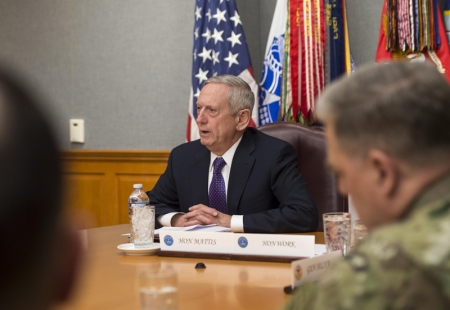
Secretary of Defense James Mattis. (Dept. of Defense/Brigitte N. Brantley)

So far, the United States coalition has driven ISIS from 55,000 square kilometers of territory in Iraq and Syria.

A New Coalition

Apart from a strategy to counter ISIS, the Trump administration also called on our allies in the Middle East to put together a new joint multi-state effort to stop financing terrorism. Leading the multi-state effort will be the Kingdom of Saudi Arabia and the United States, which together will supposedly open a new center dedicated to the elimination of terrorist financing. Positive results are not guaranteed, but it is a step in the right direction.

According to Abdul Hadi Habtoor, the center will exchange information about financing networks, adopt means to cut off funding from terrorist groups, and hopefully blacklist Iran’s jihadist army, the Islamic Revolutionary Guard Corps (IRGC). These measures in turn will help eliminate the sanctuaries from which terrorists plot and plan.

This move also places emphasis on the responsibility of states to eliminate terrorism. As President Trump said, each country — where it is sovereign — has to “carry the weight of their own self-defense“, be “pro-active” and responsible for “eradicating terrorism”, and “to deny all territory to the foot soldiers of evil”.

This determination was underscored by many Arab countries breaking diplomatic relations with Qatar for its support of Iran, the Muslim Brotherhood and ISIS. Most of Qatar’s Arab neighbors, including the Saudis, Egypt, and the UAE did so, while the US, although denouncing Qatar’s support of terrorism, continues to maintain access to, and use of, its critical military base there.

In short, the U.S. is playing good-cop, bad-cop in the region, while U.S. allies are putting together what Josh Rogin of the Washington Post described as “a regional security architecture encompassing countries on the periphery of Iran.”

Such an approach is not without risk: Turkey, allied with Iran and Qatar, has already has pledged to help Qatar defy the Gulf States’ trade cut-off. If Turkey, for example, seeks to move its promised aid shipments to Qatar through the Suez Canal, the ships could possibly be blocked by Egypt or attacked on the high seas. Does the U.S. then come to the assistance of a NATO member — Turkey — against an ally in the strategic coalition?

Drive Hateful Ideology Out

A companion challenge by the new American President underscored this new security effort. President Trump said to the assembled nations of the Islamic conference that they have to expel the ugly Islamist ideology from the mosques and madrassas that recruit terrorists and justify their actions.

Trump said: “Drive them out of your places of worship”. Such words had never been spoken so clearly by an American president, especially to the collection of nearly all the Islamic-majority countries (minus the Shi’ite bloc) gathered together.

The president’s audience doubtless understood that he was speaking of the doctrine of sharia (Islamic law). The new “test” of our alliance will be whether the assembled nations will join in removing the hateful parts of the doctrine from their communities. It was a sharp but critical departure from the previous American administration’s message in Cairo in 2009, and placed the Islamic doctrine that seeks to establish the sharia throughout the world in a contained context.

New Israeli Partnership

With Israel, the administration has cemented the next part of its strategy. Here the Trump administration successfully improved our political and military relations with Israel. Markedly so. One part of that effort was enhanced missile-defense cooperation called for in the FY18 United States defense budget, specifically to deal with Iranian and Iranian-allied missile threats.

On relations with the Palestinian Authority, the administration has moved to improve matters but has not moved to advocate a two-state solution — for which there is no contemplated security framework sufficient to protect Israel.

Challenge and Roll Back Iran

The final part of the administration’s strategy starts with a thorough review of our Iran strategy and the Joint Comprehensive Plan of Action (JCPOA), or “nuclear deal”, with Iran. As Max Singer recently wrote, even if we discount what secretive nuclear capability Iran may now have, the Iranian regime will at the very least be much closer to producing nuclear weapons down the road than when the JCPOA was agreed to.

As Ambassador John Bolton has warned the nuclear deal with Iran did nothing to restrain Iranian harmful behavior: “Defiant missile launches… support for the genocidal Assad regime… backing of then Houthi insurgency in Yemen… worldwide support for terrorism… and commitment to the annihilation of Israel” continue.

In addition, uranium enrichment, heavy water production, the concealed military dimensions of warhead development and joint missile and nuclear work with North Korea all lend a critical urgency to countering Iran’s lethal efforts. The United States did not make these counter-efforts any easier by providing to Tehran $100 billion in escrowed Iranian funds, equivalent to nearly one quarter of the Islamic Republic’s annual GDP.

The United States’ and Europe’s easing of sanctions on Iran has helped reintegrate Iran into global markets via mechanisms such as the electronic payment system run by the Society for Worldwide Interbank Financial Telecommunications (SWIFT). That, in turn, has helped Iran expand dramatically its military modernization budget by 33%, including deals worth tens of billions of dollars in military hardware with China and Russia.

Added to that is Iranian financial- and weapons-support for foreign fighters in Syria, Iraq, Yemen, Lebanon and Afghanistan. Iran’s significant support to the Houthi rebels in Yemen includes weaponry, financing and logistical support, including advanced offensive missiles. The Houthis regularly attempt to carry out missile attacks against Saudi oil facilities.

Such Iran activity is described by the Commander of U.S. Central Command, General Joseph Votel, as “the most significant threat to the Central Region and to our national interests and the interest of our partners and allies”.

As such, it can only be challenged through exactly the kind of military, political, and economic coalition the Trump administration is seeking to band together, which would include the Gulf Arab nations, especially Saudi Arabia, as well as Egypt, Jordan, and Israel.

The administration’s five-step strategy has a chance to work. It creates a policy to destroy ISIS; oppose Islamic terrorism and specifically the imposition of sharia; adopt measures to go after the financing of such terrorism; implement improvements in Gulf allies’ military capabilities — including missile defenses — parallel with pushing NATO members to meet their military spending obligations; put back into place a sound and cooperative relationship with Israel; and specifically contain and roll back Iranian hegemonic ambitions and its terror-master ways.

What still has to be considered, however, is the U.S. approach to stopping Iran from filling the vacuum created by ridding the region of ISIS, as well as Iran’s push for extending its path straight through to the Mediterranean.

If successful, some modicum of peace may be brought to the Middle East. And the arc of history will have finally been shaped toward America’s interests and those of its allies, rather than — however inadvertently — toward its mortal enemies.

Dr. Peter Huessy is President of GeoStrategic Analysis, a defense consulting firm he founded in 1981, and was the senior defense consultant at the National Defense University Foundation for more than 20 years.
Assad and Putin are testing the US in Syria. Trump is answering.

June 19, 2017

Assad and Putin are testing the US in Syria. Trump is answering., Washington ExaminerTom Rogan, June 19, 2017

(Please see also, Missile strike on ISIS turning Iran into a world power. — DM)

The United States remains the world’s sole superpower. Realistic in our appraisal of national interests and prudent in their pursuit, our adversaries must never doubt our resolve.

****************************

On Sunday, an F-18 fighter jet (almost certainly from the Mediterranean-deployed USS George H.W. Bush carrier strike group), downed a Syrian Air Force Su-22 fighter jet.

It was the right decision for both tactical and strategic reasons.

For a start, the Syrian jet was bombing United States allies (the Kurdish-dominated Syrian Democratic Forces) on the ground. It was warned, but did not retreat.

Yet it’s not just relevant who the Syrians were bombing, it’s also important where they were doing so. Because the Su-22 was striking targets in north-central Syria, proximate to the Islamic State capital, Raqqa, and a town and dam, Taqba.

That locale matters for two reasons.

First, because the Syrian axis (Bashar Assad, Russia, Iran, the Lebanese Hezbollah, and other associated Shiite militias) are determined to displace U.S./allied forces from that area. The Assad axis recognizes that if it secures Taqba, it can push east of the Euphrates river and degrade anti-regime forces operating there with U.S. protection. As I’ve explained, this area of northern Syria is crucial for the future of the Syrian civil war.

Second, had the U.S. allowed axis forces to displace Kurdish forces from the area, the axis would have been able to disrupt the operation to retake Raqqa from the Islamic State. While the axis argue that they support the U.S.-led effort to defeat the Islamic State, the reality is different.

After all, the axis have vested interests in allowing the Islamic State to survive in some form. While the Islamic State is indeed their enemy, its existence allows the axis to pretend that the choice in Syria is between Assad, and the Islamic State and al Qaeda. Russia, especially, uses this narrative to delegitimate and attack more-moderate U.S.-supported Syrian rebel groups. Ever notice that the Russians always claim they are bombing “terrorists” in Syria? The Islamic State gives them that excuse.

Absent the threat of the Islamic State, the axis powers know that the world would view the Syrian regime much more harshly. Absent international jihadist groups in Syria, the regime would no longer be able to claim “we’re the best of a bad bunch.”

Still, there’s a broader issue at stake here.

This latest axis push against U.S. interests is just the tip of the iceberg. As I noted recently, the axis is also threatening a major U.S. base in south-eastern Syria. Collectively, these efforts are designed to test the Trump administration’s commitment to U.S. interests in Syria. Put simply, by escalating their threat against the U.S., and by dangling the prospect of future U.S. casualties, the Assad axis wishes for the Trump administration to back away from its resistance to Assad’s regime. They believe that, as was the case with President Barack Obama’s red lines, the U.S. can ultimately be compelled to yield.

For that reason, the U.S. response on Sunday was the right one.

A two-person U.S. aircrew in an advanced multirole fighter met a Soviet-era aircraft and outmatched it.

The United States remains the world’s sole superpower. Realistic in our appraisal of national interests and prudent in their pursuit, our adversaries must never doubt our resolve.

Bi-Partisan Support for Bill to ‘Hold Iran Accountable’

June 16, 2017

Bi-Partisan Support for Bill to ‘Hold Iran Accountable’, Iran News Update, June 16, 2017

“It’s worth noting that the JCPOA is not unlike the Paris climate accord.

“I don’t think many people in our country or many people in this body realize that it is a non-binding political agreement that was entered into by one man using presidential executive authority and can easily be undone by one man using presidential executive authority.

“In fact, in many ways, it is easier than the Paris accord considering the president doesn’t have to take an action to exit this agreement.

All he has to do is decline to waive sanctions. I think that has been missed.

****************************

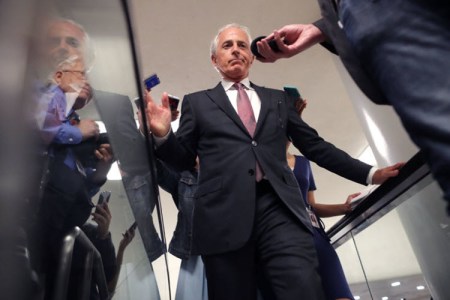
Chairman of the Senate Foreign Relations Committee, Senator Bob Corker (R-Tenn.), spoke before the Senate on Wednesday, in a bill he authored, the Countering Iran’s Destabilizing Activities Act of 2017. The legislation, has 60 bipartisan cosponsors, and is expected to pass the Senate this week. It will expand sanctions against Iranian for ballistic missile development, support for terrorism, transfer of conventional weapons to or from Iran, and human rights violations.

Senator Corker’s speech is reproduced as follows:

“Mr. President,

I rise today to speak about the Countering Iran’s Destabilizing Activities Act of 2017, which passed the Senate Foreign Relations Committee last month by a vote of 18 to 3.

“I’d like to thank the members of our committee and the co-authors of this bill for working in a constructive, bipartisan fashion to craft this legislation.

“I think it is a good example of how the Senate can still work together to tackle complex and difficult issues.

“I was in the SCIF recently – a place where senators go to read classified information – reviewing intelligence, and it truly is astounding what Iran continues to do around the world.

“For a people that are capable of so much, their foreign policy is shockingly counter to their own interest.

“We see destabilizing act after destabilizing act – from missile launches, to arms transfers, to terrorist training, to illicit financial activities, to targeting Navy ships and detaining American citizens – the list goes on and on.

“And it’s past time for us to take steps to protect the interests of the United States and our allies.

“This bill is the first time Congress has come together since the JCPOA – the Iran nuclear deal – to do just that.

“For far too long, the agreement – which I strongly opposed, as did our ranking member and presiding officer – has dictated U.S. policy throughout the Middle East.

“It’s worth noting that the JCPOA is not unlike the Paris climate accord.

“I don’t think many people in our country or many people in this body realize that it is a non-binding political agreement that was entered into by one man using presidential executive authority and can easily be undone by one man using presidential executive authority.

“In fact, in many ways, it is easier than the Paris accord considering the president doesn’t have to take an action to exit this agreement.

“I don’t think most Americans understand that. He doesn’t have to take action to exit the agreement. All he has to do is decline to waive sanctions. I think that has been missed.

“But no matter what the president decides, this bill makes it clear that the Congress intends to remain involved and will hold Iran accountable for their non-nuclear destabilizing activities.

“What the nuclear agreement failed to do was allow us to push back against terrorism, human rights issues, violations of U.N. security council resolutions relative to ballistic missile testing, and to push back against conventional arms purchases, which they are not supposed to be involved in.

“As many of us predicted at the time, Iran’s rogue behavior has only escalated since implementation of the agreement, and this bipartisan bill will give the administration tools for holding Tehran accountable.

“Let me say this. I don’t think there’s anybody in this chamber who doesn’t believe that the Trump administration – I know there’s been a lot of disagreements recently about foreign policy issues in the administration – but I don’t there’s anybody here that believes they are not going to do everything they can to push back against these destabilizing activities.

“And what we’ll be doing today and tomorrow with passage of this legislation is standing hand-in-hand with them as they do that.

“It also sends an important signal that the U.S. will no longer look the other way in the face of continued Iranian aggression.

“I want to recognize the important work of my colleagues in making this legislation possible.

“Senator Menendez has been a champion for holding Iran accountable, in this bill but also in decades of work on this issue. He truly is an asset to the Senate, and I thank him for his commitment to many issues, but especially this one.

“Senators Cotton, Rubio, and Cruz all played an important role in drafting this legislation as well.

“But finally, let me say this. This would not have been possible without the support and tireless effort of the ranking member, Senator Cardin, and his great staff. It has truly been a pleasure for me to work with him on the Russia bill that we will be voting on today at 2:00 p.m. but also on this legislation.

“We come from two very different places, representing two very different states, and yet are joined by the fact that we care deeply about making sure that the foreign policy of this country is in the national interest of our citizens and that we as a Congress and as a United States Senate are doing everything we can to drive positive foreign policy.

“I want to thank him for that and tell him I am really proud of the strong bipartisan momentum behind this legislation, which his leadership has helped make happen, and I look forward to passage of this bill.”

Iran’s Foreign Legion in Syria

June 12, 2017

Iran’s Foreign Legion in Syria, Front Page MagazineJoseph Puder, June 12, 2017

(Please see also, Syrian-Hizballah massacre in Daraa: 140 dead. — DM)

The Iranian strategy, it appears, is to consolidate is forces in southwestern Syria facing the Druze area of Dar’aa, and gradually move their commanded forces toward the Israeli border in the Golan.  Iran has sought for a long time now to establish its proxies, including Hezbollah units in the Golan facing Israel.  Israel however, was able to dislodge these Iranian efforts.  Nevertheless, the Iranian cooperation with Russia in Syria, and the lucrative arms deals between them, may persuade Russia to consider the Iranian efforts.

Iran is the leading state-sponsor of international terrorism, and the IS attack has given Tehran a taste of its own deadly medicine.  The oppression of Sunnis in Shiite Iran is likely to drive Sunni Baluch and Ahwazi Arabs into doing the IS’s bidding, translated into acts of terror in the heart of Tehran.  It demonstrates a hard truth – that Sunni jihadists can assemble a foreign legion, just as the Iranian jihadists have done in Syria.

******************************

Arab News reported (6/7/2017) that “Suicide bombers and gunmen attacked the parliament building and the Mausoleum of Ayatollah Khomeini in the Iranian capital.  Islamic State (IS) claimed responsibility and released a video purporting to show gunmen inside the parliament.”  The twin attacks on Wednesday killed 12 Iranians, and embarrassed the radical Islamist regime by showing its vulnerability at home.  IS terrorists hit the most potent symbols of Iran’s Islamic Republic on Wednesday.  It has brought into sharp focus the high cost of Tehran’s involvement in Syria, which according to the powerful Islamic Revolutionary Guards Corps (IRGC) leadership, was meant to ward off terrorist attacks at the home front.  With an economy that has barely recovered from sanctions imposed on it by the international community, the Iranian regime of Ayatollah Ali Khamenei can hardly justify the huge cost to the treasury of exporting its revolution and backing Assad in Syria with Iranian cash, if not in blood.

Given the Sunni-Shiite conflict engulfing the Middle East, it was inevitable that IS will ultimately strike at Iran – the patrons of Shiite-Islam.  The antecedents of IS in Iraq proved that the Sunnis who ruled in Iraq albeit, as a minority with a Shiite majority, won’t easily allow Shiites to disenfranchise them.  In Syria however, the Sunnis are the majority, and have been ruled for almost 50 years by the Alawite (Shiite) clan of the Assads.  It was never a question of whether or if IS will strike at Iran but rather when.  The array of Shiite militias fighting IS, and non-Islamist Sunni militias, under the command of Maj. General Qasem Soleimani, the head of the Quds Division of the IRGC, is clear enough reason why Iran is, and will continue to be a target.

To expand its influence throughout the Middle East region, and extend the Shiite Crescent, the Ayatollahs’ regime in Tehran has devoted huge resources to protect its turf in Syria, and maintain it as a bridge to Lebanon and the Mediterranean Sea.  In essence, it means the preservation of the Bashar Assad, Alawi-led (Alawites are an offshoot of Shiite Islam) regime.  The Syrian dictator who has now earned the moniker “the butcher of Damascus” can count on the Iranian ‘Foreign Legion’ made up of Shiite fighters from Lebanon (Hezbollah), Iraq, Afghanistan, Pakistan, and Yemen. They provide the manpower that serves the Iranian agenda in Syria.  Besides Hezbollah, there is the Afghan “Fatimiyoun and Khadem  el-‘Aqila Brigades; the Pakistani Zainebiyoun Brigade; Yemeni Houtis “Liwa Al-Saada Brigade, the Iraqi Shiite militia Al-Nujaba Movement.  The Iraqi Shiite contingent is the largest force engaged in the defense of the Assad regime.  It is estimated to number around 40,000 fighters.

According to the Qatari based outlet, Al-Jazeera (1/22/2016), “Some 20,000 Afghan Shia fighters alone are said to be fighting alongside Iran to help save the government of the Syrian President Assad.”  Iran, the publication pointed out, recruited tens of thousands of Afghan Shiite fighters, offering them salaries to join the fight to save President Bashar Assad.  The Afghan Shiites are refugees from the ongoing war in Afghanistan between the government of Ashraf Ghani and the Taliban.  They escaped to Iran due to economic and political hardship, and sought asylum there.  Given the inability of young Afghanis to find work in Iran, they are easily manipulated into being cannon-fodder for the Iranians.  Unlike an Iranian fighter, an Afghan illegal migrant killed in action would not be a burden on the Iranian treasury.  Moreover, its foreign mercenaries provide Iran with deniability with regards to their intervention in Syria.

Captured Afghan Shiite fighters revealed that they are attracted to Syria by the promise of a financial reward.  The Iranian regime paid recruits supposedly between $500 and $1,000 a month.  Some Afghans claimed that they joined the fighting brigades as a way to escape prison sentences or even the death penalty for drug trafficking, one of the few outlets for Afghan refugees in Iran. Anas al-Abdah, the secretary of the opposition Syrian Coalition committee told Al-Jazeera that “Iran considers itself the one and only reference point for all Shia people in the whole world.  It organizes them into political, social and military organizations, both in their local communities and abroad…This is part of the main mission of the Iranian regime in terms of exporting the revolution.  Iran recruits, motivates, organizes, finances, and trains Shias from all over the world to help support Bashar al-Assad’s regime from collapsing.”

In Israel, there is particular attention being paid to the Al Nujaba group.  Israeli Col. (retired) Dr. Jacques Neriah, suggested that at “The end of February, 2017, the leader of Al-Nujaba’, Akram el-Q’aabi, declared in an unprecedented announcement that his forces were to fight together with the Syrian army to ‘liberate’ the Golan.  El-Q’aabi justified his position by stating that the terrorism of ISIS is but a part of a grand plan designed by the Zionists, supervised by the Americans with Turkish-Gulf implementation. Therefore, it was time to decapitate the head of the Zionist snake.”  Neriah added, “The Brigade announced in March, 2017 the creation of “The Liberation of the Golan Brigade” (Liwa’ Tahrir el-Jolan). The Brigade whose members have fought in Lebanon, Syria, and Iraq will have one mission: to assist the Syrian army in liberating its “stolen lands.” According to the spokesman of the Al-Nujaba, ‘The creation of this Brigade was but a step toward liberating the holy places in occupied Palestine.”

The Iranian strategy, it appears, is to consolidate is forces in southwestern Syria facing the Druze area of Dar’aa, and gradually move their commanded forces toward the Israeli border in the Golan.  Iran has sought for a long time now to establish its proxies, including Hezbollah units in the Golan facing Israel.  Israel however, was able to dislodge these Iranian efforts.  Nevertheless, the Iranian cooperation with Russia in Syria, and the lucrative arms deals between them, may persuade Russia to consider the Iranian efforts.

As a result of the IS twin attacks in Tehran, the Golan front is a secondary priority for now. The IRGC, whose position in Iran has strengthened, despite the overwhelming reelection victory of the more “moderate” President Hassan Rouhani in the recent elections, will now increase its operations in Syria and Iraq, and more Iranian resources will be spent there.  Iranian President Rouhani will now find it more difficult to reduce spending on foreign arenas such as Syria, as he has promised to do in his election campaign.

Iran is the leading state-sponsor of international terrorism, and the IS attack has given Tehran a taste of its own deadly medicine.  The oppression of Sunnis in Shiite Iran is likely to drive Sunni Baluch and Ahwazi Arabs into doing the IS’s bidding, translated into acts of terror in the heart of Tehran.  It demonstrates a hard truth – that Sunni jihadists can assemble a foreign legion, just as the Iranian jihadists have done in Syria.

Hezbollah Terrorists Caught in US Planning Attack

June 11, 2017

Hezbollah Terrorists Caught in US Planning Attack, ClarionProjectRyan Mauro, June 11, 2017

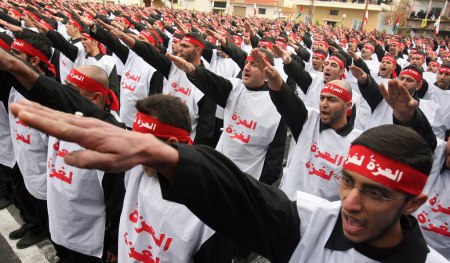
New Hezbollah recruits in Lebanon salute during a ceremony (Photo: AFP/Getty Images)

The pace of jihadist activity has been so intense lately that an incredibly important story has been barely reported on:

Two terrorists belonging to Hezbollah, a puppet of the Iranian and Syrian regimes, have been arrested for planning attacks in the U.S., with one scouting potential targets in New York including JFK International Airport.

Both are citizens who entered, exited and re-entered the U.S.

Although the Iranian and Syrian regimes regularly organize terrorist attacks through its Hezbollah proxy, the plotting of attacks on U.S. soil and on Americans overseas is very significant, but not unprecedented.

The two arrested terrorists are Ali Kourani of the Bronx, New York and Samer El-Debek of Dearborn, Michigan. Each is a well-trained militant who belongs to Hezbollah’s Islamic Jihad branch that is tasked with perpetrating terrorist attacks, preferably with some level of deniability.

Yet, under questioning, Ali Kourani explicitly told the FBI in 2016 and 2017 that he was a “sleeper” agent of Hezbollah’s Islamic Jihad carrying out “black ops” for Hezbollah and “the Iranians.”

His first round of training took place in Lebanon in 2000 when he was only 16-years old. Kourani admitted to the FBI that he was accepted by Hezbollah because his family is connected to a top official in the terrorist group. He said one of his brothers is the “face of Hezbollah” in Yater, Lebanon and boasted that his family’s name is like the “Bin Laden’s of Lebanon.” In other words, his family is famous for being terrorists.

Shockingly, in 2003 (two years after the 9/11 attacks), this member of a famous terrorist family successfully entered the U.S. and became a student. He also went by the names of “Jacob Lewis” and “Daniel.”

In 2008, he then joined Hezbollah’s Islamic Jihad branch. Shortly thereafter, he applied for naturalization and became a citizen in April 2009, all the while lying about his connections to terrorism. If his boasts are true, a simple look of his family would have tipped off the U.S. government about who Kourani was.

Kourani predictably lied throughout his process to become a U.S. citizen, including denying any plans to travel overseas when he applied to become a citizen. Only a month after becoming a citizen, he went to Guangzhou, China, on a so-called “business trip” to the location of a medical company that produces chemicals that can be used in bombs. Stolen chemicals from the company were later found in the possession of Iranian terrorists in Thailand planning bombings.

In 2011, Kourani went to Lebanon for a second round of terrorism training in RPG and various firearms. He then came back into the U.S. to use the skills he acquired.

On the orders of his Hezbollah handler, he began identifying and surveilling targets.

According to the criminal complaint, his handler directed him to “surveil and collect information regarding airports, including the layout of terminals, the locations of cameras and personnel, and other security features. In response, Kourani provided detailed information to [his handler] regarding specific security protocols, baggage-screening and collection practices and the locations of surveillance cameras, security personnel, law enforcement officers and magnetometers at JFK and an international airport in another country.”

Some historical context is important here: This is a revival of Iran’s ambitions to target New York’s JFK International Airport. Iran already tried to carry out an attack at the airport once and was preparing to do so again.

The previous plan (in 2007) was to blow up fuel tanks and pipelines going to the airport. The FBI confirms that one of the individuals involved in this plot had links to “militant groups” in Iran and Venezuela and had regularly contact with Iranian authorities.

There were various other Iranian links, including the involvement of an operative who was previously part of an Iran-sponsored bombing in Argentina in 1994.

Kourani also used Google Maps to research LaGuardia Airport in Queens, New York (specifically its terminals) in April 2011. He also looked up the U.S. Armed Forces Career Center in Queens in February 2013.

Kourani conducted surveillance on a governmental building in Manhattan with FBI offices inside; an Army National Guard office in Manhattan; an Army Armory building in Manhattan and a Secret Service office in Brooklyn.

He looked for people tied to the Israeli military. He was also tasked with making contacts who could provide firearms to Hezbollah operatives in the U.S.

In addition, Hezbollah wanted Kourani to do something in Mexico and Canada. His handler talked about possibly having him fly to one of these countries and cross into the U.S. by land using his passport. Hezbollah has ties to Latin American drug cartels, which may have something to do with the talk of a trip to Mexico.

The surveillance of targets in preparation for expected Hezbollah attacks continued until at least September 2015, as per the complaint.

Like Kourani, Samer El-Debek is a naturalized citizen who belonged to Hezbollah’s Islamic Jihad branch. He communicated via email with someone who owned a business in Iran.

El-Debek acted as an agent of the terrorist group from 2007 to September 2016, with his salary growing to over $1,000 per month plus medical expenses. He is a specialist in bomb-making and began confessing to the FBI after Hezbollah accused him of being an American spy and detained him for four months until he falsely admitted to being one.

El-Debek was first trained in 2008 and received four rounds of training total. One round included six days of religious teaching, where a sheikh taught about Islam’s rules and “martyrdom ideology.” His explosives training focused on remotely-detonated bombs.

El-Debek was specifically taught how to make IEDs like the one Hezbollah used on a bus of Israeli tourists in Bulgaria in 2012 that killed 6 people and injured 32. He told the FBI that the bomber was his aunt’s nephew.

In 2009, he was sent to Thailand to dispose of bomb ingredients from a Hezbollah safehouse that they believed to have come under surveillance. His cover was that he was traveling to Thailand for paid sex, going so far as to hire a prostitute and to have her enter the safehouse so he could try to discover any surveillance taking place.

In 2011, El-Debek flew to Colombia and entered Panama on a Hezbollah mission to identify gaps in security at the Panama Canal and the Israeli embassy. He returned to Panama in 2012 to identify weaknesses in the Panama Canal’s construction and security gaps and find out how close someone could get to a ship passing through.

He was told to conduct surveillance of the U.S. embassy but did not, fearing it would compromise his mission.

Hezbollah detained El-Debek in December 2015 until April 2016, accusing him of being a U.S. spy and demanding a confession. He eventually did so. Based on the complaint, it appears the detention caused him to open up to the FBI during voluntary questioning (assuming his story is true).

This is only a tiny portion of what Iran and Hezbollah is doing to try to attack targets in the U.S. at home and abroad. This is the experience of only two Hezbollah terrorists we caught.

If this is the scale of what we do know, then what horrors are being planned that we don’t know about?

How an Iranian general duped US command in Syria

June 10, 2017

How an Iranian general duped US command in Syria, DEBKAfile, June 10, 2017

Our sources cannot confirm for certain what part the Russians played in Iran’s underhand maneuver. Were they in on it, or were they hoodwinked by Soleimani like the Americans? However, the bottom line of this incident is that Syria’s neighbors, Israel and Jordan, face a new and distinctly troublesome downturn in the strategic situation on their borders. The next arena of potential US-Iranian confrontation is building up in Syria’s oil-rich Deir ez-Zor region.

********************************

The Iranian-made Syrian drone downed by US F-15 fighters in southeastern Syria on June 8 was presented by American media as a “pro-regime” drone. It was in fact, as DEBKAfile’s military sources can disclose, an Iranian Revolutionary Guards Shahed-129, which was fired as a part of a complicated ruse to dupe the US commanders while pro-Iranian forces surreptiously moved in on the Syrian-Iraqi border.

The Americans had drawn a line in the Syrian Desert sand 55 km outside the Al-Tanf border crossing embedded in the Syrian-Jordanian-Iraqi border triangle, which is under the control of US, Western and Jordanian special forces, together with a US-trained Syrian rebel group. The Secretary of Defense James Mattis and the US military command in Syria and Iraq were confident that by securing this perimeter, their forces would keep the pro-Iranian advance at bay and the border safe.

When the hostile drone flew past this line, it was shot down. But the Americans were reluctant to let the incident escalate into a major clash, while the Iranians were smarting under the Islamic State attack on Tehran’s national sites. And so they played it down. The next day, therefore, Pentagon spokesman Navy Capt. Jeff Davis reported that “hostilities between the coalition and the pro-regime forces had been avoided thanks to Russian influence. He went on to say: “The calm we see today is largely due to their efforts.”

What brought the Russians onstage?

The sequence of events which unfolded over 48 hours in the Syrian Desert is revealed her by our military sources. The drone was fired as a deliberate provocation to cross the 55-km line enclosing the US-controlled border garrison, on the orders of the Iran’s Gen. Qassem Soleimani. It was intended as a diversion from the real action.

The Russians entered the picture at this stage with an attempt to cool the situation and restore calm. While they were busy assuring the Americans that the Syrian army, Hizballah and its other pro-Iranian allies would refrain from crossing the 55-km line, Qassem moved a large-scale force up to a point just a few hundred meters from the American line.

By Friday, June 9, as Russian de-escalation diplomacy with the Americans wound down, Soleimani’s forces were found to have quietly reached new positions on both sides of the border.

1. He had moved those forces to a point 56km north of Al-Tanf to a rendezvous with pro-Iranian Shiite militias which had come from southern Iraq. That rendezvous breached the Iraqi-Syrian border and attained Iran’s strategic goal of opening up a land bridge between Iraq and Syria.

2. A second pro-Iranian force captured and cut off the roads from northern Syria to the southeastern town of Deir ez-Zor, thereby segregating US and pro-American forces in the north from the American garrison in the south.

Our sources cannot confirm for certain what part the Russians played in Iran’s underhand maneuver. Were they in on it, or were they hoodwinked by Soleimani like the Americans? However, the bottom line of this incident is that Syria’s neighbors, Israel and Jordan, face a new and distinctly troublesome downturn in the strategic situation on their borders. The next arena of potential US-Iranian confrontation is building up in Syria’s oil-rich Deir ez-Zor region.

One missile takes out ISIS command on Golan edge

June 8, 2017

One missile takes out ISIS command on Golan edge, DEBKAfile, June 8, 2017

DEBKAfile’s military sources report concerns in the US military commend lest Iranian general Qassem Soleimani decides to drop a division of Iranian special forces by helicopter, in order to catch the garrison off guard and capture the border crossing.

This concern increased after the Islamic State conducted a surprise bombing-cum-shooting attack on prize Iranian regime targets in Tehran on June 7. The Revolutionary Guards are bent on revenge and looking for an outstanding military success to cover this humiliation.

The US commanders are also under pressure on another score: the Iranians and Syrians have sent secret messages to Moscow complaining bitterly about the US air strike. They both made it clear that they command sufficient air and artillery fire power to overwhelm and wipe the ground with the American force in Syria.  Both Damascus and Tehran appear to be spoiling for a major showdown between their armies, using Hizballah and other Shiite proxies, and the US-led contingent.

***********************

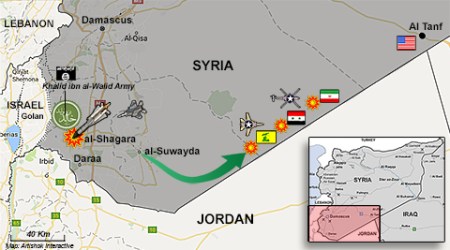
A single mystery missile, which could have been fired from the ground or the air early Wednesday morning, June 7, wiped out the entire top Islamic State command on the Syrian Golan, DEBKAfile’s military and intelligence sources report. All 16 officers of the 2,000-strong Khaled Ibn al Waleed army, the ISIS operations arm on the Syrian Golan, were present in the targeted building in the town of al-Shagara, located in the triangle where the Israeli, Syrian and Jordanian borders meet opposite the Sea of Galilee in northern Israel.

The unidentified missile blew up in the middle of a hall where the top command echelon were gathered to break their daily fast during the month of Ramadan and draw up plans. None of them survived.

Among them were the group’s chief, Gen. Abu Mohammed al-Makdessi; commander of operations, Gen. Abu Udai al-Homsi; and the group’s explosives expert who doubled as its religious leader, Abu Ali Shabat.

They operated under these aliases to conceal their real identities as former high Iraqi army officers who served in the late Saddam Hussein’s armed forces. They were also in senior command positions at the ISIS Syrian command center in Raqqa, when ISIS leader Abu Bakr al-Baghdadi decided to transfer them to the Syrian Golan to spearhead attacks that were planned to take place inside Israel and Jordan.

It took Al-Baghdad just a few hours to replace Magdessi as Khaled Ibn al-Waleed chief with a new man, Mohamed al-Refaei-Abu Hshem al-Askari.

On Tuesday, June 6, the day before the mysterious missile decapitated the Islamic State’s Golan force, US warplanes acted on another front to bomb a convoy of Iranian, Syrian and Hizballah forces that were traveling eastward from the southern town of Derra in the direction of the Al-Tanf border crossing.

Al Tanf, where US and Jordanian special forces units have established a garrison, is located in the triangle where the Syrian, Jordanian and Iraqi borders converge. The US planes destroyed several tanks, troop carriers, artillery pieces and antiaircraft systems, causing also fatalities and injuries, and so halted the convoy’s advance on the strategic crossing.

This was the second US air strike in three weeks on a similar target. The first was on May 18.

DEBKAfile’s military sources report concerns in the US military commend lest Iranian general Qassem Soleimani decides to drop a division of Iranian special forces by helicopter, in order to catch the garrison off guard and capture the border crossing.

This concern increased after the Islamic State conducted a surprise bombing-cum-shooting attack on prize Iranian regime targets in Tehran on June 7. The Revolutionary Guards are bent on revenge and looking for an outstanding military success to cover this humiliation.

The US commanders are also under pressure on another score: the Iranians and Syrians have sent secret messages to Moscow complaining bitterly about the US air strike. They both made it clear that they command sufficient air and artillery fire power to overwhelm and wipe the ground with the American force in Syria.  Both Damascus and Tehran appear to be spoiling for a major showdown between their armies, using Hizballah and other Shiite proxies, and the US-led contingent.

New US base in S. Syria for tussle over control

June 6, 2017

New US base in S. Syria for tussle over control, DEBKAfile, June 6, 2017

The ingathering of major military forces in this part of Syria is ominous: The deployment of a US forward base in the Syrian Desert, and the arrival of the most senior Iranian and Syrian commanders at the head of elite units augur the approach of a major showdown for control of southeastern Syria and its strategic multiple border assets.

***********************

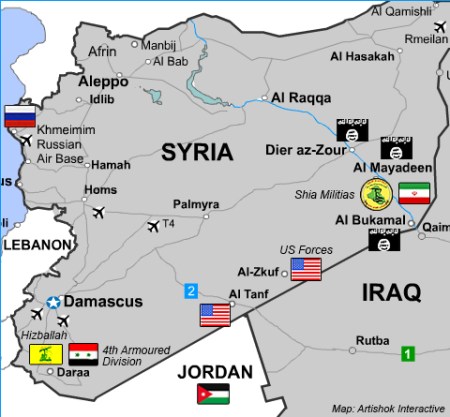
In readiness for a prospective showdown for control of southeast Syria, US Special Forces have set up a forward base at Al-Zukf in the Syrian Desert, DEBKAfile’s military and intelligence sources report. The location is 70km northwest of the Syrian-Iraqi-Jordanian border triangle and the Al Tanf crossing, which is controlled by US, Western allied and Jordanian special forces, together with a US-trained Syrian rebel unit, which calls itself the Revolutionary Commando.

(See the map at the top of this article.)

American sources say the Al Zukf base was set up for two objectives: One is to block the path of the Syrian army-Hizballah armored column, which has been advancing for the past fortnight from Al-Suweida in southeastern Syria toward the Al-Tanf crossing.

The other US objective is to capture the key town of Abu Kamal, a distance of 200km northwest of Al-Tanf, from Islamic State control.

However, the overriding goal of the US advance base is to thwart the Syrian, Hizballah and other pro-Iranian forces from gaining control of 300km of the Syrian-Iraqi border and so being able to open up Tehran’s coveted direct land bridge to the Mediterranean through Iraq.

The US force is not alone in its bid for control of this strategic area. It is getting pretty crowded.

The Syria Army’s 4th armored division rolled this week into the southern Syrian town of Daraa close to the Jordanian border and around 330km west of the new Al-Zukf base. The division moved in with high-grade Russian-made T-90 tanks complete with its high command, headed by Bashar Assad’s younger brother, Gen. Maher al-Assad. The general and staff officers were sighted carrying out inspections of Daraa’s terrain in advance of the resumption of hostilities. Parts of this potential battlefield are no more than 1,000 meters from the Jordanian border.

Our intelligence sources also reported that, this week, further north, al-Qods chief, Gen. Qassem Soleimani, commander of Iran’s Syrian and Iraqi fronts, crossed into Syria from Iraq along with his operations staff. They joined the Palmyra-based command and control of the Syrian force, which is heading out of the town in two columns for two towns – Deir ez-Zor, which is surrounded by Islamic State forces, and Abu Kamal, which is under ISIS control. Elements of Russian elite forces and Hizballah are fighting along with the Syrian troops.

The ingathering of major military forces in this part of Syria is ominous: The deployment of a US forward base in the Syrian Desert, and the arrival of the most senior Iranian and Syrian commanders at the head of elite units augur the approach of a major showdown for control of southeastern Syria and its strategic multiple border assets.

Palestinian Islamic Jihad, Iran’s ‘Preferred Proxy,’ Arming in Gaza

June 5, 2017

Palestinian Islamic Jihad, Iran’s ‘Preferred Proxy,’ Arming in Gaza, Investigative Project on Terrorism, Yaakov Lappin, June 5, 2017

Iran provides PIJ with both “military and financial support,” ITIC noted in its report.

“PIJ is the preferred organization for Iran, due to the problematic nature of the relationship between Iran and Hamas,” ITIC Director Col. (ret.) Reuven Erlich, told the Investigative Project on Terrorism.

Although Iran continues to fund Hamas’s military wing, relations between Shi’ite Tehran and the Sunni Islamist rulers of Gaza have been unstable since 2012, when the two found themselves on opposite sides of the sectarian war raging in Syria.

PIJ has around 5,000 members in its armed wing, the Quds Brigades. The organization has its own Gazan rocket production industry, and PIJ possesses the second largest arsenal of projectiles in Gaza, thanks to Iranian manufacturing knowledge. The organization has been working on improvements to its rocket launch systems. It also digs combat tunnels.

***************************************

Palestinian Islamic Jihad (PIJ), the second largest terrorist army in Gaza, recently issued a video threat about its willingness to end the three-year truce in place with Israel.

“If the Israeli enemy continues its normal game and plays with the lives of the Palestinian people, we will break the cease-fire,” PIJ leader Ramadan Shallah says in the video, according to an Algemeiner report.

The footage is laced with images of gunmen in camouflage, rising out of the ground, moving through tunnels, and watching areas of southern Israel near the Gaza border. It is interspersed with scenes from a rocket factory, and a close up shot appears of a senior Israel Defense Forces (IDF) officer, who is placed in crosshairs, before a bullet is loaded into a rifle.

“Don’t try to test the resistance,” says the video’s last message.

PIJ remains Iran’s favored proxy in the Strip as relations between Tehran and Hamas continue to fluctuate.

The Gaza-based Al-Ansar charity, a Palestinian branch of the Iranian Martyrs Foundation, announced May 21 that it would provide financial grants to “families of martyrs” whose relatives were killed between 2002 and 2014.

A parallel Iranian funding channel is in place for families of “martyrs” killed in the 2014 conflict with Israel.

The Al-Ansar charity is “affiliated with PIJ,” according to a report released by the Tel Aviv-based Meir Amit Intelligence and Terrorism Information Center (ITIC).

Iran provides PIJ with both “military and financial support,” ITIC noted in its report.

“PIJ is the preferred organization for Iran, due to the problematic nature of the relationship between Iran and Hamas,” ITIC Director Col. (ret.) Reuven Erlich, told the Investigative Project on Terrorism.

Although Iran continues to fund Hamas’s military wing, relations between Shi’ite Tehran and the Sunni Islamist rulers of Gaza have been unstable since 2012, when the two found themselves on opposite sides of the sectarian war raging in Syria.

Thus, Iran does not currently fund Hamas’s non-violent operations, including the salaries for tens of thousands of Hamas government employees.

In recent days, a Hamas senior official even took the trouble to flatly deny Arabic media reports that Iran had resumed full-scale funding for his regime, describing the claims as “fake news.”

PIJ, which plays no governmental role, has no such issues with Iran, and it continues to enjoy a high level of Iranian financial support.

A snapshot of that support can be seen in the estimated $8.7 million that was transferred from the Iranian Martyrs Foundation to Gaza over the last three years. Not all the money went to families of those killed in conflict with Israel. “We can assume that some of that money also went towards financing groups like PIJ,” Erlich said.

The Al-Ansar charity is used by the Iranian Martyrs Foundation “as a pipeline to funnel funds into the Gaza Strip, in indirect support of terrorism. The money also serves to increase Iran’s influence among the Palestinian people, and sends a message to the Sunni Arab world, that it is Iran which is supporting the Palestinians in their struggle against Israel,” the ITIC report said.

The Al-Ansar charity is fed with cash by a branch of the Iranian Martyrs Foundation in Lebanon. A second branch of the foundation in Lebanon supports Hizballah.

In 2007, the U.S. Department of Treasury designated the Iranian Martyrs Foundation and its branches in Lebanon as sponsors of terrorism. Israel banned the Al-Ansar charity in 2003, but it reestablished itself in Gaza after the Israeli withdrawal in 2005.

The reelection of Iranian President Hassan Rouhani to a second term is unlikely to dent Iranian funding for terror groups like PIJ, as Supreme Leader Khamanei, who is committed to arming and financing jihadists intent on fighting Israel, continues to exercise control over foreign affairs and military policies.

PIJ has around 5,000 members in its armed wing, the Quds Brigades. The organization has its own Gazan rocket production industry, and PIJ possesses the second largest arsenal of projectiles in Gaza, thanks to Iranian manufacturing knowledge. The organization has been working on improvements to its rocket launch systems. It also digs combat tunnels.

PIJ is a quarter of the size of Hamas’s 20,000 armed operatives, but that did not stop it from having numerous past run-ins and power struggles with Hamas.

Since the end of the 2014 conflict with Israel, however, Hamas has improved its ability to coordinate and control the other armed factions operating in its territory.

It remains unclear whether the latest PIJ threat to violate the ceasefire represents a warning of a possible split with Hamas’s leadership.

“What matters most is the ideological distinction between the PIJ and Hamas,” said Ely Karmon, a senior research scholar at the International Institute for Counter-Terrorism in Herzliya.

“While Hamas, [which is] the Palestinian Muslim Brotherhood, has a strategic cooperation with Iran, PIJ has a religious affinity with the Khomeinist doctrine and regime, since their [former] leaders Fathi Shaqaqi and ‘Abd al-‘Aziz ‘Odah, from the inception of their group, acknowledged the importance of the Iranian revolution and its influence,” Karmon told the IPT.

“Sheikh Ahmed Yassin, the Hamas leader,  wrote nothing on religious matters (and did not write about any other issues either),” Karmon noted. “Shaqaqi wrote 5 books in which he praised the Iranian revolution.”

“In this sense, the PIJ is the real proxy of Iran, and not Hamas,” he added.

PIJ leaders integrated themselves into the Iranian-Hizballah camp when Israel expelled them to Lebanon in 1988, Karmon noted. Then, PIJ leader Fathi Shaqaqi was assassinated in Malta in 1995, representing a dramatic blow to the organization.

It took his successor, Ramadan Abdullah Shallah, who is still the current leader, five years following Shaqaqi’s assassination to build up the group’s infrastructure, with the aid of “major Iranian financial and military support,” Karmon said.

“Ironically, Shallah, who spent five years at Durham University [in Britain] writing a thesis on Islamic banking in Jordan, was called to lead the PIJ from the U.S., where he taught at the University of South Florida,” Karmon added.

When Hamas released a document that represented an update to its policies last month, feigning a softer stance and a willingness to accept a Palestinian state on the 1967 borders, PIJ’s response was unequivocal.

“As partners with our Hamas brothers in the struggle for liberation, we feel concerned over the document,” said Islamic Jihad’s deputy leader, Ziad Al-Nakhala.

“We are opposed to Hamas’s acceptance of a state within the 1967 borders and we think this is a concession which damages our aims,” Al-Nakhala said, in comments posted on PIJ’s website.

Accepting a state on the 1967 borders would “lead to deadlock and can only produce half-solutions,” Al-Nakhala added.

Ultimately, the dispute between PIJ and Hamas is one over tactics, not strategy. In light of its acute isolation, Hamas is seeking to rebrand itself somewhat, without any intention of giving up its long-term goal of destroying Israel.

PIJ, enjoying firm Iranian backing, and lacking all of Hamas’s dilemmas of sovereignty, rejects the very idea of a rebranding. It insists on openly advertising its jihadist, Iranian-influenced ideology. Hoisted on Iran’s shoulders, PIJ prepares for the next round of fighting with Israel.

Yaakov Lappin is a military and strategic affairs correspondent. He also conducts research and analysis for defense think tanks, and is the Israel correspondent for IHS Jane’s Defense Weekly. His book, The Virtual Caliphate, explores the online jihadist presence.

Tillerson and Saudi Foreign Minister hold briefing

May 20, 2017

Tillerson and Saudi Foreign Minister hold briefing, PBS via YouTube, May 20, 2017