Archive for the ‘Iranian proxies’ category

Column One: The New Middle East

September 29, 2016

Column One: The New Middle East, Jerusalem PostCaroline B. Glick, September 29, 2016

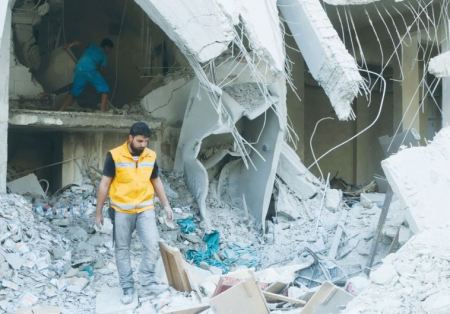
aleppo-messA RED CRESCENT aid worker inspects scattered medical supplies after an air strike on a medical depot in Aleppo on Saturday.. (photo credit:REUTERS)

So Obama let Syria burn. He let Iran and Hezbollah transform the country into their colony. And he let Putin transform the Mediterranean into a Russian lake.

A new Syria is emerging. And with it, a new Middle East and world are presenting themselves. Our new world is not a peaceful or stable one. It is a harsh place.

The new Syria is being born in the rubble of Aleppo.

The eastern side of the city, which has been under the control of US-supported rebel groups since 2012, is being bombed into the Stone Age by Russian and Syrian aircraft.

All avenues of escape have been blocked. A UN aid convoy was bombed in violation of a fantasy cease-fire.

Medical facilities and personnel are being targeted by Russia and Syrian missiles and barrel bombs to make survival impossible.

It is hard to assess how long the siege of eastern Aleppo by Russia, its Iranian and Hezbollah partners and its Syrian regime puppet will last. But what is an all but foregone conclusion now is that eastern Aleppo will fall. And with its fall, the Russian-Iranian-Hezbollah-Assad axis will consolidate its control over all of western Syria.

For four years, the Iranians, Hezbollah and Bashar Assad played a cat and mouse game with the rebel militias.

Fighting a guerrilla war with the help of the Sunni population, the anti-regime militias were able to fight from and hide from within the civilian population. Consequently, they were all but impossible to defeat.

When Russian President Vladimir Putin agreed to join the fight, he and his generals soon recognized that this manner of fighting ensured perpetual war. So they changed tactics. The new strategy involves speeding up the depopulation and ethnic cleansing of rebel-held areas. The massive refugee flows from Syria over the past year are a testament to the success of the barbaric war plan. The idea is to defeat the rebel forces by to destroying the sheltering civilian populations.

Since the Syrian war began some five years ago, half of the pre-war population of 23 million has been displaced.

Sunnis, who before the war comprised 75% of the population, are being targeted for death and exile. More than 4 million predominantly Sunni Syrians are living in Turkey, Lebanon and Jordan. More than a million have entered Europe. Millions more have been internally displaced. Assad has made clear that they will never be coming home.

At the same time, the regime and its Iranian and Hezbollah masters have been importing Shi’ites from Iran, Iraq and beyond. The process actually began before the war started. In the lead-up to the war some half million Shi’ites reportedly relocated to Syria from surrounding countries.

This means that at least as far as western Syria is concerned, once Aleppo is destroyed, and the 250,000 civilians trapped in the eastern part of what was once Syria’s commercial capital are forced from their homes and property, the Russians, Iranians, Hezbollah and their Syrian fig leaf Assad will enjoy relative peace in their areas of control.

By adopting a strategy of total war, Putin has ensured that far from becoming the quagmire that President Barack Obama warned him Syria would become, the war in Syria has instead become a means to transform Russia into the dominant superpower in the Mediterranean, at the US’s expense.

In exchange for saving Assad’s neck and enabling Iran and Hezbollah to control Syria, Russia has received the capacity to successfully challenge US power. Last month Putin brought an agreement with Assad before the Duma for ratification. The agreement permits – indeed invites – Russia to set up a permanent air base in Khmeimim, outside the civilian airport in Latakia.

Russian politicians, media and security experts have boasted that the base will be able to check the power of the US Navy’s Sixth Fleet and challenge NATO’s southern flank in the Mediterranean basin for the first time. The Russians have also decided to turn their naval station at Tartus into something approaching a fullscale naval base.

With Russia’s recent rapprochement with Turkish President Recip Erdogan, NATO’s future ability to check Russian power through the Incirlik air base is in question.

Even Israel’s ability to permit the US access to its air bases is no longer assured. Russia has deployed air assets to Syria that have canceled Israel’s regional air superiority.

Under these circumstances, in a hypothetical Russian-US confrontation, Israel may be unwilling to risk Russian retaliation for a decision to permit the US to use its air bases against Russia.

America’s loss of control over the eastern Mediterranean is a self-induced disaster.

For four years, as Putin stood on the sidelines and hedged his bets, Obama did nothing. As Iran and Hezbollah devoted massive financial and military assets to maintaining their puppet Assad in power, the Obama administration squandered chance after chance to bring down the regime and stem Iran’s regional imperial advance.

For his refusal to take action when such action could have easily been taken, Obama shares the responsibility for what Syria has become. This state of affairs is all the more infuriating because the hard truth is that it wouldn’t have been hard for the US to defeat the Iranian- Hezbollah axis. The fact that even without US help the anti-regime forces managed to hold on for four years shows how weak the challenge posed by Iran and Hezbollah actually was.

Russia only went into Syria when Putin was absolutely convinced that Obama would do nothing to stop him from dislodging America as the premier global power in the region.

As Michael Ledeen recalled earlier this week, Obama chose to stand on the sidelines in Syria because he wanted to make friends with Iran. Obama began his secret courtship of the mullahs even before he officially took office eight years ago.

After the war broke out in Syria, midway through his first term and in the following years, the Russians and the Iranians told the obsessed American president that if he took action against Assad, as strategic rationality dictated, he would get no nuclear deal, and no rapprochement with Tehran.

So Obama let Syria burn. He let Iran and Hezbollah transform the country into their colony. And he let Putin transform the Mediterranean into a Russian lake. Obama enabled the ethnic cleansing of Syria’s Sunni majority, and in turn facilitated the refugee crisis that is changing the face not only of the Middle East but of Europe as well.

And as it turns out, the deal with Iran that Obama willingly sacrificed US control of the Mediterranean to achieve has not ushered in a new era of regional moderation and stability through appeasement as Obama foresaw. It has weakened US credibility with its spurned Sunni allies. It has undermined the strategic position of Israel, the US’s only stable and reliable regional ally. It has financially and strategically fueled Iran’s hegemonic rise throughout the region. And it has facilitated Iran’s development of a nuclear arsenal.

Far from causing the Iranian to become more moderate, the nuclear deal has radicalized the regime still further.

On Wednesday Ray Takeyh wrote in The Washington Post that Supreme Leader Ali Khamenei is now grooming Ibrahim Raisi, a fanatic who makes Khamenei look moderate, to succeed him in power.

On Monday night, for the first time, Israel Air Force jets flying over Syria were shot at by Syrian anti-aircraft ordnance.

Air force sources told the media that the aircraft were never in danger and the munitions were only shot off after the aircraft had returned to Israel and were in the process off landing.

The fact that no one was hurt is of course reassuring.

But the fact that Russia targeted the planes makes clear that Putin has decided to send Israel a very clear and menacing message.

He is now the protector of the Iranian-Hezbollah colony on our northern border. If Israel decides to preemptively attack targets belong to that colony, Russia will not stand by and watch. And with the US no longer well-positioned to challenge Russian power in the region, Israel will have to deal with Russia on its own.

To face this challenge, Israel needs to look beyond its traditional reliance on air power.

There are two parts of the challenge. The first part is Iran.

As far as Israel is concerned, the problem with the Russian- Iranian takeover of Syria is not Putin.

Putin is not inherently hostile to Israel, as his Soviet predecessors were. He is an opportunist. Obama gave him the opportunity to partner with Iran in asserting Russian dominance in the Middle East and he took it. Israel is threatened by the alliance because it is threatened by Iran, not by Putin. To neutralize the alliance’s threat to its own security, Israel then needs to degrade Iran’s power, and it needs to emphasize its own.

To accomplish these goals, Israel needs to operate in two completely separate arenas. To weaken Iran, Israel should take its cue from Iran’s Revolutionary Guard Corps, and from its own past successful military ties to the Kurds of Iraq in the 1960s and 1970s.

Israel needs to deploy military trainers beyond its borders to work with other anti-Iranian forces. The goal of that cooperation must be to destabilize the regime, with the goal of overthrowing it. This may take time. But it must be done. The only way to neutralize the threat emanating from the new Syria is to change the nature of the Iranian regime that controls it.

As for Russia, Israel needs to demonstrate that it is a power that Putin can respect in its own right, and not a downgraded Washington’s sock puppet.

To this end, Israel should embark on a rapid expansion of its civilian presence along its eastern border with Syria and with Jordan. As Russia’s air base in Syria undermines Israel’s air superiority and reliance on air power, Israel needs to show that it will not be dislodged or allow its own territory to be threatened in any way. By doubling the Israeli population on the Golan Heights within five years, and vastly expanding its population in the Jordan Valley, Israel will accomplish two goals at once. It will demonstrate its independence from the US without harming US strategic interests. And it will reinforce its eastern border against expanded strategic threats from both the Golan Heights and the new Jordan with its bursting population of Syrian and Iraqi refugees.

It is ironic that the new Middle East is coming into focus as Shimon Peres, the failed visionary of a fantasy- based new Middle East, is being laid to rest. But to survive in the real new Middle East, Israel must bury Peres’s belief that peace is built by appeasing enemies along with him. The world in which we live has a place for dreamers.

But dreams, unhinged from reality, lead to Aleppo, not to peace.
Obama Turns Blind Eye to Iranian Offenses in UN Speech

September 27, 2016

Obama Turns Blind Eye to Iranian Offenses in UN Speech, Clarion Project, Jennifer Breedon, September 27, 2016

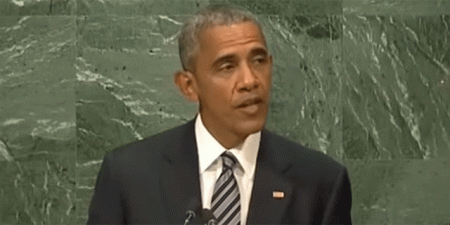
obama-un-address-2016-hpU.S. President Barack Obama addresses the UN General Assembly on Sept. 20, 2016. (Photo: video screenshot)

The Iranian leader rightfully fears a future administration that may not be willing to tolerate a total disregard for international law or human rights, given that even President Obama’s positive nod to Iran at the UN was met with the label of “continued animosity.” 

****************************

In 2015, President Obama stated that Iran’s “support for terrorism” and “its use of proxies to destabilize parts of the Middle East” was problematic, despite the Joint Comprehensive Plan of Action (the nuclear deal) that had been reached by that time that allowed Iran access to millions of previously frozen funds.

Yet, bafflingly, just five minutes after mentioning terror proxies in his 2016 UN address last week, President Obama seemed to turn a blind eye to Iran’s ongoing offenses by saying, “When Iran agrees to accept constraints on its nuclear program, that enhances global security and enhances Iran’s ability to work with other nations.”

Today, Iran is poised to move funds to its global terror proxies more easily due to the infusion of cash created by the unfreezing of their assets.  Even John Kerry admitted in 2015 that some of the money going back to Iran through sanctions relief would undoubtedly go to fund terrorism.

So, we all know it is happening and yet nothing is being done to stop them or to even state this obvious fact aloud before the very body that is designed to protect against such international violations.

The UN Convention that prohibits terrorism financing explicitly outlines the illegality of any government that commits such an offense when it

“directly or indirectly, unlawfully and willfully, provides or collects funds with the intention that they should be used or in the knowledge that they are to be used, in full or in part, in order to carry out . . . act(s) intended to cause death or serious bodily injury to a civilian, or to any other person not taking an active part in the hostilities in a situation of armed conflict, when the purpose of such act, by its nature or context, is to intimidate a population, or to compel a government or an international organization to do or to abstain from doing any act” (Article 2(1)).  

Iran is guilty in spades of all of this.

Additionally, the Iranian government remains the U.S. State Department’s top proxy war and terror sponsor. Previous reports from the U.S. State Department note that Iran remains “unwilling to bring to justice senior al-Qaeda (AQ) members [and has] previously allowed AQ facilitators to operate a core facilitation pipeline through Iran.”

The State Department has also highlighted Iran’s provision of “hundreds of millions of dollars in support of H[e]zballah in Lebanon and has trained thousands of its fighters . . . in direct support of the Assad regime in Syria” as well as terrorist groups in Palestine (Hamas), Yemen (Houthis) and “throughout the Middle East.”

President Obama’s appeals to the oppressive government of Iran have clearly fallen on deaf ears.  In a one-on-one with MSNBC’s Chuck Todd merely 24 hours after Obama’s UN speech, Iranian President Rouhani stated, “If the future administration of the United States wishes to continue animosity, it will receive the appropriate response.”

The Iranian leader rightfully fears a future administration that may not be willing to tolerate a total disregard for international law or human rights, given that even President Obama’s positive nod to Iran at the UN was met with the label of “continued animosity.”

No amount of vocal, material or financial appeasement can ease relations with the State Department’s leading state sponsor of terrorism.  Despite repeated efforts by President Obama, it will not get better until the Iranian regime abandons its practice of funding terrorism, inciting proxy wars throughout the Middle East, and oppressing their own people by using their resources to build and test weapons before providing the infrastructure needed to create a stable economy and free society for their people.

While Iranian civilians and citizens were in dire economic straits with very little government reprieve or resource allocation to ease their conditions prior to the Nuclear Deal sanctions relief, the Iranian regime was spending over $6 billion per year to support the Assad regime in Syria in its efforts to ensure a Shiite majority in the region.

The Iranian regime must be held accountable for its non-adherence to international law and its desire to finance terror globally in places like Yemen, Iraq, Lebanon, and Syria.

It must be held responsible for using funds to bankroll violence and oppression instead of providing basic necessities and freedoms for its own people.  As Obama said at the UN this year, Iran must “listen to voices of young people everywhere who call out for freedom, and dignity, and the opportunity to control their own lives.”

Rouhani made it clear that, despite all of the steps we’ve taken, including acknowledging them positively at the UN General Assembly, nothing the U.S. has done has thawed our relationship with Iran or helped to improve the security of people living in the areas ruled by Iran or its terror proxies.

Our leaders must continue to speak out against Iran’s human rights violations and the financing of terror if we ever hope to see change and remain a positive beacon of democracy and freedom.


FBI: 7,700 Terrorist Encounters in USA Last Year

September 26, 2016

FBI: 7,700 Terrorist Encounters in USA Last Year, Counter Jihad, September 26, 2016

us-mexico-border

Breitbart news has received a collection of leaked documents from the Federal Bureau of Investigation that show a massive number of terrorist encounters, especially in border states.  The documents are not classified, though they are marked sensitive.  7,712 terrorist encounters occurred from July 20, 2015 and the same date a year later — last year, in short.

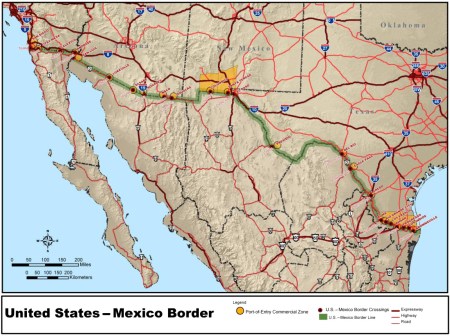
Some of the documents pertain to the entire U.S., while others focus specifically on the state of Arizona.  The states with the highest encounters are all border states. Texas, California, and Arizona–all states with a shared border with Mexico–rank high in encounters…. Most significantly, the map shows that many of the encounters occurred near the border outside of ports-of-entry, indicating that persons were attempting to sneak into the U.S.

Page Six shows a pie chart indicating that the majority of encounters in Arizona were with Islamic known or suspected terrorists, both Sunni and Shi’a.

That last is surprising, as one would expect drug cartels to make up the majority of such encounters.  The leak comes at a time when the FBI’s crime reporting shows an increase in violent crime across the country.

The Shiite terrorist organization Hezbollah has developed connections with the Latin American drug cartels because of its prominent role in heroin.  Iran’s Revolutionary Guards Corps (IRGC) controls the opium trade from the poppy fields in Afghanistan to the Levant, and they provide a great deal of opium to Hezbollah.  Hezbollah has a refining capacity in Lebanon that allows them to provide a substantial part of the world’s heroin.  They trade heroin to the Latin American drug cartels for other illegal money-making opportunities, forged documents, and access to the Americas.  Hezbollah’s operations produce between ten and twenty million dollars in revenue for its American operations, which are based out of a large Lebanese immigrant community in what is called the “Tri-border region,” an area between Paraguay, Brazil, and Argentina.

In addition to its money-making ventures, Hezbollah provides the cartels with military training.  As one of the world’s foremost guerrilla organizations, Hezbollah finds that its military trainers are sought after commodities.  They are able to parley those connections in order to perform operations in Mexico.  Their ability to infiltrate the United States, in order to conduct terrorist violence in service to Iran, is highlighted by these leaked FBI documents.

The role of Sunni groups is less fully understood, but it was a concern for the intelligence section of the United States military’s Southern Commandaccording to another set of leaks earlier this year.

Sunni extremists are infiltrating the United States with the help of alien smugglers in South America and are crossing U.S. borders with ease, according to a U.S. South Command intelligence report.  The Command’s J-2 intelligence directorate reported recently in internal channels that “special interest aliens” are working with a known alien smuggling network in Latin America to reach the United States….  Army Col. Lisa A. Garcia, a Southcom spokeswoman, did not address the intelligence report directly but said Sunni terrorist infiltration is a security concern.

“Networks that specialize in smuggling individuals from regions of terrorist concern, mainly from the Afghanistan-Pakistan region, the Middle East, and East Africa, are indeed a concern for Southcom and other interagency security partners who support our country’s national security,” Garcia told theWashington Free Beacon….  “In 2015, we saw a total of 331,000 migrants enter the southwestern border between the U.S. and Mexico, of that we estimate more than 30,000 of those were from countries of terrorist concern,” she said….

[T]he Southcom intelligence report revealed that the threat of Islamist terror infiltration is no longer theoretical. “This makes the case for Trump’s wall,” said one American security official of the Southcom report. “These guys are doing whatever they want to get in the country.”

Here at CounterJihad, we reported on Southern Command’s commander, Admiral Kurt Tidd, and his testimony before Congress on the threat.  Tidd reported that a number of terrorists were transiting the region who had gone to Syria and fought for the Islamic State (ISIS) and other radical groups.  Their ability to return to Latin America was smooth, given that they actually had legal travel documents.

Whether they can then pass into the United States is an open question.  The leaked FBI documents only talk about actual law enforcement encounters with people on terrorist lists.  How many are infiltrating without encountering law enforcement?

Iran Sanctions Have Ended – and the Mass Executions Have Restarted

September 22, 2016

Iran Sanctions Have Ended – and the Mass Executions Have Restarted, American ThinkerMansour Kashfi, September 22, 2016

The crippling global sanctions on Iran cost the country hundreds of billions of dollars and decimated the economy. Inflation rose to over 40 percent and unemployment levels reached 33 percent. Consequently, the majority of citizens experienced an astronomical cost of living and lack of government services. Therefore, news of negotiations and lifting of sanctions was very well received by Iranians and generated optimism for a life of less hardship after sanctions.

However, since the agreement ending sanctions was signed between the Islamic Republic (IR) and the international powers last January, nothing has improved regarding the everyday life of the Iranian people. Not even one of the critical civil issues that was promised by the so-called “moderate”, “pragmatic” president, Hassan Rouhani, to be addressed after sanctions ended, has been opened for discussion by the IR officials.

Regardless of the rather rapid increase in Iranian crude oil and petrochemical sales and the release of billions of dollars of frozen money by a number of international oil companies and foreign governments, the nation-wide tax in all categories remarkably increased, and a limited welfare to needy senior citizens has been discontinued.

Despite the rosy promises of the IR’s authorities, especially Hassan Rouhani, to bring justice for all and raise the standards of living of the people, amazingly nothing has been done to improve Iranians’ living conditions, and no social freedom and justice is on the horizon. On the contrary, tougher repression and mass executions are the only gift by the IR to the Iranian people after sanctions ended.

Release of Assets

US officials claimed that IR had more than $100 billion of frozen assets abroad during the sanctions era, the equivalent of 28 percent of the country’s gross domestic product, which has been returning to the IR after sanctions ended. A good portion of this money was balance payments of crude oil sold by IR to its customers during the sanction years, including Royal Dutch Shell, Italy’s Saras, Greece’s Hellenic, Emirates National Oil Company, the Indian Reliance and Essar oil refiner, the Netherlands and Japan. All unfrozen money has been transferring to IR’s Central Bank by way of the SWIFT global transactions network. President Hassan Rouhani announced last March that the government of IR has access to all unfrozen assets.

Further, according to the International Energy Agency, IR is currently exporting about 2.14 million barrels of crude and over 200,000 barrels of gas condensates daily. The IR’s oil ministry reported the oil revenues from 2016 until mid-July were about $20 billion.

During negotiations with the IR last year the Obama administration agreed to pay $400 million plus interest of $1.3 billion to settle a failed arms sale to Iran that was initiated during the monarchical government before 1979. The first payment equivalent of $400 million in cash in the form of Swiss francs and euros was airlifted from Geneva, Switzerland to Tehran on January 17, and in return four Iranian-American hostages in IR’s jail were released. Further, officials of the State and Treasury departments confirmed on September 6 that two remaining installments of the $1.3 billion were sent to Tehran in the same manner through Geneva on January 22 and February 5.

With all this windfall money nothing tangible in terms of infrastructure renovations, civil reform and the rise of standard of living has taken place in the country. On the contrary, poverty has increased, over one-third of Iranians presently live under the poverty line, and thousands of citizens escape the country everyday to find a safer place to live. Worst of all, in testimonies of various human rights advocates and organizations, the ignoring of human rights by the IR is always an ever-growing issue in Iran, particularly after the ending of sanctions.

Human Rights Issues

The level of repression inside Iran has increased since Hassan Rouhani took office as president in 2013. Since then, the number of executions has grown rapidly. In 2014, the number of death sentences in Iran reached the largest number of executions in the world except for China. In 2015, according to Ahmed Shaheed, the U.N. Special Rapporteur on human rights in Iran, the number exceeded 1,000.

The U.N. General Assembly’s human rights committee passed a resolution last November that expressed its deepest concern about human rights violations by the Islamic regime. Amnesty International has also called on regime authorities to stop the hanging, particularly of juvenile offenders who are convicted on dubious evidence.  Amnesty International time and again has published reports on physical and psychological torture in Iran, saying that the number of torture and ill-treatment cases is increasing in Iran, making it clear that these violations of human rights not only continue in this time of a moderate President, but are noticeably becoming widespread and in most places systematic.

In January of 2016, finally the expected moment of change arrived, and sanctions were lifted. But immediately, political pressure and religious discrimination began increasing daily. The penalty for apostasy is still death. Any female regardless of age that does not wear veils is arrested and faces harsh punishments. Cultural dissidents, artists, and homosexuals on most occasions would receive capital punishment. Mass executions for political prisoners which were common practice for over a decade after the so-called revolution have now restarted primarily for non-Shi’a citizens.

There was a hanging of 20 innocent Sunni-Kurdish citizens in Karaj, a suburb of Tehran on August 3, 2016, the execution of an Iranian nuclear scientist on August 7, the hanging of 5 minority citizens in the western province of Azerbaijan on August 14, and another hanging of 3 minority citizens accused of exploding the oil pipeline in the southwest province of Khuzestan on August 16. Although U.N. Representative Ahmed Shaheed firmly requested the IR stop the systematic executions, 12 more allegedly accused of possession of illegal drugs were hanged in Karaj prison on August 27. There were a total of 41 executions officially of innocent citizens just in one month. In addition many young male and female citizens disappear every day, and their decomposed bodies are occasionally found in the remote parts of their hometowns. These systematic executions reveal that the nature of the Islamic regime has not changed at all, sanctions or no sanctions. IR claims they were executed for “purported terrorism and related activities” as reported by Zeid Ra’ad Al Hussein, the U.N. High Commissioner for Human Rights.

Ed Royce, the Chairman of the House Foreign Affairs Committee, introduced on September 6 a bill to censure President Obama for his rewarding a terrorist government for its hostage taking as IR presently still has three Iranian-Americans in prison.

It is inhuman for these executions to take place after an unfair trial, absent of any attorneys on behalf of defendants, and obviously based entirely on coerced confessions. In most cases such executions take place without any trial at all, and the Islamic regime has never allowed Ahmed Shaheed to visit Iran to make a precise assessment on human rights violations.

Iran as a member of the United Nations and other international human rights communities has systematically violated nearly every provision of these institutions and the Universal Declaration of Human Rights. IR’s officials have openly opted to ridicule the concept of universal human rights, and they brand the principle of human rights as a tool of the “Great Satan” and Western imperialism.

Where does the money go?

Evidently, the released money after sanctions ended was not intended for citizens’ welfare and the improvement of the living conditions in Iran. The IR officials have been apathetic since the welfare and health of the Iranian people is of the lowest priority in their eyes, considering the huge expense of their active terrorist groups in the Middle East. The money has already reached the IR’s Revolutionary Guard Corps (IRGC) for their efforts to export the Islamic revolution to neighboring countries and carry on the IR’s hostile engagements in Syria, Iraq, and Yemen, arming and financially supporting terrorist groups around the world including Hamas in Gaza, Hezb’llah in Lebanon, Shi’a groups in Bahrain, Houthis in Yemen, and the drug traffickers in South America. The IRGC is the most powerful extralegal organization and richest entity in Iran. The associated IRGC units own over one-third of the listed companies of the Tehran Stock Exchange. Further, according to Bloomberg, the IR Supreme Leader Mullah Khamenei is the owner of an economic empire of about $95 billion.

Now we know where the money goes.

Obama Admin Seeks Pathway for Future ‘Ransom Payments’ to Iran

September 22, 2016

Obama Admin Seeks Pathway for Future ‘Ransom Payments’ to Iran, Washington Free Beacon, September 21, 2016

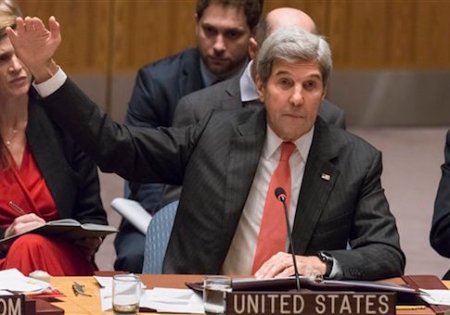
US Secretary of State John Kerry addresses the United Nations Security Council during an open, high-level debate regarding the ongoing Syrian crisis, at UN Headquarters in New York, NY, USA on September 21, 2016. The meeting, presided over by New Zealand's Prime Minister John Key, comes amid growing hostility between the United States and Russia over allegations of military operations conducted in the region. (Photo by Albin Lohr-Jones) *** Please Use Credit from Credit Field ***

US Secretary of State John Kerry addresses the United Nations Security Council during an open, high-level debate regarding the ongoing Syrian crisis, at UN Headquarters in New York, NY, USA on September 21, 2016. (Credit Field)

The Obama administration is pushing a pathway to ensure it can continue sending Iran cash payments amid mounting accusations it laundered some $1.7 billion to the Islamic Republic as part of a “ransom payment” to free U.S. hostages earlier this year, according to statements by the White House and sources familiar with the matter.

The White House late Wednesday promised to veto new legislation—first disclosed by theWashington Free Beacon—that would bar the administration from making “future ransom payments to Iran,” prompting outrage from key members of Congress who have been investigating how U.S. officials delivered nearly $2 billion in cash to Iranian officials.

The administration’s veto threat comes as top lawmakers on a range of investigatory committees launch efforts to uncover details about the cash exchange still being hidden by the Obama administration.

Congressional sources who spoke to the Free Beacon raised questions as to why the Obama administration would threaten to veto the bill, given its insistence that the cash payments to Iran were not part of a ransom.

“President Obama’s veto threat on our ransom legislation puts the lives of U.S. citizens around the world at risk,” Rep. Mike Pompeo (R., Kan.), a member of the House Intelligence Committee who helped spearhead the ransom legislation, told the Free Beacon.

“Instead of admitting wrongdoing, this administration is sticking to talking points. But selective noun use cannot explain away criminality, nor does it excuse eight months of lying to the American people,” Pompeo said. “It is unprecedented and reckless for the U.S. to be doling out billions to the Islamic Republic of Iran—under wraps and in cash—which is why our bill is necessary.”

Sen. Marco Rubio (R., Fla.), a lead sponsor of the legislation to ban future payments to Iran, told theFree Beacon that he would continue to push the legislation, despite threats by the administration.

“This effort by the President to defend his ransom payments to Iran at all costs amounts to doubling down on ‎a policy that has made Americans less safe,” Rubio told the Free Beacon. “Democrats may be swayed by this threat, but I will continue to fight to prevent the U.S. government from sending taxpayer dollars to the world’s foremost state sponsor of terrorism.”

Sen. Mark Kirk (R., Ill.) told the Free Beacon Wednesday evening that the Obama administration is betraying U.S. victims of Iranian terrorism, who are owed billions under federal court rulings.

“Under U.S. court judgments, Iran owes $55.6 billion to American victims of Iranian terrorism,” Kirk told the Free Beacon. “The Administration should stop finding ways to send more cash to Iran, and start working to bring a measure of justice to American families whose loved ones were killed or injured due to Iran-backed terrorists.”

One source familiar with the matter said Iran prefers cash because it can more easily be used to fund terrorism.

“There is no credible reason for the administration to oppose this bill. We already know, contrary to what the president initially said, that the administration can in fact wire money to Iran,” the source said. “So why do we need the option to pay in cash? Simple. This money can fund terrorism, and there’s nothing we can do to know of stop it.”

The Obama administration maintains the legislation is “ill-advised” and would “undermine U.S. obligations” to Iran.

The bill is “an ill-advised attempt to respond to a problem—so-called ‘ransom’ payments to Iran—that does not exist, in a way that would undermine U.S. obligations and ultimately benefit Iran at the expense of the United States,” the White House said in a statement.

The administration said it plans to award Iran further payments, which would not be possible under the ransom legislation.

“This bill, while styled as prohibiting future purported ‘ransom payments,’ instead bars virtually any payment from the U.S. government to Iran, including those permitted or even required by law,” the administration said.

The $1.7 billion cash payment was given to Iran as part of an effort to resolve decades-old legal disputes, many of which are still outstanding. The administration said further payments could be made to Iran in order to settle these disputes.

“Specifically, this bill would effectively prevent the United States from paying out awards rendered by the Tribunal and, thus, risk putting the United States in violation of our obligations under the Algiers Accords—an agreement concluded by President Carter, endorsed by President Reagan and honored by every President since that time,” according to the White House.

Questions remain about why the administration chose to pay Iran in cash installments routed through the New York Federal Reserve and several European banks.

Lawmakers such as Pompeo and Sen. Ted Cruz (R., Texas) have described the administration’s process as tantamount to a money laundering scheme.

UPDATE 8:40 P.M.: This piece was updated to include comments from Sens. Marco Rubio (R., Fla.) and Mark Kirk (R., Ill.).

North Korean Nukes, South Korea, Japan, China and Obama

September 10, 2016

North Korean Nukes, South Korea, Japan, China and Obama, Dan Miller’s Blog, September 10, 2016

(The views expressed in this article are mine and do not necessarily reflect those of Warsclerotic or its other editors. — DM)

On September 9th, North Korea conducted its fifth nuke test, of its most powerful nuke thus far. Can Obama get China to help make North Korea stop developing and testing nukes? Nope. China sees Obama, not as the representative of the world’s greatest power, but as a joke. He has no clout internationally and is a national embarrassment.

China and North Korea – a very short history

Here’s a link to an article I posted on June 25, 2013 about the Korean conflict. To summarize, China and the Democratic People’s Republic of Korea (North Korea) have a long history of acting together. China views the Republic of Korea (South Korea), which borders North Korea to the south and is an American ally, as a threat. She does not want reunification of the Korean peninsula under a government favorable to America.

When, on June 25, 1950, North Korea invaded South Korea with Russian aircraft, weaponry, training and other substantial support, China did not assist North Korea. North Korean forces pushed the South Korean government, as well as the few American military advisers (then under the command of the Department of State), south to the Pusan perimeter. Following General MacArthur’s unexpected and successful Inchon invasion which began on September 15th, American and other United Nations forces pushed the North Korean forces back north: MacArthur sent his by then greatly augmented forces east to Wonson and eventually managed to push North Korean forces to the northern side of the Yalu River. However, Chinese forces struck back en masse and MacArthur’s forces were driven back to Seoul.

Ever since bringing to an end MacArthur’s successes in the Korean Conflict, China has supported North Korea. She has opposed, and has then declined to enforce, significant sanctions responsive to North Korean nuclear and missile development and testing. While China may acquiesce in weak UN resolutions condemning North Korean provocations, she rarely goes beyond that.

China, Japan and the two Koreas

China has a long memory and still resents, bitterly, the lengthy period prior to and during World War II when Japan occupied significant parts of China. Ditto South Korea, all of which was under Japanese occupation for a lengthy period prior to and during World War II. Although China has substantial trade with both South Korea and Japan, she is more hostile to Japan than is South Korea; the latter two have substantial mutual interests transcending trade.

Perhaps the most important current dispute between China on the one hand, and Japan-South Korea-America on the other, involves the plans of Japan and South Korea to defend against North Korean missiles by the installation of THAAD anti-missile weapons provided by America. China’s stated reason for opposition to the THAAD system is that it could be used against Chinese, as well as North Korean, missiles. Why does China assert this objection unless she hopes to fire missiles at one or both of them? If China fires missiles at Japan and/or South Korea, they have every right to destroy her missiles and to respond in kind with U.S. assistance if requested.

President Obama

condemned Pyongyang’s fifth nuclear test today in the “strongest possible terms as a grave threat to regional security and to international peace and stability” as outraged lawmakers from both parties called for tougher action to stop North Korea’s nuclear program. [Emphasis added.]

That may well be all that Obama does — despite the warnings of Rep. Adam Smith (D-Wash.), the top Democrat on the House Armed Services Committee, that

we have to make it absolutely clear that if they engage in any military activity, they will be destroyed. We have to have a credible deterrent. That seems to be the only thing that will stop North Korea from engaging in military action… We have sanctioned them, and we should keep sanctioning them, but it’s not going to stop them from developing the nuclear weapons.” [Emphasis added.]

Obama won’t do that:

In a statement Friday, President Obama vowed to “take additional significant steps, including new sanctions, to demonstrate to North Korea that there are consequences to its unlawful and dangerous actions.”

Obama did not suggest what He might have in mind, beyond historically ineffective sanctions and condemnations “in the strongest possible terms,” to let North Korea know that there will be “consequences.”

A September 9th article at the New York Times provides an unpleasant analysis of the options Obama now has, and which His successor will have, in dealing with North Korea.

A hard embargo, in which Washington and its allies block all shipping into and out of North Korea and seek to paralyze its finances, risks confrontations that allies in Asia fear could quickly escalate into war. But restarting talks on the North’s terms would reward the defiance of its young leader, Kim Jong-un, with no guarantee that he will dismantle the nuclear program irrevocably.

For more than seven years, President Obama has sought to find a middle ground, adopting a policy of gradually escalating sanctions that the White House once called “strategic patience.” But the test on Friday — the North’s fifth and most powerful blast yet, perhaps with nearly twice the strength of its last one — eliminates any doubt that that approach has failed and that the North has mastered the basics of detonating a nuclear weapon.

Despite sanctions and technological backwardness, North Korea appears to have enjoyed a burst of progress in its missile program over the last decade, with experts warning that it is speeding toward a day when it will be able to threaten the West Coast of the United States and perhaps the entire country. [Emphasis added.]

. . . .

Mr. Obama has refused to negotiate with the North unless it agrees first that the ultimate objective of any talks would be a Korean Peninsula without nuclear arms. But Mr. Kim has demonstrated, at least for now, that time is on his side. And as he gets closer to an ability to threaten the United States with a nuclear attack, and stakes the credibility of his government on it, it may be even more difficult to persuade him to give up the program.

 In a statement Friday, Mr. Obama condemned the North’s test and said it “follows an unprecedented campaign of ballistic missile launches, which North Korea claims are intended to serve as delivery vehicles intended to target the United States and our allies.”

“To be clear, the United States does not, and never will, accept North Korea as a nuclear state,” he said.

Many experts who have dealt with North Korea say the United States may have no choice but to do so. [Emphasis added.]

“It’s too late on the nuclear weapons program — that is not going to be reversed,” William Perry, the defense secretary under President Bill Clinton during the 1994 nuclear crisis with North Korea, said in August at a presentation in Kent, Conn. The only choice now, he argued, is to focus on limiting the missile program. [Emphasis added.]

Obama has taken no significant steps to limit Iran’s continuing missile development and testing program. How can He limit that of North Korea without Chinese cooperation?

Yet the latest effort to do that, an agreement between the United States and South Korea to deploy an advanced missile defense system in the South, has inflamed China, which argues the system is also aimed at its weapons. While American officials deny that, the issue has divided Washington and Beijing so sharply that it will be even more difficult now for them to come up with a joint strategy for dealing with the North. [Emphasis added.]

China has been so vocal with its displeasure over the deployment of the American system that Mr. Kim may have concluded he could afford to upset Beijing by conducting Friday’s test. [Emphasis added.]

Fueling that perception were reports that a North Korean envoy visited Beijing earlier this week.

North Korea almost certainly sees this as an opportunity to take steps to enhance its nuclear and missile capabilities with little risk that China will do anything in response,” Evans J.R. Revere, a former State Department official and North Korea specialist, said in a speech in Seoul on Friday. [Emphasis added.]

The breach between China and the United States was evident during Mr. Obama’s meeting with President Xi Jinping last week. “I indicated to him that if the Thaad bothered him, particularly since it has no purpose other than defensive and does not change the strategic balance between the United States and China, that they need to work with us more effectively to change Pyongyang’s behavior,” Mr. Obama said, referring to the Terminal High Altitude Area Defense system, as the advanced missile defense project is known. [Emphasis added.]

North Korea and Iran

Iran and North Korea have a long history of cooperation in developing nukes and missiles with which to deliver them. In the past, Iranian scientists have been present at North Korean nuke tests, and vice versa. They have also assisted each other in the development of nukes and missiles.

Iran and North Korea have substantial reasons to cooperate: by virtue of the Iran scam, Iran now has lots of money but is at least minimally restricted in its nuke development. North Korea has little usable currency, needs whatever it can get, and no attempts to halt or even to limit its nuke development have worked.

A missile fired recently by North Korea bore a striking resemblance to an Iranian missile.

Photos released by North Korea of its launch of long-range ballistic missiles are the latest proof of the close military cooperation between Pyongyang and Tehran, an Israeli expert in the field told the news site IsraelDefense on Tuesday.

According to Tal Inbar — head of Space and UAV Research Centre at the Fisher Institute for Air & Space Strategic Studies — what was new in the photos was the shape of the warheads attached to the Nodong missiles, known in Iran as the Shahab-3.

Until now, such warheads — first detected by Inbar in Iran in 2010 — have not been seen in North Korea. At the time, Inbar dubbed them NRVs (or, “new entry vehicles”), which became their nickname among missile experts around the world. [Emphasis added.]

Inbar told IsraelDefense: “The configuration that we saw [on Tuesday] is identical to what we saw in Iran six years ago. In principle, its penetrating body (warhead) is identical to that of Scud missiles, but is mounted on the Shahab-3, and creates a more stable entity than other Shahab/Nodong warheads.”

Inbar said this was the third time that something of this nature had appeared in Iran before it did in North Korea. “But we must remember that the two countries engage in close cooperation where military and space-directed missiles are concerned,” he said. “It is thus possible that both plans and technology are being transferred regularly from one to the other.” [Emphasis added.]

Are North Korea and Iran rational? According to this New York Times analysis, North Korea is.

North Korea’s actions abroad and at home, while abhorrent, appear well within its rational self-interest, according to a 2003 study by David C. Kang, a political scientist now at the University of Southern California. At home and abroad, he found, North Korean leaders shrewdly determined their interests and acted on them. (In an email, he said his conclusions still applied.) [Emphasis added.]

“All the evidence points to their ability to make sophisticated decisions and to manage palace, domestic and international politics with extreme precision,” Mr. Kang wrote. “It is not possible to argue these were irrational leaders, unable to make means-ends calculations.” [Emphasis added.]

Victor Cha, a Georgetown University professor who served as the Asian affairs director on George W. Bush’s National Security Council, has repeatedly argued that North Korea’s leadership is rational.

I submit that the same analysis, applied to Iran, produces the same result. Iran’s leaders know what they want, and are sufficiently rational to achieve it; they did. Obama, not the leader of a dictatorial theocracy, is sufficiently irrational to believe that what he wants for the Islamic Republic of Iran is what America needs it to have. It is not.

Obama and Iran

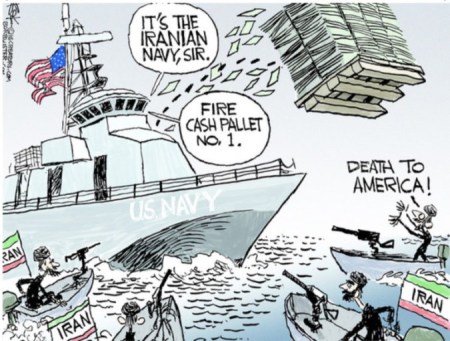
Obama’s Iran scam would be farcical were it not potentially deadly. He did not do what would have been best for America and the free world in general — increase sanctions until Iran complied fully with UN resolutions on missile testing, ceased Uranium enrichment and disposed of the means to do it, ceased all nuke research as well as all nuke cooperation with North Korea and ceased supporting all terrorist groups, including Hezbollah and Hamas. Instead, perhaps considering Himself above such trivia, Obama sought little more than what He considered His greatest achievement — His legacy:

iranian-navy-copy-1

Conclusions

If Obama were viewed internationally as the powerful leader of the world’s most powerful nation, He might be able to get China to clamp down, severely and successfully, on North Korea’s nuke and missile development. Were China to reject His overtures, He could arrange for it to wish that it had acceded. That’s not who Obama is, as demonstrated by, among His other actions, entering into the Iran Scam deal with Iran.

Perhaps Kim Jong-un needs to dress like an Iranian mullah to convince Obama to give him a “deal” similar to the one He gave to Iran. He had better hurry: that won’t work with President Trump.

Putin-Erdogan deal deadlocks Aleppo, Manjib frays

August 13, 2016

Putin-Erdogan deal deadlocks Aleppo, Manjib frays. DEBKAfile, August 13, 2016

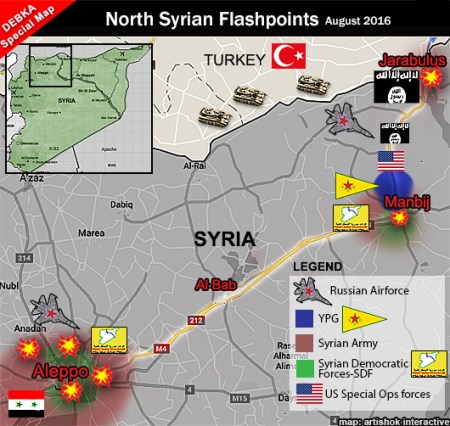
n syria flashpoints

This hopeless standoff is the result of Moscow’s refusal to provide the Syrian army and its allies with enough air support to pull ahead, in the wake of President Vladimir Putin talks with Turkish President Reccep Tayyip Erdogan in St. Petersburg Tuesday, Aug. 9.

*********************

All day Friday and Saturday, Aug.11-12, fighters of Hizballah’s elite Radwan Force – 3,000 in all – streamed to the pivotal Aleppo battlefield from all parts of Lebanon and Syria. DEBKAfile’s military and intelligence sources disclose that they were following the orders of their leader Hassan Nasrallah, who was warned by Tehran that the pro-Assad army fighting for Syria’s second city was flagging in the face of rebel assaults.

The Radwan Force was called in as the only military capable of saving the day for Assad and his allies. This step had been carefully avoided by Nasrallah was required in view of the heavy losses his organization had already suffered for backing the Syrian army – some 1,500 dead in three years – and intense fallout at home.

He has now been forced to sacrifice his last remaining military asset to fight in one of the bloodiest battles ever fought in recent times in the Middle East, even though it promises a swelling procession of Hizballah coffins returning to Lebanon.

According to our military sources, the battle to wrest Aleppo from rebel control, now in its second month, has claimed some 2,000 war dead and 4,000 injured on both sides – not counting the masses of civilians.

Some units have lost more than a quarter of their combatants and dropped out.

Nasrallah knows exactly what is happening in this critical arena. He also understands that a unit which loses 30 percent of its combatants is deemed in military terms unfit to continue fighting and that the battle for Aleppo will be drawn out and bloody. Yet he is willing to commit his entire deck of military resources to keep Bashar Assad’s fighting in Aleppo.

There is no hope of an early resolution in Aleppo, because stalemate between the combatants is exceptionally complicated and thankless. Whenever one side captures terrain, it quickly discovers it was drawn into a trap and under siege.

This hopeless standoff is the result of Moscow’s refusal to provide the Syrian army and its allies with enough air support to pull ahead, in the wake of President Vladimir Putin talks with Turkish President Reccep Tayyip Erdogan in St. Petersburg Tuesday, Aug. 9.

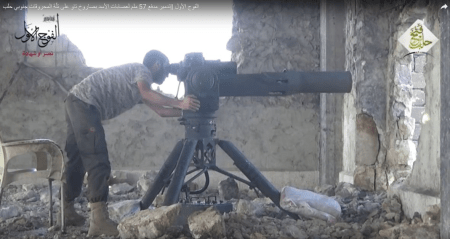
Aleppo_Rebels_ATGM-firings

Erdogan explained that if Assad’s army, along with Hizballah and Iran, defeated the Turkish-backed rebel forces holding Aleppo, he would suffer a serious knock to his prestige and setback for Syrian policy. This was more than he could sustain in the troubled atmosphere in Turkey in the wake of the failed coup against him.

He therefore asked the Russian president to abandon his Bashar Assad, Iran and Hizballah to their fate in Aleppo.

Erdogan was backed up in his request to Putin by a large Turkish military and intelligence delegation which arrived in St. Petersburg the next day to work with their Russian counterparts on setting up a joint military control center in Turkey.

DEBKAfile’s sources disclose the first two tasks assigned the new war room:

1. Russian aerial bombardments over Aleppo would not go beyond keeping the rebels from defeating Syrian and allied forces in Aleppo, but would refrain from supporting offensive action by the latter for routing the former.

2. Turkish air and ground forces would remain in a state of preparedness to ensure that rebel Syrian Democratic Forces (SDF) and the Kurdish YPG militia never moved out of the town of Manjib, from most parts of which they ousted ISIS, to the town of Jarabulus on the Turkish border.I

ISIS had used Manjib as its primary way station for supplies from Turkey 30km to the north. (See attached map). But to drive the jihadists completely out of the Syrian-Turkish border region, the combined rebel forcesmust advance on Jarabulus and expel ISIS from there too.

However, Turkish officers in the joint command center with Russia made it clear that any Kurdish forces allowed to reach that border would come under Turkish army attack.

The Russian president complied with Erdogan’s wishes on the Manjib-Jarabulus front as well as Alepp

Officials In Lebanese, Gazan Terror Organizations Confirm: Iran Funds Our Activity

August 11, 2016

Officials In Lebanese, Gazan Terror Organizations Confirm: Iran Funds Our Activity, MEMRI, August 11, 2016

Arab media have recently published statements by officials in the Lebanese Hizbullah and the Gazan Hamas and Islamic Jihad organizations, and by their supporters, confirming what has long been known – namely that these Lebanese and Gazan terror organizations receive substantial financial and military assistance from Iran. These statements join many reports, especially in the anti-Iranian media, regarding Iran’s funding of various terrorist organizations across the Arab world. According to these reports, the assistance comes mainly from the office of Iranian Supreme Leader Ali Khamenei and from the Islamic Revolutionary Guards Corps (IRGC).

The following are some examples of these statements and reports from the last two months:

Hizbullah Secretary-General Nasrallah: Hizbullah’s Entire Budget Is Provided By Iran

In a speech he delivered on June 24, 2016, marking 40 days after the killing of Mustafa Badr Al-Din, who was considered to be Hizbullah’s chief operations officer, and following the imposition of U.S. sanctions on Hizbullah that threaten its financial infrastructure and income, Hizbullah Secretary-General Hassan Nasrallah clarified: “Hizbullah’s budget – its salaries and expenditures, [the money that pays for] its food and drink, weapons and missiles – [all come from] Iran. Is that clear?… As long as Iran has money we have money. Do you require greater transparency than that[?] The funds earmarked for us do not reach us through the banks. We receive them the same way we receive our missiles, with which we threaten Israel.”[1]

Hamas Official Abu Marzouq: Iran’s Assistance To Hamas Is “Not Comparable” To Any Other Assistance

The deputy head of Hamas’s political bureau, Moussa Abu Marzouq, tweeted on June 15, 2016: “The aid extended by Iran to the Palestinian resistance, in provisions, training and funds, is not comparable [to any other aid], and most other countries cannot match it.”[2]

29502Abu Marzouq’s tweet

Former Lebanese Minister Wiam Wahhab: Iran Has Funded Resistance In Palestine

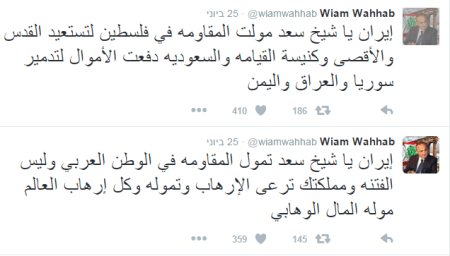
On June 25, 2016, in response to a remark by former Lebanese prime minister Sa’d Al-Hariri that Iran funds fitna(internecine strife) in the Arab world,[3] former Lebanese minister Wiam Wahhab, a known supporter of Hizbullah and the resistance axis, tweeted: “O Sheikh Sa’d [Al-Hariri], Iran has funded resistance in Palestine to restore Jerusalem, Al-Aqsa and the Church of the Sepulcher [to Palestinian hands, whereas] Saudi Arabia paid to destroy Syria, Iraq and Yemen.” In another tweet he wrote: ” O Sheikh Sa’d, Iran funded resistance in the Arab homeland rather than fitna, [whereas] your kingdom [Saudi Arabia, who supports Al-Hariri and his faction in Lebanon,] sponsors and funds terrorism. The funds of all the terrorist [organizations] in the world are Wahhabi [i.e., Saudi] funds.”[4]

29503Wiam Wahhab’s tweets

Saudi Daily Al-Sharq Al-Awsat: Hizbullah’s Weapons Come Directly From IRGC; Iran Has Renewed Regular Aid To Islamic Jihad Organization

The anti-Iranian press, such as the London-based Saudi daily Al-Sharq Al-Awsat, also reported on Iran’s funding of terrorist organizations in Lebanon and Gaza. On June 29, 2016, Al-Sharq Al-Awsat confirmed Nasrallah’s statements regarding the Iranian funding. The report stated that Hizbullah’s funds came from the office of Iranian Supreme Leader Ali Khamenei while its weapons are provided by the IRGC. It quoted the director of the Umam Research and Documentation center in Lebanon, Luqman Salim, a Shi’ite known for his opposition to Hizbullah, as saying that between 70% and 80% of Hizbullah’s funds come from Iran. According to Salim, Iran also invests about $400 million of the IRGC’s budget in the Islamic Radio and Television Union, a group of stations which includes the Iranian Al-Alam but also Hizbullah’s Al-Manar and Al-Mayadin and the Hamas-affiliated Al-Quds (all of which broadcast from Lebanon) and Hamas’s Al-Aqsa station, which broadcasts from Gaza.

The daily also cited a “knowledgeable source” as saying that until 2005 Iran transferred to Hizbullah between $200 million and $250 million annually, but since then the allocation has increased: After the 2006 Lebanon War it rose to $850 million, and since Hizbullah entered the Syria war its budget has become unlimited, because it has become part of Tehran’s war effort there.[5]

On May 25, 2016, the daily reported, citing sources close to the Islamic Jihad organization in Gaza, that Iran had renewed its regular financial aid to the organization after the two sides agreed to renew their mutual relations.[6] According to these sources, an Islamic Jihad delegation headed by the organization’s secretary-general Ramadan Shalah visited Iran in April 2016, and during this visit Tehran renewed its sponsorship of the organization after the latter accepted its terms. In meetings held by the delegation during this visit, including with IRGC commander Mohammad Ali Jafari and Qods Force commander Qassem Soleimani, Iran clarified its vision of Islamic Jihad’s course in the coming years. The sources claimed further that Soleimani decided, in coordination with the organization’s military and political bureaus, to grant $70 million a year out of the IRGC budget to Islamic Jihad’s military wing, Saraya Al-Quds, and to reorganize this body and appoint Khaled Mansour, who is close to Tehran, as its commander.[7]

Endnotes:

[1] Alahednews.com.lb, June 24, 2016.

[2] Twitter.com/mosa_abumarzook, June 15, 2016.

[3] Al-Mustaqbal (Lebanon), June 26, 2016; Al-Hariri’s remark was a response to Nasrallah’s  statement one day earlier that Hizbullah’s entire budget comes from Iran.

[4] Twitter.com/wiamwahhab, June 25, 2016.

[5] Al-Sharq Al-Awsat (Lebanon), June 29, 2016.

[6] Reports in the Arab media in the passing year indicated that Iran had suspended its assistance to Islamic Jihad following disagreements between them on the crisis in Yemen. According to these reports, the Islamic Jihad refused Iran’s demand to declare its opposition to the Arab Coalition’s activities in Yemen. See for example Aljazeera.net, May 26, 2016, Janoubia.com, April 3, 2016.

[7] Al-Sharq Al-Awsat (London), May 25, 2016.

Iran-Backed Rebels Use Hospitals as Human Shields

August 10, 2016

Iran-Backed Rebels Use Hospitals as Human Shields, Gatestone InstituteCon Coughlin, August 10, 2016

The revelation that Iranian-backed Houthi rebels are deliberately using civilian institutions for their war effort inevitably will draw comparisons with the tactics used by other radical Islamist groups such Hamas, which regularly uses institutions such as hospitals to launch attacks against Israel.

******************

♦ “While the West urges the Saudi-led coalition to use all means possible to avoid civilian casualties, we must also be aware of the tactics the Iranian-backed rebels are using as part of a deliberate policy to discredit the coalition war effort.” — Senior Western official.

♦ Iranian-backed Houthi rebels are using hospitals as military command posts, thereby deliberately putting the lives of innocent civilians at risk, according to a new report into Yemen’s long-running civil war.

Hostilities in the Yemeni conflict resumed at the weekend following the collapse of peace talks in Kuwait. The talks came after Houthi fighters, who are backed by Iran’s Islamic Revolutionary Guards, rejected a U.N.-sponsored peace plan and announced the establishment of a 10-member governing body to run the country.

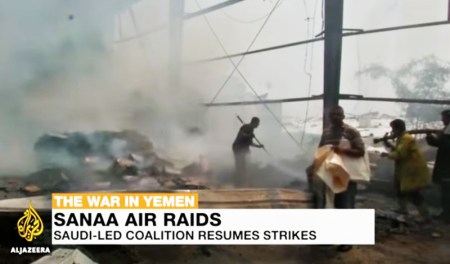
Within hours of the peace talks ending, the Saudi-led military coalition, which is backed by both the U.S. and Britain, had resumed air strikes against Houthi rebel positions in the Yemeni capital, Sana’a. Initial reports said that at least 21 people, the majority of them civilians, had been killed, including a number of workers in a potato chip factory in Sana’a. In addition, the international airport at Sana’a was shut down by the airstrikes after Saudi coalition officials notified airlines that incoming flights would be barred for 72 hours.

1774A factory in Sana’a, Yemen, burns after an airstrike on August 9, 2016. (Image source: Al Jazeera video screenshot)

It is the first time in five months that Sana’a has been bombed by warplanes from the coalition, which also includes the United Arab Emirates, Bahrain, Egypt, Sudan and other Middle East countries.

Human rights groups, which have repeatedly raised concerns about the high number of civilian casualties, will be particularly concerned by the resumption of hostilities. The U.S.-backed Saudi coalition is seeking to restore the democratically-elected government of President Abdrabbuh Mansour Hadi, who was forced to flee Sana’a in February by Houthi rebels. The Houthis are being supported by elite units from Iran’s Islamic Revolutionary Guards Corps (IRGC). More than 6,000 people have been killed in the civil war, including around 3,000 civilians.

Both sides in the conflict have been accused of causing unnecessary civilian casualties, with the Saudis, who have suffered significant casualties of their own, being singled out for particular censure over the way they have conducted coalition air strikes.

But an investigation conducted by coalition officials into claims that Saudi warplanes have directly targeted civilians found that the air strikes had been justified, because the Iranian-backed rebels had been using civilian institutions, such as hospitals, as command posts to launch attacks against coalition forces and their allies.

A report issued earlier this week by the coalition’s Joint Incidents Assessment Team (JIAT) refuted earlier claims by the French-based charity, Doctors Without Borders, that the Saudi coalition had deliberately caused civilian deaths by bombing Haiden Hospital in Yemen’s Saada province. Instead, investigators found that at the time of the attack, Houthi rebels were occupying the hospital, making it a legitimate target.

In all, JIAT investigated eight high-profile bombings where the UN or humanitarian organisations have accused the coalition of killing civilians or bombing hospitals and humanitarian structures. In each case, it concluded that all “safety procedures implemented by coalition forces adhered to international humanitarian law.”

The revelation that Iranian-backed Houthi rebels are deliberately using civilian institutions for their war effort inevitably will draw comparisons with the tactics used by other radical Islamist groups such Hamas, which regularly uses institutions such as hospitals to launch attacks against Israel.

“It is clear that the tactics used by the Houthis, where they are using places like hospitals for their military campaign, has contributed significantly to the heavy civilian death toll,” said a senior Western official. “While the West urges the Saudi-led coalition to use all means possible to avoid civilian casualties, we must also be aware of the tactics the Iranian-backed rebels are using as part of a deliberate policy to discredit the coalition war effort.”

Connecting the Nuclear Dots

August 5, 2016

Connecting the Nuclear Dots, Gatestone InstitutePeter Huessy, August 5, 2016

♦ Iran seeks to do us grave harm, potentially with ballistic missiles and nuclear weapons. The threat warnings are clear and we have strong evidence — Iran has attacked us repeatedly over the past 30 years.

♦ Instead of heeding the nuclear missile “dots” that are emerging all around us, we are busy promoting trade with Iran, downplaying its violations of the nuclear deal, simply ignoring its ballistic missile developments and dismissing the growing evidence of its terrorist past.

After the attacks on September 11, 2001, Congress, the Bush administration, and terrorist experts complained that the country had simply not “connected the dots” provided by prior terrorist threats.

The 9/11 Commission also concluded that the attacks “should not have come as a surprise,” as “Islamist extremists had given plenty of warning that they meant to kill Americans indiscriminately and in large numbers.”

The Commission then listed 10 Islamic terror plots against the US prior to 9/11:

“In February 1993, a group led by Ramzi Yousef tried to bring down the World Trade Center with a truck bomb.

“Plans by Omar Abdel Rahman and others to blow up the Holland and Lincoln tunnels and other New York City landmarks …

“In October 1993, Somali tribesmen shot down US helicopters, killing 18 and wounding 73…

“In early 1995, police in Manila uncovered a plot by Ramzi Yousef to blow up a dozen U.S. airliners while they were flying over the Pacific.

“In November 1995, a car bomb exploded outside the office of the US program manager for the Saudi National Guard in Riyadh, killing five Americans and two others.

“In June 1996, a truck bomb demolished the Khobar Towers apartment complex in Dhahran, Saudi Arabia, killing 19 US servicemen and wounding hundreds.

“In August 1998, al Qaeda, carried out near-simultaneous truck bomb attacks on the US embassies in Nairobi, Kenya, and Dar es Salaam, Tanzania. The attacks killed 224 people, including 12 Americans, and wounded thousands more.

“In December 1999, Jordanian police foiled a plot to bomb hotels and other sites frequented by American tourists…

“…US Customs agent arrested Ahmed Ressam at the US-Canadian border as he was smuggling in explosives intended for an attack on Los Angeles International Airport.

“In October 2000, an al Qaeda team in Aden, Yemen, used a motorboat filled with explosives to blow a hole in the side of a destroyer, the USS Cole, almost sinking the vessel and killing 17 American sailors.”

Despite the overwhelming indications that an attack like 9/11 was around the corner, as former Secretary of State Condoleezza Rice told the country in her April 2004 testimony to the 9/11 Commission, “The terrorists were at war with us, but we were not yet at war with them. For more than 20 years, the terrorist threat gathered, and America’s response across several administrations of both parties was insufficient.”

Are we now better equipped to “connect the terrorist-threats by dots” than we were prior to 9/11? Certainly we are not still echoing the testimony of Richard Clarke when he told the Emerging Threats Subcommittee in the summer of 2000 that the administration “had not yet” determined how to spend homeland security funds even some eight years after the first World Trade Center bombing of February 1993.

Unfortunately, not only are we not connecting the terrorist dots, we are actively downplaying their significance. Nowhere else is this more apparent than in the virtually complete failure, on the part of the US, to hold Iran responsible for the terror attacks that have killed and maimed thousands of Americans since 1979. This failure is all the more disturbing after the numerous court decisions that have found Iran accountable for nearly $60 billion in damages owed to the victims and survivors of these attacks, including the 9/11 attacks.

The outstanding news analyst and author Melanie Phillips wrote nearly a year ago that Iran had been “…perpetrating acts of war against Western interests for more than three decades — including playing a key role in the 9/11 attacks on America.” Phillips noted that a Revolutionary Guard-Iranian Intelligence (MOIS) task force

“designed contingency plans for unconventional warfare against the US… aimed at breaking the American economy, crippling or disheartening the US, and disrupting the American social, military and political order — all without the risk of a head-to-head confrontation which Iran knew it would lose.”

She explained that the court testimony from former Iranian agents illustrates that Iran “…devised a scheme to crash hijacked Boeing 747s into the World Trade Center, the White House and the Pentagon. … The plan’s code name was ‘Shaitan dar Atash’ (‘Satan in flames’).” Further, the court evidence revealed that Iran obtained “a Boeing 757-767-777 flight simulator which it hid at a secret site where the 9/11 terrorists were trained.”

In December 2011, Judge George B. Daniels found that Iran, with the participation of its Supreme Leader Ayatollah Ali Khamenei, was directly and heavily involved in the 9/11 atrocities. Khamenei instructed intelligence operatives that while expanding collaboration between Hezbollah and al-Qaeda, they must restrict communications to existing contacts with al-Qaeda’s second-in-command Ayman al Zawahiri and Imad Mughniyeh — Hezbollah’s then terrorism chief and agent of Iran.

1081Iran’s Supreme Leader, Ayatollah Ali Khamenei (center), is shown meeting in May 2014 with Iran’s military chief of staff and the commanders of the Islamic Revolutionary Guards Corps. (Image source: IRNA)

While the 9/11 Commission found solid evidence Iran aided the 9/11 hijackers in their travels from Iran, the “Extensive cooperation in major global terrorist activities,” between Iran, Hezbollah and Al Qaeda, including the 1996 bombing of the Khobar Towers housing complex in Saudi Arabia and the 1998 East Africa US embassy bombings, escaped the 9/11 Commission’s detailed attention. Notably, as long ago as in 2000, a US Defense Intelligence Agency analyst was alerting the government to a web of connections between al-Qaeda, the Iranian intelligence agencies controlled by Khamenei, and other terrorist groups.

Many press reports and analysts, cognizant of Iran’s terrorist history and aware that Iran has been designated by the US Department of State as the world’s premier state sponsor of terror, choose to believe the 2015 Iranian nuclear deal should not be derailed over concern of Iran’s possible future terrorist plans. Especially when it is often assumed these plans are aimed primarily at Israel and groups in Syria, Iraq and Lebanon, and thus not of real concern to the United States.

Is the nuclear deal with Iran thus a good trade? We get to slow Iran’s pursuit of nuclear weapons, but any serious sanctions or military effort to stop Iran’s terror agenda are off the table. Let’s connect the new nuclear-related Iran dots.

First, the world’s expert on Iran ballistic missiles, Uzi Rubin, revealed on July 15 that Iran has five new missile capabilities: they can strike the middle of Europe, including Berlin; they can target with GPS accuracy military facilities in Saudi Arabia; they can launch missiles from underground secret tunnels and caves without warning; they have missiles that are ready to fire 24/7; and they have developed other accurate missiles whose mission is to strike targets throughout Gulf region.

Second, the Associated Press revealed that a side agreement under the Joint Comprehensive Plan of Action (JCPOA) nuclear “deal” actually allows Iran to break out of the agreement in year 11, not 15, at which point Iran will not even be six months away from having sufficient nuclear fuel to arm a nuclear warhead, and Iran will be able to install nuclear centrifuges five times more efficient than the ones they have today.

Third, according to German intelligence reports, Iran has, a few dozen times since the July 2015 nuclear agreement, sought to purchase nuclear ballistic missile technology, a violation of previous UN resolutions.

As Americans wonder who will be behind the next terrorist attacks on our country — “lone wolf” terrorists inspired by social media from Islamist groups; organized cells of ISIS, Al Qaeda, Islamic Jihad, Hezbollah; states such as Iran and Syria; or a combination of all three — we would do well to be reminded of the long-term use of terrorism by the former Soviet Union as one of their trademark elements of “statecraft.”

Iran’s pursuit of nuclear weapons has not been stopped and at best has been delayed. Add to that Iran’s enhanced ballistic missile capability, its growing partnership with North Korea and its history of terrorist attacks on the United States, and connecting the dots reveals a stark reality — nuclear terrorism by missile may be on its way.

During the spring and summer of 2001, US intelligence agencies received a stream of warnings that Al Qaeda was determined to strike. The specific information pointed to threats from overseas. The Bush administration began developing a strategy in early 2001 to eliminate Al Qaeda in three years. The 9/11 attacks happened “too soon.”

Iran seeks to do us grave harm, potentially with ballistic missiles and nuclear weapons. The threat warnings are clear and we have strong evidence — Iran has attacked us repeatedly over the past 30 years

But instead of heeding the nuclear missile “dots” that are emerging all around us, we are busy promoting trade with Iran, downplaying its violations of the nuclear deal, simply ignoring its ballistic missile developments and dismissing the growing evidence of its terrorist past.

In short, we are not connecting these dots; we are erasing them.