Archive for the ‘Iranian nukes’ category

Iran Vows Nuclear Retaliation for U.S. Breach of Deal

December 14, 2016

Iran Vows Nuclear Retaliation for U.S. Breach of Deal, Washington Free Beacon, , December 14, 2016

Iranian President Hassan Rouhani speaks in a news briefing after his meeting with his Slovenian counterpart Borut Pahor at the Saadabad palace in Tehran, Iran, Tuesday, Nov. 22, 2016. (AP Photo/Vahid Salemi)

Iranian President Hassan Rouhani  (AP Photo/Vahid Salemi)

“But the Obama administration counted on Iran waiting until the next president before revealing the game, and the Iranians sprung the trap early,” the source added. “So now the administration will do everything it can to look the other way and get through the next few weeks, so they can blame the inevitable collapse on Trump.”

***************************

Senior Iranian officials vowed on Wednesday to continue moving forward with nuclear weapons work and other banned activities as retaliation against the United States for breaching last year’s nuclear accord, according to reports in the country’s state-controlled media.

Iranian leaders instructed the country’s atomic energy organization to move forward with sensitive nuclear work, including the construction of nuclear-powered ships and submarines.

Further provocative actions will be announced in the coming days, according to these Iranian leaders, who described the country’s actions as revenge for recent moves by the U.S. Congress to extend sanctions on Iran, a move the Islamic Republic claims is a breach of the nuclear deal.

Iran’s latest moves have not elicited concern from Obama administration officials, who continue to pursue a series of measures meant to decrease international pressure on Tehran and provide it with greater financial resources.

“Considering that the US administration has ignored and delayed compliance with its undertakings under the [nuclear agreement] and given the recent extension of the Iran Sanctions Act (ISA) that had already been declared as a violation of the nuclear deal by the Islamic Republic of Iran… the Atomic Energy Organization of Iran is ordered to develop the country’s peaceful nuclear program within the framework of the Islamic Republic of Iran’s international undertakings as defined in the following missions,” Iranian President Hassan Rouhani wrote in a letter Tuesday to the country’s top nuclear agency.

Iran will move forward with a “plan for designing and building propulsion systems to be used in marine transportation in cooperation with scientific and research centers,” according to Rouhani’s letter.

It also will engage in the “production of fuel for nuclear propulsion systems,” Rouhani wrote.

This is the first in a range of responses planned by Tehran, according to Ali Akbar Velayati, a senior aide to Iran’s Supreme Leader Ali Khamenei.

The renewed nuclear work is “the first but not the last measures to be taken by Iran,” Velayati was quoted as saying on Wednesday.

Iran’s announcement did not draw a sharp response from Obama administration officials, who declined to say whether the nuclear work would constitute a breach of the deal.

“This announcement itself does not constitute a violation,” State Department spokesman John Kirby told reporters. “I think there’s a lot we just don’t know. I mean, this announcement just got made. There’s a lot we don’t know about it and what it means. And so I think we’d have to reserve some judgment here about the degree to which this could present any kind of problem.”

Kirby expressed faith in international nuclear inspectors, telling reporters that they would likely catch a breach of the deal.

Michael Rubin, a former Pentagon adviser and expert of rogue regimes, told the Washington Free Beacon that Iran is using the renewal of sanctions as an excuse to ramp up its illicit research activities

“The JCPOA [Joint Comprehensive Plan of Action], which they have never officially signed, was a gift made possible by Obama’s ego and Kerry’s naiveté,” Rubin said. “If they disagree with the United States, they can follow a legal process to pursue that but the fact that they are having a temper tantrum shows their insincerity. Especially because no new sanctions have been applied to Iran. After all, the U.S. president can waive any sanctions so long as Iran complies with its commitments.”

One senior foreign policy consultant who has worked with Republican and Democratic offices in Congress on the issue told the Free Beacon that Iran always planned to breach the deal once it received promised economic relief.

“The Iran deal was deliberately structured to prevent American leaders from pressuring Iran. Kerry and his Iranian counterparts wrote the deal so that Iran would get most of the benefits immediately, so that they could blackmail American lawmakers by threatening to costlessly walk away, which is exactly what they’re doing,” the source said.

“But the Obama administration counted on Iran waiting until the next president before revealing the game, and the Iranians sprung the trap early,” the source added. “So now the administration will do everything it can to look the other way and get through the next few weeks, so they can blame the inevitable collapse on Trump.”

Iranian Official Reveals ‘Uncovering’ of Major US Cyber-Attack Plot — Failing to Mention Info Obtained From American Docu-Drama

December 13, 2016

Iranian Official Reveals ‘Uncovering’ of Major US Cyber-Attack Plot — Failing to Mention Info Obtained From American Docu-Drama, AlgemeinerRuthie Blum, December 12, 2016

maxresdefault-4-1024x576The slide of a clip in which ‘Zero Days’ is discussed. Photo: YouTube.

As The Algemeiner has reported extensively, Iranian officials have been issuing daily threats against Washington — particularly since last month’s election of Donald Trump to the presidency — about the Islamic Republic’s “fierce” response to any American breaches of the JCPOA, alongside muscle-flexing about the quality and quantity of its long-range missiles. Two weeks ago, the Senate passed a motion to extend the Iran Sanctions Act for an additional 10 years, which spurred the regime in Tehran to warn President Barack Obama not to approve the move.

********************

An Iranian Civil Defense Organization official announced on Monday that the United States is plotting a major cyber-attack on the Islamic Republic that will be more dangerous and wreak far more havoc that the Stuxnet virus, the semi-official state news agency Fars reported.

Addressing a conference in Tehran, Alireza Karimi said, “At present, the US has launched a project named Nitro Zeus with the aim of attacking Iran’s defense and telecommunication infrastructures.”

Karimi failed to mention, however, that he was actually referring to information revealed in “Zero Days,” an Alex Gibney docu-drama that premiered in July at the Berlin International Film festival. The film claimed that Nitro Zeus was developed as a backup plan in the event that Western efforts to curb Iran’s nuclear program by diplomatic means failed.

According to a description of the movie in the Tech Times, the major operation “took on great urgency as the [US] government believed that Israel Prime Minister Benjamin Netanyahu would launch a strike on the nuclear facilities of Iran, a move that would draw in the United States into the hostilities that [would] follow.”

However, the film claims that Nitro Zeus, the code name given to the mass malware operation that cost many millions of dollars, was shelved when the Joint Comprehensive Plan of Action — otherwise known as the nuclear deal — was signed between six world powers and Iran last year in July 2015.

In an extensive piece about the film, Newsweek wrote:

Gibney traces the development of Stuxnet to the last years of George W. Bush’s administration. It was a major operation, participants tell him, involving the CIA, the National Security Agency (NSA) and U.S. Cyber Command. On the Israeli side, it involved the Mossad…and Unit 8200, its military signals intelligence division. Britain’s General Communications Headquarters, its signals intelligence corps, also played a role. After the code for Stuxnet was written, it was tested both in the US and Israel on centrifuges identical to those used by Iranians. When CIA officials showed Bush the shards of a centrifuge that Stuxnet had destroyed, the president gave the OK to use it against Iran. The era of cyberwarfare had officially begun.

The participants who confirmed Stuxnet’s American and Israeli origins did so anonymously and off-camera, for fear of violating strict prohibitions against discussing classified information. That’s why Gibney used an actor…through [whom he] breaks his news in the film. “Stuxnet was just part of a much larger Iranian mission,” the character says… “Nitro Zeus would take out Iran’s strategic communications, air defenses, power grid, civilian communications, transportation and financial system…Nitro Zeus was the plan for a full-scale cyberwar with no attribution.”

Fars reported that Karimi’s remarks about Nitro Zeus came on the heels of a statement by the Civil Defense Organization chief, Brigadier General Mohammad Hassan Mansourian, who boasted his office’s capability to “defuse cyberattacks and cultural invasions.”

As The Algemeiner has reported extensively, Iranian officials have been issuing daily threats against Washington — particularly since last month’s election of Donald Trump to the presidency — about the Islamic Republic’s “fierce” response to any American breaches of the JCPOA, alongside muscle-flexing about the quality and quantity of its long-range missiles. Two weeks ago, the Senate passed a motion to extend the Iran Sanctions Act for an additional 10 years, which spurred the regime in Tehran to warn President Barack Obama not to approve the move.

Israel’s First Project with Trump

December 9, 2016

Israel’s First Project with Trump, Front Page MagazineCaroline Glick, December 9, 2016

firstproject

Originally published by the Jerusalem Post

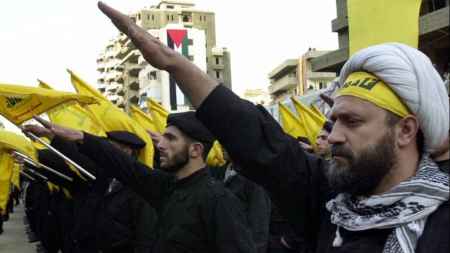
[R]ecently Hezbollah commander Hassan Nasrallah bragged, “We’re open about the fact that Hezbollah’s budget, its income, its expenses, everything it eats and drinks, its weapons and rockets are from the Islamic Republic of Iran.”

******************************

Israeli officials are thrilled with the national security team that US President-elect Donald Trump is assembling. And they are right to be.

The question now is how Israel should respond to the opportunity it presents us with.

The one issue that brings together all of the top officials Trump has named so far to his national security team is Iran.

Gen. (ret.) John Kelly, whom Trump appointed Wednesday to serve as his secretary of homeland security, warned about Iran’s infiltration of the US from Mexico and about Iran’s growing presence in Central and South America when he served as commander of the US’s Southern Command.

Gen. (ret.) James Mattis, Trump’s pick to serve as defense secretary, and Lt.-Gen. (ret.) Michael Flynn, whom he has tapped to serve as his national security adviser, were both fired by outgoing President Barack Obama for their opposition to his nuclear diplomacy with Iran.

During his video address before the Saban Forum last weekend, Prime Minister Binyamin Netanyahu said that he looks forward to discussing Obama’s nuclear Iran nuclear deal with Trump after his inauguration next month. Given that Netanyahu views the Iranian regime’s nuclear program – which the nuclear deal guaranteed would be operational in 14 years at most – as the most serious strategic threat facing Israel, it makes sense that he wishes to discuss the issue first.

But Netanyahu may be better advised to first address the conventional threat Iran poses to Israel, the US and the rest of the region in the aftermath of the nuclear deal.

There are two reasons to start with Iran’s conventional threat, rather than its nuclear program.

First, Trump’s generals are reportedly more concerned about the strategic threat posed by Iran’s regional rise than by its nuclear program – at least in the immediate term.

Israel has a critical interest in aligning its priorities with those of the incoming Trump administration.

The new administration presents Israel with the first chance it has had in 50 years to reshape its alliance with the US on firmer footing than it has stood on to date. The more Israel is able to develop joint strategies with the US for dealing with common threats, the firmer its alliance with the US and the stronger its regional posture will become.

The second reason it makes sense for Israel to begin its strategic discussions with the Trump administration by addressing Iran’s growing regional posture is because Iran’s hegemonic rise is a strategic threat to Israel. And at present, Israel lacks a strategy for dealing with it.

Our leaders today still describe Hezbollah with the same terms they used to describe it a decade ago during the Second Lebanon War. They discuss Hezbollah’s massive missile and rocket arsenal.

With 150,000 projectiles pointed at Israel, in a way it makes sense that Israel does this.

Just this week Israel reinforced the sense that Hezbollah is more or less the same organization it was 10 years ago when – according to Syrian and Hezbollah reports – on Tuesday Israel bombed Syrian military installations outside Damascus.

Following the alleged bombing, Defense Minister Avigdor Liberman told EU ambassadors that Israel is committed to preventing Hezbollah from transferring advanced weapons, including weapons of mass destruction, from Syria to Lebanon.

The underlying message is that having those weapons in Syria is not viewed as a direct threat to Israel.

Statements like Liberman’s also send the message that other than the prospect of weapons of mass destruction or precision missiles being stockpiled in Lebanon, Israel isn’t particularly concerned about what is happening in Lebanon.

These statements are unhelpful because they obfuscate the fact that Hezbollah is not the guerrilla organization it was a decade ago.

Hezbollah has changed in four basic ways since the last war.

First, Hezbollah is no longer coy about the fact that it is an Iranian, rather than Lebanese, organization.

Since Iran’s Revolutionary Guards founded Hezbollah in Lebanon in 1983, the Iranians and Hezbollah terrorists alike have insisted that Hezbollah is an independent organization that simply enjoys warm relations with Iran.

But today, with Hezbollah forming the backbone of Iran’s operations in Syria, and increasingly prominent in Afghanistan and Iraq, neither side cares if the true nature of their relationship is recognized.

For instance, recently Hezbollah commander Hassan Nasrallah bragged, “We’re open about the fact that Hezbollah’s budget, its income, its expenses, everything it eats and drinks, its weapons and rockets are from the Islamic Republic of Iran.”

What our enemies’ new openness tells us is that Israel must cease discussing Hezbollah and Iran as separate entities. Israel’s next war in Lebanon will not be with Hezbollah, or even with Lebanon. It will be with Iran.

This is not a semantic distinction. It is a strategic one. Making it will have a positive impact on how both Israel and the rest of the world understand the regional strategic reality facing Israel, the US and the rest of the nations of the Middle East.

The second way that Hezbollah is different today is that it is no longer a guerrilla force. It is a regular army with a guerrilla arm and a regional presence. Its arsenal is as deep as Iran’s arsenal.

And at present at least, it operates under the protection of the Russian Air Force and air defense systems.

Hezbollah has deployed at least a thousand fighters to Iraq where they are fighting alongside Iranian forces and Shi’ite militia, which Hezbollah trains. Recent photographs of a Hezbollah column around Mosul showed that in addition to its advanced missiles, Hezbollah also fields an armored corps. Its armored platforms include M1A1 Abrams tanks and M-113 armored personnel carriers.

The footage from Iraq, along with footage from the military parade Hezbollah held last month in Syria, where its forces also showed off their M-113s, makes clear that Hezbollah’s US platform- based maneuver force is not an aberration.

The significance of Hezbollah’s vastly expanded capabilities is clear. Nasrallah’s claims in recent years that in the next war his forces will stage a ground invasion of the Galilee and seek to seize Israeli border towns was not idle talk. Even worse, the open collaboration between Russia and Iran-Hezbollah in Syria, and their recent victories in Aleppo, mean that there is no reason for Israel to assume that Hezbollah will only attack from Lebanon. There is a growing likelihood that Hezbollah will make its move from Syrian territory.

The third major change from 2006 is that like Iran, Hezbollah today is much richer than it was before Obama concluded the nuclear deal with the ayatollahs last year. The deal, which canceled economic and trade sanctions on Iran, has given the mullahs a massive infusion of cash.

Shortly after the sanctions were canceled, the Iranians announced that they were increasing their military budget by 90%. Since Hezbollah officially received $200 million per year before sanctions were canceled, the budget increase means that Hezbollah is now receiving some $400m. per year from Iran.

The final insight that Israel needs to base its strategic planning on is that a month and a half ago, Hezbollah-Iran swallowed Lebanon.

In late October, after a two-and-a-half-year fight, Saad Hariri and his Future Movement caved to Iran and Hezbollah and agreed to support their puppet Michel Aoun in his bid for the Lebanese presidency.

True, Hariri was also elected to serve as prime minister. But his position is now devoid of power.

Hariri cannot raise a finger without Nasrallah’s permission.

Aoun’s election doesn’t merely signal that Hariri caved. It signals that Saudi Arabia – which used the fight over Lebanon’s presidency as a way to block Iran’s completion of its takeover of the country – has lost the influence game to Iran.

Taken together with Saudi ally Egyptian President Abdel Fattah al-Sisi’s announcement last week that he supports Syrian President Bashar Assad’s remaining in power, Aoun’s presidency shows that the Sunnis have accepted that Iran is now the dominant power in Iraq, Syria and Lebanon.

This brings us back to Hezbollah’s tank corps and the reconstruction of the US-Israel alliance.

After the photos of the US-made armored vehicles in Hezbollah’s military columns were posted online, both Hezbollah and the Lebanese Armed Forces insisted that the weapons didn’t come from the LAF.

But there is no reason to believe them.

In 2006, the LAF provided Hezbollah with targeting information for its missiles and intelligence support. Today it must be assumed that in the next war, the LAF, and its entire arsenal will be placed at Hezbollah-Iran’s disposal. In 2016 alone, the US provided the LAF with $216m. in military assistance.

From Israel’s perspective, the most strategically significant aspect of Hezbollah-Iran’s uncontested dominance over all aspects of the Lebanese state is that while they control the country, they are not responsible for it.

Israeli commanders and politicians often insist that the IDF has deterred Hezbollah from attacking Israel. Israel’s deterrence, they claim, is based on the credibility of our pledge to bomb the civilian buildings now housing Hezbollah rockets and missiles in the opening moments of the next conflict.

These claims are untrue, though. Since Hezbollah- Iran are not responsible for Lebanon despite the fact that they control it through their puppet government, Iranian and Hezbollah leaders won’t be held accountable if Israel razes south Lebanon in the next war. They will open the next war not to secure Lebanon, but to harm Israel. If Lebanon burns to the ground, it will be no sweat off their back.

The reason a war hasn’t begun has nothing to do with the credibility of Israel’s threats. It has to do with Iran’s assessment of its interests. So long as the fighting goes on in Syria, it is hard to see Iran ordering Hezbollah to attack Israel. But as soon as it feels comfortable committing Hezbollah forces to a war with Israel, Iran will order it to open fire.

This then brings us back to the incoming Trump administration, and its assessment of the Iranian threat.

Trump’s national security appointments tell us that the 45th president intends to deal with the threat that Iran poses to the US and its interests.

Israel must take advantage of this strategic opening to deal with the most dangerous conventional threat we face.

In our leaders’ conversations with Trump’s team they must make clear that the Iranian conventional threat stretches from Afghanistan to Israel and on to Latin America and Michigan. Whereas Israel will not fight Iran in Iraq and Afghanistan, or in the Americas, it doesn’t expect the US to fight Iran in Lebanon. But at the same time, as both allies begin to roll back the Iranian threat, they should be operating from a joint strategic vision that secures the world from Iran’s conventional threat.

And once that it accomplished, the US and Israel can work together to deal with Iran’s nuclear program.

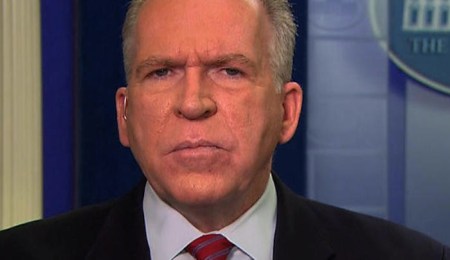
CIA’s Brennan says tearing up the Iran deal would be “height of folly”

December 1, 2016

CIA’s Brennan says tearing up the Iran deal would be “height of folly”, Jihad Watch

(Brennan’s statement is not the “clearest indication yet” that the Iran Scam needs to be rejected; many others predated it. It is, however, another pretty good indication of Brennan’s level of competence. — DM)

This is the clearest indication yet that tearing up the Iran deal is just what the U.S. needs to do. “Do the opposite of what John Brennan recommends” would be the wisest course the next administration could possibly take. John Brennan is the person who — after U.S. Muslim groups demanded he do so – “purged” all mention of Islam and jihad from law enforcement counter-terror training materials in 2011.

john_brennan

“CIA’s Brennan says tearing up Iran deal would be ‘folly,’” CNBC, November 30, 2016 (thanks to Lookmann):

Outgoing CIA Director John Brennan has said it would be the “height of folly” for U.S. President-elect Donald Trump to tear up Washington’s deal with Tehran because it would make it more likely that Iran and others would acquire nuclear weapons.

“It could lead to a weapons program inside of Iran that could lead other states in the region to embark on their own programs,” Brennan said in an interview with the BBC aired on Wednesday.

“So I think it would be the height of folly if the next administration were to tear up that agreement.”…

WikiLeaks: Podesta Agreed that Iran Deal is Disastrous

October 15, 2016

WikiLeaks: Podesta Agreed that Iran Deal is Disastrous, Power Line, Paul Mirengoff, October 14, 2016

Among the recent WikiLeaks documents is an exchange between John Podesta, Hillary Clinton’s campaign manager, and John Anzalone of something called Anzalone Liszt Grove Research. Anzalone sent Podesta an email that consisted of a quote from Sen. Mark Kirk contained in a BuzzFeed article about the Iran deal. Analone also included a link to the article.

In the quoted portion of the article, Kirk said that the Iran deal “condemns the next generation to cleaning up a nuclear war in the Persian Gulf.” Kirk added: “This is the greatest appeasement since Chamberlain gave Czechoslovakia to Hitler.”

Podesta responded to this email by saying: “Yup.”

Hillary Clinton backed the Iran deal and continues to do so. Nor is she alone. Virtually the entire Democratic Party publicly supports this disastrous agreement.

Neither Podesta nor the Clinton campaign has denied the authenticity of the email exchange, according to this report from a Chicago television station. Instead, Podesta condemned Russia for the leaks which he says are designed to help Donald Trump.

Regardless of how one views the leaks, many of them have been enlightening. The Podesta-Anzalone exchange is no exception. I see no explanation for Podesta’s “yup” other than his concurrence with Sen. Kirk’s grim assessment of the Iran deal. Thus, we can conclude that Podesta agreed with Kirk that the centerpiece of President Obama’s foreign policy, supported by Hillary Clinton, is atrocious.

I wonder whether Hillary agrees. If so, it’s another example of her duplicity, but also a rare instance of sound judgment.

In NBC Interview, Hassan Rouhani Can’t Stop Lying

October 2, 2016

In NBC Interview, Hassan Rouhani Can’t Stop Lying, The TowerDavid Gerstman, October 2, 2016

(Rouhani and Hillary would make a good team for Iran. DM)

rouhanilies

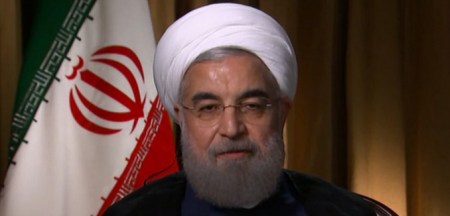
The portrait that emerges from Rouhani’s interview is of a man who lies and distorts to defend Iran’s illicit behavior— with its domestic nuclear program and in Syria. Simply put, Rouhani is not a “moderate,” as he is so often described, but an apologist for Iran’s revolutionary regime that operates in defiance of international law and norms.

****************************

In an interview two weeks ago, Iranian President Hassan Rouhani consistently lied and evaded questions put to him by NBC News’s Chuck Todd.

Todd first asked why Iran was claiming that the United States was not living up to the nuclear deal, known as the Joint Comprehensive Plan of Action (JCPOA). Rouhani responded that the deal states “that all nations involved in this agreement must free the path, pave the way for resumption of normal activities with the Islamic Republic of Iran, such as banking transactions, insurance transactions, and the likes.” Not only is that not correct, it fits a pattern described earlier this week by analysts from the Foundation for Defense of Democracies, in which Iran hopes to gain additional concessions by threatening to walk away from the deal unless the West provides every economic concession that it believes it is owed.

The United States was only required to suspend its nuclear-related sanctions, not sanctions placed on Iran due to its history of terror financing and money laundering. (The United States has seen to it that the global watchdog against money laundering, the Financial Action Task Force, relaxed some restriction on Iran despite Iran’s continued presence at the top of the list of money launderers.)

When asked by Todd whether that was a misinterpretation of the deal’s sanctions-related clauses, Rouhani evaded the question, instead accusing the United States of blocking access to large financial institutions. Then he added that “the other breach of the agreement on the side of the United States, it has been brought into the JCPOA that airplanes intended for civil aviation only must be freely sold to Iran.”

But the airplanes that Iran wants are likely not “intended for civil aviation only.” As Emanuele Ottolenghi of the Foundation for Defense of Democracies has shown, Iran Air, Iran’s national airline, which is seeking to purchase planes from Boeing and Airbus, is using planes to transport arms and troops to Syria to support the regime of Syrian dictator Bashar al-Assad. Transporting soldiers and materiel is not “civil aviation.”

Todd later asked Rouhani if the world should be concerned about Iran’s intentions once most nuclear restrictions on Iran are lifted. Rouhani responded that Iran has adopted additional anti-weaponization safeguards as per the JCPOA, and even if these measures weren’t in place, “within the doctrine or within the laws of the Islamic Republic of Iran to include the fatwa issued by the Supreme Leader of the Islamic Republic of Iran…the building or pursuing or obtaining and using any type of weapons of mass destruction are strictly and unequivocally forbidden by Islamic law.”

The Middle East Media Research Institute has searched for a record of Khamenei’s nuclear fatwa and found no such fatwa. Mehdi Khalaji, an Iran expert at the Washington Institute for Near East Policy (WINEP), wrote in a 2011 study (.pdf) “no written texts exist for the Supreme Leader’s fatwas.” But as WINEP research director Patrick Clawson observed in the preface to Khalaji’s analysis, even if Khamanei had issued such a fatwa, “past proclamations about the matter, like all fatwas issued by Shiite clerics, can be revised under new circumstances.”

Furthermore, Rouhani himself said in a 2005 speech (.pdf) that “having [nuclear] fuel cycle capability almost means that the country that possesses this capability is able to produce nuclear weapons, should that country have the political will to do so,” suggesting that he believes the decision to develop nuclear weapons to be a political, not religious, decision.

Todd followed up by asking Rouhani why Iran has deployed a missile defense system at the Fordow nuclear site if its purpose is strictly civilian. Rouhani cited the need for Iranians to “defend ourselves,” but didn’t fully address the question. When Todd persisted, Rouhani stated that “Iran has always maintained her commitment to any agreement it has become a signatory of. You will not find any instances during the past 38 years of the history of the Islamic Republic of Iran in which a bilateral agreement or an international agreement has been signed and Iran has broken its commitment.”

This is blatantly false. Iran, a signatory to the Nuclear Nonproliferation Treaty refused to end its uranium enrichment program despite the threat of being sanctioned by the United Nations Security Council. The JCPOA allowed Iran to maintain a portion of its enrichment capacity, which it had maintained despite being repeatedly sanctioned. Being forgiven for the breach of an agreement is not the same thing as having abided by it.

Then Rouhani added, “What we were accused of for years, called ‘possible military dimensions,’ the International Atomic Energy Agency eventually reached the conclusion that that file must be closed for good and announced that the activities of Iran were solely for peaceful purposes.”

This is also false. The IAEA report (.pdf) last December did not find that Iran’s nuclear activities “were solely for peaceful purposes.” Rather, it found that Iran had a military nuclear program until at least 2009, though it found “no credible indications” that its military nuclear program continued after this point. It’s true that the IAEA closed down its investigation of Iran’s past nuclear work, but as the Institute for Science and International Security assessed, “the IAEA’s report can be viewed, at best, as a document that closes the process set forth by terms of the Roadmap” to the nuclear deal, but not as a clean bill of health.

Rouhani’s protestations of abiding by the deal also must be viewed with a certain amount of skepticism based on his own record as Iran’s lead nuclear negotiator more than a decade ago. In 2006, after he left the position, Rouhani boasted in a meeting with Islamic clergy and scholars that he had duped the West. Rouhani claimed that Iran had continued installing equipment for converting yellowcake, one of the ingredients necessary for creating nuclear fuel, even as he told his European counterparts that there was no nuclear work being performed at that time.

“When we were negotiating with the Europeans in Tehran we were still installing some of the equipment at the Isfahan site,” Rouhani told his audience. “There was plenty of work to be done to complete the site and finish the work there. In reality, by creating a tame situation, we could finish Isfahan.”

Similarly, when he was running for president in 2013, Rouhani said in an interview that he used the earlier negotiations to advance Iran’s clandestine, illicit nuclear work, boasting, “We halted the nuclear program? We were the ones to complete it! We completed the technology.”

Todd then asked Rouhani about Iran’s involvement in the Syrian Civil War, starting with a question about the recent Russian bombing of a humanitarian convoy, which killed 20 aid workers and which one United Nations official called a war crime. Instead of condemning the attack, Rouhani pointed to a mistaken American airstrike on a Syrian army position—as if an accidental bombing somehow excuses a deliberate one. Rouhani also claimed that since the Syrian soldiers were fighting ISIS (also known as Daesh), the United States was involved in “a direct defense of the Daesh terrorist group.” The charge is outrageous. Even though Syrian troops have been targeting civilians, the United States said that it was an accident and apologized.

Rouhani went on to state that Israel had also attacked some Syrian positions, though he neglected to mention that it was in response to shells being fired into Israel. He allowed that a ceasefire would be beneficial because “food stuff and medicines can get to those who are in need and have been waiting for those supplies for months.” But he didn’t mention that the party engaging in the sieges is Assad, with Iran’s backing.

In response to Secretary of State John Kerry’s recent call for a halt to all flying above Syria, Rouhani stated that “any proposal can be coordinated in order to avoid the targeting of humanitarian convoys.” But a general from his own country’s Islamic Revolutionary Guard Corps (IRGC) boasted last month that Iran provides intelligence on the ground to guide Russia’s bombing campaigns. Given this, and the ensuing possibility that Iranian troops were complicit in the bombing in question, Rouhani’s assurances that convoys can be protected are glib and meaningless.

The portrait that emerges from Rouhani’s interview is of a man who lies and distorts to defend Iran’s illicit behavior— with its domestic nuclear program and in Syria. Simply put, Rouhani is not a “moderate,” as he is so often described, but an apologist for Iran’s revolutionary regime that operates in defiance of international law and norms.

North Korean Nukes, South Korea, Japan, China and Obama

September 10, 2016

North Korean Nukes, South Korea, Japan, China and Obama, Dan Miller’s Blog, September 10, 2016

(The views expressed in this article are mine and do not necessarily reflect those of Warsclerotic or its other editors. — DM)

On September 9th, North Korea conducted its fifth nuke test, of its most powerful nuke thus far. Can Obama get China to help make North Korea stop developing and testing nukes? Nope. China sees Obama, not as the representative of the world’s greatest power, but as a joke. He has no clout internationally and is a national embarrassment.

China and North Korea – a very short history

Here’s a link to an article I posted on June 25, 2013 about the Korean conflict. To summarize, China and the Democratic People’s Republic of Korea (North Korea) have a long history of acting together. China views the Republic of Korea (South Korea), which borders North Korea to the south and is an American ally, as a threat. She does not want reunification of the Korean peninsula under a government favorable to America.

When, on June 25, 1950, North Korea invaded South Korea with Russian aircraft, weaponry, training and other substantial support, China did not assist North Korea. North Korean forces pushed the South Korean government, as well as the few American military advisers (then under the command of the Department of State), south to the Pusan perimeter. Following General MacArthur’s unexpected and successful Inchon invasion which began on September 15th, American and other United Nations forces pushed the North Korean forces back north: MacArthur sent his by then greatly augmented forces east to Wonson and eventually managed to push North Korean forces to the northern side of the Yalu River. However, Chinese forces struck back en masse and MacArthur’s forces were driven back to Seoul.

Ever since bringing to an end MacArthur’s successes in the Korean Conflict, China has supported North Korea. She has opposed, and has then declined to enforce, significant sanctions responsive to North Korean nuclear and missile development and testing. While China may acquiesce in weak UN resolutions condemning North Korean provocations, she rarely goes beyond that.

China, Japan and the two Koreas

China has a long memory and still resents, bitterly, the lengthy period prior to and during World War II when Japan occupied significant parts of China. Ditto South Korea, all of which was under Japanese occupation for a lengthy period prior to and during World War II. Although China has substantial trade with both South Korea and Japan, she is more hostile to Japan than is South Korea; the latter two have substantial mutual interests transcending trade.

Perhaps the most important current dispute between China on the one hand, and Japan-South Korea-America on the other, involves the plans of Japan and South Korea to defend against North Korean missiles by the installation of THAAD anti-missile weapons provided by America. China’s stated reason for opposition to the THAAD system is that it could be used against Chinese, as well as North Korean, missiles. Why does China assert this objection unless she hopes to fire missiles at one or both of them? If China fires missiles at Japan and/or South Korea, they have every right to destroy her missiles and to respond in kind with U.S. assistance if requested.

President Obama

condemned Pyongyang’s fifth nuclear test today in the “strongest possible terms as a grave threat to regional security and to international peace and stability” as outraged lawmakers from both parties called for tougher action to stop North Korea’s nuclear program. [Emphasis added.]

That may well be all that Obama does — despite the warnings of Rep. Adam Smith (D-Wash.), the top Democrat on the House Armed Services Committee, that

we have to make it absolutely clear that if they engage in any military activity, they will be destroyed. We have to have a credible deterrent. That seems to be the only thing that will stop North Korea from engaging in military action… We have sanctioned them, and we should keep sanctioning them, but it’s not going to stop them from developing the nuclear weapons.” [Emphasis added.]

Obama won’t do that:

In a statement Friday, President Obama vowed to “take additional significant steps, including new sanctions, to demonstrate to North Korea that there are consequences to its unlawful and dangerous actions.”

Obama did not suggest what He might have in mind, beyond historically ineffective sanctions and condemnations “in the strongest possible terms,” to let North Korea know that there will be “consequences.”

A September 9th article at the New York Times provides an unpleasant analysis of the options Obama now has, and which His successor will have, in dealing with North Korea.

A hard embargo, in which Washington and its allies block all shipping into and out of North Korea and seek to paralyze its finances, risks confrontations that allies in Asia fear could quickly escalate into war. But restarting talks on the North’s terms would reward the defiance of its young leader, Kim Jong-un, with no guarantee that he will dismantle the nuclear program irrevocably.

For more than seven years, President Obama has sought to find a middle ground, adopting a policy of gradually escalating sanctions that the White House once called “strategic patience.” But the test on Friday — the North’s fifth and most powerful blast yet, perhaps with nearly twice the strength of its last one — eliminates any doubt that that approach has failed and that the North has mastered the basics of detonating a nuclear weapon.

Despite sanctions and technological backwardness, North Korea appears to have enjoyed a burst of progress in its missile program over the last decade, with experts warning that it is speeding toward a day when it will be able to threaten the West Coast of the United States and perhaps the entire country. [Emphasis added.]

. . . .

Mr. Obama has refused to negotiate with the North unless it agrees first that the ultimate objective of any talks would be a Korean Peninsula without nuclear arms. But Mr. Kim has demonstrated, at least for now, that time is on his side. And as he gets closer to an ability to threaten the United States with a nuclear attack, and stakes the credibility of his government on it, it may be even more difficult to persuade him to give up the program.

 In a statement Friday, Mr. Obama condemned the North’s test and said it “follows an unprecedented campaign of ballistic missile launches, which North Korea claims are intended to serve as delivery vehicles intended to target the United States and our allies.”

“To be clear, the United States does not, and never will, accept North Korea as a nuclear state,” he said.

Many experts who have dealt with North Korea say the United States may have no choice but to do so. [Emphasis added.]

“It’s too late on the nuclear weapons program — that is not going to be reversed,” William Perry, the defense secretary under President Bill Clinton during the 1994 nuclear crisis with North Korea, said in August at a presentation in Kent, Conn. The only choice now, he argued, is to focus on limiting the missile program. [Emphasis added.]

Obama has taken no significant steps to limit Iran’s continuing missile development and testing program. How can He limit that of North Korea without Chinese cooperation?

Yet the latest effort to do that, an agreement between the United States and South Korea to deploy an advanced missile defense system in the South, has inflamed China, which argues the system is also aimed at its weapons. While American officials deny that, the issue has divided Washington and Beijing so sharply that it will be even more difficult now for them to come up with a joint strategy for dealing with the North. [Emphasis added.]

China has been so vocal with its displeasure over the deployment of the American system that Mr. Kim may have concluded he could afford to upset Beijing by conducting Friday’s test. [Emphasis added.]

Fueling that perception were reports that a North Korean envoy visited Beijing earlier this week.

North Korea almost certainly sees this as an opportunity to take steps to enhance its nuclear and missile capabilities with little risk that China will do anything in response,” Evans J.R. Revere, a former State Department official and North Korea specialist, said in a speech in Seoul on Friday. [Emphasis added.]

The breach between China and the United States was evident during Mr. Obama’s meeting with President Xi Jinping last week. “I indicated to him that if the Thaad bothered him, particularly since it has no purpose other than defensive and does not change the strategic balance between the United States and China, that they need to work with us more effectively to change Pyongyang’s behavior,” Mr. Obama said, referring to the Terminal High Altitude Area Defense system, as the advanced missile defense project is known. [Emphasis added.]

North Korea and Iran

Iran and North Korea have a long history of cooperation in developing nukes and missiles with which to deliver them. In the past, Iranian scientists have been present at North Korean nuke tests, and vice versa. They have also assisted each other in the development of nukes and missiles.

Iran and North Korea have substantial reasons to cooperate: by virtue of the Iran scam, Iran now has lots of money but is at least minimally restricted in its nuke development. North Korea has little usable currency, needs whatever it can get, and no attempts to halt or even to limit its nuke development have worked.

A missile fired recently by North Korea bore a striking resemblance to an Iranian missile.

Photos released by North Korea of its launch of long-range ballistic missiles are the latest proof of the close military cooperation between Pyongyang and Tehran, an Israeli expert in the field told the news site IsraelDefense on Tuesday.

According to Tal Inbar — head of Space and UAV Research Centre at the Fisher Institute for Air & Space Strategic Studies — what was new in the photos was the shape of the warheads attached to the Nodong missiles, known in Iran as the Shahab-3.

Until now, such warheads — first detected by Inbar in Iran in 2010 — have not been seen in North Korea. At the time, Inbar dubbed them NRVs (or, “new entry vehicles”), which became their nickname among missile experts around the world. [Emphasis added.]

Inbar told IsraelDefense: “The configuration that we saw [on Tuesday] is identical to what we saw in Iran six years ago. In principle, its penetrating body (warhead) is identical to that of Scud missiles, but is mounted on the Shahab-3, and creates a more stable entity than other Shahab/Nodong warheads.”

Inbar said this was the third time that something of this nature had appeared in Iran before it did in North Korea. “But we must remember that the two countries engage in close cooperation where military and space-directed missiles are concerned,” he said. “It is thus possible that both plans and technology are being transferred regularly from one to the other.” [Emphasis added.]

Are North Korea and Iran rational? According to this New York Times analysis, North Korea is.

North Korea’s actions abroad and at home, while abhorrent, appear well within its rational self-interest, according to a 2003 study by David C. Kang, a political scientist now at the University of Southern California. At home and abroad, he found, North Korean leaders shrewdly determined their interests and acted on them. (In an email, he said his conclusions still applied.) [Emphasis added.]

“All the evidence points to their ability to make sophisticated decisions and to manage palace, domestic and international politics with extreme precision,” Mr. Kang wrote. “It is not possible to argue these were irrational leaders, unable to make means-ends calculations.” [Emphasis added.]

Victor Cha, a Georgetown University professor who served as the Asian affairs director on George W. Bush’s National Security Council, has repeatedly argued that North Korea’s leadership is rational.

I submit that the same analysis, applied to Iran, produces the same result. Iran’s leaders know what they want, and are sufficiently rational to achieve it; they did. Obama, not the leader of a dictatorial theocracy, is sufficiently irrational to believe that what he wants for the Islamic Republic of Iran is what America needs it to have. It is not.

Obama and Iran

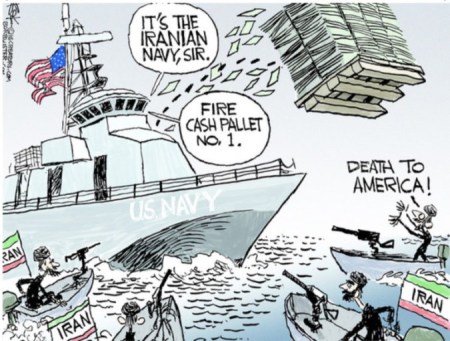
Obama’s Iran scam would be farcical were it not potentially deadly. He did not do what would have been best for America and the free world in general — increase sanctions until Iran complied fully with UN resolutions on missile testing, ceased Uranium enrichment and disposed of the means to do it, ceased all nuke research as well as all nuke cooperation with North Korea and ceased supporting all terrorist groups, including Hezbollah and Hamas. Instead, perhaps considering Himself above such trivia, Obama sought little more than what He considered His greatest achievement — His legacy:

iranian-navy-copy-1

Conclusions

If Obama were viewed internationally as the powerful leader of the world’s most powerful nation, He might be able to get China to clamp down, severely and successfully, on North Korea’s nuke and missile development. Were China to reject His overtures, He could arrange for it to wish that it had acceded. That’s not who Obama is, as demonstrated by, among His other actions, entering into the Iran Scam deal with Iran.

Perhaps Kim Jong-un needs to dress like an Iranian mullah to convince Obama to give him a “deal” similar to the one He gave to Iran. He had better hurry: that won’t work with President Trump.

Column One: Obama’s greatest achievement

September 1, 2016

Column One: Obama’s greatest achievement, Jerusalem PostCaroline B. Glick, September 1, 2016

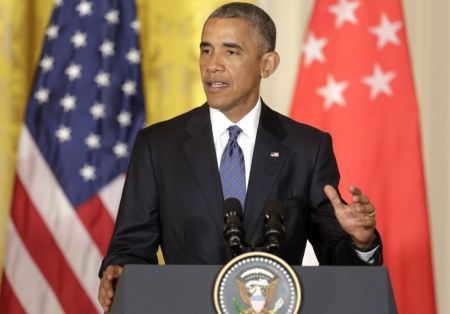
Obama lies on Iran scamU.S. President Barack Obama and Singapore Prime Minister Lee Hsien Loong (not pictured) speak during a press conference at the White House in Washington, U.S., August 2, 2016.  (photo credit:REUTERS)

The time for complaining about President Barack Obama’s nuclear deal with Iran has passed. The time has come to overcome the damage enormous damage his signature foreign policy accomplishment has caused.

To understand why this is the case, it is important to understand the breadth and depth of Obama’s failure.

On August 4, during the course of a press conference, Obama gave his interim assessment of his nuclear agreement with Iran.

“It worked,” he insisted.

A year after the deal was signed, Obama argued, events have proven that he was right and the deal’s critics were wrong.

“You’ll recall that there were all these horror stories about how Iran was going to cheat and this wasn’t going to work and Iran was going to get $150 billion to finance terrorism and all these kinds of scenarios, and none of them have come to pass,” he proclaimed.

Obama then snidely swiped at the deal’s opponents saying that it would be “impressive” if the people who criticized the deal would own up to their mistakes and admit that it worked.

As it works out, everything that Obama said about the deal with Iran during his press conference was a lie.

Some of his lies became apparent within hours.

For instance, Obama falsely claimed that Israel now “acknowledges this has been a game changer and Iran has abided by the deal and they no longer have the sort of short-term breakout capacity that would allow them to develop nuclear weapons.”

Hours later, the Defense Ministry issued a stinging rebuke of Obama’s claim, parroted more diplomatically by the Prime Minister’s Office.

Obama’s press conference took place the day after The Wall Street Journal reported that in January 2016, the US sent an unmarked plane to the Tehran airport filled with $400 million in cash, on the same day Iran released four US hostages.

Obama angrily rejected allegations that the cash payment was a ransom payment for the hostages’ release. He insisted that the US had made the payment as the first installment of a $1.7b. payment the administration made to settle an Iranian government lawsuit against America.

Obama claimed that the administration agreed to the settlement at the urging of the Justice Department.

He said his administration was able to settle the dispute only due to the nuclear deal which placed US officials in direct contact with their Iranian counterparts for the first time in decades.

Within a day, Obama’s claims were exposed as lies. It turns out that Justice Department lawyers opposed the cash payout to Iran.

One of the hostages released in January told the media that the Iranians refused to allow the hostages to leave Iran until the airplane with the cash landed in the airport.

The Iranians, for their part, contemptuously mocked Obama, and stated openly that the $400m.

was a ransom payment for the hostages.

Two weeks later, Obama’s State Department admitted that the $400m. was a payment for the hostages.

Obama’s principle claim is that due to his deal, Iran no longer has a short-term nuclear breakout capacity. He also says that in accordance with the deal, Iran has shipped its nuclear materials out of the country. These claims are both untrue and misleading.

On Thursday Reuters reported that Iran did not ship the quantities of low-enriched uranium out of the country in the quantities the deal required.

Last January, when the deadline arrived for Iran to comply with the deal’s clauses calling for it to move its uranium enriched to 3.5 percent and 20 percent out of the country and so enable the US and its European colleagues to cancel UN sanctions against it, it worked out that Iran had failed to comply.

Rather than acknowledge Iran’s failure and maintain the sanctions in accordance with their deal, the Americans and Europeans decided to move the goalpost closer to Iran.

They secretly decreased the amount of uranium the Iranians were required to part with. They then announced triumphantly that they were canceling UN sanctions because Iran had complied with the agreement.

Reuters reported that much of the low-enriched uranium Iran did remove from its territory wasn’t actually removed from its possession. Instead it was transferred to neighboring Oman, where it is held under Iranian guard and control.

Obama of course knows all of this. So his claims that the agreement “worked” are nothing more than a card trick meant to trick the American public.

Obama’s assertion that Iran’s breakout time to a nuclear arsenal has been slowed as a result of his deal is similarly a stretch of the imagination. The Iranians have suspended much of their prior centrifuge spinning. But that is only because they are now directing their efforts to developing and deploying more advanced centrifuges that will be able to enrich uranium to bomb grade material far more rapidly than the centrifuges they were required to retire.

Experts have already placed Iran’s post-deal nuclear breakout time at a mere six months. And Iran can leave the agreement – which it never actually signed or officially agreed to – anytime it wants.

While developing their next generation centrifuges, the Iranians are expanding the range and precision of their ballistic missiles, deploying them and increasing the size of their arsenals. Despite the fact that these actions are prohibited under US law and breach what was initially claimed about the ever-changing nuclear deal, the Obama administration has refused to impose sanctions against Iran, insisting that its actions merely breach the spirit, rather than substance, of the deal.

The administration has had a similar response to Iran’s recent deployment of Russia’s S-300 missile defense battery around its military nuclear site at Fordo. On Sunday Iranian television showed footage of the missiles being set up around the formerly secret site.

As Omri Ceren of the Israel Project noted this week, Iran’s deployment of the S-300 system places it in breach of three US sanctions laws. Despite this, the White House announced on Wednesday that it has no intention of enforcing US law and applying sanctions on Iran. The S-300 missiles can be used both as a defensive system and as an offensive one.

On Tuesday, Tehran announced that it will be launching three satellites in the coming months.

Satellite launches are widely viewed as a means through which Iran is covertly developing a longrange ballistic missile capability. Rather than censure Iran for its actions, the Obama administration insists that such actions, as well as Iran’s recent longrange rocket tests, do not violate the nuclear deal or warrant US action.

Taken separately and together, Iran’s actions since the nuclear deal was officially concluded make clear that it continues to pursue its nuclear program, and indeed, has become more brazen in its nuclear operations than it was before the agreement was announced last year.

In other words, not only has the deal not worked, contrary to Obama’s claims, it has been a colossal failure on every level. The deal’s opponents were entirely right about the dangers it posed and Obama was entirely wrong.

This is true as well in relation to the administration’s qualified promises that the deal would lead to better relations between the US and Iran. As Shoshana and Stephen Bryen noted last week following the Iranian naval assault on the USS Nitze in the Strait of Hormuz, with its repeated harassment of US naval ships traversing the Strait of Hormuz, Iran is clearly practicing its tactic of swarming US naval craft as a preparation for a real strike against them.

The main reason that Iran’s nuclear program is such a grave concern for Israel and for other Middle Eastern states is that the Iranian regime has hegemonic ambitions. It seeks to destroy Israel and dominate the entire region.

Since it concluded the deal with Washington, Iran has surged its forces and massively expanded its power projection throughout the region.

On Thursday the Daily Mail reported that the commonly held belief that Iran commands 16,000 troops in Syria is wrong. According to the National Council of Resistance in Iran, the regime actually commands 60,000 forces in Syria, deployed throughout the country. The entire Syrian army today numbers a mere 50,000 men.

On August 4, Obama mocked claims that Iran would spend its windfall profits of $100b.-$150b.

from the sanctions relief the nuclear deal offered to fund terrorism. Yet, according to the Daily Mail report, to date Iran has spent $100b. on the war in Syria.

The implications of the report are blood curdling.

They mean that despite Obama’s denials, the funds Iran has received as a result of the sanctions relief he brought about through his nuclear deal have paid for Iran’s war in Syria. That war has caused the death of nearly half a million people and forced more than 11 million people to flee their homes.

Obviously, it is important for Americans to know the truth about the Iran deal and its consequences as they consider their votes for Obama’s replacement.

One of Democratic nominee Hillary Clinton’s top candidates for secretary of state is Wendy Sherman.

Sherman was the chief negotiator of Obama’s nuclear deal with Iran.

For Israel, the question of what to do about Iran now is far more urgent than it is for Americans.

Today more and more commentators are voicing concern over the prospect that Obama will support an anti-Israel resolution at the UN Security Council as a parting shot at Israel.

But any such resolution will be small potatoes in comparison to the strategic devastation his nuclear deal, which is his main foreign policy legacy, has caused.

The rapidity of Iran’s advance makes clear that there is no justification for waiting to act until Obama has left office. If it doesn’t act soon, Israel is on the fast track to waking up one morning and discovering it has no means of thwarting the threat.

Indeed, with each passing month, its options for action become more and more limited.

After Israel’s security leadership undermined Prime Minister Benjamin Netanyahu’s plan to attack Iran’s nuclear installations in 2010 and 2012, Netanyahu settled on a strategy of blocking Obama’s moves to appease Tehran.

That strategy of course failed last summer. Since then, Netanyahu has worked to build an anti-Iranian alliance with the Sunni Arab states. His efforts in this area have clearly met with some measure of success, as witnessed by public statements from prominent Saudis and others.

Whatever that success may be, and whatever the status of that burgeoning alliance of spurned US allies, the fact is that it’s time Israel and its new allies do something more than send signals. Time is a-wasting.

Last spring Brig.-Gen. Hossein Salami, the deputy commander of Iran’s Revolutionary Guard Corps, said, “Today the grounds for the annihilation and collapse of the Zionist regime are more present than ever before.”

Thanks to Obama, he may be right.

It is time for Israel to make him eat his words.

Iranian Dissidents Visit Israel, View Iran after the Nuclear Deal

August 21, 2016

Iranian Dissidents Visit Israel, View Iran after the Nuclear Deal, Jerusalem Center via YouTube, August 21, 2016


Israeli-Saudi Ties Warming; Hizballah and Iran Livid

August 8, 2016

Israeli-Saudi Ties Warming; Hizballah and Iran Livid, PJ MediaP. David Hornik, August 7, 2016

netImage Courtesy of Shutterstock

As Khamenei tweeted on Monday: “Revelation of Saudi government’s relations with Zionist regime was stab in the back of Islamic Ummah.”

************************

The Israeli society that I encountered embraces a culture of peace, has accomplishments it wants to (protect), wants coexistence, and wants peace.

Those words weren’t spoken by an enthused congressman after a trip to Israel. They were spoken to BBC Arabic by Abd al-Mujid al-Hakim, director of the Middle East Center for Strategic and Legal Policy in Jedda, Saudi Arabia, and a member of a Saudi delegation that recently visited Israel.

The delegation, which included academics and businessmen, was led by Dr. Anwar Eshki, a retired Saudi general and former top adviser to the Saudi government. About a year earlier Eshki had shaken hands and shared a stage in Washington with Israeli Foreign Ministry director-general Dore Gold—seen as a major breakthrough at the time. But a public visit to Israel of this kind, which could only have been carried out with the approval of the highest level of the Saudi government, is a historical first and still has a taste of the surreal to it.

During the visit Eshki met again with Gold; with Maj.-Gen. Yoav Mordechai, responsible for Israeli administration of the territories; with Palestinian officials in Ramallah; and with opposition Members of Knesset.

One of those opposition MKs, Issawi Frej of the far-left, mostly Jewish Meretz Party, said:

The Saudis want to open up to Israel. It’s a strategic move for them. They want to continue what former Egyptian president Anwar Sadat started (with the 1979 Israeli-Egyptian peace treaty). They want to get closer with Israel, and we could feel it clearly.

What’s going on?

Israeli commentator Yossi Melman, while noting that the visit marks a new plateau in the increasingly overt Israeli-Saudi ties, points out:

[O]n a covert level, according to foreign reports, the ties being cultivated are even more fascinating. Intelligence Online reported that Israel is selling intelligence equipment, as well as control and command centers, to the Saudi security forces. Previously, it had been reported in the foreign media that the heads of the Mossad, the organization responsible for Israel’s covert ties, met with their Saudi counterparts. Media outlets affiliated with Hezbollah even reported that officers from the two countries’ armies had met.

What’s going on, in other words, is that Israel and Saudi Arabia have common enemies in the region, and with American power withdrawing, Israel’s power constantly growing, ISIS threatening, and the Obama administration having paved a path to nuclear weapons for Iran, the Saudis—like Egypt, Jordan, and other Sunni states—are casting their troubled gaze toward Jerusalem.

Or as Melman puts it:

Israel and the Saudis share a fear for Iran’s nuclear program and Tehran’s efforts to increase its influence in the region. They also both have an interest in weakening the standing of Hezbollah, “the forward headquarters” of Iran on Lebanon’s Mediterranean coast. Prime Minister Benjamin Netanyahu speaks often of Israel’s ties with the “Sunni Bloc,” and hints that the Saudis are included in this group.

It appears that he need hint no more.

Last week’s Saudi visit to Jerusalem—a dramatic, even stunning confirmation of Israel’s cooperation with that bloc—did not go unnoticed, of course, by the rival Shiite bloc. And they’re not happy about it.

Hizballah chief Hassan Nasrallah accused the Saudis of “normalizing for free, without receiving anything in return…. It seems the future of Palestine and the fate of its children have become a trivial matter for some Arab states recently.”

The Saudi visit, he said, “couldn’t have taken place without the agreement of the Saudi government. We know how things work there. In Saudi Arabia a person will be lashed for so much as tweeting.”

But if Nasrallah is not pleased with this development, his boss—Iranian supreme leader Ayatollah Khamenei—is even less thrilled.

As Khamenei tweeted on Monday: “Revelation of Saudi government’s relations with Zionist regime was stab in the back of Islamic Ummah.”

None of this means that the Sunni Arab part of the Ummah is ready to warmly embrace Israel. While in Israel last week, Dr. Eshki—like Egyptian and Jordanian officials before him—said that real “normalization” would have to await a resolution of the Palestinian issue. It’s code for: “We’re not really ready to accept a Jewish state in our midst.”

Still, considering that Israel and Sunni Arab states used to fight wars every few years, a reality of nonbelligerency and pragmatic ties is a major improvement for Israel. Whoever is the next U.S. president might want to cooperate with the Israeli-Sunni alliance against Iran instead of giving the mullahs a “sunset clause” leading to nuclear night.