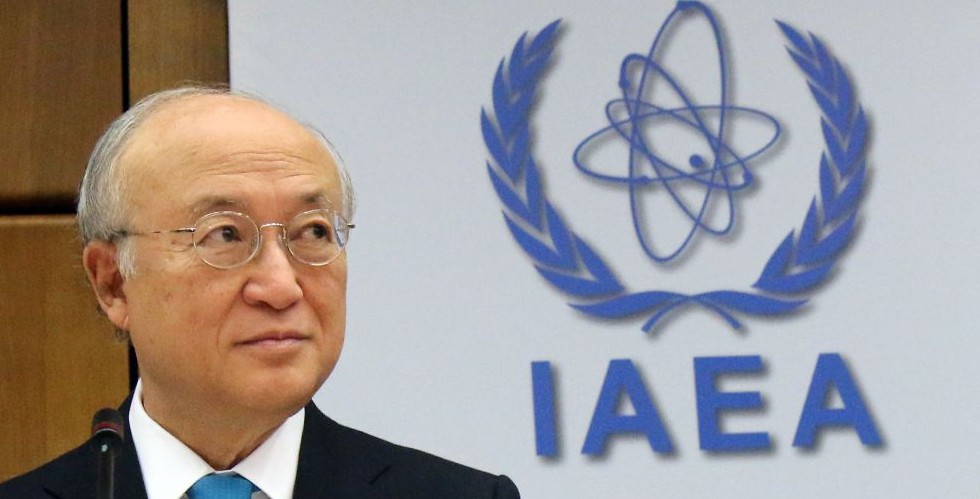
Yukiya Amano of Japan, director general of the International Atomic Energy Agency (IAEA) awaits the board of governors meeting at the International Center in Vienna, Austria, Monday, June 2, 2014. (photo credit: AP/Ronald Zak)
IAEA says ‘large-scale, high-explosive experiments’ may have been conducted at the Marivan military base.
As well as Marivan, IAEA inspectors are also interested in the Parchin military base, where they suspect tests that could be applied to a potential nuclear site have been carried out.
Iran has so far denied access to Parchin.
********************
TEHRAN, Iran – Tehran is ready to allow nuclear inspectors access to its Marivan military site, an Iranian official said Saturday, a facility long suspected of being used to develop explosive weapons.
The declaration comes as Iran and six world powers hold talks in Vienna to reach a lasting agreement on Tehran’s disputed nuclear program before November 24.
Such a deal, after 12 years of rising tensions, is aimed at easing fears that Tehran will develop nuclear weapons under the guise of its civilian activities — an ambition the Islamic Republic has always fiercely denied.
The Marivan site, close to the Iraqi border, was mentioned in a 2011 report by the International Atomic Energy Agency (IAEA) on Iran’s alleged pursuit of nuclear weapons.
The UN agency suggested at the time that “large scale high explosive experiments” may have been carried out at the complex.
Britain, China, France, Russia, the United States and Germany have been locked in talks with Iran since February after an interim accord gave it some relief from economic sanctions in return for nuclear curbs.
“We are ready to allow the IAEA controlled access to the Marivan site,” Behrouz Kamalvandi, spokesman for Iran’s Atomic Energy Organisation, was quoted as saying by the IRNA news agency.
He said the IAEA’s view of Marivan was based on “false” information.
IAEA spokeswoman Gill Tudor said the watchdog “will discuss the offer” with Tehran.
“The situation regarding a visit to the Marivan region is not as simple as that conveyed by Iran,” she told AFP.
As well as Marivan, IAEA inspectors are also interested in the Parchin military base, where they suspect tests that could be applied to a potential nuclear site have been carried out.
( “By framing the deal as fundamentally flawed, regardless of its enforcement, Israel is telling the world that it will not wait to see whether inspectors do their jobs as ordered.” )
Israeli official cites “sunset clause” in proposed comprehensive deal, which guarantees Iran a path into the nuclear club and may corner Israel into war.
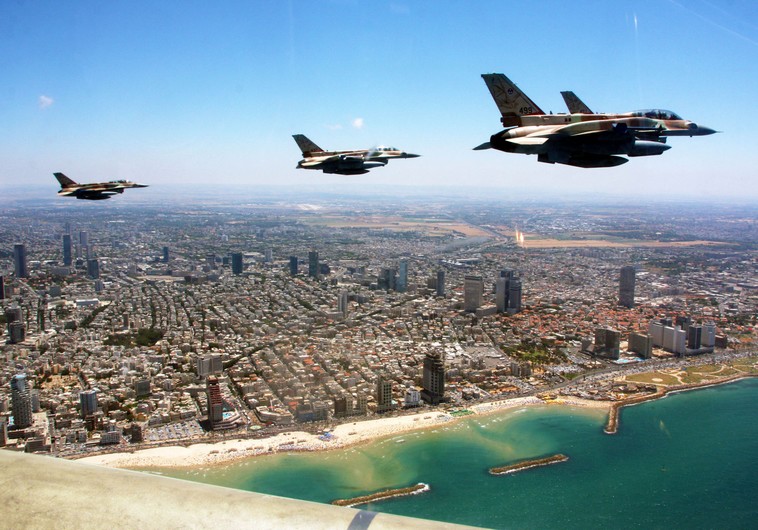
Israel Air Force planes fly over Tel Aviv. . (photo credit:IDF SPOKESPERSON’S UNIT)
[M]ore than any single enforcement standard or cap included in the deal, Israel believes the Achilles’ heel of the proposed agreement is its definitive end date – the sunset clause.
“You’ve not dismantled the infrastructure, you’ve basically tried to put limits that you think are going to be monitored by inspectors and intelligence,” said the official, “and then after this period of time, Iran is basically free to do whatever it wants.”
***************
WASHINGTON — Historic negotiations with Iran will reach an inflection point on Monday, as world powers seek to clinch a comprehensive deal that will, to their satisfaction, end concerns over the nature of its vast, decade-old nuclear program.
But sharing details of the deal under discussion with The Jerusalem Post on the eve of the deadline, Israel has issued a stark, public warning to its allies with a clear argument: Current proposals guarantee the perpetuation of a crisis, backing Israel into a corner from which military force against Iran provides the only logical exit.
The deal on the table
World powers have presented Iran with an accord that would restrict its nuclear program for ten years and cap its ability to produce fissile material for a weapon during that time to a minimum nine-month period.
Should Tehran agree, the deal may rely on Russia to convert Iran’s current uranium stockpile into fuel rods for peaceful use. The proposal would also include an inspection regime that would attempt to follow the program’s entire supply chain, from the mining of raw material to the syphoning of that material to various nuclear facilities across Iran.
Israel’s leaders believe the best of a worst-case scenario, should that deal be reached, is for inspections to go perfectly and for Iran to choose to abide by the deal for the entire decade-long period.
But “our intelligence agencies are not perfect,” an Israeli official said. “We did not know for years about Natanz and Qom. And inspection regimes are certainly not perfect. They weren’t in the case in North Korea, and it isn’t the case now – Iran’s been giving the IAEA the run around for years about its past activities.”
“What’s going to happen with that?” the official continued. “Are they going to sweep that under the rug if there’s a deal?”
On Saturday afternoon, reports from Vienna suggested the P5+1 – the US, United Kingdom, France, Russia, China and Germany – are willing to stop short of demanding full disclosure of any secret weapon work by Tehran.
Speaking to the Post, a senior US official rejected concern over limited surveillance capabilities, during or after a deal.
“If we can conclude a comprehensive agreement, we will have significantly more ability to detect covert facilities – even after its duration is over – than we do today,” the senior US official said. “After the duration of the agreement, the most intrusive inspections will continue: the Additional Protocol – which encompasses very intrusive transparency, and which Iran has already said it will implement – will continue.”
But compounding Israel’s fears, the proposal Jerusalem has seen shows that mass dismantlement of Iran’s nuclear infrastructure – including the destruction, and not the mere warehousing, of its parts – is no longer on the table in Vienna.
“Iran’s not being asked to dismantle the nuclear infrastructure,” the Israeli official said, having seen the proposal before the weekend. “Right now what they’re talking about is something very different. They’re talking about Ayatollah Khamenei allowing the P5+1 to save face.”
Officials in the Netanyahu government are satisfied that their ideas and concerns have been given a fair hearing by their American counterparts. They praise the US for granting Israel unprecedented visibility into the process.
But while those discussions may have affected the talks at the margins, large gaps – on whether to grant Iran the right to enrich uranium, or allow it to keep much of its infrastructure – have remained largely unaddressed.
“It’s like the chemical weapons deal in Syria,” the official said. “They didn’t just say: Here, let’s get rid of the stockpile and the weapons, but we will leave all the plants and assembly lines.”
‘Sunset clause’
Yet, more than any single enforcement standard or cap included in the deal, Israel believes the Achilles’ heel of the proposed agreement is its definitive end date – the sunset clause.
“You’ve not dismantled the infrastructure, you’ve basically tried to put limits that you think are going to be monitored by inspectors and intelligence,” said the official, “and then after this period of time, Iran is basically free to do whatever it wants.”
The Obama administration also rejects this claim. By e-mail, the senior US administration official said that, “‘following successful implementation of the final step of the comprehensive solution for its duration, the Iranian nuclear program will be treated in the same manner as that of any non-nuclear weapon state party to the NPT – with an emphasis on non-nuclear weapon.”
“That has in no way changed,” the American official continued, quoting the interim Joint Plan of Action reached last year.
But the treatment of Iran as any other signatory of the Nuclear Non-Proliferation Treaty –189 countries are members, including Iran – would allow Tehran to ultimately acquire “an industrial-sized capability,” the Israelis say. “The breakout times [to a nuclear weapon] will be effectively zero.”
Israel and world powers seek to maximize the amount of time they would have to identify non-compliance from a nuclear deal, should Iran choose to defy its tenets and build a bomb.
But in the deal under discussion in Vienna, Iran would be able to comply with international standards for a decade and, from Israel’s perspective, then walk, not sneak, into the nuclear club.
“You’ve not only created a deal that leaves Iran as a threshold nuclear power today, because they have the capability to break out quickly if they wanted to,” the Israeli official contended. “But you’ve also legitimized Iran as a military nuclear power in the future.”
From the moment this deal is clinched, Israel fears it will guarantee Iran as a military nuclear power. There will be no off ramp, because Iran’s reentry into the international community will be fixed, a fait accompli, by the very powers trying to contain it.
“The statement that says we’ve prevented them from having a nuclear weapon is not a true statement,” the Israeli official continued. “What you’ve said is, you’re going to put restrictions on Iran for a given number of years, after which there will be no restrictions and no sanctions. That’s the deal that’s on the table.”
Revisiting the use of force
Without an exit ramp, Israel insists its hands will not be tied by an agreement reached this week, this month or next, should it contain a clause that ultimately normalizes Iran’s home-grown enrichment program.
On the surface, its leadership dismisses fears that Israel will be punished or delegitimized if it disrupts an historic, international deal on the nuclear program with unilateral military action against its infrastructure.
By framing the deal as fundamentally flawed, regardless of its enforcement, Israel is telling the world that it will not wait to see whether inspectors do their jobs as ordered.
“Ten, fifteen years in the life of a politician is a long time,” the Israeli said, in a vague swipe against the political directors now scrambling in Vienna. “In the life of a nation, it’s nothing.”
Prime Minister Benjamin Netanyahu has threatened the use of force against Iran several times since 2009, even seeking authorization from his cabinet in 2011. Iran’s program has since grown in size and scope.
According to his aides, the prime minister’s preference is not war, but the continuation of a tight sanctions regime on Iran’s economy coupled with a credible threat of military force. Netanyahu believes more time under duress would have led to an acceptable deal. But that opportunity, in his mind, may now be lost.
Whether Israel still has the ability to strike Iran, without American assistance, is an open question. Quoted last month in the Atlanticmagazine, US officials suggested that window for Netanyahu closed over two years ago.
But responding to claims by that same official, quoted by Jeffrey Goldberg, over Netanyahu’s courage and will, the Israeli official responded sternly: “The prime minister is a very serious man who knows the serious responsibility that rests on his shoulders. He wouldn’t say the statements that he made if he didn’t mean them.”
“People have underestimated Israel many, many times in the past,” he continued, “and they underestimate it now.”
(The past indicates what the future will bring. Since Iran continues to refuse to acknowledge its past efforts to get nukes, and even to permit inspections to determine what it did and is doing now, there is no reason to assume — or even to hope — that it will permit effective future inspections of its efforts to get and use nukes. — DM}
Iran has made clear that it is not an issue it is ready to budge on. “PMD [possible military dimensions] is out of question. It cannot be discussed,” an Iranian official said.
IAEA Director General Yukiya Amano this week said Iran had again failed to provide explanations needed for the inquiry, making clear it has made scant headway in recent months.
**********
VIENNA (Reuters) – World powers will press Iran to cease stonewalling a U.N. atomic bomb investigation as part of a wider nuclear accord, but will likely stop short of demanding full disclosure of any secret weapon work by Tehran to avoid killing an historic deal.
Officially, the United States and its Western allies say it is vital that Iran fully addresses the concerns of the U.N. nuclear agency if it wants a diplomatic settlement that would end sanctions severely hurting its oil-based economy.
“Iran’s previous activities have to come to light and be explained,” a senior Western diplomat said.
Privately, however, some officials acknowledge that Iran would probably never admit to what they believe it was guilty of: covertly working in the past to develop the means and expertise needed to build a nuclear-armed missile.
Iran denies this and says its nuclear program is peaceful.
The six powers face a delicate balancing act: Israel and hawkish U.S. lawmakers – wary of any rapprochement with old foe Iran – are likely to pounce on a deal if they believe it is too soft on Tehran’s alleged nuclear arms activity.
A senior Western official said the six would try to “be creative” in coming up with a formula that would satisfy demands by those who want Iran to come clean about any atomic bomb research and those who say it is unrealistic to expect the country to openly acknowledge it.
The outcome could also affect the standing of the International Atomic Energy Agency (IAEA), which for years has been trying to investigate what it calls the possible military dimensions (PMD) of Iran’s nuclear program.
While the global powers – the United States, France, Germany, Russia, China and Britain – seek to persuade Iran to scale back its uranium enrichment program to lengthen the timeline for any bid to assemble nuclear arms, the IAEA is investigating possible research on designing an actual bomb.
The aim is to reach a comprehensive solution to end a 12-year nuclear dispute by a Nov. 24 deadline, though diplomats say it is more likely that the negotiations will be extended.
If an eventual accord does not put strong pressure on Iran to increase cooperation with the IAEA by making it a condition for some sanctions relief, it may hurt its future credibility, according to some diplomats accredited to the agency.
“You don’t want to undermine the integrity of the IAEA,” one said.
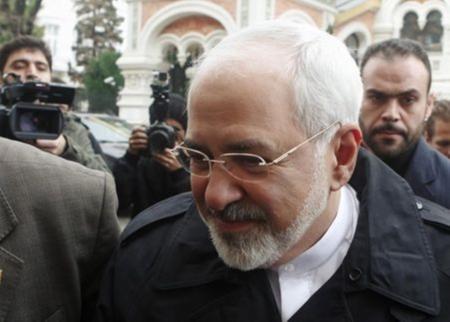
Iranian Foreign Minister Mohammad Javad Zarif arrives at the Iranian embassy for lunch with former European Union foreign policy chief Catherine Ashton in Vienna November 18, 2014. REUTERS/Heinz-Peter Bader
The IAEA issued a report in 2011 with intelligence information indicating concerted activities until about a decade ago that could be relevant for developing nuclear bombs, some of which the U.N. agency said may be continuing.
“SIMPLY IRRELEVANT”
Iran has made clear that it is not an issue it is ready to budge on. “PMD is out of question. It cannot be discussed,” an Iranian official said.
IAEA Director General Yukiya Amano this week said Iran had again failed to provide explanations needed for the inquiry, making clear it has made scant headway in recent months.
“I believe the PMD issue is not a deal-breaker even though it probably should be,” another Western official said. The official added that many inside the IAEA and Western governments shared concerns about the deadlocked investigation and felt uneasy about compromising on the issue.
Iran denies ever harboring any nuclear bomb ambitions and its supreme leader, Ayatollah Ali Khamenei, has issued a religious decree against atomic weaponry.
Because of this, experts say, it is virtually impossible for the Iranian leadership to make any “mea culpa” about activity geared toward developing nuclear bombs.
Another reason Tehran might be reluctant to admit to any wrongdoing is that it could later be used as a justification for Iran’s enemies to attack it out of “self-defense”.
As a result, the powers are weighing how hard to press it.
A U.S. official said it was “a fine line” that needs to be walked on PMD. The six want to make sure the Iranians address the issue to some extent, but do not want to hit them so hard with it that they feel like they will lose face.
Experts differ on whether Iran must come completely clean: some argue it is necessary to ensure that any such work has since been halted but others say this can be achieved without a “confession”.
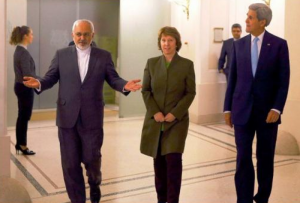
Iranian Foreign Minister Javad Zarif in Vienna with EU negotiator Catherine Ashton and US Secretary of State John Kerry. Photo: Twitter
With four days to go before the international deadline for an agreement over Iran’s nuclear program expires, the signs emerging from Vienna, where negotiations have been taking place, are that a final deal will not be agreed by Monday. Moreover, European leaders are said to be increasingly disillusioned with the American determination to grant more concessions to entice Iran into a deal, adding yet another layer of complexity to the deliberations.
Both US Secretary of State John Kerry and French Foreign Minister Laurent Fabius will return to Paris later today for what Reuters described as “consultations.” Earlier reports that Iranian Foreign Minister Javad Zarif was planning to leave Vienna for Tehran turned out to be false, with Iranian negotiators subsequently confirming that “the talks will continue.”
The obstacles to any deal are well-known, and little progress has been made to bridge the gaps between the two sides, despite the enthusiasm of the Obama Administration for a deal. Major powers in the shape of the P5+1 – the five permanent members of the UN Security Council and Germany – want Iran to reduce its number of centrifuges from the 19,000 currently in operation to 4,500, in order to delay Iran’s accumulation of the fissile material that would enable a nuclear weapon.
The Iranians are unhappy with the degree and timing of sanctions relief, insisting that sanctions should be terminated immediately rather than incrementally.
Nor is there agreement over the duration of any deal. The P5+1 is said to be looking for a 20 year deal, while the Iranians want something much shorter.
Domestic considerations are also coming to the fore, particularly in the United States, where unease with both the substance of any deal, and the possibility that President Obama will bypass Congress to secure it, is growing among legislators as well as the American public. “We did some polling last week, which we’ve not yet publicly released, which shows that 7 out of 10 Americans want Congressional approval of a deal,” said Josh Block, the President of The Israel Project, an Washington-DC based advocacy group, who is in Vienna monitoring the talks.
Western states are hardly in lockstep. The British government has sounded distinctly pessimistic that a deal is within reach, while Kerry is said to be anxious that the French government will not support a deal, having been unsuccessful in his earlier attempt to secure an undertaking from Fabius that no last minute objections would surface.
“There was a meeting in Vienna today of the French and British Foreign Ministers and the US Secretary of State which was described to me as ‘frosty,’” Block said. “That leads me to believe that the French and maybe the British will adopt a harder line than the Americans.”
The French, Block explained, have “fundamental objections” to nuclear proliferation in the Middle East and want to avoid a deal that would cause non-nuclear states in the region to embark on nuclear programs.
Back in Washington, DC, Sen. Mark Kirk (R-Ill) has said that he will “definitely” reintroduce sanctions legislation on Iran in the next Congress.
“I think the Republicans will definitely bring it up. It’s a movie we’re going to see again,” Kirk said on Capitol Hill. “The Republican majority will be working with [Sen. Mitch McConnell – R-KY] about when the time is to come up for a vote on that.”
President Obama will also have to keep a close eye on those Democratic Party legislators who will refuse to back a deal that does not explicitly prevent Iran from acquiring a nuclear weapon. Last year, 16 Democrats led by Sen. Robert Menendez (D-NJ) joined the 59 co-sponsors of a bill to impose tough new sanctions on Iran in the event of a failed deal, but the legislation was blocked by outgoing Senate Majority Leader Harry Reid (D-NV).
Sen. Chuck Schumer (D-NY) today released a statement declaring, “Along with my colleagues, who authored the bipartisan sanctions law that brought the Iranians to the negotiating table, I wish negotiations to succeed. But the success of negotiations can only be defined as an agreement that removes the threat of a world with a nuclear Iran.”
“Unless Iran is willing to agree to a final deal that prevents it from building, developing or acquiring a nuclear weapon, we should not allow any relaxation of sanctions,” Schumer said.
A bad nuke deal with Iran seems likely to be approved by the P5+1 negotiators under Obama’s guidance. It will be disastrous. However, if it is signed and Obama tries to implement it, there will be little if anything the Congress can do about it, even if it wants to, until January of 2017 — which will likely be too late. Even if it is not too late in 2017 it may or may not happen, depending on who is our President and who controls Congress.
I have written extensively about the Iran Scam and Obama’s untruths and obfuscations concerning it. I did so most recently in a semi-satirical article titled To get a nuke deal with Iran Obama and the Islamist world demonize Israel. Please read at least the Iran Scam article; to repeat here the points made there would make this post far too long.
Sen. Lindsey Graham (R-S.C.) took to the Senate floor on Thursday to ask for unanimous consent to schedule a vote on a bill that would give Congress final approval over any deal, or else reinstate tough sanctions on Iran.
Democratic Sen. Chris Murphy (Conn.) quickly rejected the request, arguing that scheduling a vote on the deal would be “premature at this point.” He said it would “send a fairly chilling message” that U.S. officials at the table with Iran did not have full authority to negotiate an agreement.
But when Republicans take control of the Senate, they could move to pass that bill, or push legislation from Senate Foreign Relations Chairman Bob Menendez (D-N.J.) and Sen. Mark Kirk (R-Ill.) which would reinstate sanctions if Iran violates any deal.
Their bill also pledges military support for Israel if it decides to strike Iran’s nuclear facilities, which it has threatened to do.
. . . .
The president has already threatened to veto the legislation, but doing so would be politically risky. The bill already enjoys the support of 60 senators, including 16 Democrats, and there is sweeping support for a similar bill in the House.
A deal that’s not supported by Congress or seen as weak could also hurt the 2016 Democratic presidential nominee, especially if it fails to prevent Iran from obtaining nuclear weapons capabilities.
Obama has displayed utter disdain for the Congress and constitutional processes. He will most likely continue to do so, in spades, when the new Republican dominated Congress is seated in January. The perceptions of the author of the linked article are excessively optimistic, as suggested below.
As a lame duck President, Obama has little if anything to lose. Any impact on the 2016 elections of a bad nuke deal with Iran may well not be of substantial importance to Obama and, to the extent that it is, He will probably use His ample opportunities to “Gruber” – to obfuscate and lie effectively — about the facts and their consequences substantially to diminish any adverse impact of His actions on those elections.
There’s more here about Obama, Gruber and Grubering, which Obama continues to do with at least modest success.
As the Obama administration did from the beginning and continues to do with the ObamaCare debacle, it will “Gruber” the facts and consequences of a nuke deal in presenting it to the Congress and the public. Should the next Congress nevertheless pass a bill which He does not like, He will veto it as He has promised to do. To override a veto requires the affirmative vote of two thirds of both houses under Article 1, Section 7, of the Constitution. Even in the unlikely event that an Obama veto is overridden, there is no reason to assume that He will apply the new law as Congress intends.
Congressional attempts to defund administration efforts to implement an agreement with Iran seem unlikely to work: multiple other governmental functions, facially unconnected with the matter, would still have to be funded. The parameters of their funding would have to be extraordinarily tight to avoid fund shifting. Even then, the Obama administration has shown itself to be extraordinarily adept at fund shifting regardless of congressional intent as reflected in seemingly clear statutory language.
Even were U.S. Sanctions – the only sanctions on which the Congress has any significant impact – to be reinstated, their enforcement would be up to the Obama administration, not the Congress. The administration would likely refuse to enforce them, as it has multiple times with other Federal laws of which Obama does not approve. Were the Congress or other interested parties to succeed in getting judicial review, the process would be long and the results uncertain until the Supreme Court granted and exercised review. That process could easily take years. In addition, it remains questionable whether the Congress, its representatives or anyone else would even have standing to initiate judicial action.
In any event Germany, Iran’s most substantial commercial partner and others who now deal with Iran, as well as Iran itself, have enjoyed substantial sanctions relief for long enough that the process is broken to the point that U.S. efforts to revive useful sanctions would likely be ineffective. According to an article at FARS News Agency, an Iranian source, posted on November 16th,
Chairman of the Iranian parliament’s National Security and Foreign Policy Commission Alaeddin Boroujerdi said imposing sanctions against Tehran is an already failed policy.
“The sanctions imposed on Iran are a failed policy; the sanctions tool has never been able to make the Iranian nation withdraw from its righteous positions,” Boroujerdi said in a meeting with new Italian Ambassador to Tehran Mauro Conciatori on Sunday. [Emphasis added.]
“Sanctions have only resulted in ample financial loss for the European industrial and trade companies,” he added. [Emphasis added.]
The article claiming that a Republican controlled Congress can dash Obama’s hopes for a nuke deal with Iran also suggests that it can pledge “military support for Israel if it decides to strike Iran’s nuclear facilities.” It can certainly do that. However, just as the Obama administration has refused to enforce or simply ignored aspects of other legislation, it can refuse to enforce or simply ignore that pledge as well.
With the exception of a possible — but far from certain — prompt and effective Israeli military attack on Iran’s nuke facilities, the mess has gone too far for effective action. Israel, which rarely brags about what she can or intends to do, has quite properly been rather coy about the resources she can use against Iran. So have possible allies in the Middle East concerning such help as they may be willing and able to provide. However, Israel probably has substantial electromagnetic pulse (EMP) capabilities which could be used to damage Iran’s command and control facilities substantially.
The attack could be carried out using a nuclear warhead detonated after launch by one of Israel’s Jericho III missiles at high-altitude over north central Iran.
EMP affects computers and other electronics and would disrupt critical infrastructure that relies on electronics and electricity, such as communications, transportation, and other networks.
The burst would create “no blast or radiation effects on the ground,” the article stated.
“Coupled with cyber-attacks, Iranians would not know it happened except for a massive shutdown of the electric power grid, oil refineries, and a transportation gridlock,” the article said.
“Food supply would be exhausted and communication would be largely impossible, leading to economic collapse. Similarly, the uranium enrichment centrifuges in Fordo, Natanz, and widely scattered elsewhere, would freeze for decades.”
Iran more than likely also has substantial EMP capabilities, so unless Israel uses her own first, and sooner than Iran anticipates, it will be too late.
Summary and Conclusions
Sanctions may well have prompted Iran to agree to discuss a nuke deal with P5+1. However, the negotiations have done little beyond diminishing those sanctions to the point of ineffectiveness, while giving Iran ample time, incentive and opportunity to continue research on, and implementation of, its nuke plans. If preventing Iran from continuing its development of nukes had been the objective, or even a substantial objective, Iran’s military facilities and advances on nuke development would have been central to any “interim agreement.” Far from being central, they were not even peripheral.
From the beginning, as contended here, here, here and elsewhere, the “Grubered” interim agreement and White House Summary of it have given Iran every possible advantage and shielded its military facilities from effective scrutiny.
Some elections have consequences. Obama’s 2012 election had very unfortunate consequences. However, the 2014 elections will probably have few if any beneficial consequences with respect to the Iran Scam and come January 2017 it will probably be too late should effective action then be attempted.
If, as seems likely, a nuke deal with Iran, good for Iran and bad for the most of the rest of world is signed, it now appears that the only possible effective solution with a decent chance of success will be prompt military action by Israel, in conjunction with her temporary and therefore uncertain allies in the Middle East which are opposed to Iranian nukes.
I am well aware of the possible adverse consequences of such a strike, including extreme actions that Russia and her allies might take in response. However, the possibility of mutually assured destruction worked in the past and should work again. Russia, et al, unlike Iran, are not compelled by a barbaric religion to bring to the world Armageddon and the arrival of the Twelfth Imam. They want power, not death. If they and their enemies are obliterated, their current power and hopes of increasing it would be destroyed along with them.
For one thing, the drawn-out process has provided Iran with the opportunity to spread out and better fortify its nuclear plants. For another, U.S. President Barack Obama has exhibited a negative attitude toward the endangered Jewish state, a declared ally which he treats like an enemy. There is no doubt in anyone’s mind that he has told Israel, in no uncertain terms, not to launch a strike.
***************
Following a second day of talks between top American, European and Iranian diplomats in Oman on Monday, U.S. Secretary of State John Kerry admitted that “real gaps” remain between the sides, but stressed that the negotiation partners were “working hard” toward an agreement by the end of the month.
He was referring to the self-imposed Nov. 24 deadline for signing a deal that would curb Iran’s nuclear program to a mutually satisfactory extent.
Statements emerging on the sidelines of the talks, which continued beyond Tuesday among lower-tier negotiators, indicated a degree of optimism on the possibility of progress in time to make the deadline. But the real test will take place next week in Vienna, when a final round of meetings is held to iron out differences that have prevented reaching an accord until now — unless another extension is decided upon, in the event of a stalemate.
Whatever happens, however, the outcome cannot be good.
The signing of a deal would mean that the P5+1 (the U.S., Russia, China, the U.K., France and Germany) will have succumbed to Iran’s demand that it be able to complete its “peaceful” nuclear program, unencumbered by restrictive international sanctions.
The absence of a deal would basically amount to the same thing, since Russia and the Obama administration will not cease pushing for an easing of sanctions, no matter what Iran does.
This no-win situation for the West is precisely what has been buying Iran time to build nuclear bombs.
It is also what enabled Iranian President Hassan Rouhani to receive Supreme Leader Ayatollah Ali Khamenei’s tacit consent to engage in negotiations with the world’s “infidels” whom Iran intends to subjugate.
Khamenei has had good reason to trust Rouhani’s methods. Diplomacy has not kept centrifuges from spinning or uranium from being enriched. And all the stalling has helped reduce the odds of an Israeli military strike.
For one thing, the drawn-out process has provided Iran with the opportunity to spread out and better fortify its nuclear plants. For another, U.S. President Barack Obama has exhibited a negative attitude toward the endangered Jewish state, a declared ally which he treats like an enemy. There is no doubt in anyone’s mind that he has told Israel, in no uncertain terms, not to launch a strike.
If this, by itself, were not enough to embolden the Islamic republic, Obama’s latest act of groveling at the feet of the chief mullah did the trick. As was revealed last week in the Wall Street Journal, Obama sent a letter to Khamenei, in which he urged the Supreme Leader to agree to a deal by the Nov. 24 deadline, and offered to cooperate with him to defeat Islamic State.
Now, Iran has no interest in joining forces with the “Great Satan” to secure a victory over the Islamic State terrorists who are competing with it for control of a global caliphate. But it certainly enjoys bringing Obama to his knees, which is just how such an appeal on his part is interpreted.
Obama’s supplication, coupled with his repeated censure of Israel, is music to Khamenei’s ears and fodder for his sermons, speeches and social media posts.
On Sunday, he tweeted a link to a chart detailing nine ways to ensure Israel’s elimination. Among these was the urgency of arming the West Bank — “like Gaza” — to confront Israel militarily.
With weakness oozing from the White House and strong support being issued from Iran, the Palestinian Authority is feeling especially empowered, as is indicated by the intifada it is currently waging against innocent Israelis.
The one aspect of the bigger picture that threatens to alter the status quo is the Republican sweep of the Senate on Nov. 4. It will now be almost impossible for Obama, already a lame duck, to get on with his job of wreaking havoc on America.
But, stripped of his domestic abilities, Obama is certain to shift his focus to foreign affairs. Desperate to go down in history as a leader with a legacy, he wants to sign a deal with Iran (and force Israel to establish a Palestinian state) before the end of his term in 2016.
With the changing of the guard at the Senate taking place in January, he is in an even bigger hurry to do so. Unfortunately — and for the first time since entering into phony negotiations with the West — Iran, too, may be anxious to reach a deal.
Fearing a tougher stance from a Republican-dominated Congress, the regime in Tehran is now calculating the wisdom of continuing to postpone an agreement. Since it has no intention of honoring any commitment involving a reduction of its nuclear capabilities, or of having its facilities monitored, it just might decide that it is preferable to sign a worthless piece of paper than risk the wrath of the Republicans.
With all this in mind, the events of the coming week in Vienna should be observed with great trepidation.
[T]he administration continues to grovel in an effort to appease the Iranians. It is widely believed that the unprecedented hostility recently directed against Israel, especially the statement that Israel had lost the opportunity of exploiting the military option to prevent Iran becoming a nuclear power, was primarily for the benefit of Khamenei.
Under pressure, following the public release of his letter to Khamenei, Obama has stepped back, stating that there is still a big gap and that “we may not be able to get there.” He added, “Our number one priority with respect to Iran is making sure they don’t get a nuclear weapon.” Even Obama’s closest associates would question their president’s credibility when he voices such statements.
********************
Despite statements to the contrary, the Obama administration appears determined to achieve an “agreement” with Iran and seems willing to breach its repeated undertakings that it would never countenance Iran becoming a nuclear power. With the mullahs’ increased intransigence as they sense the desperation of the Americans to avoid a confrontation, the Nov. 24 deadline will probably be extended, enabling the centrifuges to continue spinning while the P5+1 countries engage in fruitless negotiations with the duplicitous Iranians.
The Iranians have mocked Secretary of State John Kerry’s overtures, including his secret appeals to them to coordinate with the U.S. in opposing the Islamic State group. Speaking from a podium bedecked with banners blazing “America cannot do a damn thing,” Ayatollah Ali Khamenei boasted that the “Great Satan’s” efforts to bring Iran to its knees had failed, and that U.S. President Barack Obama lacked the courage for a military confrontation. Ali Younesi, senior adviser to “moderate” President Hassan Rouhani, referred to Obama as “the weakest of U.S. presidents,” whose six years in office were “humiliating.”
Nevertheless, the administration continues to grovel in an effort to appease the Iranians. It is widely believed that the unprecedented hostility recently directed against Israel, especially the statement that Israel had lost the opportunity of exploiting the military option to prevent Iran becoming a nuclear power, was primarily for the benefit of Khamenei.
The London Times claimed that American and Iranian officials have even been discussing the opening of a U.S. trade office in Tehran.
The frenzied, initially covert, efforts to engage the support of Iran in the struggle against Islamic State — despite Iran being designated by the U.S. as a terrorist state — has further undermined the little credibility the U.S. retains with the moderate Sunni states, considered until recently as staunch allies.
Obama’s deception of his allies was further exemplified when it was disclosed that he had written a secret letter to Khamenei pleading with him to reach an accommodation. This, the fourth letter he had written to the ayatollah — all of which were ignored — was an explicit breach of undertaking to his allies that any independent initiatives would be preceded by consultations.
Even one of Obama’s favorite in-house journalists, Jeffrey Goldberg, felt impelled to remark that the “most recent letter was delivered at an unfortunate moment in the run-up to the putatively climactic negotiations between Iran and the world powers” when the Obama administration had already conceded many of Iran’s demands. Goldberg concluded his column by stating: “The Iranians originally came to the negotiating table because U.S.-led sanctions were hurting them badly. I understand the need for give and take negotiations, but I’m getting worried that the U.S. is focused too much on the first half of that equation.”
The U.S. administration has already given approval to Iran to enrich uranium, effectively making it a nuclear threshold state. While the global powers agreed to enable the Iranians to have 1,000 centrifuges to process material required to create nuclear fuel, the Iranians have outrightly refused to dismantle any of the 19,000 centrifuges they have already accumulated. It is understood that Iran is already in the position to accrue sufficient enriched fissile material to become a nuclear power within a few months, if it so desires. The U.S. has indicated that it would be willing to sign off on a deal that would extend this breakout phase to one year, hardly reassuring to the region.
The Iranians also displayed utter contempt toward the U.S. by violating the interim accord and failing to disclose an enrichment facility in Qom and even denying access to inspectors from the International Atomic Energy Agency to military sites and nuclear scientists engaged in research. Clearly, the duplicitous Islamist regime would continue to circumvent any agreement that is not rigorously monitored and enforced — a procedure that the Iranians have already made clear they will never accept.
While the outcome of this issue will have immense global implications, especially in the Middle East, Israel is the country most affected. The Iranian regime’s hatred of Israel is messianic. It openly proclaims its commitment to destroy the Jewish state. Coinciding with Obama’s groveling letter to him, Khamenei tweeted a message stating that the only way to stop the “Israeli crimes” was to “annihilate” the “barbaric, wolflike & infanticidal regime of #Israel.”
Israel cannot accept the prospect of such a fanatical terrorist regime becoming a nuclear threshold state.
Under pressure, following the public release of his letter to Khamenei, Obama has stepped back, stating that there is still a big gap and that “we may not be able to get there.” He added, “Our number one priority with respect to Iran is making sure they don’t get a nuclear weapon.” Even Obama’s closest associates would question their president’s credibility when he voices such statements.
The question is whether at this advanced stage, the P5+1 nations, desperate to appease and reach an accord with the terrorist state at any price, can still be deterred from capitulating.
The key rests with the United States. The extraordinary landslide victory by the Republicans at the midterm elections — clearly a vote of no confidence in Obama — provides some hope.
Yet it should be noted that within the American political system, the president has primary control of foreign relations.
The Republican-controlled Congress and Senate can certainly pass resolutions, but that will not necessarily limit the White House in this arena of foreign policy. In addition, realizing that on the domestic scene his hands will be restricted by Congress, Obama might even decide to intensify his foreign policy activities. The principal areas are likely to include the embrace of the Iranians and possibly trying to impose a settlement on the Israelis with the Palestinians.
However, in relation to Iran, the president must persuade Congress to rescind the sanctions it originally legislated. Obama may constitutionally override the congressional sanctions and unilaterally suspend enforcement, but that could lead to a major confrontation with Congress.
Needless to say, if a reasonable agreement is achieved, it will be endorsed by Congress. But all indications suggest that Obama is promoting an Alice-in-Wonderland deal with the Iranians, which Congress should reject.
The incoming Senate Majority Leader Mitch McConnell (R-Ky.) has already stated unequivocally that the Senate will review any deal with Iran and ensure that “any comprehensive agreement concerning the Iranian nuclear program, both protects the national security of the United States and recognizes Israel’s own defense as a security partner of our country.”
At this critical time, American Jews and friends of Israel should exert all their influence to convince the administration and a bipartisan Congress that appeasing the Iranian mullahs will have horrific long-term consequences and must be avoided. They should mount a powerful public campaign to demonstrate the extent of the catastrophe the government would cause should it appease this evil terrorist regime, which in the absence of becoming a nuclear state, is likely in time to implode because of the growing opposition from its own young people and the middle class.
If the current U.S. desperation to avoid a confrontation enables the Iranian terrorist state to achieve a nuclear threshold level, it is likely to have far worse long-term global repercussions than Chamberlain’s appeasement of the Nazis at Munich which led to World War ll.
This is a guest post by Imam Mohamed allah-Dork, chairman of the Washington Islamist Coalition for Peace and Prosperity (WICPAP). Although it might appear to be satire it is not, because he articulates, far more candidly than most, the objectives of the “progressive” Obama Administration. I found him with the assistance of (another) imaginary “friend,” the Highly Honorable Ima Librul, Senator from the Great State of Confusion Utopia, where happy unicorns frolic endlessly in the service of Obama.
********************
Hatred of Israel is among our Dear Leader Obama’s most effective weapons against those who oppose Iran’s nuclear ambitions. He has made heroic efforts to encourage and use it, with help from the progressive media and His other friends.
Because of the wise efforts of Our Dear Leader and His brilliant Secretary of State, hatred of Israel has increased in recent years. This has been due, in large part, to Israel’s continuing and patently unreasonable refusals to commit national suicide by agreeing to all of the righteous demands of Palestinian Authority President Abbas, as Obama and Kerry have also demanded. Peaceful Palestinians have responded to Israel’s malicious refusals through non-violent protests resulting in the death or injury of Jewish terrorists, accidentally run over, stabbed or shot.
Jewish Terrorists
The beautiful song embedded above was recently augmented by a new Palestinian musical offering including wholesome family-oriented lyrics.
I am so proud of the composers, singers and musicians that I cry whenever I watch the video!
According to a specious article at a right-wing propaganda site called PJ Media,
That is absurd. They were no more “murdered,” than are filthy dogs which are righteously slaughtered because they are dangers to society at large.
Unless Israel’s refusal to commit national suicide is condemned world-wide, undue attention will focus on the peace loving Islamic Republic of Iran and its legitimate goal of having nuclear weapons to bring Islamic peace to all who desire it. Israel opposes Iran’s quest for Islamic peace through nukes and therefore selfishly rejects it.
Hatred is irrational and bad, except that directed at genocidal, apartheid Israel and others who fail to embrace Islam. Hatred of them is rational and good. Just as hatred of Israel must be encouraged to the extent possible, so must the stupidity great credulity of the American people be fed and used for Progressive purposes, as it was fed and used to give them the blessings of superior health care.
Lies, obfuscation and secrecy for good purposes as praised by our Dear Leader’s consultant Jonathan Gruber, such as the passage of ObamaCare, are good because they are necessary. Leading the way, our Dear Leader promised to have the most transparent administration in history.
It was all diversionary symbolism, of course, because truth, clarity, transparency and accountability in pursuit of bad objectives — such as defeat of our Dear Leader’s policies — are intolerable because it is racist to oppose Him. Also, they might succeed.
That brings us to our Dear Leader’s dominant role in the P5+1 negotiations with The Islamic Republic of Peace Everlasting, Iran.
It is more than simply unfortunate that Western policymakers look at Iran and appear to see only what they want to see. They heap praise on progress in the nuclear negotiations without looking at the actual content. They tune into televised smiles and reasonable-sounding public statements from the Rouhani administration and tune out the bombastic threats, insults and anti-Western rhetoric that invariably accompanies them. They push for large-scale rapprochement with Iran on the apparent assumption that its crimes will disappear if we somehow pretend they don’t exist. [Emphasis added.]
But these wishful thinkers are in the corridors of power in Washington and Westminster. Although ISIS has grown stronger thanks to the sectarian conflict that Iran has helped create, these unrealistic optimists would imply that somehow Iran is our best hope for defeating this menace. So they give in to Iranian intransigence in the nuclear talks by senselessly giving away more and more leverage. [Emphasis added.]
Make no mistake, Tehran’s theocratic rulers are very well aware of this “pie-in-the-sky” illogicality. Indeed, they are counting on it. The regime’s officials are so confident in our diplomatic vulnerability that they have been trying to use the crisis in Iraq not only to obtain unearned concessions in the nuclear domain, but also to pressure the U.S., the U.K. and their allies to modify their stance against the dictatorship of Bashar Assad in Syria. [Emphasis added.]
Nonsense! Iran needs nuclear weapons to pursue its peaceful, humanitarian goals and, with our Dear Leader’s help, will get (or keep) them! Life will then be better for everyone who matters.
No deal with Iran will be finalized unless all of Iran’s righteous demands are met. Unless ample lies and obfuscations are spoon-fed to the American public to minimize the consequences of Iran’s victory, the deal may well be opposed. Lies and obfuscation were needed to pass ObamaCare, even with solid Democrat majorities in both houses of Congress. A deal with Iran is even more important. Our Dear Leader’s wise consultant, Jonathan Gruber, knows this very well and so does our Dear Leader.
Fortunately, a Washington think tank is taking the lead to counter the silly stuff spouted by racists.
A leading liberal think tank in Washington, D.C., has begun enlisting its associates in an “all-hands-on-deck effort to support” the Obama administration as it seeks to ink a nuclear deal with Iran by the end of the month, according to emails obtained by the Washington Free Beacon.
The Truman National Security Project, a nonprofit think tank with ties to the administration, is assembling a “crack team of writers” to flood national and local media outlets with articles supporting the White House’s efforts before the details of a final nuclear deal have even emerged, according to internal emails sent by the organization to its listserv. [Emphasis added.]
“Our community absolutely must step up and not cede the public narrative to neocon hawks that would send our country to war just to screw the president,” Graham F. West, Truman’s writing and communications associate, wrote in a recent email to the organization’s listserv. [Emphasis added.]
Pay no attention to insane mumblings by the editor of this subversive blog. He has long opposed what he refers to as the Iran Scam and recently wrote this racist diatribe against our own Dear Leader and His quest for peace everlasting. If this sick cartoon isn’t racist, then I don’t know what is.
Our Dear Leader has already accomplished countless wonderful things to establish His magnificent legacy. Here are just a few:
He is the first African American President of the United States.
The award of His Nobel Peace Prize on October 9, 2009, a mere nine months after He became the President of the United States. No other President has accomplished that.
He compelled passage of the Affordable Care Act during His first term in office.
He has already issued more crucial executive decrees than any former President.
He has consistently condemned the apartheid, illegitimate state known as Israel.
Miller even contends, speciously, that Iran’s alleged human rights abuses and alleged support for world-wide terrorism should be considered by the esteemed P5+1 negotiators under our Dear Leader’s helpful guidance. That, like all of his other suggestions, would elevate facts, transparency and accountability for a bad purpose over lies, obfuscation and non-accountability for a good purpose. What great sage once wrote “the truth shall make you flee?” He was right. Truth would make many Americans flee from a deal with Iran, and we need their unthinking support to show that, despite recent election results, they reject racism and therefore still love, respect and have unbounded confidence in our Dear Leader.
********************
Editor’s comments
In an effort to help Imam Mohamed allah-Dork present his ideas most candidly and therefore effectively, I was pleased to provide the You Tube videos.
I agree with allah-Dork’s thesis that lies and obfuscation are as necessary to secure public approval of a nuke deal with Iran as they were to secure passage of ObamaCare. A nuke deal with Iran would be even worse than ObamaCare.
It will be very difficult, if not impossible, for Congress to repeal ObamaCare outright if for no reason other than that Obama would veto any bill repealing it. However, it is possible that the Supreme Court may deal ObamaCare a fatal blow if it finds that subsidies for customers of ObamaCare exchanges were clearly intended, and stated by the Congress, to be available only for customers of State, not Federal, exchanges.
Once Iran gets (or keeps) nukes, there will be no way for Congress to repeal the agreement, no way for the Supreme Court to overrule it and no way to force Iran to get rid of its nukes. That Iran may get rid of some of them voluntarily — by using them — offers no comfort at all.
Israel, the only free and democratic nation in the Middle East, has served as a useful distraction from the violation of even the most basic of human rights throughout the rest of the region. She continues to respect and implement those rights despite the Obama Administration’s increasing rejection of them and its refusal to take them into account when dealing with other nations. Iran is perhaps the worst human rights violator in the region as well as the most prolific sponsor of Islamic terrorism. As the Obama Administration ignores blatant human rights violations by other nations, it fantasizes that Israel is a gross violator and amplifies its fantasies at every opportunity.
Obama and His cohorts have learned the lessons taught by Mr. Gruber very well and have used them with success. Here is an excerpt from an article by Jonathan Turley, a liberal in the old fashioned sense of the word. He has often supported the ends which Obama has sought to achieve while opposing the methods He has used and continues to use.
In fairness to Gruber, he is again being honest about what happened in the passage of ACA and speaking as an academic. However, such machinations are rarely confirmed by high-level consultants or officials. The ACA was pushed through by a muscle vote on a handful of votes while the Administration made claims that he later had to admit were misleading at best, such as the President’s repeated assurance that citizens could keep your current insurance policy if you liked it. There was a great deal of cynicism and misleading representations made during the ACA debates — reflecting a deep-seated contempt for the intelligence of the American voter. Gruber however seems to celebrate the success in using what he viewed as the stupidity of citizens, to quote his earlier comments, to secure passage of the ACA. It is the triumph of the ends over the means — the mantra of Beltway denizens who view more principled actors as naive chumps. What is shocking for many outside of the Beltway is of course the moral relativism and cynicism reflected in such comments, but Gruber is the norm in Washington. He is the face of the consequentiality morality that has long governed this city. [Emphasis added.]
What is different is that he admits it.
Obama, et al, have consistently applied Gruber principles to the Iran Scam and will continue to do so in seeking public support for any nuke deal with Iran. They will also continue to obfuscate and lie about the Israeli situation to distract attention from what they are doing, relying on their perceptions of the “stupidity” of the American public.
There is almost zero chance that any deal struck will actually stop Iran from pursuing what it sees as its destiny to become a nuclear power, and I don’t mean the kind that makes electricity.
******************
There is a deadline looming in the talks with Iran about their nuclear power weapons program.
US and Iranian negotiators are preparing to enter the intense endgame in the Iran nuclear deal talks, amid mixed assessments of prospects for completing the deal by the self-imposed Nov. 24 deadline, just under a month away.“This is the time to finish the job,” lead US negotiator Undersecretary of State Wendy Sherman told the Maxwell School of Public Affairs on Oct. 23 in rare public remarks about the sensitive Iran nuclear negotiations.
There is almost zero chance that any deal struck will actually stop Iran from pursuing what it sees as its destiny to become a nuclear power, and I don’t mean the kind that makes electricity. Our President is currently stuck with only the giant fail of ObamaCare as his legacy, so he really, really wants a deal that he can put on the shelf with his Nobel. That makes him a grave danger to give away the farm. The only upside is that the Iranians are just bullheaded enough to walk away without taking all his lunch money. Bottom line is in the high stakes poker game going on, we have a guy who doesn’t even understand the game.
Obama intends to grant Royal amnesty for millions of illegals currently present in our nation, regardless of the adverse economic and social impacts and Republican warnings. I opined here on what He will likely do and on the unfortunately poor prospects for any Republican efforts to thwart it.
Remember “Leg Tingles?” The tingle has gone, at least temporarily
So much for deal making with the opposition.
However, Obama is anxious to have a deal — any deal — with Iran very soon.
Although He will not make a deal with His domestic enemies whose voters rejected Him and His policies on November 4th, Obama is apparently so infatuated with His need for a legacy that He continues to push for a nuke deal with Iran. Any deal will do, no matter how disastrous it will be. Obama’s protestations to the contrary are consistent with “if you like your doctor, you can keep your doctor,” “if you like your medical insurance policy you can keep it,” “My administration will be the most transparent in history” and a multitude of others.
A deal with Iran needs to be signed, sealed and delivered well before the next Congress convenes in January. Hence the importance of meeting the November 24th deadline or extending it for the minimum time needed for Iran to demand, and for Him to make, more concessions.
Iran continues to hang tough and Obama continues to seek accommodation from Iran so that He can have a legacy. Obama dispatched a letter to Iran’s Supreme Leader Ayatollah Ali Khamenei last month.
The Wall Street Journal reported Thursday that, according to people briefed on the letter, Obama wrote to Khamenei in the middle of last month and stressed that any cooperation on dealing with the Islamic State, or ISIS, was tied to Iran striking a deal over its nuclear program. The U.S., Iran and other negotiators are facing a Nov. 24 deadline for such a deal. [Emphasis added.]
. . . .
Asked about the reported letter, White House Press Secretary Josh Earnest would not confirm the report.
“I’m not in a position to discuss private correspondence between the president and any world leader,” he said.
However, he said the U.S. policy toward Iran “remains unchanged.”
Actually, Khamenei did respond. On the 30th anniversary of the seizure of the U.S. Embassy, he said this, in a mocking tone which is even more apparent in the Persian version of this speech:
The new US President made some beautiful comments. He also repeatedly asked us in writing and orally to turn a new page and help him change the present situation. He asked us to cooperate with him to solve global issues. He went as far as that.
Now, Khamenei continued to say he gave Obama a chance, but Obama didn’t come around. Khamenei then gloated about the strength of the Islamic Republic, a perception which Obama’s groveling tone has bolstered:
I wonder why they do not learn a lesson from what has happened. I do not understand why they are not prepared to get to know our nation. Do they not know that this nation is the one that resisted and brought the two superpowers – that is, the Soviet Union and America – to their knees? When there were two superpowers in the world, they were opposed to one another in almost all areas except in their enmity towards the Islamic Republic. This enmity was the only thing these two superpowers had in common. Why do you not learn your lesson? Today you are not even as powerful as you used to be. The Islamic Republic is several times more powerful today than those days, and yet you are speaking with the same tone? That is arrogance – talking to a nation arrogantly and using threats to get what they want. They threaten us. And our nation says it will resist.
Khamenei then warned the United States not to put its hope in reformers, as Obama seems keen to do:
Just because a handful of naïve or malevolent individuals have confronted the Islamic Republic does not mean that they can roll out the red carpet for Americans in our country. These individuals either had ulterior motives or had naively misunderstood the events without having very bad intentions – I do not want to be judgmental about their malevolence. Americans should know that the nation is resisting firmly.
Despite the very substantial concessions which Obama has already granted, Khamenei’s remarks seem to amount to this: give me whatever else I demand or shove your legacy up your scrawny apostate ass.
Ali Akbar Velayati, longtime foreign policy adviser to Khamenei and a former Iranian foreign minister, may join the talks between US Secretary of State John Kerry, Iran’s Foreign Minister Mohammad Javad Zarif and European Union negotiator Catherine Ashton, in a signal that the Supreme Leader may be preparing to sign off on a deal, sources told Al-Monitor on condition of anonymity. [Emphasis added.]
. . . .
The meeting between Kerry, Zarif and Ashton is due to get underway Nov. 9 in Muscat, Oman, which hosted secret US-Iran talks that helped lead to reaching the interim Iran nuclear deal last year. Following the two-day US/Iran/EU trilateral meeting Nov. 9-10, negotiators from the rest of the P5+1 — the five permanent members of the UN Security Council plus Germany — are supposed to join the talks in Oman for a Nov. 11 meeting. Another, possibly final, round of P5+1 Iran talks is due to be held in Vienna from Nov. 18 to 24.
US, Iranian and Russian negotiators say there is still more work to be done, but are expressing increasing, albeit cautious, optimism that a deal is within reach.
The November 24, 2013 P5+1 Interim deal was and remains a scam
In January of this year, I wrote about Obama’s Iran Scam, structured from the beginning in Iran’s favor by legitimizing Iran’s Uranium enrichment and effectively eliminating consideration by the P5+1 negotiators of Iran’s past and continuing efforts to militarize nuclear weapons. The January 16, 2014 White House Summary of the arrangement states,
Iran committed in the Joint Plan of Action to provide increased and unprecedented transparency into its nuclear program, including through more frequent and intrusive inspections as well as expanded provision of information to the IAEA. [Emphasis added.]
Will Iran’s “unprecedented transparency” be similar to that which Obama claimed for His administration? Or the versions of transparency He delivered?
Continuing with the White House Summary,
The Iranian enrichment facilities at Natanz and Fordow will now be subject to daily IAEA inspector access as set out in the Joint Plan of Action (as opposed to every few weeks). The IAEA and Iran are working to update procedures, which will permit IAEA inspectors to review surveillance information on a daily basis to shorten detection time for any Iranian non-compliance. In addition, these facilities will continue to be subjected to a variety of other physical inspections, including scheduled and unannounced inspections.
The Arak reactor and associated facilities will be subject to at least monthly IAEA inspections – an increase from the current inspection schedule permitting IAEA access approximately once every three months or longer.
Iran has also agreed to provide for the first time:
Long-sought design information on the Arak reactor;
Figures to verify that centrifuge production will be dedicated to the replacement of damaged machines; and
Information to enable managed access at centrifuge assembly workshops, centrifuge rotor production workshops and storage facilities, and uranium mines and mills.
These enhanced monitoring measures will enable the IAEA to provide monthly updates to the Joint Commission on the status of Iran’s implementation of its commitments and enable the international community to more quickly detect breakout or the diversion of materials to a secret program.
With respect to centrifuges, the U.S. has caved several times on the numbers and types that Iran can have and use and will very likely continue to do so. As of late September, The U.S.
is considering softening present demands that Iran gut its uranium enrichment program in favor of a new proposal that would allow Tehran to keep nearly half of the project intact while placing other constraints on its possible use as a path to nuclear weapons, diplomats told The Associated Press.
The U.S., which fears Tehran may enrich to weapons-grade level used to arm nuclear warheads, ideally wants no more than 1,500 centrifuges left operating. Iran insists it wants to use the technology only to make reactor fuel and for other peaceful purposes and insists it be allowed to run at least the present 9,400 machines.
The tentative new U.S. offer attempts to meet the Iranians close to half way on numbers, said two diplomats who demanded anonymity because their information is confidential. They said it envisages letting Iran keep up to 4,500 centrifuges but would reduce the stock of uranium gas fed into the machines to the point where it would take more than a year of enrichment to create enough material for a nuclear warhead. [Emphasis added.]
Iran has stepped up efforts to develop a process that could enrich uranium at a much quicker pace, thereby violating the interim nuclear agreement reached with world powers last year, according to the Washington-based Institute for Science and International Security, or ISIS.
“Iran may have violated [the interim deal] by starting to feed [natural uranium gas] into one of its advanced centrifuges, namely the IR-5 centrifuge,” ISIS wrote in an analysis of the confidential IAEA report issued Friday to member states, according to Reuters. “Under the interim deal, this centrifuge should not have been fed with [gas] as reported in this safeguards report.”
. . . .
Iran has also reportedly sped up its low-grade uranium enrichment over the past two months, growing its stockpile by 8% to 8.4 tons.
The issue of advanced enrichment is sensitive because Iran could potentially produce a nuclear weapon if it processes the material further, a main concern for the West.
Perhaps Obama’s willingness to cave is why, as noted above, “the Supreme Leader may be preparing to sign off on a deal.”
Moreover, as I noted here, here and here, the interim agreement and the White House Summary omit any mention of Iran’s military-nuclear sites, such as Parchin, where the IAEA had reason to think that there had been implosion testing in 2011 but was refused access to inspect. They also fail to mention
Development and construction of rocketry capable of delivering nuclear warheads; and
Development and testing of nuclear warheads.
If Iran’s continuing development of militarized nukes is of no consequence, what (besides a legacy for Obama) is the purpose of a deal? Might this happy language in the White House Summary be meaningless?
The Joint Plan of Action marks the first time in nearly a decade that the Islamic Republic of Iran has agreed to specific actions that stop the advance of its nuclear program, roll back key aspects of the program, and include unprecedented access for international inspectors. [Emphasis added.]
The farce continues apace. As the Daily Beast pointed out on November 7th,
Iran continues to refuse to disclose its nuclear activity, and experts do not anticipate the country will become more transparent in the future. That’s the assessment released Friday from the International Atomic Energy Agency. “The agency is not in a position to provide credible assurance about the absence of undeclared nuclear material and activities in Iran, and therefore to conclude that all nuclear material in Iran is in peaceful activities,” said the report, which was also pessimistic about the chance that Iran will be forthright with its nuclear activities in the future. [Emphasis added.]
Scott Johnson at Power Line posted an article on November 7th titled How to understand Obama’s Iran diplomacy. It’s a very good article, so please read the whole thing. He wrote, in the lead paragraph,
I think the easiest way to understand Obama’s diplomacy is this. Assume that Obama believes Iran should have nuclear weapons and would like to facilitate the mullahs’ nuclear weapons program. This assumption is the Occam’s Razor that clarifies what might otherwise be obscure. The assumption may not be correct, but it should prove a handy guide to coming attractions. [Emphasis added.]
Mr. Johnson may well be correct. Or perhaps Obama cares less about whether Iran gets (or keeps) nukes than He cares about securing a legacy. Either way, it’s bad for much of the Middle East and also for the United States.
Iran’s human rights record and support for terrorism
Nor was there any mention in the P5+1 interim deal, or the White House Summary, of Iran’s horrendous and worsening human rights record. According to an article titled Iran Amputating Limbs, Burning Political Opponents,
Iran executed a record-shattering 411 citizens in the first half of 2014 and a total of 852 people in the last 15 months, including at least eight juveniles, according to a new United Nations report that will be introduced to the organization’s General Assembly Tuesday.
In addition to a surge in state-sanctioned killings that a U.N. official referred to as “shocking,” Iran continues to torture imprisoned individuals using techniques such as amputation, electroshock, flogging, and burnings, according to the report, which details human rights in the Islamic Republic.
While Secretary of State Kerry has referred on occasion to Iran’s human rights record as “abysmal,” the Obama administration has done precious little to pressure Iran on this front. In fact, the rare tough talk of American diplomats has become outpaced by growing references to their blossoming friendship with Iranian regime officials. “It’s reached a level of we know each other well enough to make jokes,” a senior U.S. official recently gushed to reporters. [Emphasis added.]
What do they joke about? Obama? Human rights? Terror? Nukes? Israel?
What does our desperation to get a nuclear deal at all costs say to the modern-day Iranian Solzhenitsyns rotting in Evin prison? Or to the young social-media savvy generation who took to the streets in 2009 after Mahmoud Ahmadinejad’s fraudulent reelection? [Emphasis added.]
Rayhaneh Jabbari, executed by Iran
The interim deal as well as the White House Summary also suggest that P5+1 discussions will take no account of Iran’s already massive support for terrorism, for which it will have even more funds as sanctions continue to disappear.
Conclusions
For a major supporter of international terrorism, with a worsening human rights record that makes even that of North Korea seem relatively tame, to have and to be in a position to use nukes will be worse than merely shameful.
What will be Iran’s first nuclear target? Over the weekend the Supreme Leader repeated, for the nth time, his views on Israel:
Supreme Leader Ayatollah Ali Khamenei called for the destruction of Israel over the weekend, stating that the “barbaric” Jewish state “has no cure but to be annihilated.
Will this, transformed from a simulation into reality, be part of Obama’s legacy?
Who will be next? The Great Satan, perhaps?
A good deal for Iran is also bad for the decreasingly free “free world” for a different reason: since the Obama Nation won’t stand up, effectively, for democracy with freedom — including even the most basic of human rights — who will? Formerly Great Britain?
Continuing and largely successful efforts to sanitize Islam through multicultural political correctness and its necessary ally, repression of what was once free speech, may well mean that no nation will do more than make bland and ineffective shows of standing for even the most basic of human rights.
 Yukiya Amano of Japan, director general of the International Atomic Energy Agency (IAEA) awaits the board of governors meeting at the International Center in Vienna, Austria, Monday, June 2, 2014. (photo credit: AP/Ronald Zak)






 anneinpt
 artaxes
 danmillerinpanama
 davidking1530
 Peter Hofman
 Joseph Wouk
 Peter
Peter Louisiana Steve

Recent Comments