Archive for the ‘Iranian nukes’ category

Obama’s hidden Iran deal giveaway

April 24, 2017

Obama’s hidden Iran deal giveaway, Politico, April 24, 2017

Sean McCabe for POLITICO

The biggest fish, though, was Seyed Abolfazl Shahab Jamili, who had been charged with being part of a conspiracy that from 2005 to 2012 procured thousands of parts with nuclear applications for Iran via China. That included hundreds of U.S.-made sensors for the uranium enrichment centrifuges in Iran whose progress had prompted the nuclear deal talks in the first place.

The saga of how the Obama administration threw a monkey wrench into its own Justice Department-led counterproliferation effort continues to play out almost entirely out of public view, largely because of the highly secretive nature of the cases and the negotiations that affected them.

That may be about to change, as the Trump administration and both chambers of Congress have pledged to crack down on Tehran’s nuclear and ballistic missile programs. Last Wednesday, Secretary of State Rex Tillerson announced a government-wide review of U.S. policy toward Iran in the face of “alarming and ongoing provocations that export terror and violence, destabilizing more than one country at a time.”

Over the past year, the system has kicked back into gear, with some new cases filed and movement in existing ones. Some, however, involve activity dating to 2008, including the prosecution of some of Ravan’s suspected associates in the Iraq IED case. Privately, some prosecutors and investigators are hopeful that the Trump administration’s more hard-line approach to Tehran will mean more support for their efforts.

***********************************

By dropping charges against major arms targets, the administration infuriated Justice Department officials — and undermined its own counterproliferation task forces.

When President Barack Obama announced the “one-time gesture” of releasing Iranian-born prisoners who “were not charged with terrorism or any violent offenses” last year, his administration presented the move as a modest trade-off for the greater good of the Iran nuclear agreement and Tehran’s pledge to free five Americans.

“Iran had a significantly higher number of individuals, of course, at the beginning of this negotiation that they would have liked to have seen released,” one senior Obama administration official told reporters in a background briefing arranged by the White House, adding that “we were able to winnow that down to these seven individuals, six of whom are Iranian-Americans.”

But Obama, the senior official and other administration representatives weren’t telling the whole story on Jan. 17, 2016, in their highly choreographed rollout of the prisoner swap and simultaneous implementation of the six-party nuclear deal, according to a POLITICO investigation.

In his Sunday morning address to the American people, Obama portrayed the seven men he freed as “civilians.” The senior official described them as businessmen convicted of or awaiting trial for mere “sanctions-related offenses, violations of the trade embargo.”

In reality, some of them were accused by Obama’s own Justice Department of posing threats to national security. Three allegedly were part of an illegal procurement network supplying Iran with U.S.-made microelectronics with applications in surface-to-air and cruise missiles like the kind Tehran test-fired recently, prompting a still-escalating exchange of threats with the Trump administration. Another was serving an eight-year sentence for conspiring to supply Iran with satellite technology and hardware. As part of the deal, U.S. officials even dropped their demand for $10 million that a jury said the aerospace engineer illegally received from Tehran.

And in a series of unpublicized court filings, the Justice Department dropped charges and international arrest warrants against 14 other men, all of them fugitives. The administration didn’t disclose their names or what they were accused of doing, noting only in an unattributed, 152-word statement about the swap that the U.S. “also removed any Interpol red notices and dismissed any charges against 14 Iranians for whom it was assessed that extradition requests were unlikely to be successful.”

Three of the fugitives allegedly sought to lease Boeing aircraft for an Iranian airline that authorities say had supported Hezbollah, the U.S.-designated terrorist organization. A fourth, Behrouz Dolatzadeh, was charged with conspiring to buy thousands of U.S.-made assault rifles and illegally import them into Iran.

A fifth, Amin Ravan, was charged with smuggling U.S. military antennas to Hong Kong and Singapore for use in Iran. U.S. authorities also believe he was part of a procurement network providing Iran with high-tech components for an especially deadly type of IED used by Shiite militias to kill hundreds of American troops in Iraq.

The biggest fish, though, was Seyed Abolfazl Shahab Jamili, who had been charged with being part of a conspiracy that from 2005 to 2012 procured thousands of parts with nuclear applications for Iran via China. That included hundreds of U.S.-made sensors for the uranium enrichment centrifuges in Iran whose progress had prompted the nuclear deal talks in the first place.

When federal prosecutors and agents learned the true extent of the releases, many were shocked and angry. Some had spent years, if not decades, working to penetrate the global proliferation networks that allowed Iranian arms traders both to obtain crucial materials for Tehran’s illicit nuclear and ballistic missile programs and, in some cases, to provide dangerous materials to other countries.

“They didn’t just dismiss a bunch of innocent business guys,” said one former federal law enforcement supervisor centrally involved in the hunt for Iranian arms traffickers and nuclear smugglers. “And then they didn’t give a full story of it.”

In its determination to win support for the nuclear deal and prisoner swap from Tehran — and from Congress and the American people — the Obama administration did a lot more than just downplay the threats posed by the men it let off the hook, according to POLITICO’s findings.

Through action in some cases and inaction in others, the White House derailed its own much-touted National Counterproliferation Initiative at a time when it was making unprecedented headway in thwarting Iran’s proliferation networks. In addition, the POLITICO investigation found that Justice and State Department officials denied or delayed requests from prosecutors and agents to lure some key Iranian fugitives to friendly countries so they could be arrested. Similarly, Justice and State, at times in consultation with the White House, slowed down efforts to extradite some suspects already in custody overseas, according to current and former officials and others involved in the counterproliferation effort.

And as far back as the fall of 2014, Obama administration officials began slow-walking some significant investigations and prosecutions of Iranian procurement networks operating in the U.S. These previously undisclosed findings are based on interviews with key participants at all levels of government and an extensive review of court records and other documents.

“Clearly, there was an embargo on any Iranian cases,” according to the former federal supervisor.

“Of course it pissed people off, but it’s more significant that these guys were freed, and that people were killed because of the actions of one of them,” the supervisor added, in reference to Ravan and the IED network.

The supervisor noted that in agreeing to lift crippling sanctions against Tehran, the Obama administration had insisted on retaining the right to go after Iran for its efforts to develop ballistic missiles capable of delivering nuclear warheads and cruise missiles that could penetrate U.S. defenses, and to illegally procure components for its nuclear, military and weapons systems.

“Then why would you be dismissing the people that you know about who are involved in that?” the former official asked.

A SHREWD CALCULATION

The saga of how the Obama administration threw a monkey wrench into its own Justice Department-led counterproliferation effort continues to play out almost entirely out of public view, largely because of the highly secretive nature of the cases and the negotiations that affected them.

That may be about to change, as the Trump administration and both chambers of Congress have pledged to crack down on Tehran’s nuclear and ballistic missile programs. Last Wednesday, Secretary of State Rex Tillerson announced a government-wide review of U.S. policy toward Iran in the face of “alarming and ongoing provocations that export terror and violence, destabilizing more than one country at a time.”

On Thursday, President Donald Trump declared that even if Iran is meeting the terms of its deal with the Obama administration and other world powers, “they are not living up to the spirit of it, I can tell you that. And we’re analyzing it very, very carefully, and we’ll have something to say about that in the not-too-distant future.”
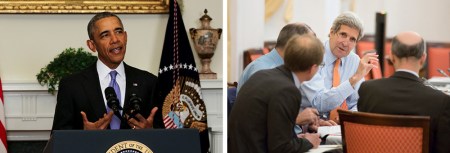
At left, President Barack Obama delivers a statement Jan. 17, 2016, on the relations between the U.S. and Iran. At right, Secretary of State John Kerry and Russian Foreign Minister Sergei Lavrov meet July 7, 2015, in Vienna, Austria, during the nuclear talks between the E3+3 and Iran. | AP and Getty Photos

Such reviews are likely to train a spotlight on an aspect of the nuclear deal and prisoner swap that has infuriated the federal law enforcement community most — the hidden damage it has caused to investigations and prosecutions into a wide array of Iranian smuggling networks with U.S. connections.

Valerie Lincy, executive director of the nonpartisan Wisconsin Project on Nuclear Arms Control, said Obama administration officials made a shrewd political calculation in focusing public attention on just those seven men it was freeing in the United States, and portraying them as mere sanctions violators.

That way, she said, “They just didn’t think it was going to make too many waves. And I think they were right.”

But Lincy, who closely tracks the U.S. counterproliferation effort against Iran, said that by letting so many men off the hook, and for such a wide range of offenses, Washington has effectively given its blessing to Iran’s continuing defiance of international laws.

Former Obama administration officials deny that, saying the men could still be prosecuted if they continue their illegal activity. But with their cases dropped, international arrest warrants dismissed and investigative assets redirected, the men — especially the 14 fugitives — can now continue activities the U.S. considers to be serious threats to its national security, Lincy said.

“This is a scandal,” she said. “The cases bear all the hallmarks of exactly the kinds of national security threats we’re still going after. It’s stunning and hard to understand why we would do this.”

Even some initial supporters of negotiating with Iran said the disclosures are troubling.

“There was always a broader conceptual problem with the administration not wanting to upset the balance of the deal or the perceived rapprochement with the Iranian regime,” said former Bush administration deputy national security adviser Juan Zarate, who later turned against the accord. “The deal was sacrosanct, and the Iranians knew it from the start and took full advantage when we had — and continue to maintain — enormous leverage.”

Most, if not all, of the Justice Department lawyers and prosecutors involved in the Counterproliferation Initiative were kept in the dark about how their cases were being used as bargaining chips, according to interviews with more than a dozen current and former officials.

So were the federal agents from the FBI and departments of Homeland Security and Commerce who for years had been operating internationally, often undercover, on the front lines of the hunt for Iranian arms and weapons smugglers.

It wasn’t just that prosecutors and agents with years of detailed knowledge about the cases were left out of the consultations about the significance of the 21 men let go in the swap. The lack of input also meant that negotiators were making decisions without fully understanding how the releases would impact the broader and interconnected matrix of U.S. investigations.

At the time, those investigations were providing U.S. officials with a roadmap of how, exactly, Tehran was clandestinely building its nuclear and ballistic missile programs and maintaining its military with the unwitting assistance of so many U.S. weapons parts and technology companies. The cases were also providing key operational details of how the Iranian procurement networks operate, and who in Tehran was calling the shots.

“So when they downplayed it, it really infuriated people,” said Kenneth MacDonald, a former senior Homeland Security official who helped establish the multi-agency coordination center at the heart of the National Counterproliferation Initiative.

“They’d spent months or years on these cases and the decisions were made with no review of what the implications were,” said MacDonald, who retired in 2013 but keeps in contact with agents as co-principal investigator at the DHS-affiliated Institute for Security Policy at Northeastern University. “There was absolutely no consultation.”

A SYSTEM IN LIMBO

In a series of interviews, senior officials from the Obama White House and Justice and State Departments said the prisoner swap was a bargain for the U.S., given the release of Washington Post reporter Jason Rezaian, former Marine Amir Hekmati and three others. Iran also promised cooperation on the case of former FBI agent Robert Levinson, who had disappeared in Iran nearly a decade earlier and was believed to be either imprisoned or dead.

Those senior officials acknowledged that all but a handful of people were kept in the dark, but said top representatives of the Justice Department and FBI helped vet the 21 Iranian proliferators and that then-Attorney General Loretta Lynch herself participated in blocking some other individuals demanded by Tehran from inclusion in potential prisoner trades.

“The condition was that they not be engaged in anything remotely attached to violence or proliferation activities,” said one senior Obama administration official familiar with the swap negotiations. “And none of them were in any stage where they were providing assistance to the [Tehran] government.”

That may be true for the seven men granted clemency in the United States, but it certainly wasn’t the case for the 14 fugitives.

“These were people under active investigation, who we wanted very badly because they were operating at such a high level that they could help us begin to find out what was happening inside the black box of how Iran’s procurement networks really operate,” said Aaron Arnold, a former intelligence analyst at CPC2, the FBI’s special Counterproliferation Center unit dedicated to thwarting Iranian nuclear and weapons smuggling. “Without that kind of strategic insight, it leaves our analysts, but more importantly, our policy-makers just guessing at what Iran is up to and how to stop it.”

Fifteen months later, the fallout from the nuclear deal and prisoner swap — and questions about the events leading up to them — continue to reverberate through the Justice Department and the specialized units at the FBI, Department of Homeland Security and Commerce Department created to neutralize the threat posed by Iran’s nuclear and military ambitions.

The National Counterproliferation Initiative, created with much fanfare a decade ago, has suffered greatly, many participants said, even as they acknowledged that metrics are hard to come by. Much of the work is done in secret, and in long-range efforts that can’t be publicly disclosed, much less measured in annual arrest or conviction statistics.

But key enforcement efforts are in limbo as the result of stalled or stymied investigations and prosecutions, and the trail of some high-value targets has gone cold, numerous participants said.

At least six times in the run-up to the nuclear deal, federal investigators scrambled to get Justice and State Department approval to lure top Iranian targets into traveling internationally in order to arrest them, according to one top Obama administration Justice Department official and other participants. But the requests weren’t approved and the targets vanished, depriving the U.S. of some of its best opportunities to gain insight into the workings of Tehran’s nuclear, missile and military programs, the sources said.

“We would say, ‘We have this opportunity and if we don’t do it now, we’ll never have the opportunity ever again,” the recently departed Justice Department official recalls. But, he added, “There were periods of time where State Department cooperation was necessary but not forthcoming.”

Obama Secretary of State John Kerry declined to comment through a former senior State Department official, who said certain requests might have been delayed temporarily because they came at particularly sensitive times in the negotiations, but only with the concurrence of the White House and Justice Department.

But even now, many experienced agents and prosecutors say they are reluctant to pursue counterproliferation cases for fear that they won’t go anywhere. They say they have also received no helpful guidance on what they can — and cannot — investigate going forward given the complicated parameters of the Iran deal and lifting of nuclear sanctions. Some said they are biding their time to see how hard-liners in the new administration, including Trump himself, deal with Iran.

But others have grown so frustrated that they have moved on from the counterproliferation effort, taking with them decades of investigative experience and relationships cultivated with other government agencies and cooperating U.S. companies, a number of current and former officials said.

And critical momentum has been lost, many say, as the 10-year anniversary of the initiative in October approaches.

“This has erased literally years — many years — of hard work, and important cases that can be used to build toward other cases and even bigger players in Iran’s nuclear and conventional weapons programs,” said former Justice Department counterproliferation prosecutor David Locke Hall, adding that the swap demolished the deterrent effect that the arrests and convictions may have had. “Even though these men’s crimes posed a direct threat to U.S. national security, the [Obama] administration has essentially told them their efforts have produced nothing more than political capital that can be traded away when politically expedient.”

One senior Obama administration official who served at the White House and DHS disagreed, saying much of the intelligence about Iranian networks remains usable even though the 21 cases were vacated, and that counterproliferation agents are a resilient bunch who will continue to do their jobs.

When asked whether the counterproliferation effort has struggled, one current Justice Department spokesman said no and quipped, “We are still in the export violation prosecuting business.”

That may be the case, said David Albright of the Institute for Science and International Security, a physicist and former weapons inspector whose decades of scientific research into Iran’s secret nuclear weapons program brings him into regular close contact with federal authorities.

But like others involved in ongoing U.S. counterproliferation efforts, Albright said he witnessed many instances since late 2014 in which important investigations and prosecutions were hindered. Albright, who serves as an expert witness in Justice Department Iran trafficking prosecutions, added that federal agents have told him of numerous cases of “lure memos” and other requests never approved by the State Department.

“You can’t keep turning these down and expecting them to want to keep doing this,” said Albright, who added that efforts to lure suspects to countries where they can be arrested are essential in getting beyond the lower rungs of middlemen for Iran. He said he could not disclose specific details, but said, “The amount of rejections has risen to the level where people were worried that it would kill the counterproliferation effort.”

“They had wanted all of these things prosecuted, they were on a roll, they were freaking out the Iranians and then they were told, boom, stop,” Albright said of the Obama administration’s counterproliferation efforts. “And it’s hard to get them back again. We are shooting ourselves in the foot, destroying the infrastructure that we created to enforce the laws against the Iranians.”

The repercussions from the prisoner swap are especially strong in Boston, where authorities had worked for years to build the case against Jamili, the suspected Iranian nuclear procurement agent, and his China-based associate Sihai Cheng.

The two were secretly indicted in 2013 along with two Iranian companies, and Cheng pleaded guilty in mid-December 2015 to four criminal counts. He acknowledged conspiring with Jamili to knowingly provide more than 1,000 high-tech components known as pressure transducers to Iran, which authorities say advanced its nuclear weapons capabilities.

Less than a month later, though, as the prisoner swap unfolded, Boston prosecutors got orders from Washington to file court papers vacating the charges against Jamili and dropping the Interpol arrest warrant for him.

It wasn’t until later that the case agents and prosecutors learned that the Iranian negotiators had specifically demanded that Jamili be included in the swap, said Arnold, the former analyst at the FBI’s Counterproliferation Center Iran unit, where he headed a financial intelligence team tracking the money flows of the Iranian networks.

A GLOBAL CAT AND MOUSE GAME

By the time of the nuclear deal and prisoner swap, the U.S. government had spent 35 years in pursuit of Iran’s ever more sophisticated web of smugglers, traffickers, transport operatives and procurement agents.

In 1979, President Jimmy Carter declared that Iran constituted an unusual and extraordinary threat to U.S. security after Islamic revolutionaries overran the U.S. Embassy in Tehran and took hostage 52 Americans. Tehran began calling the United States “the Great Satan” and vowed its destruction, in part by using proxy forces like Hezbollah.

A raft of economic sanctions against Iran and Iranian entities were put in place, followed by other restrictions on U.S. parts and technology that Tehran needed for military or other restricted applications, including its squadrons of F-class fighter jets that Washington sold it during friendlier times. Its ambitious ballistic missile program became a grave concern over the years, especially when it became apparent that Tehran was using U.S. commodities to engineer inter-continental versions that could reach the United States, and to top them with nuclear, conventional or even chemical and biological weapons.

And as Iran’s suspected nuclear weapons program ramped up, so did the U.S. effort to stop it.

Overseas, U.S. intelligence operatives shadowed Iranian procurement agents, cultivated informants and used cyberweapons to sabotage Iran’s clandestine program. The U.S. military tried to interdict illicit shipments headed for Tehran. The Treasury Department issued endless rounds of targeted sanctions, but each time it restricted access to global markets for suspect individuals and companies, Tehran would simply create new ones. And successive administrations tried the diplomatic route to slow or stop Iranian proliferation, including Tehran’s efforts to share weapons and research with other enemies of the United States, without success.

In response, federal law enforcement agents and prosecutors were deployed to shut down the Iranian procurement networks and dam the rivers of U.S. parts and technology illicitly flowing to Iran in violation of export control laws.

That proved virtually impossible, given the hundreds of trading, shipping and transport companies Iran employed, and the complex payment schemes and often unwitting procurement agents it used to get the products via other countries with lax export controls.

Meanwhile, since at least 1982, the Government Accountability Office began issuing stinging reports about how the lack of coordination and information-sharing among U.S. agencies severely hampered efforts to bring criminal cases against traffickers.

After the 9/11 attacks, those turf battles intensified. The cases often took years to investigate, and federal agents from two or even three agencies would sometimes discover they were conducting international undercover operations against the same target, a top former Homeland Security official recalls.

Securing convictions from American juries was also a huge challenge given the complex nature of the cases, especially when the procurement networks were buying so-called dual-use components that also could be used for less nefarious purposes.

Two post-9/11 cases exposed gaping holes in the global counterproliferation safety net. In the United States, Israeli-born trafficker Asher Karni was arrested for illegally shipping suspected U.S. nuclear components to Pakistan for its atomic bomb arsenal. And in Pakistan, metallurgist Abdul Qadeer Khan was caught selling his country’s nuclear capability to Iran, Libya and North Korea.
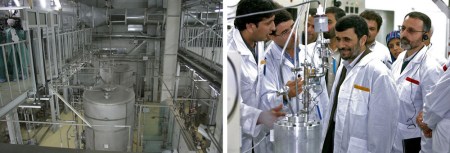
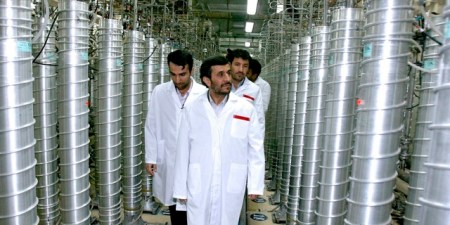
At left, an Iranian security employee walks in a part of the uranium conversion facility just outside the city of Isfahan, Iran, in 2005. At right, Iranian President Mahmoud Ahmadinejad visits the Natanz uranium enrichment facilities on April 8, 2008. Ahmadinejad announced on Iranian state television during the visit that Iran had begun the installation of some 6,000 new centrifuges, adding to to the 3,000 centrifuges already at the facility. | Getty

Both cases ratcheted up Washington’s fears that the vast underground of WMD trafficking rings could sell their wares to Al Qaeda and other terrorist groups.

In 2007, the Bush administration responded by establishing the National Counterproliferation Initiative, charging the Justice Department with coordinating and expanding U.S. efforts to dismantle the procurement networks.

Task forces were established around the country, with special training for prosecutors and agents in how to collectively build cases that would not only put front-line traffickers in prison, but also map the illicit networks and target their leadership.

From the outset, Iran cases were front and center, especially in cities like San Diego, Houston and New York with large military, industrial or technology sectors. Boston, in particular, seemed a favorite of the Iranian networks.

Soon, the multi-agency teams were homing in on key players in Iran’s nuclear and missile programs and another network procuring the IED components that Tehran’s fearsome Revolutionary Guard used to assist Iraqi insurgents killing American troops in Iraq.

An early high-value target was Amin Ravan, who by 2008 was working with a Singapore firm on behalf of the Aerospace Industries Organization, described by a secret State Department cable that year as “the umbrella organization and key procurement center for all Iranian industries responsible for developing and manufacturing missiles.”

Another was Behrouz Dolatzadeh, the suspected assault weapons buyer for Tehran. Authorities say he had been active as far back as 1995 in illegal arms smuggling and other illegal activities in connection with a sprawling business empire linked to Iran’s hard-line leader, Ayatollah Ali Khamenei.

By 2011, the Justice-led task forces had developed so many promising leads that the FBI, Commerce and Homeland Security Department had created special units to better coordinate efforts. Together, they also improved liaisons with overseas law enforcement agencies instrumental in interdicting shipments headed for Iran.

And working with U.S. intelligence agencies and the State Department, the task forces successfully lured several key Iranian operatives out of Tehran and China for capture elsewhere, including two who would end up on Obama’s prisoner swap list.

Dolatzadeh was indicted under seal in Arizona in February 2012, lured to the Czech Republic to inspect weapons en route to Iran, and arrested. And Ravan, already linked to the IED network, was secretly indicted in Washington in November 2012 and captured soon after in Malaysia.

And after a three-year undercover investigation, U.S. authorities lured a major Iranian proliferator named Parviz Khaki to the Philippines in May 2012 and arrested him on charges of conspiring to smuggle nuclear-related U.S. equipment to Iran.

“By dismantling this complex conspiracy … we have disrupted a significant threat to national security,” John Morton, then-director of DHS Immigration and Customs Enforcement, said at the time.

All three investigations provided U.S. officials with unprecedented insight into Iran’s secret procurement efforts, current and former task force members said. But Dolatzadeh and Ravan were released by courts overseas, and Khaki died in custody, before the U.S. could extradite them.

The counterproliferation teams also enlisted the help of American companies, providing them with Iran’s massive shopping list of needed items and hotlines to call when they got a nibble.

“It took a long time to mature, but by 2013 to 2014, it became very evident that we were getting a lot of great leads,” recalls Randall Coleman, who as assistant FBI director oversaw the bureau’s fledgling Counterproliferation Center and special coordinators in all 56 field offices.

“We were very aggressive, and as a result of that, our caseload went up about 500 percent,” Coleman said. “It really exploded. We were rocking and rolling.”

One of the most promising cases was in Boston, where federal agents were deep into their investigation of the illicit flow of parts to Iran from a Massachusetts firm, MKS Instruments, and its Shanghai subsidiary.

With help from MKS, which was not suspected of wrongdoing, agents initially focused on Cheng and gathered evidence that he had been indirectly supplying Iran with components with nuclear applications for years. The trail led to Eyvaz Technic Manufacturing, an Iranian company designated by European authorities as an entity involved in developing and procuring parts for Iran’s nuclear weapons and ballistic missile programs.

“Time is important, not only for you, for me, for your end user, but also for your nation,” Cheng wrote in a 2010 instant message to a suspected Iranian accomplice. “I personally believe the war will break out in 2 years and that will be the start of World War Three.”

But the agents’ curiosity was also piqued by another message from back in 2007, in which the Iranian accomplice, Seyed Jamili, asked Cheng for thousands of pressure transducers, for “a very big project and secret one.”

The project, authorities determined, was Iran’s clandestine uranium nuclear enrichment facilities at Natanz and Fordow, where the transducers helped run thousands of gas centrifuge cascades to reach weapons-grade capability. There was even a photo of then-president Mahmoud Ahmadinejad touring Natanz, with the centrifuges — and MKS transducers clearly visible — in the background.

International U.S. arrest warrants were secretly issued for the two men, and authorities nabbed Cheng when he traveled to London to watch a soccer match in February 2014. After he was extradited and brought to Boston that December, authorities began to realize that Jamili was a far more important cog in Iran’s proliferation network than they had suspected.

It was Jamili who had recruited Cheng with the promise of big and easy money, they determined, and who had been using his Iranian import-export firm as cover for personally recruiting other procurement agents on trips to China and possibly other countries.

Around that same time, negotiations over a comprehensive nuclear deal with Iran were heating up, and so were the top-secret prisoner swap talks on the sidelines of them.

AN OPERATIONAL SLOWDOWN

By the winter of 2014, federal agents and prosecutors began to detect waning support at the higher rungs of the Obama administration for their counterproliferation efforts against Iran, according to numerous officials involved. Also, they said, Justice Department management — and an interagency Iran working group — suddenly were scrutinizing Iran cases more closely, asking a lot more questions and holding up requests and approvals that in the past had been routine.

No specific guidance or order was given, some said, but the message was clear.

“They didn’t want to have cases just popping up in the workup to the agreement or shortly after the agreement. The administration would not look good if there were [cases documenting] these acquisition attempts. And the Iranians kept doing it,” MacDonald, the former senior Homeland Security official, said of Tehran’s illegal procurement efforts.

“They were never told no, just to wait,” MacDonald said of the agents. “It was a common theme among the people working these cases. The official response was that nothing had changed, that if you brought the case forward, it would be worked. But unofficially, that was just not the case.”

Some of the cases involved significant investigations into nuclear and missile proliferation that required State Department approval, including visas to lure suspects to the U.S. for arrest, said MacDonald, who had also served on the White House Task Force on Export Control Reform. “I’ve been told that the highest levels of the State Department weren’t processing those, and the cases couldn’t move forward.”

A former senior State Department official said that in most cases, State Department and White House could only provide nonbinding guidance on how ongoing law enforcement operations might affect the sensitive negotiations. Ultimately, he said, the Justice Department was responsible for pushing back and protecting the integrity of its investigations and prosecutions.

And while it’s possible that federal law enforcement officials missed opportunities as a result of State Department delays, “I am not aware of a single case where they lost out on some key arrest or information, or some proliferation activity was allowed to continue,” the former senior State Department official said, adding that some lures and extraditions were approved “until the very end of our tenure.”

Clockwise from upper left: A U.S. plane sits on the tarmac of Geneva’s airport Jan. 17, 2016, awaiting the arrival of some of the Americans freed by Iran in a prisoner swap with the United States. The prisoners were former Marine Amir Hekmati, Washington Post reporter Jason Rezaian, Idaho pastor Saeed Abedini, private investigator and retired FBI and DEA agent Robert Levinson, Massachusetts student Matthew Trevithick and Nosratollah Khosravi-Roodsari (not pictured). | AP and Getty Photos

Richard Nephew, a former top Iran sanctions official at the State Department and National Security Council, said any delays were “much more a case of managing the diplomatic initiative than letting the bad guys get away with stuff. If we found out in the NSC that something involved active law enforcement activity, then we were advised to stay the hell away from it.”

A top Obama Justice Department official rejected the notion that the State Department didn’t undermine important cases. He said prosecutors and investigators sometimes acceded to requests for delays they believed to be reasonable. But they became infuriated at times, he said, especially when opportunities to lure and arrest key Iranian proliferators were lost due to delay or outright rejection by State.

“The impediment was not the leadership of DOJ but the other agencies that DOJ has to work with to bring these cases successfully,” the Obama Justice official said. “They can kibosh it, they can pocket veto it, they can tell us no, they can punt it down a couple of steps.”

Justice Department officials demanded “high-level conversations” with the State Department and White House, but “not a whole lot” changed, the Obama Justice official said. “Did it fix the issue? I don’t think it did. I remember people up and down at DOJ being frustrated with the inability to move things.”

A senior former federal law enforcement official involved in counterproliferation efforts agreed, saying the FBI was especially impacted. “Did some of these other agencies’ actions … undermine what we were trying to accomplish in terms of the Iran network in the U.S.? Yes. But you are treading into waters where people don’t like what you are doing because it affects other things they are trying to do, diplomatically and politically.”

Ultimately, the dysfunction created by the slowdown spread far beyond the enforcement agencies and damaged relationships with partners in private industry and foreign governments, former DHS official MacDonald and others said.

By early 2015, the Obama administration’s oft-publicized desire for securing an Iran deal “was politicizing all of the ongoing investigations,” Arnold said. He visited his former CPC Iran Unit colleagues that August while briefing Treasury and FBI officials on the Iran deal, reached a month earlier, as a counterproliferation expert at Harvard’s John F. Kennedy School of Government.

“There was a fear that as negotiations went on, the White House wouldn’t want to get caught in a flap” created by a high-profile arrest or criminal case, Arnold said.

For agents and prosecutors, the headlines such an incident would create would antagonize not only their superiors but also a White House intent on proving to Tehran that it was committed to reaching an accord. On the flip side, it could also provide ammunition to the proposed deal’s many critics in Congress and elsewhere, who were claiming that Iran was aggressively continuing its clandestine procurement efforts even as it pledged good behavior.

But agents and prosecutors had an even more powerful reason to throttle back on Iran proliferation cases, according to Arnold and others.

Despite repeated requests, many were not given guidance or reassurances that the nuclear deal being negotiated in secret wouldn’t render unprosecutable new and ongoing cases, especially high-priority ones against nuclear traffickers, Arnold said. So agents had no confidence that their work would bear fruit.

“It was absolutely insane,” Arnold said. “People didn’t know what to do.”

“From the summer of 2015 on, there was a serious slowdown” as many counterproliferation officials shut down prosecutions and investigations voluntarily, Arnold said. “During that time, CPC wasn’t as aggressive as it should have been.”

The senior Obama administration official acknowledged that the twin sets of negotiations influenced the overall U.S. counterproliferation effort against Iran, especially the timing of individual investigations, prosecutions and international efforts to bring suspects to justice.

Such competing equities are unavoidable when high-level matters of diplomacy and geopolitics are under consideration, the official said. At those times, the White House must be guided by broader policy objectives, in this case de-escalating conflict with Iran, curbing its nuclear weapons program and freeing at least four American prisoners.

“The White House wouldn’t be getting involved in saying yea or nay to particular arrests or cases or the like” that are the purview of the Justice Department, the administration official said. “It was not uncommon, though, that before we were going to undertake a law enforcement action that we thought would have foreign policy implications, we would alert folks at the White House so that there could be appropriate notice given to a foreign government. That happens.”

The former official also acknowledged the complaints by agents and prosecutors about cases being derailed but said they were unavoidable, and for the greater good.

“It’s entirely possible that during the pendency of the negotiations, that folks who were doing their jobs, doing the investigations and bringing cases, having no understanding of and insight into the other process, were frustrated because they don’t feel like their stuff is moving forward,” said the Obama official. “Or they were not getting answers, because there are these entirely appropriate discussions happening on the policy side.

“That doesn’t strike me as being, a, unusual or, b, wrong,” the official added. “But I completely understand why it’s frustrating.”

The Justice Department refused repeated requests to make available for interviews anyone related to the counterproliferation effort since the Iran deal, or to provide information about its role in the negotiations.

But in a statement to POLITICO, the Justice Department said the negotiations “did not affect the Department’s determination to investigate and charge worthy cases” and that it continued to “investigate, charge, and prosecute viable criminal cases … throughout negotiations of the JCPOA,” the formal term for the Iran deal. The Justice Department said it filed federal charges against 90 individuals and entities for violations of export controls and sanctions implicating Iran between 2014 and 2016, many under seal. It did not provide information about cases under seal for those or other years, making it impossible to place those numbers in the proper context.

Also, some of those cases involve the 21 Iranians let go in the swap. And because numerous individuals and entities often are charged in a single case, the statistics suggest a slowdown in counterproliferation efforts, according to current and former investigators and a POLITICO review of DOJ cases.

The timing of arrests, prosecutions and other investigative activities “may be informed by a variety of factors, including, especially in the national security context, collateral foreign policy consequences and impacts on American lives,” the Justice Department said. “Once an individual is charged, the Department works to ensure that the defendant, whether located in the U.S. or abroad, is held accountable. In seeking to apprehend defendants located abroad, however, we need assistance from other departments, agencies, and countries, and sometimes we cannot accomplish an arrest without it.”

Senior Obama administration officials also said the negotiations over the nuclear deal and, even more so the prisoner swap, required such extraordinary secrecy that only a tiny number of people were involved.

But as the nation’s top law enforcement official — and as a participant in the negotiations —Lynch failed in her responsibility as attorney general to protect the integrity of the Justice Department’s investigations and prosecutions from any political interference, some current and former officials believe.

Lynch, through an aide, declined to comment.

(A timeline graphic is at the link below. — DM

Trump’s attorney general, Jeff Sessions, raised the issue of Justice Department independence in 2015, when as a senator he asked incoming Deputy Attorney General Sally Yates about whether she knew that she had “the responsibility to say no to the president if he asks for something that’s improper?”

Earlier this year, this issue arose again when Trump fired then-Acting Attorney General Yates for doing just that and refusing to defend his executive order on immigration. By doing so, Trump had “placed the independence of the Justice Department at stake,” said Sen. Patrick J. Leahy (D-Vt.). “The attorney general is the people’s attorney, not the president’s attorney.”

Obama spokesman Kevin Lewis also emphasized the importance of such a firewall recently when addressing Trump’s claim that Obama had ordered wiretaps of him or his campaign. “A cardinal rule of the Obama administration was that no White House official ever interfered with any independent investigation led by the Department of Justice,” Lewis said.

Many front-line current and former authorities disagree, and say the Iran deal and prisoner swap is a glaring example of that.

“A lot of people were furious; they had cases in the pipeline for months, in some cases years, and then, all of a sudden, they were gone — all because they were trying to sell the nuke deal,” a former Department of Commerce counterproliferation agent said. “Things fell apart after that. There are some really good cases out there and they are not going forward. They just let them die on the vine.”

A MASTERMIND EMERGES

Top Obama administration officials insist that the nuclear deal does not impede any of the broader U.S. efforts to go after Iran’s vast nuclear, missile and conventional weapons procurement efforts. Even so, many participants said the way forward is still sufficiently unclear that they can’t, or won’t, proceed.

Over the past year, the system has kicked back into gear, with some new cases filed and movement in existing ones. Some, however, involve activity dating to 2008, including the prosecution of some of Ravan’s suspected associates in the Iraq IED case. Privately, some prosecutors and investigators are hopeful that the Trump administration’s more hard-line approach to Tehran will mean more support for their efforts.

Like many others, though, Albright said he is concerned that the counterproliferation effort has suffered significant and lasting damage, even if much of it involves classified efforts that may never become public.

“How much damage was done to the law enforcement side of this from us pulling back from these prosecutions?” he asked. “We have to pick up the pieces.”

Albright said that is especially the case in Boston, where he testified for the government against Cheng.

A few weeks after the prisoner swap, a judge sentenced Cheng to nine years in federal prison, even more than the prosecutors asked for, for his role in the conspiracy.

Cheng’s lawyer, Stephen Weymouth, accused federal prosecutors of unfair treatment, saying they threw the book at his client, a relatively small fish, while dropping all charges against the “mastermind,” Jamili.

Since the swap, federal authorities have learned more about Jamili, including intelligence tying him directly to Mostafa Ahmadi-Roshan, a top Iranian nuclear official who supervised a key “commercial affairs” initiative at the Natanz uranium enrichment facility, according to officials familiar with the case. Authorities believe Jamili was on the phone with Ahmadi-Roshan on Jan. 11, 2012, when unknown assailants on a motorbike killed him by attaching a bomb to his car. Tehran accused Israel’s Mossad in the attack.

But the federal agents’ efforts to pursue such leads, even in the U.S., have been complicated by the general uncertainty hanging over the broader counterproliferation effort, according to Arnold, the former FBI analyst.
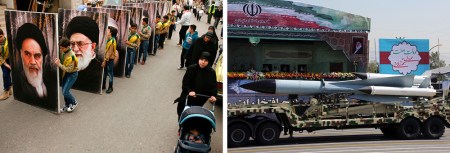
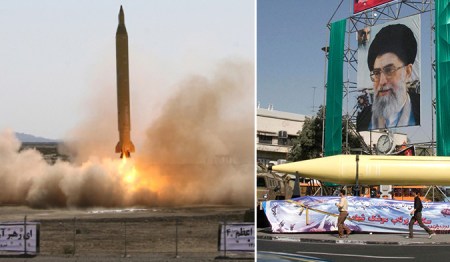
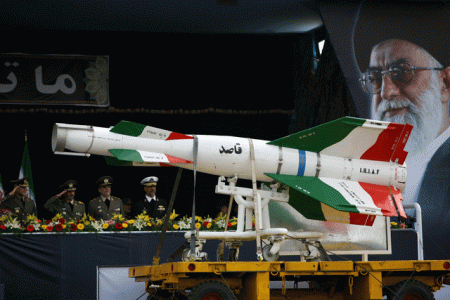
At left, young supporters of Lebanon’s militant Shiite Hezbollah movement carry portraits March 18, 2017, of the founder of Iran’s Islamic Republic, Ayatollah Ruhollah Khomeini, and Iran’s supreme leader Ayatollah Ali Khamenei as they march in the southern Lebanese town of Kfar Hatta during the funeral of a Hezbollah fighter. At right, an S-200 surface-to-air missile is driven past Iranian military commanders Sept. 22, 2015, during the annual military parade in Tehran marking the anniversary of the start of Iran’s 1980-1988 war with Iraq. | Getty

“Part of the frustration is that there is strong evidence Iran is still conducting illegal procurement operations and the FBI can’t really go forward with these cases,” said Arnold, who has been closely following the Jamili-Cheng case as part of a Harvard research project into nuclear proliferation networks.

That frustration is especially acute when it comes to Jamili and the 13 other fugitives. When dropping the charges, the Justice Department said it was doing so in large part because it was unlikely that the U.S. would ever be successful in capturing or extraditing them anyway.

Some federal officials familiar with the cases scoffed at that, noting that they have lured many Iranians to places where they could be arrested, and that others were tripped up by sealed Interpol warrants while traveling. In Jamili’s case, said one, “he has traveled so we know there’s a chance we could get him.”

Despite decades of intensive investigations, Arnold said, U.S. officials still have a “major air gap” when it comes to understanding the intermediaries like Jamili involved in the Iranian networks — who are between foot soldiers like Cheng and government officials running the nuclear and weapons programs.

“All of a sudden, we’re no longer playing whack-a-mole, and we suddenly have this key player who is directly involved and has insider knowledge as to how this whole process works,” he said. “So to see him being traded away is frustrating.”
Diplomat Rejects MKO’s Nuclear Allegations against Iran as “Absurd”

April 23, 2017

Diplomat Rejects MKO’s Nuclear Allegations against Iran as “Absurd”, Tasnim News Agency, April 23, 2017

(Please see also, Iran violating U.S. deal with secret nukes research, opposition group says. — DM)

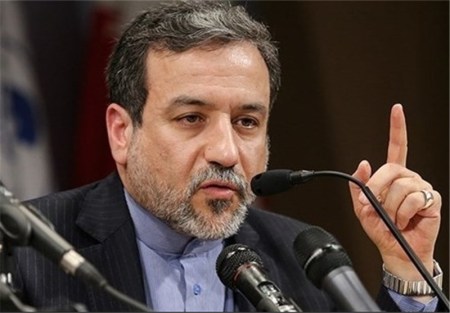
TEHRAN (Tasnim) – Iranian Deputy Foreign Minister for Legal and International Affairs Abbas Araqchi dismissed recent allegations leveled by the terrorist Mojahedin-e Khalq Organization (MKO) against Tehran’s nuclear program, as “absurd”.

In remarks released on Sunday night, Araqchi denounced recent MKO allegations that Iran is violating its nuclear deal with six world powers as “absurd and a repetition of a failed scenario whose invalidity has previously been proved by the International Atomic Energy Agency (IAEA).”

He further warned the new US administration not to be misled by the efforts made by the anti-Iran terror group and their regional supporters to spread Iranophobia, saying that previous US administrations have repeatedly taken the path and suffered every time they trusted the notorious group.

He made the remarks in response to recent MKO allegations that Iran is violating the nuclear agreement, known as the Joint Comprehensive Plan of Action (JCPOA) by “secretly conducting research into nuclear weapons components” at the Parchin military site in Iran.

Earlier on April 15, US Senator John McCain met with the MKO members in Albania, talking about his opposition to the Islamic Republic and pledging continued support for the group.

The MKO – listed as a terrorist organization by much of the international community – fled Iran in 1986 for Iraq and was given a camp by former Iraqi dictator Saddam Hussein.

They fought on the side of Saddam during the Iraqi imposed war on Iran (1980-88). They were also involved in the bloody repression of Shiite Muslims in southern Iraq in 1991 and the massacre of Iraqi Kurds.

The notorious group is also responsible for killing thousands of Iranian civilians and officials after the victory of the Islamic revolution in 1979.

More than 17,000 Iranians, many of them civilians, have been killed at the hands of the MKO in different acts of terrorism including bombings in public places, and targeted killings.

Iran violating U.S. deal with secret nukes research, opposition group says

April 21, 2017

Iran violating U.S. deal with secret nukes research, opposition group says, Washington TimesRowan Scarborough, April 21, 2017

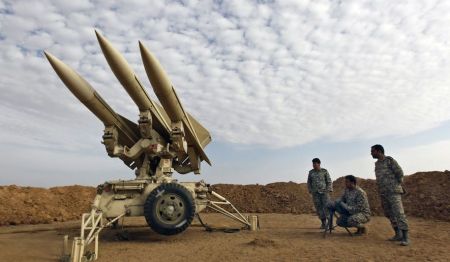
In this photo obtained from the Iranian Mehr News Agency, Iranian army members prepare missiles to be launched during a maneuver at an undisclosed location in Iran on Nov. 13, 2012. (AP Photo/Mehr News Agency, Majid Asgaripour) **FILE**

The council and MEK have a good track record over the years of disclosing Iranian nuke programs that operated under the radars of Western intelligence agencies. It boasts an extensive spying network inside the Defense Ministry, Islamic Revolutionary Guard Corps and other organs of the hard-line Islamic state ruled by religious mullahs.

The MEK said METFAZ is operating in a secret location unbeknownst to the International Atomic Energy Agency (IAEA), the world’s nuclear watchdog. In official communications, the regime refers to it as the code name “Research Academy.”

********************************

Iran is cheating on its historical deal with the U.S. by secretly conducting research into nuclear weapons components such as bomb triggers and enriched uranium, the main Iranian opposition group said Friday.

The regime is doing engineering and weaponization testing at a walled military complex south of Tehran, a location which Iran has declared off-limits to inspectors, said the National Council of Resistance of Iran (NCRI) and its main operational arm, the People’s Mujaheddin of Iran (MEK).

“This is the site that has been kept secret,” said Alireza Jafrazadeh, NCRI’s Washington office deputy director. “There is secret research to manufacture the bomb and basically cover up the real activities of the Iranian regime.”

The 2015 Joint Comprehensive Plan of Action (JCPOA), negotiated by the Obama administration, has become a major foreign policy issue for the Trump White House as it evaluates whether to reimpose economic sanctions on Tehran. Iran has benefited with billions of dollars in freed-up funds while it pursues interventions in Iraq, Syria and Yemen against U.S. interests.

The NCRI-MEK report came the day after Secretary of State Rex Tillerson lambasted Iran for its expansionist terrorist activities in the region which he said violated the spirit of the JCPOA. He called the deal a “failed approach” since Iran can break out and build bombs after 10 years.

The JCPOA outlaws the type of weaponization work described by the NCRI-MEK report.

The State Department reported this week that Iran was abiding by the deal hammered out by former Secretary of State John Kerry and approved by Russia and other powers.

The NCRI rebutted that conclusion during a press conference in Washington by saying it is providing new information on Iranian misdeeds.

The council and MEK have a good track record over the years of disclosing Iranian nuke programs that operated under the radars of Western intelligence agencies. It boasts an extensive spying network inside the Defense Ministry, Islamic Revolutionary Guard Corps and other organs of the hard-line Islamic state ruled by religious mullahs.

The NCRI asserts that Iran’s so-called “declared” sites were not disclosed by Iran, but by the intelligence work of MEK.

The heart of the NCRI-MEK intelligence report is a research operation known as the Organization of Defensive Innovation and Research (SPND) and its seven subdivision, which MEK said it first exposed in 2011.

“They are carrying out their research in various fields related to the manufacturing of a nuclear weapon,” the council’s report said. “In some of these fields, new initiatives have also been undertaken in order to keep the real objectives of the research a secret and to cover up the real activities.”

One those subdivisions, the Center of Research and Expansion of Technologies on Explosions and Impact (METFAZ) works on triggers and explosive yields, the statement said. The MEK disclosed METFAZ’s existence in 2009.

The MEK said METFAZ is operating in a secret location unbeknownst to the International Atomic Energy Agency (IAEA), the world’s nuclear watchdog. In official communications, the regime refers to it as the code name “Research Academy.”

The council investigation said that for the mullahs to continue METFAZ’s work undetected, they downsized a center in Sanjariana and transferred the research and testing to a new site in the military district of Parchin 20 miles south of Tehran.

“We are disclosing this for the first time today,” Mr. Jafrazadeh said. “They felt this was optimum location for shielding the actives of METFAZ.”

Reporters asked Mr. Jafrazadeh why the U.S.’s latest 90-day report to Congress say Iran was complying if it is now cheating.

He answered that the assessment is based on the IAEA monitoring known sites and measuring technical metrics, such as the amounts of enriched uranium.

He said that what the council is disclosing is secret weaponization work that now needs to be investigated. He said the council provided its report in the last few days to the Trump administration and the IAEA.

“We’re talking about an extensive covert operation by the Iranian regime,” he said.

Mr. Jafrazadeh said that when the IAEA visited a limited number of sites at Parchin in 2015, Iran had cleansed them of weaponization evidence.

“It needs to be inspected immediately,” Mr. Jafrazadeh said. He predicted this new intelligence report will prompt Iran to “clean out” its illicit work.

Iranian Supreme Leader Ali Khamenei has said that “inspection of our military sites is out of the question and is one of our red lines.” A number of Iranian leaders have repeated that warning in recent months.

The MEK provided satellite photos and descriptions of the exact locations of nuclear research inside the Parchin complex, such as “Plan 6” which is located at “the end of Babaj highway, Khojir-Parchin military road, after the tunnel on the southern side of Mamlo Dam.”

The site is protected by the Islamic Revolutionary Guard Corps, the dominant security force inside Iran.

The report described the musical chairs this way: “The move resulted in the subsiding of activities at the Sanjarian site. The Iranian regime has done its utmost to keep the Research Academy, which is an important site, a secret from the eyes of international organizations. The reason for the move was based on the conclusion reached by regime officials that the probability for the IAEA to get access to Parchin in the future is extremely low, which means that the site is an optimal location for shielding the regime’s activities in this regard.”

To bolster its findings, the MEK released what it said are the nuts and bolts of Iran’s cheating, such as the identities of 15 METFAZ personnel and their jobs descriptions, and addresses of various secret sites.

The SPND network is headquartered in Tehran in the “Nour Building,” near the Defense Minister which supervises operations.

“In order to understand the regime’s secret and illicit activities, it is critical that the IAEA inspect and monitor not only the Research Academy, but also all other sites related to SPND,” the NCRIR-MEK said. “This will help shed light on the scope of the regime’s secret military and nuclear activities.”

It added, “The weaponization program must be totally dismantled. There is no reason to maintain SPND, and all its subordinate organizations, including METFAZ. They have no peaceful, energy use whatsoever and, their only function is to facilitate the development of the nuclear bomb.”

Mr. Jafrazadeh termed as “ridiculous” Iran’s restrictions on military site inspections since it is the military that oversees nuclear bomb research.

The NCRI received a boost this week when Senate Armed Services Chairman John McCain, Arizona Republican, attended a council event in Tirana, Albania, its new home after spending years in Iraq.

He met privately with NCRI leader Maryam Rajavi.

The Washington Times asked the State Department to respond to the NCRI-MEK investigation.

A spokesman referred to Mr. Tillerson’s April 18 letter to Congress certifying that Iran is in compliance. Mr. Tillerson added that the Trump administration will conduct a review of whether the suspension of economic sanctions under JCPOA is in the U.S’s interest.

“Notwithstanding, Iran remains a leading state sponsor of terror through many platforms and methods,” Mr. Tillerson wrote.

Rex Tillerson’s Tough Talk on Iran

April 20, 2017

Rex Tillerson’s Tough Talk on Iran, Power LinePaul Mirengoff, April 19, 2017

Yesterday, as we noted here, Secretary of State Rex Tillerson informed Congress that Iran is in compliance with the nuclear deal and that the administration will continue to provide relief from sanctions, as called for by the agreement. He added, however, that “Iran remains a leading state sponsor of terror through many platforms and methods.”

Today, Tillerson (1) elaborated in scathing language on Iran’s role as a leading sponsor of terrorism and on other of its misdeeds, (2) made clear that the nuclear deal is unsatisfactory, and (3) stressed that the U.S. government is engaged in a thorough review of our Iran policy.

Tillerson characterized the Iran deal as “another example of buying off a power who has nuclear ambitions.” Citing the North Korean example, Tillerson complained “we buy them off for a short period of time, and then someone has to deal with it later.” He then added that the administration does not intend to follow this course.

It is rumored that President Trump hit the roof when he saw Tillerson’s letter to Congress (or maybe the way it was reported) and demanded that he issue today’s tough statement. According to this account, the tough statement had been drafted previously, nixed by influential soft-liners in the administration, and revived in light of the Tillerson letter.

Whether or not this is what happened, I think today’s statement was much needed.

But what will come of the policy review promised in Tillerson’s statement? The Obama administration did an effective job of fencing in its successors. I discussed the future of the Iran deal under Trump in this post.

The upshot of two days of Tillerson talk about Iran seems to be that our Iran policy is up-for-grabs, like much else in the policy realm. Sharp disagreement probably exists within the administration about how to proceed and, not unlike other policy disputes, the disagreement occurs in the context of no truly good options.

You can watch Tillerson’s speech, plus a brief Q&A, below. Don’t miss Andrea Mitchell fretting that if the U.S. backs out of the Iran deal, rogue states like North Korea won’t trust us.


We’re turning a blind eye to Iran’s genocidal liars

April 18, 2017

We’re turning a blind eye to Iran’s genocidal liars, The Australian, Michael Oren, April 19, 2017

(Please see also, What North Korea Should Teach Us about Iran. DM)

In responding forcibly to North Korean and Syrian outrages, President Trump has taken a major step towards restoring America’s deterrence power. His determination to redress the flaws in the JCPOA and to stand up to Iran will greatly accelerate that process. The US, Israel and the world will all be safer.

**************************

The US has signed agreements with three rogue regimes strictly limiting their unconventional military capacities. Two of those regimes — Syria and North Korea — brazenly violated the agreements, provoking game-changing responses from Donald Trump. But the third agreement — with Iran — is so inherently flawed that Tehran doesn’t even have to break it. Honouring it will be enough to endanger millions of lives.

The framework agreements with North Korea and Syria, concluded respectively in 1994 and 2013, were similar in many ways. Both recognised that the regimes already possessed weapons of mass destruction or at least the means to produce them. Both ­assumed that the regimes would surrender their arsenals under an international treaty and open their facilities to inspectors. And both believed these repressive states, if properly engaged, could be brought into the community of nations.

All those assumptions were wrong. After withdrawing from the nuclear non-proliferation treaty, Pyongyang tested five atomic weapons and developed ­intercontinental missiles capable of carrying them. Syrian dictator Bashar al-Assad, less than a year after signing the framework, reverted to gassing his own people. Bolstered by the inaction of the US and backed by other powers, North Korea and Syria broke their commitments with impunity.

Or so it seemed. By ordering a Tomahawk missile attack on a Syrian air base, and a US Navy strike force to patrol near North Korea’s coast, the Trump administration has upheld the frame­­works and placed their violators on notice. This reassertion of power is welcomed by all of ­America’s allies, Israel among them. But for us the most dangerous agreement of all is the one that may never need military enforcement. For us, the existential threat looms in a decade, when the agreement with Iran expires.

Like the frameworks with North Korea and Syria, the Joint Comprehensive Plan of Action of 2015 assumed that Iran would fulfil its obligations and open its facilities to inspectors. The JCPOA assumed that Iran would moderate its behaviour and join the international community. Yet unlike its North Korean and Syrian allies, Iran was the largest state sponsor of terror and openly vowed to destroy another state: Israel. Unlike them, Iran systematically lied about its unconventional weapons program for 30 years. And unlike Damascus and Pyongyang, which are permanently barred from acquiring weapons of mass destruction, Tehran can look forward to building them swiftly and legitimately in the late 2020s, once the JCPOA expires.

This, for Israel and our neighbouring Sunni states, is the appalling flaw of the JCPOA. The regime most committed to our destruction has been granted a free pass to develop military nuclear capabilities. Iran could follow the Syrian and North Korean examples and cheat. Or, while enjoying hundreds of billions of dollars in sanctions relief, it can adhere to the agreement and deactivate parts of its nuclear facilities rather than dismantle them. It can develop new technologies for producing atomic bombs while testing intercontinental ballistic missiles. It can continue massacring Syrians, Iraqis and Yemenis, and bankrolling Hamas and Hezbollah. The JCPOA enables Iran to do all that merely by complying.

A nuclear-armed Iran would be as dangerous as “50 North Koreas”, Israeli Prime Minister Benjamin Netanyahu told the UN in 2013, and Iran is certainly many times more dangerous than Syria. Yet Iran alone has been granted immunity for butchering civilians and threatening genocide. Iran alone has been guaranteed a ­future nuclear capability. And the Iranian regime — which brutally crushed a popular uprising in 2009 — has amassed a million-man force to suppress any future opposition. Rather than moderating, the present regime promises to be more radical yet in another 10 years.

How can the US and its allies pre-empt catastrophe? Many steps are possible, but they begin with penalising Iran for the conventions it already violates, such as UN restrictions on missile development. The remaining American sanctions on Iran must stay staunchly in place and congress must pass further punitive legislation. Above all, a strong link must be established between the JCPOA and Iran’s support for terror, its pledges to annihilate ­Israel and overthrow pro-American Arab governments, and its complicity in massacres. As long as the ayatollahs oppress their own population and export their ­tyranny abroad, no restrictions on their nuclear program can ever be allowed to expire.

In responding forcibly to North Korean and Syrian outrages, President Trump has taken a major step towards restoring America’s deterrence power. His determination to redress the flaws in the JCPOA and to stand up to Iran will greatly accelerate that process. The US, Israel and the world will all be safer.

Michael Oren is Israel’s deputy minister for diplomacy, a member of the Knesset and a former ambassador to Washington.

What North Korea Should Teach Us about Iran

April 18, 2017

What North Korea Should Teach Us about Iran, Gatestone InstituteAlan M. Dershowitz, April 18, 2017

(The proposed legislation should explicitly authorise military action whenever Iran develops nukes; not merely after the Iran Scam permits their development. — DM

If we are not to make the same mistake with Iran that we made with North Korea, we must do something now – before Iran secures a weapon – to deter the mullahs from becoming a nuclear power, over which we would have little or no leverage.

Congress should now enact legislation declaring that Iran’s reaffirmation that it will never “develop or acquire nuclear weapons” is an integral part of the agreement and represents the policy of the United States. It is too late to change the words of the deal, but it is not too late for Congress to insist that Iran comply fully with all of its provisions, even those in the preamble.

Congress should authorize the President “to take military action against Iran’s nuclear weapon’s program if it were to cross the red lines….”

*****************************

We failed to prevent North Korea from developing nuclear weapons. As a result, our options to stop them from developing a delivery system capable of reaching our shores are severely limited.

The hard lesson from our failure to stop North Korea before they became a nuclear power is that we MUST stop Iran from ever developing or acquiring a nuclear arsenal. A nuclear Iran would be far more dangerous to American interests than a nuclear North Korea. Iran already has missiles capable of reaching numerous American allies. They are in the process of upgrading them and making them capable of delivering a nuclear payload to our shores. Its fundamentalist religious leaders would be willing to sacrifice millions of Iranians to destroy the “Big Satan” (United States) or the “Little Satan” (Israel). The late “moderate” leader Hashemi Rafsanjani once told an American journalist that if Iran attacked Israel with nuclear weapons, they “would kill as many as five million Jews,” and that if Israel retaliated, they would kill fifteen million Iranians, which would be “a small sacrifice from among the billion Muslims in the world.” He concluded that “it is not irrational to contemplate such an eventuality.” Recall that the Iranian mullahs were willing to sacrifice thousands of “child-soldiers” in their futile war with Iraq. There is nothing more dangerous than a “suicide regime” armed with nuclear weapons.

The deal signed by Iran in 2015 postpones Iran’s quest for a nuclear arsenal, but it doesn’t prevent it, despite Iran’s unequivocal statement in the preamble to the agreement that “Iran reaffirms that under no circumstances will Iran ever seek, develop or acquire nuclear weapons.” (Emphasis added). Recall that North Korea provided similar assurances to the Clinton Administration back in 1994, only to break them several years later — with no real consequences. The Iranian mullahs apparently regard their reaffirmation as merely hortatory and not legally binding. The body of the agreement itself — the portion Iran believes is legally binding — does not preclude Iran from developing nuclear weapons after a certain time, variously estimated as between 10 to 15 years from the signing of the agreement. Nor does it prevent Iran from perfecting its delivery systems, including nuclear tipped inter-continental ballistic missiles capable of reaching the United States.


If we are not to make the same mistake with Iran that we made with North Korea, we must do something now – before Iran secures a weapon – to deter the mullahs from becoming a nuclear power, over which we would have little or no leverage.

Congress should now enact legislation declaring that Iran’s reaffirmation that it will never “develop or acquire nuclear weapons” is an integral part of the agreement and represents the policy of the United States. It is too late to change the words of the deal, but it is not too late for Congress to insist that Iran comply fully with all of its provisions, even those in the preamble.

In order to ensure that the entirety of the agreement is carried out, including that reaffirmation, Congress should adopt the proposal made by Thomas L. Friedman on 22 July 2015 and by myself on 5 September 2013. To quite Friedman:

“Congress should pass a resolution authorizing this and future presidents to use force to prevent Iran from ever becoming a nuclear weapons state … Iran must know now that the U.S. president is authorized to destroy – without warning or negotiation – any attempt by Tehran to build a bomb.”

I put it similarly: Congress should authorize the President “to take military action against Iran’s nuclear weapon’s program if it were to cross the red lines….”

The benefits of enacting such legislation are clear: the law would underline the centrality to the deal of Iran’s reaffirmation never to acquire nuclear weapons, and would provide both a deterrent against Iran violating its reaffirmation and an enforcement authorization in the event it does.

A law based on these two elements — adopting Iran’s reaffirmation as the official American policy and authorizing a preventive military strike if Iran tried to obtain nuclear weapons — may be an alternative we can live with. But without such an alternative, the deal as currently interpreted by Iran will not prevent Iran from obtaining nuclear weapons. In all probability, it would merely postpone that catastrophe for about a decade while legitimating its occurrence. This is not an outcome we can live with, as evidenced by the crisis we are now confronting with North Korea. So let us learn from our mistake and not repeat it with Iran.

U.S. Options in Syria Don’t Include Ground Troops

April 10, 2017

U.S. Options in Syria Don’t Include Ground Troops, PJ Media, David P. Goldman, April 10, 2017

FILE – In this file image provided on Friday, April 7, 2017 by the U.S. Navy, the guided-missile destroyer USS Porter (DDG 78) launches a tomahawk land attack missile in the Mediterranean Sea. The U.S. missile attack has caused heavy damage to one of Syria’s biggest and most strategic air bases, used to launch warplanes to strike opposition-held areas in central, northern and southern Syria. (Mass Communication Specialist 3rd Class Ford Williams/U.S. Navy via AP, File)

The war has already displaced half of Syria’s 22 million people, and Iran plans to replace Sunnis with Shi’ite immigrants in order to change the demographic balance. The Sunni side of the conflict has become globalized with fighters from the Russian Caucasus, China’s Xinjiang Province, as well as Southeast Asia.

The U.S. State Department last year estimated that 40,000 foreign fighters from 100 countries were in Syria; Russia cited a figure of 30,000. Whatever the number is today, it would not be difficult to add a zero to it.

Russia and China must be frightened of America’s prowess, especially in military technology. A Reagan-style effort to established unquestioned U.S. supremacy in military technology is the Big Stick we require. Tomahawk missiles are not a Big Stick. They speak loudly. Trump was magnificently right to send the signal to Moscow and Beijing, especially (as Secretary Tillerson said) in the light of Russia’s duplicity or incompetence in the matter of Syrian poison gas. Now we need to get to work.

***************************

Writing in the Washington Post, neo-conservatives Reuel Gerecht and Ray Takeyh propose to send U.S. ground troops to fight Iran and its proxies in Iran and Syria:

It is way past time for Washington to stoke the volcano under Tehran and to challenge the regime on the limes of its Shiite empire. This will be costly and will entail the use of more American troops in both Syria and Iraq. But if we don’t do this, we will not see an end to the sectarian warfare that nurtures jihadists. We will be counting down the clock on the nuclear accord, waiting for advanced centrifuges to come on line. As with the Soviet Union vs. Ronald Reagan, to confront American resolution, the mullahs will have to pour money into their foreign ventures or suffer humiliating retreat.

They’re nuts.

It isn’t Iran that we would be fighting: It’s an international mercenary army that already includes thousands of fighters recruited from the three million Hazara Afghans now seeking refuge in Iran, from the persecuted Pakistani Shi’ites who comprise a fifth of that country’s huge population, and elsewhere. As I reported recently in Asia Times:

The IRGC’s foreign legions include volunteers from Afghanistan and Pakistan, where Shi’ites are an oppressed minority often subject to violent repression by the Sunni majority. IRGC-controlled forces include the Fatemiyoun Militia recruited mainly from Shi’ite Hazara refugees from Afghanistan, with reported manpower of perhaps 12,000 to 14,000 fighters, of whom 3,000 to 4,000 are now in Syria. Iranians also command the Zeinabiyoun militia composed of Pakistani Shi’ites, with perhaps 1,500 fighters in Syria.

The manpower pool from which these fighters are drawn is virtually bottomless. The war has already displaced half of Syria’s 22 million people, and Iran plans to replace Sunnis with Shi’ite immigrants in order to change the demographic balance. The Sunni side of the conflict has become globalized with fighters from the Russian Caucasus, China’s Xinjiang Province, as well as Southeast Asia.

The U.S. State Department last year estimated that 40,000 foreign fighters from 100 countries were in Syria; Russia cited a figure of 30,000. Whatever the number is today, it would not be difficult to add a zero to it.

Russia and China, as I explained in the cited Asia Times essay, blame the U.S. for opening the Pandora’s Box of Sunni radicalism by destroying the Iraqi State and supporting majority (that is, Shi’ite) rule in Iraq. Sadly, they are broadly correct to believe so. Thanks to the advice of Gerecht and his co-thinkers at the Weekly Standard and Commentary, the Bush administration pushed Iraq’s and Syria’s Sunnis into the hands of non-state actors like al-Qaeda and ISIS.

A seventh of Russia’s population is Muslim, and 90% of them are Sunnis. China has a restive Muslim population among the Uyghurs in its far West, and all of them are Sunnis. Moscow and Beijing therefore support Shi’ite terrorists as a counterweight to Sunni jihadists. A Eurasian Muslim civil war is unfolding as a result. Daniel Pipes of the Middle East Forum thinks America should let Sunnis and Shi’ites exhaust each other. If it were just Syria, that would make sense, but the Syrian conflict is the nodal point for a much larger and more dangerous conflagration. If the 300 million Muslims of Southeast Asia were to become involved, the consequences would be horrific.

Gerecht and Tayekh want the U.S. to back the anti-regime forces whom Obama left twisting in the wind during the 2009 demonstrations against Iran’s rigged elections. That is the right thing to do. The Trump administration should create a special task force for regime change in Iran and recruit PJ Media’s Michael Ledeen to run it. Iran is vulnerable to subversion. With 40% youth unemployment and extreme levels of social pathology (the rate of venereal disease infection is twenty times that of the U.S.), Iranians are miserable under the theocratic regime.

But I don’t know if that will work: Iran gets all its money from oil, and the mullahs have the oil, the money, and all the guns. If we can’t overthrow the Iranian regime, we will have two choices.

The first is to bomb Iran — destroy nuclear facilities and Iran Revolutionary Guard Corps bases. That risks war with Russia and China. It is an option, but a dangerous one, and not anyone’s first choice. We could have done this before Iran became a Russian-Chinese ally.

The second is to cut a deal with Russia and China: We muzzle the Sunni jihadists whom we (or our allies like Saudi Arabia) supported, and Russia and China cut Iran off at the knees. I sketched out such a deal in August 2016. It won’t happen easily, or any time soon, because Russia and China are not sufficiently afraid of us to want to come to the table. Russia would demand other concessions (e.g., recognition of its acquisition of territory by force in Ukraine). As the use of poison gas despite past Russian assurances makes clear, one can’t trust the Russians unless, of course, they really are scared of us.

So it all comes down to Grand Strategy: Russia and China must be frightened of America’s prowess, especially in military technology. A Reagan-style effort to established unquestioned U.S. supremacy in military technology is the Big Stick we require. Tomahawk missiles are not a Big Stick. They speak loudly. Trump was magnificently right to send the signal to Moscow and Beijing, especially (as Secretary Tillerson said) in the light of Russia’s duplicity or incompetence in the matter of Syrian poison gas. Now we need to get to work.

—————

Update: Christina Lin, a former senior U.S. Defense Department analyst and fellow at SAIS (and frequent Asia Times contributor), told The Diplomat in an interview today:

As a recent Israeli intelligence report documented, there are thousands of Chinese Uyghurs fighting in the ranks of al-Qaeda affiliates and ISIS in Syria, namely in the Turkistan Islamic Party (TIP) based in Idlib — an al-Qaeda stronghold. The August 30, 2016 bombing of the Chinese embassy in  Krgyzstan, planned by TIP in Syria and financed by Al Nusra, signals increasing threats to Chinese citizens and interests overseas if Syria becomes a terrorist safe haven.

Because of “inter-mingling” with Ahrar al Sham and other so called “moderate” jihadists, TIP and Nusra enjoy U.S. and its allies’ protection even though they are designated as terrorist organizations. The have procured advanced Western weapons such as U.S.-supplied anti-tank TOW missiles, Grad missiles, and likely anti-aircraft MANPADS, and drones that they used to record their recent suicide campaigns against the Syrian army. These Western weapons enhance their war fighting capabilities to launch future attacks on China and Chinese interests, so Beijing will likely step up its military support to the Syrian army. Chinese military advisers are already on the ground in Syria, according to media reports.

The Real War in ‘Syria’ and the Strategy for Long-Term Victory

April 7, 2017

The Real War in ‘Syria’ and the Strategy for Long-Term Victory, PJ MediaMichael Ledeen, April 6, 2017

(Iran is ripe for regime change and the sooner the better. Please see also, Iran’s Elections: A Breaking Crisis? and All 15 Arab Summit resolutions blast Iran.– DM)

Syria’s President Bashar al-Assad (Reuters, RTX34BQA)

Punishing Assad would be satisfying, but we’ve got a big war to win. It’s smarter and more effective to go after the regime in Tehran. Not militarily, but rather supporting the tens of millions of Iranians who detest the Khamenei regime. Call it political warfare, or subversion, or democratic revolution. It worked against the Soviet Empire, and there are good reasons to believe it would work in Iran as well. Most Iranians, suffering under the failed regime, want a freely chosen government that will address their problems instead of dispatching their husbands and sons sent to the battlefield.

Regime change in Iran would be devastating to Assad and Putin, and its positive effects would be felt in North Africa and our own hemisphere, striking at the Revolutionary Guards and Hezbollah in Latin America. And it would remind the tyrants that America’s greatest weapon is political. We are the most revolutionary country in the world, and we should act like it.

****************************

Of course I loathe Assad. And of course I despise the Obamans for that phony red line and the subsequent retreat-and-bogus-Russian-deal. But just carrying out vengeance against Assad isn’t good enough. It fails to address the central problem of our time: the global anti-American alliance.

There is no Syria any more, and the enemy forces on the Middle Eastern battlefield come from various jihadi groups, and three regimes: Moscow, Tehran, and Damascus. We have to defeat them all, and other members of the enemy alliance, including Cuba and North Korea. Nikki Haley has it right: “The truth is that Assad, Russia and Iran have no interest in peace.”

Indeed, they are waging war, and the principal force driving that war is not Assad, but Iranian Supreme Leader Ali Khamenei. Khamenei’s killers have been alongside Assad’s from the very beginning, as the survival of the Syrian dictator is crucial to Iranian ambitions and quite likely also the survival of the Islamic Republic itself. Listen to Defense Secretary James Mattis a few days ago (from Reuters):

Asked about comments Mattis made in 2012 that the three primary threats the United States faced were “Iran, Iran, Iran,” Mattis told reporters that Iran’s behavior had not changed in the years since.

“At the time when I spoke about Iran I was a commander of US central command and that (Iran) was the primary exporter of terrorism, frankly, it was the primary state sponsor of terrorism and it continues that kind of behavior today,” Mattis said.

True, and Mattis’ characteristically strong language points the way to the best American action in the region, namely bringing down the Tehran regime. Lashing out at Assad isn’t nearly good enough. After all, what strategic objective would we accomplish by smashing, even removing, Assad? The Iranian and Russian fighters would still be there, as would the Islamist forces. The demands on our military would dramatically expand. We do not want to occupy a significant land mass in what used to be called Syria, nor do we seem to have sorted out what we want to do with the Turks and the Kurds.

Punishing Assad would be satisfying, but we’ve got a big war to win. It’s smarter and more effective to go after the regime in Tehran. Not militarily, but rather supporting the tens of millions of Iranians who detest the Khamenei regime. Call it political warfare, or subversion, or democratic revolution. It worked against the Soviet Empire, and there are good reasons to believe it would work in Iran as well. Most Iranians, suffering under the failed regime, want a freely chosen government that will address their problems instead of dispatching their husbands and sons sent to the battlefield.

Regime change in Iran would be devastating to Assad and Putin, and its positive effects would be felt in North Africa and our own hemisphere, striking at the Revolutionary Guards and Hezbollah in Latin America. And it would remind the tyrants that America’s greatest weapon is political. We are the most revolutionary country in the world, and we should act like it.

Iran: A “Paper Tiger”

April 1, 2017

Iran: A “Paper Tiger,” Iran Focus, March 31, 2017

(What would Russia do? Please see also, Iran’s Elections: A Breaking Crisis? — DM)

London, 31 Mar – While Iran calls for the destruction of Israel, according to some experts, an American or Israeli attack against the Islamic Republic’s nuclear and military sites would be fairly easy to execute. This is because, although Iran points to technological advancement in their military, it is actually has overextended itself in Syria.

A report published in March by the Middle East Media Research Institute (MEMRI), noted Iran has backed off their provocations against U.S. Navy vessels, and has even ceased their threats to sink these ships in the Persian Gulf. The report continued, “The slogan ‘death to America’ has disappeared almost entirely from the official discourse of regime spokesmen, including Iranian Supreme Leader Ali Khamenei himself, as have public burnings of the American flag.”

Fars News Agency reported on March 26, that deputy chief of staff of Iran’s armed forces, Brigadier General Masoud Jazayeri, warned the U.S. to be more careful about its warship movements in the Persian Gulf, which is a softer warning than we’ve heard in the past from Iranian leaders.

President and founder of MEMRI, Yigal Carmon, has stated that Iran’s claims of domestic development of military technologies are “complete nonsense,” but said that the country’s acquisition of North Korean missiles is concerning. Carmon said further, that Iran imports North Korean missiles and renames them to give the impression that they were domestically developed.

He explained that Iranian media publishes stories every few weeks about success of their military programs. One such story in January 2013, announced that Iran’s Space Agency had sent a monkey into space, yet pictures of the monkey before and after the “mission” failed to match up. “Iran does not create any quality military equipment, they only are able to buy from abroad. What do they invent to counter U.S. ships? All they are able to come up with is suicide speed boats,” he said.

Iran has also “displayed what they claimed to be domestically built submarines, but when we saw the picture that they put out, we saw that the size would be good for the Baltimore aquarium,” said Carmon.

The ballistics test Iran conducted in January failed. Carmon believes that Iran poses no real challenge to the U.S. “If the U.S. or Israel attack Iran’s nuclear sites and military targets, it will be a done deal,” he said.

A comparison of American and Iranian financial resources may bolster this argument. Fox News columnist Jonathan Adelman, an international studies professor at the University of Denver, wrote in February, “Look at the figures. The American GDP of over $18 trillion is more than 40 times the GDP of Iran ($450 billion)…. Given all this, the fear of Iran getting nuclear weapons still remains real. But, even more real is the notion that the biggest power in the world, plus three significant regional powers (Israel, Egypt and Saudi Arabia), could handle Iran if they would put their minds to it.”

Iran sank $6 billion annually of its resources into the Syrian Civil War, according to Bloomberg News.

Dr. Harold Rhode, a distinguished senior fellow at the Gatestone Institute, and a former U.S. Defense Department official, has stated that while America is strong both militarily and internally, Iran and North Korea “appear strong, but are weak and rotten inside.” Rhode said that while Iran is trying to develop nuclear weapons, it is destroying its country by inaction on domestic problems such as its water crisis. London-based NGO Small Media published a study in March 2016, saying that Iran “faces an unprecedented crisis of water resources that threatens to render vast swathes of the country near-uninhabitable within the coming decades.”

A dangerous opium drug problem is also facing Iran. Rhode speculated that Iranian authorities could crack down on drugs, but ignore it instead, in order “to keep the people preoccupied so they don’t concern themselves with overthrowing the government.”

Rhode believes the American or Israeli approach should be one of strength, but said, “Do we need to have a massive invasion [of Iran]? No. We must show that this regime cannot do what is necessary to keep themselves in power.”

There are alternatives to “actual physical attacks,” such as electronic warfare, when it comes to confronting Iran, according to MEMRI’s Carmon.

Rhode said other options should be considered before putting troops on the ground, including bringing about regime change. “We live in very stable societies, we expect changes to come slowly, but that is not how it works in totalitarian societies like Iran. The moment the people see the regime has lost its ability and willingness to keep itself in power, the regime will topple very quickly, as happened to the shah in 1979. The shah was not willing to do what was necessary to put down the rioting,” he said, and called Iran a “potentially a paper tiger” adding that it is “our job to encourage regime change—and we can.”

Dr. Majid Rafizadeh: Why the Islamist State of Iran is So Dangerous

March 22, 2017

Dr. Majid Rafizadeh: Why the Islamist State of Iran is So Dangerous, Clarion ProjectElliot Friedland, March 22, 2017

Dr. Majid Rafizadeh. (Photo: Supplied)

Dr. Majid Rafizadeh is a world-renowned Iranian-American political scientist,  businessman and author. He is a leading expert on Iran, Middle East, US foreign policy, and president of the International American Council on the Middle East and North Africa. Harvard-educated, Rafizadeh serves on the board on Harvard International Review. Born in Iran, Dr. Rafizadeh lived most of his life in Iran and Syria.

He can be reached on Twitter: @Dr_Rafizadeh or by email at Dr.Rafizadeh@Post.Harvard.Edu

He graciously agreed to speak with Clarion Project Dialogue Coordinator Elliot Friedland about Iran and why he feels so strongly about the threat posed by the regime. The views expressed below are those of Dr. Rafizadeh’s and not necessarily those of Clarion Project.

1. Clarion Project: What do you think is so dangerous about the regime of Iran?

Dr. Majid Rafizadeh: There are so many reasons why the Islamist state of Iran is extremely dangerous. They could fill an entire book.

Briefly speaking, I believe there are four major reasons, or what I will call, five concentric forces of extremism and fundamentalism:

First of all, from my perspective, the Iranian regime is far more dangerous than terrorist groups such as the Islamic State or Al Qaeda. On a daily basis, Iran tortures and executes people on a much larger scale than terrorist organizations such as ISIS. It is the top state sponsor of terrorism in the world. It supports militarily and financially hundreds of militia and terrorist groups all around the world. It regularly gives birth to terrorist groups. Only one country, the Islamist state of Iran single-handedly assists almost one quarter of world-designated terrorist groups. The Iranian regime contributes in terrorist attacks around the world. This means that the Iranian regime is responsible for blood spilled across many nations, for the slaughter of countless victims of terrorism. Iran has placed spies, lobbyists and agents across the globe, even in the U.S.

The Iranian regime is more dangerous than ISIS and Al Qaeda combined because the Islamist state of Iran operates under the “legitimacy” of the state system. Unlike ISIS or Al Qaeda, the Iranian regime has easily gotten away with its brutal actions for almost four decades because it is a “government” and supported by the United Nations when it comes to sovereignty. Since the ruling clerics rule a country, no one questions their actions.

Unlike terrorists groups such as ISIS and Al Qaeda, the Iranian regime has powerful ballistic missiles which can hit any country in the region; it has military institutions, it hires hundreds of thousands of militiamen, it freely controls the wealth of a large nation and wields all of the influence that comes with it. Instead of solely focusing on ISIS, the international community should also address the Iranian regime.

A military parade in Iran. (Photo: Getty Images)


Secondly, the Iranian regime is a radical theocracy. This means that its core pillars are anchored in radical Islamism and extreme interpretations of the religion of Islam. The Iranian regime imposes strict Shia sharia laws to suppress and control its population and export its ideology beyond its borders.  For nearly four decades, the ruling political establishment has exploited Islam and used their fundamentalist version of Islam in order to advance its parochial, religious, ideological, revolutionary and political interests. From the Iranian regime’s perspective, it is mandatory to commit any act of terrorism necessary to advance these religious and political goals.

Third, the Iranian regime ranks at the very top when it comes to human rights abuses according to Amnesty International and Human Rights Watch. This regime brutally cracks down on religious and ethnic minorities. It crushes all kinds of freedoms on a daily basis, engages in torture, and executes children.

Fourth, the Iranian regime’s objective is to spread its Shia radical Islamism across the globe. The Islamist state of Iran’s constitution clearly states that it is the mission of the Islamic state to export its ideology, religion and revolutionary principles beyond its borders. The functions of Iran’s Quds Force, proxies, lobbyists and agents among others, are to accomplish this goal. The constitution mandates an “Imam” or “Velyat-e Faqih” to rule people; which is another form of authoritarian theocracy. The regime believes that the world will be ruled under the power of the Islamic state of Iran and its Shia sharia law. It will do anything to achieve this religious and political objective.

Fifth, the Iranian regime aims at directly damaging the US and Israel’s national security interests in addition to any other country that opposes its authoritarian views. The regime has killed Americans and Westerners and it continues to fund efforts to harm the lives of American and Israeli people, as well as millions of other people.


Iranian Foreign Minister Mohammed Javad Zarif laughs during the nuclear negotiations. (Photo: Reuters)


2. Clarion: The Iranian people are a lot more liberal than the regime. How can outside powers such as the United States reach out to and empower the people without emboldening the regime?

Rafizadeh: First of all, the U.S. government and other powers need to cooperate with those voices which oppose the theocratic and Islamist state of Iran. Powerful countries should stand on the right side of history.  There are many human rights groups and civil societies inside and outside of Iran that aim to democratize Iran and eliminate its violence. The U.S. specifically can help these people and unite the groups they form. It is in the long-term interest of any influential country that makes the effort to unify those that oppose the Islamic state and the human rights activists that struggle against it. Providing support to  opposition groups is an effective tool that will empower the Iranian people without emboldening the government. Seeing these groups strengthen and grow in numbers would frighten Iran’s government and weaken its grasp on the country as a whole.

Secondly, the U.S. and other powerful countries should cease all diplomatic, political, or economic ties with the Islamist state of Iran. They need to put pressure on the regime to respect human rights and to moderate its militaristic and ideological foreign policy. Four decades of diplomacy has not changed the violent behavior of the Islamist state of Iran.

A building in Tehran emblazoned with anti-American graffiti. (Photo: ATTA KENARE/AFP/Getty Images)

3. Clarion: Now that the Iran Deal has gone through and will be upheld, what is the next step for those worried about the regime’s nuclear ambitions?

Rafizadeh: I strongly believe, and we should all be aware, that the Iranian regime will use every opportunity to acquire nuclear weapons. Nuclear weapons are the Iranian regime’s golden shield which can guarantee its rule for eternity and will ensure the achievement of its radical goals.

The nuclear deal is very dangerous. When it expires, it will allow Iran to legally become a nuclear state. It is already providing Iran with billions of dollars every year, wealth that is used for extremism, terrorism, damaging U.S. national interests, and killing Westerners and Americans.

The nuclear activities of the Iranian regime should be monitored by independent groups meticulously. History has shown us, that the International Atomic Energy Agency or the UN will not detect Iran’s undercover nuclear operations. They have failed to do so several times.  All violations should be brought to the attention of the public. In addition, sanctions (particularly the UN Security Council’s sanctions) should be re-imposed on the Iranian regime. The Iranian regime should be punished for its ballistic activities and violations of UN resolutions. Without consequences, they have no motivation to limit their activities or progress toward becoming a nuclear state.

Then Iranian President Mahmoud Ahmadinejad tours the nuclear facility at Natanz. (Photo: Reuters)

4. Clarion: Should international activists who want to see the Iranian situation improve be using a policy of detente and engagement or isolation, boycotts and shaming?

Rafizadeh: The only policy that has resulted in success against the Iranian Regime was the application of pressure and boycotts. For example, in several cases, when there has been an international outcry and when the media paid attention to a victim of torture or execution in Iran, the Iranian regime has been forced to change its sentence. The economic boycotts successfully forced the Iranian regime to the negotiating table.

For the Islamic state of Iran, engagement and concessions signal weakness, not diplomacy. Negotiations only embolden and empower the regime. Applying pressure is the most effective, and likely only way, to create change within the regime.

A woman protests against nuclear weapons for Iran at a rally in Times Square. (Photo: KENA BETANCUR/AFP/Getty Images

5.  Clarion: What is the most important thing people who want to eliminate extremism and see positive relations between Muslims and non Muslims should be doing?

Rafizadeh: The most important thing is to do what you [Clarion] are doing: to give a voice to those Muslims who strongly oppose radical Islam and attempt to create reforms from within Islam. Those silent moderate Muslims need to speak up, and need to be supported when they do. If we stay silent, radical Islam will continue winning and expanding. It is our job to strongly stand against radical Islam even if that endangers our life. People should know that there are truly some Muslims who want to forge genuine reformation in Islam and help eliminate radical Islam.

Many Muslims, including myself and my family, who have endured oppression under radical Islam in Muslim nations, would like to eliminate radical Islam, promote a peaceful moderate form of Islam and lead a reformation.

Finally, I describe in detail other important topics in this article “As a Muslim, I am shocked by Leftists and Liberals” as well as in my books.

I grew up between two authoritarian governments, the Islamic Republic of Iran and Syria, under the leadership of people such as Assad, Ayatollah Ali Khamenei, and Mahmoud Ahmadinejad. My youth was influenced by two major denominations of Islam in the Muslim world; the Shia and Sunni. I also studied Shia and Sunni Islam academically, and at one point I was a very devout Muslim. My parents, who still live in Iran and Syria, come from two different ethnic Muslim groups; Arab and Persian.

Unfortunately, in the West and particularly in the US I have witnessed that there are some groups, who have access to megaphones, including liberals, democrats, leftists and Western Muslim scholars (who have never experienced radical Islam first hand and have never lived under states ruled by sharia law) spread apologetic views toward radical Islam. They also criticize those Muslims who attempt to promote social justice and peace within Islam.

If liberals, leftists and many Western Muslim scholars truly stand for values which they call for, such as peace and social justice, they should be aware that their actions are actually contributing to the expansion of radical Islam, and they are hurting us and our efforts to lead reformation in Islam and weaken radical Islam.