Archive for the ‘Iranian missiles’ category

Strategic decisiveness, tactical caution

October 15, 2017

Strategic decisiveness, tactical caution, Israel Hayom, Prof. Abraham Ben-Zvi, October 15, 2017

Iran is now facing a three-pronged American challenge: the steps that stem directly from the newly announced Trump Doctrine; new legislation against it; and unilateral action by Trump should Congress fail to enact new legislation, leading to the U.S. withdrawing from the pact.

In one fell swoop, through a single speech, Trump put the ball squarely in Iran’s court.

******************************

When it comes to North Korea, U.S. President Donald Trump has adopted a policy of containment and deterrence, owing to the fact that it presents a general threat.

But when it comes to Iran, things are different. On Friday, Trump unveiled a new doctrine against this component of the Axis of Evil, a doctrine that is based more on red lines and clear thresholds that would trigger American action should they be crossed.

This approach represents a creative blend of strategic decisiveness and tactical caution. The strategic decisiveness rests on his pledge to counter Iran head-on, should the need arise, over its repeated violations of key parts of the 2015 nuclear deal, and over its conduct in the region (including its ongoing ballistic missile program and its continued support for terrorist groups and destabilization efforts).

The tactical caution part is based on his recognition that a potential Iranian-American clash is not necessarily immediate, forceful or even inevitable. In other words, the White House has articulated a gradual process that gives Iranian President Hassan Rouhani a way out by mending his ways before the moment of truth arrives.

Thus, even though the Trump Doctrine is a break from the way the nuclear deal has been implemented so far, Washington will stay in it in order to improve it, hoping that its threats will have a moderating effect on the ayatollah regime. Therefore, Trump’s decision to decertify the agreement doesn’t mean that he is bent on withdrawing from it. He is still going to play by the rules, but his new doctrine presents several powerful deterrent elements.

The first: He has sent a signal to Tehran of what’s to come. Through the newly announced sanctions on the Iranian Revolutionary Guard Corps, which complement other steps the Pentagon has taken in the region to curtail Iran’s destabilizing activity, Iran now knows what’s at stake.

The second: He announced what could be a new, comprehensive and structured mechanism to punish Iran. If and when Congress decides to adopt such a mechanism, it will include a host of steps against the regime, including sanctions that are automatically imposed if Iran violates certain provisions characterized as “red lines” (say, regarding its missile program).

The third: If Congress fails to pass new legislation to punish Iran over the next two months, this will lead to the termination of the agreement as far as he is concerned – with all the consequences that this may entail.

Iran is now facing a three-pronged American challenge: the steps that stem directly from the newly announced Trump Doctrine; new legislation against it; and unilateral action by Trump should Congress fail to enact new legislation, leading to the U.S. withdrawing from the pact.

In one fell swoop, through a single speech, Trump put the ball squarely in Iran’s court.

Congress Seeks Deadline on Iran Accepting Tougher Nuclear Deal Standards

October 13, 2017

Congress Seeks Deadline on Iran Accepting Tougher Nuclear Deal Standards, Washington Free Beacon, October 13, 2017

Rep. Peter Roskam / Getty Images

Roskam’s legislation would mandate that Iran permit unfettered, unannounced, and indefinite access to all of Iran’s contested nuclear sites, including military spots that have been completely off-access to international nuclear inspectors.

Iran opposes such proposals, claiming that its military sites will never been opened to the international community.

*************************************

Congress is set to consider new legislation that would require Iran to accept tough new conditions on the landmark nuclear deal or face a rash of harsh new economic sanctions aimed at thwarting the Islamic Republic’s continued nuclear buildup, according to a draft of new legislation exclusively viewed by the Washington Free Beacon.

On the heels of President Donald Trump’s announcement that he will decertify Iranian compliance with the nuclear agreement, top GOP lawmakers are already working on legislation that would compliment the White House’s announcement and move forward with efforts to harshly penalize Tehran if it does not accept rigid new standards on its nuclear activities within the next six months, according to a copy of draft legislation circulating in the House of Representatives.

The new legislation, spearheaded by Rep. Peter Roskam (R., Ill.), would reimpose all economic sanctions lifted by the former Obama administration as part of the nuclear agreement if Iran refuses to comply with tough new standards restricting its ballistic missile program, arms buildup, and failure to permit access to a range of military sites suspected of engaging in nuclear work.

The legislation also would effectively kill provisions of the nuclear agreement known as sunset clauses. These are portions of the deal that would rollback restrictions on Iran’s advanced nuclear research and weapons buildup within the next five to six years.

Trump, as well as allies in Congress, maintains the original nuclear accord contains several key flaws that permit Iran to cheat on the deal and receive sweetheart bonuses—such as sanctions relief and other assets—despite evidence of multiple violations of the agreement.

Sources who spoke to the Free Beacon about the effort to tighten the deal said that many in Congress would be willing to reimpose all key sanctions on Iran if it does not agree to abide by the stricter enforcement regulations.

“The days of appeasing the Mullah’s every wish and sitting back and watching as the terrorist state goes nuclear are over,” said one senior congressional official intimately familiar with the new proposal. “Congress overwhelmingly opposed Obama’s disastrous deal with Iran. Now’s the time to assert our constitutional responsibility to defend our nation and use all tools of U.S. power to permanently prevent an nuclear armed Iran.”

This new legislation is similar to the policy approach advocated by senior Trump administration officials, such as Secretary of State Rex Tillerson, who told reporters late Thursday the administration is looking to create a parallel nuclear deal that gives Congress a larger role in ensuring Iranian compliance.

These would include “trigger points that are specific to the nuclear program itself, but also deals with things like their ballistic missile program,” according to Tillerson.

Roskam’s new legislation, called the JCPOA Improvement Act of 2017, seeks to do precisely this.

In addition to banning Iran from developing, testing, and operating ballistic missile technology—which was never addressed in the original nuclear agreement – the new legislation would impose even stricter regulations on the amount of nuclear enrichment Iran can legally engage in.

It also would stop Iran from installing advanced nuclear centrifuges that can enrich uranium, the key component in a nuclear weapon, much faster than older versions of this equipment. Under the original nuclear agreement, known as the Joint Comprehensive Plan of Action, or JCPOA, Iran would have been granted the right to operate advanced centrifuges within the next several years.

Congress also is seeking to address Iran’s development of heavy water nuclear reactors that provide a secondary pathway to a nuclear weapon via the use of plutonium, a by-product of such equipment, according to the draft legislation and sources who spoke to the Free Beacon.

The Obama administration had worked to ensure that, under the agreement, Iran retained its right to operate such reactors, despite opposition in Congress and elsewhere. Iran has already inked several deals with Russia to assist in the construction of new light and heavy water reactors, though this new legislation could complicate that matter.

Another key portion of the original agreement that has been vehemently criticized by Trump and congressional allies surrounds caveats that give Iran more than a month before consenting to inspections of its nuclear sites.

Roskam’s legislation would mandate that Iran permit unfettered, unannounced, and indefinite access to all of Iran’s contested nuclear sites, including military spots that have been completely off-access to international nuclear inspectors.

Iran opposes such proposals, claiming that its military sites will never been opened to the international community.

If Iran does not agree to the new restrictions proposed in the legislation, Congress has the ability to reimpose all sanctions that were lifted as part of the original accord. This represents a major new tool for Congress as it works to thwart Iran’s continued military endeavors across the Middle East and its pursuit of advanced new weaponry.

Under the new legislation, any future attempt to rescind these new restrictions would be subject to a vote in the United Nations Security Council, according to the bill.

Viewing Enemy Regimes as They Are, Not as We Wish They Were

October 10, 2017

Viewing Enemy Regimes as They Are, Not as We Wish They Were, Gatestone InstitutePeter Huessy, April 10, 2017

Experience has shown that soft rhetoric and so-called “smart diplomacy” have served only to enable North Korea and Iran to produce more nuclear weapons and better ballistic missiles.

Not only has the International Atomic Energy Agency (IAEA) been prevented from monitoring Iranian compliance, but it is not pushing the issue for fear that “Washington would use an Iranian refusal as an excuse to abandon the JCPOA.”

During his first press conference after taking office in January 1981, US President Ronald Reagan called détente a “one-way street that the Soviet Union has used to pursue its own aims.” Echoing this remark while addressing reporters later the same day, Secretary of State Alexander Haig said that the Soviets were the source of much support for international terrorism, especially in Latin and Central America.

The following day, both Reagan and Haig were criticized for their remarks, with members of the media describing the president’s words as “reminiscent of the chilliest days of the Cold War,” and appalled that the administration’s top diplomat was accusing the Russians of backing terrorist activities.

Nearly four decades later, in spite of the successful defeat of the Soviet empire, the White House is still frowned upon when it adopts a tough stance towards America’s enemies. Today’s outrage is directed at President Donald Trump’s warnings about — and to — North Korea and Iran. The Washington Post called his recent “fire and fury” threats to Pyongyang a “rhetorical grenade,” for example, echoing top Democrats’ attacks on his remarks for being “reckless” and “irresponsible.”

Critics of Trump’s attitude towards Tehran go equally far, describing his opposition to the Joint Comprehensive Plan of Action (JCPOA) — the nuclear deal with Iran — as “rushing headlong into war.”

Trump’s detractors, however, are just as wrong as those who berated Reagan in 1981. Experience has shown that soft rhetoric and so-called “smart diplomacy” have served only to enable North Korea and Iran to produce more nuclear weapons and better ballistic missiles.

Although the JCPOA stipulates that Iran is not permitted to produce more than a certain quantity of enriched uranium or to enrich uranium beyond a certain level, not only has the International Atomic Energy Agency (IAEA) been prevented from monitoring Iranian compliance, but it is not pushing the issue for fear that “Washington would use an Iranian refusal as an excuse to abandon the JCPOA.”

Furthermore, among its many other flaws, the JCPOA does not address Iran’s ballistic-missile capabilities or financing of global terrorism.

Nevertheless, it is the administration’s rhetoric that is under attack. Isn’t it high time for the media and foreign-policy establishment to wake up to the reality that seeing regimes as they are, rather than as we wish them to be, is the only way to confront our enemies effectively, and with the least number of casualties?

Peter Huessy is president of GeoStrategic Analysis, a defense consulting firm he founded in 1981

ANALYSIS: Certified or decertified, Iran faces tough road ahead

October 10, 2017

ANALYSIS: Certified or decertified, Iran faces tough road ahead, Al Arabiya, Heshmat Alavi, October 9, 2017

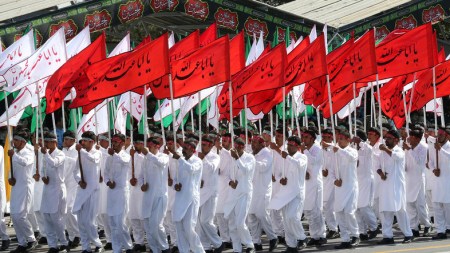
Members of Iranian armed forces march during a parade in Tehran, Iran, September 22, 2017. President.ir/Handout via REUTERS.

The new mentality sought by Washington is to address all of Iran’s belligerence and not allow its nuclear program and the JCPOA devour all of the international community’s attention.

The new US response, including blacklisting Iran’s notorious Revolutionary Guards, to be announced by Trump is said to cover missile tests, support for terrorism and proxy groups checkered across the Middle East, hopefully human rights violations at home, and cyberattacks.

Iran has a history of resorting to such measures, including targeting Saudi oil interests. Raising the stakes for Iran, Trump described a meeting with his top military brass on Thursday evening as “the calm before the storm.” Neither the US President nor the White House provided further details, yet rest assured Tehran received the message.

**************************

All eyes are on US President Donald Trump and his upcoming Iran speech later this week to clarify his decision to certify or decertify Tehran’s compliance with a nuclear agreement, officially known as the Joint Comprehensive Plan of Action (JCPOA), designed to curb the regime’s controversial atomic drive.

This has Iran’s regime on its toes, as senior elite in Tehran understand fully how the US can lead the international community in adopting strong measures against its broad scope of malign activities. Expected to be addressed is also a wide range of concerns over Iran’s dangerous policies in relation to its ballistic missile advances, meddling in Middle East states and supporting terrorist proxy groups as explained in a new video.

‘Iran’s unacceptable behavior’

Iran’s rogue behavior, currently imposing its influence on four major regional capitals of Baghdad, Beirut, Damascus and Sanaa, are the result of the Obama administration’s “overly lenient foreign policy, which sought to promote America’s priorities through consensus, rather than through the frank display of power,” as put by a recent The New Yorker piece.

“Lifting the sanctions as required under the terms of the JCPOA has enabled Iran’s unacceptable behavior,” US Secretary of State Rex Tillerson said in a late September meeting with his P5+1 counterparts and Iran’s top diplomat Mohammad Javad Zarif.

The Trump administration is also deeply concerned over Iran’s proxies mining the strategic Bab el-Mandeb Strait waterway, aiming its indigenous missiles from Yemen towards cities in Saudi Arabia and other Gulf countries, and from southern Lebanon towards Israel. This is Tehran in action with the objective of taking advantage of the destruction left behind by ISIS across the region, especially in Syria and Iraq.

“The Iranian regime supports terrorism and exports violence, bloodshed and chaos across the Middle East,” Trump told reporters before a Thursday evening meeting with senior military leaders at the White House. “That is why we must put an end to Iran’s continued aggression and nuclear ambitions,” he said. “They have not lived up to the spirit of their agreement.”

Trump has put Iran “on notice” over charges that Tehran violated a nuclear deal with the West by test-firing a ballistic missile. (Reuters)

Joint effort

Parallel to the White House there are voices on Capitol Hill advocating the new approach weighed by the administration.

“The president should decline to certify, not primarily on grounds related to Iran’s technical compliance, but rather based on the long catalog of the regime’s crimes and perfidy against the United States, as well as the deal’s inherent weakness,” Senator Tom Cotton said last week at a speech in the Council on Foreign Relations.

As the Trump administration seeks to place necessary focus on Iran’s illicit Middle East ambitions and actions, talks are also ongoing as we speak over how to amend the JCPOA’s restrictions.

“Sunset clauses,” Iran’s ballistic missile development and testing, and an inspections regime lacking the bite to gain necessary access into the regime’s controversial military sites. Under the current framework Iran can easily conduct nuclear weapons research and development in military sites and claim such locations do not fall under the JCPOA jurisdiction.

While it is expected of Trump to decertify Iran, he most likely will not go the distance to completely pull America out of the nuclear agreement. Obama refused to send the JCPOA to Congress for discussion and approval. Trump, however, seems set to place the decision to impose further sanctions on Iran upon the shoulders of US lawmakers.

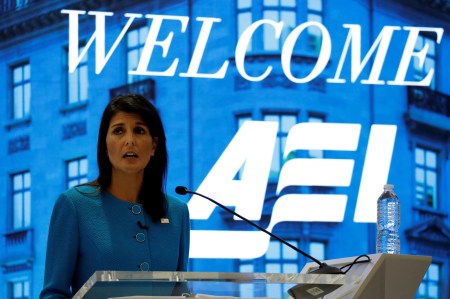
US Ambassador to the United Nations Nikki Haley speaks about the Iran nuclear deal at the American Enterprise Institute in Washington, on September 5, 2017. (Reuters)

More than ‘one piece’

The new mentality sought by Washington is to address all of Iran’s belligerence and not allow its nuclear program and the JCPOA devour all of the international community’s attention.

The new US response, including blacklisting Iran’s notorious Revolutionary Guards, to be announced by Trump is said to cover missile tests, support for terrorism and proxy groups checkered across the Middle East, hopefully human rights violations at home, and cyberattacks.

Iran has a history of resorting to such measures, including targeting Saudi oil interests. Raising the stakes for Iran, Trump described a meeting with his top military brass on Thursday evening as “the calm before the storm.” Neither the US President nor the White House provided further details, yet rest assured Tehran received the message.

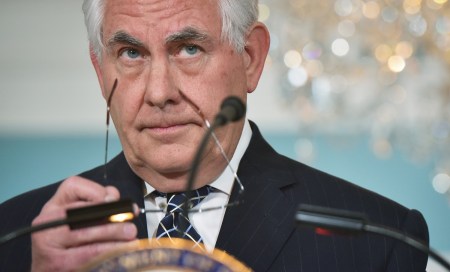
US Secretary of State Rex Tillerson delivering a statement on Iran in the Treaty Room of the State Department in Washington, DC, on April 19, 2017. (AFP)

Fear renders contradiction

Sensing an increasingly escalating tone from Washington, Tehran signaled its first sign of fear by expressing readiness to discuss its ballistic missile program, according to Reuters. And yet less than 24 hours later, Iranian officials said no offers were made to negotiate such restrictions.

“Iran regards defensive missile programs as its absolute right and will definitely continue them within the framework of its defensive, conventional and specified plans and strategies,” Iranian Foreign Ministry spokesman Bahram Qassemi said, according state media.

Iranian President Hassan Rouhani also felt the need to make remarks to save face before the regime’s already depleting social base. “In the nuclear negotiations and agreement we reached issues and benefits that are not reversible. No one can turn that back, not Mr. Trump or anyone else,” Rouhani said at a recent Tehran University ceremony, according to state media.

Of course, we all remember how prior to the JCPOA signing in 2015 senior Iranian officials went the limits in describing any “retreat” regarding their nuclear program as a “red line.” To make a long story short, Tehran is comprehending how the times are changing at a high velocity, endangering its domestic, regional and international interests. And unlike the Obama years, its actions will not go unanswered.

Senator Cotton made this crystal clear at his speech: “Congress and the President, working together, should lay out how the deal must change and, if it doesn’t, the consequences Iran will face.”

The Iran Deal Isn’t Worth Saving

October 8, 2017

The Iran Deal Isn’t Worth Saving, Gatestone InstituteJohn R. Bolton, October 8, 2017

(The chances of renegotiating the JCPOA to make it less harmful to America appear to be close to zero. — DM)

[T]he deal’s acolytes are actively obscuring this central issue, arguing that it is too arduous and too complex to withdraw cleanly. They have seized instead on a statutory requirement that every 90 days the president must certify, among other things, that adhering to the agreement is in America’s national-security interest. They argue the president should stay in the deal but not make the next certification, due in October.

This morganatic strategy is a poorly concealed ploy to block withdrawal, limp through Mr. Trump’s presidency, and resurrect the deal later. Paradoxically, supporters are not now asserting that the deal is beneficial. Instead, they concede its innumerable faults but argue that it can be made tougher, more verifiable and more strictly enforced. Or, if you want more, it can be extended, kicked to Congress, or deferred during the North Korea crisis. Whatever.

The only sure way to resume economic pressure on Iran is for President Trump to stop waiving the sanctions, as he did a few weeks ago. The power to act is in executive hands, as it should be.

*********************************

“Cut, and cut cleanly,” Sen. Paul Laxalt advised Ferdinand Marcos in 1986, urging the Philippine president to resign and flee Manila because of widespread civil unrest. The Nevada Republican, Ronald Reagan’s best friend in Congress, knew what his president wanted, and he made the point with customary Western directness.

President Trump could profitably follow Mr. Laxalt’s advice today regarding Barack Obama’s 2015 deal with Iran. The ayatollahs are using Mr. Obama’s handiwork to legitimize their terrorist state, facilitate (and conceal) their continuing nuclear-weapons and ballistic-missile programs, and acquire valuable resources from gullible negotiating partners.

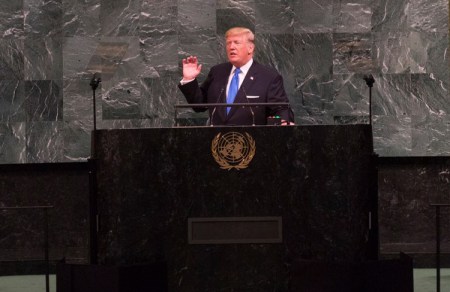
Mr. Trump’s real decision is whether to fulfill his campaign promise to extricate America from this strategic debacle. Last month at the United Nations General Assembly, he lacerated the deal as an “embarrassment,” “one of the worst and most one-sided transactions the United States has ever entered into.”

Last month at the United Nations General Assembly, President Donald Trump lacerated the Iran nuclear deal as an “embarrassment,” “one of the worst and most one-sided transactions the United States has ever entered into.” (Image source: The White House)

Fearing the worst, however, the deal’s acolytes are actively obscuring this central issue, arguing that it is too arduous and too complex to withdraw cleanly. They have seized instead on a statutory requirement that every 90 days the president must certify, among other things, that adhering to the agreement is in America’s national-security interest. They argue the president should stay in the deal but not make the next certification, due in October.

This morganatic strategy is a poorly concealed ploy to block withdrawal, limp through Mr. Trump’s presidency, and resurrect the deal later. Paradoxically, supporters are not now asserting that the deal is beneficial. Instead, they concede its innumerable faults but argue that it can be made tougher, more verifiable and more strictly enforced. Or, if you want more, it can be extended, kicked to Congress, or deferred during the North Korea crisis. Whatever.

As Richard Nixon said during Watergate: “I want you to stonewall it, let them plead the Fifth Amendment, cover up, or anything else if it’ll save it — save the plan.”

Mr. Trump should not be deceived. The issue is not certification. The issue is whether we will protect U.S. interests and shatter the illusion that Mr. Obama’s deal is achieving its stated goals, or instead timidly hope for the best while trading with the enemy, as the Europeans are doing. It is too cute by half to employ pettifoggery to evade this reality.

U.N. Security Council Resolution 2231 embodies the deal and includes two annexes: the Joint Comprehensive Plan of Action itself, and a statement by the other negotiating parties on “transparency… creating an atmosphere conducive” to full JCPOA implementation. Resolution 2231, the JCPOA and the statement were all crafted word-for-word with Iran (with Russia and China acting as Tehran’s scriveners on the statement), as was the cash-for-hostages swap Mr. Obama sought desperately to conceal. This packaging is more than a diplomatic nicety. It means Iran’s ballistic-missile program is integral to the deal — fittingly, since Iran’s missiles would deliver its nuclear warheads.

The ayatollahs have neither the desire nor the incentive to renegotiate even a comma of the agreement. Why should they, when it is entirely to their advantage? Both Resolution 2231 and the statement, for example, “call upon” Iran to forgo activity regarding “ballistic missiles designed to be capable of delivering nuclear weapons.” The U.N. secretary-general recently reported that Iran is violating this provision and implicitly lying about it. But the deal’s language allows Iran to claim solemnly that its missiles are not “designed” to carry nuclear warheads, an assertion whose verification would require polygraphs and psychologists, not weapons inspectors. This is one of many textual loopholes.

If the deal is vitiated, Tehran would not be freer than it is now to pursue nuclear weapons and ballistic missiles. Not only is the international compliance regime a far cry from Mr. Obama’s promised “anytime, anywhere” inspections, crucial language is vague and ambiguous. Mr. Obama’s negotiators crippled real international verification by pre-emptively surrendering on what were delicately termed “possible military dimensions” of Iran’s nuclear program.

Moreover, simple economic logic suggests that Tehran’s scientists are probably enjoying Pyongyang’s hospitality, well beyond the International Atomic Energy Agency’s limited capability to detect. Even U.S. intelligence could be in the dark if Iran is renting a uranium enrichment facility under a North Korean mountain. It is specious to assert that the North Korean nuclear crisis should lead to deferring action on the Iran deal. The conclusion should be precisely the opposite: Failure to act decisively on Iran now worsens the global proliferation threat.

The IAEA has interpreted Mr. Obama’s possible-military-dimension concession as requiring new evidence before it attempts to visit Tehran’s military bases, where the real work on weaponization and missiles is taking place—if not under mountains in North Korea. Mr. Obama acquiesced in this emasculation of the IAEA’s will to inspect, making the agency today like the drunk looking for his car keys under a street lamp because the light is better there. This is a sorry caricature of a robust, Reaganesque “trust but verify” regime.

Perhaps the most inane argument is that Congress should decide the deal’s fate and whether to reimpose U.S. sanctions. If a president is unwilling to solve this kind of problem, he shouldn’t have applied for the job. Watching what has happened on failed legislative efforts to repeal and replace ObamaCare, can anyone doubt that Senate Democrats (joined by Rand Paul) would filibuster any legislative effort to renew sanctions? The only sure way to resume economic pressure on Iran is for President Trump to stop waiving the sanctions, as he did a few weeks ago. The power to act is in executive hands, as it should be.

Mr. Trump knows his mind on Iran. And as Mr. Laxalt said to Marcos, “the time has come” to act decisively.

John R. Bolton, former U.S. Ambassador to the United Nations, is Chairman of Gatestone Institute, a senior fellow at the American Enterprise Institute, and author of “Surrender Is Not an Option: Defending America at the United Nations and Abroad”.

This article first appeared in The Wall Street Journal and is reprinted here with the kind permission of the author.

Yemen’s Houthi rebels threaten to attack Israel with missiles

October 1, 2017

Yemen’s Houthi rebels threaten to attack Israel with missiles, DEBKAfile, October 1, 2017

While Israel has no reason to fear an Iranian missile attack on its soil by Yemeni insurgents as yet,  its Red Sea shipping is definitely vulnerable to the P-20 (Chinese Silkworm) shore-to-ship weapon, a kind of cruise missile, which the Houthis have available for shooting at the Israeli war fleet and merchant vessels sailing in the Red Sea to and from the Gulf of Aqaba.

***********************

Israel heard a new threat this week from an entirely new quarter, Yemen’s rebel Houthis. Their military spokesman, Col, Aziz Rashid, said Sunday, Oct. 1, in reference to Israeli bases in Eritrea: “Israel’s military bases in Africa are within range of Houthi missiles,” adding, if necessary, “Our forces would soon have missiles capable of reaching Israel itself.”

He did not need to spell out where those missiles come from. It is no secret that the Houthis are amply armed and supplied with intermediate range ballistic missiles from a single source, their sponsor, Iran.

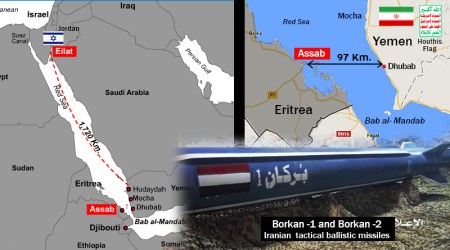
Interestingly, the spokesman mentioned missiles able to cover the 1,720km distance between northern Yemen and the Israeli port of Eilat. However, according to DEBKAfile’s military sources, the Yemeni insurgents don’t have missiles with that sort of range. Tehran has given them Borkan-1 and Borkan-2 tactical ballistic missiles, whose ranges are respectively 800km and 1,400km. Both are short of the distance to Israel.

In the past year, the Houthis fired a number of missiles into neighboring Saudi Arabia, leader of the coalition fighting their insurgency. Some were aimed at the capital Riyadh. Two fell short near the Yemeni border and one hit a military target outside the Saudi capital. But most of the others were either intercepted by Saudi anti-missile defenses or exploded on open ground far wide of target.

While Israel has no reason to fear an Iranian missile attack on its soil by Yemeni insurgents as yet,  its Red Sea shipping is definitely vulnerable to the P-20 (Chinese Silkworm) shore-to-ship weapon, a kind of cruise missile, which the Houthis have available for shooting at the Israeli war fleet and merchant vessels sailing in the Red Sea to and from the Gulf of Aqaba.

Exactly a year ago, a Houthi missile struck a United Arab Emirate warship and set it on fire. Ten days later, on Oct. 10, they launched missiles against the USS Mason destroyer and drew an American retaliatory blow to their missile batteries.

More recently, on September 14, the Houthi leader, Abdulmalek Badruddin Al-Houthi, declared that the UAE is within his forces’ missile range. He noted that he spoke from experience after a successful test launch at the oil emirates, which is 1,500km away. He did not say when the test took place or which missiles were fired. But he went on to boast that his army possessed drones capable of cruising through Saudi air space.

The Houthi spokesman’s threat Sunday of a missile attack on Israel was the second time in a month that the Yemeni insurgents had referred to new Iranian long-range missiles for attacking a nation accused of siding with Saudi Arabia.

They claim Israel has become involved in the Yemen war by providing the Saudis with intelligence from its reconnaissance fleet which is based at the Eritrean port of Assab just 97km across the sea from the Yemeni coast.

Israel has never acknowledged those bases, but foreign sources began reporting in 2012 the discovery of Israeli war ships and submarines in permanent berths at Assab port, as well as an early warning station built there.

Iran Defies Nuclear Deal With Latest Ballistic Missile Test

September 25, 2017

Iran Defies Nuclear Deal With Latest Ballistic Missile Test, Washington Free Beacon , September 25, 2017

Iranian President Hassan Rouhani / Getty Images

Iran’s weekend test firing of yet another long-range ballistic missile is amplifying congressional calls for the Trump administration to formally declare Iran in violation of the landmark nuclear agreement, a move that would lay the groundwork for the United States to abandon the agreement.

Iran claims to have successfully test fired a new long-range ballistic missile in response to threats by the Trump administration to leave the nuclear accord.

President Donald Trump criticized Iran during his first speech before the United Nations last week, singling out the Islamic Republic as one of the leading global threats. The speech prompted tough talk by senior Iranian leaders and military officials, who vowed to boost the country’s capabilities.

The latest ballistic missile test has amplified congressional calls for Trump to leave the deal and has provided grist to those inside the administration pushing for the president to formally declare Iran in violation of the nuclear deal due to these tests and other actions that violate the accord.

“Iran’s missile test is further proof that the Obama-Khamenei nuclear deal has only served to empower and embolden the Islamist regime,” Rep. Ron DeSantis (R., Fla.), a member of the House Foreign Affairs Committee, told the Washington Free Beacon.

“Given Iran’s belligerent conduct and its violations of the terms of the deal, President Trump should follow his instincts and decertify the JCPOA in October,” DeSantis said, using the acronym for the nuclear agreement, also known as the Joint Comprehensive Plan of Action. “We can’t allow Iran to follow in the footsteps of North Korea when it comes to acquiring a nuclear capability.”

DeSantis’s comments jibe with public remarks from Trump and some of his most senior officials, including United Nations Ambassador Nikki Haley, who has been a vocal critic of the nuclear accord and Iran’s threatening behavior.

Haley, commenting on Iranian violations of U.N. accords last week, said that U.S. is focused on holding the Islamic Republic responsible for defying these resolutions.

“What we’re looking at and what you’re going to hear us very vocal on is the fact that 2331, the resolution that was in place, what we saw was it basically wrapped in with the nuclear deal; it said if Iran did any of these things, it would be in violation,” Haley said, adding that evidence indicates Iran has violated international resolutions multiple times.

The ballistic missile test shows that Iran had made further strides in its long-range ballistic technology and that international calls for it to refrain from such behavior have no impact on the country’s actions.

Under U.N. Security Resolution 2231, which codifies the nuclear agreement, Iran is prohibited from test firing ballistic missiles, though the restriction has not altered Tehran’s behavior.

The newest missile, unveiled during a Friday military parade in Tehran, is reported to be Iran’s third such rocket capable of traveling nearly 1,250 miles. It weighs more than a ton and can carry “several warheads,” according to reports in Iran’s state-controlled media.

Trump offered a strong response to the missile test, tweeting that the missile is “capable of reaching Israel.”

Iran is also “working with North Korea. Not much of an agreement we have,” Trump wrote.

The tweet is being viewed as a window into Trump’s thinking on the deal and whether he will formally designate Iran as in violation.

A State Department official told the Free Beacon that officials are looking into the missile launch and will seek to counter the threats posed by Iran’s continued rocket tests.

“We have seen the media reports that Iran launched a ballistic missile,” the official said. “We are looking into these reports.”

“As we’ve said before, Iran’s continued ballistic missile development and support for terrorism are provocative and undermine security, prosperity, and stability throughout the region,” the official added, noting that “UN Security Council Resolution (UNSCR) 2231 (2015) calls upon Iran to not undertake any activity related to ballistic missiles designed to be capable of delivering nuclear weapons.”

The administration “will continue monitor these issues closely and to use all of the tools at our disposal to counter threats from Iran’s missile program,” the official said.

While the Trump administration has recertified the deal in the past months, some believe that Trump has decided not to do so again.

One veteran Middle East analyst who works closely with White House official on the Iran portfolio told the Free Beacon that Trump’s tweet is a good indication of where he currently stands on the matter.

“The president’s tweet reflected exactly how he feels, and everyone at every level knows it,” the source said. “He thinks the deal is garbage because it’s riddled with so many flaws, in this case dismantling sanctions while Iran builds ballistic missiles capable of striking Israel and Europe.”

However, there have been internal tensions of the matter, with Secretary of State Rex Tillerson pushing for Trump to keep the agreement. The Free Beacon first reported last week that disagreements between Tillerson and Haley on the matter have been a source of tension in the State Department.

“The State Department has been fighting [Trump] at every turn because Tillerson and his Obama holdovers want to preserve the deal,” the source explained. “So suddenly they’ve begun downplaying Iranian missile launches, because that would make it obvious how the deal isn’t in America’s national interest.”

Iranian President Hassan Rouhani has vowed a fierce response if the United States decides to leave the deal, saying in a recent interview such a move would “yield no results for the United States, but at the same time, it will generally decrease international trust placed in Washington.”

Iran is prepared to respond if the United States abandons the agreement.

“We have thought long and hard about our reactions,” Rouhani said, noting that these reactions would come “quite swiftly” and “probably within a week.”

Meanwhile, Iranian military leaders have disclosed the Islamic Republic continues to build advanced weaponry, despite international bans on some of these arms.

“Different missiles and ground combat weaponries, along with our air defense and marine combat systems, are all made in Iran and our ready-to-service experts will continue this path robustly,” Brigadier General Amir Hatami, Iran’s defense minister, said during the weekend.

16 Years Later: Lessons Put into Practice?

September 11, 2017

16 Years Later: Lessons Put into Practice? Gatestone Institute, John R. Bolton, September 11, 2017

Sept. 11 should be more than just a few moments of silence to remember the Twin Towers falling, the burning Pentagon and the inspiring heroism of regular Americans in bringing down United Flight 93 in Shanksville, Pa. We should also seriously consider today’s global threats. Those who made America an exceptional country did so by confronting reality and overcoming it, not by ignoring it.

********************************

Today marks the 16th anniversary of al-Qaida’s 9/11 attacks. We learned much that tragic day, at enormous human and material cost. Perilously, however, America has already forgotten many of Sept. 11’s lessons.

The radical Islamicist ideology manifested that day has neither receded nor “moderated” as many naive Westerners predicted. Neither has the ideology’s hatred for America or its inclination to conduct terrorist attacks. Iran’s 1979 Islamic Revolution brought radical Islam to the contemporary world’s attention, and it is no less malevolent today than when it seized our Tehran embassy, holding U.S. diplomats hostage for 444 days.

The Taliban, which provided al-Qaida sanctuary to prepare the 9/11 attacks, threaten to retake control in Afghanistan. Al-Qaida persists and may even be growing worldwide.

While ISIS’s caliphate in Syria and Iraq will not survive much longer, countries across North Africa and the Middle East (“MENA”) have destabilized or fractured entirely. Syria and Iraq have ceased to exist functionally, and Libya, Somalia and Yemen have descended into chaos. Pakistan, an unstable nuclear-weapons state, could fall to radicals under many easily predictable scenarios.

The terrorist threat is compounded by nuclear proliferation. Pakistan has scores of nuclear weapons, and Iran’s program continues unhindered. North Korea has now conducted its sixth, and likely thermonuclear, nuclear test, and its ballistic missiles are near to being able to hit targets across the continental United States. Pyongyang leads the rogue’s gallery of would-be nuclear powers, and is perfectly capable of selling its technologies and weapons to anyone with hard currency.

During Barack Obama’s presidency, he ignored these growing threats and disparaged those who warned against them. His legacy is terrorist attacks throughout Europe and America, and a blindness to the threat that encouraged Europe to accept a huge influx of economic migrants from the MENA region, whose numbers included potentially thousands of already-committed terrorists.

IGNORING NORTH KOREA

Obama also ignored North Korea, affording it one of an aspiring proliferator’s most precious assets: time. Time is what a would-be nuclear state needs to master the complex scientific and technological problems it must overcome to create nuclear weapons.

And, in a dangerous unforced error that could be considered perfidious if it weren’t so foolish, Obama entered the 2015 Vienna nuclear and missile deal that has legitimized Tehran’s terrorist government, released well over a hundred billion dollars of frozen assets, and dissolved international economic sanctions. Iran has responded by extending its presence in the Middle East as ISIS had receded, to the point where it now has tens of thousands of troops in Syria and is building missile factories there and in Lebanon.

Before 2009, publishers would have immediately dismissed novelists who brought them such a plainly unrealistic plot. Today, however, it qualifies as history, not fantasy. This is the agonizing legacy the Trump administration inherited, compounded by widespread feelings among the American people that we have once again sacrificed American lives and treasure overseas for precious little in return.

These feelings are understandable, but it would be dangerous to succumb to them. We didn’t ask for the responsibility of stopping nuclear proliferation or terrorism, but we are nonetheless ultimately the most at risk from both these threats.

And as we knew during the Cold War, but seem to have forgotten since it ended, our surrounding oceans do not insulate us from the risk of long-distance nuclear attacks. We face the choice of fighting the terrorists on our borders or inside America itself, or fighting them where they seek to plot our demise, in the barren mountains of Afghanistan, in the MENA deserts, and elsewhere.

Nor can we shelter behind a robust national missile-defense capability, hoping simply to shoot down missiles from the likes of North Korea and Iran before they hit their targets. We do not have a robust national missile defense capability, thanks yet again to Barack Obama’s drastic budget cuts.

President Trump appreciates that nuclear proliferation and radical Islamic terrorism are existential threats for the United States and its allies. During the 2016 campaign, he repeatedly stressed his view that others should play a larger role in defeating these dangerous forces, bearing their fair share of the burden. But candidate Trump also unambiguously (and entirely correctly) called for restoring our depleted military capabilities because he saw that American safety depended fundamentally on American strength.

Sept. 11 should be more than just a few moments of silence to remember the Twin Towers falling, the burning Pentagon and the inspiring heroism of regular Americans in bringing down United Flight 93 in Shanksville, Pa. We should also seriously consider today’s global threats. Those who made America an exceptional country did so by confronting reality and overcoming it, not by ignoring it.

The names of passengers and crew of United Airlines Flight 93, who lost their lives in the September 11 attacks, as displayed at the National 9/11 Memorial in New York. (Image source: Luigi Novi/Wikimedia Commons)

____________________________

John R. Bolton, former U.S. Ambassador to the United Nations, is Chairman of Gatestone Institute, a senior fellow at the American Enterprise Institute, and author of “Surrender Is Not an Option: Defending America at the United Nations and Abroad”.

This article first appeared in The Pittsburgh Tribune Review and is reprinted here with the kind permission of the author.

Gorka: Trump Administration Must Kill the Iran Deal

September 11, 2017

Gorka: Trump Administration Must Kill the Iran Deal, Washington Free Beacon, , September 11, 2017

(And Frau Merkel wants a deal with North Korea comparable to the Iran scam. — DM)

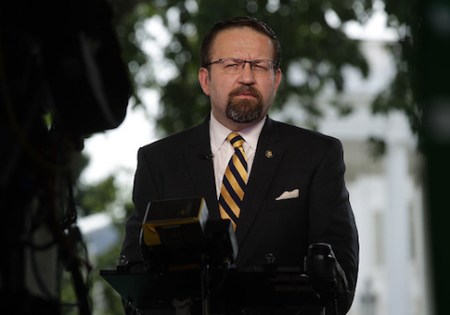
Sebastian Gorka / Getty Images

“The American government’s strategy to defeat Sunni jihadism must not play into the hands of Shia jihadism,” according to Gorka. “All the more so after the billions of dollars released by the last White House back into the coffers of Tehran.”

“A nuclear Caliphate informed by an apocalyptic vision of Islamic salvation will not succumb to the logic of nuclear deterrence and the prior stability of Mutually Assured Destruction,” Gorka states. “Action must be taken now to obviate the establishment a nuclear-capable Shia Caliphate. Recertification of the Potemkin Accord that is the JCPOA (Iran) Deal will not stop Iran acquiring nuclear weapons.”

********************************

The Trump administration must end the landmark nuclear deal with Iran, which has only empowered the Islamic Republic and aided its efforts to develop nuclear weapons, according to former senior Trump strategist Sebastian Gorka, who is set to call for an end to the deal during wide-ranging remarks Monday in Israel on the anniversary of the September 11 terror attacks.

The Washington Free Beacon obtained an advance partial copy of Gorka’s remarks, in which he notes the failure of U.S. administrations to combat the spread of global terror organizations since al Qaeda terrorists struck the Twin Towers 16 years ago.

Gorka, a veteran national security expert who served as a key adviser to President Donald Trump until his resignation late last month, noted that America has “seen more jihadist attacks and plots on U.S. soil in the last two years than any previous comparable period,” a sign that past strategies to combat this threat have failed.

“In arrests as far apart as California and New York, we see an enemy that has moved from attempting to send foreign terrorists here to America, move to recruiting and indoctrinating U.S. nationals or residents who are already in the country, such as the Boston bombers and the San Bernardino killers,” Gorka will say during a keynote address before the International Institute for Counterterrorism during its annual national security summit in Israel.

The high-profile international get together brings together senior Israeli government officials with their global counterparts. Gorka’s call to end the Iran deal at this forum is likely to generate much discussion among international officials present at the forum.

The near daily arrests by U.S. authorities of would-be jihadists “is not an improvement” in the war on terror, according to Gorka, because “‘homegrown’ terrorists are much harder for our domestic agencies to detect.”

Gorka said he has faith that the Trump administration will plot a new course that will help the United States finally end the war in Afghanistan, the longest conflict in U.S. history.

The United States is still failing to win the war against what Gorka describes as the “Global Jihadi Movement”—and international agreements such as the Iran nuclear deal have not improved the West’s chances of curbing the terror threat.

“If we use a less parochial filter, and look at what the Global Jihadi Movement has wrought globally since September 11, 2001, we cannot claim any kind of victory,” Gorka says.

A key part of the strategy to put the United States on the path to victory must focus on cancelling the Iran nuclear agreement, which has awarded the foremost global sponsor of terrorism with billions in cash.

“Iran remains the largest state sponsor of terrorism in the world today,” Gorka says. “With the rise of ISIS, the collapse and Syria, and the continued conflict in Yemen, the mullahs and the forces under their command have expanded their destabilizing actions in support of their Shia version of radical Islam.”

The Trump administration must be cautious to avoid empowering Iran, a Shia Muslim majority nation, in its efforts to defeat Sunni Muslim terror organizations.

The nuclear deal served as a particular boon to Iran’s vision for a Shia-dominated Middle East, in which the Islamic Republic can rule the region.

“The American government’s strategy to defeat Sunni jihadism must not play into the hands of Shia jihadism,” according to Gorka. “All the more so after the billions of dollars released by the last White House back into the coffers of Tehran.”

“A nuclear Caliphate informed by an apocalyptic vision of Islamic salvation will not succumb to the logic of nuclear deterrence and the prior stability of Mutually Assured Destruction,” Gorka states. “Action must be taken now to obviate the establishment a nuclear-capable Shia Caliphate. Recertification of the Potemkin Accord that is the JCPOA (Iran) Deal will not stop Iran acquiring nuclear weapons.”

Iran Follows In North Korea’s Footsteps: Nuclearization, Missile Development Alongside Agreements With The Superpowers; EU3, IAEA Director-General Submitted To Obama Administration Pressure, Agreed To JCPOA With No Real Inspection, No Response To Iran’s Missile Program; French President: ‘Absolutely Necessary’ That JCPOA Be ‘Supplemented’

September 9, 2017

Iran Follows In North Korea’s Footsteps: Nuclearization, Missile Development Alongside Agreements With The Superpowers; EU3, IAEA Director-General Submitted To Obama Administration Pressure, Agreed To JCPOA With No Real Inspection, No Response To Iran’s Missile Program; French President: ‘Absolutely Necessary’ That JCPOA Be ‘Supplemented’, MEMRI, September 8, 2017

(Please see also, Powers may end up with Iranian model for NKorea. Obama would be very proud. –DM)

Introduction

Top Iranian officials have stated in the past that Tehran is learning from the experience of North Korea in attempting to actualize aspirations for regional supremacy and gaining the status of a global nuclear power.

Iran has achieved both of these under the cover of an agreement with the superpowers that protects it from both attack and inspection, and allows it to proceed, legitimately and with the help of the superpowers, to develop its nuclear capabilities. These include detonation of a nuclear device “for research purposes” as well as the continued development of its missile program, without any restrictions whatsoever under the agreement.

Iran Follows In North Korea’s Footsteps

Like North Korea, which came to several agreements with U.S. administrations, i.e. the Clinton and Obama administrations, as well as with other superpowers, yet continued with its military nuclear program without allowing real inspection of its sites, and also continued to develop long-range ballistic missiles, Tehran is utilizing the JCPOA to develop its nuclear capabilities without allowing real inspection, while continuing to develop and freely test long-range missiles.

It was President Obama who pressured the EU3 – the UK, France, and Germany – and the International Nuclear Energy Agency (IAEA) to agree to no inspection of military and other suspect sites, and to keep the issue of missiles separate from the JCPOA, thus enabling Iran to do as North Korea has done, without any significant response from the West. Iran, which monitored the West’s reaction to North Korea’s activity, concluded that it could do the same, and this lesson has been expressed in statements by top Iranian officials.

For example, Supreme National Security Council secretary Ali Larijani said in a September 2005 speech: “I recommend once again that you pay attention to the conduct of North Korea. After two years of dealings with North Korea, what have you got? You have accepted North Korea ‘s nuclear technology in the field of uranium enrichment. So accept ours now.”[1]

The Kayhan daily, which is affiliated with Iranian Supreme Leader Ali Khamenei, wrote in an October 12, 2006 editorial titled “Lessons from North Korea”: ” “[North] Korea has built a [nuclear] bomb before the American’s eyes, despite the great pressure it was under, and [despite] years of harsh international sanctions – and no one has managed to do anything [against it]. What this means precisely is that if any country, such as North Korea, concludes, for political or security reasons, that it must have nuclear weapons, it will ultimately succeed in implementing its wish – even if the whole world doesn’t want it to. The superpowers may manage to slow down [its] path [in going] nuclear, or may apply economic and psychological pressures on it and on its citizens – but   in the end the wish that arises from among the people is what prevails and determines the policy.”[2]

An article in Sobh-e Sadeq, the weekly of Iran’s Islamic Revolutionary Guards Corps (IRGC), published in June 2008, called North Korea’s decision to destroy the cooling tower of the reactor at Yongbyon that month “a strategic deception” aimed at alleviating the pressure from the superpowers that oppose its nuclear activity. It added that the destruction of this facility could be a step towards another nuclear test. Also according to the article, the destruction of the tower, the use of which had long been suspended, did not prevent North Korea from being able to revive its activity, thanks to its knowhow, and with its stock of plutonium it could conduct at least another eight nuclear tests.[3]

The Iran Diplomacy research center, which is close to the Iranian Foreign Ministry, called, in April 2009, for careful study of the U.S. reaction to North Korea’s launch that month of a long-range missile, saying that the North Korean model could be applied to the Middle East.[4]

The conservative Iranian daily Resalat stated, following the North Korean missile launch, that the U.S. was weak and could not force its position on North Korea, which, it said, benefits from Russian and Chinese support. It added that the Obama administration was facing a difficult dilemma. If it adopted the harsh position of the preceding Bush administration, Obama’s conciliatory image would be harmed. If it gave in to North Korea, it would strengthen North Korea’s position in southeast Asia.[5]

Iran acted based on North Korea’s experience, but with greater sophistication, as manifested in the following aspects:

1. Instead of rejecting inspections out of hand like North Korea, Tehran created a framework under which only declared nuclear sites could be inspected, along with a different framework in which there would be no inspections of military and other sites, and gained full Western cooperation for this, in addition to tremendous benefits for itself. The West agreed to this Iranian scheme, and the President of the United States himself even explained on July 14, 2015, the day this agreement was announced, that “[t]he IAEA will have access where necessary, when necessary.”[6]Today, the U.S. is obligated to reconfirm every quarter that Iran is meeting the terms of the agreement even though inspection is limited to certain sites only.

2. Tehran took the issue of long-range ballistic missile development out of the negotiations for the JCPOA, and in the absence of an international treaty regulating the issue of long-term missiles, the Obama administration allowed Iran to continue to develop its missile capability to the point where it threatens the Middle East and the West. It should be noted that Iran calls its long-range missiles “defensive missiles” but that by any accepted standard they are offensive missiles; it also threatens the countries of the region with them.


On missile, in Hebrew and Farsi: Israel Should Be Wiped Off the Face of the Earth.” Photo: Fars, Iran, March 9, 2016. See also MEMRI Special Dispatch No. 6349, Iran Launches Long-Range Missiles Emblazoned With Slogan: ‘Israel Should Be Wiped Off The Face Of The Earth,’ March 16, 2016.

3. The JCPOA was written in such a way that it expires after a certain time period, as do the restrictions and certain qualifications to which Tehran agreed.

4. The U.S. administration acquiesced to Tehran’s demand that its heavy water be stored in nearby Oman, its proxy, where it will be in immediate reach of Iran. The administration also acquiesced to Iran’s demand that it be allowed to continue developing advanced-generation centrifuges, such that after the JCPOA expires in 2025 it will be able to skip significant stages in its nuclearization process.<

What Inspection Did The EU3 And IAEA Agree To Under Pressure From The Obama Administration?

IAEA director-general Yukia Amano recently announced that the IAEA could enter any site in Iran to inspect it. But his statements are misleading, because the JCPOA does not allow real inspection of any nuclear site except for those declared by Iran. The following are the terms agreed to in the JCPOA by Amano and the Europeans:[7]

  1. The JCPOA created a unique inspection framework for Iran that bypasses the Additional Protocol, which allows inspection of military sites, which Iran accepted as a voluntary and unilateral step, and from which it can drop out without violating the JCPOA.
  2. The JCPOA transferred the authority to make clear professional decisions from the IAEA to a political supreme forum whose authority supersedes that of the IAEA – with the agreement of IAEA director-general Yukia Amano, who relinquished his status under pressure from Obama.
  3. The JCPOA set out a series of restrictions for conducting inspections; for example, any claim by the IAEA must not be motivated by an intent to damage Iranian military or security activity. This wording hands Iran the tools to prevent any inspection of any security or other site, by arguing that such an inspection is motivated by an intent to damage its military activity. The procedure demands that the information that casts suspicion on any of these sites and that prompts a request for inspection be revealed to Iran, Russia, and China – and this demand, which cannot be met, is aimed at stopping the inspection process in its tracks.
  4. The JCPOA created a political precedent for a non-credible inspection process, through closing Iran’s PMD (Possible Military Dimensions) file by a predetermined political decision and while negotiating with Iran about writing the IAEA report on the PMD – i.e. the file was not closed independently by the IAEA. That is, IAEA inspectors did not visit the sites, and the samples from these sites were taken by the Iranians themselves and handed over to the IAEA inspectors without any way of ascertaining that the sample taken is what was handed over. IAEA director-general Yukia Amano submitted to the Obama administration’s pressure to agree to this unprofessional and non-credible procedure, violating the trust placed in him and in the IAEA as an independent, professional, and authoritative body. This is because the Iranians made their acceptance of the JCPOA conditional upon the closure of their PMD file in this exact way, so that there could be no entrance to suspect military sites. Additionally, he submitted to Iran’s refusal to allow the IAEAto question Iranian nuclear scientists, and agreed not to mention the term “PMD” in the report focusing on this issue, because Iran opposed this. Furthermore, the IAEA report on the PMD issue stated that there was indeed suspect activity in Iran, but refrained from stating that the Iranian regime was responsible for it.

These were also clarified by Iran’s representative in the IAEA, Reza Najafi, in a September 21, 2015  interview with the ISNA news agency. He said: “I deny the Reuters report that the samples from Parchin were taken in the presence of IAEA inspectors. We ourselves took the samples. This is the red line for us, and no inspector is authorized to enter a military site and conduct an inspection. The visit of Amano and his deputy was strictly a general protocol visit; they had no equipment, not even a cellphone, their visit did not last more than a few minutes, [and it was] only  in order for them to see that there is nothing suspicious and that the claims about [Parchin] were completely wrong.”[8]

See also the following MEMRI reports:

French President Macron: It Is “Absolutely Necessary” That The JCPOA “Be Supplemented… As Far As The Use Of Ballistic Missiles Is Concerned”

French President Emmanuel Macron, in an August 29, 2017 Paris speech to a conference of French ambassadors, spoke of the need to fortify the JCPOA as part of the nonproliferation regime, and proposed “absolutely necessary” supplementation of it “as far as the use of ballistic missiles is concerned” after 2025 when the JCPOA expires. He said: “[T]his agreement [JCPOA] was improved thanks to the intervention of France. There is no alternative to the nonproliferation regime and we will be extremely strict as to its implementation. The framework of this agreement is good. It can be supplemented by some work [on it] after 2025 – an absolutely necessary work as far as the use of ballistic missiles is concerned.”[9]

* A. Savyon is Director of the MEMRI Iran Studies Project; Y. Carmon is President of MEMRI.

Appendix: Additional MEMRI Reports On The Subject


[1] See MEMRI Special Dispatch No. 994, Iranian Nuclear Chief Ali Larijani: The West Should Learn the Lesson of North Korea, September 26, 2005.

[2] Kayhan (Iran), October 12, 2006. See also MEMRI Special Dispatch No. 1321, Iranian Daily Close to Supreme Leader Khamenei: ‘If Any Country Such as North Korea, Concludes, for Political or Security Reasons, That It Must Have Nuclear Weapons, It Will Ultimately Succeed… Even if the Whole World Is Opposed…’ October 13, 2006.

[3] Sobh-e Sadeq (Iran), June 30, 2008.

[4] Iran Diplomacy (Iran), April 6, 2009.

[5] Resalat (Iran), April 6, 2009.

[6] Obamawhitehouse.archives.gov/the-press-office, July 14, 2015.

[7] See Section Q of Annex of the JCPOA, pp 42-43, Apps.washingtonpost.com/g/documents/world/full-text-of-the-iran-nuclear-deal/1651. See also MEMRI Inquiry & Analysis Series No. 1325 – Discussion Of Iranian Violations Of JCPOA Is Futile; The Inspection Procedure Designed By The Obama Administration Precludes Actual Inspection And Proof Of Violations, August 18, 2017.

[8] ISNA (Iran), September 21, 2015.

[9] Elysee.fr, August 29, 2017.