Archive for the ‘Iranian military’ category

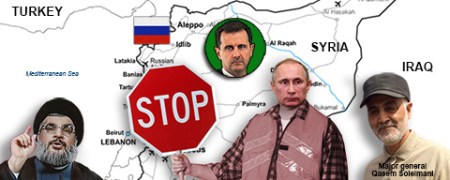
Russia freezes Syrian, Iranian military movements

January 31, 2017

Russia freezes Syrian, Iranian military movements, DEBKAfile, January 31, 2017

putinstopsyriaeng480

The ban came from Moscow to prevent military reprisals against the Putin-Trump deal for Syria.

Iran can no longer doubt that the two powers, America and Russia, have ganged up to push the Islamic Republic out of their way. Trepidation in Tehran was articulated on Monday, Jan. 30, at a convention staged in the Iranian capital to celebrate 515 years of Iranian-Russian relations, an anniversary that would not normally be marked by a special event.

****************************

An order to remain stationary was issued Thursday night, Jan. 26, by the Russian Commander in Syria Lt. Gen. Alexander Zhuravlev to the high commands of the Syrian army and of the Iranian and Shiite forces positioned in Aleppo, as well as Hizballah units in all parts of Syria. Gen. Zhuravlev, acting on instructions from Moscow, prohibited any movement by those forces out of their current positions as of noon local time.

DEBKAfile’s military and intelligence sources report that the order banned the opening of new battlefronts anywhere in Syria and the movement of Syrian air force units between bases.

This order has been obeyed to date.

The ban came from Moscow to prevent military reprisals against the Putin-Trump deal for Syria. There was no mention of penalties for disobedience, but the tone was peremptory. The three army commanders did not need reminding that the Russians are capable of using their electronic warfare systems to disrupt unauthorized military movements, jam their communications, and withhold fuel, ammo and spare parts to create havoc in their armies.

lieutenant_general_alexander_zhuravlev_120Russian Lt. Gen. General Alexander Zhuravlev

Moscow has never resorted to extreme action of this kind in previous Russian military interventions in Middle East lands.

The decision was taken shortly after the Kremlin was notified that US President Donald Trump had agreed to join forces with President Vladimir Putin in Syria.

Since then, the Trump administration has kept all dealings with Moscow over Syria under a cloak of secrecy, including the outcome of President Trump’s first phone conversation with his Russian counterpart Vladimir Putin. All other concerned parties, such as Israel, have been left groping in the dark about what happens next.

The Russian standstill order in Syria came shortly before the US presidential decree that barred Iranians from entering the United States (along with the nationals of six other terror-prone Muslim countries)

Iran can no longer doubt that the two powers, America and Russia, have ganged up to push the Islamic Republic out of their way. Trepidation in Tehran was articulated on Monday, Jan. 30, at a convention staged in the Iranian capital to celebrate 515 years of Iranian-Russian relations, an anniversary that would not normally be marked by a special event.

In his opening remarks, Foreign Minster Mohammed Zarif Javad said: that Iran and Russia “need to have far more extensive relations,” and “few countries in the world have relations as deep and historical as Iran and Russia.” This sounded like an appeal to Moscow for protection against the new US president. It most likely fell on deaf ears. Putin is fully engaged in promoting his new relations with Donald Trump.

Re-isolate Iran now

January 27, 2017

Re-isolate Iran now, Israel Hayom, David M. Weinberg, January 27, 2017

In fact, the U.S. and Israel should reach an accord on a basket of responses to Iranian violations and aggressions, including the placement of a military option against Iran’s nuclear program back on the table.

Trump and Netanyahu must together promulgate an approach for combating the malign influence and hegemonic ambitions of Iran.

*********************************

Prime Minister Benjamin Netanyahu has made it clear that one of the top items on his agenda for consultation with U.S. President Donald Trump in Washington next month is countering Iranian aggression. With good reason. The net result of the Joint Comprehensive Plan of Action has been to foster Iran’s rise to regional hegemon.

While the JCPOA suspended a part of Iran’s nuclear weapons program for a few years, the ayatollahs see it as providing time to advance their centrifuge capability and regional sway.

In a Hoover Institution paper published this month, Professor Russell Berman and Ambassador Charles Hill call Iran a “de facto Islamic caliphate,” and the Islamic Revolutionary Guard Corps an “Iranian expeditionary force for invading strategic Arab spaces.”

They call former President Barack Obama’s declared goal — of finding and bolstering so-called moderates in Tehran via the JCPOA — an “illusion.” Iran is not a polity of moderates and hard-liners, they write. It is a revolutionary theocracy masquerading as a legitimate state actor. So the first thing Trump must do is recognize the consistently hostile character of the regime.

Alas, Obama was obsessed from the advent of his presidency with making nice to Iran, and was willing to subordinate much of American foreign policy in service of that goal. He sent many secret letters to Supreme Leader Ayatollah Ali Khamenei that recognized the prerogatives of the Islamic republic and foreswore regime change. He cut funding to anti-regime groups and abandoned Iranian moderates during the early days of the Green Revolution in 2009, after the regime fixed an election. He effectively conceded Syria as within Iran’s sphere of influence.

In his penetrating book, “The Iran Wars: Spy Games, Bank Battles, and the Secret Deals That Reshaped the Middle East,” Wall Street Journal reporter Jay Solomon exposes the money trail that accompanied this strategic sellout to Iran. In exchange for talking, Obama gave the Iranians hundreds of millions of dollars monthly, stabilizing their economy. And in the end, Obama offered Iran a deal that legalized full-blown uranium, plutonium, and ballistic missile work on a timeline, and did not force the country to disclose its previous nuclear cheating. The deal also released roughly a hundred billion dollars to Iran; had American officials traveling to drum up business for Iran; and removed restrictions on a range of Iranian terrorists.

Along the way, the administration abandoned the powerful sanctions leverage it had over Iran. Solomon chronicles the ramp-up of severe banking sanctions on Iran that were having a disastrous impact on the Iranian economy. “Iran’s economy was at risk of disintegrating, the result of one of the most audacious campaigns in the history of statecraft. The country was months away from running short on hard currency. The budget had a $200 billion black hole. And the U.S. Treasury Department had made sure Iran had no way to recover. Iranian ships and airplanes were not welcome beyond Iran’s borders, and oil revenue was frozen in overseas accounts.”

And then, behold, Obama backed off. Administration officials all of a sudden claimed that tightening the noose on the Iranian economy would cause the sanctions policy to collapse! And Secretary of State John Kerry was sent to cut a sweet deal with Iran; a deal that squandered — and then reversed — a decade’s worth of effort to constrain Iran.

Now Trump must act to constrain Iran all over again.

Over the past year, Iran has intensified a pattern of aggression and increased its footprint across the region. Iranian advisers with Shiite militias from as far away as Afghanistan have flooded Syria, giving Tehran a military arc of influence stretching to the Mediterranean.

Khamenei says that Iran’s massive military presence (alongside Hezbollah) in Syria is a supreme security interest for the regime — a front line against Israel — and that Iran has no plans to leave.

This has grave implications for Israel. Netanyahu must demand of Trump (and Putin) to include the removal of all foreign forces, especially Iran, in any future agreement regarding Syria. This will be very difficult — especially since Russia has just signed a long-term agreement to greatly enlarge its military presence in Syria, including the port in Tartus and air base in Latakia.

Iran, too, is aggressively expanding its naval presence in the Red Sea region and eastern Mediterranean. Since 2011, it has been sending warships through the Suez Canal, and has used maritime routes to send arms shipments to Hizballah and Hamas. (Israel has intercepted five of these armament ships.) And in the Strait of Hormuz, IRGC speedboats have repeatedly engaged in provocative encounters with American warships, including the conduct of surprise live rocket fire exercises in proximity to U.S. Navy vessels.

Then there is Iranian terrorism. IRGC agents have been caught planning attacks on Israeli, American, British and Saudi targets in Kenya. Over the past five years, Iranian agents were exposed while planning to attack Israeli diplomats in Azerbaijan, Cyprus, Georgia, India, Nigeria, Thailand and Turkey. Hezbollah operatives supported by Iran carried out the bus bombing of Israeli tourists at the Burgas airport.

Also: The detailing of Iranian terrorism in Arab countries such as Egypt, Jordan and Saudi Arabia could fill this entire newspaper.

Then there is Iran’s ballistic missile program. In December, U.S. Senator Ted Cruz sent a seven-page letter to three senior officials of the Obama administration, detailing his well-founded concerns that North Korea and Iran might be working together on developing nuclear missiles. (Not surprisingly, the Obama officials never answered.)

Cruz’s basic question was: Why does Iran, having promised not to make nuclear weapons, continue to pour resources into developing long-range ballistic missiles, including numerous missile tests this past year? If not for nuclear weapons, then for what?

The intrepid analyst Claudia Rosett continually has raised the suspicion that North Korea’s nuclear program is secretly doubling as a nuclear backshop for Iran. It’s very possible that the $1.7 billion in air-freighted cash that Obama granted Iran is being used to finance nuclear weapons and missile research in North Korea. It’s even possible that Iran may be bold enough to buy warheads from North Korea.

Only Washington can stop this, by re-isolating and pressuring Iran. Netanyahu should travel to Trump with a comprehensive plan to influence U.S. policy toward Iran, as well as plans for joint action against Tehran.

This should include an end to the secrecy surrounding many sections of the JCPOA. All side agreements should be disclosed relating to Iranian technology acquisitions, raw material quantities, uranium and plutonium enrichment levels, sanctions relief and financial transfers. Loopholes and exceptions made surreptitiously by Obama should be closed.

Penalties should be set firmly in place for Iran’s prohibited missile programs. (Such penalties do not exist in the JCPOA or in U.N. Security Council Resolution 2231.)

U.S. and Israeli resources should be pooled, in a renewed and formal U.S.-Israel agreement, to uncover and eliminate any undisclosed sites within Iran connected to nuclear weapons technology; to counter Iranian terror threats across the region; and to subvert any Iranian bases in Syria and Lebanon.

In fact, the U.S. and Israel should reach an accord on a basket of responses to Iranian violations and aggressions, including the placement of a military option against Iran’s nuclear program back on the table.

Trump and Netanyahu must together promulgate an approach for combating the malign influence and hegemonic ambitions of Iran.

Column One: The New Middle East

September 29, 2016

Column One: The New Middle East, Jerusalem PostCaroline B. Glick, September 29, 2016

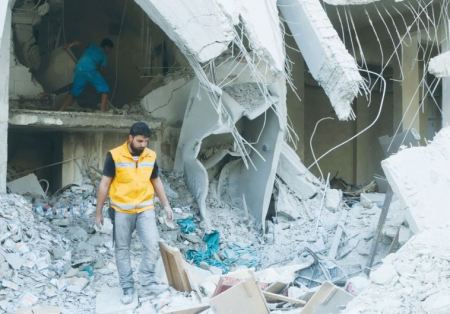
aleppo-messA RED CRESCENT aid worker inspects scattered medical supplies after an air strike on a medical depot in Aleppo on Saturday.. (photo credit:REUTERS)

So Obama let Syria burn. He let Iran and Hezbollah transform the country into their colony. And he let Putin transform the Mediterranean into a Russian lake.

A new Syria is emerging. And with it, a new Middle East and world are presenting themselves. Our new world is not a peaceful or stable one. It is a harsh place.

The new Syria is being born in the rubble of Aleppo.

The eastern side of the city, which has been under the control of US-supported rebel groups since 2012, is being bombed into the Stone Age by Russian and Syrian aircraft.

All avenues of escape have been blocked. A UN aid convoy was bombed in violation of a fantasy cease-fire.

Medical facilities and personnel are being targeted by Russia and Syrian missiles and barrel bombs to make survival impossible.

It is hard to assess how long the siege of eastern Aleppo by Russia, its Iranian and Hezbollah partners and its Syrian regime puppet will last. But what is an all but foregone conclusion now is that eastern Aleppo will fall. And with its fall, the Russian-Iranian-Hezbollah-Assad axis will consolidate its control over all of western Syria.

For four years, the Iranians, Hezbollah and Bashar Assad played a cat and mouse game with the rebel militias.

Fighting a guerrilla war with the help of the Sunni population, the anti-regime militias were able to fight from and hide from within the civilian population. Consequently, they were all but impossible to defeat.

When Russian President Vladimir Putin agreed to join the fight, he and his generals soon recognized that this manner of fighting ensured perpetual war. So they changed tactics. The new strategy involves speeding up the depopulation and ethnic cleansing of rebel-held areas. The massive refugee flows from Syria over the past year are a testament to the success of the barbaric war plan. The idea is to defeat the rebel forces by to destroying the sheltering civilian populations.

Since the Syrian war began some five years ago, half of the pre-war population of 23 million has been displaced.

Sunnis, who before the war comprised 75% of the population, are being targeted for death and exile. More than 4 million predominantly Sunni Syrians are living in Turkey, Lebanon and Jordan. More than a million have entered Europe. Millions more have been internally displaced. Assad has made clear that they will never be coming home.

At the same time, the regime and its Iranian and Hezbollah masters have been importing Shi’ites from Iran, Iraq and beyond. The process actually began before the war started. In the lead-up to the war some half million Shi’ites reportedly relocated to Syria from surrounding countries.

This means that at least as far as western Syria is concerned, once Aleppo is destroyed, and the 250,000 civilians trapped in the eastern part of what was once Syria’s commercial capital are forced from their homes and property, the Russians, Iranians, Hezbollah and their Syrian fig leaf Assad will enjoy relative peace in their areas of control.

By adopting a strategy of total war, Putin has ensured that far from becoming the quagmire that President Barack Obama warned him Syria would become, the war in Syria has instead become a means to transform Russia into the dominant superpower in the Mediterranean, at the US’s expense.

In exchange for saving Assad’s neck and enabling Iran and Hezbollah to control Syria, Russia has received the capacity to successfully challenge US power. Last month Putin brought an agreement with Assad before the Duma for ratification. The agreement permits – indeed invites – Russia to set up a permanent air base in Khmeimim, outside the civilian airport in Latakia.

Russian politicians, media and security experts have boasted that the base will be able to check the power of the US Navy’s Sixth Fleet and challenge NATO’s southern flank in the Mediterranean basin for the first time. The Russians have also decided to turn their naval station at Tartus into something approaching a fullscale naval base.

With Russia’s recent rapprochement with Turkish President Recip Erdogan, NATO’s future ability to check Russian power through the Incirlik air base is in question.

Even Israel’s ability to permit the US access to its air bases is no longer assured. Russia has deployed air assets to Syria that have canceled Israel’s regional air superiority.

Under these circumstances, in a hypothetical Russian-US confrontation, Israel may be unwilling to risk Russian retaliation for a decision to permit the US to use its air bases against Russia.

America’s loss of control over the eastern Mediterranean is a self-induced disaster.

For four years, as Putin stood on the sidelines and hedged his bets, Obama did nothing. As Iran and Hezbollah devoted massive financial and military assets to maintaining their puppet Assad in power, the Obama administration squandered chance after chance to bring down the regime and stem Iran’s regional imperial advance.

For his refusal to take action when such action could have easily been taken, Obama shares the responsibility for what Syria has become. This state of affairs is all the more infuriating because the hard truth is that it wouldn’t have been hard for the US to defeat the Iranian- Hezbollah axis. The fact that even without US help the anti-regime forces managed to hold on for four years shows how weak the challenge posed by Iran and Hezbollah actually was.

Russia only went into Syria when Putin was absolutely convinced that Obama would do nothing to stop him from dislodging America as the premier global power in the region.

As Michael Ledeen recalled earlier this week, Obama chose to stand on the sidelines in Syria because he wanted to make friends with Iran. Obama began his secret courtship of the mullahs even before he officially took office eight years ago.

After the war broke out in Syria, midway through his first term and in the following years, the Russians and the Iranians told the obsessed American president that if he took action against Assad, as strategic rationality dictated, he would get no nuclear deal, and no rapprochement with Tehran.

So Obama let Syria burn. He let Iran and Hezbollah transform the country into their colony. And he let Putin transform the Mediterranean into a Russian lake. Obama enabled the ethnic cleansing of Syria’s Sunni majority, and in turn facilitated the refugee crisis that is changing the face not only of the Middle East but of Europe as well.

And as it turns out, the deal with Iran that Obama willingly sacrificed US control of the Mediterranean to achieve has not ushered in a new era of regional moderation and stability through appeasement as Obama foresaw. It has weakened US credibility with its spurned Sunni allies. It has undermined the strategic position of Israel, the US’s only stable and reliable regional ally. It has financially and strategically fueled Iran’s hegemonic rise throughout the region. And it has facilitated Iran’s development of a nuclear arsenal.

Far from causing the Iranian to become more moderate, the nuclear deal has radicalized the regime still further.

On Wednesday Ray Takeyh wrote in The Washington Post that Supreme Leader Ali Khamenei is now grooming Ibrahim Raisi, a fanatic who makes Khamenei look moderate, to succeed him in power.

On Monday night, for the first time, Israel Air Force jets flying over Syria were shot at by Syrian anti-aircraft ordnance.

Air force sources told the media that the aircraft were never in danger and the munitions were only shot off after the aircraft had returned to Israel and were in the process off landing.

The fact that no one was hurt is of course reassuring.

But the fact that Russia targeted the planes makes clear that Putin has decided to send Israel a very clear and menacing message.

He is now the protector of the Iranian-Hezbollah colony on our northern border. If Israel decides to preemptively attack targets belong to that colony, Russia will not stand by and watch. And with the US no longer well-positioned to challenge Russian power in the region, Israel will have to deal with Russia on its own.

To face this challenge, Israel needs to look beyond its traditional reliance on air power.

There are two parts of the challenge. The first part is Iran.

As far as Israel is concerned, the problem with the Russian- Iranian takeover of Syria is not Putin.

Putin is not inherently hostile to Israel, as his Soviet predecessors were. He is an opportunist. Obama gave him the opportunity to partner with Iran in asserting Russian dominance in the Middle East and he took it. Israel is threatened by the alliance because it is threatened by Iran, not by Putin. To neutralize the alliance’s threat to its own security, Israel then needs to degrade Iran’s power, and it needs to emphasize its own.

To accomplish these goals, Israel needs to operate in two completely separate arenas. To weaken Iran, Israel should take its cue from Iran’s Revolutionary Guard Corps, and from its own past successful military ties to the Kurds of Iraq in the 1960s and 1970s.

Israel needs to deploy military trainers beyond its borders to work with other anti-Iranian forces. The goal of that cooperation must be to destabilize the regime, with the goal of overthrowing it. This may take time. But it must be done. The only way to neutralize the threat emanating from the new Syria is to change the nature of the Iranian regime that controls it.

As for Russia, Israel needs to demonstrate that it is a power that Putin can respect in its own right, and not a downgraded Washington’s sock puppet.

To this end, Israel should embark on a rapid expansion of its civilian presence along its eastern border with Syria and with Jordan. As Russia’s air base in Syria undermines Israel’s air superiority and reliance on air power, Israel needs to show that it will not be dislodged or allow its own territory to be threatened in any way. By doubling the Israeli population on the Golan Heights within five years, and vastly expanding its population in the Jordan Valley, Israel will accomplish two goals at once. It will demonstrate its independence from the US without harming US strategic interests. And it will reinforce its eastern border against expanded strategic threats from both the Golan Heights and the new Jordan with its bursting population of Syrian and Iraqi refugees.

It is ironic that the new Middle East is coming into focus as Shimon Peres, the failed visionary of a fantasy- based new Middle East, is being laid to rest. But to survive in the real new Middle East, Israel must bury Peres’s belief that peace is built by appeasing enemies along with him. The world in which we live has a place for dreamers.

But dreams, unhinged from reality, lead to Aleppo, not to peace.
Iran: Anti-American Propaganda

September 1, 2016

Iran: Anti-American Propaganda, MEMRI-TV via YouTube

(H/t LS for the video link. — DM)

https://www.youtube.com/watch?v=A5f2hRGUbv8&feature=youtu.be

Putin-Erdogan deal deadlocks Aleppo, Manjib frays

August 13, 2016

Putin-Erdogan deal deadlocks Aleppo, Manjib frays. DEBKAfile, August 13, 2016

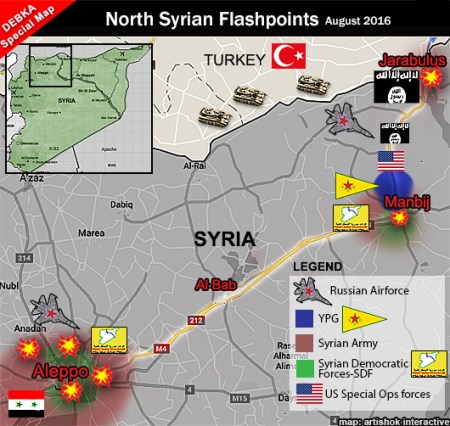
n syria flashpoints

This hopeless standoff is the result of Moscow’s refusal to provide the Syrian army and its allies with enough air support to pull ahead, in the wake of President Vladimir Putin talks with Turkish President Reccep Tayyip Erdogan in St. Petersburg Tuesday, Aug. 9.

*********************

All day Friday and Saturday, Aug.11-12, fighters of Hizballah’s elite Radwan Force – 3,000 in all – streamed to the pivotal Aleppo battlefield from all parts of Lebanon and Syria. DEBKAfile’s military and intelligence sources disclose that they were following the orders of their leader Hassan Nasrallah, who was warned by Tehran that the pro-Assad army fighting for Syria’s second city was flagging in the face of rebel assaults.

The Radwan Force was called in as the only military capable of saving the day for Assad and his allies. This step had been carefully avoided by Nasrallah was required in view of the heavy losses his organization had already suffered for backing the Syrian army – some 1,500 dead in three years – and intense fallout at home.

He has now been forced to sacrifice his last remaining military asset to fight in one of the bloodiest battles ever fought in recent times in the Middle East, even though it promises a swelling procession of Hizballah coffins returning to Lebanon.

According to our military sources, the battle to wrest Aleppo from rebel control, now in its second month, has claimed some 2,000 war dead and 4,000 injured on both sides – not counting the masses of civilians.

Some units have lost more than a quarter of their combatants and dropped out.

Nasrallah knows exactly what is happening in this critical arena. He also understands that a unit which loses 30 percent of its combatants is deemed in military terms unfit to continue fighting and that the battle for Aleppo will be drawn out and bloody. Yet he is willing to commit his entire deck of military resources to keep Bashar Assad’s fighting in Aleppo.

There is no hope of an early resolution in Aleppo, because stalemate between the combatants is exceptionally complicated and thankless. Whenever one side captures terrain, it quickly discovers it was drawn into a trap and under siege.

This hopeless standoff is the result of Moscow’s refusal to provide the Syrian army and its allies with enough air support to pull ahead, in the wake of President Vladimir Putin talks with Turkish President Reccep Tayyip Erdogan in St. Petersburg Tuesday, Aug. 9.

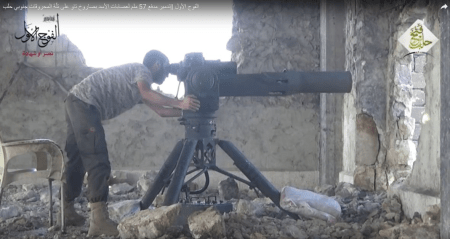
Aleppo_Rebels_ATGM-firings

Erdogan explained that if Assad’s army, along with Hizballah and Iran, defeated the Turkish-backed rebel forces holding Aleppo, he would suffer a serious knock to his prestige and setback for Syrian policy. This was more than he could sustain in the troubled atmosphere in Turkey in the wake of the failed coup against him.

He therefore asked the Russian president to abandon his Bashar Assad, Iran and Hizballah to their fate in Aleppo.

Erdogan was backed up in his request to Putin by a large Turkish military and intelligence delegation which arrived in St. Petersburg the next day to work with their Russian counterparts on setting up a joint military control center in Turkey.

DEBKAfile’s sources disclose the first two tasks assigned the new war room:

1. Russian aerial bombardments over Aleppo would not go beyond keeping the rebels from defeating Syrian and allied forces in Aleppo, but would refrain from supporting offensive action by the latter for routing the former.

2. Turkish air and ground forces would remain in a state of preparedness to ensure that rebel Syrian Democratic Forces (SDF) and the Kurdish YPG militia never moved out of the town of Manjib, from most parts of which they ousted ISIS, to the town of Jarabulus on the Turkish border.I

ISIS had used Manjib as its primary way station for supplies from Turkey 30km to the north. (See attached map). But to drive the jihadists completely out of the Syrian-Turkish border region, the combined rebel forcesmust advance on Jarabulus and expel ISIS from there too.

However, Turkish officers in the joint command center with Russia made it clear that any Kurdish forces allowed to reach that border would come under Turkish army attack.

The Russian president complied with Erdogan’s wishes on the Manjib-Jarabulus front as well as Alepp

Ex-CIA Chief’s Comments Reflect ‘What US is Secretly Doing in Syria’

August 11, 2016

Ex-CIA Chief’s Comments Reflect ‘What the US is Secretly Doing in Syria , from Sputnik News, August 10, 2016

(??????????????????????????? — DM)

Former CIA Deputy Director Michael Morell, who has recently endorsed Hillary Clinton, has caused a firestorm when he said that the United States should covertly kill Russians and Iranians in Syria, with Russian lawmakers denouncing the remarks as “monstrous” and experts saying that he merely confirmed what Washington has secretly been doing.

Vladimir Vasilyev, a senior research fellow at the Moscow-based Institute of US and Canada Studies of the Russian Academy of Sciences, maintained that Morell’s comments should be taken at face value.

This is “what the United States has secretly and surreptitiously been doing and most importantly what Washington will do if Hillary wins presidential election,” he told RIA Novosti. “Russia should understand who it is dealing with. In fact, Moscow could thank Morell for leaking important informationon Washington’s true goals in Syria.”

“Monstrous remarks”

Russian MP Irina Yarovaya, the head of the State Duma Committee for Security, echoed these sentiments, saying that Morell made “monstrous remarks.” He essentially confirmed that Washington is capable of carrying out “covert killings … to pursue its own devastating plans.”

Yarovaya also noted that Morell’s comments point to a hidden agenda in Washington’s counterterrorism activities. “The US State Department must issue a clear statement on the issue. Otherwise, there are grounds to assume that the former CIA deputy director inadvertently revealed an existing top secret CIA plan.”

Morell’s remarks are meant to “fuel tensions between Russia and the US,” Dmitry Gorovtsov, the deputy chairman of the State Duma’s Committee for Security, told RIA Novosti, adding that such rhetoric is unacceptable. He also called Morell’s plan “extremist” and “akin to fascist ideology.”

Morell “does not understand what he is talking about”

First deputy chairman of the defense and security committee in the Federation Council of Russia Franz Klintsevich referred to Morell’s remarks as “absurd.”

“I think that Michael Morell does not understand what he is talking about. Modern surveillance equipment that covers all Syria renders any ‘covert’ killings impossible,” he said. Russia’s cutting edge technologies allow Moscow to determine the name, the date, the place and the goal of any such activity if it took place.

Moreover, Morell’s advice “would automatically lead to an open confrontation between Russia and the US, which the Americans, as far as I understand, do not need,” Klintsevich added.

On Monday, Michael Morell, who served as CIA’s acting director twice, told talk show host Charlie Rose that the US “must make” Russia and Iran “pay a price” in Syria by “covertly” killing their nationals. “You don’t tell the world about it, right? You don’t stand up at the Pentagon and say, ‘we did this.’ Right? But you make sure they know it in Moscow and Tehran,” he added.

Morell also suggested “scaring” Bashar al-Assad by bombing government offices and presidential guard positions, but added that he did not urge to assassinate the Syrian president.

Journalist and political commentator Murtaza Hussain pointed out that the former CIA deputy director championed “efforts that later helped incubate al-Qaeda,” referring to a strategy that the United States employed in Afghanistan in the 1980s.

He also warned that if Morell’s plan is given the green light, it “would entail a massive escalation of American covert military involvement in Syria that would bring the United States much closer to direct confrontation with Russia and Iran.”

More Obama Doublespeak on Iran

August 6, 2016

More Obama Doublespeak on Iran, Gingrich Productions, Newt Gingrich, August 5, 2016

“Iran’s Guardian Council approved the government’s 2017 budget that instructed Iran’s Central Bank to transfer the $1.7 billion [the ransom plus interest] to the military.”

******************

The Obama administration has instructed us that Obamacare’s tax is not a tax, that its policy of not enforcing immigration law is “prosecutorial discretion,” and that hundreds of American military personnel on the ground in Iraq and Syria are not “boots on the ground.” So it’s not surprising to hear from the President this week that money paid in exchange for hostages is not a “ransom”.

The administration insists that’s not what we should call the planeload of $400 million in cash that arrived in Iran at the same time as four American hostages were released in January.

Thankfully, the facts are in less dispute than the definition of the word.

In negotiations that led to the release of the hostages, the Wall Street Journal reports, “The Iranians were demanding the return of $400 million” sent to the U.S. in 1979, and “they also wanted billions of dollars as interest accrued since then.”

Since it would be a violation of U.S. law to pay the regime in U.S. dollars however, the Journal reports that the Treasury Department asked European central banks to change its payment into Euros and Swiss Francs before loading the notes on a plane and flying them to Iran.

There, one of the hostages involved told Fox News, the Iranian captors told the Americans they were “waiting for another plane” before they would be released.

So to review: the Iranians made a demand for $400 million in exchange for releasing the hostages. The U.S. government went to extraordinary lengths to deliver $400 million to Iran. And as a result, the hostages were released. But this wasn’t a ransom situation?

“No, it was not,” says White House Press Secretary Josh Earnest. “It is against the policy of the United States to pay ransom for hostages.”

“We do not pay ransom,” President Obama echoed. “We didn’t here, and we won’t in the future.”

In his famous essay, “Politics and the English Language,” George Orwell describes words for which “the person who uses them has his own private definition, but allows his hearer to think he means something quite different.” Perhaps President Obama’s own private definition of “ransom” requires the use of a paper bag–or U.S. dollars.

Whatever the President’s beliefs about what he’s done, however, clearly he has sent a signal to Iran that the regime can take hostages and extract concessions. The $400 million in cash will likely endanger more Americans and result in more false imprisonments.

It is worth remembering that prisoners whose stories are known to the public had done absolutely nothing wrong, and should never have been imprisoned to begin with. No payment should have been required to secure their release. And yet the same administration that recently arrested a police officer who tried to send $245 to ISIS has now sent hundreds of millions to the world’s leading state sponsor of terror.

That Iran would take innocent Americans hostage for ransom is a reminder of how untrustworthy and dangerous a regime the Obama administration is dealing with on nuclear weapons. Such actions are one of the reasons there are sanctions on the country in the first place.

Indeed, those restrictions made the $400 million in cash an even sweeter deal than it might seem. It solved a serious problem for the regime.

As a senior U.S. official explained to the Wall Street Journal, “Sometimes the Iranians want cash because it’s so hard for them to access things in the international financial system. They know it can take months just to figure out how to wire money from one place to another.”

In other words, Iran got more than its money’s worth out of the plane full of cash. And what did the regime do with it? As Bloomberg reported, the funds are going straight into their war chest: “Iran’s Guardian Council approved the government’s 2017 budget that instructed Iran’s Central Bank to transfer the $1.7 billion [the ransom plus interest] to the military.”

So the Obama administration hasn’t just struck a deal with Iran that will allow it to obtain nuclear weapons. In paying the ransom money, the U.S. has also funded the military that could seek to use those weapons against us.

Connecting the Nuclear Dots

August 5, 2016

Connecting the Nuclear Dots, Gatestone InstitutePeter Huessy, August 5, 2016

♦ Iran seeks to do us grave harm, potentially with ballistic missiles and nuclear weapons. The threat warnings are clear and we have strong evidence — Iran has attacked us repeatedly over the past 30 years.

♦ Instead of heeding the nuclear missile “dots” that are emerging all around us, we are busy promoting trade with Iran, downplaying its violations of the nuclear deal, simply ignoring its ballistic missile developments and dismissing the growing evidence of its terrorist past.

After the attacks on September 11, 2001, Congress, the Bush administration, and terrorist experts complained that the country had simply not “connected the dots” provided by prior terrorist threats.

The 9/11 Commission also concluded that the attacks “should not have come as a surprise,” as “Islamist extremists had given plenty of warning that they meant to kill Americans indiscriminately and in large numbers.”

The Commission then listed 10 Islamic terror plots against the US prior to 9/11:

“In February 1993, a group led by Ramzi Yousef tried to bring down the World Trade Center with a truck bomb.

“Plans by Omar Abdel Rahman and others to blow up the Holland and Lincoln tunnels and other New York City landmarks …

“In October 1993, Somali tribesmen shot down US helicopters, killing 18 and wounding 73…

“In early 1995, police in Manila uncovered a plot by Ramzi Yousef to blow up a dozen U.S. airliners while they were flying over the Pacific.

“In November 1995, a car bomb exploded outside the office of the US program manager for the Saudi National Guard in Riyadh, killing five Americans and two others.

“In June 1996, a truck bomb demolished the Khobar Towers apartment complex in Dhahran, Saudi Arabia, killing 19 US servicemen and wounding hundreds.

“In August 1998, al Qaeda, carried out near-simultaneous truck bomb attacks on the US embassies in Nairobi, Kenya, and Dar es Salaam, Tanzania. The attacks killed 224 people, including 12 Americans, and wounded thousands more.

“In December 1999, Jordanian police foiled a plot to bomb hotels and other sites frequented by American tourists…

“…US Customs agent arrested Ahmed Ressam at the US-Canadian border as he was smuggling in explosives intended for an attack on Los Angeles International Airport.

“In October 2000, an al Qaeda team in Aden, Yemen, used a motorboat filled with explosives to blow a hole in the side of a destroyer, the USS Cole, almost sinking the vessel and killing 17 American sailors.”

Despite the overwhelming indications that an attack like 9/11 was around the corner, as former Secretary of State Condoleezza Rice told the country in her April 2004 testimony to the 9/11 Commission, “The terrorists were at war with us, but we were not yet at war with them. For more than 20 years, the terrorist threat gathered, and America’s response across several administrations of both parties was insufficient.”

Are we now better equipped to “connect the terrorist-threats by dots” than we were prior to 9/11? Certainly we are not still echoing the testimony of Richard Clarke when he told the Emerging Threats Subcommittee in the summer of 2000 that the administration “had not yet” determined how to spend homeland security funds even some eight years after the first World Trade Center bombing of February 1993.

Unfortunately, not only are we not connecting the terrorist dots, we are actively downplaying their significance. Nowhere else is this more apparent than in the virtually complete failure, on the part of the US, to hold Iran responsible for the terror attacks that have killed and maimed thousands of Americans since 1979. This failure is all the more disturbing after the numerous court decisions that have found Iran accountable for nearly $60 billion in damages owed to the victims and survivors of these attacks, including the 9/11 attacks.

The outstanding news analyst and author Melanie Phillips wrote nearly a year ago that Iran had been “…perpetrating acts of war against Western interests for more than three decades — including playing a key role in the 9/11 attacks on America.” Phillips noted that a Revolutionary Guard-Iranian Intelligence (MOIS) task force

“designed contingency plans for unconventional warfare against the US… aimed at breaking the American economy, crippling or disheartening the US, and disrupting the American social, military and political order — all without the risk of a head-to-head confrontation which Iran knew it would lose.”

She explained that the court testimony from former Iranian agents illustrates that Iran “…devised a scheme to crash hijacked Boeing 747s into the World Trade Center, the White House and the Pentagon. … The plan’s code name was ‘Shaitan dar Atash’ (‘Satan in flames’).” Further, the court evidence revealed that Iran obtained “a Boeing 757-767-777 flight simulator which it hid at a secret site where the 9/11 terrorists were trained.”

In December 2011, Judge George B. Daniels found that Iran, with the participation of its Supreme Leader Ayatollah Ali Khamenei, was directly and heavily involved in the 9/11 atrocities. Khamenei instructed intelligence operatives that while expanding collaboration between Hezbollah and al-Qaeda, they must restrict communications to existing contacts with al-Qaeda’s second-in-command Ayman al Zawahiri and Imad Mughniyeh — Hezbollah’s then terrorism chief and agent of Iran.

1081Iran’s Supreme Leader, Ayatollah Ali Khamenei (center), is shown meeting in May 2014 with Iran’s military chief of staff and the commanders of the Islamic Revolutionary Guards Corps. (Image source: IRNA)

While the 9/11 Commission found solid evidence Iran aided the 9/11 hijackers in their travels from Iran, the “Extensive cooperation in major global terrorist activities,” between Iran, Hezbollah and Al Qaeda, including the 1996 bombing of the Khobar Towers housing complex in Saudi Arabia and the 1998 East Africa US embassy bombings, escaped the 9/11 Commission’s detailed attention. Notably, as long ago as in 2000, a US Defense Intelligence Agency analyst was alerting the government to a web of connections between al-Qaeda, the Iranian intelligence agencies controlled by Khamenei, and other terrorist groups.

Many press reports and analysts, cognizant of Iran’s terrorist history and aware that Iran has been designated by the US Department of State as the world’s premier state sponsor of terror, choose to believe the 2015 Iranian nuclear deal should not be derailed over concern of Iran’s possible future terrorist plans. Especially when it is often assumed these plans are aimed primarily at Israel and groups in Syria, Iraq and Lebanon, and thus not of real concern to the United States.

Is the nuclear deal with Iran thus a good trade? We get to slow Iran’s pursuit of nuclear weapons, but any serious sanctions or military effort to stop Iran’s terror agenda are off the table. Let’s connect the new nuclear-related Iran dots.

First, the world’s expert on Iran ballistic missiles, Uzi Rubin, revealed on July 15 that Iran has five new missile capabilities: they can strike the middle of Europe, including Berlin; they can target with GPS accuracy military facilities in Saudi Arabia; they can launch missiles from underground secret tunnels and caves without warning; they have missiles that are ready to fire 24/7; and they have developed other accurate missiles whose mission is to strike targets throughout Gulf region.

Second, the Associated Press revealed that a side agreement under the Joint Comprehensive Plan of Action (JCPOA) nuclear “deal” actually allows Iran to break out of the agreement in year 11, not 15, at which point Iran will not even be six months away from having sufficient nuclear fuel to arm a nuclear warhead, and Iran will be able to install nuclear centrifuges five times more efficient than the ones they have today.

Third, according to German intelligence reports, Iran has, a few dozen times since the July 2015 nuclear agreement, sought to purchase nuclear ballistic missile technology, a violation of previous UN resolutions.

As Americans wonder who will be behind the next terrorist attacks on our country — “lone wolf” terrorists inspired by social media from Islamist groups; organized cells of ISIS, Al Qaeda, Islamic Jihad, Hezbollah; states such as Iran and Syria; or a combination of all three — we would do well to be reminded of the long-term use of terrorism by the former Soviet Union as one of their trademark elements of “statecraft.”

Iran’s pursuit of nuclear weapons has not been stopped and at best has been delayed. Add to that Iran’s enhanced ballistic missile capability, its growing partnership with North Korea and its history of terrorist attacks on the United States, and connecting the dots reveals a stark reality — nuclear terrorism by missile may be on its way.

During the spring and summer of 2001, US intelligence agencies received a stream of warnings that Al Qaeda was determined to strike. The specific information pointed to threats from overseas. The Bush administration began developing a strategy in early 2001 to eliminate Al Qaeda in three years. The 9/11 attacks happened “too soon.”

Iran seeks to do us grave harm, potentially with ballistic missiles and nuclear weapons. The threat warnings are clear and we have strong evidence — Iran has attacked us repeatedly over the past 30 years

But instead of heeding the nuclear missile “dots” that are emerging all around us, we are busy promoting trade with Iran, downplaying its violations of the nuclear deal, simply ignoring its ballistic missile developments and dismissing the growing evidence of its terrorist past.

In short, we are not connecting these dots; we are erasing them.

Has the IDF hit the Basij forces commander General Naghdi?

July 30, 2016

Has the IDF hit the Basij forces commander General Naghdi? DEBKAfile, July 30, 2016

EinZivan2 (1)

Gen. Naghdi’s visit to Quneitra undoubtedly presaged some decisions in Tehran with regard to direct Hizballah-Syrian-Iranian action against Israel.

The Iranian, Syrian and Hizballah agencies accuse Israel of the attack because the say it was executed by two Nimrod anti-tank long-range missiles, manufactured by the Israeli Aerospace Industry, for use by the IDF against armored vehicles, ships, bunkers and troop concentrations.

*****************

Iranian, Syrian and Hizballah sources are intimating that the “Syrian officer” injured on July 26 in Quneitra by Israel’s double Nimrod’ missile shot was none other than Revolutionary Guards Gen. Muhammad Resa Naghdi, head of the paramilitary Organization for the Mobilization of the Oppressed, also known as the Basij, which falls under the Islamic Revolutionary Guard Corps (IRGC). The victim was earlier described officially as a Syrian officer.

If he was indeed hurt or killed by an Israeli rocket, Naghdi would become the highest-ranking IRGC general ever hit by the IDF.

On July 27, the semi-official Fars news agency reported that a top Iranian general recently visited the Israeli-Syrian border to tour Quneitra and the Golan demarcation lines between Syria and Israel – the first time the Tehran government had publicized a visit by a senior regime official to the area.

It may be presumed, DEBKAfile’s intelligence sources say, that someone at the IDF lookout posts spotted and reported on Gen. Naghdi’s arrival with an entourage in Quneitra on July 26 and saw him inspecting through binoculars the IDF defense positions. He was then quickly identified.

Any decision to go after a high-ranking Iranian would not have been left to local IDF commanders or even OC Northern Command Maj. Gen. Aviv Kohavi, but passed straight to Prime Minister Binyamin Netanyahu, Defense Minister Avigdor Lieberman and Chief of Staff Lt. Gen. Gady Eisenkot – especially in this case.

General Naghdi is not just another Iranian general. He heads the more than a million-strong Basij militia, which is a pillar of the ayatollahs regime in Tehran, and the backbone of the Iranian internal security forces which maintain the regime’s total control in every corner of the Islamic Republic.

Gen. Naghdi’s visit to Quneitra undoubtedly presaged some decisions in Tehran with regard to direct Hizballah-Syrian-Iranian action against Israel.

The IDF is holding its silence on reports of his injury, declining as usual to comment on reports by foreign publications.

The Iranian, Syrian and Hizballah agencies accuse Israel of the attack because the say it was executed by two Nimrod anti-tank long-range missiles, manufactured by the Israeli Aerospace Industry, for use by the IDF against armored vehicles, ships, bunkers and troop concentrations..

The missile has a semi-active laser guidance system, and is able to operate day and night. Its flight path can be below the clouds, while its operators far behind use a laser to guide it to target.

The launcher platform, with four missiles, can be installed on a Jeep, weapon-bearing vehicle, Abir, or armored vehicles. In addition, it is possible to send it from CH-53 ‘Yasur’ helicopter.

Israel has acted in the past against the establishment of an Iranian and/or Hizballah military presence on its Golan doorstep. On Jan. 19, 2015, an IDF air strike killed the Iranian Brig. Gen, Mohammad Ali Allahdadi and six Hizballah officers while they were on a tour of inspection near Quneitra.

Thursday, July 28, DEBKAfile ran an exclusive report on rising Israel-Russia tensions centering on southern Syria and the Golan.

For four days since July 25, the Syrian army has been continuously firing artillery batteries – moved close to Israel’s defense lines on the Golan border – in a manner that comes dangerously close to provoking an Israeli response. This carefully orchestrated Syrian campaign goes on around the clock.

It is the first time in the six years of the Syrian war that Bashar Assad has ventured to come near to provoking Israel. But now he appears to be emboldened by his Russian ally.

The IDF is holding its fire for the moment. But Israeli military and government leaders know that the time is near for the IDF to be forced to hit back, especially since it is becoming evident that the Syrian army’s steps ae backed by Russia.

DEBKAfile’s military sources provide details of the Syrian steps:

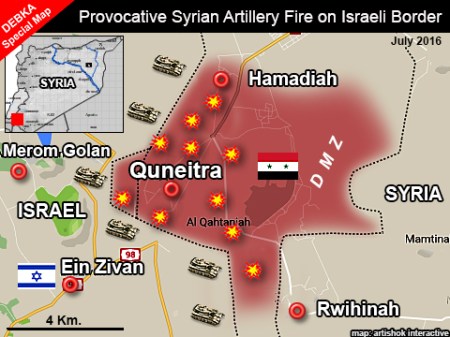
  • The Syrian army’s 90th and 121nd battalions have been firing their artillery batteries non-stop across a 10km band along the Golan border from Hamadia, north of Quneitra, up to a point facing the Israeli village of Eyn Zivan. (See attacked map).
    This means that the Syrian army has seized the center of buffer zone between Israel and Syria and made it a firing zone.
  • This artillery fire fans out across a radius that comes a few meters short of the Israeli border and the IDF troops stationed there. It then recedes to a distance of 500 to 600 meters and sweeps across the outposts and bases of the Syrian rebel forces believed to be in touch with Israel or in receipt of Israeli medical aid.
  • The new Syrian attack appears to hold a message for Jerusalem: For six years, you supported the rebels against the Assad regime in southern Syria. That’s now over. If you continue, you will come face to face with Syrian fire.
  • Damascus is also cautioning those rebels:  For years, you fought us with Israel at your backs. But no longer. Watch us bring you under direct artillery fire, while the IDF sits on its hands.
  • On July 26, Russian media published an article revealing that Russia had delivered to the Syrian Air Force, advanced SU-24M2 front-line bombers, which is designed for attack on frontlines of battle. Israeli officials were unpleasantly taken aback by the news. Up until now, the Russians and Syrians refrained from deploying air strength in South Syria near the Israeli border. Now the Syrian air force has the means to do so.
  • DEBKAfile military sources report that the SU-24M2, following recent upgrades and modifications in Russian factories, is now capable of dropping smart bombs – ballistic bombs with a guidance system on their tails that enable them to hit targets with precision.This guidance system does not rely on US GPS satellites but rather the equivalent Russian GLONASS system which is linked to a network of 21 Russian satellites and partially encrypted for military usages.
    In addition, the SU-24M2 is equipped with a system that projects the information the pilot needs (flight details and battle details) on the plane’s windshield (head-up display) and on the pilot’s visor.
  • The Russians delivered to the Syrians two of these sophisticated airplanes this week, out of 10 that they will supply soon.

The IDF has concluded that it is only a matter of time before these planes appear in Southern Syria and so generate a new and highly combustible situation on Israel’s northern and northeastern borders.

The Russians are colluding with Damascus to inform Israel that it will no longer be allowed by either to continue backing the rebel forces in southern Syria or sustain the buffer zone which they man.

Israel may pay dear if Prime Minister Binyamin Netanyahu, Defense Minister Avigdor Lieberman, and Chief of Staff Lt. Gen. Gadi Eisenkot decide to continue to abstain from hitting back at the Syrian fire which is aimed every few hours at the vicinity of IDF posts or the impending arrival of Russian bombers. The price in store would be the weakening of the IDF’s hold on the Golan border.

More airports under ISIS threat after Istanbul

June 29, 2016

More airports under ISIS threat after Istanbul, DEBKAfile, June 29, 2016

istanbul-dead

The US, Europe and the Middle East are again refusing to connect the dots of the terrorist threat, recalling the denial that marked the peak period of Al Qaeda’s atrocities in the early 2000’s.

When the US Defense Secretary Ashton Carter trumpeted the Fallujah victory over the Islamic State on June 27, he neglected to disclose that the real victors were Iranians – not Iraqis. The next day, an ISIS suicide attack on Istanbul’s Ataturk airport overshadowed that success, killing at least 41 people including 13 foreign nationald and injuring more than 230.

As the Obama administration labored to conceal from the public in the West its strategy of using Shiite forces to hammer ISIS in Iraq and parts of Syria, the Sunni terrorists retaliated in Istanbul – and not just there.

Seven ISIS suicide bombers, some on motorcycles, exploded on Monday, June 27, in a Christian village in the Lebanon Valley near Baʿalbek. A week earlier, an ISIS suicide bomber blew himself up at the gates of a large Jordanian military base on the Syrian border.

The connection between the ISIS arenas and cause and event is there for anyone who wants to see it.

ISIS has a ready store of suicide bombers who are willing to blow themselves up, not just because they are ‘extreme fanatics’ or “thugs” as President Obama insists on defining them, but because they believe they are fighting a religious war: Sunnis against Shiites, Sunnis against Christians and Sunnis against Jews.

On this point, Obama is in denial.

Turkey’s Sunni President Tayyip Erdogan was swiftly punished for concluding a political-military-intelligence agreement with the Jewish state. That same day, three suicide bombers, probably waiting for months at a safe house near the Istanbul airport, were ordered from ISIS Syrian headquarters in Raqqa, to go into action.

Neither the dense US intelligence net in the region, nor Turkish and Israeli intelligence managed to intercept the order.

DEBKAfile intelligence sources point out that the highly secure Ataturk airport, the third largest in Europe, is not the only one on the continent at which ISIS suicide units are lurking ready to strike.

American-European intelligence input points to their presence near at least two or three other airports in Europe. The problem is that the intel is very general, pointing to intent, with no specifics on countries or airports.

The public in the West and Middle-East are not told either about the ‘small’ victories scored by ISIS on the battle field. For instance, ISIS forces managed to block the Syrian-Hizballah advance towards the highway leading from Palmyra to Raqqa, inflicting heavy losses despite Russian air cover.

In Israel, where security awareness is usually high, no one was told about the successful ISIS engagement at the Syria-Jordan-Israel border junction bordering on the Israeli Golan against US-trained and armed Syrian rebels, who fought under artillery cover from Jordan.

In other words, ISIS has established itself on the Israeli border, a few kilometers away from the Sea of Galilee and Tiberius.

The Islamic State is fully geared to respond to such losses as Fallujah by going for strategic gains on the ground and inflicting horrible retribution on its victims by remotely activating sleeper cells of suicide killers.

Rather than being degraded, as Obama claims, ISIS is fully equipped to target its victims across several continents.

On Tuesday Istanbul airport was its chosen target. Now, we must wait and see who is next.