David Axe 02.20.18 4:39 AM ET Via The Daily Beast
Source Link: In Iraq, Hezbollah’s Got U.S. Tanks, and Washington Wants Them Back
{Still cleaning up the mess left behind by Barack Barry Sotero Hussein Obama…and dealing with the Iraqi government this former sorry excuse of a POTUS so greatly admired. – LS}
The Pentagon is pressuring Iraq to seize any M-1s that are still in the hands of Iran-backed militias but is vague about how many have been recovered––or not.
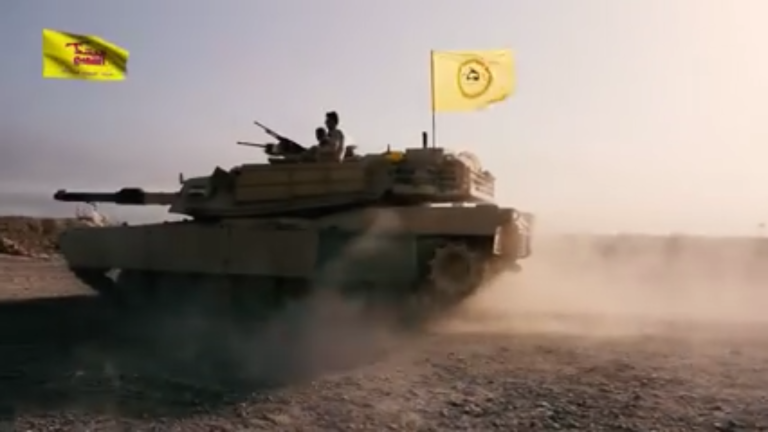
Pro-Iranian militias in Iraq got their hands on at least nine high-tech, U.S.-made M-1 tanks as early as 2015, the U.S. government acknowledged earlier this month. Along with the belated admission, the Pentagon and the U.S. State Department say they are trying to take back the tanks. But to a great extent, the damage is already done. The militias have already deployed them against some of America’s longtime Kurdish allies.
“We are aware that not all U.S.-provided defense articles are under the control of the intended recipient,” a spokesperson for the U.S.-led coalition in Iraq and Syria told The Daily Beast via email. “The U.S. continues to work with the government of Iraq to continue acting as quickly as possible to ensure all defense articles are with their intended recipients.”
The Iraqi army has reclaimed “several” of the tanks, the spokesperson said.
The 70-ton M-1A1 Abrams, the most numerous tank in the arsenals of the U.S. Army and Marine Corps and a mainstay of U.S. allies’ own armies, is one of the most powerful fighting vehicles in the world. The four-person tank boasts a 120-millimeter cannon, thick armor and a gas-turbine engine that can propel the vehicle as fast as 40 miles per hour.
Iraq bought 140 refurbished M-1s from the United States starting in 2008 in order to rebuild armored divisions that American forces had destroyed during the 2003 U.S.-led invasion. The unit cost can vary, but each one is worth approximately $4.3 million.
When the so-called Islamic State swept through northwest Iraq in 2014, Iraqi M-1s were in the thick of the fighting. Militants quickly destroyed five of them, damaged dozens more, and captured several intact M-1s. For a few months at least, ISIS possessed operational M-1s. Then pro-Iran Shia militias—collectively known as “Popular Mobilization Forces” or PMF—recaptured some the tanks, the coalition spokesperson said.
In January 2015, a video appeared online that showed an M-1 flying the flag of the Hezbollah Brigades, a U.S.-designated terror group that’s part of the PMF and fights alongside the Iraqi army. A separate video that appeared in February 2016 showed an M-1 sporting the flag of Kata’ib Sayyid Al Shuhada, another PMF militia.
Recaptured vehicles that the PMF seized from ISIS account for only “some” of the at least nine M-1s that have appeared in the militias’ arsenal, according to the coalition spokesperson. The Iraqi army appears to have supplied the balance of the tanks directly to the PMF, in violation of Iraq’s original contract for the M-1s.
The Shia militias deployed at least one M-1 against Kurdish Peshmerga forces during skirmishes in the contested Iraqi city of Kirkuk in October 2017 when the Kurdish Regional Government was making an ill-fated bid for independence. Although the U.S. did not back that effort, the Kurds remain some of Washington’s closest allies in the region, and Iran its most important adversary.
In this instance the Peshmerga knocked out the tank, reportedly using either a Chinese- or German-made anti-tank missile.The Kurdish Regional Government circulated aerial photos of the burned-out M-1 as proof of the tank’s use by the PMF.
The disabled M-1 quickly disappeared from the battlefield, and a Kurdish commander accused the government of Iraq of moving the tank in order “to hide the truth that they have used Abrams tank against the Peshmerga.”
In any event, the U.S. State Department finally confirmed the PMF’s possession of M-1s in a February report from the inspector general for the Iraq and Syria campaigns. “This quarter, the [Department of State] acknowledged that some U.S.-provided military equipment sent to support the mission, including as many as nine M-1 Abrams tanks, had fallen into the hands of Iranian-backed militias that fought against ISIS in Iraq,” the report stated.
The Pentagon is pressuring Iraq to seize any M-1s that are still in the PMF’s hands. “As recipients of U.S.-origin defense equipment, Iraqi authorities have an obligation to adhere to end-use requirements as outlined in agreements concluded with the United States government.”
Besides withholding future arms shipments, Washington can end support for the scores of M-1s in the Iraqi army’s armored divisions. There have been reports that General Dynamics Land Systems, the Michigan-based company that builds the M-1s and provides spare parts and technicians for the tanks, recently threatened to cut ties with Baghdad over the militia’s use of M-1s. A General Dynamics spokesperson declined to comment on the reports.




 anneinpt
 artaxes
 danmillerinpanama
 davidking1530
 Peter Hofman
 Joseph Wouk
 Peter
Peter Louisiana Steve
 WarSclerotic
Recent Comments