Archive for the ‘Iran’ category

The Nuclear Giveaway

October 4, 2014

The Nuclear Giveaway, Center for Security Policy, Fred Fleitz, October 2, 2014

3 stoogesSource: National Review Online

With the Iran nuclear talks now in their endgame and the prospect of a very different political environment in Washington next year if Republicans capture the Senate, Obama officials are in overdrive to achieve their dream of a legacy agreement with Tehran so that President Obama can claim he halted the threat from the Iranian nuclear program. Their goal is to get a final agreement before the nuclear talks are scheduled to end November 24.

While the Obama administration has long been desperate to get such an agreement, two recent ill-advised American concessions and a string of misleading statements and proposals demonstrate how far the White House is willing to go and why it is vital that Congress denounce on a bipartisan basis the nuclear talks and a possible final agreement .

Two weeks ago, the United States floated a proposal to let Iran keep all of its 19,000 centrifuge machines, which Tehran is using to enrich uranium to reactor grade as long as all but 1,500 are “disconnected” and cease enriching uranium. This proposal alarmed many experts because Iran could quickly begin enriching uranium to weapons grade by reconnecting all of its centrifuges.

As generous as this offer was, it apparently did not go far enough for Tehran. The Associated Press reported on September 25 that U.S. diplomats have proposed letting Iran operate up to 4,500 centrifuges if its stockpile of enriched uranium gas is converted to uranium “powder.” This proposal rests on the assumption that such an arrangement would give the international community plenty of time to react to an Iranian “dash” toward constructing a nuclear weapon because it would take over a year for Iran to re-convert low-enriched powder into uranium gas for further enrichment to weapons-grade uranium.

The assumption behind this proposal is false. Both Amos Yadlin, former head of the Israeli Military Intelligence Directorate, and Mark Hibbs, a senior associate with the Carnegie Endowment and nuclear proliferation expert, agree that it would take Iran only about two weeks. [Emphasis added. — DM]

A final agreement also appears unlikely to do anything to reduce the nuclear-proliferation threat posed by Iran’s large stockpile of low-enriched uranium. I noted in NRO last November how a 2013 American Enterprise Institute study found that Iran has produced enough reactor-grade uranium since 2009 “to fuel a small arsenal of nuclear weapons after conversion to weapons grade.” The Langley Intelligence Group Network agreed with this assessment and estimated that, from its 20 percent-enriched-uranium stockpile, Iran could make enough nuclear fuel for one bomb and could make another seven from its reactor-grade uranium if further enriched to weapons grade.

Estimates by the American Enterprise Institute, the Institute for Science and International Security, and the Nuclear Proliferation Education Center on how fast Iran could make enough weapons-grade uranium for one nuclear bomb using reactor-grade uranium range from four to six weeks.

This latest proposed concession continues a pattern of misleading statements and proposals by Obama-administration officials on the Iran talks that began with last November’s interim agreement with Iran, which set up this year’s negotiations on a final agreement.

For example, last November, President Obama claimed the interim deal “halted the progress of the Iranian nuclear program.” At best, the agreement froze only part of this program.

Also last November, National Security Council aide Anthony Blinken said the interim deal halted progress on Iran’s Arak nuclear reactor — which will be a source of plutonium when completed — even though it allowed work on this reactor to continue. This marked a retreat from the West’s prior insistence that the dangerous Arak reactor be abandoned.

Negotiators are now discussing ways to allow the completion of the Arak reactor with design or operational alterations so it produces little plutonium. Iran has been resisting any limitations on this reactor and will likely agree only to one easily reversible change — fueling it with low-enriched uranium.

Although the interim agreement permitted Iran to continue uranium enrichment, Secretary of State John Kerry has insisted this did not mean the United States has conceded to Iran the “right” to enrich. Not true. The preamble of the interim agreement says “a final agreement will involve a mutually defined enrichment program.”

There also are issues concerning the interim deal and this year’s nuclear talks that Obama officials prefer not to discuss publicly. Talks on a final agreement were supposed to begin in late December 2013 but were delayed for several weeks because Iran cheated on the interim agreement shortly after it was signed by installing centrifuges with more advanced designs.

The Obama administration is playing down how the interim deal committed all parties to a “sunset” clause in a final agreement that will limit its duration and treat Iran as a “normal” state entitled to pursue whatever nuclear technologies it wishes under the Nuclear Nonproliferation Treaty after the agreement expires. This means after a final agreement, there will be no limits on how many uranium centrifuges and plutonium-producing reactors Iran can build as long as it informs the IAEA.

Iran wants a final agreement to last less than ten years. The Obama administration wants it to last “in double digits.”

Although there are three legs to a nuclear-weapons program — fuel production, designing and building a warhead, and delivery systems — the nuclear talks have ignored Tehran’s growing ballistic-missile arsenal, which experts believe is being developed to deliver nuclear warheads. Iran’s ballistic missiles have been excluded from the talks despite three Iranian satellite launches since 2009, which many experts believe were actually tests of long-range missiles capable of striking Europe and the United States.

Moreover, there is compelling evidence in a Iranian document obtained by the IAEA in 2005 of an effort by Iran to develop nuclear warheads for ballistic missiles. The IAEA believes this document is a layout for a Shahab-3 missile re-entry vehicle that appears “quite likely to accommodate a nuclear device.” Iran refuses to explain this document and has denounced it as a forgery.

Add to these concerns a recent IAEA report that says Iran is refusing to comply with an important element of the interim agreement: to fully cooperate with the IAEA, grant its inspectors full access to nuclear facilities, and answer all outstanding questions about past nuclear activities that appear to be related to weapons development.

Iran’s refusal to cooperate with the IAEA during the nuclear talks is certain to continue after the signing of a final nuclear agreement, which will make it difficult to verify its compliance with the agreement and the peaceful nature of any nuclear activities that Tehran launches after the pact expires.

And then there are recent reports that U.S. diplomats have discussed with Iranian officials during the nuclear talks how Iran might help defeat the Islamic State. Mixing the Iran nuclear talks with discussions of the situation in Iraq and Syria was a bad idea for two reasons.

First, Iran bears significant responsibility for the sectarian violence in Iraq because of its ties to the Maliki government and its training of Shiite militias that have killed Iraqi Sunnis. The U.S. should be trying to get Iran out of Iraq’s affairs, not draw it in further.

Second, Iran is using the U.S. request for help against the Islamic State to bargain for even better terms in a nuclear agreement. Senior Iranian officials told Reuters last week that Iran is ready to work with the United States and its allies to stop Islamic State militants but would like to see them show more flexibility on Iran’s uranium-enrichment program.

The Obama administration is telling the press that Western states and Iran are still far apart on key issues in the nuclear talks and that reported U.S concessions on enrichment have not been formally presented to Iranian diplomats. I doubt this is the case. I believe it is more likely that the Obama administration is staging an eleventh-hour show of toughness while simultaneously leaking controversial elements of the draft agreement before it announces a final nuclear deal that the White House knows will be very unpopular with Congress.

This all adds up to a dramatic and reckless shift in the U.S. approach to the Iranian nuclear program.

Before the spring of 2012, the Obama administration’s public approach to Iran’s nuclear program was the same as the Bush administration’s and can be summed up by the question “How do we stop Iran from getting a nuclear bomb?”

However, in their desperation to get a legacy nuclear agreement with Iran for President Obama, his diplomats have given away so much that the U.S. approach has essentially shifted to “How long can we delay an Iranian nuclear bomb?” and “How many nuclear bombs should Iran be allowed to make?”

This approach is unacceptable and poses grave risks to the Middle East and the world. We are headed for a weak, short-duration nuclear agreement with Iran that will do nothing to stop its pursuit of nuclear weapons and could spark a nuclear-arms race in the Middle East. The Iran talks have drifted so far from reality that they are unsalvageable. Congress therefore should reestablish a responsible U.S. policy on the Iranian nuclear program by renouncing these negotiations on a bipartisan basis and place new sanctions on Tehran if it does not halt its current nuclear activities, which violate six U.N. Security Council resolutions.

I believe a meaningful agreement with Tehran on its nuclear program involving significant compromises by both sides will someday be possible. Such an agreement must halt or significantly set back Iran’s pursuit of nuclear weapons and last 20 years or longer. Because of the one-sided concessions made by the United States in the current nuclear talks, it is clear this administration is incapable of negotiating a nuclear agreement with Iran that meets these standards.
Why Obama Refuses to support anti-Islamist, Secular Moslems

October 4, 2014

Why Obama Refuses to support anti-Islamist, Secular Moslems, American ThinkerManda Zand Ervin, October 4, 2014

(Please see also Muslim Leaders Sign Letter Against ISIS, But Endorse Sharia and “Goodbye, Dear Mum”: Iran Executes Rayhaneh Jabbari — UPDATED.– DM)

If we are really determined to eradicate Islamism, we should stop making deals with them and start supporting the people against the Islamist regimes.

It is believed that the reason for President Obama’s silence is the fear that it may cause the supreme leader Khamenei unhappy.  He needs the top Islamist’s consent to give him a deal on their nuclear bomb no matter what the cost.

*******************

The war against Islamist terrorism has been going in the wrong direction, and the cancer has metastasized under the present administration. As we get rid of one Islamist tumor, more pop up.

But the most dangerous of all Islamists are ruling Iran and are determined to make themselves untouchable by possessing their own nuclear bomb.

We have wrongly chosen to ignore the majority moderate and secular Moslems in the Middle East and here at home. Those advising the White House and the State Department are lobbyists for the Islamist dictators, not secular Moderate Moslem Americans.

For reasons unknown, the Obama Administration had no qualms in removing and even bombing the secular Arab dictators, citing the human rights of their citizens, but when it comes to the human rights of the citizens living under the bloodiest Islamist dictators in Iran, this administration has gone out of its way to ignore the victims and empower the aggressors.

President Obama did not support the secular uprising in Iran but chose to stand by the Islamist clerics and their international terrorist Revolutionary Guards who are creating havoc across the Middle East, Africa, South America, and even here in the United States. Hizb’allah is the brainchild of Khomeini. Hamas is another gang of Islamists that Khamenei supports, leaving the people of Iran hungry. The Revolutionary Guards are operating in Africa, in every city in Europe, and in South America making deals with the drug cartels.

If we are really determined to eradicate Islamism, we should stop making deals with them and start supporting the people against the Islamist regimes.

America was the savior of the colonial world after the WWII. American foreign policy was based on human rights, but it is now based on policies that the old imperialists might well approve of.

94% of Iranian people are against the ruling Islamist regime that is anti-Iranian, anti-American, anti-civilization, and rules under barbaric Sharia laws.

Many Iranian clerics are against the rule of religion in government. The majority of the clerics do not dare to speak up — the ones who have spoken up have either disappeared or been arrested, imprisoned, tortured, and executed by the clerics in charge of Iran’s so- called Justice system, called Revolutionary Court.

The numbers of opposing clerics are high enough for the regime to create Cleric’s Wards in the prisons of Iran.

The most prominent cleric prisoner is Ayatollah Seyyed Hossein Kazemeini Boroujerdi, who has been held in the dreaded Evin prison since the supreme leader Khamenei ordered his arrest in 2006.

Not only he was arrested, his wife and children were harassed and their home and belongings were confiscated. By order of the supreme leader Khamenei, he was then defrocked and imprisoned. Since being in prison he has suffered two heart attacks as the result of mistreatment and torture.

Mr. Broudjerdy’s crimes have included urging the separation of the government of Iran from Islamic rule. He first went public with his support of the Universal Declaration of Human Rights and protestations against the abuses of theocratic rule. He condemned Islamic fundamentalism, radicalism, and terror. He rejected anti-Semitism and advocating religious freedom.  He has spoken for the equal rights of women and has called for abolishment of capital punishment, and cruel, inhuman, degrading treatment or punishments such as torture, stoning and flogging.

On the day President Rohani was speaking in the United Nations, clergyman Mohammad Movahedi, was in the clerical ward of the Evin prison Threatening Mr. Boroujerdi, and all those who had proceeded to publish and disseminate his books will be sentenced for apostasy and executed.

Although there has been calls from the human rights organizations and Iranians in and outside Iran who have provided a Petition with more than 600,000 signatures asking the president of the United States to help his release, there has been no response from the most powerful man on earth.

It is believed that the reason for President Obama’s silence is the fear that it may cause the supreme leader Khamenei unhappy.  He needs the top Islamist’s consent to give him a deal on their nuclear bomb no matter what the cost.

Instead of supporting the secular Moslems to rid the world of a gang of Islamist clerics and their revolutionary guards, United States is ignoring the security of Israel, the world at large, and the human rights issue and instead supports the Islamists.

This is how America loses 75,000,000 friends.


Netanyahu finds himself increasingly alone on Iran

October 2, 2014

Netanyahu finds himself increasingly alone on Iran, Reuters, Dimi Reider, October 2, 2014

(Churchill stood nearly “alone” during the mid to late 1930’s in his arguments concerning the dangers of Germany under Hitler. Churchill was right, Chamberlain was wrong. Churchill’s arguments were eventually vindicated — but only after the substantial damage left by his predecessor had diminished Britain’s abilities to fight Nazi Germany and had to be fixed. Like many directed against Churchill, the post provided below is in large measure a selective hit piece against Netanyahu. Still, it’s worth reading because it apparently reflects the views of many. Churchill was right and so is Netanyahu. Will he be vindicated as well? — DM)

bibib1-1024x604

The client retains its value only so long as it aligns itself with the interests of its patron — or at the very least tries not to undermine them. On Iran, however, Netanyahu has repeatedly attempted to dictate to America what its interests should be in trying to hamstring his patron’s push toward a nuclear deal with Iran.

*******************

For Israeli Prime Minister Benjamin Netanyahu, Iran and the Islamic State, also known as ISIS, are essentially the same thing.

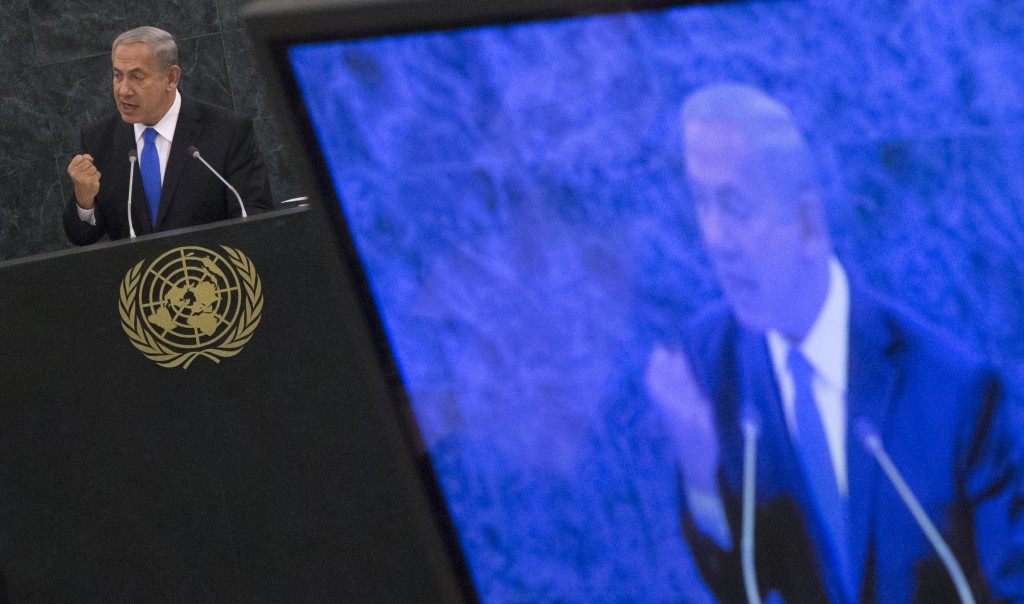
During a diatribe against Iran in his United Nations speech on Monday, Netanyahu asked: “Would you let ISIS enrich uranium? Would you let ISIS build a heavy water reactor? Would you let ISIS develop intercontinental ballistic missiles? Of course you wouldn’t.”

It was almost as if Netanyahu views Iran and ISIS as interchangeable. But the rest of the world doesn’t see it that way — least of all the United States, which is making a crucial last push for a comprehensive agreement with Iran on its nuclear program, even as it musters an international coalition to fight the Islamic State.

In insisting that Iran and ISIS are essentially the same enemy, Netanyahu broadcast his isolation among world leaders and underscored the jadedness of the idea that he has championed for most of his political career: the imminence of an Iranian nuclear bomb and the apocalyptic threat it would pose to the free world.

After all these years, Netanyahu still calls for every nook and cranny of Iran’s nuclear program to be demolished by military force, though preferably not Israel’s alone.

The isolation of his views was evidenced not only by the near-empty General Assembly hall when he gave his speech, but also in the Israeli media.

Although the Islamic Republic of Iran (which Netanyahu persistently, if not naggingly, referred to as “The Islamic State of Iran”) was referenced in Netanyahu’s speech many more times than ISIS, the Israeli media did not follow suit.

They instead focused on Netanyahu’s appeal to “moderate” Arab states to unite against common threats, including militant Islam. A few outlets looked at Netanyahu’s riposte to Palestinian leader Mahmoud Abbas’ charges of genocide. And even the most pro-Netanyahu daily, Yisrael Hayom, led with a headline proclaiming the Israeli Defense Forces to be “the most moral army in the world”– a quote from the speech, but not about the Islamic Republic’s nuclear project.

The Israeli media’s disinterest in Netanyahu’s Iran obsession is matched at home. In poll after poll, Israelis consistently put Iran behind such concerns as street crime and the rising cost of living.

Netanyahu’s fixation on Iran has also deepened divisions between Israel’s political leadership and top military brass. The nadir was reached in 2010, when Netanyahu and then-Defense Minister Ehud Barak ordered the army to stand by for an imminent attack on Iran and the chief of staff refused to comply.

Former Mossad chief Meir Dagan, who related the incident two years later, added that he’d never before seen the entire political leadership adamantly insisting on one course of action and the entire professional military leadership absolutely opposing it.

Four years on, the issue still festers. At the peak of the war in Gaza this summer, analyst Shlomi Eldar accused Netanyahu of all but turning a blind eye to Hamas’ tunnels that formed a pretext for the ground incursion. The reason for this, Eldar charged, was that the prime minister was completely “obsessed” with Iran.

Netanyahu’s absolutist approach to Iran is also straining Israel’s bond with the United States. For all the grandeur, courtesy and genuine complexity that feed into the staple American reference to Israel as an ally, the relationship between the two is, on the strategic level, fundamentally that of a patron power and a client state.

The client retains its value only so long as it aligns itself with the interests of its patron — or at the very least tries not to undermine them. On Iran, however, Netanyahu has repeatedly attempted to dictate to America what its interests should be in trying to hamstring his patron’s push toward a nuclear deal with Iran.

Such an agreement could radically shift the power paradigm in the Middle East toward a more open, less violent and more consensus-based arrangement. Would Israel see itself as a player in this new arrangement or outside it?

Depends on who you ask.

The relative silence of most Israeli institutions on the talks on Iran’s nuclear program suggests they are reluctant to make themselves entirely external to the potential new paradigm. But Netanyahu’s speech — intransigent as it was – indicates that at least one Israeli leader will go down fighting rather than bring Israel on board.

Obama’s Peace Process for Iraq, Syria and the Islamic State begins [Caution: includes satire]

October 2, 2014

Obama’s Peace Process for Iraq, Syria and the Islamic State begins [Caution: includes satire], Dan Miller’s Blog, October 2, 2015

Obama was heard to remark during a recent presidential golf game,

“Israel is a terrorist war criminal. It won’t even yield to my reasonable demands for a two state solution with my beloved Palestinians, whose children and other innocent civilians it relishes murdering. However, Iraq, Syria, ISIL, etc. are humanitarians and will recognize that I am like them, as I lead them to peace through the Light of My true wisdom and greatness.”

FINALLY, He has a plan!

His best plan yet!

Obama functions at His very best with no intelligence. Intelligence would imperil His domestic and foreign priorities and perhaps even His brilliant world view.

I don’t think the problem is Obama’s inattentiveness. It’s not the demands of his golf game. It’s not his incessant fundraising. It’s his worldview. [Not satire.]

(The video is not satire)

The first Peace Process phase

In Iraq and now in Syria, Obama is trying to appear less humanitarian. It’s the initial focus of His Peace Process (PP), through which He plans to arrange a three state solution among the Non-Islamic Islamic State, its cohorts, friends and associates, Iraq and Syria. During His initial PP phase, He intends to gain credibility with and empathy from the Islamic State, et al. Accordingly, He has lifted His rules of engagement, previously intended to minimize civilian casualties, when striking forces of the Islamic State, et al.

The White House revealed on Tuesday that its usually strict rules of engagement, intended to prevent civilian casualties of US airstrikes, have been relaxed in the current offensive against the Islamic State and other radical Islamist groups. [Emphasis added.]

National Security Council spokeswoman Caitlin Hayden told Yahoo News in an email that a much-publicized statement last year by President Barack Obama that US drone strikes would only be carried out if there is a “near certainty” of no civilian injuries would not apply to the US campaign against jihadi forces in Syria and Iraq.

Hayden wrote that the “near certainty” rule was intended “only when we take direct action ‘outside areas of active hostilities,’ as we noted at the time.

“That description — outside areas of active hostilities — simply does not fit what we are seeing on the ground in Iraq and Syria right now,” she continued, but added that the strikes, “like all US military operations, are being conducted consistently with the laws of armed conflict, proportionality and distinction.”

The statement came after reports that a dozen civilians, including women and children, were killed on September 23 after an errant Tomahawk cruise missile hit a house in the village of Kafr Daryan, in Syria’s Idlib province, believed to be a stronghold of al-Qaeda-linked militants. [Emphasis added.]

In a briefing to the House Foreign Affairs Committee last week, Syrian rebel commanders described scenes of devastation as the bodies of women and children were pulled from the beneath the rubble of the destroyed building, which was apparently being used as a shelter for displaced civilians. [Emphasis added.] [Not satire.]

It’s His most clever strategy yet, and only Obama could devise it: by showing the Islamic State, et al, that He agrees with their strategy of maximizing casualties, both combatant and civilian, Obama will easily convince them of the benefits of the true peace and security His PP will provide.

When asked whether, during the next Gazan conflagration, Israel should adopt His modified rules of engagement, Obama was heard to mumble at the 15th hole, “That’s entirely different. Hamas does not threaten My popularity in My country.” State Department spokesperson Jen Psaki hinted at much the same in August:

US State Department Spokesperson Jen Psaki delivered an unusually strong condemnation of an Israeli strike near a Gaza school being used as a shelter in Rafah, saying that the US was “appalled” by the “disgraceful shelling outside an UNRWA school. [Emphasis added.]

The shelling, which left 10 people dead according to Palestinian reports, drew harsh condemnations worldwide, including from the United Nations, London and elsewhere, amid growing international criticism of the 27-day-long operation. [Emphasis added.]

The IDF issued a statement saying that forces had targeted three Palestinian Islamic Jihad terrorists on board a motorcycle in vicinity of an UNRWA school in Rafah, and added that “the IDF is reviewing the consequences of this strike.”

However, the US said that the presence of combatants did not justify targeting areas near the school. [Emphasis added.]

. . . .

Before the reports of the latest strike came in, senior White House adviser and Obama confidant Valerie Jarrett addressed the ongoing violence on CBS’s Face the Nation Sunday morning.

Describing the conflict as “a devastating situation,” Jarrett asserted that “Israel absolutely has the right to defend itself, and we are Israel’s staunchest ally.”

At the same time, she added that “you also can’t condone the killing of all of these innocent children,” referring to the hundreds of civilian casualties reported in Gaza over the course of the past three weeks. [Emphasis added.] [Not satire.]

Neither Psaki nor Jarrett mentioned Obama’s popularity at home expressly. However, increasing civilian (mainly Muslim) casualties in Iraq and Syria, and demanding that Israel do even more to engage in strictly proportionate kinetic actions against Hamas Islamists, are both calculated to increase Obama’s popularity at home. This twofer is consistent with an address prepared for Him by my confidential White House informant, The Really Honorable I.M. Totus:

Israel’s actions have been disgracefully disproportionate and must stop. If they do not cease before I leave for my much needed family vacation at Martha’s Vineyard on August 9th, my red line will have been crossed and upon my return I may issue an Angry Executive Decree chastising Israel. Here is what Israel has done and what it must stop doing:

Israel has used WMDs (Weapons Minimizing Death and Destruction) including “Iron Dome,” warning sirens and shelters to thwart missile attacks. The Palestinians in Gaza have no even remotely comparable WMDs: They have no Iron Domes, their tunnels — clearly dug as air-raid shelters — have been destroyed maliciously and their air-raid sirens often can not be used due to Israel’s inhumane refusal to furnish electricity. They are therefore forced to use civilians, including small children, to guard their missile sites. They do so in the forlorn hope that Israel will take pity on them and refrain from attacking. Merciless Israel continues to attack, wantonly and intentionally wasting the precious lives of many innocent Palestinians. [Emphasis added.] [Satire.]

Second PP phase

Unlike the Obama Nation and its splendid coalition of the unwilling, the Islamic State, et al, have no aircraft. Nor have they any WMDs comparable to the Iron Dome used by wickedly ferocious Israel. Despite that, airstrikes have done little to diminish their effectiveness.

As of Tuesday, the U.S. and its coalition partners had conducted nearly 310 air attacks on Islamic terrorist targets, more than 230 in Iraq and 76 in Syria, a Pentagon spokesman said.

And while the air campaign has forced the terrorists to change their tactics, “We still believe ISIL remains a very potent force,” Admiral John Kirby told reporters on Tuesday. [Emphasis added.]

“Yes, they’ve changed some of their tactics, there’s absolutely no question about that, in response to the pressure that we put them under, but that doesn’t make them less dangerous or less potent over time,” Kirby said. [Emphasis added.] [Not satire.]

Accordingly, during the second phase of His PP strategy, Obama will cease all air strikes. He will also require Iraqi, coalition and any U.S. boots on the ground to use only stolen or abandoned weapons, ammunition and vehicles. As the photo provided below clearly shows, Islamic State, et al, forces have little more than rocks for weapons and that is not fair. Neither is forcing them to steal the few they do have, vigorously punished under Sharia law.

islamic-state-stoning-from-dabiq-magazine-ip_0 (1)

Additionally, all lethal weapons heretofore provided to those fighting disproportionately will now be provided only to the Islamic State, et al. Obama will make it perfectly clear that, in return, non-Islamic freedom fighters must read their rights under Sharia law (to be drafted by Attorney General Holder) to all whom they intend to execute. If convenient, the notification must be read in languages they are believed able to understand.

These steps will level the playing field and help the non-Islamic Islamic State, et al, to understand that Obama is the Messiah of true Peace, Virtue and Understanding based on true Islamic values under Sharia law, as recently articulated in a letter signed by one hundred and twenty-six moderate Islamists (not satire). They may even accept Him as the Mahdi, an honor greater even than His highly regarded and equally well deserved Nobel Peace Prize.

Third PP phase

With the realistic understanding of His life, His universe and everything which Obama will thus give to them, they will follow Him anywhere He may lead, particularly from well behind. They will jump, shout with joy and fire our their rifles into the air when He receives His second Nobel PP prize.

Conclusions

According to Reuters, Obama met with Israeli Prime Minister Netanyahu at the White House on October 1st — the same day that His new rules of engagement increasing civilian casualties in Iraq and Syria were announced.

Even as Netanyahu pressed Obama over Iran in White House talks, the president urged the Israeli leader to help find ways to prevent Palestinian civilian casualties like those inflicted in the recent Gaza war between Israel and Hamas militants.

. . . .

While Netanyahu put the emphasis on Iran, Obama was quick to focus on the bloody 55-day Gaza conflict, which ended in August with no clear victor. This followed the collapse of U.S.-sponsored peace talks between Israel and Palestinians in April. [Not satire]

“Iran? Nukes? What’s wrong with that,” Obama didn’t ask. He probably knows that a nuke deal allowing the Islamic Republic of Iran to get (or to keep) nukes will enhance His popularity ratings if Iran doesn’t actually use them until He leaves office in January of 2017, in accordance with His informal understanding with the Islamic Republic. And to Him, that’s what matters. When He leaves office, anything bad that happens will be somebody else’s fault, as He will be quick to point out.

Anne in PT, my favorite Israeli blogger, wrote a serious article about Obama’s hypocrisy titled Hypocrisy as demonstrated by the White House. She began,

In this post I want to highlight the brazen double standards and utter screaming hypocrisy demonstrated by that ill-mannered hostile man who stands at the head of Israel’s ostensible best friend, America. [Not satire.]

She then does so, clearly and well. I had considered writing a similar article but didn’t have the stomach for it. Therefore, I tried to write this bit of satire instead.

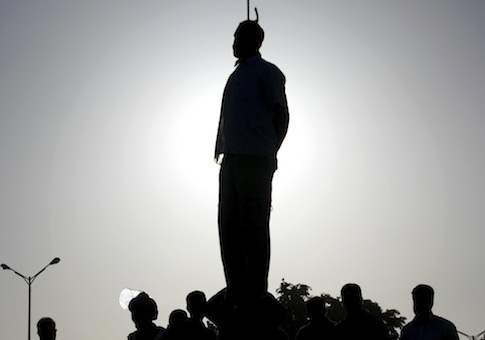
Iranian Doctor Hung for ‘Heresy’ After Eight Years in Prison

October 1, 2014

Iranian Doctor Hung for ‘Heresy’ After Eight Years in Prison, Washington Free Beacon, , October 1, 2014

Executed for making claim that Jonah did not emerge from whale’s belly

Mideast Iran Execution

Iran officially executed 373 people in 2013. But according to Cornell University’s Deathpenaltyworldwide.org database, there were between 624 and 727 last year, up from an estimated 314 to 580 in 2012.

The U.S.-based Iran Human Rights Documentation Centre puts the total number of executions at 531 for this year.

***********************

(Reuters) – A former psychologist has been executed for heresy in Iran after eight years in detention, human rights groups said, in the latest example of what activists say is a worrying rise in the use of death penalty by the Islamic Republic.

Mohsen Amir Aslani was hanged in a prison near the city of Karaj west of Tehran on Sept. 24, according to the Human Rights Activists News Agency (HRANA), which is based outside Iran, for “corruption on earth and heresy in religion”.

Iranian opposition news websites have said Aslani, 37, had given religious classes where he propagated a new interpretation of the Koran. He was also accused by the authorities of insulting the Prophet Jonah.

The Iran Wire website reported that in one of his classes he told his audience that Jonah could not have emerged from the whale’s belly, and it was this statement that led to his charge of insulting the Prophet Jonah.

U.N. Secretary-General Ban Ki-moon has expressed alarm at a reported increase in executions in Iran. Iran has one of the highest levels of executions in the world, second to China, according to Amnesty.

Some human rights activists and others fear that hardliners who oppose pragmatic President Hassan Rouhani and his negotiations with Western powers over the country’s nuclear program are pushing the executions to weaken him.

Iran officially executed 373 people in 2013. But according to Cornell University’s Deathpenaltyworldwide.org database, there were between 624 and 727 last year, up from an estimated 314 to 580 in 2012.

The U.S.-based Iran Human Rights Documentation Centre puts the total number of executions at 531 for this year.

On Thursday, in an open letter to Iran’s Supreme Leader, Ali Khamenei, 18 physics Nobel laureates called for the “immediate and unconditional” release of Iranian physicist and prisoner of conscience, Omid Kokabee, according to a statement by the International Campaign for Human Rights in Iran.

He is suffering serious health problems, according to the campaign.

Kokabee, who was arrested while on a visit to Iran from the United States in 2011 where he was studying, was charged with “communicating with a hostile government,” and receiving “illegitimate funds.”

In an open letter from Evin prison, in April 2013, Kokabee wrote that his imprisonment was the result of his refusal to heed pressure by Iranian intelligence agents to collaborate on a military research project.

Obama’s post-American world is taking shape with the rise of Iran

October 1, 2014

Obama’s post-American world is taking shape with the rise of Iran, Washington Examiner Opinion, Arthur Herman, October 1, 2014

(Iran is a post-mature bastion of human rights and tolerance, cf. “Goodbye, Dear Mum”: Iran Executes Rayhaneh Jabbari — UPDATED. A post-moderate, post-benign country such as Iran would never attack another country and desires only post-peaceful nukes. Right? — DM)

Remarkable is one word for it; obscene might be another. Whatever word you choose, the long-term implications of embracing Iran are nearly all bad for the region and for the United States.

[W]in or lose against the Islamic State, the West’s outreach to Iran only sets the stage for more chaos in the Middle East — and more opportunities for Tehran to extend its power. The irony is that the West has a potential democratic ally in the region, one that really does have a stake in a peaceful, stable Middle East and in defeating terrorism — Israel.

*********************

Anyone wanting to take the moral temperature of the post-American world President Obama wants to create only had to drop by the United Nations last Thursday afternoon.

There he would have seen British prime minister David Cameron sitting down with Iranian President Hassan Rouhani to ask — no, beg him to join the misbegotten coalition Obama has assembled against the Islamic State. Obama and Secretary of State John Kerry had already extended the invitation to Iran to join, and Iran had already refused. Now it was Cameron’s turn.

He may think this will burnish his image as a master diplomat after convincing the Scots not to demand independence. Instead, he’s only opened one more sordid chapter in the most remarkable story of how Iran, a vicious rogue nation and state sponsor of terrorism — not to mention beacon of anti-Semitism — has become the rising dominant power in the region, and is now being blatantly courted as an ally by the West.

Remarkable is one word for it; obscene might be another. Whatever word you choose, the long-term implications of embracing Iran are nearly all bad for the region and for the United States.

Even more strikingly, this change in Iran’s international status comes only two years after the regime in Tehran was reeling from sanctions that had largely cut off its access to Western banks and capital, and above all, Western customers of its oil. Iran’s oil output plummeted by nearly half; gasoline prices in the country soared into the stratosphere while the economy teetered on bankruptcy. The country’s natural gas industry (Iran’s gas reserves are among the biggest in the world) was in an extended state of collapse as Western companies and technicians packed up and left. Even China had agreed to abide by some modified sanctions against Iran, all in order to force the mullahs to halt their illegal nuclear weapons program.

Now today China is importing record amounts of oil from Iran while Western companies are rushing back to its oil and gas fields. Iran is the chief protector and patron of Syria, and also Iraq. Moreover, Iran’s bomb is more on track than ever. Indeed, its uranium enrichment program is close to 70 percent of what’s required — and no one now seriously believes they can be stopped from making a bomb, or putting it on the long-range ballistic missiles they continue to develop.

So what happened? John Kerry’s disastrous deal struck in Geneva last year lifting key sanctions against Iran in exchange for promises to cut back on the enrichment process — a promise premier Hassan Rouhani never intended to keep—is only symptomatic of a much larger delusion. This is that Iran can be persuaded to become a constructive actor in the Middle East if only the United States will offer enough carrots including lifting sanctions, and forswear the sticks, including military strikes against the regime’s nuclear sites.

Many Russian experts had a similar delusion about the Soviet Union during the Cold War; it’s also the one that convinced Neville Chamberlain to sit down with Hitler at Munich. It holds that self-interest will trump ideology; that bad regimes are bad because they’ve been badly treated (Hitler had Versailles to complain about, after all; Tehran has the CIA plot against Prime Minister Mossadegh some sixty years ago) — and that evil ultimately isn’t evil.

Now we know better about Hitler, and about the former Soviet Union. Whether we learn the same about Iran before it’s too late, is going to be the major issue in the Middle East in the next decade — far more than the Islamic State.

In fact, even as the world’s attention has been distracted by the Islamic State, Iranian-backed Shia rebels scored a major victory in Yemen, and now control 17 of the country’s 21 provinces. Soon Tehran’s proxies will be poised on the border of Saudi Arabia, its arch rival for regional dominance. If anything gives Saudi Arabia a signal that it’s time to get its own atomic bomb, it won’t just be whether Iran finishes its enrichment process; it will also be a Yemen firmly in Tehran’s camp, and ready to foment revolt in the kingdom’s Shia provinces.

In short, win or lose against the Islamic State, the West’s outreach to Iran only sets the stage for more chaos in the Middle East — and more opportunities for Tehran to extend its power. The irony is that the West has a potential democratic ally in the region, one that really does have a stake in a peaceful, stable Middle East and in defeating terrorism — Israel.

Nevertheless, this administration and its NATO allies still insist on treating the Jewish state as the pariah, even as they know it will be Iran’s principal target once it gets its nuclear bomb.

The sight of Western leaders kissing the hem of Rouhani’s robe may be sickening, but it’s also understandable. When you lose your moral compass, your self-respect follows. Sadly, it’ll be a long time before the United States will get either one back.

“Goodbye, Dear Mum”: Iran Executes Rayhaneh Jabbari — UPDATED

September 30, 2014

“Goodbye, Dear Mum”: Iran Executes Rayhaneh Jabbari, Jonathan Turley, September 30, 2014

(Update: According to Fox News, her execution has again been postponed — DM)

[E]arly Tuesday, Shole Paravan said she had learned the execution had been postponed. That word came after Paravan and other supporters of Jabbari went to Rajaiy Shahr Prison to protest the pending execution, and after Jabbari’s farewell.

(Please see also Iran’s “Hanging Machine” to Execute Reyhaneh Jabbari. But what the heck; it’s not as though the Islamic Republic of Iran were Islamic or even evil. Just give them (or let them keep) nukes to play with. — DM)

Iran execution

It is another notch in the belt of Iran’s Sharia courts and medieval prison system.

*********************

Over international protests, Iran has reportedly executed Rayhaneh Jabbari, 26. Jabbari claimed that a former Iranian Intelligence Ministry employee tried to rape her and that she stabbed in him the shoulder to escape. Despite the fact that a drink given to her was found to contain a date rape drug, the Iranian officials still wanted her hanged and they have now carried out their intent. As she was being led away to be hanged, a guard showed mercy and gave her his phone to type a final message to her mother. Her reported message below is poignant and tragic as a final goodbye to her mother.

Jabbari wrote:

“I am currently handcuffed and there is a car waiting outside to take me for the execution of the sentence. Goodbye, dear Mum. All of my pains will finish early tomorrow morning. I’m sorry I cannot lessen your pain. Be patient. We believe in life after death. I’ll see you in the next world and I will never leave you again because being separated from you is the most difficult thing to do in the world.”

When her mother called the prison to ask what she could do, they told her to pick up the body of her daughter.

Jabbari was a decorator who said that she was contacted Morteza Abdolali Sarbandi, who arranged a meeting. She said that Sarbandi drugged her and tried to rape her after the two met at a café and she agreed to go to his office to discuss a business deal. She said that Sarbandi took her to a remote building and offered her a fruit drink which was later found to contain the date-rape drug. Her family noted that the wounds from a small pocket knife to the shoulder would not have caused death.

After her arrest, her family said that she was tortured to confess.

It is another notch in the belt of Iran’s Sharia courts and medieval prison system.


Netanyahu tells UN: Israel’s fight is the world’s fight

September 30, 2014