Archive for the ‘Iran’ category

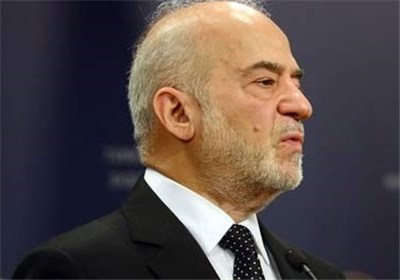
Iraqi FM Deplores US Plan to Deploy Troops to Baghdad

February 13, 2015

Iraqi FM Deplores US Plan to Deploy Troops to Baghdad, Tasnim News Agency (Iran), February 12, 2015

(With Iran in control of both Iranian and Iraqi troops in Iraq, Obama’s recent request for congressional authorization to, maybe someday if he feels like it, deploy more U.S. special forces troops seems not to be welcome. — DM)

139308161844234754028513

During a press conference in the White House on Wednesday, US President Barack Obama said the Washington-led coalition purportedly fighting against the ISIL terrorist group in Iraq and Syria is on the offensive and that he might use US special forces to eliminate the Takfiris.

**************

TEHRAN (Tasnim) – Iraq’s foreign minister lashed out at US plans for the deployment of special forces to his country under the pretext of fighting the ISIL terror group, saying Baghdad has not asked the UN for any such troops.

“The message that Iraq has submitted to the (United Nations) Security Council never included a request for ground forces to enter Iraqi territory to conduct such operations,” Ibrahim al-Jafari told a press conference after meetings with Australian Foreign Minister Julie Bishop on Thursday.

The minister further said that Iraqi armed forces were making gains against the extremist militants on their own and were not in need of more troops, Press TV reported.

“We have established a set of guidelines” for the US-led coalition, including air support for Iraqi forces as well as providing training and intelligence, Jafari said, emphasizing that “no country has regular armies or ground troops present in Iraq except for providing training and counseling.”

Bishop, in turn, said Australia’s role in Iraq was solely restricted to aerial support, training, advice and intelligence, adding, “We have not sought to expand our role to include combat troops.”

During a press conference in the White House on Wednesday, US President Barack Obama said the Washington-led coalition purportedly fighting against the ISIL terrorist group in Iraq and Syria is on the offensive and that he might use US special forces to eliminate the Takfiris.

His remarks came hours after he asked Congress to authorize a three-year war against ISIL “and associated forces.”

Iraq has been facing the growing threat of terrorism, mainly posed by the ISIL terrorist group.

The ISIL militants made swift advances in much of northern and western Iraq over the summer, after capturing large swaths of northern Syria.

Since late September, the US and some of its allies have been conducting airstrikes against the ISIL inside Syria without any authorization from Damascus or a UN mandate.

Meanwhile, a combination of concentrated attacks by the Iraqi military and the popular forces, who rushed to take arms after top Iraqi cleric Ayatollah Ali al-Sistani issued a fatwa calling for fight against the militants, have blunted the edge of the ISIL offensive.

Obama’s foreign policy successes in Yemen

February 11, 2015

(Here are two You Tube videos, posted today, dealing with the evacuation of the U.S. embassy in Yemen and the situation there in general. Please compare and contrast. Obama hasn’t said much recently about his foreign policy successes there. Perhaps, as the State Dept. spokesperson says, the current situation in Yemen has nothing to do with Islam the United States.– DM)

CNN: Iran-Backed Rebels Seized U.S. Military Equipment As Embassy in Yemen Was Abandoned, CNN via You Tube, February 11, 2015


State Dept: U.S. Not ‘Being Run Out of Town’ Despite Abandoning 3rd US Embassy in Middle East, Washington Free Beacon via You Tube, February 11, 2015


4-Star Admiral Slams Obama: Muslim Brotherhood Infiltrated All Of Our National Security Agencies

February 11, 2015

4-Star Admiral Slams Obama: Muslim Brotherhood Infiltrated All Of Our National Security Agencies, You Tube, January 28, 2015

During a press conference on how to combat radical Islamic extremism, Admiral James A. “Ace” Lyons (U.S. Navy, Ret.), former Commander-in-Chief, U.S. Pacific Fleet, stated that under the leadership of Barack Obama the Muslim Brotherhood have infiltrated all of the National Security Agencies of the United States. Furthermore, Lyons said that Obama is deliberately unilaterally disarming the military and spoke to the need for the new GOP controlled congress and Military leaders to stand up to the administration and uphold their oaths.


What’s worse than no strategy?

February 11, 2015

What’s worse than no strategy? Israel Hayom, Clifford D. May, February 11, 2015

It seems like only yesterday that U.S. President Barack Obama was being criticized for having no strategy to ‎counter the jihadi threat. In fact, it was about 10 days ago. Peggy Noonan’s Feb. 1 Wall Street ‎Journal column was headlined: “America’s strategy deficit.”‎

Since then, a different perception has been taking root: Obama does indeed have a strategy — ‎a “secret strategy,” one that is alarmingly misguided. ‎

According to this theory, he believes that fighting terrorism requires accommodating the regime ‎long recognized by the U.S. government as the world’s leading sponsor of terrorism: the Islamic Republic of Iran. ‎

He may also see the Islamic republic not as a rival to the Islamic State group but as a more moderate ‎alternative — despite the fact that Iran’s Supreme Leader Ali Khamenei has repeatedly declared ‎hostility toward America the foundation of the Islamic revolution. ‎

The president appears to believe that Sunni jihadis can be countered by Shia jihadis. Last week, Islamic State demonstrated its barbarism by immolating a Jordanian pilot. That should not ‎cause us to forget that Iran’s rulers supplied militias in Iraq with improvised explosive devices used to immolate ‎American soldiers, are supporting Syrian dictator Bashar Assad who has used chemical ‎weapons to scorch the lungs of his opponents, and are continuing to illicitly develop nuclear ‎weapons capable of immolating millions.‎

Dr. Michael Doran, a senior fellow at the Hudson Institute, has not just speculated about ‎Obama’s “secret strategy.” He has painstakingly combed through the record and produced a ‎‎9,000-word report persuasively establishing that Obama, since early in his presidency, has ‎been in pursuit of a “comprehensive agreement” that would allow Iran to become what the ‎president has called “a very successful regional power.” ‎

Understand what that means: Iran would be the hegemon of the Middle East. Some states would ‎accept Tehran’s authority, striking deals and kowtowing in order to survive. Europeans would ‎accommodate Iran, based on its control of the flow of Gulf oil. Israel and Saudi Arabia, nations ‎that Iran’s rulers have threatened to wipe from the map, would be left to fend for themselves.‎

And some Sunnis would almost certainly turn to al-Qaida and Islamic State to help defend ‎them from Shia domination. Indeed, Islamic State rose in response to the extension of ‎Iranian power in Baghdad after America’s withdrawal from Iraq, coupled with ‎Obama’s decision not to support non-Islamist Syrians who had rebelled against the Assad ‎dictatorship.‎

Doran cites evidence that in the first year of Obama’s first term, there were more ‎White House meetings on Iran than any other national security concern. Detente with Iran was ‎seen as “an urgent priority,” but the president “consistently wrapped his approach to that priority ‎in exceptional layers of secrecy” because he was convinced that neither Congress nor the ‎American public would support him.‎

A year ago, Doran further reports, Benjamin Rhodes, a member of the president’s inner ‎circle, told a group of Democratic activists (unaware that he was being recorded) that a deal with ‎Iran would prove to be “probably the biggest thing President Obama will do in his second term ‎on foreign policy.” He made clear that there would be no treaty requiring the Senate’s advice and ‎consent.‎

The president believes that “the less we know about his Iran plans, the better,” Doran ‎concludes. “Yet those plans, as Rhodes stressed, are not a minor or incidental component of his ‎foreign policy. To the contrary, they are central to his administration’s strategic thinking about ‎the role of the United States in the world, and especially in the Middle East.” ‎

Those plans also explain why the president has refused to use tough sanctions, or even the threat ‎of tough sanctions, to force Supreme Leader Ali Khamenei to choose between his nuclear ‎weapons program and economic collapse. Doran writes, “For Obama, to force a confrontation ‎with Khamenei would destroy any chance of reaching an accommodation on the nuclear front ‎and put paid to his grand vision of a new Middle East order.”‎

Doran’s piece was published in the online journal Mosaic on Feb. 2. Four days later, ‎Obama released his 2015 National Security Strategy. It contained nothing about the ‎‎”secret strategy.” In fact, it contained nothing that could be called a strategy. ‎

That appraisal is widely shared. For example, David Rothkopf — who served in the Clinton ‎administration, “voted for Barack Obama twice” and now edits Foreign Policy magazine — called‎ the National Security Strategy “a brief filed by the president in defense of his record to date” and “a mishmash ‎leavened by good intentions but unintentionally spiced up by oversights, misrepresentations, and ‎a bad track record.” ‎

Last Friday, National Security Adviser Susan Rice reassured an audience at the Brookings ‎Institution that “the dangers we face … are not of the existential nature we confronted during ‎World War II or the Cold War.” But if Iran becomes nuclear-armed, other despotic regimes will ‎follow, greatly increasing the likelihood that terrorists will get their hands on nukes and, sooner ‎or later, use them.‎

Remember that American leaders of both parties similarly minimized the threat posed by al-Qaida prior to Sept. 11, 2001. Is the lesson of that day, as Rice implies, that we should ‎worry only about existential threats — confident that we can absorb lesser doses of death and ‎destruction? Or should we have learned instead to do all we can to prevent our enemies from ‎inflicting such punishment now and in the future?‎

This is a debate worth having. But it will be inhibited so long as the president insists on hiding ‎his views, leaving it to a few exceptional scholars to read between the lines. ‎

Iran’s Moves in the Middle East and Why You Should Care.

February 10, 2015

Iran’s Moves in the Middle East and Why You Should Care, The Watchman via You Tube, February 10, 2015


Egypt Under Al-Sisi: An Interview with Raymond Stock

February 9, 2015

Egypt Under Al-Sisi: An Interview with Raymond Stock, Middle East Forum, February 8, 2015

by Jerry Gordon
The New English Review
February 2015

The introduction to this interview has been abridged.

To discuss Egypt’s prospects under the Abdel Fattah al-Sisi government, we invited back Dr. Raymond Stock whom we had interviewed in November 2012. (See: No Blinders About Egypt Under Muslim Brotherhood ). Stock is a Shillman/Ginsburg Writing Fellow at the Middle East Forum and a former Assistant Professor of Arabic and Middle East Studies at Drew University. He spent twenty years in Egypt and was deported by the Mubarak regime in 2010. He is writing a biography of 1988 Egyptian Nobel laureate in literature Naguib Mahfouz (1911-2006) for Farrar, Straus and Giroux and is a prolific translator of his works.

……………………..

“[The Muslim Brotherhood] has deeply bonded with the highest levels of the Obama administration, which uncritically backed its creation of an elected, one-party dictatorship under Morsi.

“Unlike Morsi and the MB, who worked covertly with the terrorists in Sinai, al-Sisi wholeheartedly supports the peace with Israel.”

Egypt is now in an informal alliance with Israel, the United Arab Emirates and Bahrain to confront Iran. That alliance is compromised, however, by recent moves from Egypt’s Gulf partners to mend fences with Iran as a result of their feeling exposed by Washington’s alarming pivot toward Tehran at the expense of its traditional Sunni clients.

“Obama’s leftist, rather Edward-Saidian worldview … sees indigenous anti-Western forces such as the Islamists to be the benignly natural and legitimate consequence of American and European policies during the colonial era and the Cold War.”


********************

Jerry Gordon: Ray Stock thank you for consenting to this interview.

Raymond Stock: Thank you for inviting me back.

Jerry Gordon: Egyptian President al-Sisi started 2015 with two dramatic moves- his New Year’s speech at al-Azhar University and Christmas greetings at a Coptic church with Pope Tawadros II present. What were the messages he conveyed to Muslim clerics, Coptic Christians and the world?

Raymond Stock: At al-Azhar, President al-Sisi was saying it is not merely an extremist interpretation of Islam that is threatening the world with global jihad, but ideas that are at the core of the mainstream, orthodox understanding of the religion–and that this would require a “religious revolution” to change.

At the Coptic Cathedral, he urged Egyptians not to define themselves by their religion, be it Christian or Muslim, but by the fact that they are Egyptians–a rejection of Islamism, which defines national identity in purely religious terms.

To the world, he was saying that Islam as it is being taught and practiced by its leading religious scholars has given birth to a globally destructive ideology which is now threatening us all.

Moreover, he wants to launch a movement within Islam to save the religion from itself, that is, before it tears itself apart completely and the rest of the world destroys it in self-defense.

And he challenged the clerics to take the lead in that effort by openly re-examining their own teachings and source materials for interpreting Islam.

Gordon: Al-Sisi has cracked down on press freedoms in Egypt and brought to trial three Al Jazeera correspondents. What in your view prompted that?

Stock: Though no libertarian, it is hard to say if al-Sisi himself has had anything to do directly with the suppression of press freedom, though it is happening on his watch. Going back to Pharaonic times, Egypt’s state institutions, the oldest in the world, and its political culture, have little tradition of respecting civil liberties. Some periods have been worse than others–the worst was actually under Gamal Abdel-Nasser in the 1950s and ’60s, when many thousands of political prisoners were sent “behind the sun” to camps in the Western Desert.

Al-Sisi is still so popular, the public so widely disgusted with the unending social and political chaos since the 2011 revolution, and so alarmed by the terrorist insurgency waged by the Islamists, that probably a majority of news editors and perhaps also of reporters have decided to support him completely and to oppose his critics automatically. At this point it is hard to find any clear connection with al-Sisi himself to this consensus, enshrined in a declaration by several hundred key media figures a few months ago. However, certainly if he didn’t like it he could well speak up against it–yet he hasn’t so far.
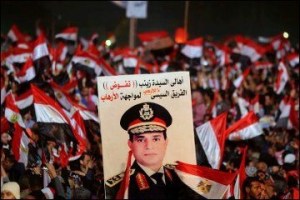
948Pro-Sisi demonstrators celebrate the third anniversary of Mubarak’s overthrow, January 2014.

Last summer he publicly regretted the imprisonment of the three Al Jazeera journalists, saying he wished they had been deported instead. Citing his belief in an independent judiciary, he refused to intervene in the legal process. Now that they are being retried after winning on appeal, we’ll see if he pardons and deports them should they be convicted again.

Gordon: Following, al-Sisi’s ouster of President Morsi and crackdown on Muslim Brotherhood leaders, what has happened to the movement in Egypt?

Stock: Though deservedly banned as a terrorist group, its top leaders in jail and the rest driven underground or abroad, it is far from dead and remains a threat to the Egyptian state and society. Its refusal to accept the June 30 popular revolution (far larger than the one that overthrew Mubarak), parental bonds to Hamas, financial support from Qatar and wealthy Gulf donors (and possibly Iran), partnership with the Salafis and ideological affinity and outreach to groups like al-Qa’ida and Islamic Jihad have served it well in retaining its base while gaining sympathy–especially internationally.

Though all these factors–plus its horrendous behavior in power–have greatly alienated the majority of Egyptians, they are for the most part also its greatest assets for the future, if they can only survive the current storm. As they have shown in several major periods of repression in the past–the most severe being under Abdel-Nasser–they only need to endure until there is successor to al-Sisi, who may decide to restore the MB to political legitimacy as a means of fighting al-Sisi’s remaining political allies. (Anwar al-Sadat, for example, freed the MB activists from prison to combat the surviving members of Abdel-Nasser’s coterie.) Such a situation could put them in striking distance of taking power again.

Meanwhile, the MB has global headquarters in Istanbul and London, is very influential in Europe, and has enormously increased its penetration at the federal, state and local levels all over the US. As part of this, it has deeply bonded with the highest levels of the Obama administration, which uncritically backed its creation of an elected, one-party dictatorship under Morsi. Obama evidently seeks to help the MB to return to power in Egypt—as shown, for example, by the State Department’s recent hosting of a conference of MB allies at Foggy Bottom, though it may take a while. Al-Sisi probably only has a year or two to turn the economy around before he risks another uprising.

The goal of the terrorist insurgency is to discourage foreign investment and stifle the stimulus provided by major government projects such as the new second channel to the Suez Canal to aid the recovery from the last four years of chaos. This, they hope, will pave the way for new popular upheaval which they hope to manipulate if not lead.

Gordon: Has the Islamic State supplanted the Salafist and Muslim Brotherhood movements?

Stock: In a sense, yes, but the situation is actually quite complex. Ideologically, IS—like al-Qa’ida–is an extension of the Salafist movement and the MB (itself established as a Salafi organization in the Salafi library in Ismailiya, Egypt in 1928). IS, because of its uncompromising Islamist purity, harshness, brutality and its dramatic seizure of so much territory in Iraq and Syria, coupled with its incredibly savvy use of social media, has largely eclipsed all of its predecessors in recruitment of fighters to the Middle East. It also outpaced all of them in its creation of lone wolves and sleeper cells in Europe, America and elsewhere.
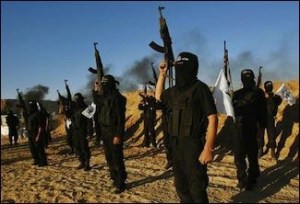
949Ansar Bayt al-Maqdis pledged allegiance to the Islamic State (IS) group last year.

That includes Egypt, where the MB-and-AQ aligned Ansar Bayt al-Maqdis (ABM) organization is responsible for most of the attacks in the country over the past two years. ABM, along with its allies controls much of North Sinai and has declared its allegiance to IS. The MB, as noted, still retains a very strong base, as does the Salafi al-Nour Party which has pragmatically allied itself with Al-Sisi. The appeal of IS may frustrate their ability to draw younger members–yet it is far from clear that IS will do any better in the long run. So have many of the Islamists in Libya, the eastern half of which IS now controls, and may soon run Tripoli as well. The stunning success of IS provides further inspiration to groups like Boko Haram, which has overrun much of northeastern Nigeria and has recently spread into Cameroon, as well as al-Shabaab in Somalia. IS also now has a presence in southern Afghanistan and beyond. Unless it is destroyed militarily in the very near future–which is virtually impossible so long as Obama is President–IS threatens every state with a significant Muslim population, as well as the West, which is its ultimate target.

Gordon: Al-Sisi has propounded a doctrine of stability for Egypt. What is it and has he succeeded since his election?

Stock: I would say that if al-Sisi truly has established such a doctrine for stability, it would consist of the following:

    1. Anti-Islamism—i.e. a more limited role for Shariah (which is nonetheless still enshrined in the new constitution, yet no longer to be interpreted by the clerics at al-Azhar, but by the government, whose authority and much of its outlook is secular, not religious;
    2. Electoral democracy though with somewhat limited civil liberties, to satisfy both the demand for popular sovereignty and for an end to the endless chaos–strikes and demonstrations (and skyrocketing crime) since the fall of Mubarak in 2011, and to limit the public role of the Islamists, who are at war with Egypt; and
    3. An independent foreign policy—one that still seeks to maintain the traditional alliance with the U.S. and the West, but is not afraid to go elsewhere as needed.

Obama’s backing of the Islamists and his cutting of aid for the past two years have driven al-Sisi to radically diversity Egypt’s sources of funding and investment from abroad, including for the first time military aid. For more than three decades, Egypt’s military assistance came almost exclusively from Washington, though that is now being surpassed by multi-billion dollar arms deals from Moscow and even to an extent from Beijing, funded by al-Sisi’s backers in the Gulf. That puts the Egyptian-American alliance and its principal benefits—the more than thirty-five year peace with Israel, our priority access to the Suez Canal (now being expanded with a second channel but without US investment), and vital cooperation on security issues—seriously at risk.

Gordon: Some analysts have said that in the wake of the Arab Spring the old order of regional autocracies has re-emerged in an alliance against the Muslim Brotherhood. What is your view and especially in the case of Egypt’s North African neighborhood?

Stock: That depends on the country: in North Africa, King Mohammed VI is still in power, but the Muslim Brotherhood has won more seats than the other parties in parliament, a situation echoing that in Jordan, though it is less precarious at present. Algeria, still recovering from the savage Islamist bloodbath after the Army’s annulment of elections in January 1992, was least affected of all the states in the region by the Arab Spring. (Perhaps the only major result there was the lifting of the State of Emergency that had prevailed for nearly two decades, in February 2011.) Tunisia, where the Arab Spring began in December 2010, threw out its MB-affiliate controlled government in a popular movement backed by the army—in a situation that rather echoed the one in Egypt, and late last year elected a new secularist plurality in parliament and a new secularist president, Béji Caїd Essebsi.

In Libya, the feeble central government that we helped install by foolishly removing the vicious, eccentric but cooperative Col. Mu’ammar al-Qaddafi has predictably collapsed. Yet a new secularist-dominated government was elected last June 25 and a pro-secularist remnant of the Qaddafi era, General Khalifa Haftar, for the past year has been at war with the Islamist militias that have been the real powers since 2011. Haftar also wants to destroy the Libyan iteration of the Muslim Brotherhood, root and branch, especially after it launched an armed uprising in eastern Libya following Morsi’s ouster in Egypt in 2013. As a result of this chaos, generated by our own needless—or at least, badly botched–intervention in the Arab Spring, the U.S. now has no effective presence in Libya. The security vacuum prompted Egypt and the United Arab Emirates to cooperate in launching air strikes near Tripoli last summer in support of Haftar’s forces. IS and other Islamist organizations are now infiltrating weapons and fighters into Egypt from Libya, threatening the country’s—and the region’s—stability.

In the Eastern Arab world, Egypt’s principal allies now are Saudi Arabia and the UAE, who together immediately pledged 12 billion dollars in aid after Morsi’s removal, and have given billions more since. All of it and more is desperately needed to compensate for the depletion of Egypt’s hard currency reserves, loss of foreign investment and near-destruction of the once lucrative tourist industry that have all continued since the January 25th Revolution against Hosni Mubarak. Both the Saudis and the Emiratis oppose the MB and Hamas, who—along with Egypt under Morsi—are clients of their Gulf rival, Qatar. America’s annual, mainly military package of $1.5 billion seems trifling in comparison (unless viewed cumulatively since it began in 1979). Still, it will be difficult to switch to mainly Russian or Chinese systems–much as the latter may be based on hacked American designs–after so many years of absorbing Yankee equipment and training.

Gordon: What is the emerging change in Egypt’s relations with Israel, both geo-political and economic?

Stock: Unlike Morsi and the MB, who worked covertly with the terrorists in Sinai, al-Sisi wholeheartedly supports the peace with Israel. He has greatly increased security cooperation with the Jewish state—which had been endangered in the 2011-12 transition and during the Morsi era—to levels exceeding those under Mubarak. Again, even more than Mubarak, who loathed them too, al-Sisi sees the MB, Hamas and their Islamist allies as threats to Egypt as well as Israel. Likewise, he sees Iran—with whom Morsi sought a rapprochement—as Egypt’s greatest strategic adversary in the region.

As a result, Egypt is now in an informal alliance with Israel, the United Arab Emirates and Bahrain to confront Iran. That alliance is compromised, however, by recent moves from Egypt’s Gulf partners to mend fences with Iran as a result of their feeling exposed by Washington’s alarming pivot toward Tehran at the expense of its traditional Sunni clients.

Meanwhile, though overall Israel-Egypt trade remains minimal (as it had through the decades of cold peace under Mubarak and afterward), energy-strapped Egypt may soon be importing natural gas from Israel’s newly-developed Tamar Reservoir in the Mediterranean. Given that Israel used to import natural gas from Egypt via a pipeline shared with Jordan (repeatedly sabotaged physically as well as assailed legally in Egypt since the fall of Mubarak), that is a remarkable turnaround indeed.

Gordon: What triggered Qatar’s re-opening of relations with Egypt despite the former’s support of Hamas and the Brotherhood?

Stock: The main factor was probably al-Sisi’s logical desire to stay in step with the policy of Egypt’s current primary foreign donors and investors, the Arab states in the Persian Gulf. After freezing relations with Qatar due to its support for Hamas and the MB, and perhaps also AQ and IS (the latter only early on?), and the universal irritant of Doha-based Al Jazeera, the members of the Gulf Cooperation Council (GCC), especially Saudi Arabia and the United Arab Emirates, decided last summer to repair the rift, apparently in face of the increasing U.S. tilt toward Iran. The U.S. tried to bypass al-Sisi by turning to Qatar and Turkey—both of whom Cairo had shunned for their support of Islamists and their criticism of Morsi’s ouster—as intermediaries with Hamas in the Gaza conflict last summer.

Ironically, that move may have done more to damage relations with Washington than with either Doha or Ankara, who probably could not be totally excluded in any case, given their closeness to Hamas. Yet those two regional rival countries’ desire to cut out Cairo, the historic mediator between the Palestinians, Israel and the West, did aggravate the Egyptians enormously, to be sure.

Qatar has taken some token steps to distance itself from the MB, like deporting several MB leaders who had taken refuge there. But Qatar apparently continues to finance them in their new home in London, and few believe the change is more than cosmetic. Thus the warming with Egypt and even within the GCC may not long endure.

Gordon: Why has the US Administration maintained an arm’s length relationship with al-Sisi subsequent to the ouster of Morsi?

Stock: It is no doubt due to Obama’s leftist, rather Edward-Saidian worldview, which sees indigenous anti-Western forces such as the Islamists to be the benignly natural and legitimate consequence of American and European policies during the colonial era and the Cold War—for which he has apologized repeatedly. He also has a positive, nostalgic view of Islam, given that he was born of a Muslim father and having apparently been raised as one by his step-father during his early childhood in Indonesia, and seems to project this image onto radical groups like the MB who cleverly pose as moderates. He is thus surrounded by numerous pro-Islamist advisers, as well as those who simply take a naïve view of groups like the MB, Hamas and Hizbollah–and even the Taliban (not a new position, but one now getting attention in the news).

It also means that he denies the common Islamist ideology of all those groups as well as AQ and IS, or even any connection of their beliefs to Islam. This, despite their being made up entirely of Muslims, that they base their ideology and tactics on the Qur’an, Hadith and other key Islamic texts, and that they have a very wide appeal in the global Islamic community. This is even more bizarre if you compare his statements and those of his aides about this question to those of al-Sisi—a Muslim leader of a majority Muslim country—at the seat of Sunni Islam’s highest authority, al-Azhar, on New Year’s Day. One of them, Obama, is willfully blind; the other, al-Sisi, with devastating clarity, identifies the problem as coming from within the very heart of Islam.

On a personal level, Obama does not take kindly to those who cross him. Just look at his relationship with Congress, and with Benjamin Netanyahu, while ignoring his own transgressions against those he thinks are transgressing against him. He regarded al-Sisi’s patriotic overthrow of Morsi–whom he had bolstered with more and more aid even as the MB leader became more and dictatorial–at the demand of more than twice as many Egyptians as those who voted for Morsi, as a personal affront as well as ideological heresy. He has since punished al-Sisi and the Egyptian people who rejected his chosen savior of their destiny accordingly. That may have softened a bit recently, due to the need to find Arab allies to fight IS, but that is not a serious effort: the default position is against al-Sisi and for the MB.

Gordon: Given your Egyptian sojourn does al-Sisi have both the domestic and international support to implement his agenda?

Stock: Domestic, yes—all but a quarter to a third of the country wants him to succeed. But internationally is another story. Al-Sisi’s greatest enemy is not the MB, or even IS, but the president of the United States. When the State Department invited key figures from the pro-MB alliance of groups to a major conference in Washington this week, he was signaling his desire (and only Obama sets our foreign policy) to overthrow al-Sisi—just as his invitation to the leaders from the banned MB to sit in the front row of his Cairo speech in 2009 signaled that he wanted to remove Mubarak. So U.S.-dependent international institutions and allies may not be too supportive of al-Sisi.

The only possible silver lining for Egypt is, ironically (given our historic alliance), really a great problem for our country, if one values its role of global leadership since World War II. That is, Obama has done so much to destroy America’s standing with the rest of the world that even our closest allies no longer fear to stray, and may yet not follow his wishes regarding al-Sisi. Tragically, on many issues, that may be better for us all until Obama leaves office. For the heading he has set leads directly to hell, a destination that many countries, thanks to in large part to his policies, have already seen (and Syria and Libya have already become)–good intentions (by his lights) notwithstanding.

Gordon: Dr. Stock many thanks for this highly informative interview.

Stock: You’re most welcome.
Kerry: No Extension of Extension of Iran Nuclear Talks, Maybe

February 9, 2015

Kerry: No Extension of Extension of Iran Nuclear Talks, Maybe, Front Page Magazine, Daniel Greenfield, February 9, 2015

john-kerry-283x350

Absolutely not. Unless maybe the talks that are going nowhere, except to an Iranian nuclear bomb, seem really promising.

MUNICH — Secretary of State John F. Kerry said in an interview broadcast Sunday that it would be “impossible” to extend nuclear negotiations with Iran if an agreement on fundamental principles is not reached in the coming weeks.

Munich, how appropriate. Also that extension might still be possible if that agreement is reached.

Using more categorical language than he has employed previously, Kerry definitively precluded a third extension to talks with Iran about reducing its ability to make a nuclear bomb or easing sanctions.

That’s right. No third extension of talks… unless an agreement on principles is reached. Then we can extend it until Iran goes nuclear.

Except Iran isn’t in favor of that either.

Khamenei seems to oppose a procedure already agreed to by the two sides, which is to conclude an understanding of general principles by March 24 and to finalize details of a deal by the end of June. “If an agreement is reached,” he said, “it must be concluded in one go and must encompass both general principles and details.”

So much for that. The negotiations can’t agree on the principles.

In November, when no deal could be struck by a self-imposed deadline, a temporary agreement, which had been in place for a year and had been extended once before, was pushed to late June. Kerry said at the time that the major points of agreement would have to be reached by late March.

So Kerry is desperately and clumsily trying to pressure the Iranians to agree to Obama’s sellout. Unfortunately for him, the Iranians know that he can rolled like an empty barrel, so they’re pushing even harder.

It’s a game of chicken in which Iran isn’t worried while Obama needs some kind of signature on a piece of paper to shut up senators from both parties.

“But if we’re not able to make the fundamental decisions that have to be made over the course of the next weeks, literally, I think it would be impossible to extend,” Kerry said. “I don’t think we would want to extend at that point. Either you make the decisions to prove your program is a peaceful one, or if you’re unable to do that, it may tell a story that none of us want to hear.”

Smart power. Notice how many ways Kerry backtracks a simple statement. When he says, “a story that none of us want to hear”, he’s talking about his administration’s denial. Iran has no problem talking about destroying Israel.

Kerry just refuses to hear it.

Qatar, Egypt on a collision course

February 9, 2015

Qatar, Egypt on a collision course, Israel Hayom, Dr. Reuven Berko, February 9, 2015

This anti-Egypt agenda, which seems to be shared by Turkey, is fueled by the desire to realize the dream of installing a Sunni Islamic empire, all while undermining moderate Arab regimes and giving a nod to Iran, as a way of covering all bases — just in case.

******************

Qatar and Egypt are at odds, and the attempts by the late King Abdullah of Saudi Arabia to facilitate a reconciliation between them have failed.

Qatar’s relentless efforts to overthrow Egyptian President Abdel-Fattah el-Sissi’s regime and reinstate the Muslim Brotherhood to power are evident from the programs airing on the Doha-controlled Al-Jazeera television network, and from the publication of doctored wiretaps featuring the Egyptian president and his advisers, who allegedly “stole” Egypt away from the Muslim Brotherhood and the “holy” Mohammed Morsi.

This anti-Egypt agenda, which seems to be shared by Turkey, is fueled by the desire to realize the dream of installing a Sunni Islamic empire, all while undermining moderate Arab regimes and giving a nod to Iran, as a way of covering all bases — just in case.

Egypt’s decision to outlaw the Muslim Brotherhood has resulted in increased incitement by Qatar as well as in an escalation in terrorist attacks in Egypt and Sinai. Egyptian intelligence has linked the latest series of attacks to Ansar Beit al-Maqdis, an offshoot of the Islamic State group, as well as to Hamas’ Izzedine al-Qassam Brigades. Hamas and the Izzedine al-Qassam Brigades are very much Qatar’s “babies,” and their involvement in these terrorist attacks has prompted Egypt to outlaw both.

In response, Al-Jazeera has begun portraying Izzedine al-Qassam Brigades’ operatives, who have denounced Sissi as a traitor to Islam and Arabs everywhere, as heroes fighting for the liberation of “Palestine.” The Qatari television station has also been obsessively covering the riots and unrest instigated by the Muslim Brotherhood to undermine the regime, intimidate foreign investors, and reverse the image of stability Sissi’s government is trying to convey to the world.

The airing of secret wiretaps, on which Sissi is heard mocking the wealthy Persian Gulf states, at this time seeks to pit Cairo against the Gulf states, ahead of the World Economic Forum on the Middle East, which is scheduled to convene in Sharm el-Sheikh, in Egypt, in late February, and where Egypt will lobby for aid.

Sissi’s assertion about the current situation in the Middle East is correct: Sunni Arab states are being offered as sacrifice to Iran, which is pursuing its nuclear endeavors uninterrupted. These states understand that Egypt’s stability is a prerequisite for their own national security, and therefore aiding Cairo is a favor that could only work to their advantage.

At the end of the day, in a reality where Iran poses an existential threat to other Arab countries, pointing to the emir of Qatar as a leader drowning in gold while millions of Egyptians go hungry — as heard on the wiretaps — may prove to be a double-edged sword, which may end up striking Qatar itself.

Houthi Yemen coup moves Iran’s Middle East hegemonic ambitions forward – upheld by Washington

February 9, 2015

Houthi Yemen coup moves Iran’s Middle East hegemonic ambitions forward – upheld by Washington, DEBKAfile, February 8, 2015

Houthi_fighters_downtown_Sanaa_5.2.15Victorious Houthi fighters in downtown Sanaa

It is hard for those governments to make up their minds where to look for the most acute menace to their national security – the US-Iranian nuclear deal taking shape, or the give-and-take between Washington and Tehran in Yemen and Iraq. 

******************

The strings of the pro-Iranian Houthi rebels’ coup which toppled the Yemeni government in Sanaa were pulled from Tehran and Washington. US intelligence and shared US-Iranian support helped the Houthis reach their goal, which is confined for now to parts of central Yemen and all of the North.

Friday, Feb. 6, the rebels dissolved parliament and seized power in the country of 24 million. They propose to rule by a revolutionary council. President Abed Rabbo Mansour Hadi and his cabinet who were forced to resign last month are under house arrest.

DEBKAfile’s Saudi intelligence sources reveal that the dominant figure of the uprising was none other than Ali Abdullah Saleh, president of Yemen from 1990 until he was ousted in 2012.

A member of the Zaydi branch of Shiite Islam like the Houthis, he led them to power with the same enthusiasm with which he fought their insurgency during his years in power. By rallying his supporters in the army, intelligence and security services, he enabled the rebels to take over these departments of government and overpower the Hadi regime with only minimal resistance.

They were also able to commandeer $400 million worth of modern American munitions.

The Houthis secretly call themselves “Ansar Allah” and have adopted the “Death to America, Death to Israel” slogans routinely heard in government-sponsored parades and demonstrations on the streets and squares of revolutionary Tehran.

Amid the political turmoil in Sanaa, the US Sunday resumed drone strikes against AQAP.

The six Arab countries of the Gulf Cooperation Council, led by Sunni-ruled Saudi Arabia and the United Arab Emirates, issued a statement Saturday, Feb. 7, calling for the UN Security Council to “put an end to this coup, an escalation that cannot be accepted under any circumstances.”

The Iranian-US gambit has resulted in different parts of Yemen falling under the sway of two anti-American radical forces – the pro-Tehran Houthis and Al Qaeda in the Arabian Peninsula (AQAP).

The new Saudi King Salman starts his reign with a double-barreled threat facing the kingdom from its southern neighbor, Yemen – posed by an Iranian pawn and a proactive branch of Al Qaeda.

Ten days ago, when US President Barack Obama visited Riyadh, the Saudi monarch voiced his concern about the alarming situation developing Yemen. However, Obama replied noncommittally with general remarks.

In Washington, administration spokesmen Saturday tried pouring oil on the troubled waters roiled by US support for the Iranian maneuver in Sanaa and the return of Abdullah Saleh to the Yemeni scene.

“We’re talking with everybody,” one US official said, explaining that the United States was ready to talk to any Yemeni factions willing to fight Al Qaeda.

His colleagues tried to downplay Tehran’s hand in the Houthi coup. “The Houthis get support from Iran, but they’re not controlled by Iran,” said another official in Washington.

Our military and intelligence sources report that Yemen is not the only Middle East platform of the joint US-Iranian military, intelligence and strategic performance. The second act is unfolding in Iraq.

Saudi Arabia, the Gulf emirates, Jordan and Israel are therefore watching the evolving US-Iranian cooperation in fighting al Qaeda’s various affiliates in the region with deep forebodings, lest it is merely a façade for the Obama administration’s espousal of Tehran’s regional ambitions.

It is hard for those governments to make up their minds where to look for the most acute menace to their national security – the US-Iranian nuclear deal taking shape, or the give-and-take between Washington and Tehran in Yemen and Iraq.

What Is the Islamic State Trying to Accomplish?

February 7, 2015

What Is the Islamic State Trying to Accomplish? National Review on line, Andrew C. McCarthy, February 7, 2015

(As soon as Obama defeats climate change, he may begin to focus on other less important problems.  — DM)

pic_giant_020715_SM_ISIS-Fighter(Image: ISIS video)

The Islamic State and al-Qaeda are our problem.

*********************

The Islamic State’s barbaric murder of Lieutenant Mouath al-Kasaebeh, the Jordanian air-force pilot the jihadists captured late last year, has naturally given rise to questions about the group’s objectives. Charles Krauthammer argues (here and here) that the Islamic State is trying to draw Jordan into a land war in Syria. It is no doubt correct that the terrorist group would like to destabilize Jordan — indeed, it is destabilizing Jordan. Its immediate aim, however, is more modest and attainable. The Islamic State wants to break up President Obama’s much trumpeted Islamic-American coalition.

As the administration proudly announced back in September, Jordan joined the U.S. coalition, along with the United Arab Emirates, Saudi Arabia, Bahrain, and Qatar. The only potential value of the coalition is symbolic: It has enabled the president to claim that Muslim countries were lining up with us against the Islamic State. Militarily, the coalition is of little use. These countries cannot defeat the Islamic State.

Moreover, even the symbolism is insignificant. Symbolism, after all, cuts both ways. As I pointed out when the administration breathlessly announced the coalition, our five Islamic partners have only been willing to conduct (extremely limited) aerial operations against the Islamic State. They would not attack al-Qaeda targets — i.e., the strongholds of al-Nusra (the local al-Qaeda franchise) and “Khorasan” (an al-Qaeda advisory council that operates within al-Nusra in Syria).

Obviously, if the relevance of the five Islamic countries’ willingness to fight the Islamic State is the implication that the Islamic State is not really Islamic, then their unwillingness to fight al-Qaeda equally implies their assessment that al-Qaeda is representative of Islam. The latter implication no doubt explains why the Saudis, Qatar, and the UAE have given so much funding over the years to al-Qaeda . . . the terror network from which the Islamic State originates and with which the Islamic State shares its sharia-supremacist ideology.

I’ll give the Saudis this: They don’t burn their prisoners alive in a cage. As previously recounted here, though, they routinely behead their prisoners. In fact, here’s another report from the British press just three weeks ago:

Authorities in Saudi Arabia have publicly beheaded a woman in Islam’s holy city of Mecca. . . . Laila Bint Abdul Muttalib Basim, a Burmese woman who resided in Saudi Arabia, was executed by sword on Monday after being dragged through the street and held down by four police officers.

She was convicted of the sexual abuse and murder of her seven-year-old step-daughter.

A video showed how it took three blows to complete the execution, while the woman screamed “I did not kill. I did not kill.” It has now been removed by YouTube as part of its policy on “shocking and disgusting content”.

There are two ways to behead people according to Mohammed al-Saeedi, a human rights activist: “One way is to inject the prisoner with painkillers to numb the pain and the other is without the painkiller. . . . This woman was beheaded without painkillers — they wanted to make the pain more powerful for her.”

The Saudi Ministry of the Interior said in a statement that it believed the sentence was warranted due to the severity of the crime.

The beheading is part of an alarming trend, which has seen the kingdom execute seven people in the first two weeks of this year. In 2014 the number of executions rose to 87, from 78 in 2013.

Would that the president of the United States were more worried about the security of the United States than about how people in such repulsive countries perceive the United States.

In any event, the Islamic State is simply trying to blow up the coalition, which would be a useful propaganda victory. And the strategy is working. It appears at this point that only Jordan is participating in the airstrikes. While all eyes were on Jordan this week for a reaction to Lieutenant al-Kasaebeh’s immolation, the administration has quietly conceded that the UAEsuspended its participation in bombing missions when the pilot was captured in December.

The explanation for this is obvious: The Islamic countries in the coalition know they can’t stop the Islamic State unless the United States joins the fight in earnest, and they know this president is not serious. The White House says the coalition has carried out a total of about 1,000 airstrikes in the last five months. In Desert Storm, we did 1,100 a day.

Seven strikes a day is not going to accomplish anything, especially with no troops on the ground, and thus no search-and-rescue capability in the event planes go down, as Lieutenant al-Kasaebeh’s did. With no prospect of winning, and with a high potential of losing pilots and agitating the rambunctious Islamists in their own populations, why would these countries continue to participate?

The Islamic State knows there is intense opposition to King Abdullah’s decision to join in the coalition. While the Islamic State’s sadistic method of killing the pilot has the king and his supporters talking tough about retaliation, millions of Jordanians are Islamist in orientation and thousands have crossed into Syria and Iraq to fight for the Islamic State and al-Qaeda. There will continue to be pressure on Jordan to withdraw. Without a real American commitment to the fight, this pressure will get harder for Abdullah to resist.

Jordan has no intention of getting into a land war the king knows he cannot win without U.S. forces leading the way. But the Islamic State does not need to lure Jordan into a land war in order to destabilize the country — it is already doing plenty of that by intensifying the Syrian refugee crisis, sending Jordanians back home from Syria as trained jihadists, and trying to assassinate Abdullah.

I will close by repeating the larger point I’ve argued several times before. We know from experience that when jihadists have safe havens, they attack the United States. They now have more safe havens than they’ve ever had before — not just because of what the Islamic State has accomplished in what used to be Syria and Iraq (the map of the Middle East needs updating) but because of what al-Qaeda has done there and in North Africa, what the Taliban and al-Qaeda are doing in Afghanistan, and so on.

If we understand, as we by now should, what these safe havens portend, then we must grasp that the Islamic State, al-Qaeda, and the global jihad constitute a threat to American national security. That they also (and more immediately) threaten Arab Islamic countries is true, but it is not close to being our top concern. Ensuring our security is a concern that could not be responsibly delegated to other countries even if they had formidable armed forces — which the “coalition” countries do not.

The Islamic State and al-Qaeda are our problem.