U.S.: Strategic Objectives in the Middle East, Gatestone Institute, Peter Huessy, June 22, 2017
On relations with the Palestinian Authority, the administration has moved to improve matters but has not moved to advocate a two-state solution — for which there is no contemplated security framework sufficient to protect Israel.
****************************
The new “test” of our alliance will be whether the assembled nations will join in removing the hateful parts of such a doctrine from their communities.
What still has to be considered is the U.S. approach to stopping Iran from filling the vacuum created by ridding the region of the Islamic State (ISIS), as well as Iran’s push for extending its path straight through to the Mediterranean.
The tectonic plates in the Middle East have shifted markedly with President Trump’s trip to Saudi Arabia and Israel, and his announced new regional policy.
The trip represented the beginning of a major but necessary shift in US security policy.
For much of the last nearly half-century, American Middle East policy has been centered on the “peace process” and how to bring Israel and the Palestinians to agreement on a “two-state” solution for two peoples — a phrase that Palestinian Authority President Mahmoud Abbas refuses to say.
First was shuttle diplomacy during 1973-74 in the Nixon administration; then second, in 1978, the Camp David agreement and the recognition of Israel by Egypt, made palatable by $7 billion in new annual US assistance to the two nations; third, the anti-Hizballah doctrine, recently accurately described by National Security Advisor General H.R. McMaster, as Iran, since 1983, started spreading its terror to Lebanon and elsewhere in the region. This last effort was often excused by many American and European analysts as a result somehow, of supposed American bad faith. Fourth, came the birth, in 1992, of the “Oslo Accords” where some Israelis and Palestinians imagined that a two-state solution was just another round of negotiations away.
Ironically, during the decade after Oslo, little peace was achieved; instead, terror expanded dramatically. The Palestinians launched three wars, “Intifadas,” against Israel; Al Qaeda launched its terror attacks on U.S. Embassies in Africa; and Iran, Hizballah, and Al Qaeda together carried out the forerunner attacks against America of 9/11/2001.
Since 9/11, despite wars in Afghanistan and Iraq, terrorism has not only failed to recede; on the contrary, it has expanded. Iran has become the world’s biggest state sponsor of terrorism, and the Islamic State (ISIS) has tried to establish a transnational “Islamic caliphate.” Literally tens of thousands of terror attacks have been carried out since 9/11 by those claiming an Islamic duty to do so. These assaults on Western civilization have taken place on bridges, cafes, night clubs, offices, military recruitment centers, theaters, markets, and sporting events — not only across the West but also in countries where Muslims have often been the primary victims.
Particularly condemnable have been the improvised explosive device (IED) attacks against U.S. soldiers in Iraq and Afghanistan, perpetrated to a great extent by Iran, according to U.S. military testimony before Congress.
All the while, we in the West keep trying to convince ourselves that, as a former American president thought, if there were a peace deal between Israel and the Palestinian Authority, most of the terrorist attacks we see in Europe and the United States “would disappear.”
No matter how hard we may rhetorically push the “peace process”, there is no arc of history that bends naturally in that direction. Rather, nations such as the United States together with its allies must create those alliances best able to meet the challenges to peace and especially defeat the totalitarian elements at the core of Islamist ideology.
If anything, the so-called Middle East “peace process” has undercut chances of achieving a sound U.S. security policy. While the search for a solution to the Israel-Palestinian “problem” dominated American thinking about Middle East peace for so many decades, other far more serious threats materialized but were often ignored, not the least of which was the rise of Iran as the world’s most aggressive terrorist.
The United States has now moved in a markedly more promising and thoughtful direction.
The new American administration has put together an emerging coalition of nations led by the United States that seeks five objectives:
(1) the defeat of Islamic State;
(2) the formation of a coalition of the major Arab nations, especially Egypt and the Kingdom of Saudi Arabia, to clean up in their own back yards financing terrorism and providing terrorists with sanctuary. As Elliott Abrams, an adviser to former U.S. President George W. Bush, cautions us, however, this will not be an easy effort: “Partnerships with repressive regimes may in some cases exacerbate rather than solve the problem for us” but, Abrams says, “gradual reform is exactly the right approach…”;
3) “driving out” sharia-inspired violence and human rights abuses from the region’s mosques and madrassas;
(4) a joint partnership with Israel as part of an emerging anti-Iran coalition — without letting relations with the Palestinian authority derail United States and Israeli security interests; and
(5) the adoption of a strategy directly to challenge Iran’s quest for regional and Islamic hegemony, while ending its role in terrorism.
Defeating Islamic State
Defeating ISIS began with an accelerated military campaign and a new American-led strategy to destroy the organization rather than to seek its containment. According to the new U.S. Secretary of Defense, James Mattis, “Our intention is that the foreign fighters do not survive the fight to return home to North Africa, to Europe, to America, to Asia. We’re going to stop them there and take apart the caliphate.”
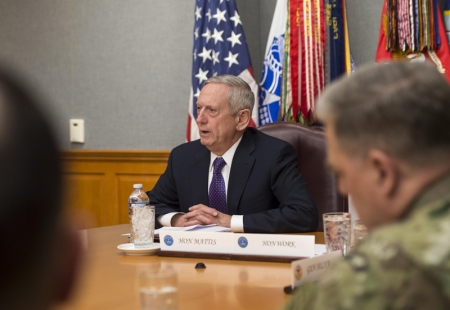 Secretary of Defense James Mattis. (Dept. of Defense/Brigitte N. Brantley)
So far, the United States coalition has driven ISIS from 55,000 square kilometers of territory in Iraq and Syria.
A New Coalition
Apart from a strategy to counter ISIS, the Trump administration also called on our allies in the Middle East to put together a new joint multi-state effort to stop financing terrorism. Leading the multi-state effort will be the Kingdom of Saudi Arabia and the United States, which together will supposedly open a new center dedicated to the elimination of terrorist financing. Positive results are not guaranteed, but it is a step in the right direction.
According to Abdul Hadi Habtoor, the center will exchange information about financing networks, adopt means to cut off funding from terrorist groups, and hopefully blacklist Iran’s jihadist army, the Islamic Revolutionary Guard Corps (IRGC). These measures in turn will help eliminate the sanctuaries from which terrorists plot and plan.
This move also places emphasis on the responsibility of states to eliminate terrorism. As President Trump said, each country — where it is sovereign — has to “carry the weight of their own self-defense“, be “pro-active” and responsible for “eradicating terrorism”, and “to deny all territory to the foot soldiers of evil”.
This determination was underscored by many Arab countries breaking diplomatic relations with Qatar for its support of Iran, the Muslim Brotherhood and ISIS. Most of Qatar’s Arab neighbors, including the Saudis, Egypt, and the UAE did so, while the US, although denouncing Qatar’s support of terrorism, continues to maintain access to, and use of, its critical military base there.
In short, the U.S. is playing good-cop, bad-cop in the region, while U.S. allies are putting together what Josh Rogin of the Washington Post described as “a regional security architecture encompassing countries on the periphery of Iran.”
Such an approach is not without risk: Turkey, allied with Iran and Qatar, has already has pledged to help Qatar defy the Gulf States’ trade cut-off. If Turkey, for example, seeks to move its promised aid shipments to Qatar through the Suez Canal, the ships could possibly be blocked by Egypt or attacked on the high seas. Does the U.S. then come to the assistance of a NATO member — Turkey — against an ally in the strategic coalition?
Drive Hateful Ideology Out
A companion challenge by the new American President underscored this new security effort. President Trump said to the assembled nations of the Islamic conference that they have to expel the ugly Islamist ideology from the mosques and madrassas that recruit terrorists and justify their actions.
Trump said: “Drive them out of your places of worship”. Such words had never been spoken so clearly by an American president, especially to the collection of nearly all the Islamic-majority countries (minus the Shi’ite bloc) gathered together.
The president’s audience doubtless understood that he was speaking of the doctrine of sharia (Islamic law). The new “test” of our alliance will be whether the assembled nations will join in removing the hateful parts of the doctrine from their communities. It was a sharp but critical departure from the previous American administration’s message in Cairo in 2009, and placed the Islamic doctrine that seeks to establish the sharia throughout the world in a contained context.
New Israeli Partnership
With Israel, the administration has cemented the next part of its strategy. Here the Trump administration successfully improved our political and military relations with Israel. Markedly so. One part of that effort was enhanced missile-defense cooperation called for in the FY18 United States defense budget, specifically to deal with Iranian and Iranian-allied missile threats.
On relations with the Palestinian Authority, the administration has moved to improve matters but has not moved to advocate a two-state solution — for which there is no contemplated security framework sufficient to protect Israel.
Challenge and Roll Back Iran
The final part of the administration’s strategy starts with a thorough review of our Iran strategy and the Joint Comprehensive Plan of Action (JCPOA), or “nuclear deal”, with Iran. As Max Singer recently wrote, even if we discount what secretive nuclear capability Iran may now have, the Iranian regime will at the very least be much closer to producing nuclear weapons down the road than when the JCPOA was agreed to.
As Ambassador John Bolton has warned the nuclear deal with Iran did nothing to restrain Iranian harmful behavior: “Defiant missile launches… support for the genocidal Assad regime… backing of then Houthi insurgency in Yemen… worldwide support for terrorism… and commitment to the annihilation of Israel” continue.
In addition, uranium enrichment, heavy water production, the concealed military dimensions of warhead development and joint missile and nuclear work with North Korea all lend a critical urgency to countering Iran’s lethal efforts. The United States did not make these counter-efforts any easier by providing to Tehran $100 billion in escrowed Iranian funds, equivalent to nearly one quarter of the Islamic Republic’s annual GDP.
The United States’ and Europe’s easing of sanctions on Iran has helped reintegrate Iran into global markets via mechanisms such as the electronic payment system run by the Society for Worldwide Interbank Financial Telecommunications (SWIFT). That, in turn, has helped Iran expand dramatically its military modernization budget by 33%, including deals worth tens of billions of dollars in military hardware with China and Russia.
Added to that is Iranian financial- and weapons-support for foreign fighters in Syria, Iraq, Yemen, Lebanon and Afghanistan. Iran’s significant support to the Houthi rebels in Yemen includes weaponry, financing and logistical support, including advanced offensive missiles. The Houthis regularly attempt to carry out missile attacks against Saudi oil facilities.
Such Iran activity is described by the Commander of U.S. Central Command, General Joseph Votel, as “the most significant threat to the Central Region and to our national interests and the interest of our partners and allies”.
As such, it can only be challenged through exactly the kind of military, political, and economic coalition the Trump administration is seeking to band together, which would include the Gulf Arab nations, especially Saudi Arabia, as well as Egypt, Jordan, and Israel.
The administration’s five-step strategy has a chance to work. It creates a policy to destroy ISIS; oppose Islamic terrorism and specifically the imposition of sharia; adopt measures to go after the financing of such terrorism; implement improvements in Gulf allies’ military capabilities — including missile defenses — parallel with pushing NATO members to meet their military spending obligations; put back into place a sound and cooperative relationship with Israel; and specifically contain and roll back Iranian hegemonic ambitions and its terror-master ways.
What still has to be considered, however, is the U.S. approach to stopping Iran from filling the vacuum created by ridding the region of ISIS, as well as Iran’s push for extending its path straight through to the Mediterranean.
If successful, some modicum of peace may be brought to the Middle East. And the arc of history will have finally been shaped toward America’s interests and those of its allies, rather than — however inadvertently — toward its mortal enemies.
Dr. Peter Huessy is President of GeoStrategic Analysis, a defense consulting firm he founded in 1981, and was the senior defense consultant at the National Defense University Foundation for more than 20 years.




 anneinpt
 artaxes
 danmillerinpanama
 davidking1530
 Peter Hofman
 Joseph Wouk
 Peter
Peter Louisiana Steve
 WarSclerotic
Recent Comments