Archive for the ‘Iran Sucks’ category

The Hydra has Many Heads

July 15, 2015

Nuke Deal Helps Qasem Soleimani, The Top Iranian General With ‘American Blood on His Hands’

by Shane Harris 14 Jul 2015 Via The Daily Beast


Stay scared my friends.[Source: AP]

(A lot of wounded Marines would love to even the score with this snake. – LS)

John Kerry denied it. So did Iran’s foreign minister. But the world’s most notorious spymaster stands to benefit—big time—from the accord with Tehran.

Among the big winners in the agreement to curtail Iran’s nuclear program, count a notorious and shadowy Iranian general who helped Shiite militias in Iraq kill American soldiers and who has come to the rescue of Syrian dictator Bashar al-Assad.

You’ll find his name, Qasem Soleimani, buried in an annex (PDF) of the unremittingly dense Joint Comprehensive Plan of Action, along with some of his colleagues from the senior ranks of the Iranian Revolutionary Guard Corps, as well as its various divisions and corporate fronts. They’ll all be granted some sanctions relief as part of the U.S.-brokered deal to curtail Iran’s development of a nuclear weapon.

That Soleimani—who runs Iran’s elite paramilitary and covert operations group, the Quds Force—was even on the list appeared to catch some U.S. officials by surprise. A senior administration official briefing reporters on Tuesday morning didn’t have a ready response when asked when and why Soleimani was added. Secretary of State John Kerry reportedly denied that the 58-year-old general was on the list to be freed from the sanctions yoke. Iranian foreign minister Javad Zarif, agreed, saying Soleimani—whom the U.S. accused in 2011 of plotting to launch a terrorist attack in the United States—had been confused with someone else with a similar name.

They were all wrong—or maybe didn’t want to be right. Soleimani is, in fact, on the list, a Treasury Department official later confirmed to The Daily Beast. And his presence definitely surprised some powerful lawmakers, who are already sharpening their knives for a filleting of the Iran deal.

“He’s got American blood on his hands,” Sen. John Cornyn said of Soleimani. “I’m not sympathetic to lifting sanctions on him, that’s for sure.”

“Soleimani is the guy that sent the copper-tipped IEDs into Iraq,” said Senate Armed Services Committee Chairman John McCain, referring to powerful improvised explosive devices, which Marine Corps Commandant Gen. Joseph Dunford testified last week were responsible for the deaths of 500 soldiers and Marines. “That is really unbelievable,” McCain said when asked about Soleimani’s name showing up in the bowels of the Iran nuclear deal.

And Soleimani is not alone. The man whom retired general and ex-CIA director David Petraeus once called “truly evil” is joined in the get-out-of-sancitons club by other military officers, including a Revolutionary Guard Corps general, Mohammad Reza Naqdi, who said that “erasing Israel off the map” should still be Iran’s objective, even if the country’s isn’t allowed to build a nuke.

Joining him are Brigadier General Mostafa Mohammad Najjar, a former interior minister and minister of defense who also advocated attacking Israel; Brigadier General Mohammad Naderi, who runs Iran’s Aerospace Industries Organization (also getting sanctions relief); and Brigadier General Hossein Salami, who said Iran’s quest for modern weapons was guided not by military strategy, but by religion.

There are plenty more where they came from. But why bother counting? The entire Quds Force, the Revolutionary Guard’s Air Force, and the Al-Ghadir Missile Command are also getting sanctions relief in the years to come—presuming that Iran hasn’t reneged on its commitments by then or a future U.S. president hasn’t tried to roll back the deal, as Republican contenders Scott Walker, Marco Rubio, and Rick Perry have all said they’d do if elected.

This international rogues gallery of spies, soldiers, and anti-Semites were thrown into the deal like ingredients in a stew. Who put them there is still unclear. But Kerry’s apparent misunderstanding aside, U.S. officials would have negotiated every name on the list, making it almost impossible that Soleimani was snuck in by surprise.

There are hundreds of companies, government entities, and individuals slated to get sanctions relief. “Presumably, in the beginning, the Iranians put a list across the table and said, ‘We want these people off the sanctions list,’” Zachary Goldman, a former senior official in the Treasury Department’s Office of Terrorism and Financial Intelligence, told The Daily Beast.

Goldman, who helped develop Iran sanctions policy, said that an array of U.S. government departments review such proposals, just as they do when deciding whether to impose sanctions. Obama administration officials were certainly aware of who was on the final list of the Iran agreement, Goldman added.

Sanctions relief is the very heart of the nuclear deal, but you need a panel of experts to explain how it works. Annex II, and its corresponding “attachments,” describe the international choreography by which Iran submits to a series of inspections of its nuclear facilities by United Nations experts and, in return, the United States and the European Union lift one set of sanctions after another.

There are two “phases” in which sanctions are removed. The first should come relatively soon—probably in the next few months—after Iran makes good on its commitments and the inspectors give the thumbs up. Then the Europeans and the Americans lift a raft of sanctions, mostly on companies that have had some connection to Iran’s nuclear weapons program.

Next comes phase two. That’s much later—as many as eight years from now. And this is the round where Soleimani and his IRGC buddies finally get their big day. But only the Europeans will be helping them out.

Why? The Obama administration has opted only to lift only nuclear-related sanctions, because, it says, the Iran deal is strictly limited to the country’s nuclear program, not its status as a leading sponsor of global terrorism or its abysmal human rights record. Granting concessions to Soleimani, who is accused of helping to kill American soldiers, propping up a brutal dictator who gassed his own people, and conspiring to blow up a Saudi Arabian official in a popular Washington, DC, restaurant frequented by U.S. politicians, would eviscerate the Obama administration’s entire premise in the Iran negotiations.

Why the Europeans felt fine giving Soleimani a hand is still unclear. But even those who will be unshackled from U.S. sanctions are hardly free of terrorist ties. “Some of them are also involved in terrorist activities or human rights abuses, and yet they’ve only been hit for their proliferation activities,” Matthew Levitt, the Director of the Stein Program on Counterterrorism and Intelligence at the Washington Institute, told The Daily Beast. Like them, Soleimani will have his reward, regardless of who’s giving it to him. He and his fellow generals “will almost definitely be able to open bank accounts in Europe,” Levitt noted.

Plenty of financial penalties will remain in place. But Obama officials are sensitive to any lightening of Soleimani’s load.

“His designation under U.S. sanctions will in no way be impacted by the Joint Comprehensive Plan of Action reached today,” the Treasury Official said. She added that “secondary sanctions remain in place on the U.S. side,” which means that anyone or any company doing business with Soleimani can also be penalized.

Even if sanctions aren’t lifted on Soleimani and the Iranian military establishment right away, however, they will undoubtedly reap some short-term benefit. Iran has billions in frozen assets that, once thawed, the regime could pour into military adventures and terrorist plots.

“We are of course aware and concerned that, despite the massive domestic spending needs facing Iran, some of the resulting sanctions relief could be used by Iran to fund destabilizing actions,” a State Department official recently told The Daily Beast.

Such is the price of a deal. Whether the United States comes to regret paying it, we’ll find out. Maybe in eight years.
Iran Is Responsible for More Than 1,000 American Military Deaths Since 9/11

July 14, 2015

Iran Is Responsible for More Than 1,000 American Military Deaths Since 9-11

by David French July 14, 2015 12:26 PM Via The National Review


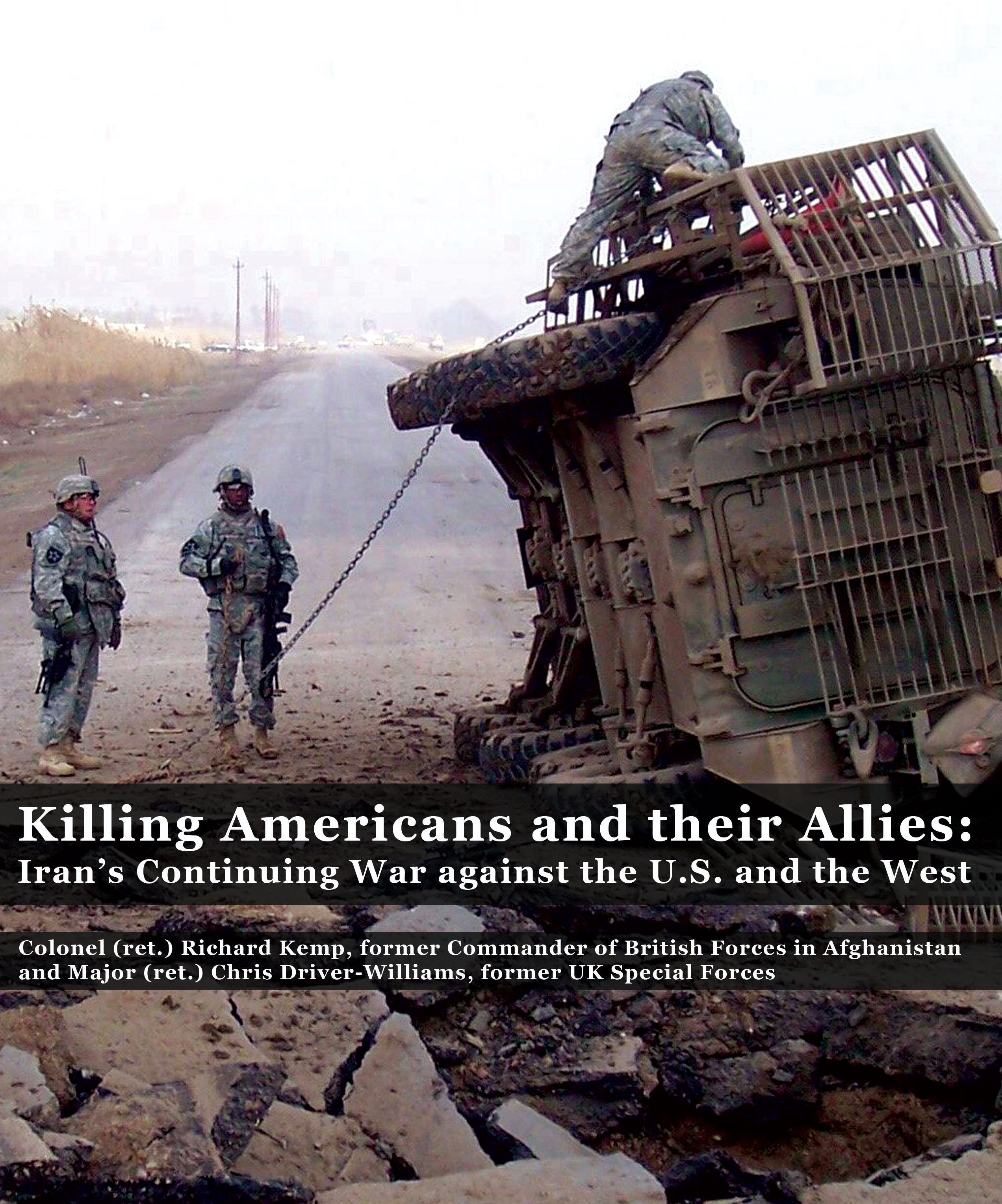
Killing Americans and Their Allies [Source: Jerusalem Center for Public Affairs]

(I encourage you to follow the link in this overview and take a look at the report. – LS)

I’m going to say more about the Iran deal in a piece that will go up shortly on the homepage, but I wanted to highlight this report, by Colonel (ret.) Richard Kemp and Major (ret.) Chris Driver-Williams, that comprehensively outlines Iran’s acts of war against the United States. Some lowlights:

Iranian military action, often working through proxies using terrorist tactics, has led to the deaths of well over a thousand American soldiers in Iraq and Afghanistan over the last decade and a half. Throughout the course of the Iraq campaign, a variety of weapons flowed into the country through direct purchases by the government of Iran. These included Explosively Formed Penetrators (EFPs), a shaped charge designed to penetrate armor. These weapons – often camouflaged as rocks – were identical to those employed by Hizbullah against Israeli forces. In 2006, the British Telegraph revealed that three Iranian factories were “mass producing” the roadside EFP bombs used to kill soldiers in Iraq . . . Iran paid Taliban fighters $1,000 for each U.S. soldier they killed in Afghanistan. The Sunday Times reported that a Taliban operative received $18,000 from an Iranian firm in Kabul as reward for an attack in 2010 that killed several Afghan government troops and destroyed an American armored vehicle.

The Obama administration’s nuclear agreement is nothing more than a stimulus package for jihad. Billions of dollars will flow into the world’s worst terror-exporting country — a sworn enemy of the United States — and it will soon enough even have (legal) access to international conventional-arms markets. It can continue to export terror and even kill American soldiers without breaching the nuclear agreement. Until Iran stops trying to kill Americans and stops imprisoning Americans (including Saeed Abedini, a pastor prosecuted merely because of his Christian faith), how can any rational person trust its good faith?

YOU CAN READ THE REPORT AT: http://jcpa.org/killing-americans-allies-irans-war/

Michael Oren: Why Israel Won’t Be Celebrating the Iran Deal

July 14, 2015

Michael Oren: Why Israel Won’t Be Celebrating the Iran Deal

Michael B. Oren 7:28 AM ET Via Time 7-14-2015


[Source: Wikipedia]

(Sounding the alarm. Anyone listening? – LS)

The present deal with Iran poses a threat not only to Israel, but to the U.S. and the world

In Israel, one of the world’s rowdiest democracies, politicians rarely agree on anything. Which is why their reaction to the nuclear arms deal with Iran is so unique. For the first time in living memory, virtually all Israelis – left, right, religious, secular, Arabs, Jews – are together calling the deal disastrous.

The reasons might not be clear to many readers of the agreement. According to preliminary reports, its 100 pages contain bewilderingly complex provisions for supposedly delaying Iran from making a bomb. There are international inspections of the Iranians’ nuclear facilities but none that would actually catch them off guard. There are limits to the number of centrifuges with which Iran can enrich uranium to weapons grade, but only for a decade during which not a single centrifuge will be dismantled. And Iran can continue to research and develop more advanced technologies capable of producing nuclear weapons even faster. Most mystifying still, the deal recognizes Iran’s right to peaceful nuclear power without demanding that Iran cease promoting war throughout the Middle East and terror worldwide.

For Israelis, though, there is nothing mystifying about this picture. We see an Iranian regime that will deceive inspectors and, in the end, achieve military nuclear capabilities. We see an Iranian nuclear program that, while perhaps temporarily curtailed, will remain capable of eventually producing hundreds of nuclear weapons.

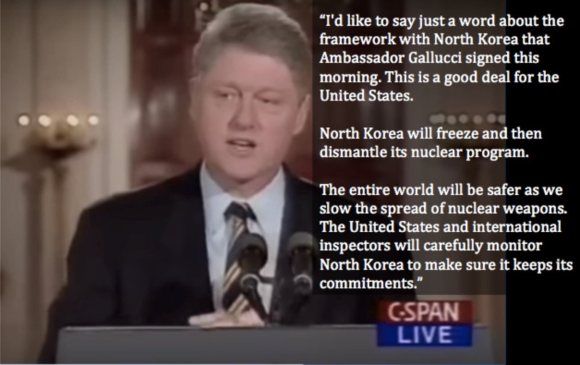
This is a picture that we’ve all seen before. Back in 1994, American negotiators promised a “good deal” with North Korea. Its nuclear plants were supposed to be frozen and dismantled. International inspectors would “carefully monitor” North Korea’s compliance with the agreement and ensure the country’s return to the “community of nations.” The world, we were told, would be a safer place.

It wasn’t. North Korea never forfeited its nuclear plants and the inspections proved useless. The community of nations is threatened by North Korean atomic bombs and the world is anything but safe. And yet, against all logic, a very similar deal has been signed with Iran.

And Iran is not North Korea. It’s far worse. Pyonyang’s dictators never plotted terrorist attacks across five continents and in thirty cities, including Washington, D.C. Tehran’s Ayatollahs did. North Korea is not actively undermining pro-Western governments in its region or planting agents in South America. Iran is. And North Korea – unlike Iran – did not kill many hundreds of U.S. soldiers in Iraq.

So why, then, are only Israelis united in opposing this deal? The answer is that we have the most to lose, at least in the short run. We know that the deal allows Iran to break out and create nuclear bombs in as little as three months, too quickly for the world to react. We know that the Ayatollahs, who have secretly constructed fortified nuclear facilities that have no peaceful purpose and have violated all of their international commitments, will break this deal in steps too small to precipitate a powerful global response. And we know that the sanctions, once lifted, cannot be swiftly revived, and that hundreds of billions of dollars Iran will soon receive will not be spent on better roads and schools. That treasure will fund the shedding of blood – of Israelis but also of many others.

Israelis know that, while the world might weather its deception by North Korea, they cannot afford to be duped by Iran. But neither, in fact, can the United States. Just last week, Iran’s President attended a rally in Tehran where tens of thousands of protesters chanted “Death to America.” The deal will better enable them to carry out that attack – if not today, then against future generations. And Iran’s Supreme Leader has publicly pledged to do just that.

The planned celebrations in Tehran and Iranian declarations of victory contrast starkly with the gloom hanging today over almost all Israelis. We believe that with stronger sanctions and tougher demands, a better deal is still possible. But we also understand that the present deal poses grave dangers not only to us, but ultimately to America and the world.

(UPDATE: Thought I’d throw this in for good measure. – LS):

Clinton

Iran Fails to Receive Miss Congeniality Award

June 18, 2015

Iran’s Global Image Mostly Negative

Jun 18, 2015, 2:26 PM ET By Hani Zainulbhai and Richard Wike Via Pew Research Center


Oh well, there’s always rugby. (photo credit: AP)

(I have a feeling the ‘Most Likely to Succeed’ award will go to someone else as well. – LS)


views of iranAs the June 30 deadline for negotiations over its nuclear program approaches, a new Pew Research Center poll finds that attitudes toward Iran are mostly negative worldwide. Majorities or pluralities in 31 of 40 countries surveyed hold an unfavorable opinion of the Islamic Republic. And in several Muslim-majority countries in the Middle East and Asia, ratings have declined considerably in recent years.

June also marks the second anniversary of the election of Iranian President Hassan Rouhani, who generally receives low marks across the Middle Eastern nations polled.

These are among the key findings of a new survey by the Pew Research Center conducted in 40 countries among 45,435 respondents from March 25 to May 27, 2015.

Low Marks for Iran in Middle East, Other Regions

Iran is viewed negatively by most nations surveyed, with a global median of 58% saying they have an unfavorable opinion of the country that borders Afghanistan in the east and Iraq in the west. Pakistan is the only country polled where a majority (57%) views Iran favorably.

In the Middle East, roughly nine-in-ten Israelis (92%) hold a negative opinion of Iran, including nearly all Israeli Jews (97%) and more than six-in-ten Israeli Arabs (63%).

Attitudes are nearly as negative in Jordan, where 89% have an unfavorable view of Iran. Smaller majorities of Turks, Lebanese and Palestinians also give their regional neighbor low marks. Meanwhile, in Lebanon attitudes divide along religious lines. More than nine-in-ten Lebanese Shia Muslims (95%) express a positive opinion of Iran — the country with the world’s largest Shia Muslim population — compared with 29% of Lebanese Christians and just 5% of Sunni Muslims.

With the exception of Pakistan, publics in the Asia-Pacific region are either mixed or negative in their assessments of Iran. Unfavorable views of the Islamic Republic are especially widespread in Japan and Australia (73% and 67%, respectively). Even in Pakistan, opinion of Iran has somewhat soured, with negative ratings increasing from 8% to 16% over the past year.

Iran’s image also suffers in Latin America, where a median of 61% across six countries express unfavorable views. Publics in Africa, while negative on balance, are more mixed in their assessments of Iran. A median of 39% in nine African nations surveyed view Iran in a negative light, 32% view the nation positively, and a quarter do not offer any opinion. In Nigeria, attitudes differ among the predominant religious groups: 43% of Muslims express favorable views of Iran while only 23% of Christians hold that view.

Amidst the negotiations over the future of Tehran’s nuclear program, publics in the so-called “P5+1” countries are generally critical of Iran. Roughly three-quarters of Americans (76%) view Iran unfavorably, virtually unchanged from last year. Majorities in France (81%), Germany (78%), the UK (62%) and China (61%) share this opinion. Only in Russia do about a third (34%) rate Iran positively, and even here the prevailing view is negative (44%).

Declining Ratings for Iran in Muslim-Majority Nations

views of iranPerhaps influenced by political and sectarian tensions in the Middle East, favorable views of majority-Shia Iran have declined precipitously in some Muslim-majority countries over the last decade.

Since 2006-2007, favorable ratings of Iran have dropped by 41 percentage points each in Indonesia and Jordan. Turkish public opinion has also deteriorated significantly (-36 points) over the same period. Sizable declines in Iran’s standing are also evident in Malaysia (-22), the Palestinian territories (-21) and Pakistan (-15). In Lebanon, opinions of Iran have remained relatively stable – 41% currently express a positive view, similar to the 36% registered in 2007. Over the last eight years, however, the percentage of Lebanese Shia who have a very favorable opinion of the Persian nation has increased significantly, rising from 47% to 80%.

Little Support for Rouhani in Middle East

views of rouhaniAs is the case with his country as a whole, Iranian President Hassan Rouhani receives generally poor marks among neighboring publics in the Middle East, with half or more in each country surveyed viewing him unfavorably. In Lebanon, views divide along religious lines: 95% of Lebanese Shia have a positive opinion of Rouhani, compared with a quarter of Christians and roughly one-in-ten Sunnis (11%). Since his first year in office, the Iranian president’s favorable ratings have slightly increased in the Palestinian territories (+10 percentage points) and Jordan (+8).