Rpt: U.S. Preparing New Sanctions On Iran After Rocket Test – America’s Newsroom, Fox News via You Tube, December 31, 2015
(Please see also, Possible New US Sanctions against Iran “Illegal”, Says Spokesman. — DM)
Rpt: U.S. Preparing New Sanctions On Iran After Rocket Test – America’s Newsroom, Fox News via You Tube, December 31, 2015
(Please see also, Possible New US Sanctions against Iran “Illegal”, Says Spokesman. — DM)
Possible New US Sanctions against Iran “Illegal”, Says Spokesman, Tasnim News Agency, December 31, 2015

TEHRAN (Tasnim) – Iranian Foreign Ministry Spokesman Hossein Jaberi Ansari on Thursday lashed out at the new sanctions the US administration is preparing to impose on Iran, saying Tehran has already warned Washington against such unilateral and illegal moves.
“Such measures are unilateral, arbitrary, and illegal, and the Islamic Republic of Iran has already warned the US administration (against such moves),” Jaberi Ansari stressed.
He made the remarks in reaction to recent reports that the Obama administration is preparing to impose its first financial sanctions on Iran since Tehran and six world powers, including the US, reached a landmark nuclear agreement in July.
“As they themselves have already announced, Iran’s missile program has nothing to do with the JCPOA (the nuclear deal), and nothing could deprive the Islamic Republic of Iran from its legitimate and legal rights to reinforce its defense power and national security,” he asserted.
Therefore, Jaberi Ansari went on to say, Iran will maintain its attempts to improve its defense power in reaction to any US interference against the Islamic Republic’s defense programs.
Iran in October successfully test-fired a homegrown ballistic missile dubbed ‘Emad’, a long-range guided projectile that can hit targets with high precision.
Using the missile test as a pretext, US officials announced on Wednesday that the Treasury Department will put in the blacklist nearly a dozen companies and individuals in Iran, Hong Kong and the United Arab Emirates for their alleged role in developing Iran’s ballistic-missile program.
Tehran has denied that the missile launch was in violation of UN resolutions, with Foreign Minister Mohammad Javad Zarif saying that it was not designed to carry nuclear warheads.
Iran’s test of missiles is an issue relating to defense of its territorial integrity and has nothing to do with the comprehensive nuclear deal between Tehran and world powers or with a subsequent resolution the UNSC passed to endorse the accord, Iran’s foreign minister underscored in October.
Reassuring, not challenging, Iran, Israel Hayom, Elliott Abrams, December 25, 2015
Since the signing of the nuclear deal with Islamic Republic of Iran, that government has treated the Obama administration with contempt. U.S. officials might have hoped Iran’s conduct would improve, but it has worsened. Iran sent more Revolutionary Guard troops to fight in Syria, for example; it conducted two ballistic missile tests in violation of a Security Council resolution; leaders continue to chant “Death to America”; and it has imprisoned more Americans.
What is the Obama administration’s response? To beg their pardon.
I refer to a remarkable letter sent by Secretary of State John Kerry to Iranian Foreign Minister Mohammad Javad Zarif. Iran, in an additional gesture of contempt, has complained about new United States visa requirements placed on persons who have traveled to Iran (or Iraq, Sudan, or Syria). These requirements were recently added so that people who had visited those countries could not come to the United States without getting a visa even if they were from countries that are part of the “visa waiver” program. The obvious purpose: to avoid having terrorists get to the United States through a program that allows them to avoid the visa application process and the information it would supply.
Iran has complained that “Zionist lobbyists” put the new rules in place, a good reminder of the nature of the regime.
How did the United States react? By denouncing the Iranian attacks on “Zionist lobbyists,” which came from the spokesman for the Foreign Ministry? By noting that Iran is the world’s worst state sponsor of terrorism? By recalling the fact that Iran just violated U.N. Security Council resolutions, and continues to jail innocent American citizens?
Nope. By offering reassurance that we certainly do not mean to disadvantage Iran in any possible way. Here is the text of Kerry’s letter:
“December 19, 2015
“His Excellency Mohammad Javad Zarif
“Minister of Foreign Affairs of the Islamic Republic of Iran Tehran
“Dear Mr. Minister:
“Thanks for a constructive meeting yesterday. I wanted to get back to you in response to your inquiry about amendments to our Visa Waiver Program. First, I want to confirm to you that we remain fully committed to the sanctions lifting provided for under the JCPOA. We will adhere to the full measure of our commitments, per the agreement. Our team is working hard to be prepared and as soon as we reach implementation day we will lift appropriate sanctions.
“I am also confident that the recent changes in visa requirements passed in Congress, which the Administration has the authority to waive, will not in any way prevent us from meeting our JCPOA commitments, and that we will implement them so as not to interfere with legitimate business interests of Iran. To this end, we have a number of potential tools available to us, including multiple entry 10-year business visas, programs for expediting business visas, and the waiver authority provided under the new legislation. I am happy to discuss this further and provide any additional clarification.
“Secretary of State John Kerry”
Let’s put aside the thanks to Zarif for a “constructive meeting.” We can be sure that Zarif was advancing Iranian national interests, and for doing that, he deserves no thanks from us. The tone of the letter would be fine were it addressed to the foreign minister of Canada. Must we really assure the representative of this vile, repressive regime that regardless of its behavior, we will bend over backward and use every tool possible (“we have a number of potential tools available to us, including multiple entry 10-year business visas, programs for expediting business visas, and the waiver authority provided under the new legislation”) to defend and advance its “legitimate business interests?”
Here’s one of many possible alternative formulations: The ability and willingness of the United States government to use the tools at its disposal will depend on the treatment Iran accords American citizens whom it has unjustly detained and imprisoned. Kerry seems more worried about offending Iran than freeing those Americans — whose imprisonment was an issue set aside during the nuclear negotiations. Must we set it aside forever as we protect Iran’s “legitimate business interests”?
Iran Warns US of Decision to Seize Assets, Tasnim News Agency, December 25, 2015
(Please see also, Obama’s $150 Billion ‘Signing Bonus’ To Iran Hits Legal Snag. — DM)
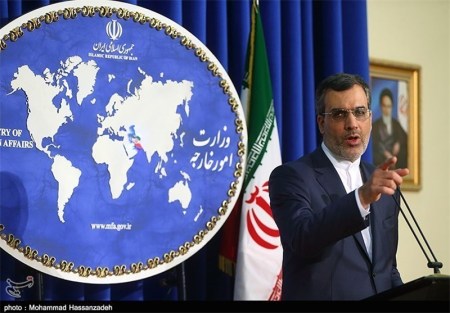
TEHRAN (Tasnim) – Iran’s Foreign Ministry spokesman warned of any move to confiscate the country’s assets in the US banks under “invalid and unlawful” court rulings, stressing that the US administration will be accountable for that possible decision and will have to pay compensation.
“If the assets belonging to the Islamic Republic of Iran, its organizations and nationals are seized, the US administration will be responsible to make up for the losses and pay compensation,” Hossein Jaberi Ansari said on Thursday.
He made the comments in reaction to reports that the US Supreme Court is considering a case to confiscate the Iranian Central Bank’s assets in the US to pay the American victims of terrorist attacks allegedly linked to the Iranian government.
The US House of Representatives is now weighing in on a pending case that accuses Iran of links with the 1983 bombing of the Marine barracks in Beirut and the 1996 bombing of the Khobar Towers in Saudi Arabia.
The US lawmakers are trying to force Iran’s Central Bank to pay damages to over 1,300 American plaintiffs. In 2008, the victims discovered that Iran’s Central Bank had almost $2 billion stored in Citibank accounts in New York. The victims sued for that money, and the litigation has now reached the Supreme Court.
Elsewhere in his comments, Jaberi Ansari said such efforts to block Iran’s assets show that the US hostility towards Iran continues to persist under pressure from the Zionist lobbies.
He also lashed out at the US judicial system for “violating the basics of the international law and resorting to bogus and baseless accusations” to deliver verdicts against Iran.
The new attempts at the US Supreme Court “contradict the inalienable international law and lack any legal validity,” the spokesman added.
Jaberi Ansari said the accusations against Iran come while those terrorist attacks have been committed by citizens of certain US allies.
“The US administration has proved that its hostile measures against Iran are in place with the influence of the Zionist lobbies and without care for the realities,” the spokesman underlined.
He further took a swipe at the US for its inaction to get advantage of the current circumstances and try to repair the Iranian nation’s deep distrust.
Earlier in November, Supreme Leader of the Islamic Revolution Ayatollah Seyed Ali Khamenei underscored that there has been no slackening off in US hostility towards Iran.
Imam Khamenei stressed that the US antagonistic attitude towards Iran has not changed a bit, but there are attempts to whitewash the issue.
Iran provokes the world as Obama does nothing, Washington Post, The Editorial Board, December 20, 2015
(The interesting thing about this article is that it states the opinion of the Washington Post Editorial Board. — DM)
IRAN IS following through on the nuclear deal it struck with a U.S.-led coalition in an utterly predictable way: It is racing to fulfill those parts of the accord that will allow it to collect $100 billion in frozen funds and end sanctions on its oil exports and banking system, while expanding its belligerent and illegal activities in other areas — and daring the West to respond.
Unfortunately, the Obama administration’s response to these provocations has also been familiar. It is doing its best to downplay them — and thereby encouraging Tehran to press for still-greater advantage.
We’ve pointed out how the regime of Ayatollah Ali Khamenei has unjustly sentenced Post correspondent Jason Rezaian to prison and arrested two businessmen with U.S. citizenship or residence since signing the nuclear accord. There have been no penalties for those outrageous violations of human rights. Now a United Nations panel has determined that Iran test-fired a nuclear-capable missile on Oct. 10 with a range of at least 600 miles, in violation of a U.N. resolution that prohibits such launches. Moreover, it appears likely that a second missile launch occurred on Nov. 21, also in violation of Security Council Resolution 1929.
The U.S. response? “We are now actively considering the appropriate consequences to that launch in October,” State Department official Stephen Mull testified at a Senate committee hearing Thursday. In other words, there have so far been none — other than a speech by the U.S. ambassador to the United Nations blaming the Security Council for the lack of action. As for the second missile launch, the administration claims to be investigating it, though it likely has in its possession the intelligence necessary to make a judgment.
It’s not hard to guess the reasons for this fecklessness. President Obama is reluctant to do anything that might derail the nuclear deal before Iran carries out its commitments, including uninstalling thousands of centrifuges and diluting or removing tons of enriched uranium. The same logic prompted him to tolerate Iran’s malign interventions in Syria, Yemen and elsewhere, along with the arrest of Mr. Rezaian, while the pact was under negotiation.
U.S. officials argue that Iran’s nonnuclear violations make it all the more important that the nuclear deal be implemented. But that ignores the clear connections between the missile launches and Tehran’s ambitions to become a nuclear power. The only practical military purpose of the missiles the regime is testing is to carry atomic warheads. And while missile launches are not prohibited by the nuclear pact itself, the separate resolution banning them remains in effect until the deal is implemented, after which a new resolution takes effect that calls on Iran not to develop such missiles for eight years.
By flouting the U.N. resolutions, Iran is clearly testing the will of the United States and its allies to enforce the overall regime limiting its nuclear ambitions. If there is no serious response, it will press the boundaries in other areas — such as the inspection regime. It will take maximum advantage of Mr. Obama’s fear of undoing a legacy achievement, unless and until its bluff is called. That’s why the administration would be wise to take firm action now in response to the missile tests rather than trying to sweep them under the carpet.
Kerry Tells Iran Congress Visa Requirements will be Waived, Front Page Magazine, Daniel Greenfield, December 21, 2015
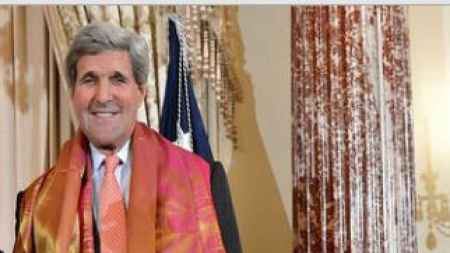
The Ayatollah and his terrorists needn’t worry, John Forbes Kerry and Barack Hussein Obama have their back.
The Obama administration, pushing to support international trade with Iran, has advised the country’s rulers not to worry about new U.S. legislation that clamps visa restrictions on people who have traveled to Iran.
Iranian officials have publicly complained the new U.S. rules will unfairly target travelers who visit Iran and could dampen investment interest in their country.
Secretary of State John Kerry wrote his Iranian counterpart on Saturday to assure him the visa changes approved by Congress last week won’t undermine business opportunities in Iran or violate the terms of the nuclear agreement between global powers and Tehran in July. Mr. Kerry said the administration was exploring ways to ensure visitors to Iran aren’t unfairly blocked from entering the U.S.
He specifically cited the State Department’s ability to expedite visa applications and to issue longer-term, multiple-entry travel documents. He also said the White House had the power to issue waivers to potentially exempt individuals from the new travel laws.
Americans can’t get waivers, but enemies of the United States can always get waivers from Obama. Despite Iran’s latest weapons tests, Kerry wrote to Iran that…
Thanks for a constructive meeting yesterday. I wanted to get back to you in response to your inquiry about amendments to our Visa Waiver Program. First, I want to confirm to you that we remain fully committed to the sanctions lifting provided for under the JCPOA. We will adhere to the full measure of our commitments, per the agreement. Our team is working hard to be prepared and as soon as we reach implementation day we will lift appropriate sanctions.
I am also confident that the recent changes in visa requirements passed in Congress, which the Administration has the authority to waive, will not in any way prevent us from meeting our JCPOA commitments, and that we will implement them so as not to interfere with legitimate business interests of Iran. To this end, we have a number of potential tools available to us, including multiple entry ten-year business visas, programs for expediting business visas, and the waiver authority provided under the new legislation.
Now let’s frantically bend over backward for the terrorists.
Obama Admin: Congressional Crackdown on Terror Will Violate Iran Deal, Washington Free Beacon,

Stephen Mull / AP
Senior Obama administration officials are expressing concern that congressional attempts to tighten laws preventing terrorists from entering the United States could violate the Iran nuclear agreement and prompt Tehran to walk away from the agreement.
Congress is considering measures that would tighten the Visa Waiver Program to make it harder for potential terrorists to legally enter the United States by increasing restrictions on individuals who have travelled to countries with prominent terrorist organizations from bypassing security checks upon entering the United States.
Iranian officials have in recent days repeatedly issued threatening statements to the Obama administration, saying that such moves would violate the nuclear agreement, and the Obama administration last week conveyed the Iranian anger to American lawmakers.
Stephen Mull, the State Department official in charge of implementing the Iran deal, warned the Senate Foreign Relations Committee late last week that these congressional efforts “could have a very negative impact on the deal.”
Under the revised law, which came in the week of a deadly terrorist attack in California, individuals who have travelled to Iran—a lead sponsor of global terrorism—would no longer be eligible to participate in the Visa Waiver Program, which permits individuals from 38 partner nations to more easily enter the United States.
Congress remains concerned that gaps in the program could prevent federal law enforcement officials from detecting terror-tied individuals before they are granted entrance to U.S. soil.
However, a portion of the Iran nuclear deal mandates that the United States not take any action that could harm Iran’s economic relationships with other countries. Iranian officials maintain that the new restrictions violate this passage of the deal.
Ali Larijani, the speaker of Iran’s parliament, said last week that these tightened measures “are aimed at harassment” and that they “blatantly violate the nuclear agreement,” according to comments carried by the Iranian state-controlled press.
Larijani warned that this action will detonate the deal before it has even been implemented.
“If the Americans pursue the plan, they will destroy an achievement with their own hands since it is against the [nuclear deal] and it will trouble them,” he warned.
Rep. Patrick Murphy (D., Conn.) echoed these concerns last week when he questioned Mull during a Senate hearing.
Visa waiver reform efforts include “a naming of Iran such that individuals who have travelled to Iran will no loner be eligible for the visa waiver program,” Murphy said. “There has been a suggestion because there is an element of the agreement that obligates us to not to take steps that would stop economic relations between other nations and Iran that we could perhaps be in jeopardy of breaching the agreement.”
Mull agreed with this assessment.
“I have heard from very senior, and Secretary [of State John] Kerry has as well, from very senior officials of differing European allies of ours that it could have a very negative impact on the deal,” he said.
Sources working with Congress on the Iran deal criticized the Obama administration for attempting to stymie increased action on terrorism due to its desire to preserve the nuclear deal.
“According to the Obama administration’s latest interpretation, the nuclear deal allows Iran to test ballistic missiles in violation of international law, but does not allow Congress to prevent terrorists from coming into the United States,” Omri Ceren, the managing director of press and strategy at The Israel Project, a D.C.-based organization that works with journalists on Middle East issues, told the Washington Free Beacon.
Seyed Araqchi, Iran’s deputy foreign minister, also warned that Iran is prepared to “take action” against the United States for implementing visa restrictions.
Iran’s latest threat to break the deal comes amid numerous Iranian provocations, including multiple tests of advanced ballistic missiles, acts prohibited under United Nations Security Council resolutions.
The Obama administration repeatedly said that, while it does not agree with those launches, they do not violate the nuclear deal.
The Iran Deal: From Bad to Worse, Power Line,
[I]s there a deal or not? It hasn’t been signed, and the parties have never agreed on what its terms are supposed to be. In the meantime, if a deal exists, Iran is violating it. Does anyone care? Certainly not President Obama.
*****************
The Iran nuclear deal has faded from the headlines. That must mean things are going well, right?
Just kidding. Amir Taheri brings us up to date:
Last month the president sent his Energy Secretary Ernest Moniz to Vienna to twist the arm of International Atomic Energy Agency chief Yukiya Amano into issuing a favorable report on the state of the Iranian nuclear program.
The yes-or-no question Amano faced was simple: Has Iran closed the military aspect of its nuclear program?
Being an honorable man, Amano could not provide the straight “yes” that Muniz was asking for. “Much progress has been made, but much remains to be done,” he said. “More confidence building is needed, and verification of what Iran is doing may need many more weeks.”
Amano also hedged in his formal report to the IAEA board of governors. In paragraph 79 of the report, he states that the IAEA is in no position to categorically report that all of Iran’s nuclear program is entirely peaceful. That’s because the IAEA does not have access to all nuclear sites in the Islamic Republic.
I think it is blindingly obvious that Iran continues its progress toward becoming a nuclear power. Taheri makes a point that I also have emphasized repeatedly:
Meanwhile, Iran openly flouts the deal — and UN Security Council resolutions — by testing a new generation of medium-range ballistic missiles known as “Al-Qadr 110.”
These tests make sense only if Tehran continues to contemplate a military nuclear dimension to its program. The two new missiles are designed to carry warheads of between 75 to 100 kilograms. It makes no sense to deploy a ballistic missile over a distance of 1,800 to 2,000 kilometers — that is to say, capable of reaching all capitals in the Middle East and parts of Europe — simply to carry a payload of TNT.
One basic question is, is there a deal or not? It hasn’t been signed, and the parties have never agreed on what its terms are supposed to be. In the meantime, if a deal exists, Iran is violating it. Does anyone care? Certainly not President Obama.
It’s embarrassing enough that Obama pushed off implementation of the nuclear deal from last week until the end of January. But here’s the dirty little secret: It doesn’t matter. From Iran’s point of view, it’s getting everything it wants, deal or no deal.
The EU already has gotten rid of most sanctions against the nation, and Obama has suspended our sanctions for 90 days. Assets have been unfrozen, pumping an estimated $8 billion into Tehran. Iran is set to recover some $120 billion.
I can’t wait to see how that famous “snap back” provision will work.
All for a nuclear agreement that Iran has not signed and seemingly has no intention of following.
Remember when Obama claimed the deal would block Iran from obtaining a nuclear bomb for fifteen years? The Iranians have never agreed to any such thing:
Behruz Kamalvand, spokesman for the Iranian Atomic Energy commission, said the Obama deal “does not change our nuclear program by a single iota.”
“We continue doing exactly what we were doing before,” he says.
Nice work, Barack! Taheri itemizes some of the fallout from the administration’s craven diplomacy:
After two years of secret negotiations, Obama, far from resolving the Iranian nuclear issue, has made it even more complicated.
In the process, he has virtually killed the Nuclear Nonproliferation Treaty, discredited the IAEA, made a mockery of the UN Security Council and emboldened the most radical faction within the Khomeinist regime.
The truth is that there is no deal. It was not the mullahs who took Obama for a ride. It was Obama who hitched a ride with them.
Obama’s “the chance of a lifetime” is just that — for Iran.
The Iran deal isn’t merely sub-par diplomacy, it is a scandal. I don’t see how a president who took seriously his duty to preserve American security could have entered into it. There is another scandal, too: a journalistic one. Here, as in so many instances, reporters have covered up for the Obama administration by deliberately failing to report the facts surrounding the Iranian nuclear debacle. It would be interesting to compare the number of minutes that network news broadcasts have devoted, over the last few months, to the fulminations of Donald Trump with the minutes they have devoted to the crumbling of the Iran agreement. Likewise with column inches in our supposedly sophisticated newspapers.
When the first Iranian nuclear bomb explodes, whether in Europe, Israel or the United States, a number of people will have much to answer for, and they won’t all be officials in the Obama administration.
Column One: Rubio, Cruz and US global leadership, Jerusalem Post, Caroline Glick, December 17, 2015
For the first time in a decade, Americans are beginning to think seriously about foreign policy; But are they too late?
At some point between 2006 and 2008, the American people decided to turn their backs on the world. Between the seeming futility of the war in Iraq and the financial collapse of 2008, Americans decided they’d had enough.
In Barack Obama, they found a leader who could channel their frustration. Obama’s foreign policy, based on denying the existence of radical Islam and projecting the responsibility for Islamic aggression on the US and its allies, suited their mood just fine. If America is responsible, then America can walk away. Once it is gone, so the thinking has gone, the Muslims will forget their anger and leave America alone.
Sadly, Obama’s foreign policy assumptions are utter nonsense. America’s abandonment of global leadership has not made things better. Over the past seven years, the legions of radical Islam have expanded and grown more powerful than ever before. And now in the aftermath of the jihadist massacres in Paris and San Bernadino, the threats have grown so abundant that even Obama cannot pretend them away.
As a consequence, for the first time in a decade, Americans are beginning to think seriously about foreign policy. But are they too late? Can the next president repair the damage Obama has caused? The Democrats give no cause for optimism. Led by former secretary of state Hillary Clinton, the Democratic presidential hopefuls stubbornly insist that there is nothing wrong with Obama’s foreign policy. If they are elected to succeed him, they pledge to follow in his footsteps.
On the Republican side, things are more encouraging, but also more complicated.
Republican presidential hopefuls are united in their rejection of Obama’s policy of ignoring the Islamic supremacist nature of the enemy. All reject the failed assumptions of Obama’s foreign policy.
All have pledged to abandon them on their first day in office. Yet for all their unity in rejecting Obama’s positions, Republicans are deeply divided over what alternative foreign policy they would adopt.
This divide has been seething under the surface throughout the Obama presidency. It burst into the open at the Republican presidential debate Wednesday night.
The importance of the dispute cannot be overstated.
Given the Democrats’ allegiance to Obama’s disastrous policies, the only hope for a restoration of American leadership is that a Republican wins the next election. But if Republicans nominate a candidate who fails to reconcile with the realities of the world as it is, then the chance for a reassertion of American leadership will diminish significantly.
To understand just how high the stakes are, you need to look no further than two events that occurred just before the Wednesday’s Republican presidential debate.
On Tuesday, the International Atomic Energy Agency voted to close its investigation of Iran’s nuclear program. As far as the UN’s nuclear watchdog is concerned, Iran is good to go.
The move is a scandal. Its consequences will be disastrous.
The IAEA acknowledges that Iran continued to advance its illicit military nuclear program at least until 2009. Tehran refuses to divulge its nuclear activities to IAEA investigators as it is required to do under binding UN Security Council resolutions.
Iran refuses to allow IAEA inspectors access to its illicit nuclear sites. As a consequence, the IAEA lacks a clear understanding of what Iran’s nuclear status is today and therefore has no capacity to prevent it from maintaining or expanding its nuclear capabilities. This means that the inspection regime Iran supposedly accepted under Obama’s nuclear deal is worthless.
The IAEA also accepts that since Iran concluded its nuclear accord with the world powers, it has conducted two tests of ballistic missiles capable of carrying nuclear weapons, despite the fact that it is barred from doing so under binding Security Council resolutions.
But really, who cares? Certainly the Obama administration doesn’t. The sighs of relief emanating from the White House and the State Department after the IAEA decision were audible from Jerusalem to Tehran.
The IAEA’s decision has two direct consequences.
First, as Iranian President Hassan Rouhani said Wednesday, it paves the way for the cancellation of the UN’s economic sanctions against Iran within the month.
Second, with the IAEA’s decision, the last obstacle impeding Iran’s completion of its nuclear weapons program has been removed. Inspections are a thing of the past. Iran is in the clear.
As Iran struts across the nuclear finish line, the Sunni jihadists are closing their ranks.
Hours after the IAEA vote, Turkey and Qatar announced that Turkey is setting up a permanent military base in the Persian Gulf emirate for the first time since the fall of the Ottoman Empire a century ago. Their announcement indicates that the informal partnership between Turkey and Qatar on the one side, and Hamas, the Muslim Brotherhood and Islamic State on the other hand, which first came to the fore last year during Operation Protective Edge, is now becoming a more formal alliance.
Just as the Obama administration has no problem with Iran going nuclear, so it has no problem with this new jihadist alliance.
During Operation Protective Edge, the administration supported this jihadist alliance against the Israeli-Egyptian partnership. Throughout Hamas’s war against Israel, Obama demanded that Israel and Egypt accept Hamas’s cease-fire terms, as they were presented by Turkey and Qatar.
Since Operation Protective Edge, the Americans have continued to insist that Israel and Egypt bow to Hamas’s demands and open Gaza’s international borders. The Americans have kept up their pressure on Israel and Egypt despite Hamas’s open alliance with ISIS in the Sinai Peninsula.
So, too, the Americans have kept Egyptian President Abdel Fattah al-Sisi at arm’s length, and continue to insist that the Muslim Brotherhood is a legitimate political force despite Sisi’s war against ISIS. Washington continues to embrace Qatar as a “moderate” force despite the emirate’s open support for the Muslim Brotherhood, Hamas and ISIS.
As for Turkey, it appears there is nothing Ankara can do that will dispel the US notion that it is a credible partner in the war on terror. Since 2011, Turkey has served as Hamas’s chief state sponsor, and as ISIS’s chief sponsor. It is waging war against the Kurds – the US’s strongest ally in its campaign against ISIS.
In other words, with the US’s blessing, the forces of both Shi’ite and Sunni jihad are on the march.
And the next president will have no grace period for repairing the damage.
Although the Republican debate Wednesday night was focused mainly on the war in Syria, its significance is far greater than one specific battlefield.
And while there were nine candidates on the stage, there were only two participants in this critical discussion.
Sens. Marco Rubio and Ted Cruz faced off after weeks of rising contention between their campaigns.
In so doing, they brought the dispute that has been seething through their party since the Bush presidency into the open.
Rubio argued that in Syria, the US needs to both defeat ISIS and overthrow President Bashar Assad.
Cruz countered that the US should ignore Assad and concentrate on utterly destroying ISIS. America’s national interest, he said, is not advanced by overthrowing Assad, because in all likelihood, Assad will be replaced by ISIS.
Cruz added that America’s experience in overthrowing Middle Eastern leaders has shown that it is a mistake to overthrow dictators. Things only got worse after America overthrew Saddam Hussein and supported the overthrow of Muammar Gaddafi and Hosni Mubarak.
For his part, Rubio explained that since Assad is Iran’s puppet, leaving him in power empowers Iran. The longer he remains in power, the more control Iran will wield over Syria and Lebanon.
The two candidates’ dispute is far greater than the question of who rules Syria. Their disagreement on Syria isn’t a tactical argument. It goes to the core question of what is the proper role of American foreign policy.
Rubio’s commitment to overthrowing Assad is one component of a wider strategic commitment to fostering democratic governance in Syria. By embracing the cause of democratization through regime change, Rubio has become the standard bearer of George W. Bush’s foreign policy.
Bush’s foreign policy had two seemingly contradictory anchors – a belief that liberal values are universal, and cultural meekness.
Bush’s belief that open elections would serve as a panacea for the pathologies of the Islamic world was not supported by empirical data. Survey after survey showed that if left to their own devices, the people of Muslim world would choose to be led by Islamic supremacists. But Bush rejected the data and embraced the fantasy that free elections lead a society to embrace liberal norms of peace and human rights.
As to cultural meekness, since the end of the Cold War and with the rise of political correctness, the notion that America could call for other people to adopt American values fell into disrepute. For American foreign policy practitioners, the idea that American values and norms are superior to Islamic supremacist values smacked of cultural chauvinism.
Consequently, rather than urge the Islamic world to abandon Islamic supremacism in favor of liberal democracy, in their public diplomacy efforts, Americans sufficed with vapid pronouncements of love and respect for Islam.
Islamic supremacists, for their part stepped into the ideological void without hesitation. In Iraq, the Iranian regime spent hundreds of millions of dollars training Iranian-controlled militias, building Iranian-controlled political parties and publishing pro-Iranian newspapers as the US did nothing to support pro-American Iraqis.
Although many Republicans opposed Bush’s policies, few dared make their disagreement with the head of their party public. As a result, for many, Wednesday’s debate was the first time the foundations of Bush’s foreign policy were coherently and forcefully rejected before a national audience.
If Rubio is the heir to Bush, Cruz is the spokesman for Bush’s until now silent opposition. In their longheld view, democratization is not a proper aim of American foreign policy. Defeating America’s enemies is the proper aim of American foreign policy.
Rubio’s people claim that carpet bombing ISIS is not a strategy. They are right. There are parts missing from in Cruz’s position on Syria.
But then again, although still not comprehensive, Cruz’s foreign policy trajectory has much to recommend it. First and foremost, it is based on the world as it is, rather than a vision of how the world should be. It makes a clear distinction between America’s allies and America’s enemies and calls for the US to side with the former and fight the latter.
It is far from clear which side will win this fight for the heart of the Republican Party. And it is impossible to know who the next US president will be.
But whatever happens, the fact that after their seven-year vacation, the Americans are returning the real world is a cause for cautious celebration.




 anneinpt
 artaxes
 danmillerinpanama
 davidking1530
 Peter Hofman
 Joseph Wouk
 Peter
Peter Louisiana Steve
 WarSclerotic
Recent Comments