Archive for the ‘Iran scam’ category

UNSC resolution promotes Mid East war

December 24, 2016

UNSC resolution promotes Mid East war, DEBKAfile, December 24, 2016

obama_bibi2480-1

The United States did not abandon Israel by its abstention from vetoing the UN Security Council resolution condemning settlements that was passed Friday, Dec. 23, 2016.

The one who abandoned Israel was US President Barack Obama – and not for the first time. During his eight years in office, Obama let Israel down at least three times on issues that jeopardized its security:

One of the first consequences of his 2011 “Arab Spring” initiative was the overthrow of Hosni Mubarak as Egyptian president and his direct promotion of the Muslim Brotherhood’s takeover of power in Cairo.

Four years later, Obama turned his back on Israel to award Iran favored status. Iran was allowed to retain the infrastructure of its military nuclear program as well as continuing to develop ballistic missiles, with the help of an infusion of $250 billion in US and European sanctions relief.

The horror of the carnage in Syria overshadowed the fact that President Obama allowed Tehran to pump Revolutionary Guards forces into the country through Iraq in order to fight for the brutal Assad regime. The president made no effort to halt the influx of pro-Iranian Shiite groups, including the Lebanese Hizballah, into Syria, as though it was perfectly natural and his policies had nothing to do with bringing Israel’s arch-foes to its back door.

In 2015, too, when Obama tried to wash his hands of the Middle East at large, he opened the war for the Islamic State and its leader Abu Bakr Al-Baghdadi to walk in and commandeer large swathes of Iraq and Syria virtually unopposed.

From those vantage points, the jihadists sent out a tentacle to Egyptian Sinai – close to another Israeli border.

Of late, the Obama has claimed he was not aware of ISIS’ potential for expansion, implying that US intelligence was at fault.

All the same, Obama never tired of emphasizing that he had done more than any US president before him to support Israel’s security, mainly in the form of advanced US weapons systems supplied for its defense. Because of the close military and intelligence ties between the two countries, no voice was raised to contradict him.

It is now time to point to the hypocrisy of the incumbent president’s posture: Had he invested less in granting benefits and free rein to the Jewish state’s closest enemies, Israel would perhaps have been less dependent on American hardware.

In the latest UN Security Council resolution, Israel is reprimanded on the score that “all Israeli settlement activities in the Occupied Palestinian Territory, including east Jerusalem, are illegal under international law and constitute a major obstacle to the achievement of peace on the basis of the two-state solution.”

Before anyone else, Barack Obama and his Secretary of State John Kerry are in a position to attest to the falseness of this equation.

On Nov. 25, 2009, Prime Minister Binyamin Netanyahu announced that Israel would impose a 10-month freeze on construction in the West Bank and east Jerusalem as a concession to ease the US peace initiative. Israel gave way further on its demand for direct negotiations, when Palestinian leader Mahmoud Abbas dug his heels in against meeting Israeli officials face to face. John Kerry was forced to engage in shuttle diplomacy.
Even after those concessions for peace, the Obama initiative fell flat when it came up against Palestinian resistance.

The departing US president seems determined to use his last weeks in office to teach the Israeli prime minister a painful lesson he won’t forget in a hurry after his White House exit on Jan. 20.

But he is getting it wrong one more time. The UN SC resolution will soon be reduced to a piece of paper. The Palestinians will wave it gladly in the face of the international community, but Israel won’t remove a single settlement or stop building new housing estates in Jerusalem. The Prime Minister’s Office made it clear that Israel is not bound by the resolution and rejects it.
The only concrete result will be to make peace more elusive than ever

The notion that Donald Trump will come riding to Israel’s rescue as soon as he moves into the Oval Office is foolish. He was elected to rebuild America as a global power. That would necessarily include restoring US influence in the Middle East, but how he proposes to accomplish this is not generally known.

If he decides to call on Israel for support and assistance, it stands to reason that he will introduce radical changes in Obama’s steps – especially the nuclear deal with Iran and the peace process with the Palestinians.

Not all those changes can be achieved peacefully. They may well entail the use of military force by the United States and Israel. In this sense, Security Council Resolution 2334 may turn out to be the real obstacle to peace, tending rather to promote belligerence in the Middle East, because the Palestinians and other hardliners and rejectionists will use the resolution as their justification for bashing Israel and more acts of terror.

The sorrow and the pity in Syria

December 21, 2016

The sorrow and the pity in Syria, Washington Times

(Please see also, Lies and Hypocrisy over Aleppo. — DM)

iraninsyriaIllustration on Iran’s future role in Syria by Linas Garsys/The Washington Times

ANALYSIS/OPINION:

Over the last five years, Syria has been descending into a hell on Earth. Over the last four months, the lowest depths of the inferno have been on display in Aleppo, an ancient city, once among the most diverse and dynamic in the Middle East. On Friday, in the final press conference of his presidency, Barack Obama addressed this still-unfolding humanitarian and strategic catastrophe.

“So with respect to Syria,” he said, “what I have consistently done is taken the best course that I can to try to end the civil war while having also to take into account the long-term national security interests of the United States.”

An estimated 500,000 dead, 11 million displaced, millions more living in fear, sorrow and pitiful poverty, Iranian forces backed by Russian forces occupying the heart of the Arab world — yet no-drama Mr. Obama remains so casual, so confident that the decisions he’s made were “the best” and, what’s more, that he made them “consistently.” Is refusing to change one’s mind as conditions worsen and policies fail really a virtue?

To bolster his case, the president emphasized that he has spent lots of time — “if you tallied it up, days and weeks” — attending meetings on Syria. “We went through every option in painful detail with maps,” he said, “and we had our military and we had our aid agencies and we had our diplomatic teams, and sometimes, we’d bring in outsiders who were critics of ours.” Imagine that: painful detail, maps, aid agencies, even critical outsiders.

Count me among those not convinced. In 2011, during that hopeful moment known as the Arab Spring, peaceful protesters took to the streets of Damascus. The dynastic dictator Bashar Assad responded brutally. Before long, a civil war was ignited.

Mr. Obama’s top advisers recommended assisting non-Islamist and nationalist rebels — not with the proverbial boots on the proverbial ground but with secure communications devices, money, weapons and training. Mr. Obama rejected that advice. He had done the math: Mr. Assad, a member of the Alawite minority, hadn’t enough loyal troops to prevail against Syria’s insurgent Sunni majority. So the fall of the Assad regime had to be both inevitable and imminent.

What that failed to take into account: Iran’s theocrats would send in foreign Shia fighters, including those of Hezbollah, their Lebanese proxy, all under the leadership of their Islamic Revolutionary Guard Corps. Vladimir Putin also would deploy forces in support of the Assad regime. We can surmise his reasons: to have a Mediterranean port for his navy; to re-establish Russia’s influence in the Middle East; to show the world that, unlike Mr. Obama, he does not abandon his friends; to diminish American credibility and prestige.

Mr. Obama’s response was, as it so often is, mainly rhetorical. He warned Mr. Putin that he was stepping into a quagmire. He proclaimed, as so he often does, that there can be “no military solution.”

The Russian president, a product of the KGB rather than the faculty lounge, knew that was nonsense. In the Middle East, the law of the jungle trumps international law every time.

Having accused President George W. Bush of overreach, Mr. Obama adopted a policy that might be called underreach. He decided not to enforce the “red line” he had declared against Mr. Assad’s use of chemical weapons. He decided not to eliminate Mr. Assad’s air power, which would have ended the barrel-bombing of civilians. He wasn’t even willing to help establish “safe zones” where innocent Syrians might stand a chance to defend themselves.

I know: Mr. Obama saw his mission as ending wars and certainly not risking additional American entanglements. And he is among those who believe that the projection of American power generally does more harm than good.

Not mutually exclusive is the theory that he had a specific goal in mind: to bring Iran’s rulers into a strategic partnership with the United States. To achieve that, he had to demonstrate that he respected what he has called their “equities” in Syria. Were he to take action against Mr. Assad, the Islamic republic’s envoys might walk away from the table where they were negotiating the nuclear weapons deal Mr. Obama envisioned as his great foreign policy legacy.

The president has been nothing if not “consistent” in his pursuit of detente with Iran’s Islamic revolutionaries. In all likelihood, that is what explains his decision, just after taking office, to turn a blind eye to the clerical regime’s ruthless repression of the Green Movement that took to the streets of Iranian cities following a rigged presidential election in 2009.

History will record that these efforts failed. Nixon went to China. Mr. Obama will not be going to Iran — or to Syria, which Iran intends to incorporate into its version of a caliphate (which Shia call an “imamate”).

Aleppo,” U.S. Ambassador Samantha Power said last week at the U.N., “will join the ranks of those events in world history that define modern evil, that stain our conscience decades later. Halabja, Rwanda, Srebrenica, and, now, Aleppo. To the Assad regime, Russia, and Iran, your forces and proxies are carrying out these crimes.”

She went on to ask: “Are you truly incapable of shame? Is there literally nothing that can shame you? Is there no act of barbarism against civilians, no execution of a child that gets under your skin?”

Would it be unfair to suggest that the answers to these questions should have been apparent to her and the president years ago? Had that been the case, perhaps they would have formulated different policies and implemented a different course of action. Or perhaps not.

Iranian Commander Who Killed Americans Tours Syria, Violating International Travel Ban

December 19, 2016

Iranian Commander Who Killed Americans Tours Syria, Violating International Travel Ban, Washington Free Beacon, , December 19, 2016

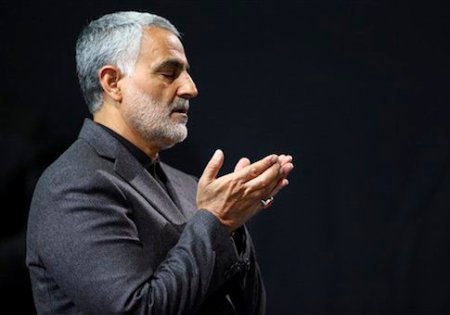
CORRECTS SPELLING OF NAME TO SOLEIMANI - In this photo released by an official website of the office of the Iranian supreme leader, commander of Iran's Quds Force, Qassem Soleimani, prays in a religious ceremony at a mosque in the residence of Supreme Leader Ayatollah Ali Khamenei, in Tehran, Iran, Friday, March 27, 2015. Iran's Foreign Minister Mohammad Javad Zarif sought Friday to reassure the six world powers conducting nuclear power talks in Switzerland, saying the negotiations remained focused on sealing a deal. (AP Photo/Office of the Iranian Supreme Leader)

Qassem Soleimani,  (AP Photo/Office of the Iranian Supreme Leader)

Multiple sources who spoke with the Washington Free Beacon about the matter disclosed that the Obama administration is taking a soft approach with Iran, including not enforcing sanctions, in order to preserve the nuclear deal and diplomacy with Tehran, which has threatened repercussions for any new sanctions.

Soleimani’s visit to Syria is viewed as a sign that Iran is not worried about facing repercussions for its continued military presence in Syria in support of embattled leader Bashar al-Assad.

Iran has breached international laws for some time without facing consequences. The Obama administration repeatedly assured Congress it would enforce sanctions on Iran when lawmakers expressed doubt about the viability of the Iran nuclear deal.

********************************

A top Iranian commander responsible for the deaths of Americans was photographed touring the war-torn city of Aleppo in Syria over the weekend, in violation of a United Nations travel ban that the Obama administration swore to enforce while selling the landmark nuclear deal with Iran to Congress, according to multiple sources and photographs.

Iranian Quds Force Commander Qasem Soleimani—a top general who leads Iranian militants across the globe and is directly responsible for the death of Americans—was recently photographed touring Aleppo in a demonstration of Iran’s waxing influence in Syria and disregard for international resolutions barring such behavior. Soleimani’s presence in Syria is a direct violation of the United Nations resolution governing the nuclear deal.

Soleimani’s visit coincided with moves by the terror group Hezbollah, which is controlled by Iran, to establish its own claim in Syria, according to regional reports and footage.

Iran’s public presence in Syria has not been met with action by the Obama administration, which has come under increasing pressure in recent weeks to explain why it is not enforcing current sanctions against Iran. Soleimani continues to direct Iranian forces in both Iraq and Syria and has long been sanctioned for the murder of U.S. citizens.

Mutliple sources who spoke with the Washington Free Beacon about the matter disclosed that the Obama administration is taking a soft approach with Iran, including not enforcing sanctions, in order to preserve the nuclear deal and diplomacy with Tehran, which has threatened repercussions for any new sanctions.

Soleimani’s visit to Syria is viewed as a sign that Iran is not worried about facing repercussions for its continued military presence in Syria in support of embattled leader Bashar al-Assad.

Iran has breached international laws for some time without facing consequences. The Obama administration repeatedly assured Congress it would enforce sanctions on Iran when lawmakers expressed doubt about the viability of the Iran nuclear deal.

The absence of consequences for Iran’s behavior has paved the way for Hezbollah to stake it own claim in Syria, according to congressional and foreign policy insiders who told the Free Beacon that the Obama administration is working behind the scenes to prevent any new sanctions against Iran.

“The Obama administration has been working overtime to prevent any U.S. official from doing anything new to punish the butchers of Syria, because they know that would force them to take action against Iran, and then Iran would walk away from the deal,” said one veteran insider who consults with Congress on the issue. “Now they’re ignoring even old sanctions against the Iranians. They’ll do anything to keep the Iranians in the deal for just a couple more weeks, so they can blame the inevitable collapse on Trump.”

A senior congressional aide apprised of the situation said the administration would continue to turn a blind eye to blatant violations in order to preserve diplomacy with Iran.

“This administration’s refusal to enforce sanctions explicitly allowed under the nuclear deal is not only cowardice—it’s dangerous,” said the aide. “What does it say about U.S. leadership when a terrorist like General Soleimani—someone with American blood on his hands—can freely travel to the ground zero of genocide in Syria without penalty? President Obama knows his nuclear deal is on thin ice, so he’s willing overlook blatant sanctions violations like this one even if it means more carnage in Aleppo.”

A second senior congressional source warned that refusal to enforce sanctions was empowering Iran’s radical regime, which has increasingly taken hold in Iraq as well, where the U.S. military has been accused of training Iranian-backed militias.

“The outgoing Obama administration struck a Faustian bargain with Iran, the world’s biggest state sponsor of terrorism, and Soleimani, head of the IRGC terrorist organization that’s responsible for the death of many hundreds of Americans, continues to do victory laps throughout the Middle East” the source said. “Unless the Trump administration changes course, this short-sighted Iran policy cannot and will not end well.”

Troops in Aleppo, as well as an Iranian reporter, have been spotted raising Hezbollah’s flag in recent days, calling into question the Obama administration’s claim that it has been working to constrain the terror group.

Michael Rubin, a former Pentagon adviser and expert on radical regimes, told the Free Beacon that Iran sees the nuclear deal as a vehicle to advance its regional aspirations.

“For Obama, diplomacy’s goal was to affirm his brilliance,” Rubin said. “For Iran’s leadership, it was an asymmetric warfare tactic meant to distract from a continuous geopolitical goal.”

“Red lines matter. Over 25 years, both Republicans and Democrats signaled to Iran about what they were,” Rubin explained. “Obama, however, believed himself wiser than Reagan, Clinton, and Bush—at least that’s what the man in the mirror told him every morning. Once Iran realized there were no real red lines, it concluded it could bust sanctions with impunity. Soleimani is the personification of that conclusion.”

The State Department conceded on Monday that Soleimani’s visit to Syria violated United Security Council resolutions government the nuclear deal, but would not lay out steps meant to address the behavior.

“We do intend to consult with our partners on the security council about how to address our concerns with this,” State Department Spokesman John Kirby said during a press briefing. “We’ve long said that Iran needs to choose whether it’s going to play a positive role in helping peacefully resolve conflicts, such as in Syria, or whether it will choose to prolong them. And you’re absolutely right, his travel was a violation.”

Update 3:05 P.M.: This post has been updated to reflect comment from the State Department.

The Audacity of Silence On Possible Iran-North Korea Nuclear Ties

December 16, 2016

The Audacity of Silence On Possible Iran-North Korea Nuclear Ties, Canada Free Press, , December 15, 2016

(Does the unwritten, never-produced or otherwise verified Khamenei “fatwa” against nukes — but not against missiles to deliver them —  upon which Obama, Kerry et al relied apply to North Korea? — DM)

If the silent officials of the Obama administration are confident that there has been no nuclear cooperation between Iran and North Korea, it’s time to put that assessment in writing and send it to Cruz. If, on the other hand, Clapper, Kerry, Lew or Obama himself have any information that points to nuclear collaboration, it’s past time to inform Cruz, the rest of Congress and the American public of the staggering extent of the radioactive debacle they are about to hand off to President-elect Donald Trump, under the heading of Obama’s legacy Iran nuclear deal.

************************

It’s now more than eight weeks since Senator Ted Cruz sent a letter to three senior officials of the Obama administration, detailing his concerns that North Korea and Iran might be working together on developing nuclear missiles.

In particular, Cruz had a question for Director of National Intelligence James Clapper. Referring to the period since the Iran nuclear deal took effect on Jan. 16, Cruz asked: “Has the U.S. intelligence community observed any possible nuclear collaboration between Iran and North Korea…”?

That’s one of the huge questions looming behind the Iran nuclear deal, officially titled the Joint Comprehensive Plan of Action, which President Obama has been urging President-elect Donald Trump to preserve.

It’s a question that deserves an immediate answer. If there has been any such nuclear teamwork between Tehran and rogue, nuclear-testing Pyongyang, that would be a violation by Iran that should immediately blow up the Iran deal — which the Obama White House currently touts on its web site as “The Historic Deal that Will Prevent Iran from Acquiring a Nuclear Weapon.”

Questions about possible Iran-North Korea teamwork on nuclear weapons are well-founded, as Cruz explained in his seven-page letter, referencing numerous open-source reports (including two of my own). North Korea and Iran have been strategic allies since just after Iran’s 1979 Islamic revolution. They have a long history of weapons deals, in which the usual arrangement has been that North Korea works on the weapons, oil-rich Iran pays the bills, and technicians shuttle between both countries.

While there’s been no official U.S. confirmation that this Iran-North Korea partnership extends to nuclear collaboration, there’s plenty of official U.S. documentation that it includes cooperation on developing ballistic missiles. That has long raised questions about whether the two countries are also in nuclear cahoots, because ballistic missiles are basically cost-efficient only as vehicles for delivering nuclear warheads.

And though it could be mere coincidence, it is striking that during the past year, in which Iran — to multi-billion dollar emolument — has officially relinquished any interest in nuclear weapons, cash-hungry North Korea has never been busier. North Korea has carried out two nuclear tests this year alone, in January and September, bringing its total number of nuclear tests to five since 2006, four of them during Obama’s presidency.

Over many years, North Korea and Iran have both carried out numerous ballistic missile tests, including multiple tests by both countries since the Iran nuclear deal took effect this January. That raises the question of why Iran, having promised not to make nuclear weapons, continues to pour resources into testing ballistic missiles. If not for nuclear weapons, then for what? One obvious question is whether North Korea’s nuclear program might be secretly doubling as a nuclear backshop for Iran.

Cruz, in his letter, raised specific worries about North Korea’s test this September of a powerful new rocket booster, which according to North Korean state media had a thrust of 80 tons — enough power to carry “a heavier, or less-minaturized nuclear warhead to the United States.” That happens to be exactly the same amount of thrust referenced in a Jan. 17 Treasury press release that mentioned the excursions of “Iranian missile technicians,” who “within the past several years” have “traveled to North Korea to work on an 80-ton rocket booster being developed by the North Korean government.”

Cruz asked Treasury Secretary Jack Lew to confirm that the capability of North Korea’s new rocket engine, tested in September, was the same as that of the North Korean rocket on which Iranian technicians had been working in North Korea.

Cruz also had some questions for Secretary of State John Kerry, including “What penalties do you plan to announce against Iran in light of its JCPOA violations?” He also wanted to know, “What is the United States doing to ensure that the $1.7 billion paid to Iran in cash earlier this year is not used to finance nuclear weapons research in North Korea?”

From all these Administration officials, Cruz requested answers no later than Nov. 1. To date, according to his staff, he has received no answers at all.

State and Treasury have not even extended the courtesy of acknowledging the letter. From Clapper’s office, at National Intelligence, came a message in October, saying they had received the letter, and would respond. They have not.

That’s an alarming silence. For years, Obama administration officials have dodged questions about possible Iran-North Korea nuclear teamwork by reciting the talking point that any signs of such cooperation would be cause for serious concern. Now it seems Administration officials are skirting even that customary evasion. Why?

My own queries to State, Treasury and National Intelligence, asking why they had not answered Cruz, ran into the same blank walls. State and Treasury made no response. National Intelligence emailed back on Dec. 6 only to say that they had received Cruz’s letter, and “are working to respond as soon as possible.”

Obama’s administration has racked up a record that suggests silence on Iran-related issues is not a good sign. Back in January, when Obama celebrated a $1.7 billion settlement of an old financial dispute with Iran, a number of lawmakers wrote to the Administration asking for details of this transaction, and whether it was a ransom for Iran’s release of American prisoners.

The Administration took weeks to provide even partial replies, denied paying ransom and omitted entirely the manner in which the $1.7 billion had been dispatched to Iran. It took more than six months for Congress and the press to eke out of the Administration the information that the entire $1.7 billion, converted into European hard currency, had been paid to Iran in stacks of cash — hard to trace and convenient chiefly for illicit purposes — with the first installment of $400 million conveyed, ransom-style, on the same day as the prisoner release, and held in Geneva until the airplane carrying the released American prisoners was on its way out of Iran.

For the Obama administration, invested in the Iran nuclear deal as one of Obama’s signature legacies, there is tremendous temptation to ignore or bury any evidence that Iran is cheating. There is also enormous incentive to downplay another of Obama’s legacies: the dramatic enhancement, since he took office in 2009, of the nuclear arsenal and proficiency of North Korea, now honing its increasingly powerful missiles, beefing up its stockpile of nuclear fuel, and preparing for its sixth nuclear test.

If the silent officials of the Obama administration are confident that there has been no nuclear cooperation between Iran and North Korea, it’s time to put that assessment in writing and send it to Cruz. If, on the other hand, Clapper, Kerry, Lew or Obama himself have any information that points to nuclear collaboration, it’s past time to inform Cruz, the rest of Congress and the American public of the staggering extent of the radioactive debacle they are about to hand off to President-elect Donald Trump, under the heading of Obama’s legacy Iran nuclear deal.

Iran Breaks Nuclear Deal and UN Resolutions

December 15, 2016

Iran Breaks Nuclear Deal and UN Resolutions, Gatestone Institute, Majid Rafizadeh, December 15, 2016

“We will have a new ballistic missile test in the near future that will be a thorn in the eyes of our enemies.” – Iranian President Hassan Rouhani.

The range of existing Iranian ballistic missiles has grown from 500 miles to over 1,250 miles (roughly 2,000 kilometers), which can easily reach Eastern Europe, as well as countries such as Israel.

In addition, Iranian Defense Minister Brig. Gen. Hossein Dehqan said that there would be no limit for the range and amount of missiles that Iran will develop.

The nuclear agreement, known as the Joint Comprehensive Plan of Action Agreement (JCPOA) — effective, as of October 18, 2015, according to the State Department – clearly and distinctly stipulates that Iran should not undertake any ballistic missile activity “until the date eight years after the JCPOA Adoption Day or until the date on which the IAEA submits a report confirming the Broader Conclusion, whichever is earlier.”

Not only is Iran avoiding honoring this stipulation, but also Iran’s ballistic missile operations have significantly ratcheted up. More importantly, there has been no criticism at all from the Obama administration or other involved parties regarding this critical violation.

As cited by Iran’s state-owned Fars News Agency, Brig. Gen. Amir Ali Hajizadeh, Iran’s commander of the Islamic Revolutionary Guards Corps (IRGC) Aerospace Force, said in Tehran on Dec 6, 2016:

“In addition to enhancing the precision-striking power and quality of ballistic missiles, the Iranian authorities and experts have used innovative and shortcut methods to produce inexpensive missiles, and today we are witnessing an increase in production [of ballistic missiles].”

Iran is bragging about it.

1173-2

In addition, Iranian Defense Minister Brig. Gen. Hossein Dehqan said that there would be no limit for the range and amount of missiles that Iran will develop. He boasted:

“90 percent of the country’s defense systems have reached an acceptable standard and enjoy competitive quality compared with the weapons of advanced countries; production of the national individual weapons and efforts to improve the quality and precision-striking power of ballistic missiles are among the defense ministry’s achievements in the defense field.”

Fars News reported on a December 6, 2016 statement from Iran’s Defense Minister:

“His remarks came as the Islamic Revolution Guards Corps (IRGC) fired 2 home-made ‘Qadr H’ ballistic missiles from the Eastern Alborz Mountains at a target in Iran’s Southeastern Makran seashore some 1400km away… The missiles were fired on the sidelines of the main stage of the IRGC drills in Central Iran and various parts of the country.”

One missile, which was launched on March 2016, had a clear message written on it that said in the Hebrew language: “Israel should be wiped off the Earth”. Fars Agency adds:

“Qadr is a 2000km-range, liquid-fuel and ballistic missile which can reach territories as far as Israel… The missile can carry different types of ‘Blast’ and ‘MRV’ [Multiple Reentry Vehicle] payloads to destroy a range of targets. The new version of Qadr H can be launched from mobile platforms or silos in different positions and can escape missile defense shields due to their radar-evading capability.”

Iran has repeatedly test-fired, long-range ballistic missiles and laser-guided surface-to-surface missiles. For example, on March 2016, Iran tested a new ballistic missile, capable of carrying multiple warheads. More recently, Iran fired a test missile with an accuracy within 25 feet, which is characterized as “zero error,” according to Brig. Gen. Ali Abdollahi, the Iranian military’s deputy chief of staff, and Iran’s semi-official Tasnim news agency.

The range of existing Iranian ballistic missiles has grown from 500 miles to over 1,250 miles (roughly 2,000 kilometers), which can easily reach Eastern Europe, as well as countries such as Israel.

According to a previous report obtained by the Associated Press, the launches are “destabilizing and provocative” and the Shahab-3 medium-range ballistic missile and Qiam-1 short-range ballistic missile fired by Iran are “inherently capable of delivering nuclear weapons.”

In addition to violating the nuclear agreement, provoking and threatening other nations, and destabilizing the region, Iran is breaching two UN Security Council Resolutions. Security Council resolution 2231 (section 3 of Annex B) “calls upon Iran not to undertake any activity related to ballistic missiles designed to be capable of delivering nuclear weapons, including launches using such ballistic missile technology.”

The second United Nations Security Council resolution, 1929, states:

“Iran shall not undertake any activity related to ballistic missiles capable of delivering nuclear weapons, including launches using ballistic missile technology, and that States shall take all necessary measures to prevent the transfer of technology or technical assistance to Iran related to such activities.”

Iran has the largest ballistic missile arsenal in the Middle East. It is also the most diversified one. No country, other than Iran, has acquired long-range ballistic missiles before obtaining nuclear weapons. Ballistic missiles can be used for offensive or defensive purposes, but sophisticated missiles are more likely developed as delivery vehicles for nuclear weapons.

These missiles have the capability of carrying multiple nuclear warheads. Iran Tasnim news agency reported:

“Defense Minister Brigadier General Hossein Dehqan praised the country’s military might…saying the Islamic Republic can mass produce ballistic missiles with any range and destructive power… In the missile sphere, Iran has been able to maximize the accuracy of projectiles, as emphasized by Leader of the Islamic Revolution Ayatollah Seyed Ali Khamenei, with reliance on the local forces, Brigadier General Amir Ali Hajizadeh said at an academic ceremony in Tehran on Tuesday.”

Iran is also is increasingly provoking other countries in the region, and has made it clear that the ballistic missiles are aimed at targeting other nations. Brig. Gen. Amir Ali Hajizadeh, said previously to FARS news agency that “Iran has built missiles that can hit targets at 2,000 Km. They are designed to hit Israel at such a distance.” He added that Islamic countries have surrounded Israel and “its [Israel’s] life is short. So it will collapse in any given war — long before a missile is even fired.”

Iran also exports these missiles to its proxies across the region. Tasnim news agency quoted General Hossein Salami as saying:

“Hezbollah has 100,000 missiles that are ready to hit Israel to liberate the occupied Palestinian territories if the Zionist regime repeats its past mistakes… today, the grounds for the annihilation and collapse of the Zionist regime are (present) more than ever.”

In addition, Gen. Salami warned Israeli leaders that if they make the “wrong move,” Israel would come under attack.

It is crucial to point out that both Iran’s so-called “moderates” and hardliners are on the same page when it comes developing ballistic missiles. When his country was unveiling a new missile, Fateh 313, President Hassan Rouhani pointed out that “we will have a new ballistic missile test in the near future that will be a thorn in the eyes of our enemies.”

The Obama administration, the international community, a major global power, or a coalition of nations need robustly to confront these provocations, threats, and violations of the nuclear deal and UN Security Council Resolutions by Iran.

U.S. Money Transferred To Iran Used To Expand Iran’s Military Budget

December 15, 2016

U.S. Money Transferred To Iran Used To Expand Iran’s Military Budget, MEMRI, Dr. Nimrod Raphaeli*

While we cannot establish whether the money transferred from the U.S. went directly into the expanded defense budget, it, at a minimum, enabled the government to release an equal amount of money for defense purposes. It is noteworthy that the increase in the proposed defense budget for 2017 is approximately equal to the amount transferred by the U.S. Whatever the source of the defense budget increase, the IRGC will have ample resources to expand its nefarious activities far beyond the borders of the Islamic Republic.

*****************************

The government of Iranian President Hassan Rohani has submitted to the Majlis (parliament) a draft budget for the fiscal year March 2017-March 2018 for a total of $99.7 billion equivalent. The budget envisages a growth in expenditure of 13.9 percent over the preceding year, but a sharp increase of 39 percent, or $10.3 billion, in funds earmarked for defense, including a big increase in the budget of Iran’s Islamic Revolutionary Guard Corps (IRGC).

Notwithstanding political, economic and social conflicts between the Rohani government and the IRGC, foreign policy is closely coordinated by the two bodies. Upon reaching power, the Rohani government declared two key priorities: reforming the national economy, and reaching agreement with the West on the nuclear program. The government has shown no objection to the role of the IRGC, a potent military force accountable to the Supreme Leader, in regional politics, and particularly in Syria and Iraq. A branch of the IRGC, the Qods Force Brigade, commanded by Gen. Qasem Soleimani, is responsible for spreading Iran’s subversive and, often, terrorist activities across the Middle East and beyond.

Growth Of Iran’s Defense Budget

Overall, Iran’s defense budget has increased from $6 billion in 2013 during the presidency of Mahmoud Ahmadinejad to $8 billion in 2014, and in access of $10 billion for the next Iranian fiscal year. However, the section of the military budget earmarked for the IRGC has registered a far greater increase than the military budget as a whole. The budget allocation for the Revolutionary Guards was $3.3 billion in 2013, increased to $6 billion in 2015, declined to $4.5 billion in 2016 but increased by 53 percent to $6.9 billion for 2017 which translated into 77 percent of the total defense budget. In fact, under the Rouhani presidency, the total allocations to the military, the IRGC, the Organization for the Mobilization of the Oppressed (Basij), and the General Staff of the Armed Forces all rose to almost 80 percent since mid-2013 when Rohani assumed the presidency.

Apart of its dominant share in the national defense budget, the IRGC derives vast revenues from its control over energy, construction, banking, and marketing (as well as smuggling of contraband.) Much of these economic activities are carried out by a company known as Khatam Al-Anbiya (“Seal of the Prophet”) established by Supreme Leader Ali Khamenei in the late 1980s as the economic arm of the IRGC. Upon the withdrawal of the major oil companies such as Shell Oil (Anglo-Dutch) and Total (French) from Iran’s oil sector following the international sanctions, ownership of the oil and gas fields vacated by these companies was transferred to Khatam Al-Anbiya.[1]

The Ultimate Destiny Of The U.S.-Transferred Cash To Iran

In seeking to strengthen the policy of rapprochement with Iran, the Obama administration (though its Treasury Department) has surreptitiously transferred to Rohani’s government two tranches, in cash, for a total of $1.7 billion, allegedly as the cumulated interest on Iran’s deposits, made during the Shah regime before the 1979 revolution, for the purchase of American weapons

It is a commonly accepted premise that money is fungible. While we cannot establish whether the money transferred from the U.S. went directly into the expanded defense budget, it, at a minimum, enabled the government to release an equal amount of money for defense purposes. It is noteworthy that the increase in the proposed defense budget for 2017 is approximately equal to the amount transferred by the U.S. Whatever the source of the defense budget increase, the IRGC will have ample resources to expand its nefarious activities far beyond the borders of the Islamic Republic.

*Dr. Nimrod Raphaeli is Senior Analyst (emeritus) at MEMRI.


[1] Al-Quds al-Arabi, December 10, 2016

Iran Vows Nuclear Retaliation for U.S. Breach of Deal

December 14, 2016

Iran Vows Nuclear Retaliation for U.S. Breach of Deal, Washington Free Beacon, , December 14, 2016

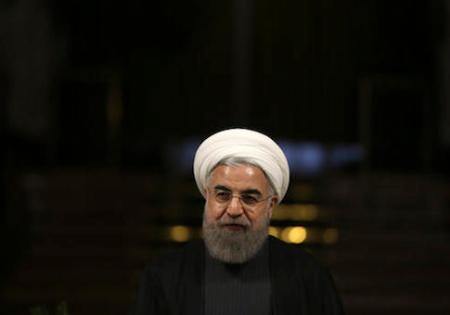
Iranian President Hassan Rouhani speaks in a news briefing after his meeting with his Slovenian counterpart Borut Pahor at the Saadabad palace in Tehran, Iran, Tuesday, Nov. 22, 2016. (AP Photo/Vahid Salemi)

Iranian President Hassan Rouhani  (AP Photo/Vahid Salemi)

“But the Obama administration counted on Iran waiting until the next president before revealing the game, and the Iranians sprung the trap early,” the source added. “So now the administration will do everything it can to look the other way and get through the next few weeks, so they can blame the inevitable collapse on Trump.”

***************************

Senior Iranian officials vowed on Wednesday to continue moving forward with nuclear weapons work and other banned activities as retaliation against the United States for breaching last year’s nuclear accord, according to reports in the country’s state-controlled media.

Iranian leaders instructed the country’s atomic energy organization to move forward with sensitive nuclear work, including the construction of nuclear-powered ships and submarines.

Further provocative actions will be announced in the coming days, according to these Iranian leaders, who described the country’s actions as revenge for recent moves by the U.S. Congress to extend sanctions on Iran, a move the Islamic Republic claims is a breach of the nuclear deal.

Iran’s latest moves have not elicited concern from Obama administration officials, who continue to pursue a series of measures meant to decrease international pressure on Tehran and provide it with greater financial resources.

“Considering that the US administration has ignored and delayed compliance with its undertakings under the [nuclear agreement] and given the recent extension of the Iran Sanctions Act (ISA) that had already been declared as a violation of the nuclear deal by the Islamic Republic of Iran… the Atomic Energy Organization of Iran is ordered to develop the country’s peaceful nuclear program within the framework of the Islamic Republic of Iran’s international undertakings as defined in the following missions,” Iranian President Hassan Rouhani wrote in a letter Tuesday to the country’s top nuclear agency.

Iran will move forward with a “plan for designing and building propulsion systems to be used in marine transportation in cooperation with scientific and research centers,” according to Rouhani’s letter.

It also will engage in the “production of fuel for nuclear propulsion systems,” Rouhani wrote.

This is the first in a range of responses planned by Tehran, according to Ali Akbar Velayati, a senior aide to Iran’s Supreme Leader Ali Khamenei.

The renewed nuclear work is “the first but not the last measures to be taken by Iran,” Velayati was quoted as saying on Wednesday.

Iran’s announcement did not draw a sharp response from Obama administration officials, who declined to say whether the nuclear work would constitute a breach of the deal.

“This announcement itself does not constitute a violation,” State Department spokesman John Kirby told reporters. “I think there’s a lot we just don’t know. I mean, this announcement just got made. There’s a lot we don’t know about it and what it means. And so I think we’d have to reserve some judgment here about the degree to which this could present any kind of problem.”

Kirby expressed faith in international nuclear inspectors, telling reporters that they would likely catch a breach of the deal.

Michael Rubin, a former Pentagon adviser and expert of rogue regimes, told the Washington Free Beacon that Iran is using the renewal of sanctions as an excuse to ramp up its illicit research activities

“The JCPOA [Joint Comprehensive Plan of Action], which they have never officially signed, was a gift made possible by Obama’s ego and Kerry’s naiveté,” Rubin said. “If they disagree with the United States, they can follow a legal process to pursue that but the fact that they are having a temper tantrum shows their insincerity. Especially because no new sanctions have been applied to Iran. After all, the U.S. president can waive any sanctions so long as Iran complies with its commitments.”

One senior foreign policy consultant who has worked with Republican and Democratic offices in Congress on the issue told the Free Beacon that Iran always planned to breach the deal once it received promised economic relief.

“The Iran deal was deliberately structured to prevent American leaders from pressuring Iran. Kerry and his Iranian counterparts wrote the deal so that Iran would get most of the benefits immediately, so that they could blackmail American lawmakers by threatening to costlessly walk away, which is exactly what they’re doing,” the source said.

“But the Obama administration counted on Iran waiting until the next president before revealing the game, and the Iranians sprung the trap early,” the source added. “So now the administration will do everything it can to look the other way and get through the next few weeks, so they can blame the inevitable collapse on Trump.”

Trump picked Tillerson for tough new Iran policy

December 14, 2016

Trump picked Tillerson for tough new Iran policy, DEBKAfile, December 14, 2016

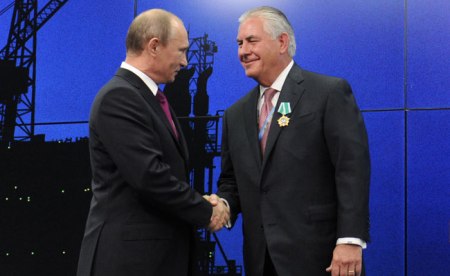
rex-tillerson-putin

Rex Tillerson, Chairman an CEO of Exxon Mobil, was named this week as the next administration’s Secretary of State to execute the tough foreign policies charted by president-elect Donald Trump, including his decision to stiffen the nuclear accord signed with Iran as soon as he moves into the White House on Jan. 20.

DEBKAfile reports this exclusively from New York and its intelligence sources.

While campaigning for the presidency, Trump called the accord “the worst deal” ever.

According to our sources, a special team is already working on revisions of the accord which the US and five other global powers concluded with Iran in 2015 in the hope of retarding Iran’s nuclear weapons program by a decade.

As new president, Trump will issue Tehran with a unilateral demand to accept those revisions as pre-condition for the continuation of relations between the US and Iran. He does not intend consulting America’s co-signers, Russia, China, Germany, Britain and France, or asking them for their endorsement of the revamped accord.

The teams preparing the Trump administration’s Iran policy were put in place last week by Tillerson and designated national security adviser Lt. Gen. Michael Flynn.

No members of the incumbent NSC, State Department, Pentagon or Treasury, who managed the Obama administration’s Iran policy, was invited to take part. The teams were instead chosen from among scientists, military leaders and intelligence officials who opposed the nuclear accord with Iran.

Also attached were former administration officials hired by Exxon for their extensive knowledge of Iran’s oil trade and their close ties with oil circles in the Gulf Emirates, which like Israel, fought hard to pre-empt the nuclear deal with Iran.

Our sources have also learned that if Iran rejects the revised accord, the president elect has a list of new economic sanctions drawn up which are a lot tougher than the sanctions regime imposed by the Bush and Obama administrations.

The incoming president will have a fight on his hands to get the Tillerson appointment through the Senate in the face of objections raised by Republican lawmakers over his ties with Russian President Vladimir Putin. However, Trump hopes to turn those ties to his advantage. He trusts that Tillerson is just the man to sell the new administration’s Iran policies to the Russian president.

Read more about Trump’s plans for his secretary of state in the coming issue of DEBKA Weekly (for subscribers) out on Friday. Dec. 16, 2016.

Iranian Official Reveals ‘Uncovering’ of Major US Cyber-Attack Plot — Failing to Mention Info Obtained From American Docu-Drama

December 13, 2016

Iranian Official Reveals ‘Uncovering’ of Major US Cyber-Attack Plot — Failing to Mention Info Obtained From American Docu-Drama, AlgemeinerRuthie Blum, December 12, 2016

maxresdefault-4-1024x576The slide of a clip in which ‘Zero Days’ is discussed. Photo: YouTube.

As The Algemeiner has reported extensively, Iranian officials have been issuing daily threats against Washington — particularly since last month’s election of Donald Trump to the presidency — about the Islamic Republic’s “fierce” response to any American breaches of the JCPOA, alongside muscle-flexing about the quality and quantity of its long-range missiles. Two weeks ago, the Senate passed a motion to extend the Iran Sanctions Act for an additional 10 years, which spurred the regime in Tehran to warn President Barack Obama not to approve the move.

********************

An Iranian Civil Defense Organization official announced on Monday that the United States is plotting a major cyber-attack on the Islamic Republic that will be more dangerous and wreak far more havoc that the Stuxnet virus, the semi-official state news agency Fars reported.

Addressing a conference in Tehran, Alireza Karimi said, “At present, the US has launched a project named Nitro Zeus with the aim of attacking Iran’s defense and telecommunication infrastructures.”

Karimi failed to mention, however, that he was actually referring to information revealed in “Zero Days,” an Alex Gibney docu-drama that premiered in July at the Berlin International Film festival. The film claimed that Nitro Zeus was developed as a backup plan in the event that Western efforts to curb Iran’s nuclear program by diplomatic means failed.

According to a description of the movie in the Tech Times, the major operation “took on great urgency as the [US] government believed that Israel Prime Minister Benjamin Netanyahu would launch a strike on the nuclear facilities of Iran, a move that would draw in the United States into the hostilities that [would] follow.”

However, the film claims that Nitro Zeus, the code name given to the mass malware operation that cost many millions of dollars, was shelved when the Joint Comprehensive Plan of Action — otherwise known as the nuclear deal — was signed between six world powers and Iran last year in July 2015.

In an extensive piece about the film, Newsweek wrote:

Gibney traces the development of Stuxnet to the last years of George W. Bush’s administration. It was a major operation, participants tell him, involving the CIA, the National Security Agency (NSA) and U.S. Cyber Command. On the Israeli side, it involved the Mossad…and Unit 8200, its military signals intelligence division. Britain’s General Communications Headquarters, its signals intelligence corps, also played a role. After the code for Stuxnet was written, it was tested both in the US and Israel on centrifuges identical to those used by Iranians. When CIA officials showed Bush the shards of a centrifuge that Stuxnet had destroyed, the president gave the OK to use it against Iran. The era of cyberwarfare had officially begun.

The participants who confirmed Stuxnet’s American and Israeli origins did so anonymously and off-camera, for fear of violating strict prohibitions against discussing classified information. That’s why Gibney used an actor…through [whom he] breaks his news in the film. “Stuxnet was just part of a much larger Iranian mission,” the character says… “Nitro Zeus would take out Iran’s strategic communications, air defenses, power grid, civilian communications, transportation and financial system…Nitro Zeus was the plan for a full-scale cyberwar with no attribution.”

Fars reported that Karimi’s remarks about Nitro Zeus came on the heels of a statement by the Civil Defense Organization chief, Brigadier General Mohammad Hassan Mansourian, who boasted his office’s capability to “defuse cyberattacks and cultural invasions.”

As The Algemeiner has reported extensively, Iranian officials have been issuing daily threats against Washington — particularly since last month’s election of Donald Trump to the presidency — about the Islamic Republic’s “fierce” response to any American breaches of the JCPOA, alongside muscle-flexing about the quality and quantity of its long-range missiles. Two weeks ago, the Senate passed a motion to extend the Iran Sanctions Act for an additional 10 years, which spurred the regime in Tehran to warn President Barack Obama not to approve the move.

Obama Admin Staking Iran Deal Legacy on Doomed Bid to Sell Tehran Aircraft

December 12, 2016

Obama Admin Staking Iran Deal Legacy on Doomed Bid to Sell Tehran Aircraft, Washington Free Beacon, , December 12, 2016

kerry-zarifJohn Kerry, Javad Zarif / AP

The Obama administration is locked in a last minute bid to save last year’s nuclear deal with Iran by promoting the delivery of airliners to the Islamic Republic, despite mass opposition in Congress that has moved the administration to engage in a series of public relations maneuvers and backroom deals meant to secure the multi-billion dollar sale, according to multiple sources familiar with the administration’s thinking who spoke to the Washington Free Beacon.

The Obama administration has been scrambling for weeks to provide Iran with assurances the United States will continue to grant Iran vast relief from economic sanctions and help push through deals with Boeing and AirBus, American and French airplane manufacturers, respectively. The effort comes as the nuclear deal hangs in the balance following a flood of Iranian threats and the election of Donald Trump, a vocal opponent of the deal, as well as several new moves by Congress to increase pressure on Tehran’s global terror operations.

Boeing confirmed Monday it sealed a $16 billion deal to sell Iran 80 jetliners, an announcement that sources told the Free Beacon was meant to provide momentum to the nuclear deal and stop Tehran from walking away.

Multiple sources familiar with the situation told the Free Beacon the administration is promoting a false prognosis and that the pact is likely to collapse by next year, when President-elect Trump assumes control of the White House and is partnered with a Congress that is more than willing to put a kibosh on the sale, which lawmakers say will embolden Iran’s terrorist forces.

“The Obama administration oversold the deal to the Iranians by secretly promising to relieve a range of sanctions that Congress was never going to agree to,” said one senior congressional adviser apprised of the White House’s thinking on the matter.

“The administration then did everything it could do unilaterally, including lifting restrictions on military assets and ballistic missile banks, to try to make good on those secret promises,” the source said. “But Congress was never going to allow Iran to steamroll across the Middle East, even if the Obama administration was willing to look the other way, and so the deal was always going to collapse under its own weight.”

The State Department would not provide more details about the deal, including how it is being financed, by press time.

Tehran has a long history of using its national air carrier, Iran Air, to ferry weapons and support to terror groups across the region, including in Lebanon and Syria. Despite these concerns, the Obama administration has fast tracked special licenses permitting Boeing and AirBus to move forward with the sales without violating sanctions barring such agreements.

Experts have repeatedly warned that Iran Air could easily resell these planes to other Iranian airline companies still targeted by sanctions for their illicit activities.

David Pasch, a spokesman for Rep. Peter Roskam (R., Ill.), who has worked to block the plane sales to Iran, told the Free Beacon that Congress will have an easy time killing the deal next year.

“We will aggressively fight this deal next Congress, though we probably won’t even need new legislation to do it,” Pasch said. “The incoming appointees at Treasury and State will no longer report to a White House willing to bend over backwards and ignore national security concerns to keep Iran from walking away from the nuclear deal.”

One senior congressional aide who works on the issue told the Free Beacon that the flurry of recent news stories casting the deal as a lock is part of a public relations campaign by the White House meant to given the appearance the deal is set in stone, despite multiple obstacles standing in the way.

“The administration is creating a facade of false assurances to assuage Iranian concerns about completing these sales,” the source told the Free Beacon. “They want, in essence, to make this a fait accompli. In reality, there are a number of obstacles in the way of completing this deal. For example, the House has already passed legislation to cut off Ex-Im [export-import] financing for aircraft sales to Iran. I think with a Trump administration we can reasonably expect renewed movement in Congress to block these dangerous deals.”

The planes are not set to be delivered to Iran until 2018, meaning that Congress and the next administration have a couple years to disassemble the deal. There also remain questions about how these Western companies will get financing to seal the deal with Iran, which remains a safe haven for terrorist financing.

These obstacles are expected to grow more daunting under a Trump administration, which has discussed increased transparency for companies willing to deal with regimes that sponsor terrorism such as Iran.

Another issue of top concern to opponents of the sale is a carve out guaranteeing Boeing engineers work with Iran to provide spare parts and technical know-how, a move that immunizes Tehran from future sanctions targeting the airline sector.

“The Obama administration created a fantasy world in which it’s safe to sell airplanes to Iran, then pulled Boeing into that fantasy world,” said the congressional adviser quoted above. “But it’s not safe to sell airplanes to Iran, because the Iranians use their airplanes for all sorts of illegal things, including arming Syria’s war machine. That’s why the sale stalled, because no one wanted to touch it. But the administration is desperate to make it look like the sale was moving forward, so that when it collapses they can blame it on Trump.”