Archive for the ‘Iran – sanctions relief’ category

Senate sends Iran sanctions bill to Obama with 99-0 vote

December 1, 2016

Senate sends Iran sanctions bill to Obama with 99-0 vote, Washington ExaminerSusan Crabtree, December 1, 2016

mcconnelSenate Majority Leader Mitch McConnell, R-Ky., said Thursday that the bill, which would preserve existing sanctions set to expire at the end of the year, is critical given Iran’s “continued pattern of aggression” and “efforts to expand its sphere of influence across the region.” (Graeme Jennings/Examiner)

The Obama administration has opposed the legislation, arguing that it already has the power to extend or impose additional sanctions on Tehran and the sanctions are no longer necessary after the nuclear deal.

********************

The Senate unanimously passed legislation Thursday that would extend sanctions on Iran for 10 years, a move many supported as a way to ensure the U.S. maintains its leverage over Iran in light of questions about its implementation of the Iran nuclear agreement.

The 99-0 Senate vote sends it along to the president’s desk for his signature. The vote came after the House overwhelmingly approved the measure, known as the Iran Sanctions Extension Act, two weeks ago in a 419-1 vote.

Senate Majority Leader Mitch McConnell, R-Ky., said Thursday that the bill, which would preserve existing sanctions set to expire at the end of the year, is critical given Iran’s “continued pattern of aggression” and “efforts to expand its sphere of influence across the region.”

“This is even more important given how the current administration has been held hostage by Tehran’s threats to withdraw from the nuclear agreement, and how it has ignored Iran’s overall efforts to upset the balance of power in the greater Middle East,” he said.

Under the nuclear agreement between Iran, the United States and five other world powers, many sanctions were lifted or eased in exchange for Iran’s agreement to roll back its nuclear program and an inspections regime to try to enforce it. The Obama administration and supporters of the deal insisted that sanctions could easily “snap back” if Iran was found to have violated the terms of the deal.

But critics argued that sanctions, once lifted, could not easily be re-imposed because foreign investors previously barred from doing business with Tehran before the nuclear pact couldn’t easily cancel contracts and abandon their financial ties to the country.

The U.S. sanctions, which Congress first passed in 1996, target any outside investments in Iran’s energy sector to prevent Tehran from developing nuclear weapons, and would have expired at the end of 2016 if Congress hadn’t acted.

In the months since the nuclear deal went into effect, Iran has complained that these non-nuclear related sanctions are preventing businesses from investing in the country, particularly the prohibition on Iranian access to the U.S. financial system. Tehran argues that the strict limits are preventing many companies from engaging in new business deals in Iran, in effect, subverting the economic benefits it expected the nuclear deal to produce.

Critics, however, countered that Iran is still suffering because foreign businesses are nervous about violating the new rules and risking U.S. sanctions on them and are reluctant to contribute to revenue to a top state sponsor of terrorist activity.

The Obama administration has opposed the legislation, arguing that it already has the power to extend or impose additional sanctions on Tehran and the sanctions are no longer necessary after the nuclear deal.

Members of Congress, including key Democrats, are adamant that the existing sanctions remain in effect in order to demonstrate to Iran that the U.S. will respond to any provocations or violations of the nuclear agreement.

New UN Security Council Resolution Strengthens Sanctions Against North Korea

December 1, 2016

New UN Security Council Resolution Strengthens Sanctions Against North Korea, Front Page MagazineJoseph Klein, December 1, 2016

kim

But Iran, freed of sanctions, is likely to be the spoiler.

The United Nations Security Council unanimously adopted Resolution 2321 (2016) on November 30th. It condemns the North Korean (DPRK) regime’s continued pursuit of nuclear weapons and ballistic missiles while its people continue to suffer under inhumane conditions. The resolution strengthens previous UN-imposed sanctions on the DPRK in response to its fifth nuclear test conducted on September 9, 2016.

The prior resolutions have failed to slow, much less eliminate, the DPRK’s nuclear program involving the development and testing of both nuclear device and ballistic missile capabilities. As UN Secretary General Ban Ki-moon pointed out in his remarks to the Security Council following the vote, “The Council first adopted a resolution on the DPRK nuclear issue in 1993. Twenty-three years and six sanctions resolutions later, the challenge persists.”

The new resolution is intended to put more of a financial squeeze on the DPKR regime than ever before by closing loopholes and cutting the DPRK off from sources of hard currency that can be used to fund its nuclear bomb and ballistic missile programs.

Most notably, the new resolution places tighter restrictions on the DPRK’s export of coal. There will now be an absolute cap on how much coal the DPRK can export per year, closing a loophole that had allowed an exemption from any coal export limitations so long as the transactions were determined to be exclusively for “livelihood” purposes. Member states must report all transactions promptly to the 1718 DPRK Sanctions Committee, which is directed to monitor total volumes and notify states when the allowed quantities have been reached and all procurement of coal from the DPRK must end.

The binding export cap will potentially cut the DPRK’s largest export, coal, by approximately $700 million per year from 2015 (more than 60%). Considering the fact that China is the DPRK’s principal purchaser of coal, the new restrictions agreed to by China are significant if fully implemented.

In addition, the new resolution imposes further restrictions on the sale or transfer of copper and other non-ferrous metals. It also places a ban on the supply, sale or transfer from the DPRK of statues, which has proven to be a lucrative source of hard currency needed by the regime. The resolution contains travel bans and assets freezes directed to individuals and entities not previously listed for such punitive actions, who are determined to be involved in the development, production, and financing of the DPRK’s nuclear weapons and ballistic missile programs, as well as the DPRK coal and conventional arms trade. There are more dual-use items, materials, equipment, goods and technology that will be subject to the embargo covering transfers to and from the DPRK.  Strict new sanctions on the DPRK’s illicit transportation activities are imposed.  Inspections of cargo transiting to and from the DPRK by rail, sea, air and road are to be expanded. And the new resolution contains further measures to isolate the DPRK from the global financial system and to prohibit financial support for trade with the DPRK in the form of export credits, guarantees, insurance and the like.

Resolution 2321 emphasizes, for the first time, a human rights dimension beyond the DPKR’s proliferation activities – the need for the DPRK to respect and ensure the inherent dignity of people in its territory. It also warns the DPRK that it is subject to being suspended from its UN rights and privileges.

U.S. Ambassador to the UN Samantha Power, who led the negotiations of the text primarily with her Chinese counterpart, heralded the new resolution. She said it “imposes unprecedented costs on the DPRK regime for defying this Council’s demands.” She admitted, however, that “No resolution in New York will likely, tomorrow, persuade Pyongyang to cease its relentless pursuit of nuclear weapons.” Ambassador Power stressed that for the resolution to have any material impact on the DPRK’s behavior “all Member States of this United Nations must fully implement the sanctions that we have adopted today.” Secretary General Ban Ki-moon, while lauding the new resolution for including “the toughest and most comprehensive sanctions regime ever imposed by the Security Council,” reinforced Ambassador Power’s admonition. He warned that “sanctions are only as effective as their implementation. It is incumbent on all Member States of the United Nations to make every effort to ensure that these sanctions are fully implemented.”

The problem with such an expectation for full implementation by all member states is Iran, which is known to have a tight collaborative relationship with the DPRK to bolster both countries’ nuclear weapons and missile programs. Iran has flouted UN Security Council resolutions in the past aimed at its own nuclear program. And despite the nuclear deal under which Iran is expected to curtail its nuclear program, it is continuing the testing and development of ballistic missiles designed to carry nuclear weapons. When I raised the concern about Iran’s relationship with the DPRK to Ambassador Power after she delivered some brief remarks to the press, she refused to answer my question and walked away. It is not surprising in this case why she ducked my question. The concessions President Obama and Secretary of State John Kerry made in order to reach agreement with Iran on the nuclear deal known as the Joint Comprehensive Plan of Action (JCPOA) have provided a huge loophole for Iran and the DPRK to exploit together.

More specifically, the JCPOA contains a long “Specially Designated Nationals” list of individuals and entities that will no longer be subject to previously instituted nuclear-related sanctions. This delisting includes entities involved in supporting Iran’s ballistic missile program, which Iran is now arguably freer to pursue thanks to other concessions offered by Obama and Kerry.

One of the entities removed from both the UN and U.S. sanctions lists is Bank Sepah, a large Iranian state-owned financial institution. Bank Sepah had been sanctioned by the U.S. Treasury Department back in 2007 for “facilitating Iran’s weapons program” and providing “support and services to designated Iranian proliferation firms.”   The bank had also been listed as an entity “involved in nuclear or ballistic missile activities” in UN Security Council Resolution 1747.

In addition to supporting Iran’s own missile program, Bank Sepah has also been involved, according to the U.S. Treasury Department, in transferring large sums of money from Iran’s Aerospace Industries Organization to a North Korean firm associated with the Korea Mining Development Trading Bureau (KOMID), “a North Korean entity designated for providing Iran with missile technology.”

The DPRK’s Tanchon Commercial Bank, which has been designated by the US and the UN Security Council for sanctions due to its suspected proliferation-related activities, has served as the financial arm for KOMID.  “Since 2005,” according to a statement issued several years ago by the Treasury Department, “Tanchon has maintained an active relationship with various branches of Iran’s Bank Sepah…the U.S. has reason to believe that the Tanchon-Bank Sepah relationship has been used for North Korea-Iran proliferation-related transactions.”

Bank Sepah now is no longer hobbled by sanctions as a result of the JCPOA and a follow-up Security Council resolution endorsing the JCPOA and terminating the previous UN sanctions resolutions against Iran. This means not only more funding for Iran’s missile program, which Iran is continuing to pursue without any consequences. It also means a potential source of hard currency for North Korea’s nuclear program – precisely the opposite of what Ambassador Power said was the intent of the new DPRK Security Council sanctions resolution. And this is only scratching the surface of how the unfreezing of billions of dollars of Iranian assets and removal of sanctions on Iranian entities involved in nuclear-related activities, which have had ties with North Korean entities involved in nuclear-related activities, will help accelerate the nuclear weapons and missile programs of both rogue regimes.

In short, for the Obama administration, “The one hand giveth; the other hand taketh away.” Hopefully, the new Trump administration will do a better job in connecting the dots in the dangerous collaborative relationship between Iran and the DPKR and undo the damage the Iran nuclear deal is likely to do in helping to further that relationship.

Intel: Iran Using Commercial Planes to Smuggle Weapons to Terrorists

November 24, 2016

Intel: Iran Using Commercial Planes to Smuggle Weapons to Terrorists, Washington Free Beacon, November 24, 2016

(Please see also, Israel: Iran is smuggling weapons to Hezbollah on commercial flights  — DM)

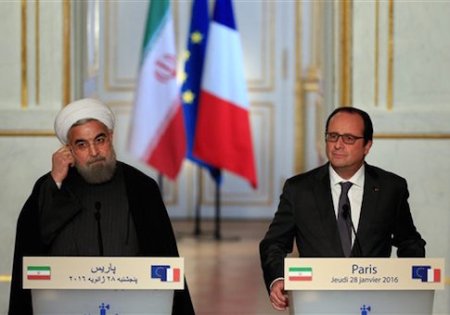
France's President Francois Hollande, right, and Iranian President Hassan Rouhani give a press conference, at the Elysee Palace, in Paris, Thursday, Jan. 28, 2016. Iran Air has signed a deal to buy 118 aircraft from Airbus in the first of an expected host of commercial deals expected to be announced during the visit of Iranian President Hassan Rouhani to Paris. (AP Photo/Thibault Camus)

France’s President Francois Hollande, right, and Iranian President Hassan Rouhani give a press conference, at the Elysee Palace, in Paris, Thursday, Jan. 28, 2016. Iran Air has signed a deal to buy 118 aircraft from Airbus in the first of an expected host of commercial deals expected to be announced during the visit of Iranian President Hassan Rouhani to Paris. (AP Photo/Thibault Camus)

The Obama administration has given clearance to Western airline manufacturers to sell planes to Iran at the same time the Islamic Republic is using commercial airliners to smuggle weapons and other illicit arms to Hezbollah terrorists in Lebanon, according to new intelligence and congressional communications obtained by the Washington Free Beacon.

The disclosure of this new intelligence, which shows that Iran has been using its commercial airline company to smuggle advanced weaponry to Hezbollah and terrorists operating in Syria, has placed renewed focus on a congressional inquiry that has been stymied by Obama administration officials since early October.

Senators, led by Sen. David Perdue (R., Ga.), have been pushing Obama administration officials to explain why they are helping airline manufacturers Boeing and AirBus sell planes to Iran, despite clear evidence that Tehran is using its commercial airline as cover for its continued terrorist operations across the region.

As with multiple other congressional investigations into the Obama administration’s efforts to roll back economic sanctions and conduct secret dealings with Iran, officials have stonewalled Perdue, refusing to answer key questions about the motivation for aiding Tehran’s pursuit of planes that could be used to further its terrorist enterprise.

This new intelligence comes just days after the Obama administration approved a second license for AirBus, a French company, to pursue even more sales with Iran.

The Free Beacon recently disclosed that several American-made planes are currently being flown by Iran’s Air Force, while other jets are being used in its commercial sector to smuggle arms.

Perdue on Wednesday accused the Obama administration of facilitating Iran’s terrorist operations by signing off on the multi-billion dollar deals to sell Iran planes, according to a letter sent to the Treasury Department, which oversees such sales, and obtained by the Free Beacon.

The senator chided the department for ignoring his initial Oct. 6 request for information, describing this lack of response as “troubling.”

“While I find your lack of a response to our last letter troubling, I would not that the issue surrounding commercial aircraft usage for illicit purposes by the Iranian regime has now expanded, given new intelligence information alleging that Iran has indeed been using Mahan Air — a commercial airline that is currently subject to U.S. and UN sanctions — to smuggle weapons and ammunition to Hezbollah in Lebanon,” Perdue writes.

New intelligence unearthed by the Israelis and disseminated to United Nations Security Council members in an “urgent letter” shows that Iran has been using Mahan Air to smuggle a large quantity of arms into Lebanon, where they are then transferred to Hezbollah, which remains committed to destroying the Jewish state.

“These planes fly directly to the airport in Lebanon or Damascus and from there the weapons are transferred on the ground to Hezbollah,” according to the letter sent by Israeli officials to U.N. Security Council members.

This includes weapons, ammunition, and missile technology to Hezbollah, which is placed inside suitcases and placed on Mahan’s commercial flights.

The intelligence further shows that Hezbollah now has about 12,000 missiles hidden underground in Lebanon, or “more than 17 times the number of missiles it possessed 10 years ago, and more than the European NATO allies have above the ground,” according to Perdue’s letter.

The intelligence appears to confirm fears by many in Congress that the easing of airline sales to Iran by the Obama administration will directly fuel Tehran’s global terrorist operation, according to the senator.

“This report confirms precisely the fear we expressed in our October 6 letter: that Iran continues to use commercial aircraft to smuggle weapons and ammunition in violation of UN Security Council Resolution 2231 to support its terrorist proxies,” Perdue wrote, referring to the UN resolution currently governing last year’s comprehensive nuclear deal with Iran.

“We are rightly concerned that Iran may continue to do so with the new commercial aircraft it purchases from Boeing and Airbus, as permitted by the U.S. Treasury Department,” the letter stated.

Despite this intelligence, the Obama administration continues to sign off on and endorse these sales to Iran.

“I was also disturbed to see that Airbus, one of the companies seeking licenses for the sale of commercial aircraft to the government of Iran, was just awarded a second license from U.S. Office of Foreign Asset Control (OFAC) to sell up to 118 jets to Iran,” Perdue wrote. “To echo the concerns of our last letter, what, if any, end-use monitoring controls can you guarantee will follow this license to ensure that these aircraft are not used to further support Iran’s terrorist proxies or support for the Assad regime in Syria?”

One senior congressional aide familiar with the matter told the Free Beacon that the Obama administration’s permissive attitude towards Tehran has only emboldened its bad behavior.

“The sanctions relief President Obama agreed to has allowed Iran to ramp up support for its destructive ambitions,” the source said. “Given this recent discovery by [Israeli U.N.] Ambassador Danon, President Obama and Congress shouldn’t wait to see what this rogue nation has planned for this massive increase in commercial aircraft.”

“It’s been nearly a year since the implementation of President Obama’s nuclear deal and we’ve seen Iran become increasingly aggressive in its support of terrorism,” the source noted. “In fact, Iran is still the number one state sponsor of terrorism. If this isn’t a symptom of a failed deal, what is?”

Will Team Trump Air Obama’s Iran Secrets?

November 21, 2016

Will Team Trump Air Obama’s Iran Secrets? Power Line, Paul Mirengoff, November 21, 2016

For years, Republicans and conservatives have charged that President Obama has shielded embarrassing intelligence and other information regarding Iran in order to limit opposition to the Iran nuclear deal and Obama’s conciliatory approach to Tehran. The charge seems well-founded. After all, it took Sens. Tom Cotton and Rep. Mike Pompeo to discover secret side agreements attached to the nuclear deal.

Eli Lake suggests that the Trump administration may well stop covering for the mullahs. Certainly, as Lake argues, Trump’s early high level personnel picks suggest so.

Trump’s nominee for CIA Director is none other than Mike Pompeo. Not only did he and Sen. Cotton uncover side deals to the nuclear agreement, he also pressed hard for answers about the cash payments the U.S. delivered to the mullahs in exchange for the release of hostages.

Pompeo wrote to Attorney General Lynch asking for answers as to how the cash payments were approved by the Justice Department. Lynch stonewalled him. Perhaps Jeff Sessions will be more cooperative.

Mike Flynn is the other key appointment for purposes of airing Obama’s Iran secrets. Lake points out that in 2011 General Flynn ran a team at the Office of the Director of National Intelligence that reviewed the troves of material captured in the 2011 Osama bin Laden raid.

Under Obama, only a small fraction of these documents have been declassified and released. After he retired from the military, Flynn charged that the disclosures were selective.

Flynn noted, for example, that some documents captured in the bin Laden raid show a much tighter relationship between Iran and al-Qaeda than previously disclosed. In The Field of Fight: How We Can Win the Global War Against Radical Islam and Its Allies (written with Micheal Ledeen), Flynn states: “One letter to bin Laden reveals that al-Qaeda was working on chemical and biological weapons in Iran.”

Given Obama’s desire to deal with Iran and, indeed, for a rapprochement, you can see why the administration shielded such intelligence. Given the well-deserved contempt by Pompeo and Flynn for Obama’s Iran policy, you can see why they might want relevant facts to come to light. As a general matter, these are facts the public has a right to know.

If such facts are made public, Obama won’t have much standing to complain. Lake reminds us:

Obama himself in 2008 campaigned against the sitting president’s policies on waterboarding and enhanced interrogation. One of the first things his government did when he took office was to declassify and release the legal memos that justified and revoked these practices.

It looks like the Republicans are about to return the favor.

Congress: Attorney General Lynch ‘Pleads Fifth’ on Secret Iran ‘Ransom’ Payments

October 28, 2016

Congress: Attorney General Lynch ‘Pleads Fifth’ on Secret Iran ‘Ransom’ Payments, Washington Free Beacon, October 28, 2016

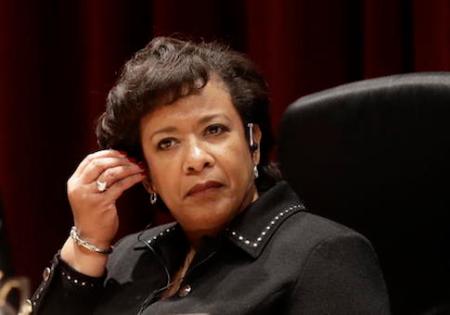
US attorney general, Loretta E. Lynch attends a conference on organised crime in Rome, Thursday, Oct. 20, 2016. (AP Photo/Gregorio Borgia)

US attorney general, Loretta E. Lynch, AP Photo/Gregorio Borgia

Attorney General Loretta Lynch is declining to comply with an investigation by leading members of Congress about the Obama administration’s secret efforts to send Iran $1.7 billion in cash earlier this year, prompting accusations that Lynch has “pleaded the Fifth” Amendment to avoid incriminating herself over these payments, according to lawmakers and communications exclusively obtained by the Washington Free Beacon.

Sen. Marco Rubio (R., Fla.) and Rep. Mike Pompeo (R., Kan.) initially presented Lynch in October with a series of questions about how the cash payment to Iran was approved and delivered.

In an Oct. 24 response, Assistant Attorney General Peter Kadzik responded on Lynch’s behalf, refusing to answer the questions and informing the lawmakers that they are barred from publicly disclosing any details about the cash payment, which was bound up in a ransom deal aimed at freeing several American hostages from Iran.

The response from the attorney general’s office is “unacceptable” and provides evidence that Lynch has chosen to “essentially plead the fifth and refuse to respond to inquiries regarding [her] role in providing cash to the world’s foremost state sponsor of terrorism,” Rubio and Pompeo wrote on Friday in a follow-up letter to Lynch, according to a copy obtained by the Free Beacon.

The inquiry launched by the lawmakers is just one of several concurrent ongoing congressional probes aimed at unearthing a full accounting of the administration’s secret negotiations with Iran.

“It is frankly unacceptable that your department refuses to answer straightforward questions from the people’s elected representatives in Congress about an important national security issue,” the lawmakers wrote. “Your staff failed to address any of our questions, and instead provided a copy of public testimony and a lecture about the sensitivity of information associated with this issue.”

“As the United States’ chief law enforcement officer, it is outrageous that you would essentially plead the fifth and refuse to respond to inquiries,” they stated. “The actions of your department come at time when Iran continues to hold Americans hostage and unjustly sentence them to prison.”

The lawmakers included a copy of their previous 13 questions and are requesting that Lynch provide answers by Nov. 4.

When asked about Lynch’s efforts to avoid answering questions about the cash payment, Pompeo told the Free Beacon that the Obama administration has blocked Congress at every turn as lawmakers attempt to investigate the payments to Iran.

“Who knew that simple questions regarding Attorney General Lynch’s approval of billions of dollars in payments to Iran could be so controversial that she would refuse to answer them?” Pompeo said. “This has become the Obama administration’s coping mechanism for anything related to the Islamic Republic of Iran—hide information, obfuscate details, and deny answers to Congress and the American people.”

“They know this isn’t a sustainable strategy, however, and I trust they will start to take their professional, and moral, obligations seriously,” the lawmaker added.

In the Oct. 24 letter to Rubio and Pompeo, Assistant Attorney General Kadzik warned the lawmakers against disclosing to the public any information about the cash payment.

Details about the deal are unclassified, but are being kept under lock and key in a secure facility on Capitol Hill, the Free Beacon first disclosed. Lawmakers and staffers who have clearance to view the documents are forced to relinquish their cellular devices and are barred from taking any notes about what they see.

“Please note that these documents contain sensitive information that is not appropriate for public release,” Kadzik wrote to the lawmakers. “Disclosure of this information beyond members of the House and Senate and staff who are able to view them could adversely affect the diplomatic relations of the United States, including with key allies, as well as the State Department’s ability to defend [legal] claims against the United States [by Iran] that are still being litigated at the Hague Tribunal.”

“The public release of any portion of these documents, or the information contained therein, is not authorized by the transmittal of these documents or by this communication,” Kadzik wrote.

Congressional sources have told the Free Beacon that this is another part of the effort to hide details about these secret negotiations with Iran from the American public.

One senior congressional source familiar with both the secret documents and the inquiry into them told the Free Beacon that the details of the negotiations are so damning that the administration’s best strategy is to ignore lawmakers’ requests for more information.

“Every Obama administration official and department involved in the Iran Deal appear to be running for cover,” the source said. “Like we feared, the [Iran deal] is turning out to be a disaster and Iran is emboldened in its aggression. Evidently Attorney General Lynch and the Department of Justice have decided ‘refusal to cooperate’ is their best strategy. But this is dangerous and ultimately won’t protect them from anything.”

Update: The headline has been updated to more accurately characterize the story.

Venezuela, Iran, USA and Narco-Terrorism

October 13, 2016

Venezuela, Iran, USA and Narco-Terrorism, Gatestone Institute, Susan Warner, October 13, 2016

There are an estimated six million Muslims living in Latin American cities, who provide a fertile terrorist recruiting environment.

“Iran has opened up more than 80 cultural centers in Latin America in order to export its toxic brand of political influence and serve its interest, focusing on partnering with nations well known for their anti-American rhetoric including Venezuela, Argentina, Bolivia, Ecuador, and Nicaragua.” — US Rep. Ileana Ros-Lehtinen, in testimony for the House Sub-Committee on the Middle East and North Africa.

Amidst the unspeakable economic distress facing residents of Venezuela today, security experts have identified yet another major cause for concern emanating from this once prosperous, oil-rich nation: Iran is moving in, partnering with Venezuela’s prosperous drug traders and creating a foothold there, as well as in other “friendly” Latin American countries. Iran is laundering money in Latin America and presumably secretly plotting to accomplish a strategic long-term goal to penetrate the Western hemisphere.

Iran’s terrorist activities, its partnership with Venezuelan drug traffickers and the general criminal atmosphere affects the citizens of Caracas so much that people reportedly are fearful of even going to the store to wait in the endless lines for food.

In Venezuela, security analysts say, the corruption starts at the very top with President Nicolas Maduro himself, who is looking frantically for money in every crevasse to keep the nation and his presidency afloat. Reports estimate that in Venezuela one police officer dies every day and the number of homicides per capita in Caracas is the highest in the world.

National crime statistics, however, seem to be just the start: deeper and more alarming than the Venezuelan homicide toll, there appears to be an imminent threat to the entire Western hemisphere from partnerships between Venezuelan drug traffickers and terrorist networks like Hamas and Hezbollah, two groups that act a proxies for Iran.

Together, terrorism and illegal drugs represent a significant export for Venezuela. Iran and Venezuela partner together to move terrorist cells and drugs to hubs in the United States and throughout North America.

This alliance has already come to the attention of the House Sub-Committee on the Middle East and North Africa; in 2015, Chairwoman Ileana Ros-Lehtinen headed a hearing entitled, “Iran and Hezbollah in the Western Hemisphere.”

“Drug trafficking funds terrorism,” said Ros-Lehtinen. “The need for a comprehensive strategy must address this fundamental cause of the problem.”

“Recent reports of the connections between Hezbollah and the FARC [Colombia]; the murder of the special prosecutor of Argentina, Alberto Nisman, and the alleged conspiracy between the Argentine Government, Venezuela and Iran to cover up Hezbollah’s activities and involvement in the AMIA [Jewish Community Center] bombing do nothing to quell doubts about Iran’s activities in Latin America.”

Through its Islamic Revolutionary Guard Corps (IRGC) and Hezbollah, Iran’s terrorist proxy in Lebanon, Iran is spreading its roots through legitimate enterprise “laundries” throughout Latin America.

Iran has set up banking entities, embassies, cultural centers and business enterprises, through which it is building an infrastructure to advance expansionist strategies.

Vanessa Neumann wrote in 2011:

“Besides its sponsored terrorist groups, Iran also has a growing direct influence in Latin America, spurred by three principal motivations: 1) a quest for uranium, 2) a quest for gasoline, 3) a quest for a base of operations that is close to the US territory, in order to position itself to resist diplomatic and possible military pressure, possibly by setting up a missile base within striking distance of the mainland US, as the Soviets did in the Cuban Missile Crisis”

“FARC in Columbia, Hezbollah in Lebanon and Al Qaeda all have training camps, recruiting bases and networks of mutual assistance in Venezuela as well as throughout the continent,” the Foreign Policy Research Institute reported.

Jaime Daremblum wrote in 2011:

“An official involved in the fight against terrorism said that the relation between Venezuela and Iran is becoming a strategic association. How to explain otherwise reported regular flights between Caracas and Tehran, for which no tickets are sold and no immigration or customs inspections are required?”

Rachel Ehrenfeld, in her 1990 book on terrorism funding (page xiii), defined the term “narco-terrorism” as “the use of drug trafficking to advance the objectives of certain governments and terrorist organizations.” Two decades after the book’s publication, the term narco-terrorism has almost become a household word, with Venezuela as a hub of activity in the Western hemisphere.

A U.S. State Department report stated:

“Venezuela remained a major drug-transit country in 2014. Venezuela is one of the preferred trafficking routes for illegal drugs from South America to the Caribbean region, Central America, the United States, Western Africa, and Europe, due to its porous western border with Colombia, weak judicial system, sporadic international counternarcotics cooperation, and permissive and corrupt environment.”

Hezbollah’s annual budget of more than 100 million dollars is provided by the Iranian government directly and through a complex system of finance cells scattered around the world, from Bangkok and Paraguay to Michigan and North Carolina.

Far from being the passive beneficiaries of drug-trafficking expats and sympathizers, Hezbollah has high-level officials directly involved in the South American cocaine trade and its most violent cartels, including the Mexican crime syndicate Los Zetas. Hezbollah’s increasing foothold in the cocaine trade is facilitated by an enormous Lebanese diaspora.

There are an estimated six million Muslims living in Latin American cities, who provide a fertile terrorist recruiting environment. Vanessa Neumann writes:

“The Free Trade Zones of Iquique, Chile; Maicao, Colombia; and Colón, Panama, can generate undetected financial and logistical support for terrorist groups. Colombia, Bolivia, and Peru offer cocaine as a lucrative source of income. In addition, Cuba and Venezuela have cooperative agreements with Syria, Libya, and Iran.”

Iran’s Islamic Revolutionary Guards Corps (IRGC) was established by Ayatollah Khomeini in 1979. Today it plays a leading role in Iran’s expansionist enterprises. The IRGC has become a wide-ranging political, social, and economic corporation — with holdings in industry, security, energy, construction, and communications. It is the most robust economic organization in the country. According to reports, many of its former members currently hold senior political and bureaucratic positions in the Iranian government.

According to a 2013 report in Military and Strategic Affairs:

“… the Revolutionary Guards are active on two major complementary levels. First, the organization leads the efforts to export the Iranian Islamic Revolution, seeking to expand the republic’s political, ideological, and religious influences in the Middle East, Central Asia, Africa, and Latin America. Secondly, the Revolutionary Guards continuously exert efforts to undermine the influence of the United States in the Middle East by harming the superpower’s regional interests and its allies. … the Revolutionary Guards make extensive global use of asymmetrical strategies in their struggle against the West and its allies, preferring tactics of subversion and terrorism.”

The Quds Force, an arm of IRGC, is in charge of exporting the Islamic Revolution and organizing terrorist and subversive activity against Iran’s enemies, according to a 2013 report from theAmerican Center for Democracy

The Quds Force uses proxies as a way to disguise Iran’s involvement in terrorist activity. The force’s most prominent ally is the Lebanese Hezbollah, which was established in 1982 with the help of the Revolutionary Guards.

Alongside their efforts to battle their own serious homegrown drug problems in Iran, the Revolutionary Guards are also reportedly working to harness the strategic and tactical potential of the international drug trade in order to advance Iran’s expansion.

Venezuela and Iran seem to have been friendly since the establishment of the Organization of Petroleum Exporting Countries (OPEC) in 1960. They have been reinforcing their bonds since May 2001, when then President Hugo Chavez paid a visit to Tehran. There he coordinated their anti-Western narrative, stressing opposition to all forms of “imperialism and oppression” in the Third World — a code for “lets agree to stay away from any relationship with Western capitalist powers: the United States, Israel and their allies”. This “anti-imperialist” mantra has been used by both Chavez and his successor, Nicolas Maduro, along with Iran as a unifying cry against the U.S. and its allies.
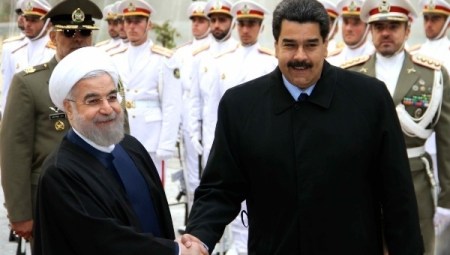
1944Venezuelan President Nicolas Maduro (right) meets with Iranian President Hassan Rouhani in Tehran, January 10, 2015. (Image Source: TeleSUR video screenshot)

According to the testimony of Ileana Ros-Lehtinen:

“Iran has opened up more than 80 cultural centers in Latin America in order to export its toxic brand of political influence and serve its interest, focusing on partnering with nations well known for their anti-American rhetoric including Venezuela, Argentina, Bolivia, Ecuador, and Nicaragua.”

Hamas and Hezbollah, both Iranian proxy terrorist groups, have also established offices in Caracas.

Representatives Ileana Ros-Lehtinen, Jeff Duncan and others say this is an appropriate time for the United States to pay more attention to activities happening in its own backyard.

The Need for a U.S. Response

In his statement to the House Committee on Foreign Affairs, Rep. Jeff Duncan asserted at the 2015 hearing, that the U.S. and its allies must do more to counter Iran’s goals to develop nuclear weapons, export terrorism and develop alliances with the narcotics trade.

Since the (unfortunate) approval of “Iran Nuclear Deal” in 2015, the United States has largely dissolved international sanctions against Iran, which leaves the IRGC free to make uninhibited alliances with networks of transnational organized crime organizations to finance its aspirations. Along with United States’ recent payment of $1.5 billion to Iran, there may be a grave risk to our own national security as Iran marches north from Venezuela into Central America and further into the United States through our southern border with Mexico.

In 2015, according to the US Department of State, U.S. President Barack Obama determined that Venezuela had failed to adhere to its obligations under international counternarcotics agreements. Even so, the US issued a waiver, allowing for continued assistance to be granted to Venezuela “in the interest of U.S. national security“.

The State Department admits that Venezuelan authorities do not effectively prosecute drug traffickers, in part due to their political corruption. Additionally, Venezuelan law enforcement officers lack the equipment, training, and resources required to significantly impede the operations of major drug trafficking organizations.

The U.S. Treasury Department has sanctioned multiple Venezuelan banks and Venezuelan regime operatives, including the former Minister of Interior and Justice. The U.S. State Department has cited Venezuela’s state-owned oil company, PDVSA, and CAVIM, the Venezuelan weapons company, for their role in helping Iran circumvent the sanctions that the U.S. has now lifted altogether.

At the same time, the U.S. administration continues to purchase 10% of its oil (roughly 300 million barrels per year) from Venezuela, the same entity that it sanctioned in 2011 for shipping gasoline to Iran.

This is all happening while terrorist groups are regularly connecting to drug cartels in the region, and forging a deepening narco-terror machine that in turn is funding terrorist activities.

While the US administration — apparently in denial about the clear threats posed by Iran’s expansionist and nuclear aspirations — dismisses Israel’s concerns as “hysteria,” Iran quietly continues its unfettered march westward.

New Report Shows Iran’s Revolutionary Guards Profiting from Iran Deal

October 5, 2016

New Report Shows Iran’s Revolutionary Guards Profiting from Iran Deal, Counter Jihad, October 5, 2016

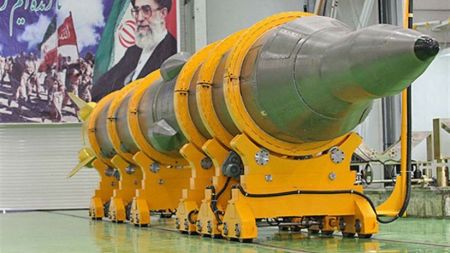
iranian-nuclear-weapon

A new report from the Foundation for the Defense of Democracies showcases the ways in which Iran’s Revolutionary Guards Corps (IRGC) has benefited from the so-called nuclear deal.  This deal, which Congress never voted to approve nor reject, and which the Iranian government fundamentally altered rather than accepting, has nevertheless led to a vast transfer of wealth to Iran.  Much of that wealth has fallen right in the hands of the IRGC, which oversees Iran’s terrorist and military nuclear programs.

Here at CounterJihad, we have covered the problems withIran’s nuclear deal somewhat extensively.  The Foundation for Defense of Democracies report’s conclusions will thus be of little surprise to our regular readers.  However, it does include additional detail on the degree to which Iran’s corporate and business ventures are secretly dominated by IRGC elites.  As the report says:

[IRGC abuses] did not stop France’s mobile phone giant, Orange, from beginning talks with Iran’s largest mobile phone operator, Mobile Telecommunication Company of Iran (MCI), over acquiring a stake in the Iranian company. The IRGC controls MCI through a 50-percent-plus-one stake in its parent company, the Telecommunication Company of Iran (TCI).  In short, whether its internal security, foreign adventures, or large corporate ventures, the IRGC plays an outsized role in Iran’s internal power structure. Established in 1979 to consolidate the Islamic revolution and fight its enemies, the IRGC has evolved over the years into a full-fledged conventional army, conducting and directing terrorist activity abroad. The Guard has also become a political power broker, an economic conglomerate, and an agency in charge of nuclear and ballistic-missile proliferation….  IRGC revenues from economic activities yield the necessary resources and political leverage to place its members in positions of power. Conversely, the Guard’s political power serves the economic enterprises it owns, and both its political and economic weight in turn advance its military projects.

The IRGC’s corporate activity offers revenue to the organization in the same way that its control of narcotics within Iran does.  However, whereas the narcotics are often passed on to Hezbollah to be turned into heroin, corporate profits can be rolled over into apparently legitimate enterprises that have useful military applications.  That allows Iran a backdoor to internationally-developed advanced weaponry and so-called “dual use” technologies.  These are technologies that have both a legitimate purpose, but also an application to Iran’s nuclear program.

Their space program is an excellent example of the way in which a legitimate purpose can mask development of nuclear weapons:  the same technologies involved in building space rockets that can deploy satellites in particular orbits can also be used to develop ballistic missiles that will deliver nuclear warheads to particular cities.  The New York Times reported in September that the biggest engine in North Korea’s nuclear missile program seems to have been developed in partnership with Iran.  Iran’s version is “nuclear-capable,” but the North Korean version makes no pretense about its intentions.

The potential links to Iran complicate the issue. Iran has ignored a United Nations Security Council resolution, passed in conjunction with last year’s agreement freezing its nuclear program, to refrain from tests of nuclear-capable missiles for eight years.  The Obama administration has not sought sanctions, knowing they would be vetoed by Russia and China, nor has it said much in public about the details of the cooperation on the new rocket engine.

Nor are they likely to do so, given how much of the administration’s prestige is tied up with the so-called nuclear deal.  It is worth noting, however, that the effect of the deal has been to embolden Iran — and North Korea, and Russia, and America’s enemies in general.

Obama Admin Secretly Facilitated Iranian Ballistic Missile Program

October 4, 2016

Obama Admin Secretly Facilitated Iranian Ballistic Missile Program, Washington Free Beacon, , October 4, 2016

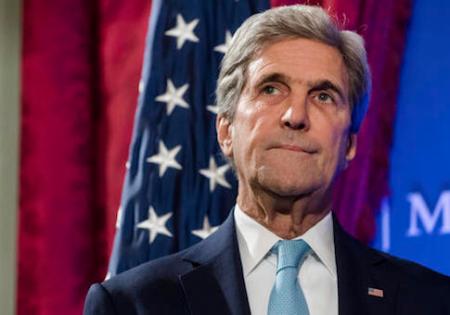
U.S. Secretary of State John Kerry smiles during a speech on the future of "Transatlantic Relations" during an event hosted by The German Marshall Fund (GMF) and the U.S. Mission to the EU at Concert Noble in Brussels, Tuesday, Oct. 4, 2016. Kerry is in Brussels for a two-day conference, hosted by the EU, with the participation of over 70 countries to discuss the current situation in Afghanistan. (AP Photo/Geert Vanden Wijngaert)

U.S. Secretary of State John Kerry smiles during a speech on the future of “Transatlantic Relations” during an event hosted by The German Marshall Fund (GMF) and the U.S. Mission to the EU at Concert Noble in Brussels, Tuesday, Oct. 4, 2016. AP Photo/Geert Vanden Wijngaert

The Obama administration misled journalists and lawmakers for more than nine months about a secret agreement to lift international sanctions on a critical funding node of Iran’s ballistic missile program, as part of a broader “ransom” package earlier this year that involved Iran freeing several U.S. hostages, according to U.S. officials and congressional sources apprised of the situation.

The administration agreed to immediately lift global restrictions on Iran’s Bank Sepah—a bank the Treasury Department described in 2007 as the “linchpin of Iran’s missile procurement”–eight years before they were to be lifted under last summer’s comprehensive nuclear agreement. U.S. officials initially described the move as a “goodwill gesture” to Iran.

The United States also agreed to provide Iran $1.7 billion in cash to release or drop charges against 21 Iranians indicted for illegally assisting Tehran. Full details of this secret agreement were kept hidden from Congress and journalists for more than nine months, multiple sources told theWashington Free Beacon.

State Department officials who spoke to the Free Beacon now say the United States “already made” the decision to drop U.S. sanctions, but declined to address multiple questions aimed at clarifying the discrepancy between past and current explanations for dropping international sanctions.

The Free Beacon first reported on these terms in January, including the dropping of international sanctions on Bank Sepah.

State Department officials told the Free Beacon at the time that the settlement with Iran, including the $1.7 billion cash award, was “not related” to “the release of the U.S. citizens from Iran.”

U.S. officials last week confirmed to the Wall Street Journal that in fact the dropping of sanctions on Bank Sepah “was part of a package of tightly scripted agreements” surrounding the release of the U.S. citizens from Iran.

When asked about the discrepancies between these statements, a State Department official would not elaborate, instead telling the Free Beacon, “The U.S. government had already made the determination that it would remove Bank Sepah from our domestic Specially Designated Nationals and Blocked Persons List on Implementation Day, which was outlined clearly in the JCPOA [nuclear deal] itself in July 2015.”

“We made this determination after a careful review of the activity of all individuals and entities—including Bank Sepah—that would be removed from the SDN list,” the official explained. “Although we removed Bank Sepah from the U.S. SDN list, Bank Sepah will continue to be cut off from the U.S. financial system and its funds under U.S. jurisdiction will remain blocked. Furthermore, we have the ability to quickly reimpose additional U.S. sanctions if Bank Sepah or any other entity engages in activities that remain sanctionable.”

The Free Beacon was not the only publication that was provided with misleading information by the Obama administration.

U.S. officials told Al Monitor in late January that the move to cancel international sanctions on Bank Sepah at the United Nations was undertaken by Venezuela without U.S. action.

“We already made the decision to delist this bank as part of U.S. secondary sanctions as part of the nuclear deal,” the official added, claiming the United States only agreed “not to oppose the delisting at the U.N., which Iran very much wanted.”

Senior Iranian officials said in January that the $1.7 billion payment and delisting of Bank Sepah were part of the agreement to free U.S. hostages, a charge the Obama administration denied at the time.

“The annulment of sanctions against Iran’s Bank Sepah and reclaiming of $1.7mln of Iran’s frozen assets after 36 years showed that the U.S. doesn’t understand anything but the language of force,” Mohammad Reza Naqdi, commander of Iran’s Basij Volunteer Force, told Iran’s state-controlled press in early February.

Senior congressional sources apprised of the matter told the Free Beacon that these latest revelations provide further proof of the administration’s intentional bid to deceive the public about its dealings with Iran.

“Facts are facts, no matter how much the administration tries to hide them,” said one senior congressional aide involved in investigating the matter. “Journalists and Members of Congress are on the trail and have already uncovered so much, including the cash payment of almost $2 billion to the world’s largest state sponsor of terrorism as a ransom for four American hostages. The truth, no matter how disturbing it is, will continue to come out.”

“This should eliminate any remaining doubt that the administration paid a ransom to Iran,” said another source familiar with the issue. “Why else would they keep Congress and the American people in the dark about this unprecedented concession? President Obama’s continued capitulation to the Iranian regime is a hazard to our national security.”

Another source who serves as a senior adviser to Congress and is familiar with the administration’s thinking told the Free Beacon that the Obama administration misled the public to avoid sparking outrage over its decision to drop sanctions on the top funder of Iran’s ballistic missile program.

“The Obama administration couldn’t tell the American public that it had just unleashed Iran’s ballistic missile program as one part of an enormous ransom extracted by Iran,” the source said. “So instead they ran to friendly reporters to misleadingly boast about how successful their diplomacy was, while they were bribing Iran with billions of dollars and military concessions to stay at the table.”

The Foundation for Defense of Democracies, a Washington, D.C.-based think tank, described the administration’s move as putting Iran’s ballistic missile program “back in business.”

“It represents a unilateral dismantling of the international ballistic missile embargo against the Islamic Republic,” FDD wrote in a recent policy analysis. “Iran’s preferred missile-financing bank is back in business.”

Iran has test fired multiple ballistic missiles since the nuclear deal was implemented, despite international restrictions on this type of activity.

In NBC Interview, Hassan Rouhani Can’t Stop Lying

October 2, 2016

In NBC Interview, Hassan Rouhani Can’t Stop Lying, The TowerDavid Gerstman, October 2, 2016

(Rouhani and Hillary would make a good team for Iran. DM)

rouhanilies

The portrait that emerges from Rouhani’s interview is of a man who lies and distorts to defend Iran’s illicit behavior— with its domestic nuclear program and in Syria. Simply put, Rouhani is not a “moderate,” as he is so often described, but an apologist for Iran’s revolutionary regime that operates in defiance of international law and norms.

****************************

In an interview two weeks ago, Iranian President Hassan Rouhani consistently lied and evaded questions put to him by NBC News’s Chuck Todd.

Todd first asked why Iran was claiming that the United States was not living up to the nuclear deal, known as the Joint Comprehensive Plan of Action (JCPOA). Rouhani responded that the deal states “that all nations involved in this agreement must free the path, pave the way for resumption of normal activities with the Islamic Republic of Iran, such as banking transactions, insurance transactions, and the likes.” Not only is that not correct, it fits a pattern described earlier this week by analysts from the Foundation for Defense of Democracies, in which Iran hopes to gain additional concessions by threatening to walk away from the deal unless the West provides every economic concession that it believes it is owed.

The United States was only required to suspend its nuclear-related sanctions, not sanctions placed on Iran due to its history of terror financing and money laundering. (The United States has seen to it that the global watchdog against money laundering, the Financial Action Task Force, relaxed some restriction on Iran despite Iran’s continued presence at the top of the list of money launderers.)

When asked by Todd whether that was a misinterpretation of the deal’s sanctions-related clauses, Rouhani evaded the question, instead accusing the United States of blocking access to large financial institutions. Then he added that “the other breach of the agreement on the side of the United States, it has been brought into the JCPOA that airplanes intended for civil aviation only must be freely sold to Iran.”

But the airplanes that Iran wants are likely not “intended for civil aviation only.” As Emanuele Ottolenghi of the Foundation for Defense of Democracies has shown, Iran Air, Iran’s national airline, which is seeking to purchase planes from Boeing and Airbus, is using planes to transport arms and troops to Syria to support the regime of Syrian dictator Bashar al-Assad. Transporting soldiers and materiel is not “civil aviation.”

Todd later asked Rouhani if the world should be concerned about Iran’s intentions once most nuclear restrictions on Iran are lifted. Rouhani responded that Iran has adopted additional anti-weaponization safeguards as per the JCPOA, and even if these measures weren’t in place, “within the doctrine or within the laws of the Islamic Republic of Iran to include the fatwa issued by the Supreme Leader of the Islamic Republic of Iran…the building or pursuing or obtaining and using any type of weapons of mass destruction are strictly and unequivocally forbidden by Islamic law.”

The Middle East Media Research Institute has searched for a record of Khamenei’s nuclear fatwa and found no such fatwa. Mehdi Khalaji, an Iran expert at the Washington Institute for Near East Policy (WINEP), wrote in a 2011 study (.pdf) “no written texts exist for the Supreme Leader’s fatwas.” But as WINEP research director Patrick Clawson observed in the preface to Khalaji’s analysis, even if Khamanei had issued such a fatwa, “past proclamations about the matter, like all fatwas issued by Shiite clerics, can be revised under new circumstances.”

Furthermore, Rouhani himself said in a 2005 speech (.pdf) that “having [nuclear] fuel cycle capability almost means that the country that possesses this capability is able to produce nuclear weapons, should that country have the political will to do so,” suggesting that he believes the decision to develop nuclear weapons to be a political, not religious, decision.

Todd followed up by asking Rouhani why Iran has deployed a missile defense system at the Fordow nuclear site if its purpose is strictly civilian. Rouhani cited the need for Iranians to “defend ourselves,” but didn’t fully address the question. When Todd persisted, Rouhani stated that “Iran has always maintained her commitment to any agreement it has become a signatory of. You will not find any instances during the past 38 years of the history of the Islamic Republic of Iran in which a bilateral agreement or an international agreement has been signed and Iran has broken its commitment.”

This is blatantly false. Iran, a signatory to the Nuclear Nonproliferation Treaty refused to end its uranium enrichment program despite the threat of being sanctioned by the United Nations Security Council. The JCPOA allowed Iran to maintain a portion of its enrichment capacity, which it had maintained despite being repeatedly sanctioned. Being forgiven for the breach of an agreement is not the same thing as having abided by it.

Then Rouhani added, “What we were accused of for years, called ‘possible military dimensions,’ the International Atomic Energy Agency eventually reached the conclusion that that file must be closed for good and announced that the activities of Iran were solely for peaceful purposes.”

This is also false. The IAEA report (.pdf) last December did not find that Iran’s nuclear activities “were solely for peaceful purposes.” Rather, it found that Iran had a military nuclear program until at least 2009, though it found “no credible indications” that its military nuclear program continued after this point. It’s true that the IAEA closed down its investigation of Iran’s past nuclear work, but as the Institute for Science and International Security assessed, “the IAEA’s report can be viewed, at best, as a document that closes the process set forth by terms of the Roadmap” to the nuclear deal, but not as a clean bill of health.

Rouhani’s protestations of abiding by the deal also must be viewed with a certain amount of skepticism based on his own record as Iran’s lead nuclear negotiator more than a decade ago. In 2006, after he left the position, Rouhani boasted in a meeting with Islamic clergy and scholars that he had duped the West. Rouhani claimed that Iran had continued installing equipment for converting yellowcake, one of the ingredients necessary for creating nuclear fuel, even as he told his European counterparts that there was no nuclear work being performed at that time.

“When we were negotiating with the Europeans in Tehran we were still installing some of the equipment at the Isfahan site,” Rouhani told his audience. “There was plenty of work to be done to complete the site and finish the work there. In reality, by creating a tame situation, we could finish Isfahan.”

Similarly, when he was running for president in 2013, Rouhani said in an interview that he used the earlier negotiations to advance Iran’s clandestine, illicit nuclear work, boasting, “We halted the nuclear program? We were the ones to complete it! We completed the technology.”

Todd then asked Rouhani about Iran’s involvement in the Syrian Civil War, starting with a question about the recent Russian bombing of a humanitarian convoy, which killed 20 aid workers and which one United Nations official called a war crime. Instead of condemning the attack, Rouhani pointed to a mistaken American airstrike on a Syrian army position—as if an accidental bombing somehow excuses a deliberate one. Rouhani also claimed that since the Syrian soldiers were fighting ISIS (also known as Daesh), the United States was involved in “a direct defense of the Daesh terrorist group.” The charge is outrageous. Even though Syrian troops have been targeting civilians, the United States said that it was an accident and apologized.

Rouhani went on to state that Israel had also attacked some Syrian positions, though he neglected to mention that it was in response to shells being fired into Israel. He allowed that a ceasefire would be beneficial because “food stuff and medicines can get to those who are in need and have been waiting for those supplies for months.” But he didn’t mention that the party engaging in the sieges is Assad, with Iran’s backing.

In response to Secretary of State John Kerry’s recent call for a halt to all flying above Syria, Rouhani stated that “any proposal can be coordinated in order to avoid the targeting of humanitarian convoys.” But a general from his own country’s Islamic Revolutionary Guard Corps (IRGC) boasted last month that Iran provides intelligence on the ground to guide Russia’s bombing campaigns. Given this, and the ensuing possibility that Iranian troops were complicit in the bombing in question, Rouhani’s assurances that convoys can be protected are glib and meaningless.

The portrait that emerges from Rouhani’s interview is of a man who lies and distorts to defend Iran’s illicit behavior— with its domestic nuclear program and in Syria. Simply put, Rouhani is not a “moderate,” as he is so often described, but an apologist for Iran’s revolutionary regime that operates in defiance of international law and norms.

Another Day, Another Secret Obama Side Deal with Iran

September 30, 2016

Another Day, Another Secret Obama Side Deal with Iran, Center for Security Policy, September 30, 2016

409742601

Source: National Review

According to a September 30 Wall Street Journal article, the Obama administration signed a secret agreement with Iran to lift U.N. sanctions from two Iranian banks — Bank Sepah and Bank Sepah International — that helped finance Iran’s ballistic-missile program. U.S. and Iranian officials signed this deal on January 17, 2016, the same day Iran released four U.S. prisoners.

U.S officials in January said the prisoners were swapped for the release of seven Iranian prisoners by the U.S. and the removal of 21 persons — mostly Iranian nationals — from an INTERPOL wanted list for violating U.S. laws barring transfers of WMD technology and weapons to Iran.

The American people and Congress did not learn until August that the U.S. prisoners were not allowed to leave Iran until a planeload of $400 million in cash sent by the United States had landed in Iran. This payment — and two more over the next month — has been strongly condemned by Republican congressmen as U.S. ransom payments to a state sponsor of terror.

Commenting on the $400 million cash payment to Iran, the prisoner swap and the lifting of sanctions from the Iranian banks, a senior U.S. official told the Journal, “The timing of all this isn’t coincidental. Everything was linked to some degree.”

The Journal also quoted unnamed Obama officials who justified lifting sanctions against the two Iranian banks to “harmonize the U.N. sanctions list with the U.S.’s” and because “Washington believed Iran had earned more sanctions relief because Tehran had been implementing the terms of the nuclear agreement.” The Obama administration lifted U.S. sanctions against Bank Sepah and Bank Sepah International in July 2015. The U.N. Security Council voted to lift these sanctions on January 17, 2016.

This suggests the removal of sanctions against the Iranian banks was part of a broad ransom agreement to free U.S. prisoners held by Iran.

The secret agreement to lift sanctions against the Iranian banks also violated U.N. Security Council Resolution 2231, passed in July 2015 which endorsed the JCPOA. This resolution stipulated that U.N. missile-related sanctions against Iran would remain in place for eight years. In addition, lifting sanctions against the two banks broke promises to Congress by Obama officials that the nuclear deal would only lift nuclear-related sanctions against Iran and that U.N. missile sanctions would remain in place for eight years.

The secret deal to lift missile sanctions against the Iranian banks joins a long list of secret JCPOA side deals that the Obama administration illegally withheld from the U.S. Congress and the American people. These include allowing Iran to inspect itself for nuclear weapons work; the dumbing down of IAEA Iran reports; exemptions granted to Iran on its JCPOA obligations so it would receive $150 billion in sanctions relief; sending Iran planeloads of $1.7 billion in cash to free four imprisoned Americans; and an agreement allowing Iran to construct advanced centrifuges in 2027. One has to wonder how many more secret side deals have yet to be disclosed.

I argue in my new book on the Obama administration’s nuclear diplomacy with Iran is national-security fraud. This latest secret side deal is more compelling evidence of this.