Archive for the ‘Iran – sanctions’ category

The Ayatollah Empire Is Rotting Away

January 7, 2018

The Ayatollah Empire Is Rotting Away, TabletEdward N. Luttwak, January 7, 2018


There is no need to laboriously negotiate a new set of sanctions against Iran—strict, swift, and public enforcement of the restrictions that are already on the books is enough. Every time a South Korean regime-related deal is detected, the offenders need a quick reminder they will be excluded from the United States if they persist. In this, as in everything else, it is just a matter of getting serious in our focus on Iran.

Obama was serious in his courtship of the ayatollahs’ regime. Trump should do the same to bring the regime to an end, faster

*************************************

Ronald Reagan, who outraged the Washington elite and frightened European leaders by flatly refusing coexistence with the Soviet Union, lived to see its sudden decline and fall. There is a fair chance that Donald Trump, who contradicts Barack Obama and Europe’s leaders by refusing coexistence with Iran’s ayatollah empire, will also have the satisfaction of seeing the dissolution of a regime that Obama among many others preferred to accommodate.

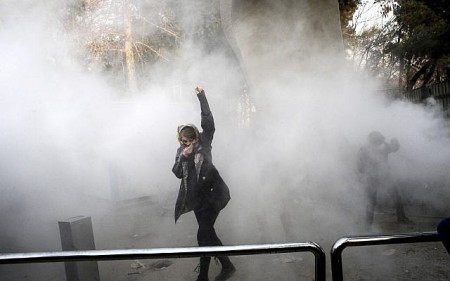
Whether or not this past weekend’s mass demonstrations in Iran will spread, whether a second revolution is imminent or not, the numbers for the ayatollah empire just don’t add up. A breakdown is materially inevitable.

With some 80 million people, and with oil accounting for 80 percent of its exports, Iran would need to export some 25 million barrels a day to make a go of it, but it can barely export 2.5 million. That would be luxuriously ample for the likes of Abu Dhabi with fewer than 800,000 citizens, but it is a miserable pittance for Iran, with a population more than 100 times as large.

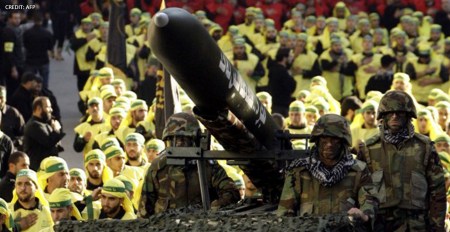
Iran cannot even match the $6,000 income per capita of Botswana. That most fashionable of safari destinations is a fine and well-governed country to be sure, and far from poor by African standards—but then its citizens are not required to pay for extensive nuclear installations, which are very costly to maintain even in their current semi-frozen state, or for the manufacture of a very broad range of weapons—from small arms to ballistic missiles—for which much expensive tooling is imported daily from the likes of our own dear ally South Korea. Neither is Botswana mounting large-scale military expeditions in support of a foreign dictator at war with 80 percent of his own population or providing generous funding for the world’s largest terrorist organization, Hezbollah, whose cocaine-smuggling networks and local extortion rackets cannot possibly cover tens of thousands of salaries. The ayatollah empire is doing all those things, which means that average Iranians are actually much poorer than their Botswanian counterparts.

You would never know it looking at photographs of Tehran, one more bombastic capital city fattened on intercepted oil revenues and graft, but Iran is dirt poor. I recently saw Iran’s general poverty at first-hand driving through one of Iran’s supposedly more prosperous rural districts. In an improvised small market next to a truck stop, several grown men were selling livestock side by side, namely ducks. Each had a stock of three or four ducks, which looked like their total inventory for the day.

That is what happens in an economy whose gross domestic product computes at under $6,000 per capita: very low productivity, very low incomes. The 500,000 or so Iranians employed in the country’s supposedly modern automobile industry are not productive enough to make exportable cars: Pistachio nuts are the country’s leading export, after oil and petroleum products.

The pistachios bring us directly to Iran’s second problem after not-enough-oil, namely too much thieving by the powerful, including pistachio-orchard-grabbing Akbar Hashemi “Rafsanjani,” former president and a top regime figure for decades.

Akbar Hashemi was not being immodest when he claimed the name of his native Rafsanjan province for himself. He became the owner of much of it as huge tracts of pistachio-growing orchards came into his possession.

His son Mehdi Hashemi is very prominent among the aghazadeh (“noble born”), the sons and daughters of the rulers. He preferred industrial wealth to pistachios, and his name kept coming up in other people’s corruption trials (one in France), until he finally had his own trial, for a mere $100 million or so. But the Rafsanjani clan as a whole took a couple of billion dollars at least.

The Supreme Leader Khamenei himself is not known to have personally stolen anything—he has his official palaces, after all. But his second son, Mojtaba, may have taken as much as $2 billion from the till, while his third son, Massoud, is making do with a mere 400- or 500-hundred million. His youngest son, Maitham, is not living in poverty either, with a couple of hundred million. The ayatollah’s two daughters, Bushra and Huda, each received de-facto dowries in the $100 million range.

This shows that the regime is headed by devoted family men who lovingly look after their many children, for whom only the best will do. It also cuts into the theoretical $6,000 income per Iranian head, because some “heads” are taking a thousand times as much and more.

That is one motive for today’s riots—bitter anger provoked by the regime’s impoverishing and very visible corruption, which extends far, far beyond the children of the top rulers: thousands of clerics are very affluent, starting with their flapping Loro Piana “Tasmania” robes—that’s 3,000 euros of fancy cloth right there.

Much of the economy is owned by bonyads, Islamic foundations that pay modest pensions to war widows and such, and very large amounts to those who run them, mostly clerics and their kin. The largest, the Mostazafan Bonyad, with more than 200,000 employees in some 350 separate companies in everything from farming to tourism, is a very generous employer for its crowds of clerical managers.

That is why the crowds have been shouting insults at the clerics—not all are corrupt, but high-living clerics are common enough to take a big bite out of that theoretical $6,000 per capita.

But the largest cause of popular anger is undoubtedly the pasdaran, a.k.a the Islamic Revolutionary Guards (IRGC), an altogether more costly lot than the several hundred aghazadeh or tens of thousands of high-living clerics. The IRGC’s tab starts with the trillion dollars or more that the pasdaran-provoked nuclear sanctions cost before the Obama team agreed to lift them and continues with the billions that Iran still loses annually because of the ballistic-missile sanctions that Trump will never lift. Then there are the variable costs of the pasdaran’s imperial adventures, as well as the fixed cost of pasdaran military industries that spend plenty on common weapons as well as on “stealth” fighters and supposedly advanced submarines that exist only in the fantasies of regime propagandists. Pasdaran militarism and imperial adventures are unaffordable luxuries that the demonstrators very clearly want to do without—hence their shouts of “no-Gaza, no-Syria.”

Whatever happens next—and at least this time the White House will not be complicit if it ends in brutal repression—the ayatollah empire cannot last. Even despite Obama’s generous courtship gifts, the Iranian regime cannot just keep going, any more than the USSR could keep going by living off its oil.

So what can be done to accelerate the collapse? Broad economic sanctions are out of the question because they would allow the rulers to blame the Americans for the hardships inflicted by their own imperial adventures. But there is plenty of room for targeted measures against regime figures and their associates—the State Department list of sanctioned individuals is far from long enough, with many more names deserving of the honor. (Iran is not North Korea; it is not hard to find names and assets and to make them public.)

Above all, very much more could be done to impede the pasdaran and their military industries. Many European and Japanese big-name companies are staying away from Iran because the missile and terrorism sanctions persist—and to avoid displeasing the United States. They should. But the South Koreans whom we defend with our own troops totally ignore U.S. interests in regard to Iran and have therefore emerged as the lead suppliers of machinery and tooling for the pasdaran weapon factories. Nor do they hesitate to sell equipment that can be adapted to military use in a minute or less, as in the case of the airfield instrument landing system and portable ILS/VOR signal analyzer that the Korea Airports Corp. has just agreed to supply to Iran’s Tolid Malzomat Bargh.

There is no need to laboriously negotiate a new set of sanctions against Iran—strict, swift, and public enforcement of the restrictions that are already on the books is enough. Every time a South Korean regime-related deal is detected, the offenders need a quick reminder they will be excluded from the United States if they persist. In this, as in everything else, it is just a matter of getting serious in our focus on Iran.

Obama was serious in his courtship of the ayatollahs’ regime. Trump should do the same to bring the regime to an end, faster.
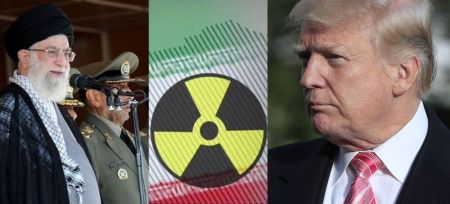
Act 2 of Trump clampdown on Iran: Re-imposing sanctions lifted under nuclear accord

January 6, 2018

Act 2 of Trump clampdown on Iran: Re-imposing sanctions lifted under nuclear accord, DEBKAfile, January 6, 2018

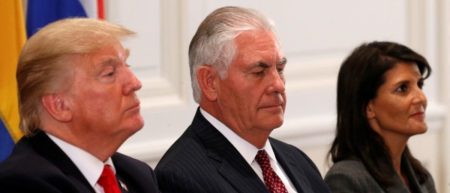
On the heels of the first protests to hit the Iranian regime, Washington will turn the screw by negating financial benefits afforded by the nuclear deal.  To this end, President Donald Trump will use the deadlines he faces as of next week for certifying the Iranian nuclear deal and approving sanctions waivers. This intent was indicated by Secretary of State Rex Tillerson in an AP interview Friday, Jan. 5.

Since the president had demanded that the 2015 nuclear accord with Iran be either “fixed or cancelled,” Tillerson said the administration was working with lawmakers on legislation for making it more acceptable to the president. Last October, Trump reluctantly waived sanctions for another three months. However, since sanctions relief was not incorporated in the nuclear deal, which Iran signed with six world nations three years ago, the US may set them aside without being accused of non-compliance. The US may therefore certify the framework while emptying it of the economic benefits the Obama administration granted, which funneled hundreds of billions of dollars to the Iranian treasury.

This is what Tillerson meant by “fixing” rather than “cancelling” the nuclear accord. He is charged with reformulating the deal, while upholding the Trump policy for countering Iran’s regional aggression and continuing support for anti-regime protests. These steps are components of the drawn-out, staged war of attrition the Trump administration has begun orchestrating against the revolutionary Shiite regime in Tehran for the year of 2018.

The following steps are already in the pipeline, DEBKAfile reports:

  1. President Trump may refrain this time from signing on to the sanction waivers, but may re-certify Iran’s compliance with the accord.
  2. The US Treasury Department has meanwhile announced new sanctions targeting banks, financial entities and officials – whether involved in Iran’s missile program or propping up the Revolutionary Guard Corps and its actions to suppress popular dissent.
  3. Washington will likewise target entities in the Middle East and beyond that serve Tehran and receive Iranian financial assistance and weapons. Examples are Lebanon, Hizballah, the Iraqi Shiite militias under Iranian command, Hamas, the Palestinian Islamic Jihad and others.
  4. A broad US strategy is now in place for halting or slashing American aid programs to entities and governments which refuse to cooperate with the administration’s policy objectives.
  5. Donald Trump’s original plan was to work closely with the Europeans on his drive against Iran. Since the European governments have not only opted out of cooperation but are flatly opposed to US support for the Iranian protesters, Washington is forging ahead on its own, without reference to any European capital.
    Trump has thus scrapped one of the basic principles which gave birth to the nuclear accord, close cooperation between the US, Russia and the leading European powers.
  6. The breakup of this transatlantic partnership confronts Russia’s Vladimir Putin with a dilemma. Lining up with Europe on Iran would place Moscow on a collision course with the Trump administration. That Moscow knows exactly what is at stake was evident in the remarks made by Russia’s Deputy Foreign Minister Sergei Ryabkov on Jan. 4, in response to Washington’s call for a UN Security Council to discuss repression in Iran: “We warn the US against attempts to interfere in the internal affairs of the Islamic Republic of Iran.” He also cautioned Washington against being “tempted to use the moment to raise new issues with regard to the JCPOA (the 2015 nuclear accord.)

New US Policy Confronts Iranian Regime, Opening up New Opportunities for Change

November 4, 2017

New US Policy Confronts Iranian Regime, Opening up New Opportunities for Change, Iran News Update, November 4, 2017

It appears that the only options left with Iranian authorities are confronting, retreating, or buying time until the end of the Trump presidency. Still, the regime must face the other factors at work against it, like the social disaffection within Iran towards the regime, and the recognition of the main opposition movements — the National Council of Resistance of Iran (NCRI) and People’s Mujahideen of Iran (PMOI) — by US and its allies in the region.

There is now an opportunity, with the current international situation, for the Iranian people and its main opposition movement (NCRI and PMOI), as well as for the people of Middle East and the whole world, for these factors that can lead to regime change and put an end to Iran’s destabilization activities in the Middle East.

***************************

INU – Saudi Arabia and Egypt, important countries in the region, concerned about the destabilizing activities of the Iranian regime in the Arab world, have strongly welcomed the October 13th announcement by US President Trump his regarding his new policy against the destabilizing behavior of Iran in the Middle East, particularly its missile activities. The new policy emphasized making the Middl#$e East a region without weapons of mass destruction.

The Iranian opposition movement and its President-elect, Maryam Rajavi, is leading a campaign to isolate the regime in Tehran. It welcomes the new White House strategy that delegitimizes the Iranian regime. Rajavi called on Trump and the international community to work toward “the ultimate solution”, regime overthrow and the establishment of freedom and democracy in Iran.

By refusing to give approval to the nuclear deal, and designating the Iranian Revolutionary Guard Corps (IRGC) on the list of terrorist organizations, the new US policy is targeting at the heart of the Iranian regime. According to the Washington Post the strategy marks an important change in US policy on the Middle East: a shift from focusing on war against ISIS and towards the end of Iran’s expansionism in the region.

The steps taken by the White House to carry out this policy include the visit by US Secretary of State to Saudi Arabia and other countries in the region, imposition of sanctions on Hezbollah for being the military wing of IRGC in Lebanon, and sanctions on companies, financial institutions and individuals related to the regime’s ballistic missiles programs.

According to F. Mahmoudi, Kurdish-Iranian political and human rights activist, in his Al Arabiya article, “Therefore, there is no reason for any objection by European countries to the new White House policy. European states are only thinking of securing their financial and economic interests with Iran, as not only the political and military power of the Iranian regime but also economic control lie in the hands of the IRGC.”

Sanctions against the Iranian regime, IRGC and Hezbollah will put European companies and banks in serious danger if they deal with this regime and its affiliates.

Additionally, the sanctions and the terrorist designation of IRGC have put Hasan Rouhani, who earlier presented himself to the West as a moderate, in a position of fully supporting the IRGC.

Supreme Leader, Ali Khamenei, reacting to the new US strategy, defended the IRGC’s presence in Iraq, Syria and Yemen and asked Europeans to stand strongly against Trump’s policy. However, it is believed that Europe will eventually choose the US instead of Iran and it will not sacrifice billion of dollars in trade benefits with the US. Additionally, Europe cannot accept the risk of Trump’s threat of leaving NATO.

It appears that the only options left with Iranian authorities are confronting, retreating, or buying time until the end of the Trump presidency. Still, the regime must face the other factors at work against it, like the social disaffection within Iran towards the regime, and the recognition of the main opposition movements — the National Council of Resistance of Iran (NCRI) and People’s Mujahideen of Iran (PMOI) — by US and its allies in the region.

There is now an opportunity, with the current international situation, for the Iranian people and its main opposition movement (NCRI and PMOI), as well as for the people of Middle East and the whole world, for these factors that can lead to regime change and put an end to Iran’s destabilization activities in the Middle East.

Sanctions on Hizbollah Unanimously Passed by US Congress

October 27, 2017

Sanctions on Hizbollah Unanimously Passed by US Congress, Iran News Update, October 26, 2017

(Please see also, Hezbollah denounces US sanctions bill targeting its cash flow. — DM)

The bills will now move to the Senate where another vote is expected, before the new legislations are sent to the President’s desk to be signed into law. This process is expected to take approximately one month.

*********************************

INU – US escalation toward the Iranian government and the Lebanese Hizbollah moved forward when on Wednesday, Democratic and Republican members of Congress unanimously voted through measures designed to curb Iran’s ballistic missile program and Hizbollah’s funding. Three resolutions were approved, after nearly six months of deliberations and amendments, that tighten the economic screws on Tehran and the Shiite militant party.

Democratic and Republican members of Congress unanimously voted orally in unison, and passed the following resolutions: 1- H.R 359 – Urging the European Union to designate Hizbollah in its entirety as a terrorist organization; 2-H.R. 3342 – Sanctioning Hizbollah’s Illicit Use of Civilians as Defenseless Shields Act; 3-H.R. 3329 – Hizbollah International Financing Prevention Amendments Act of 2017 (HIFPA).

On Thursday, Members will vote on Resolution H.R. 1698 – Iran Ballistic Missiles and International Sanctions Enforcement Act. These Ballistic missile sanctions put a stop to any outside support for Iran’s missile program, and are significant in terms of timing and efforts by the Trump administration to push for concessions from Tehran on the issue.

In terms of scope and reach of the proposed sanctions, the HIFPA bill represents the largest escalation against Hizbollah. It authorizes new sanctions against the group and its financial networks, and it requires the US president to release an annual estimate of the net worth of Hizbollah leaders and backers, including its secretary general Hassan Nasrallah.

Also targeted by the bill are Hizbollah affiliates, including Bayt Al Mal, Jihad Al Bina, the Islamic Resistance Support Association, the Foreign Relations Department of Hizbollah, the External Security Organization of Hizbollah, and its media outlets — Al Manar TV and Al Nour Radio.

An expert on Hizbollah at the Washington Institute for Near East Policy, Hanin Ghaddar, said that “official Lebanese visits to Washington in 2017 have somehow succeeded in protecting the Lebanese banks from these sanctions.” She added, “But that doesn’t mean that Lebanon’s economy won’t be affected.”

Joseph Bahout of The Carnegie Endowment for International Peace agrees with Ghaddar. He said “Hizbollah itself has mastered new financial engineering to navigate through sanctions but the real impact will be felt on banking system in Lebanon.” Mr Bahout continued, “If the Lebanese banks were to fully implement all the measures [requested under HIFPA] lots of foreign capital would flee the system.”

Hassan Nasrallah, an Hizbollah leader, previously boasted that “all the banks of the world cannot stand as an obstacle to Hizbollah.” He said, “As long as there is money in Iran, we will have money.”

Ms. Ghaddar said, “Hizbollah will not be directly affected as we all know how money comes from Iran — in bags — and sanctions won’t stop this flow.” However, she also said that this may hurt Hizbollah, as “its backers’ financial assets will have to be revealed, and its institutions will be sanctioned, this will create a serious gap and mistrust between Hizbollah and its community.” Ms. Ghaddar added that as a result, many in business community “will try to distance themselves from Hizbollah for fears of sanctions.”

Mr. Bahout said HIFPA may complicate Hizbollah’s activities locally, “like paying employees of their agencies [that are targeted] or doing business with organizations, commerce tied to them, and a whole range of minute day-to-day annoyances that could follow.”

There are concerns over possible Hizbollah retaliation. Ms. Ghaddar pointed out that the last time a lighter version of HIFPA passed in 2015, “Blom bank in Verdun was blown up few months after.”

The bills will now move to the Senate where another vote is expected, before the new legislations are sent to the President’s desk to be signed into law. This process is expected to take approximately one month.

Strategic decisiveness, tactical caution

October 15, 2017

Strategic decisiveness, tactical caution, Israel Hayom, Prof. Abraham Ben-Zvi, October 15, 2017

Iran is now facing a three-pronged American challenge: the steps that stem directly from the newly announced Trump Doctrine; new legislation against it; and unilateral action by Trump should Congress fail to enact new legislation, leading to the U.S. withdrawing from the pact.

In one fell swoop, through a single speech, Trump put the ball squarely in Iran’s court.

******************************

When it comes to North Korea, U.S. President Donald Trump has adopted a policy of containment and deterrence, owing to the fact that it presents a general threat.

But when it comes to Iran, things are different. On Friday, Trump unveiled a new doctrine against this component of the Axis of Evil, a doctrine that is based more on red lines and clear thresholds that would trigger American action should they be crossed.

This approach represents a creative blend of strategic decisiveness and tactical caution. The strategic decisiveness rests on his pledge to counter Iran head-on, should the need arise, over its repeated violations of key parts of the 2015 nuclear deal, and over its conduct in the region (including its ongoing ballistic missile program and its continued support for terrorist groups and destabilization efforts).

The tactical caution part is based on his recognition that a potential Iranian-American clash is not necessarily immediate, forceful or even inevitable. In other words, the White House has articulated a gradual process that gives Iranian President Hassan Rouhani a way out by mending his ways before the moment of truth arrives.

Thus, even though the Trump Doctrine is a break from the way the nuclear deal has been implemented so far, Washington will stay in it in order to improve it, hoping that its threats will have a moderating effect on the ayatollah regime. Therefore, Trump’s decision to decertify the agreement doesn’t mean that he is bent on withdrawing from it. He is still going to play by the rules, but his new doctrine presents several powerful deterrent elements.

The first: He has sent a signal to Tehran of what’s to come. Through the newly announced sanctions on the Iranian Revolutionary Guard Corps, which complement other steps the Pentagon has taken in the region to curtail Iran’s destabilizing activity, Iran now knows what’s at stake.

The second: He announced what could be a new, comprehensive and structured mechanism to punish Iran. If and when Congress decides to adopt such a mechanism, it will include a host of steps against the regime, including sanctions that are automatically imposed if Iran violates certain provisions characterized as “red lines” (say, regarding its missile program).

The third: If Congress fails to pass new legislation to punish Iran over the next two months, this will lead to the termination of the agreement as far as he is concerned – with all the consequences that this may entail.

Iran is now facing a three-pronged American challenge: the steps that stem directly from the newly announced Trump Doctrine; new legislation against it; and unilateral action by Trump should Congress fail to enact new legislation, leading to the U.S. withdrawing from the pact.

In one fell swoop, through a single speech, Trump put the ball squarely in Iran’s court.

Congress Seeks Deadline on Iran Accepting Tougher Nuclear Deal Standards

October 13, 2017

Congress Seeks Deadline on Iran Accepting Tougher Nuclear Deal Standards, Washington Free Beacon, October 13, 2017

Rep. Peter Roskam / Getty Images

Roskam’s legislation would mandate that Iran permit unfettered, unannounced, and indefinite access to all of Iran’s contested nuclear sites, including military spots that have been completely off-access to international nuclear inspectors.

Iran opposes such proposals, claiming that its military sites will never been opened to the international community.

*************************************

Congress is set to consider new legislation that would require Iran to accept tough new conditions on the landmark nuclear deal or face a rash of harsh new economic sanctions aimed at thwarting the Islamic Republic’s continued nuclear buildup, according to a draft of new legislation exclusively viewed by the Washington Free Beacon.

On the heels of President Donald Trump’s announcement that he will decertify Iranian compliance with the nuclear agreement, top GOP lawmakers are already working on legislation that would compliment the White House’s announcement and move forward with efforts to harshly penalize Tehran if it does not accept rigid new standards on its nuclear activities within the next six months, according to a copy of draft legislation circulating in the House of Representatives.

The new legislation, spearheaded by Rep. Peter Roskam (R., Ill.), would reimpose all economic sanctions lifted by the former Obama administration as part of the nuclear agreement if Iran refuses to comply with tough new standards restricting its ballistic missile program, arms buildup, and failure to permit access to a range of military sites suspected of engaging in nuclear work.

The legislation also would effectively kill provisions of the nuclear agreement known as sunset clauses. These are portions of the deal that would rollback restrictions on Iran’s advanced nuclear research and weapons buildup within the next five to six years.

Trump, as well as allies in Congress, maintains the original nuclear accord contains several key flaws that permit Iran to cheat on the deal and receive sweetheart bonuses—such as sanctions relief and other assets—despite evidence of multiple violations of the agreement.

Sources who spoke to the Free Beacon about the effort to tighten the deal said that many in Congress would be willing to reimpose all key sanctions on Iran if it does not agree to abide by the stricter enforcement regulations.

“The days of appeasing the Mullah’s every wish and sitting back and watching as the terrorist state goes nuclear are over,” said one senior congressional official intimately familiar with the new proposal. “Congress overwhelmingly opposed Obama’s disastrous deal with Iran. Now’s the time to assert our constitutional responsibility to defend our nation and use all tools of U.S. power to permanently prevent an nuclear armed Iran.”

This new legislation is similar to the policy approach advocated by senior Trump administration officials, such as Secretary of State Rex Tillerson, who told reporters late Thursday the administration is looking to create a parallel nuclear deal that gives Congress a larger role in ensuring Iranian compliance.

These would include “trigger points that are specific to the nuclear program itself, but also deals with things like their ballistic missile program,” according to Tillerson.

Roskam’s new legislation, called the JCPOA Improvement Act of 2017, seeks to do precisely this.

In addition to banning Iran from developing, testing, and operating ballistic missile technology—which was never addressed in the original nuclear agreement – the new legislation would impose even stricter regulations on the amount of nuclear enrichment Iran can legally engage in.

It also would stop Iran from installing advanced nuclear centrifuges that can enrich uranium, the key component in a nuclear weapon, much faster than older versions of this equipment. Under the original nuclear agreement, known as the Joint Comprehensive Plan of Action, or JCPOA, Iran would have been granted the right to operate advanced centrifuges within the next several years.

Congress also is seeking to address Iran’s development of heavy water nuclear reactors that provide a secondary pathway to a nuclear weapon via the use of plutonium, a by-product of such equipment, according to the draft legislation and sources who spoke to the Free Beacon.

The Obama administration had worked to ensure that, under the agreement, Iran retained its right to operate such reactors, despite opposition in Congress and elsewhere. Iran has already inked several deals with Russia to assist in the construction of new light and heavy water reactors, though this new legislation could complicate that matter.

Another key portion of the original agreement that has been vehemently criticized by Trump and congressional allies surrounds caveats that give Iran more than a month before consenting to inspections of its nuclear sites.

Roskam’s legislation would mandate that Iran permit unfettered, unannounced, and indefinite access to all of Iran’s contested nuclear sites, including military spots that have been completely off-access to international nuclear inspectors.

Iran opposes such proposals, claiming that its military sites will never been opened to the international community.

If Iran does not agree to the new restrictions proposed in the legislation, Congress has the ability to reimpose all sanctions that were lifted as part of the original accord. This represents a major new tool for Congress as it works to thwart Iran’s continued military endeavors across the Middle East and its pursuit of advanced new weaponry.

Under the new legislation, any future attempt to rescind these new restrictions would be subject to a vote in the United Nations Security Council, according to the bill.

Repeal and Replace In Farsi

October 13, 2017

Repeal and Replace In Farsi, Washington Free Beacon, October 13, 2017

(Are the media playing games with their headlines as usual or are their reports accurate? Here’s a link to the principal Times of Israel article cited, Netanyahu at odds with security team over Iran deal. — DM)

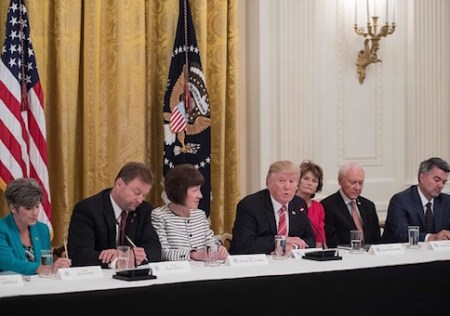
President Donald Trump is flanked by GOP senators to discuss health care / Getty Images

[T]he headlines preceding today’s remarks have been almost entirely shaped by the deal’s supporters, by the echo chamber that promoted and distorted the aims and conditions of the agreement to begin with. These were but some of the stories in Thursday’s edition of the Times of Israel: “Barak urges Trump not to decertify Iran nuke deal,” “Netanyahu at odds with security team over Iran deal,” “With Trump set to decertify Iran deal, experts tell Congress to stick to accord,” “Jewish Democrats who opposed Iran nuke deal now urge Trump to keep it.” You have to look hard for a piece detailing Iranian noncompliance, explaining the process of decertification and its relation to the overarching agreement, or quoting defenders of the president and his policy.

****************************************

President Trump is expected to announce today that he cannot certify Iran’s compliance with the terms of the agreement over its nuclear program that it entered into with the United States and five other nations in 2015. The president’s decision, according to the Iran Nuclear Agreement Review Act of 2015, will commence a 60-day expedited legislative process during which the Republican-controlled Congress may re-impose sanctions against the Islamic theocracy for its intransigence and belligerence. Sanctions, I might add, that should never have been lifted in the first place.

What is striking is that, with the exception of Senator Tom Cotton of Arkansas, none of the Republicans and Democrats who opposed the nuclear deal two years ago with such vehemence have gone out of their way to prepare the ground and make the national security case for the president’s decision.

Now, the Democrats I can understand. They are just playing to type. To say a kind word for Trump’s attempt to improve the deal would violate the secular commandment to resist his very being. The Republican silence, by contrast, is far more maddening.

This is the party that invited Bibi Netanyahu to criticize the deal in an address to a joint session of Congress. This is the party whose 2016 platform reads, “A Republican president will not be bound by” the deal and “We must retain all options in dealing with a situation that gravely threatens our security, our interests, and the survival of our friends.” This is the party that nominated and elected a president who said his “number one priority is to dismantle the disastrous deal with Iran.”

Yet the headlines preceding today’s remarks have been almost entirely shaped by the deal’s supporters, by the echo chamber that promoted and distorted the aims and conditions of the agreement to begin with. These were but some of the stories in Thursday’s edition of the Times of Israel: “Barak urges Trump not to decertify Iran nuke deal,” “Netanyahu at odds with security team over Iran deal,” “With Trump set to decertify Iran deal, experts tell Congress to stick to accord,” “Jewish Democrats who opposed Iran nuke deal now urge Trump to keep it.” You have to look hard for a piece detailing Iranian noncompliance, explaining the process of decertification and its relation to the overarching agreement, or quoting defenders of the president and his policy.

And the reason you have to look hard is that there are few elected Republicans who are taking the lead on this issue. Internal division, uncertainty, and personal rivalry may once again prevent the congressional GOP from achieving the aims it has stated loudly and proudly for years. The parallels to the attempted repeal and replacement of Obamacare are startling and, for this conservative, disturbing. “This is health care for us,” Ben Rhodes said of the Iran deal back in 2014. It would be both a diplomatic and a political disaster if the Republicans flopped as badly while trying to undo the central achievement of Barack Obama’s second term as they had while trying to undo the central achievement of his first.

Iranian noncompliance is a no-brainer. Look at the number of advanced centrifuges Iran is currently operating, its repeated violation of limits on its heavy water stocks, its underground efforts to obtain nuclear- and missile-related technologies. Look at the IAEA’s acknowledgment in September that it has difficulty verifying compliance with Section T of the Joint Comprehensive Plan of Action, which forbids “activities which could contribute to the development of a nuclear explosive device.”

And look at the Swiss cheese inspections regime. How can the president in good conscience certify compliance when no Americans are involved in the inspections, when inspections are limited to “declared” nuclear sites, when the Iranians have 24 days to prepare for IAEA inspections of other locations, when inspectors are forbidden from examining military bases? We have no idea what is going on in such places, much less in the places we do not know about. Remember: We didn’t know about the installations at Natanz and Arak until 2002 and the one at Fordow until 2009.

Of course a serious agreement would allow access to military locations. The apologies for Iranian stubbornness on this point are absurd. “For many Iranians—including those who support the nuclear deal—keeping inspectors out of military facilities is a point of national pride,” write Shashank Bengali and Ramin Mostaghim of the Los Angeles Times. Funny that national pride is okay as long as it’s Iran we’re talking about. Bengali and Mostaghim quote a “newspaper employee” in Tehran, Susan Saderi, who says, “It’s our country, and any country’s defense systems should be off limits to international inspections.”

No offense, Ms. Saderi, but you know whose defense systems are not off limits to international inspections?

  1. Associated Press from 2014: “Russians inspect Montana nuclear launch facilities.”
  2. Washington Free Beacon from 2014: “Russian Inspectors to Check U.S. Nuclear Cuts Amid Ukraine Crisis.”
  3. Fortune last August: “Russian Surveillance Plane Makes Low-Flying Pass of Capitol and Pentagon.”
  4. Wall Street Journal last August: “Top U.S. General Breaks Bread With Chinese Soldiers on North Korea’s Doorstep.”

Ok, the PLA probably didn’t allow General Dunford to count ammo stocks in Shenyang. But the point stands. The arms control treaties we signed with the Soviet Union permitted American inspectors to visit military locations. That was the whole point of trust but verify. President Obama may have trusted the Iranians—but then President Obama trusted Harvey Weinstein to oversee his daughter’s post-high school internship earlier this year. Why should Donald Trump play the patsy?

“If the political branches, [work] on a bipartisan basis on the parts of the deal we all know are flawed,” Cotton said earlier this month, “we will have the strong and unified front between Democrats and Republicans, and between Congress and the president, that the Iran deal never enjoyed. That unity will help the president forge a unified position with our allies—not only the United Kingdom, France, and Germany, but also Israel and our Arab allies. Then it will be Russia and China who must choose between a stronger deal and being isolated and in league with the ayatollahs.”

Are Republicans prepared to close ranks in a “strong and unified front” to remove the sunset clauses from the Iran deal, impose further limits on Iranian centrifuges, include Americans on IAEA inspection teams that have access to Iranian military bases, and constrain Iranian missile development? Or will they prove as disunited, feckless, spiteful, and incompetent as they did during the repeal and replace debacle?

I’m not sure I want to know the answer.

Trump Admin Will Not Commit to Designating IRGC as Terror Group

October 11, 2017

Trump Admin Will Not Commit to Designating IRGC as Terror Group, Washington Free Beacon , October 11, 2017

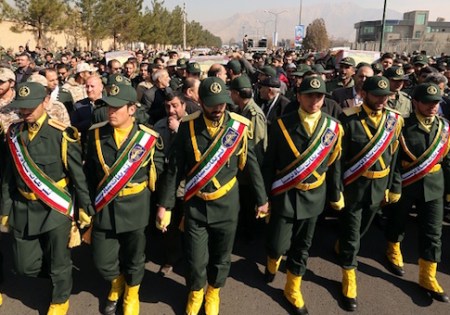
Members of the Iran’s Revolutionary Guard Corps / Getty Images

Trump last week signed new sanctions legislation mandating that the United States extend a terror designation to the IRGC, marking the first time in U.S. history a foreign country’s military branch would be hit with such a designation.

However, the State and Treasury Departments would not confirm Wednesday that the administration intends to make good on this law, which was approved by Congress with bipartisan support.

***********************************

The Trump administration will not commit to designating the Islamic Revolutionary Guard Corps, or IRGC, Iran’s elite fighting force, as terrorists, despite a congressional mandate to do so by the end of the month, according to multiple U.S. officials and other administration insiders who told the Washington Free Beacon that holdovers from the Obama administration are working to stymie the effort.

While President Donald Trump is expected to announce this week that he will not certify Iran as in compliance with the landmark nuclear deal, it remains unclear if he will follow through with congressionally approved plans to extend a terror designation to the IRGC, a move that has prompted Iran to threaten greater attacks on U.S. forces in the Middle East.

The IRGC is responsible for numerous terror attacks on American troops over the years and has played a key role in interfering with U.S. operations in Syria. A bipartisan consensus in Congress has already backed such a designation, but key Obama-era holdovers and top national security officials who have the president’s ear are urging him to refrain, according to multiple sources who spoke to the Free Beacon.

Top lawmakers and insiders who spoke to the Free Beacon about the growing uncertainty over how best to hold Iran accountable for its terror activities expressed frustration over what they view as the administration’s inability to follow through with its foreign policy promises, particularly as they relate to Iran, which has increasingly targeted U.S. forces with military action.

New reports emerged Wednesday afternoon that Trump’s planned speech on Iran may be scaled back and not take place until Friday, if it does at all.

Trump last week signed new sanctions legislation mandating that the United States extend a terror designation to the IRGC, marking the first time in U.S. history a foreign country’s military branch would be hit with such a designation.

However, the State and Treasury Departments would not confirm Wednesday that the administration intends to make good on this law, which was approved by Congress with bipartisan support.

The administration may be getting cold feet due to the objections of key U.S. officials and those in the Treasury Department who view such a designation as harmful to American companies that have business interests in Iran, where the IRGC controls a majority of the economy, sources said.

“The IRGC is responsible for wreaking havoc throughout the Middle East and, through its Quds Force, for killing hundreds of American troops in Iraq,” Rep. Ron DeSantis (R., Fla.), a member of the House Foreign Affairs Committee and chair of its National Security Subcommittee, told the Free Beacon.

“The IRGC represents a quintessential terrorist group and should be designated as such,” DeSantis said.  “Whereas the Obama administration flew pallets of cash to the IRGC, the Trump administration should act to hold the IRGC accountable.  Designating it as a terrorist group is a good first step.”

Neither the State Department or White House would confirm to the Free Beacon plans to follow through with this designation, prompting speculation that the process may be held up over objections by Obama-era holdovers in the Trump administration who view the move as a shot at dismantling the former president’s nuclear deal.

“Congress didn’t ask the president to designate the full IRGC,” according to one veteran Middle East policy advisor who lobbies Congress on Iran sanctions. “They told the president to do it by veto proof majorities. Obama holdover lawyers and his establishment staffers are telling him he can use loopholes to just go after some entities and circumvent Congress.”

These same voices are continuing to advise Trump against decertifying Iranian compliance with the deal, despite the president’s personal belief that the Islamic Republic has flagrantly violated what he has repeatedly described as a bad deal.

“These are the same people advising him to certify the nuclear deal, which was also rejected by bipartisan majorities in Congress,” the source said. “They’re wrong and if they stay wrong, lawmakers will eventually make it an oversight issue.”

A State Department official declined repeated requests for clarification on what the administration intends to do about the IRGC, but told the Free Beacon officials remain “deeply troubled by Iran’s longstanding provocative activities including its support for terrorism and destabilizing activities in the region.”

“We are committed to holding Iran accountable for its behavior,” the official said. “The United States retains the authority to respond to Iran’s support for terrorism, human rights abuses, and destabilizing activities. The U.S. government constantly reviews information, through an interagency process, to evaluate potential sanctions violators for targeting under existing sanctions authorities.”

A Treasury Department official did not respond to a request for comment on the matter.

Iranian officials vowed last week to strike U.S. forces and bases in the region if the Trump administration moves forward with extending a terror designation to the IRGC.

Rep. Sean Duffy (R., Wis.), a vocal opponent of the Iran deal, told the Free Beacon that Iran would be wise to back down from its threats.

“President Obama’s terrible Iran deal predictably emboldened the Iranian regime to build up their military and antagonize the region,” Duffy said. “Iran may have been able to bully our previous president, but the American people elected President Trump to stand up for the United States on the world stage.”

“The Iranian regime is already on notice for being the world’s largest state-sponsor of terror, and it would be wise for them to back down from their belligerent posture,” Duffy added.

ANALYSIS: Certified or decertified, Iran faces tough road ahead

October 10, 2017

ANALYSIS: Certified or decertified, Iran faces tough road ahead, Al Arabiya, Heshmat Alavi, October 9, 2017

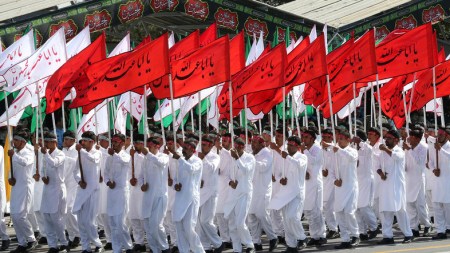
Members of Iranian armed forces march during a parade in Tehran, Iran, September 22, 2017. President.ir/Handout via REUTERS.

The new mentality sought by Washington is to address all of Iran’s belligerence and not allow its nuclear program and the JCPOA devour all of the international community’s attention.

The new US response, including blacklisting Iran’s notorious Revolutionary Guards, to be announced by Trump is said to cover missile tests, support for terrorism and proxy groups checkered across the Middle East, hopefully human rights violations at home, and cyberattacks.

Iran has a history of resorting to such measures, including targeting Saudi oil interests. Raising the stakes for Iran, Trump described a meeting with his top military brass on Thursday evening as “the calm before the storm.” Neither the US President nor the White House provided further details, yet rest assured Tehran received the message.

**************************

All eyes are on US President Donald Trump and his upcoming Iran speech later this week to clarify his decision to certify or decertify Tehran’s compliance with a nuclear agreement, officially known as the Joint Comprehensive Plan of Action (JCPOA), designed to curb the regime’s controversial atomic drive.

This has Iran’s regime on its toes, as senior elite in Tehran understand fully how the US can lead the international community in adopting strong measures against its broad scope of malign activities. Expected to be addressed is also a wide range of concerns over Iran’s dangerous policies in relation to its ballistic missile advances, meddling in Middle East states and supporting terrorist proxy groups as explained in a new video.

‘Iran’s unacceptable behavior’

Iran’s rogue behavior, currently imposing its influence on four major regional capitals of Baghdad, Beirut, Damascus and Sanaa, are the result of the Obama administration’s “overly lenient foreign policy, which sought to promote America’s priorities through consensus, rather than through the frank display of power,” as put by a recent The New Yorker piece.

“Lifting the sanctions as required under the terms of the JCPOA has enabled Iran’s unacceptable behavior,” US Secretary of State Rex Tillerson said in a late September meeting with his P5+1 counterparts and Iran’s top diplomat Mohammad Javad Zarif.

The Trump administration is also deeply concerned over Iran’s proxies mining the strategic Bab el-Mandeb Strait waterway, aiming its indigenous missiles from Yemen towards cities in Saudi Arabia and other Gulf countries, and from southern Lebanon towards Israel. This is Tehran in action with the objective of taking advantage of the destruction left behind by ISIS across the region, especially in Syria and Iraq.

“The Iranian regime supports terrorism and exports violence, bloodshed and chaos across the Middle East,” Trump told reporters before a Thursday evening meeting with senior military leaders at the White House. “That is why we must put an end to Iran’s continued aggression and nuclear ambitions,” he said. “They have not lived up to the spirit of their agreement.”

Trump has put Iran “on notice” over charges that Tehran violated a nuclear deal with the West by test-firing a ballistic missile. (Reuters)

Joint effort

Parallel to the White House there are voices on Capitol Hill advocating the new approach weighed by the administration.

“The president should decline to certify, not primarily on grounds related to Iran’s technical compliance, but rather based on the long catalog of the regime’s crimes and perfidy against the United States, as well as the deal’s inherent weakness,” Senator Tom Cotton said last week at a speech in the Council on Foreign Relations.

As the Trump administration seeks to place necessary focus on Iran’s illicit Middle East ambitions and actions, talks are also ongoing as we speak over how to amend the JCPOA’s restrictions.

“Sunset clauses,” Iran’s ballistic missile development and testing, and an inspections regime lacking the bite to gain necessary access into the regime’s controversial military sites. Under the current framework Iran can easily conduct nuclear weapons research and development in military sites and claim such locations do not fall under the JCPOA jurisdiction.

While it is expected of Trump to decertify Iran, he most likely will not go the distance to completely pull America out of the nuclear agreement. Obama refused to send the JCPOA to Congress for discussion and approval. Trump, however, seems set to place the decision to impose further sanctions on Iran upon the shoulders of US lawmakers.

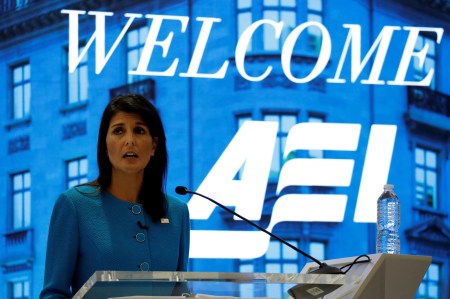
US Ambassador to the United Nations Nikki Haley speaks about the Iran nuclear deal at the American Enterprise Institute in Washington, on September 5, 2017. (Reuters)

More than ‘one piece’

The new mentality sought by Washington is to address all of Iran’s belligerence and not allow its nuclear program and the JCPOA devour all of the international community’s attention.

The new US response, including blacklisting Iran’s notorious Revolutionary Guards, to be announced by Trump is said to cover missile tests, support for terrorism and proxy groups checkered across the Middle East, hopefully human rights violations at home, and cyberattacks.

Iran has a history of resorting to such measures, including targeting Saudi oil interests. Raising the stakes for Iran, Trump described a meeting with his top military brass on Thursday evening as “the calm before the storm.” Neither the US President nor the White House provided further details, yet rest assured Tehran received the message.

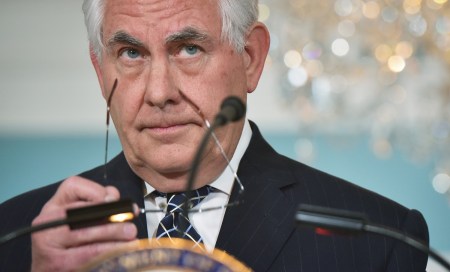
US Secretary of State Rex Tillerson delivering a statement on Iran in the Treaty Room of the State Department in Washington, DC, on April 19, 2017. (AFP)

Fear renders contradiction

Sensing an increasingly escalating tone from Washington, Tehran signaled its first sign of fear by expressing readiness to discuss its ballistic missile program, according to Reuters. And yet less than 24 hours later, Iranian officials said no offers were made to negotiate such restrictions.

“Iran regards defensive missile programs as its absolute right and will definitely continue them within the framework of its defensive, conventional and specified plans and strategies,” Iranian Foreign Ministry spokesman Bahram Qassemi said, according state media.

Iranian President Hassan Rouhani also felt the need to make remarks to save face before the regime’s already depleting social base. “In the nuclear negotiations and agreement we reached issues and benefits that are not reversible. No one can turn that back, not Mr. Trump or anyone else,” Rouhani said at a recent Tehran University ceremony, according to state media.

Of course, we all remember how prior to the JCPOA signing in 2015 senior Iranian officials went the limits in describing any “retreat” regarding their nuclear program as a “red line.” To make a long story short, Tehran is comprehending how the times are changing at a high velocity, endangering its domestic, regional and international interests. And unlike the Obama years, its actions will not go unanswered.

Senator Cotton made this crystal clear at his speech: “Congress and the President, working together, should lay out how the deal must change and, if it doesn’t, the consequences Iran will face.”

The Iran Deal Isn’t Worth Saving

October 8, 2017

The Iran Deal Isn’t Worth Saving, Gatestone InstituteJohn R. Bolton, October 8, 2017

(The chances of renegotiating the JCPOA to make it less harmful to America appear to be close to zero. — DM)

[T]he deal’s acolytes are actively obscuring this central issue, arguing that it is too arduous and too complex to withdraw cleanly. They have seized instead on a statutory requirement that every 90 days the president must certify, among other things, that adhering to the agreement is in America’s national-security interest. They argue the president should stay in the deal but not make the next certification, due in October.

This morganatic strategy is a poorly concealed ploy to block withdrawal, limp through Mr. Trump’s presidency, and resurrect the deal later. Paradoxically, supporters are not now asserting that the deal is beneficial. Instead, they concede its innumerable faults but argue that it can be made tougher, more verifiable and more strictly enforced. Or, if you want more, it can be extended, kicked to Congress, or deferred during the North Korea crisis. Whatever.

The only sure way to resume economic pressure on Iran is for President Trump to stop waiving the sanctions, as he did a few weeks ago. The power to act is in executive hands, as it should be.

*********************************

“Cut, and cut cleanly,” Sen. Paul Laxalt advised Ferdinand Marcos in 1986, urging the Philippine president to resign and flee Manila because of widespread civil unrest. The Nevada Republican, Ronald Reagan’s best friend in Congress, knew what his president wanted, and he made the point with customary Western directness.

President Trump could profitably follow Mr. Laxalt’s advice today regarding Barack Obama’s 2015 deal with Iran. The ayatollahs are using Mr. Obama’s handiwork to legitimize their terrorist state, facilitate (and conceal) their continuing nuclear-weapons and ballistic-missile programs, and acquire valuable resources from gullible negotiating partners.

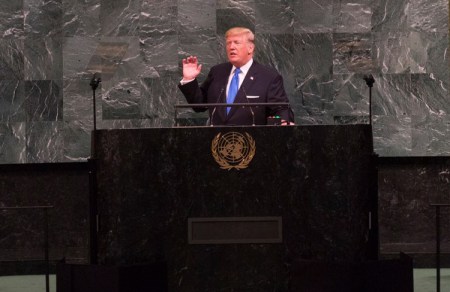
Mr. Trump’s real decision is whether to fulfill his campaign promise to extricate America from this strategic debacle. Last month at the United Nations General Assembly, he lacerated the deal as an “embarrassment,” “one of the worst and most one-sided transactions the United States has ever entered into.”

Last month at the United Nations General Assembly, President Donald Trump lacerated the Iran nuclear deal as an “embarrassment,” “one of the worst and most one-sided transactions the United States has ever entered into.” (Image source: The White House)

Fearing the worst, however, the deal’s acolytes are actively obscuring this central issue, arguing that it is too arduous and too complex to withdraw cleanly. They have seized instead on a statutory requirement that every 90 days the president must certify, among other things, that adhering to the agreement is in America’s national-security interest. They argue the president should stay in the deal but not make the next certification, due in October.

This morganatic strategy is a poorly concealed ploy to block withdrawal, limp through Mr. Trump’s presidency, and resurrect the deal later. Paradoxically, supporters are not now asserting that the deal is beneficial. Instead, they concede its innumerable faults but argue that it can be made tougher, more verifiable and more strictly enforced. Or, if you want more, it can be extended, kicked to Congress, or deferred during the North Korea crisis. Whatever.

As Richard Nixon said during Watergate: “I want you to stonewall it, let them plead the Fifth Amendment, cover up, or anything else if it’ll save it — save the plan.”

Mr. Trump should not be deceived. The issue is not certification. The issue is whether we will protect U.S. interests and shatter the illusion that Mr. Obama’s deal is achieving its stated goals, or instead timidly hope for the best while trading with the enemy, as the Europeans are doing. It is too cute by half to employ pettifoggery to evade this reality.

U.N. Security Council Resolution 2231 embodies the deal and includes two annexes: the Joint Comprehensive Plan of Action itself, and a statement by the other negotiating parties on “transparency… creating an atmosphere conducive” to full JCPOA implementation. Resolution 2231, the JCPOA and the statement were all crafted word-for-word with Iran (with Russia and China acting as Tehran’s scriveners on the statement), as was the cash-for-hostages swap Mr. Obama sought desperately to conceal. This packaging is more than a diplomatic nicety. It means Iran’s ballistic-missile program is integral to the deal — fittingly, since Iran’s missiles would deliver its nuclear warheads.

The ayatollahs have neither the desire nor the incentive to renegotiate even a comma of the agreement. Why should they, when it is entirely to their advantage? Both Resolution 2231 and the statement, for example, “call upon” Iran to forgo activity regarding “ballistic missiles designed to be capable of delivering nuclear weapons.” The U.N. secretary-general recently reported that Iran is violating this provision and implicitly lying about it. But the deal’s language allows Iran to claim solemnly that its missiles are not “designed” to carry nuclear warheads, an assertion whose verification would require polygraphs and psychologists, not weapons inspectors. This is one of many textual loopholes.

If the deal is vitiated, Tehran would not be freer than it is now to pursue nuclear weapons and ballistic missiles. Not only is the international compliance regime a far cry from Mr. Obama’s promised “anytime, anywhere” inspections, crucial language is vague and ambiguous. Mr. Obama’s negotiators crippled real international verification by pre-emptively surrendering on what were delicately termed “possible military dimensions” of Iran’s nuclear program.

Moreover, simple economic logic suggests that Tehran’s scientists are probably enjoying Pyongyang’s hospitality, well beyond the International Atomic Energy Agency’s limited capability to detect. Even U.S. intelligence could be in the dark if Iran is renting a uranium enrichment facility under a North Korean mountain. It is specious to assert that the North Korean nuclear crisis should lead to deferring action on the Iran deal. The conclusion should be precisely the opposite: Failure to act decisively on Iran now worsens the global proliferation threat.

The IAEA has interpreted Mr. Obama’s possible-military-dimension concession as requiring new evidence before it attempts to visit Tehran’s military bases, where the real work on weaponization and missiles is taking place—if not under mountains in North Korea. Mr. Obama acquiesced in this emasculation of the IAEA’s will to inspect, making the agency today like the drunk looking for his car keys under a street lamp because the light is better there. This is a sorry caricature of a robust, Reaganesque “trust but verify” regime.

Perhaps the most inane argument is that Congress should decide the deal’s fate and whether to reimpose U.S. sanctions. If a president is unwilling to solve this kind of problem, he shouldn’t have applied for the job. Watching what has happened on failed legislative efforts to repeal and replace ObamaCare, can anyone doubt that Senate Democrats (joined by Rand Paul) would filibuster any legislative effort to renew sanctions? The only sure way to resume economic pressure on Iran is for President Trump to stop waiving the sanctions, as he did a few weeks ago. The power to act is in executive hands, as it should be.

Mr. Trump knows his mind on Iran. And as Mr. Laxalt said to Marcos, “the time has come” to act decisively.

John R. Bolton, former U.S. Ambassador to the United Nations, is Chairman of Gatestone Institute, a senior fellow at the American Enterprise Institute, and author of “Surrender Is Not an Option: Defending America at the United Nations and Abroad”.

This article first appeared in The Wall Street Journal and is reprinted here with the kind permission of the author.