Archive for the ‘Iran – regime change’ category

Nikki Haley’s Comments on Iran Highlight Russian-Related Complications

June 29, 2017

Nikki Haley’s Comments on Iran Highlight Russian-Related Complications, Iran News Update, Edward Carney, June 29, 2017
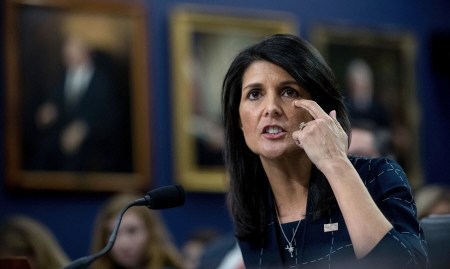
On Tuesday, Nikki Haley, the US ambassador to the United Nations delivered testimony to the House panel on foreign operations, a subcommittee of the Appropriations Committee in the US House of Representatives. In that testimony, Haley addressed multiple issues relating to the Islamic Republic of Iran, thereby reasserting the Trump administration’s assertive policies toward the Iranian regime. By most accounts those policies are still emerging, but they have already come to include purposive outreach to other adversaries of the Islamic Republic and a program of expanded sanctions on matters such as Iran’s ballistic missile program.

However, those efforts to confront and contain the Islamic Republic are arguably complicated by other aspects of the Trump administration’s policy commitments, including a focus on domestic issues and an effort to improve relations between the US and Russia, which boasts close relations with Iran in the areas of trade and military cooperation, especially as it relates to the Syrian Civil War.

While the US supports moderate rebel groups fighting against the dictatorship of Bashar al-Assad, the Iranians and Russians have been credited with turning the war in favor of Assad. Various Shiite militias are currently operating as proxies for Iran in that war, and the Iranian Revolutionary Guard Corps is increasingly playing a direct role in the conflict. Meanwhile, Russia has been providing air support for pro-Assad ground operations since 2015.

Western commentators, including officials in the Trump administration, have variously accused Russia and Iran of ignoring or actively facilitating human rights abuses by the Assad regime, including an April chemical weapons attack that killed at least 80 people in a rebel-controlled civilian area.

As the Associated Press points out, Ambassador Haley’s comments to the House panel came shortly after the White House had issued a warning to Syria regarding alleged preparations for another such chemical attack. The article specified that Pentagon officials had confirmed the intelligence underlying that warning, involving particular movements at the same Syrian air base that had been used as the staging area for the previous chemical attack on Khan Sheikhoun.

White House Press Secretary Sean Spicer said of Assad that “he and his military will pay a heavy price” if they follow through with apparent plans for another “mass murder attack using chemical weapons.” But the AP quoted Haley as saying that the administration’s remarks were not intended only for Assad, but also for Russia and Iran. Both of the Syrian allies joined in denying Assad’s responsibility for the attacks, with some officials insisting that the chemical weapons had originated in a rebel warehouse at the site of a conventional military airstrike.

The dispute over this issue and the subsequent US cruise missile strike on Shayrat air base can be seen as early examples of the escalation between Iranian allies and adversaries which is still going on to this day. In fact, Haley’s effort to fold Russia and Iran into a warning directed more explicitly against Syria is reminiscent of an incident earlier in June wherein a member of Iran’s Revolutionary Guard said that a ballistic missile strike on eastern Syria had been intended largely as a warning to the US and Saudi Arabia.

Those two traditional adversaries of the Islamic Republic have been expanding relations under the Trump administration, sometimes with explicit reference to shared anxieties over expanding Iranian influence and meddling in the broader Middle East. President Trump’s visit to Riyadh in May for an Arab-US summit coincided with the signing of trade agreements that included 110 billion dollars in arms sales to the Arab Kingdom.

But at the same time that the White House is openly siding with Saudi Arabia and its regional allies against the Iranian regime, it does not appear to be giving up on the prospect of improved relations with Russia. In fact, the Western strategy for a political solution to the Syrian Civil War seems to presently involve the expectation that Russia can be encouraged to rein in the Islamic Republic and prevent it from further sabotaging ceasefire agreements.

Recent developments have cast doubt upon the practicality of this strategy however. As the US has taken a more direct role in defending rebel groups, even resorting to the shoot-down of at least two military controlled drones and a Syrian warplane, Russia has responded by threatening to target US aircraft and to halt the use of a hotline intended to prevent mid-air collisions between the multiple powers operating in the skies over Syria.

Haley’s comments on Tuesday were indicative of a roughly matching increase in American criticism of Russia. And this criticism was not limited to the issue of chemical weapons. Haley also explained that Russia’s position on the UN Security Council allowed it to stymie US efforts to sanctions Iran and hold it to account for ongoing misbehavior in matters including the development of the Iranian nuclear program.

“[The Iranians are] going to continue their nuclear capabilities and we just gave them a lot of money to do it with,” Haley said, referring to the 2015 nuclear agreement that President Trump has described as “the worst deal ever negotiated.” She went on to highlight concerns about Iran’s sponsorship of terrorism, suggesting that nuclear weapons could find their way into the hands of terrorist groups at some point in the future, and that Russia would effectively prevent the US and its allies from doing anything to stop this.

“Yes, we would love to sanction Iran; and, yes we will continue to be loud about it; and, yes, Russia will veto it,” Haley said, according to the Washington Examiner.

But this is not to say that the Trump administration has positively brought an end to its strategy of attempting to improve relations with Russia. In fact, various reports suggest that this endeavor is even standing in the way of congressional legislation aimed at increasing national-level sanctions on both Iran and Russia. The Countering Iran’s Destabilizing Activities Act passed the Senate two weeks ago by a margin of 98 to 2, but it was subsequently stalled in the House on procedural grounds, leading Democrats to argue that the House Republican leadership was trying to protect the president’s Russian agenda.

The prospects for resolution appeared to grow dimmer on Tuesday when the Washington Post reported that energy lobbyists were urging lawmakers to reevaluate the bill on the grounds that its restrictions on doing business with Russian companies could have a punishing effect on American firms and foreign firms doing business in the US. These objections could bolster the prospects of the House leadership sending the bill to various committees for review and markup – a process that could delay a final vote by months.

As it concerns Iran, the bill would include sanctions on Iran’s ballistic missile activities and also extend all terrorism-related sanctions to the Revolutionary Guard Corps, for which Trump has urged designation as a foreign terrorist organization. This position has not changed, and it seems that neither has the Trump administration’s hardline approach to Iran policy. Some have suggested that the emerging policy is pointing in the direction of regime change, though this has not become a declared position as yet.

The Washington Examiner pointed out that one member of the House panel on foreign operations, Republican Representative Hal Rogers, had directly raised the prospect of regime change on Tuesday, asking Nikki Haley whether it is an option. The ambassador’s only response was “I don’t know.”

This coming Saturday, the National Council of Resistance of Iran will hold its annual Free Iran rally, which will include explicit calls for regime change driven by a domestic opposition movement within the Islamic Republic. The event is expected to be attended by tens of thousands of Iranian expatriates, plus hundreds of policymakers and experts from the US, Europe, and throughout the world. Notably, these dignitaries will include figures with close ties to the Trump administration, such as John Bolton, who served the second Bush administration in the position now occupied by Haley.
What Is the Right U.S. Policy on Iran?

June 21, 2017

What Is the Right U.S. Policy on Iran? Clarion ProjectShahriar Kia, June 21, 2017

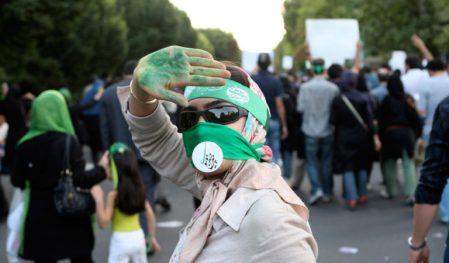
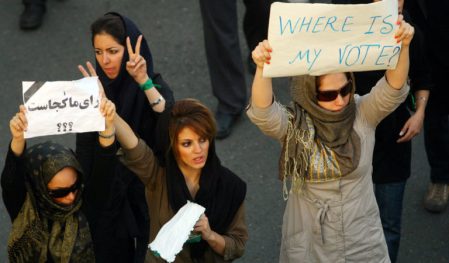
Iranian women protest election irregularities in 2009 (Photo: Getty Images)

Tillerson added. “As you know, we have designated the Quds [Force]. Our policy towards Iran is to push back on this hegemony, contain their ability to develop obviously nuclear weapons, and to work toward support of those elements inside of Iran that would lead to a peaceful transition of that government. Those elements are there, certainly as we know.”

******************************

United States Secretary of State Rex Tillerson responded to a variety of very serious questions raised by House of Representatives members in a recent hearing focusing on U.S. policy vis-à-vis Iran. Representative Ted Poe (R) from Texas touched on what many believe is the ultimate issue when he said:

“I’d like to know what the policy is of the U.S. toward Iran. Do we support the current regime? Do we support a philosophy of regime change, peaceful regime change? There are Iranians in exile all over the world. Some are here. And then there’s Iranians in Iran who don’t support the totalitarian state. So is the U.S. position to leave things as they are or set up a peaceful, long-term regime change?”

America’s top diplomat, taking into consideration how the Trump administration’s all-out Iran policy remains an issue of evaluation, answered:

“… our Iranian policy is under development.

“We continually review the merits both from the standpoint of diplomatic but also international consequences of designating the Iranian Revolutionary Guard in its entirety as a terrorist organization.” 

Tillerson added. “As you know, we have designated the Quds [Force]. Our policy towards Iran is to push back on this hegemony, contain their ability to develop obviously nuclear weapons, and to work toward support of those elements inside of Iran that would lead to a peaceful transition of that government. Those elements are there, certainly as we know.”

Iran is terrified of such a stance and responded immediately. In a tweet, Iranian Foreign Minister Mohammad Javad Zarif claimed that 75 percent of Iran’s population voted in the recent election farce back in May.

Iran’s wrath was not limited to this very issue. Following the twin ISIS attacks targeting Iran’s parliament and the tomb of Ayatollah Khomeini, leader of the Islamic revolution in Iran, senior regime officials sought to portray their apparatus as a victim of terrorism.

Failing to do so, Iranian regime officials accused the US, Saudi Arabia and the main opposition group, the People’s Mojahedin Organization of Iran (PMOI/MEK), of this terrorist plot. A few days ago, Supreme Leader Ayatollah Ali Khamenei lashed out at the US and accused Washington of bringing ISIS to life.

“Who created ISIS? Was it anyone but the U.S.? … The U.S. claim that they have established a coalition against ISIS is a lie; of course, the U.S. is against an ‘unrestrained ISIS,’ however, if anyone truly seeks to eradicate ISIS, they will have to fight against it,” he said.

Now the question is, what is Iran so concerned about and what is the right policy vis-à-vis Iran?

With Obama leaving the White House, Iran forever lost a major international backer. For eight years, the “golden era” as Iran dubbed the Obama years, any and all activities by the Iranian people and their organized opposition for change in Iran was countered by the domestic crackdowns and international hurdles, specifically by the U.S.

Obama’s neglect of Tehran’s crimes in Syria and Iraq led to the disasters we are witnessing today. Internationally, a major overhaul of U.S. policy in the region and establishing a significant Arab-American alliance in the face of Iran’s meddling has become a major concern for the mullahs.

In addition, increasing popular dissent and widespread activities by the PMOI/MEK in the past few months have also raised major concerns for the regime.

Khamenei personally intervened last week, first acknowledging the 1988 massacre, defending the Revolutionary Guards (IRGC), and those involved in the murder of over 30,000 political prisoners. Most of the victims, all executed in mass groups, were PMOI/MEK members and supporters.

Khamenei’s second concern and that of his entire apparatus is focused on the upcoming Iranian opposition’s annual convention in Paris scheduled for July 1 this year. The National Council of Resistance of Iran (NCRI), the main entity representing the Iranian opposition, hosts more than 100,000 Iranians from across the globe each year alongside hundreds of prominent dignitaries delivering their support and speeches seeking true change in Iran.

Last year alone, a very prominent delegation of American dignitaries from both sides of the political aisle included former New York Mayor Rudy Giuliani, former House Speaker Newt Gingrich, former U.S. ambassador to the UN John Bolton from the Republicans, former Democratic National Committee chairman Gov. Howard Dean, former U.S. ambassador to the UN Gov. Bill Richardson took part.

This year’s Iranian opposition rally is already brewing major concerns for Tehran as the regime understands the end of the era of appeasement has led to sweeping changes in Western policy regarding the Middle East, and most importantly Iran.

This is exactly why Tehran is going the limits to prevent the shifting of policy towards the Iranian people. Tehran’s lobbies in the U.S. and Europe are placing a comprehensive effort to demonize the images of the PMOI/MEK and the NCRI to prevent any such changes, especially in Washington.

If Iran resorts to ridiculous remarks of accusing the U.S. and Iranian opposition of staging the recent double attacks in Tehran, the correct policy is none other than supporting the Iranian people and their resistance to realize regime change in Tehran.

Iran and Middle East Instability

June 3, 2017

Iran and Middle East Instability, American ThinkerShahriar Kia, June 3, 2017

During President Donald Trump’s trip to the region and beyond Iran was strongly condemned by the American leader and senior Saudi officials for its support for terrorism, destructive role across the Middle East, and meddling in Syria, Iraq, and Yemen. Tehran is most specifically concerned with world leaders denouncing Iran’s human rights violations and acknowledging how the Iranian people are the main victims of the mullahs’ atrocities.

The Arabs, as the flagbearers of implementing U.S. sanctions, have launched the domino of freezing Iran’s money abroad. Iranian bank accounts in countries such as Turkey, Oman, and the UAE, especially in Dubai and Abu Dhabi, are being blocked one after another. This can be considered the prelude to comprehensive sanctions on Iran’s banking network.

***********************

The end result of Iran’s presidential election has created further rifts and launched a more intense power struggle amongst the regime’s senior ranks. Supreme Leader Ali Khamenei, fearing a repeat of the 2009 scenario of nationwide uprisings, failed to “engineer” the election results with the aim of unifying his regime apparatus. Khamenei sought to prepare conservative cleric Ebrahim Raisi as his heir by first placing him in the presidency, similar to the process he himself went through.

The elections, however, failed to provide such a finale and in fact prompted all candidates to unveil corruption in the most senior ranks. This has prompted the general public to increase their demands. Protests and demonstrations are witnessed these days in more than 30 cities and towns across Iran, with sporadic reports of clashes, following the bankruptcy of two state-run financial firms, Caspian and Arman.

Iran is also facing major foreign dilemmas, with a new international coalition shaping and targeting Tehran’s interests. The Arab-Islamic-American alliance, with the presence of 55 States, and Iran’s absence, delivered a major blow to the mullahs’ objectives in the Middle East.

On the other hand, Iranian opposition People’s Mojahedin Organization of Iran (PMOI/MEK), transferring all its members from Iraq to a number of European countries, has become ever more powerful. Through a vast network of supporters inside Iran, the PMOI/MEK was able to significantly influence the recent elections and place the regime in a quagmire like never before.

A major rally is scheduled for July 1st by supporters of the National Council of Resistance of Iran (NCRI), the political umbrella group of Iranian dissidents, including the PMOI/MEK. Policymakers and influential figures from across the globe will be gathering to provide a concrete plan to evict the mullahs’ presence from the region, how to establish freedom and democracy in Iran, and thus result in peace and stability in the Middle East. Last year more than 100,000 people took part in this convention.

During President Donald Trump’s trip to the region and beyond Iran was strongly condemned by the American leader and senior Saudi officials for its support for terrorism, destructive role across the Middle East, and meddling in Syria, Iraq, and Yemen. Tehran is most specifically concerned with world leaders denouncing Iran’s human rights violations and acknowledging how the Iranian people are the main victims of the mullahs’ atrocities.

Despite the heavy blows and new sanctions against Tehran, Khamenei has chosen to remain completely silent. This is in complete contrast to the Obama era, where the mullahs’ leader resorted to harsh outbursts in response to even the slightest hint of threats by U.S. officials.

To this end, adopting a strong approach against Tehran has proven to be correct, parallel to the weakness seen in Tehran following the presidential election.

To add insult to injury for Iran, the Trump administration has imposed sanctions on dozens of Iran’s companies, sending a highly important message.

Sanctions have now expanded from ballistic missiles and reached the human rights perspective, and specifically targeting the Revolutionary Guards (IRGC) with the objective of designating this entity as a foreign terrorist organization

The IRGC-affiliated Fars news agency described a new U.S. Senate bill as an “effort to bring Europe aboard in nuclear sanctions.”

“Foreign investment in Iran during the past four years has halved during the past four years, lowering from $4.6 billion to $2.05 billion,” according to Naseem Online citing a UN report.

The Arabs, as the flagbearers of implementing U.S. sanctions, have launched the domino of freezing Iran’s money abroad. Iranian bank accounts in countries such as Turkey, Oman, and the UAE, especially in Dubai and Abu Dhabi, are being blocked one after another. This can be considered the prelude to comprehensive sanctions on Iran’s banking network.

Is Rouhani able, or even willing?

Rouhani is neither willing nor able to carry out any measures outside of Khamenei’s framework. The entire apparatus and power structure is controlled by the Supreme Leader. As long as Iran remains under the mullahs’ regime structure, one should set aside all expectations of change emanating from within Iran. A look at Mohammad Khatami’s tenure is president from 1997 to 2005, andRouhani’s first term, are undeniable proof to this reality.

“They want to change our behavior, but changing it means changing our regime,”Khamenei said recently, signaling his red line.

Rouhani defending Iran’s missiles

The regime’s president recently said that Tehran would continue its ballistic missile program.

“… US officials should know whenever we need to technically test a missile, we will do so and will not wait for their permission,” he said in a news conference.
The Iranian regime reported recently the construction of a third underground ballistic missile production factory and will keep developing its missile program.

This came in the same week when Trump in his foreign visit described Iran as a supporter of militia groups and a threat to all Middle East countries.

Rouhani is an “utterly ruthless operator,” who had presided since 2013 over a collapsing economy and what Amnesty International called “a staggering execution spree,” murdering and imprisoning so many dissidents that Iran has per capita the highest execution rate in the world, according to Christopher Booker in a recent Telegraph article.

Obama’s departure ended the period of appeasement and golden opportunities for Tehran’s mullahs. The road ahead promises to be very difficult, to say the least.

The past four decades have proven that only regime change will bring about what the Iranian people desire and deserve. This is something that is supported by the NCRI and Rajavi’s ten-point plan, calling for a free and democratic Iran where equal opportunities are provided to all citizens regardless of gender, ethnicity, and religion. During the short campaigning season, Iranians manifested their support for Rajavi’s plan by putting up posters reading “Maryam Rajavi is our president.”


The Iranian People Hope Trump Will Support Them, Not Their Rulers

May 14, 2017

The Iranian People Hope Trump Will Support Them, Not Their Rulers, Iran Focus, May 14, 2017

(Please see also, Prosecutor General Warns against Attempts to Upset Election Security in Iran. — DM)

The new American president is reviewing policy with regards to Iran, and with an eye to change. Kashfi suggests that, “Any further support for the un-elected regime in Teheran, be it commercial, economic, diplomatic should be tied to a commitment by the Islamic regime to stop supporting international terrorism and to respect women, minorities, and human rights.”

With the change of power in America, the hope and expectation of the Iranian people is that Washington will support the Iranian people, and advocate the overthrow of the Islamic regime.

******************

London, 14 May – It’s been reported that more than 9 million Iranians have fled their homeland since the Revolution in 1979. This means that more than 12 percent of Iran’s citizens chose to abandon their homes, families, and belongings, to maintain their freedom. It is estimated that close to four million Iranians have taken refuge in the U.S since 1979.

These refugees consider the International, and specifically European, trade agreements and relations with Iran, their worst nightmare.

The Islamic regime and some in the international community claim that support for the so-called “reformist” and “pragmatic” President Hassan Rouhani will ultimately bring freedom and democracy to Iran. They attempt to convince the free world and democratic countries that appeasement and normalized relations will change the Iranian regime’s attitude and behavior.

“However,” writes Mansour Kashfi, author and president of Kashex International Petroleum Consulting with over 50 years’ experience in petroleum exploration, primarily in Iran in an article for WorldTribune, “the distinction between a ‘moderate’ president and ‘fundamentalist’ Supreme Leader in Iran is a political subterfuge used to mislead the population and perpetuate the inherent corruption of the Islamic regime governing system.

This corruption will not only continue to oppress the Iranian people but also undermine the transparency in business dealings with foreign investors.”

After two years of negotiations, an agreement was reached to lift the sanctions on Iran in return for the Islamic Republic halting its efforts to acquire nuclear weapons.

In the midst of this, former President Obama decided to attempt to make a connection with Ayatollah Khameini, the Supreme Leader of the Islamic regime. Obama sent Khameini several friendly letters. Some called this course of action outrageous, considering that the Iranian people were crying for democracy and American help to support a secular government in Iran, and the disastrous human rights issues in Iran, continued terrorist acts in the region, and ongoing testing of intercontinental missiles. Obama may have done better by establishing a relationship with the Iranian people, instead.

According to Kashfi, “Clergies in Iran are as murderous as any religious group in history. From the very first day of the Islamic regime’s establishment, they executed many innocent Iranian officials and military officers, and provoked war with Iraq just to consolidate their dictatorial regime,” and adds, “During eight years of bitter war with Iraq and over one million casualties, clergies dragged school children to the front lines, where their little bodies were used as sandbags to clear mine fields.”

“War was an excuse to execute dissidents and anyone who displeased the bloodthirsty clergies. Minorities including non-Shiite believers such as Sunnis, Jews, Christians, and Bahais were executed on political charges. All these killings and unjust acts in Iran were carried out on command of the Supreme Leader, Ayatollah Khameini,” writes Kashfi.

According to The U.S. Congress’s Human Rights Country Report there has been no change in the status of human rights in Iran. Since 2013, when Hassan Rouhani became president, the status of human rights worsened.

Respect for human rights distinguishes America as a great nation, so Kashfi wonders how it can “…still believe it can establish a lasting line of communication with a terrorist regime in Iran that routinely persecutes religious and ethnic minorities, tortures and systematically executes political prisoners, and promotes international terrorism abroad?” He adds, “…when America fails to lead, enemies of freedom like the Islamic regime of Iran and Russia fill the vacuum.”

After the U.S.withdrew from Iraq, Kashfi says that “the Islamic regime did everything it could to establish oppression and spread terror in that country, and Russia began focusing on the southern Persian Gulf states.”

The new American president is reviewing policy with regards to Iran, and with an eye to change. Kashfi suggests that, “Any further support for the un-elected regime in Teheran, be it commercial, economic, diplomatic should be tied to a commitment by the Islamic regime to stop supporting international terrorism and to respect women, minorities, and human rights.”

With the change of power in America, the hope and expectation of the Iranian people is that Washington will support the Iranian people, and advocate the overthrow of the Islamic regime.

Prosecutor General Warns against Attempts to Upset Election Security in Iran

May 14, 2017

Prosecutor General Warns against Attempts to Upset Election Security in Iran, Tasnim News Agency, May 14, 2017

(Please see also, How to Secure and Stabilize the Middle East. Are the mad mullahs worried? — DM)

TEHRAN (Tasnim) – Iran’s Judiciary has obtained information about hostile schemes to create insecurity as the country is gearing up for presidential election, Prosecutor General Mohammad Jafar Montazeri warned, stressing that any move to disrupt security will receive a harsh response.

Speaking at a press conference on Sunday, Montazeri said reports suggest that “ill-wishers and enemies are seeking to upset security with any means” as election day is nearing.

Giving an assurance that hostile attempts at causing insecurity will get nowhere, the prosecutor general warned that the Iranian Establishment’s response to anyone wanting to upset the security of the country or the election will be severe.

In comments on May 10, Leader of the Islamic Revolution Ayatollah Seyed Ali Khamenei warned that the enemies’ short-term purpose is to upset Iran’s security and foment chaos.

The Leader also cautioned the six candidates running for presidency against moves or comments that may upset the country’s security and serve the interests of the enemy unintentionally.

“Anybody wanting to take any measure against the country’s security in the election will certainly receive a hard reaction and slap in the face,” Ayatollah Khamenei underlined.

“(The issue of) security is of great significance for the country, for the people, and consequently for me, and security must be fully maintained in the election,” the Leader added.

The 12th presidential election will be held in Iran on May 19.

Six candidates, Hassan Rouhani, Mohammad Baqer Qalibaf, Eshaq Jahangiri, Ebrahim Raisi, Mostafa Aqa-Mirsalim, and Mostafa Hashemitaba are running in the race.

How to Secure and Stabilize the Middle East

May 14, 2017

How to Secure and Stabilize the Middle East, Clarion ProjectShahriar Kia, May 14, 2017

An Iranian protester during the Green Revolution (Photo: Reuters)

The opinions below are those of the author and do not necessarily reflect those of Clarion Project.

In contrast to other countries that lack a opposition that can be trusted, Iran enjoys an internationally-recognized alternative based on democratic values acknowledged across the globe.

The National Council of Resistance of Iran (NCRI) and its pivotal member, the People’s Mojahedin Organization of Iran (PMOI/MEK), is the largest and most organized opposition in the face of the Iranian regime. The NCRI enjoys widespread support inside Iran and throughout the world, with the ability to organize an uprising against the regime in Tehran. Senior Iranian regime officials have acknowledged the time and again that the main threat compromising Iran’s entire regime apparatus is none other than the PMOI/MEK. To this end, they have focused their entire efforts on physically obliterating this Iranian opposition group.

In 2009, when the Iranian people took to the streets and demanded fundamental change, their efforts went unsupported due to Obama’s appeasement policy that sought to sign the nuclear deal with Tehran at all costs. This was an opportunity that enjoyed the potential of significantly decreasing existing Middle East crises. Today, the regime in Tehran is facing crises far more dangerous than 2009.

The correct Iran policy is supporting regime change by the Iranian people and their organized and legitimate resistance. By adopting such a stance, the international community can begin to confront Iran’s notorious influence in the region and its nuclear ambitions in order to spread security in a non-nuclear Middle East free of terrorism.

***************************

U.S. Secretary of State Rex Tillerson announced at a press conference on April 19 that the White House is evaluating its policy on Iran. This policy overview will not merely cover the Iran nuclear deal, but will be a comprehensive look at all Iran-related issues.

At a press conference, Tillerson formalized Iran’s provocative and destructive measures in different fields.

“Iran is the world’s leading state sponsor of terrorism and is responsible for intensifying multiple conflicts and undermining U.S. interests in countries such as Syria, Yemen, Iraq, and Lebanon, and continuing to support attacks against Israel … An unchecked Iran has the potential to travel the same path as North Korea, and take the world along with it … Iran’s provocative actions threaten the United States, the region, and the world …” he said.

“Iran continues to have one of the world’s worst human rights records,” Tillerson added.

Defense Secretary James Mattis adopted a similar approach on April 22 at the Center for Strategic and International Studies, saying, “But we’re talking about the Mideast at an inflection point. And I would just point out right now that among the many challenges the Mideast faces, I think Iran is actually foremost … The Iranian regime, in my mind, is the single most enduring threat to stability and peace in the Middle East.”

Iran’s meddling has neutralized all efforts to resolve the region’s crises, said Bahrain Interior Minister Rashed bin Abdullah at a Gulf Cooperation Council (GCC) session, adding the region faces threats that demand cooperation to confront. He emphasized the need for unity in Gulf positions regarding strategic matters.

What is the right Iran policy?

Supporters of the Iran appeasement approach believe the correct policy is to engage the mullahs’ regime and continue dialogue. They justify this approach for two reasons: first, to contain Iran’s nuclear ambitions and second, to attempt to establish change from within by supporting so-called “moderates” inside the regime apparatus.

This is the policy pursued during the Obama years without any political or strategic reservation, and also that of previous administrations throughout the past few decades.

However, rapprochement with Tehran not only failed to contain the mullahs’ ambitions and terrorism; in fact, it further encouraged the regime and plunged the entire Middle East into insecurity and instability.

The Wall Street Journal wrote in a recent piece, “President Donald Trump’s hard-line view on Iran was at odds with State Department diplomats.”

Yet, the solution placed forward by Obama and the State Department’s experienced diplomats resulted in Iran escalating its flagrant human rights violations and expanding its devious influence throughout the Middle East.

Others believe the right Iran policy is a military solution and the U.S. must launch airstrikes targeting Iran’s nuclear sites. Although this can deliver significant blows to Iran’s ambitions and disrupt the mullahs’ efforts to obtain nuclear weapons, the consequences on regional security and stability are controversial, placing the U.S. and its allies in yet another Middle East war.

What is the durable solution? Can we avoid war while bringing an end to the spread of extremism and terrorism across the globe?

Iran is the leading state sponsor of terrorism in today’s world. Since the appeasement policy adopted by previous U.S. administrations has been fruitless in containing Iran and actually led to the current dangerous circumstances, the only viable long-term solution is to adopt a firm policy that hinges on regime change.

In contrast to other countries that lack a opposition that can be trusted, Iran enjoys an internationally-recognized alternative based on democratic values acknowledged across the globe.

The National Council of Resistance of Iran (NCRI) and its pivotal member, the People’s Mojahedin Organization of Iran (PMOI/MEK), is the largest and most organized opposition in the face of the Iranian regime. The NCRI enjoys widespread support inside Iran and throughout the world, with the ability to organize an uprising against the regime in Tehran. Senior Iranian regime officials have acknowledged the time and again that the main threat compromising Iran’s entire regime apparatus is none other than the PMOI/MEK. To this end, they have focused their entire efforts on physically obliterating this Iranian opposition group.

Following a visit paid by Senator John McCain to Albania and his meeting with Iranian opposition leader Maryam Rajavi, an analysis posted on April 27 in Iran Dideban, a state-sponsored outlet, made vivid the regime’s concern that the Revolutionary Guards (IRGC) failed to quell and destroy the PMOI/MEK.

“The IRGC’s involvement in Syria led to serious neglect. This inattention has surfaced, resulting in this group [MEK] gaining a more open hand to play a role in on-the-ground developments … It is worth noting this group has significant experience in organizing campaigns and can pose a potential security threat for the country. The use of social domestic networks inside the country and influencing grayscale correspondents are among the efforts of this group. This has launched a wave of disappointment among forces loyal to the establishment and state.”

In 2009, when the Iranian people took to the streets and demanded fundamental change, their efforts went unsupported due to Obama’s appeasement policy that sought to sign the nuclear deal with Tehran at all costs. This was an opportunity that enjoyed the potential of significantly decreasing existing Middle East crises. Today, the regime in Tehran is facing crises far more dangerous than 2009.

The correct Iran policy is supporting regime change by the Iranian people and their organized and legitimate resistance. By adopting such a stance, the international community can begin to confront Iran’s notorious influence in the region and its nuclear ambitions in order to spread security in a non-nuclear Middle East free of terrorism.

Assad’s Air Force Chemical Attack & Possible Link to Iran’s IRGC Ground Forces Operations

April 22, 2017

Assad’s Air Force Chemical Attack & Possible Link to Iran’s IRGC Ground Forces Operations, Iran News Update, April 21, 2017

“The goal of chemical attack on Khan Sheikhoun was changing the balance of power in favor of the Iranian Revolutionary Guards,” writes the NCRI, adding, “The IRGC conflict zone was on average 20 km away from Khan Sheikhoun.”

The National Council of Resistance of Iran writes,”The role of the clerical regime and the IRGC in recent chemical attack proves once again that the only way to end war and bloodshed in Syria is to evict the mullahs’ regime and to expel the IRGC and its mercenaries from the country.”

********************************

When looking at the events before and after Bashar al-Assad’s chemical attack on the town of Khan Sheikhoun, and the operations of Iranian Revolutionary Guards (IRGC) in the northern province of Hama, questions arise as to the goal of the attack.

Beginning March 21, 2017, the Free Syrian Army and the Syrian opposition began to advance in the north of Hama, and reached within three kilometers of the city of Hama. According to an article published by the National Council of Resistance of Iran (NCRI), the IRGC dispatched its forces in Damascus and its suburbs, using its highest ranking commanders. These forces were present in the North and West of the city of Hama and around the town of Soran. They include battalions of the 19th Fajr Shiraz Division, battalions of the division known as Nabi Akram of Kermanshah, Saberine special battalions of Tehran province, and Ninawa brigade forces in Golestan province.

Dozens of IRGC forces and their mercenaries, including some IRGC commanders, were killed in the region less than two weeks before the chemical attack on Khan Sheikhoun. The NCRI reports that some of them include:

• Revolutionary Guards Corps Brigadier General Abdullah Khoshnoud from 19th Fajr Division on March 29 in the outskirts of Hama;

• Colonel Morad Abbasifar, from the division known as Nabi Akram who had close relationship with Qasem Soleimani, in late March in the town of Moardas in northeast of city of Hama;

• Mohammad Jannati known as Haj Haidar, a commander of the Revolutionary Guards in Syria, in late March in Tarabee near the city of Halfaya;

• Saeed Khaja Salehani, an IRGC officer, on March 25 in north of Hama;

• Hossein Moez Gholami of the Iranian Revolutionary Guards in Tehran, Abuzar Farahbakhsh and Ghodratollah Aboudi from 19th Fajr Division in Hama province.

A large number of Iraqi, Afghan and Pakistani mercenaries sent by the IRGC to Hama province were also killed. So high were the losses, that on March 31, four days before the chemical attack, Qassem Soleimani visited the IRGC forces to boost their morale.

“The goal of chemical attack on Khan Sheikhoun was changing the balance of power in favor of the Iranian Revolutionary Guards,” writes the NCRI, adding, “The IRGC conflict zone was on average 20 km away from Khan Sheikhoun.”

The IRGC forces continued their assault after the chemical attack, and last week, the bodies of a number of Afghan and Pakistani mercenaries were returned to Iran.

Bashar al-Assad’s ground force is weakened, and so offensive ground operations in Syria are now carried out by the IRGC, with support from Assad’s air force.

In his memoirs, Revolutionary Guards Corps (IRGC) Brigadier General Hossein Hamadani, who commanded the IRGC forces and was killed in October 2015 near the city of Aleppo, wrote, “In March 2013 (opposition) was quite close to a victory … they tightened the noose and got closer to the Syrian Presidential Palace such that they were set to occupy the palace… Bashar al-Assad also thought it was over and was pursuing to go to another country.” Hamadani goes on to tell how the IRGC saved Bashar al-Assad from being overthrown.

The National Council of Resistance of Iran writes,”The role of the clerical regime and the IRGC in recent chemical attack proves once again that the only way to end war and bloodshed in Syria is to evict the mullahs’ regime and to expel the IRGC and its mercenaries from the country.”

Iran: Possible US and Iranian Opposition Cooperation to Counter the Threat of Mullahs’ Rule

April 21, 2017

Iran: Possible US and Iranian Opposition Cooperation to Counter the Threat of Mullahs’ Rule, Iran Focus, April 20, 2017

(Please see also, Iran’s Top Judge Warns of Enemy Schemes for Election. Might the “enemy schemes” of the Iranian dissidents who met with Sen. McCain be among those referenced there? — DM)

Senator McCain’s visit to Albania to visit dissidents and Maryam Rajavi could perhaps be a step in the direction of cooperation between the US government and the main Iranian opposition. It is true that the NCRI is receiving more and more support from lawmakers in the West, and from all over the world, and it is making the Iranian regime nervous. Cooperation between the US and the Iranian opposition, which has large networks of people all over Iran, will be a positive move for the people of Iran. No one knows more about the Iranian regime and its activities than the main opposition group and it will help the US get foreign policy to counter the regime’s threat right.

*****************************

London, 20 Apr – Last week, Senator John McCain went to Albania where he met a number of the former residents of the Camp Liberty base. The dissidents were finally released from the former US military base last year and many of them have now made Albania their permanent residence. The dissidents at Camp Liberty had been victim to numerous attacks planned by the Iranian regime.

However, they have now all finally been released from Camp Liberty and have the freedom to continue their activism, must to the dismay of the Iranian regime.

Senator McCain also met with the leader of the People’s Mojahedin Organization of Iran (PMOI/MEK) and the National Council of Resistance of Iran (NCRI), Maryam Rajavi.

It was no surprise that the mullahs were unhappy about this encounter and claimed it was part of a conspiracy against the Islamic Republic. There were also threats that the US would be made to “pay” for the “mistakes” it has made. This predictable anger is nothing but proof that the Iranian regime is extremely weak and terrified of opposition.

For years, the Iranian regime has attempted to destroy the opposition via various methods including force, violence, false allegations and slander. It is clear that the opposition groups, especially the National Council of Resistance of Iran (NCRI), pose a very real threat to the mullahs’ rule.

The threat has got even more real now that the Trump administration is in place. While President Obama was in office, the Iranian regime enjoyed free reign over the Middle East. Obama did not dare call the regime out on its malign activities, let alone sanction it.

In his presidency so far, Trump has put Iran “on notice” after it conducted testing of ballistic missiles and has issued numerous sanctions on Iranian individuals and entities. The Trump administration is also weighing up whether or not to designate the IRGC (Islamic Revolutionary Guard Corps) as a FTO (Foreign Terrorist Organisation). However, the biggest message was sent to Iran when it launched a strike on its ally in Syria. As well as saying that the United States will not put up with such evil acts (the chemical weapons attack that killed dozens of civilians), it was a challenge to Iran’s position as the main backer of the Syrian regime.

Senator McCain’s visit to Albania to visit dissidents and Maryam Rajavi could perhaps be a step in the direction of cooperation between the US government and the main Iranian opposition. It is true that the NCRI is receiving more and more support from lawmakers in the West, and from all over the world, and it is making the Iranian regime nervous. Cooperation between the US and the Iranian opposition, which has large networks of people all over Iran, will be a positive move for the people of Iran. No one knows more about the Iranian regime and its activities than the main opposition group and it will help the US get foreign policy to counter the regime’s threat right.

Iran’s Stage-Managed Elections

April 15, 2017

Iran’s Stage-Managed Elections, American ThinkerReza Shafiee, April 15, 2017

(What can President Trump do to promote regime change in Iran? What can he do to support the resistance, in and outside Iran? What, if anything will he do?– DM)

Iran’s history has shown that people are willing to risk and speak openly when they have outside support and sympathy. The United States’ policies with regard to human rights have an instant effect in hearts and minds of ordinary citizens in Iran. What happened in Iran in 2009 is not a distant memory. The Obama administration’s flawed policy set off a chain reactions in the region which still reverberates in Syria, Yemen and Iraq. By focusing just on getting the nuclear deal done with the mullahs in Tehran, it actually left out other pressing issues such supporting the Iranian people and indirectly preventing the carnage in the neighboring countries. 

***************************

Every four years, Iranian citizen witness a show called ‘elections.’ These have nothing in common with genuine democratic elections; they’re facades. The upcoming May 19 elections are no exception.

A closer look at the candidates proves that they are no different from one another and all have a clear track record of participation in suppression of Iranian people over the past four decades. They have won the approval to enter the race by the mullahs for just this reason.

The two more serious ones are: Hassan Rouhani, the incumbent president; and Ebrahim Raisi, custodian of Iran’s wealthiest charity, Astan Quds Razavi in Iran’s holiest shrine of Imam Reza in Mashhad, northeastern Iran. Having charge of such vast amount of wealth, it’s a given that Raisi enjoys Supreme Leader Khamenei’s full trust. Both candidates are cut from the same cloth and are committed to principle to Supreme Guardianship (Velayat-e faqih), meaning, the rule of the ayatollahs

So who are they? Let’s start with the second one.

Ebrahim Raiai a member of “Death Commission” and close confident of Ali Khamenei

He was a low-level cleric who climbed the ladder in the mullahs’ hierarchy just for his undeniable services to the late Khomeini in slaughtering of 30,000 political prisoners in summer of 1988. (In Iran, we don’t refer to Khomeini as “Ayatollah,” just Khomeini is enough.  The title has been stolen and abused by the ruling mullahs in Iran.) The prisoners were mainly members and sympathizers of the Iranian opposition People’s Mojahedin Organizations of Iran (PMOI/MEK).

The “Death Commission” was a four-member body with the sole task of carrying out Khomeini’s fatwa against dissidents. In his hand-written decree, Khomeini openly ordered the commission to kill the political prisoners, the majority of whom had been already imprisoned.

Ayatollah Hossein-Ali Montazeri, Khomeini’s handpicked successor was later sacked over his quarrel with Khomeini for the indiscriminate killings. In a shocking 28-year-old audio file of one the meetings of Death Commission leaked in August by his son Ahmad, Montazeri called the killings a “crime that future generations will certainly not forget” and declared: “It is committed in the name of the Islamic Republic and carried out by you.”

Ahmad Montazeri has regarded Ebrahim Raisi’s standing for presidential elections a ‘joke’ and ‘an insult to Iranian people’. Raisi’s record does not stop at just his role in the massacre of political prisoners in 1988, but what he did overrides any other tasks he has undertaken in Islamic Republic’s killing machine.

Canada’s Parliament adopted the following motion on June 5th, 2013 on the events of 1988 in Iran: “That the House condemn the mass murder of political prisoners in Iran in the summer of 1988 as a crime against humanity, honors the memory of the victims buried in mass graves at Khavaran cemetery and other locations in Iran, and establishes Sept. 1 as a day of solidarity with political prisoners in Iran.”

Now let’s look at the other candidate:

Hassan Rouhani is no saint

Make no mistake about Rouhani being a saint by comparison. He is not far behind Raisi when it comes to cruelty. For starters, Mostafa Pour-Mohammadi, his justice minister, is none other than another member of the same notorious Death Commission. Last summer when Pour-Mohammadi was pressed to answer for the massacre of 1988, he proudly said: “I carried out God’s will and I have not lost sleep over what I did.”

The rate of executions during Rouhani’s presidency has been unprecedented in past 25 years in Iran, according to Ahmed Shaheed, who was Iran’s last UN Special Rapporteur for human rights. During Rouhani’s tenure, around 3000 executions were carried out.

When asked about hangings during his presidency, Rouhani simply said: “They were carried out according to God’s laws.”

Amnesty International’s report for 2016 indicates that with the exception of China, Iran carried out 55 percent of all executions worldwide.

Rouhani has always said that he has been in a decision making-position throughout the life of the Islamic Republic. He personally was in a commanding position when the 1999 student uprisings were crushed in Iran.

The European Union extended its sanctions on Iranian regime’s offices for participating in suppression of Iranian citizens.

EU documents state that they target persons complicit in “torture, cruel, inhuman and degrading treatment, or the indiscriminate, excessive and increasing application of the death penalty, including public executions, stoning, hangings or executions of juvenile offenders.”

As U.S. Ambassador to the UN Nikki Haley mentioned recently: “Peace and security cannot be achieved in isolation from human rights.” The long-suffering people of Iran, Syria, and Iraq bear witness that “human rights abuses are not the byproduct of conflict; they are the cause of conflict, or they are the fuel that feeds the conflict.”

There’s also a third candidate worth looking at:

Mahmoud Ahmadinejad is back in the race

The trio of Rouhani, Raisi and Ahmadinejad in Iran’s upcoming elections is more than a mere joke: It has a plain and clear message – that of Khamenei’s extreme weakness in controlling his goons. The humorous Iranian people have already made jokes about the three and this bagatelle called elections. Social media is full of them.

Khamenei ordered Ahmadinejad to stay away from elections. By disobeying his master’s direct order he is demonstrating the Supreme Leader’s unprecedented lack of control over his establishment. Khamenei offered an explicit warning in September that his candidacy would be a “polarizing situation” that would be “harmful to the country.”

That is a reference to the disputed election in 2009 which ignited massive street demonstrations and subsequent arrests of thousands of protesters and the killing of hundreds of others by the Revolutionary Guard Corps (IRGC).

Final thoughts     

Iran’s history has shown that people are willing to risk and speak openly when they have outside support and sympathy. The United States’ policies with regard to human rights have an instant effect in hearts and minds of ordinary citizens in Iran. What happened in Iran in 2009 is not a distant memory. The Obama administration’s flawed policy set off a chain reactions in the region which still reverberates in Syria, Yemen and Iraq. By focusing just on getting the nuclear deal done with the mullahs in Tehran, it actually left out other pressing issues such supporting the Iranian people and indirectly preventing the carnage in the neighboring countries.

The elections in Iran – for parliament or president – have been designed or “engineered,” as the word has been widely used, by the regime’s inner circles, for both internal and external consumption. However after the nuclear deal with the West, it has become a high priority for the regime to show popular support at home and project it as an image to the rest of the world as a regime fully in control and ready to do business. It is no secret that the regime has no popular support in Iran.

Ebrahim Rasis, Hassan Rounhani, Mahmoud Ahmadinejad and their likes should not be allowed to escape the consequences of their crimes against humanity. Known human rights criminals such as entire ruling mullah class in Iran should not go unpunished. They should soon see the inside of International Criminal Court.

Reza Shafiee is a member of Foreign Affairs Committee of the National Council of Resistance of Iran (NCRI) 


U.S. Options in Syria Don’t Include Ground Troops

April 10, 2017

U.S. Options in Syria Don’t Include Ground Troops, PJ Media, David P. Goldman, April 10, 2017

FILE – In this file image provided on Friday, April 7, 2017 by the U.S. Navy, the guided-missile destroyer USS Porter (DDG 78) launches a tomahawk land attack missile in the Mediterranean Sea. The U.S. missile attack has caused heavy damage to one of Syria’s biggest and most strategic air bases, used to launch warplanes to strike opposition-held areas in central, northern and southern Syria. (Mass Communication Specialist 3rd Class Ford Williams/U.S. Navy via AP, File)

The war has already displaced half of Syria’s 22 million people, and Iran plans to replace Sunnis with Shi’ite immigrants in order to change the demographic balance. The Sunni side of the conflict has become globalized with fighters from the Russian Caucasus, China’s Xinjiang Province, as well as Southeast Asia.

The U.S. State Department last year estimated that 40,000 foreign fighters from 100 countries were in Syria; Russia cited a figure of 30,000. Whatever the number is today, it would not be difficult to add a zero to it.

Russia and China must be frightened of America’s prowess, especially in military technology. A Reagan-style effort to established unquestioned U.S. supremacy in military technology is the Big Stick we require. Tomahawk missiles are not a Big Stick. They speak loudly. Trump was magnificently right to send the signal to Moscow and Beijing, especially (as Secretary Tillerson said) in the light of Russia’s duplicity or incompetence in the matter of Syrian poison gas. Now we need to get to work.

***************************

Writing in the Washington Post, neo-conservatives Reuel Gerecht and Ray Takeyh propose to send U.S. ground troops to fight Iran and its proxies in Iran and Syria:

It is way past time for Washington to stoke the volcano under Tehran and to challenge the regime on the limes of its Shiite empire. This will be costly and will entail the use of more American troops in both Syria and Iraq. But if we don’t do this, we will not see an end to the sectarian warfare that nurtures jihadists. We will be counting down the clock on the nuclear accord, waiting for advanced centrifuges to come on line. As with the Soviet Union vs. Ronald Reagan, to confront American resolution, the mullahs will have to pour money into their foreign ventures or suffer humiliating retreat.

They’re nuts.

It isn’t Iran that we would be fighting: It’s an international mercenary army that already includes thousands of fighters recruited from the three million Hazara Afghans now seeking refuge in Iran, from the persecuted Pakistani Shi’ites who comprise a fifth of that country’s huge population, and elsewhere. As I reported recently in Asia Times:

The IRGC’s foreign legions include volunteers from Afghanistan and Pakistan, where Shi’ites are an oppressed minority often subject to violent repression by the Sunni majority. IRGC-controlled forces include the Fatemiyoun Militia recruited mainly from Shi’ite Hazara refugees from Afghanistan, with reported manpower of perhaps 12,000 to 14,000 fighters, of whom 3,000 to 4,000 are now in Syria. Iranians also command the Zeinabiyoun militia composed of Pakistani Shi’ites, with perhaps 1,500 fighters in Syria.

The manpower pool from which these fighters are drawn is virtually bottomless. The war has already displaced half of Syria’s 22 million people, and Iran plans to replace Sunnis with Shi’ite immigrants in order to change the demographic balance. The Sunni side of the conflict has become globalized with fighters from the Russian Caucasus, China’s Xinjiang Province, as well as Southeast Asia.

The U.S. State Department last year estimated that 40,000 foreign fighters from 100 countries were in Syria; Russia cited a figure of 30,000. Whatever the number is today, it would not be difficult to add a zero to it.

Russia and China, as I explained in the cited Asia Times essay, blame the U.S. for opening the Pandora’s Box of Sunni radicalism by destroying the Iraqi State and supporting majority (that is, Shi’ite) rule in Iraq. Sadly, they are broadly correct to believe so. Thanks to the advice of Gerecht and his co-thinkers at the Weekly Standard and Commentary, the Bush administration pushed Iraq’s and Syria’s Sunnis into the hands of non-state actors like al-Qaeda and ISIS.

A seventh of Russia’s population is Muslim, and 90% of them are Sunnis. China has a restive Muslim population among the Uyghurs in its far West, and all of them are Sunnis. Moscow and Beijing therefore support Shi’ite terrorists as a counterweight to Sunni jihadists. A Eurasian Muslim civil war is unfolding as a result. Daniel Pipes of the Middle East Forum thinks America should let Sunnis and Shi’ites exhaust each other. If it were just Syria, that would make sense, but the Syrian conflict is the nodal point for a much larger and more dangerous conflagration. If the 300 million Muslims of Southeast Asia were to become involved, the consequences would be horrific.

Gerecht and Tayekh want the U.S. to back the anti-regime forces whom Obama left twisting in the wind during the 2009 demonstrations against Iran’s rigged elections. That is the right thing to do. The Trump administration should create a special task force for regime change in Iran and recruit PJ Media’s Michael Ledeen to run it. Iran is vulnerable to subversion. With 40% youth unemployment and extreme levels of social pathology (the rate of venereal disease infection is twenty times that of the U.S.), Iranians are miserable under the theocratic regime.

But I don’t know if that will work: Iran gets all its money from oil, and the mullahs have the oil, the money, and all the guns. If we can’t overthrow the Iranian regime, we will have two choices.

The first is to bomb Iran — destroy nuclear facilities and Iran Revolutionary Guard Corps bases. That risks war with Russia and China. It is an option, but a dangerous one, and not anyone’s first choice. We could have done this before Iran became a Russian-Chinese ally.

The second is to cut a deal with Russia and China: We muzzle the Sunni jihadists whom we (or our allies like Saudi Arabia) supported, and Russia and China cut Iran off at the knees. I sketched out such a deal in August 2016. It won’t happen easily, or any time soon, because Russia and China are not sufficiently afraid of us to want to come to the table. Russia would demand other concessions (e.g., recognition of its acquisition of territory by force in Ukraine). As the use of poison gas despite past Russian assurances makes clear, one can’t trust the Russians unless, of course, they really are scared of us.

So it all comes down to Grand Strategy: Russia and China must be frightened of America’s prowess, especially in military technology. A Reagan-style effort to established unquestioned U.S. supremacy in military technology is the Big Stick we require. Tomahawk missiles are not a Big Stick. They speak loudly. Trump was magnificently right to send the signal to Moscow and Beijing, especially (as Secretary Tillerson said) in the light of Russia’s duplicity or incompetence in the matter of Syrian poison gas. Now we need to get to work.

—————

Update: Christina Lin, a former senior U.S. Defense Department analyst and fellow at SAIS (and frequent Asia Times contributor), told The Diplomat in an interview today:

As a recent Israeli intelligence report documented, there are thousands of Chinese Uyghurs fighting in the ranks of al-Qaeda affiliates and ISIS in Syria, namely in the Turkistan Islamic Party (TIP) based in Idlib — an al-Qaeda stronghold. The August 30, 2016 bombing of the Chinese embassy in  Krgyzstan, planned by TIP in Syria and financed by Al Nusra, signals increasing threats to Chinese citizens and interests overseas if Syria becomes a terrorist safe haven.

Because of “inter-mingling” with Ahrar al Sham and other so called “moderate” jihadists, TIP and Nusra enjoy U.S. and its allies’ protection even though they are designated as terrorist organizations. The have procured advanced Western weapons such as U.S.-supplied anti-tank TOW missiles, Grad missiles, and likely anti-aircraft MANPADS, and drones that they used to record their recent suicide campaigns against the Syrian army. These Western weapons enhance their war fighting capabilities to launch future attacks on China and Chinese interests, so Beijing will likely step up its military support to the Syrian army. Chinese military advisers are already on the ground in Syria, according to media reports.