Archive for the ‘Iran – ransom payments’ category
Iran: $400 Million In Cash Was Part of ‘Expensive Price’ to Free U.S. Hostages
August 5, 2016(Please see also, OBAMA LIED! US-Iranian Hostage Says Iran Would Not Let Plane Leave Until Ransom Plane Arrived. — DM)
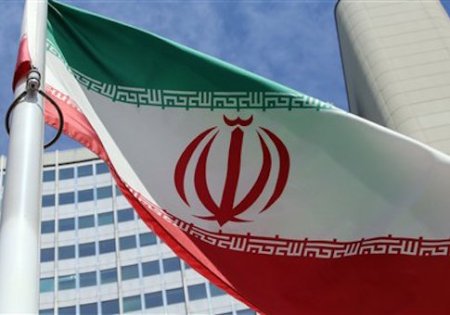
An Iranian flag flies in front of the building where closed-door nuclear talks take place in Vienna, Austria, Wednesday, July 2, 2014. (AP Photo/Ronald Zak)
Iranian television has broadcast what some say is purported footage of the $400 million pallets of cash that officials claim was part of the “expensive price” paid by the Obama administration to free several U.S. hostages.
The footage, which could not be independently verified, shows images of large stacks of hard currency and features claims that the Obama administration sent this money over as part of an effort to free several U.S. hostages. The White House vehemently denied these claims this week following new reports about the cash exchange.
BBC Persian reporter Hadi Nili posted the footage on Twitter and describing it as showing the “pallets of cash” and quoting officials as saying “this was just part of the ‘expensive price’ to release Americans.”
The footage, which is from an Iranian documentary published a few months ago, contradicts claims by Obama administration officials maintaining that the payment was completely unrelated to the release of these U.S. hostages, despite the payment having been supplied on the same day these individuals were freed by Iran.
Iran experts who spoke to the Washington Free Beacon said that it is impossible to verify if the images show the same pallets of cash transferred by the Obama administration.
The footage also claims that the Obama administration insisted the negotiations over the matter take place in secret and threatened Iranian officials who may have leaked information to the media.
Republican Presidential candidate Donald Trump referenced the footage in remarks this week, claiming that it is part of an effort by Iran to embarrass the United States.
“They have a perfect tape, done by obviously a government camera and the tape is of the people taking the money off the plane, right?” Trump said. “That means that in order to embarrass us further, Iran sent us the tapes, right?”
“It’s a military tape; it’s a tape that was a perfect angle, nice and steady, nobody getting nervous because they’re gonna be shot because they’re shooting a picture of money pouring off a plane,” Trump said.
The footage is part of a February documentary published by Iran’s Tasnim News Agency, which is affiliated with the Iranian Revolutionary Guard Corps.
The documentary purported to reveal behind-the-scenes details of the negotiations with the United States to free the American hostages. It maintains the negotiations were tied up in efforts to push the Iran nuclear agreement forward as it moved towards implementation.
OBAMA LIED! US Iranian Hostage Says Iran Would Not Let Plane Leave Until Ransom Plane Arrived
August 5, 2016OBAMA LIED! US Iranian Hostage Says Iran Would Not Let Plane Leave Until Ransom Plane Arrived, Fox News via YouTube, August 4, 2016
(Please see also, Obama’s Ransom Payment (4) — DM)
Obama’s Ransom Payment (4)
August 4, 2016Obama’s Ransom Payment (4), Power Line,
As in all matters related to the Obama administration’s dealing with Iran, the abasement of the United States is complete, the humiliation thorough, the lying pervasive, the damage devastating, the scandal hiding in plain sight.
********************
The United States purchased $400 million of cash in European currencies from European central banks; the cash was purchased with American dollars. The United States then delivered the $400 million in cash to the Iranian regime in an unmarked cargo plane on the day that four Americans held by the Iranian regime were released. The transaction was kept secret from the American people. Among other things, the Obama administration sought to conceal the obvious.
Jay Solomon and Carol Lee reported the transaction in a page-one Wall Street Journal story earlier this week. The Journal’s Devlin Barrett has now followed up with a story on the Department of Justice’s objections to the transaction.
Solomon and Lee explain the indirection in the cash payment: “The $400 million was paid in foreign currency because any transaction with Iran in U.S. dollars is illegal under U.S. law.” This is the kind of workaround that would land lesser mortals in prison.
Solomon and Lee somewhat cruelly note: “Since the cash shipment, the intelligence arm of the Revolutionary Guard has arrested two more Iranian-Americans. Tehran has also detained dual-nationals from France, Canada and the U.K. in recent months.”
In following developments related to the nuclear deal with Iran, I have frequently found the Iranian press and Iranian authorities to be a more reliable source of information on their dealing with the Obama administration than the administration itself. I believe that is the case here as well. Solomon and Lee add: “Iranian press reports have quoted senior Iranian defense officials describing the cash as a ransom payment. The Iranian foreign ministry didn’t respond to a request for comment.”
Obama administration spokesman Josh Earnest is not so shy. He was asked about Solomon and Lee’s story at his daily press conference yesterday. C-SPAN has posted the video here. The White House has posted the transcript here.
Earnest was in a tough spot. He defends the indefensible. He denies the undeniable. He castigates those who have observed that Emperor Obama wears no clothes. According to Earnest, they are liars and worse. It is truly a disgusting performance.
I have gone through the transcript to extract questions and excerpt answers of interest. I can only say that it is worth reading. What he says is as interesting as what he doesn’t say.
Has any of the cash gone to support Iran’s terrorist activities? Earnest responds at various points:
[T]he Iranian government has spent the money largely in the way that we expected that they would.
The analysis that we’ve done confirms what we predicted — is that, largely, that money was spent to address the dire economic condition of the nation of Iran.
The President was quite forward-leaning, in advance of the nuclear deal even being completed, in acknowledging that we know that Iran supports terrorism. We know that Iran supports Hezbollah and the Assad regime. And it certainly is possible that some of the money that Iran has is being used for those purposes too.
I think, Ron, the point is right now that we do know how Iran has spent a lot of that money. And the amount of money that Iran has received is far less than what critics predicted. So they were either wrong or lying. You can go ask them.
I trust you can translate the double-talk and disparagement on your own. It sets the pattern here.
Why are we only learning about this particular transaction now? Drawing on the classic scandal playbook, Earnest asserts that this is old news. This is almost laughable:
I guess the point that I’m trying to make, Margaret, is we could not possibly have been more transparent about this arrangement than to have the President of the United States announce it to all of you on live national television on the day that the agreement was reached.
What about the timing of the cash payment coincident with the release of the American prisoners? Analyze this:
Q This financial dispute you mentioned has been going on for 35 years. Why was it necessary to airlift in the pallets of cash on the very weekend that the American prisoners were released?
MR. EARNEST: Again, Scott, the reason is simple. The United States does not have a banking relationship with Iran. So —
Q That explains that it was cash, but it doesn’t explain the timing.
MR. EARNEST: Because we reached the agreement and Iran wanted their money back. So, again —
Q They waited 35 years.
MR. EARNEST: Right, so you might expect that they would be eager for them to get their money back. Again, this all stems from a payment that Iran had made into a U.S. account related to a military sale that didn’t actually go through. The military equipment wasn’t provided. So, again, you could understand why they’re quite eager for the money.
You also would understand that they’re quite eager for the money when you consider that the value of their currency has plummeted, that they haven’t been able to invest in infrastructure, that they’ve got debts that need to be paid, and that they’re in the middle of a recession. So at the time, they were eager to try to address the legitimate concerns of the Iranian people about the state of the Iranian economy.
Q And why was the U.S. government so eager to pay —
MR. EARNEST: I’m sorry?
Q Why was the U.S. eager to deliver the money so quickly?
MR. EARNEST: Well, again, I would not describe the United States as eager — I would describe the Iranians as eager. I think what the United States is, is we’re a country that lives up to the commitments that we make. And that’s exactly what we did.
Another reporter takes a whack:
Q So it’s been called a ransom payment by Iran. That’s not exactly surprising. But would those prisoners have been released had this payment not been made at the time that it was? And so it isn’t essentially a ransom payment then, even if the U.S. does not view it that way?
MR. EARNEST: No. It is not a ransom payment. The United States does not view it that way, and it’s not accurate to describe it that way.
Q So would those prisoners have been released then if this money hadn’t been paid then?
MR. EARNEST: Well, again, I think what is true is that there were a team of negotiators — let me just start from the beginning. What I know is true is there were a team of negotiators in the United States that were interacting with Iranian officials to secure the release of five Americans who were unjustly detained in Iran. That negotiating work was successful and those Americans are at home….
Hmmmm. He really doesn’t want to answer the question. He seems to be taking a long way around avoiding the answer. Then another reporter pursues the point and Earnest resorts to the ad hominem attacks that should be a red flag to sentient observer:
Q I think a lot more people find this interesting than just people who are opposed to it. But, again, would those prisoners have been released then if this money had not been paid then?
MR. EARNEST: What I can tell you is that our negotiators who were talking with the Iranians about what was necessary to secure the release of American citizens in Iran succeeded. That was different than the group of negotiators who were involved in The Hague negotiating with their Iranian counterparts to settle these longstanding financial claims.
Q So because U.S. policy is opposed to ransom payments, even if it were only for the appearance of this not being a ransom payment, why would you not have made Iran wait even a week longer? I mean, why would Iran’s eagerness to get their hands on their money be more important than making sure that this was not a quid pro quo that was based on the exact timing being right?
MR. EARNEST: Well, I think the answer to that is pretty obvious, which is that even a week delay would not have prevented Paul Ryan and Marco Rubio from falsely claiming that they’re a ransom. Because, Michelle, come on, I saw you sigh. If we announced this financial settlement on the same day that the prisoners were released, that’s fodder to our Republican critics. I get that.
After other questions a reporter comes back to the question of ransom:
Q Thanks, Josh. If I can circle back to Iran briefly. Is it your contention that it is not a ransom payment because there was no quid pro quo or because it was Iranian money that was flown in?
MR. EARNEST: It is our contention that there was no ransom paid to secure the release of U.S. citizens who were being unjustly detained in Iran because, A, it’s against the policy of the U.S. government to pay ransoms. And that’s something that we told the Iranians that we would not do. We would not — we have not, we will not pay a ransom to secure the release of U.S. citizens. That’s a fact. That is our policy and that is one that we have assiduously followed.
You don’t have to be a student of logic to observe that there is a certain circularity in Earnest’s answer.
As in all matters related to the Obama administration’s dealing with Iran, the abasement of the United States is complete, the humiliation thorough, the lying pervasive, the damage devastating, the scandal hiding in plain sight.
Obama’s Ransom Payment (2)
August 3, 2016Obama’s Ransom Payment (2), Power Line,
Iran has taken more hostages since the deal and now is looking for another ransom – Tehran went back to arresting American hostages after releasing the last round, and are now seeking another billion dollar deal in the last six months of the administration
***********************
In the adjacent post Paul Mirengoff extracts the key points from the page-one Wall Street Journal story by Jay Solomon and Carol Lee reporting the Obama administration’s covert cash payment of $400 million to our enemies in Iran as they released four Americans they had detained. Omri Ceren has also emailed a useful summary of key points. Despite the repetition, I thought readers might find it of interest. Omri writes:
(1) It was indeed a ransom payment – negotiators originally established a formula of people for people: American nationals held by Iran for Iranian nationals held by America. But then the Iranians started demanding billions of dollars as well. Iranian officials later bragged they coerced the ransom out of U.S. diplomats —
The U.S. and Iran entered into secret negotiations to secure the release of Americans imprisoned in Iran in November 2014… The discussions… initially focused solely on a formula whereby Iran would swap the Americans detained in Tehran for Iranian nationals held in U.S. jails… But around Christmas, the discussions dovetailed with… the old arms deal. The Iranians were demanding the return of $400 million… They also wanted billions of dollars as interest accrued since then… a report by an Iranian news site close to the Revolutionary Guard, the Tasnim agency, said the cash arrived in Tehran’s Mehrabad airport on the same day the Americans departed. Revolutionary Guard commanders boasted at the time that the Americans had succumbed to Iranian pressure. “Taking this much money back was in return for the release of the American spies,” said Gen. Mohammad Reza Naghdi, commander of the Guard’s Basij militia, on state media.
(2) The administration hid the details from Congress – Lawmakers have been pressing the administration for six months to provide more details about how and where the money went, among other things because Iran has been transferring money for military purposes. They’ve made little progress —
The Obama administration has refused to disclose how it paid any of the $1.7 billion, despite congressional queries, outside of saying that it wasn’t paid in dollars. Lawmakers have expressed concern that the cash would be used by Iran to fund regional allies, including the Assad regime in Syria and the Lebanese militia Hezbollah, which the U.S. designates as a terrorist organization. The U.S. and United Nations believe Tehran is subsidizing the Assad regime’s war in Syria through cash and energy shipments. Iran has acknowledged providing both financial and military aid to Syrian President Bashar al-Assad and deploying Iranian soldiers there.
(3) The administration used cash to dodge the effects of sanctions against Iran – banks don’t want to touch Iran’s financial system because of years of sanctions for terrorism, money laundering, etc. The State Department and Treasury Department enlisted the Swiss and Dutch governments to route hard cash to Iran to circumvent those problems —
The U.S. procured the money from the central banks of the Netherlands and Switzerland, they said… “Sometimes the Iranians want cash because it’s so hard for them to access things in the international financial system,” said a senior U.S. official briefed on the January cash delivery. “They know it can take months just to figure out how to wire money from one place to another.”… Mr. Kerry and the State and Treasury departments sought the cooperation of the Swiss and Dutch governments… the Obama administration transferred the equivalent of $400 million to their central banks. It was then converted into other currencies, stacked onto the wooden pallets and sent to Iran on board a cargo plane.
(4) Iran has taken more hostages since the deal and now is looking for another ransom – Tehran went back to arresting American hostages after releasing the last round, and are now seeking another billion dollar deal in the last six months of the administration —
Since the cash shipment…the Revolutionary Guard has arrested two more Iranian-Americans. Tehran has also detained dual-nationals from France, Canada and the U.K. in recent months. At the time of the prisoner release, Secretary of State John Kerry and the White House portrayed it as a diplomatic breakthrough. Mr. Kerry cited the importance of “the relationships forged and the diplomatic channels unlocked over the course of the nuclear talks.”… Friends and family of the Namazis believe the Iranians are seeking to increase their leverage to force another prisoner exchange or cash payment in the final six months of the Obama administration. Mr. Kerry and other U.S. officials have been raising their case with Iranian diplomats… Iranian officials have demanded in recent weeks the U.S. return $2 billion in Iranian funds that were frozen in New York in 2009. The Supreme Court recently ruled that the money should be given to victims of Iranian-sponsored terror attacks.




 anneinpt
 artaxes
 danmillerinpanama
 davidking1530
 Peter Hofman
 Joseph Wouk
 Peter
Peter Louisiana Steve
 WarSclerotic
Recent Comments