Archive for the ‘Iran – prisoner release’ category

Obama’s Ransom Payment (4)

August 4, 2016

Obama’s Ransom Payment (4), Power LineScott Johnson, August 4, 2016

As in all matters related to the Obama administration’s dealing with Iran, the abasement of the United States is complete, the humiliation thorough, the lying pervasive, the damage devastating, the scandal hiding in plain sight.

********************

The United States purchased $400 million of cash in European currencies from European central banks; the cash was purchased with American dollars. The United States then delivered the $400 million in cash to the Iranian regime in an unmarked cargo plane on the day that four Americans held by the Iranian regime were released. The transaction was kept secret from the American people. Among other things, the Obama administration sought to conceal the obvious.

Jay Solomon and Carol Lee reported the transaction in a page-one Wall Street Journal story earlier this week. The Journal’s Devlin Barrett has now followed up with a story on the Department of Justice’s objections to the transaction.

Solomon and Lee explain the indirection in the cash payment: “The $400 million was paid in foreign currency because any transaction with Iran in U.S. dollars is illegal under U.S. law.” This is the kind of workaround that would land lesser mortals in prison.

Solomon and Lee somewhat cruelly note: “Since the cash shipment, the intelligence arm of the Revolutionary Guard has arrested two more Iranian-Americans. Tehran has also detained dual-nationals from France, Canada and the U.K. in recent months.”

In following developments related to the nuclear deal with Iran, I have frequently found the Iranian press and Iranian authorities to be a more reliable source of information on their dealing with the Obama administration than the administration itself. I believe that is the case here as well. Solomon and Lee add: “Iranian press reports have quoted senior Iranian defense officials describing the cash as a ransom payment. The Iranian foreign ministry didn’t respond to a request for comment.”

Obama administration spokesman Josh Earnest is not so shy. He was asked about Solomon and Lee’s story at his daily press conference yesterday. C-SPAN has posted the video here. The White House has posted the transcript here.

Earnest was in a tough spot. He defends the indefensible. He denies the undeniable. He castigates those who have observed that Emperor Obama wears no clothes. According to Earnest, they are liars and worse. It is truly a disgusting performance.

I have gone through the transcript to extract questions and excerpt answers of interest. I can only say that it is worth reading. What he says is as interesting as what he doesn’t say.

Has any of the cash gone to support Iran’s terrorist activities? Earnest responds at various points:

[T]he Iranian government has spent the money largely in the way that we expected that they would.

The analysis that we’ve done confirms what we predicted — is that, largely, that money was spent to address the dire economic condition of the nation of Iran.

The President was quite forward-leaning, in advance of the nuclear deal even being completed, in acknowledging that we know that Iran supports terrorism. We know that Iran supports Hezbollah and the Assad regime. And it certainly is possible that some of the money that Iran has is being used for those purposes too.

I think, Ron, the point is right now that we do know how Iran has spent a lot of that money. And the amount of money that Iran has received is far less than what critics predicted. So they were either wrong or lying. You can go ask them.

I trust you can translate the double-talk and disparagement on your own. It sets the pattern here.

Why are we only learning about this particular transaction now? Drawing on the classic scandal playbook, Earnest asserts that this is old news. This is almost laughable:

I guess the point that I’m trying to make, Margaret, is we could not possibly have been more transparent about this arrangement than to have the President of the United States announce it to all of you on live national television on the day that the agreement was reached.

What about the timing of the cash payment coincident with the release of the American prisoners? Analyze this:

Q This financial dispute you mentioned has been going on for 35 years. Why was it necessary to airlift in the pallets of cash on the very weekend that the American prisoners were released?

MR. EARNEST: Again, Scott, the reason is simple. The United States does not have a banking relationship with Iran. So —

Q That explains that it was cash, but it doesn’t explain the timing.

MR. EARNEST: Because we reached the agreement and Iran wanted their money back. So, again —

Q They waited 35 years.

MR. EARNEST: Right, so you might expect that they would be eager for them to get their money back. Again, this all stems from a payment that Iran had made into a U.S. account related to a military sale that didn’t actually go through. The military equipment wasn’t provided. So, again, you could understand why they’re quite eager for the money.

You also would understand that they’re quite eager for the money when you consider that the value of their currency has plummeted, that they haven’t been able to invest in infrastructure, that they’ve got debts that need to be paid, and that they’re in the middle of a recession. So at the time, they were eager to try to address the legitimate concerns of the Iranian people about the state of the Iranian economy.

Q And why was the U.S. government so eager to pay —

MR. EARNEST: I’m sorry?

Q Why was the U.S. eager to deliver the money so quickly?

MR. EARNEST: Well, again, I would not describe the United States as eager — I would describe the Iranians as eager. I think what the United States is, is we’re a country that lives up to the commitments that we make. And that’s exactly what we did.

Another reporter takes a whack:

Q So it’s been called a ransom payment by Iran. That’s not exactly surprising. But would those prisoners have been released had this payment not been made at the time that it was? And so it isn’t essentially a ransom payment then, even if the U.S. does not view it that way?

MR. EARNEST: No. It is not a ransom payment. The United States does not view it that way, and it’s not accurate to describe it that way.

Q So would those prisoners have been released then if this money hadn’t been paid then?

MR. EARNEST: Well, again, I think what is true is that there were a team of negotiators — let me just start from the beginning. What I know is true is there were a team of negotiators in the United States that were interacting with Iranian officials to secure the release of five Americans who were unjustly detained in Iran. That negotiating work was successful and those Americans are at home….

Hmmmm. He really doesn’t want to answer the question. He seems to be taking a long way around avoiding the answer. Then another reporter pursues the point and Earnest resorts to the ad hominem attacks that should be a red flag to sentient observer:

Q I think a lot more people find this interesting than just people who are opposed to it. But, again, would those prisoners have been released then if this money had not been paid then?

MR. EARNEST: What I can tell you is that our negotiators who were talking with the Iranians about what was necessary to secure the release of American citizens in Iran succeeded. That was different than the group of negotiators who were involved in The Hague negotiating with their Iranian counterparts to settle these longstanding financial claims.

Q So because U.S. policy is opposed to ransom payments, even if it were only for the appearance of this not being a ransom payment, why would you not have made Iran wait even a week longer? I mean, why would Iran’s eagerness to get their hands on their money be more important than making sure that this was not a quid pro quo that was based on the exact timing being right?

MR. EARNEST: Well, I think the answer to that is pretty obvious, which is that even a week delay would not have prevented Paul Ryan and Marco Rubio from falsely claiming that they’re a ransom. Because, Michelle, come on, I saw you sigh. If we announced this financial settlement on the same day that the prisoners were released, that’s fodder to our Republican critics. I get that.

After other questions a reporter comes back to the question of ransom:

Q Thanks, Josh. If I can circle back to Iran briefly. Is it your contention that it is not a ransom payment because there was no quid pro quo or because it was Iranian money that was flown in?

MR. EARNEST: It is our contention that there was no ransom paid to secure the release of U.S. citizens who were being unjustly detained in Iran because, A, it’s against the policy of the U.S. government to pay ransoms. And that’s something that we told the Iranians that we would not do. We would not — we have not, we will not pay a ransom to secure the release of U.S. citizens. That’s a fact. That is our policy and that is one that we have assiduously followed.

You don’t have to be a student of logic to observe that there is a certain circularity in Earnest’s answer.

As in all matters related to the Obama administration’s dealing with Iran, the abasement of the United States is complete, the humiliation thorough, the lying pervasive, the damage devastating, the scandal hiding in plain sight.
Iran: U.S. Bought Freedom of Citizens with $1.7 Billion Cash Release

January 20, 2016

Iran: U.S. Bought Freedom of Citizens with $1.7 Billion Cash Release, Washington Free Beacon, January 20, 2016

Close up of stack of money (Photo by: Tetra Images/AP Images)

Iranian military leaders also have revealed that at least 200,000 troops have been stationed in Iraq, Syria, and Libya and will work to combat U.S. forces in the region.

************************

The leader of Iran’s Basij military organization claimed on Wednesday that the United States released $1.7 billion in cash assets to Iran “in a bid to buy [the] freedom of its spies held by Tehran,” according to the country’s state-controlled press.

Mohammad Reza Naqdi, the Basij commander, said that the $1.7 billion release, which purportedly includes the repayment by the United States of a $400 million debt and $1.3 billion in interest, was awarded to Iran in order to secure the release of five Americans who were freed by Iran over the weekend.

“The annulment of sanctions against Iran’s Bank Sepah and reclaiming of $1.7mln of Iran’s frozen assets after 36 years showed that the US doesn’t understand anything but the language of force,” Naqdi was quoted as saying on Wednesday during a speech before the Basic forces in Tehran.

This particular cash release was not formally part of the nuclear deal, Naqdi claimed.

“This money was returned for the freedom of the US spy and it was not related to the [nuclear] negotiations,” he said.

In exchange for the release of the five prisoners, the United States pardoned or dropped sanctions on 21 Iranian accused of breaching sanctions by aiding the Islamic Republic’s illicit nuclear program.

Meanwhile, Iranian Supreme Leader Ali Khamenei praised the country’s military on Wednesday for the temporary detainment of 10 U.S. sailors early last week.

“They displayed Iran’s identity and power against the enemy aggression,” Ayatollah Khamenei was quoted as saying to Iranian officials on Wednesday. “The Iranian officials should also show similar actions in all other fields and show powerful reaction wherever the enemy violates Iran’s national interests.”

Iranian military leaders also have revealed that at least 200,000 troops have been stationed in Iraq, Syria, and Libya and will work to combat U.S. forces in the region.

“A massive numberless popular force similar to Basij [volunteer forces] has been formed in Iraq, Syria and Libya against internal and foreign plots which is necessary for the survival of resistance,” Mohammad Ali Jafari, commander of Iran’s Revolutionary Guard Corps, was said during a speech in Tehran on Wednesday.

“And over-200,000-strong organized popular force has been formed in these countries and it is the same force that no army even of the US and Israel can confront it,” Jafari said.

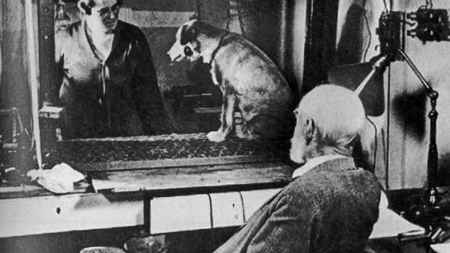
Iran is Training Obama Like a Dog

January 17, 2016

Iran is Training Obama Like a Dog, Front Page Magazine, Daniel Greenfield, January 17, 2016

pavlov

Obama and his team are celebrating as if they were FBI agents who successfully conducted a cash for hostages exchange while the criminals went free.

The “diplomacy” that they’re celebrating is one in which Iran gets what it wants and occasionally frees hostages. But since Iran can take more hostages at any time, and since it now has more motivation than ever to do so, there’s nothing to celebrate.

With animals, there’s sometimes a question of who is training whom. Is the owner training the dog to do tricks in exchange for treats. Or is the dog training the owner to give treats in exchange for not making a mess on the floor.

This is the essential question in power relationships.

What Obama has going on with Iran isn’t mutual. It’s a relationship in which Iran’s “moderates” show that Western governments can be trained to give them what they want or they’ll make a mess on the floor by taking hostages or blatantly violating nuclear protocols.

Part of this training program involves deliberate messes so that the number of treats and the owner’s anxiety is redoubled.

Iran creates a crisis. Obama rushes treats and then claims it’s a diplomatic success.

Kerry and co. claim that Iran is being trained to negotiate problems diplomatically. But Iran knows how to do that already. As the nuke negotiations showed, it’s much better at it than Obama and Kerry are. Iran knows how to use diplomacy, but its intentions are not diplomatic. So instead it’s using diplomacy to train Obama and his European allies to dispense more treats even as it continues to pursue a nuclear weapons program.

And the most pathetic part of this is that Obama and the Europeans have been trained to treat every payout like a victory.

U.S. lifts sanctions against Iran, says nuclear deal obligations have been met

January 17, 2016

U.S. lifts sanctions against Iran, says nuclear deal obligations have been met, Washinton TimesDave Boyer, January 16, 2016

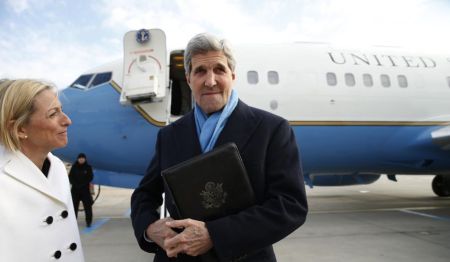
austria_iran_kerry_c0-0-3500-2040_s885x516U.S. Secretary of State, John Kerry, is greeted by the U.S. Ambassador to Austria, Alexa Wesner, left, as he steps from his plane Saturday, Jan. 16, 2016, upon his arrival in Vienna, Austria on what is expected to be “implementation day,” the day the International Atomic Energy Agency (IAEA) verifies that Iran has met all conditions under the nuclear deal. (Kevin Lamarque/Pool Photo via AP)

Completing a major diplomatic effort over the objections of many in Congress, President Obama lifted economic sanctions against Iran Saturday after the U.N. atomic watchdog agency determined that Tehran has complied with the deal to curb its nuclear program in exchange for sanctions relief.

In a statement, Secretary of State John F. Kerry said the sanctions termination provisions of Iran’s landmark nuclear agreement are now in effect.

Mr. Obama signed the orders Saturday afternoon, saying Iran’s compliance with the deal “marks a fundamental shift in circumstances with respect to Iran’s nuclear program.”

The U.S. and Iran also carried out a prisoner swap Saturday, with Iran releasing an American pastor, a Washington Post reporter and three other Americans who had been held.

Removing the sanctions is part of the international agreement reached last year among Iran, the U.S. and five other world powers when Iran agreed to curbs on its nuclear program in exchange for sanctions relief.

Certification by the International Atomic Energy Agency will allow Iran to immediately recoup some $100 billion in assets frozen overseas. Iran will also see huge benefits from new oil, trade and financial opportunities after Western sanctions against it are lifted.

IAEA director general Yukiya Amano said Saturday this means “relations between Iran and the IAEA now enter a new phase. It is an important day for the international community. I congratulate all those who helped make it a reality.”

In Congress, Speaker Paul D. Ryan, Wisconsin Republican, said the administration was lifting sanctions “on the world’s leading state sponsor of terrorism.”

“As the president himself has acknowledged, Iran is likely to use this cash infusion — more than $100 billion in total — to finance terrorists,” Mr. Ryan said. “This comes just weeks after Tehran’s most recent illegal ballistic missile test, and just days after [Iranian forces] detained 10 American sailors. A bipartisan majority in the House voted to reject this deal in the first place, and we will continue to do everything possible to prevent a nuclear Iran.”

House Foreign Affairs Committee Chairman Ed Royce, California Republican, said the “flawed” deal is allowing Iran to keep much of its nuclear infrastructure.

“The ayatollah won’t even have to cheat to be just steps away from a nuclear weapon,” Mr. Royce said. “Meanwhile, tens of billions of dollars in sanctions relief will now start flowing to Iran’s Islamic Revolutionary Guard Corps. Since the nuclear deal was signed, Iran has twice violated U.N. resolutions to test ballistic missiles, fired rockets within 1,500 yards of the U.S.S. Truman, and seized 10 American sailors — all while propping up the murderous Assad regime in Syria. Iran will use this deal to become more militarily aggressive and dominate the region.”

At the same time, the administration engaged in a high-profile prisoner swap with Tehran. Iran agreed Saturday to release four detained Americans in exchange for seven Iranians held or charged in the U.S., while a fifth American detained in Iran, a student, was also released in an unrelated move.

The wife of an Idaho pastor who is among four detained Americans being released from Iran says the news is “a huge burden lifted off.”

Naghmeh Abedini told The Associated Press on Saturday that after she learned that Iran was going to release Pastor Saeed Abedini, she woke her kids up and told them, “Daddy was coming home.”

She said in a telephone interview from Boise that “they were just excited. They couldn’t believe it.”

The Boise man was detained for compromising national security, presumably because of Christian proselytizing, in September 2012. He was sentenced in 2013 to eight years in prison.

Republican presidential candidates Sens. Ted Cruz of Texas and Rand Paul of Kentucky welcomed the release of Mr. Abedini, and Democratic presidential candidate Sen. Bernie Sanders of Vermont said the exchange shows “diplomacy can work even in this volatile region of the world.”

Republican presidential hopeful Sen. Marco Rubio of Florida and other Republicans say Americans should never have been captured in the first place, and Mr. Rubio blamed the administration’s willingness to do prisoner swaps in the past.

In Iowa, Mr. Rubio said that governments were taking Americans hostage because they believe they can gain concessions from the Obama administration. He mentioned the June 2014 swap in which the United States exchanged Army Sgt. Bowe Bergdahl, who had been held by the Taliban for five years, for five top Taliban commanders at Guantanamo Bay, Cuba.

The publisher of The Washington Post says he “couldn’t be happier” to hear that the paper’s reporter, Jason Rezaian, had been released from Iran’s Evin Prison on Saturday.

In a statement, publisher Frederick J. Ryan Jr. also says more information will be available once he has more details and can confirm Mr. Rezaian has safely left Iran.

Mr. Rezaian had been held more than 543 days on espionage and related charges. He is among four detained Americans released Saturday in exchange for seven Iranians held or charged in the U.S.

Among the seven Iranians affected by the U.S.-Iranian prisoner swap is Bahram Mechanic, who has been jailed since his indictment last April on charges of illegally exporting microelectronic technology to Iran.

Defense lawyer Joel Androphy said his client was “elated” to be pardoned Saturday but says Mechanic has “been incarcerated for nine months for a crime that he’s just accused of but did not commit.”

Two other defendants in the case, Khosrow Afghahi and Tooraj Faridi, are also among those being offered clemency.

Mr. Androphy said the products his client was accused of providing to Iran were essentially surge protectors but the Justice Department “blew it up into some sort of national security terrorism threat.” He says Mechanic is “basically a victim of the trade issues between the United States and Iran.”


