Archive for the ‘Iran – North Korea’ category

China to Obama: America Forced Norks to get Nukes and Must Negotiate a Deal

September 20, 2016

China to Obama: America Forced Norks to get Nukes and Must Negotiate a Deal, Dan Miller’s Blog, September 20, 2016

(The views expressed in this article are mine and do not necessarily reflect those of Warsclerotic or its other editors. — DM)

In an article titled North Korean Nukes, South Korea, Japan, China and Obama, posted the day after North Korea’s most recent nuke test, September 9th, I contended that China would not honor Obama’s request to make North Korea stop developing and testing nukes. China has remained a faithful ally of North Korea since the end stage of the Korean Conflict and “sees Obama, not as the representative of the world’s greatest power, but as a joke. He has no clout internationally and is a national embarrassment.”  NB: I had hoped to publish this article more than a week ago, but my internet was down or at best intermittent from September 13th until September 19th.)

I was right, but it’s a bit worse than I had thought.

On September 12th, an article was published by Xinhua titled China urges U.S. to take responsibility on Korean Peninsula nuclear issueXinhua is

the official press agency of the People’s Republic of China. Xinhua is the biggest and most influential media organization in China. Xinhua is a ministry-level institution subordinate to the Chinese central government. Its president is a member of theCentral Committee of China’s Communist Party.

According to Xinhua,

U.S. Defence Secretary Ashton Carter reportedly called for further pressure on the DPRK last Friday after the country carried out a new nuclear test and said China bears “responsibility” for tackling the problem. [Emphasis added.]

The essence of the Korean Peninsula nuclear issue is the conflict between the DPRK and the United States, spokesperson Hua Chunying said at a press conference. [Emphasis added.]

As a permanent member of the UN Security Council and a close neighbor of the DPRK, China has made unremitting efforts to maintain peace and stability on the Korean Peninsula and safeguard the international nuclear non-proliferation regime, Hua said.

A statement released by the Foreign Ministry of the DPRK Sunday said the United States compelled the DPRK to develop nuclear warheads, and the nuclear threat it has constantly posed to the DPRK for decades is the engine that has pushed the DPRK to this point. [Emphasis added.]

Blindly increasing the pressure and the resulting bounce-back will only make the nuclear issue on the Korean Peninsula “a firm knot,” Hua said, calling for responsibility from all relevant parties.

Hua reiterated that China will remain committed to resolving issues concerning the Peninsula through dialogue to realize long-term peace and stability.

China strongly urges all parties to speak and act cautiously with the larger picture in mind, avoid provoking each other and make genuine efforts to achieve denuclearization, peace and stability on the Korean Peninsula, Hua said.

. . . .

“We have seen the twists and turns in the situation on the Korean Peninsula since the six-party talks have stalled,” Hua said, noting that it proves that simple sanctions cannot solve the issue. [Emphasis added.]

Hua said the security concerns of parties on the Korean Peninsula must and can only be resolved in a way that serves the interests of all parties.

Any unilateral action based on one’s self-interest will lead to a dead end, and it will not help resolve one’s security concerns but will only aggravate the tension, complicate the issue, and make it more difficult to achieve relevant goals, Hua said. [Emphasis added.]

The six-party talks, involving China, the DPRK, the United States, the Republic of Korea (ROK), Russia and Japan, were a multilateral mechanism aimed at solving the Korean Peninusla nuclear issue. The talks began in 2003 and stalled in December 2008. The DPRK quit the talks in April 2009.

“Resuming the six-party talks is difficult, but we cannot give up easily ,” Hua said.

China will continue to keep close communication with relevant parties and call on them to return to the right track of solving issues related to the Korean Peninsula through dialogue and negotiation, the spokesperson said.

China clearly appears to be following the line of Kim Jong-un on why North Korea needs nukes:

The Obama administration cannot engage in successful negotiations with North Korea, for several reasons. They are, in no particular order: Obama will be gone in about four months; Kerry is Obama’s Secretary of State; The Obama-Clinton-Kerry Iran Scam gave the Islamic Republic everything it sought and, at best, left Iran on the highway to nukes. North Korea and Iran are different in at least one major respect: Iran claimed that it did not have nukes and had not tried to develop them; Supreme Leader Khamenei was claimed to have issued a fatwa against the acquisition, development and use of nukes — despite propaganda videos showing how Iran will use nukes against the “great and little Satan.” North Korea has and has tested five nukes. Kim brags about them and threatens to use them.

The nuke threat

38 North is a think tank largely devoted to obtaining and publishing reliable information about North Korea’s nuke and missile programs. An article there by , published on September 12th, concludes:

What are the greatest threats from the rapidly expanding North Korean nuclear program? Left unchecked, Pyongyang will likely develop the capability to reach the continental United States with a nuclear tipped missile in a decade or so. Much more troubling for now is that its recent nuclear and missile successes may give Pyongyang a false sense of confidence and dramatically change regional security dynamics. The likely ability of the DPRK to put nuclear weapons on target anywhere in South Korea and Japan and even on some US assets in the Pacific greatly complicates the regional military picture. That situation would be exacerbated if Pyongyang decides to field tactical nuclear weapons as its arsenal expands and its confidence in its nuclear arsenal grows.

More bombs and better bombs also increase the potential of accidents and miscalculations with greater consequences as the number and sophistication of bombs increase. Rendering the nuclear enterprise safe and secure in case of internal turmoil or a chaotic transition in the North becomes more difficult. We also cannot rule out that a financially desperate leadership may risk the sale of fissile materials or other nuclear assets, perhaps to non-state actors. [Emphasis added.]

So, what to do? The latest nuclear test demonstrates conclusively that attempting to sanction the DPRK into submission and waiting for China to exert leverage over Pyongyang’s nuclear program do not work. Increasing sanctions and adding missile defenses in South Korea to that mix will also not suffice and make China even less likely to cooperate. What’s missing is diplomacy as much as Washington may find it repugnant to deal with the Kim regime.

On September 20th, North Korea announced that it had tested a new long-range rocket engine, suggesting that it “can be used for an intercontinental ballistic missile (ICBM), which is capable, in theory, of hitting targets on the U.S. mainland.” The September 9th nuke test is claimed to have involved “a miniaturized nuclear warhead that could be mounted on a ballistic missile.” How close in North Korea to being able to nuke the U.S. mainland? I don’t know and don’t want to find out by having it happen.

Can diplomacy, even if undertaken by a new administration after Obama leaves office, be successful? Continued sanctions got Iran to engage in negotiations; both Iran and Obama’s America very much wanted the sanctions lifted so that Iran would become an honorable member of the community of nations. There are few if any significant sanctions to lift on North Korea and China will not impose or enforce any; China’s role has been to help North Korea evade sanctions.

In China Won’t Stop Kim Jong-un. The U.S. Must Stand Up to Both of Them, published by Slate Magazine on September 13,  had some perhaps useful suggestions:

[T]he United States should rally the same sort of campaign that revved up the pressure against Iran before those nuclear talks got underway. In other words, the international community should apply sanctions not only against North Korea but also against all institutions that do business with North Korea—an action that would affect some major Chinese banks, which provide it with energy supplies, other goods, and hard currency. [Emphasis added.]

Yes, this would stir tensions in U.S.-China relations; but so do a lot of other actions, many of them instigated by China (for instance, the dodgy territorial claims in the South China Sea), and in this case, any perceptions of American aggression would be offset, to some degree, by a realization—at least by some Chinese officials—that it’s time for Beijing to face up to its problem and reassess its strategic priorities accordingly. (Longtime China-watchers say that some of Xi’s senior comrades have been advocating tougher action against Kim.)

He also suggests that if an end is put to North Korea’s nuclear ambitions and work, America should agree to terminate its no longer necessary THAAD deployments in South Korea and Japan. Further, the next president

should take steps, especially with China, to prevent Pyongyang from deploying a nuclear missile; but if that proves fruitless, he or she should make very clear that North Korea’s use of nuclear weapons—or even a conventional invasion of South Korea (which might be accompanied by a brandishing of nukes to deter anyone from coming to Seoul’s aid)—will be regarded as an attack on the United States and will be dealt with accordingly. There should be no ambiguity about this. Kim Jong-un may be crazy, but his eccentricities have always been in the service of his survival—and he should understand that he’s putting his survival on the line. Daniel Sneider, associate director of Stanford University’s Shorenstein Asia-Pacific Research Center, thinks we should deploy more nuclear-capable aircraft on U.S. bases in Asia to drive this point home fiercely.

It seems worth noting that among the reasons to expect that a Russian-assisted attack on South Korea would be successful, which Kim Il-sung suggested to Stalin in 1950, was that Secretary of State Dean Atcheson had delivered an important address in which he listed the nations to the defense of which America would come if attacked. South Korea was not on the list. As I observed here in November of 2010,

When Kim il-Sung secretly visited Moscow between March 30 and April 25, he assured Stalin that his attack would succeed in three days: there would be an uprising by some two hundred thousand party members and he was convinced that the United States would not intervene. Secretary of State Dean Acheson’s January 12, 1950 speech was persuasive evidence. There, Secretary Acheson had omitted South Korea from a list of nations which the United States would defend if attacked. Stalin gave the go-ahead.

Conclusions

China has encouraged North Korean nuclearization and wants America and her allies, principally South Korea, to cease their “provocations” against the Kim regime. Yet Kim thrives on, and encourages his supporters by, engaging in provocations far more serious and dramatic than anything thus far done by America and South Korea. It seems likely that the North Korean nuke – missile problem will continue until Kim is (a) taken out and (b) replaced with someone less narcissistic and more interested in feeding his people than his ego. Whether such a replacement will emerge is unknown. However, if a Kim clone emerges instead, he seems likely to be more concerned than Kim about his prospects for a long and happy life, even with protection from China.
Are North Koreans fighting in Syria? It’s not as far-fetched as it sounds.

March 26, 2016

Are North Koreans fighting in Syria? It’s not as far-fetched as it sounds, Stars and Stripes, Adam Taylor, The Washington Post, March 25, 2016

(North Korea and Iran also have long-standing ties, Iran has substantial funds due to the Iran Scam, and North Korea is desperate for money. — DM)

This week, representatives of Western-backed Syrian opposition delegation in Geneva told Russian state media that President Bashar Assad had a surprising new ally on the Syrian battlefield: militia units from North Korea.

“Two North Korean units are there, which are Chalma-1 and Chalma-7,” Asaad az-Zoubi, head of the High Negotiations Committee to Syrian peace talks in the Swiss city, reportedly told Tass news agency Tuesday.

In any other context, the presence of soldiers from the internationally isolated and geographically distant country North Korea might seem absurd. However, the civil war in Syria has emerged as a mini-world war over the past five years, with foreign fighters from at least 86 countries believed to be fighting there.

The Syrian regime headed by Assad is already known to have the support of a number of international partners, including Russia, Iran and the Lebanese militia group Hezbollah. And this isn’t the first time that there have been reports of soldiers from the Hermit Kingdom being involved in the conflict.

In 2013, Rami Abdulrahman, director of the London-based Syrian Observatory for Human Rights, told Saudi-owned Arabic newspaper Al-Sharq al-Awsat that a small number of North Koreans were in Syria, to provide logistical and planning support.

“The exact number of the officers is not known, but there are definitely 11 to 15 North Korean officers, most of whom speak Arabic,” Abdulrahman said, according to a translation published by South Korean outlet Chosun Ilbo. Abdulrahman’s report was followed up the next year by another from Jane’s Defence Weekly, which reported that North Korea was assisting helping Syria improve its missile capabilities.

These reports are hard to confirm, but many experts believe they are credible: North Korea and Syria have had a military relationship for decades and there’s little sign it’s been shaken recently.

“The North Koreans have been involved with Syria since the late-1960s,” says Joseph S. Bermudez Jr., a contributor to 38 North, an analysis website affiliated with the U.S.-Korea Institute at John Hopkins School of Advanced International Studies. That involvement included providing advisers and air defense troops immediately after the 1967 and 1973 wars with Israel, Bermudez says, and stretches to the modern era, when North Korea is believed to have provided technology used to help build the secret al-Kibar nuclear site in Syria, which was destroyed by an Israeli airstrike in 2007.

“Syria is one of North Korea’s longest standing and deepest political and military relationships,” Andrea Berger of the Royal United Services Institute adds. In a report published last year, Berger had described how the relationship was originally based upon military training but eventually graduated to weapons sales, including ballistic missiles and chemical weapons. Remarkably, the relationship between North Korea and Syria does appear to have survived to the present day, Berger noted, despite U.N. sanctions on North Korea which should, in theory, curtail them: It may even have thrived, with state media in both countries loudly publicizing the regular high-level meetings between Syria and North Korea.

Bermudez says that since the Arab Spring began, there have been a number of reports that small teams of North Korean soldiers were providing logistical support to the Syrian regime. However, he notes that some more recent seem to suggest North Korean soldiers are actively playing a role in fighting in Syria. “While I can’t confirm these reports,” Bermudez says, “it would not be out of character for North Korea to do so, as they historically have provided small ‘regime support’ forces to countries in crisis in Africa.”

Berger agrees. “Military to military cooperation between the two countries, including on-the-ground presence of North Korean troops, would be in keeping with the history of their bilateral relationship,” she says.

(Bermudez also notes that the reference to North Korean units being named “Chalma” could be a reference to the Kalma airfield in North Korea.)

Not everyone is so sure. Philip Smyth, a researcher at the University of Maryland who studies groups allied to the Syrian regime, says that he has also recently seen a number of vague reports about North Koreans fighting for Assad in Syrian news sources that are sympathetic to the regime. However, he wasn’t sure of their accuracy.

“Often, they would confuse Afghan Shia Hazara fighters for ‘Chinese’ or ‘Koreans,’ ” Smyth says, referring to an Afghan minority known to fight alongside the Syrian regime.

North Korean authorities have denied any military involvement in the past, with state news agency KCNA writing in 2013 that “foreign media” were “floating misinformation.”

But with North Korea increasingly cash-strapped, analysts have noted that it has increasingly sent citizens abroad to earn foreign money. These citizens often work in conditions that Marzuki Darusman, the special rapporteur on human rights in North Korea, has referred to as “forced labor.” For Pyongyang, perhaps the Syrian war is a payday.

When North Korea Tests a Nuke, Assume It’s Iran’s as Well

January 13, 2016

When North Korea Tests a Nuke, Assume It’s Iran’s as Well, Clarion ProjectRyan Mauro, January 13, 2016

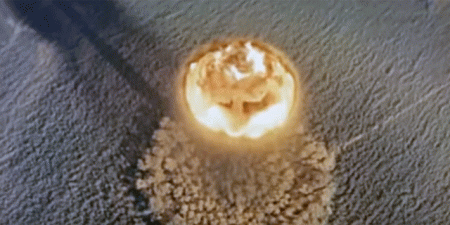
North-Korean-Nuclear-Test-HPA previous nuclear Test made by North Korea (Photo: Video screenshot)

Given the spotty record of U.S. intelligence assessments (to say the least), the West must operate under the assumption that there isn’t an Iranian WMD problem and a North Korean WMD problem, but an Iranian-North Korean WMD problem.

********************************

North Korea briefly reclaimed the global press’ attention again by claiming to have tested a hydrogen bomb. While coverage focused on whether that was an exaggeration, the press missed a much more important question: Was this test only for Kim Jong-Un or was it also for the Iranian regime?

The North Korean and Iranian nuclear and ballistic missile programs should be seen as a single entity, as should be their shared cyber warfare programs. The advance of one is an advance of the other. Differences in their activity should be seen as a common-sense division of labor. Gordon Chang, a prominent expert on Asian affairs, has written about the likelihood that this is the case.

Last May, an Iranian opposition group that has accurately identified hidden nuclear sites in the past reported that it had specific intelligence about North Korean nuclear and missile experts secretly visiting Iran. Intelligence analyst Ilana Freedman said in January 2014 that her sources said a relocation of major parts of Iran’s nuclear program to North Korea began as early as December 2012.

For Iran, it is best to let the North Koreans put the finishing touches on the most provocative nuclear and missile work. Whereas the Iranian regime does suffer from sanctions and must always keep the 2009 Green Revolution in the back of its mind, North Korea thrives off isolation and international provocation.

North Korea has nothing to lose and can only gain by such an arrangement. Kim Jong-Un’s regime has already crossed the nuclear pariah threshold, so it might as well let its Iranian allies take the lucrative deal offered by the West. It has been content to spend $1.1-$3.2 billion each year on it. Plus, the deal puts Iran in a more advantageous position  and its economic improvements can help it invest more in North Korea’s activity.

The good news is that this latest test—North Korea’s fourth— does not appear to be more powerful than its last one, indicating no significant advance in technology. RAND Corporation analyst Bruce Bennett says North Korea is still working on the “basics” of a nuclear fission bomb.

It is hard for some to accept that an Islamist theocracy like that in Iran would work with a cultish communist dictatorship like North Korea, but there is nothing in either one’s ideology that would prevent such cooperation. In fact, North Korea’s success in building a nuclear arsenal actually encourages Iran to see nuclear weapons as a key lesson for the Islamic Revolution.

“The entire world may well consider North Korea a failed state, but from the view point of [Iran], North Korea is a success story and a role model: A state which remains true to its revolutionary beliefs and defies the Global Arrogance,” Ali Alfoneh, an expert on the Iranian regime, told the Washington Free Beacon.

Given the spotty record of U.S. intelligence assessments (to say the least), the West must operate under the assumption that there isn’t an Iranian WMD problem and a North Korean WMD problem, but an Iranian-North Korean WMD problem.

After Bomb Test, North Korea, Iran Continue Illicit Nuke Cooperation

January 8, 2016

After Bomb Test, North Korea, Iran Continue Illicit Nuke Cooperation, Washington Free Beacon, January 7, 2016

(Please see also, North Korea and Iran: The Nuclear Duo. — DM)

Iranian President Hasan Rouhani, right, shakes hands with a top North Korean leader, Kim Yong Nam, at the start of a meeting in Tehran, Iran, Saturday, Aug. 3, 2013. Iran's supreme leader formally endorsed Hasan Rouhani as president Saturday, allowing the moderate cleric to take charge of a country weakened by economic sanctions over its nuclear program. Kim Yong Nam is in Tehran to attend a ceremony when Rouhani will take the oath of office in parliament Sunday. (AP Photo/Ebrahim Noroozi)

Iranian President Hasan Rouhani, right, shakes hands with a top North Korean leader, Kim Yong Nam, at the start of a meeting in Tehran, Iran, Saturday, Aug. 3, 2013.

Iran won’t even need to make any progress on its domestic nuclear program—once it perfects its ballistic missiles it could purchase a weapon from North Korea and all of the conditions and monitoring in the [nuclear deal] would be ineffective in detecting or stopping that. . . .

****************************

One day after North Korea claimed to have successfully tested a miniaturized hydrogen bomb, lawmakers and regional experts are warning that Pyongyang and Tehran are continuing an illicit clandestine partnership enabling the rogue nations to master nuclear technology.

Loopholes in the nuclear pact recently reached between Iran and the international community have allowed the Islamic Republic and North Korea to boost their nuclear cooperation, which includes the exchange of information and technology, according to material provided to Congress over the past year.

Iran is believed to be housing some of its key nuclear weapons-related technology in North Korea in order to avoid detection by international inspectors. Iranian dissidents once tied to the regime have disclosed that both countries have consulted on a nuclear warhead.

Following the test, however, the White House publicly denied that Iran and North Korea are working together, according to multiple statements issued by the administration on Wednesday.

Still, the Iranian-North Korean nuclear axis is coming under renewed scrutiny by lawmakers in light of Pyongyang’s most recent detonation, which is the fourth of its kind in recent years.

Congressional critics now warn that the Obama administration cannot be trusted to clamp down on North Korea given its recent efforts to appease Iran by dropping a new set of sanctions that were meant to target its illicit ballistic weapons program.

Iran, on the other hand, thinks that the bomb test will give it “media breathing space” by drawing attention away from its own nuclear pursuits, according to Persian-language reports carried by state-controlled media outlets closely aligned with the country’s Revolutionary Guards Corps.

“The entire world may well consider North Korea a failed state, but from the view point of the [Iranian Revolutionary Guard Corps], North Korea is a success story and a role model: A state which remains true to its revolutionary beliefs and defies the Global Arrogance,” said Ali Alfoneh, an expert on the inner workings of the Iranian regime.

Prominent members of Congress are now warning that North Korea’s latest nuclear test is a sign of what could come from Iran, which they claim is closely following the North Korean nuclear playbook.

Rep. Ileana Ros Lehtinen (R, Fla.), chair of House’s foreign relations subcommittee on the Middle East and North Africa, described North Korea’s latest test as “a precursor to what we can expect from Iran in a few years.”

Iran, Ros-Lehtinen told the Washington Free Beacon, “is following the North Korea playbook” and “stands to be the main beneficiary of Pyongyang’s continued nuclear progress.”

“Iran and North Korea have a history of collaboration on military programs and have long been suspected of collaborating on nuclear related programs,” she said, noting that the Iran deal provides the Islamic Republic with the cash necessary to purchase advanced nuclear technology.

“Iran won’t even need to make any progress on its domestic nuclear program—once it perfects its ballistic missiles it could purchase a weapon from North Korea and all of the conditions and monitoring in the [nuclear deal] would be ineffective in detecting or stopping that,” she said.

“Let’s not forget, Iranians have reportedly been present at each of North Korea’s previous nuclear tests,” Sen. David Perdue (R., Ga.), a member of the Senate Foreign Relations Committee, said in a statement. “We cannot turn a blind eye to ongoing ties between North Korea and Iran. President Obama must act now to stop these rogue nations from supporting each other’s nuclear weapons efforts aimed at harming America and our allies.”

Rep. Patrick Meehan (R., Pa.) expressed concern that Iran is following in North Korea’s footsteps, and that the nuclear deal will collapse just as  Bill Clinton’s agreement with North Korea did in the mid-1990s.

“This test is just the latest sign that North Korea is a regime hell-bent on building and developing a sophisticated nuclear program,” Meehan said. “The passage of the 1995 nuclear deal with [North Korea] came with it promises from the Clinton administration of accountability and transparency for Kim’s regime.”

“Those same sort of assurances are echoed today by the Obama White House as it seeks to assure us that its own deal with Iran will be more successful,” Meehan said. “The Iran deal and the North Korean deal were sold with the same promises, the same assurances, to the American people, sometimes even word-for-word.”

“When you put the rhetoric of the 90’s and the North next to the rhetoric of today and Iran, it’s hard to tell the difference,” he added.

Sen. Mark Kirk (R., Ill.), a chief advocate for increased economic sanctions on Iran, highlighted what he called North Korea’s “alarming record” of “cooperating on missile development with Iran.”

With Iran set to receive billions of dollars in sanctions relief later this month, regional experts have informed Congress that the nuclear deal “creates conditions and incentives that are highly likely to result in the expansion” of Iran and North Korea’s illicit nuclear exchange, according to testimony submitted last year by Claudia Rossett, an expert at the Foundation for Defense of Democracies.

The deal fails to “cut off the pathways between Iran and nuclear-proliferating North Korea” and even has made “it safer for Iran to cheat,” according to Rossett’s testimony.

Additionally, sanctions relief gives Iran a chance to “go shopping in North Korea,” she said.

The Obama administration denied the ties between Iran and North Korea, telling reporters on Wednesday that “they’re entirely two different issues altogether.”

“We consider the Iran deal as a completely separate issue handled in a completely different manner than were the—than was the Agreed Framework with North Korea,” said John Kirby, a State Department spokesman, echoing similar remarks issued by the White House.

The administration’s hesitance to link the two nuclear issues has angered some critics of the Iran deal.

“This is exactly the kind of dishonest incoherence that the Iran nuclear deal forces its advocates to defend,” said Omri Ceren, the managing director of press and strategy at The Israel Project, a D.C.-based organization that works with journalists on Middle East issues.

“The Obama administration can’t admit that the [deal] provided the Iranians with hundreds of billions of dollars, some of which they’re going to invest in nuclear research beyond their borders, allowing them to get sanctions relief while advancing their program anyway,” Ceren said. “So instead they have to deny that there are links between Iran and North Korea’s nuclear program, even though that’s laughable.”

North Korea and Iran: The Nuclear Duo

January 8, 2016

North Korea and Iran: The Nuclear Duo, Front Page MagazineJoseph Klein, January 8, 2016

(With the Iran Scam’s sanctions relief, Iran will soon have lots more money to outsource development of nuclear weapons to North Korea. North Korea desperately needs foreign currency and will be delighted to help, as it has done in the past and, apparently, continues to do. — DM)

pl (1)

There is no reason to believe that, as a result of the deal Iran is already sidestepping, Iran will suddenly stop all dealings with North Korea with regard to both countries’ nuclear programs. The Obama administration and the United Nations upon which it relies ignore the close relationship between the two rogue nations at the world’s peril.

********************************

North Korea conducted its fourth nuclear test on January 6th, which it claimed was a hydrogen bomb. Despite some skepticism as to North Korea’s claim that it had actually tested a hydrogen bomb, the Obama administration acknowledged that North Korea had indeed tested some sort of nuclear device. The administration condemned North Korea’s latest testing as a violation of a series of past United Nations Security Council resolutions.

“We do not and will not accept North Korea as a nuclear armed state, and actions such as this latest test only strengthen our resolve,” declared Secretary of State John Kerry.

Mr. Kerry is a bit late with his declaration. North Korea has had an active nuclear arms program for nearly a decade and has conducted three of its four nuclear tests during President Obama’s time in office. None of the sanctions contained in the Security Council resolutions have stopped North Korea from thumbing its nose at the so-called “international community” and conducting as many nuclear and missile tests as it wishes. Kerry’s declaration begs the question – “resolve” to do what? Pass yet another Security Council resolution with a few more symbolic sanctions and some additional travel restrictions on senior North Korean officials?

The Obama administration’s claim of “resolve” in dealing effectively with nuclear threats rings hollow. Its idea of what “resolve” means was demonstrated by the loophole-ridden nuclear deal with Iran, which contains no safeguards against Iran’s cooperation with North Korea on nuclear technology and development. No doubt the administration would offer North Korea a similar deal if its leader Kim Jong-un were as crafty as Iranian President Hassan Rouhani in lulling President Obama and Kerry into a false sense of security.

Moreover, rather than work closely with China to maximize its leverage in defusing North Korea’s nuclear threat, the administration chose to prioritize climate change in its relationship with China above all other issues.

The administration’s solution to the North Korea problem is to double down on its failed strategy of relying principally on the UN for concerted “international” action. It joined Japan, a non-permanent member of the Security Council, in calling for the December 6th emergency session. After about two hours of closed door consultations, the Security Council issued a press statement condemning the test and vowing further unspecified measures in response:

“The members of the Security Council strongly condemned this test, which is a clear violation of Security Council resolutions1718 (2006), 1874 (2009), 2087 (2013), and 2094 (2013) and of the non-proliferation regime, and therefore a clear threat to international peace and security continues to exist. The members of the Security Council also recalled that they have previously expressed their determination to take ‘further significant measures’ in the event of another DPRK nuclear test, and in line with this commitment and the gravity of this violation, the members of the Security Council will begin to work immediately on such measures in a new Security Council resolution.”

Even if Russia and China were to come around and support another resolution under the enforcement provisions of Chapter 7 of the UN Charter, it is hard to believe that it will make any difference. Before the emergency Security Council meeting even began, Russian UN Ambassador Churkin was already lowering expectations, saying softly to reporters: “Cool heads, cool heads” and “proportionate response.”

North Korea regards the UN Security Council, and the Obama administration for that matter, with about as much contempt as Iran does. Indeed, all North Korea’s leaders have had to do is look at how Iran has been treated when it behaves badly. Iran was rewarded with a deal that merely postpones its nuclear arms program in return for the lifting of sanctions and unfreezing of many billions of dollars. Moreover, Iran suffered no consequences to speak of from its recent violations of the Security Council resolutions prohibiting it from developing or testing ballistic missiles capable of carrying nuclear weapons. The Security Council held meetings but did nothing. As U.S. ambassador to the United Nations Samantha Power told the Senate Foreign Relations Committee last December, “Beyond having Security Council discussions on the matter there’s been no follow-on action. Discussions are a form of U.N. action.”

For its part, the Obama administration put off the imposition of any separate U.S. sanctions it had been considering in response to Iran’s missile launchings as soon as the Iranians claimed that any such sanctions would violate President Obama’s “holy grail” nuclear deal.

The United Nations Security Council, as well as the Obama administration, tend to compartmentalize flashpoints erupting in different regions of the world. They refuse to acknowledge that Iran and North Korea have long been joined at the hip when it comes to the development of nuclear material for bombs and ballistic missiles capable of delivering them.

The Security Council holds separate meetings on Iran and North Korea, as if their respective nuclear activities have been completely unrelated to each other. And, as demonstrated by the following exchange between a correspondent and White House Press Secretary Josh Earnest at the January 6th daily press briefing, the Obama administration is turning a blind eye to the dangerous risk of continuing cooperation between Iran and North Korea:

“Q: You mentioned Iran earlier, and I’m wondering if there’s a bit of sleight of hand there from the Iranians’ perspective — meaning they’re trying to, on the one hand, work with the international community to have sanctions relief, but on the other hand, it’s been widely reported that they’ve been working with the North Koreans, perhaps even using them as a proxy to continue development of their own nuclear ambition. Does the White House understand that view?

MR. EARNEST:  I can’t speak to the veracity of those claims.

Iran and North Korea have been cooperating for decades on nuclear technology. As Ilan Berman, a leading expert on the Middle East and Iran, wrote last August in the National Journal, “over the past three decades, Iran and the Stalinist regime of the Kim dynasty in North Korea have erected a formidable alliance—the centerpiece of which is cooperation on nuclear and ballistic-missile capabilities.”

Secretary of Defense Ashton Carter stated during an April 2015 interview that North Korea and Iran could still be cooperating to develop a nuclear weapon. Moreover, according to an assessment of “Iran-North Korea-Syria Ballistic Missile and Nuclear Cooperation” published by the Congressional Research Service last May, “U.S. intelligence officials have expressed concern that North Korea might export its nuclear technology or fissile material.”

Iran “may still rely on Pyongyang for certain materials for producing Iranian ballistic missiles, Iran’s claims to the contrary notwithstanding,” the Congressional Research Service report added.

North Korea has also conducted several tests involving nuclear explosive devices, a technology in which Iran has reportedly shown interest and would be in a position to procure from North Korea.

In short, rebutting the claims by the Obama administration that its nuclear deal with Iran cuts off all its pathways to the achievement of a nuclear weapon capability, the title of Mr. Berman’s National Journal article says it all – “North Korea: Iran’s Pathway to a Nuclear Weapon.”

There is no reason to believe that, as a result of the deal Iran is already sidestepping, Iran will suddenly stop all dealings with North Korea with regard to both countries’ nuclear programs. The Obama administration and the United Nations upon which it relies ignore the close relationship between the two rogue nations at the world’s peril.


