Archive for the ‘Iran / Israel War’ category

WILL ISRAEL STRIKE IRAN? | Sky News Blogs

November 5, 2009

WILL ISRAEL STRIKE IRAN? | Iran | Israel | nuclear | Middle East Blog | Sky News Blogs.

Dominic Waghorn November 04, 2009 1:29 PM

Is Israel in the advanced stages of preparing to attack Iran to destroy its alleged nuclear facilities?

I asked two of Israel’s leading journalists in the field of defence and security. This is an interview with Dr. Ronen Bergman author of ‘The Secret War with Iran’.

DW: Is apprehensive about the current diplomatic track and the current nuclear offer from western nations?

RB: Israel is convinced that this is a major achievement for the Iranians. Israel is convinced that Iran is determined to have the bomb, Iran is trying to reach it as soon as possible and Israel thinks that the present agreement and the engagement are lowering the economic pressure on Iran and therefore make it far more possible for it to continue. So from the Israeli point of view this is a major error of the west and paradoxically it makes the chances of an Israeli attack much much higher.

DW: But it would make it harder for Israel to carry out the attack in the sense that international opinion will be against Israel, won’t it?

RB: I always try to explain to non Israelis that they will not be able to understand Israelis or Israeli politicians and the Israeli decision making process without understanding how profound how deep is the memory of the holocaust in the overall character of the Israelis. AT the end of the day the first priority of the Israeli Prime Minister would not be American rage, European condemnation or Iranian retaliation, the first priority is that Israel, the Jewish people would never face another Holocaust. And therefore if the time comes when the Israeli Prime Minister receives information that Iran is on the verge of having a bomb I would suspect that he would have only one choice, one decision to make.

DW: Does the current Prime Minister have what it takes to make that decision?

RB: I think so and campaign slogans have a tendency to become reality and Prime Minister Netanyahu has made it his campaign slogan. Not on my shift. Iran will not become a nuclear military state. I believe that even if Iran becomes a military nuclear superpower it does mean the end of Israel but it surely means the end of the political career of Benjamin Netanyahu and he understands that as well.

DW: Does the Israeli military believe it’s capable of knocking out Iran’s nuclear military potential.

RB: No, nobody is talking about the full destruction of the project. Everyone is talking about the delay and now the calculation is how long and what’s the price. The Israeli military, the Israeli Air Force, the Israeli intelligence community is all preparing for a possible strike. Theoretically even if tomorrow the prime minister orders the strike the plans are ready the planes are ready the pilots have been practising this for a very long time. It can be commenced tomorrow. The assessment is that a successful attack would result in a delay of three to four years. Is it enough, of course not, but the hope in Israel is that with such a delay, at the end of the day, the regime would collapse before they close the gap. The overall assessment is that Israel knows enough about the Iranian attempts to hide the facilities from the international community so it is able to destroy facilities that Iranians are convinced are not going to be hit in such at attack.

DW: Do you personally think it will happen?

RB: If history continues on its current path, yes. AT the end of the day, Israel will attack. The Iranians have expressed no willingness to stop the project. They see it as a necessity as an insurance policy for the regime to have the bomb. They don’t want to bomb Israel but Israel on the other hand still adopting the Begin doctrine, saying that Israel would never tolerate the existence of an atomic bomb in the hands of a country that calls for its destruction.

DW: The problem is that if they do strike it only puts it back three years but gives Iran the ability to say, well we weren’t building the bomb but we are now because of what just happened to us and then they will have much of the world’s opinion on their side. It could be totally counterproductive for Israel.

RB: And I could add numerous calculations and motivations why not to attack. It would unite the Iranian people behind the regime. It will ignite a series of terrorist bombings throughout the world against Israel. It will raise oil prices. It would create rage from the Oval Office, but the first reason why such an attack would occur is that the Israeli Prime Minister would never accept the existence of non conventional warfare, of an atomic bomb in the hands of a country like Iran.

DW: Can you explain that fear and the fear Israelis have about this to an audience in the UK to help them understand how they feel about it here?

RB: The first prime minister of Israel David Ben Gurion used to say “My worst nightmare is that I brought the survivors of the holocaust to Israel and their sons and daughters would face another holocaust. The fear of extinction, the existential threat is profound to anything happening in Israel, any sort of decision any sort of thinking any sort of mindset derives from the holocaust. And when Ahmedinejad is talking about the destruction of Israel and trying to have the bomb this immediately translates in the minds of Israelis into what Hitler used to say and what Hitler did. Israel is a tiny country. Israel cannot even sustain even one nuclear blast. Therefore from the Israeli point of view the only way to combat it is not by a balance of deterrence but by preventing the other side from having it in the first place.

Israel Claims Hamas Has Test Fired Rocket That Could Hit Tel Aviv From Gaza

November 4, 2009

Israel Claims Hamas Has Test Fired Rocket That Could Hit Tel Aviv From Gaza, Hamas Is Denying Claims | World News | Sky News.

10:22am UK, Wednesday November 04, 2009

Dominic Waghorn, Middle East correspondent

Hamas has test-fired a new rocket capable of hitting Israel’s capital Tel Aviv from the Gaza Strip, according to Israeli military intelligence.

Graphic showing a 60km missile range from Gaza

The circle shows the 60 kilometres Israel claims Hamas can fire a new missile


It said the militant Islamist organisation launched the missile 37 miles (60km) into the sea off Gaza last week.

The development increases the likelihood of renewed conflict between Hamas and Israel according to analysts, though Hamas is denying the claims.

Tel Aviv’s apparent new vulnerability has considerable psychological significance for Israelis and the government has said it is deeply concerned.

“This is something of grave consequences and major dangerous implications,” deputy foreign minister Danny Ayalon told Sky News.

“Hamas has rearmed itself to the teeth, and with upgraded missiles and weapons and of course with a 60 kilometre range I would say that most of our population centres are within range including the outskirts of Tel Aviv.”

If the claims are true, Hamas has extended its range by a crucial 12 miles.


Israeli Deputy Foreign Minister Danny Ayalon poses for a picture in Jerusalem

“Grave consequences” – Israeli Deputy Foreign Minister Danny Ayalon

Yaakov Katz, defence analyst with the Jerusalem Post, told Sky News the new missile would be a game-changer if it were fired at Tel Aviv.

“A rocket landing in Tel Aviv, having been fired from Gaza, that is something penetrating deep into Israel’s heart and that would change the Israeli public opinion about what needs to be done.”

Hamas denied Israel’s claims, calling them an attempt to “justify the crimes it committed in Gaza”.

But Israeli officials insist Hamas has smuggled in and adapted a five-metre long Iranian artillery rocket that can carry a warhead weighing 45kg.

Israel claims Hamas has amassed a stockpile of dozens of the missiles.

The innovation would give Hamas more options following Operation Cast Lead, the Israeli offensive in January that killed hundreds of its fighters as well as hundreds of Palestinian civilians.

Mr Katz said it made a second round of fighting more likely.

“I think Israel and Hamas are definitely on a collision track particularly with this new development.

“Israel will not be able to sit by as these rockets land in Israeli cities and I think Hamas will eventually want to make use of them,” he said.

AFP: Israel intercepts ship carrying weapons

November 4, 2009

AFP: Israel intercepts ship carrying weapons: military.

dabur

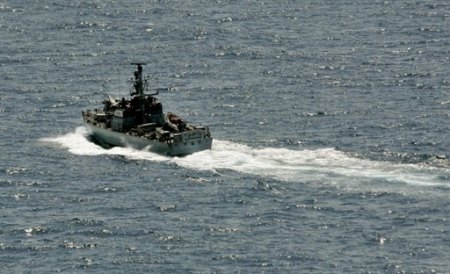
JERUSALEM — The Israeli navy intercepted a ship carrying weapons 100 nautical miles (185 kilometres) off its coastline overnight, a military spokeswoman said on Wednesday.

“During the night a special marine force intercepted a ship that was supposed to be carrying cargo around 100 (nautical) miles from our shore,” the spokeswoman said, adding that the vessel was sailing under an Antigua flag.

“We suspected it was carrying weapons and when we inspected it that turned out to be true,” she said, adding that the ship has been taken to port for further investigation.

The military declined to say what kind of weapons were on board or where the ship was heading.

Israel’s Defence Minister Ehud Barak hailed the operation, calling it a “new success in our struggle against weapons smuggling aimed at reinforcing terrorist organisations that are threatening the security of Israel.”

His remarks were carried in a defence ministry statement that said the ship was captured “near Cyprus” but did not provide further details.

Israel’s military radio meanwhile reported that the shipment was from Iran, bound for the Lebanese Hezbollah militia, and included anti-aircraft and anti-tank rockets. The military itself declined to comment on the report.

Israel has long accused arch-foes Syria and Iran of supplying weapons to Hezbollah and to Palestinian militants in the Gaza Strip, which has been ruled by the Islamist Hamas movement since June 2007.

On Tuesday a senior Israeli general warned that Hamas had successfully test-fired a rocket out to sea capable of reaching Tel Aviv from Gaza.

The rocket, believed to be Iranian-made, has a range of about 60 kilometres (37 miles), putting Israel’s major population centres in range, said Major General Amos Yadlin, head of military intelligence.

Hamas called the claim a “fabrication” designed to mobilise world opinion against the Islamist group before the UN General Assembly which was on Wednesday to discuss a controversial report on the Gaza war.

“This is a pre-emptive step by the Zionist enemy to influence international opinion,” Hamas spokesman Fawzi Barhum said, adding that the report had put Israel in a state of “crisis.”

The UN report by respected South African jurist and former international war crimes prosecutor Richard Goldstone accused both Israel and Palestinian militants of committing war crimes during the December-January Gaza war.

Some 1,400 Palestinians and 13 Israelis were killed in the three-week war launched by Israel on December 27 and aimed at halting rocket attacks, which have been mostly confined to communities a few kilometres from the Gaza border.

Israel has in the past seized shipments of weapons allegedly bound for Gaza, including in May 2003, when it intercepted a ship off its northern coast loaded with bomb-making material it said was from Hezbollah.

On January 3, 2002, Israel intercepted a 50-tonne shipment of weapons destined for the Palestinians aboard the Karine A in the Red Sea.

The late Palestinian leader Yasser Arafat admitted responsibility for the smuggling attempt, and the affair seriously eroded his standing with Washington.

In May 2001, the navy intercepted the Santorini, which was packed with 40 tonnes of anti-aircraft missiles, Katyusha rockets, anti-tank grenades, mortar shells and automatic weapons, and was bound for Gaza.

Israel said the shipment was sent by Ahmad Jibril’s Damascus-based PLO offshoot, the Popular Front for the Liberation of Palestine General Command.

Lord Weidenfeld of Chelsea: Gaza, Iranian Rockets and J Street

November 4, 2009

Lord Weidenfeld of Chelsea: Gaza, Iranian Rockets and J Street.

Lord Weidenfeld of Chelsea

Lord Weidenfeld of Chelsea

Posted: November 3, 2009 01:05 PM

Read more at: http://www.huffingtonpost.com/lord-weidenfeld-of-chelsea/gaza-iranian-rockets-and_b_343896.html

Even the most apolitical tourist in Israel cannot escape noticing the contrast between an openly displayed show of opulence in a world economic crisis — overcrowded hotels, a healthy currency, expanding exports thanks to the inventiveness of the pioneers of the new technologies — and an inner bitterness and doubt about the possibility of peace.

A hostile media campaign against Israel in Europe, a wavering of friends and neutrals in the battle against terror and a Palestinian neighbor, though split, politically united in refusal to start serious peace talks — all this clouds the atmosphere and faith in a peaceful solution.

The Goldstone report on Gaza is almost uniformly condemned. The very fact that European voices failed to make it clear that Hamas is condemned as well as Israel, embitters Israelis. The fact that a country loudest in its condemnations is Saudi Arabia where only recently a female journalist was sentenced to sixty lashes and her male guest in a talk show to five years in prison and a thousand lashes.

A statement by Colonel Kemp, senior British officer and commander in various scenes of fighting in the Middle East, that he thought the moral and ethical behavior of the Israeli fighting forces were the best in the world, was only sparingly reported.

There is a suspicion in Israel that President Obama’s foreign policy, far from reassuring the Muslim world, is regarded by most regimes in the area as a smokescreen hiding a policy of withdrawal from the region. Hence it is felt that this is the moment for more and more concessions to be wrung from the United States without the need to reciprocate. That is why more of the players in the region look for cover elsewhere; thus Turkey is in the process of changing its pro-Western policy — more drastically than is generally assumed.

An Israeli Cabinet minister told me that Iran’s rockets can now reach as far as Vienna and in a year’s time would be able to reach Great Britain. The Iranian war machine works on all cylinders to be able to reach the Atlantic coast and New York within three years. Simultaneously Iran’s vassal, Hezbollah, prepares to use its arsenal of 33,000 rockets to open a second front on Israel.

Finally, a development which at first sight seems fairly harmless depresses politically astute Israelis: the establishment of a second group of American Jews claiming to further U.S./Israel relations and the cause of peace. Its aim is to rival AIPAC, the well-known American Israeli Public Affairs Committee. This new group, known as J Street, contains many names who have for a long time been extremely critical of the Jewish State and in some cases even queried its very legitimacy. They have, however, quite a few eloquent and well-known supporters in American Jewry who accuse AIPAC of pursuing an aggressive pro-Israel policy and act as a potent pressure group in Washington. The Israeli government refused to send its ambassador in Washington to the founding conference of J Street, whereas the leader of the Opposition, Tzipi Livni, decided to send two leading members of her party to find out if J Street could be tamed.

One of the main money sources of J Street is held to be the financial mogul George Soros, who has never made a secret of his criticism of Israeli policy. Such a ‘counter lobby’ would very probably be used by anti-Israel elements in Congress, the State Department, even the White House, to neutralize the influence of AIPAC. Such a serious schism in its own camp must be considered as yet another front in Israel’s existential battle for survival.

AFP: Netanyahu hails anti-missile exercise with US

November 4, 2009

AFP: Netanyahu hails anti-missile exercise with US.

JERUSALEM — Israel’s prime minister on Tuesday hailed a joint anti-missile exercise with US forces, amid continuing high tensions with Iran, amid claims that Hamas now has rockets capable of hitting Tel Aviv.

Benjamin Netanyahu, speaking at an air force base in central Israel, said the two countries are “creating a new path, and the goal is to defend Israel,” a statement from the country’s military said.

“Overall, the goal is to ensure peace in the region, and maybe even farther from this region. This cooperation has great potential and is very impressive.”

The Juniper Cobra 10 exercises, the fifth in a series of joint air defence drills between the allies, began on October 22 and are due to end on Thursday.

Defence Minister Ehud Barak said the exercise “follows a long period of preparation by the (Israeli military) and the Americans.

“We are watching an exercise of unprecedented scale that deals with real challenges that we will have to face in the future and we had better be ready.”

And Israeli chief of staff General Gabi Ashkenazi said: “This is a very important exercise dealing with the growing threat to the citizens of the State of Israel from the development of missiles in our region.”

Israel considers Iran to be its arch-enemy after repeated statements by President Mahmoud Ahmadinejad that the Holocaust was a “myth” and that the Jewish state is doomed to be “wiped off the map.”

Iran has an arsenal of missiles it claims can reach Israel.

Israeli and US commanders refused to describe the scenarios simulated in the exercise, but said they would practise merging different anti-missile systems that defend simultaneously against long-, medium- and short-range missiles.

Israeli media reported that the exercise would probably include the scenario of a combined attack from Iran together with shorter range barrages from Syria and the Lebanese Shiite militant group Hezbollah.

The United States sent batteries of Patriot missiles to Israel during the first Gulf War in 1991, when Saddam Hussein fired dozens of Scud missiles at Israel.

The country’s air defences were further tested in 2006, when Hezbollah fired hundreds of rockets at the country from neighbouring Lebanon. And Palestinian militants have also lobbed thousands of improvised rockets from the Gaza Strip.

On Tuesday, military intelligence chief Major General Amos Yadlin said Hamas, which rules Gaza, now has a rocket believed to be Iranian-made that has a range of about 60 kilometres (37 miles).

That would put Israel’s major population centres in potential danger.


BBC NEWS | Middle East | The shadow behind US-Israeli war games

November 2, 2009

BBC NEWS | Middle East | The shadow behind US-Israeli war games.

US Navy soldiers aboard the USS Higgins in Haifa, Israel

American and Israeli personnel run joint simulation exercises every two years


By Paul Wood
BBC Middle East correspondent

“We’re here for some very specific reasons, some specific threats that the Israelis are interested in, that we’re interested in. And that’s as far as I want to go down that road.”

Com Carl Meuser of the US Navy destroyer Higgins was interrupted at this point by an anxious public affairs officer. The scenario neither wanted to discuss with the circle of visiting journalists aboard his ship was this: Israel bombs Iranian nuclear facilities – and Iran hits back.

In that case, Israel would definitely need the missile shield – sophisticated long-range radars and Patriot anti-missile devices – being tested in joint war games this week.

The US could do it much better, but an Israeli campaign would be very short
Ronen Bergman, Israeli security analyst

Operation Juniper-Cobra involves some 2,000 American and Israeli personnel. It is a regular event, taking place every two years, but this year speculation is more intense than ever that Israel is prepared to bomb Iran to stop its supposed nuclear weapons programme.

But how likely are hostilities between Israel and Iran?

The frequent Israeli insistence that “all options are on the table” could just be a means of putting pressure on Tehran. And if there is an element of bluff, then the more we hear about the military option the less likely it will be.

Conversely, says Ronen Bergman, a leading Israeli security analyst and author, if things go quiet that might be time to think Israel is preparing to act.

“I would not expect any signs whatsoever,” he said, “if I was planning the attack I would do what I could to lower their alertness.”

Air power

“It is not a bluff,” said Isaac Ben Israel, a former general, now a professor of security studies at Tel Aviv University. “It is putting pressure on Iran in order than no-one will have to use [force].

“But if Iran will not be pressed, if Iran continues to insist that it has the right to go and enrich uranium as much as it wants, then someone will have to use force. Because in one thing we are serious. We will not let Iran have a nuclear bomb.”

Is there an American veto over Israeli action? Ronen Bergman says Israeli has the military capability to go it alone.

“[It would be] a short campaign of air-strikes, focussing on the main facilities,” he said. “Of course, the US could do it much better, but an Israeli campaign would be very short, focussing on what Israel sees as the main elements of the project, and using only air power.”

Israeli distrust of Iran’s nuclear programme and a determination to do something about it forms a remarkably broad consensus across the military, the intelligence establishment, the government and the opposition.

Iranian President Mahmoud Ahmadinejad

Iran insists its nuclear programme is for peaceful civilian purposes

Iran, of course, denies that its nuclear programme is anything other than peaceful. Israeli officials don’t believe it. From their point of view, the deal on uranium enrichment is a trap: not enough to stop the construction of a weapon but convincing to the rest of the world – and therefore a block to Israeli military action.

“Using military force is the last option but it should be prepared,” said Shaul Mofaz, deputy opposition leader, formerly Israel’s military commander and, coincidentally, an Iranian-born Jew.

How long then would you give sanctions to work before Israeli takes military action, I asked him?

“I believe 2010 will be the year of sanctions,” he said. “To see result of the sanctions would need at least one year and the co-operation of Russia and China. The Iranians are using a policy of buying time and so far they are very successful. It is race against time, and so far time is winning.”

A crude rocket was sent into Israel from Hezbollah guerrillas in southern Lebanon this week. It was – presumably – a message from Iran: if we are attacked, expect to hear from Hezbollah – and Hamas. The Iranians themselves have long-range missiles capable of hitting Tel Aviv.

The Israeli public were reassured to see US Patriot missile trucks parked in beach-side car parks this week. Juniper Cobra is just an exercise – at best an ambiguous guide to Israeli intentions.

But shouldn’t the proposed deal for Iran to enrich uranium abroad mean the crisis is over? Most Israelis don’t think so – and neither does their government.

The Associated Press: Analysis: Iran in no hurry to cut nuclear deal

November 2, 2009

The Associated Press: Analysis: Iran in no hurry to cut nuclear deal.

DUBAI, United Arab Emirates — If Western leaders were still puzzling over Iran’s approach to nuclear talks, Mahmoud Ahmadinejad offered a timely tutorial.

It came complete with a dismissive sound bite — comparing Iran’s foes to a mosquito — a bit of boasting about Iran’s prestige and a touch of self-analysis. Iran’s president said Sunday that Tehran doesn’t trust the West to keep its promises.

Added together, it helps explain Iran’s zigzag reactions last week to a U.N.-drafted nuclear pact, and why Iran is in no hurry to cut a deal.

For days, Iran had hinted that it would back the essential element of the U.N. offer — to send about 70 percent of its low-enriched uranium stockpile out of the country — but wanted some changes to the formula.

Those changes turned out to be more like a full counter proposal.

The response Thursday — as described by diplomats — essentially seeks to keep the uranium in Iran. That could be an ultimate deal breaker, because the West wants to pare down Iran’s store of low-enriched uranium to a point where it cannot make a nuclear warhead — at least temporarily.

But no one is ready to call it quits yet. Washington and its allies are hoping Iran softens its position. On Monday, Iran’s Foreign Minister Manouchehr Mottaki told reporters in Malaysia that bargaining was still possible.

Asked if Tehran has rejected the deal, Mottaki said: “No.”

This may be welcome news in Western capitals. Yet many will see it as suspiciously like another stalling tactic.

Iran’s negotiations with the West have been a master class in slo-mo diplomacy. Since uranium enrichment was restarted three years ago, Iran has been able to draw out a showdown by offering just enough to the West when the heat became uncomfortable.

“Iran believes time is on their side for now,” said Mustafa Alani, a regional analyst at the Gulf Research Center in Dubai.

That is because there’s little in the U.N. plan that Iran likes and no serious domestic pressure for unpopular compromises. Standing firm, meanwhile, brings some immediate dividends.

Ahmadinejad and his hard-line allies can claim the high ground as defenders of Iran’s national dignity and strides in nuclear technology. It’s particularly tempting for Ahmadinejad, a rare opportunity to cross the political no man’s land after June’s disputed elections. Even his harshest opponents take pride in Iran’s nuclear accomplishments.

Ahmadinejad played this to full effect Sunday. In a posting on a government Web site, he was quoted as describing the nuclear negotiations as a match between Goliath Iran and an annoying insect.

“While enemies have used all their capacities … the Iranian nation is standing powerfully and (Iran’s foes) are like a mosquito,” he said.

He further scolded the West for what he called a history of broken promises. Iran, he said, “looks at the talks with no trust.”

The trust gap comes with a long back story. Before the 1979 Islamic Revolution, Iran says it made a deal with France for a 10 percent stake in a nuclear plant and was expected to receive 50 tons of UF-6 gas, which can be turned into enriched uranium. But Iran claims it never received even a gram.

To Iranian leaders, that’s just another example of perceived Western bullying, which also include sanctions and a lack of pressure on Israel to open itself to international nuclear scrutiny. Israel is widely considered to have nuclear arms, but has never publicly disclosed details — and has left open the option of military action to block Iran from acquiring nuclear weapons.

In the current context, Iranian authorities also raise worries about Iran’s self-sufficiency or of being at the mercy of the West for reactor fuel. Those are powerful themes inside Iran — making it unlikely that Iranian leaders would stoke such anxieties and then agree to the U.N. package.

Iran insists its nuclear program is only for research and energy production and has reportedly floated a counterproposal: to enrich uranium to reactor-ready strength at home with monitoring by the U.N.’s nuclear watchdog group.

But Western leaders are not biting on Iran’s Plan B.

On Friday, the European Union expressed “grave concern” about Iran’s nuclear program and “persistent failure to meet its international obligations.” In Washington, the reaction has been more muted, but President Barack Obama does not favor open-ended talks.

Congress also could give the White House new sanctions leverage, this time to penalize foreign firms that sell and ship refined petroleum products to Iran. That is perhaps Iran’s most vulnerable point. Right now, it must already import about 40 percent of its gasoline and other fuel products.

But there’s no sign of panic from Tehran. The country has ridden out U.S. and international sanctions for years and can look to its economic ties with China and Russia as major buffers.

For the moment, it appears Iran instead is banking on the gravitas of the groundbreaking talks that opened new channels with the United States.

The West may be reluctant to step away from a level of outreach that would be hard to recapture. Yet there is certainly an expiration date on Washington’s patience.

“The president’s time is not unlimited,” White House press secretary Robert Gibbs said Friday.

Brian Murphy, the Associated Press bureau chief in Dubai, United Arab Emirates, has covered Iranian affairs for more than 10 years.

Iran’s Ahmadinejad compares West to a ‘mosquito’ | csmonitor.com

November 1, 2009

Iran’s Ahmadinejad compares West to a ‘mosquito’ | csmonitor.com.

President Mahmoud Ahmadinejad , a day after US Secretary of State Hillary Clinton warned that the West is ‘not going to wait forever’ for Iran to accept a UN-backed nuclear deal.

/* story tools */ #story-tools { width:640px; height:18px; padding:8px 0 4px; margin:10px 0 20px 0; text-align:right; border-top:1px dotted #ccc; border-bottom:1px dotted #ccc; } #story-tools ul { text-align:left; list-style-type:none; padding:0 0 0 0; margin:0 0 20px 0; } #story-tools ul li { color:#31639c; font-family: ‘Arial’, ‘Helvetica’, sans-serif; font-size:12px; font-weight:bold; line-height:16px; display:inline; border-left:1px solid #bbb; padding:0 0 0 10px; margin:0 0 20px 10px; } #story-tools ul li.first{ border:0; padding:0 0 0 0px; margin:0 0 20px 0px; } #story-tools img { border: none !important; padding: 0 !important; margin: 0 5px 0 0; display: inline; float: none; vertical-align: middle; }

Iran’s President Mahmoud Ahmadinejad has compared Iran’s enemies to a “mosquito” as his regime continues to stall in negotiations with the West over Iran’s nuclear program.

Mr. Ahmadinejad made the comment Sunday, a day after US Secretary of State Hillary Clinton warned Iran that “we’re not going to wait forever” for Iran to accept the UN-backed nuclear deal, reports the Associated Press.

“While enemies have used all their capacities … the Iranian nation is standing powerfully and they are like a mosquito,” a government Web site quoted Ahmadinejad early Sunday as saying. … “Given the negative record of Western powers, the Iranian government … looks at the talks with no trust. But realities dictate to them to interact with the Iranian nation.”

Under the International Atomic Energy Agency deal hammered out by negotiators from France, the US, and Russia, Iran would send 1.2 tons of low-enriched uranium to Russia in one shipment before January, where it would be converted to fuel for a Iranian research reactor. The Associated Press reports that amount is about 70 percent of Iran’s stockpile.

Iran on Thursday essentially refused the deal, saying it would not send the entire batch of fuel in one shipment, but preferred several smaller shipments. That is unacceptable to Western officials, who fear Iran could further enrich the nuclear material for use in weapons.

On Friday, the Iranian state news agency IRNA said that position was not a response to the proposal and Iran still wants more talks, but Mrs. Clinton warned Iran Saturday that “patience does finally have its limits” and called on the regime to accept the deal.

Russia’s envoy to Tehran, Alexander Sadovnikov, also chimed in on Sunday, urging Iran to sign the fuel deal, reports Agence France-Presse.

“This is not to trick Iran in order to take its low-enriched uranium out of its hands,” Mr. Sadovnikov said in an interview with the official IRNA news agency. “We believe that reaching this agreement and signing the technical contract to produce fuel for the Tehran reactor is beneficial to Iran and will help in resolving the nuclear issue.”


While Ahmadinejad takes a tough line with the international community, he also faces new challenges at home. The British daily The Guardian reports that Iranian students are planning a massive protest Wednesday against the president’s regime on the 30th anniversary of the takeover of the US embassy in Iran by students.

The demonstration is a continuation of the protests that swept through Iran after a disputed election in June, in which Ahmadinejad claimed victory over accusations of massive fraud. The Guardian reports that universities have become hubs of underground dissent since June. Opposition leader Mir Hossein Mousavi appeared to support the planned protest, reports the newspaper, and said that the significance of planning it on the anniversary of student takeover of the US embassy is to remind Iran that “it is the people who are the leaders.”

Allies closing ranks before the war?

November 1, 2009

US drops demand for Israeli settlement freeze – Telegraph.

US drops demand for Israeli settlement freeze

US credibility in the Arab world has suffered a serious setback after Hillary Clinton dropped demands for a halt to Jewish settlement expansion in the West Bank.

Hillary Clinton dropped demands for a halt to Jewish settlement expansion in the West Bank


Hillary Clinton dropped demands for a halt to Jewish settlement expansion in the West Bank Photo: AFP

Signalling an end to the brief flirtation with the Palestinian cause, the US secretary of state flew to Jerusalem to voice full American support for Israel and its prime minister, Benjamin Netanyahu.

In an effort to repair badly strained US-Israeli relations, she heaped praise on Mr Netanyahu, lauding his offer to limit settlement construction – even though it falls well short of President Obama’s original demands.

Risking the ire of the Arab world, she also joined Israeli calls for an immediate Palestinian return to the negotiating table without preconditions.

America’s about-turn on the most contentious issue stalling a resumption of Middle East peace talks has delighted Israel.

But it will also damage Mr Obama’s reputation as a peacemaker for many Arabs, bolster critics who have accused him of naïvety and enhance a growing sense of betrayal in the Palestinian territories.

The Palestinian leadership immediately rejected Mrs Clinton’s demand to return to negotiations without a resolution on the settlements issue and gave warning that the peace process was “in a state of paralysis”.

“The result of Israel’s intransigence and America’s back-peddling is that there is no hope for negotiations on the horizon,” said Nabil Abu Rdainah, a spokesman for Mahmoud Abbas, the moderate Palestinian leader.

Delivering a landmark speech to university students in Cairo five months ago, Mr Obama sought to reach out to the Arab world by speaking of his sympathy for Palestinian “suffering” and the “humiliation” of occupation.

In a major policy declaration, he also rejected the legitimacy of Israeli settlement in the West Bank saying: “It is time for the settlements to stop.”

Presented with a subsequent demand from Mrs Clinton for a total settlement freeze without exception, Israel recoiled while the Arab world rejoiced.

Critics, however, denounced Mr Obama for setting Israel an unrealistic goal, pointing to the huge domestic opposition that Mr Netanyahu would have faced had he imposed such restrictions on the 500,000 settlers living in the West Bank and East Jerusalem.

“Obama came with a very idealistic conceptualisation of the Middle East that didn’t exist,” said Eytan Gilboa, an Israeli political scientist. “He created very high expectations in the Arab world with his excessive focus on the settlement issue. Now he has lost credibility on both sides.”

Israeli government officials hailed Mr Obama’s climb down as a diplomatic victory.

Danny Ayalon, the deputy foreign minister, claimed that Israel’s policy of refusing to give into US pressure had paid off, while his cabinet colleague Daniel Hershkowitz declared: “The US administration understands what we have always said – that the real obstacle to negotiations are the Palestinians.”

Yet while the United States and Israel may once more be friends, the confusing shifts in the Obama administration’s policy seem to bode poorly for the prospects of a peace settlement.

Mr Abbas, America’s most important Palestinian ally, has already been severely weakened by the United States after he was persuaded to withdraw support for a UN report that accused Israel of war crimes during its winter offensive in Gaza.

Facing unprecedented public uproar and fury from within his own party, Mr Abbas had to back down.

Mrs Clinton’s demand that he return to negotiations leaves the Palestinian leader in an invidious position. Observers say that were he to do so with his condition of settlements still unrequited, he could be toppled.

A Diplomatic Tumult | STRATFOR

November 1, 2009

Free Article for Non-Members | STRATFOR.

Thursday, October 29, 2009

A Diplomatic Tumult

I

RANIAN OFFICIALS SAID THEY WILL SUBMIT A COUNTERPROPOSAL to the P-5+1 plan on Iran’s nuclear enrichment program on Thursday. Tehran clearly hopes that the counterproposal and ensuing negotiations will buy it time, but a number of forces appear to be shifting on the global stage that might change Iran’s calculus.

For one thing, U.S. National Security Adviser Gen. James Jones was in Moscow on Wednesday, and the future of Iran was one of the items up for discussion. Jones came to Moscow with a clear message: As far as the United States is concerned, all options are on the table with regard to Iran. So far, Moscow has not considered U.S. threats of military action against Iran and its nuclear program as legitimate (and has quietly laughed at the idea of sanctions). But the arrival of such a power player with this message could change Russia’s calculations.

“It appears that all options — including military action — may truly be under consideration by the United States.”

Backing Jones up on Wednesday was Israeli opposition leader and former Foreign Minister Tzipi Livni, who carried the same message to Moscow. Israel, too, considers all options to be on the table, and long has expressed the view that imposing additional sanctions against Iran would be meaningless. But Israel also sent a very clear message to Moscow by having Defense Minister Ehud Barak meeting with leaders in Central Europe — driving home the message that the Israelis know how to prod the Russians where they are most tender. There is no shortage of players hostile to Moscow along Russia’s Western periphery, and Israel easily could supply weapons to Europe, should it be so inclined. Israeli diplomatic moves were not limited to Russia, however: Israel and France also engaged in talks on Wednesday, and the situation with Iran was discussed.

Meanwhile, in the Mediterranean, the United States and Israel are conducting their largest and most complex bilateral ballistic missile defense exercises — exercises that were uncharacteristically delayed by a week before they started.

On the domestic front, word has reached STRATFOR that the government is laying the groundwork to permit the U.S. Strategic Petroleum Reserve (SPR) to be tapped. The SPR, which sets aside more than 700 million barrels of crude oil, was designed expressly to keep the country running in the event of a war in an oil-producing region.

With all of these processes in motion, it is clear that a great deal of preparation is taking place. The Israelis have made it clear that they have no use for a soft approach to Iran, but they need the United States on board. The Americans would prefer to avoid taking military action against Iran — the impact on oil prices and the fragile global recovery would be profound — but Washington cannot possibly make gasoline sanctions work if Russia refuses to cooperate. But Moscow has more leverage than just the threat of breaking sanctions. For years, Russia has threatened for years to sell S-300 strategic air defense systems to Iran, a move that would greatly complicate any air strikes against that country.

With so many players pursuing their disparate aims, there is no single clear outcome that we are prepared to predict. There is clearly pressure building on Iran, but there appears to be a lack of clarity among the actors as to who is capable and willing to do what. From our perspective, it appears that all options — including military action – truly might be under consideration by the United States. It is not yet clear that Iran has adjusted to this, but talks between Washington and Moscow are certainly not a comforting thought to Tehran.

For the moment, it is unclear which statements and actions amount to posturing, and which indicate intent. Nor is it clear where the tripwires lie. This means that we must watch and wait for the next whiff of intelligence. For the countries in play, it means that the negotiations are exceedingly complex, and that the chance of miscalculation is high.