Archive for the ‘Iran compliance with JCPOA’ category

JCPOA Noncompliance — A Totalitarian Imperative

August 29, 2017

JCPOA Noncompliance — A Totalitarian Imperative, Center for Security Policy, Peter Pry, August 28, 2017

Originally published at Newsmax

Mr. President, don’t let Iran become another North Korea. Tear-up the JCPOA!

*****************************

Democracies have a blind faith that treaties can disarm totalitarian regimes. The notion that “peace in our time” is possible through a scrap of paper is an irrational addiction in Washington, D.C., the opioid of the U.S. State Department.

The free world is free because it has laws and contracts, and an ideological imperative to believe in the efficacy of negotiation and compromise. The totalitarian world is not free because its laws and contracts are lies, merely a propagandistic means to the end of tyranny, where the ideological imperative is to enslave.

Never the twain shall meet. But the free world never learns war cannot be outlawed by the Kellogg-Briand Pact of Aug. 27, 1928 or, just as absurdly, a world without nuclear weapons achieved by negotiating with North Korea an Agreed Framework (1994) or with Iran a Joint Comprehensive Plan Of Action (JCPOA, 2015).

Perhaps the best warning against JCPOA is the long, failed history of arms control.

True believers in JCPOA should read two books, Barton Whaley’s “Covert German Rearmament 1919-1939: Deception and Misperception” and John Jordan’s “Warships After Washington.” Both books describe cheating by Nazi Germany and Imperial Japan on the Versailles Treaty of June 28, 1919, the Washington Naval Treaty of  Feb. 6, 1922, the London Naval Treaty of April 22, 1930, and the Second London Naval Treaty of March 25, 1936.

Also read “The President’s Unclassified Report to the Congress on Soviet Noncompliance with Arms Control Agreements” (Released Feb. 1, 1985) wherein is described the USSR’s cheating on the major arms control agreements of the Cold War. The State Department is still sitting on the even more shocking classified version.

Now, Clare Lopez, a former CIA clandestine services officer who is vice president for research and analysis at the Center for Security Policy (CSP), one of the best Washington, D.C. think tanks, has written the definitive study titled “Why Trump Must Not Re-Certify Iranian JCPOA Compliance.” (Center for Security Policy, Aug. 23, 2017).

Lopez has deep expertise in the ideology of radical Islam that drives the Islamic Republic of Iran and their Islamic Revolutionary Guard to be the world’s leading sponsors of international terrorism — and why development of an Islamic Bomb is an ideological religious imperative for Iran.

The mullahs who run Iran, and the fanatical Islamic Revolutionary Guard Corps who run Iran’s nuclear and missile programs, will never betray Allah by surrendering their Islamic bomb — the most powerful weapon for material and spiritual victory in their global jihad.

Failure by the U.S. State Department to understand the ideological motives behind Iran’s nuclear missile program is repeating State’s catastrophic misunderstanding that the ideological imperatives of totalitarianism made inevitable North Korea’s cheating on former-President Bill Clinton’s Agreed Framework.

Totalitarian Iran and North Korea, despite profound ideological differences, are strategic partners in a nuclear missile “axis of evil” because the free world is even more abhorrent to Tehran and Pyongyang than each other.

Key Findings from Clare Lopez’s “Why Trump Must Not Re-Certify Iranian JCPOA Compliance”:

—”It is imperative that President Trump not recertify the Iranian regime as compliant with the provisions of the Joint Comprehensive Plan of Action (JCPOA) when the next deadline comes due in October 2017;”

— “Tehran is explicitly and demonstrably out of compliance with the JCPOA on numerous specific counts’”

— “The nature of the Iranian regime is self-avowedly jihadist per its own constitution, which   declares the objective of the regime is global conquest by an Islamic State under rule of Islamic Law (shariah) – thus, its nuclear weapons program is a means to achieve that objective;”

— “The Iranian regime is signatory to a host of international conventions and treaties but has a documented record of violations that lends little credence to its JCPOA pledges;”

— “The Iranian regime most notably violated the Nuclear Non-Proliferation Treaty (NPT) for at least 14 years before getting caught and publicly revealed with a clandestine nuclear weapons program in 2002.”

— “The International Atomic Energy Agency (IAEA) documented a long list of so-called Possible Military Dimensions (PMDs) related to the Iranian nuclear program in November 2011 that strongly suggest its assessment that Iran had an advanced nuclear weapons program and possibly nuclear warheads at that time;”

— “More recent revelations demonstrate that the Iranian regime continues to work on nuclear warheads and explosive charges to initiate the implosion sequence of a nuclear bomb at clandestine sites off-limits to IAEA inspections;”

— “Even after the July 2015 JCPOA, the Iranian regime has been confronted with credible information that it is operating more advanced centrifuges than permitted, exceeding limits on production of heavy water, and covertly procuring nuclear and missile technology outside of JCPOA-approved channels: these are all material breaches of the JCPOA;”

— “The Iranian regime’s nuclear weapon and ballistic missile ‘Joint Venture’ with North Korea dates back at least to the 1990s and continues currently with especial concern about the sharing of expertise on warhead miniaturization and Electromagnetic Pulse (EMP) technology;”

— “Denial of recertification of Iranian compliance with the JCPOA must be the first step in a complete review of the nuclear and ballistic missile threats from both Iran and North Korea.”

Mr. President, don’t let Iran become another North Korea. Tear-up the JCPOA!

READ GAC REPORT EXECUTIVE SUMMARY HERE (PDF)

Peter Vincent Pry is executive director of the Task Force on National and Homeland Security. He served in the Congressional EMP Commission, the Congressional Strategic Posture Commission, the House Armed Services Committee, and the CIA. He is author of “Blackout Wars.” 

Nuclear Agreement Under Pressure, Though Methods are Uncertain

August 29, 2017

Nuclear Agreement Under Pressure, Though Methods are Uncertain, Iran News Update, Edward Carney, August 29, 2017

(Please see also, Discussion Of Iranian Violations Of JCPOA Is Futile; The Inspection Procedure Designed By The Obama Administration Precludes Actual Inspection And Proof Of Violations. The Iran scam was never ratified by the U.S. Senate and the Iran – IAEA deals remain secret. We should exit.— DM)

As was reported last week, various Iranian officials have responded to that pressure by saying that the country could dramatically increase its levels and quantities of nuclear enrichment in a matter of days.

Although intended as a threat against decertifying Iranian compliance, these remarks may also have the effect of raising questions about how the Islamic Republic could resume nuclear activities at such a high level if it had not been engaged in undisclosed activities while the JCPOA was being enforced.

*************************************

On Monday, The Guardian reported upon the pressure supposedly being exerted on American intelligence agencies by the White House as US President Donald Trump looks forward to the October deadly for the quarter-annual report to Congress on Iranian compliance with the 2015 nuclear agreement. On the campaign trail, Trump repeatedly referred to that agreement as one of the worst deals ever negotiated, and in recent weeks he has indicated that he would have deemed Iran to be out of compliance at his earliest opportunity, thus precipitating the deal’s cancellation, if not for the intervention of his foreign policy team.

The environment in which intelligence agencies are working is one in which the president has evidently made up his mind about how to proceed, even though US Ambassador to the UN Nikki Haley made statements to the contrary last week. Haley said that the White House is examining the evidence but still maintains that the Islamic Republic is generally untrustworthy and clearly out of compliance with parallel agreements such as UN Security Council Resolution 2231, which calls upon Iran to avoid work on nuclear-capable ballistic missiles.

Haley’s comments came in the context of a visit to the International Atomic Energy Agency, which is tasked with monitoring Iran’s nuclear activities and enforcing the Joint Comprehensive Plan of Action. This visit was met with harsh criticism by Iranian officials, several of whom asserted that the actual American intention was not a neutral assessment of the IAEA’s investigations, but rather the spreading of doubt about the compliance judgments that the IAEA has already made.

The Iranian Foreign Ministry has already sent a formal letter of complaint to the head of the nuclear monitoring agency over this issue, and Daily Trust reported on Monday that the Iranians had also declared their intention to call a meeting of the nuclear negotiating parties, known as the P5+1, within the context of the larger meeting of the UN General Assembly, which is set to take place between September 12 and September 25. The announcement was made by Ali Akbar Salehi, the head of the Atomic Energy Organization of Iran, following up on his previous letter referring to “the harassing acts of the Americans” with regard to the nuclear agreement.

On Sunday, Iranian Foreign Ministry spokesman Bahram Qassemi indicated that Tehran would use the planned meeting to reinforce the notion that inspections of Iranian compliance would only be carried out within the framework of Iran’s own policies. Primarily, this signifies rejection of the idea often voiced in the US and by harsh critics of the Islamic Republic, that effective verification of Iranian compliance depends upon unqualified access to suspect sites within the country, including military sites.

It is not clear whether President Trump is personally convinced that the Islamic Republic is carrying out nuclear research or development at these sites, but The Guardian indicates that focus on military sites is one means by which the White House could precipitate the cancelation or renegotiation of the JCPOA. If the US convinces the IAEA that there is evidence of illicit activities at those sites, the international body can push for and ultimately force inspector access under the terms of the deal. But having made this issue a prominent red line in the past, the Islamic Republic might simply walk away from the deal rather than allow this procedure to proceed.

Thus, suspicious activity at military sites is one piece of intelligence that the Trump administration would very much like to get its hands on. And according to The Guardian, the White House is actively pushing for the revelation of this or any other data that might justify Trump’s decertification of Iranian compliance on the basis of something other than violations of the deal’s “spirit.”

This apparent pressure has led to numerous unfavorable comparisons to the politicization of intelligence regarding weapons of mass destruction in the run-up to the US invasion of Iraq. But The Guardian also quotes David Albright of the Institute for Science and International Security as disputing this comparison and noting that “the Obama administration downplayed and even hid violations and problems,” leaving serious questions open about the true extent of Iranian compliance.

The same report quoted Richard Nephew, a member of the JCPOA’s American negotiating team, as saying that there is a responsible way of asking intelligence analysts to sift back through information that has already been looked at and that might have been unjustifiably dismissed.

It is an open question as to whether the Trump administration is following such responsible procedures, as opposed to pushing a pre-determined narrative. But at the same time, the mere existence of pressure on this matter may be leading to the Islamic Republic unwittingly exposing itself to additional scrutiny. As was reported last week, various Iranian officials have responded to that pressure by saying that the country could dramatically increase its levels and quantities of nuclear enrichment in a matter of days.

Although intended as a threat against decertifying Iranian compliance, these remarks may also have the effect of raising questions about how the Islamic Republic could resume nuclear activities at such a high level if it had not been engaged in undisclosed activities while the JCPOA was being enforced.

How to Get Out of the Iran Nuclear Deal

August 28, 2017

How to Get Out of the Iran Nuclear Deal, National Review, John R. Bolton, August 28, 2017

(A very dispiriting article appeared at MEMRI today. It notes that

Within three months, the U.S.’s position in the Middle East has changed from one of might and deterrence against Iran to one of weakness, retreat, and being deterred by Iran. This situation, of course, in no way reflects the real balance of power between the U.S. and Iran, neither generally nor regionally. It is an image created jointly by President Trump’s policies and Iran’s offensive approach.

. . . .

It is the approach of the Trump administration – which has agreed to Iran’s regional expansion, under the cover of the war on ISIS – that has prompted this huge shift in the attitude of Iran, which also is relying on Russian backing.

It appears that some in the National Security Council and elsewhere in the Trump administration have intentionally deprived President Trump of information he needs in order to deal resolutely with Iran and Iran scam. –DM)

Although candidate Donald Trump repeatedly criticized Barack Obama’s Iran nuclear agreement, his administration has twice decided to remain in the deal. It so certified to Congress, most recently in July, as required by law. Before the second certification, Trump asked repeatedly for alternatives to acquiescing yet again in a policy he clearly abhorred. But no such options were forthcoming, despite “a sharp series of exchanges” between the president and his advisers, as the New York Times and similar press reports characterized it. 

Many outside the administration wondered how this was possible: Was Trump in control, or were his advisers? Defining a compelling rationale to exit Obama’s failed nuclear deal and elaborating a game plan to do so are quite easy. In fact, Steve Bannon asked me in late July to draw up just such a game plan for the president — the option he didn’t have — which I did.

Here it is. It is only five pages long, but like instant coffee, it can be readily expanded to a comprehensive, hundred-page playbook if the administration were to decide to leave the Iran agreement. There is no need to wait for the next certification deadline in October. Trump can and should free America from this execrable deal at the earliest opportunity.

I offer the Iran nonpaper now as a public service, since staff changes at the White House have made presenting it to President Trump impossible. Although he was once kind enough to tell me “come in and see me any time,” those days are now over.

If the president is never to see this option, so be it. But let it never be said that the option didn’t exist.

I. Background:

The Trump Administration is required to certify to Congress every 90 days that Iran is complying with the July 2015 nuclear deal (the Joint Comprehensive Plan of Action — JCPOA), and that this agreement is in the national-security interest of the United States.1 While a comprehensive Iranian policy review is currently underway, America’s Iran policy should not be frozen. The JCPOA is a threat to U.S. national-security interests, growing more serious by the day. If the President decides to abrogate the JCPOA, a comprehensive plan must be developed and executed to build domestic and international support for the new policy. Under the Iran Nuclear Agreement Review Act of 2015, the President must certify every 90 days that:

(i) Iran is transparently, verifiably, and fully implementing the agreement, including all related technical or additional agreements;

(ii)  Iran has not committed a material breach with respect to the agreement or, if Iran has committed a material breach, Iran has cured the material breach;

(iii)  Iran has not taken any action, including covert activities, that could significantly advance its nuclear weapons program; and

(iv)  Suspension of sanctions related to Iran pursuant to the agreement is – (I)  appropriate and proportionate to the specific and verifiable measures taken by Iran with respect to terminating its illicit nuclear program; and (II) vital to the national-security interests of the United States.

(I)  appropriate and proportionate to the specific and verifiable measures taken by Iran with respect to terminating its illicit nuclear program; and

(II) vital to the national-security interests of the United States.

U.S. leadership here is critical, especially through a diplomatic and public education effort to explain a decision not to certify and to abrogate the JCPOA. Like any global campaign, it must be persuasive, thorough, and accurate. Opponents, particularly those who participated in drafting and implementing the JCPOA, will argue strongly against such a decision, contending that it is reckless, ill-advised, and will have negative economic and security consequences.

Accordingly, we must explain the grave threat to the U.S. and our allies, particularly Israel. The JCPOA’s vague and ambiguous wording; its manifest imbalance in Iran’s direction; Iran’s significant violations; and its continued, indeed, increasingly, unacceptable conduct at the strategic level internationally demonstrate convincingly that the JCPOA is not in the national-security interests of the United States. We can bolster the case for abrogation by providing new, declassified information on Iran’s unacceptable behavior around the world.

But as with prior Presidential decisions, such as withdrawing from the 1972 ABM Treaty, a new “reality” will be created. We will need to assure the international community that the U.S. decision will in fact enhance international peace and security, unlike the JCPOA, the provisions of which shield Iran’s ongoing efforts to develop deliverable nuclear weapons. The Administration should announce that it is abrogating the JCPOA due to significant Iranian violations, Iran’s unacceptable international conduct more broadly, and because the JCPOA threatens American national-security interests.

The Administration’s explanation in a “white paper” should stress the many dangerous concessions made to reach this deal, such as allowing Iran to continue to enrich uranium; allowing Iran to operate a heavy-water reactor; and allowing Iran to operate and develop advanced centrifuges while the JCPOA is in effect. Utterly inadequate verification and enforcement mechanisms and Iran’s refusal to allow inspections of military sites also provide important reasons for the Administration’s decision.

Even the previous Administration knew the JCPOA was so disadvantageous to the United States that it feared to submit the agreement for Senate ratification. Moreover, key American allies in the Middle East directly affected by this agreement, especially Israel and the Gulf states, did not have their legitimate interests adequately taken into account. The explanation must also demonstrate the linkage between Iran and North Korea. We must also highlight Iran’s unacceptable behavior, such as its role as the world’s central banker for international terrorism, including its directions and control over Hezbollah and its actions in Iraq, Syria, and Lebanon. The reasons Ronald Reagan named Iran as a state sponsor of terrorism in 1984 remain fully applicable today.

We must also highlight Iran’s unacceptable behavior, such as its role as the world’s central banker for international terrorism, including its directions and control over Hezbollah and its actions in Iraq, Syria, and Lebanon. The reasons Ronald Reagan named Iran as a state sponsor of terrorism in 1984 remain fully applicable today.

II. Campaign Plan Components

There are four basic elements to the development and implementation of the campaign plan to decertify and abrogate the Iran nuclear deal: 1.     Early, quiet consultations with key players such as the U.K., France, Germany, Israel, and Saudi Arabia, to tell them we are going to abrogate the deal based on outright violations and other unacceptable Iranian

1.     Early, quiet consultations with key players such as the U.K., France, Germany, Israel, and Saudi Arabia, to tell them we are going to abrogate the deal based on outright violations and other unacceptable Iranian behavior, and seek their input. 2.     Prepare the documented strategic case for withdrawal through a detailed white paper (including declassified intelligence as appropriate) explaining why the deal is harmful to U.S. national interests, how Iran has violated it, and why Iran’s behavior more broadly has only worsened since the deal was agreed. 3.     A greatly expanded diplomatic campaign should immediately follow the announcement, especially in Europe and the Middle East, and we should ensure

2.     Prepare the documented strategic case for withdrawal through a detailed white paper (including declassified intelligence as appropriate) explaining why the deal is harmful to U.S. national interests, how Iran has violated it, and why Iran’s behavior more broadly has only worsened since the deal was agreed. 3.     A greatly expanded diplomatic campaign should immediately follow the announcement, especially in Europe and the Middle East, and we should ensure

3.     A greatly expanded diplomatic campaign should immediately follow the announcement, especially in Europe and the Middle East, and we should ensure continued emphasis on the Iran threat as a top diplomatic and strategic priority.

4.     Develop and execute Congressional and public diplomacy efforts to build domestic and foreign support.

III. Execution Concepts and Tactics

1.     Early, quiet consultations with key players It is critical that a worldwide effort be initiated to inform our allies, partners, and others about Iran’s unacceptable behavior. While this effort could well leak to the press, it is nonetheless critical that we inform and consult with our allies and partners at the earliest possible moment, and, where appropriate, build into our effort their concerns and suggestions. This quiet effort will articulate the nature and details of the violations and the type of relationship the U.S. foresees in the future, thereby laying the foundation for imposing new sanctions barring the transfer of nuclear and missile technology or dual use technology to Iran. With Israel and selected others, we will discuss military options. With others in the Gulf region, we can also discuss means to address their concerns from Iran’s menacing behavior. The advance consultations could begin with private calls by the President, followed by more extensive discussions in capitals by senior Administration envoys. Promptly elaborating a comprehensive tactical diplomatic plan should be a high priority.

2.     Prepare the documented strategic case The White House, coordinating all other relevant Federal agencies, must forcefully articulate the strong case regarding U.S. national-security interests. The effort should produce a “white paper” that will be the starting point for the diplomatic and domestic discussion of the Administration decision to abrogate the JCPOA, and why Iran must be denied access to nuclear technology indefinitely. The white paper should be an unclassified, written statement of the Administration’s case, prepared faultlessly, with scrupulous attention to accuracy and candor. It should not be limited to the inadequacies of the JCPOA as written, or Iran’s violations, but cover the entire range of Iran’s continuing unacceptable international behavior.

Although the white paper will not be issued until the announcement of the decision to abrogate the JCPOA, initiating work on drafting the document is the highest priority, and its completion will dictate the timing of the abrogation announcement.

A thorough review and declassification strategy, including both U.S. and foreign intelligence in our possession should be initiated to ensure that the public has as much information as possible about Iranian behavior that is currently classified, consistent with protecting intelligence sources and methods. We should be prepared to “name names” and expose the underbelly of the Iranian Revolutionary Guard business activities and how they are central to the efforts that undermine American and allied national interests. In particular, we should consider declassifying information related to activities such as the Iran-North Korea partnership, and how they undermine fundamental interests of our allies and partners.

3.      Greatly expanded diplomatic campaign post-announcement

The Administration, through the NSC process, should develop a tactical plan that uses all available diplomatic tools to build support for our decision, including what actions we recommend other countries to take. But America must provide the leadership. It will take substantial time and effort and will require a “full court press” by U.S. embassies worldwide and officials in Washington to drive the process forward. We should ensure that U.S. officials fully understand the decision, and its finality, to help ensure the most positive impact with their interlocutors.

Our embassies worldwide should demarche their host governments with talking points (tailored as may be necessary) and data to explain and justify abrogating JCPOA. We will need parallel efforts at the United Nations and other appropriate multilateral organizations. Our embassies should not limit themselves to delivering the demarche, however, but should undertake extensive public diplomacy as well.

After explaining and justifying the decision to abrogate the deal, the next objective should be to recreate a new counter-proliferation coalition to replace the one squandered by the previous Administration, including our European allies, Israel, and the Gulf states. In that regard, we should solicit suggestions for imposing new sanctions on Iran and other measures in response to its nuclear and ballistic-missile programs, sponsorship of terrorism, and generally belligerent behavior, including its meddling in Iraq and Syria.

Russia and China obviously warrant careful attention in the post-announcement campaign. They could be informed just prior to the public announcement as a courtesy, but should not be part of the pre-announcement diplomatic effort described above. We should welcome their full engagement to eliminate these threats, but we will move ahead with or without them.

Iran is not likely to seek further negotiations once the JCPOA is abrogated, but the Administration may wish to consider rhetorically leaving that possibility open in order to demonstrate Iran’s actual underlying intention to develop deliverable nuclear weapons, an intention that has never flagged.

In preparation for the diplomatic campaign, the NSC interagency process should review U.S. foreign-assistance programs as they might assist our efforts. The DNI should prepare a comprehensive, worldwide list of companies and activities that aid Iran’s terrorist activities.

4.      Develop and execute Congressional and public diplomacy efforts

The Administration should have a Capitol Hill plan to inform members of Congress already concerned about Iran, and develop momentum for imposing broad sanctions against Iran, far more comprehensive than the pinprick sanctions favored under prior Administrations. Strong congressional support will be critical. We should be prepared to link Iranian behavior around the world, including its relationship with North Korea, and its terrorist activities. And we should demonstrate the linkage between Iranian behavior and missile proliferation as part of the overall effort that justifies a national-security determination that U.S. interests would not be furthered with the JCPOA.

Unilateral U.S. sanctions should be imposed outside the framework of Security Council Resolution 2231 so that Iran’s defenders cannot water them down; multilateral sanctions from others who support us can follow quickly.

The Administration should also encourage discussions in Congress and in public debate for further steps that might be taken to go beyond the abrogation decision. These further steps, advanced for discussion purposes and to stimulate debate, should collectively demonstrate our resolve to limit Iran’s malicious activities and global adventurism. Some would relate directly to Iran; others would protect our allies and partners more broadly from the nuclear proliferation and terrorist threats, such as providing F-35s to Israel or THAAD resources to Japan. Other actions could include:

End all landing and docking rights for all Iranian aircraft and ships at key allied ports;

End all visas for Iranians, including so called “scholarly,” student, sports, or other exchanges;

Demand payment with a set deadline on outstanding U.S. federal-court judgments against Iran for terrorism, including 9/11;

Announce U.S. support for the democratic Iranian opposition;

Expedite delivery of bunker-buster bombs;

Announce U.S. support for Kurdish national aspirations, including Kurds in Iran, Iraq, and Syria;

Provide assistance to Balochis, Khuzestan Arabs, Kurds, and others — also to internal resistance among labor unions, students, and women’s groups; Actively organize opposition to Iranian political objectives in the U.N.

IV. Conclusion

This effort should be the Administration’s highest diplomatic priority, commanding all necessary time, attention, and resources. We can no longer wait to eliminate the threat posed by Iran. The Administration’s justification of its decision will demonstrate to the world that we understand the threat to our civilization; we must act and encourage others to meet their responsibilities as well.

___________________________

1 Although this paper will refer to “the JCPOA,” the abrogation decision should also encompass the July 14, 2015, statement by the Security Council’s five permanent members and Germany, attached as Annex B to Security Council Resolution 2231. The JCPOA is attached as Annex A to Resolution 2231.
Discussion Of Iranian Violations Of JCPOA Is Futile; The Inspection Procedure Designed By The Obama Administration Precludes Actual Inspection And Proof Of Violations

August 22, 2017

Discussion Of Iranian Violations Of JCPOA Is Futile; The Inspection Procedure Designed By The Obama Administration Precludes Actual Inspection And Proof Of Violations, MEMRI, August 18, 2017

(Obama’s Iran scam was, and continues to be, contrary to the security interests of America and much of the rest of the world. Even if Iranian violations of the JCPOA can not be proven under its terms, we need to exit. — DM)

This ridiculous inspection procedure obviously does not enable any real investigation of Iran’s continuing military nuclear activity, even when there is intelligence information about it. This situation is in direct contradiction with President Obama’s commitment when the JCPAO was announced on July 14, 2015: “Inspectors will also be able to access any suspicious location. Put simply, the organization responsible for the inspections, the IAEA, will have access where necessary, when necessary.”[2]

**************************

The JCPOA’s Inspection Procedure Precludes Actual Inspection And Proof Of Violations

The public debate in the U.S. over the future of the JCPOA, amid media reports that President Trump has demanded that his national security team provide evidence of Iranian violations of the agreement by October 2017,[1] is a futile debate.

It will not be possible, neither in October nor at any other time, to prove that Iran is in violation of the JCPOA – even if the U.S. has intelligence that proves that it is. This is because the inspection procedure designed by the Obama administration precludes actual inspection – at Iran’s military sites and at any other suspect site, with the exclusion of Iran’s declared nuclear sites.

Accordingly, the demand that intelligence information on Iranian violations be presented as a condition for taking steps against the JCPOA is based on inadequate knowledge of what the JCPOA stipulates. This is because under the agreement, the obtaining of such intelligence information is only the beginning of a detailed and binding process, which delays and in actuality does not enable inspection of a suspected site at all. Instead of an inspection of a site being immediately triggered when such information is obtained, the JCPOA requires a series of preliminary steps before any such inspection will be permitted – if it is permitted at all. That is, under the JCPOA, the U.S. must:

a) Hand over the intelligence information and information on its sources to Iran for the purpose of clarifying “concerns,” both in discussions between the International Atomic Energy Agency (IAEA) and Iran, and in discussions with the Joint Commission of the JCPOA – which in addition to the U.S., U.K., France, Germany, and the IAEA includes Iran, Russia, and China – with the aim of clearing up the concerns via alternative ways that will not involve inspection of the site. The demand to reveal this information and its sources to Iran, Russia, and China is ridiculous and the U.S. cannot agree to it; since these are the conditions of the JCPOA, no further action is actually possible.

b) If no agreement on alternative ways not involving inspection of the site can be reached, there will be an additional discussion in the Joint Commission, where decisions on this matter are to be made by majority vote within seven days. Iran must comply with the decision within three additional days.

This ridiculous inspection procedure obviously does not enable any real investigation of Iran’s continuing military nuclear activity, even when there is intelligence information about it. This situation is in direct contradiction with President Obama’s commitment when the JCPAO was announced on July 14, 2015: “Inspectors will also be able to access any suspicious location. Put simply, the organization responsible for the inspections, the IAEA, will have access where necessary, when necessary.”[2]

It should be clarified that the heart of the JCPOA lies in the lifting of the nuclear sanctions on Iran, in exchange for Iran’s temporary and targeted suspension of some of its nuclear activity. The inspection procedure is not the heart of the agreement; this procedure is a section of the JCPOA aimed at ensuring that the JCPOA’s conditions are met. Additionally, it should also be mentioned that Iran and the IAEA Iran had, in July 2015, reached a “road map” agreement to resolve the military aspects of Iran’s nuclear program – the content of which is secret.[3] Accordingly, every demand by the U.S. administration aimed at changing the inspection procedure, if such a demand is made, will not constitute a demand to change the heart of the JCPOA itself – and in fact will even reinforce the JCPOA by reinforcing its inspection procedure.However, without any change to the inspection procedure itself, Iran will be able to covertly advance its military nuclear development, and there will be no real way of overseeing that development. Even if intelligence information from outside the inspection procedure is obtained, the JCPOA’s provisions make it worthless (see Appendix).

Iranian Regime: We Will Never Allow IAEA Inspectors Access To Military Sites

As soon as the JCPOA was announced, on July 14, 2015, Iranian regime officials, headed by Supreme Leader Ali Khamenei and top Islamic Revolutionary Guards Corps (IRGC) commanders, stressed that IAEA inspectors would not be given access to Iran’s military sites for inspection purposes.

Khamenei, July 25, 2015: “[The foreigners] shouldn’t be allowed at all to penetrate into the country’s security and defensive boundaries under the pretext of supervision, and the country’s military officials are not permitted at all to allow the foreigners to cross these boundaries or stop the country’s defensive development under the pretext of supervision and inspection.”[4]

Foreign Minister Javad Zarif, July 22, 2015: Inspections of this kind cross “the red lines” and in the [JCPOA] negotiations Iran had “succeeded in fully ensuring” that the agreement would not allow such inspections.[5]

Khamenei’s top adviser for international affairs, Ali Akbar Velayati, July 2015 to the Arabic service of Al-Jazeera TV: “Access of inspectors from the IAEA or from any other body to Iran’s military centers is forbidden.”[6]

More recently, IRGC Aerospace Force commander Amir Ali Hajizadeh, August 7, 2017: “In the matter of the Westerners’ request to inspect our military centers, the answer is clear. We will not allow them to do such a thing.”[7]

IRGC deputy commander Hossein Salami, August 12, 2017: “I say to the dear Iranian nation, to America, and to the entire world: If in all of history and in the world, there is [only] one request that will not be complied with and will receive a negative answer, it is this request. And if there is one wish that will be buried with those wishing it, it is the wish that they will visit our military centers.”[8]

Appendix: What The JCPOA Says About The Inspection Procedure

The JCPOA’s “Q. Access” section, paragraphs 74-78, dealing with the inspection procedure:

The agreement specifies that requests for access for inspection “will not be aimed at interfering with Iranian military or other national security activities.” Furthermore, if the IAEA obtains secret intelligence information, it “will provide Iran the basis for such concerns and request clarification.”

Further: “If Iran’s explanations do not resolve the IAEA’s concerns, the Agency may request access to such locations for the sole reason to verify the absence of undeclared nuclear materials and activities or activities inconsistent with the JCPOA at such locations. The IAEA will provide Iran the reasons for access in writing and will make available relevant information.”

It continues: “Iran may propose to the IAEA alternative means of resolving the IAEA’s concerns that enable the IAEA to verify the absence of undeclared nuclear materials and activities or activities inconsistent with the JCPOA at the location in question, which should be given due and prompt consideration.

“If the absence of undeclared nuclear materials and activities or activities inconsistent with the JCPOA cannot be verified after the implementation of the alternative arrangements agreed by Iran and the IAEA, or if the two sides are unable to reach satisfactory arrangements to verify the absence of undeclared nuclear materials and activities or activities inconsistent with the JCPOA at the specified locations within 14 days of the IAEA’s original request for access, Iran, in consultation with the members of the Joint Commission, would resolve the IAEA’s concerns through necessary means agreed between Iran and the IAEA. In the absence of an agreement, the members of the Joint Commission, by consensus or by a vote of 5 or more of its 8 members, would advise on the necessary means to resolve the IAEA’s concerns. The process of consultation with, and any action by, the members of the Joint Commission would not exceed 7 days, and Iran would implement the necessary means within 3 additional days.”[9]


*Y. Carmon is President of MEMRI; A. Savyon is Director of MEMRI’s Iran Studies Project.

___________________________________

[1] October 2017 is the deadline for the U.S. administration to notify Congress whether or not Iran is complying with the JCPOA.

[2] Statement by the President on Iran, July 14, 2015,
Obamawhitehouse.archives.gov/the-press-office/2015/07/14/statement-president-iran.

[4] English.farsnews.com, July 25, 2015. See also MEMRI Daily Brief No. 57, What Iran Is Permitted To Do Under The JCPOA, September 17, 2015.

[5] Latimes.com, July 22, 2015. See also MEMRI Daily Brief No. 57, What Iran Is Permitted To Do Under The JCPOA, September 17, 2015.

[6] English.farsnews.com, July 25 and August 1, 2015.

[7] Tasnim (Iran), August 7, 2017.

[8] Asr-e Iran (Iran), August 13, 2017.

[9] Apps.washingtonpost.com/g/documents/world/full-text-of-the-iran-nuclear-deal/1651.

Nikki Haley Increasing Scrutiny of Iran Amid Nuclear Deal Review

August 17, 2017

Nikki Haley Increasing Scrutiny of Iran Amid Nuclear Deal Review, Washington Free Beacon, August 17, 2017

(Please see also, President [of Iran]: Iran Could Swiftly Return to Pre-JCPOA Conditions. Will Ambassador Haley discuss — or be permitted to review — the limitations imposed on the IAEA under the “secret agreements” between it and the Iranian regime?– DM)

Nikki Haley / Getty Images

Haley will meet next week with members of the International Atomic Energy Agency, which is tasked with monitoring Iran’s compliance with the deal, as part of a fact-finding mission to investigate the extent of Tehran’s nuclear activities.

The trip is part of a policy review ordered by President Donald Trump in April to evaluate Iran’s adherence to the 2015 agreement. The administration said the review will be completed before the deal is up for recertification in October.

*********************************

U.S. Ambassador to the United Nations Nikki Haley has ramped up pressure on Iran ahead of a trip to Vienna next week, where she will meet with international atomic watchdog officials concerning Tehran’s nuclear activities.

Haley on Tuesday rejected threats from Iranian President Hassan Rouhani, who warned the country could walk away from its nuclear agreement with world powers “within hours” if the United States continued to impose new sanctions.

Rouhani said recently enacted sanctions targeting Iran’s ballistic missile program violated its pact with the United States and five other world powers, which aimed to limit Tehran’s nuclear activities in exchange for the lifting of sanctions related to the program.

Haley said the sanctions were separate from the deal and were instead imposed “to hold Iran responsible for its missile launches, support for terrorism, disregard for human rights, and violations of UN Security Council resolutions.”

“Iran cannot be allowed to use the nuclear deal to hold the world hostage,” Haley said in a statement directed at Rouhani. “The nuclear deal must not become ‘too big to fail.'”

Earlier this month, the United States, backed by Britain, France, and Germany, demanded the UN Security Council take action against Iran after the Islamic Republic launched a rocket carrying a satellite into space in late July.

The group, spearheaded by Haley, warned in a letter to the council that the Iranian missile was “inherently capable of delivering a nuclear warhead” and therefore violated an international resolution.

Under UN Security Council resolution 2231, Iran is “called upon” to refrain from conducting “any activity” related to ballistic missiles capable of delivering nuclear weapons, “including launches using such ballistic missile technology.”

The Trump administration, which previously accused Rouhani’s government of failing to comply with the “spirit” of the nuclear deal, swiftly imposed sanctions on six Iranian companies for their role in the country’s ballistic missile program in response to the rocket launch.

Haley will meet next week with members of the International Atomic Energy Agency, which is tasked with monitoring Iran’s compliance with the deal, as part of a fact-finding mission to investigate the extent of Tehran’s nuclear activities.

The trip is part of a policy review ordered by President Donald Trump in April to evaluate Iran’s adherence to the 2015 agreement. The administration said the review will be completed before the deal is up for recertification in October.

If Trump rejects certification, his administration can reapply sanctions that were suspended under the pact.

Similar to Trump, Haley has repeatedly criticized the deal for empowering Iran and Russia while handicapping U.S. leverage over the Rouhani regime.

Iran Developing Advanced Nuclear Capabilities, Reducing Time to Weapon

June 5, 2017

Iran Developing Advanced Nuclear Capabilities, Reducing Time to Weapon, Washington Free Beacon, June 5, 2017

Iranian President Hassan Rouhani holds a press conference in Tehran on May 22, 2017. AFP PHOTO / ATTA KENARE (Photo credit should read ATTA KENARE/AFP/Getty Images)

Ali Akbar Salehi, the head of Iran’s Atomic Energy Organization, bragged in April that Tehran is prepared to mass-produce advanced centrifuges on “short notice.” Work of this nature would greatly increase the amount of nuclear fissile material produced by Iran, prompting concerns the country could assemble a functional nuclear weapon without being detected.

The issue is complicated by the lack of access international nuclear inspectors have to Iran’s contested military sites, according to the report.

**********************************

Iran is believed to be developing advanced nuclear-related capabilities that could significantly reduce the time it needs to build a deliverable nuclear weapon, according to statements by Iranian officials that have fueled speculation among White House officials and nuclear experts that the landmark accord has heightened rather than reduced the Islamic Regime’s nuclear threat.

The head of Iran’s nuclear program recently announced the Islamic Republic could mass produce advanced nuclear centrifuges capable of more quickly enriching uranium, the key component in a nuclear weapon. Work of this nature appears to violate key clauses of the nuclear agreement that prohibits Iran from engaging in such activity for the next decade or so.

The mass production of this equipment “would greatly expand Iran’s ability to sneak-out or breakout to nuclear weapons capability,” according to nuclear verification experts who disclosed in a recent report that restrictions imposed by the Iran deal are failing to stop the Islamic Republic’s nuclear pursuits.

The latest report has reignited calls for the Trump administration to increase its enforcement of the nuclear deal and pressure international nuclear inspectors to demand greater access to Iran’s nuclear sites.

It remains unclear if nuclear inspectors affiliated with the International Atomic Energy Agency, or IAEA, have investigated Iran’s pursuit of advanced centrifuges, according to the report, which explains that greater access to Iran’s sites is needed to verify its compliance with the deal.

The report comes amid renewed concerns about Iran’s adherence to the nuclear agreement and its increased efforts to construct ballistic missiles, which violate international accords barring such behavior.

“Iran could have already stockpiled many advanced centrifuge components, associated raw materials, and the equipment necessary to operate a large number of advanced centrifuges,” according to a report by the Institute for Science and International Security. “The United States and the International Atomic Energy Agency (IAEA) need to determine the status of Iran’s centrifuge manufacturing capabilities, including the number of key centrifuge parts Iran has made and the amount of centrifuge equipment it has procured.”

Ali Akbar Salehi, the head of Iran’s Atomic Energy Organization, bragged in April that Tehran is prepared to mass-produce advanced centrifuges on “short notice.” Work of this nature would greatly increase the amount of nuclear fissile material produced by Iran, prompting concerns the country could assemble a functional nuclear weapon without being detected.

The issue is complicated by the lack of access international nuclear inspectors have to Iran’s contested military sites, according to the report.

Salehi’s declaration highlights the “profound weaknesses in the JCPOA which include lack of inspector access, highly incomplete knowledge of Iran’s centrifuge manufacturing capabilities and output, and too few centrifuge components being accounted for and monitored,” according to the report.

Iran already has manufactured more centrifuge parts than needed for the amount of nuclear work permitted under the agreement.

The terms of the agreement permit Iran to operate one advanced IR-8 centrifuge. However, Iran is known to have assembled more than half a dozen such centrifuges.

Iran also is working to construct IR-6 centrifuges, which also point to an increased focus on the production of enriched nuclear materials.

“These numbers are excessive and inconsistent with the JCPOA,” according to the report. “Moreover, in light of Salehi’s comments, the excessive production of [centrifuge] rotors may be part of a plan to lay the basis for mass production.”

Iran’s work on “any such plan is not included in Iran’s enrichment plan under the JCPOA,” according to the report.

Inspectors affiliated with the IAEA should immediately investigate the total number of centrifuge parts in Iran’s possession and determine exactly how many of these parts are currently being manufactured, the report states. The IAEA also should attempt to keep tabs on any clandestine nuclear work Iran may be engaging in.

Iran may be misleading the world about its centrifuge production and it still has not declared all materials related to this work, as is obligated under the nuclear deal.

“A key question is whether Iran is secretly making centrifuge rotor tubes and bellows at unknown locations, in violation of the JCPOA, and if it takes place, what the probability is that it goes without detection,” the report concludes.

Additionally, “the United States and the International Atomic Energy Agency (IAEA) need to determine the status of Iran’s centrifuge manufacturing capabilities, including the number of key centrifuge parts Iran has made and the amount of centrifuge equipment it has procured,” the report states.

“They need to ensure that Iran’s centrifuge manufacturing is consistent with the intent of the nuclear deal as well as the deal’s specific limitations on advanced centrifuges,” according to the report. “Moreover, the Iranian statement illuminates significant weaknesses in the Iran deal that need to be fixed.”

When asked to address the issue, a State Department official told the Washington Free Beacon that Iran’s centrifuge work remains very “limited” under the nuclear agreement.

“Under the JCPOA, consistent with Iran’s enrichment and enrichment and [research and development] plan, Iran can only engage in production of centrifuges, including centrifuge rotors and associated components, to meet the enrichment and R&D requirements of the JCPOA,” the official said. “In other words, Iran’s production of centrifuges and associated components are limited to be consistent with the small scale of R&D that is permissible under the JCPOA.”

If Iran is in violation of the deal, the United States will take concrete action to address this once the Trump administration finishes its interagency review of the Iran deal.

“The Trump administration has made clear that at least until this review is completed, we will adhere to the JCPOA and will ensure that Iran is held strictly accountable to its requirements,” the official said.

Iran’s Nuclear Weapons Program: On Course, Underground, Uninspected

April 25, 2017

Iran’s Nuclear Weapons Program: On Course, Underground, Uninspected, Center for Security Policy, Clare M. Lopez, April 24, 2017

The Iranian regime’s nuclear weapons program, born in secrecy and kept hidden for years, has never skipped a beat and today continues on course in underground and military facilities to which inspectors have no access. On 21 April 2017, the National Council of Resistance of Iran (NCRI), the oldest, largest, and best organized democratic Iranian opposition group presented startling new evidence that the jihadist regime in Tehran is violating the terms of the JCPOA (Joint Comprehensive Plan of Action) agreement reached in July 2015 among the P-5 +1 (Permanent Five Members of the UN Security Council plus Germany), the IAEA (International Atomic Energy Agency), and Iran.

As will be recalled, it was the NCRI that first blew the lid off Iran’s clandestine nuclear weapons program in 2002, at a time when it had been in progress for at least fourteen years (since 1988), unbeknownst to most of the world, including the IAEA. Virtually all of the Iranian nuclear sites now known publicly were only retroactively ‘declared’ by the mullahs’ regime after exposure: the Natanz enrichment site, Isfahan conversion site, Fordow enrichment and Research and Development (R&D) site, Lavizan-Shian, and more. Regularly corroborated additional revelations since 2002 by the NCRI have built a record of credibility that should prompt a closer official look at these new reports by the U.S. State and Defense Departments, National Security Council (NSC), and White House.

Alireza Jafarzadeh, deputy director of NCRI’s Washington office, provided a devastating expose of the ongoing activities of the Organization of Defensive Innovation and Research (SPND), the Tehran-based element of the Iranian Ministry of Defense that has primary responsibility for the regime’s nuclear weapons development. The SPND, established in February 2011, was officially sanctioned by the U.S. Department of State in August 2014 for engaging in nuclear weapons R&D.   Mohsen Fakhrizadeh (aka Dr. Hassan Mohseni), the founder and director of the SPND and a veteran IRGC (Islamic Revolutionary Guards Corps) brigadier general, was designated individually under UN Security Council (UNSC) Resolution 1747 in 2007 and by the U.S. in July 2008 for his involvement in Iran’s proscribed WMD activities. Despite these designations, and the IAEA’s failure to resolve the many critical indicators of “Possible Military Dimensions” related to Iran’s nuclear program as specified in the November 2011 IAEA Board of Governors report, the July 2015 JCPOA inexplicably lifted sanctions against the SPND.

It is hardly surprising, then, to learn that the SPND not only continues critical weaponization research involving nuclear warheads, triggers, and explosives, but has expanded that work at each of seven subordinate locations. One of these, revealed by the NCRI in 2009 but never declared to the IAEA, is the Center for Research and Expansion of Technologies on Explosions and Impact (Markaz-e Tahghighat va Tose’e Fanavari-e Enfejar va Zarbeh or METFAZ), which works on triggers and high-impact, non-conventional explosives. The current METFAZ director is a Ministry of Defense engineer named Mohammad Ferdowsi, whose expertise is in high explosives. Ferdowsi also serves as chairman of the board of directors of the High-Explosive Society of Malek Ashtar University (affiliated with the Defense Ministry).

After conclusion of the July 2015 JCPOA, much of METFAZ’s personnel and work was moved to the Parchin military facility for better cover and security. Parchin Chemical Industries, an element of Iran’s Defense Industries Organization (DIO), was sanctioned by the U.S. Department of the Treasury in 2008 for importing “a chemical precursor for solid propellant oxidizer, possibly to be used for ballistic missiles.” Parchin is the location where the IAEA long suspected Iran was conducting test explosions for nuclear detonators. In October 2014, Iran finally admitted to using Parchin to test exploding bridge wires, but implausibly claimed they were not for weapons development. Equally incredibly, the IAEA concluded a secret side deal with Iran that allowed it to collect its own samples at Parchin—in which the IAEA in fact did find evidence of enriched uranium. But despite that and more evidence, the JCPOA was concluded and sanctions against Parchin Chemical Industries were lifted.

Within Parchin are twelve separate military and missile complexes. According to the NCRI’s new information, METFAZ has established a new location within one of these that is near the center of Parchin and referred to simply as the “Research Academy” in SPND internal communications. Located on the sprawling Parchin complex some 30 miles southeast of Tehran, the new METFAZ center is called the Chemical Plan of Zeinoddin and is located in a section called Plan 6. It’s completely fenced in and protected by heavy security under control of the IRGC’s Intelligence Service. What goes on there is concealed from the IAEA, and likely with good reason.

Old and New Locations for the SPND

METFAZ’s Research Academy Location within Parchin Plan 6 Area

Lambasting the Iranian regime for its ongoing regional aggression and support to terrorist organizations, as Secretary of State Tillerson did on 20 April 2017, is certainly a step in the right direction. Noting that after ten years, Iran can break out and build all the bombs it wants is also a useful observation. But neither of those comes close to fulfilling the Trump campaign pledge to “rip up” the JCPOA – or hold Iran accountable for its violations of the JCPOA. Secretary Tillerson’s 18 April letter to U.S. House of Representatives Speaker Paul Ryan, certifying that Iran was in compliance with the 2015 deal, simply cannot be squared with the NCRI’s latest revelations, which it has shared with both the U.S. government and the IAEA. Indeed, the independent Institute for Science and International Security (ISIS) issued a March 3, 2017 report in which it explicitly states about the IAEA’s 24 February 2017 Quarterly report, “Nowhere in the report does the IAEA state that Iran is fully compliant with the JCPOA, and it should not make that judgement.”

The real problem with the JCPOA—and why it needs to be ripped to shreds—is not what’s in it: it’s what’s been left out or exempted in any number of secret side deals that the U.S. and IAEA concluded with the Iranians. Among critical issues either explicitly permitted or simply not covered in the JCPOA are the following:

  • Iran keeps its entire nuclear infrastructure intact
  • Iran keeps all its centrifuges and is allowed to work on newer models
  • Iran can deny IAEA inspectors access to any site it seeks to keep off-limits
  • Iran can continue its ballistic missile nuclear weapons delivery system research, development, and testing
  • Iran’s nuclear, chemical, and biological weapons and ballistic missile collaboration with North Korea is not mentioned in the JCPOA
  • Iran’s ongoing support for terrorism is off-limits for the JCPOA

The Trump administration must make good on its campaign promises with regard to Iran, its nuclear weapons program, and the JCPOA. The U.S. with its international partners and the IAEA must demand that Iran fully implement all UN Security Council Resolutions (including the one prohibiting Iran from any nuclear enrichment activities); accept the Additional Protocol; and allow unhindered access for IAEA inspectors to all suspected centers and facilities.

Beginning to fill relevant USG positions with officers untainted by association with the failed JCPOA or Iran Lobby affiliates like NIAC (National Iranian American Council) is an imperative and urgent first step. Announcing U.S. intent to end all activities associated with the JCPOA, hold Iran to account for its human rights abuses, involvement in the 9/11 attacks, and continuing support for terrorism would be natural subsequent policy positions.

We look forward to the results of the JCPOA policy review that Secretary Tillerson has announced.

Krauthammer’s Take: Obama ‘Caved’ on Inspections, Now Iran Is Developing a Nuclear Weapon

April 22, 2017

Krauthammer’s Take: Obama ‘Caved’ on Inspections, Now Iran Is Developing a Nuclear Weapon, National Review via YouTube, April 21, 2017

(Please see also, Iran violating U.S. deal with secret nukes research, opposition group says.

Iran is cheating on its historical deal with the U.S. by secretly conducting research into nuclear weapons components such as bomb triggers and enriched uranium, the main Iranian opposition group said Friday.

The regime is doing engineering and weaponization testing at a walled military complex south of Tehran, a location which Iran has declared off-limits to inspectors, said the National Council of Resistance of Iran (NCRI) and its main operational arm, the People’s Mujaheddin of Iran (MEK).

— DM)

https://www.youtube.com/watch?v=QaeiQUReLcU


Iran violating U.S. deal with secret nukes research, opposition group says

April 21, 2017

Iran violating U.S. deal with secret nukes research, opposition group says, Washington TimesRowan Scarborough, April 21, 2017

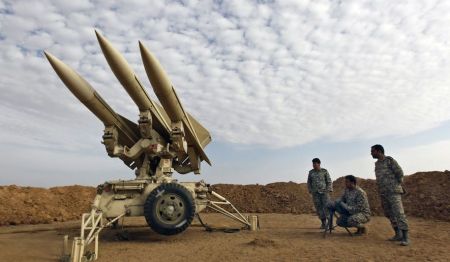
In this photo obtained from the Iranian Mehr News Agency, Iranian army members prepare missiles to be launched during a maneuver at an undisclosed location in Iran on Nov. 13, 2012. (AP Photo/Mehr News Agency, Majid Asgaripour) **FILE**

The council and MEK have a good track record over the years of disclosing Iranian nuke programs that operated under the radars of Western intelligence agencies. It boasts an extensive spying network inside the Defense Ministry, Islamic Revolutionary Guard Corps and other organs of the hard-line Islamic state ruled by religious mullahs.

The MEK said METFAZ is operating in a secret location unbeknownst to the International Atomic Energy Agency (IAEA), the world’s nuclear watchdog. In official communications, the regime refers to it as the code name “Research Academy.”

********************************

Iran is cheating on its historical deal with the U.S. by secretly conducting research into nuclear weapons components such as bomb triggers and enriched uranium, the main Iranian opposition group said Friday.

The regime is doing engineering and weaponization testing at a walled military complex south of Tehran, a location which Iran has declared off-limits to inspectors, said the National Council of Resistance of Iran (NCRI) and its main operational arm, the People’s Mujaheddin of Iran (MEK).

“This is the site that has been kept secret,” said Alireza Jafrazadeh, NCRI’s Washington office deputy director. “There is secret research to manufacture the bomb and basically cover up the real activities of the Iranian regime.”

The 2015 Joint Comprehensive Plan of Action (JCPOA), negotiated by the Obama administration, has become a major foreign policy issue for the Trump White House as it evaluates whether to reimpose economic sanctions on Tehran. Iran has benefited with billions of dollars in freed-up funds while it pursues interventions in Iraq, Syria and Yemen against U.S. interests.

The NCRI-MEK report came the day after Secretary of State Rex Tillerson lambasted Iran for its expansionist terrorist activities in the region which he said violated the spirit of the JCPOA. He called the deal a “failed approach” since Iran can break out and build bombs after 10 years.

The JCPOA outlaws the type of weaponization work described by the NCRI-MEK report.

The State Department reported this week that Iran was abiding by the deal hammered out by former Secretary of State John Kerry and approved by Russia and other powers.

The NCRI rebutted that conclusion during a press conference in Washington by saying it is providing new information on Iranian misdeeds.

The council and MEK have a good track record over the years of disclosing Iranian nuke programs that operated under the radars of Western intelligence agencies. It boasts an extensive spying network inside the Defense Ministry, Islamic Revolutionary Guard Corps and other organs of the hard-line Islamic state ruled by religious mullahs.

The NCRI asserts that Iran’s so-called “declared” sites were not disclosed by Iran, but by the intelligence work of MEK.

The heart of the NCRI-MEK intelligence report is a research operation known as the Organization of Defensive Innovation and Research (SPND) and its seven subdivision, which MEK said it first exposed in 2011.

“They are carrying out their research in various fields related to the manufacturing of a nuclear weapon,” the council’s report said. “In some of these fields, new initiatives have also been undertaken in order to keep the real objectives of the research a secret and to cover up the real activities.”

One those subdivisions, the Center of Research and Expansion of Technologies on Explosions and Impact (METFAZ) works on triggers and explosive yields, the statement said. The MEK disclosed METFAZ’s existence in 2009.

The MEK said METFAZ is operating in a secret location unbeknownst to the International Atomic Energy Agency (IAEA), the world’s nuclear watchdog. In official communications, the regime refers to it as the code name “Research Academy.”

The council investigation said that for the mullahs to continue METFAZ’s work undetected, they downsized a center in Sanjariana and transferred the research and testing to a new site in the military district of Parchin 20 miles south of Tehran.

“We are disclosing this for the first time today,” Mr. Jafrazadeh said. “They felt this was optimum location for shielding the actives of METFAZ.”

Reporters asked Mr. Jafrazadeh why the U.S.’s latest 90-day report to Congress say Iran was complying if it is now cheating.

He answered that the assessment is based on the IAEA monitoring known sites and measuring technical metrics, such as the amounts of enriched uranium.

He said that what the council is disclosing is secret weaponization work that now needs to be investigated. He said the council provided its report in the last few days to the Trump administration and the IAEA.

“We’re talking about an extensive covert operation by the Iranian regime,” he said.

Mr. Jafrazadeh said that when the IAEA visited a limited number of sites at Parchin in 2015, Iran had cleansed them of weaponization evidence.

“It needs to be inspected immediately,” Mr. Jafrazadeh said. He predicted this new intelligence report will prompt Iran to “clean out” its illicit work.

Iranian Supreme Leader Ali Khamenei has said that “inspection of our military sites is out of the question and is one of our red lines.” A number of Iranian leaders have repeated that warning in recent months.

The MEK provided satellite photos and descriptions of the exact locations of nuclear research inside the Parchin complex, such as “Plan 6” which is located at “the end of Babaj highway, Khojir-Parchin military road, after the tunnel on the southern side of Mamlo Dam.”

The site is protected by the Islamic Revolutionary Guard Corps, the dominant security force inside Iran.

The report described the musical chairs this way: “The move resulted in the subsiding of activities at the Sanjarian site. The Iranian regime has done its utmost to keep the Research Academy, which is an important site, a secret from the eyes of international organizations. The reason for the move was based on the conclusion reached by regime officials that the probability for the IAEA to get access to Parchin in the future is extremely low, which means that the site is an optimal location for shielding the regime’s activities in this regard.”

To bolster its findings, the MEK released what it said are the nuts and bolts of Iran’s cheating, such as the identities of 15 METFAZ personnel and their jobs descriptions, and addresses of various secret sites.

The SPND network is headquartered in Tehran in the “Nour Building,” near the Defense Minister which supervises operations.

“In order to understand the regime’s secret and illicit activities, it is critical that the IAEA inspect and monitor not only the Research Academy, but also all other sites related to SPND,” the NCRIR-MEK said. “This will help shed light on the scope of the regime’s secret military and nuclear activities.”

It added, “The weaponization program must be totally dismantled. There is no reason to maintain SPND, and all its subordinate organizations, including METFAZ. They have no peaceful, energy use whatsoever and, their only function is to facilitate the development of the nuclear bomb.”

Mr. Jafrazadeh termed as “ridiculous” Iran’s restrictions on military site inspections since it is the military that oversees nuclear bomb research.

The NCRI received a boost this week when Senate Armed Services Chairman John McCain, Arizona Republican, attended a council event in Tirana, Albania, its new home after spending years in Iraq.

He met privately with NCRI leader Maryam Rajavi.

The Washington Times asked the State Department to respond to the NCRI-MEK investigation.

A spokesman referred to Mr. Tillerson’s April 18 letter to Congress certifying that Iran is in compliance. Mr. Tillerson added that the Trump administration will conduct a review of whether the suspension of economic sanctions under JCPOA is in the U.S’s interest.

“Notwithstanding, Iran remains a leading state sponsor of terror through many platforms and methods,” Mr. Tillerson wrote.

We’re turning a blind eye to Iran’s genocidal liars

April 18, 2017

We’re turning a blind eye to Iran’s genocidal liars, The Australian, Michael Oren, April 19, 2017

(Please see also, What North Korea Should Teach Us about Iran. DM)

In responding forcibly to North Korean and Syrian outrages, President Trump has taken a major step towards restoring America’s deterrence power. His determination to redress the flaws in the JCPOA and to stand up to Iran will greatly accelerate that process. The US, Israel and the world will all be safer.

**************************

The US has signed agreements with three rogue regimes strictly limiting their unconventional military capacities. Two of those regimes — Syria and North Korea — brazenly violated the agreements, provoking game-changing responses from Donald Trump. But the third agreement — with Iran — is so inherently flawed that Tehran doesn’t even have to break it. Honouring it will be enough to endanger millions of lives.

The framework agreements with North Korea and Syria, concluded respectively in 1994 and 2013, were similar in many ways. Both recognised that the regimes already possessed weapons of mass destruction or at least the means to produce them. Both ­assumed that the regimes would surrender their arsenals under an international treaty and open their facilities to inspectors. And both believed these repressive states, if properly engaged, could be brought into the community of nations.

All those assumptions were wrong. After withdrawing from the nuclear non-proliferation treaty, Pyongyang tested five atomic weapons and developed ­intercontinental missiles capable of carrying them. Syrian dictator Bashar al-Assad, less than a year after signing the framework, reverted to gassing his own people. Bolstered by the inaction of the US and backed by other powers, North Korea and Syria broke their commitments with impunity.

Or so it seemed. By ordering a Tomahawk missile attack on a Syrian air base, and a US Navy strike force to patrol near North Korea’s coast, the Trump administration has upheld the frame­­works and placed their violators on notice. This reassertion of power is welcomed by all of ­America’s allies, Israel among them. But for us the most dangerous agreement of all is the one that may never need military enforcement. For us, the existential threat looms in a decade, when the agreement with Iran expires.

Like the frameworks with North Korea and Syria, the Joint Comprehensive Plan of Action of 2015 assumed that Iran would fulfil its obligations and open its facilities to inspectors. The JCPOA assumed that Iran would moderate its behaviour and join the international community. Yet unlike its North Korean and Syrian allies, Iran was the largest state sponsor of terror and openly vowed to destroy another state: Israel. Unlike them, Iran systematically lied about its unconventional weapons program for 30 years. And unlike Damascus and Pyongyang, which are permanently barred from acquiring weapons of mass destruction, Tehran can look forward to building them swiftly and legitimately in the late 2020s, once the JCPOA expires.

This, for Israel and our neighbouring Sunni states, is the appalling flaw of the JCPOA. The regime most committed to our destruction has been granted a free pass to develop military nuclear capabilities. Iran could follow the Syrian and North Korean examples and cheat. Or, while enjoying hundreds of billions of dollars in sanctions relief, it can adhere to the agreement and deactivate parts of its nuclear facilities rather than dismantle them. It can develop new technologies for producing atomic bombs while testing intercontinental ballistic missiles. It can continue massacring Syrians, Iraqis and Yemenis, and bankrolling Hamas and Hezbollah. The JCPOA enables Iran to do all that merely by complying.

A nuclear-armed Iran would be as dangerous as “50 North Koreas”, Israeli Prime Minister Benjamin Netanyahu told the UN in 2013, and Iran is certainly many times more dangerous than Syria. Yet Iran alone has been granted immunity for butchering civilians and threatening genocide. Iran alone has been guaranteed a ­future nuclear capability. And the Iranian regime — which brutally crushed a popular uprising in 2009 — has amassed a million-man force to suppress any future opposition. Rather than moderating, the present regime promises to be more radical yet in another 10 years.

How can the US and its allies pre-empt catastrophe? Many steps are possible, but they begin with penalising Iran for the conventions it already violates, such as UN restrictions on missile development. The remaining American sanctions on Iran must stay staunchly in place and congress must pass further punitive legislation. Above all, a strong link must be established between the JCPOA and Iran’s support for terror, its pledges to annihilate ­Israel and overthrow pro-American Arab governments, and its complicity in massacres. As long as the ayatollahs oppress their own population and export their ­tyranny abroad, no restrictions on their nuclear program can ever be allowed to expire.

In responding forcibly to North Korean and Syrian outrages, President Trump has taken a major step towards restoring America’s deterrence power. His determination to redress the flaws in the JCPOA and to stand up to Iran will greatly accelerate that process. The US, Israel and the world will all be safer.

Michael Oren is Israel’s deputy minister for diplomacy, a member of the Knesset and a former ambassador to Washington.