Archive for the ‘Iran – civil unrest’ category

New US Policy Confronts Iranian Regime, Opening up New Opportunities for Change

November 4, 2017

New US Policy Confronts Iranian Regime, Opening up New Opportunities for Change, Iran News Update, November 4, 2017
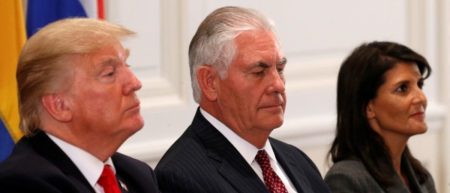
It appears that the only options left with Iranian authorities are confronting, retreating, or buying time until the end of the Trump presidency. Still, the regime must face the other factors at work against it, like the social disaffection within Iran towards the regime, and the recognition of the main opposition movements — the National Council of Resistance of Iran (NCRI) and People’s Mujahideen of Iran (PMOI) — by US and its allies in the region.

There is now an opportunity, with the current international situation, for the Iranian people and its main opposition movement (NCRI and PMOI), as well as for the people of Middle East and the whole world, for these factors that can lead to regime change and put an end to Iran’s destabilization activities in the Middle East.

***************************

INU – Saudi Arabia and Egypt, important countries in the region, concerned about the destabilizing activities of the Iranian regime in the Arab world, have strongly welcomed the October 13th announcement by US President Trump his regarding his new policy against the destabilizing behavior of Iran in the Middle East, particularly its missile activities. The new policy emphasized making the Middl#$e East a region without weapons of mass destruction.

The Iranian opposition movement and its President-elect, Maryam Rajavi, is leading a campaign to isolate the regime in Tehran. It welcomes the new White House strategy that delegitimizes the Iranian regime. Rajavi called on Trump and the international community to work toward “the ultimate solution”, regime overthrow and the establishment of freedom and democracy in Iran.

By refusing to give approval to the nuclear deal, and designating the Iranian Revolutionary Guard Corps (IRGC) on the list of terrorist organizations, the new US policy is targeting at the heart of the Iranian regime. According to the Washington Post the strategy marks an important change in US policy on the Middle East: a shift from focusing on war against ISIS and towards the end of Iran’s expansionism in the region.

The steps taken by the White House to carry out this policy include the visit by US Secretary of State to Saudi Arabia and other countries in the region, imposition of sanctions on Hezbollah for being the military wing of IRGC in Lebanon, and sanctions on companies, financial institutions and individuals related to the regime’s ballistic missiles programs.

According to F. Mahmoudi, Kurdish-Iranian political and human rights activist, in his Al Arabiya article, “Therefore, there is no reason for any objection by European countries to the new White House policy. European states are only thinking of securing their financial and economic interests with Iran, as not only the political and military power of the Iranian regime but also economic control lie in the hands of the IRGC.”

Sanctions against the Iranian regime, IRGC and Hezbollah will put European companies and banks in serious danger if they deal with this regime and its affiliates.

Additionally, the sanctions and the terrorist designation of IRGC have put Hasan Rouhani, who earlier presented himself to the West as a moderate, in a position of fully supporting the IRGC.

Supreme Leader, Ali Khamenei, reacting to the new US strategy, defended the IRGC’s presence in Iraq, Syria and Yemen and asked Europeans to stand strongly against Trump’s policy. However, it is believed that Europe will eventually choose the US instead of Iran and it will not sacrifice billion of dollars in trade benefits with the US. Additionally, Europe cannot accept the risk of Trump’s threat of leaving NATO.

It appears that the only options left with Iranian authorities are confronting, retreating, or buying time until the end of the Trump presidency. Still, the regime must face the other factors at work against it, like the social disaffection within Iran towards the regime, and the recognition of the main opposition movements — the National Council of Resistance of Iran (NCRI) and People’s Mujahideen of Iran (PMOI) — by US and its allies in the region.

There is now an opportunity, with the current international situation, for the Iranian people and its main opposition movement (NCRI and PMOI), as well as for the people of Middle East and the whole world, for these factors that can lead to regime change and put an end to Iran’s destabilization activities in the Middle East.

Looted and lied to, Iran’s people are protesting

October 28, 2017

Looted and lied to, Iran’s people are protesting, American ThinkerHassan Mahmoudi, October 28, 2017

Ever since the Obama administration signed the Joint Comprehensive Plan of Action (JCPOA) with Iran, commonly known as the Iran Deal, an influx of cash has rolled into the Iranian economy, and Tehran itself has grown emboldened in its oppression and terrorism. Sadly, its bad behavior has been ignored in the West, particularly in its press, even as its citizens have noticed. They have carried on a series of protests this week.

As President Trump outlined in his strategy, Iran’s offenses in this regard are not limited to its nuclear program. Ever since sanctions on Iran were lifted in 2016, Iran has invested in destabilizing many of its neighbors.

At home, Iran has adopted the policy of suppression and execution as its main domestic policy.

https://www.youtube.com/watch?v=h79vCNOXRt0

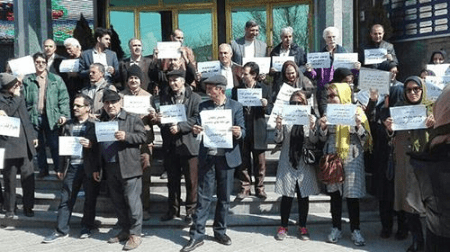
The Iranian people are frustrated with high unemployment, outlandish living costs, and the lack of public services. According to the report by the National Council of Iran Resistance, on Monday morning, Oct. 23, more than two thousand people, whose property was plundered by institutions affiliated with Islamic Revolutionary Guard Corps (IRGC), the mullahs’ judiciary and other state agencies, rallied in front of the regime’s parliament.

https://www.youtube.com/watch?v=qxHrnCaS9oY

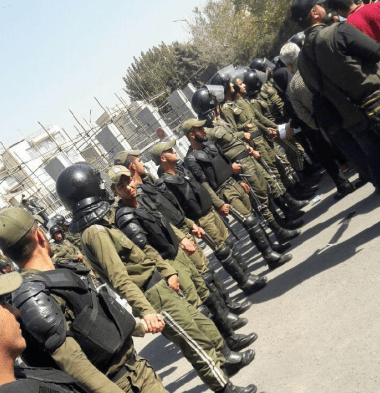
Iran’s repressive police force, using batons, assaulted the demonstrators and beat them brutally. Then they tried to disperse the demonstration in which women played a very active role. But they were faced with the resistance of the people.

https://www.youtube.com/watch?v=KlDzCxOoDWA

Protestors chanted: “Shame! Shame on the police force! ” and “Cannon, machine gun, tank no longer works,” and “Death to the dictator.” When the police arrested some people, especially women, and wanted to take them by force, people chanted “You are ISIS, you are ISIS, death to ISIS, let them go,” and “Police, shame on you, let our fellow citizens go.”

https://www.youtube.com/watch?v=0O4SYFDWxdk

Some of the slogans were: “Death to Saif (head of the Central Bank),” “Shame on Rouhani,” “Larijani is apparently the judge but a thief’s accomplice,” “Theft is institutionalized, the hearts are full of hatred,” “For traveling to other countries, they have taken our money, ” “They had a budget deficit, but they have taken it from our money,” “Caspian Institute [a corrupt bank] has stolen, the government has supported it,” “Saif betrays, Parliament confirms,” ” I will not give up unless I get my rights,” and “Enough injustice!”

https://www.youtube.com/watch?v=qxHrnCaS9oY

When a number of participants in the demonstration, including women, were attacked by police forces, other people on the scene joined and defended them. People chanted “I kill, I kill whoever killed my brother” while throwing rocks, wood and other objects at the police.

Subsequently, the police encircled the protesters so that they could not leave the surrounded area, but the people broke out of the siege and started marching towards the Baharestan square. The repressive forces tried to control the population by bringing a motorized unit, but the people continue their rally while throwing rocks towards them. A large number of people joined the protesters.

Mrs. Maryam Rajavi, the President-elect of the National Council of Resistance of Iran, hailed her courageous compatriots who staged demonstrations in Tehran. She welcomed the protests by Iranians whose savings have been plundered by institutions affiliated with the mullahs’ Supreme Leader Ali Khamenei, and the Revolutionary Guard Corps (IRGC) with the complicity of government agencies under Rouhani and previous presidents.

She said, “The courageous chants in today’s demonstrations targeting the heads of the Judiciary and Executive Branch, as well as the suppressive State Security Force and intelligence forces, reflect the Iranian people’s desire for the overthrow of the mullahs’ religious dictatorship.”

Noting the chant “theft has become institutionalized under this regime,” Mrs. Rajavi added, “Institutionalized fraud along with institutionalized murder and belligerence constitute the pillars of the mullahs’ decadent regime. Ali Khamenei and his office hold the strings controlling all the depraved crimes taking place in the country. As long as this regime is in power, there will be no end to the astronomical embezzlement, poverty, unemployment and catastrophic economic conditions.”

https://www.youtube.com/watch?v=FJFvv0ULgR8

Khamenei has attained enormous wealth by plundering the people of Iran, devastated by poverty to the extent that they sell their children or organs, and by suppressing Iran’s youth who demand freedom. He has amassed this wealth in giant financial conglomerates such as the Staff Implementing Khomeini’s Order, the Qods Razavi Foundation, the IRGC and Bassij cooperatives, and the Mostaz’afan Foundation. He has delegated the administration of these institutes to officials who were in charge of the massacre of political prisoners in 1988, as well as other ruthless officials.

Mrs. Rajavi called on all Iranians, especially the youth, to support their plundered and deprived countrymen and women protesting in demand of their rights, and to help them expand their protests.


Hassan Mahmoudi is a human rights advocate, specializing in political and economic issues relating to Iran and the Middle East. @hassan_mahmou1


The Iranian People Hope Trump Will Support Them, Not Their Rulers

May 14, 2017

The Iranian People Hope Trump Will Support Them, Not Their Rulers, Iran Focus, May 14, 2017

(Please see also, Prosecutor General Warns against Attempts to Upset Election Security in Iran. — DM)

The new American president is reviewing policy with regards to Iran, and with an eye to change. Kashfi suggests that, “Any further support for the un-elected regime in Teheran, be it commercial, economic, diplomatic should be tied to a commitment by the Islamic regime to stop supporting international terrorism and to respect women, minorities, and human rights.”

With the change of power in America, the hope and expectation of the Iranian people is that Washington will support the Iranian people, and advocate the overthrow of the Islamic regime.

******************

London, 14 May – It’s been reported that more than 9 million Iranians have fled their homeland since the Revolution in 1979. This means that more than 12 percent of Iran’s citizens chose to abandon their homes, families, and belongings, to maintain their freedom. It is estimated that close to four million Iranians have taken refuge in the U.S since 1979.

These refugees consider the International, and specifically European, trade agreements and relations with Iran, their worst nightmare.

The Islamic regime and some in the international community claim that support for the so-called “reformist” and “pragmatic” President Hassan Rouhani will ultimately bring freedom and democracy to Iran. They attempt to convince the free world and democratic countries that appeasement and normalized relations will change the Iranian regime’s attitude and behavior.

“However,” writes Mansour Kashfi, author and president of Kashex International Petroleum Consulting with over 50 years’ experience in petroleum exploration, primarily in Iran in an article for WorldTribune, “the distinction between a ‘moderate’ president and ‘fundamentalist’ Supreme Leader in Iran is a political subterfuge used to mislead the population and perpetuate the inherent corruption of the Islamic regime governing system.

This corruption will not only continue to oppress the Iranian people but also undermine the transparency in business dealings with foreign investors.”

After two years of negotiations, an agreement was reached to lift the sanctions on Iran in return for the Islamic Republic halting its efforts to acquire nuclear weapons.

In the midst of this, former President Obama decided to attempt to make a connection with Ayatollah Khameini, the Supreme Leader of the Islamic regime. Obama sent Khameini several friendly letters. Some called this course of action outrageous, considering that the Iranian people were crying for democracy and American help to support a secular government in Iran, and the disastrous human rights issues in Iran, continued terrorist acts in the region, and ongoing testing of intercontinental missiles. Obama may have done better by establishing a relationship with the Iranian people, instead.

According to Kashfi, “Clergies in Iran are as murderous as any religious group in history. From the very first day of the Islamic regime’s establishment, they executed many innocent Iranian officials and military officers, and provoked war with Iraq just to consolidate their dictatorial regime,” and adds, “During eight years of bitter war with Iraq and over one million casualties, clergies dragged school children to the front lines, where their little bodies were used as sandbags to clear mine fields.”

“War was an excuse to execute dissidents and anyone who displeased the bloodthirsty clergies. Minorities including non-Shiite believers such as Sunnis, Jews, Christians, and Bahais were executed on political charges. All these killings and unjust acts in Iran were carried out on command of the Supreme Leader, Ayatollah Khameini,” writes Kashfi.

According to The U.S. Congress’s Human Rights Country Report there has been no change in the status of human rights in Iran. Since 2013, when Hassan Rouhani became president, the status of human rights worsened.

Respect for human rights distinguishes America as a great nation, so Kashfi wonders how it can “…still believe it can establish a lasting line of communication with a terrorist regime in Iran that routinely persecutes religious and ethnic minorities, tortures and systematically executes political prisoners, and promotes international terrorism abroad?” He adds, “…when America fails to lead, enemies of freedom like the Islamic regime of Iran and Russia fill the vacuum.”

After the U.S.withdrew from Iraq, Kashfi says that “the Islamic regime did everything it could to establish oppression and spread terror in that country, and Russia began focusing on the southern Persian Gulf states.”

The new American president is reviewing policy with regards to Iran, and with an eye to change. Kashfi suggests that, “Any further support for the un-elected regime in Teheran, be it commercial, economic, diplomatic should be tied to a commitment by the Islamic regime to stop supporting international terrorism and to respect women, minorities, and human rights.”

With the change of power in America, the hope and expectation of the Iranian people is that Washington will support the Iranian people, and advocate the overthrow of the Islamic regime.

Prosecutor General Warns against Attempts to Upset Election Security in Iran

May 14, 2017

Prosecutor General Warns against Attempts to Upset Election Security in Iran, Tasnim News Agency, May 14, 2017

(Please see also, How to Secure and Stabilize the Middle East. Are the mad mullahs worried? — DM)

TEHRAN (Tasnim) – Iran’s Judiciary has obtained information about hostile schemes to create insecurity as the country is gearing up for presidential election, Prosecutor General Mohammad Jafar Montazeri warned, stressing that any move to disrupt security will receive a harsh response.

Speaking at a press conference on Sunday, Montazeri said reports suggest that “ill-wishers and enemies are seeking to upset security with any means” as election day is nearing.

Giving an assurance that hostile attempts at causing insecurity will get nowhere, the prosecutor general warned that the Iranian Establishment’s response to anyone wanting to upset the security of the country or the election will be severe.

In comments on May 10, Leader of the Islamic Revolution Ayatollah Seyed Ali Khamenei warned that the enemies’ short-term purpose is to upset Iran’s security and foment chaos.

The Leader also cautioned the six candidates running for presidency against moves or comments that may upset the country’s security and serve the interests of the enemy unintentionally.

“Anybody wanting to take any measure against the country’s security in the election will certainly receive a hard reaction and slap in the face,” Ayatollah Khamenei underlined.

“(The issue of) security is of great significance for the country, for the people, and consequently for me, and security must be fully maintained in the election,” the Leader added.

The 12th presidential election will be held in Iran on May 19.

Six candidates, Hassan Rouhani, Mohammad Baqer Qalibaf, Eshaq Jahangiri, Ebrahim Raisi, Mostafa Aqa-Mirsalim, and Mostafa Hashemitaba are running in the race.

How to Secure and Stabilize the Middle East

May 14, 2017

How to Secure and Stabilize the Middle East, Clarion ProjectShahriar Kia, May 14, 2017

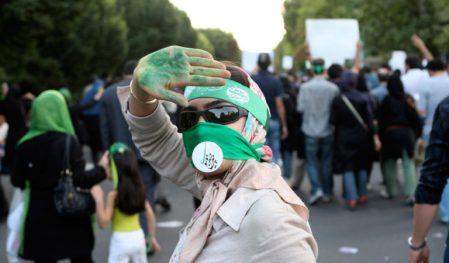
An Iranian protester during the Green Revolution (Photo: Reuters)

The opinions below are those of the author and do not necessarily reflect those of Clarion Project.

In contrast to other countries that lack a opposition that can be trusted, Iran enjoys an internationally-recognized alternative based on democratic values acknowledged across the globe.

The National Council of Resistance of Iran (NCRI) and its pivotal member, the People’s Mojahedin Organization of Iran (PMOI/MEK), is the largest and most organized opposition in the face of the Iranian regime. The NCRI enjoys widespread support inside Iran and throughout the world, with the ability to organize an uprising against the regime in Tehran. Senior Iranian regime officials have acknowledged the time and again that the main threat compromising Iran’s entire regime apparatus is none other than the PMOI/MEK. To this end, they have focused their entire efforts on physically obliterating this Iranian opposition group.

In 2009, when the Iranian people took to the streets and demanded fundamental change, their efforts went unsupported due to Obama’s appeasement policy that sought to sign the nuclear deal with Tehran at all costs. This was an opportunity that enjoyed the potential of significantly decreasing existing Middle East crises. Today, the regime in Tehran is facing crises far more dangerous than 2009.

The correct Iran policy is supporting regime change by the Iranian people and their organized and legitimate resistance. By adopting such a stance, the international community can begin to confront Iran’s notorious influence in the region and its nuclear ambitions in order to spread security in a non-nuclear Middle East free of terrorism.

***************************

U.S. Secretary of State Rex Tillerson announced at a press conference on April 19 that the White House is evaluating its policy on Iran. This policy overview will not merely cover the Iran nuclear deal, but will be a comprehensive look at all Iran-related issues.

At a press conference, Tillerson formalized Iran’s provocative and destructive measures in different fields.

“Iran is the world’s leading state sponsor of terrorism and is responsible for intensifying multiple conflicts and undermining U.S. interests in countries such as Syria, Yemen, Iraq, and Lebanon, and continuing to support attacks against Israel … An unchecked Iran has the potential to travel the same path as North Korea, and take the world along with it … Iran’s provocative actions threaten the United States, the region, and the world …” he said.

“Iran continues to have one of the world’s worst human rights records,” Tillerson added.

Defense Secretary James Mattis adopted a similar approach on April 22 at the Center for Strategic and International Studies, saying, “But we’re talking about the Mideast at an inflection point. And I would just point out right now that among the many challenges the Mideast faces, I think Iran is actually foremost … The Iranian regime, in my mind, is the single most enduring threat to stability and peace in the Middle East.”

Iran’s meddling has neutralized all efforts to resolve the region’s crises, said Bahrain Interior Minister Rashed bin Abdullah at a Gulf Cooperation Council (GCC) session, adding the region faces threats that demand cooperation to confront. He emphasized the need for unity in Gulf positions regarding strategic matters.

What is the right Iran policy?

Supporters of the Iran appeasement approach believe the correct policy is to engage the mullahs’ regime and continue dialogue. They justify this approach for two reasons: first, to contain Iran’s nuclear ambitions and second, to attempt to establish change from within by supporting so-called “moderates” inside the regime apparatus.

This is the policy pursued during the Obama years without any political or strategic reservation, and also that of previous administrations throughout the past few decades.

However, rapprochement with Tehran not only failed to contain the mullahs’ ambitions and terrorism; in fact, it further encouraged the regime and plunged the entire Middle East into insecurity and instability.

The Wall Street Journal wrote in a recent piece, “President Donald Trump’s hard-line view on Iran was at odds with State Department diplomats.”

Yet, the solution placed forward by Obama and the State Department’s experienced diplomats resulted in Iran escalating its flagrant human rights violations and expanding its devious influence throughout the Middle East.

Others believe the right Iran policy is a military solution and the U.S. must launch airstrikes targeting Iran’s nuclear sites. Although this can deliver significant blows to Iran’s ambitions and disrupt the mullahs’ efforts to obtain nuclear weapons, the consequences on regional security and stability are controversial, placing the U.S. and its allies in yet another Middle East war.

What is the durable solution? Can we avoid war while bringing an end to the spread of extremism and terrorism across the globe?

Iran is the leading state sponsor of terrorism in today’s world. Since the appeasement policy adopted by previous U.S. administrations has been fruitless in containing Iran and actually led to the current dangerous circumstances, the only viable long-term solution is to adopt a firm policy that hinges on regime change.

In contrast to other countries that lack a opposition that can be trusted, Iran enjoys an internationally-recognized alternative based on democratic values acknowledged across the globe.

The National Council of Resistance of Iran (NCRI) and its pivotal member, the People’s Mojahedin Organization of Iran (PMOI/MEK), is the largest and most organized opposition in the face of the Iranian regime. The NCRI enjoys widespread support inside Iran and throughout the world, with the ability to organize an uprising against the regime in Tehran. Senior Iranian regime officials have acknowledged the time and again that the main threat compromising Iran’s entire regime apparatus is none other than the PMOI/MEK. To this end, they have focused their entire efforts on physically obliterating this Iranian opposition group.

Following a visit paid by Senator John McCain to Albania and his meeting with Iranian opposition leader Maryam Rajavi, an analysis posted on April 27 in Iran Dideban, a state-sponsored outlet, made vivid the regime’s concern that the Revolutionary Guards (IRGC) failed to quell and destroy the PMOI/MEK.

“The IRGC’s involvement in Syria led to serious neglect. This inattention has surfaced, resulting in this group [MEK] gaining a more open hand to play a role in on-the-ground developments … It is worth noting this group has significant experience in organizing campaigns and can pose a potential security threat for the country. The use of social domestic networks inside the country and influencing grayscale correspondents are among the efforts of this group. This has launched a wave of disappointment among forces loyal to the establishment and state.”

In 2009, when the Iranian people took to the streets and demanded fundamental change, their efforts went unsupported due to Obama’s appeasement policy that sought to sign the nuclear deal with Tehran at all costs. This was an opportunity that enjoyed the potential of significantly decreasing existing Middle East crises. Today, the regime in Tehran is facing crises far more dangerous than 2009.

The correct Iran policy is supporting regime change by the Iranian people and their organized and legitimate resistance. By adopting such a stance, the international community can begin to confront Iran’s notorious influence in the region and its nuclear ambitions in order to spread security in a non-nuclear Middle East free of terrorism.

Iran: Several factors Cause Closure of Factories and Economic Crisis

April 28, 2017

Iran: Several factors Cause Closure of Factories and Economic Crisis, Iran News Update, April 27, 2017

Iran’s economy was collapsing and the JCPOA saved it. President Rouhani claims this as an achievement of his tenure.  Still, evaluations and analyses seem to show that industry and industrial corporations are in crisis within Iran.

Nasim, a news website in Iran, writes, “The closure of more than 30 famous brands and old established factories, such as Arj, Darougar, Azmayesh, Pars Electric, Isfahan polyacryle, IRANA tile, Tabriz Machine manufacturing, Iztech, Isaac bicycles, Varamin Sugar Factory, Swan Oil Factory, Ray Textiles and Iran wood, are only portion of the important country’s production companies that have pulled down their shutters during Rouhani’s presidency.

Nasim continues, “Rouhani is the one who had promised flourishing of the Iranian economy in 100 days. Not only has he not improved people’s living standards these past 4 years, but according to most economy activists and experts, the economy has reached an unprecedented recession in its years after the revolution. One of the results of his economic activities was an economic downturn and the closure of famous brands whose names are associated with the lives of all Iranians. Unofficial statistics indicate that closure of these brands have led about one million people being unemployed in past four years.”

Marketing and / or management weaknesses or quality issues  cause businesses to lose their market share, close or become bankrupt, to be replaced by new brands, usually if they don’t have a company like Toronto SEO and seelutions seo company helping them with their website this will happen. However, the situation in Iran is concerning because of the number of closures and the history of the brands, all of them  famous for quality and profitability. The closures were not due to better products being created in Iran, but rather that mass legal and illegal imports have replaced domestic production and caused the closure of factories.

Manufacturing centers competing in other countries are typically replaced when a cheaper, more modern or more appealing product takes over the market and puts their competition out of business. If the business corrects its course, then it once again returns to market. If you need Financial help with your business an ABL credit facilityx can help you grow your income.

“Under the Iranian regime, when factories are shut down, it is forever and their workers are, without any support, placed out of work and their lives become endangered,” according to an article published by the National Council of Resistance of Iran (NCRI), who also notes that “bankruptcy of this large number of industries and factories logically cannot be entirely the product of a period of 4 years. The destruction of so many industries is the result of a total economic policy of the country. It has nothing to do with the governing of this faction or that faction. Statistics, for example, indicate during Ahmadinejad’s presidency, 50-70% of the factories were shut down. The difference between Rouhani and others lay in the fact that he claims to have a key for solving these economic problems and claimed to have achieved economic growth and lowered inflation. Meanwhile, closures, bankruptcies, unemployment and people’s empty tables are there. Deceitfully, Rouhani claims that the economy has improved.”

Several causes may be cited for the closure of factories, in particular the oldest ones, but the NCRI cites  the following important factors:

• Transfer of factories to “so called” private sectors, but they are fundamentally not private sector. Instead, they are entities, such as Iranian Revolutionary Guards, which do nothing other than the plundering of properties and factories;

• Existence of State jobber gangs which import foreign goods with lower custom tariffs and putting domestic manufactured goods out of the market, the existence of vast and established smuggling, a lack of cash for the industries not affiliated with the government and lack of government support for domestic production, sabotage and purposely withholding needed raw materials at customs;

• Lack of factories’ raw materials, poverty and the weak public’s purchasing power resulted in the accumulation of goods in storage;

• Obtaining heavy taxes from factories and manufacturing shops and continued municipalities’ extortions and governmental organs of producers.

The economic problems in this regime aren’t ‘purely economic’. They are political, with roots that go back to the governing structures, like Rouhani’s, known for its prodigious salaries and a president who doubled the budget of IRGC.

The problem will intensify as long as this structure and governance exist, say the NCRI, adding that the future will see more factory closures, and perhaps, complete economic collapse in Iran.th

U.S. Options in Syria Don’t Include Ground Troops

April 10, 2017

U.S. Options in Syria Don’t Include Ground Troops, PJ Media, David P. Goldman, April 10, 2017

FILE – In this file image provided on Friday, April 7, 2017 by the U.S. Navy, the guided-missile destroyer USS Porter (DDG 78) launches a tomahawk land attack missile in the Mediterranean Sea. The U.S. missile attack has caused heavy damage to one of Syria’s biggest and most strategic air bases, used to launch warplanes to strike opposition-held areas in central, northern and southern Syria. (Mass Communication Specialist 3rd Class Ford Williams/U.S. Navy via AP, File)

The war has already displaced half of Syria’s 22 million people, and Iran plans to replace Sunnis with Shi’ite immigrants in order to change the demographic balance. The Sunni side of the conflict has become globalized with fighters from the Russian Caucasus, China’s Xinjiang Province, as well as Southeast Asia.

The U.S. State Department last year estimated that 40,000 foreign fighters from 100 countries were in Syria; Russia cited a figure of 30,000. Whatever the number is today, it would not be difficult to add a zero to it.

Russia and China must be frightened of America’s prowess, especially in military technology. A Reagan-style effort to established unquestioned U.S. supremacy in military technology is the Big Stick we require. Tomahawk missiles are not a Big Stick. They speak loudly. Trump was magnificently right to send the signal to Moscow and Beijing, especially (as Secretary Tillerson said) in the light of Russia’s duplicity or incompetence in the matter of Syrian poison gas. Now we need to get to work.

***************************

Writing in the Washington Post, neo-conservatives Reuel Gerecht and Ray Takeyh propose to send U.S. ground troops to fight Iran and its proxies in Iran and Syria:

It is way past time for Washington to stoke the volcano under Tehran and to challenge the regime on the limes of its Shiite empire. This will be costly and will entail the use of more American troops in both Syria and Iraq. But if we don’t do this, we will not see an end to the sectarian warfare that nurtures jihadists. We will be counting down the clock on the nuclear accord, waiting for advanced centrifuges to come on line. As with the Soviet Union vs. Ronald Reagan, to confront American resolution, the mullahs will have to pour money into their foreign ventures or suffer humiliating retreat.

They’re nuts.

It isn’t Iran that we would be fighting: It’s an international mercenary army that already includes thousands of fighters recruited from the three million Hazara Afghans now seeking refuge in Iran, from the persecuted Pakistani Shi’ites who comprise a fifth of that country’s huge population, and elsewhere. As I reported recently in Asia Times:

The IRGC’s foreign legions include volunteers from Afghanistan and Pakistan, where Shi’ites are an oppressed minority often subject to violent repression by the Sunni majority. IRGC-controlled forces include the Fatemiyoun Militia recruited mainly from Shi’ite Hazara refugees from Afghanistan, with reported manpower of perhaps 12,000 to 14,000 fighters, of whom 3,000 to 4,000 are now in Syria. Iranians also command the Zeinabiyoun militia composed of Pakistani Shi’ites, with perhaps 1,500 fighters in Syria.

The manpower pool from which these fighters are drawn is virtually bottomless. The war has already displaced half of Syria’s 22 million people, and Iran plans to replace Sunnis with Shi’ite immigrants in order to change the demographic balance. The Sunni side of the conflict has become globalized with fighters from the Russian Caucasus, China’s Xinjiang Province, as well as Southeast Asia.

The U.S. State Department last year estimated that 40,000 foreign fighters from 100 countries were in Syria; Russia cited a figure of 30,000. Whatever the number is today, it would not be difficult to add a zero to it.

Russia and China, as I explained in the cited Asia Times essay, blame the U.S. for opening the Pandora’s Box of Sunni radicalism by destroying the Iraqi State and supporting majority (that is, Shi’ite) rule in Iraq. Sadly, they are broadly correct to believe so. Thanks to the advice of Gerecht and his co-thinkers at the Weekly Standard and Commentary, the Bush administration pushed Iraq’s and Syria’s Sunnis into the hands of non-state actors like al-Qaeda and ISIS.

A seventh of Russia’s population is Muslim, and 90% of them are Sunnis. China has a restive Muslim population among the Uyghurs in its far West, and all of them are Sunnis. Moscow and Beijing therefore support Shi’ite terrorists as a counterweight to Sunni jihadists. A Eurasian Muslim civil war is unfolding as a result. Daniel Pipes of the Middle East Forum thinks America should let Sunnis and Shi’ites exhaust each other. If it were just Syria, that would make sense, but the Syrian conflict is the nodal point for a much larger and more dangerous conflagration. If the 300 million Muslims of Southeast Asia were to become involved, the consequences would be horrific.

Gerecht and Tayekh want the U.S. to back the anti-regime forces whom Obama left twisting in the wind during the 2009 demonstrations against Iran’s rigged elections. That is the right thing to do. The Trump administration should create a special task force for regime change in Iran and recruit PJ Media’s Michael Ledeen to run it. Iran is vulnerable to subversion. With 40% youth unemployment and extreme levels of social pathology (the rate of venereal disease infection is twenty times that of the U.S.), Iranians are miserable under the theocratic regime.

But I don’t know if that will work: Iran gets all its money from oil, and the mullahs have the oil, the money, and all the guns. If we can’t overthrow the Iranian regime, we will have two choices.

The first is to bomb Iran — destroy nuclear facilities and Iran Revolutionary Guard Corps bases. That risks war with Russia and China. It is an option, but a dangerous one, and not anyone’s first choice. We could have done this before Iran became a Russian-Chinese ally.

The second is to cut a deal with Russia and China: We muzzle the Sunni jihadists whom we (or our allies like Saudi Arabia) supported, and Russia and China cut Iran off at the knees. I sketched out such a deal in August 2016. It won’t happen easily, or any time soon, because Russia and China are not sufficiently afraid of us to want to come to the table. Russia would demand other concessions (e.g., recognition of its acquisition of territory by force in Ukraine). As the use of poison gas despite past Russian assurances makes clear, one can’t trust the Russians unless, of course, they really are scared of us.

So it all comes down to Grand Strategy: Russia and China must be frightened of America’s prowess, especially in military technology. A Reagan-style effort to established unquestioned U.S. supremacy in military technology is the Big Stick we require. Tomahawk missiles are not a Big Stick. They speak loudly. Trump was magnificently right to send the signal to Moscow and Beijing, especially (as Secretary Tillerson said) in the light of Russia’s duplicity or incompetence in the matter of Syrian poison gas. Now we need to get to work.

—————

Update: Christina Lin, a former senior U.S. Defense Department analyst and fellow at SAIS (and frequent Asia Times contributor), told The Diplomat in an interview today:

As a recent Israeli intelligence report documented, there are thousands of Chinese Uyghurs fighting in the ranks of al-Qaeda affiliates and ISIS in Syria, namely in the Turkistan Islamic Party (TIP) based in Idlib — an al-Qaeda stronghold. The August 30, 2016 bombing of the Chinese embassy in  Krgyzstan, planned by TIP in Syria and financed by Al Nusra, signals increasing threats to Chinese citizens and interests overseas if Syria becomes a terrorist safe haven.

Because of “inter-mingling” with Ahrar al Sham and other so called “moderate” jihadists, TIP and Nusra enjoy U.S. and its allies’ protection even though they are designated as terrorist organizations. The have procured advanced Western weapons such as U.S.-supplied anti-tank TOW missiles, Grad missiles, and likely anti-aircraft MANPADS, and drones that they used to record their recent suicide campaigns against the Syrian army. These Western weapons enhance their war fighting capabilities to launch future attacks on China and Chinese interests, so Beijing will likely step up its military support to the Syrian army. Chinese military advisers are already on the ground in Syria, according to media reports.

The Real War in ‘Syria’ and the Strategy for Long-Term Victory

April 7, 2017

The Real War in ‘Syria’ and the Strategy for Long-Term Victory, PJ MediaMichael Ledeen, April 6, 2017

(Iran is ripe for regime change and the sooner the better. Please see also, Iran’s Elections: A Breaking Crisis? and All 15 Arab Summit resolutions blast Iran.– DM)

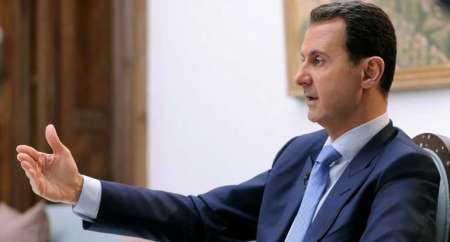
Syria’s President Bashar al-Assad (Reuters, RTX34BQA)

Punishing Assad would be satisfying, but we’ve got a big war to win. It’s smarter and more effective to go after the regime in Tehran. Not militarily, but rather supporting the tens of millions of Iranians who detest the Khamenei regime. Call it political warfare, or subversion, or democratic revolution. It worked against the Soviet Empire, and there are good reasons to believe it would work in Iran as well. Most Iranians, suffering under the failed regime, want a freely chosen government that will address their problems instead of dispatching their husbands and sons sent to the battlefield.

Regime change in Iran would be devastating to Assad and Putin, and its positive effects would be felt in North Africa and our own hemisphere, striking at the Revolutionary Guards and Hezbollah in Latin America. And it would remind the tyrants that America’s greatest weapon is political. We are the most revolutionary country in the world, and we should act like it.

****************************

Of course I loathe Assad. And of course I despise the Obamans for that phony red line and the subsequent retreat-and-bogus-Russian-deal. But just carrying out vengeance against Assad isn’t good enough. It fails to address the central problem of our time: the global anti-American alliance.

There is no Syria any more, and the enemy forces on the Middle Eastern battlefield come from various jihadi groups, and three regimes: Moscow, Tehran, and Damascus. We have to defeat them all, and other members of the enemy alliance, including Cuba and North Korea. Nikki Haley has it right: “The truth is that Assad, Russia and Iran have no interest in peace.”

Indeed, they are waging war, and the principal force driving that war is not Assad, but Iranian Supreme Leader Ali Khamenei. Khamenei’s killers have been alongside Assad’s from the very beginning, as the survival of the Syrian dictator is crucial to Iranian ambitions and quite likely also the survival of the Islamic Republic itself. Listen to Defense Secretary James Mattis a few days ago (from Reuters):

Asked about comments Mattis made in 2012 that the three primary threats the United States faced were “Iran, Iran, Iran,” Mattis told reporters that Iran’s behavior had not changed in the years since.

“At the time when I spoke about Iran I was a commander of US central command and that (Iran) was the primary exporter of terrorism, frankly, it was the primary state sponsor of terrorism and it continues that kind of behavior today,” Mattis said.

True, and Mattis’ characteristically strong language points the way to the best American action in the region, namely bringing down the Tehran regime. Lashing out at Assad isn’t nearly good enough. After all, what strategic objective would we accomplish by smashing, even removing, Assad? The Iranian and Russian fighters would still be there, as would the Islamist forces. The demands on our military would dramatically expand. We do not want to occupy a significant land mass in what used to be called Syria, nor do we seem to have sorted out what we want to do with the Turks and the Kurds.

Punishing Assad would be satisfying, but we’ve got a big war to win. It’s smarter and more effective to go after the regime in Tehran. Not militarily, but rather supporting the tens of millions of Iranians who detest the Khamenei regime. Call it political warfare, or subversion, or democratic revolution. It worked against the Soviet Empire, and there are good reasons to believe it would work in Iran as well. Most Iranians, suffering under the failed regime, want a freely chosen government that will address their problems instead of dispatching their husbands and sons sent to the battlefield.

Regime change in Iran would be devastating to Assad and Putin, and its positive effects would be felt in North Africa and our own hemisphere, striking at the Revolutionary Guards and Hezbollah in Latin America. And it would remind the tyrants that America’s greatest weapon is political. We are the most revolutionary country in the world, and we should act like it.

Iran: A “Paper Tiger”

April 1, 2017

Iran: A “Paper Tiger,” Iran Focus, March 31, 2017

(What would Russia do? Please see also, Iran’s Elections: A Breaking Crisis? — DM)

London, 31 Mar – While Iran calls for the destruction of Israel, according to some experts, an American or Israeli attack against the Islamic Republic’s nuclear and military sites would be fairly easy to execute. This is because, although Iran points to technological advancement in their military, it is actually has overextended itself in Syria.

A report published in March by the Middle East Media Research Institute (MEMRI), noted Iran has backed off their provocations against U.S. Navy vessels, and has even ceased their threats to sink these ships in the Persian Gulf. The report continued, “The slogan ‘death to America’ has disappeared almost entirely from the official discourse of regime spokesmen, including Iranian Supreme Leader Ali Khamenei himself, as have public burnings of the American flag.”

Fars News Agency reported on March 26, that deputy chief of staff of Iran’s armed forces, Brigadier General Masoud Jazayeri, warned the U.S. to be more careful about its warship movements in the Persian Gulf, which is a softer warning than we’ve heard in the past from Iranian leaders.

President and founder of MEMRI, Yigal Carmon, has stated that Iran’s claims of domestic development of military technologies are “complete nonsense,” but said that the country’s acquisition of North Korean missiles is concerning. Carmon said further, that Iran imports North Korean missiles and renames them to give the impression that they were domestically developed.

He explained that Iranian media publishes stories every few weeks about success of their military programs. One such story in January 2013, announced that Iran’s Space Agency had sent a monkey into space, yet pictures of the monkey before and after the “mission” failed to match up. “Iran does not create any quality military equipment, they only are able to buy from abroad. What do they invent to counter U.S. ships? All they are able to come up with is suicide speed boats,” he said.

Iran has also “displayed what they claimed to be domestically built submarines, but when we saw the picture that they put out, we saw that the size would be good for the Baltimore aquarium,” said Carmon.

The ballistics test Iran conducted in January failed. Carmon believes that Iran poses no real challenge to the U.S. “If the U.S. or Israel attack Iran’s nuclear sites and military targets, it will be a done deal,” he said.

A comparison of American and Iranian financial resources may bolster this argument. Fox News columnist Jonathan Adelman, an international studies professor at the University of Denver, wrote in February, “Look at the figures. The American GDP of over $18 trillion is more than 40 times the GDP of Iran ($450 billion)…. Given all this, the fear of Iran getting nuclear weapons still remains real. But, even more real is the notion that the biggest power in the world, plus three significant regional powers (Israel, Egypt and Saudi Arabia), could handle Iran if they would put their minds to it.”

Iran sank $6 billion annually of its resources into the Syrian Civil War, according to Bloomberg News.

Dr. Harold Rhode, a distinguished senior fellow at the Gatestone Institute, and a former U.S. Defense Department official, has stated that while America is strong both militarily and internally, Iran and North Korea “appear strong, but are weak and rotten inside.” Rhode said that while Iran is trying to develop nuclear weapons, it is destroying its country by inaction on domestic problems such as its water crisis. London-based NGO Small Media published a study in March 2016, saying that Iran “faces an unprecedented crisis of water resources that threatens to render vast swathes of the country near-uninhabitable within the coming decades.”

A dangerous opium drug problem is also facing Iran. Rhode speculated that Iranian authorities could crack down on drugs, but ignore it instead, in order “to keep the people preoccupied so they don’t concern themselves with overthrowing the government.”

Rhode believes the American or Israeli approach should be one of strength, but said, “Do we need to have a massive invasion [of Iran]? No. We must show that this regime cannot do what is necessary to keep themselves in power.”

There are alternatives to “actual physical attacks,” such as electronic warfare, when it comes to confronting Iran, according to MEMRI’s Carmon.

Rhode said other options should be considered before putting troops on the ground, including bringing about regime change. “We live in very stable societies, we expect changes to come slowly, but that is not how it works in totalitarian societies like Iran. The moment the people see the regime has lost its ability and willingness to keep itself in power, the regime will topple very quickly, as happened to the shah in 1979. The shah was not willing to do what was necessary to put down the rioting,” he said, and called Iran a “potentially a paper tiger” adding that it is “our job to encourage regime change—and we can.”

In Iran, A Nationwide Teachers’ Demonstration

March 13, 2017

In Iran, A Nationwide Teachers’ Demonstration, American ThinkerHassan Mahmoudi, March 13, 2017

Amid ballistic missile tests by Iran’s Revolutionary Guard and continued economic and political isolation, Iran’s domestic unrest is escalating.

Simultaneous protests of thousands of angry teachers in more than 22 cities broke out in Iran on Thursday, March 9. The nationwide teachers’ demonstration took place in Tehran, Mashhad, Bojnourd, Ferdows, Torbat-heidaria, Mazandaran, Sanandaj, Saqqez, Marivan, Qorveh, Tabriz, Ardebil, Zanjan, Shiraz, Bushehr, Isfahan, Kermanshah, Kangan, Dehgolan, Lordegan, Ahwaz and Aligudarz.

The demonstrators held a sit-in in front of the local branch of the ministry of education buildings, calling for their demands to be met. They chanted slogans against suppression, repression and plundering policies of the ruling mullahs in Iran. They were holding placards that read:  ‘Detained Teachers Must be Freed,’  ‘NO to Prison,’ ‘Teachers’ future must be secured.’ See the photo at right.

According to Iranian Opposition (MEK) report, in Tehran, more than 1,000 teachers, as well as the families of political prisoners, and staff from the Ministry of Education demonstrated in front of the Iranian regime’s parliament, demanding proper jobs and security.  In today’s teachers gathering, one of the security force members of parliament tried to confiscate the smartphone of one of the protestors in a provocative manner, but he was pushed back by the protestors.

In what was an act of bravery for the teachers in Esfahan, they chanted: ‘Teachers are ready to die but wouldn’t be bullied by the government.’ The photo is below.

In Shiraz, the protesting teachers sat at a table with no food on it, in a symbol of their poor economic condition. The problem is so bad many are severely suffering from food insecurity. They said they are unable to feed themselves or their children with the meager wages and salaries they are getting. They had placards that read: ‘Teachers must rise to end the discrimination and a petty monthly salary.’

In some cities, the special anti-riot guards had surrounded the protesting teachers, but the protestors ignored the intimidation and continued with their protest for hours. Passersby hailed the protestors and paid sympathy and tributes to them as they signaled their hatred of the regime.

The security forces prevented any passerby from stopping in the street. The protestors were holding placards that read: ‘We will not rest until we get our rights.’

Teachers in Sanandaj demanded an end to the rising instances of torture and the high number of executions of the mullahs’ government.

In Kermanshah, in southwestern Iran, the presence of female teachers was remarkable in the streets of that city. The suppressive security forces were trying to prevent the demonstration but failed miserably. The protestors continued to protest there and had placards that read: ‘Discrimination and inequality must end.’ ‘We are crying out of poverty and frustrated of discrimination’,

In their final statement, the protestors condemned the exiles and expulsions of teachers for teaching and speaking out, and demanded the freedom of teachers, especially the freedom of Mr. Baghani who is a known teacher in Kermanshah.

In Ardebil, northwestern Iran, the protesting teachers were chanting: ‘Teachers are willing to die but not to submit to discrimination.’ They demanded unpaid wages and benefits.

According to the National Council of Resistance of Iran (NCRI) roundup report of February 2017 on the teachers’ protests, there were 13 protests classified as cultural. Statistics for the month showed a slight increase from January.

Protests were over the lack of salary increases, lack of equalization of retirement wages and lack of formal employment. Also, a group of teachers published a text about the prosecution of Jafar Azim Zadeh. Teachers who retired in 2016 gathered in front of parliament to demand their 30-year employment bonus.

Maryam Rajavi, President-elect of the Iranian Resistance, in her last statement regarding the teachers’ protest “hailed the noble teachers who have staged protest gatherings in various parts of the country to attain their lawful rights and to protest the oppressive and criminal measures by the mullahs’ regime. She called on the nation, especially the students and their parents and the youth throughout the country to support and express solidarity with teachers.

Rajavi said: In circumstances where the clerical regime spends most of the Iranian people’s wealth on suppression, export of terrorism, the massacre of peoples in Syria, Iraq, Yemen and Lebanon, the bottomless and anti-patriotic nuclear projects, or which funnels this wealth to the bank accounts of regime’s leaders and their families, the hard-working and noble teachers of the country that play the greatest role in building the future of Iran are living in poverty and face the most hardship in their lives.”