Forecasting what lies ahead is truly impossible, making Khamenei and his entire regime extremely concerned, trekking this path very carefully and with a low profile. As we witnessed with the inauguration of Ronald Reagan, Iran immediately released the 52 hostages held for 444 days.
This regime understands the language of force very carefully. And yet, there is no need to use military force to inflict a significant blow and make Tehran understand the international community means business. Blacklisting Iran’s IRGC as a terrorist organization by the U.S. at this timing would be the nail in the coffin for the mullahs.
********************************
The recent dust storms that wreaked havoc in southwest Iran signaled only one of the many crises the mullahs are facing less than three months before critical elections. Tehran has been hit with severe blows during the Munich Security Conference, contrasting interests with Russia, the recent escalating row with Turkey, and most importantly, a new U.S. administration in Washington.
These crises have crippling effects on the mullahs’ apparatus, especially at a time when Iranian Supreme Leader Ali Khamenei sees his regime facing a changing balance of power in the international community, and is faced with a major decision of selecting the regime’s so-called president.
Iran and Ahvaz
The dust storms crisis in Ahwaz, resulting from the mullahs’ own destructive desertification policies, caused severe disruptions in water and power services and people pouring into the streets in major protests.
The regime, and especially the Revolutionary Guards (IRGC), has for decades pursued a desertification policy of constructing dams, drying lagoons, digging deep oil wells beneath underground water sources with resulting catastrophic environmental disasters. Various estimates indicate the continuation of such a trend will literally transform two-thirds of Iran into desert lands in the next decade. This will place 14 to 15 million people at the mercy not only dust storms but also salt storms.
Iran and the Munich Security Conference
Iranian Foreign Minister Mohammad Javad Zarif attended this conference with a series of objectives in mind, only to face a completely unexpected scene. U.S. Vice President Mike Pence described Iran as the world’s leading state sponsor of terrorism. Saudi Arabia Foreign Minister Adel al-Jubeir said the mullahs are the source of threats and instability throughout the Middle East. Turkey went one step further and said Tehran is the heart of sectarianism and spreads such plots across the region, and all traces in Syria lead to Iran’s terrorism and sectarian measures.
This resembles a vast international coalition against Tehran, inflicting yet another blow to the mullahs following a new administration taking control of the White House. These developments are very costly for Khamenei and the entire regime.
In comparison to the early 2000s when the U.S. launched wars against Afghanistan and Iraq, Iran was the main benefactor. The current balance of power now is quite different, as seen in Munich. While there is talk of an Arab NATO, any coalition formed now in the Middle East will be completely against Iran’s interests.
Iran and Russia
Following a disastrous joint campaign in Syria, for the first time Russia is reportedly supporting a safe zone in Syria. Russian Deputy Foreign Minister Mikhail Bogdanov said contacts have been made with the Syrian regime to establish safe zones in Syria. These are the first remarks made by any Russian official on the issue of safe zones in Syria.
Moscow’s increasing contrast in interest with Iran over Syria has the potential of playing a major role in regional relations. Russia certainly doesn’t consider Bashar Assad remaining in power as a red line, a viewpoint far different from that of Iran. Moscow is also ready to sacrifice its interests in Syria in a larger and more suitable bargain with the Trump administration over far more important global interests.
Iran and Turkey
Yes, Ankara and Tehran enjoy a vast economic partnership. However, recent shifts in geopolitical realities have led to significant tensions. Turkish President Recep Tayyip Erdogan accused the mullahs of resorting to “Persian nationalism” in an effort to split Iraq and Syria.
Turkish Foreign Minister Mevlut Cavusoglu accused Iran of seeking to undermine Bahrain and Saudi Arabia as part of Tehran’s “sectarian policy.” Cavusoglu used his speech in Munich to say, “Iran is trying to create two Shia states in Syria and Iraq. This is very dangerous. It must be stopped.”
Tehran considers Ankara’s soldiers in Iraq and Syria as a major obstacle in its effort to expand its regional influence.
U.S. president Donald Trump’s strong approach vis-à-vis Iran and the possibility of him supporting the establishment of a Turkish-administered northern Syria safe zone may have also played a major part in fuming bilateral tensions between these two Middle East powers.
Erdogan has obviously realized completely the new White House in Washington intends to adopt a much more aggressive stance against Tehran. This is another sign of changing tides brewing troubles for Iran’s mullahs.
Iran and Presidential Elections
With new reports about his ailing health, Khamenei is extremely concerned about his predecessor. One such signal is the candidacy of Ibrahim Reisi, current head of the colossal Astan Quds Razavi political empire and a staunch loyalist to Khamenei’s faction, for the presidency. With former Iranian president Ali Akbar Hashemi Rafsanjani out of the picture, Khamenei may seek to seal his legacy by placing Reisi against Iranian president Hassan Rouhani in the upcoming May elections.
This is literally Khamenei playing with fire, as Reisi is considered a hardline figure and such an appointment may spark 2009-like protests across the country, as the country has become a scene of massive social challenges. Rouhani himself doesn’t enjoy any social base support, especially after four years of lies and nearly 3,000 executions.
Final Thoughts
This places the entire regime in a very fragile situation. From the internal crises of Ahwaz, the upcoming elections and the formation of a significant international front threatening the Iranian regime’s strategic interests.
Forecasting what lies ahead is truly impossible, making Khamenei and his entire regime extremely concerned, trekking this path very carefully and with a low profile. As we witnessed with the inauguration of Ronald Reagan, Iran immediately released the 52 hostages held for 444 days.
This regime understands the language of force very carefully. And yet, there is no need to use military force to inflict a significant blow and make Tehran understand the international community means business. Blacklisting Iran’s IRGC as a terrorist organization by the U.S. at this timing would be the nail in the coffin for the mullahs.
(The footnote suggests that the article may not reflect the views of the Iranian regime. — DM)
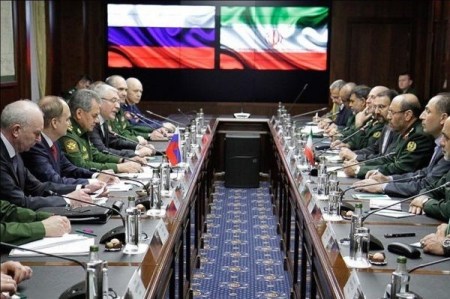
On February 21, 2017, the Iranian reformist news agency Amadnews reported on information from a military source in Iran’s Islamic Revolutionary Guards Corps (IRGC) about preparations being made by the Iranian leadership following President Donald Trump’s threats against Iran.[1] According to this IRGC source, the Iranian leadership had accepted a recommendation to ally strategically with Russia so that Russia would defend Iran in the event of a U.S. military attack on it. In exchange for the Russian defense umbrella, the Iranian officials had recommended to Iranian Supreme Leader Ali Khamenei that Iran grant Russia extensive economic and military privileges, in the form of concessions for the oil fields in southern Iran, as well as access to the Persian Gulf – which would give Russia control of Iran’s ports, and profits that would compensate it for the U.S. sanctions against it. An additional recommendation, which is already being implemented, is reviving the battlefront against Israel by means of Hizbullah in Lebanon and the Palestinian resistance organizations in Gaza and the West Bank, to keep Israel busy fighting and keep the Trump administration focused on Israel, not on Iran.
At the end of the report, Amadnews underlined the price that Iran would have to pay for the implementation of these recommendations, and noted that they constitute an explicit contradiction of the goals of Iran’s Islamic Revolution and of the legacy of revolution founder Ayatollah Ruhollah Khomeini. Khomeini, it said, had insisted that Iran follow neither the U.S. nor the then-Soviet Union – that is, that it be independent of both of them.
Amadnews.com, February 21, 2017.
The following is the translation of the Amadnews.com article.
“A knowledgeable military source told Amadnews that at secret consultation meetings aimed at deciding on how Iran should confront the threats by the new American president Donald Trump, the decision makers in Iran spoke about serious decisions that contradict [Iran’s] national interests.
“According to this knowledgeable source, many meetings were held, under the title ‘How To Respond To The Threats of The New American President,’ and the conclusions were sent to the Leader [Khamenei]. The decision makers discussed a big question: Is it possible to reopen the U.S. Embassy in Iran? And if the answer is no, how can Iran respond in a way that will reduce the increasing threats by America – threats that can turn into an extensive military confrontation?
“Political, security, and military experts expressed their opinion [at the meetings] and determined that the decision makers in Iran should not deal with reopening the U.S. Embassy in Iran or with normalizing relations with [the U.S.]. Instead, Iran should deepen its strategic ties with Russia, such that in the event of an extensive war, Russia will defend Iran from American threats. According to this report [to Khamenei], there are many ways to deepen Iran-Russia ties: At these meetings, a strategic alliance with Russia was recommended, and three important recommendations were presented to the Leader.
“This team of experts’ first recommendation was to grant Russia a permit for development, concessions, and production in the oil fields and wells of southern Iran. This recommendation will bring Russia annual profits of over $50 billion, at least, which can save it from economic crises stemming from the American sanctions against it because of the Crimea issue.
“The second recommendation is to realize Russia’s decades-old dream of access to free waters. This team proposed giving Russia access to the warm waters of the Persian Gulf, so that if America attacks Iran, Russia will be able to defend Iran against the mighty sea and land strength of America.
“For over a century, Russia has sought access to the ‘warm waters’ of the Persian Gulf, but Iran has refrained from allowing Russia to do this, for fear of Russian infiltration and influence in Iran. If Russia has a Persian Gulf presence, and access to the warm waters of southern Iran, it will take control of southern Iranian ports, and will benefit from increasing economic prosperity despite the severe American sanctions against it.
“The Russians have already been granted the right to use the Noje military base in Hamdan in order to demonstrate [their] military presence in Syria. This right was granted to the Russians by direct order of the Leader [Khamenei] and without the involvement of Iran’s decision-making apparatuses.
“The third recommendation is to involve Israel in a war with Hizbullah, and with the other Palestinian groups, so that it is too busy to discuss [uniting ranks] with other countries worldwide against Iran, and uniting global public opinion against it. A new war between Israel and Hizbullah in Lebanon, as well as with Palestinian groups, will completely divert global public attention from Iran and focus it on Israel. Such a war could become the focal point of the first four-year term of Donald Trump, and prevent an opportunity to fight Iran.
“Yesterday [February 20], Hizbullah secretary-general Sayyed Hassan Nasrallah gave an interview to [Iran’s] official Channel 1 [TV], and the Palestine conference [i.e. the International Conference in Support of the Palestinian Intifada] was held, with the Leader’s attendance. These two things happened because of other recommendations by the team of experts.”
Here, the Amadnews article summarizes the information from the military source, and criticizes the Iranian leadership for deviating from the dictates of Ayatollah Ruhollah Khomeini who had clearly outlined a policy of political independence vis-à-vis the Western bloc, led by the U.S., and the eastern bloc, led by the then-Soviet Union. The article then continues:
“In exchange for giving these rights to Russia, the Russians are supposed to make a military commitment such that if there is a war with any country, Russia will remain Iran’s military ally. But there is a big question: If Iran does not become entangled in a war with any country, how will the Russians give Iran back the rights that they have received? Not least that one of the main slogans of the people of the 1979 Revolution and the toppling of the Shah’s regime was ‘Neither East nor West – [Only] The Islamic Republic.'”[2]
____________________________
[1] Amadnews.com was established by journalists who were arrested or threatened during the 2009 Green Revolution, which maintained that the June 2009 presidential election results had been faked. The journalists said that they were continuing the Green Movement by publishing news transparently and acting to expose corruption in the Iranian regime so as to help the people obtain its rights. Amadnews.com/about-us, accessed February 21, 2017.
(The views expressed in this article are mine and do not necessarily reflect those of Warsclerotic or its other editors. — DM)
Evidence of political corruption should be.
It has been obvious since the early Republican primaries that most media coverage of a Trump presidency would be adverse and presented out of context. Perhaps a recent editorial at The Week Magazine explains why, albeit inadvertently. Or maybe this cartoon better explains the media view:
Trump and Putin as seen by the lamebrain media
According to The Week Magazine, all leaks are equal. However, we approve of those which fit our politics and disapprove of those which don’t.
Live by the leak, die by the leak. When WikiLeaks was releasing a steady stream of embarrassing emails hacked from Democratic officials during the presidential campaign, Hillary Clinton and her supporters cried foul, and urged the press not to report their contents. Donald Trump applauded every new revelation, saying the leaks provided voters with important information, and gleefully invited the Russians to find and publish emails she had deleted. “Boy, that WikiLeaks has done a job on her, hasn’t it?” Trump exulted. Now that it’s Trump who is being tortured by leaks, he’s complaining they’re illegal and “un-American.” Democrats, meanwhile, are welcoming the torrent like a rainstorm after a long drought. (See Main Stories.) When it comes to leaks, everyone is a hypocrite. “Good” leaks are ones that damage our opponents. “Bad” leaks are those that hurt Our Side. [Emphasis added.]
But let’s set partisanship aside for a moment. Is it always in the public interest for government officials to leak, and for the media to publish leaked material? Crusading journalist Glenn Greenwald—who angered the Obama administration by publishing Edward Snowden’s trove of stolen NSA documents—argues in TheIntercept.com this week that all leaks exposing “wrong-doing” are good ones, regardless of the leaker’s motives. “Leaks are illegal and hated by those in power (and their followers),” Greenwald says, “precisely because political officials want to be able to lie to the public with impunity and without detection.” The implication of this argument, of course, is that governments, politicians, and organizations should not keep any secrets—that when people in power conceal documents, emails, or information that could embarrass them, they are by definition deceiving the public. Radical transparency certainly sounds noble—but I suspect it’s a standard no public official, or indeed most of us, could survive. It’s so much more convenient to have a double standard: Transparency for thee, but not for me.
I disagree. Leaks of unclassified materials demonstrating corruption of the political process by either party are necessary for an effectively functioning democracy. Leaks of highly classified national security information — particularly in the area of foreign policy — endanger our democracy, are crimes and the perpetrators should be dealt with accordingly. When the media sensationalize leaks of the latter type, they are complicit and must be criticized vigorously.
The press has long served as an objective fail-safe to protect the public from the powers-that-be. That objectivity is now absent and the media’s role in our democratic society is in jeopardy. Rather than self-reflect as to how they got off course, the press have opted to label the man who exposed this derailment as un-American.
What’s un-American is the belief that the press should be unaccountable for its actions. What’s un-American is the belief that any attempt to criticize the press should be viewed as heresy. What’s un-American is the belief that the press is akin to a golden calf that compels Americans, presidents included, to worship the press.
Two very different types of leaks
a. DNC and Podesta e-mails:
The DNC and Podesta e-mails were released as written and posted by DNC officials and Podesta for transmission on unsecured servers easily hacked by modestly competent teenage hackers. I have seen no suggestion that the e-mails were classified. The intelligence community opined that Russian agents had done the hacking, but offered no significant proof beyond that the methods used by the hacker(s) were comparable to those used by Russian hackers in the past.
They found no discrepancies between the original e-mails and those posted by WikiLeaks (which denied that Russia had been the source). The e-mail leaks damaged the Clinton campaign because they portrayed, accurately — and in their own words — dishonest efforts of high-level DNC and Clinton campaign personnel to skew the Democrat primary process in Ms. Clinton’s favor. They did not involve American foreign policy until Obama — who had previously done nothing of significance to halt Russia’s hacking of highly classified information from our intelligence establishment beyond asking, “pretty please, stop” — decided that Russia must be punished for Hillary’s loss of the general election through sanctions and by the expulsion of thirty-five of its diplomats.
Russian president Vladimir Putin had been expected to respond in kind, with the expulsion of US diplomats from its territory.
Neither transcripts nor audio recordings of the Flynn telephone conversations were released. Instead, conclusions of the leakers were released. According to House Intelligence Chair Devin Nunes,
“I think there is a lot of innuendo out there that the intelligence agencies have a problem with Donald Trump. The rank and file people that are out doing jobs across the world — very difficult places — they don’t pay attention to what is going on in Washington,” the California representative told CBS “Face the Nation” host John Dickerson.
“What we have is we do have people in the last administration, people who are burrowed in, perhaps all throughout the government, who clearly are leaking to the press,” Nunes added. “And it is against the law. Major laws have been broken. If you believe the Washington Post story that said there were nine people who said this, these are nine people who broke the law.” [Emphasis added.]
Nunes said the FBI and other intelligence agencies ought to investigate who has leaked information to the press because so few people in the administration knew these secrets, that it would have had to have been someone at the “highest levels of the Obama administration” who is an acting official until Trump replaces him or her.
Did the leaker(s) try to present the conversations honestly, or to damage President Trump’s efforts to deal with Russia in matters of foreign policy where American and Russian interests coincide? To disrupt America’s badly needed “reset” with Russia which seemed likely to succeed under President Trump after Clinton’s and Obama’s efforts had failed?
Remember the Obama – Romney debate when Romney characterized Russia as America’s greatest geopolitical threat and Obama responded that the cold war was over and that “the 1980’s are calling and want their foreign policy back”?
The position now asserted by the Democrats and the media seems rather like the position that Obama rejected. If the position(s) of the Democrats and the media are now correct and Russia is again our enemy, might it be due to actions which Obama took or failed to take over the past eight years?
On January 22, 2017, the Russian media outlet Pravda.ru published an analysis on Russia-Iran relations. According to the article’s author, Dmitri Nersesov, Iran is becoming a problem for Russian interests. Nersesov also added that Iran wants Russia to choose between Iran and Washington. “Iran wants Russia to recognize that Teheran holds the key to the regulation of the Syrian crisis. Should Russia decide that the real strategy is built on the cooperation between Moscow and Washington, rather than Moscow and Teheran; the Islamic Republic will be extremely disappointed,” Nersesov wrote. [Emphasis added.]
An American – Russian realignment in areas of mutual concern — which as suggested below had seemed to be progressing well until General Flynn ceased to be involved — would be good, not bad. We have many areas of mutual concern, and Iran is one of them. The war in Syria is another. When were Russians last directed to yell Death to America? Or to refer to America as the “Great Satan?”
c. General Flynn, Russia and Iran
General Flynn had, at President Trump’s request, been dealing with Russia concerning the future roles of Iran, Russia and America in the Syria debacle:
Overlaying US President Donald Trump’s extraordinary, hour-long skirmish with reporters Thursday, Feb. 16, was bitter frustration over the domestic obstacles locking him out from his top security and foreign policy goals. [Emphasis added.]
Even before his inauguration four weeks ago, he had arranged to reach those goals by means of an understanding with President Vladimir Putin for military and intelligence cooperation in Syria, both for the war on the Islamic State and for the removal of Iran and its Lebanese surrogate Hizballah from that country. [Emphasis added.]
But his antagonists, including elements of the US intelligence community, were turning his strategy into a blunderbuss for hitting him on the head, with the help of hostile media.
Thursday, in a highly unconventional meeting with the world media, he tried to hit back, and possibly save his strategy.
That won’t be easy. The exit of National Security Adviser Mike Flynn, the prime mover in the US-Russian détente, sent the Kremlin a negative signal. The Russians began unsheathing their claws when they began to suspect that the US president was being forced back from their understanding. The SSV 175 Viktor Leonov spy ship was ordered to move into position opposite Delaware on the East Coast of America; Su-24 warplanes buzzed the USS Porter destroyer in the Black Sea.
Before these events, Washington and Moscow wre moving briskly towards an understanding. debkafile’s intelligence sources disclose that the Kremlin had sent positive messages to the White House on their joint strategy in Syria, clarifying that Moscow was not locked in on Bashar Assad staying on as president. [Emphasis added.]
They also promised to table at the Geneva conference on Syria taking place later this month a demand for the all “foreign forces” to leave Syria. This would apply first and foremost to the pro-Iranian Iraqi, Pakistani and Afghan militias brought in by Tehran to fight for Assad under the command of Revolutionary Guards officers, as well as Hizballah. [Emphasis added.]
Deeply troubled by this prospect, Tehran sent Iran’s supreme commander in the Middle East, the Al Qods chief Gen. Qassem Soleimani, to Moscow this week to find out what was going on.
Flynn’s departure put the lid on this progress. Then came the damaging leak to the Wall Street Journal, that quoted an “intelligence official” as saying that his agencies hesitated to reveal to the president the “sources and methods” they use to collect information, due to “possible links between Trump associates and Russia.. Those links, he said “could potentially compromise the security of such classified information.”
A first-year student knows that this claim is nonsense, since no agency ever share its sources and methods with any outsider, however high-placed.
What the leak did reveal was that some Washington insiders were determined at all costs to torpedo the evolving understanding between the American and Russian presidents. The first scapegoat was the strategy the two were developing for working together in Syria. [Emphasis added.]
Defending his policy of warming relations with Moscow, Trump protested that “getting along with Russia is not a bad thing.” He even warned there would be a “nuclear holocaust like no other” if relations between the two superpowers were allowed to deteriorate further.
It is too soon to say whether his Russian policy is finally in shreds or can still be repaired. Trump indicated more than once in his press briefing that he would try and get the relations back on track.
Asked how he would react to Russia’s latest provocative moves, he said: “I’m not going to tell you anything about what responses I do. I don’t talk about military responses. I don’t have to tell you what I’m going to do in North Korea,” he stressed.
At all events, his administration seems to be at a crossroads between whether to try and salvage the partnership with Russia for Syria, or treat it as a write-off. If the latter, then Trump must decide whether to send American troops to the war-torn country to achieve his goals, or revert to Barack Obama’s policy of military non-intervention in the conflict. [Emphasis added.]
Substantially more is generally involved in matters of foreign policy than is facially apparent or than government officials should discuss publicly, particularly while negotiations with foreign powers are underway. Leaks by held-over members of the intelligence community did much to reveal the opinions of the leakers but little to reveal what General Flynn had been doing, while upsetting the chances of better American – Russian relations in areas of mutual concern.
Conclusions — The Administrative State
The Federal Government has grown far too big for its britches, giving the unelected “administrative state” substantially more authority, and hence power, than is consistent with a properly functioning democracy. As they have been demonstrating in recent months, holdovers from one administration can succeed, at least partially, in paralyzing a new and democratically elected president. Holdovers with political appointee status can generally be fired. Few others who should be can be.
Getting rid of the obstructionist “civil servants” who have become our masters should rank very high on President Trump’s “to do” list and should be accomplished before it’s too late. The task may be difficult but is not impossible. Perhaps some particularly obnoxious Federal agencies (or departments within those agencies) can be relocated to places less congenial than Washington. Inner City Chicago comes to mind. So do otherwise pleasant cities in California, where housing prices are much higher than in the Washington, D.C. area. How many Federal employees faced with the choice of relocating or resigning would choose the latter option?
There are likely other and probably better ways to get rid of the fatheads. President Trump’s administration should devise them.






 anneinpt
 artaxes
 danmillerinpanama
 davidking1530
 Peter Hofman
 Joseph Wouk
 Peter
Peter Louisiana Steve
 WarSclerotic
Recent Comments