Archive for the ‘Iran and Israel’ category

Russian monitors for Syrian Golan – not Iranians

May 11, 2017

Russian monitors for Syrian Golan – not Iranians, DEBKAfile, May 11, 2017

The issue came up during Russian Foreign Minister Sergey Lavrov’s talks with US President Donald Trump and Secretary of State Rex Tillerson in Washington on May 11, and a day earlier, in a telephone conversation between Russian President Vladimir Putin and Israeli Prime Minister Binyamin Netanyahu.

****************************

Moscow this week responded to Israel’s concerns about posting Iranian and Turkish officers on its borders to monitor the potential “de-escalation” zones Russia is proposing for Syria. In respect of those concerns, DEBKAfile’s military and intelligence sources reveal that Russia agreed in high-level contacts in the last few days to replace them with Russian military officers in the Mt. Hermon region and the areas where Israeli, Lebanese and Syrian borders meet. The proposal also calls for the expansion of the UN Disengagement Observer Force (UNDOF), which supervises the cease-fire between Israel and Syria on the Golan.

(DEBKAfile was the first publication to reveal Israel’s concerns on May 3 and May 5.)

The Russian military are preparing to establish four ceasefire safe zones in Syria. The southernmost would be located along Syria’s borders with Israel and Jordan. The issue came up during Russian Foreign Minister Sergey Lavrov’s talks with US President Donald Trump and Secretary of State Rex Tillerson in Washington on May 11, and a day earlier, in a telephone conversation between Russian President Vladimir Putin and Israeli Prime Minister Binyamin Netanyahu.

The chairman of the US Joint Chiefs of Staff, Gen. Joseph Dunford, was also involved in the exchanges on the ceasefire zones between Washington, Moscow and Jerusalem during his visit to Israel this week as the guest of the Israeli chief of staff, Lieut. Gen. Gady Eisenkott. On Tuesday, May 9, Dunford said that “Israel is concerned about the possibility of having Iranian or Iranian-backed forces, such as Hizballah, so close to its border.” Both Putin and Lavrov promised that neither Iranian, pro-Iranian, nor Turkish officers would be placed in areas close to the Israeli border.

Our military sources report that during talks between Washington, Moscow and Jerusalem on Thursday, May 11, the three sides agreed to continue to discuss the Russian proposal.

Another issue raised among them was who will deal with the ISIS forces in the Yarmouk area near the Israel-Jordan and Israel-Syria borders, including the bases established by the Khaled bin al-Walid army, which has sworn allegiance to ISIS.

The coming DEBKA Weekly out Friday, May 12, also reveals positive US-Russian dialogue on more Syrian issues.  If you are not already a subscriber, click here.

Iran in Syria: A Gathering Storm?

April 28, 2017

Iran in Syria: A Gathering Storm? Front Page MagazineP. David Hornik, April 28, 2017

A cyber attack on Israel, arms shipments to Hizballah, and provocative moves against the U.S. navy are—among much else—all in a week’s work for Iran. 

Israeli officials are, though, well aware that the current administration has a much more sober view of the problem than the previous one, and more hopeful that, this time around, the forces of civilization will push back against a regime that has been sowing discord and death for almost four decades.

****************************

The Iranian regime, as it has made clear in countless threats, rallies, and missile displays, wants to destroy Israel, the “Little Satan.” 

Given Israel’s military might and, according to foreign reports, nuclear arsenal, Iran’s goal is probably unattainable. But the nearer Iran gets—or perceives itself to get—to that goal, the more warfare and instability is likely to ensue.

At present, thanks to Syria’s collapse into civil war and the Obama administration’s—at best—inept policy there, Iran is within reach of establishing a permanent military presence to Israel’s north—a surefire recipe for ongoing struggle and menace.

Israeli officials, Reuters reports, now estimate that Iran “commands at least 25,000 fighters in Syria, including members of its own Revolutionary Guard, Shi’ite militants from Iraq and recruits from Afghanistan and Pakistan.”

Iran is also reportedly seeking a naval base in Syria, and, if it gains a lasting foothold in Israel’s northern neighbor, will undoubtedly want an airbase there as well.

The Reuters report notes that Israeli intelligence minister Yisrael Katz has been on Capitol Hill urging stepped-up U.S. threats and sanctions on Iran and its Lebanese proxy Hizballah. Israel wants Russia to rein in Iran, too—though whether Russia is willing is still in dispute.

Of particular concern are Iran’s efforts to establish a beachhead for itself and Hizballah on the northern Golan Heights, directly across the border from the Israeli-controlled southern Golan.

Two years ago an Israeli airstrike on the northern Golan killed both Hizballah and Iranian commanders seeking to build a terror network there. Israel remains acutely concerned that such efforts will continue.

Iran’s naked aggression toward Israel was in evidence this week in a different kind of attack. The Israeli daily Haaretz reports:

Cybersecurity experts are convinced that Iran is behind the large-scale cyberattack revealed Wednesday by Israel’s Cyber Defense Authority. The attacks have been identified as being carried out by a hacker group known as OilRig, which has been tracked to Iran and is believed to be financed and directed by one of the Islamic Republic’s intelligence agencies.

OilRig…is known to have attacked in both government and private sector targets the past, focusing primarily on Saudi Arabia, Turkey, the United States and Israel.

The recent attacks were aimed at at least 120 Israeli targets, including private companies, government departments, research institutes and hospitals…. It is unclear at this point whether the attack had any specific targets beyond creating damage in Israeli computer networks, and the extent of that damage is still being assessed.

Other reports, like this one, claim the cyberattack was successfully thwarted.

What is not in doubt is that the—for now—low-level war between Iran and Israel is not only continuing but intensifying. On Thursday it was reported that Israeli missiles fired from the Golan Heights hat hit and destroyed Iranian arms supplies in a Hizballah depot near Damascus International Airport.

Intelligence Minister Yisrael Katz, mentioned above, appeared to confirm that Israel was behind the strike, saying it “exactly matches our declared policy.”

Iran’s harassment of a U.S. warship in the Persian Gulf this week suggests that its cockiness toward the “Great Satan,” too—after a period when it seemed to have waned—is returning.

A cyber attack on Israel, arms shipments to Hizballah, and provocative moves against the U.S. navy are—among much else—all in a week’s work for Iran.

Israeli officials are, though, well aware that the current administration has a much more sober view of the problem than the previous one, and more hopeful that, this time around, the forces of civilization will push back against a regime that has been sowing discord and death for almost four decades.

US-Israel security interests converge

April 28, 2017

US-Israel security interests converge, Israel Hayom, Yoram Ettinger, April 28, 2017

In 2017, the national security interests of the U.S. and Israel have converged in ‎an unprecedented manner in response to anti-U.S. ‎Islamic terrorism; declining European posture of deterrence; drastic cuts in ‎the U.S. defense budget; an increasingly unpredictable, dangerous globe; ‎Israel’s surge of military and commercial capabilities and U.S.-Israel shared ‎values. ‎

Contrary to conventional wisdom — and traditional State Department policy — ‎U.S.-Israel and U.S.-Arab relations are not a zero-sum game. This is ‎currently demonstrated by enhanced U.S.-Israel strategic cooperation, ‎concurrently with expanded security cooperation between Israel and Egypt, ‎Jordan, Saudi Arabia and other pro-U.S. Arab countries, as well as stronger ‎cooperation between the U.S. and those same Arab countries. Unlike the ‎simplistic view of the Middle East, Arab policymakers are well aware of their ‎priorities, especially when the radical Islamic machete is at their throats. They ‎are consumed by internal and external intra-Muslim, intra-Arab violence, which ‎have dominated the Arab agenda, prior to — and irrespective of — the ‎Palestinian issue, which has never been a core cause of regional turbulence, a ‎crown-jewel of Arab policymaking or the crux of the Arab-Israeli conflict. ‎

Israel’s posture as a unique ally of the U.S. — in the Middle East and beyond — ‎has surged since the demise of the USSR, which transformed the bipolar ‎globe into a multipolar arena of conflicts, replete with highly unpredictable, ‎less controllable and more dangerous tactical threats. Israel possesses proven ‎tactical capabilities in face of such threats. Thus, Israel provides a tailwind to the ‎U.S. in the pursuit of three critical challenges that impact U.S. national security, significantly transcending the scope of the Arab-‎Israeli conflict and the Palestinian issue: ‎

‎1. To constrain/neutralize the ayatollahs of Iran, who relentlessly aspire to ‎achieve nuclear capability in order to remove the ‎U.S. from the Persian Gulf, dominate the Muslim world, and subordinate the American “modern-day Crusaders.”‎

‎2. To defeat global Islamic terrorism, which aims to topple all pro-U.S. Arab ‎regimes, expand the abode of Muslim believers and crash the abode of non-Muslim “‎infidels” in the Middle East and beyond.‎

‎3. To bolster the stability of pro-U.S. Arab regimes, which are lethally ‎threatened by the ayatollahs and other sources of Islamic terrorism.

Moreover, Israel has been the only effective regional power to check the North ‎Korean incursion into the Middle East. For instance, on Sept. 6, 2007, the ‎Israeli Air Force destroyed Syria’s nuclear site, built mostly with the support of ‎Iran and North Korea, sparing the U.S. and the globe the wrath of a ruthless, ‎nuclear Assad regime. ‎

While Israel is generally portrayed as a supplicant expecting the U.S. to extend a ‎helping hand, Adm. (ret.) James G. Stavridis, a former NATO supreme commander, ‎currently the dean of the Fletcher School of Law and Diplomacy at Tufts ‎University, says otherwise. He maintains that Israel is not a supplicant but ‎rather a unique geostrategic partner, extending the strategic hand of the U.S. ‎through a mutually beneficial, highly productive ‎relationship with the U.S.

On Jan. 5, 2017, Stavridis wrote: “Our ‎best military partner in the region, by far, is Israel … as we stand together ‎facing the challenges of the Middle East. … Israeli intelligence gathering is ‎superb. … A second zone of potentially enhanced cooperation is in technology ‎and innovation. … In addition to missile defense, doing more together in ‎advanced avionics (as we did with the F-15), miniaturization (like Israel’s small ‎airborne-warning aircraft) and the production of low-cost battlefield unmanned ‎vehicles (both air and surface) would yield strong results. … We should up our ‎game in terms of intelligence cooperation. [The Israeli intelligence ‎services] of our more segregated sectors on a wide range of trends, including the disintegration of Syria, the events in Egypt and the military and nuclear ‎capability of Iran. … Setting up a joint special-forces training and innovation ‎center for special operations in Israel would be powerful. … It truly is a case ‎of two nations that are inarguably stronger together.” ‎

Unlike other major U.S. allies in Europe, the Far East, Africa and the Middle East, ‎Israel does not require U.S. military personnel and bases in order to produce an ‎exceptionally high added value to the annual U.S. investment in — and not ‎‎”foreign aid” to — Israel’s military posture.

For example, the plant manager of Lockheed Martin, the manufacturer of the ‎F-16 and F-35 fighter planes, told me during a visit to the plant in Fort Worth, Texas: “The ‎value of the flow of lessons derived from Israel’s operation, maintenance and ‎repairs of the F-16 has yielded hundreds of upgrades, producing a mega-‎billion-dollar bonanza for Lockheed-Martin, improving research and ‎development, increasing exports and expanding employment.”

A similar ‎added value has benefitted McDonnell Douglas, the manufacturer of the F-15 fighter plane ‎in Berkeley, Missouri, as well as hundreds of U.S. defense manufacturers, ‎whose products are operated by Israel. The Jewish state — the most ‎predictable, stable, effective, reliable and unconditional ally of the U.S. — has ‎become the most cost-effective, battle-tested laboratory of the U.S. defense ‎industry. ‎

According to a former U.S. Air Force intelligence chief, Gen. George Keegan: ‎‎”I could not have procured the intelligence [provided by Israel on Soviet Air ‎Force capabilities, new Soviet weapons, electronics and jamming devices] with ‎five CIAs. … The ability of the U.S. Air Force in particular, and the Army in ‎general, to defend NATO owes more to the Israeli intelligence input than it ‎does to any other single source of intelligence.” The former chairman of the ‎Senate Appropriations Committee, Sen. Daniel Inouye, revealed that “Israel ‎provided the U.S. [operational lessons and intelligence on advanced Soviet ‎ground-to-air missiles] that would have cost the U.S. billions of dollars to find ‎out.”

On Oct. 28, 1991, in the aftermath of the First Gulf War, then-Defense ‎Secretary Dick Cheney stated: “There were many times during the course of ‎the buildup in the Gulf, and subsequent conflict, that I gave thanks for the ‎bold and dramatic action that had been taken some 10 years before [when ‎Israel destroyed Iraq’s nuclear reactor at Osirak].” The destruction of Iraq’s ‎nuclear capabilities in 1981 spared the U.S. a nuclear confrontation in 1991.

An Israel-like ally in the Persian Gulf would have dramatically minimized U.S. ‎military involvement in Persian Gulf conflicts, and drastically reduced the ‎monthly, mega-billion dollar cost of U.S. military units and bases in the ‎Gulf and Indian Ocean, as is the current Israel-effect in the eastern flank of ‎the Mediterranean.‎

Yoram Ettinger is a former ambassador and head of Second Thought: A U.S.-Israel Initiative.
Germany: Iran Plotting Terror on Jewish and Israeli Targets

April 25, 2017

Germany: Iran Plotting Terror on Jewish and Israeli Targets, Investigative Project on Terrorism, April 24, 2017

Last month, Bahrain security authorities arrested members of an Iranian-sponsored terrorist cell, accusing them of planning to assassinate senior government officials. The IRGC reportedly provided military training to several cell members.

************************

Iran is responsible for a significant amount of espionage activity in Germany over the past decade, and is responsible for planning terrorist attacks on Israeli and Jewish targets, the Jerusalem Post reports.

In a letter sent to a Left Party deputy from German’s interior ministry, the federal government launched 22 criminal investigations concerning Iran’s illegal espionage activity – more than China and Turkey who were suspected in 15 spy cases each. Only Russia, with 27 cases, is involved in more suspected espionage activity than Iran.

In one case, German prosecutors allege that Haidar Syed-Naqfi was ordered to identify Jewish and Israeli institutions in Germany and other Western European countries as potential targets for terrorist attacks. For example, he was accused of monitoring the headquarters of a Jewish newspaper in Berlin. Syed-Naqfi also identified several Israel supporters, including the former chief of the German-Israel Friendship Society and a French-Israeli business professor. German authorities believe his preparations were “a clear indication of an assassination attempt.”

Between July 2015 and July 2016, Iran’s Revolutionary Guards Corps’ (IRGC) al-Quds Force paid Syed-Naqi more than $2,200.

Half of Germany’s state governments reported Iranian attempts to acquire material related to nuclear activities in 2015, the Post reports. An examination of intelligence sources in 2016 also produced new revelations surrounding Iran’s chemical and biological weapons programs.

Iran pursued German businesses in the Rhineland-Palatinate state seeking dual-use goods that could be “used for atomic, biological and chemical weapons in a war,” according to that state’s intelligence report.

An estimated 250 active Iranian-backed Hizballah operatives, out of about 950 Hizballah members throughout Germany, according to a 2014 Berlin intelligence report summarized by the Post.

Last month, Bahrain security authorities arrested members of an Iranian-sponsored terrorist cell, accusing them of planning to assassinate senior government officials. The IRGC reportedly provided military training to several cell members.

Iran has been accused of plotting terrorist attacks in recent years – mainly through proxies like Hizballah and IRGC’s Quds Force – in countries such as Egypt, Cyprus, Georgia, Thailand, India and others. In July 2012, a bus bomb widely attributed to Hizballah killed five Israeli tourists and a bus driver in Bulgaria.

In October 2011, the United Stated disrupted an Iranian plot to assassinate the Saudi Arabian ambassador in Washington D.C. and bomb the Saudi and Israeli embassies in the U.S. capital.

Rex Tillerson’s Tough Talk on Iran

April 20, 2017

Rex Tillerson’s Tough Talk on Iran, Power LinePaul Mirengoff, April 19, 2017

Yesterday, as we noted here, Secretary of State Rex Tillerson informed Congress that Iran is in compliance with the nuclear deal and that the administration will continue to provide relief from sanctions, as called for by the agreement. He added, however, that “Iran remains a leading state sponsor of terror through many platforms and methods.”

Today, Tillerson (1) elaborated in scathing language on Iran’s role as a leading sponsor of terrorism and on other of its misdeeds, (2) made clear that the nuclear deal is unsatisfactory, and (3) stressed that the U.S. government is engaged in a thorough review of our Iran policy.

Tillerson characterized the Iran deal as “another example of buying off a power who has nuclear ambitions.” Citing the North Korean example, Tillerson complained “we buy them off for a short period of time, and then someone has to deal with it later.” He then added that the administration does not intend to follow this course.

It is rumored that President Trump hit the roof when he saw Tillerson’s letter to Congress (or maybe the way it was reported) and demanded that he issue today’s tough statement. According to this account, the tough statement had been drafted previously, nixed by influential soft-liners in the administration, and revived in light of the Tillerson letter.

Whether or not this is what happened, I think today’s statement was much needed.

But what will come of the policy review promised in Tillerson’s statement? The Obama administration did an effective job of fencing in its successors. I discussed the future of the Iran deal under Trump in this post.

The upshot of two days of Tillerson talk about Iran seems to be that our Iran policy is up-for-grabs, like much else in the policy realm. Sharp disagreement probably exists within the administration about how to proceed and, not unlike other policy disputes, the disagreement occurs in the context of no truly good options.

You can watch Tillerson’s speech, plus a brief Q&A, below. Don’t miss Andrea Mitchell fretting that if the U.S. backs out of the Iran deal, rogue states like North Korea won’t trust us.


We’re turning a blind eye to Iran’s genocidal liars

April 18, 2017

We’re turning a blind eye to Iran’s genocidal liars, The Australian, Michael Oren, April 19, 2017

(Please see also, What North Korea Should Teach Us about Iran. DM)

In responding forcibly to North Korean and Syrian outrages, President Trump has taken a major step towards restoring America’s deterrence power. His determination to redress the flaws in the JCPOA and to stand up to Iran will greatly accelerate that process. The US, Israel and the world will all be safer.

**************************

The US has signed agreements with three rogue regimes strictly limiting their unconventional military capacities. Two of those regimes — Syria and North Korea — brazenly violated the agreements, provoking game-changing responses from Donald Trump. But the third agreement — with Iran — is so inherently flawed that Tehran doesn’t even have to break it. Honouring it will be enough to endanger millions of lives.

The framework agreements with North Korea and Syria, concluded respectively in 1994 and 2013, were similar in many ways. Both recognised that the regimes already possessed weapons of mass destruction or at least the means to produce them. Both ­assumed that the regimes would surrender their arsenals under an international treaty and open their facilities to inspectors. And both believed these repressive states, if properly engaged, could be brought into the community of nations.

All those assumptions were wrong. After withdrawing from the nuclear non-proliferation treaty, Pyongyang tested five atomic weapons and developed ­intercontinental missiles capable of carrying them. Syrian dictator Bashar al-Assad, less than a year after signing the framework, reverted to gassing his own people. Bolstered by the inaction of the US and backed by other powers, North Korea and Syria broke their commitments with impunity.

Or so it seemed. By ordering a Tomahawk missile attack on a Syrian air base, and a US Navy strike force to patrol near North Korea’s coast, the Trump administration has upheld the frame­­works and placed their violators on notice. This reassertion of power is welcomed by all of ­America’s allies, Israel among them. But for us the most dangerous agreement of all is the one that may never need military enforcement. For us, the existential threat looms in a decade, when the agreement with Iran expires.

Like the frameworks with North Korea and Syria, the Joint Comprehensive Plan of Action of 2015 assumed that Iran would fulfil its obligations and open its facilities to inspectors. The JCPOA assumed that Iran would moderate its behaviour and join the international community. Yet unlike its North Korean and Syrian allies, Iran was the largest state sponsor of terror and openly vowed to destroy another state: Israel. Unlike them, Iran systematically lied about its unconventional weapons program for 30 years. And unlike Damascus and Pyongyang, which are permanently barred from acquiring weapons of mass destruction, Tehran can look forward to building them swiftly and legitimately in the late 2020s, once the JCPOA expires.

This, for Israel and our neighbouring Sunni states, is the appalling flaw of the JCPOA. The regime most committed to our destruction has been granted a free pass to develop military nuclear capabilities. Iran could follow the Syrian and North Korean examples and cheat. Or, while enjoying hundreds of billions of dollars in sanctions relief, it can adhere to the agreement and deactivate parts of its nuclear facilities rather than dismantle them. It can develop new technologies for producing atomic bombs while testing intercontinental ballistic missiles. It can continue massacring Syrians, Iraqis and Yemenis, and bankrolling Hamas and Hezbollah. The JCPOA enables Iran to do all that merely by complying.

A nuclear-armed Iran would be as dangerous as “50 North Koreas”, Israeli Prime Minister Benjamin Netanyahu told the UN in 2013, and Iran is certainly many times more dangerous than Syria. Yet Iran alone has been granted immunity for butchering civilians and threatening genocide. Iran alone has been guaranteed a ­future nuclear capability. And the Iranian regime — which brutally crushed a popular uprising in 2009 — has amassed a million-man force to suppress any future opposition. Rather than moderating, the present regime promises to be more radical yet in another 10 years.

How can the US and its allies pre-empt catastrophe? Many steps are possible, but they begin with penalising Iran for the conventions it already violates, such as UN restrictions on missile development. The remaining American sanctions on Iran must stay staunchly in place and congress must pass further punitive legislation. Above all, a strong link must be established between the JCPOA and Iran’s support for terror, its pledges to annihilate ­Israel and overthrow pro-American Arab governments, and its complicity in massacres. As long as the ayatollahs oppress their own population and export their ­tyranny abroad, no restrictions on their nuclear program can ever be allowed to expire.

In responding forcibly to North Korean and Syrian outrages, President Trump has taken a major step towards restoring America’s deterrence power. His determination to redress the flaws in the JCPOA and to stand up to Iran will greatly accelerate that process. The US, Israel and the world will all be safer.

Michael Oren is Israel’s deputy minister for diplomacy, a member of the Knesset and a former ambassador to Washington.

After Syrian Gassing, Trump Must Expose the Iran Deal

April 10, 2017

After Syrian Gassing, Trump Must Expose the Iran Deal, PJ Media, Roger L Simon, April 9, 2017

Among the more disturbing questions emerging from the renewed use of gas by Bashar Assad is whether Barack Obama and his loyal minions (Kerry, Rhodes, Rice, etc.) actually knew the Syrian leader still had chemical weapons, even though they trumpeted the opposite to the American public on numerous occasions. Either they lied or were so extraordinarily credulous they believed — apparently without verification — the Syrians had truly rid themselves of those WMDs, in which case Obama — not Trump — was Vladimir Putin’s personal “useful idiot.”

(It may even be time to take a second look at the contention of some that Saddam transferred his chemical weapons to Syria way back when, which would be a surprise vindication of Bush 43.)

Whatever the case, it’s “heavy water” under the bridge at this point, but should alert us even more to the absolute necessity of revealing everything known about the also Obama-instigated Iran Deal, all its myriad hidden codicils and clauses that remain mysterious to the citizens of this country in whose name they were allegedly signed. That agreement too could be the product of useful idiocy, a sucker punch from the mullahs.  The devil, in this case, is very much in the details, few of which we know, except that the Iranians refused to give a baseline development level for their nuclear weapons program in this first place. In a sense, that made everything else moot.

Nevertheless, Iran has been the beneficiary of this deal to the tune of billions of dollars, some evidently in cash, much of which has been and is being spent in Syria, if not directly on chemical weapons, on a war that no less than the former chief rabbi of Israel, himself a Holocaust survivor, has called another Holocaust.  Iran is also using the money to finance Hezbollah in that war, simultaneously arming those terrorist thugs with tons of modern weapons, including long range missiles, even while the mullahs use Hezbollah’s guerrillas as cannon fodder to spare Iran’s own quasi-terrorist Revolutionary Guard. The Islamic Republic’s obvious goal is to control both Syria and Iraq by proxies.  A victorious Assad would be Iran’s boy as much as Russia’s, possibly more.

The Trump administration should expose this deal in its entirety to public view now.  If that means Iran pulls out of the agreement — as they have warned — so be it.  The transparency is worth whatever minimal insurance against a nuclear-armed Iran might be inherent in these evanescent documents.  After seeing just how much insurance against chemical weapons was inherent in Obama’s deal with Putin over the crossing of our then-president’s “red line,” one could be skeptical that there is any at all.  Indeed, what little we know of the Iran Deal leads one to believe that it would be simple for the mullahs to be as busy as ever on their nuclear program.  That they are allied with North Korea makes this all the more likely.

Further to be investigated is Obama’s peculiar desire to make a deal with these same mullahs from the very beginning of his administration or even before. Indeed, Obama representatives have been accused of meeting with both Hamas and Iran during his first presidential campaign. These meetings are better documented than Trump’s supposed collusion with Putin, which seems so unlikely now.

In a continuation of that behavior, Obama later famously ignored the pleas for support by the Iranian pro-democracy demonstrators during the Green Revolution of 2009.  “Obama, you are either with us or are you with them!”  they chanted.  Obama was evidently with them. He didn’t want to disrupt his rapport with Ahmadinejad in order to make his dreamed-of deal. (You can see it all on YouTube here.  As we used to say in the sixties, “Which side are you on?”)

Obama and Kerry then welcomed the election of Hassan Rouhani, whom their cheering section in the willfully ignorant mainstream media ludicrously called a “moderate” when he was, if anything, worse than Ahmadinejad and has since been responsible for many more murders of political prisoners than his predecessor.  They made their deal with Rouhani, who is obviously now cooperating in the maintenance of peace…. Well, not exactly.

What’s behind all this? As I said at the outset, this is disturbing — liberalism and progressivism turned upside down, at least according to their own self-described principles. Everything is situational. That Democrats like Schumer and Pelosi were so positive about Trump’s actions in Syria is a sure sign that not so deep down they were more than a little uncomfortable when Obama did nothing after a similar gassing.  Like a lot of people I would imagine, they had to bury their feelings and opinions in the name of party loyalty, what the French called mauvaise foi.  They should have felt the same way yet more intensely after Obama’s execrable non-reaction to the Green Revolution.  Maybe they did, but we’ll never know until someone leaks it out in a memoir. We didn’t need to send in the Marines.  All Obama would have had to have done was to say a few words of encouragement echoed by the international community and the revolution might have happened.  It was close enough.

Thank God there’s a new sheriff in town. Maybe there will be some hope for the citizens of Iran, eventually, some support for regime change after eight years of kowtowing to the mullahs.  But for now lets at least clear up the terms of the mysterious deal, its provenance and its usefulness, if any.  No time like the present.

KLEIN – Iran Is the Wild Card Following U.S. Air Strikes In Syria

April 7, 2017

KLEIN – Iran Is the Wild Card Following U.S. Air Strikes In Syria, BreitbartAaron Klein, April 7, 2017

U.S. Navy/via AP

President Vladimir Putin cannot risk a military confrontation with Trump and Russia is already signaling willingness to abandon Assad to come to a larger regional accommodation.

Still, there is the possibility that Russia may quietly support action by others, especially agents of a very nervous Iranian regime that has been preparing proxies for years who can heat up Israel’s northern border and beyond.  Both Moscow and Tehran have reason for wanting Trump to pay a price for acting in their Syrian playground.  The question is whether they will dare to respond, even tacitly.

The next few days and weeks will be critical in determining Iran and Russia’s resolve in the face of an awakened America that has returned from its eight-year slumber.

******************************

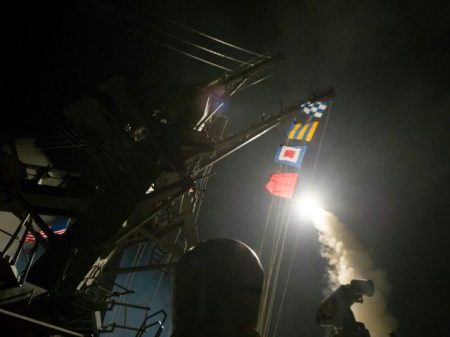
TEL AVIV – Following the U.S. launch of Tomahawk missiles targeting a strategic Syrian airfield on Thursday night, Iran must be monitored carefully for the possibility that it may use its proxies for retaliation, especially against Israel’s northern border.

Following eight years of inaction on Syria under the Obama administration, President Donald Trump demonstrated last night that he is willing to hold Syrian President Bashar al-Assad to account, this time by striking the Shayrat Airfield near the Syrian city of Homs that was believed to have been utilized to carry out a chemical weapons attack that killed scores of civilians.

The U.S. airstrikes signaled to Assad and his Russian and Iranian backers that Trump will act in Syria and the administration strongly supports the removal of the Syrian president – an important strategic ally of Moscow and Tehran. The U.S. military move demonstrates to Israel and the Sunni Arab bloc cast aside by Obama’s nuclear deal with the mullahs that American leadership has officially returned to the region.

Assad himself is unlikely to retaliate since the last thing he wants amidst a years-long insurgency attempting to topple his regime is to go to war with Trump or expand the battlefield to U.S. ally Israel.

Trump’s bold authority in Syria directly threatens Russian interests since it was Moscow that largely filled the security vacuum in that country when Obama repeatedly failed to take any meaningful action against Assad. However, Russia’s direct response will most likely be confined to vocal protestation, such as Kremlin spokesman Dmitry Peskov calling the U.S. strikes “aggression against a sovereign nation” carried out on a “made-up pretext.”

President Vladimir Putin cannot risk a military confrontation with Trump and Russia is already signaling willingness to abandon Assad to come to a larger regional accommodation.

Still, there is the possibility that Russia may quietly support action by others, especially agents of a very nervous Iranian regime that has been preparing proxies for years who can heat up Israel’s northern border and beyond.  Both Moscow and Tehran have reason for wanting Trump to pay a price for acting in their Syrian playground.  The question is whether they will dare to respond, even tacitly.

And that brings us to Iran.  Trump’s embrace of America’s traditional Sunni Arab partners at the expense of Tehran and his strong positions against the disastrous international nuclear agreement have been deeply concerning to the expansionist, terrorist-supporting Twelvers in Tehran.  And while the removal of Assad from power would be a blow to Russia, depending on the ultimate outcome such a move could be disastrous for Iran’s position in Syria.  Iranian Revolutionary Guard units have been fighting the anti-Assad insurgents alongside the Syrian military and the Iran-backed Hezbollah militia.  Syria represents a key pawn in Iran’s geopolitical chessboard that stretches across the vital region.

In recent weeks, there have been strong indications that Iran has been seeking to arm its Hezbollah proxy with even more advanced weapons that can target the Jewish state. Last month, Israel took the unusual step of striking a Hezbollah weapons convoy near the city of Palmyra that Prime Minister Benjamin Netanyahu said was transporting advanced weapons to the Iran-backed militia.

Israeli leaders and Hezbollah terrorists have in recent weeks ratcheted up war rhetoric, with Israeli officials warning that Hezbollah, which can only act at the direction of Iran, has been preparing for conflict.

Last Sunday, IDF Chief of Staff Lt. Gen. Gadi Eisenkot warned the IDF would not hold back from striking Lebanese state institutions in a future conflict with Hezbollah. “The recent declarations from Beirut make it clear that in a future war, the targets will be clear: Lebanon and the organizations operating under its authority and its approval,” Eisenkot stated.

Hezbollah is not Iran’s only option. Breitbart Jerusalem has been reporting on the formation of a “Golan Liberation Brigade,” which was announced last month by the secretary-general of the Iraqi Harakat al Nujaba Shiite militia and is reportedly being trained by the Iranian Revolutionary Guard Corps.  The so-called militia is another Iranian front that could be used to target Israel’s Golan Heights at the behest of Tehran.

The next few days and weeks will be critical in determining Iran and Russia’s resolve in the face of an awakened America that has returned from its eight-year slumber.

Iran Sponsored Shi’a Militia Launches Terror Group to Fight Israel

April 5, 2017

Iran Sponsored Shi’a Militia Launches Terror Group to Fight Israel, Investigative Project on Terrorism, April 5, 2017

Israel is very concerned with the establishment of Iranian-led terrorist bases in the Golan Heights. Hizballah openly seeks to consolidate its presence in the region and launch attacks against Israel from a new front in a future war.

**************************

An Iranian supported Shi’a militia, Al-Nujaba, says it formed the “Golan Liberation Army” to fight Israel, the Middle East Media Research Institute (MEMRI) reports.

“This army has been trained and has detailed plans. If the Syria regime asks us to, we are ready to act to liberate the Golan [from Israel] along with our allies,” Al-Nujaba spokesman Hashem Al-Mousawi said in a March 8 interview with Iran’s Tasnim news agency.

Al-Mousawi also admitted that the new militant group is “part of the PMU [Popular Mobilization Units],” an Iraqi-backed umbrella organization comprised of numerous Shi’a militias, including some with close ties to Iran. The Golan Liberation Army emerged from the Iranian led “resistance” axis and consists of “special forces who have received training and equipment,” he said.

“Iran is the only country that has helped us,” Al-Mousawi said, “and sent us its military advisors, led by Qassem Soleimani.”

Soleimani, the commander of the Iranian Revolutionary Guards Corps’ (IRGC) Quds Force, is tasked with advancing Iran’s regional expansion and terrorist networks. Since September 2015, Iran increased its forces in Syria from hundreds to thousands to support Hizballah terrorists acting at Iran’s behest in propping up the Bashar al-Assad regime.

Despite Iran’s commitment to Syria, the Islamic Republic is establishing terrorist networks in the Golan Heights, using Hizballah, Druze, and Palestinian Islamic Jihad (PIJ) operatives to target Israel. The new Golan Liberation Army shows that Iran is now diverting Iraqi militia assets from fighting ISIS to confront the Jewish state.

Soleimani’s Quds Force financed most of the Iraqi-Shi’ite militias and provided them with weapons specifically to target American soldiers. With Hizballah’s assistance, the Quds Force supplied terrorists with powerful explosive devices that killed numerous American and coalition troops in Iraq.

Israel is very concerned with the establishment of Iranian-led terrorist bases in the Golan Heights. Hizballah openly seeks to consolidate its presence in the region and launch attacks against Israel from a new front in a future war.

Iran: A “Paper Tiger”

April 1, 2017

Iran: A “Paper Tiger,” Iran Focus, March 31, 2017

(What would Russia do? Please see also, Iran’s Elections: A Breaking Crisis? — DM)

London, 31 Mar – While Iran calls for the destruction of Israel, according to some experts, an American or Israeli attack against the Islamic Republic’s nuclear and military sites would be fairly easy to execute. This is because, although Iran points to technological advancement in their military, it is actually has overextended itself in Syria.

A report published in March by the Middle East Media Research Institute (MEMRI), noted Iran has backed off their provocations against U.S. Navy vessels, and has even ceased their threats to sink these ships in the Persian Gulf. The report continued, “The slogan ‘death to America’ has disappeared almost entirely from the official discourse of regime spokesmen, including Iranian Supreme Leader Ali Khamenei himself, as have public burnings of the American flag.”

Fars News Agency reported on March 26, that deputy chief of staff of Iran’s armed forces, Brigadier General Masoud Jazayeri, warned the U.S. to be more careful about its warship movements in the Persian Gulf, which is a softer warning than we’ve heard in the past from Iranian leaders.

President and founder of MEMRI, Yigal Carmon, has stated that Iran’s claims of domestic development of military technologies are “complete nonsense,” but said that the country’s acquisition of North Korean missiles is concerning. Carmon said further, that Iran imports North Korean missiles and renames them to give the impression that they were domestically developed.

He explained that Iranian media publishes stories every few weeks about success of their military programs. One such story in January 2013, announced that Iran’s Space Agency had sent a monkey into space, yet pictures of the monkey before and after the “mission” failed to match up. “Iran does not create any quality military equipment, they only are able to buy from abroad. What do they invent to counter U.S. ships? All they are able to come up with is suicide speed boats,” he said.

Iran has also “displayed what they claimed to be domestically built submarines, but when we saw the picture that they put out, we saw that the size would be good for the Baltimore aquarium,” said Carmon.

The ballistics test Iran conducted in January failed. Carmon believes that Iran poses no real challenge to the U.S. “If the U.S. or Israel attack Iran’s nuclear sites and military targets, it will be a done deal,” he said.

A comparison of American and Iranian financial resources may bolster this argument. Fox News columnist Jonathan Adelman, an international studies professor at the University of Denver, wrote in February, “Look at the figures. The American GDP of over $18 trillion is more than 40 times the GDP of Iran ($450 billion)…. Given all this, the fear of Iran getting nuclear weapons still remains real. But, even more real is the notion that the biggest power in the world, plus three significant regional powers (Israel, Egypt and Saudi Arabia), could handle Iran if they would put their minds to it.”

Iran sank $6 billion annually of its resources into the Syrian Civil War, according to Bloomberg News.

Dr. Harold Rhode, a distinguished senior fellow at the Gatestone Institute, and a former U.S. Defense Department official, has stated that while America is strong both militarily and internally, Iran and North Korea “appear strong, but are weak and rotten inside.” Rhode said that while Iran is trying to develop nuclear weapons, it is destroying its country by inaction on domestic problems such as its water crisis. London-based NGO Small Media published a study in March 2016, saying that Iran “faces an unprecedented crisis of water resources that threatens to render vast swathes of the country near-uninhabitable within the coming decades.”

A dangerous opium drug problem is also facing Iran. Rhode speculated that Iranian authorities could crack down on drugs, but ignore it instead, in order “to keep the people preoccupied so they don’t concern themselves with overthrowing the government.”

Rhode believes the American or Israeli approach should be one of strength, but said, “Do we need to have a massive invasion [of Iran]? No. We must show that this regime cannot do what is necessary to keep themselves in power.”

There are alternatives to “actual physical attacks,” such as electronic warfare, when it comes to confronting Iran, according to MEMRI’s Carmon.

Rhode said other options should be considered before putting troops on the ground, including bringing about regime change. “We live in very stable societies, we expect changes to come slowly, but that is not how it works in totalitarian societies like Iran. The moment the people see the regime has lost its ability and willingness to keep itself in power, the regime will topple very quickly, as happened to the shah in 1979. The shah was not willing to do what was necessary to put down the rioting,” he said, and called Iran a “potentially a paper tiger” adding that it is “our job to encourage regime change—and we can.”