Archive for the ‘IDF’ category

IDF pulls units from locations bordering Gaza, ignoring rising Egyptian military and al Qaeda activity

January 4, 2015

IDF pulls units from locations bordering Gaza, ignoring rising Egyptian military and al Qaeda activity, DEBKAfile, January 4, 2015

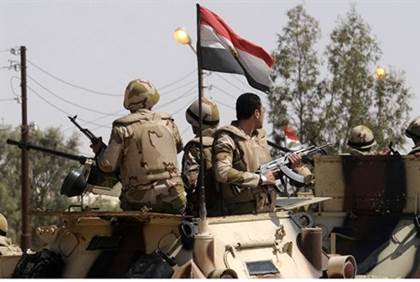
Egyptian_troops_SinaiEgyptian troops battling terrorists in Sinai

Israelis living in a string of villages and towns bordering on the Gaza Strip protested in vain against Defense Minister Moshe Ya’alon’s decision to withdraw the military presence keeping them safe, especially since the summer war on Gaza.

Four significant security events in the last 48 hours on both sides of the border added to their concerns:

Their government, at its weekly cabinet meeting in Jerusalem Sunday, Jan. 4, set up a committee to expedite the transfer of the bulk of IDF facilities from the center of the country to the south.

At the same time, Israelis living in the south within range of the Hamas-ruled Gaza Strip saw the soldiers heading out and were advised to put their trust in local paramilitary “preparedness squads” taking over from the army. The local population believes that they are not up to the job of safeguarding them from more terrorist aggression – by missile, tunnel or intrusion.

Also Sunday, Egypt began expanding the security buffer zone along the 14km of the Gaza-Sinai-Israel border, doubling its breadth from one half to a whole kilometer. The mostly Palestinian inhabitants of this zone were evacuated.

Saturday, Jan. 3, Egyptian troops raided three towns in northern Sinai: Rafah (which is part located in the Gaza Strip), El Arish and Sheikh Zuweid, killing 7 militants of Ansar Beit al-Maqdis, which last month pledged allegiance to the Islamic State of Iraq and the Levant, and jihad against Egypt and Israel.

A few hours later, an Egyptian army explosives expert was killed and several soldiers injured when a large bomb planted on a road in Sheikh Zuweid blew up when they tried to dismantle it.

Saturday night, the IDF commander of the Gaza Division, Brig. Gen. Itay Virov tried to calm dwellers across from the Gaza Strip, who were up in arms about the withdrawal of their military safety net. He addressed members of Kibbutz Nahal Oz with a rare burst of frankness. He spoke of military policy, but his words no doubt reflected the strategic thinking of Prime Minister Binyamin Netanyahu, Defense Minister Ya’alon, the outgoing Chief of Staff, Lt. Gen. Benny Gantz, and his successor next month Maj. Gen. Gadi Eisenkott.

The general may be commended for laying the truth about official policy on the table. However, instead of calming his audience, he bared evaluations that may give the rest of the country sleepless nights as well.

Here are the high points of his Nahal Oz lecture:

  • Israel can’t deter Gazan Palestinians from making war, because they have no other options. So deterrence in this case is an empty value.
  • Israel deliberately avoided going all the way to remove Hamas from power in Gaza in the summer war because salafist jihadists and al Qaeda would have moved in to replace them. It was deemed better to rely on Egypt to grapple with the terrorist threat, including al Qaeda, rather than the IDF.
  • Brig. Virov termed the last Gaza operation a campaign based on the doctrine of prevention rather than a war of aggression.
  • The political wing of Hamas looks after the population and wants peace and quiet, whereas the military wing lost no time in restoring the tunnels Israel blew up, conducting scores of test launches of rockets, and training hard for the next round of combat with Israel.
  • Israel therefore has no option but to prepare for a replay of Defense Edge with operations 2, 3 or even 4. Hamas must be degraded militarily each time – but not so far as to be rendered incapable of buttressing the Hamas regime.
  • The conclusion drawn from Gen. Virov’s lecture was that the Netanyahu government has provided Hamas-Gaza with a political and military guarantee of safety.

Like all policies, even those well thought out, this one too carries a price tag.

The general spoke of Hamas in terms of an independent entity whose operations and impact are confined to the Gaza Strip. He refrained from mentioning that, as recently as December, both of Hamas’ branches, the military and the political, jumped aboard the Iran-led Iraqi-Syrian-Hizballah alliance. This Palestinian group is now subject to Tehran’s policy decisions and directives. This omission from Israel’s policy calculations could be dangerous. Clearly, an undefeated Hamas remains a lasting menace.

Tehran’s decisions regarding Hamas may have an overarching effect, possibly touching on the moves directed by President Barack Obama. (See our Jan. 1 article on Obama’s New Year gift to Israel and the Middle East.).

Israel’s policy of relying on the Egyptian army to contain Al Qaeda’s Sinai network also comes at a price.

For now, Israel has quietly consented to large-scale Egyptian military strength entering Sinai: One and a half divisions, including fighter squadrons and tank battalions, have taken up positions, nullifying the key demilitarization clause of their 1979 peace treaty.

And that’s just for starters.

Syrian rebel Yarmouk Brigades ditch US and Israel allies, defect to ISIS

December 18, 2014

Syrian rebel Yarmouk Brigades ditch US and Israel allies, defect to ISIS, DEBKAfile, December 17, 2014

SyriaGolanISIS

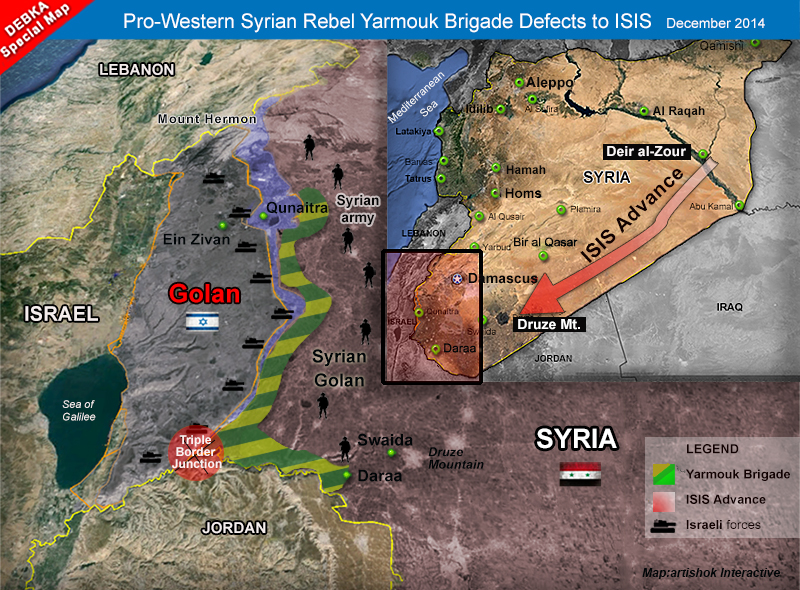
The Syrian rebel militia Al Yarmouk Shuhada Brigades, backed and trained for two years by US officers, mostly CIA experts, in Jordan, and supported by the Israeli army, has abruptly dumped these sponsors and joined up with the Islamic State in Iraq and Syria, DEBKAfile’s exclusive military and counter-terrorism sources reveal.

The sudden defection of this 2,000-strong anti-Assad force leaves IDF defense formations on the Golan, US and Jordanian deployments in the northern part of the kingdom, and pro-Western rebel conquests in southern Syria in danger of collapse.

The Brigades’ jump into the radical jihadi camp was negotiated in the last two weeks by its commander Mousab Ali Qarfan, who also goes by the name of Mousab Zaytouneh. He was in direct contact with ISIS chief Abu Baqr Al-Baghdadi, whom our sources report has recently relocated from Iraq to his northern Syrian headquarters at al-Raqqa.

Unlike the Sinai Islamists, Ansar Beit al Maqdis, the Yarmouk Brigades did not pledge allegiance to ISIS. The ir pact was forged as an operational alliance, which is just as grave a peril for the rebel militias’ abandoned allies.

For Israel, in particular, the new development is fraught with three dangers:

1. The Yarmouk Brigades are strung out along Israel’s Golan border with Syria, from the UN peacekeepers camp opposite Kibbutz Ein Zivan (see map) in the north, down to the Israeli-Syrian-Jordanian border junction in the south. The Brigades therefore sit along 45 of the total 76 kilometers of the Syrian-Israeli border. This means that a long stretch of Israel’s Golan border with Syria has fallen under the control of the Islamic State.

2.  This militia also commands sections of the Syrian-Jordanian border, as well as districts of the southern Syrian town of Deraa. Therefore, the link between Jordan and southern Syria, which served American strategic interests, is now under military threat.

3.  Islamic State forces are preparing to take advantage of their new asset with a buildup near the Druze Mountains (see map) for a rapid push south towards the town of Deraa, where they will join forces with their new ally.

Israel’s Security and Unintended Consequences

October 23, 2014

Israel’s Security and Unintended Consequences, Gatestone InstituteRichard Kemp, October 26, 2014

(Please see also Terror attack by vehicle in Jerusalem – 3-month old baby killed — DM)

Would General Allen — or any other general today — recommend contracting out his country’s defenses if it were his country at stake? Of course not.

The Iranian regime remains dedicated to undermining and ultimately destroying the State of Israel. The Islamic State also has Israel in its sights and would certainly use the West Bank as a point from which to attack, if it were open to them.

There can be no two-state solution and no sovereign Palestinian Arab state west of the Jordan, however desirable those things might be. The stark military reality is that Israel cannot withdraw its forces from the West Bank.

Fatah leaders ally themselves with the terrorists of Hamas, and, like Hamas, they continue to reject the every existence of the State of Israel.

If Western leaders actually want to help, they should use all diplomatic and economic means to make it clear to the Palestinians that they will never achieve an independent and sovereign state while they remain set on the destruction of the State of Israel.

When in 1942 American General Douglas MacArthur took command of the defense of Australia against imminent Japanese invasion, one of the plans he rejected was to withdraw and fight behind the Brisbane line, a move that would have given large swathes of territory to the Japanese.

Instead, he adopted a policy of forward defense: advancing northwards out of Australia to attack the Japanese on the island of New Guinea. MacArthur then went on to play a pivotal role in the defeat of the Japanese empire.

At the end of last year, during the Israeli-Palestinian negotiations involving U.S. Secretary of State John Kerry, another extremely able and widely respected American General, John Allen, drew up a plan progressively to withdraw Israeli forces from the West Bank and hand over Israel’s forward defense to a combination of Palestinian Arab forces, international monitors and technology.

Given the range of existential threats emanating from, or through, the West Bank today, known and unknown threats that will develop tomorrow, and the exceptional geographical vulnerability of the State of Israel, such a proposal is blatantly untenable. No other country would take risks with the lives of its people and the integrity of its territory by contracting out their defenses in this way — nor should it.

753General Douglas MacArthur (left) strongly believed in forward defense. General John Allen (right) also believes in forward defense — but for U.S. forces only, not for the Israel’s military defending its borders.

Britain, for example, where no such existential threats exist, even refuses to adopt the EU’s Schengen arrangements, which would hand over the security of UK borders to Poland, Slovakia, Hungary, Spain, Italy and its other European neighbors. It is a long-standing opt-out that looks wiser by the day as international jihadist aggression against the West increases.

General MacArthur would never have recommended the “Allen Plan.” MacArthur, however, was not then under the same political pressure as General Allen. If he had been, he would have repulsed it. In 1934, as Army Chief of Staff, he argued against President Franklin D. Roosevelt’s intention to cut drastically the Army’s budget with such vehemence that he vomited on the steps of the White House as he was leaving.

Would General Allen – or any other general today – recommend a similar plan to his own president, if it were not Israel’s security, but the security of the United States, that was at stake? Of course he would not.

Indeed, U.S. generals unsuccessfully argued the opposite course of action when U.S. President Barack Obama decided on a total withdrawal of US forces from Iraq in 2011, a move that made inevitable the resurgence of large-scale violent jihad.

General Allen is now leading the American and allied forward defensive operations against the Islamic State in Syria and Iraq [ISIS]. In the face of what he has defined as a “clear and present danger to the US,” he is not recommending withdrawal of American forces back into the continental United States and reliance on Arab forces, peacekeepers and technology to protect U.S. interests. The reverse, in fact, is true.

The reverse is also true for the forward defensive operations of the U.S. and its Western allies against violent jihad in Yemen, Pakistan, Afghanistan, Mali, Somalia and elsewhere. All are significant threats to the West, yet none is as immediate and dangerous as the threat to Israel from an undefended West Bank.

Despite the determination of so many in the West erroneously to view the Israel-Palestine conflict as a mere territorial dispute that could be settled if only the so-called “occupation” ended, the forward defensive measures necessary for other Western nations are necessary for Israel as well. The stark military reality is that Israel cannot withdraw its forces from the West Bank — either now or at any point in the foreseeable future.

For those willing to see with clarity and speak with honesty, that conclusion has been obvious for many years. It is even more obvious, perhaps, for leaders with direct responsibility — such as General MacArthur had in Australia in 1942 — than for those who do not have to live with the consequences of their actions — such as General Allen in Israel in 2013.

Recent events have made this reality even more certain. Through incessant rocket fire and the construction of a sophisticated tunnel system to abduct and massacre Israeli civilians on a large scale, Hamas has just delivered another powerful object lesson in the consequences of IDF withdrawal.

Fatah leaders may take a somewhat different stance for international consumption, but they ally themselves with the proscribed terrorists of Hamas. And, like Hamas, in reality they continue to reject the very existence of the State of Israel. They apparently continue to want only a one-state solution: Arab rule from the river to the sea, with the ethnic cleansing of the Jews that would follow.

They are consistently encouraged in this intent, both wittingly and unwittingly, by Western nations, particularly in Europe. Not least by Sweden’s commitment in September to support a unilateral Palestinian state, the UK Parliament’s recent vote for the same thing, and similar moves across Europe that are likely in the coming weeks and months.

Especially with such encouragement, there is no possibility that Palestinian Arab political leaders’ rejection of the Jewish State will modify in the foreseeable future. The launch pad that an IDF-free West Bank would provide for attacks against Israel is so dangerous it makes even Gaza look about as threatening as Switzerland.

The external threats are at least as serious as those from within the West Bank. Despite the wishful thinking of many Western leaders and the alluring grins from Tehran, the Iranian regime remains dedicated to undermining and ultimately destroying the State of Israel. By funding and fomenting violence, Iran’s leadership will continue to exploit the Palestinian Arab populations in both Gaza and the West Bank to these ends.

Those who are currently arguing for Israeli military withdrawal from the West Bank and the establishment of a sovereign state must have missed the war General Allen is fighting against the Islamic State [IS] and their jihadist bedfellows across the border in Syria. The Islamic State also has Israel in its sights and would certainly use the West Bank as a point from which to attack, if it were open to them. In the hands of international monitors and Palestinian Arab forces, the West Bank would be wide open to them.

We have only to look at the reaction to aggression of almost all international peacekeepers over the decades to know they would not last five minutes. And we have only to look at the performance of the battle-hardened Syrian and Iraqi armies when confronted by Islamic State fighters to know how long Palestinian Arab forces would withstand such aggression, whether by infiltration or frontal assault.

Whatever happens to the Islamic State in the future, this resurgent Islamist belligerence is not a flash in the pan. On the contrary, it has been building for decades, and President Obama, UK Prime Minister David Cameron and other world leaders acknowledge it as a generational struggle.

This means that for Israel, as far as the West Bank is concerned, both the enemy within and the enemy without are here to stay. And if the IDF has no choice but to remain in the West Bank to defend Israel, there can be no two state solution and no sovereign Palestinian Arab state west of the Jordan, however desirable those things might be.

Nor can there be a one-state solution with democratic rights for all because that would spell the end of the one and only democratic and Jewish state and the beginning of a new autocracy and the next exodus of the Jews.

For those who do not want that to happen, the harsh reality is continuation of the status quo. But the status quo can be significantly improved, by gradual and progressive increases to PA autonomy in the West Bank, to the point where a state exists in virtually all aspects other than military security. That progress can only be achieved through low-key bilateral negotiations with concessions from both sides. It cannot be achieved by Kerry-like peace processes that demand big sweeping strokes to deliver groundbreaking, legacy-delivering announcements.

Nor can such progress be achieved in the face of a Western world that reflexively condemns every move Israel makes and encourages the Palestinian Arabs to believe that the fantasy of a two-state solution or a one-state solution on their terms can become a reality in the foreseeable future.

As so often in the paradoxical world of geopolitics, the well-meaning actions and words of national leaders and international organizations have unintended consequences. For the Israel-Palestine situation, the unintended consequences of Western actions are to deprive Palestinian Arabs of increased freedom and prosperity and to undermine the security of the only stable, liberal democratic state in the Middle East. If the West actually wants to help, its leaders need to face up to this unpalatable truth rather than continue to delude the Palestinian people as well as themselves.

Instead, Western leaders should use all available diplomatic and economic means to make it clear to the Palestinians that they will never achieve an independent and sovereign state while they remain set on the destruction of the State of Israel and while they continue to brainwash future generations to believe in that goal.
Is Hezbollah preparing large assault on Israel?

October 22, 2014

Is Hezbollah preparing large assault on Israel? Al-MonitorBen Caspit, October 21, 2014

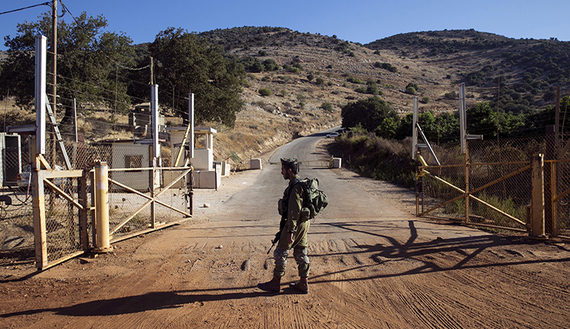
An Israeli soldier stands guard at a check point near the Lebanese-Israeli border, southern LebanonAn Israeli soldier stands guard at a checkpoint near the Lebanese-Israeli border, Oct. 8, 2014. (photo by REUTERS/Baz Ratner

This assessment is based on the possibility that Iran will indeed reach an agreement with the West by November or January — an agreement that’s good for Tehran, allowing it to preserve its nuclear capability as well as the potential for a fast break — within a matter of months — toward a bomb. Such an agreement, the senior minister told me, will set Iran free from all the shackles and brakes that have restrained it thus far. We think that it might consider siccing Hezbollah on Israel.

***********************

Stirring the pot of threats Israel is facing from Iran’s nuclear program began with a speech Prime Minister Benjamin Netanyahu delivered Oct. 19 at a dedication ceremony of a new road named after the late Prime Minister Yitzhak Shamir. The next day, Minister for Intelligence Affairs Yuval Steinitz published his own statement, which came out a day after The New York Times published his op-ed. He was joined by Foreign Minister Avigdor Liberman, who evoked the cliche, “If you want to shoot, shoot; don’t talk.”

At the same time, the Israeli media (Yedioth Ahronoth) addressed this matter with questions raised by security officials who wondered “what awoke Netanyahu in terms of the Iranian issue.” The queries were raised on behalf of top Israel Defense Forces (IDF) officials who did not quite agree with the pessimistic forecasts provided by Netanyahu and his senior ministers to the effect that the world powers, chief among them the United States, were about to reach a “capitulation agreement” with Tehran on its nuclear program.

The New York Times later published an article answering this question: It reported that US President Barack Obama was contemplating reaching an agreement with Iran that would not consist of totally lifting the sanctions but only suspending them. Such a move, the newspaper said, lies within the president’s purviews, allowing him not to seek the approval of the Congress (as opposed to lifting the sanctions). Thus, the president will be able to bypass the intractable Congress, which may or may not endorse a “bad” deal with Iran. It is believed that this information reached Israeli intelligence officials before being published in the Times, which is what set off Netanyahu, Liberman and Steinitz.

Following a talk I held Oct. 20 with a senior minister from the diplomatic-security Cabinet, further details came to light. As we discussed the possibility of early elections in Israel, the minister made a surprising comment, noting that a war in the north was more likely to break out before new elections were held. Some of Israel’s top Cabinet ministers estimate that Hezbollah and Iran are fast approaching a fateful watershed, which might prompt them to drag Israel into another confrontation, far broader than the previous ones. This assessment is based on the possibility that Iran will indeed reach an agreement with the West by November or January — an agreement that’s good for Tehran, allowing it to preserve its nuclear capability as well as the potential for a fast break — within a matter of months — toward a bomb. Such an agreement, the senior minister told me, will set Iran free from all the shackles and brakes that have restrained it thus far. We think that it might consider siccing Hezbollah on Israel.

This information comes amid many previous reports regarding the marked change in Hezbollah policy in terms of its conduct along the confrontation line with Israel — to wit, the Israeli-Lebanese border as well as the Golan Heights sector, into which Hezbollah has been infiltrating little by little. Lately, the Lebanese Shiite organization has claimed responsibly for attempted terrorist attacks in the Golan Heights, for the first time in many years. Hezbollah no longer hides behind proxy “subcontractors.” It is no longer ambiguous nor does it try to go under the radar. On the contrary, it operates openly against Israel, publicly acknowledging its responsibility. It seems to have gained a great deal of confidence and is no longer apprehensive of an unexpected conflagration vis-a-vis the IDF.

What this means is that the era of Israel’s deterrence in the north is over. Achieved after the Second Lebanon War in 2006, this deterrence lasted more than eight years. Its remnants remain noticeable on the ground, but according to all indications Hezbollah has lost its brakes and its restraint and has started looking for a confrontation instead of running away from one. Until lately, most Israeli intelligence elements estimated that Hezbollah was unready to open a second front against Israel, given that it is up to its neck in the war in Syria and now in the fighting in north Lebanon. While this assessment has yet to be officially scrapped, the voices coming from top political officials in Jerusalem nevertheless point to a plausible possibility of another war with Hezbollah in the coming months.

The organization’s militants openly carry out patrols along the border. Its presence in friction-prone areas has been beefed up considerably. It is now engaged in planning and executing micro-guerrilla warfare against the IDF also on the Golan sector, while setting new rules of deterrence: Any Israeli activity that crosses Hezbollah’s “red line” will be met by an appropriate response.

As for the question whether the heavy fighting in Lebanon has not burned out Hezbollah capabilities, the senior minister told me: “On the contrary; it has gained confidence and operational experience. Now it can fight like any other state military, employing forces on a division scale or even broader, relying on intel, airborne vehicles, etc.” And there’s something else: The Israeli performance during Operation Protective Edge apparently did not impress Hezbollah. Even the threats made in recent weeks by senior Israeli officials such as chief of staff Benny Gantz and Defense Minister Moshe Ya’alon, namely that “Israel will knock Lebanon back 70 or 80 years” in the event of a confrontation with the IDF, make no special impression on Hezbollah.

Are we on the way to an all-out confrontation in the north? There’s no need to scurry for shelter just yet. Such a confrontation would result in casualties and devastation at proportions we have never witnessed to date. This time around, Israel, too, will sustain heavy casualties and great devastation in view of the fact that Hezbollah’s rocket capabilities are much more improved than those of Hamas. The Iron Dome missile defense system will not provide an effective and complete response to curb the rocket offensive on Tel Aviv and its environs. The last thing the blazing Middle East needs right now is an Armageddon between Israel and Hezbollah, which might also draw Syria, and possibly Iran, either overtly or covertly.

We must also bear in mind that there is another possibility, whereby Jerusalem is trying to create a warmongering spin to heat up the atmosphere, to wield pressure on the world powers to toughen their positions vis-a-vis Iran. Or maybe Jerusalem just wants to scare Israelis who are starting to move toward a socioeconomic agenda, thus making it harder for Netanyahu to get re-elected.

The truth could be composed of a colorful mosaic consisting of all the existing possibilities. In every truth there is a grain of spin, and vice versa. And yet, the possibility of a very hot winter in the north exists more than it has.


IDF Ups Presence Near Sinai Border Amid Heightened Tensions

October 5, 2014

IDF Ups Presence Near Sinai Border Amid Heightened Tensions, Israel National News, Tova Dvorin, October 5, 2014

(Beheadings? They must not be Islamic. — DM)

Egyptian security personnelEgyptian security personnel Reuters

An additional reason behind the deployment is the number of ISIS ‘copycat’ attacks in the peninsula, he added – noting that beheaded bodies have been found ‘continually’ in the Al-Arish area over the past several weeks.

********************

Southern Command deployed in response to heightened tensions between Egypt, Sinai terror groups. ‘We don’t take risks,’ officer explains.

The IDF’s Southern Command has reinforced its forces along Israel’s southern border, a senior IDF officer revealed Sunday, due to rising unrest in the Sinai Peninsula

On Thursday, the Egyptian Army eliminated a major terror leader in the peninsula, the head of the ISIS-linked Ansar Bayt Al-Maqdis group.

Mohamed Abu Shatiya, who took part in the kidnapping of seven Egyptian soldiers in Sinai last year, died during fighting with the army south of Rafah, on the border with Gaza.

Terror attacks in Egypt have eased over the past month as the military squeezes their hideouts in the sparsely inhabited peninsula, analysts have noted – and could ease even further with the elimination – but IDF officials told Walla! News Sunday that the extra deployment is a necessary precaution.

“The Egyptian Army has raised the volume on its terror crackdown, and they in turn have increased their efforts to harm Egypt,” the officer stated.

An additional reason behind the deployment is the number of ISIS ‘copycat’ attacks in the peninsula, he added – noting that beheaded bodies have been found ‘continually’ in the Al-Arish area over the past several weeks.

Thus, the IDF has “decided not to take unnecessary risks,” he said, for fear that members of Ansar Bayt Al-Maqdis will turn to attacking Israeli targets in an attempt to destabilize the region. The group has claimed responsibility in the past for several rocket attacks that targeted the Israeli resort city of Eilat.

The Southern Command has increased its posts along the Gaza-Egypt border near Rafah, commanders in the field said, adding that the Egyptian Army “faces significant challenges.”

But more than just the regional threat of Ansar Bayt al-Maqdis, the source added, the deployment is also to fend off an increase in infiltrations from Gaza.

Last week, two separate infiltration attempts were apprehended along the same border. One suspect was armedthe other was not.

“Palestinians who have despaired of the situation in Gaza are jumping across the border with a knife, hoping to be arrested by the IDF,” the source said. “We do not take a risks; in our view, such intrusion is taken as an attempted attack.”