Archive for the ‘Houthi’ category

NBC’s Engel: Officials Say Allies: Simply Don’t Trust” U.S. Under Obama Admin – The Five

March 28, 2015

NBC’s Engel: Officials Say Allies: Simply Don’t Trust” U.S. Under Obama Admin – The Five, Fox News via You Tube, March 27, 2015

(In other breaking news, today is Saturday, unexpectedly. Please see also, Iranian general in Sanaa to organize Yemen rebel counter-offensive for Saudi-led attacks.  — DM)


Gulf states, abandoned against Iran

March 26, 2015

Gulf states, abandoned against Iran, Israel Hayom, Dr. Reuven Berko, March 26, 2015

(At least the Gulf States are awakening. That’s a good start. — DM)

The West’s weakness and apathy toward Iran and the perilous predicament it has created in Yemen again prove the flimsy nature of those security and defense treaties. This lesson justifies Israel’s approach, which is based on the ability to defend itself on its own. In the meantime, following the Houthi takeover, Saudi Arabia has decided to deploy a massive military force along the border with Yemen. The first shot is in the chamber and the finger is already on the trigger.

**********************

Shiite Iran’s increasing involvement in Iraq, Syria and Lebanon, while exploiting the Shiite elements of the population in those target countries, is causing a great deal of concern among leaders of Arab Gulf states. The trauma of Iran’s attempt to topple the regime in Bahrain, where most of the population is Shiite, under the claim that Bahrain is Iran’s 14th province, is still fresh in their minds. The Iranian goal of using Bahrain as a bridgehead from which to spread across the Arabian Peninsula is still in play, despite Iran’s first effort being blocked in March 2011, when some 1,000 Saudi troops and 500 policemen from the United Arab Emirates entered Bahrain to save its regime.

Ever since Saddam Hussein’s sudden invasion of Kuwait, the Gulf states — Saudi Arabia, Oman, Kuwait, Qatar, Bahrain and the UAE — realized the need for a type of “Al Jazeera defense force” to pose a strategic deterrent against Iranian machinations on the peninsula. Their effort has not been a success. Through its latest intervention, via the mobilization of Shiite Houthi tribesmen to capture key targets in Yemen, including the primary port cities and airports in the south of the country leading to control of the Gulf of Aden, Iran is clearly reiterating its ambition of acquiring the straits of Hormuz and Bab el-Mandeb, which will allow Iran to paralyze the Red Sea and Persian Gulf waterways.

Arab stagnation combined with the West turning a blind eye to this Iranian aggression, alongside the willingness of Western powers to sign a deal allowing Iran to acquire a nuclear bomb, is causing sleepless nights among those Arab leaders who are again pushing the need to upgrade the capabilities of the “Al Jazeera defense force.”

Considering the lack of trust in the West and Yemen’s expected fall to the Houthis, the leaders of the Arab Gulf states are again working, feverishly, to build the military capability to curb Iran. As early as December 2009, with the goal of protecting the integrity of Arab territories situated in the Arabian Peninsula, the Arab League decided to establish a massive, unified, heavily funded, rapid-reaction military force comprising hundreds of thousands of troops and naval capabilities, capable of posing a deterrent and striking a decisive blow on the battlefield. Morocco and Jordan were also added to this coalition, as strategic depth, but the initiative ultimately failed to gain traction.

The recent gathering of these partner states in Riyadh gave birth to a multitude of agreements, including support and aid to Egypt, which is considered the strongest true military force in the Sunni Arab Middle East. Additionally, Saudi Arabia has lobbied for Pakistani support in the aftermath of Yemen’s inevitable fall, or worse, when Iran completes its nuclearization with American consent.

As the West falls victim to the fraud peddled by Mohammad Javad Zarif, Iran’s foreign minister, the Arabs (and Israel) have no illusions about Iran’s true intentions. Even as the Bahrain crisis was unfolding, the threats issued by many of Iran’s highest-ranking defense establishment officials — whether in the regime, the military or the Shura (parliament) — reflected the hostile nature of Iran’s foreign policy, and removed any doubt in the minds of neighboring Arab leaders.

Many of the Gulf states with signed security and defense pacts with the West, namely the United States, are currently feeling abandoned. Ever since the events in Bahrain, and to a greater degree following the recent developments in Yemen, the realization is growing in the Gulf that Iran’s aggressive goals and ambitions regarding the Arabian Peninsula have not changed and that they must take care of themselves.

The Arabs have recently come to the realization that not only will they not receive aid from the West in their hour of need, but that the West is forging a deal with Iran at their expense — a deal that will pose the greatest threat to their security. The situation that has been created provides an opportunity for Israel, even if clandestinely, to play a part in the geostrategic plans being formulated by states in the region, and which could help lead to an agreeable deal on the Palestinian issue — which is rather secondary in the current pan-Arab context.

The West’s weakness and apathy toward Iran and the perilous predicament it has created in Yemen again prove the flimsy nature of those security and defense treaties. This lesson justifies Israel’s approach, which is based on the ability to defend itself on its own. In the meantime, following the Houthi takeover, Saudi Arabia has decided to deploy a massive military force along the border with Yemen. The first shot is in the chamber and the finger is already on the trigger.

Saudi Arabia launches airstrikes in Yemen, ambassador says

March 26, 2015

Saudi Arabia launches airstrikes in Yemen, ambassador says, Fox News, March 26, 2015

(Meanwhile, as Iranian supported Houthis take over much of Yemen, the U.S. is providing airstrikes in Tikrit to assist Iran and helping Iran to establish itself as a nuclear power. Please see also, US air force bombs Tikrit to aid Iran-led operation against ISIS. Saudi, Egyptian bombers strike Iran-backed Houthi rebels in Yemen. — DM)

032515_shep_Yemen2_640Iran-backed rebels bring Yemen to brink of civil war

Saudi Arabia launched airstrikes against the Houthi rebels in Yemen early Thursday, one day after the U.S.-backed Yemeni president was driven out of the country.

President Obama has authorized the provision of logistical and intelligence support to the military operations, National Security Council spokesperson Bernadette Meehan said late Wednesday night. She added that while U.S. forces were not taking direct military action in Yemen, Washington was establishing a Joint Planning Cell with Saudi Arabia to coordinate U.S. military and intelligence support.

Saudi Ambassador Adel al-Jubeir said the operations began at 7 p.m. Eastern time.

He said the Houthis, widely believed to be backed by Iran, “have always chosen the path of violence.” He declined to say whether the Saudi campaign involved U.S. intelligence assistance.

Al-Jubeir made the announcement at a rare news conference by the Sunni kingdom.

He said the Saudis “will do anything necessary” to protect the people of Yemen and “the legitimate government of Yemen.”

A Yemeni official earlier Wednesday would not say where Yemeni President Abed Rabbo Mansour Hadi fled to, but did tell Fox News: “He is safe. That’s all I can say at this point.”

Hadi’s departure marks a dramatic turn in Yemen’s turmoil and means a decisive collapse of what was left of his rule, which the United States and Gulf allies had hoped could stabilize the chronically chaotic nation and fight Al Qaeda’s branch here after the 2011 ouster of longtime autocrat Ali Abdullah Saleh.

Over the past year, the Shiite rebels known as Houthis, who are believed to be supported by Iran, have battled their way out of their northern strongholds, overwhelmed the capital, Sanaa, seized province after province in the north and worked their way south. Their advance has been boosted by units of the military and security forces that remained loyal to Saleh, who allied with the rebels.

With Hadi gone, there remains resistance to the Houthis scattered around the country, whether from Sunni tribesmen, local militias, pro-Hadi military units or Al Qaeda fighters.

Hadi and his aides left Aden after 3:30 p.m. on two boats, security and port officials told The Associated Press. He is scheduled to attend an Arab summit in Egypt on the weekend, where Arab allies are scheduled to discuss formation of a joint Arab force that could pave the way for military intervention against Houthis.

His flight came after Houthis and Saleh loyalists advanced against Hadi’s allies on multiple fronts. Military officials said militias and military units loyal to Hadi had “fragmented,” speeding the rebel advance. The officials spoke on condition of anonymity because they were not authorized to speak to reporters

Earlier in the day, the rebels seized a key air base where U.S. troops and Europeans had advised the country in its fight against Al Qaeda militants. The base is only 60 kilometers (35 miles) away from Aden.

In the province of Lahj, adjoining Aden, the rebels captured Hadi’s defense minister, Maj. Gen. Mahmoud al-Subaihi, and his top aide on Wednesday and subsequently transferred them to the capital, Sanaa. Yemen’s state TV, controlled by the Houthis, announced a bounty of nearly $100,000 for Hadi’s capture.

Hadi then fled his presidential palace, and soon after warplanes targeted presidential forces guarding it. No casualties were reported. By midday, Aden’s airport fell into hands of Saleh’s forces after intense clashes with pro-Hadi militias.

Aden was tense Wednesday, with schools, government offices, shops and restaurants largely closed. Inside the few remaining opened cafes, men watched the news on television. With the fall of the city appearing imminent, looters went through two abandoned army camps, one in Aden and the other nearby, taking weapons and ammunition.

The takeover of Aden, the country’s economic hub, would mark the collapse of what is left of Hadi’s grip on power. After the Houthis overran Sanaa in September, he had remained in office, but then was put under house arrest. He fled the capital earlier in March with remnants of his government and declared Aden his temporarty capital.

Yemen’s Foreign Minister Riad Yassin told Dubai-based Al-Arabiya TV satellite news network that he officially made a request to the Arab League on Wednesday to send a military force to intervene against the Houthis. Depicting the Houthis as a proxy of Shiite Iran, a rival to Sunni Gulf countries, he warned of an Iranian “takeover” of Yemen. The Houthis deny they are backed by Iran.

Mohammed Abdel-Salam, a spokesman for the Houthis, said their forces were not aiming to “occupy” the south. “They will be in Aden in few hours,” Abdel-Salam told the rebels’ satellite Al-Masirah news channel.

Earlier, Al-Masirah reported that the Houthis and allied fighters had “secured” the al-Annad air base, the country’s largest. It claimed the base had been looted by both Al Qaeda fighters and troops loyal to Hadi.

The U.S. recently evacuated some 100 soldiers, including Special Forces commandos, from the base after Al Qaeda briefly seized a nearby city. Britain also evacuated soldiers.

The base was crucial in the U.S. drone campaign against Al Qaeda in the Arabian Peninsula, which Washington considers to be the most dangerous offshoot of the terror group. And American and European military advisers there also assisted Hadi’s government in its fight against Al Qaeda’s branch, which holds territory in eastern Yemen and has claimed the attack on the French satirical magazine Charlie Hebdo in Paris.

U.S. operations against the militants have been scaled back dramatically amid Yemen’s chaos. U.S. officials have said CIA drone strikes will continue in the country, though there will be fewer of them. The agency’s ability to collect intelligence on the ground in Yemen, while not completely gone, is also much diminished.

The Houthis, in the aftermath of massive suicide bombings in Sanaa last week that killed at least 137 people, ordered a general mobilization and their leader, Abdel-Malik al-Houthi, vowed to send his forces to the south to fight Al Qaeda and militant groups.

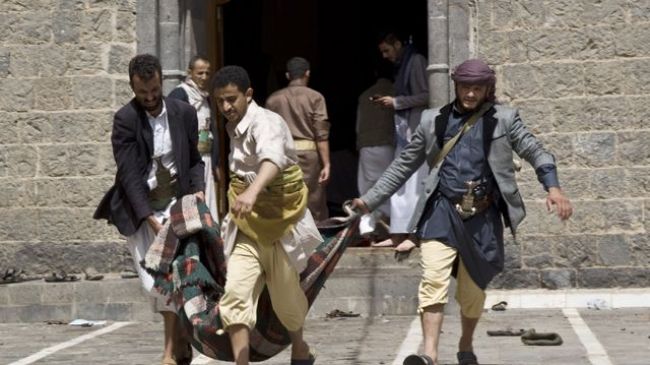
In Sanaa, dozens of coffins were lined up for a mass funeral of the victims Wednesday. Among the victims was a top Shiite cleric. Yemen’s Islamic State-linked militants have claimed responsibility for the attack.

The Houthis seized the capital, Sanaa, in September and have since been advancing south along with Saleh’s loyalists. On Tuesday, they fired bullets and tear gas to disperse thousands of protesters in the city of Taiz, known as the gateway to southern Yemen. Six demonstrators were killed and scores more were wounded, officials said.

The Houthis also battled militias loyal to Hadi in the city of al-Dhalea, adjacent to Taiz, Yemen’s third-largest city. Taiz is also the birthplace of its 2011 Arab Spring-inspired uprising that forced Saleh to hand over power to Hadi in a deal brokered by the U.N. and Gulf countries.

Hadi on Tuesday asked the U.N. Security Council to authorize a military intervention “to protect Yemen and to deter the Houthi aggression” in Aden and the rest of the south. In his letter, Hadi said he also has asked members of the six-nation Gulf Cooperation Council and the Arab League for immediate help.

Saudi Arabia warned that “if the Houthi coup does not end peacefully, we will take the necessary measures for this crisis to protect the region.”
Obama’s foreign policy successes in Yemen

February 11, 2015

(Here are two You Tube videos, posted today, dealing with the evacuation of the U.S. embassy in Yemen and the situation there in general. Please compare and contrast. Obama hasn’t said much recently about his foreign policy successes there. Perhaps, as the State Dept. spokesperson says, the current situation in Yemen has nothing to do with Islam the United States.– DM)

CNN: Iran-Backed Rebels Seized U.S. Military Equipment As Embassy in Yemen Was Abandoned, CNN via You Tube, February 11, 2015


State Dept: U.S. Not ‘Being Run Out of Town’ Despite Abandoning 3rd US Embassy in Middle East, Washington Free Beacon via You Tube, February 11, 2015


Houthi Yemen coup moves Iran’s Middle East hegemonic ambitions forward – upheld by Washington

February 9, 2015

Houthi Yemen coup moves Iran’s Middle East hegemonic ambitions forward – upheld by Washington, DEBKAfile, February 8, 2015

Houthi_fighters_downtown_Sanaa_5.2.15Victorious Houthi fighters in downtown Sanaa

It is hard for those governments to make up their minds where to look for the most acute menace to their national security – the US-Iranian nuclear deal taking shape, or the give-and-take between Washington and Tehran in Yemen and Iraq. 

******************

The strings of the pro-Iranian Houthi rebels’ coup which toppled the Yemeni government in Sanaa were pulled from Tehran and Washington. US intelligence and shared US-Iranian support helped the Houthis reach their goal, which is confined for now to parts of central Yemen and all of the North.

Friday, Feb. 6, the rebels dissolved parliament and seized power in the country of 24 million. They propose to rule by a revolutionary council. President Abed Rabbo Mansour Hadi and his cabinet who were forced to resign last month are under house arrest.

DEBKAfile’s Saudi intelligence sources reveal that the dominant figure of the uprising was none other than Ali Abdullah Saleh, president of Yemen from 1990 until he was ousted in 2012.

A member of the Zaydi branch of Shiite Islam like the Houthis, he led them to power with the same enthusiasm with which he fought their insurgency during his years in power. By rallying his supporters in the army, intelligence and security services, he enabled the rebels to take over these departments of government and overpower the Hadi regime with only minimal resistance.

They were also able to commandeer $400 million worth of modern American munitions.

The Houthis secretly call themselves “Ansar Allah” and have adopted the “Death to America, Death to Israel” slogans routinely heard in government-sponsored parades and demonstrations on the streets and squares of revolutionary Tehran.

Amid the political turmoil in Sanaa, the US Sunday resumed drone strikes against AQAP.

The six Arab countries of the Gulf Cooperation Council, led by Sunni-ruled Saudi Arabia and the United Arab Emirates, issued a statement Saturday, Feb. 7, calling for the UN Security Council to “put an end to this coup, an escalation that cannot be accepted under any circumstances.”

The Iranian-US gambit has resulted in different parts of Yemen falling under the sway of two anti-American radical forces – the pro-Tehran Houthis and Al Qaeda in the Arabian Peninsula (AQAP).

The new Saudi King Salman starts his reign with a double-barreled threat facing the kingdom from its southern neighbor, Yemen – posed by an Iranian pawn and a proactive branch of Al Qaeda.

Ten days ago, when US President Barack Obama visited Riyadh, the Saudi monarch voiced his concern about the alarming situation developing Yemen. However, Obama replied noncommittally with general remarks.

In Washington, administration spokesmen Saturday tried pouring oil on the troubled waters roiled by US support for the Iranian maneuver in Sanaa and the return of Abdullah Saleh to the Yemeni scene.

“We’re talking with everybody,” one US official said, explaining that the United States was ready to talk to any Yemeni factions willing to fight Al Qaeda.

His colleagues tried to downplay Tehran’s hand in the Houthi coup. “The Houthis get support from Iran, but they’re not controlled by Iran,” said another official in Washington.

Our military and intelligence sources report that Yemen is not the only Middle East platform of the joint US-Iranian military, intelligence and strategic performance. The second act is unfolding in Iraq.

Saudi Arabia, the Gulf emirates, Jordan and Israel are therefore watching the evolving US-Iranian cooperation in fighting al Qaeda’s various affiliates in the region with deep forebodings, lest it is merely a façade for the Obama administration’s espousal of Tehran’s regional ambitions.

It is hard for those governments to make up their minds where to look for the most acute menace to their national security – the US-Iranian nuclear deal taking shape, or the give-and-take between Washington and Tehran in Yemen and Iraq.


