Archive for the ‘Hezbollah’ category

Iran-Syria-North Korea Nuclear Nexus

January 28, 2015

Iran-Syria-North Korea Nuclear Nexus, Front Page Magazine, January 28, 2015
Hassan

As Iranian and American chief diplomats continue to meet to find ways to speed up nuclear negotiations and strike a final nuclear deal that would lead to the removal of all international sanctions on the ruling clerics, the Obama administration persists in ignoring the recent revelations about the Islamic Republic and its covert operations in the region.

A new Western intelligence assessment points to efforts by the Syrian government to renew its operations in an underground and clandestine nuclear facility near Qusair, close to the border of Lebanon, in order to produce nuclear weapons. Citing the Western intelligence assessment, the German weekly Der Spiegel pointed out that the reconstruction of the nuclear facility is being conducted with the assistance of the Islamic Republic, North Korea, and Hezbollah.

The intelligence report indicates that dialogue between Ibrahim Othman, head of the Syrian Atomic Energy Commission of Iranian, and North Korean and Hezbollah affiliates were “intercepted.” In addition, according Abu Muhammad al-Bitar, the Free Syrian Army has also noticed the “unprecedented” presence of Iranian and Hezbollah security members in the town of Qusair on the suburbs of Homs.

If Iran is engaged in such operations assisting Syrian President Bashar al Assad, it is breaching the protocols of the Non-Proliferation Treaty (NPT), as well as posing a great threat to security in the region.

If, even before obtaining nuclear weapons, the ruling clerics of Iran are assisting their allies to become nuclear states, how can we trust the Islamic Republic in nuclear negotiations and how can one rely on their claim that they are not seeking to build a nuclear bomb?

Iran-Syria and North Korean-Syria military and nuclear cooperation has been going on for a long time. When it comes to the issues of ballistic missiles, Syria has previously cooperated with both Iran and North Korea.

Syria possess approximately 50 tons of uranium which could be adequate enough to create 5 nuclear bombs. For developing nuclear weapons either highly enriched uranium or an adequate amount of plutonium is required.

Some might make the argument that Syria developed the uranium by itself without the assistance of other countries or other non-state actors. Nevertheless, technically, pragmatically and realistically speaking, Syria does not possess the capability of developing an estimated 50 tons of natural uranium. This suggests that the role of other states and non-state actors have definitely played a significant role. Some of the only allies that the Syrian government has still kept are Iran, North Korea and Hezbollah.

It is crucial to point out that, without a doubt, becoming a nuclear state for the Syrian and Iranian government would be a formidable tool in to suppress opposition, maintain power, and deter foreign intervention in case of crimes against humanity.

There are two major nuclear site in Syria. The first one is the Al Kibar reactor in the northeast of the city of Deir Ezzour and the second one is Marj Sultan in the outskirt of Damascus where the fuel is reportedly stored.

News with respects to the Syrian government renewing its nuclear program were previously reported in 2013. There had been reports that some activities were being carried out at an alleged Syrian nuclear facility close to an eastern suburbs of Damascus, Marj Sultan.

The International Atomic Energy Agency (IAEA) reported previously that Damascus was building a nuclear reactor in Deir Ezzour. Reportedly tons of enriched uranium in Damascus are being protected by Iran’s Revolutionary Guard Corps and Hezbollah.

According to Der Spiegel, “Syria’s dictator has not given up his dream of an atomic weapon and has apparently built a new nuclear facility at a secret location…..It is an extremely unsettling piece of news.”

In addition to the aforementioned concerns about the undeclared Syrian nuclear site and nuclear proliferation, one of the crucial issues is that the nuclear material might fall in the hands of multiple other players and Islamist groups. In other words, if these nuclear sites are seized by some radical groups or Al Qaeda-linked affiliates, they might be capable of utilizing the highly enriched uranium and produce nuclear weapons.

Iran’s other indisputable and multi-layered activities and engagements in Syria — including the military, financial, intelligence, and advisory assistance to the Syrian government which have further radicalized and militarized the ongoing Syrian war — persist. In addition, the recent intelligence report and satellite images of secretly renewing nuclear activities with the assistance of the Iranian and North Korean governments poses a grave threat to stability and security in the region. Unfortunately, despite the seriousness of this issue, the Obama administration continues to ignore these issues and persists on trusting the Islamic Republic in the nuclear negotiations.

Iran’s New Terror Base against Israel

January 22, 2015

Iran’s New Terror Base against Israel, The Gatestone InstituteYaakov Lappin, January 22, 2015

The new base in Syria gives Hezbollah the option of attacking Israel and drawing Israel’s return fire away from Lebanon, where its most precious assets are hidden: well over 100,000 rockets and missiles that might be saved for a future battle over Iran’s nuclear weapons program.

Hezbollah, exploiting its presence in Syria, has been attempting to open a new front against Israel.

Over the past 18 months, Hezbollah and its enablers from the Iran’s Islamic Revolutionary Guard Corps [IRGC] have begun launching a series of attacks on Israel from their new center of operations in southern Syria.

After Sunday’s air strike (attributed by the media to the Israel Air Force) that killed 12 high-ranking Hezbollah and IRGC operatives near Quneitra, Syria, along the Israeli border, Israel is bracing for the possibility of an attack by Hezbollah and Iran.

Although Israel has not officially taken responsibility for the strike, it would make sense to view the action as a preemptive move designed to remove a clear and present danger arising on Israel’s border with Syria. The danger is the formation of a second Hezbollah terrorism base, in addition to Hezbollah’s home base already in Lebanon.

The IRGC and Hezbollah have begun playing a dual role in the geographical area once known as the Syrian Arab Republic, a country that no longer exists as it appears on world maps. Iran and Hezbollah are acting as the life support machine for the shrunken but still functional Assad regime, now in control of just Damascus, Aleppo, and the Syrian Mediterranean coastline.

Since moving into Syria to rescue the regime of Bashar Al-Assad, Hezbollah, acting on orders from Iran, has expanded its presence in several areas of Syria. Iran too has boosted its presence in Syria, primarily though the presence of members of its Revolutionary Guards.

At the same time, the IRGC and Hezbollah have begun building a terrorism base in Syria that is directed against Israel, in addition to the Iranian-backed Hezbollah semi-state entity in southern Lebanon.

The new base in Syria, at Israel’s northeast border, gives Hezbollah the option of attacking Israel and drawing Israel’s return fire away from Lebanon, where its most precious assets are hidden: well over 100,000 rockets and missiles that might be saved for a future battle over Iran’s nuclear weapons program.

Hezbollah is also under domestic Lebanese pressure not to drag Lebanon into a new devastating conflict with Israel.

The Hezbollah and IRGC operatives that were targeted in Sunday’s airstrike were in the midst of significantly stepping up these attacks. Their plans included rockets and cross-border raids by terror cells. These attack plans were seriously larger in scale than past assaults.

It is in this context that Sunday’s air strike occurred.

Now, all eyes are on northern Israel to see whether Hezbollah and Iran retaliate there. The leader of the IRGC, Major General Mohammad Ali Jafari, on Tuesday threatened Israel with “devastating thunderbolts” — threats Israel cannot afford to take lightly.

896Israeli soldiers take part in a training exercise near the border with Syria, December 2013. (Image source: IDF)

It would be safe to assume, however, that Hezbollah wishes to avert the outbreak of an all-out conflict. Such a war would expose Lebanon to unprecedented Israeli firepower, and would also expose Israel to unprecedented Hezbollah rocket attacks and cross-border infiltrations by land, air and sea.

If such a conflict were to break out, many parts of southern Lebanon could lie in ruins, and Hezbollah’s many Sunni enemies in next-door Syria could seize on the weakness of their Shi’ite foes and pounce, dragging Lebanon into the Syrian war.

That kind of outcome would not benefit Hezbollah or Iran in any way. But in the Middle East, miscalculations have led to costly errors in the past, and events can take on a life of their own.

800,000-strong Shiite militia calls for formal recognition by Baghdad

January 18, 2015

800,000-strong Shiite militia calls for formal recognition by Baghdad, RUDAW, January 18, 2015

(RUDAW is a Kurdish media network. Hezbollah was conceived by Muslim clerics and funded by Iran following the Israeli invasion of Lebanon in 1982. From the inception of Hezbollah to the present, the elimination of the State of Israel has been one of Hezbollah’s primary goals. [Footnotes omitted.] — DM)

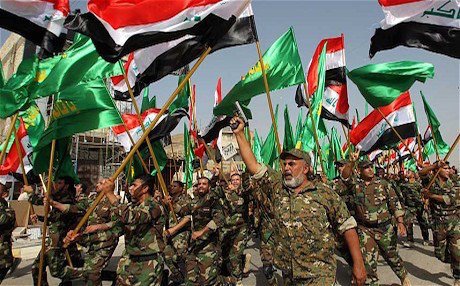
97644Image1Thousands of Shiite men responded to a call for jihad after ISIS stormed across Iraq in June and captured a third of the country. AFP photo.

BAGHDAD, Iraq – The leader of Iraq’s Hezbollah met with Shiite clerical authorities in Najaf Sunday to discuss formal recognition of hundreds of thousands of militiamen by the government and putting them on official payroll, a Hezbollah statement said.

Sheikh Abbas al-Mahmadawi, leader of the Shiite militia group Hezbollah, said that he met with Shiite clerics in Najaf, including Ayatollah Muhammad Saeed al-Hakim, to seek recognition “for the success of the militia groups in the fight against the Islamic State (ISIS).”

Al-Mahmadawi added that the Shiite volunteer militia should be recognized by the authorities and compensated financially “because many of them do not have any salaries and many have been wounded and handicapped.”

According to al-Mahmadawi, there are 800,000 volunteer Shiite fighters in Iraq who joined the fight against ISIS last June.

But he added that “the numbers have been inflated by some political parties” by more than double.

“We do not have any such numbers on the ground which is put down as 2 million volunteers,” he said in a statement following his visit to Najaf.

Al-Mahmadawi hoped that Baghdad would put the Shiite militia on its payroll now that the country is about to pass this year’s budget.

Thousands of Shiite men responded to a call for jihad against ISIS by Iraq’s Grand Ayatollah Ali Sistani last year, when the extremist Sunni group captured Mosul and made a lightening advance towards Baghdad and important Shiite shrines.

A great number of Shiite militiamen are based in the towns of Jalawla and Saadiya, north of Diyala, which they jointly liberated from ISIS in November.

Local residents, mainly the Kurdish population, have remained apprehensive about returning to their homes for fear of the armed militia groups, which operate outside government control and have been accused by Sunnis of acting as vigilantes.

On Saturday, Iraq’s parliament speaker Salim al-Jibouri met with Kurdish leaders in Sulaimani on forming a joint committee to facilitate the return of displaced peoples to Jalawla and Saadiya.

Meanwhile, around 200 tribal and political figures in Diyala met on Saturday to discuss normalizing the situation in the province after some of the fiercest battles between ISIS and a joint force of Peshmerga and Shiite militia groups.

The Islamic State and Hezbollah Fight For Lebanon

November 8, 2014

The Islamic State and Hezbollah Fight For Lebanon, Vice News via You Tube, November 6, 2014


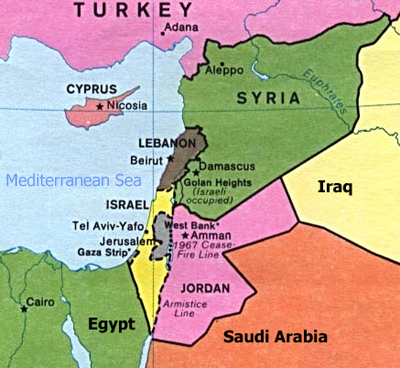
israel_lebanon_map

Is Hezbollah preparing large assault on Israel?

October 22, 2014

Is Hezbollah preparing large assault on Israel? Al-MonitorBen Caspit, October 21, 2014

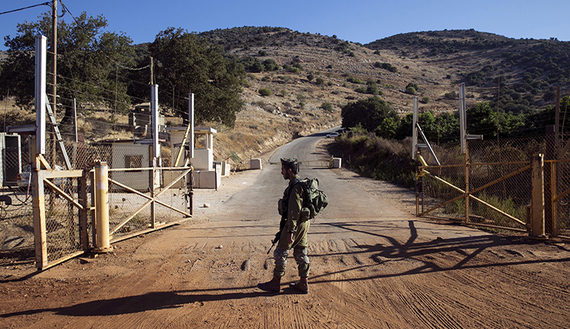
An Israeli soldier stands guard at a check point near the Lebanese-Israeli border, southern LebanonAn Israeli soldier stands guard at a checkpoint near the Lebanese-Israeli border, Oct. 8, 2014. (photo by REUTERS/Baz Ratner

This assessment is based on the possibility that Iran will indeed reach an agreement with the West by November or January — an agreement that’s good for Tehran, allowing it to preserve its nuclear capability as well as the potential for a fast break — within a matter of months — toward a bomb. Such an agreement, the senior minister told me, will set Iran free from all the shackles and brakes that have restrained it thus far. We think that it might consider siccing Hezbollah on Israel.

***********************

Stirring the pot of threats Israel is facing from Iran’s nuclear program began with a speech Prime Minister Benjamin Netanyahu delivered Oct. 19 at a dedication ceremony of a new road named after the late Prime Minister Yitzhak Shamir. The next day, Minister for Intelligence Affairs Yuval Steinitz published his own statement, which came out a day after The New York Times published his op-ed. He was joined by Foreign Minister Avigdor Liberman, who evoked the cliche, “If you want to shoot, shoot; don’t talk.”

At the same time, the Israeli media (Yedioth Ahronoth) addressed this matter with questions raised by security officials who wondered “what awoke Netanyahu in terms of the Iranian issue.” The queries were raised on behalf of top Israel Defense Forces (IDF) officials who did not quite agree with the pessimistic forecasts provided by Netanyahu and his senior ministers to the effect that the world powers, chief among them the United States, were about to reach a “capitulation agreement” with Tehran on its nuclear program.

The New York Times later published an article answering this question: It reported that US President Barack Obama was contemplating reaching an agreement with Iran that would not consist of totally lifting the sanctions but only suspending them. Such a move, the newspaper said, lies within the president’s purviews, allowing him not to seek the approval of the Congress (as opposed to lifting the sanctions). Thus, the president will be able to bypass the intractable Congress, which may or may not endorse a “bad” deal with Iran. It is believed that this information reached Israeli intelligence officials before being published in the Times, which is what set off Netanyahu, Liberman and Steinitz.

Following a talk I held Oct. 20 with a senior minister from the diplomatic-security Cabinet, further details came to light. As we discussed the possibility of early elections in Israel, the minister made a surprising comment, noting that a war in the north was more likely to break out before new elections were held. Some of Israel’s top Cabinet ministers estimate that Hezbollah and Iran are fast approaching a fateful watershed, which might prompt them to drag Israel into another confrontation, far broader than the previous ones. This assessment is based on the possibility that Iran will indeed reach an agreement with the West by November or January — an agreement that’s good for Tehran, allowing it to preserve its nuclear capability as well as the potential for a fast break — within a matter of months — toward a bomb. Such an agreement, the senior minister told me, will set Iran free from all the shackles and brakes that have restrained it thus far. We think that it might consider siccing Hezbollah on Israel.

This information comes amid many previous reports regarding the marked change in Hezbollah policy in terms of its conduct along the confrontation line with Israel — to wit, the Israeli-Lebanese border as well as the Golan Heights sector, into which Hezbollah has been infiltrating little by little. Lately, the Lebanese Shiite organization has claimed responsibly for attempted terrorist attacks in the Golan Heights, for the first time in many years. Hezbollah no longer hides behind proxy “subcontractors.” It is no longer ambiguous nor does it try to go under the radar. On the contrary, it operates openly against Israel, publicly acknowledging its responsibility. It seems to have gained a great deal of confidence and is no longer apprehensive of an unexpected conflagration vis-a-vis the IDF.

What this means is that the era of Israel’s deterrence in the north is over. Achieved after the Second Lebanon War in 2006, this deterrence lasted more than eight years. Its remnants remain noticeable on the ground, but according to all indications Hezbollah has lost its brakes and its restraint and has started looking for a confrontation instead of running away from one. Until lately, most Israeli intelligence elements estimated that Hezbollah was unready to open a second front against Israel, given that it is up to its neck in the war in Syria and now in the fighting in north Lebanon. While this assessment has yet to be officially scrapped, the voices coming from top political officials in Jerusalem nevertheless point to a plausible possibility of another war with Hezbollah in the coming months.

The organization’s militants openly carry out patrols along the border. Its presence in friction-prone areas has been beefed up considerably. It is now engaged in planning and executing micro-guerrilla warfare against the IDF also on the Golan sector, while setting new rules of deterrence: Any Israeli activity that crosses Hezbollah’s “red line” will be met by an appropriate response.

As for the question whether the heavy fighting in Lebanon has not burned out Hezbollah capabilities, the senior minister told me: “On the contrary; it has gained confidence and operational experience. Now it can fight like any other state military, employing forces on a division scale or even broader, relying on intel, airborne vehicles, etc.” And there’s something else: The Israeli performance during Operation Protective Edge apparently did not impress Hezbollah. Even the threats made in recent weeks by senior Israeli officials such as chief of staff Benny Gantz and Defense Minister Moshe Ya’alon, namely that “Israel will knock Lebanon back 70 or 80 years” in the event of a confrontation with the IDF, make no special impression on Hezbollah.

Are we on the way to an all-out confrontation in the north? There’s no need to scurry for shelter just yet. Such a confrontation would result in casualties and devastation at proportions we have never witnessed to date. This time around, Israel, too, will sustain heavy casualties and great devastation in view of the fact that Hezbollah’s rocket capabilities are much more improved than those of Hamas. The Iron Dome missile defense system will not provide an effective and complete response to curb the rocket offensive on Tel Aviv and its environs. The last thing the blazing Middle East needs right now is an Armageddon between Israel and Hezbollah, which might also draw Syria, and possibly Iran, either overtly or covertly.

We must also bear in mind that there is another possibility, whereby Jerusalem is trying to create a warmongering spin to heat up the atmosphere, to wield pressure on the world powers to toughen their positions vis-a-vis Iran. Or maybe Jerusalem just wants to scare Israelis who are starting to move toward a socioeconomic agenda, thus making it harder for Netanyahu to get re-elected.

The truth could be composed of a colorful mosaic consisting of all the existing possibilities. In every truth there is a grain of spin, and vice versa. And yet, the possibility of a very hot winter in the north exists more than it has.