Archive for the ‘Hezbollah vs Israel’ category

Iran Sponsored Shi’a Militia Launches Terror Group to Fight Israel

April 5, 2017

Iran Sponsored Shi’a Militia Launches Terror Group to Fight Israel, Investigative Project on Terrorism, April 5, 2017

Israel is very concerned with the establishment of Iranian-led terrorist bases in the Golan Heights. Hizballah openly seeks to consolidate its presence in the region and launch attacks against Israel from a new front in a future war.

**************************

An Iranian supported Shi’a militia, Al-Nujaba, says it formed the “Golan Liberation Army” to fight Israel, the Middle East Media Research Institute (MEMRI) reports.

“This army has been trained and has detailed plans. If the Syria regime asks us to, we are ready to act to liberate the Golan [from Israel] along with our allies,” Al-Nujaba spokesman Hashem Al-Mousawi said in a March 8 interview with Iran’s Tasnim news agency.

Al-Mousawi also admitted that the new militant group is “part of the PMU [Popular Mobilization Units],” an Iraqi-backed umbrella organization comprised of numerous Shi’a militias, including some with close ties to Iran. The Golan Liberation Army emerged from the Iranian led “resistance” axis and consists of “special forces who have received training and equipment,” he said.

“Iran is the only country that has helped us,” Al-Mousawi said, “and sent us its military advisors, led by Qassem Soleimani.”

Soleimani, the commander of the Iranian Revolutionary Guards Corps’ (IRGC) Quds Force, is tasked with advancing Iran’s regional expansion and terrorist networks. Since September 2015, Iran increased its forces in Syria from hundreds to thousands to support Hizballah terrorists acting at Iran’s behest in propping up the Bashar al-Assad regime.

Despite Iran’s commitment to Syria, the Islamic Republic is establishing terrorist networks in the Golan Heights, using Hizballah, Druze, and Palestinian Islamic Jihad (PIJ) operatives to target Israel. The new Golan Liberation Army shows that Iran is now diverting Iraqi militia assets from fighting ISIS to confront the Jewish state.

Soleimani’s Quds Force financed most of the Iraqi-Shi’ite militias and provided them with weapons specifically to target American soldiers. With Hizballah’s assistance, the Quds Force supplied terrorists with powerful explosive devices that killed numerous American and coalition troops in Iraq.

Israel is very concerned with the establishment of Iranian-led terrorist bases in the Golan Heights. Hizballah openly seeks to consolidate its presence in the region and launch attacks against Israel from a new front in a future war.

Hizballah’s trust in Russia – strategic dilemma for Israel

March 19, 2017

Hizballah’s trust in Russia – strategic dilemma for Israel, DEBKAfile, March 18, 2017

Israel is not planning action against Russian forces in Syria, but if the Russian army, whether deliberately or unintentionally, grants Iran and Hizballaha military protection, as they counted on having at T4, Israel would not hesitate to disabuse them.

************************

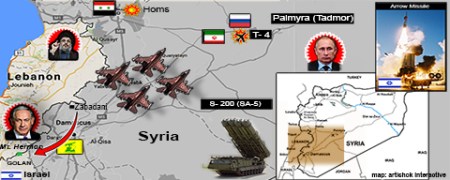
Israel finally took a hand in the swiftly moving events looming from Syria over its northern borders by launching multiple air raids against the key northern Syrian air base known as T4 near Palmyra early Friday night March 17.

Those events are spearheaded by the pro-Iranian Hizballlah’s drive to capture the Golan in line with its war of “resistance” on the Jewish state.  This fixation came into sharp focus the day after the air strike in a rare admission by Hizballah of the loss of a commander. He was named Badee Hamiyeh and was described as having been killed “in the southern Syrian region of Quneitra near the Israeli-held Golan Heights.”  This was the first anyone had heard of any recent battle on the Golan.

A week earlier, Prime Minister Binyamin Netanyahu and IDF Intelligence Director Maj. Gen. Hertzl Halevi showed President Vladimir Putin in the Kremlin maps depicting the various military movements ongoing in Syria, with the accent on an armored convoy of several hundred Hizballah troops driving out of their Syrian stronghold of Zabadani towards Mt. Hermon. The convoy was clearing a path by overrunning some 30 Syrian rebel villages on the Hermon slopes, which command the Syrian Golan town of Quneitra and the Israeli border.

This evidence demonstrated that Hizballah had developed a single military stratagem for threatening Israel-held Hermon, ruling central Golan and gearing up for battle to restore the entire Golan area to Syrian sovereignty under Hizballah control.

Netanyahu had hoped that Putin would agree to stop the Hizballah convoy and keep his promise not to let Iran and Hizballah deploy on the Israeli border. However, the Russian leader was unresponsive. Not only were Russian commanders in Syria not instructed to restrain Hizballah, they acted to persuade Syrian rebels on the Hermon and the Golan to surrender to he Lebanese Shiite invaders.

And indeed, as the Hizballah advance continued. Its leader Hassan Nasrallah contrived an equation to justify his assault on the Golan. “They brought ISIS to the Beqaa [Hizballah’s Lebanese stronghold] and so the ‘resistance’ [Hizballah] went to Syria. They wanted this group to reach Beirut, and so, today, we are in Golan.”

Seeing Hizballah on the move unchecked and gearing up for an expeced showdown with Israel, Netanyahu and the IDF decided to take matters in their own hands. They ordered several air force strikes Friday on the relatively remote strategic T4 air base near Palmyra in northeastern Syria and hit several birds with one stone.

DEBKAfile’s military sources describe T4 as the main terminal for Iranian planes to land day by day and unload  war materials for their own forces as well as the Syrian army and Hizballah.This air base also houses Russian attack helicopters and special operations troops, whose presence there was trusted by Tehran and Nasrallah to be an effective shield against Israeli attack.

The IAF air strike Friday proved them wrong.

These developments were the subtext of the video statement by Netanyahu that was broadcast Friday night by Israeli media: “I can assure you that our resolve is firm, as attested to by our actions,” he said. “This is something that everyone should take into account, everyone!.” When he said, “everyone,” he was not just addressing Tehran and Beirut, but Moscow as well.

Israel is not planning action against Russian forces in Syria, but if the Russian army, whether deliberately or unintentionally, grants Iran and Hizballaha military protection, as they counted on having at T4, Israel would not hesitate to disabuse them.

The Kremlin got the message and, a few hours after the Israeli air strikes, Israeli Ambassador Cary Koren was summoned to the Russian Foreign Ministry. There was no official protest, but Deputy Foreign Minister Mikhail Bogdanov firmly informed the ambassador that Moscow would not tolerate any further Israeli attacks on Syrian bases where Russian forces were present.

In the course of the raid, Israel’s advanced anti-missile Arrow system made its first operational appearance. IDF chiefs feared that the Syrian anti-air missiles fired against the Israeli jets might fall on a populated location inside Israel and so decided it was necessary to intercept any incoming projectiles.

Israel’s military experts got into an argument, which will no doubt go on for years, over whether Arrow’s first appearance in this situation was a good or a bad move. However, the deafening bang that the IDF wonder weapon inflicted on millions of Israeli ears, within a radius of more than a 150 kilometers from the Jordan Valley to the Mediterranean, offered an inkling of how much worse it will be in a full-scale conflict.

In-House Hizballah Missile Factories Could Add to Massive Arms Buildup

March 17, 2017

In-House Hizballah Missile Factories Could Add to Massive Arms Buildup, Investigative Project on Terrorism, Yaakov Lappin, March 17, 2017

This does not mean Hizballah is seeking a conflict with Israel now, but it does mean that should a new war erupt in the future, Israel’s civilian population will face unprecedented threats.

Israel’s defense establishment is making its own preparations accordingly, based on the understanding that this Iranian agent has developed into a full-fledged terrorist army.

*********************************

A recent report saying that Iran constructed underground missile factories in Lebanon for Hizballah would, if accurate, indicate a disturbing boost in the Shi’ite terror organization’s ability to self-produce weapons.

Already, the Israeli defense establishment sees Hizballah as a powerful and radical army rather than a ‘mere’ terror organization due to its deep and sophisticated weaponry (which surpasses that of most states), and its hierarchical command structure.

An ability to manufacture destructive rockets and missiles would mean that the militant Islamist Lebanese-Shi’ite organization is no longer entirely reliant on arms trafficking from its patron Iran and ally, the Assad regime in Syria.

The report, made available by the Middle East Media Research Institute (MEMRI), was published in the Kuwaiti daily Al-Jarida. It cites an aide to the commander of Iran’s Islamic Revolutionary Guards Corps (IRGC) as its source. The IRGC’s Quds Force is an elite unit that runs Iran’s extensive overseas operations to arm, finance, and strengthen Iran’s regional proxies.

According to the Kuwaiti report, the IRGC built the arms-making facilities more than 50 meters underground and fortified them against air strikes before handing control of them over to Hizballah three months ago.

The report is well within the realm of the possible, Ely Karmon, a Hizballah expert and a senior research scholar at the International Institute for Counter-Terrorism in Herzliya told the Investigative Project on Terrorism. He pointed to a 2015 statement made by the IRGC’s Aerospace Force commander, Brigadier General Amir Ali Hajizadeh, boasting that Tehran has provided “Syria, Iraq, Palestine and the Lebanese Hizballah resistance group with the needed know-how to produce missiles.”

“The IRGC’s Aerospace Force has developed to a stage in the field of missile industries that it can mass-produce different types of short- and mid-range missiles,” Hajizadeh said.

Assessing the latest Kuwaiti report, Karmon said that it is “possible that these Hizballah military factories are in the Quseyr area in Syria, and not in Lebanon.” Quseyr is an area of western Syria near Lebanon which has come under Hizballah control in recent years after being seized from Sunni rebel organizations.

Israel bombed targets in the area in the past, Karmon noted, likely as part of Israel’s covert program to selectively disrupt of Hizballah’s force build-up.

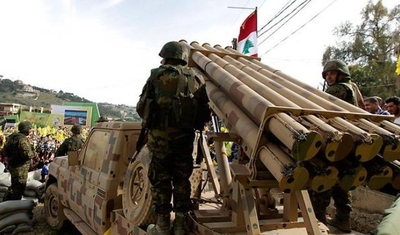
In November, Hizballah paraded its heavy weaponry in Quseyr – including tanks, armored personnel carriers, artillery guns, and missile launchers.

The Kuwaiti report also claimed that “a special department has been established at the IRGC’s Imam Hossein University [in Tehran] to train Lebanese and other experts, and hundreds of experts have already been trained… The manufacture of the missiles does not take place in one factory; different parts are built in different factories and then assembled together.”

The missile factories reportedly can produce surface-to-surface missiles with a range of over 500 kilometers – in other words, capable of hitting anywhere in Israel – surface-to-sea missiles, perhaps intended to hit Israeli ships and Israel’s offshore gas rigs in the Mediterranean Sea, armed drones, anti-tank missiles, and other weapons. The production sites can also be used to make machine guns, mortars, and anti-aircraft guns.

Since the end of the 2006 war with Israel, Hizballah stockpiled an arsenal totaling 120,000 missiles – one of the largest of its kind in the world. The vast majority of these arms were manufactured in Iran and Syria and smuggled into Lebanon. A growing number are guided rockets and missiles, which Hizballah could use to try to use to overcome Israeli air defenses and target sensitive targets.

Iranian weapons transfers continue regardless of whether Hizballah has access to its own missile factories. Israeli Prime Minister Benjamin Netanyahu provided details on “the ongoing Iranian attempt to transfer weapons, advanced weapons, to Hizballah, via Syria,” when he visited Russian President Vladimir Putin in Moscow earlier this month.

Reports say that Israel targeted such weapons again overnight, triggering Syrian surface-to-air missile fire at Israeli jets. At least one of those missiles reportedly was intercepted by Israel’s Arrow defense system.

Hizballah also is training elite terror cells to infiltrate Israel during the next war, and to temporarily ‘conquer’ northern Israeli communities in a bid to demoralize Israelis.

These preparations, it is safe to assume, are being closely monitored by Israel.

Hizballah’s deep involvement fighting for the Assad regime in Syria for four years also has boosted its power. The best form of training is combat itself, and its operatives have been exposed to Iranian commanders and technology on the battlefields of Syria.

Meanwhile, back in Lebanon, Hizballah has embedded the vast majority of its bases, rocket launchers, and command posts in civilian regions, including a massive maze of underground tunnels and subterranean compounds.

Yet all is not well in Hizballah’s camp despite its clear and growing power. Hizballah is facing a dramatic economic crisis due to a shortage of cash flow from Iran, which itself has not yet received all of the funds it was expecting to get after signing the nuclear deal.

Hizballah’s expenses are not only military and terrorist. They include many civilian and political activities in Lebanon, for which it is now struggling to pay. Additionally, the fact that it has sustained more than 1,500 casualties in Syria has demoralized sections of the traditional Lebanese Shi’ite support base.

Nevertheless, Hizballah is pushing to build up its massive offensive capabilities against Israel.

It seeks more accurate rockets and missiles, while its leader Hassan Nasrallah has repeatedly threatened to strike Israeli strategic targets such as ships carrying industrial ammonia to the Israeli city of Haifa, and Israel’s nuclear reactor in Dimona.

This does not mean Hizballah is seeking a conflict with Israel now, but it does mean that should a new war erupt in the future, Israel’s civilian population will face unprecedented threats.

Israel’s defense establishment is making its own preparations accordingly, based on the understanding that this Iranian agent has developed into a full-fledged terrorist army.

Hizballah Continues Recruiting Palestinians to Kill Israelis

March 9, 2017

Hizballah Continues Recruiting Palestinians to Kill Israelis, Investigative Project on Terrorism, March 9, 2017

Over the years, Hizballah has tried to establish a West Bank foothold to carry out terrorist and kidnapping attacks against Israelis. Members of Hizballah’s Unit 133 external operations branch used social media, particularly Facebook, to recruit West Bank Palestinians.

*****************************

Israeli security authorities arrested a suspected Palestinian member of Hizballah for planning terrorist attacks against Israelis, Israel’s domestic security agency announced on Thursday.

A subsequent Shin Bet interrogation revealed that Hizballah recruited Yusef Yasser Suylam, 23, via Facebook page. Suylam hails from the West Bank town Qalqiliya.

Investigators say the Palestinian operative was responsible for establishing a cell devoted to kidnapping Israeli civilians. Hizballah also directed Suylam to conduct surveillance on Israeli military bases and other security sites, in addition to various places in Jerusalem.

After an Israeli military court filed an indictment, several felony charges are expected against the Palestinian terrorist.

Over the years, Hizballah has tried to establish a West Bank foothold to carry out terrorist and kidnapping attacks against Israelis. Members of Hizballah’s Unit 133 external operations branch used social media, particularly Facebook, to recruit West Bank Palestinians.

Last August, a Shin Bet investigation found disrupted a terror cell that was recruited though the “Palestine the Free” Facebook page featuring anti-Israel Hizballah posts. Cell leader Mustafa Kamal Hindi recruited other operatives in hopes of waging a shooting attack against the Israeli military. Each operative was between the ages of 18-22 and lived in Qalqiliya.

One of the cell members purchased the material required to build a suicide bomb, while another was tasked with building the explosive device. Another terrorist focused on garnering intelligence about IDF patrols in the area. The group also began training with rifles for shooting attacks.

The characteristics, modus operandi, and recruitment methods match the description and reports surrounding recently arrested Yussef Suylam.

In January 2016, a Shin Bet investigation found that Hizballah leader Hassan Nasrallah’s son, Jawan, used social media to recruit terrorists in the West Bank. Through encrypted email exchanges with a Hizballah handler, cell leader Muhammad Zaghloul received instructions for carrying out suicide-bombing attacks and provided a plan to kill an IDF officer. Zaghloul admitted that the cell conducted surveillance of the officer and requested $30,000 to purchase arms to kill him. The plot to kill Israeli troops was likely in the execution phase, considering the two operatives were arrested in possession of a firearm.

Click here to read more details about other Hizballah attempts at recruiting Palestinians to conduct terrorist attacks against Israelis.

Hizballah lists targeted Israeli “nuclear sites”

March 4, 2017

Hizballah lists targeted Israeli “nuclear sites”, DEBKAfile, March 3, 2017

targetshizballah_480eng

Our military and counterterrorism sources draw a straight line from Hizballah’s latest stance and the newfound aggressiveness displayed this week by the Palestinian extremist Hamas which rules the Gaza Strip.

****************************

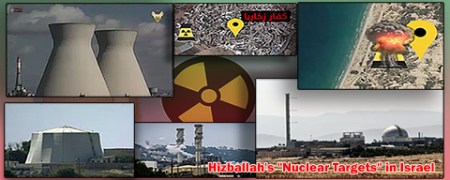
Hizballah’s latest round of threats against Israel reached a new peak Thursday, March 2, with the release of a videotape claiming to expose nine locations allegedly tied to the production and assembly of Israel’s nuclear weapons, DEBKAfile reports. The Lebanese Shiite terror organization said it possessed precise missiles for wiping out Israel’s nuclear infrastructure and attached addresses to all its targets.

Five locations topped the list, starting with the nuclear reactors at Dimona in southern Israel and Nahal Soreq on the Mediterranean coast. “Revealed” next are three secret locations for the production, assembly and storage of nuclear missiles and warheads. Kfar Zacharia near Beit Shemesh in the Jerusalem Hills, defined as the main depot for the Jericho Series I, II and III, of three-stage ballistic missiles, which can reach ranges of up to 6,000 km.

Two others were a factory in Beer Yaakov near the central Israeli town of Ramleh, the alleged production site for nuclear warheads; and the “Galilee Wing-20” plant at the Tefen Industrial Park, 17km from the town of Carmiel, a facility where the Rafael Advanced Defense System Authority was said to mount nuclear warheads on ballistic missiles and prepare them for launching.

The video stresses that Hizballah now possesses precise missiles able to pinpoint and destroy every single facility.

Just two weeks ago, Nasrallah “advised” Israel in an aggressive speech, to dismantle its large ammonia tank in Haifa and the nuclear reactor in Dimona before they were hit by Hizballah rockets and caused massive casualties. He and his associates have repeatedly warned in recent weeks that their Lebanese terrorist group has acquired weapons capable of deterring Israel as well as the capability to catch Israeli intelligence unawares by “surprises.”

In previous articles, DEBKAfile accounted for the heightened bellicosity of Hizballah’s leaders by the permission Bashar Assad recently granted Hizballah to launch missiles against Israel from Syrian soil as well as from Lebanon.

Our military and counterterrorism sources draw a straight line from Hizballah’s latest stance and the newfound aggressiveness displayed this week by the Palestinian extremist Hamas which rules the Gaza Strip.

Thursday, March 2, Hamas spokesmen stated that the group would no longer exercise restraint in responding to the heavy Israeli air and artillery strikes that are conducted in retaliation for rocket fire from the Gaza Strip. Henceforth, it would conduct a policy of “military position for military position” – meaning that for every Hamas position destroyed by Israel, the Palestinian extremists would swipe at a comparable Israeli military site.

The new Hamas posture challenged Defense Minister Avigdor Lieberman”s strategy of holding the Hamas government of Gaza responsible for any attacks coming from the Palestinian enclave – whether the work of Hamas or the extremist Salafis running loose there.

On Feb. 27, the Israeli Air Force smashed five Hamas targets in the northern, central and southern regions of the enclave after a rocket from Gaza exploded in Israel. The IDF did not respond to the rocket fired subsequently at the Hof Ashkelon region. But then, after a round of fire from Gaza to shoot up IDF military engineering equipment, the IDF knocked over two small Hamas look-out positions in the north.

Hamas had in fact given the defense minister an ultimatum:  either exercise restraint, or continue the policy of massive retaliations for every rocket coming from the Gaza Strip – at the risk of a fresh round of fighting with Hamas. Lieberman appears to have settled for the first option for the time being.

Trump-Putin deal on Syria bears on Israel security

January 28, 2017

Trump-Putin deal on Syria bears on Israel security, DEBKAfile, January 28, 2017

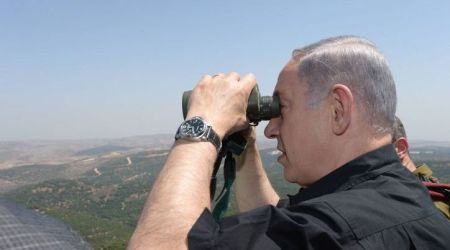
Israeli Prime Minister Benjamin Netanyahu looks through binoculars during his visit in the Northern district border of Israel on August 18, 2015. Photo by Amos Ben Gershom/GPO *** Local Caption *** ???? ??? ?????? ?????? ?????? ?????? ????? ????? ???? ????

Israeli Prime Minister Benjamin Netanyahu looks through binoculars during his visit in the Northern district border of Israel on August 18, 2015. Photo by Amos Ben Gershom/GPO

1. Will Washington and Moscow go through with the expulsion from Syria of Iranian forces and their proxies, including Hizballah – and take it all the way until it is accomplished?

2. After they are gone, who will take over the areas they evacuate?

3. Will Bashar Assad stay on as president, or has his successor been nominated?

4. The most burning question of all is the level of Hizballah’s armament. Not only must Hizballah forces be pushed out of Syria, but it is essential to strip them of their sophisticated new weaponry, including missiles. Israel’s military and security chiefs assess Hizballah’s arsenal as having been upgraded in recent weeks to a level that directly impinges on Israel’s security.

**************************

It would be a mistake to take it for granted that Prime Minister Binyamin Netanyahu’s talks with President Donald Trump in Washington early next month will be plain sailing or produce an automatic shower of benefits for the Jewish state. It is understood in Jerusalem that a new order is unfolding close to Israel’s borders, which is not yet fully in the sights of its government, military and intelligence leaders. This process is going forward at dizzying speed in Syria, currently the central Middle East arena, where Presidents Donald Trump, Vladimir Putin and Tayyip Erdogan have agreed to cooperate.

The British Prime Minister Theresa May picked up fast on the new power equation. After standing before the media with the US President Friday, Jan. 27, and declaring hopefully, “Britain and the US can once again lead the world together,” she decided to fly straight from Washington to Ankara Saturday, before returning home.

The outcome of her first meeting with President Erdogan was one of the fastest defense collaboration pacts ever negotiated for trade and the war on terror. The British leader lost no time in getting down to brass tacks on how British military and intelligence can be integrated in the joint US-Russian-Turkish military steps for Syria. Erdogan did not exactly receive her with open arms. He did not afford his visitor the courtesy of placing a British flag in the reception room in his palace.

Israel is in much the same position. Israel stayed out of military involvement in the Syrian civil war, according to a policy led by Netanyahu, former Defense Minister Moshe Ya’alon and OC Northern Command Maj. Gen. Avivi Kochavi (then Direct of Military Intelligence). This policy has left Israel out of today’s decision-making loop on Syria’s future.

Towards the end of 2015, shortly after Russia embarked on its massive military intervention in the Syrian conflict, Netanyahu took steps for safeguarding Israel’s security interests by setting up a direct line with the Russian president. It was translated into a military coordination mechanism between the Russian air force command in Syria and the Israeli air force, with Gen. Valery Gerasimov, Russia’s Chief of General Staff, and Maj. Gen. Yair Golan, Israel’s Deputy Chief of Staff, in charge of this direct military link.

Any problems that could not be solved at the military level were promptly turned over to be addressed at meetings or in phone calls between Netanyahu and Putin.

In one example, the prime minister obtained an undertaking from the Russian president to keep Iranian forces and Iran’s Shiite surrogates, including the Lebanese Hizballah, away from the Syrian-Israeli border, or allow them to use borderlands to send terrorists into Israel.

Shortly after Trump’s election victory (Nov. 8, 2016), the spadework on his collaboration with Putin was quietly begun by their national security advisers, Michael Flynn, in New York and Nikiolai Platonovich Patrushev in Moscow.

Jerusalem knew what was going on, but was taken aback by the speed at which those close understandings ripened into US-Russian deals on the ground. Before Trump had finished his first week in the White House, US warplanes had escorted a Russian air strike against ISIS in Syria.

This rush of events injects further urgency into Netanyahu forthcoming talks with the US president.  Whereas in the second term of the Obama presidency, the Israeli leader was wont to travel to Moscow or Sochi to sort out security problems relating to Syria, henceforth he must directly engage Donald Trump as the lead player.

So when the Israeli premier travels to the White House next month, he will have to address four pressing concerns, all relating to the fast-moving Syrian scene:

1. Will Washington and Moscow go through with the expulsion from Syria of Iranian forces and their proxies, including Hizballah – and take it all the way until it is accomplished?

2. After they are gone, who will take over the areas they evacuate?

3. Will Bashar Assad stay on as president, or has his successor been nominated?

4. The most burning question of all is the level of Hizballah’s armament. Not only must Hizballah forces be pushed out of Syria, but it is essential to strip them of their sophisticated new weaponry, including missiles. Israel’s military and security chiefs assess Hizballah’s arsenal as having been upgraded in recent weeks to a level that directly impinges on Israel’s security.

Israel’s First Project with Trump

December 9, 2016

Israel’s First Project with Trump, Front Page MagazineCaroline Glick, December 9, 2016

firstproject

Originally published by the Jerusalem Post

[R]ecently Hezbollah commander Hassan Nasrallah bragged, “We’re open about the fact that Hezbollah’s budget, its income, its expenses, everything it eats and drinks, its weapons and rockets are from the Islamic Republic of Iran.”

******************************

Israeli officials are thrilled with the national security team that US President-elect Donald Trump is assembling. And they are right to be.

The question now is how Israel should respond to the opportunity it presents us with.

The one issue that brings together all of the top officials Trump has named so far to his national security team is Iran.

Gen. (ret.) John Kelly, whom Trump appointed Wednesday to serve as his secretary of homeland security, warned about Iran’s infiltration of the US from Mexico and about Iran’s growing presence in Central and South America when he served as commander of the US’s Southern Command.

Gen. (ret.) James Mattis, Trump’s pick to serve as defense secretary, and Lt.-Gen. (ret.) Michael Flynn, whom he has tapped to serve as his national security adviser, were both fired by outgoing President Barack Obama for their opposition to his nuclear diplomacy with Iran.

During his video address before the Saban Forum last weekend, Prime Minister Binyamin Netanyahu said that he looks forward to discussing Obama’s nuclear Iran nuclear deal with Trump after his inauguration next month. Given that Netanyahu views the Iranian regime’s nuclear program – which the nuclear deal guaranteed would be operational in 14 years at most – as the most serious strategic threat facing Israel, it makes sense that he wishes to discuss the issue first.

But Netanyahu may be better advised to first address the conventional threat Iran poses to Israel, the US and the rest of the region in the aftermath of the nuclear deal.

There are two reasons to start with Iran’s conventional threat, rather than its nuclear program.

First, Trump’s generals are reportedly more concerned about the strategic threat posed by Iran’s regional rise than by its nuclear program – at least in the immediate term.

Israel has a critical interest in aligning its priorities with those of the incoming Trump administration.

The new administration presents Israel with the first chance it has had in 50 years to reshape its alliance with the US on firmer footing than it has stood on to date. The more Israel is able to develop joint strategies with the US for dealing with common threats, the firmer its alliance with the US and the stronger its regional posture will become.

The second reason it makes sense for Israel to begin its strategic discussions with the Trump administration by addressing Iran’s growing regional posture is because Iran’s hegemonic rise is a strategic threat to Israel. And at present, Israel lacks a strategy for dealing with it.

Our leaders today still describe Hezbollah with the same terms they used to describe it a decade ago during the Second Lebanon War. They discuss Hezbollah’s massive missile and rocket arsenal.

With 150,000 projectiles pointed at Israel, in a way it makes sense that Israel does this.

Just this week Israel reinforced the sense that Hezbollah is more or less the same organization it was 10 years ago when – according to Syrian and Hezbollah reports – on Tuesday Israel bombed Syrian military installations outside Damascus.

Following the alleged bombing, Defense Minister Avigdor Liberman told EU ambassadors that Israel is committed to preventing Hezbollah from transferring advanced weapons, including weapons of mass destruction, from Syria to Lebanon.

The underlying message is that having those weapons in Syria is not viewed as a direct threat to Israel.

Statements like Liberman’s also send the message that other than the prospect of weapons of mass destruction or precision missiles being stockpiled in Lebanon, Israel isn’t particularly concerned about what is happening in Lebanon.

These statements are unhelpful because they obfuscate the fact that Hezbollah is not the guerrilla organization it was a decade ago.

Hezbollah has changed in four basic ways since the last war.

First, Hezbollah is no longer coy about the fact that it is an Iranian, rather than Lebanese, organization.

Since Iran’s Revolutionary Guards founded Hezbollah in Lebanon in 1983, the Iranians and Hezbollah terrorists alike have insisted that Hezbollah is an independent organization that simply enjoys warm relations with Iran.

But today, with Hezbollah forming the backbone of Iran’s operations in Syria, and increasingly prominent in Afghanistan and Iraq, neither side cares if the true nature of their relationship is recognized.

For instance, recently Hezbollah commander Hassan Nasrallah bragged, “We’re open about the fact that Hezbollah’s budget, its income, its expenses, everything it eats and drinks, its weapons and rockets are from the Islamic Republic of Iran.”

What our enemies’ new openness tells us is that Israel must cease discussing Hezbollah and Iran as separate entities. Israel’s next war in Lebanon will not be with Hezbollah, or even with Lebanon. It will be with Iran.

This is not a semantic distinction. It is a strategic one. Making it will have a positive impact on how both Israel and the rest of the world understand the regional strategic reality facing Israel, the US and the rest of the nations of the Middle East.

The second way that Hezbollah is different today is that it is no longer a guerrilla force. It is a regular army with a guerrilla arm and a regional presence. Its arsenal is as deep as Iran’s arsenal.

And at present at least, it operates under the protection of the Russian Air Force and air defense systems.

Hezbollah has deployed at least a thousand fighters to Iraq where they are fighting alongside Iranian forces and Shi’ite militia, which Hezbollah trains. Recent photographs of a Hezbollah column around Mosul showed that in addition to its advanced missiles, Hezbollah also fields an armored corps. Its armored platforms include M1A1 Abrams tanks and M-113 armored personnel carriers.

The footage from Iraq, along with footage from the military parade Hezbollah held last month in Syria, where its forces also showed off their M-113s, makes clear that Hezbollah’s US platform- based maneuver force is not an aberration.

The significance of Hezbollah’s vastly expanded capabilities is clear. Nasrallah’s claims in recent years that in the next war his forces will stage a ground invasion of the Galilee and seek to seize Israeli border towns was not idle talk. Even worse, the open collaboration between Russia and Iran-Hezbollah in Syria, and their recent victories in Aleppo, mean that there is no reason for Israel to assume that Hezbollah will only attack from Lebanon. There is a growing likelihood that Hezbollah will make its move from Syrian territory.

The third major change from 2006 is that like Iran, Hezbollah today is much richer than it was before Obama concluded the nuclear deal with the ayatollahs last year. The deal, which canceled economic and trade sanctions on Iran, has given the mullahs a massive infusion of cash.

Shortly after the sanctions were canceled, the Iranians announced that they were increasing their military budget by 90%. Since Hezbollah officially received $200 million per year before sanctions were canceled, the budget increase means that Hezbollah is now receiving some $400m. per year from Iran.

The final insight that Israel needs to base its strategic planning on is that a month and a half ago, Hezbollah-Iran swallowed Lebanon.

In late October, after a two-and-a-half-year fight, Saad Hariri and his Future Movement caved to Iran and Hezbollah and agreed to support their puppet Michel Aoun in his bid for the Lebanese presidency.

True, Hariri was also elected to serve as prime minister. But his position is now devoid of power.

Hariri cannot raise a finger without Nasrallah’s permission.

Aoun’s election doesn’t merely signal that Hariri caved. It signals that Saudi Arabia – which used the fight over Lebanon’s presidency as a way to block Iran’s completion of its takeover of the country – has lost the influence game to Iran.

Taken together with Saudi ally Egyptian President Abdel Fattah al-Sisi’s announcement last week that he supports Syrian President Bashar Assad’s remaining in power, Aoun’s presidency shows that the Sunnis have accepted that Iran is now the dominant power in Iraq, Syria and Lebanon.

This brings us back to Hezbollah’s tank corps and the reconstruction of the US-Israel alliance.

After the photos of the US-made armored vehicles in Hezbollah’s military columns were posted online, both Hezbollah and the Lebanese Armed Forces insisted that the weapons didn’t come from the LAF.

But there is no reason to believe them.

In 2006, the LAF provided Hezbollah with targeting information for its missiles and intelligence support. Today it must be assumed that in the next war, the LAF, and its entire arsenal will be placed at Hezbollah-Iran’s disposal. In 2016 alone, the US provided the LAF with $216m. in military assistance.

From Israel’s perspective, the most strategically significant aspect of Hezbollah-Iran’s uncontested dominance over all aspects of the Lebanese state is that while they control the country, they are not responsible for it.

Israeli commanders and politicians often insist that the IDF has deterred Hezbollah from attacking Israel. Israel’s deterrence, they claim, is based on the credibility of our pledge to bomb the civilian buildings now housing Hezbollah rockets and missiles in the opening moments of the next conflict.

These claims are untrue, though. Since Hezbollah- Iran are not responsible for Lebanon despite the fact that they control it through their puppet government, Iranian and Hezbollah leaders won’t be held accountable if Israel razes south Lebanon in the next war. They will open the next war not to secure Lebanon, but to harm Israel. If Lebanon burns to the ground, it will be no sweat off their back.

The reason a war hasn’t begun has nothing to do with the credibility of Israel’s threats. It has to do with Iran’s assessment of its interests. So long as the fighting goes on in Syria, it is hard to see Iran ordering Hezbollah to attack Israel. But as soon as it feels comfortable committing Hezbollah forces to a war with Israel, Iran will order it to open fire.

This then brings us back to the incoming Trump administration, and its assessment of the Iranian threat.

Trump’s national security appointments tell us that the 45th president intends to deal with the threat that Iran poses to the US and its interests.

Israel must take advantage of this strategic opening to deal with the most dangerous conventional threat we face.

In our leaders’ conversations with Trump’s team they must make clear that the Iranian conventional threat stretches from Afghanistan to Israel and on to Latin America and Michigan. Whereas Israel will not fight Iran in Iraq and Afghanistan, or in the Americas, it doesn’t expect the US to fight Iran in Lebanon. But at the same time, as both allies begin to roll back the Iranian threat, they should be operating from a joint strategic vision that secures the world from Iran’s conventional threat.

And once that it accomplished, the US and Israel can work together to deal with Iran’s nuclear program.